Saturday, January 07, 2012

Penn State football takes first, slow step out of swamp

 
Friday, January 06, 2012
Bill O'Brien, the Patriots' offensive coordinator, will become Penn State's new head football coach.

The first football coaching search at Penn State in nearly half a century seemed to last nearly half a century; but it was over in less than two miserable months.

There were times when it seemed like you'd soon hear that the Coast Guard had joined the search, or that the search would henceforth be aided by highly-trained coach-sniffing dogs. By Thursday of this week, the Penn State job was the last of 25 such positions at the major college level still not filled for 2012.

The low point in a process that had the external appearance of a full-blown bumblethon was when Tom Clements was reportedly interviewed on Skype.

Holy Skype, isn't that the way Joe Paterno managed his final recruiting visits? Was Clements, the former Steelers assistant and the quarterbacks coach of the Green Bay Packers, on the inside track to be the world's first Skype hire? Why not just turn the whole program into a video game? Don't think someone doesn't have Grand Theft Auto-State College in the works right now.

In the end, new coach Bill O'Brien got described as hard-nosed and old-school, probably because Penn State had easily taken long enough to sift through the entire soft-nosed, new-school population of these United States.

Throughout the process, Penn State proved still again that it could keep a secret, which is, with still another heapin' helpin' of down-home irony, exactly what got it into this unholy mess in the first place. Maybe dear old State was going to be conducting a coaching search this winter anyway. Maybe had he been allowed to coach in the 100 percent tradition-free Ticket City Bowl, Paterno would have called a press conference to say that after 62 years on the sideline, the last 46 as head coach, maybe someone who could still stand erect for three hours should run the show.

Nothing so quaint happened, not remotely.

All of this happened instead because in about 72 hours, former Paterno assistant Jerry Sandusky was to be arraigned on the lurid charges that he sexually abused 10 young boys over the past 15 years, and because every Penn State employee who ever got so much as a whiff of it abandoned those kids just as demonstrably as if they had left each of them on the shoulder of I-80 in a Centre County blizzard.
So maybe that's the reason the coaching search took so long, no?

Your typical college coaching search doesn't start with the question, "Who among the nation's great football minds and motivators of young college men would best be qualified to get plopped down into the middle of an open-ended child rape scandal?"

Your typical college coaching interview doesn't start with the question, "Hey coach, if one of your grad assistants came to you with a story about a former assistant improperly touching a child in the shower of the football building, what would you do? We'll need a full explanation."

No, this was an extra sensitive, ultra-pressurized process that needed to transcend every pedestrian football question, such as salvaging a recruiting class, for example.

If Penn State thinks that's its primary concern for the moment, it still doesn't get it. State needs a transformational figure, a statesman to lead it out of Sandusky Swamp toward its own new testament. That's why, by my interpretation, it wanted Mike Munchak more than anyone.

The head coach of the Tennessee Titans is a former Nittany Lion All-American, with all the fresh psychological wounds and chronic heartache so many alumni are experiencing as Penn State struggles for its equilibrium. It was someone with that kind of stake in this, Penn State searchers felt, preferably someone whose Penn State experience predated any allegations, who would have been best equipped and thus best motivated.

Depending on how injurious to the school's bloodied reputation the Sandusky trial becomes, depending on what further abominations are brought forth in criminal and civil trials that stretch to the horizon, and depending to a lesser extent on the academic, interpersonal, and on-field performance of the Lions of O'Brien, Penn State might decide that its new coach looks better as a seat holder for someone who can start over still again if the nightmare ever ends.

For the moment, though, it looks as though Penn State has itself a good, relatively young football coach, something it hasn't been able to say in a very long time. The last irony is that in the years just before he built Penn State into a leading athletic and academic brand, Paterno turned down a fortune from the New England Patriots to see the process through. In Penn State's darkest hour, the fact that a highly valued coach with the New England Patriots would leave a top NFL brand to coach where Joe coached might now, nearly 40 years later, be the signal that all is not lost.

Gene Collier's "Two-Minute Warning" videos are featured exclusively on PG+, a members-only web site from the Pittsburgh Post-Gazette. Our introduction to PG+ gives you all the details.

Friday, January 06, 2012

Mother With a Gun


She and her baby are alive, and their would-be killer is dead, because she was armed.

By Rich Lowry
http://www.nationalreview.com
January 6, 2012

Sarah Dawn McKinley and child.

If the National Rifle Association had an award for Mother of the Year, it might already have a winner. When two men began to break into her home on New Year’s Eve, Sarah Dawn McKinley of Blanchard, Okla., popped a bottle into her crying three-month-old baby’s mouth and reached for her guns.

According to her account and that of police, she defended herself and her child in terrifying circumstances. To say McKinley was in the middle of nowhere would exaggerate the centrality of her location in a sparsely populated area about 25 miles outside of Oklahoma City. To say her home was vulnerable would exaggerate the security of a trailer with no alarm system or safe rooms. To say she was on her own would probably exaggerate her sense of connectedness, by herself, tending to her infant, after her husband had died of lung cancer on Christmas Day.

This is the stuff of nightmares. But McKinley never lost her cool. We know because, after shoving the couch in front of her door, she called 911 from her cell phone. The recording of the call should be put in a time capsule to capture the odd juxtaposition in 21st-century America of hardscrabble common sense on the one hand and a polite solicitousness toward the authorities on the other.

“I’m here by myself with my infant baby, can I please get a dispatcher out here immediately?” she asked. Note the instinctive civility of the “please.” The answer was basically “no.” With three deputies covering 12,000 square miles, no one could get to her soon. McKinley stayed on the line an incredible 21 minutes. Then, she got to the crux of the matter. “I’ve got two guns in my hand,” she told the operator. “Is it OK to shoot him if he comes in the door?”

This would seem a superfluous question if you believe your safety is at risk at the hands of someone forcibly entering your home. But not all states have the same “castle doctrine” as Oklahoma that gives homeowners an unambiguous right to shoot unlawful intruders. And not all jurisdictions are rational about firearms. Visiting New York City from Tennessee, where she has a gun permit, Meredith Graves brought a pistol in her purse to the 9/11 Memorial. When she saw a sign saying “No Guns Allowed,” she innocently asked guards where she could check her pistol. This query prompted her arrest on — yes — suspicion of carrying a loaded weapon. She could face jail time, in what promises to be the most pointless trial of the century.

Back in Oklahoma, the 911 operator was cagey, if unmistakable: “I can’t tell you that you can do that, but you do what you have to do to protect your baby.” That’s all the permission McKinley needed. The confrontation ended badly for Justin Martin, a 24-year-old who McKinley says had been harassing her. Police found him dead of a single gunshot wound, armed with a knife. His accomplice told police that they both were high on prescription painkillers and thought they could find medications used by McKinley’s late husband.

McKinley says she is sorry about Martin’s death, but would do it again. As Oliver Wendell Holmes Jr. wrote in a case nearly a century ago, “detached reflection cannot be demanded in the presence of an uplifted knife.”

Instances of self-defense are the anecdotes that gun controllers never want to hear. The NRA keeps a running list of them on its website: attempted armed robberies, home invasions, and other attacks rebuffed every month by the would-be victims. Surely, Sarah McKinley’s assailants thought the young, slender, widowed mother was an easy mark. Her shotgun meant they were wrong. Who would have it any other way? Otherwise, the intruder has the knife and she has nothing except a cellphone and the wan hope that someone armed with a gun makes it to her in time.

― Rich Lowry is the editor of National Review. He can be reached via e-mail: comments.lowry@nationalreview.com. © 2012 by King Features Syndicate

A worthy challenger

By
The Washington Post
http://www.washingtonpost.com
January 6, 2012


Rick Santorum addresses supporters at his Iowa caucus victory party, Jan. 3, 2012, in Johnston, Iowa.
(Charlie Riedel/AP Photo)
 
After every other conservative alternative to Mitt Romney crashed and burned (libertarian Ron Paul is in a category of his own), from the rubble emerges Rick Santorum. But he isn’t just the last man standing. He is the first challenger to be plausibly presidential: knowledgeable, articulate, experienced, of stable character and authentic ideology.

He’d been ignored largely because he appeared unelectable — out of office for five years, having lost his Senate seat in Pennsylvania by a staggering 17 points in 2006.

However, with his virtual tie for first in Iowa, he sheds the loser label and seizes the momentum, meaning millions of dollars’ worth of free media to make up for his lack of money. He’s got the stage to make his case, plus the luck of a scheduling quirk: If he can make it through the next three harrowing primaries, the (relative) February lull would allow him to build a national campaign structure before Super Tuesday on March 6.

Santorum’s electoral advantage is sociological: His common-man, working-class sensibility would be highly appealing to battleground-state Reagan Democrats. His fundamental problem is ideological: He’s a deeply committed social conservative in a year when the country is obsessed with the economy and when conservatism is obsessed with limited government. Republicans, after all, swept the 2010 election on economic concerns and opposition to big government. The Tea Party revolution was not about gay marriage. Which is why so much Tea Party fervor attaches to Paul.

Santorum did win the Tea Party vote in Iowa. But because he was such a long shot, his record did not receive much scrutiny. It will now. He is no austere limited-government constitutionalist. He participated in George W. Bush’s compassionate conservatism, which largely made peace with big government. Santorum, for example, defends earmarks and supported No Child Left Behind and the Medicare prescription drug benefit. It’s a perfectly defensible philosophy — but now he’ll be called upon to actually defend it.

Moreover, Iowa is anomalous. It’s not just that the Republican electorate is disproportionately evangelical and thus highly receptive to Santorum’s social conservatism (as to Mike Huckabee’s in 2008). It’s that Iowa’s economy is unusually healthy with only 5.7 percent unemployment, high agricultural prices and strong real estate values. Although the economy did rate as a major issue in the entrance poll, in such relative prosperity it registers more as a concern for the nation than as a visceral personal issue — diminishing the impact of Romney’s calling card, economic competence.

For his part, Romney remains preternaturally inert. His numbers, his demeanor, his campaign are flat-line steady: no highs, no lows, no euphoria, no panic.

With one minor exception. Romney wasn’t expected to do very well in Iowa. A top-three finish would have been good; a first or second, a surprising success. But feeling his Iowa prospects rise, he let fly a last-minute high. (Two hairs were seen dangling over his forehead.) He began touting his chance of winning, thus gratuitously raising expectations.

That turned a hairline victory into something of a setback, accentuating his inability to break out of his flat-line25 or so percent support. How flat? His final 2012 Iowa vote count deviated from his 2008 total of 30,021 by six votes. (Not 6 percent. A party of six.)

For a front-runner who can’t seem to expand his base, he’s been fortunate that the opposition has been so split. But the luck stops here. Michele Bachmann is gone. Rick Perry will skip New Hampshire, then dead-man-walk through South Carolina. And then there is Newt.

Gingrich is staying in. This should be good news for Romney. It’s not. In his Iowa non-concession speech, Gingrich was seething. He could not conceal his fury with Paul and Romney for burying him in negative ads. After singling out Santorum for praise, Gingrich launched into them both, most especially Romney.

Gingrich speaks of aligning himself with Santorum against Romney. For Newt’s campaign, this makes absolutely no strategic sense. Except that Gingrich is after vengeance, not victory. Ahab is loose in New Hampshire, stalking his great white Mitt.

What a lineup. Santorum and Gingrich go after Romney, whose unspoken ally is Paul, who needs to fight off Santorum in order to emerge as both No. 1 challenger and Republican kingmaker, leader of a movement demanding respect, attention and concessions. And Jon Huntsman goes after everybody.

Is this any way to pick a president? Absolutely. It works. It winnows. And it has produced, after just one contest, an admirably worthy conservative alternative to Romney.

Thursday, January 05, 2012

Today's Tune: Jason & The Scorchers - Shop it Around (Live)

Ain't nothing but a twang: Jason and The Scorchers celebrate milestone

By LISA O'DONNELL
Winston-Salem Journal
Relish
http://www2.relishnow.com/
January 05, 2012


Back in 1981, Jason and The Scorchers melded traditional country with punk music, creating an unlikely, even unholy, union.

Music executives couldn't figure out how to market them.

Audiences couldn't decide whether to love them or stomp 'em with their boot heels. Turns out, the band experienced both kinds of treatment.

With Jason Ringenberg singing as if his vocal cords had been steeped in corn likker, and Warner Hodges bashing out chunky riffs on his Telecaster, JATS eventually won over skeptics, emerging as critical favorites and college radio darlin's, while coming within a whisker of mainstream success.

After several amiable partings and reunions over the years, JATS is a solid unit again, releasing a highly praised album in 2010 and performing a series of 30th anniversary shows in the U.S. and Europe. They will play at The Garage on Friday.

Fans will be delighted to know that they remain consummate hell raisers.

"The best Jason and The Scorchers shows are a train wreck, when it looks like the train is going to jump the track but never does," said Hodges, a grandfather. "We can be a great country band, a great rock band and a great punk band. All kinds of things can happen in the course of a Jason and The Scorchers evening."

The band formed in 1981 when Ringenberg, an Illinois farm boy who grew up on country and discovered the Ramones in college, came to Nashville to fulfill his musical vision.

Hodges caught an early incarnation of the band and, sensing he had found a kindred spirit, teamed up with Ringenberg. Drummer Perry Baggs and bass player Jeff Johnson rounded out the classic lineup.

"It was just an explosion of different chemistries," Ringenberg said.

They each brought different musical sensibilities to the table, with country music the common thread weaving through all their tastes.

"We all had admiration and love for the Ramones but also George Jones," Hodges said. "It made sense for us to play music that way."

On records such as 1983's "Fervor" and 1985's "Lost and Found," JATS delivered hard-driving melodies and raucous, but tight, musicianship at a time when every pretty boy and girl with an eyeliner pencil and a synthesizer was producing MTV-ready pop.

But it was their live shows that distinguished the band. A Billboard reviewer gushed: "Someday, Jason and The Scorchers may play a mediocre set. But it won't be this lifetime."

In a cowboy hat and fringed shirt, the long-limbed Ringenberg was a focal point, karate kicking the air and swinging the mic stand around like a dance partner while Hodges shook his mop of unruly hair in true head banger fashion.

For all their prowess on record and stage, JATS never scored that big hit, to the dismay of their record label, EMI.

"We worked hard to give them one and didn't succeed," Hodges said. "If reviews were money, we'd be the Beatles. But reviews do not translate into sales. And I've long since made my peace with that."

Eventually, JATS disbanded, although they have occasionally played and recorded. Ringenberg took on a new career as a farmer and made kids' records under the moniker "Farmer Jason." (Farmer Jason will play at the Milton Rhodes Center for the Arts on March 30, celebrating the release of his new CD, "Nature Jams").

In 2010, Ringenberg and Hodges — Baggs and Johnson left for various reasons — recorded "Halcyon Times," which was met with widespread praise. An off-and-on again tour has followed, with Ringenberg still making music as Farmer Jason and Hodges touring with Dan Baird, formerly of the Georgia Satellites.

"I always had the goal that we'd be a long-term band, but when you're 21, you can't think 30 years ahead," Ringenberg said. "At the time, we admired as career role models more the Rolling Stones, as opposed to Duran Duran."


lo'donnell@wsjournal.com (336) 727-7420

Related


BOOK REVIEW: ‘Holidays in Heck’

By Jeremy Lott - Special to The Washington Times
http://www.washingtontimes.com/
January 3, 2012

HOLIDAYS IN HECK
By P.J. O’Rourke
Atlantic Monthly Press, $24, 288 pages

Patrick Jake “P.J.” O’Rourke is often called a humorist, but the term has become a stretch. I bet he’s sick of it by now. Sure, he writes many things that make you laugh, but he rarely writes just for laughs. One reason for this is his aging audience. Mr. O’Rourke used to be the managing editor of National Lampoon and foreign affairs gonzo for Rolling Stone. These days, his work lands in the Weekly Standard, World Affairs Journal and the Atlantic, outlets that prefer any humor - if one must wisecrack - to be in the service of a serious point.

That suits him fine because he does have a few things to say. Mr. O’Rourke is a journalist and a moralist with both Irish Methodist and libertarian inclinations. His most famous book is “Parliament of Whores,” published in 1991 with the subtitle, “A Lone Humorist Attempts to Explain the Entire U.S. Government.” The light approach helped leaven the message right up to the very last sentence, with its unforgettable blast-of-bitter: “In a democracy, the whores are us.” Atlantic Monthly Press brought out a sequel of sorts in 2010 with a title that better captured his anti-democratic bile: “Don’t Vote: It Just Encourages the Bastards.”

Mr. O’Rourke’s publisher followed up the next year with “Holidays in Heck,” another alleged sequel to an earlier book. On the cover, before we get to the subtitle, we are told this is the “follow-up to the classic ‘Holidays in Hell,’ ” a huge PR-generated stretch. In “Holidays in Hell,” the author went to geopolitical hot spots, war zones and very bad places. Then he gave that up and started traveling to “fun” places - yes, the scare quotes are necessary - with his wife and three children.

How well did that work out for him? He complains that in America today, “Apparently shorts and T-shirts are what one wears when one is having fun.” Problem: “I don’t seem to have any fun outfits. I travel in a coat and tie. This is useful in negotiating customs and visa formalities, police barricades, army checkpoints, and rebel roadblocks. ‘Halt!’ say border patrols, policemen, soldiers, and guerrilla fighters in a variety of angry-sounding languages. I say, ‘Observe that I am importantly wearing a jacket and tie.’ ‘We are courteously allowing you to proceed now,’ they reply. This doesn’t work worth a damn with the TSA.”

So Mr. O’Rourke visits several museums, goes duck hunting with his wife Tina in South Carolina, and drags the whole O’Rourke clan to places such as Hong Kong and Disneyland. At the latter, he uses the changes that have been made to Tomorrowland over the years to say something about American cultural regression. The all-plastic House of the Future was demolished in 1967 and the “Hall of Chemistry closed that same year, just as an entire generation of me and my friends got very interested in chemicals,” he writes.

Tomorrowland underwent further, awful changes. It was remodeled in 1988 with a “retro” theme, which rather defeated Walt Disney’s purpose. In 2007, Disneyland decided to add a new House of the Future. The new one is fully networked - it can give you fashion and dietary advice - but is otherwise a huge yawn. Mr. O’Rourke breathes a sigh of relief for the future of his family when his preteen daughter Muffin says, with disappointment, “It looks like our hotel.”

Mr. O’Rourke went to a few places without the wife and kids in tow. He took the maiden voyage of a new class of jumbo jet, (written up in chapter 6, “On First Looking into the Airbus”; har har, and no, the Airbus does not look back into you) and he hitched a ride on a plane that landed hard on the deck of the USS Theodore Roosevelt (“the most fun I’ve ever had with my trousers on,” he writes, though he may have needed to change them after). Along the way, he got cancer.

The cancer was, Mr. O’Rourke says, “of all the inglorious things, a malignant hemorrhoid. What color bracelet does one wear for that?” While considering treatment, he turned to prayer. “I can’t be the only person who feels like a jerk saying, ‘Please cure me, God. I’m underinsured. I have three little children. And my wife will cry and mourn and be inconsolable and have to get a job. P.S. Our mortgage is subprime. God knows this stuff. He’s God,” he writes. Perhaps Somebody Up There was listening. He made a full recovery.

• Jeremy Lott, editor of Real Clear Books and Real Clear Religion, is writing a book about death.

G.K. Chesterton: Champion of Orthodoxy

By Joseph Pearce
http://www.catholiceducation.org/


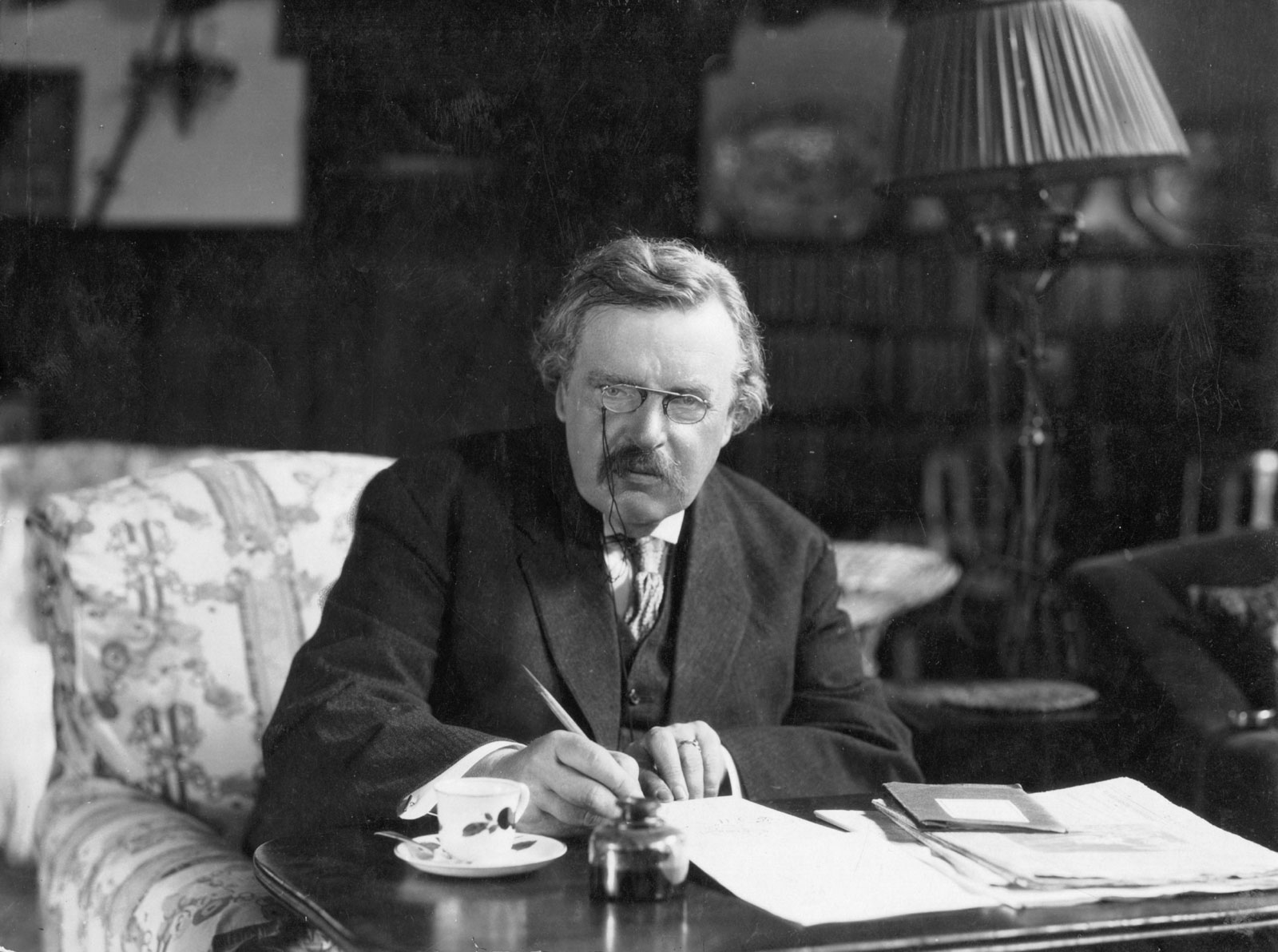
Chesterton's reputation as one of the key figures in Christian literature during the 20th century is linked inextricably with the concept of "orthodoxy." His book of that title, published in 1908, was, according to Wilfrid Ward, a major milestone in the development of Christian thought.

Wilfrid Ward was certainly not alone in his flattering praise of Chesterton's book. Its influence on the intellectual development of a whole generation was summed up by Dorothy L. Sayers. She had first read Orthodoxy as a schoolgirl when her faith had been threatened by adolescent doubt. In later years she confessed that its "invigorating vision" had inspired her to look at Christianity anew, and that if she hadn't read Chesterton's book she might, in her schooldays, have given up Christianity altogether. "To the young people of my generation," Sayers wrote in 1952, "G.K.C. was a kind of Christian liberator."

In stressing firm and fixed foundations for the concept and teachings of Christianity, Chesterton had turned "orthodoxy" into a battle cry — a rapier-sharp reply to the heresies of the age. His approach would be hugely influential on C.S. Lewis, and there are obvious and unmistakable parallels between Chesterton's populist approach to "orthodoxy" and Lewis's "mere Christianity."

There is also a clear similarity between Chesterton's approach to orthodoxy and that of T. S. Eliot. In Notes Towards the Definition of Culture, Eliot captured the spirit of the Christian literary revival of which he and Chesterton were part in his last appeal . . . to the men of letters of Europe, who have a special responsibility for the preservation and transmission of our common culture . . . we can at least try to save something of the goods of which we are the common trustees; the legacy of Greece, Rome and Israel, and the legacy of Europe throughout 2,000 years. In a world which has seen such material devastation as ours, these spiritual possessions are also in imminent peril.

For Eliot, and for Chesterton, this inheritance was not merely something old-fashioned which could be shrugged off and discarded in favor of new fads. It was a sacred tradition, the custodian of eternal verities which spoke with inexorable authority to every new and passing generation. The beauty of great literature resided in its being an expression of a common culture which was itself the fruit of the preservation of learning, the pursuit of truth, and the attainment of wisdom. The highest function of art, therefore, was to express the highest common factors of human life and not the lowest common denominators — life's loves and not its lusts. This was the mindset at the very core of the literary revival of which Chesterton was part.

In the wake of the publication of Orthodoxy, he was no longer tolerated as a young and precocious writer, but was considered provocative and a threat to the agnostic status quo. Chesterton was acutely aware of this change of attitude:

Very nearly everybody . . . began by taking it for granted that my faith in the Christian creed was a pose or a paradox. The more cynical supposed that it was only a stunt. The more generous and loyal warmly maintained that it was only a joke. It was not until long afterwards that the full horror of the truth burst upon them; the disgraceful truth that I really thought the thing was true . . . Critics were almost entirely complimentary to what they were pleased to call my brilliant paradoxes; until they discovered that I really meant what I said.

It says something about the scintillating cynicism of our age that, in the eyes of his contemporaries, Chesterton's greatest sin was his sincerity. This thought was certainly in Chesterton's mind in the months following the publication of Orthodoxy, and was one of the principal inspirations behind his novel, The Ball and the Cross, published in February 1910. "The theme in Mr Chesterton's new novel," wrote a reviewer in the Pall Mall Gazette, "is largely the same that he treated in Orthodoxy . . . the story is concerned with the effort of the two honest men to fight a duel on the most vital problem in the world, the truth of Christianity."

Although the truth of Christianity may have been the novel's object, its subjects were two men — one a Catholic, the other an atheist — whose sincerity scandalised their cynical contemporaries. There is little doubt that Chesterton had intended the novel as a light-hearted, entertaining response to those who had criticised his defense of Christianity in Orthodoxy. It was also a thinly disguised parable on his relationship with George Bernard Shaw, one of the literary figures discussed by Chesterton in his earlier book, Heretics. Like the two adversaries in The Ball and the Cross, Chesterton and Shaw disagreed passionately on most of the issues of the day but remained good friends. Their relationship was a living embodiment of the command to "love thine enemy."

If Chesterton's Orthodoxy had been born out of debates with "heretics" such as Shaw, his other great work of Christian apologetics, The Everlasting Man, would be born out of a protracted and bad-tempered debate between Hilaire Belloc and H.G. Wells. Initially, Belloc had objected to the tacitly anti-Christian stance of Wells's Outline of History, which had given less space to Christ than to the Persians' campaign against the Greeks. Yet Belloc's principal objection was the materialistic determinism that formed the foundation of Wells's History, which prompted him to write a series of articles exposing Wells's errors.

Chesterton's own contribution to the debate was The Everlasting Man, intended as a refutation of Wells's case, but written in a wholly different tone from that of the bombastic bellicosity which characterised Belloc's articles. In essence, The Everlasting Man was Chesterton's own attempt at an "outline of history."

Perhaps the importance of The Everlasting Man, as with the importance of Orthodoxy, is best judged by its impact on others.

Ronald Knox was "firmly of the opinion that posterity will regard The Everlasting Man as the best of his books," a view echoed by Evelyn Waugh, who wrote that Chesterton was "primarily the author of The Everlasting Man," which he described as "a great, popular book, one of the few really great popular books of the century; the triumphant assertion that a book can be both great and popular."

Perhaps the literary figure who was affected most profoundly by The Everlasting Man was C.S. Lewis. Although Lewis was already an admirer of Chesterton when The Everlasting Man was published in 1925, he could not accept Chesterton's Christianity. "Chesterton had more sense than all the other moderns put together," Lewis wrote, "bating, of course, his Christianity . . . Then I read Chesterton's Everlasting Man and for the first time saw the whole Christian outline of history set out in a form that seemed to me to make sense."

Lewis, of course, would go on to become arguably the most influential Christian apologist of the 20th century, with the possible exception of Chesterton himself. The fact that he owed his own conversion to Christianity in large part to Chesterton is a living testament to the latter's enduring importance.

Yet the importance of Chesterton to the subsequent development of the Christian literary revival goes much deeper. He influenced the conversion of Evelyn Waugh and inspired, at least in part, the original conception of Brideshead Revisited. He indirectly influenced the conversion of Graham Greene following discussions with his future wife who had previously converted through the avid reading of Chesterton's books. He had nurtured to full recovery the ailing faith of both Ronald Knox and Dorothy L. Sayers during periods of adolescent doubt. This, in itself, would constitute a laudable testament to Chesterton's importance. Yet even this only tells a tiny part of the story, the tip of the evangelical iceberg. How many others, less well known, have had their faith either restored or germinated by Chesterton's genius and his genial expositions of orthodoxy?

Dr. Barbara Reynolds, friend and biographer of Dorothy L. Sayers, has described the interchange and interplay of ideas between Christian writers as a network of minds energizing each other. In this network of minds few have done more "energizing" than Gilbert Keith Chesterton.

ACKNOWLEDGEMENT

Joseph Pearce. "G.K. Chesterton: Champion of Orthodoxy." Lay Witness (March 2001).

Reprinted with permission of Lay Witness magazine.

Lay Witness is a publication of Catholic United for the Faith, Inc., an international lay apostolate founded in 1968 to support, defend, and advance the efforts of the teaching Church.

THE AUTHOR
Joseph Pearce is a full-time writer who grew up in East London and now lives in Norfolk, England. His book, Literary Converts (Ignatius Press, 1999), inspired this ten-part series which focuses on some of the leading writers at the forefront of the Catholic literary revival in the 20th century. This is the fourth installment. Joseph Pearce is also the author of Tolkien: Man and Myth, Old Thunder: A Life of Hilaire Belloc, C. S. Lewis and the Catholic Church, J. R. R. Tolkien's Sanctifying Myth: Understanding Middle-Earth, and Solzhenitsyn.

Copyright © 2001 LayWitness

Wednesday, January 04, 2012

And the Winner in Iowa Is… Rush Limbaugh!

Rick Santorum's smartest move.

By
The American Spectator
http://spectator.org/
January 4, 2012

[Note: Mitt Romney won yesterday's Iowa Caucus by eight votes (30,015 to 30,007). Romney and Santorum each collected 25% of the vote while Ron Paul came in at 21% and New Gingrich at 13%. - jtf]


At the time of this writing, one Eastern hour into January 4th of 2012, Rick Santorum is barely ahead in the Iowa caucuses with 29,968 votes to 29,964 for Mitt Romney. Iowa is not known for its consonance, but this kind of multiple avowal is unprecedented.

My home state of Florida has decided to freeze tonight in solidarity with Iowa, so this is somewhat akin to an on-the-scene report. Manning my media control center, I observe that Santorum is enjoying a honeymoon with the press that is certain to be limited to a one-night stand.

In the moment, all the correspondents are buzzing affirmatively, with the merest hint of a caveat: "Santorum peaked just at the right time… he was the last man standing… he won the game of musical chairs… he visited all 99 counties… he did 367 Town Halls… door to door… retail politics… for now he gets to be the anti-Romney… social conservatives… evangelical vote coalescing… probably not sustainable… not enough cash on hand… doesn't have the national network."

By morning, they will shake off their hangovers and try to change the channel, adjusting the narrative. The Tea Party was not much of a direct force in Iowa, but its aura will be invoked in trying to portray Santorum as the new incarnation of Sharron Angle and Christine O'Donnell. Once again, the forces of narrow-mindedness, mean-spiritedness and wrong-headedness had won a Pyrrhic victory. Richard-the-Lionhearted of tonight's proclamation will give way to Poor Richard in tomorrow's almanac.

For now, there is much talk of the hard work, the doggedness and the good timing. His virtues are being paraded even though their ticker will quickly run out of tape. But there is one piece of the saga that even these erstwhile enthusiasts will not verbalize, the fact that the biggest winner of all this night is Rush Limbaugh. That is because Santorum breached the First Commandment of Republican political consultants: Thou Shalt Not Take the Name of Limbaugh in Advertisement.

This has been one of the great anomalies of Republican politics the past two decades. The revolution in talk radio initiated by Limbaugh in 1990 is what gave conservative politics new life after Ronald Reagan's tenure in office elapsed. Reagan himself acknowledged as much, writing a letter to Limbaugh in 1992 essentially passing the baton of leadership.

Despite the fact that Republican candidates have always vied to get some air time on the show, the political consultants they hire have steered them away from quoting Limbaugh by name in other venues or using his name in advertising. The fact that he generally refrains from openly endorsing particular candidates has enabled them to get away with this brand of disloyalty. They can't very well be expected to cite him in an ad if he has not specifically expressed his backing, can they?

Thus the paradox. Five minutes on Limbaugh is worth more than all the campaign ads put together, yet mentioning him in a commercial is seen by campaign managers as taboo. It will anger the independents, they say, and the moderates… and the women… and the minorities… and on and on.

The consequence of this strategy is that we wind up with colorless compromisers like Bob Dole and John McCain as Presidential candidates, and elections are written off as losses before the first lever is pulled in the voting booth for a Republican or in the mortuary for a Democrat.

This time Santorum broke the mold. He ran a bold ad quoting accolades tossed in his direction by Sarah Palin, Mike Huckabee, and Rush Limbaugh. That willingness to name names sent a powerful signal, electrifying the fence that most Iowa Republicans had been sitting on. There are an awful lot of conservative voters who have been waiting a long time to hear their heroes acknowledged. In my estimation, that single advertising spot put Santorum over the top in Iowa.

Can Santorum actually win the primaries pursuing this strategy? Well, the first bit of good news came along right away. The word is out that John McCain is about to announce his backing for Romney. This is a contest I will relish watching: Romney ads citing McCain versus Santorum ads citing Limbaugh. Stay tuned.


- Jay D. Homnick, commentator and humorist, is a frequent contributor to The American Spectator. He also writes for Human Events. Here he performs his original composition, "Buy You (Bayou) a Drink".

Tuesday, January 03, 2012

Today's Tune: The War on Drugs - Come to the City

Don't Worry, Read Happy: Alan Jacobs on The Pleasures of Reading

Why you can stop fretting over what you 'need to know' and enjoy those books that bring delight.


The fact is that people don't read anymore." Or so Steve Jobs said, in 2008, two years before the introduction of the iPad. Such pronouncements abound nowadays—often appearing in … books. But the most thoughtful reflection on the subject comes without any apocalyptic huffing and puffing. In The Pleasures of Reading in an Age of Distraction (Oxford University Press), Alan Jacobs, professor of English at Wheaton College, is sanguine about the future of reading and the book, and positively seductive when he urges us to read "for the plain old delight and interest of it, not because we can justify its place on the mental spreadsheet or accounting ledger." Books & Culture editor John Wilson talked with Jacobs about the distractions that beckon us, the virtues of the Kindle (and, by extension, similar devices), and the rewards of reading with concentrated attention.

In the journal Historically Speaking, historian Timothy Snyder laments how Internet access distracts students in the classroom. Does this track with your own experience as a professor?

I decided some years ago that I was not going to allow laptops in the classroom. And the main reason was actually not because of the distractions involved, though they are multiple. I will walk sometimes down the halls of Wheaton and I'll look into a classroom, and I'll see a student sitting in the back of the room clearly doing Facebook or playing Solitaire or involved in some sort of game while the teacher is talking, and I know that that person has only minimal attention. So I'm aware of that as a problem, and I don't want my students to have that problem.

But I actually banned laptops for a different reason. There's a technology that we call the book, and many of us tend to assume that, well, everybody knows how to use books. Books are easy. It's the modern technologies that students need to be trained to use effectively. And I think, No, not really. A book is actually not that easy to know how to use well, especially for young people who haven't formed the habit of attending carefully to how they work.

So I tell my students, "Look, I want you to have the book in your hand. Take notes if you want to. I would prefer you to take notes in the book. Or if you don't want to write in books, get sticky notes, or do something. But I want you to be engaged with this technology." I want to be able to say, "Okay, put your finger there on page 36 and now let's go over to page 130." And I want to be able to go back and forth between the two. For many of them this is very unfamiliar. They're used to dealing with books in different ways. One of the really interesting things about getting them to work with a book is that it's a lot harder for them to get distracted, because I'm actually pushing them to make fuller use of this technology.

So for quite some time I've been keeping electronic technologies out of the classroom, even though I encourage students to use such technologies outside the classroom. While we're in the room together, the book is the technology I want everybody focused on. And the students seem to get that. In fact, I think they find it something of a relief to put their computers aside and engage with something else. Though every now and then I do see a student checking his or her smartphone under the desk.

You discovered, a couple of years ago, that your reading in books had steeply declined, due to the digital distractions that bedevil your students. That doesn't mean you necessarily read much less, because of course you take in an awful lot through the Internet. But the Kindle helped you return to your customary diet of books.

I was in a bookstore—the local Borders, which has since closed its doors—and I had pulled several books off the shelves. One of them was Diarmaid MacCulloch's history of the Reformation, and another was Neal Stephenson's novel Anathem, and I had two or three others sort of crawling up my arm. They were all hefty, and they were also books with small print. And I just thought, I don't want to lug all these around. When I get home, I don't know where I'm going to put them. Forget this; I'm going to buy a Kindle. So I put the books back on the shelves, bought the Kindle, and got the books that way. And I found, to my surprise, that the Kindle proved to be extremely helpful to me in restoring my ability to concentrate.

One source of distraction is bodily. You're reading a book, and your hand starts to twitch because you know that you can grab your smartphone or your iPad or even your laptop and do something with your fingers that will bring up new information. With the book you're not necessarily doing so much with your fingers. I found that pushing the next-page button on the Kindle tended to satisfy that physical desire, that somatic desire, to do something.

I was focusing on reading because my finger had something to do from time to time. And I was really surprised at how quickly my ability to read for long, uninterrupted periods was restored. I would suppose right now that roughly half of my reading is Kindle reading. When I'm reading for fun, when I just want to read a good story, if it's available on the Kindle, that's what I'll do.

Not long ago, you wrote about Samuel Johnson for Books & Culture. There's a famous portrait of Johnson in which he's holding a book close to his face—clutching it, really, with tremendous intensity—and he seems to be absolutely sucking the juice from the book. It gives a striking illustration of your argument that reading demands a particular kind of attention.

Yes. Recently I went to a commencement ceremony at the Greenhouse, a co-op of sorts for Christian homeschoolers here in Wheaton. Kids go to school there one day a week, and it provides a kind of a spine for their homeschooling curriculum. The commencement service consisted largely of children reciting things that they had memorized. For the younger children it might be a Bible verse; for the older children it got more and more ambitious, with the 14-year-olds reciting lengthy passages from Shakespeare. Someone did Richard II's speech about weeping over the death of kings. Somebody did Portia's "The quality of mercy is not strain'd." Then there was a student who did one of Queen Elizabeth's speeches, and another one who did John Donne's "Meditation 17": "No man is an island, entire of itself." And at the end of it I thought, I don't know that I've ever spent a more delightful hour at an official educational ceremony. By and large, the kids had internalized these wonderful words, and they were saying them with some conviction and understanding.

Those kids have been taught that to read is not just to scan their eyes across the page but to know it by heart, and then to speak it for others. (George Steiner, the literary scholar, is really good on that phrase, "to know something by heart," which means more than being able to recite a text word-for-word.) That's really reading. That's the whole trajectory of the reading experience—taking the words in, knowing them by heart, and then bringing them forth again. It's really beautiful to see.

Your delight at that ceremony reminds me of the most salient theme in your book: the sheer pleasure of reading. It's a powerful corrective to much that we hear. But I think it will be challenging to some readers and audiences, especially in academic or intellectual settings where people feel obligated to read certain books. You say early in the book that your overriding rule for reading is Read at whim. What do you mean?

Where this really got started was with the many, many students who have come to me over the years after graduating from Wheaton. And they think, Oh, there are so many important books I haven't read. They come to many teachers, but I get my fair share of them. They come to me and say, "Give me 10 books that I should read over the next year." Or: "Give me 10 books that you think everyone should read." I always find myself thinking, Read what you want to read. Since you were 6 years old you've been reading things that people told you to read. Now you don't have to do that anymore, unless you're going to graduate school. Go out and read what strikes you as being fun.

I don't think these students trust themselves to be readers on their own. They want to continue the sort of reading under direction that they have experienced ever since they started school. Over the years I've gotten absolutely stiff-necked about it. I refuse to give any recommendations. I say, "Go and read for fun," because that sense of reading as a duty is not going to carry you through. It's not going to sustain you as a vibrant reader, as you will be if you read what gives you delight. You may have actually lost some of that sense of delight over the years reading primarily for school. So go out there and have fun with it.
What will happen when people do that? Will they read frivolous things? Yes—at least I certainly hope so. I quote W. H. Auden, who says that the great masterpieces should be reserved for the "high holidays of the spirit." You're not designed for a steady diet of literary masterpieces any more than you would eat a seven-course French meal every day. At one point, Auden says it's not only permissible but admirable not always to be in the mood for Dante. And I think that's right. Sometimes you just want a lighter fare.
Auden himself liked detective stories and doggerel poetry and other things that many of his peers would have looked down their noses at. I want people to recover that sense of pleasure. Of course you're going to want the heavier stuff. You're going to want the stuff that's possibly life-changing. But for heaven's sake, don't turn reading into a matter of eating your literary vegetables. I don't think that's healthy in the long run.

Related Elsewhere:
The Pleasures of Reading in an Age of Distraction is available from ChristianBook.com and other book retailers.
See Christianity Today's book awards from 2000-2011 and 2012.

Goodbye, Mr. Hitchens

Memories of an unusual and rewarding acquaintanceship

By Victor Davis Hanson
http://www.nationalreview.com
January 3, 2012


I used to talk with Christopher Hitchens from time to time between 2003 and 2010. But as in the case of most who knew him, I was an acquaintance of someone with far more acquaintances than I had. So while his company stood out to me, I am sure that mine did not to him to the same degree. With that now-customary Hitchens prooimion out of the way, I continue with what I recall of him.

I was once in extremis with a ruptured appendix and peritonitis in Libya. I could make only one call before the ad hoc operation, and I left a brief message for my wife and son to give them the grim prognosis. For reasons I never quite fathomed, in desperation late at night they called one number of the many written on my desk: Christopher Hitchens. When I awoke after the operation in a dingy Tripoli Red Crescent clinic, there soon arrived a Libyan-American neurosurgeon (by happenstance there on vacation) to insist on proper antibiotics (hard to find then in Qaddafi’s Libya); later I was visited by the newly arrived American chargé d’affaires. Back home, I gathered that their presence somehow was the result of various phone calls Christopher made, though to whom and when he never quite disclosed. Later he told me only — in connection with the struggle in Iraq — “Anyone stupid enough to keep supporting these incompetent bastards in Washington deserves a second chance to be stupid enough to keep supporting these incompetent bastards in Washington.” Note here that Hitchens felt by 2006 that the Bush administration had botched the occupation, but that fact was no reason for him to abandon them or it — given what was at stake.

There were a few other odd things that we shared.

I had lived for a time in Athens, on Deinokrates Street, on the slopes of Mt. Lykabettos. In the autumn of 1973, as I walked to and from classes at the Hellenic Center each day, I passed by a prominent luxury hotel (whose best terraced rooms looked out on the Acropolis). One November afternoon on the way home I was redirected by legions of Greek police, who had cordoned off the hotel’s driveways. For the next few days, the police milled around the hotel as the investigation of the suicide of a Mrs. Hitchens and a retired Anglican priest were played out in predictable detail in the tabloid press.

Like many in Greece that fall (sex, religion, and suicide were instant distractions under a repressive regime), I followed the strange and tragic case. The remains in the adjoining rooms were not immediately discovered; lurid speculation soon ranged over the assumed chronology of the double suicide (was the priest, the media gossip went, really a partner in suicide, or perhaps a jilted lover, a murderer, and then a suicide?). I remembered the papers writing about a twenty-something Christopher Hitchens arriving in Athens as the loyal son come to claim his mother’s body — all of this soon to be eclipsed by the unrest and the fall of the Papadopoulos regime, and thus by December entirely forgotten. I made the connection between all this and the adult Hitchens in 1989, when he reviewed favorably a book I wrote, The Western Way of War, and I later mentioned my memories to Christopher. He was interested at the knowledge that I had lived a few hundred yards from the scene of the tragedy; and perhaps surprised that I did not try to offer some contorted psychoanalysis about the origins of his own antipathy for organized religion. I can be stupid, but not that stupid.

Most who write of Hitchens (I knew him as Christopher, never Hitch) cite his prodigious consumption of booze and cigarettes, either in awe at his iron constitution or shocked at his self-destructive impulses, or both. I never had any strong reaction to these appetites other than a sort of sadness at the monotony of it all. When one maintains such a level of consumption after 55, it ensures that one will not be around much longer. No one is exempt from the toxicity of the combined excess of cigarettes and hard liquor. I say that in memory of my wonderful father — who had been a star athlete, a war hero, a football coach, a farmer, a gifted college administrator, a yoga instructor, a weight lifter, and a health nut — who inexplicably started drinking heavily and smoking (three packs a day) in his mid-fifties. I think his quart of nightly bourbon, bookended by red wine and scotch, and 60 cigarettes a day almost matched those of Hitchens (who also likewise felt that his own genes and constitution — and his alone! — would ensure longevity).

As with my father, so too with Christopher I felt that the tab that had to be paid was not far off, and yet did not necessarily have to be paid even at the eleventh hour. I recognized in both cases that the drinking and smoking in some way could not be entirely divorced from productivity (my father similarly never missed a day of work) and indeed might be the essential fuel that kept them going. But equally I knew that continuing those habits was akin to putting leaded gas in a contemporary automobile — the car runs wonderfully until the oxygen sensors eventually clog and with them the engine. In response to such a dour observation, Christopher reminded me that his father had died of cancer after quite a bit of drinking and, I think, smoking — but not until his late seventies. And sometime around 2007 Christopher, while out west, had checked on his own medical deterioration, only to discover that, mirabile dictu, there was no deterioration: His 58-year-old lungs, heart, and circulation were supposedly those of a 50-year-old ascetic — and, as he reminded me, he was enjoying his most productive and richly rewarded years. A prayerless, secular miracle.

Our shared support for the Iraq War made us pariahs of sorts by 2006, especially in the eyes of those who once advocated the removal of Saddam Hussein and soon either argued that they had never really taken that position, or claimed parentage only of the brilliant three-week war, outsourcing responsibility for the flawed and orphaned six-year occupation to denser others. In his comparison of things small to large (and he all but said just that), Christopher once asked me whether the classics community, my readers, and my Democratic family had become disgusted with me in the same way that the far greater global literary and left-wing world had with him over Iraq. I could only answer, “Well, yes, of course, but it is a matter of degree, since I am not sure how much they knew or cared.” He smiled, “Well, if they did, at least, that’s good news, Victor. We are judged better by our enemies than our friends.” I disagreed about that.

Like many Englishmen, Christopher had a great reverence for classics; he made it a point once to have me over to dine with the great Sophoclean scholar Bernard Knox, and on another occasion a Latin-quoting Jerry Brown (who remembered that I had written him a note in classical Greek in 1976). Christopher’s daughter was a gifted Latin student, and he often peppered me with academic questions about Thucydides and Aristophanes. He oddly seemed interested in the scholarly minutiae that others considered the equivalent, to paraphrase Dr. Johnson, of a dog walking on two legs (impressive, but for what purpose?): Could the average Greek have followed Pericles’ Funeral Oration as it is “transcribed” by Thucydides? How did the parabases actually work on stage in Aristophanes’ plays? For a radical, Mr. Hitchens had great reverence for traditional education, especially its emphasis on rote, grammar, and syntax.

I was more surprised about Christopher’s interest in agriculture, but then, in my experience, the English — and Christopher seemed to me as English as anyone born in Britain — seem to treat farming with the same special reverence they extend to dogs and Greek. He once asked to visit me for a weekend on our farm, and was fascinated about raisin production, tree fruit, tractors, and the economy of rural central California. I kidded him that out here driving a Massey Ferguson with a tandem disk was seen as far more impressive than reciting a stanza of Kipling, and he flared up and answered, “But why, man, one at the expense of the other?” But often of course they are.

When he arrived in rural Selma, out of drink and angry that he had exhausted his usual favorites, I warned him there was no way I could buy all his accouterments out here, and I was not going to drive all the way up to Fresno to find them. He rattled off a number of carbonated-mineral-water brands that he apparently knew well from Mexico, and announced, “Victor, there is a global brotherhood of quality drinkers that reaches even here that you are apparently not aware of.” He then insisted that we drive into the local barrio and find a “good” liquor store. Finally at one of the most run-down places imaginable we found two dusty bottles of exactly what he was looking for. “Why the surprise?” he scoffed.

As we walked around town, I noticed that, aside from the fact that he seemed to the eye and ear to be in atrocious physical shape, he had a confidence in his own presence that meant that even though he knew nothing about the American poor in the sense of ever having lived among or worked beside them, that fact could be easily trumped by his immediate aura of friendliness and mannered politeness. In the best tradition of Horace, he believed that his character was fully formed and need not change despite his constantly changing surroundings; if, when out of his milieu — and he surely was that day in Selma — he seemed ridiculous to others, he never seemed so to himself. And he was not oblivious.

Dining with Christopher, as some who knew him far better have attested, was like eating beside a coiled cobra who might turn and bite at any moment, given his venom as the contrarian and a certain sense that he should be the great leveler of those too taken with their own table talk. His dinners reminded me a lot of what one reads in Athenaeus, silly sophisticated chat on almost any conceivable topic mingled with polite putdowns and outrageous, often lurid commentary. He was not a historian who had advanced some novel thesis about the ancient or modern world. Nor was he a literary doyen of the classical sort who had established a particular school of criticism, or authored masterful reviews of contemporary classics. Rather, he was a relentless polymath who reminded his associates that he knew at least something about almost everything. Drinking, talking, dining — these were his creative genres, inseparable from his writing. And from hundreds of his admirers no doubt another Boswell would emerge to confirm his wit and learning for the ages with a Life of Christopher Hitchens.

Introspection and remorse Mr. Hitchens was not much interested in. Once he took a position, whether in print or in conversation, he rarely regretted it, even as new information came to light. But I don’t think that he was thereby not self-critical, but rather more worried about charges of fickleness and hypocrisy than of appearing dogmatic. The trimmers and flip-floppers were his banes, especially in the dark years of Iraq. In some sense, he was harder on left-wing campus charlatans than on right-wing zealots, seeing in the former a sort of lazy and pretentious groupthink, in the latter the sort of blinkered minds who at least sincerely believed in their dogmas.

Though he had a regrettable mean streak that I think led him into time-consuming and dead-end invectives, I never found him cruel to others present, as he so often was in print; and even as he said quite unkind things about third parties that could logically be applicable to myself, most of those at the table — and Christopher Hitchens himself. He got very angry at me only once, when I suggested that his appetites and the title of his proposed book, God Is Not Great (I thought from his description over dinner that it would be focused more on radical Islam than on Christianity), might make things difficult for his daughter, whether through his own unforeseen illness or a needless provocation to terrorists. “You too — Brutus!” he snapped, a line that I think he had used similarly on others.

Most of the time we discussed Iraq, Greece, the European Union, Churchill, Tolkien (I thought him a scholarly and fictive genius, Hitchens thought him a mediocrity), and 19th-century Britain. His prejudices were often my own — whether on Pakistan or Hillary Clinton. Some of his conclusions, if not original, at least were unusual — e.g., that we should have let the Russians in 1979 do away with the pre-Taliban, since their unworkable fix for Afghanistan would have evaporated more quickly than Islam’s and in the process would have been kinder to women, homosexuals, and those in the professions. His fierce loyalty to persecuted small nations — Armenia, Kurdistan, Greece, Cyprus — that for centuries had suffered terribly from Islamic aggression and Western indifference did not in the least extend to cotemporary Israel. He felt that ultraorthodox Jewry was comparable to radical Islam, mutatis mutandis — which I felt was as unsound as saying Timothy McVeigh was comparable to Osama bin Laden and his epigones. I bothered him on another occasion by noting that Henry Kissinger’s memoirs at least were well written, informative, and witty in ironic fashion, and in short comparable to Acheson’s. He countered with (precise) examples of all sorts of monsters who left behind lively accounts. In regard to Mother Teresa and Henry Kissinger, I do not think it was so much their supposedly dastardly acts that had enraged him, or even that they had become wrongly esteemed because of them; rather he assumed that the general regard in which they were held had fooled us all into thinking they were near flawless — without any concession that most of us simply had added up their pluses and minuses and found both mostly better than the alternatives.

With the ascendancy of Barack Obama, and Christopher’s much busier and more public schedule, we saw less of each other. I found Obama a sort of Greek cathartic figure — the sum total of a half-century of flawed assumptions that now had inevitably arrived as our collective Greek nemesis. Hitchens came to welcome Obama (although he was masterly in his dissection of the Rev. Jeremiah Wright) as the modern scientific mind’s proper antidote to the supposedly superstitious and pre-modern Palin (an “ignoramus” and “idiot,” he thundered, who did not believe in subsidizing Drosophila research) or the surely “senile” McCain. He was savage in the 2008 race in insisting McCain/Palin were medieval, with Obama/Biden avatars of the Enlightenment — a contrast he had never made in the case of the supposedly erudite Kerry and the evangelical Bush, whom he voted for. When I later pointed out all sorts of instances where Obama simply had made up historical facts and based policy on pseudo-science, it was a futile rear-guard action from someone who already sullied himself by once defending Palin — as if I were a pathetic sort of William Jennings Bryan pitted against Clarence Darrow.

I once ambiguously remarked to him that he would soon learn — with his support for Obama (yet I think this support was genuine rather than contrived), along with the publication of God Is Not Great — that his former critics now were more likely to welcome him home where he belonged. In one of my final arguments with him, I remember hearing in near disbelief his championing of John Edwards (in the days well before the sex “disclosures”). I pressed him to tell me just one good thing about such an unimpressive figure. He tried, but even his gifts were not up to it, and finally he resorted to the fact that he knew Edwards and especially his impressive wife. I suggested that his support for Edwards was far more logically suspect than was my admiration for Sarah Palin’s odyssey from Wasilla to the governorship. (Attention, John Edwards: If you are reading this, be assured that Christopher Hitchens supported your sorry cause to the bitter end.)

In this regard, I never quite understood why conservatives thought Hitchens a conservative. He was most certainly not. Did they expect that his brilliant polemics on behalf of finishing the job in Iraq would lead to metamorphoses on other issues? Did they not see that for Hitchens the issue was not supporting George Bush — or conservatives or Republicans or a U.S. war, right or wrong — but helping to rectify the betrayal of the Shiites of 1991, showing solidarity with the long-persecuted (and at times Trotskyite) Kurds, opposing a murderously illiberal radical Islam that sought to hijack our own liberation from a genocidal Saddam, fulfilling both the U.N. and congressional authorizations, and in the process tweaking a number of liberal hypocrisies that long had needed to be tweaked? I note too that he had an enormous respect for U.S. soldiers on the ground in Iraq that made the thought of opposing what they were in the middle of fighting for impossible.

So we met less frequently after 2009, with the ascendancy of Obama, the quiet in Iraq, and the new rounds of fresh Hitchens invective that earned headlines rather than reflected logic and good sense. Even for the late Jerry Falwell (yes, Jerry Falwell) was there not to be any sense of de mortuis nihil nisi bonum? Of course not! Why the low blows to Paul Johnson? Hitchens laughed all that off as not rising to the level of needing rebuttal — given my bumpkin ignorance of long-ago London literary hypocrisies — but on one occasion at his home in California he walked over, went into his files, and handed me a Xerox of an old review of Johnson’s Intellectuals with the quip, “I hope it is as bad as you remember it.” I once suggested to him that whether Mitt Romney wore holy underwear or not was none of our business, but whether Barack Obama smoked was; he answered with a brief three-minute exegesis about why underwear most certainly trumped cigarettes.

I had read Peter Hitchens’s The Abolition of Britain and some of his columns, and liked what he wrote, even as I accepted that he was as hostile to Americans who supported the Bush foreign policy as he was to leftists. Here I was sincere in praising Christopher’s brother, not seeking a barb from Christopher; but he exceeded my praise with compliments of own. That too was a trait of Mr. Hitchens. Whatever he may have written, in informal conversation he had only reverence for his father, his mother, his children, and especially his wife Carol — and apparently his rival brother as well. As a general rule with the me-generation over fifty, what they say now about their parents is often a valuable window into their souls.

Although we communicated even less after his illness, I remember writing something to him to the effect that it did not matter what he believed in, since he had tried to live his life according to truth and candor, courage being the classical virtue without which others cannot exist.

And of course, those were historically Christian values as well, and would be so acknowledged in the Socratic sense of nothing bad ever happening to the good person. I meant that, and prayed to the Christian God both for his cure and for his soul, at least as well as any doomed sinner could who neither had been baptized nor currently attends church.

I remember one of our last meetings, which I think was in the spring before his illness was diagnosed. It was on the Stanford campus. He was limping, with a foot in a bandage, from what he said was a “spider bite” he had gotten on his lawn in Atherton. I told him the chances that a black widow or brown recluse had crawled up his leg on a California lawn were almost nil (as someone who does his own plumbing under a 140-year-old rural farmhouse could attest), and that the boil-like welt, and accompanying stiffness, were more likely from a bacterial infection misdiagnosed as a black-widow bite. (The same thing would later happen to my son.)

He looked too white and a little ill, but he mentioned that a doctor had prescribed him medicine. I assumed that it was an antibiotic and would do the trick, whether the problem was an infected spider bite or a more organic staph infection. But I regret to this day that I did not force the issue with him, and so worried later that his “bite” might in fact have been an early indication of an immune system taxed with undiagnosed cancer.

My dinners and meetings with Mr. Christopher Hitchens were oddly formal, though in spurts frequent. There were plenty of reasons he gave for not liking him, all of which I’ll pass on, but I did like him a lot. I admired his photographic recall, his mastery of recitation, his quick barbs and Johnson-like wit, the zeal with which he tried to take down bullies and pretension, and his deliberate and at times too studied emulation of Orwell’s courage. I often suggested, as I have mentioned here, that he was wrong about much and unfair to too many, and yet was met with kindness and courtesy in all those rebukes. I learned that expressing such stereotyped reservations to Hitchens was all part of the game; and without a need for such reservations there could be no game.

I suggested that while pounding so-called national treasures in theory at least prompted needed revisionist examination that few were willing to undertake, the meanness of the attack often nullified any good that could come of it. He smiled with a “Well, now . . .” as if he thought I was from Mars — or Selma.

Since he has passed away, for all the supposed Hitchens adulation, I have met a surprising number of people who have scoffed with something like “Good riddance!” or “What a clever opportunistic con artist!” or “What did the alcoholic expect?”

Expect? Why, I think he expected to live far, far longer than he did, and to be remembered as someone who told the truth as he saw it, and did so with style and erudition as few others could, all with an acknowledgment of our own biases and vanities. For a supposedly mean person, he could be awfully kind.

I miss talking to Mr. Hitchens and reading him, in a way I don’t miss most others. And I think I’ll feel the same in five or, God willing, ten or fifteen years as I do today about one of the most unusual and disconcerting people I have ever met.

— NRO contributor Victor Davis Hanson is a senior fellow at the Hoover Institution and the author most recently of the just-released The End of Sparta, a novel about ancient freedom.

A Muslim Apostate’s Defense of the West

by
http://frontpagemag.com/
January 3, 2012

Ibn Warraq​ is the pseudonymous, Pakistani-born author of the modern classic Why I Am Not a Muslim and the writer or editor of several other estimable books about Muhammed, the Koran, Islamic culture, Muslim apostates, and Western civilization. Surely few people know as much as he does about both the West and Islam. Therefore I was more than eager to read his new book, Why the West Is Best: A Muslim Apostate’s Defense of Liberal Democracy.

Naturally, I expected something wise and incisive and steeped in learning – and I wasn’t disappointed. But what I hadn’t counted on was how fresh, original, delightfully inspired, and emotionally stirring Warraq’s approach to his topic would be. Take his first chapter, which is about New York, a city he views as “a testament to the robustness of Western culture and to its welcoming catholicity.” Warraq’s goal here is to help us to see a Western metropolis through the eyes of a person from, say, the Islamic world, and thus recognize the magnificence of things so familiar to us that we may take them for granted.

Let it be said at once that he is highly successful at this. He tells a surprisingly touching story about an Iraqi colleague who, at age forty-five, left his country for the first time on a visit to New York and was so overwhelmed by “the number and variety of magazines available” at the Barnes & Noble in Warraq’s neighborhood that he started taking pictures of them. Warraq quotes a paean to the New York Public Library by none other than Lenin, who, at some point between that institution’s founding in 1911 and the Russian Revolution, took time to marvel at the number of people who used the library, at the number of books they took out, at the then-expanding system of branch libraries, and at the resources the library made available to children. “Such is the way things are done in New York,” Lenin wrote. “And in Russia?”

Warraq devotes several pages to a celebration of Tin Pan Alley, noting perceptively that the Great American Songbook is not just a collection of pretty tunes and clever lyrics but a life-affirming cultural inheritance that “lend[s] dignity to the lives and struggles of ordinary people” and “cross[es] all the boundaries of race, class, and religion.” He pays tribute to American humor, noting that the abundance of comedy clubs in a city like New York “is a sure sign of a healthy society.” And he expresses admiration for “[t]he civilized pleasure of alcohol,” citing the philosopher Roger Scruton​’s thumbs-up for American cocktail parties, which “immediately break the ice between strangers and set every large gathering in motion.”

In praising all these things about New York, of course, Warraq is not only extolling the core values of the West itself but, implicitly or explicitly, rebuking non-Western – and especially Muslim – culture. Islam, after all, abhors a library or magazine rack which has not been cleansed of “offensive” items, and it frowns on music, humor, and the consumption of alcohol. These, Warraq wants us to realize, are not minor issues – they are the kinds of things that make the difference between a happy life and a miserable one. For him the Declaration of Independence’s foregrounding of the right to “Life, Liberty and the pursuit of Happiness” is no mere rhetorical flourish – it sums up the rich possibilities and promise of life in the West as opposed to life in the less happy regions of the world.

After taking us on his enthusiastic spin around New York, Warraq leaps back in history to discover why the West has been so successful. The Greeks bequeathed us critical thinking, the concept of citizenship, and the separation of politics from religion; Rome developed law; Christianity taught compassion and forgiveness.

There were other important factors. While Islamic educational institutions were “governed by religious law” and thus limited in what they could explore and teach, European universities “were independent institutions” and could thus “engage in relatively unfettered research into a multitude of subjects and cultivate a rational approach to studying the world.” Reason was crucial: if “[m]edieval Christian philosophers believed that the rational faculties not only came from God, but represented the likeness of God in man,” in Islam “[t]he idea that human reason could be a source of law or ethics was considered blasphemous.”

Warraq also highlights the importance to the rise of Western civilization of such things as literacy, the recognition of the importance of the freedom to criticize, Spinoza’s introduction of Biblical criticism, and the introduction of the newspaper. (“Newspapers,” he notes, “did not appear in the Islamic world until the nineteenth century.”) In addition, he very effectively takes on the argument that the West won its prosperity at the expense of “exploited” non-Western peoples, the romantic myth that “Native Americans and other primitive cultures lived in harmony with nature before the white man’s arrival,” and the uninformed notion that Western civilization is uniquely violent and other cultures uniquely spiritual.

In the same way, he shows that – contemporary leftist rhetoric to the contrary – neither racism nor imperialism is distinctively Western. He reminds us of the now politically incorrect fact that if West African natives had not sold their black brothers and sisters to Europeans and Americans, there would have been little or no Atlantic slave trade. He notes that during the seventeenth and eighteenth centuries, North African Muslims made slaves of a million or so white Europeans and Americans. And he stresses that while human bondage still exists in the non-Western world, its abolition on moral grounds “was very much a Western initiative.”

Warraq points up one substantial irony that should receive a great deal more attention – namely, that many of the same people who consider Western imperialism an unmitigated evil hold up Arab imperialism, which crushed “many ancient, advanced civilizations” without mercy, “as something admirable and a justifiable source of Muslim pride.” In a wonderful passage, he observes that

Muslims despise any coreligionists who accept what they regard as alien Western values, yet fail to consider that they themselves could justifiably be seen as “traitors” to the culture of their ancestors. Muslims in present-day India are descendants of Hindus; in Iran, of Zoroastrians; in Syria, of Christians. A vast number of Muslims throughout the world have been persuaded to accept a religion that originated thousands of miles away and to bow toward Arabia five times a day – a vivid symbol of cultural imperialism. Before they can read or write their national language, they are taught to recite a book in a language they do not understand. These Muslims learn more about the history of a people remote from them geographically and ethnically than about their own countries before the advent of Islam.

Indeed, as Warraq so pithily puts it, “[t]he Arabs turned out to be the most successful imperialists of all time, since so many of those conquered by Arabs came to believe they were thereby saved and that their whole prior cultural heritage was worthless.”

What Warraq has produced here is a wide-ranging, illuminating, and powerful case for the superiority of Western civilization to all others. His purpose, to be sure, is not to encourage self-congratulation on the part of those of us who happen to be the heirs of this civilization. We are not its creators, after all, but its beneficiaries – and should also be its fierce and uncompromising protectors. That’s Warraq’s point: to underscore what an incomparable treasure we have in the edifice of culture and values that our ancestors built, generation by generation and century by century, and that we owe it to them, and to our posterity, to preserve in the face of every assault against it – whether from without or from within – so that we may be able to pass it on as it was passed on to us.

If I had written this piece a few weeks ago, I would have urged readers to buy copies of Warraq’s book as Christmas or Hanukkah gifts for the intelligent young people in their lives. In a time when students in the West are, all too often, being taught to despise their own civilization and to exalt others – the more primitive, brutal, and alien, it sometimes seems, the better – this book can provide a desperately needed corrective. So, okay, don’t buy it for Christmas – but buy it for their birthdays, their graduations, their confirmations or bar mitzvahs. Whatever. Just buy it, and talk to them about it. The next generation needs to know the things that are in this book.


Bruce Bawer is a Shillman Journalism Fellow at the Freedom Center and the author of “While Europe Slept” and “Surrender.” His e-book, "The New Quislings", about the Norwegian Left's exploitation of the July 22 mass murders in Norway, will be published in early January by Harper Collins.