Showing posts with label Jonah Goldberg. Show all posts

Saturday, January 05, 2019

The Character That Matters


By 
https://amgreatness.com/2019/01/04/the-character-that-matters/
January 4, 2019

Related image
Aristotle

A few days ago, American Greatness published some thoughts of mine about Jonah Goldberg’s contention that “President Trump is not a man of good character” and that, consequently, his administration “will end poorly.”

“Character,” Jonah says, “is destiny.” Trump’s character is bad. Therefore his destiny is grim.
While acknowledging that the president is an imperfect man (but at whom can that criticism not be leveled?), I also defended Trump’s character. Quoting Cardinal Newman, I noted that character was a multifaceted attribute. A man, said Newman, “may be great in one aspect of his character, and little-minded in another. . . . A good man may make a bad king; profligates have been great statesmen, or magnanimous political leaders.” I believe President Trump has been astonishingly successful during his first two years. I believe further that his success is a testament to the strength of his character.
Jonah disagrees with me absolutely about Trump’s character and, in a more qualified way, about my assessment of Trump’s successes. I am pleased that his explanation of those disagreements provides me an opportunity to expand on and clarify a couple of points.
To start with a clarification. Jonah says that in my earlier column I seemed determined “to minimize, dispute, divert, and debunk the contention that Donald Trump is a person of bad character, while never actually denying it. The goal seems to be less to rebut my argument than to confuse the issue.”
I apologize for my lack of clarity. Let me rectify that by stating baldly I do believe Donald Trump is, in the ways that matter for a president, a man of good character.
I hasten to acknowledge that Jonah takes me and other supporters of the president to task for qualifications like “in the ways that matter for a president.” He thinks all such admissions are obfuscating rhetorical window dressing designed to conceal “a new and wholly instrumental definition of good character. Not only is Trump doing things conservatives want, but because Trump is doing what conservatives want, he clears a definition of good character.”
I would answer that, first, the idea of character I have in mind is not a new one. One might trace it back to James Madison’s thoughts, in Federalist 51, about the relationship between private imperfection and the public good. Indeed, one might trace it back to Aristotle’s discussion of the good at the beginning of the Nicomachean Ethics.
I think it is also worth pondering the work that Jonah wants the adverb “wholly” to do in the deflationary phrase “wholly instrumental.” Any meaningful definition of good character has to involve an instrumental element. Otherwise the character in question would be impotent. This is part of what Aristotle meant, I think, when he observed that “it is our choice of good or evil that determines our character, not our opinion about good or evil.” In dismissing the connection between character and potency as “wholly instrumental” Jonah flirts with an idea of character that is unanchored to the realities of life.
In a related criticism, Jonah complains that some of the president’s supporters defend him by comparing his behavior to the behavior of other politicians. This he calls “Whataboutism.” Donald Trump is alleged to have had an extramarital affair with Stormy Daniels. OK, but Bill Clinton did icky things with Monica Lewinsky. (I am not sure the cases are really comparable, but you see the strategy.)
Tu quoque objections are generally unconvincing and are certainly not, as your mother will have told you, exculpatory. But Jonah misses the larger point here. Many people were surprised when Peter Thiel declared his support for Donald Trump. He was just about the only Silicon Valley entrepreneur who did. One interlocutor, citing something unpalatable that Trump had done or said, asked Thiel how he could support Trump given his outré behavior. I don’t support him because of the things he does that I don’t like, Thiel said, but because of things that he does that I do like.
I think that is a mature and politically potent attitude. And it brings me to the two elephants that loiter about the room whenever the discussion turns to Trump’s character and fitness for office. The first elephant is named Hillary Clinton. Jonah has been a staunch critic of Hillary Clinton. Bravo for that. But I believe I am correct in saying that confronted with the choice between Hillary Clinton and Donald Trump he abstained from voting for either. To me, although I too live in a place where Republican votes do not count, the choice between Hillary Clinton and Donald Trump was an existential, a moral choice—a choice, if you like, that turned upon the character of the two candidates.
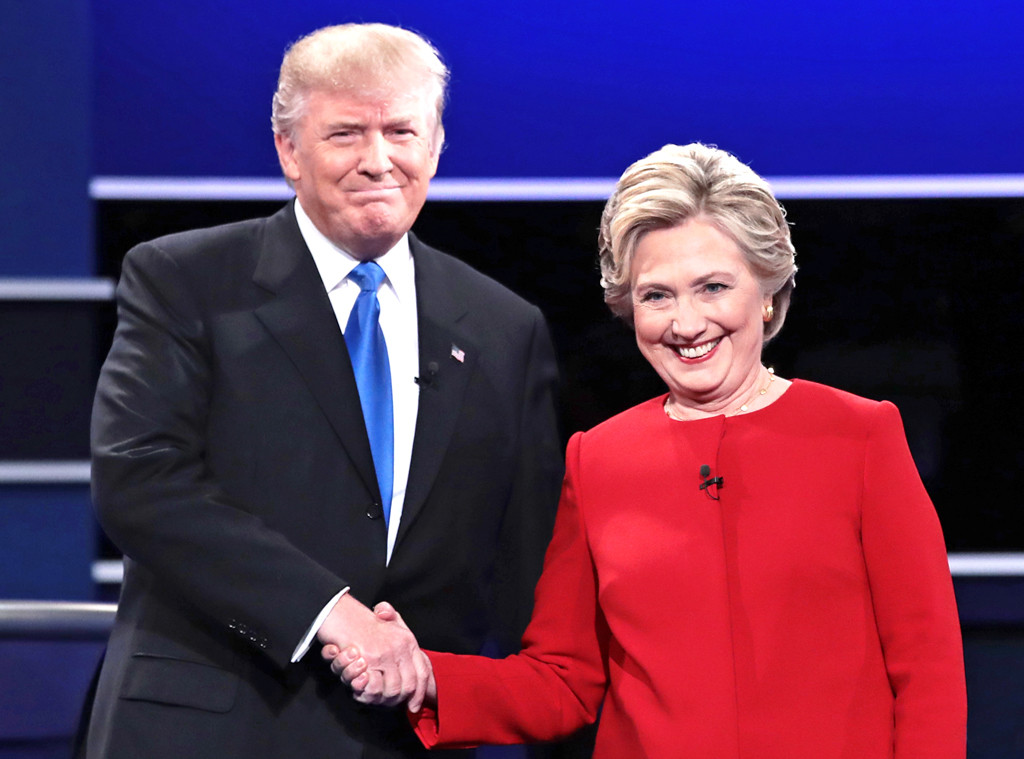
Image result for donald trump hillary clinton
I submit that anyone possessed of even a smidgen of what Henry James called “the imagination of disaster” will shudder that the prospect of what a Clinton presidency would have entailed. Who knows whom she would have nominated to the Supreme Court and other federal courts, what she would have done about taxes, about energy, about the plague of political correctness on college campuses, about military spending, about border security, about North Korea’s nuclear ambitions, about religious freedom, about militant Islamism, about American manufacturing, about the size of government and the burdens of the regulatory state.
I say “Who knows,” but of course we all know. Hillary Clinton was the most corrupt serious candidate for the presidency in history, and her corruption was evident not merely in her lying to Congress and the the FBI, her pay-to-play schemes while secretary of state, and her handling of the Benghazi attack. It was evident, too, in her fealty to the dictates of the administrative state, to the unaccountable elite that 63 million voters elected Donald Trump to combat. And who knows what she would not have done, such as prime the economy to ensure near record peacetime unemployment and strong economic growth—which are moral acts in themselves given the millions whose live have already been changed.
Which brings me to the other pachyderm in the vicinity. The most important pro-Trump essay to have been published on the run-up to the 2016 election undoubtedly was “The Flight 93 Election” by Michael Anton (writing then under the pseudonym Publius Decius Mus). The most famous bit of that essay—an essay Jonah took to task when it appeared—is the arresting comparison of the election to the doomed United Flight 93. The airliner was commandeered by murderous al-Qaeda fanatics. The only chance the passengers had was to storm the cockpit and try to retake control of the plane. The United States, Anton argued, faced an analogous peril. Its controls had been commandeered by people who would ruin us unless stopped. There was no guarantee that storming the “cockpit” of government by electing Donald Trump would save us. But it was our only hope.
That idea, as I say, was the most famous part of Anton’s essay. But perhaps even more telling in the context of this discussion about character was what he had to say about the conservative establishment.
If conservatives are right about the importance of virtue, morality, religious faith, stability, character and so on in the individual; if they are right about sexual morality or what came to be termed “family values”; if they are right about the importance of education to inculcate good character and to teach the fundamentals that have defined knowledge in the West for millennia; if they are right about societal norms and public order; if they are right about the centrality of initiative, enterprise, industry, and thrift to a sound economy and a healthy society; if they are right about the soul-sapping effects of paternalistic Big Government and its cannibalization of civil society and religious institutions; if they are right about the necessity of a strong defense and prudent statesmanship in the international sphere—if they are right about the importance of all this to national health and even survival, then they must believe—mustn’t they?—that we are headed off a cliff.
Alas, as Anton goes on to observe, “it’s quite obvious that conservatives don’t believe any such thing, that they feel no such sense of urgency, of an immediate necessity to change course and avoid the cliff.” The status quo is the nutrient jelly in which they live. They may criticize it. But they would not dream of changing it.
In is in this context—the context of Hillary Clinton as the only alternative to Donald Trump and the existential peril that Anton outlined—that we must place any meaningful discussion of Trump’s character. James Piereson makes an illuminating point about this aspect of the issue. “The problem with Trump,” he writes, “is that it is hard to say what his character is, or where his unusual style ends and his character begins, or whether or not the various things he does actually reveal his character.”
If Trump’s character is his destiny, then it is hard to understand how he managed to come as far as he has through the ups and downs of a business career and now election to the highest office in the land. If we take his critics at their word, then Trump’s bad character should have taken him out of the business world and certainly out of the presidential race a long time ago. Bad character leads to a bad ending. His success up until now, far surpassing the achievements of most mortals, contradicts the proposition that “character is destiny,” unless one is prepared to say that there are important aspects of Trump’s character that produced his success—a proposition that is worth pondering.
And this brings me to another thing that has struck me about much anti-Trump rhetoric: its astringent but unidirectional moralism. By “unidirectional” I mean directed exclusively at Donald Trump when there are many other suitable objects of moral obloquy parading about. Just yesterday, Bill Kristol, primus inter paresof the NeverTrump fraternity, provided a good example of the sort of moralism I have in mind. “Trump,” Kristol wrote on Twitter, “is in fact losing to the left and destroying a decent and elevated conservatism as he does so.”
What is this “decent and elevated conservatism” of which Kristol speaks? It is, of course, the conservatism that he and his friends represent—the conservatism Michael Anton anatomized in his remarkable essay, a conservatism, alas, that may have the right opinion about morality but is too feckless actually to choose it.
The reason I am happy to say that Donald Trump, despite his imperfections, is a man of good characteris that he has again and again shown himself to be willing to storm the cockpit of our corrupt, sclerotic, and increasingly unaccountable governmental apparatus. He has worked tirelessly on behalf of the American people and by implication (and it was part of his genius to make this connection) on behalf of people everywhere. He understands that his job is to put America first, but that by so doing he benefits everyone with whom we deal. Those things, I think, are marks of good character.
One codicil. I have deliberately avoided engaging with most of the particulars of Jonah’s indictment of president, mostly because many of the items he mentions are subject to vastly different interpretations. For example, he cites “Trump’s inability to hold onto cabinet secretaries of quality” as a reflection of his bad character, but has Trump been unable to hold onto “cabinet secretaries of quality”? I can imagine someone arguing that Trump’s cabinet, that his team in general, is stronger now than it ever was. But I understand that opinions differ.
I did, however, want to say a word about Jonah’s comment about the president’s attitude toward the First Amendment. In my original column, I responded to Jonah’s earlier criticism of the president’s “rants against the First Amendment” by saying that I couldn’t recall any such rants. Jonah responded to this by observing,
on numerous occasions the president has talked about “opening up” libel laws and revoking FCC licenses of certain news outlets, endorsed physical assaults on protestors, wanted to ban adherents of an entire religion from entering the country, celebrated the physical assault of a reporter, said (while in Canada) that it is “frankly disgusting the way the press is able to write whatever they want to write,” and so on. I don’t think his rants about “fake news,” “the enemy of the people,” etc. are necessarily anti-First Amendment. But given the larger context of his views, I think it’s reasonable to see them that way.
I will pass over the more contentious items in this list. I do not think, for example, it is accurate to say the president “wanted to ban adherents of an entire religion from entering the country.” But I did want to comment on Jonah’s point about “opening up” libel laws. The case in question was the landmark 1964 decision in New York Times v. Sullivan, which made it almost impossible for any “public figure” to win a libel action. The press loved this decision. But, as the legal scholar Glenn Reynolds noted in The Judiciary’s Class War, the decision was in effect “a subsidy to media companies, whose libel risks (and insurance premiums) were drastically reduced. It also meant that juries . . . had far less power in libel cases. Perhaps coincidentally (but perhaps not), trust in the press has fallen steadily since the Sullivan ruling freed media organizations from previously existing legal accountability.”
This was a point that the lawyer Gregory J. Sullivan dilated on in Jonah’s magazine, National Review, on the 50th anniversary of the decision in 2014. Although the press celebrated the anniversary as a triumph for free speech, Sullivan wrote, for “those committed to the text and history of the Constitution, and a judiciary tethered to them, there is nothing at all to celebrate.”
Even by the imperial-judiciary standards of the Warren Court, this case stands out as something of a classic effusion in that Court’s project of remaking American society to conform with its far-Left preferences. There is no question that the case is a watershed: Before New York Times v. Sullivan, the first amendment protected a free press that was responsible in law for its errors; after and because of this case, the press has anything-goes immunity from almost any mistakes, no matter how damaging. As a policy matter, this may or may not be a prudent development. Constitutionally, the decision is an infamous failure and a disgrace to the judicial role.
When one surveys the extraordinarily vituperative, monolithic, and unfair coverage under which the president and anyone associated him struggle it is easy to see why he castigates “fake news” and thinks about revisiting decisions like New York Times v. Sullivan. Far from being an assault on the First Amendment, I’d say it was an effort to protect it by limiting its abuse.

Sunday, December 30, 2018

Jonah Goldberg and Cardinal Newman


By 
https://amgreatness.com/2018/12/29/jonah-goldberg-and-cardinal-newman/
December 29, 2018

Image result for cardinal newman
Cardinal Newman


My friend Jonah Goldberg has prompted me to think a bit about the issue of character as it relates to public service. Jonah thinks that Donald Trump is a man of bad character. He’s written this several times, most recently, I believe, at National Review where he puts it negatively: it is an “obvious truth,” he says, that “President Trump is not a man of good character.”

In August, on Twitter, Jonah issued a challenge that, he noted, he had been pressing for three years: “Please come up with a definition of good character that Donald Trump can clear.”
I’ll take a crack at that in a moment. First, I want to agree, at least provisionally, with Jonah’s observation in his column that “Character is one of those topics, like culture or morality, that everyone strongly supports yet also argues about.” I say “provisionally” because although I agree that character, culture, and morality are typically matters that interest us deeply and, hence, are things that we endlessly discuss and often argue about, I am not quite sure what he means when he says that “everyone strongly supports” them. Thinking it over, I am not sure I have ever heard anyone say “I support character.” Have you?
Jonah is fond of quoting Heraclitus’s aphorism ἦθος ἀνθρώπῳ δαίμων against the president. He says that it is “most often” translated as “man’s character is his fate.” It has indeed been translated thus, but it is perhaps more accurately translated as “Man’s character is his daimon.” The usual Greek word for fate is μοῖρα. “Daimon,” which was that inner admonitory voice that Socrates said guided him, is something else.
While I am at it, I should perhaps also say I am not sure that ēthos means quite what Jonah’s weaponization of the aphorism implies. As I understand it, ēthos means one’s settled disposition; the Liddell and Scott lexicon mentions the Latin word ingenium among its definitions. Someone in the early modern era might have described it as a man’s “humor.” Jonah begins his most recent column by noting:
For a very long time now, I have been predicting that the Trump presidency will end poorly because character is destiny.
The logic is: Trump’s character is bad. Character is destiny. Ergo Trump’s administration will come a cropper. The aphorism by Heraclitus is offered as confirmation of this syllogism.
It is, I’ll admit, amusing to speculate about what Heraclitus would have made of Donald Trump. But for my money, a more pertinent saying of the old Ephesian is φύσις κρύπτεσθαι φιλεῖ: the true nature of things likes to conceal itself.
In any event, Jonah goes on to say, notwithstanding the “obvious truth” that Donald Trump is “not a man of good character,” some people disagree and, mirabile dictu, “seem to have convinced themselves that Trump is a man of good character.” Some of these people, moreover, “take personal offense at the insult, even though I usually offer it as little more than an observation.” The contention that Trump is “not a man of good character,” you see, although it is “an insult,” is also an “obvious truth.” Which is to say, like the proposition “All men are mortal,” one is not free to disagree with it. You might dislike it. You might wish it were not true. But there is something coercive about “an obvious truth.” It is simply beyond debate.
That, I believe, is Jonah’s contention, which makes his irritation at those who persist in disagreeing with him about this understandable. “They rush to rebut the claim,” he says “citing banal or debatable propositions: He loves his children! He’s loyal to a fault! He’s authentic! Never mind that many bad men love their children, that loyalty to people or causes unworthy of loyalty is not admirable, and that authentic caddishness is not admirable. Moreover, he is not remotely loyal to his wives or the people who work for him.”
There is a lot that one might say about those observations, which, speaking of banal propositions, seem to me to mix the banal (“many bad men love their children”) with the highly debatable: is it, for example, unarguable that the president’s fundamental loyalties are to “unworthy” people or causes, as Jonah implies?
One frequent objection to Donald Trump’s behavior—and one that is made by friends as well as opponents—revolves around his sometimes intemperate rhetoric. The president’s friends lament this but exonerate, or half-exonerate, him with the contention that the tweets and the insults are merely a matter of style whereas his achievements are a matter of substance. Jonah anticipates and dismisses this gambit. “[H]is insults are not simply an act,” he says; “they are the product of astonishing levels of narcissism, insecurity, and intellectual incuriosity. Trump’s Twitter account is simply a window into his id.”
Jonah concludes his indictment with this inventory:
Trump’s refusal to listen to advisers, his inability to bite his tongue, his demonization and belittling of senators who vote for his agenda but refuse to keep quiet when he does or says things they disagree with, his rants against the First Amendment, his praise for dictators and insults for allies, his need to create new controversies to eclipse old ones, and his inexhaustible capacity to lie and fabricate history: All of this springs from his character.
Again, I’d say there was a lot that was debatable in this list. For example, there are many instances, as the public record shows, where Trump not only listened to but also heeded the counsel of his advisers. I cannot myself recall any “rants against the First Amendment,” per se. And I’d say that his “praise for dictators” was really praise for their possible good behavior or acquiescence to policies that the president thought were in our national interest. One might agree or disagree in this or that case, thinking the president ought to have said or done this instead of that. But that is my point: the issues are debatable, not settled.
As for coming up with “a definition of good character” that the president can clear, let me begin by backing into it and offering a negative definition a friend of mine offered: “Maybe not having sex in the Oval Office with an intern, weaponizing the IRS, DOJ, CIA, and FBI, being impeached for lying under oath or wiping clean thousands of text messages and emails under subpoena…”. The concluding ellipsis, it should go without saying, looks forward to a much longer list.
My question is this: what is the character that Jonah wants us to champion and that he stipulates Donald Trump lacks? Let us grant that the president is an imperfect man. What betokens worse character: tweeting rude things or having sex with your intern in the Oval Office? What’s worse, insulting Bob Corker or using the Department of Justice and the IRS to harass and persecute your political opponents?
I remember being taken aback when Bret Stephens this time last year took stock of Donald Trump’s accomplishments and concluded, “I still wish Hillary Clinton were president.” The list that Stephens mustered was long and impressive. It began with tax cuts, the effective obliteration of ISIS, and the decertification of the Iran deal and ended with the robust economy and the ascension of Neil Gorsuch to the Supreme Court. (Brett Kavanaugh was yet to come.) “What, for a conservative,” Stephens asked, “is there to dislike about this policy record as the Trump administration rounds out its first year in office?”
I thought that was a very good question. But Stephens’ answer was the same as Jonah’s: Donald Trump’s character, his “personality,” was defective. He suffers, said Stephens, from a virtue deficit. “Character does count,” Stephens insisted, and Trump does not have it. On the contrary, the president, he said, “has imported a style of politics reminiscent of the cults of Juan Perón and Hugo Chávez.”
This is where Cardinal Newman comes in. In his book The Grammar of Assent, Newman devotes some interesting pages to Aristotle’s concept of φρόνησις, “prudence.” “Properly speaking,” Newman says, “there are as many kinds of phronesis as there are virtues: for the judgment, good sense, or tact which is conspicuous in a man’s conduct in one subject-matter, is not necessarily traceable in another.”
[H]e may be great in one aspect of his character, and little-minded in another. He may be exemplary in his family, yet commit a fraud on the revenue; he may be just and cruel, brave and sensual, imprudent and patient. And if this be true of the moral virtues, it holds good still more fully when we compare what is called his private character with his public. A good man may make a bad king; profligates have been great statesmen, or magnanimous political leaders.
I don’t know anyone who voted for Donald Trump, or who later came to support him, because he thought the president was a candidate for sainthood.
On the contrary, people supported him, first, because of what he promised to do and, second, because of what, over the past two years, he has accomplished. These accomplishments, from rolling back the regulatory state and scores of conservative judicial appointments, from moving our Israeli embassy to Jerusalem to resuscitating our military, working to end Obamacare, and fighting to keep our borders secure, are not morally neutral data points. They are evidences of a political vision and of promises made and kept. They are, in short, evidences of what sort of character Donald Trump is.
Add them up and I think they go a long way towards a definition of good character that Donald Trump can clear.
Voltaire, writing against Rousseau and his self-intoxicated paeans to “virtue,” occupied a similar semantic neighborhood: “What is virtue, my friend?” Voltaire asked. “It is to do good: let us do it, and that’s enough. We won’t look into your motives.”

Thursday, April 26, 2018

How to stop the West from committing cultural suicide


By John Podhoretz
https://nypost.com/opinion/
April 25, 2018

Image result for jonah goldberg suicide

It might seem odd to say a book with the alarming title of “Suicide of the West” is an exhilarating call to arms in defense of what is highest and best in our civilization, but Jonah Goldberg’s extraordinary new bestseller is exactly that.
Goldberg says if we don’t veer from the cultural glide path we’re on, with both left and right committed to factually misleading and emotionally suppurating narratives about the innate cruelty and inborn injustice of this country, the greatest force for prosperity and freedom the world has ever known is likely to die. That is the “suicide” of Goldberg’s title.
But since this is something we’re doing to ourselves — a perverse effort to set fire to our own cultural patrimony — it’s also something we can correct.
The key factoid animating “Suicide of the West” is this: For 2,000 years, everywhere on earth, the large mass of humanity lived on the equivalent of $1.90 a day. “Near subsistence living,” Goldberg writes, “defined human habitats for almost all of human history.”
Then something happened. In the 18th century. In Great Britain. It was a complex phenomenon Goldberg calls the Miracle — a new way of thinking about humanity and human achievement and personal liberty that unlocked a hidden door in the possibilities of the species.
The results of the Miracle are astounding. Where once 94 percent of the people on earth survived on less than $2 a day, today only 9.6 percent does. “Around the world, the number of people considered poor has decreased both relatively and absolutely — an incredible feat, given massive increases in population,” Goldberg writes.
We have come to take most of this for granted, so much so that many of us believe the benefits of material prosperity are of little meaning because they’re not shared equally across all societies. We lament our failings rather than dwell on the astonishing fact that, as Goldberg puts it, “If the 200,000-year life span of homo sapiens were a single year, the vast majority of human economic progress would have transpired in roughly the last fourteen hours.”
We do this, as Goldberg observes in the most original observation in his very original book, because the Miracle is unnatural. It’s a human construct. It’s a new thing, and it remains a radical thing, even though we call its loudest expostulants today “conservative.”
Meanwhile, though we tend to think of those who reject the democratic capitalism at the heart of the Miracle as being “progressives,” they are in fact reactionaries seeking to restore a lost way of life and return humanity to a more natural path.
The political liberty we were granted by the Miracle has freed humankind to pursue individual achievement — and it’s a series of unbroken individual achievements that have led the world to unprecedented bounty. But these achievements involve harnessing nature and improving on it. And it’s this aspect of the Miracle that creates a cognitive dissonance in us. It’s not so easy to transcend humanity’s hard-wired pre-modern drives.
As Goldberg says, we’re tribal creatures, intensely social and innately hierarchical, and we find greater meaning within groups. The great ideological fight in the Age of the Miracle is between those who see the rise of the West as a fulfillment of humankind’s potential and those who cannot reconcile themselves to the ways it seems to go against what they think is natural.
The problem is that the rejecters are themselves creating unnatural constructs to try and restore the existence that seems most real to them. They’re building fake tribes through the vehicle of what we now call “identity politics.” And these fake tribes and the demand that we adhere to the arbitrary rules they establish for who is in and who is out are the true drivers of the West’s suicidal impulses.
Goldberg’s answer is so simple it seems too easy, and yet so difficult it seems unachievable. We need to teach and experience gratitude for what we have been given, which means reacquainting ourselves with the philosophical and scientific roots of the Miracle and then passing them on to our posterity. So much is arrayed against this effort, and yet we Americans, we tribal Americans, do long to belong to the American tribe.
In his pathbreaking book, Goldberg makes it clear all we need do to find our place is to understand that we are the beneficiaries of a great tradition that not only speaks the truth about us, but has rewarded us with gifts once beyond imagining. This is the book of the year.

Thursday, December 21, 2017

Despite Venezuela, Socialism Is Still Popular in the U.S.


By blaming everything else but socialism and tweaking its definition, the Left has managed to keep it haute couture.


By Jonah Goldberg
December 20, 2017

Image result for venezuela economic crisis
Opponents of Venezuelan President Nicolas Maduro demonstrate in front of riot police in Caracas on January 24, 2015 (AFP Photo/Federico Parra)

It's a puzzle. Over the last decade, Venezuela has supplanted Cuba as the Shangri-La of the American left. Not long ago, self-declared socialist senator Bernie Sanders insisted that the American dream was more achievable in the Bolivarian Republic than in America. A string of Hollywood luminaries made the pilgrimage to visit the socialist Mecca to say ponderous and stupid things.

Today, the praise is more muted, because events have illuminated that stupidity. The government recently advised its citizens to eat their pet rabbits. Inflation in Venezuela is reminiscent of Weimar Germany. Roughly 85 percent of Venezuelan companies have stopped production to one extent or another, in the most oil-rich country in the world.

And yet, socialism is arguably more popular — in theory — than at any time in American history, particularly among young people. A Victims of Communism Memorial Foundation poll last November found that 42 percent of young people support capitalism, but 44 percent prefer socialism for a socioeconomic system.

Why the disconnect? For conservatives of my ilk, the most obvious answer is that, for the left, socialism itself is never to blame. One of my favorite guilty pleasures is the Socialist Party of Great Britain’s Twitter feed, which insists daily that the socialist ideal has never been tarnished by real-world socialists. A tweet permanently affixed to the top of their page reads: “Are you about to tell us ‘Socialism was tried in Russia’ or ‘Look at Venezuela’ etc? It has NEVER EXISTED! It comes AFTER global capitalism!”

Even mainstream liberals don’t like to concede any points in socialism’s disfavor. The late Chilean dictator Augusto Pinochet was a murderer and a tyrant. So was the late Cuban communist Fidel Castro. Pinochet helped his country transition to democracy. Castro, who killed more people, left his country as a police state. But while Pinochet is a demonic figure in the liberal imagination, Castro’s status is far more complicated. He is still a hero to many.

For the last decade, the New York Times has covered the socialism of both Venezuelan dictator Hugo Chavez and his successor, Nicolas Maduro, with the same sophisticated nuance it long applied to Cuba. Over the weekend, it ran a heart-wrenching story on how Venezuela’s poor children are dying from starvation. But the culpability of Chavism, Venezuela’s brand of socialism, is something the reader has to bring to the page. Such passive detachment between cause (in this case, socialist policies) and effect (mass misery and starvation) is rarely found when the Times reports on, say, Republican economic policy.

The disconnect between socialism’s record and its invincible appeal also stems from leftists’ denial of what it really entails. Thus, Tony Blair, the former prime minister of Great Britain, dragged the Labor party away from its official socialist dogma about the need for the “common ownership of the means of production.”

“Socialism for me,” Blair said, “Was never about nationalization or the power of the state, not just about economics or even politics. It is a moral purpose to life, a set of values, a belief in society, in cooperation, in achieving together what we cannot achieve alone.”

That’s why he rejected socialism in favor of what he called “social-ism.”

Similarly, Bernie bros focus on social solidarity rather than political economy.

But even this watered-down spirit of “we’re all in it together” — whether you call it socialism or nationalism — can do enormous damage. It is very hard to reconcile with democracy and the rule of law, unless there’s a dire national crisis, and even then it may cause grave damage.

I don’t want America to be Denmark. But at least Denmark recognizes that social democracy requires democracy, free speech, and the rule of law to keep it from turning into Venezuela on the Baltic. I wouldn’t be so concerned about the rising support for socialism among young people in the United States, save for the fact that it’s been accompanied by a modest decline in support for democracy, too.


– Jonah Goldberg is a fellow at the American Enterprise Institute and a senior editor of National Review. © 2017 Tribune Content Agency, LLC.

Friday, December 08, 2017

Trump Puts Fact Ahead of Fiction in Israel


The only reason recognizing Jerusalem as the Jewish State’s capital is controversial is that the world has been pretending it’s not for decades.


By Jonah Goldberg
December 8, 2017

Image result for jerusalem western wall capital
(Getty Images)

The most exhausting thing about the Middle East — except for the bloodshed, poverty, tyranny, etc. — is that it refuses to conform to how it’s described in the West.

It’s like journalists, diplomats, and politicians want to announce a football game, but the players keep insisting on playing rugby. The field looks similar. The scoring isn’t all that different. It’s just a different game. But don’t tell the gang in the booth. They get furious when you point out that the facts don’t line up with the commentary.

Consider President Trump’s momentous (though for now mostly symbolic) announcement that the United States will recognize Jerusalem as the capital of Israel. Before you can debate whether this was a good move, you must acknowledge one glaring fact that the chatterers want to ignore or downplay: It’s true. Jerusalem is the capital of Israel. The Knesset, Israel’s parliament, convenes there. Israelis call it their capital for the same reason they claim two plus two equals four. It’s just true.

What makes the decision controversial is that everyone had agreed to pretend it wasn’t the capital in order to protect “the peace process.”

That’s another term that doesn’t quite correspond with reality. There is no peace process. Mahmoud Abbas, the Palestinian president finishing the twelfth year of his four-year term, has refused to meet with the Israelis to discuss anything since early in the Obama administration.

Part of the blame for that, of course, belongs with Obama, who built an entire foreign policy around what he wanted to be true rather than what was actually going on. Obama sought to distance the U.S. from Israel on the assumption that Israel was the unreasonably stubborn party in the “peace process.” That’s why, on the way out the door, the Obama administration broke with precedent and opted not to veto a U.N. Security Council resolution declaring East Jerusalem “occupied territory.”

This implied that, as a matter of international law, the Western Wall and the Jewish Quarter of Jerusalem itself really belong to the Palestinians — which is an insane fantasy.

But denying reality is how this game has long been played. In his speech after Trump’s announcement, Abbas talked at great length about Jerusalem’s history as a Muslim and Christian city. He made no mention of the fact that it’s also a famously Jewish city, having been established as the capital of ancient Israel 1,000 years before Jesus was born.

Trump called his decision “a recognition of reality.” People invested in irreality insist the move will worsen “the Middle East conflict.”

Here, too, we have mislabeling. Whole books are dedicated to the Middle East conflict, as if the Israel–Palestinian issue were the only conflict in the region. Tell that to the hundreds of thousands of dead Syrians or the millions displaced by the civil war there. Tell it to those dying in Yemen, site of a proxy war between Iran and Saudi Arabia.

It’s been this way for decades. The Palestinians and their Arab patrons insisted to gullible Westerners that the Israel–Palestinian conflict was the source of all the region’s problems. Was the Iran–Iraq War, which cost more than a million lives, a fight over Palestinian statehood? What about the Lebanese Civil War? Turkey’s campaign against the Kurds?

The only people who bought the idea that the Middle East conflict began and ended with Israel were those guys in the control booth describing the wrong game — i.e., Western experts and activists deeply invested in the “peace process.”

In a sense, that’s understandable. If you’ve dedicated your entire professional life to a moveable feast that covers your airfare and lodging in Paris or Geneva while you discuss grave matters, it’s probably hard not to cling to fictions.

But those fictions are losing their hold, ironically thanks in large part to the Obama administration. By working on fantasy rather than facts, Obama threw the balance of power in the region heavily in Iran’s favor, lifting sanctions and giving Iran hundreds of billions of dollars. He thought the Iranians would join the community of nations or some such twaddle. Instead, they pocketed the money and are now on a surer path to a nuclear bomb.

As a result of this new reality, the old fictions are a luxury that Iran’s regional adversaries can no longer afford. That’s why Saudi Arabia, a longtime Palestinian patron, has been moving steadily closer to Israel: because Israel is a more valuable friend in the new Middle East conflict than the Palestinians are — or Obama was.

— Jonah Goldberg is a fellow at the American Enterprise Institute and a senior editor of National Review. © 2017 Tribune Content Agency, LLC

Friday, May 19, 2017

Roger Ailes, One of a Kind


The Fox News founder shaped his times more than almost anyone.

By Jonah Goldberg — May 19, 2017
Image result for roger ailes
Roger Ailes, chairman and CEO of Fox News and Fox Television Stations, answers questions during a panel discussion at the Television Critics Association summer press tour in Pasadena, California, U.S. on July 24, 2006. REUTERS/Fred Prouser/File Photo


On my first visit to Roger Ailes’s office, I half expected to find him petting an enormous white tiger, perhaps feeding it from a bowl of raw meat. After all, this was at the height of Ailes’s reputation as a kind of James Bond villain (and well before the sexual harassment scandals that ended his career).

That wasn’t his reputation in-house at Fox News (where I am a contributor), of course. He elicited enormous affection and loyalty from most of the people who worked for him, particularly those he plucked from obscurity and turned into superstars. But in a field that trails only Hollywood and pop music for its capacity to create divas, Ailes understood that fear — which tends to encourage humility — was a useful tool for managing superstars.

Over the course of the meeting it became clear that Ailes was sizing me up for a project he thought I might be right for. (I wasn’t.) His language was alternately ribald and cerebral. I realized that there was a brilliance behind the bawdiness; it helped him take the measure of people. I’ve often joked that Ailes was an odd mix of Boss Hogg and Aristotle.

But Aristotle is probably the wrong comparison. Aristophenes — the Greek playwright — is a better fit.

Ailes was proud of the fact that he got his start in theater. He told me that he brought that sensibility to television. TV is an entertainment medium, one that appeals to the rational parts of our brains but also to the emotional parts. This was not an insight unique to Ailes, but he understood better than most that if the emotional part wasn’t working (what people see), people wouldn’t pay attention to the rational parts (what people said). 

That’s why Ailes famously watched the news on mute when he was assessing talent. “If there was nothing happening on screen in the way the host looked or moved that made me interested enough to stand up and turn the sound up, then I knew that the host was not a great television performer,” Ailes wrote in his book, You Are the Message.

Of course, he took his understanding of human nature and drama to politics as well. Discovered by Richard Nixon, Ailes went on to become one of the most influential political consultants in American history.

When Ailes started Fox News, the joke goes, he discovered an underserved niche in television news: half the country. 

Most of the people who decry Fox News as “right wing” either don’t watch it or cherry-pick quotes from the opinion side. The truth is, Fox was always more nationalist and populist — patriotic, if you prefer — than ideologically conservative. Ailes had a healthy (and sometimes unhealthy) contempt for the journalistic establishment, which by the early 1990s had become ideologically cosmopolitan.

As a broad generalization, the elite media saw itself as a kind of transatlantic guild, with at best loose attachments to this country, and a dim and cynical view toward anything that smacked of not just conservatism, but patriotism and traditionalism.

For example, in 1987, Columbia University held a symposium with political, journalistic, and military leaders. The journalists were asked if they’d agree to embed with an enemy army unit. They said they would. When asked if they would tip off Americans about to be ambushed, then-ABC News anchor Peter Jennings agonized and finally said he would. Mike Wallace of CBS chastised Jennings, saying it was “another story. . . . You don’t have a higher duty. No. No. You’re a reporter!” Jennings switched his position.

Ailes not only had contempt for this kind of thing, he understood that many decent Americans shared it. “My first qualification” for running Fox News, Ailes once said, “is I didn’t go to Columbia Journalism School.”

Dramaturgically, Ailes’s vision for Fox News was predicated on the belief that America is a decent country — particularly in the vast middle where coastal elites do not dominate — and that there is no inherent contradiction between good reporting and the sort of patriotism common to journalists such as Walter Cronkite and Ernie Pyle.

Fox’s populism was an easy fit with American conservatism for two decades because populist indictments of liberal elites and conservative ones overlap a great deal. In the era of Donald Trump that overlap has been attenuated somewhat, and that has been a challenge at Fox — and beyond.

Ailes, a man of demons and angels, brilliance and bawdiness, shaped his times more than almost anyone. It would have been fascinating to hear his ultimate answer to that challenge.

— Jonah Goldberg is a fellow at the American Enterprise Institute and a senior editor of National Review. You can write to him by e-mail at goldbergcolumn@gmail.com or via Twitter @JonahNRO. Copyright © 2017 Tribune Content Agency, LLC

Friday, May 13, 2016

Millennials Embrace Socialism, but Do They Know What It Is?


By Jonah Goldberg
May 13, 2016

Supporters cheer as Democratic presidential candidate, Sen. Bernie Sanders, I-Vt., speaks at a rally Monday, March 21, 2016, in Salt Lake City.
 (John Locher, AP)


Socialism is having a moment.

I’m not just referring to Bernie Sanders’s surprisingly strong showing in the Democratic primaries. Various polls show that Millennials have a more favorable view of socialism than of capitalism. And Millennials generally are the only age group that views socialism more favorably than unfavorably.

Some conservatives aren’t surprised. Schools have been force-feeding left-wing propaganda to kids like it was feed for geese at a foie gras factory.

On the other hand, what are we to make of the fact that only a fraction of the young people who say they like socialism can explain what it is? If left-wing indoctrination is so effective at getting kids to like socialism, you’d think it would have more success at getting kids to at least parrot back a serviceable definition.

Regardless, this is a familiar tale. Young people have a well-documented tendency of skipping facts and arguments and going straight to conclusions.

Writing in The Federalist, Emily Ekins and Joy Pullmann note that many of these young people think socialism is federally mandated niceness. A 2014 Reason-Rupe survey asked Millennials to define socialism. They had in mind a more generous safety net, more kindness and, as one put it, more “being together.”

But when asked if they agreed with a more technically accurate definition of socialism — government control of the economy — support dropped considerably (though not nearly enough). Given a choice between a government-managed economy and a free-market economy, Millennials overwhelmingly chose the latter. It seems young people realize that putting bureaucrats in charge of Uber wouldn’t work too well.

Still, it boggles the mind that anyone can see the folly of having the government take over Amazon or Facebook but be blind to the problems of having the government run health care.
More intriguing to me is the fact that kids who don’t know what textbook socialism is actually have a better understanding of what drives socialism in the first place.

Karl Marx was one of the worst things to ever happen to socialism, and not just because he set the world on a path to the murder, oppression, and enslavement of millions upon millions of people. It was Marx and his confreres who persuaded the intellectual classes that socialism was a strictly “scientific” doctrine. For generations, economists — real and so-called — worked on the assumption that the economy could be run like a machine. Just as engineers had mastered the steam engine and the transistor, they could do likewise with supply and demand.

For generations, intellectuals — real and so-called — argued that economics was best left to “planners.” Time and again, reality — specifically, the reality dictated by human desires — refused to be bent to neatly arrayed columns of numbers and well-stacked slips of paper. The philosopher-economist Friedrich Hayek long ago explained that planners suffer from what he called “the knowledge problem.” Even the best bureaucrat couldn’t know what customers, suppliers, and managers on the ground wanted or needed.

And each time the planners insisted that if they just had a little bit more power, a bit more data, a few more resources, they could make planning work. When all you have is a hammer, you’re inclined to believe that there’s no problem a few more nails won’t fix.

The Soviet Union and its various cousins did much to discredit “scientific socialism,” what with all the killing and totalitarianism. The fact that it didn’t seem to make people richer also undermined its appeal. “Scientifically,” people didn’t want to be bullied, oppressed, or impoverished.

The unrealism of socialism spelled its undoing — for a time.

The dilemma is that there is a reality underneath the fraud of scientific socialism. The first socialists were not economists or technocrats. They were romantics and nostalgists. They loathed the relentless logic of the market and its reward of merit and efficiency as judged by the marketplace.

They wanted to return to the imagined Eden of the noble savage and the state of nature. They wanted to live in a world of tribal brotherhood and mutual love. Long before the math of “scientific socialism” there were the emotions of socialism, both light and dark: egalitarianism and envy.

Young people understandably are drawn by the promise of “being together.” But they think the federal government can make it happen. If government planners can’t even provide goods and services efficiently, how will they ever provide togetherness?

— Jonah Goldberg is a fellow at the American Enterprise Institute and a senior editor of National Review​. You can write to him by e-mail at goldbergcolumn@gmail.com, or via Twitter @JonahNRO. © 2016 Tribune Content Agency, LLC