Showing posts with label G.K. Chesterton. Show all posts

Saturday, June 29, 2019

Chesterton the Crusader: Using Words as a Sword


By 
https://theimaginativeconservative.org/2019/06/knight-of-the-holy-ghost-dale-ahlquist-gk-chesterton-joseph-pearce.html
June 28, 2019

Image result for knight of the holy ghost

G.K. Chesterton, like the God he worshipped, has risen from the dead. There was a time, in the decades after his death, that he was woefully neglected and seemed to have been almost forgotten. He was dead and, as far as many people were concerned, he was buried.
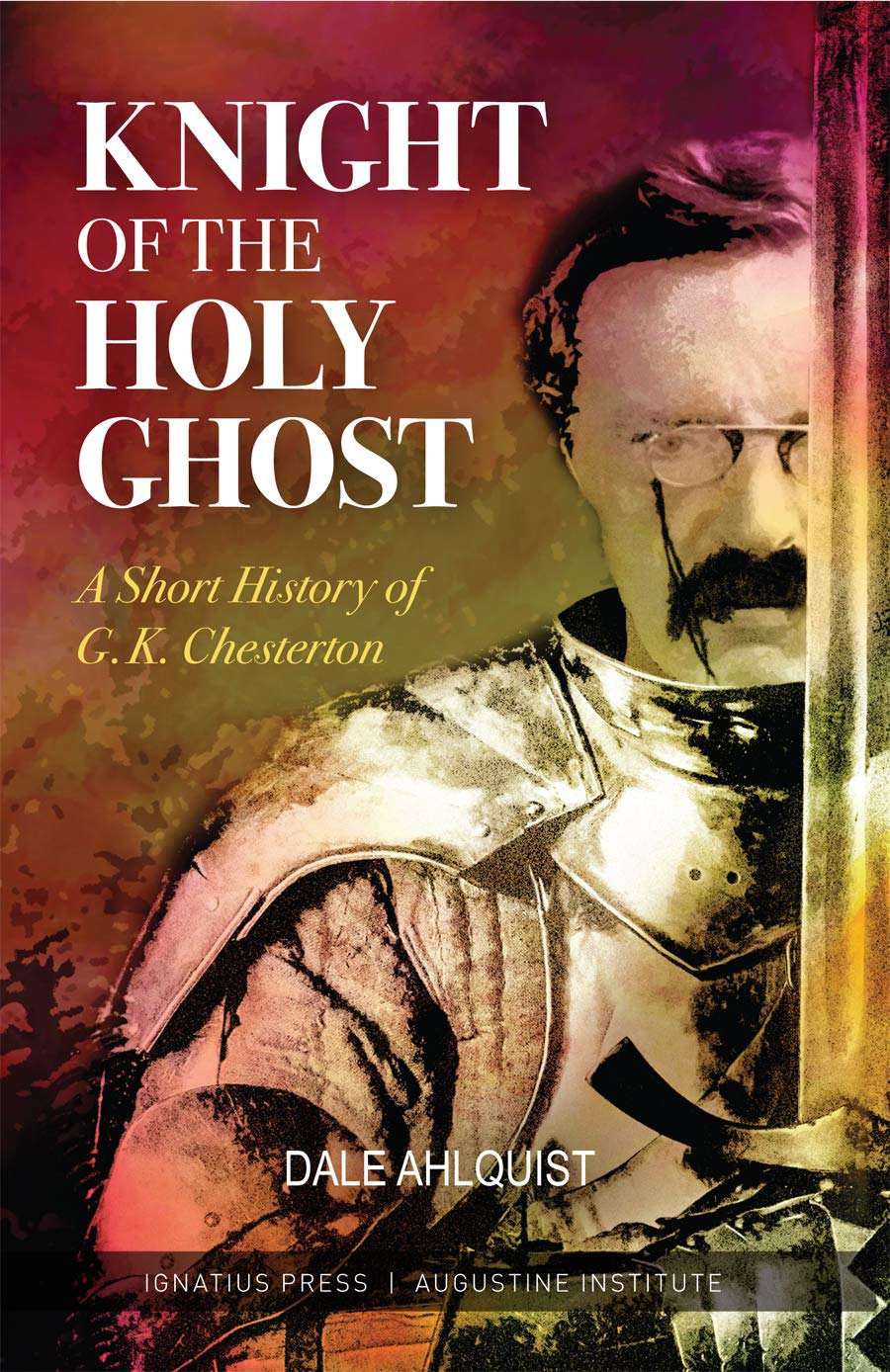
Chesterton had fallen out of fashion during the fifties and sixties as orthodoxy itself had fallen out of fashion. During those darkening days and the darkening daze that they heralded, religion had apparently succumbed to a dumbed-down ecumenism in which no god of any religion could be proclaimed as the One God to be worshipped exclusively. In such a climate there could be no place for a Christian crusader who used his words as a sword with which to vanquish the enemies of the Faith; there could be no place for a modern-day St. George who used his pen to slay the dragons of modernity; there could be no place for a “Knight of the Holy Ghost,” to employ the epithet that Dale Ahlquist employs for Chesterton in the title of his new book, which is subtitled “A Short History of G. K. Chesterton.”
Mr. Ahlquist is uniquely qualified to write this short history of the man to whom he has dedicated his life. As the present author expressed it in the endorsement on the back cover of the book, “Dale Ahlquist is probably the greatest living authority on the life and work of G.K. Chesterton. As such, nobody is better qualified to offer a concise and illuminating overview of Chesterton’s important contribution to contemporary faith and culture.” For years, as President of the American Chesterton Society, Mr. Ahlquist has been an indefatigable champion of G.K. Chesterton. Like a servant of the servants of the poor, he has been a champion of this champion of the Faith. More than anyone he has borne witness to the power of GKC and has witnessed the resurrection of Chesterton’s reputation. His book is therefore the fruit of much labour and tremendous knowledge, as well as being an act of unabashed homage to one whom Mr. Ahlquist considers to be not merely a hero but a saint.
The book is divided into three parts. The first is a portrait of Chesterton “the man,” the second an appraisal of Chesterton “the writer,” and the third asks whether Chesterton should be considered a saint.
The first part constitutes a succinct biographical summary of Chesterton’s life which also serves as a defence of Chesterton’s reputation. Mr. Ahlquist defends Chesterton’s much publicized love for wine and ale, insisting that the fermented fruits of the grape and grain are “God’s good gifts,” and yet he insists that Chesterton could not be accused of drunkenness. As if to prove his point, he quotes Chesterton himself as saying that “there is nothing so good as drink, and nothing so bad as drunkenness.” For Chesterton, as for all those who enjoy such things, the imbibing of fermented or distilled beverages teaches the necessity of temperance and prudence. In ironic contrast, and as Chesterton never tired of telling us, there are few things less temperate than the ill-tempered prudes in the temperance movement who lose their temper at other people’s intemperance.
Intent on painting a positive portrait of Chesterton the man, Mr. Ahlquist concedes that his hero succumbed on occasion to “a few flashes of temper” but likens these to taking “a whip against the moneychangers,” thereby apparently seeking to sanctify and therefore justify such moments of anger. “For the most part,” he continues, “except in one instance where he unleashed some bitterness after the death of his brother, he expressed his anger with restraint.” This is indubitably the case. There are few who argued as much as Chesterton and fewer still who have quarreled less. He crossed swords with many and made enemies of none. Indeed, this crucial distinction between arguing and quarreling is exemplified by Chesterton to such a degree that he should serve as an exemplar to all those who seek to employ the power of rhetoric in the service of truth.
In the second part of the book, on Chesterton the writer, Mr. Ahlquist sub-divides his discussion of Chesterton’s literary legacy into four areas: Chesterton’s books, his poetry, his journalism, and finally the Father Brown stories. It is with this section that many lovers and admirers of Chesterton’s work will have queries and quibbles. The most obvious anomaly is the inordinate amount of space that Mr. Ahlquist devotes to the journalism. No fewer than 52 of the 78 pages on Chesterton’s literary legacy are devoted to a discussion of the essays that he wrote for various journals. Mr. Ahlquist would no doubt defend this peculiar lack of balance by pointing to Chesterton’s own estimation of himself as being, first and foremost, a journalist. It is true that Chesterton made most of his money from his journalism; it is equally true that, in terms of quantity, he employed more words on his essays than on his books; and it is also true that Chesterton is one of the finest essayists in the English language. And yet none of this justifies the devotion of two-thirds of the discussion of Chesterton’s oeuvre on only one of the literary forms in which he excelled.
As if to add insult to injury, or salt to the wound of the reader’s offended literary sensibility, Mr. Ahlquist fails to even mention Chesterton’s novels. This is nothing less than a significant sin of omission. The Man Who was Thursday is indubitably one of the classic novels of the twentieth century and The Ball and the Cross is a superb and sadly neglected work, and yet these and the other novels do not apparently warrant the reader’s attention. How can these gems of literary fiction fail to warrant as much as a passing reference or the smallest of deferential nods in their direction? For these defects and deficiencies, Mr. Ahlquist’s book will serve as a fine introduction to his subject but will not serve as the final word. In this case the first should not be last!
Were the present author to write a book on “Chesterton the Writer” it would be subdivided very differently. Categorizing by genre, it would include sections on the novels, the essays, the short stories, the poetry, the biographies, the histories, the literary criticism, and, last but not least, the works of Christian apologetics.
Enough. And let’s make it plain that such quibbling is not quarreling. On the contrary, it is a healthy discussion between friends. This being so, and laying such arguments aside, Knight of the Holy Ghost is nonetheless a marvelous introduction to the life and work of Chesterton which ends, appropriately enough, with questions concerning Chesterton’s sanctity. Was Chesterton a saint? Mr. Ahlquist believes so, and the present author is not minded to disagree with him. Will he be canonized? That remains to be seen. Some might feel, considering the indifference and the inertia of those who could initiate the canonization process, that it is unlikely. Perhaps it is more than unlikely. Perhaps it will take a miracle. Now that is something worthy of our prayers.
Knight of the Holy Ghost: A Short History of G.K. Chesterton by Dale Ahlquist (208 pages, Ignatius Press and the Augustine Institute, 2019)
Joseph Pearce is Senior Contributor at The Imaginative Conservative. A native of England, Mr. Pearce is Director of Book Publishing at the Augustine Institute, editor of the St. Austin Review, editor of Faith & Culture, and series editor of the Ignatius Critical Editions. He is the author of numerous books, which include The Quest for Shakespeare,Tolkien: Man and MythThe Unmasking of Oscar WildeC. S. Lewis and The Catholic Church,Literary ConvertsWisdom and Innocence: A Life of G.K. ChestertonSolzhenitsyn: A Soul in Exileand Old Thunder: A Life of Hilaire Belloc.

Monday, December 24, 2018

G. K. Chesterton and the Death of Christmas


December 8, 2017

Image result for g k chesterton christmas
“There is no more dangerous or disgusting habit than that of celebrating Christmas before it comes, as I am doing in this article.” Thus wrote, or confessed, G. K. Chesterton in an essay entitled “Christmas that is Coming”, published in the Illustrated London News in 1906. Now, on the eleventy-first anniversary of Chesterton having indulged the “dangerous or disgusting habit”, I am following his ignoble example.
To be fair to myself, and to Chesterton, I don’t really think that getting into the Christmas spirit in the days and weeks before the Feast is exactly synonymous with celebrating the Feast itself. Isn’t such a spirit part of the necessary preparation? Aren’t we supposed to have a childlike glow as we do the Christmas shopping? Shouldn’t there be a Dickensian decorum to our preparation? Aren’t we meant to be full of the expectant joy of Bob Cratchit or Tiny Tim or Mr. Fezziwig? Isn’t a failure to get into the spirit in preparedness for the joyful Season a sign of Scroogish tendencies?
Having defended myself, and Chesterton, from any pharisaical guardians of the Feast, I’m going to risk the ire of lovers of Christmas by confessing that I prefer good old Father Christmas to that new-fangled Santa Claus fellow, the latter of whom strikes me as something of an interloper. Chesterton never wrote about Santa Claus, nor, for that matter, did Tolkien or C. S. Lewis; they wrote about Father Christmas. Nor is this a question of mere semantics. There is a real difference between Santa Claus and Father Christmas which should not be overlooked, even if they have been melded in our modern minds into something or someone akin to a synonym.
For one thing, Father Christmas is English whereas Santa Claus is American – and heaven forbid that anyone should suggest that Englishmen and Americans are in any way synonymous!
Father Christmas has his roots in the personification of the Spirit of Christmas in the Merrie England of mediaeval times, though he really came of age in the seventeenth century as a spirit of resistance to the efforts of the Puritans to ban Christmas after their victory in the English Civil War. Believe it or not, the Puritan-controlled English government actually legislated to abolish Christmas, considering, reasonably enough, that the celebration of “Christ-Mass” was papist. Since the celebration of the Mass had been outlawed, it was natural that the celebration of “Christ-Mass” should be outlawed also. Traditional Christmas customs were banned and the Purityrannical rulers of England declared, in league with a certain White Witch, that it would be always winter but never Christmas.
As resistance to the tyranny grew, Old Father Christmas became the symbol of “the good old days”, a personification of Merrie England, with its feasting and good cheer, and its celebration of the liturgical year.
It is this Father Christmas that is celebrated with appropriate rumbustiousness by Chesterton, Tolkien and Lewis.
In a wonderful short story, “The Shop of Ghosts,” Chesterton writes of a mysterious toyshop and its equally mysterious proprietor, who was “very old and broken, with confused white hair covering his head and half his face, hair so startlingly white that it looked almost artificial”. Refusing to take any money for some wooden soldiers, he explains that he never has taken money. “I’ve always given presents,” he explains. “I’m too old to stop.”
“Good heavens!” his would-be customer exclaims. “What can you mean? Why, you might be Father Christmas.”
“I am Father Christmas,” the man responds apologetically.
 Father Christmas then says that he is dying and offers an explanation for his imminent demise: “All the new people have left my shop. I cannot understand it. They seem to object to me on such curious and inconsistent sort of grounds, these scientific men, and these innovators…. I don’t understand. But I understand one thing well enough. These modern people are living and I am dead.”
“You may be dead,” his interlocutor replies. “You ought to know. But as for what they are doing – do not call it living.”
This would have been a good place for the story to end, the somewhat sullen point having been made, but such a lacklustre defeatist conclusion, all whimper and no whimsy, is hardly satisfactory from a Chestertonian perspective. As such, we are not surprised that the best is yet to come. The silence is broken by the entry of several ghosts from Christmases Past: Charles Dickens, Sir Richard Steele, Ben Jonson, and finally Robin Hood. All of these ghosts remark that Father Christmas looks much the same now as he had looked in their day. As for Robin Hood, he doesn’t understand how Father Christmas could still be alive because he had seen him dying seven hundred years earlier.
“I have felt like this a long time,” Father Christmas concedes.
“Since when?” asks the ghost of Dickens. “Since you were born?”
“Yes,” the old man says, sinking into a chair. “I have been always dying.”
“I understand it now,” Dickens cries, “you will never die.”
The paradox is that each generation believes that Father Christmas is dying, but he never dies. It is each generation that dies while Father Christmas lives on. And since Father Christmas is a personification of Christmas itself, Chesterton is reminding us that this unchristian and anti-Christian generation will pass away – indeed it is dying – but that Christmas will live forever, as the One who was born on Christmas Day will live forever.
“Christianity has died many times and risen again,” Chesterton wrote in The Everlasting Man, “for it had a god who knew the way out of the grave. But the first extraordinary fact which marks this history is this: that Europe has been turned upside down over and over again; and that at the end of each of these revolutions the same religion has again been found on top.”
Father Christmas will never die because Christ has risen from the dead. He is immortal because he personifies the spirit of the birth of the Everlasting Man. And as for the rest of us, we can rejoice, in the words of a popular song, that man will live forever more because of Christmas Day.

Monday, May 01, 2017

The Enduring Relevance of G.K. Chesterton


by 
http://www.theimaginativeconservative.org/
April 26, 2017

Related image

Editor’s Note: The following essay is an interview with The Imaginative Conservative‘s Senior Contributor Joseph Pearce with Agustín de Beitia, for the Argentinean newspaper La Prensa.

1) In a recent interview, you agreed with the idea that we are in the middle of a Chesterton revival. I apologize for asking you about this subject again, but I find it fascinating. What are the evidences of this revival and why do you think it’s happening?
We are indeed in the midst of a Chesterton revival. The practical evidence for this can be seen in the number of Chesterton books that are currently in print, compared with, say, twenty years ago, as well as the evident growth in the size and number of Chesterton Societies around the world. The reasons for this are manifold but much is due to Chesterton’s enduring relevance. Chesterton analyzed the problems that plague modernity with a wit and wisdom which is charming and disarming, using the power of paradox and combining clarity with charity in a way that is difficult to resist. His greatest strength, me judice, is the way in which he always insists on the inextricable marriage of faith and reason and uses this marriage to counter the errors of modernism. After reading Chesterton we are inoculated from the poison of modernism and will never again confuse the Heilige Geist with the Zeitgeist, the Holy Spirit with the Spirit of the Age. 
2) In the modern world, we can see an individual detachment from faith, while an intolerant laicism grows among society. Do you find any similarities with the time when Chesterton lived and worked? Would you say he was a visionary?
It is said that the more things change, the more they remain the same. The fact is that secularism is always at war with the Faith and that laicism is always at war with the Church. We can see this in the persecution of the early Christians by the Roman Empire, which established a pattern that has been prevalent in human history ever since, from the Machiavellianism of Henry VIII and Elizabeth I in England, to the French Revolution and its Great Terror, and on into the twentieth century with the secular fundamentalism of the Russian Revolution, the Mexican Revolution, the Third Reich, the Spanish Civil War, etcetera, ad nauseam. Chesterton was a visionary insofar as he recognized this all too often forgotten reality, stressing that Christendom is always the cultural and political expression of the Church Militant, the Church at war with the forces of secularism: Pro Ecclesia contra Mundum!
3) One can—at least—be surprised by the natural way in which Chesterton includes faith and reason in his thoughts, up to an extent in which they seem familiar. Was faith such a politically incorrect issue as it is today? Why do you think it appears to be so easy for Chesterton to address this subject?
At the forefront of Chesterton’s engagement with the errors of his day, which were essentially the same errors that are so prevalent today, is his realism, in the philosophical sense of the word. He is always at war with nominalism and relativism, and always a defendant of the rational essence of reality. It is his absolute insistence, at all times, on the inextricable bond that exists between fides et ratio which makes him such a powerful force for good.
4) Why does reading Chesterton’s work lead oneself to the joy of being a Christian? Is it because of the discovery of faith omnipresence? What reflexion can be made at present time, when faith has been erased from public debate?
At the heart of Chesterton’s joy at being a Christian, a joy which is contagious to anyone who spends time with him in his writings, is the connection between humour and humility which we see in his work, a connection that is encapsulated in the wonderful lines in Orthodoxy about angels flying because they take themselves lightly (humility) whereas the Devil falls through the law of gravity because he takes himself too seriously (pride). It is this animus between levitas and gravitas which animates Chesterton’s work.
5) Chesterton dazzles with his eruditeness and his mastery of the paradox and irony to ridicule his opponent’s ideas. How can you explain such a genius, who was at the same time a novelist, an essayist, a poet, an apologist, and a successful polemicist at a wide range of subjects?
Chesterton astonishes us with his wisdom because he sees with Christ-like eyes. Paradoxically, he sees with the wisdom of Christ because he sees with the innocent wonder of a child. This is the paradox of all perception. As Thomas Aquinas teaches, humility opens the eyes to wonder, and wonder opens the eyes and the heart to the splendor of truth and the glories of God’s omnipresence in His Creation. It is this humble and wonder-filled openness (dilatatio) to reality which enables Chesterton to see with such clarity and charity. This is why he always leads us to God whether we are reading one of his novels or poems, or one of his essays or biographies. Chesterton can start with a piece of chalk and lead us to God. He can be running after his hat and find that he is running after God. He can discuss Dickens and find God, or write history as though it’s His Story. He is a writer and an apologist for whom everything is charged with the grandeur of God.    
6) Chesterton occupied an important place during the English catholic resurgence of the early past century after the initiator: Cardinal Newman. There are some people who believe that even those familiarized with Chesterton don’t appreciate the importance of his writing. Is he comparable to Newman in any way?
Chesterton is very much comparable to Newman. Just as Newman could be seen as the initiator or instigator of the Catholic Revival, through his conversion in 1845 and his powerful works of apologetics thereafter, Chesterton can be seen as the main momentum and catalyst for the second phase of the Revival, his own conversion and powerful works proving to be significant contributors to the conversion of thousands of people in his own lifetime and thousands more since. We might call the first phase of the Catholic Revival the Newman Period, from Newman’s conversion in 1845 till his death in 1890, but the second phase should be called the Chesterton Period, from Chesterton’s first being published in 1900 till his death in 1936. If Newman blazed the trail, Chesterton fanned the flames of faith that Newman had set alight. They are partners in evangelism!
7) Would you say he was less acknowledged as a man of letters and a poet than as an apologist?
Part of the genius of Chesterton is that he defies categorization. He was a poet, a novelist, an essayist, a biographer, a popular and populist historian, an apologist, a wit, a controversialist—and some would say a saint! He might not be larger than life, because no man is larger than life, but he is certainly larger than any of the boxes in which we try to squeeze him!
8) We have talked about a time when the two lines of confrontation in the cultural war were balanced, while at the present time we assist to a complete disproportion of forces (in human terms, of course). A time, also, when those lines were still clear –Chesterton had to deal with anarchism, socialism—while now confusion and ambiguity reign, up to the point that even the Church seems to oppose to itself. Is it possible to conclude that such threats were then barely in the beginning? And what do you think that Chesterton would have done today?
I think we are in danger of accepting the “progressive” presumption that there is an inexorable “progress/regress,” i.e. that things are going to continue getting better or worse in a linear sense. The culture of death is seemingly in the ascendant at the moment but it contains within itself the seeds of its own decay and death. What we are witnessing is not the triumph of secular “progress” but its dissolution, disintegration and ultimate suicide. What secular “progressives” see as recent political triumphs are in fact the acceleration of their own demise. We need to remember, as Chesterton never forgot, that evil is its own worst enemy. If Chesterton were alive today he’d be doing exactly what he did in his own time. He’d be exposing the lies of relativism, secularism and the culture of death and showing our generation, as he showed his, that Christian orthodoxy is the only solution to the world’s dissolution.

Books on the topic of this essay may be found in The Imaginative Conservative Bookstore. This essay was originally published in La Prensa (2016) and is republished with gracious permission from the author. The Imaginative Conservative applies the principle of appreciation to the discussion of culture and politics—we approach dialogue with magnanimity rather than with mere civility. Will you help us remain a refreshing oasis in the increasingly contentious arena of modern discourse? Please consider donating now.

Joseph Pearce is a Senior Contributor at The Imaginative Conservative. He is writer in residence and director of the Center for Faith and Culture at Aquinas College in Nashville, Tennessee. His works include: G.K. Chesterton: Wisdom and InnocenceLiterary ConvertsTolkien: Man and MythSolzhenitsyn: A Soul in ExileThe Quest for Shakespeare and Old Thunder: A Life of Hilaire Belloc. He is the series editor of the Ignatius Critical Editions, and editor of the St. Austin Review. Mr. Pearce has hosted two television series for EWTN on Shakespeare’s Catholicism.

Saturday, December 19, 2015

'A Child was Born': G.K. Chesterton on the Mystery of the Nativity


By Ralph C. Wood
http://www.abc.net.au/religion/articles/2015/12/17/4374791.htm
December 17, 2015


Nativity with St. Francis and St. Lawrence - Caravaggio
G.K. Chesterton's abiding devotion to the Holy Virgin was not prompted by pious longing for motherly comfort - the usual canard about "sentimental Marianism." It sprang, instead, from his estimate of her as the Theotokos, the God-bearing mother of Jesus who is also mother of his Body called the Church.
Mary is both the prime exemplar of Christ and thus also the Mother of the Church. She is, as Brian Daley puts it, "a unique representative of the human participation in God's life that we call grace or divinization."
The word "divinization" is derived from the Greek theosis. For the Eastern Church, as increasingly also for Western Christianity, it is the key term for authentic Christian existence. We are meant so fully to participate in God's own triune life, through the sacraments and practices of the Church, as gradually to be made divine.
So declared the author of the second letter of St. Peter: If we are to receive God's blessings in His Son, he asserted, we must become "partakers of the divine nature" (2 Peter 1:4, 10-11). St. Athanasius of Alexandria gave theosis its most celebrated formulation in the fourth century: "God became man so that man might become god."
This renewed emphasis on theosis helps to resist a one-sided emphasis on forensic salvation -the notion, namely, that we are simply declared righteous in and through the merits of Christ's atoning death, even though we remain sunk in sin, untransformed by grace.
Perhaps it is also time for evangelicals to recognize that a similar understanding of theosis underwrites the Marian doctrines of both Orthodoxy and Roman Catholicism. Thus should we too exalt the Blessed Virgin as the first person to realize full divinization. As the Second Vatican Council declared, she is the one who:
"in this singular way ... cooperated by her obedience, faith, hope and burning charity in the work of the Saviour in giving back supernatural life to souls. Wherefore she is our mother in the order of grace."
Two drastic conclusions follow: we cannot speak of Christ without speaking of his Mother; nor can we speak of Christ's Church without honouring Mary's mothering of it as well. In his various obiter dicta concerning Our Lady, Chesterton confirms these two central claims.
In The Everlasting Man, for example, Chesterton recounts a bizarre occurrence in his childhood Church of England parish, where a statue alleged to give undue regard for the Blessed Virgin was drastically modified. These latter-day iconoclasts quite barbarously removed the Christ Child from the arms of the Holy Mother. This struck Chesterton as passing strange:
"One would think that this [act] was even more corrupted with Mariolatry, unless the mother was counted less dangerous when deprived of a sort of weapon. But the practical difficulty is also a parable. You cannot chip away the statue of a mother from all round that of a newborn child. You cannot suspend the new-born child in mid-air; indeed you cannot really have a statue of a newborn child at all. Similarly, you cannot suspend the idea of a newborn child in the void or think of him without thinking of his mother. You cannot visit the child without visiting the mother, you cannot in common human life approach the child except through the mother. If we are to think of Christ in this aspect at all ... we must admit, if only as we admit it in an old picture, that those holy heads are too near together for the haloes not to mingle and cross."
These aureoles "mingle and cross" in Chesterton's finest Marian poem:

The Nativity

The thatch on the roof was as golden,
Though dusty the straw was and old,
The wind had a peal as of trumpets,
Though blowing and barren and cold,
The mother's hair was a glory
Though loosened and torn,
For under the eaves in the gloaming
A child was born.
Have a myriad children been quickened,
Have a myriad children grown old,
Grown gross and unloved and embittered,
Grown cunning and savage and cold?
God abides in a terrible patience,
Unangered, unworn,
And again for the child that was squandered
A child is born.
What know we of aeons behind us,
Dim dynasties lost long ago,
Huge empires, like dreams unremembered,
Huge cities for ages laid low?
This at least - that with blight and with blessing,
With flower and with thorn,
Love was there, and his cry was among them,
"A child is born."
Though the darkness be noisy with systems,
Dark fancies that fret and disprove,
Still the plumes stir around us, above us
The wings of the shadow of love:
Oh! Princes and priests, have ye seen it
Grow pale through your scorn;
Huge dawns sleep before us, deep changes,
A child is born.
And the rafters of toil still are gilded
With the dawn of the stars of the heart,
And the wise men draw near in the twilight,
Who are weary of learning and art,
And the face of the tyrant is darkened,
His spirit is torn,
For a new king is enthroned; yea, the sternest,
A child is born.
And the mother still joys for the whispered
First stir of unspeakable things,
Still feels that high moment unfurling
Red glory of Gabriel's wings.
Still the babe of an hour is a master
Whom angels adorn,
Emmanuel, prophet, anointed,
A child is born.
And thou, that art still in thy cradle,
The sun being crown for thy brow,
Make answer, our flesh, make an answer,
Say, whence art thou come - who art thou?
Art thou come back on earth for our teaching
To train or to warn - ?
Hush - how may we know? - knowing only
A child is born.
Chesterton the poet is at his best in his Christmas verse. He rightly credits Charles Dickens as almost single-handedly recovering this holy feast for the Anglophone world, after the Puritans had almost succeeded in suppressing Christmas as the ultimate display of papist paganism. In fact, their celebration of Thanksgiving was an attempt to displace Christmas as a holy day. Chesterton wittily suggested that the English might want to devise their own counter-Thanksgiving, praising God that the Puritans had departed!
Chesterton exalted Christmas because he regarded it not as the Feast of the Incarnation, but of the Nativity. In fact, until recent times the term Incarnation named the entire event of Christ's conception, birth, life, death, resurrection and ascension - not just his entrance into the world. Nor does the Nativity centre upon Jesus alone, but on his Holy Mother as well. Thus does Chesterton begin and end his poem "The Nativity" with splendid Marian moments, though the last one often goes undetected.
Chesterton does not idealize the Bethlehem scene. By means of alternating trochees and iambs, we are shown a stable made externally golden by the setting sun. Within, it is draughty and chill and lifeless.
In accord with the ancient tradition that regards a woman's tresses as her most feminine feature, the sinless Virgin's hair is wondrously modest but also noticeably dishevelled. Here is a woman in the pangs of childbirth. In full consent to the divine will, she consents for her hair to be torn, as she thrashes in agony. Perhaps her flesh is also ripped as the infant is brought forth from her womb.
Here, and for once only, Chesterton resorts to the past tense in describing the birth of Jesus. Because this child is born to this woman in this way, every child's birth now acquires new significance. The human race no longer repeats itself in endless and weary iteration, as the engine of animal reproduction runs on. Because this one divine Child subsumes the whole of humanity in his Nativity, every newborn is meant to be reborn. Hence Chesterton's crucial replacement of the definite article that we expect ("the child") with the indefinite article that startles and surprises ("a child").
Though published in 1897, when Chesterton had only recently begun identifying himself a Christian, and a quarter century before he was received into the Church of Rome, this poem is filled with remarkable theological discernment. In the claim that Christ assumes the whole of humanity within himself, Chesterton is echoing the teaching of the ancient church as well as anticipating the work of le nouvelle theologie. Its most characteristic exponent, Henri de Lubac, also insists that human nature is not one thing here and another thing elsewhere. However twisted and tarnished, every person bears the imprint of God as the result of both their creation and their redemption in Christ. Humanity constitutes, in fact, a bodily no less than a spiritual whole.
To desecrate even a single person, therefore, is to desecrate all others. "The divine image," de Lubac declares, "does not differ from one individual to another: in all it is the same image." Our embodied souls/ensouled bodies display our shared human dependence, our singleness as a race, our commonality that makes us "so entirely one that we ought not speak of man in the plural any more than we speak of three Gods." Hence the teaching of St. Augustine that we are "one spiritual family intended to form the one city of God." The effect of the Incarnation, it follows, is all-encompassing:
"Christ from the very first moment of his existence virtually bears all men within himself ... For the Word did not merely take a human body; his Incarnation was not a simple corporatio, but as St. Hilary says, a concorporatio. He incorporated himself in our humanity, and incorporated [our humanity] in his humanity."
Chesterton makes a radical theological claim in shifting from the past tense to the present in all of the succeeding stanzas. For in this one birth, we can now take the measure of all other births, whether for good or ill.
In the second stanza, for instance, we are shown the awful waste and loss entailed in most human lives. The promise heralded by the infant's first motion within its mother's womb (its "quickening") is fulfilled not in a long and happy life, but in a long and living death. The child becomes the father of the man, alas, in a terrible and anti-Wordsworthian way. Instead of reaching healthy maturity, he becomes passively withdrawn, alienated, void of all sensibility; or else he becomes aggressively crass and clever and heartless - all for want of the Love that both conceived and birthed this all-defining Child of Bethlehem.
Yet not one of Chesterton's stanzas ends in dejection, as the final lines always return to the hope now resident in the birth of every child. God waits with a frightening forbearance. Chesterton's reversed trochaic and spondaic rhythm echoes God's own reversal - namely, his refusal to grow weary and angry with human sinning. Not a single castaway child is now or ever has been excluded from the compass of divine mercy. Whether in time irrecoverably past or in time all too pressingly present, every child is reclaimed with this Child's birth.
The measure of the Nativity is historical no less than personal. The long unfurling course of human history is too lengthy to be recalled in its terrible successiveness. Mighty civilizations have risen and collapsed beyond all recovering, indeed beyond all remembering. Yet of one thing we can still be assured, amid the endless cycles of time wherein - to use Milton's metaphor of the wind-flattened flower - many children are "no sooner blown than blasted." Christ's birth stretches backwards no less than forward to lay claim on every child born to woman. Even when those nameless and numberless children were most horribly conceived in the loveless and violent act of rape - even there the Good News of this gentle Love-Child and his Mother was also proclaimed in the infant's wail.
Chesterton's tropes shift from the personal and the historical to the luminous and the tenebrous in the fourth and fifth stanzas, as the gloaming passes into nightfall. Despite the loud clamour made by logical thinkers and political actors, despite the worried fantasies of those who can only negate, despite the withering contempt shown by high officials of state and church alike, the quiet motion of angel feathers first heard by Mary can be felt again, hovering over the rude stable. The sun rising afresh over the Bethlehem stall is the dawn that will soon break upon the entire world, awakening men from their terrible slumbers. This Day Spring from on high now illumines all who dwell in darkness. The rural shepherds who keep watch over the world's sheep, perhaps representing all who guard the well-being of others, will now be warmed by the Sun of true pastoral care. The urbane wise men, with their minds dimmed by their sin-limited art and thought, personify all the thinkers and artists who shall now receive true enlightenment.
Most especially will these piercing rays strike the tyrant whose visage is now as livid as his soul is shadowed. Whereas Mary's hair was torn by her gracious consent, Herod's countenance is involuntarily ripped, as if to anticipate the veil that will be torn in the Temple on Good Friday. Like the Christ-child in Chesterton's parish church, chipped away by philistines who feared the Virgin holding him, so will this helpless infant-king become God's curious weapon against all despots of both body and soul. This defenceless infant ruling the universe from a bed of straw will pierce the world's will-to-power with the terrible lance of love.
Hence the poem's rightful return, in the final two stanzas, to the Marian moment in the Nativity. Though still weary with the pangs of parturition, her delight remains so strong that Chesterton must convert a noun into a verb. Nothing less than the Marian act of "joying" can describe the Annunciation that came to her in a voice that, though proffering the seemingly impossible, was even less coercive than the lightest brush of angelic wings. What cannot possibly happen has indeed happened: the infant whose umbilical is still drying must already be accorded the munus triplex first formulated by Eusebius, the trifold office of Christ's ministry: the Priest who sacramentally makes God with us in the flesh, the Prophet who pronounces God's judgment in mercy, and the King whose sovereignty breaks down the gates of hell and sets its subjects free - all because "a child is born."
Then comes the extraordinary surprise of the final stanza, where the poetic speaker anonymously addresses the Infant himself. The babe is no longer "mewling and puking" (to use candid Shakespearean language) but sleeping, whether in his wicker basket or else in his mother's arms, having only a sunray for his diadem. "You who are human like us," the questioner twice interrogates the divine Babe, "What is your origin and aim? Are you perhaps John the Baptizer risen from the dead to serve as the new rabbi of wise example, or the new prophet announcing the wrath to come?"
Such supposals constitute a serious misprision of the Christ-child's mission. Gabriel did not announce that Our Lady would bear another rabbi, not even once so great as Gamaliel. Thus do we hear a second voice making a sudden and perhaps impatient interruption.
It is the Holy Mother, I believe, who halts these clamorous queries, lest the sleeping babe be rudely roused, and lest we too miss the staggering Mystery of eternity shut within the span of a man's hand. Surely it is time not to question but to be questioned; indeed, to bow in silence, for "a child is born."
During the final years of his life, when Chesterton began to have long thoughts about everlasting things, he returned again to the Blessed Virgin. In one of his last and best books, The Well and the Shallows, Chesterton made what I regard as his deepest Marian confession:
"Now I can scarcely remember a time when the image of Our Lady did not stand up in my mind quite definitely, at the mention of the thought of all these things ... But whether the figure was distant, or was dark and mysterious, or was a scandal to my contemporaries, or was a challenge to myself - I never doubted that this figure was the figure of the Faith. The instant I remembered the Catholic Church, I remembered her. When I tried to forget about the Catholic Church I had to forget her! When I finally saw what was nobler than my fate, the freest and the hardest of all my acts of freedom, it was in front of a gilded and very gaudy little image of her in the port of Brindisi that I promised the thing that I would do, if I returned to my own land."
Chesterton refers to a tour of Italy that he and his wife Frances had taken in 1920. He had been made a confessing rather than a nominal Christian by the witness of this devoutly Anglican woman. Yet he was reluctant to become a Catholic without her joining him. Not until 1922, at age 48, would he be received into the Roman Catholic Church. In 1926 she would follow him.
Almost everyone knows that G.K. Chesterton was the most celebrated convert of his time. Few know, however, that he was also a Marian poet who challenges Christians of all sorts to restore the Blessed Lady to her rightful place in Christian belief and devotion.
Ralph C. Wood is University Professor of Theology and Literature at Baylor University. He is the author of several books, including Chesterton: The Nightmare Goodness of God and Flannery O'Connor and the Christ-Haunted South.

Friday, July 31, 2015

Chesterton, Tolkien and Lewis in Elfland

Lord-of-the-ringsIt is difficult to overstate the influence of G.K. Chesterton. Apart from the numerous converts who have come to Christianity, at least in part, because of an encounter with his writings, two of the bestselling books of all time were written, at least in part, under Chesterton’s benign patronage. The Lord of the Rings and The Lion, the Witch and the Wardrobe, both of which are in the top ten bestselling books of all time, were written by authors who cited Chesterton as a major influence.
J.R.R. Tolkien grew up, as a young and devout Catholic in Edwardian England, in the shadow of the wings of Chesterton’s flights of fancy. In his celebrated essay “On Fairy Stories,” Tolkien cites “Chestertonian Fantasy” as a powerful “means of recovery,” which he defined as a “return and renewal of health” and as a “regaining of a clear view” of reality, of “seeing things as we are…meant to see them.”
cslewis
C.S. Lewis
C.S. Lewis had first read Chesterton in a field hospital in France during World War One and was surprised by the joy that Chesterton exuded in his essays. In spite of the fact that Lewis was an atheist at the time, he couldn’t help liking Chesterton’s jollity, his sense of humour, and his rumbustious joie de vivre. Chesterton had more common sense than all the moderns put together, the young atheist believed, except of course for his Christianity. A few years later, after reading Chesterton’s classic work, The Everlasting Man, Lewis perceived the whole Christian outline of history laid out before him for the first time in a way that made sense. This revelation proved to be a significant pointer on Lewis’s own path to conversion.
Although it is evident that Tolkien and Lewis were well-versed in Chesterton’s work, the essay of his which was probably most influential on the philosophy of myth that underpinned their own approach to story-telling was “The Ethics of Elfland,” which formed the fourth chapter of Chesterton’s book, Orthodoxy.
For many people, this essay, or chapter, is best remembered for the perceptive and surprising connection that Chesterton makes between tradition and democracy:
I have never been able to understand where people got the idea that democracy was in some way opposed to tradition. It is obvious that tradition is only democracy extended through time….Tradition may be defined as an extension of the franchise. Tradition means giving votes to the most obscure of all classes, our ancestors. It is the democracy of the dead. Tradition refuses to submit to the small and arrogant oligarchy of those who merely happen to be walking about. All democrats object to men being disqualified by the accident of birth; tradition objects to their being disqualified by the accident of death….I, at any rate, cannot separate the two ideas of democracy and tradition; it seems evident to me that they are the same idea.
gk-chesterton2
G.K. Chesterton
For Chesterton, the traditions of the past, extended through time by the continuum that we call civilization, constitute a powerful voice or presence in the present which ensures their being handed on in trust to future generations. Tradition is, therefore, truly, as Chesterton insists, “an extension of the franchise;” it is an extension of democracy through time, the proxy of the dead and the enfranchisement of the unborn. Such an understanding of tradition as a shared inheritance across the generations is clearly a potent and palpable presence in Middle-earth and Narnia. It has a gravitas that does not weigh heavily on one, like an oppressive force from above, but grants security and therefore freedom from the winds of change by securing one with a healthy rootedness in the soil and soul of the culture which has nurtured and nourished one. It is the freedom that comes with a sense of belonging.
Another facet of Chesterton’s “Ethics of Elfland” which would prove inspirational to Tolkien and Lewis was Chesterton’s insistence that myths and fairy stories were not unbelievable, in the sense that they conveyed untruths, but were the most believable things in the world because they conveyed truths and taught lessons that the world needed to know and learn:
The things I believed most then, the things I believe most now, are the things called fairy tales. They seem to me to be the entirely reasonable things….Fairyland is nothing but the sunny country of common sense. It is not earth that judges heaven, but heaven that judges earth; so for me at least it was not earth that criticised elfland, but elfland that criticised the earth.
Wallpaper3_1024In this brief passage, Chesterton reminds us that we should always judge sin from the perspective of virtue, even if, especially if, sin is more common than virtue. The shouldjudges the is. This is the sense in which Tolkien, in his essay “On Fairy Stories,” states that one of the functions of fairy stories was to hold up the mirror of scorn and pity to man. They show us ourselves and are most powerful when they show us what is wrong with ourselves.
This ability of fairy stories to show us ourselves is dependent on our ability to see ourselves in the mirror that they hold up to us. Whereas the sin of pride blinds us so that we cannot see our image in the mirror, humility opens our eyes. Only when our eyes are opened by humility to the sense of wonder in the goodness, truth and beauty of the cosmos can we attain the gratitude at the heart of all true joy:
The test of all happiness is gratitude; and I felt grateful, though I hardly knew to whom. Children are grateful when Santa Claus puts in their stockings gifts of toys and sweets. Could I not be grateful to Santa Claus when he put in my stockings the gift of two miraculous legs? We thank people for birthday presents of cigars and slippers. Can I thank no one for the birthday present of birth?
In stark contrast to this sense of wonder that opens and widens the cosmos, the philosophy of materialism seeks to imprison the senses within the confines of mere physical space. The materialist, wrote Chesterton, “like the madman, is in prison” and, what was worse, he was seemingly consoled by the fact that the prison, i.e. the material universe, was very large:
It was like telling the prisoner in Reading gaol that he would be glad to hear that the gaol now covered half the county. The warder would have nothing to show the man except more and more long corridors of stone lit by ghastly lights and empty of all that is human. So these expanders of the universe had nothing to show us except more and more infinite corridors of space lit by ghastly suns and empty of all that is divine.
Evidently inspired by this metaphor of materialism as a prison, Tolkien resurrected it in his own essay “On Fairy Stories” in which he spoke of “Escape” as “one of the main function of fairy-stories”: “Why should a man be scorned, if, finding himself in prison, he tries to get out and go home? Or if, when he cannot do so, he thinks and talks about other topics than jailers and prison-walls?”
J.R.R. Tolkien
J.R.R. Tolkien
We desire something beyond the prison of time and space because our true home is to be found beyond the prison walls, and the reason that the greatest truths are told in stories is because history itself is a story told by the greatest of all Story-Tellers. History is His Story. As Chesterton put it, “this world of ours has some purpose; and if there is a purpose, there is a person. I had always felt life first as a story: and if there is a story there is a story-teller….I felt in my bones; first, that this world does not explain itself….Second, I came to feel as if magic must have a meaning, and meaning must have some one to mean it. There was something personal in the world, as in a work of art….”
Such a view of the world as being a work of art evokes images of God’s Grandeur as exclaimed by the great Gerard Manley Hopkins:
The world is charged with the grandeur of God.
It will flame out, like shining from shook foil;
It gathers to a greatness, like the ooze of oil
Crushed.
It will also remind lovers of Tolkien and Lewis of the Great Music of God’s Creation in The Silmarillion and of Aslan’s singing of Narnia into being. And as for Chesterton’s proclamation that “this world of ours has some purpose” and that “magic must have a meaning, and meaning must have some one to mean it,” it leads us into the words of Gandalf, whose words of encouragement to Frodo will serve as appropriately encouraging words with which to conclude our musings on the magic of Elfland:
[T]here was something else at work, beyond any design of the Ring-maker. I can put it no plainer than by saying that Bilbo was meant to find the Ring, and not by its maker. In which case you were meant to have it. And that may be an encouraging thought.
Books on the topic of this essay may be found in The Imaginative Conservative Bookstore