Showing posts with label ISIS. Show all posts

Tuesday, April 23, 2019

New Zealand and Sri Lanka Were Not the Same


BY ROGER L. SIMON
https://pjmedia.com/rogerlsimon/new-zealand-and-sri-lanka-were-not-the-same/
April 22, 2019


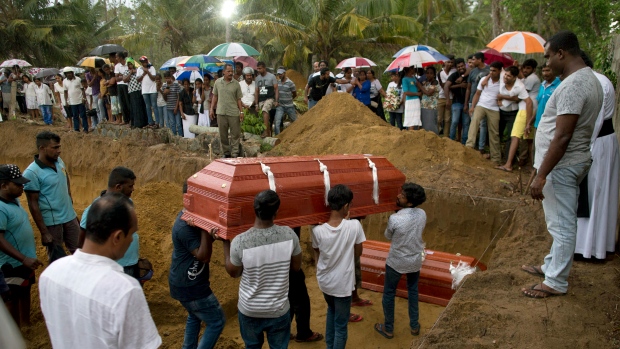
Image result for sri lanka bombing
Relatives carry a coffin for burial during the funerals of three members of the same family, all died at Easter Sunday bomb blast at St. Sebastian Church in Negombo, Sri Lanka, Monday, April 22, 2019. (AP Photo/Gemunu Amarasinghe)

The seemingly unlimited supply of virtue-signalers who dominate our culture have assured us emphatically the recent terror attacks in New Zealand and Sri Lanka are equivalent, a kind of quid pro quod between races and religions.

Other than the fact that, tragically, a great many people died in both—more in Sri Lanka, but the numbers are horrific enough in NZ—-this is utter nonsense. They couldn't be more different.

New Zealand was the act of one aberrant or evil (call him either or both) racist individual motivated by rage against immigrants—Muslim "invaders"—he thought were ruining his country. Sri Lanka was a planned attack on multiple targets by a local militant group, likely with the aid of a yet larger group or groups (possibly ISIS) from outside the country, acting under the dicta of a highly-evolved ideology euphemistically referred to as fundamentalist Islam or Islamism.

That ideology—that seeks to take over the world—has hundreds of millions of adherents and sympathizers across the globe, vastly more than Nazism at its height.  Whether active or not, they consider themselves at war with Judaism and Christianity as well as all other religions (Hinduism, Buddhism, etc.) and seek to eradicate these others from the earth.

Victory was recently achieved over ISIS's so-called caliphate, but only in the most limited way was Donald Trump right to celebrate. Although this victory was necessary, it was undoubtedly but a temporary success in a longer war. It is highly unlikely, actually impossible as we have seen most recently in Sri Lanka but also from a staggering 34,986 deadly attacks since 9/11, that the underlying ideology has been extinguished. Only when that is done will such attacks end.

Unfortunately, we seem to be going in the opposite direction. The cult of Islamophobia—and, yes, it is a cult because it is built on a lie—is a major and growing deterrent to a solution. That deliberately false accusation of "unjustified fear" (phobia), promulgated with no consistent evidence that discrimination against Muslims is a serious problem (actually, the reverse) is meant to do one thing only—deflect legitimate criticism of Islam, therefore preventing its reformation.

And Islam has plenty to criticize, not just the obvious misogyny, homophobia, and other aspects of Sharia law, including the primacy of religious law over state law, stonings for adultery, death for apostasy, thieves having their hands removed, etc. It is indeed Medieval. Unlike other religions, Islam has never been significantly reformed—indeed, resists reformation via, among several other things, that bogus accusation of Islamophobia.

Meanwhile, many more will die, the majority of whom will be Muslims, destroyed in their primitive internecine rivalries (see the link above to deadly attacks). Islamic cultures will remain backward and impoverished because the most logical explanation for their condition, in fact, the only one at this point unless you are racist, is Islam itself.

The rest of us in the wealthy and technologically advanced West and East will continue to suffer myriad indignities—restrictions and inconveniences to our travel, visits to concerts and museums, places of business, government buildings, etc.—while looking over our shoulders for the intermittent attacks that will continue for the rest of our and our children's lives. Soon you will have to be fifty to remember what it was like to get on a plane without having to go through security. Maybe it's already so.

Believing this will go away by itself is magical thinking. Isn't it time for a little honesty?

Roger L. Simon — co-founder and CEO emeritus of PJ Media — is a novelist and screenwriter.

Saturday, March 30, 2019

The West's Crimes against Persecuted Minorities in the Middle East


Nobel Peace Prize 2018 laureate Nadia Murad delivers her speech during the Nobel Peace Prize 2018 Ceremony in Oslo Town Hall, Oslo, on Dec 10, 2018.PHOTO: EPA-EFE


The debate in Western Europe about the rights of returning Islamic State (ISIS) terrorists reflects a disturbing sentiment: There appears to be tremendous concern for the well-being of people who decided to leave their native or adopted countries to pledge allegiance to ISIS, the followers of which perpetrated some of the most gruesome crimes committed in this or any century.

Now that the US-supported forces in Syria have taken the last ISIS stronghold in Syria, Baghouz, and ISIS in Iraq and Syria has been defeated, its terrorists and their brides apparently long for the West again.

Few people in the West seem concerned that the reason for this longing might not be Western comforts alone, but also an ISIS command. One ISIS spokesmen, Abu al-Hassan al-Muhajer, recently "issued a recording calling on organization operatives in all ISIS's provinces to continue the path of jihad and expand their activities against the 'infidel nations,' particularly the United States..."

Swedish officials issued concern about returning ISIS perpetrators in curiousstatements. One, for instance, by Klas Friberg, the head of the Swedish Security Service (Säpo), in January, described returning ISIS fighters as "broken people who have been traumatized by their experiences" and said that Swedish society has to "play a big role in re-integrating them".[1]

There were also questionable statements about an ISIS bride, Shamima Begum, attempting to return to Britain. In a recent interview from Syria, Begum readily admitted that she had no problem with beheadings and other atrocities committed by ISIS, because, "Islamically that is all allowed." Despite this, Richard Barret, a former director of global counter-terrorism at the UK's MI6 intelligence agency, said Begum should be "given a chance" and allowed to come home, despite her lack of remorse. He then lamented that the British government, at the initiative of Home Secretary Sajid Javid, in stripping Begum of her citizenship and not allowing her to come back to the UK, had shown "a complete lack of concern for her plight". British MP Diane Abbott said that making Begum "stateless" was "callous and inhumane".

The problem is that these same representatives of the political establishment have not shown remotely similar concern -- if any at all -- for the real victims of the ISIS terrorists; they appear to have been completely forgotten.

The real victims were the many people whom ISIS terrorists had happily volunteered to rape, torture, behead, drown, burn alive, crucify and shoot to death for sport. Yet, the horror of these victims -- Yazidis, Christians, Druze and the "wrong kind" of Muslims -- is barely mentioned in public debates about returning ISIS fighters. It is as if those victims had never existed. The only comment that keeps being repeated is the right of the perpetrators to return because they happen to be in possession of Western citizenship. One wonders, if such compassion would also have been extended today to, say, Nazis, if they had run off to kill victims abroad and then, after being defeated, asked to come back.
The West, by this disregard of ISIS's victims, is committing a double crime against them: First, by failing to speak out for and help rescue the victims at the time they were being devastated; second, by their sentimental concern for these terrorists after their hard-won defeat.

Recently, fifty Yazidi women were found to have been beheaded in the city of Baghouz. That discovery, however, did not seem to propel Western leaders to help find those thousands of Yazidis who are still missing, including many children. According to one report, 3000 women are still being held by ISIS as slaves and their likely fate is to be held in sexual slavery for the rest of their lives, unless someone rescues them. Nadia Murad, the Yazidi human rights activist and Nobel Peace Prize laureate, who was one of thousands of Yazidi women taken prisoner by ISIS and held as a slave until she managed to escape, recently wrote, "My greatest fear is that if the world still fails to act, my community – the Yazidi community – will cease to exist".

Unfortunately, the world has stood by passively for nearly five years, since August 2014, when the Yazidi genocide by ISIS went into in full swing. Some of these terrorists are already back in the West or on their way there. One Yazidi teenage girl, who had been sold into slavery by ISIS, managed to escape to Germany, where she was horrified to discover that her former captor, who had beaten and raped her, was also living in Germany:
"I know you, he said. And where you live and who you live with. He knew everything about my life in Germany... The last thing I expected was to meet my IS captor and that he would know everything about me."
It appears to be dawning on some of the mainstream media outlets, at least in the UK, that Britain's inaction on behalf of the persecuted Middle Eastern minorities makes its government look horrendous. The Sunday Times recently wrote of the UK government:
"The Home Office has repeatedly failed to give sanctuary in Britain to a fair proportion of Christians, Yazidis and Druze, according to figures obtained under freedom of information laws by Barnabas Fund, which helps persecuted Christians overseas. 
"The finding that it appears to discriminate in favour of Muslisms [sic] risks embarrassing the government which has begun a review, ordered by the foreign secretary, Jeremy Hunt, into the global persecution of Christians.
"When he announced the review on Boxing Day, Hunt cited estimates of about 215m [million] Christians suffering persecution around the world and suggested Britain had not been generous enough."
That is putting it mildly. According to the Sunday Times, of the 4,850 Syrians accepted in 2017 by the Home Office, 4,572 were Sunni Muslims; only 11 were Christians. According to figures for the second quarter of 2018, of the 1,197 Syrians accepted into the UK, 1,047 were Sunnis and 10 were Christians. There was no mention at all of Yazidis, despite the genocide committed against them in 2014, when ISIS terrorists stormed the predominantly Yazidi city of Sinjar in northern Iraq and proceeded to destroy Yezidi shrines and murder, abduct and rape the Yazidis. 200,000 people fled Sinjar and around 50,000 took refuge on Mount Sinjar. To this day, Yazidi refugees are still living there in tents and in unimaginable poverty, waiting for help from a world that has completely forgotten them.

Unfortunately, the rot at the core of Britain's Home Office seems so deep, it is doubtful that it can be shamed into anything. According to The Times, the Home Office recently refused asylum to an Iranian who converted from Islam to Christianity on the grounds that Christianity is supposedly not a peaceful religion:
"Immigration officials wrote to the man citing violent passages from the Bible to prove their point. They said that the Book of Revelation was 'filled with imagery of revenge, destruction, death and violence'. The Church of England condemned the 'lack of religious literacy' shown by the immigration officials, after the man warned he might now face persecution in Iran for his faith".
Across the Western world, the political and media classes put on a daily show of pretending to care about human rights, while letting down persecuted minorities -- including many Muslim women. As Asra Nomani wrote:
"One of our greatest challenges here in America is that progressives don't always stand with the progressive Muslims because in the interest of freedom of religion and civil liberties and political correctness, they don't want to offend cultural choices by Muslims. I know that people have gone to these interfaith sessions at different mosques and they see that the women end up in the basement, but they don't want to challenge anyone because they think, 'Oh, well this is your way.'"
It is long overdue for everyone to start calling out this posturing for the moral narcissism it is and to demand from their politicians and the establishment media, who seemingly never tire of proclaiming their commitment to human rights, to begin providing some to the countless real victims waiting to be helped.

Judith Bergman, a columnist, lawyer and political analyst, is a Distinguished Senior Fellow at Gatestone Institute.

[1] Integrating former ISIS fighters in Sweden is not going very well. In a recent study of 29 male returned ISIS fighters, 13 were suspected of or had been convicted of committing crimes in Sweden after their return. The crimes included committing severe physical abuse, money laundering, dealing in stolen goods, extortion, theft and drug offenses.

Saturday, March 23, 2019

ISIS CALIPHATE: DREAM OVER


The jihad will, of course, continue.


March 22, 2019

Heavy smoke rises above the Islamic State (IS) group's last remaining position in the village of Baghouz during battles with the Syrian Democratic Forces (SDF), in the countryside of the eastern Syrian province of Deir Ezzor on March 18, 2019. (AFP)


The Syrian town of Baghouz, the last redoubt of the Islamic State (ISIS), was reportedly liberated on Thursday, and that means that the Islamic State’s caliphate is now definitively a thing of the past.
On June 29, 2014, the group that had up to that point called itself the Islamic State of Iraq and the Levant, or Shams in Arabic (hence the synonymous acronyms ISIL and ISIS) announced that it was forming a new caliphate – the single unified government of all the Muslims and the only government to which Muslims rightly owe allegiance, according to Sunni Muslim thought -- and would henceforth drop the second half of its name and call itself simply the Islamic State.
This claim to constitute a new caliphate became the basis of its appeal to Muslims worldwide, who traveled in unprecedented numbers to Iraq, Syria and Libya to join it: it attracted 30,000 Muslims from 100 different countries.
The reason for this was the appeal of the idea of the caliphate. The caliph is the successor of Muhammad as the military, political, and spiritual leader of the Muslims. From the time of the origins of Islam until 1924, there was always a caliphate somewhere in the world. The Umayyad, Abbasid, and Ottoman caliphates were, at their peaks, massive empires. The caliph is the only person authorized, according to Sunni theology, to wage offensive jihad, and most did.
ISIS, along with al-Qaeda and other jihad groups, considered the abolition of the Ottoman caliphate by Kemal Ataturk in 1924 to be the beginning of the troubles for the Islamic world: disunity, dominance by Western powers, inability to expand the domains of Islam in any concerted manner. All of them shared, and share, the goal of restoring the caliphate. Only the Islamic State ever managed to do so, albeit only for 57 months.
Once it declared itself the new caliphate, the Islamic State swiftly began to consolidate its control over the large expanses of Iraq and Syria that it controlled – an area larger than the United Kingdom with a population of eight million people. Blithely disregarding the world’s universal condemnation of its pretensions, it moved to assemble the accouterments of a state: currency, passports and the like. Its control of oil wells in Iraq quickly gave it a steady and sizeable source of wealth.
And contrary to the confident claims of Barack Obama and a host of non-Muslim leaders worldwide, it imposed Sharia in its domains, and strictly enforced it. It collected the jizya, the Qur’an-mandated tax on the “People of the Book,” from Christians. It severely punished women for not adhering to the Sharia dress code. Its scrupulous care to implement Sharia was part of its international appeal for Muslims, along with its pretensions to the caliphate.
That fact is also why we will see another caliphate, and it will be just as brutal and bloody as the Islamic State, because that brutality and bloodlust against non-Muslims were not eccentricities of a rogue non-Islamic group twisting and hijacking Islam’s peaceful teachings, as John Kerry and so many others insisted. In reality, the cruelty of the Islamic State – stonings, amputations, oppression of women and non-Muslims – is, as I have demonstrated many times from the Islamic texts, mandated in the Qur’an and the teachings of Muhammad.
Of course the Western intelligentsia knows that to say that Islamic violence and oppression is based on Qur’anic teaching is simply a manifestation of “Islamophobia,” and that the Qur’an is full of wisdom and peace. That’s why, when some group of Muslims founds another caliphate somewhere, and it looks very much like ISIS (and Iran and Saudi Arabia and other Sharia states, for that matter), they will be utterly bewildered. Why is this misunderstanding of Islam so widespread and persistent?
Anyway, the collapse of ISIS is due to President Trump. When Obama left office, it looked as if ISIS was here to stay, and was on the path to legitimization, a la the Palestine Liberation Organization. It was finding buyers for its low-priced oil. It had, it has just been revealed, an ambassador to Turkey. If Hillary Clinton had won the Presidency, there is no doubt that it would still be a significant force in Iraq and Syria.
The caliphate is over, but ISIS isn’t. Its dispersed jihadis are focusing on attacking civilians in the West. Unfortunately, few, if any, Islamic State jihadis will take the collapse of the caliphate as a sign that their premises were wrong; they will just go wage jihad somewhere else, which is why Western countries are suicidal to take back the ISIS jihadis who are their citizens.
Robert Spencer is the director of Jihad Watch and a Shillman Fellow at the David Horowitz Freedom Center. He is author of the New York Times bestsellers The Politically Incorrect Guide to Islam (and the Crusades)and The Truth About Muhammad. His new book is The History of Jihad From Muhammad to ISIS. Follow him on Twitter here. Like him on Facebook here.

Friday, February 22, 2019

The ISIS Brides Should Not Live among Us


By Douglas Murray
February 22, 2019
Image result for isis wives
Hoda Muthana and Shamima Begum
It is almost five years since ISIS declared a caliphate in parts of northern Iraq and Syria. From countries across the West, hundreds of Muslim citizens found the promise of the caliphate so enticing that they heeded the call to join. Now we are in precisely the situation that anyone could have predicted, and many did: former members of Islamic State, who turned their backs on the West, are now trying to get back to the West. In each country there is now a completely predictable political row over whether they should be allowed to return or not.
Despite recently urging European countries to take responsibility for their own jihadis and have them back, President Trump says that he has instructed Secretary of State Mike Pompeo to ensure that Hoda Muthana, of Alabama, is not allowed back into the U.S. The secretary of state has declared that Muthana “is not a U.S. citizen and will not be admitted into the United States.” In the U.K., the home secretary, Sajid Javid, has said that Shamima Begum — who, like Muthana, joined ISIS but is now pleading to return to her home country from a refugee camp — will be stripped of her British citizenship so that she cannot return to the country. It is claimed that Begum has Bangladeshi citizenship too, although the authorities in that country deny this claim and insist that there is no way Begum is heading to their country.
There are good arguments on each side of the larger debate that has ensued. Begum was 15 when she went to join ISIS, and though she is obviously now an adult, her case is an especially difficult one on which to base any policy because of the additional question of the age of terrorist responsibility. Added to that, all countries are expected to abide by the international obligation not to make any person stateless, and so unless the individual has joint citizenship and the second country rather surprisingly decides that it could do with an extra ISIS fanatic in the mix, withdrawing citizenship opens the relevant authorities up to legal challenge.
In Europe in particular — which is already struggling with the integration of its Muslim populations — there is a serious additional question over what message a policy of stripping citizenship gives out. If I were to decide to leave the country, destroy my passport, and swear allegiance to a foreign jihadist group and would-be state, would the U.K. government strip me of my citizenship? Would they only do so if, like Begum, I were the child of immigrants? Many people, including people who should be taken seriously in this area — such as Shiraz Maher of the International Centre for the Study of Radicalisation at King’s College London — are insisting that the British home secretary’s treatment of Begum is actually “racist.” There are cases we could compare it with (such as that of “Jihad Jack,” a white convert who grew up in Oxford before joining ISIS), but the impression given out could well be that there is one rule for children of immigrants and another for others. If that impression is true, it would ride against the whole modern European multicultural insistence that once immigrants become citizens they are exactly, and in every way, equal.
What is remarkable is that we have had years to avert precisely this situation: not just half a decade with the case of ISIS, but almost two decades in which this general problem could have been averted. At least since 9/11, there has been some recognition in the counterterror community that our laws are not wholly fit for purpose — in particular, that our toolkit is missing something in the area of what used to be treason laws. In America as in Europe, you do not have to wait very long in the legal and counterterror communities for it to be assured that such laws are antiquated, defunct, moribund, or otherwise unusable. But in each case it also tends to be recognized that without something like a treason law (“subversion” or “aiding the Queen’s enemies” in the old adumbration) we cannot answer the specific challenge that people such as Begum and Muthana pose. That we are little nearer answering this predictable challenge is yet another example of the opportunity cost of a political and media class obsessed with what it cannot change and disinterested in what it could.
Those who insist that that such people should simply return and face criminal charges in domestic courts ignore the standards of evidence needed in a court, the difficulty of compiling such evidence, and the endless questions around fair trials, the presumption of innocence, and more. Shabina Begum claims to have merely been an ISIS housewife and seen some heads in bins and so on. The tedious domestic life of the Islamic State. If she played no role in any beheadings, or if there aren’t enough people around to give eyewitness testimony, what should she be prosecuted on? Should she simply be brought back to the U.K. and put through a “deradicalisation” program? To claim she should is to put a vast amount of trust in a program, and a policy, which is far from a science and far from even frequently successful. All this is in a country whose security services are already overstretched with the number of Islamists they would like to keep their eyes on versus the number they actually can afford to keep an eye on.
For what it’s worth, I am not especially torn over whether people like those who went to join ISIS should be allowed back into their countries of origin or not. The age issue with Begum is troubling. The prospect of an expansion of the use of such powers is an undeniable worry. But overriding this is another consideration which I have not seen stressed enough in the debate to date. In the whole debate around Islamist extremism one of the things we have most lacked is strong signals. There is a quote from Alexis de Tocqueville of which I’m fond: “One does not depend on laws to reanimate beliefs that are extinguished. But one does depend on laws to interest men in the destiny of their country.”
Over recent years the message given out from the Western democracies has been, “You can do absolutely anything here. You can mutilate your daughters and we won’t catch you. You can kill girls in your family who have brought you ‘dishonor’ and we won’t much bother to pursue you. You can preach the destruction of our society and we will tolerate you. You can fight for our enemies, and we will tie ourselves in legal knots over how — if at all — we might be able to discipline you afterwards.” I have always thought that the lack of strong signals is one of the strongest possible incentives for Islamist extremism. You can fight for your country, or you can fight for your country’s enemies. If you choose the latter and it all goes fine, you’re in clover. And if it doesn’t, then you can at any point return to the situation you were in when you started off, as though you never made that treasonous choice. In short, the number of negatives is not commensurate with the number of positives.
There are costs to everything in this life. A cost for making bad decisions, and a cost for making the worst ones. Joining ISIS is not an “oops,” but is among the worst decisions anyone of this generation could have made. Our entire value system is not on the line here. Only a couple of generations ago we would have hanged Begum for what she did. Perhaps she should be allowed to live. But not among us.

Saturday, December 22, 2018

The Syria Fairy Tale Lives!

Americans will no longer support Washington’s incoherent Middle East adventurism.
By Andrew C. McCarthy
December 22, 2018
Related image
(AFP)
There has never been any vacuum in Syria (or Iraq). Sharia supremacism fills all voids. In focusing on ISIS, David discounts sharia supremacism as “an idea.” But it is much more than that. It is a cultural distinction — even, as Samuel Huntington argued, a civilizational one. It will always be a forcible enemy of the West. It doesn’t matter what the groups are called. You can kill ISIS, but it is already reforming as something else. In fact, it may no longer even be the strongest jihadist force in Syria: Its forebear-turned-rival al-Qaeda is ascendant — after a few name changes (the latest is Hayat Tahrir al-Sham, the Levant Liberation Organization) and some infighting with other militant upstarts. There is a better chance that ISIS will reestablish ties with the mothership than fade away.


The fact that al-Qaeda, which triggered the “War on Terror,” does not factor into American clamoring about Syria is telling. The anti-ISIS mission David describes was not always the U.S. objective in Syria. First we were going to pull an Iraq/Libya redux and help the “moderates” overthrow Assad. But the “moderates,” in the main, are Muslim Brotherhood groups that are very content to align with al-Qaeda jihadists — and our fabulous allies in Syria, the Turks and the Saudis, were only too happy to abet al-Qaeda. Syria had thus become such a conundrum that we were effectively aligning with the very enemies who had provoked us into endless regional war.
When ISIS arose and gobbled up territory, beheading some inhabitants and enslaving the rest, Obama began sending in small increments of troops to help our “moderate” allies fend them off. But the moderates are mostly impotent; they need the jihadists, whether they are fighting rival jihadists or Assad. Syria remains a multi-front conflict in which one “axis” of America’s enemies, Assad-Iran-Russia, is pitted against another cabal of America’s enemies, the Brotherhood and al-Qaeda factions; both sides flit between fighting against and attempting to co-opt ISIS, another U.S. enemy. The fighting may go on for years; the prize the winner gets is . . . Syria (if it’s the Russians, they’ll wish they were back in Afghanistan).


Degrading ISIS into irrelevance would not degrade anti-American jihadism in Syria into irrelevance. If sharia didn’t ban alcohol, I’d say the old wine would just appear in new bottles. It was, moreover, absurd for President Trump to declare victory just because ISIS has been stripped of 95 percent of the territory it once held. Caliphate aspirations notwithstanding, ISIS’s mistake was the attempt to be an open and notorious sovereign. It was always more effective as a terrorist underground, and it still has tens of thousands of operatives for that purpose.
If we stayed out of the way, America’s enemies would continue killing each other. That’s fine by me. I am not indifferent to collateral human suffering, but it is a staple of sharia-supremacist societies; we can no more prevent it in Syria than in Burkina Faso. And I am not indifferent to the challenge David rightly identifies: terrorists occupying safe havens from which they can plot against the West. But that is a global challenge, and we handle it elsewhere by vigilant intelligence-gathering and quick-strike capabilities. We should hit terrorist sanctuaries wherever we find them, but it is not necessary to have thousands of American troops on the ground everyplace such sanctuaries might take root.


The Kurds are a more complicated problem. We have had a good deal with the Kurds: We protect them from Turkey, they kill jihadists. I could not agree more with David (among others) that it is shameful to abandon them, and it is shame multiplied by cowardice if, as reporting indicates, Trump decided to pull out after a threat by Ankara.
When we look a little deeper, though, we see why Americans will no longer support Washington’s incoherent Middle East adventurism. When we made our arrangements with the Kurds, we knew the backbone of their fighting forces was the PKK, which the U.S. government has designated a terrorist organization. We knew the Kurds had territorial ambitions over which the Turks (and the Iranians, for that matter) are spoiling to go to war. We knew, further, that Turkey is our purported ally in NATO — quite apart from its failure to keep its defense commitments, this Western alliance maintains as a member the regime of Recep Tayyip Erdogan, a sharia-supremacist in the Muslim Brotherhood mold who despises the West. We knew, therefore, that conflict between Turkey and the Kurds was inevitable, that we would eventually have to make an excruciating choice, and that the freight of the NATO alliance would tip the scales in Erdogan’s favor. In fact, in the very conversation in which Erdogan advised Trump to steer U.S. troops clear of Turkey’s imminent anti-Kurd operations, Trump offered Erdogan a Patriot air- and missile-defense system in order to dissuade the Turks from completing a purchase of Russia’s S-400 missile-defense system.
Could we defy Erdogan and keep — or even beef up — the U.S. military presence to protect the Kurds (including protecting the designated terrorists with whom we’ve managed to ally)? Sure we could . . .but by what authority?
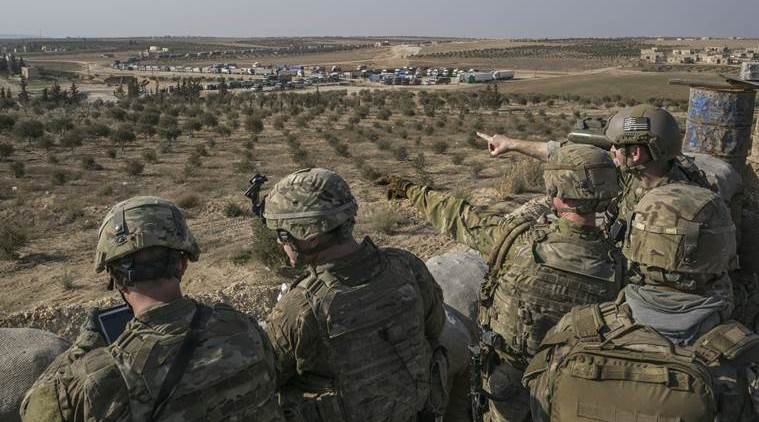
Image result for us troops syria
(New York Times)
I felt like a lonely voice around here in April 2017, when I condemned President Trump’s airstrikes on Syria as an unconstitutional act of war and an embarrassing contradiction of Trump’s broadsides against Obama for doing the same thing. I was therefore delighted when, addressing Syria a few months later, David asserted, “The Constitution cannot be discarded when it’s inconvenient.” He elaborated:
It’s past time for a true congressional vote on American engagement in Syria. Any argument that previous use-of-force resolutions applicable to Iraq or al-Qaeda also apply to the current conflict evaporate the instant American forces find themselves holding foreign territory in hostile opposition to the foreign sovereign. There is no credible argument that any current authorization allows American forces to occupy a single square inch of Syria without the consent of its government.
Amen. The Constitution is not a suggestion; it is our law. But this week, it is somehow not even a consideration. I hold no brief for Trump on Syria (as noted above, I believe his lawless aggression risked a wider war no one wants). But I find it remarkable that, as the president was rebuked across Capitol Hill — from Senator Lindsey Graham, who is a true believer in American adventurism, to Democrats, who will exploit any pretext to attack Trump — congressional critics never paused, ever so slightly, over the fact that the troops they want the president to keep in Syria were never authorized by Congress to be in Syria.
Some commentators sensed the problem but tried to finesse it, allowing that it would be good for Congress to have a “debate” about Syria because it would give clarity to the mission. That misses the point. The clarifying debate is a residual benefit we get from the constitutional necessity of obtaining congressional authorization before committing acts of war against other countries that have not threatened us. If the mission is not authorized, its clarity is immaterial.
Which brings me back, finally, to the excellent discussion on The Editors. Here’s David again, defending the mission:
This is one of the clearer missions that I’ve seen. This is not a nation-building mission. This is a mission that is a degrade and destroy a specified enemy, and then hold a geographic line against geopolitical foes who would seek to take that geography and crush our allies. That’s a clear mission
Yes, it’s clear. But so was David’s declaration, a year ago, that there is no lawful authorization in existence that “allows American forces to occupy a single square inch of Syria.” How, then, is it permissible for our forces to be “holding a geographic line” in a foreign country? What does it matter that, rhetorically speaking, Syria, Iran, and Russia are “geopolitical foes” if Congress has never authorized the use of force against them?
We all know the answer to this. Obama did not seek congressional authorization for combat operations in Syria because Congress would have refused. And Congress does not want any president to ask for authorization because members do not want to be accountable — they want to go on cable TV and whine that whoever is president has been heedless, whether for going in or for pulling out.
Want to declare war against ISIS? I’d be up for discussing that. Or, as a matter of honor, an authorization of military force to protect the Kurds for what they’ve done on our behalf? I could be persuaded. Or even a declaration of war against Iran — it wouldn’t require us to invade, but it might be useful as part of a real “maximum pressure” strategy, rather than just making mean faces at them in Syria. I’d be open to all of that; but not to more unprovoked military interventions that don’t have congressional authorization.
There is nothing for America in Syria. We haven’t defeated ISIS by taking its territory, and it wouldn’t matter if we did because sharia-supremacist culture guarantees that a new ISIS will replace the current one. The names change, but the enemy remains the same. And if you want to fight that enemy in an elective war, the Constitution demands that the people give their consent through their representatives in Congress.
ANDREW C. MCCARTHY — Andrew C. McCarthy is a senior fellow at the National Review Institute and a contributing editor of National Review

Thursday, November 22, 2018

Give Thanks That ISIS Is Going, Going . . .


By Deroy Murdock
November 22, 2018
Image result for operation inherent resolve
A U.S. Army Soldier, deployed in support of Combined Joint Task Force-Operation Inherent Resolve, waits while a CH-47 Chinook is refueled at Qayyarah West Airfield, Iraq. More than 60 Coalition partners have committed themselves to the goal of eliminating the threat posed by ISIS in Iraq and Syria and have contributed in various capacities to the effort. CJTF-OIR is the global Coalition to defeat ISIS in Iraq and Syria. (Cpt. Rachel Diehm/U.S. Army)

As Americans pause this week to give thanks, let us be grateful that the dramatically diminished ISIS caliphate is nearly crushed. And let’s applaud the Trump administration’s role in so severely reducing this threat.
As President Donald J. Trump took office, the Islamic State was not just another terrorist group. It was a Muslim-extremist mini-nation. Straddling Iraq and Syria, ISIS controlled some 17,500 square miles — visualize two New Jerseys — according to the Washington Examiner’s Jamie McIntyre.
Its 35,000 fighters enforced Sharia law, detonated historical sites, hurled gay men off of tall buildings, and displaced, persecuted, and slaughtered tens of thousands of Christians, Shiites, and Yazidis. Radical Muslim fools rushed in, boarded the jihadist bandwagon, and expanded ISIS’s bloody footprint from Paris to Brussels to San Bernardino. The Islamofascist group terrified Europeans and Americans. ISIS’s trained killers and Internet-inspired lone rats could attack anytime, anywhere.
But by last September, this veritable Islamic-terrorist country had shriveled to its last 200 square miles — an area roughly the size of Tulsa.
According to a September 27 Operation Inherent Resolve statement, this U.S.-led multinational effort is responsible for “liberating nearly 8 million Iraqis and Syrians from ISIS’s brutal rule and reducing its control of territory to approximately 1 percent of what it previously held.” The Syrian Democratic Forces have worked closely with American personnel to wipe out ISIS. Today’s military combat reportedly focuses on Deir az-Zour, ISIS’s holdout beside the Euphrates River.
“The fight is continuing, and we hope that it will be over in a few months and that will be the last of ISIS’s terrain that it holds in a quasi-conventional way,” Ambassador James Jeffrey, U.S. special envoy for Syrian engagement, told Reuters. “The enduring defeat means not simply smashing the last of ISIS’s conventional military units holding terrain, but ensuring that ISIS doesn’t immediately come back in sleeper cells, come back as an insurgent movement.”
ISIS has lost nearly all of its real estate. Perhaps more important, it has surrendered tons of prestige. Why would anyone brave the blazing sunshine and blistering sands to join the virtual mirage that is today’s Islamic State caliphate? This would be like fording the Rhine to fight for Nazi Germany — in March 1945.
Why is ISIS’s headquarters nearly gone with the wind? Obama’s pussyfooting yielded to President Trump’s robust attacks.
“The Obama White House micromanaged the war against ISIS and did a poor job of it,” Heritage Foundation national-security scholar Jim Phillips told me. “The Pentagon was forced to pull its punches because of tight political restrictions on the use of force. The Obama administration initially ruled out air strikes against ISIS-controlled oil fields and oil trucks carrying ISIS oil because of a fear of causing civilian casualties.” This brilliant policy made ISIS Earth’s wealthiest terrorist group, awash in petroleum revenues.
“President Trump deserves credit for removing counterproductive political restrictions on the U.S. military, escalating the air campaign, deploying U.S. advisers and special operations forces closer to the fighting, and accelerating the defeat of ISIS,” Phillips said. “The U.S. military did the bulk of the heavy lifting in the international campaign to defeat ISIS. Without U.S. involvement, ISIS would still be crucifying its opponents and holding non-Muslim women as sex slaves.”
These positive developments likely are news to most Americans. The Trump-hating old-guard media have sat on this story, lest the president enjoy any kudos for making America and the world safer from these bloodthirsty murderers (ISIS, not the press).
“Since Inauguration Day (January 20, 2017), the three broadcast network evening newscasts have spent more than 10,000 minutes on the Trump presidency, and only 33 minutes (0.33 percent) involved the administration’s handling of the fight against ISIS in Iraq and Syria,” Media Research Center analyst Bill D’Agostino wrote last month.
There you have it: President Trump has helped shrink ISIS by 99 percent, while his nightly-news tormentors have spent 99.7 percent of their time looking elsewhere.

Monday, October 22, 2018

UK: Anjem Choudary Released from Prison


by 
October 20, 2018

Prime Minister Theresa May has downplayed concerns over Choudary's release; British counter-terrorism authorities, however, say they are worried that he will re-exert influence on hundreds of followers upon his release. The cost to British taxpayers of keeping Choudary under surveillance is expected to exceed £2 million (€2.25 million; $2.6 million) a year, compared to the £50,000 (€57,000; $65,000) to keep him in prison.

Choudary, a 51-year-old born in Britain to Pakistani immigrants, has actively been promoting Islamic fundamentalism in Britain for more than three decades. In 1986, Choudary and an exiled preacher, Omar Bakri Mohammed, founded an Islamist group, al-Muhajiroun (Arabic: The Emigrants), a network of Salafi jihadists determined to spread Sharia law across Britain.

Al-Muhajiroun — which hailed the September 2001 jihadi attacks on the United States — was banned under the UK Terrorism Act 2000, in January 2010.

After that, al-Muhajiroun reinvented itself under an array of successor aliases. These included Islam4UK, Call to Submission, Islamic Path, Islamic Dawa Association, London School of Sharia, Muslims Against Crusades and Need4Khalifah, all of which have also been proscribed.

A November 2013 investigative report published by the anti-extremism charity Hope Not Hate concluded that al-Muhajiroun was "the single biggest gateway to terrorism in recent British history."

A September 2014 study published by the London-based Henry Jackson Societyfound that one in five terrorists convicted in Britain have had links to al-Muhajiroun.

In October 2018, during a debate in the House of Lords, Lord Anderson, a former independent reviewer of terrorism legislation, said that existing British law is insufficient to deal with Islamic radicalizers:
"Anjem Choudary has been mentioned, with good reason. As many as 25% of British jihadis convicted between 2001 and 2015 were associated with his organizations, outnumbering the 10% linked to al-Qaeda and the 5% linked to ISIS, or Daesh. His organizations also had great influence in northern Europe, yet although the police reported his activities to the Crown Prosecution Service 10 times between 2002 and 2015, no prosecution could be brought, whether for incitement to religious hatred, indirect encouragement to terrorism, inciting terrorism overseas, incitement to murder or proscription offences."
For years, Choudary, a lawyer by training, managed to stay "just within the law" by treading the fine legal line between the inflammatory rhetoric of Islamic supremacism and the right to free speech. Choudary — who called for the flag of the Islamic State to fly above Downing Street and wanted Buckingham Palace converted into a mosque and the Queen's face to be covered — was never been convicted of any offense, presumably much to the frustration of British authorities.

That scenario changed after the Islamic State proclaimed the establishment of an Islamic Caliphate in Iraq and Syria in June 2014. Police said that Choudary had become far more brazen and repeatedly crossed the legal threshold for criminal prosecution by encouraging terrorism.

In September 2014, Choudary pledged allegiance to the Islamic State anddeclared that the leader of the Islamic State, Abu Bakr al-Baghdadi, is "the caliph of all Muslims and the prince of the believers." Between June 29, 2014 and March 6, 2015, Choudary also uploaded a series of lectures on YouTube in which he invited support for the Islamic State. At the time, Choudary wasbelieved to have had links to as many as 500 jihadis who left Britain to join the Islamic State.

Police said the oath of allegiance was a "turning point" in terms of their ability to prosecute him. On September 25, 2014, Choudary and Mohammed Mizanur Rahman, of Palmers Green in London, were each charged under Section 12 of the Terrorism Act with one offense of inviting support for the Islamic State.Speaking to Sky News before his conviction, Choudary claimed that he was exercising his right to freedom of speech and had not broken the law: 
"If you look at my speeches, I have said the same thing for 20 years. For me, it is a matter of worship. If people are implementing the Sharia, then I cannot shy away from what the divine text says in relationship to that. If you cannot say when you believe in something and you cannot share that view, then you don't really have freedom to express yourself in this country."
Choudary also welcomed the prospect of spending time in prison: "If they arrest me and put me in prison, I will carry on in prison. I will radicalize everyone in prison."
On July 28, 2016, following a trial at the Old Bailey, Choudary and co-defendant Rahman, were found guilty of inviting support for the Islamic State. Both were sentenced to five-and-a-half years in prison.

Choudary spent some of his sentence in a special "separation unit" for dangerous extremists inside Frankland Prison in County Durham, to limit his possible influence over other inmates. He was released from Belmarsh prison in south-east London on October 19.

It is probable that Choudary will carry on as before: During his time in prison,according to the BBC, Choudary refused to take part in deradicalization programs.

Choudary will spend the rest of his sentence on "license" (parole) in the community, as part of attempts to reintegrate him and reduce the risk of reoffending. He must comply with 25 conditions that his release team, made up of probation and police officers, believe are necessary and proportionate to manage the risk he may still pose. If he breaches them, he risks being recalled to prison.

Several British officials downplayed the significance of Choudary's release. Prime Minister Theresa May said that "obviously he's an extremist preacher" but "if and when any terrorist offender is released, well-rehearsed plans are put in place to keep the public safe."

Mark Rowley, the Metropolitan Police's former assistant commissioner and former national lead for the UK's counter-terrorism policing, said it was important not to overstate Choudary's influence:
"At the end of the day he is a pathetic groomer of others.That is what he has done in the past. He is not some sort of evil genius we all need to be afraid of. I think we have to recognize that radicalizers look to generate a profile, look to prey on the vulnerable and we need to be thoughtful about how we report their activity."
Rowley also criticized the media's elevation of individuals like Choudary:
"It's pretty depressing if you Google 'UK Muslim spokesman' and he comes up as the first hit. For goodness sake, we have a very impressive Muslim mayor of London, a Muslim home secretary and he comes up as the first hit. On YouTube he is four of the first 10 videos. 
"That is giving him a profile because these companies chase your attention through the salacious and contentious rather than through anything accurate or responsible.That is the disgrace in this and it gives people like him, who is a sad individual, more credibility and more attention than they deserve."
Others vehemently disagree. Prisons Minister Rory Stewart admitted that Choudary remains a "genuinely dangerous" individual; he added that the "completely pernicious" cleric would be watched "very, very carefully" by police and security services.

Richard Walton, a former head of Scotland Yard's counter-terrorism command, said that British authorities were underestimating the threat Choudary presents:
"I would describe him as a hardened terrorist, somebody who has had huge influence on the Islamist extremist scene in this country over many years. I believe we are underestimating the potency and danger of the radicalizers who don't carry knives, guns and overtly plot terrorist attacks but who pollute the minds of young Muslim men."
A former member of al-Muhajiroun, Adam Deen, who is now a director of the anti-extremist group Quilliam, warned that "it's highly unlikely that he's reformed and being out of prison he would definitely get lots of credence from his followers." Deen added:
"Restrictions are not going to stop Anjem's act. Be it middle-men or whoever, he will find a way to make an impact. I would be very surprised if he has in any way been reformed by prison. He has too much invested in his image. Some think he doesn't mean what he says, but he does. It's the scariest thing about him."
David Videcette, a former counter-terrorism officer, added:
"[Choudary] is aware of what the law allows him to say and what not to say, and he rarely steps over the line. He knows how not to get himself into trouble. We were extremely lucky to find some material showing him promoting IS that allowed us to put him away. He remains a danger to anyone with whom he comes into contact — those who are vulnerable and impressionable. 
"Goading is part of his strategy. He wants to drive a wedge between the Muslim community and the secular community. Terrorism is about polarizing views. Muslims are left alone by the main population and that allows extremists to thrive within that community.
"Choudary is one of the few public faces of Islamist extremism.There are not many people with his public persona, but several hundred who behind closed doors share his views. He is at the top of a hierarchical structure that at its base has about 20,000 people who are known to have contact with these hundreds of advisers."
The head of the anti-extremist group Faith Matters, Fiyaz Mughal, spoke of his interaction with an imam who was brought into prison to try to deradicalize Choudary:
"Choudary was put in containment that stops him engaging with other prisoners, but also given pastoral care to see if they could get through to him. I asked the guy who spoke to him if the de-radicalization program had worked and he said, 'No, he's got worse. He's hardened. He speaks in the mind-set of the victim. He sees himself as a martyr the state tried to silence.'"
"He [Choudary] should have served the full term. It's a terrible day for victims of the attacks he has helped incite. We need a change in the law so that anyone named as the inciter in two terrorist attacks should automatically serve the full sentence."
Only hours after Choudary arrived at a halfway house, where he will spend the next six months before being allowed to return home, he held a staged photo session. Choudary smiled and waved to the cameras — but said nothing, mindful not to breach his parole conditions, which prevent him talking to the media.

Choudary is now considering mounting a legal challenge to the strict conditions of his release, according to the Telegraph. It reported that he has applied for legal aid funding, at taxpayer expense, to bring his action against government ministers, and arguing the parole conditions breach his human rights.

Soeren Kern is a Senior Fellow at the New York-based Gatestone Institute.