Showing posts with label Charles Krauthammer. Show all posts

Saturday, June 23, 2018

The Indispensable Man


Charles Krauthammer, R.I.P.

June 22, 2018
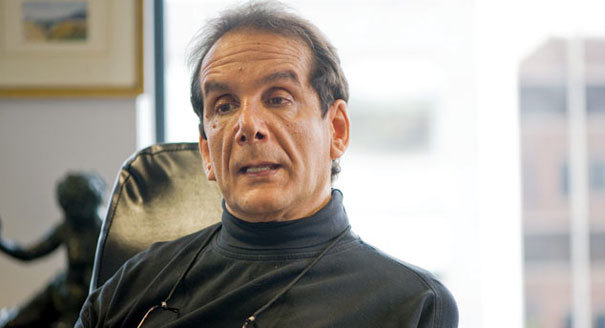
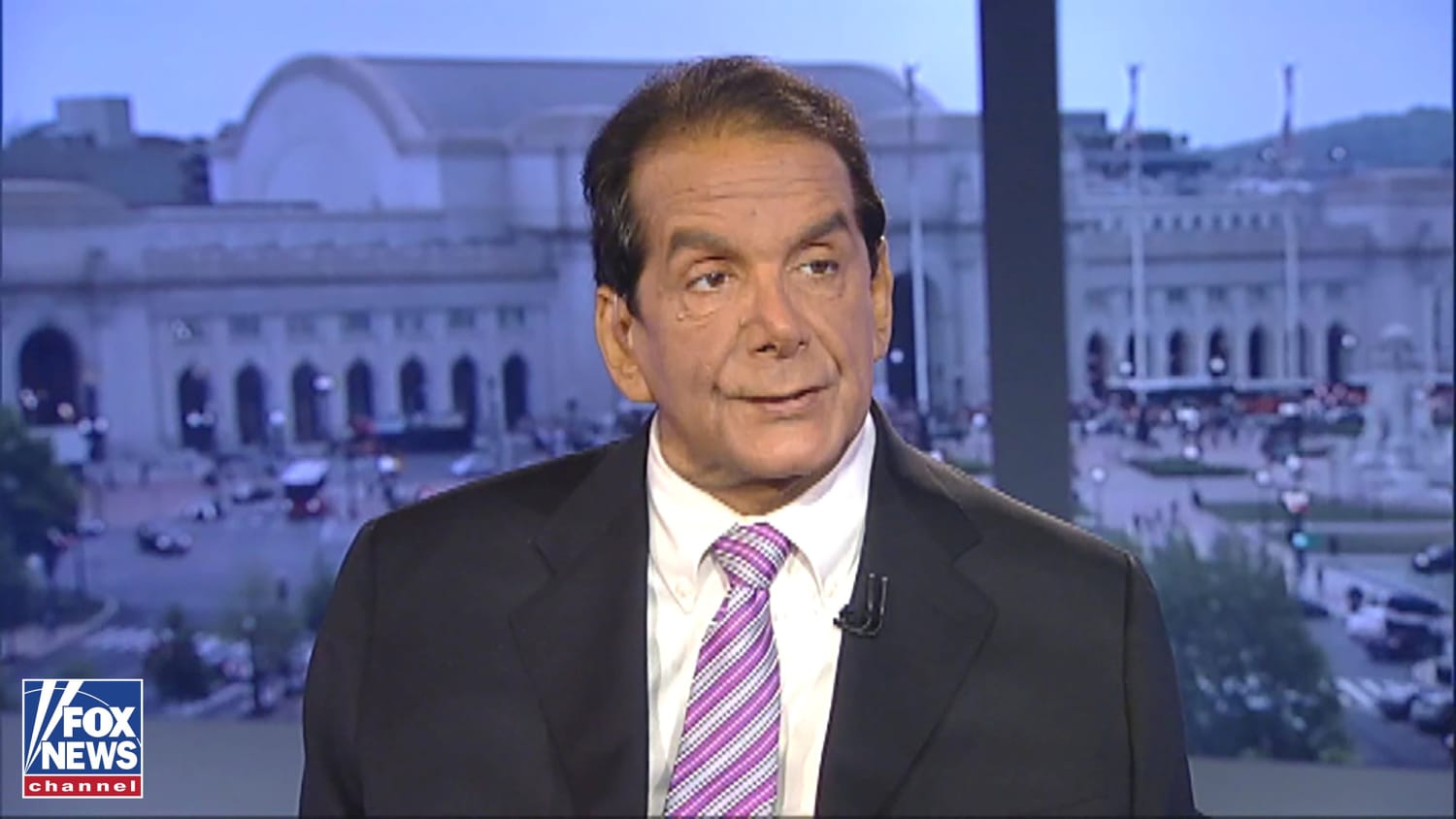
Related image

It’s hard to put your finger on what caused millions of readers to develop a deep personal attachment to Charles Krauthammer, who died yesterday at 68, but the clearest sign of this extraordinary sentiment came from the Washington Nationals baseball team: they held a moment of silence for Charles at their home game last night. Many great writers and thinkers among us command our respect and attention, but the outpouring of emotion expressed now, and since his announcement two weeks ago that he had but a short time to live, tells us that he existed in a class by himself. His poignant farewell statement called forth the insight of Seneca, who said that it is the hallmark of a well-regulated mind to be able to call a halt at will and dwell at peace within itself.
The clarity of his writing and the precision of his comments on television had a nearly hypnotic effect. Charles was riveting, and usually decisive. He may not have literally had the last word on an issue, but such was his gravitas that when he finished speaking, the subject was done. The measured pace of his speech was directly related to his disability; he needed to regulate his breathing carefully. A lot of viewers never knew that he was confined to a wheelchair and had very limited use of his arms, the result of a tragic accident at age 22. Maybe this is the key to understanding why he became such a compelling person.
I’ve wondered whether Charles’s disability in some way contributed to his laser-like clarity and lucidity of his prose. You often hear that people who can’t see develop a keener sense of hearing, or that humans compensate in other ways for specific disabilities. Pascal said that all the ills that afflict a man proceed from one cause—the inability to sit quiet and contentedly in a room. Charles had no choice in the matter, though I’ve seldom perceived someone so energetic. And he didn’t let his disability limit his mobility all that much. I once watched as he sped down the sidewalk in Washington in his powered wheelchair—a typical sight, I’m told. He had a specially outfitted van with custom hand controls that he could drive himself, usually to Nationals baseball games after he finished a stint on the Special Report panel on Fox.
I didn’t know him well, but you only needed to spend a short time in his company to appreciate his generosity and humor. In person, he had a wry smile that you only seldom caught on TV. At a small gathering in San Francisco two years ago, I asked him what costume he might wear if he went trick or treating. His answer, accompanied by a mischievous grin: “I’d like to dress up as one of those creepy clowns . . . and show up at Ruth Bader Ginsburg’s front door!”
At an age when he might have started to scale back and enjoy more leisure, Charles did just the opposite. The election of Barack Obama in 2008 energized him and stimulated his combativeness, and suddenly he stepped up his television appearances to mount a sustained critique of the new administration. He never openly or directly admitted his motivation for this, but you got the sense that duty as much as interest drove his exertions to provide a vigorous opposition to Obama’s machinations.
It was my privilege to host and introduce him for speeches on three occasions in California. Here’s part of what I said then, which I can’t improve on just now:
Charles Krauthammer’s complete biography, both literary and personal, is extraordinary, but also very long, and that’s what the Internet is for.  So I will move quickly to the main event with a single observation drawn from one of his articles included in his new collection, Things That Matter.
It is from his fine essay about Winston Churchill.
These two men have many things in common.  Both have a wit as dry as a properly mixed martini.  They both exhibit an unparalleled intellectual capaciousness, enabling a supremely wide range in their writing.  Both men dictate their prose.
Charles may think my comparison of him to the great statesman is extravagant, but I do not think so, for this simple reason: Charles rightly refers to Churchill in his essay as “the indispensable man.”  Well, for those of us trying to make sense of what is happening in our country right now, Charles is our indispensable man.
I will miss the indispensable Charles Krauthammer, along with millions of other Americans.

A Tribute to Charles Krauthammer


By David M. Weinberg
https://www.jpost.com/Opinion/A-tribute-to-Charles-Krauthammer-560590
June 21, 2018

Image result for charles krauthammer

Dr. Charles Krauthammer, perhaps the most luminous and incisive columnist of this generation, announced two weeks ago that he was stricken with terminal cancer and had only weeks to live. I feel an obligation to pay homage to this incredible man, and to add a Jewish, Zionist and personal angle to the many tributes to him that have rightly poured forth.

For 38 years, Krauthammer’s columns, essays, and lectures have stood as pillars of conservative principle and moral clarity.


On foreign policy matters, he was unquestionably the most radiant intellectual hawk in America, and on Middle East affairs he was the most consistent defender of Israel and the US-Israel special relationship.

Two examples of his razor-sharp writing regarding Israel and American Mideast policy will suffice, among hundreds of exhibits.

Krauthammer wrote in 2014 about “Kafkaesque ethical inversions” that make for Western criticism of Israel. “The world’s treatment of Israel is Orwellian, fueled by a mix of classic antisemitism, near-total historical ignorance and reflexive sympathy for the ostensible Third World underdog,” he wrote.

He understood that eruptions featuring Palestinian casualties (such as recent Hamas assaults on the Gaza border) were “depravity.”

“The whole point is to produce dead Palestinians for international television; to deliberately wage war so that your own people can be telegenically killed; indeed, moral and tactical insanity,” he said. “But it rests on a very rational premise. The whole point is to draw Israeli counter-fire; to produce dead Palestinians for international television, and to ultimately undermine support for Israel’s legitimacy and right to self-defense.”


In 2015, he repeatedly skewered then-president Barack Obama’s nuclear deal with Iran, calling it “the worst agreement in U.S. diplomatic history.”

To Obama, he wrote accusingly: “You set out to prevent proliferation and you trigger it. You set out to prevent an Iranian nuclear capability and you legitimize it. You set out to constrain the world’s greatest exporter of terror threatening every one of our allies in the Middle East and you’re on the verge of making it the region’s economic and military hegemon.”

Krauthammer’s profound understanding of Jewish history, his admiration for Israel, and his very deep concern for its future were on fullest display in a magisterial essay he published in The Weekly Standard in 1998 entitled “At Last, Zion.”

The essay conducted a sweeping analysis of Jewish peoplehood, from Temple times and over 2,000 years of Diaspora history to the modern return to Zion.

Krauthammer understood that American Jewry was dying. “Nothing will revive the Jewish communities of Eastern Europe and the Islamic world. And nothing will stop the rapid decline by assimilation of Western Jewry.” The dynamics of assimilation were inexorable in America and elsewhere, he wrote.

Israel, Krauthammer understood, was different. “Exceptional,” he called it – because Israel was about “reattachment of Russian and Romanian, Uzbeki and Iraqi, Algerian and Argentinean Jews to a distinctively Hebraic culture,” and this gave it civilizational and societal staying power for the long term.

Israel “is now the principal drama of Jewish history,” he wrote. “What began as an experiment has become the very heart of the Jewish people – its cultural, spiritual, and psychological center, soon to become its demographic center as well. Israel is the hinge. Upon it rest the hopes – the only hope – for Jewish continuity and survival.”

However, because the “cosmology of the Jewish people has been transformed into a single-star system with a dwindling Diaspora orbiting around,” Krauthammer was apprehensive. It frightened him that “Jews have put all their eggs in one basket, a small basket hard by the waters of the Mediterranean. And on its fate hinges everything Jewish.”

Israel’s centrality, he feared, was a “bold and dangerous new strategy for Jewish survival” because of the many security threats posed to the country, chiefly among them the specter of Iranian nuclear weapons.

Indeed, Krauthammer’s essay “thinks the unthinkable” and “contemplates Israel’s disappearance.” And while Jewish political independence has been extinguished twice before and bounced back following centuries of dispersion, Krauthammer doubted that the Jewish People could pull the trick again. “Twice Jews defied the norm [and survived Diaspora]. But never, I fear, again.”

I challenged Krauthammer about his pessimistic perspective on the survival of Israel and the Jewish People at a Tikvah Fund seminar in 2016, where he engaged the Fund’s erudite chairman, Roger Hertog, in the deepest of conversations on strategy and identity.

In this lengthy conversation (which you can watch and read online; search Charles Krauthammer At Last Zion Tikvah), Krauthammer admitted to “trembling doubt” about God alongside belief in some transcendence in the universe, and then he repeated his sobering solicitudes about Israel’s precariousness. He spoke of the impossibility of a fourth Jewish commonwealth – were Israel, transcendence forbid, to be crushed.

I gently reproached Krauthammer on theological terms, by saying that “those of us who moved to Israel out of a grand meta-historic sense of drama believe that our third Jewish commonwealth won’t fail. Whatever it takes, we’ll make it work.”

I sensed that Krauthammer was glad for my emotive intervention, since he immediately and poignantly responded (in Hebrew): “Netzach Yisrael lo yishaker [The eternity of Israel will not lie, or fail].”

Krauthammer: “That’s what my father used to say when he talked about Israel. I too feel as an obligation to make sure of that throughout my life. I have done what I could, because that prospect [Israel’s disappearance] would make everything I’ve done lose its value. There’s nothing more important than that.”

And then referencing my aliyah, Krauthammer said, “I honor your choice… I commend you for that.” (He went on to describe how he too considered moving to Israel after college, at the urging of his then-philosophy professor David Hartman).

And then Krauthammer asked me: “I wonder what it’s like, and maybe you could tell me, to be an Israeli putting your kids on a school bus, raising them while knowing that one day Iran could have the bomb? Once the nuclear bomb is in the hands of genocidists – then what does that feel like? Do you think there might be emigration as a result? Do you have a feeling about that?” I answered: “My personal sense is that Israeli society is becoming more traditional, more deeply rooted, more ideological than before. I’m talking even about secular Israeli society. So we’re digging- in for the long term, and not being frightened away despite the shadow that you’re talking about.”

And Krauthammer responded to me, again in Hebrew: “As you people say, ‘kol ha-kavod [Well done].’” 

So now it’s time for me to return the compliment, and say to Dr. Charles Krauthammer in his dying days: kol ha-kavod to you! On behalf of so many Jews, Americans and Israelis alike, thank you for your resilience, brilliance and steadfast support. We miss you already.


The author is vice president of the Jerusalem Institute for Strategic Studies, jiss.org.il. His personal site is davidmweinberg.com.


Friday, June 22, 2018

An Example and an Immortal


By 
https://www.nationalreview.com/corner/an-example-and-an-immortal/
June 21, 2018

Image result for charles krauthammer

I can’t pay tribute to Charles Krauthammer in a little post — I owe him so much — but here goes.
I suppose I first read him in about 1983, in The New Republic. I also read him in Time. These were early college years for me. I can’t tell you how important he was to those of us migrating rightward (as he was). It was daunting to reject the Left and join the Right. Krauthammer said, in effect, “Don’t worry — we’re doing what we must. Here are the reasons.”
He wrote something, and you could wave it around, saying, “See? See? This is what I mean. This is what I wish to say.”
In his Democratic days, he wrote speeches for Mondale, about which the Right teased him ever after. “I loved him,” he once told me about Mondale. (He said the same about Reagan.) Recently, I read and reviewed a book about the Carter presidency by Stuart Eizenstat, Carter’s chief domestic-policy adviser. Mondale is quoted throughout, enjoyably. I could see why Krauthammer loved him.
In 1995, President Clinton gave a speech that vexed me (more than most of his speeches did). I was hoping that Krauthammer would respond, in his Friday column. I waited for that day. And when it arrived, I bought the Washington Post, and, lo, Krauthammer had.
I had to drive to work — but I didn’t want to wait till I got there to read the column. I read it on the way, at stoplights and maybe a little in between.
 wrote Krauthammer a letter to thank him for the column — and I told him how I had read it. “Thank you,” he answered. “But next time, at stoplights only, please.”
When I write about music — about performance — I’ll sometimes say, “It had the quality of just-rightness.” It was just right in tempo, phrasing, dynamics, nuance, architecture, spirit, understanding. So it was with Krauthammer, time and time again. Just right.
He knew the value of liberal democracy, and countered its enemies, on all sides. He knew the true nature and the importance of America. He stood up for Israel. He loved baseball — like his fellow Washington Post conservative George Will — and spoke about it compellingly.
A few years ago, I was doing a Q&A with him in front of an audience. I said, “I often see baseball diamonds grassed over for soccer. Tell me: Is soccer evil?” “Yes,” he said, and expounded. The audience laughed and laughed. I wish I had a tape of Dr. K.’s remarks.
(To be clear, he was kidding about soccer. Mainly.)
I guess I’ve been talking with Charles for 20, 25 years, and writing about him, citing him . . . Here is a longish piece from 2009. Here is a podcast from 2015. Last August, I said, “How about another podcast?” He said of course, “but I must delay. I’m having surgery tomorrow and will be incapacitated for about two weeks. Let’s plan for shortly after that.”
He was important to us at every stage, in the course of his career. He was definitely important in this current period, when the Republican party and the conservative movement have changed dramatically. Last year, I thanked him (as one did) for something he had written. He answered, “I must admit that when I write these days I have the feeling that everything I say is so perfectly obvious that there’s no need to write it. Except that these days, that’s all the more reason to write it.”
Yes, yes.
I could go on and on, but I suppose I’ll finish by saying I loved him and will be forever grateful for him. Forgive me for writing so personally in this tribute — so much “I.” Charles Krauthammer left a deep mark on me, as on so many, I know. A sage and a prince he was. Is.
And should I mention the physical courage that few of us could have known about? Physical, mental, and spiritual courage? The obstacles that he had to surmount, to carry on with life — and a brilliant, useful, and indelible life, at that?
An example and an immortal.
JAY NORDLINGER — Jay Nordlinger is a senior editor of National Review and a book fellow at the National Review Institute.

The irreplaceable Charles Krauthammer

June 22, 2018

Related image

Having worked in Washington conservative circles for over a decade, I wish I had a great personal anecdote to share about Charles Krauthammer, who by all accounts was as wonderful a human being as he was a writer.
Unfortunately, on the few occasions on which I had the opportunity to meet him, I was too tongue-tied and bumbling to sustain any sort of conversation, not quite knowing what to say to a man who I felt I had so much to say.
As part of my job, I’ve had to interact with a number of public figures, and typically have had no qualms about pressing cabinet officials, presidential candidates, or members of Congress. Yet why is it that of all the people I’ve met in this city, I was so awestruck in the presence of another writer?
Of course, the answer is that it’s because Krauthammer wasn’t just another writer. In an era of YouTube and social media, when anybody with an Internet connection can spout out an opinion that could potentially go viral, it seems absurd to think of any political pundit as irreplaceable. Yet that’s the word I keep coming back to when I think of the sad passing of Charles Krauthammer. He is simply irreplaceable.
To start, Krauthammer was undeniably brilliant. After graduating from Harvard Medical School, he was well on his way to making a name for himself as a psychiatrist before changing course and entering the world of political writing. The fact that he was able to shift gears so seamlessly speaks to his mental agility.
But there are a lot of people who are brilliant. What was different about Krauthammer is that he was able to use his intellect to form opinions and then communicate them in an accessible way to broader audiences without dumbing down his arguments.
The 800-word column format presents a challenge to writers, who often struggle to make a broader point and provide enough evidence to back it up, without going into excessive detail. Krauthammer was a master of the format. Read through his columns, and they weren’t typically filled with fancy prose or lengthy Latin phrases. Instead, his intelligence came through in the clarity of his thought and his ability to work through issues with reason using just enough supporting evidence.
His column ran every Friday, and while the rest of us rushed to weigh in on the ongoing controversies in Washington that consumed any given week, he managed to write something that took a bigger picture view, simultaneously seeming obvious yet fresh. For many conservatives, his columns often expressed ideas that were kind of floating around in their minds, but that they couldn’t quite articulate as clearly. He coined the term the ”Reagan Doctrine” to describe President Ronald Reagan’s strategy to win the Cold War, and “Bush Derangement Syndrome” to diagnose the hysterical way that opponents reacted to President George W. Bush.
Under President Barack Obama, Krauthammer set the standard for substantive criticism that was harsh yet steered clear of the bile and conspiratorial thinking that tempted some conservative pundits. Whether the issue was Obamacare, the disastrous Iran deal, executive overreach, or his parting shot toward Israel at the U.N., Krauthammer offered blistering yet fair critiques of Obama’s presidency.
Krauthammer made no secret of his disapproval of President Trump and fretted about the awful choice in the 2016 election, yet in his final column written last year, he expressed relief that the guardrails of democracy seemed to be keeping Trump’s worst impulses in check.
Perhaps above all, Krauthammer managed to convey a sense of moral clarity, something that was on full display whenever he wrote about Israel, and was also demonstrated in a powerful 2004 column in which he grappled with the issue of stem cell research and where to draw the line on medical experimentation given the “competing human values” of searching for cures and respecting life.
“When I was 22 and a first-year medical student, I suffered a spinal-cord injury,” he wrote. “I have not walked in 32 years. I would be delighted to do so again. But not at any price. I think it is more important to bequeath to my son a world that retains a moral compass…”
Charles Krauthammer has left this world far too soon and will be sorely missed, but his legacy will not soon be forgotten.

America Lost Its Greatest Political Commentator in Krauthammer


BY ROGER L SIMON 
https://pjmedia.com/rogerlsimon/america-lost-its-greatest-political-commentator-in-krauthammer/
June 22, 2018

Image result for charles krauthammer

When you call someone the greatest at anything, you risk being accused of foolishness or worse; but it's safe to say that Charles Krauthammer, who passed away Thursday, was the greatest political commentator of our time.

I write this not just because he won the Pulitzer for commentary as a conservative, a near Herculean task.  And I say this even though I sometimes  disagreed with him, especially lately. Whom do we not disagree with at one time or another -- even ourselves?

I write this because Krauthammer was the gold standard of columnists, the most incisive mind in political journalism augmented by the most elegant and precise prose. For much of his life, no one was even close.  In recent years, others have stepped forward as Charles had, as happens after many years in the limelight, more difficulty wrapping his mind around contemporary events.  But as we now know, he was desperately ill.

That he was ill most of his life made many of us underestimate how serious it was despite Charles' own warnings of his demise, because his personal bravery was legendary.  He was a profile in courage if anyone was, having overcome that diving accident that made him a paraplegic days before entering Harvard Medical School.  And then, to everyone's amazement, continuing on and graduating at the top of his class, only to abjure the psychiatric career for which he was training.

With characteristic wit, he called himself a psychiatrist in "remission."  That was a remission that benefited the mental health of the country as, first as a liberal with The New Republic, he entered the journalistic world.  But his keen analytical mind wouldn't allow him to remain an orthodox liberal for long.  He was among the first to recognize there was actual political depth behind Ronald Reagan's affable California facade and wrote (for Time magazine in 1985 -- imagine that today) "The Reagan Doctrine," coining a phrase that lasted. From there, he continued to migrate rightward.

What Krauthammer accomplished was to show that conservatives (not liberals or progressives) were the true smart guys, that conservatives could be cool.  He showed the way for an entire generation in that regard.

In a sense he was the living embodiment of the saying oft-attributed (probably wrongly) to Churchill that "a man who isn't a liberal in his twenties has no heart; a man who isn't a conservative in his thirties has no brain." (This quote obviously was originated some time ago before a time when people waited until forty-seven to grown up.)

I only met Krauthammer briefly, bumping into him through my friend Lionel Chetwynd with whom I did the Poliwood show on PJTV.  Charles, a film buff, was interested in what we were doing. I also attended the Churchill dinner of The Claremont Institute at which he was the principal speaker.  The man was genuinely funny, for me always a sign of intelligence.

Is this where I'm supposed to say RIP?  Okay, RIP!  If anyone deserves a peaceful rest, Charles Krauthammer does.  The man loved his country and fought for it every single day.

Roger L. Simon - Co-founder and CEO of PJ Media - is a novelist and screenwriter.

Charles Krauthammer, a Diagnostician of Our Public Discontents

By George Will
June 21, 2018
Image result for charles krauthammer
When he was asked how to become a columnist, Charles Krauthammer would say, with characteristic drollery, “First, you go to medical school.” He did, with psychiatry as his specialty because, he said with characteristic felicity, it combined the practicality of medicine and the elegance of philosophy. But he also came to the columnist craft by accident. Because of one.
It has been said that if we had to think about tying our shoes or combing our hair we would never get out of the house in the morning. Life is mostly habitual — do you actually remember any details of driving home last evening? The more of life’s functions that are routinely performed without thinking, the more thinking we can do. That, however, is not how life was for Charles after his accident.
In 1972, when he was a 22-year-old student at Harvard Medical School, he was swimming in a pool. Someone pushed the diving board out, extending over a shallower part of the pool. Charles, not realizing this, dove and broke his neck. At the bottom of the pool, “I knew exactly what happened. I knew why I wasn’t able to move, and I knew what that meant.” It meant that life was going to be different than he and Robyn had anticipated when they met at Oxford.
He left two books at the pool. One was a text on the spinal cord. The other was Andre Malraux’s novel Man’s Fate.
Paralyzed from the neck down, he completed medical school, did an internship and, one thing leading to another, as life has a way of doing, became not a jewel in the crown of the medical profession, which he would have been, but one of America’s foremost public intellectuals. Nothing against doctors, but the nation needed Charles more as a diagnostician of our public discontents.
During the 1980 presidential campaign, Charles wrote speeches for the Democratic vice presidential candidate, Walter Mondale, who did not realize — neither did Charles — that the campaign harbored a thinker who soon would be a leading light of contemporary conservatism. Dictating columns when not driving himself around Washington in a specially designed van that he operated while seated in his motorized wheelchair, crisscrossing the country to deliver speeches to enthralled audiences, Charles drew on reserves of energy and willpower to overcome a multitude of daily challenges, any one of which would cause most people to curl up in a fetal position. Fortunately, with more brain cells to spare than the rest of us have to use, he could think about doing what was no longer habitual, and about national matters, too.
Charles died at 68, as did, 19 years ago, Meg Greenfield, the editor of the Washington Post‘s editorial page. For many years, Meg, Charles, and this columnist met for Saturday lunches with a guest — usually someone then newsworthy; now completely forgotten — at a Washington greasy spoon whose name, the Chevy Chase Lounge, was grander than the place. Like Meg, Charles was one of those vanishingly rare Washingtonians who could be both likable and logical. This is not easy in a town where the local industry, politics — unlike, say, engineering; get things wrong and the bridges buckle — thrives on unrefuted errors.
Medicine made Charles intimate with finitude — the skull beneath the skin of life; the fact that expiration is written into the lease we have on our bodies. And his accident gave him a capacity for sympathy, as Rick Ankiel knows.
Ankiel was a can’t-miss, Cooperstown-bound pitching phenomenon for the St. Louis Cardinals — until, suddenly and inexplicably, he could not find the plate. Starting the opening game of a playoff series at age 21, the prodigy threw five wild pitches and his career rapidly spiraled far down to . . . resurrection as a 28-year-old major league outfielder, for a short but satisfying stint in defiance of F. Scott Fitzgerald’s dictum that there are no second acts in a life. As Charles wrote, Ankiel’s saga illustrated “the catastrophe that awaits everyone from a single false move, wrong turn, fatal encounter. Every life has such a moment. What distinguishes us is whether — and how — we ever come back.”
The health problems that would end Charles’s life removed him from the national conversation nine months ago, so his legion of admirers already know that he validated this axiom: Some people are such a large presence while living that they still occupy space even when they are gone.
GEORGE WILL — George Will is a Pulitzer Prize–winning syndicated columnist. His email address is georgewill@washpost.com.

Friday, January 20, 2017

Obama’s self-revealing final act


By Charles Krauthammer
January 19, 2017
President Barack Obama gives his final presidential news conference Wednesday at the White House,
Nicholas Kamm/AFP/Getty Images
President Barack Obama gives his final presidential news conference Wednesday at the White House. (Nicholas Kamm/AFP/Getty Images)
Barack Obama did not go out quietly. His unquiet final acts were, in part, overshadowed by a successor who refused to come in quietly and, in part, by Obama’s own endless, sentimental farewell tour. But there was nothing nostalgic or sentimental about Obama’s last acts. Two of them were simply shocking.
Perhaps we should have known. At the 2015 White House correspondents’ dinner, he joked about whether he had a bucket list: “Well, I have something that rhymes with bucket list.”
Turns out, he wasn’t kidding. Commuting the sentence of Chelsea Manning, one of the great traitors of our time, is finger-in-the-eye willfulness. Obama took 28 years off the sentence of a soldier who stole and then released through WikiLeaks almost half a million military reports plus a quarter-million State Department documents.
The cables were embarrassing; the military secrets were almost certainly deadly. They jeopardized the lives not just of American soldiers on two active fronts — Iraq and Afghanistan — but of locals who were, at great peril, secretly aiding and abetting us. After Manning’s documents release, the Taliban “went on a killing spree” (according to intelligence sources quoted by Fox News) of those who fit the description of individuals working with the United States.
Moreover, we will be involved in many shadowy conflicts throughout the world. Locals will have to choose between us and our enemies. Would you choose a side that is so forgiving of a leaker who betrays her country — and you?
Even the word “leaker” is misleading. “Leak” makes it sound like a piece of information a whistleblower gives Woodward and Bernstein to expose misdeeds in high office. This was nothing of the sort. It was the indiscriminate dumping of a mountain of national security secrets certain to bring harm to American troops, allies and interests.
Obama considered Manning’s 35-year sentence excessive. On the contrary. It was lenient. Manning could have been — and in previous ages, might well have been — hanged for such treason. Now she walks after seven years.
What makes this commutation so spectacularly in-your-face is its hypocrisy. Here is a president who spent weeks banging the drums over the harm inflicted by WikiLeaks with its release of stolen materials and emails during the election campaign. He demanded a report immediately. He imposed sanctions on Russia. He preened about the sanctity of the American political process.
Over what? What exactly was released? A campaign chairman’s private emails and Democratic National Committee chatter, i.e., campaign gossip, backbiting, indiscretions and cynicism. The usual stuff, embarrassing but not dangerous. No national security secrets, no classified material, no exposure of anyone to harm, just to ridicule and opprobrium.
The other last-minute Obama bombshell occurred four weeks earlier when, for the first time in nearly a half-century, the United States abandoned Israel on a crucial Security Council resolution, allowing the passage of a condemnation that will plague both Israel and its citizens for years to come. After eight years of reassurance, Obama seized the chance — free of political accountability for himself and his potential Democratic successor — to do permanent damage to Israel. (The U.S. has no power to reverse the Security Council resolution.)
Daniel Patrick Moynihan, the U.S. ambassador to the U.N. who went on to be a great Democratic senator, once argued passionately that in the anti-American, anti-democratic swamp of the U.N., America should act unwaveringly in opposition and never give in to the jackals. Obama joined the jackals.
Why? To curry favor with the international left? After all, Obama leaves office as a relatively young man of 55. His next chapter could very well be as a leader on the international stage, perhaps at the U.N. (secretary-general?) or some transnational (ostensibly) human rights organization. What better demonstration of bona fides than a gratuitous attack on Israel? Or the about-face on Manning and WikiLeaks? Or the freeing of a still unrepentant Puerto Rican terrorist, Oscar Lopez Rivera, also pulled off with three days remaining in his presidency.
A more likely explanation, however, is that these are acts not of calculation but of authenticity. This is Obama being Obama. He leaves office as he came in: a man of the left, but possessing the intelligence and discipline to suppress his more radical instincts. As of Nov. 9, 2016, suppression was no longer necessary.
We’ve just gotten a glimpse of his real self. From now on, we shall see much more of it.

Friday, December 23, 2016

Aleppo and American decline


December 22, 2016
Image result for aleppo
Residents look for survivors at a damaged site after what activists said was a barrel bomb dropped by forces loyal to Syria's President Bashar al-Assad in the Al-Shaar neighborhood of Aleppo, Syria, September 17, 2015.ABDALRHMAN ISMAIL/REUTERS
The fall of Aleppo just weeks before Barack Obama leaves office is a fitting stamp on his Middle East policy of retreat and withdrawal. The pitiable pictures from the devastated city showed the true cost of Obama’s abdication. For which he seems to have few regrets, however. In his end-of-year news conference, Obama defended U.S. inaction with his familiar false choice: It was either stand aside or order a massive Iraq-style ground invasion.
This is a transparent fiction designed to stifle debate. At the beginning of the civil war, the popular uprising was ascendant. What kept a rough equilibrium was regime control of the skies. At that point, the United States, at little risk and cost, could have declared Syria a no-fly zone, much as it did Iraqi Kurdistan for a dozen years after the Gulf War of 1991.
The U.S. could easily have destroyed the regime’s planes and helicopters on the ground and so cratered its airfields as to make them unusable. That would have altered the strategic equation for the rest of the war.
And would have deterred the Russians from injecting their own air force — they would have had to challenge ours for air superiority. Facing no U.S. deterrent, Russia stepped in and decisively altered the balance, pounding the rebels in Aleppo to oblivion. The Russians were particularly adept at hitting hospitals and other civilian targets, leaving the rebels with the choice between annihilation and surrender.
They surrendered.
Obama has never appreciated that the role of a superpower in a local conflict is not necessarily to intervene on the ground, but to deter a rival global power from stepping in and altering the course of the war. That’s what we did during the 1973 Yom Kippur War, when Moscow threatened to send troops to support Egypt and President Nixon countered by raising America’s nuclear alert status to Defcon 3. Russia stood down.
Less dramatically but just as effectively, American threats of retaliation are what kept West Germany, South Korea and Taiwan free and independent through half a century of Cold War.
It’s called deterrence. Yet Obama never had the credibility to deter anything or anyone. In the end, the world’s greatest power was reduced to bitter speeches at the United Nations. “Are you truly incapable of shame?” thundered U.S. Ambassador Samantha Power at the butchers of Aleppo. As if we don’t know the answer. Indeed the shame is on us for terminal naivete, sending our secretary of state chasing the Russians to negotiate one humiliating pretend cease-fire after another.
Even now, however, the Syria debate is not encouraging. The tone is anguished and emotional, portrayed exclusively in moral terms. Much less appreciated is the cold strategic cost.
Assad was never a friend. But today he’s not even a free agent. He’s been effectively restored to his throne, but as the puppet of Iran and Russia. Syria is now a platform, a forward base, from which both these revisionist regimes can project power in the region.
Iran will use Syria to advance its drive to dominate the Arab Middle East. Russia will use its naval and air bases to bully the Sunni Arab states, and to shut out American influence.
It’s already happening. The foreign and defense ministers of Russia, Iran and Turkey convened in Moscow this week to begin settling the fate of Syria. Notice who wasn’t there. For the first time in four decades, the United States, the once dominant power in the region, is an irrelevance.
With Aleppo gone and the rebels scattered, we have a long road ahead to rebuild the influence squandered over the past eight years. President-elect Donald Trump is talking about creating safe zones. He should tread carefully. It does no good to try to do now what we should have done five years ago. Conditions are much worse. Russia and Iran rule. Maintaining the safety of safe zones will be expensive and dangerous. It will require extensive ground deployments, and it risks military confrontation with Russia.
And why? Guilty conscience is not a good reason. Interventions that are purely humanitarian — from Somalia to Libya — tend to end badly. We may proclaim a “responsibility to protect,” but when no American interests are at stake, the engagement becomes impossible to sustain. At the first losses, we go home.
In Aleppo, the damage is done, the city destroyed, the inhabitants ethnically cleansed. For us, there is no post-facto option. If we are to regain the honor lost in Aleppo, it will have to be on a very different battlefield.