Showing posts with label Srdja Trifkovic. Show all posts

Thursday, September 18, 2008

Britain Adopts Shari'a

Britain Adopts Shari’a
by Srdja Trifkovic
http://www.chroniclesmagazine.org/
September 16, 2008

British papers are reporting that shari’a law has been officially adopted in Britain, with shari’a courts given powers to rule on Muslim civil cases, notably including wife beating. Gordon Brown’s Labour government “has quietly sanctioned the powers for sharia judges to rule on cases ranging from divorce and financial disputes to those involving domestic violence.” Particularly alarming is the fact that Islamic rulings are now enforceable with the full power of the judicial system, through the county courts or High Court. Previously such rulings could not be enforced by the British state.


LONDON, UNITED KINGDOM - 15.06.07. (Photo by Marc Vallée/marcvallee.co.uk) (c) Marc Vallée, 2007.

Shari’a courts with these powers have been set up in London, Birmingham, Bradford and Manchester with the network’s headquarters in Nuneaton, Warwickshire, with two more courts planned for Glasgow and Edinburgh. A visibly pleased Sheikh Faiz-ul-Aqtab Siddiqi, whose Muslim Arbitration Tribunal runs the courts, explains that he had taken advantage of a clause in the British Arbitration Act of 1996, which classifies sharia courts as “arbitration tribunals” whose rulings are binding in law once both parties in a dispute agree to accept its authority. It goes without saying that battered Muslim wives and disinherited Muslim daughters will “freely choose” the authority of shari’a courts rather than face various unpleasant and potentially fatal consequences of not conforming to the “community’s” rules and preferences.

What this means in practice was evident from a recent inheritance dispute in the Midlands, when the Nuneaton shari’a court divided the estate of a Muslim father between three daughters and two sons. The “judges” gave the sons twice as much as the daughters—perfectly in accordance with sharia, of course, but contrary to any regular British court, which would have given the daughters equal shares. In six cases of domestic violence quoted by Siddiqi, the “judges” ordered the husbands to take “anger management” classes and “mentoring from community elders” (such as imams and shari’a judges). In each case, the battered women subsequently withdrew the complaints and the police stopped their investigations. It should be noted that under normal British law those six cases could have been prosecuted as criminal, rather than “family” cases.

UNDERSTANDING SHARI’A—Muslim activists point out that allegedly simiral Jewish family courts (Bet Din) and Catholic marriage tribunals have existed in Britain for many years, but there is a major difference: such courts explicitly claim jurisdiction only over their believers, whereas according to orthodox Islamic teaching shari’a is the only legitimate law in the world, with universal jurisdiction over Muslims and non-Muslims alike. To a devout Muslim the incorporation of shari’a into British law is by no means the end of the affair. It is merely a major milestone on the road that cannot stop short of subjecting all Britons, regardless of faith, to the stricutres of Allah’s commandment and Muhammad’s example.

The Islamic law, the Shari’a, is not a supplement to the “secular” legal code, it is the only such code and the only basis of obligation (Kuran 4:8). No mere human entity has the authority to enact laws: shari’a judges cannot do or enact anything contrary to the Kuran or Sunnah. The definition of what is just depends solely on Allah’s will and Muhammad’s acts, to which none of the usual moral criteria found among non-Muslims is applicable. “Just” and “unjust” are not regarded in Islam as intrinsic characteristics of human actions to be legally judged. A shari’a judgment requires extensive knowledge of the Kuran and the Hadith, of course, as well as of Islamic legal precedents. Nevertheless, the body of sources of the law is finite and only qiya, or analogical reasoning, can be applied in the judgment.

Contrary to the Christian concept of governmental legitimacy (Romans 13:1), Islam condemns as rebellion against Allah’s supremacy the submission to any other form of law (Kuran, 5:50). Muslims believe that Shari’a should be used as a standard test of validity of all positive laws. Christ recognized the realm of human government as legitimate when he said, “Render therefore to Caesar the things that are Caesar’s, and to God the things that are God’s” (Matthew 22:21). In Islam there is no such distinction between church and state.

Shari’a is not at all a “religious law” but a blend of political theory and penal law that relies for the punishment of violators on the sword of the state. To be legitimate, all political and legal power must rest with those who obey Allah’s authority and his revealed will sent down through his prophet (Kuran 5:59). Shari’a applies to all humankind just as Kuran applies to all creation. Any law that is inconsistent with it is null and void, not only to the Muslims, but to all humanity. Jews, Christians, and pagans are subject to Shari’a, too, and from Muhammad’s standpoint they cannot invoke the judgments and moral principles of prior revelations (4:60). Resort to any other source of authority is not only unjustified, it is satanic. The non-Muslims are to be judged by the laws of Islam in everything, “whether they like it or not, whether they come to us or not.”

Shari’a stands above reason, conscience, or nature. Its lack of any pretense to moral basis is explicit: there is no “spirit of the law” in Islam, no discernment of the consequences of deeds. The revelation and tradition must not be questioned or any other standard of judgment—least of all any notion of “natural” justice inherent to men as such—can be invoked, let alone applied (5:45). Muhammad has stifled in his followers the proclivity to natural law, “this high and often ultrahuman motive enhanced by education and refinement” (C.S. Lewis). A shari’a judge, like any other good Muslim, knows that thing is right simply because Allah says so, or because the prophet has thus said or done. No other standard of good and evil can ever be invoked.

BRITANNIA DELENDA—The ruling elite in Great Britain is either ignorant of, or more likely indifferent to, the implications of shari’a’s incorporation into the country’s legal system. The pace of Islamification of Britain is impressive. Earlier this year Rowan Williams, the Archbishop of Canterbury, declared on BBC Radio 4 that the establishment of sharia “seems unavoidable” in Britain. Two months ago Britain’s top judge (“the lord chief justice”), Lord Phillips, said that Muslims in Britain should be able to live under sharia. Theirs is the mature form of appeasement and surrender that has a long and inglorious history.

In the immediate aftermath of 9-11, then-Prime Minister “Tony” Blair said, “What happened in America was not the work of Islamic terrorists, it was not the work of Muslim terrorists.” Speaking to Muslim “community leaders” he added: “It was the work of terrorists, pure and simple,” who must not be honored “with any misguided religious justification,” because they “contravened all the tenets of Islam” which “is a peace-loving, tolerant religion.”

Echoing the Prime Minnister, two weeks after 9-11 former Home Office Minister John Denham made a pledge to cut out the “cancer of Islamophobia” allegedly infecting Britain, and declared that “the real Islam is a religion of peace, tolerance and understanding.” He called on the media to avoid promoting “a distorted or caricatured or prejudiced” view of Muslims or the Islamic faith. Yet Dr. Richard Stone, chairman of the Commission on British Muslims and Islamophobia, responded by criticizing the government for not addressing “in a deep way” the anti-Muslim prejudice and for failing to address “institutional Islamophobia.”

Exactly six months later, on July 7, 2005, London’s turn came. The suicide bombers were four young British citizens, Muslim by religion, three of them Pakistani by parentage, born and bred in England and educated in state schools. Yet the deputy assistant commissioner of London’s Metropolitan Police, Brian Paddick, said that the culprits “certainly were not Islamic terrorists, because Islam and terrorism simply don’t go together.” He repeated, almost word for word, Tony Blair’s assurances given four years earlier. Blair himself declared it was hard to understand how those “born-and-bred Yorkshire lads” could turn on their fellow citizens. His reference to the morbid jihadist team as “lads”—an English term of endearment for the youthful male person, derived from Middle English ladde—was indicative of a seriously deranged mindset.

The adoption of shari’a is a logical outcome of the Blairite forma mentis, the size of Muslim immigration into Britain, and the dynamics of that growing community’s symbiotic interaction with the elite consensus. That consensus had started emerging even before the Rushdie affair (1988) allowed Muslims in Britain to flex their muscles in open opposition to the law of the land.

A generation later mosques and Islamic centers have multiplied all over Britain and provide the backbone to terrorist support network. The British security services have largely followed their political masters into a state of denial regarding the threat. The courts, for their part, routinely interpret the criminal, asylum, and terrorism laws in the manner damaging to the security of the Realm and favorable to the Jihadist underground. That underground thrives in mosques, state-supported Islamic educational institutions and community centers.

The new and supposedly improved Tory Party hardly offers an alternative. After a string of electoral defeats, under David Cameron it has joined the multiculturalist bandwagon. He now believes in racial, ethnic, and gender-based quotas. His colleague, the Conservative Party chairman Francis Maude, says immigration had been “fantastically good” for the United Kingdom.

Such inanities are light years away from another British Prime Minister and a far truer Tory, Winston Churchill, who warned over a century ago that “no stronger retrograde force exists in the world” than Islam: “Far from being moribund, Mohammedanism is a militant and proselytizing faith. It has already spread throughout Central Africa, raising fearless warriors at every step; and were it not that Christianity is sheltered in the strong arms of science—the science against which it had vainly struggled—the civilization of modern Europe might fall, as fell the civilization of ancient Rome.”

The science is still there, but the shelter has been eroded, perhaps fatally, in the realm of the soul. T.S. Eliot may yet be proven right in his warning that the West would end, “not with a bang but a whimper.”

Share This
Srdja Trifkovic :: Sep.16.2008 :: News & Views :: 23 Comments »

Thursday, February 07, 2008

Srdja Trifkovic: A Glimmer of Hope for Europe

http://www.chroniclesmagazine.org/

Feb. 5, 2008

In spite of some decades of relentless multiculturalist indoctrination and “Religion of Peace” propaganda, an “overwhelming majority” of Europeans believe immigration from Islamic countries is a threat to their traditional way of life, a major new survey revealed on January 23.

Prepared for the World Economic Forum in Davos, Switzerland, in collaboration with Georgetown University, “Islam and the West: Annual Report on the State of Dialogue” was—according to the official press release—a pioneering attempt “to provide a systematic and thorough overview of how Muslim and Western societies perceive and relate to each other at the political, social, economic and cultural levels.” In spire of their evident bias in favor of intensified dialogue, interaction, mutual understanding etc, the report’s authors admit that

majorities in populations around the world . . . share a great deal of pessimism about the state of the relationship. Among both Muslim majority and non-Muslim majority nations, the proportion who say they think the ‘other side’ is committed to better relations rarely rises above a minority of 30%.

The poll reported that “a severe deficit of trust is found between the Western and Muslim communities,” with most non-Muslims wanting as little to do with the Muslim world as possible. Specifically referring to Britain, the study showed that political leaders who preach the benefits of open immigration were “dangerously out of touch with the public.” It reports “a growing fear among Europeans of a perceived Islamic threat to their cultural identities, driven in part by immigration from predominantly Muslim nations . . . An overwhelming majority of the surveyed populations in Europe believe greater interaction between Islam and the West is a threat.”

It is noteworthy that Muslim immigration is said to breed “a growing fear”—which implies an irrational, emotional response to a “perceived” threat, rather than a normal response stemming from experiential learning. It is on par with reporting, 75 years ago, “a growing fear among Jews of a perceived Nazi threat to their cultural identity.” The authoritative and presumably well-paid analysts advising the Davos “community” refrain from assessing the validity of this perception. They also pass no judgment on the fact that Europeans “believe” that interaction is undesirable. They choose, yet again, to present this “belief” as irrational: most Europeans reject “interaction” (a word with positive connotations) because they see it as a “threat” (a word with negative connotations denoting an emotional response).

It takes a brave man, in today’s Britain dominated by three social-democratic parties (Labour, Conservative, and Lib-Dems), to draw the obvious conclusion. Tory MP David Davies—who is now even more certain to go on lingering on the back benches—is one of them. He told the Sunday Express: “I am not surprised by these findings. People are fed up with multiculturalism and being told they have to give up their way of life. Most people in Britain expect anyone who comes here to be willing to learn our language and fit in with us.” Mr Davies, who serves on the Commons Home Affairs Committee, added:

People do get annoyed when they see millions spent on translating documents and legal aid being given to people fighting for the right to wear a head-to-toe covering at school. A lot of people are very uncomfortable with the changes being caused by immigration and politicians have been too slow to wake up to that.

The report says people have little enthusiasm for “greater understanding with Islam.” That is a sure sign that they are gaining greater understanding OF Islam. “Understanding with Islam” may happen only in those societies fortunate enough not to have any interaction with Islam.

The report also says that attempts to improve relations between Muslims living in Europe and the non-Muslim majority have been “disappointing.” That was entirely predictable, however. It is utterly impossible ab initio for pious Muslims to have normal, harmonious relations with non-Muslims, relations based on mutual respect and the acceptance of the legitimacy of non-Muslim beliefs, lifestyles, and institutions. Most Muslims in Europe live in a parallel universe that has very little to do with the host country. Overwhelmingly they feel nothing but contempt for the liberal concept of “tolerance” and “diversity.” If not overtly hostile, their attitude to the host-society is disdainful and filled with contempt.

The Muslim response to the Davos report was a mixture of lies and distortions—the good, old taqiyya. Baroness Haleh Afshar, OBE, of York University, blamed media “hysteria” for the findings. She admitted that there is an absence of trust towards Muslims, but that is

very much driven by an uninformed media. To blame immigration is much harder because the current influx of immigrants from eastern Europe are by-and-large not Muslim. The danger is that when people are fearful of people born and bred in this country it is likely that discrimination may follow.

Presumably it would betray a discriminatory mindset to point out to the good Baroness of Heslington that all four “Yorkshire lads” who blew up themselves and 52 other people on the London Underground on July 7, 2005, were Muslims “born and bred in this country” [i.e. Britain]. But translated from taqiyya-speak into plain English, Dr. Afshar said the following:

* “Absence of trust towards Muslims” should be recognized as not only abnormal but also inherently discriminatory and therefore illegal response of non-Muslims to the Jihadist threat. Accordingly, “absence of trust” needs to be rectified by (a) an even more relentless “Religion of Peace” indoctrination; and (b) legislative criminalization.

* As a first step, further legal restraints should be imposed on media reporting of Islamic terrorism and Jihad activism, so as to counter anti-Muslim “hysteria” and turn “an uninformed media” into “well-informed,” i.e. Sharia-compliant media.

* There is no Muslim problem, but there is prejudice against immigration per se—which is equally reprehensible, and therefore worthy of .

* One task of the reformed media will be to teach the native public that Muhammads, Yusufs and Sabahuddins listening to their favorite imams in Leicester and Leeds on Friday nights are no more a threat to their way of life, or to their life itself, than Polish plumbers, Russian tycoons, or Moldovan prostitutes.

It is a sure bet that the European union nomenklatura in Brussels and its subsidiary organs in the member-countries’ nominal capitals will take Dr. Afshar’s recommendations to heart. They don’t need any prodding, having spent close to seven years since 9-11 indoctrinating their subject-populations into believing that the migration of tens of millions of Muslims into Europe and the Old Continent’s subsequent demographic shift in favor of Islamic aliens is actually a blessing that enriches the natives’ culturally deprived and morally unsustainable societies.

The elite class has a number of mandatory political documents and enforcement tools to guide the enforcers, starting with the European Parliamentary Assembly Recommendation N° 1162 (19 September 1991) on “the contribution of the Islamic civilization to European culture.” A giant step forward was made a decade later, in the “General policy recommendation n° 5: Combating intolerance and discrimination against Muslims” issued by the European Commission against Racism and Intolerance. This “recommendation” could have been written by Baroness Afshar:

* It emphasized “Islam’s positive contribution to the continuing development of European societies, of which it is an integral part.”

* It expressed concern that “religious intolerance towards Islam” was still strong in Europe.

* It expressed strong regret “that Islam is sometimes portrayed inaccurately [as] a threat.”

* It warned that “this prejudice may manifest itself in different guises, in particular through negative general attitudes.”

The E.U. Commission Against Racism and Intolerance then came to the point, and called on the Union’s member states to adopt legally binding measures that would counter such negative tendencies. These measures, if and when applied, will effectively outlaw any serious debate about Islam and introduce pro-Muslim “affirmative action” that would far exceed some of the worst excesses of similar programs in the United States. The E.U. body call on the member countries:

* To impose sanctions in cases of discrimination on grounds of religion [i.e. to prosecute those who “inaccurately” claim that Islam may be a threat];

* To remove “unnecessary legal or administrative obstacles [i.e. planning and zoning permits, local authority and neighborhood approvals] to the construction of sufficient numbers of appropriate places of worship for the practice of Islam” [i.e. as many mosques as Muslims want, where they want them, of whatever size, shape, or form];

* To ensure that public institutions make provision in their everyday practice for cultural and other requirements of the Muslim community [i.e. taxpayer-funded prayer rooms facing Mecca and foot baths in state schools, public offices, hospitals, prisons, barracks . . . ];

* To prevent discrimination on religious grounds regarding access to citizenship [i.e. to speed up naturalization of Muslims resident in Europe regardless of an EU country’s formal requirements, such as taking an oath of allegiance odious to Muslims];

* To eliminate any discrimination on grounds religion in access to education [i.e. allow hijabs and burqas in taxpayer-funded classrooms . . . where crosses are banned];

* To legislate against religious discrimination in employment and at the workplace [i.e. set aside a quota of positions that will be filled by Muslims regardless of ability or of the availability of better qualified non-Muslim candidates];

* To encourage employers to devise and implement “codes of conduct” to combat religious discrimination and “to work towards the goal of workplaces representative of the diversity of the society in question” [i.e. fire or demote non-Muslim employees who see Islam as a threat, and introduce “affirmative action” programs for Muslims];

* To prevent “discrimination of Muslims connected with social exclusion” [which means inviting them to company picnics, and instructing employees to bring them to parties and social events, provided—of course—that no alcohol or pork are served, and that men and women are rigorously segregated];

* To pay special attention to the situation of Muslim women “who may suffer both from discrimination against women in general and that against Muslims” [but paying attention to their Kuranically-mandated abuse by their husbands is verboten];

* To modify curricula to prevent “distorted interpretations of religious and cultural history” and “portrayal of Islam on perceptions of hostility and menace” [which is already happening in Britain, with Muslim activists approving state school textbooks dealing with Islam];

* To ensure that religious instruction in schools respects cultural pluralism and make provision for teacher training to this effect;

* To raise awareness among the population of those areas where particular care is needed to avoid social and cultural conflict [i.e. more vigorous indoctrination];

* To encourage debate in the media on the image which they convey of Islam and on their responsibility to avoid perpetuating prejudice and bias [again, pure Dr. Afshar];

* To provide for the monitoring and evaluation of the effectiveness of all measures to combat intolerance and discrimination against Muslims [Orwell].

The diligence with which individual E.U. member countries translate this appalling list into national legislation, and the instances of “Islamophobia” all over the Union, are being tracked by the Vienna-based European Union Monitoring Centre on Racism and Xenophobia. The Centre routinely refers to “institutional Islamophobia” as an inherent social and cultural sickness of most European societies that needs to be rooted out by education, re-education, and legislation. The rampant insanity emanating from Brussels grows more unrestrained with each new terrorist plot or attack, resulting in calls for more understanding of the “underlying causes” of terrorism (racism, Iraq, poverty, “fear,” discrimination, etc, etc etc.) and the insistence on greater inclusiveness and more stringent anti-Islamophobic legislation.

An ideological commitment to neoliberal globalization has turned multiculturalism and effectively open-ended Third World (overwhelmingly Muslim) immigration into two inviolable Euro-dogmas. The result is the inherent inability of Brussels and its post-national subsidiaries to defend Europe from the threat of Jihad. Cynically defeatist, self-absorbed and unaccountable to anyone but their own corrupt class, the Eurocrats are just as bad as jihad’s fellow-travelers; they are its active abettors and facilitators.

“Islam and the West: Annual Report on the State of Dialogue” indicates that their job is far from done, which is excellent news. They preach death, and it is up to the millions of normal people in the Western world to stop the madness. The traitor class wants them to share its death wish, to self-annihilate as people with a historical memory and a cultural identity, and to make room for the monistic Utopia spearheaded by the Jihadist fifth column. That crime can and must be stopped. The founders of the Old Republic overthrew their colonial rulers for offenses far lighter than those of which the Jihad-enabling traitor class is guilty.

Srdja Trifkovic :: Feb.05.2008 :: Islam, News & Views ::

Monday, October 15, 2007

Srdja Trifkovic: The Really Bad Dogs of War


MPRI training Bosnian soldiers (Reuters)

The Really Bad Dogs of War
by Srdja Trifkovic

http://www.chroniclesmagazine.org/


October 10, 2007

Focusing on Blackwater while neglecting MPRI is like investigating Ivan Demjanjuk for years on end, but allowing Adolf Eichmann to live peacefully in Buenos Aires.

Up to 17 Iraqis were killed on September 16 by mercenaries working for the security company Blackwater USA, in what Iraqi and some U.S. officials say was unprovoked murder. Earlier this week two Armenian Christian women were killed by Unity Resources Group hired guns. A devastating report by the House Oversight Committee accused Blackwater of acting like murderous cowboys, but the firm still operates with impunity—unaccountable under either U.S. or Iraqi law. Yet while exposing the misdeeds of “security contractors” is necessary and long overdue, it is curious that the media have neglected the work of a far more sinister mercenary outfit, one that has caused thousand-fold more death and suffering over the years.

Since time immemorial kings and governments have hired militarily skilled men and groups to do their fighting and provide security services. In the two decades since the Iran-Contra scandal, however, a few major “international security firms” and “private military contractors” have come into being to satisfy a particular requirement of the U.S. government: to provide military training, logistics, arms, equipment and advice to foreign clients whenever it is desirable for Washington to be able to plausibly deny direct American involvement. The most important among them has been MPRI. The firm has claimed “more generals per square foot than in the Pentagon,” including Gen. Carl E. Vuono, the former Army chief of staff; Gen. Crosbie E. Saint, the former commander of the US Army in Europe; and Gen. Ron Griffith, the former Army vice chief of staff. There are also dozens of retired top-ranked generals and thousands of former military personnel, including elite special forces, on the firm’s books.

MPRI is to Blackwater what a general is to a sergeant. It is less interested in the heat of combat than—in its own words—in “training, equipping, force design and management, professional development, concepts and doctrine, organizational and operational requirements, simulation and wargaming operations, humanitarian assistance, quick reaction military contractual support, and democracy transition assistance programs.”

When the 1991 UN arms embargo prevented the Clinton Administration from helping Croats and Bosnian Muslims directly, MPRI was engaged to do all that the U.S. government preferred not to do openly. In 1994 it referred MPRI to Croatia’s visiting defense minister Gojko Susak, who duly contracted the company to train and equip its forces. According to U.S. Army War College Quarterly, with the explicit consent of the U.S. State and Defense Departments the firm undertook to modernize and retrain the Croatian army, including the general staff. In the summer of 1995, thanks to such assistance, the formerly inept Croatian army mounted Operation Storm,

using typical American combined-arms tactics, including integrated air, artillery, and infantry movements, as well as maneuver warfare targeted against Serbian command, control, and communication systems. French and British officials accused MPRI of helping to plan the Croatian invasion, an allegation denied by the company. Correctly or not, MPRI received credit for a major success.

This “major success” was the bloodiest episode of ethnic cleansing in Europe since World War II. The operation drove a quarter-million Serb civilians from their homes, with MPRI-trained Croat soldiers summarily executing the stragglers and indiscriminately shelling refugees. All along, according to the former head of Croatian counterintelligence, Markica Redic, “the Pentagon had complete supervision during the Storm action.”

Miro Tudjman, son of the late president and former head of Croatia’s foreign intelligence, says that during Operation Storm all Croatian electronic intelligence “went online in real time to the National Security Agency in Washington.” Several Croat officers—including MPRI graduates—have been brought to trial for war crimes since that time, but no MPRI employee has ever been charged.

“These new mercenaries work for the Defense and State Department and Congress looks the other way,” the late Colonel David Hackworth, a highly decorated Vietnam veteran, commented on MPRI’s role in the Balkan wars. “The American taxpayer is paying for our own mercenary army, which violates what our founding fathers said.”

MPRI was also granted a major contract to train and equip the Bosnian Muslim forces. It was financed by a number of Islamic countries. Saudi Arabia, Kuwait, Brunei, the United Arab Emirates and Malaysia deposited money in the United States Treasury, which MPRI drew against. The Bosnian Muslims received over $100 million in surplus military equipment from the US government “Equip and Train Program,” but MPRI contractors did everything else, from planning long-term strategy to conducting war games and training locals in the use of American weaponry. According to Peter Singer of the Brookings Institution, “It was a brilliant move in that the U.S. government got someone else to pay for what we wanted from a policy standpoint.”

The next MPRI assignment was to train and equip a shadowy guerrilla group accused by the State Department of being a terrorist organization. The military men knew that the Drug Enforcement Administration suspected the guerrillas of smuggling high-grade Afghan heroin into North America and Western Europe, and police agencies across Europe had been alerted to the links among the rebels and the various mafias:

Was this the setting for a Tom Clancy novel? Or was it a flashback to one of the numerous secret meetings attended by the likes of Richard Secord and Oliver North during the Iran-contra scandal of the 1980s? Actually, it was neither. It was a real life and present-day strategy session at MPRI (formerly known as Military Professional Resources, Inc.). Its client: the Kosovo Liberation Army (KLA).

MPRI was subsequently caught off-guard when Bosnia’s Muslim army arranged for millions of dollars worth of arms to be secretly transferred from Bosnian caches to KLA guerrillas in Kosovo and Serbian Muslims in the province of Sandzak. As a result of the arms transfers, the State Department temporarily suspended MPRI’s “train and equip” program—but not for long: soon thereafter the KLA itself became itself a valued client. Col. Hackworth was the first prominent commentator to reveal that MPRI was using former U.S. military personnel to train KLA forces at secret bases inside Albania. Some of the military leadership of the KLA—including Kosovo’s current “prime minister” Agim Ceku, a war criminal par excellence—included veterans of MPRI-planned Operations Storm.

The fruits of MPRI’s work became apparent in the aftermath of NATO bombing. Just like in the Krajina, hundreds of thousands of Serbs were ethnically cleansed, thousands were murdered, their homes looted or burned, their cemeteries vandalized, their churches dynamited.

And finally, in 2001, MPRI enjoyed the rare feat of working for both sides both sides of a Balkan conflict. It was contracted by the government of Macedonia—as part of a U.S. military aid package—“to deter armed aggression and defend Macedonian territory.” It was also helping the local KLA offshoot known as the NLA carry out armed aggression against Macedonian territory. In late June of that year, the Macedonian army undertook a major assault against KLA positions in the village of Aracinovo near Skopje. In a NATO sponsored operation—supposedly to help the Macedonian Army—U.S. troops were sent in to “evacuate” and “disarm” the terrorists. The soldiers “saved” 500 terrorists together with their weaponry, took them to another village, gave them their U.S.-made weapons back, and set them free. But sources in the U.S. Army in Kosovo revealed that the mysterious “evacuation” had the real objective of rescuing and concealing the identity of 17 Americans, MPRI instructors, who were among the withdrawing rebels.

Compared to MPRI, Blackwater are thuggish amateurs; but don’t expect any House Oversight Committee reports or New York Times exposés.

Srdja Trifkovic :: Oct.10.2007 :: News & Views :: 18 Comments »

Monday, September 03, 2007

Srdja Trifkovic: Half a Billion "Americans"?

http://www.chroniclesmagazine.org/
August 31, 2007

The latest report from the Center for Immigration Studies on how immigration may impact the future size of America’s population has been released. Their findings are based on the Census Bureau projections, and show that if immigration continues at current levels, the U.S. population will increase from 301 million today to 468 million in 2060—a 167 million (or 56 percent) increase. New immigrants and their descendants will account for 105 million (or 63 percent) of that increase.

The report says that, at the moment, approximately 1.6 million legal and illegal immigrants settle in the United States each year and 350,000 leave, resulting in net immigration of 1.25 million. The total projected growth of 167 million would exceed the current total population of Central America (41 million), the Caribbean (37 million) and Egypt (79 million). The 105 million from immigration by itself is equal to the present population of Mexico.

Even those staggering figures are based on the assumption that immigration levels will remain static. Net immigration has been increasing for the past half-century, however, and there are no signs that the trend is changing. If it continues, the increase caused by immigration may well be higher than the projected 105 million—taking us easily to an America of half a billion people five decades from now.

On the other hand, if the annual level of net immigration was reduced to 300,000—which can be done if the political will is present—future immigration would add 25 million people to the population by 2060. That would be some 80 million fewer than the current level would add.
One of the most interesting findings of the report is that immigration does not have an impact on the overall aging of this country’s population—which is a key argument used by the proponents of open-door policy. In reality,

At the current level of net immigration (1.25 million a year), 61 percent of the nation’s population will be of working age (15 to 66) in 2060, compared to 60 percent if net immigration were reduced to 300,000 a year. If net immigration was doubled to 2.5 million a year it would raise the working-age share of the population by one additional percentage point, to 62 percent, by 2060. But that level of immigration would create a U.S. population of 573 million, double its size in the 2000 Census.

The report does not tackle the national security aspect of the problem. The number of Muslim immigrants in the united States is growing more than twice as fast as the already rampant total. Growth of overall immigration since 1970 has been 300 percent, but growth of immigration from the Middle East over the same period has been 700 percent—from under 200,000 in 1970 to 1.5 million in 2000. In 2005, more people from Muslim countries became legal permanent U.S. residents—almost 100,000—than in any year in the previous two decades. More than 40,000 of them were admitted legally in 2005, the highest annual number since the terrorist attacks, according to data on 22 countries provided by the Department of Homeland Security.

On current form, in 2010 the expected number of immigrants from the Middle East alone will exceed 2,500,000. Lavishly financed by Saudi and other Middle Eastern oil money, an intricate jihadist infrastructure has come into being to cater to this large and growing community. The number of mosques and Islamic centers stands at around two thousand and keeps growing. The total number of mosques increased 42 percent between 1990 and 2000, compared with a 12 percent average increase for the evangelical Protestant denominations, and a two percent average increase among old-line Protestant, Roman Catholic and Orthodox groups.

The figures for immigration from the Middle East are already matched, and are likely to be exceeded, by the number of Muslim immigrants from the Indian Sub-Continent (Pakistan, India, Bangladesh). Currently Muslims account for one-tenth of all naturalizations, and their birth rates exceed those of any other significant immigrant group.

Far from enhancing America’s “diversity,” the coming deluge threatens to impose a numbing Thirld-World sameness, to eradicate the remnants of this country’s identity, and to demolish what survives of her special character. On current form, not only will English-speaking Americans of European origin become a minority in their own country half a century from now, but they will share an increasingly overpopulated, polluted, lumpenproleterized, culturally unrecognizable country with tens of millions of actual or potential jihadists and their accomplices, aiders and abettors.

Whether this colossally criminal idiocy can be stopped, and how, is open to doubt. The cultural-Marxist ruling class sees self-annihilation of peoples with a historical memory and a cultural identity as the key to its revolutionary project. The founders of the United States rebelled against King George for sins far lighter than those of which our rulers are culpable.

Srdja Trifkovic :: Aug.31.2007 :: News & Views :: 111 Comments »

Monday, August 20, 2007

Srdja Trifkovic- Pakistan at 60: A Most Uncertain Ally

Pakistan at 60: A Most Uncertain Ally
by Srdja Trifkovic
August 17, 2007
Mohammad Ali Jinnah (1876-1948), founder of Pakistan

A 31-gun salute boomed at daybreak in Islamabad last Tuesday to mark Pakistan’s 60th anniversary of independence from British rule—or, to be precise, its birth as a Muslim state that resulted from the bloody partition of India in 1947. That event was accompanied by the largest mass migration in history, as over ten million people crossed the new borders fleeing for their lives; up to a million never made it.

“Pakistan has come a long way since Independence,” President Pervez Musharraf said in a message to the nation’s 165 million people. In a sense he is right, of course: All countries in the world have “come a long way” over the past six decades, for better or worse. South Korea and Southern Rhodesia of 1947 are equally unrecognizable today. But in comparison to its perennial rival India, Pakistan is lagging behind. It is politically less stable, institutionally less democratic, and economically less prosperous. More importantly, it is ideologically far less attuned to Western values and modes of thought than it was at the time of its birth.

The notion of “Pakistan”—“the Land of the Pure”—as the homeland and state for the Muslims of India was based on the two-nation concept of the Muslim League, founded at Dhaka in 1906. In 1916 a souave British-educated lawyer, Mohamed Ali Jinnah, became its leader. He only joined the League in 1913, having started his political career as an Indian nationalist and an advocate of Hindu-Muslim Unity. Between the wars, however, he became apprehensive that in an independent India the Muslim identity would be threatened in a secular state based on the British model of parliamentary democracy, as envisaged by the Congress Party of Gandhi and Nehru. By 1940 the demand for the creation of Pakistan had been formally endorsed by the Muslim League.

Seven years later, with the hasty departure of the British, Pakistan came into being as the first modern state to be established on openly Islamic principles. As V.S. Naipaul wrote on the 50th anniversary of the Partition,

Muslim insecurity led to the call for the creation of Pakistan. It went at the same time with an idea of old glory, of the invaders sweeping down from the northwest and looting the temples of Hindustan and imposing faith on the infidel. The fantasy still lives: and for the Muslim converts of the subcontinent it is the start of their neurosis, because in this fantasy the convert forgets who or what he is and becomes the violator.

While defined by religion (even though many of its citizens had not, until then, defined themselves that way), Pakistan theoretically could have developed either as a democracy with equal rights for all, or as an Islamic state with Islamic law. But as Bronwen Maddox noted in the Times last week, the death of Muhammad Ali Jinnah after only one year of independence was “a fatal blow to the first vision; Islamist rhetoric was a tempting tool for his successors.”

Unlike India, Pakistan has never been a functional democracy. Since inception it has allowed discrimination against Christians and other religious minorities—after all, only the “Pure,” i.e. Muslims, are its true citizens—and it surreptitiously aids and abets Islamic terrorists in Kashmir and the Taliban in Afghanistan. Suicide attacks in London on July 7 2005, masterminded by a young British-born Pakistani, and that country’s long list of proven or suspected links with numerous other terrorist attacks in recent years, finally focused attention on the ambivalent role of Pakistan and its leader, General Pervez Musharraf, in the war on terrorism.

It would be inconceivable for a de-Nazified, post-1945 Germany to be a bona fide member of the family of nations, yet at the same time to tolerate the existence of a nationwide network of Hitler Jugend camps and schools preaching National Socialism. And yet General Musharraf’s government has consistently backtracked on its promise to control the Islamic schools that are grooming new generations of terrorists. Pakistan thus remains the epicenter of global jihad, a breeding ground for the new echelons of “martyrs.” It is an enormous Islamist campus in which thousands of madrassas prepare over one million students for the rigors of jihad. When pressed, Musharraf announces the closure of some of the schools where “the eggs of the snake of terrorism are incubated,” only to let them re-open later. It can hardly be otherwise in a country founded on the pillars of Islamic orthodoxy.

After 9-11 Musharraf allowed America to use Pakistani air bases and air space, winning praise from Mr. Bush and obtaining an improvement in U.S-Pakistani relations that had deteriorated since the end of the Cold War. On his own admission, however, he did so under duress. In a senastional CBS interview last year, Musharraf said that the Bush administration threatened to bomb Pakistan “back to the stone age” after the September 11 attacks if the country did not cooperate with America’s war in Afghanistan. He said the threat was delivered by the assistant secretary of state, Richard Armitage, in conversations with Pakistan’s intelligence director. “One has to think and take actions in the interests of the nation, and that’s what I did,” he told CBS—hardly the grounds for a solid and enduring alliance.

While Musharraf”s cooperation, such as it was, proved somewhat helpful in the initial military campaign in Afghanistan, the Pakistani Army’s subsequent deliberate failure to block Al-Qaeda’s escape routes ensured that all the big fish have safely slipped away. To this day the Pakistani military are loath to risk alienating their erstwhile Taliban clients and allies, and the remote border areas remain a safe haven for the insurgents. Most of the militants arrested in late 2001 were released without charge only months later, among them the heads of groups listed as terrorist organisations by Britain and the US.

Not only Taliban but most other Islamic extremist and terrorist movements all over the world were born out of ideas conceived in the battlefields of Afghanistan and subsequently matured and spread from Pakistan’s political, military, and religious establishment. These movements enjoyed the support of the Pakistani military-intelligence structures, and most notably its powerful Inter-Service Intelligence Agency (ISI), a leading promoter of state-sponsored terrorism. It grew rich and mighty, thanks to the U.S. role in helping Islamic fundamentalists fight the Soviets in the 1980sa. The ethos of the Pakistani military may be better understood from the preface to “The Qur’anic Concept of War” by Brigadier S.K. Malik: “The defiance of God’s authority by one who is His slave exposes that slave to the risk of being held guilty of treason.” It is therefore necessary to fight unbelief “in order to save the rest of humanity.”

It was in such spirit that the officers of the ISI were steeped when the CIA subcontracted to the ISI the arming of the the mujaheddin. It was hedging its bets during the 2001 Afghan war: the U.S. intelligence admitted to having no idea “which side of the street they’re playing on,” an opinion unwittingly echoed by former ISI chief Hamid Gul— later to become a vociferous defender of the defeated Taliban—who freely admitted that “it is unnatural to expect the ISI to act against what it knows are Pakistan’s best interests and be as motivated as it was before.”

Iran may be dominating the headlines, but the future of Pakistan’s nuclear program should be of even greater concern to the United States. On May 28, 1998, when Pakistan detonated a string of nuclear devices and became the first Islamic country to join the nuclear club, the jubilant masses poured to the streets of Pakistan to cheer the news, shouting Allah Akbar! They carried models of the Hatf—Pakistan’s nuclear missile—marked “Islamic bomb.” In Friday prayers, mullahs stressed that the tests are a “triumph for Islam.”

The question vexing the U.S. intelligence community for the past decade is not so much whether there will be a nuclear exchange between Pakistan and India, but what will happen if some of Pakistan’s assets fall into the wrong hands. As far back as 2001 elite U.S. and Israeli units were reportedly being trained to “take out Pakistan’s nuclear weapons to make sure that the warheads do not fall into the hands of renegades” if Pervez Musharraf is toppled.

Pakistan is also a major violator of the ban on nuclear proliferation, thanks to the work of Abdul Qadeer Khan, the architect of Pakistan’s nuclear program. In 2003 Dr. Khan stunned the world when he admitted on television to leaking nuclear weapons secrets to—among others—North Korea, Libya, and Iran. Widely considered a national hero in Pakistan for his role in developing the country’s nuclear arsenal, Khan made his “confession” after a meeting with President Pervez Musharraf. He claimed that he had acted “without authorization” from Gen. Musharraf’s government, promised not to do so again, and asked for forgiveneess. The proceedings could be reminiscent of Moscow, 1936, except that Khan’s life and liberty were not in any danger. His de facto invincibility became obvious when the government immediately decided to grant him “clemency,” while repeating Khan’s assertion that his was an “unauthorized” network.

The suspicion that Pakistan was engaged in illicit proliferation is as old as its nuclear program, but the U.S. appeasement seems to be on automatic pilot. Soon after 9-11 BBC Television’s Newsnight reported that the Bush administration had thwarted an investigation of Khan and his associates. Former CIA operatives told the BBC they could not investigate the development and intended proliferation of “Islamic bombs” by Pakistan because funding for it appeared to originate in Saudi Arabia. The Bush Administration’s decision followed from the twin policy of not alienating Saudi Arabia and courting the support of the authorities in Islamabad for the military action in Afghanistan.

Khan’s direct or indirect contacts may have included Islamic terrorist groups, or organizations or persons connected with them. What technological blueprints, materials, or hardware may have exchanged hands is still unknown. Such concern is justified in view of Khan’s open support for Muslim solidarity. He was eager to defy the West and pierce “clouds of the so-called secrecy,” as he once put it, and felt that giving nuclear technology to a Muslim country was not a crime.

The sentiment is shared by Pakistan’s ruling elite, which is unsurprising in the first modern state to be established on openly Islamic principles. It still suffers from many defects derived from its origins. This social structure predicated upon the supposed superiority of Islamic imperialism (ashraf) suggests that Islam is the cause, or at least a major aggravating feature in the array of Pakistan’s problems. For as long as the country’s Islamic character is explicitly upheld by Musharraf and his successors, Pakistan cannot evolve into a democracy or an efficient economy without undermining the religious rationale for its very existence.

Always on the verge of bankruptcy, Pakistan has been for most of its 55 years of existence under military dictatorships. None of its leaders has ever left power voluntarily. Some were executed on trumped-up charges, notably the democratically elected Prime Minister Bhutto. His executioner, the ultra-pious Islamist General Zia ul-Haq, was the military dictator of Pakistan from 1977 until 1988. He had strong links with the Jamaat-e-Islami and Shari’a was reintroduced after a bogus referendum, but Zia was enlightened enough to allow doctors to be present so that the whipping of transgressors stopped short of death. Smelling salts were often administered if the victim lost consciousness before receiving his allotted number of lashes.
Nevertheless, Zia had maintained Pakistan’s special relationship with the United States. Despite human rights abuses, Pakistan was a “front-line state” helping to fight a jihad against Communism. He received over $500 million a year in economic and military aid from the U.S.A., plus whatever did not reach the mujaheddin forces in Afghanistan. The U.S. Under-Secretary of State James Buckley testified before the Senate Foreign Relations Committee that elections “were not in the security interests of Pakistan.”

Benazir Bhutto promised a new dawn for Pakistan in the 1980s, but in the end had to make compromises with the religious groups. She may have thought that they would accept the legitimacy of her credentials in spite of her sex, but she was wrong. Her career is not a demonstration that women may succeed in Islam, but, quite the contrary, that they are unwelcome at the top. The civilian government of Prime Minister Nawaz Sharif was overthrown on October 12, 1999, by General Musharraf—who is now a self-anointed president. That was the first military coup in a major country since the end of the Cold War, and the first ever in a country with nuclear weapons.

Eight years later the Bush administration is still struggling to find a way to keep Musharraf in power amid a deepening . Washington is currently said to be quietly prodding him to share authority with his longtime rival Benazir Bhutto as a way of broadening his base. He appears to have lost so much domestic support in recent months that U.S. officials view a deal with Benazir Bhutto that would result in her becoming prime minister once again as his best chance of remaining president.

If Musharraf fails in that endeavor, however, it will not be the end of the world. It has always been wrong to assume either that Musharraf was turning into a Pakistani Kemal Ataturk, or that Pakistan itself is a reliable American partner. If and when he goes at least this country will be forced to consider the problem of Pakistan with clarity and sobriety that have been lacking over the past 60 years.

Share This
Srdja Trifkovic :: Aug.17.2007 :: News & Views :: 3 Comments »

Thursday, June 07, 2007

Srdja Trifkovic: A French Lesson for George W. Bush

A French Lesson for George W. Bush
by Srdja Trifkovic

http://www.chronclesmagazine.org/

Brice Hortefeux

The head of France’s newly established Ministry of Immigration and National Identity, Brice Hortefeux, has ruled out the possibility of mass legalization of illegal immigrants, saying that government policy would be firm and pragmatic.

In line with his Ministry’s avowed task to control the inflow of immigrants and protect French values and cohesion, he declared that “massive legalization” is out of the question because “it doesn’t work.” Announcing a policy guided by “firmness and humanism,” he announced tough new quotas for the number of illegal immigrants authorities should arrest and expel each month.

In a meeting with security officials, Hortefeux reiterated President Sarkozy’s goal of 25,000 expulsions by the end of 2007, and he set a year-end goal of 125,000 arrests for illegal entry or illegal residence. He also stressed the need to expand the system of paying illegal immigrants to return to their country of origin of their own accord. Those volunteering to leave, as part of a program started in late 2005, usually receive $4,700 per couple, with $1,350 each for the first three children.

Prime Minister Francois Fillon echoed his minister’s announcement by declaring that “Europe is no El Dorado,” and announced that “the French Republic will be extremely firm. It will ensure laws are applied . . . Generosity is not opening wide the borders without thought for how people will integrate, how they will live, how they will subsist.”

Such statements and policies are in marked contrast to the bipartisan clamoring for mass amnesty of unkonwn millions of illegal aliens in the United States, justified by the deterministic claim that “they are here to stay anyway”—and motivated either by greed, or by the cultural-Marxist ideology of revolutionary transformation through “multiculturalism.”

It should be noted that before the energy crisis of the 1970s France resembled the United States, rather than the rest of Europe, in that it encouraged permanent immigration. Unlike the United States, however, the political class in France has responded to the evident inability or unwillingness of millions of (primarily Muslim) immigrants to integrate into the host society by legitimizing the debate about identity, culture, legality, and the link between immigration and national security. The views that would be routinely branded as “nativist” or “racist” by the dominant elite in this country, such as immigration zéro, were embraced by then-Prime Minister Edouard Balladur as far back as 1993.

Le Pen was defeated in the second round of the presidential election in May 2002, but he did come second (imagine Buchanan, or someone like Buchanan, doing that here!) and his ideas have had such an impact that he has accused Sarkozy of stealing them. And unlike the United States, where businesses, labor unions, ethnic interests and the Left have forged an unholy alliance that jointly lobbies for open-door policy and blanket amnesties, there are no major pressure groups in France advocating greater immigration. Employers are subjected to rigorous fines if caught hiring illegals, labor unions are loath to allow further erosion of wages, and immigrant lobbies’ inevitable Islamism makes broader alliances unlikely.

While many French conservatives do not trust Sarkozy and suspect that this seasoned operator will turn out to be just another consensus politician, his very pragmatism may prompt him to let M. Hortefeux carry out his promises and pursue a sanguine immigration policy. His neo-Lepenist rhetoric yielded tangible political dividends in the second round of the presidential election last month, and he must know that softening the stand on immigration could cost him a fifth of the residual FN vote in the future—without wooing any Socialist supporters to his camp in return.

The emerging new consensus in France is a direct consequence of the riots almost two years ago. The country used to pride herself on her ability to turn outsiders into Frenchmen, but that was possible when most of them were Italians and Spaniards, Poles and Russians . . . who were culturally assimilable. They came in tens of thousands, hundreds of thousands even (notably the Pieds-Noirs after the fall of Algeria, many of them non-French Southern Europeans), but not in the millions. The Muslims did, and it is estimated that they now account for over ten percent of France’s population and a quarter of all newborns. They live in compact communities in which it is no longer possible to buy wine in a local store. Their leaders regard their faith and culture as superior to that of the host society. Those who have doubts wisely keep quiet, or else risk a knife slash across the face.

M. Fillon’s “extreme firmness” may well be France’s last chance to stem the tide: over three million new voters, at least half of them Third World immigrants, have been added to the electoral roll following the rioting in October-November 2005; another two million will follow suit before the next election. They are voting, as their counterparts in America vote, for the parties reconciled to or actively supportive of the nation’s eventual self-liquidation. A mere one percent of eligible Muslim voters, to take but one example, cast their ballot for Sarkozy last month, compared with over 90% for his opponents. They are the unnatural allies of that half of the French electorate which is dependent on the state for wages, benefits or pensions. In 2012 they will present a formidable force in favor of reestablishing the statist status quo.

Whether Sarkozy will make a serious attempt to prevent such outcome remains to be seen. For now, however, we can only wish President Bush would say or do some of the things that French government ministers have been saying and doing over the past week.

Srdja Trifkovic :: Jun.05.2007 :: News & Views :: 9 Comments »

Wednesday, May 30, 2007

Srdja Trifkovic: A Dark Day in History

A Dark Day in History

http://www.chroniclesmagazine.org

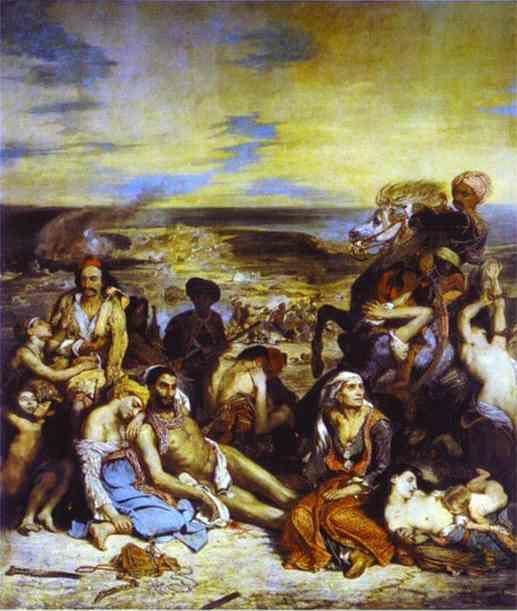
The Massacre at Chios by Eugene Delacroix


On May 29, 1453, the city of Constantinople fell to the Muslims. It was a dark day for Christendom and for all civilized humanity. His pleas ignored in the West, his supplies running out after six weeks’ siege, his soldiers outnumbered 15 to one, Emperor Constantine XI Dragas knew that his cause was hopeless. Like Prince Lazar at Kosovo 64 years earlier, he chose martyrdom.

On May 22 the moon, symbol of Constantinople since its founding, rose in dark eclipse, fulfilling an old prophecy on the city’s demise. Four days later the Bosphorus was shrouded by thick fog, a phenomenon unknown in eastern Mediterranean in late spring. When the final assault started on the 29th and the walls of the city were shattered, the Emperor discarded his purple cloak and led the last defenders to charge into the breach. The Turks were never able to identify his body; the last Roman Emperor was buried in a mass grave along with his soldiers.

When it was all over, bands of Turks went on a rampage. Pillaging and killing went on for three days. The blood ran down the steep streets from the heights of Petra toward the Golden Horn. All the treasures of the Imperial Palace were promptly removed. Books and icons were burnt on the spot, once the jeweled covers and frames had been wrenched off. In the monastery of the Holy Savior, the invaders first destroyed the icon of the Mother of God, the Hodigitria, the holiest icon in all Byzantium, painted—so men said—by Saint Luke himself. When the Turks burst into the Hagia Sophia, Sir Steven Runciman tells us in his Fall of Constantinople,

The worshippers were trapped. A few of the ancient and infirm were killed on the spot; but most of them were tied or chained together. Many of the lovelier maidens and youths and many of the richer-clad nobles were almost torn to death as their captors quarreled over them. The priests went on chanting at the altar till they too were taken . . . The inhabitants were carried off along with their possessions. Anyone who collapsed from frailty was slaughtered, together with a number of infants who were held to be of no value . . . [The city] was now half in ruins, emptied and deserted and blackened as though by fire, and strangely silent. Wherever the soldiers had been there was desolation. Churches had been desecrated and stripped; houses were no longer habitable and shops and stores battered and bare.

Sultan Mehmed II is said to have been shaken by the spectacle as he rode through the burning streets, but the same carnage and bestiality was to be repeated, in one form or another, dozens of times over hundreds of years. Eugene Delacroix’s depiction of The Massacre at Chios: Greek families awaiting death or slavery is a masterpiece of horror depicting the systematic extermination of the entire population of an Aegean island. It graphically illustrated how being a Greek, Armenian, Serb, or indeed any other Christian, in the Ottoman Empire meant living in daily fear of murder, rape, torture, kidnap of one’s children, slavery, and genocide. Indeed, the last century of Ottoman rule—from the defeat of Napoleon until the dissolution of the Ottoman Empire at the end of the First World War—witnessed a more thorough and tragic destruction of the Christian communities in the Middle East, Asia Minor, the Caucasus, and the Balkans, than at any prior period.

The tragedy of Christian communities under Turkish rule, as Gladstone rightly pointed out, was not “a question of Mohammedanism simply, but of Mohammedanism compounded with the peculiar character of a race.” The Turks, in his view, “were, upon the whole, from the black day when they first entered Europe, the one great anti-human specimen of humanity. Wherever they went, a broad line of blood marked the track behind them, and, as far as their dominion reached, civilization disappeared from view. They represented everywhere government by force as opposed to government by law.”

The Ottoman Empire gave up the ghost right after the Great War, but long before that it had little interesting to say, or do, at least measured against the enormous cultural melting pot it had inherited and its splendid opportunities between East and West. Not even a prime location at the crossroads of the world could prompt creativity that was not there.

A century later the Turkish Republic is a populous, relatively prosperous and self-assertive nation-state. The Turkish nation has developed a culture based on a blend of European-style nationalism, which is very un-Ottoman, and an underlying Islamic ethos inherited from the Empire. Kemal Ataturk hoped to impose a strictly secular concept of nationhood, but political Islam has reasserted itself. Popular Islamic political movements of the past three decades have produced a Turkish-Islamic synthesis whose “post-Islamist” upholders are firmly in power in Ankara. Their success is due to the fact that most Turks remain Muslim in their beliefs, values, and world outlook. The Kemalist dream of secularism has never penetrated beyond the military and a narrow stratum of urban elite centered in Istanbul, and today it is in retreat. The Kemalist edifice, uneasily perched atop the simmering Islamic volcano, will remain tentative at best.
The re-emergence of an empire centered on the Bosphorus is unlikely, for now, but less so than the integration into the European Union of a democratic, secular and stable Turkey.

The freeing of Hagia Sophia from the four ugly bars imprisoning her is even less likely, for now; but miracles do happen, and therefore this one can happen. On this melancholy anniversary let us pray that it will happen.

Srdja Trifkovic :: May.29.2007 :: News & Views :: 8 Comments »

8 Responses to “A Dark Day in History”
on 29 May 2007 at 6:01 pm

1 Ira Nayus

What you fail to point out is the fact that Constantinople fell six months or so after an attempted illegitimate unia with the Latins. Thanks to St. Mark of Ephesus, the unia did not take place. Of course, the fall of Constantinople was a blow not to “Christendom” — some ecumenical notion embraced by those who have to rely on traffic with Latins for their pay — but a blow to the one, holy Catholic Orthodox Church — not Rome. Why is it that you as a Serb continue to play step-and-fetch-it to Rome? Why do you continue to ignore the countless outrages of Rome against Orthodoxy — never mind the actions of Croatian Latins during WWII, the sacking of Constantinople, or the Uniates in the Ukraine. Constantinople fell in no small part because Rome wanted to capitalize on the vulnerable state of Byzantium, ever looking to “convert” the Orthodox to their heresies and innovations. And why all of this non-sense about Islam? I don’t see any Muslim names heading up media outlets that pump pornographic entertainment into our homes every night of the week through the television and radio. I don’t see any Muslim names heading up organizations demanding the removal of any and everything associated with Christianity from the public square. I didn’t hear any Muslims calling for a new Pearl harbor event. For whom do ye not speak for fear of?

on 29 May 2007 at 6:13 pm

2 George Ajjan

There is another icon of Mary in Sednaya, Syria - also reportedly painted by St. Luke. Very popular local and regional attraction - even Gulf tourists, who are Muslims, regularly pray there.
on 29 May 2007 at 6:35 pm

3 Trifkovic

Re Union etc, cf. my “1204 AND ALL THAT”: http://64.233.167.104/search?q=cache:tzzgBCPSIswJ:www.chroniclesmagazine.org/News/Trifkovic04/NewsST121404.html+1204+and+all+that&hl=en&ct=clnk&cd=2&gl=us
on 29 May 2007 at 6:40 pm

4 A J Pestronic

Mr. “Nayus” is misguided on his history. The Council of Florence took place in 1439 — roughly 13 years before the fall of Constantinople. However, it is interesting to point out that Emperor Constantine XI was, for all practical purposes, a Uniate: he attempted to force a union with Rome. In fact, he was not crowned in Constantinople because of the fierce opposition to his uniate views. In December of 1452, he allowed a uniate liturgy to be served in the Hagia Sophia in which the Pope was commemorated. Then, six months later, Constantinople fell. The spiritual import of this will, one supposes, divide Orthodox and Catholic alike. However, Emperor Constantine XI’s uniate sympathies cannot be denied nor can Rome’s attempt to capitalize on them.

on 29 May 2007 at 10:24 pm

5 S.

So much for “Ottoman tolerance”! Much to often we hear European bureaucrats and western elite talk of Ottoman Empire’s kind treatment of non-Muslims ! This excellent column might make them reshape their enthusiasm for Muslim open-mindedness.
on 29 May 2007 at 11:32 pm

6 Eunomia · Aiei Mnisomen

[…] Second Update: Dr. Trifkovic also has a very good piece on the Fall of Constantinople. […]
on 30 May 2007 at 2:50 am

7 Darcy

I cannot help but read of the fall of Constantinople without getting the shivers. Glorious, doomed Constantinople. Yet I think you protest too loudly about the Evil Turk of Ottoman times. For all their (correct) complaints about being treated as second-class citizens, all the Balkan nationalities managed to preserve their language and msot their religion under the Ottomans. Not a feat that would have been repeated had, say, Serbia been annexed in the 15th century by the Austrians. And the killing, well, yeah, it was hardly confined to the Ottomans.

So boo. The Ottomans were hardly tolerant by today’s standards, but until the 19th century, it would have been more pleasant living as a minority in Ottoman lands than, say, Spain or France. With the probable exceptions of Poland-Lithuania and the Dutch Netherlands.

As for today, your comment “The Kemalist dream of secularism has never penetrated beyond the military and a narrow stratum of urban elite centered in Istanbul, and today it is in retreat.” is way off. In many respects, Istanbul is the most conservative of Turkey’s larger cities. And if the recent series of massive demonstrations against the Government do not convince you that Ataturk’s reforms took hold, then I suppose you also believe in Creationism?

As for your final statement: “The freeing of Hagia Sophia from the four ugly bars imprisoning her is even less likely, for now; but miracles do happen, and therefore this one can happen. On this melancholy anniversary let us pray that it will happen.” This is childish melancholy.

Turkey is hardly a model country, but I see an energy and a will to betterment here that is missing anywhere else in Europe or the Middle East. Next time you visit the Balkans, travel a little further afield to Turkey. Not just to Babylon-on-the-Bosphorus. Go into the heartland of Anatolia and speak with the peasant farmers and the grocers, the taxi drivers and the professors. It will prove enlightening.

on 30 May 2007 at 3:40 am

8 Alistair

“I didn’t hear any Muslims calling for a new Pearl harbor event.” Ira, prhaps you’ve heard of: Osama bin Laden, Mahmoud Ahmadinejad, Ayman al-Zawahiri, Ayatollah Ruhollah Khomeini, Hassan Nasrallah (just for starters), who have all called for the destruction of the U.S.? Or have you been in a cave the past 28 years?

It’s a shame to see people of the West still harboring ancient grudges that prevent them from uniting against a common foe, who is only too glad to stoke those fires of division.

Trackback this post Feed on Comments to this post

Friday, May 11, 2007

Srdja Trifkovic: Kosovo Blowback Reaches America

Kosovo Blowback Reaches America

http://www.chroniclesmagazine.org

The story: four Albanian Muslims from Kosovo, plus a Turk and a Jordanian, are arrested for conspiring to attack Fort Dix, a military base in New Jersey, with AK47s and “to kill as many soldiers as possible” (U.S. Attorney’s Office).

The Mainstream Media spin: “Four of them were born in the former Yugoslavia” (The New York Times); “One of the suspects was born in Jordan, another in Turkey… [t]he rest are believed to be from the former Yugoslavia” (CNN); “Four of the men were born in the former Yugoslavia, one in Jordan and one in Turkey” (MSNBC); “One of the suspects was born in Turkey and four in the former Yugoslavia” (AP), und so weiter…

The names of the four “Yugoslavs” are Dritan Duka, Eljvir Duka, Shain Duka (three brothers, all of them in the United States illegally), and Agron Abdullahu. Those are Albanian names, of course, but not one in a hundred Americans knows that. In fact, grasping that they are Albanians and knowing that “ethnic Albanian” plus “Muslim from the former Yugoslavia” equals “Kosovo,” is the privilege of experts. It is but one of many Balkan equations that mainstream media editors are determined to keep hidden from their consumers. That there is nothing in the federal complaint about the “Yugoslav” suspects’ origins is almost certainly the result of political interference.

White House spokesman Tony Snow was quick to assure us there is “no direct evidence” that the men arrested in the Fort Dix plot have ties to international terrorism. His meta-message is clear: The Administration knows it cannot keep the Albanian identity of four “Yugoslav” suspects concealed for ever, but it wants to pre-empt any suspicion that an independent KosovA would be a black hole of jihad-terrorism in the heart of Europe. Hastily denying the group’s link to al-Qaeda and other global networks is a political necessity for the proponents of Kosovo’s independence, not necessarily the reality.

Having been assured ad nauseam over the years by successive U.S. administrations that Kosovo’s Albanians are not really serious about their Islam, that even when they desecrate Christian churches and joyously rip crosses from their cupolas they do it for nationalist rather than jihadist reasons, the powers-that-be are doing their utmost to ensure that the public remains anesthetized. Asking when and how Albanian “secularists” became Islamic radicals is a no-no. Being so audacious as to wonder what this transformation bodes for a new, independent Muslim state in the heart of Europe is simply not on. Asking questions about major KLA figures’ documented links to jihad terrorism (including to Osama bin Laden personally) is polizeilich verboten. In the meantime, cadres, cash and ordnance linked to jihadist outrages all over Europe have been traced back to Kosovo, including the bombings in Madrid (March 2004) and London (July 2005), and a rocket attack on the U.S. embassy in Athens last year.

In New Jersey in May 2007, Kosovo blowback has finally reached America.

It is now essential to unmask the web of lies and distortions that has guided U.S. policy in the Balkans for years. The first step is to demand an explanation why and how Muslim Albanian terrorists from Kosovo were able to plan an operation here in the U.S. Why indeed: didn’t the U.S. military fight the Serbs for 78 days in 1999 so that they could have their ethnically clrean, Serbenfrei statelet? As a Washingtonian insider points out,

For almost a decade the U.S. government (or more precisely a handful of State Department bureaucrats and a few Congressmen) have placed the U.S. firmly on the side of the KLA and have helped created a haven for their operations. Even worse, KLA supporters in the United States have operated with virtual impunity, collecting money and weapons to support KLA operations not only in Kosovo, but in neighboring areas of southern Serbia, Montenegro, Macedonia, and northern Greece.

He reminds us that in 2004 Dutch television broadcast a documentary of Kosovo Albanian Muslims legally buying weapons in the U.S. and shipping them to Kosovo is support of their “liberation war” in violation of numerous U.S. laws, including the Neutrality Act: “The documentary then showed the same Albanians at a fundraiser in New York writing hefty checks to American politicians of both parties. There is no public indication that any action was taken by federal or state law enforcement agencies.”

But like the Bourbons of yore, KosovA enthusiasts inside the Beltway learn nothing and forget nothing. At last Tuesday’s open hearing of the House Committee on Foreign Affairs, titled “The Outlook for the Independence of Kosova” (sic!), the Committee’s Chairman, Rep. Tom Lantos (D-CA), declared urbi et orbi:

“Just a reminder to the predominantly Muslim-led governments in this world that here is yet another example that the United States leads the way for the creation of a predominantly Muslim country in the very heart of Europe. This should be noted by both responsible leaders of Islamic governments, such as Indonesia, and also for jihadists of all color and hue. [sic!] The United States’ principles are universal, and in this instance, the United States stands foursquare for the creation of an overwhelmingly Muslim country in the very heart of Europe.”

On that same occasion Ms. Rice’s No. 2, Under Secretary for Political Affairs Nicholas Burns, reiterated the U.S. position that immediate independence without standards or compromise is a must lest the Albanians get nasty: “the prospects for violence would be greater if we waited, because 92 to 94 percent of the people who now live in Kosovo are Albanian Muslims. They have been waiting a long, long time.”

Albanian Muslims, mind. Not Albanians, not “Kosovars,” not “Yugoslavs.” As Julia Gorin pointed out, Mr. Burns also didn’t miss the opportunity to invoke the usual Nazi imagery in reference to the Serbs, while praising the Kosovo prime minister Agim Ceku, an indicted Serb-slaughterer, as “impressive” and “worthy.” That’s the broad picture, dear reader, and a bunch of overexcitable, non-al-Qaeda-connected “Yugoslavs” from New Jersey will not be allowed to disturb it.
And yes, Mr. Lantos’s “jihadists of all color and hue” are taking note.

Srdja Trifkovic :: May.08.2007 :: News & Views :: 38 Comments »

Friday, May 04, 2007

Srdja Trifkovic: France’s Fateful Choice

Nicolas Sarkozy

Thursday, May 03, 2007

http://www.chroniclesmagazine.org

Nicolas Sarkozy, the Center-Right candidate, will face Socialist Segolene Royal in the run-off of France’s presidential election on May 6. In the first round last Sunday M. Sarkozy had 31 percent of the vote, Mlle Royal just under 26 percent, “extreme-centrist” Francois Bayrou 18 percent, and nationalist conservative Jean-Marie Le Pen almost 11 percent.

Voting reached near-record levels at 85 percent, the highest since 1965. Disillusionment with politicians and distrust of their promises—endemic in France since De Gaulle’s second term—did not translate into apathy on this particular occasion for three main reasons.

First of all, millions of Frenchmen feel that the country is not on the right course. They had felt that before, of course (notably in 1968) but this time the Angst is real. Change is in the air. After decades of establishmentarian consensus, it is clear that de facto open-door Third World immigration, 35-hour working week (for two-fifths of the population who do work, that is), and generous welfare benefits for the rest cannot continue indefinitely.

Among the main candidates only Nicolas Sarkozy, former interior minister, promised a “rupture” with the past and meaningful economic reform coupled with the renewed insistence on national identity and values. Unlike his predecessor Jacques Chirac, Sarkozy is not visibly corrupt or intellectually sluggish. He can be rough around the edges, and—being a politician—prone to unprincipled opportunism. Unlike his Socialist opponent Ségolène Royal, however, “Sarko” has a coherent world outlook, some good ideas coupled with the ability to articulate them, and government experience that breeds self-confidence essential for the job. To his credit, and unlike most members of France’s ruling political elite, he is not a graduate of the elite National Administration School whose alumni have presided over decades of France’s decline.

While other E.U. countries have lowered taxation rates and reduced the burden of bureaucratic controls since Maastricht, France remains stuck in the sixties. Her per capita GDP was eighth in the world a generation ago; today it is 19th. In the early 1990s GDP was 83% of that of the U.S.; now it is 71 percent. Three decades ago France had a bigger economy than Britain, but not any more. For a generation, under the tepid Francois Mitterrand and slimy Chirac—the immobile “Mitterand by other means,” in the words of a disgruntled former aide—hard economic and social decisions necessary to reform the country’s dirigiste welfarism had been avoided.

Sarkozy may not be able to make the clean break—he’d be well advised to study the causes of Thatcher’s ultimate failure in the 1980s—but at least he will try, unlike the hapless “Ségo,” whose fiscal program was a head-in-the-sand rehash of failed orthodoxies. His 2005 statement that “success and social promotion are not some right that anybody can claim [at a welfare office] but a right that one can deserve because of one’s sweat” reflects a promising mindset for an “Old European.” In addition he had warned French voters for weeks that the nation was undergoing a “national identity crisis,” cultural as well as managerial, that sapped its political and economic vitality. When the Left accused him of being too “Anglo-Saxon” in his proposed remedy, Sarkozy responded that he was “proud” to be called more American than French, and that there “are many good lessons that we must learn from America.”

Sarkozy’s Socialist opponent Ségolène Royal has pledged a “fairer society” (i.e., more of the same), and she could count on the support of all those who benefit from France’s old status quo—sinecured loafers, Muslim invaders, Rive Gauche “intellectuals” and their provincial emulators, state-sector union members, central and local government salariat. Even to them she appealed faute de mieux. She was weakened by the vanishing influence of the gauche de la gauche: keeping the Socialists and the far left united while wooing centrists under the banner of a modern social democracy proved to be way beyond her limited powers. Ignorant of the world (she thinks the Taliban still rules Afghanistan), unwilling or (more likely) unable to spell out a coherent position on many key economic and social issues (“I’ll consult my advisors,” “I’ll let the people decide”), she is the least impressive second-round candidate in the history of the Fifth Republic.


Segolene Royal


Secondly, the huge campaign by the Left and by immigrant activists of different hues—from doctrinaire Maoists to doctrinaire Jihadists—to register millions of non-French citizens of France who are legally eligible to vote, has been successful in bringing to the polls some two million new voters who want to turn Marseilles into Mogadishu and Arles into Algiers. More than three million new voters, at least half of them Third World immigrants, have been added to the electoral roll following the Muslim riots of October-November 2005; another two million will follow suit before the next election. They are voting, as their counterparts in America vote, for the parties reconciled to or actively supportive of the nation’s eventual self-liquidation. A mere one percent of eligible Muslim voters cast their ballot for Sarkozy, compared with 64 percent for Royal and one-fifth for the centrist Francois Bayrou. They are the unnatural allies of that half of the French electorate which is dependent on the state for wages, benefits or pensions. In 2012 they will present a formidable force in favor of reestablishing the long road to extinction. At the same time, immigrants’ evident success in getting the vote has prompted millions of real Frenchmen, who may have abstained otherwise, to go to the polls.

Thirdly, after Le Pen’s second-round debacle in 2002 they knew that the only viable option for them is Sarkozy, and their choice was facilitated by his embrace of much of Le Pen’s rhetoric and specific policy proposals. This has enabled “Sarko” to produce the French variety of Reagan’s 1980 strategy, and appeal to many elderly, blue-collar and traditionally centrist voters who would not have been his natural constituency five, let alone ten years ago.

To a woman asking him, in October 2005, if he would “get rid of this scum”—referring to North African Muslims causing havoc in predominantly immigrant suburbs—Sarkozy the Interior Minister replied with the words unutterable by any American politician: “Enough of this scum? Well, we’re going to get rid of them for you!” Around the same time he told Le Parisien, “When you fire bullets at police, you’re not a ‘youth,’ you’re a thug.” In a similar spirit he told Charlie Rose last January that “if you don’t want your wife to be examined by a male doctor, then you’re not welcome here.” On the eve of the first round of voting on April 22 he reiterated, “If living in France bothers some people, they should feel free to leave the country.”

Such sanguineness was decisive in reducing Jean-Marie Le Pen’s share of the vote to only 11 percent in the first round, prompting Le Pen’s complaint that Sarkozy had stolen his platform—including the demand for the creation of a new Ministry of Immigration and National Identity—and his voters. The old paratrooper is not any less impressive today than he was in 2002 when he went into the run-off with Chirac, but many of his supporters evidently decided that, on this occasion, lesser-evilism was the sound strategy to preserve what is left of their idea of France. This was 79-year-old Le Pen’s last election, but the issue of succession and policy articulation on the nationalist right remains unresolved.

Europe is under demographic siege, and France is the keystone of Europe. Sarkozy appears to understand the problem. When he told Le Monde two years ago that “we live in a world where people don’t all have the same scruples,” he was restating a view deeply odious to the Kantian-liberal mindset: that it is impossible for all cultures and creeds to subscribe to a one-world, “universal morality,” and that those groups that embrace it will inevitably be displaced by those that do not. Jean Raspail said the same thing when he warned that Westerners are doomed irretrievably to extinction in the century to come, if they hold fast to their utopian delusions: “No other race subscribes to these moral principles — if that is really what they are — because they are weapons of self-annihilation.” This key insight is essential in a Western leader, especially one who leads a country with a higher percentage of Muslim immigrants and their offspring than any other developed country in the world. Sarkozy is unlikely to reiterate this insight so openly any time soon, but it is comforting to know that this is what he thinks.

The choice facing France on May 6 is clear. Her foreign friends, who appreciate her culture and civilization and many fruits (even if they draw the line at une certaine idée de la France) should pray that it is the right one.

Srdja Trifkovic is the foreign-affairs editor of Chronicles: A Magazine of American Culture and director of The Rockford Institute's Center for International Affairs.