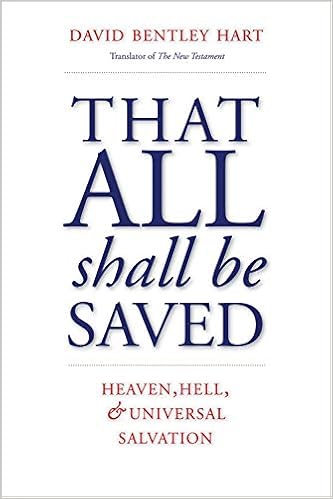
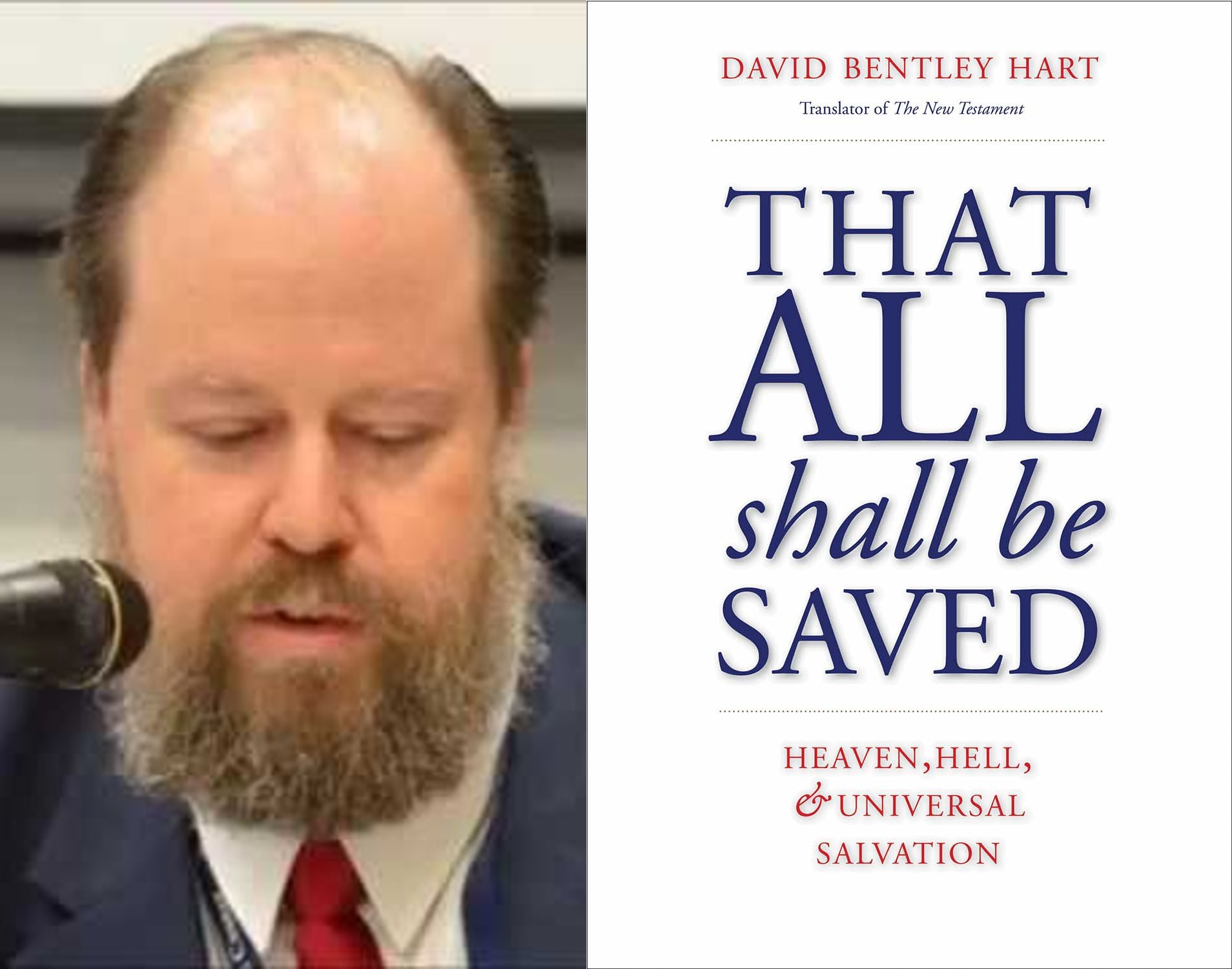
At a time when a good many books have been written, some by academics and others by non-academics, on the topic of Christian universalism, David Bentley Hart’s That All Shall Be Saved: Heaven, Hell, and Universal Salvation stands out in several ways. Its author is, first and foremost, an accomplished classicist and expert in the Greek language, one whose previous publications include an important translation of the New Testament. And one of his purposes in this translation was to restore “certain ambiguities” that, so he believes, are “present in the original texts” but have been lost in later translations. He thus writes, “I am firmly convinced that two millennia of dogmatic tradition have created in the minds of most of us a fundamentally misleading picture of the claims made in Christian scripture” (p. 3). He traces much of that misleading picture, most notably the doctrines of limited election and limited atonement, “back to the late Augustine—a towering genius whose inability to read Greek and consequent reliance on defective Latin translations turned out to be the single most consequential case of linguistic incompetence in Christian history” (p. 49). As this quotation already illustrates, Hart pulls few of his punches in this book; and that very fact, whatever else one might think about it, contributes a lot to the book’s rhetorical power.
Hart relentlessly opposes, secondly, the whole idea of unending punishment and any other conception of a final separation from God; he rejects all such ideas as “manifestly absurd” even when they do not rest upon a morally offensive doctrine of limited election. For even “the gentlest, the most morally delicate, the most judiciously reluctant” conceptions of a final separation from God “all start . . . on the far side of a prior existential decision to accept an obviously ludicrous premise” (p. 202). So just what is this ludicrous premise, according to Hart? It is essentially the premise that divine justice, divine love, and divine goodness are compatible with God’s having created someone whose final fate he always knew would consist of everlasting misery and torment. For how could that even be possible? “If ‘justice’ means anything at all,” Hart protests, “it cannot be that; if ‘love’ means anything at all, it cannot be that; if ‘goodness’ means anything at all, it cannot be that” (p. 203). Hart also notes how glibly some speak of eternal conscious torment without seriously considering what such a destiny would truly mean. “Can we [even] imagine,” he asks, “that someone still in torment after a trillion years, or then a trillion trillion, or then a trillion vigintillion, is in any meaningful sense the same agent who contracted some measurable quantity of personal guilt in that tiny, ever more vanishingly insubstantial gleam of an instant that constituted his or her terrestrial life?” (pp. 203-204).
A third unique feature of this book is the extent to which its author refuses to apologize for the hard-hitting nature of his personal manifesto against the “infernalist orthodoxy,” as he calls it. He thus writes:
Custom dictates and prudence advises that here, in closing, I wax gracefully disingenuous and declare that . . . I entirely understand the views of those that take the opposite side of the argument, and that I fully respect contrary opinions on these matters. . . . [But] I believe that I am obeying my conscience with a special rigor in rejecting the majority view that there is a hell of eternal torment, since I am fairly sure that it must be a wicked thing to give one’s intellectual assent to something that one cannot help but find morally repugnant. . . . I make no apologies whatsoever for rejecting the late Augustinian tradition . . . [and] that tradition’s sheer moral wretchedness as a vision of the gospel . . . I have [also] rejected every version of the infernalist orthodoxy, no matter which Christian tradition may have produced it, and no matter how tenderhearted the reasoning that informs it. To have done otherwise would have been dishonest on my part. (pp. 199-200)
Although he rejects this “infernalist orthodoxy,” sometimes in exceedingly harsh terms, as morally intolerable, biblically untenable, and philosophically confused, Hart nonetheless acknowledges that the book he has written “is at odds with a body of received opinion so invincibly well-established” that he “cannot reasonably expect to persuade anyone of anything,” with the possible exception of persuading some of his own sincerity (p. 4). At the same time, however, he laments having written a book that “ought never have needed to be written in the first place” because “the doctrine of eternal hell is prima facie nonsensical” (p. 202). And herein lies an insight into his rhetorical strategy, which will, I suspect, make this book difficult for evangelicals and other self-appointed guardians of orthodoxy simply to ignore. Hart himself describes his effort as “a logical and rhetorical experiment” and explains this in the following way:
There is, at the very least, something liberating about knowing that I have probably lost the rhetorical contest before it has even begun. It spares me the effort of feigning tentativeness or moderation or judicious doubt . . . and allows me instead to advance my claims in as unconstrained a manner as possible . . . [I]f nothing else, this book may provide the champions of the dominant view an occasion for honest reflection and scrupulous cerebration and serious analysis (and a whole host of other bracing intellectual virtues of that sort). (p. 4)
But at this point, I fear, Hart may find himself subjected to anad hominemargument of the following kind: the criticism that he just regards himself as morally superior to his infernalist opponents. It is a criticism that sort of goes with the territory. After publishing a scathing critique of the Reformed doctrine of reprobation several decades ago, one in which I labeled it “a respectable blasphemy” against God, I understandably received many harsh criticisms in return. The only criticism that touched my heart, however, was exceedingly gentle. It happened when the wife of my best friend in the Reformed church that my wife and I were then attending—a dear woman with some serious physical challenges—hesitantly expressed the worry that I might be regarding myself as more loving than others in the church. That was startling indeed, because I knew without question that others in the church were far more loving in their personal lives than I tend to be in my own. None of us, after all, are fully consistent in our moral lives. So in the end I found myself saying, or at least thinking to myself, things like, “Virtually all Calvinists I have known are far better than the theology they have embraced, even as I am far worse than the theology I have embraced.” But Hart’s own attempt to forestall similar criticisms may be better than my own. “Really,” he asks concerning the infernalist orthodoxy, “could we truly believe it apart from either profound personal fear or profound personal cruelty? Which is why, again, I do not believe that most Christians truly believe what they believe they believe” (p. 204). Some may find such a view counterintuitive, but I do not. For over the course of my own life, I have observed more than a few instances where people have sincerely thought they believed certain things about God only to have some tragic event—such as a husband dying “in unbelief” or a teenage daughter committing suicide—prove that they did not truly believe what they previously had sincerely thought they believed.
In any case, I have found no major theological claim in this book with which to disagree. It would be truly remarkable, of course, were I to agree with every detail of every argument presented therein. But I am prepared to endorse every major theological claim contained in the book, starting with this one, which I take to be the main thesis of the book: “if Christianity taken as a whole is indeed an entirely coherent and credible system of belief, then the universalist understanding of its message is the only one possible” (p. 3—my emphasis). Not even many of those who sympathize with the universalist message are so bold as to declare that, given the New Testament understanding of God, the very idea of someone being lost forever represents a logical (or metaphysical) impossibility. Most find it sufficient to endorse a so-called “hopeful universalism,” even as they acknowledge that an eternal hell is at least logically possible. But I disagree with that, even as Hart does; and the reason we both reject even the logical possibility of an eternal hell should emerge in subsequent installments of this review.
Does hell exist? It depends on what you mean by “hell.” David Bentley Hart answers the question in the affirmative but gives the term a definition different from that assumed by “apologists for the ‘infernalist’ orthodoxies,” as he calls his adversaries in the perennial debate over the nature of hell.
What is hell? Who goes there? Do they ever leave? Hart embraces universalism, also known as universal salvation, universal reconciliation, and apokatastasis (Greek for “restoration,” as of all creation in the age to come) — the doctrine, sometimes regarded as merely heterodox, other times as outright heretical, “that all shall be saved,” to quote the title of his lively new book on this burning topic.
Saved from what? From death and damnation. Not spared from their clutches, but delivered from them ultimately.
First, death: Each of us can expect to die and, like Christ, “descend into hell,” in the words of an antiquated but not entirely abandoned translation of the Apostles’ Creed. (In an older sense now all but forgotten, “hell” was a reasonable English equivalent of the original Greek — ta katōtata, the parts below, where the dead dwell. To modern ears, of course, to say that Christ went to hell sounds like blasphemy. It causes confusion and illustrates the outsized role that translation decisions have played in the reception — or, as Hart argues throughout, in the corruption — of doctrine down the centuries.) We can also expect, like Christ, to rise from the dead, although our uncertainty about the precise nature of our glorified, spiritual bodies will persist until we receive them at the general resurrection. Only then will we see the promised new reality face to face.
As for damnation, Hart imagines that most of us, even while on earth, spend too much time in hell, that our subjection to hell’s torments is not confined to kingdom come, that we walk through hell’s gates and then lock ourselves in, and that we are helpless to leave until they’re opened for us from the outside. “I do in fact believe in hell,” he explains,
though only in the sense of a profound and imprisoning misery that we impose upon ourselves by rejecting the love that alone can set us free. I believe, in fact, that I have on occasion experienced that hell from within its walls; . . . I suspect that most of us, at least past a certain age, have done so. . . . Practically all of us go through life as prisoners of our own egos, which are no more than the shadows cast by our souls, but which are nonetheless quite impossible for us to defeat without assistance and without grace.
That’s a solid meditation at the intersection of psychology and spirituality. The darkness described by Hart is, as he says, familiar to many. He calls it “hell,” but it doesn’t sound much like the lake of fire in the Book of Revelation, does it? If you’re looking for that, or for a live cam on the lake of ice in the ninth circle of Dante’s Inferno, this is not the book for you. It will leave you cold, unless your rage provoked by the author’s ridicule of your beliefs about the Last Things leaves no room in your heart for such milder emotions as disappointment. Make no mistake: David Bentley Hart is an able rhetorician and polemicist. What a sharp tongue he has: There are, I admit — unfortunately, I have met some of them — those Christians who are earnestly attached to the idea of an eternal hell not just because they feel they must be, but also because it is what they want to believe. For some of them, in fact, it is practically the best part of the story. It gives them a sense of belonging to a very special club, and they positively relish the prospect of a whole eternity in which to enjoy the impotent envy of all those writhing, resentful souls that have been permanently consigned to an inferior neighborhood outside the gates. That is the sort of prestige that cannot be bought where the common people shop.
Speaking of prestige: By now, in his mid fifties, the itinerant academic and indefatigable essayist (his full curriculum vitae could probably be its own book) has established himself as one of the best theologians writing in English today and as hands down the best writer among contemporary Anglophone theologians. Behold his literary pyrotechnics. I sometimes wonder whether they distract readers from the hard work of sitting down with him and thinking problems through. I suppose that after a point he gets bored with trying to untangle intractable philosophical knots. He’s capable of mischief. If he ends up doodling in the margins, limning the pages with generous applications of sarcasm and color, to relieve the tedium of, say, a necessary excursus on voluntarist theology, do you blame him?
The book has no endnotes. In a section dedicated to “acknowledgments and bibliographic notes,” Hart cites a few major sources, all of them in English. He’s erudite, and it may be that his final product is a symphony composed of the best, and the worst, but in any case the loudest and boldest that has been thought and said about hell, from Jesus himself to Saint Augustine (one of Hart’s bêtes noires) all the way to Thomas Talbott and a whole roster of present-day thinkers on all sides of the universalism controversy, but it’s hard to say. Hart shows his work, so to speak, only in patches. A convert to Eastern Orthodoxy, he’s wont to quote and reference various of the Greek Fathers with enthusiasm. He loves Origen and Gregory of Nyssa especially. When it comes to modern scholars, though, he names names sparingly. Chalk it up to tact, if you like, in recognition of how much of his work is an exercise in intellectual derision and evisceration. The book is published by a university press and is scholarly, but is it scholarship? One thing it’s not is intellectual history.
Call it an essay. It’s an attempt, from several angles, not to deny hell’s existence but to refute a common assumption about the duration of anyone’s residence there. The duration is finite, Hart maintains, and he pours out a cornucopia of arguments to make his case. He has arguments from reason (philosophy), arguments from faith (scripture and patristics), and arguments that can be understood only as members of both categories at once — any gesture toward philosophical reasoning tends to enjoy a benefit of the doubt from conservative Christians if the author is a Church Father in whom some of the authority of sacred tradition has come to be invested.
The most common “infernalist” accounts lean on the notion that eternal damnation is a corollary of human free will, which entails risk. We can choose evil over good. When we do, we must suffer the consequences of our moral error as surely as we must suffer those of playing with fire in a dry forest or of swimming too far from shore during a storm. The moral law is as blind and unforgiving as any law of nature.
Hart rehearses the counterargument that no one is culpable for breaking the moral law if he errs in ignorance or under deception. To someone who chooses evil over good, the evil appears as good or, on the whole, at least better than the alternative. Otherwise he wouldn’t choose the evil. God warned us about the fruit in the garden, but the serpent had a way with words, and we fell under their spell. Our judgment was clouded. We’re mere creatures, after all, limited in our intelligence and willpower. A punishment of infinite duration would be incommensurate with our finite nature and therefore unacceptable to God not only because he’s all-merciful but also because he’s all-just.
Nice chess move. But so what? God may knock the pieces off the board. He’s been known to do that. His ways are not ours. In Genesis, he commands Abraham to kill Isaac, setting a precedent that instills in the mindful believer a respectful wariness, an attitude of fear and trembling before the inscrutable Almighty.
Moreover, God desists from preventing outrages that nature inflicts on human persons and that human persons inflict on one another. To the dulcet theory that the fall of creation is ultimately fortunate because the response it elicits from God is his salvation plan, which, when fully realized, leaves the cosmos more blessed than it would have been had we never lapsed — to that, we might respond, with Hart: No, God is infinitely resourceful. He could have arranged it so that we would enjoy the deepest, richest happiness without having to suffer the slings and arrows of misfortune first.
Why he didn’t is a mystery. It’s at the heart of the theodicy problem, which is the heart of the matter for the universalist. Hart has no patience for the idea that God might be a capricious judge when deciding our eternal destiny, but God is capricious in other matters all the time, at least from our human perspective. An infant notices his mother’s absence but doesn’t know that it’s only momentary. To him it’s the end of the world. He cries out with all his strength, exercising his lungs and vocal cords almost to the breaking point. We smile at him. We call him “dear.” If you bristle at the suggestion that God rightly does the same to us when we wail over our adult afflictions, over massacres or mass shootings or enormities than which none, we feel, could ever be more heinous, fine. Go ahead and bristle.
No philosophical argument for universalism is unanswerable, as far as I can tell. Hart is at his most cogent and engaging when he leaves philosophy for philology and sifts the Greek of the New Testament and Church Fathers. He may be right that “eternal” is not the obvious best translation of every instance of aiōnios, whose primary meaning is something like “age-long.” Hades, the underworld in Greek mythology, and Gehenna, a valley in Jerusalem, are often conflated under the rubric “hell” in translations of the New Testament but perhaps shouldn’t be. The New Testament provides a wealth of vivid images and strong statements, possibly hyperbolic in many cases, that Christians piece together in different configurations to illustrate competing eschatological visions, some of them more layered than others. What has become the default version, in which hell will endure forever as an abscess of unredeemed evil in a cosmos otherwise perfected and glorified, may be flatter than a close reading of the Greek can support.
Granted, belief in the tragedy of eternal damnation is fertile soil. It nourishes much heartfelt Christian devotion. Without it, no Inferno. No Doctor Faustus, either. Those are not sound reasons for rejecting universalism, but they’re strong reasons. A better reason would be that we’re less likely to avoid grave sin if we think that the hell we will go to for punishment will not be forever, although a reading of the Purgatorio might disabuse us of any complacency. Remember that Catholics who appreciate the severity of what is, in effect, hell with a temporal limit offer fervent prayers for the reduction of purgatorial suffering, their own and that of loved ones and even of strangers.
The best reason for rejecting universalism would be that it’s untrue. Is it, though? “We are, as it were, doomed to happiness,” according to Hart. If we are, so be it. Neither his opinion nor yours changes the fact. Consequently, no book on the controversy can be worth fearing or loathing. Here’s one worth reading.
This article appears as “Hell, Yes. Forever? Maybe Not.” in the September 30, 2019, print edition of National Review.
Chances are churches frequented by your readers and listeners rarely if ever offer sermons about hell and damnation these days. And yet this rather unpleasant topic is eternally (so to speak) fascinating, and may be about to grab some headlines. That’s due to Eastern Orthodox lay theologian David Bentley Hart's acerbic Sep. 24 release from Yale University Press “That All Shall Be Saved: Heaven, Hell, & Universal Salvation.”
Sample sentences: “No one, logically speaking, could merit eternal punishment.”
Also this: “If Christianity is in any way true, Christians dare not doubt the salvation of all,”
Yes, Hart is a Hitler-in-heaven sort of guy (see page 38), and your sources will have interesting responses. Lest Hart seem a rank heretic, the Very Rev. John Behr of St. Vladimir’s Orthodox Theological Seminary blurbs that this book presents “the promise that, in the end, all will indeed be saved, and exposing the inadequacy — above all moral — of claims to the contrary.”
Heretofore Hart was better known for ridiculing non-belief, as in “Atheist Delusions.” The prolific author has held a succession of university appointments, most recently as a University of Notre Dame fellow. Catholic theologian Paul Griffiths (in the news when he resigned over Duke University’s “diversity” policy) proclaims Hart “the most eminent” theologian in the English-speaking world.
Terms Hart applies to centuries of traditional orthodox and Orthodox doctrines on hell and damnation include “absurd,” “ludicrous,” “nonsensical,” “incoherent,” “horrid,” “degrading,” “loathsome,” “diseased,” “perverse,” “cruel,” “wicked” and “morally repugnant.” He is mainly offended by the idea that punishment is everlasting, on grounds that the punishment doesn’t fit the crime. Hart is open to some sort of cleansing to make sorry souls fit for heaven, but doesn’t spell out any version of Western Catholicism’s Purgatory.
“All” is a far cry from the sentimental optimism about humanity preached by officially Universalist churches. Hart argues that the Christian God is not truly God if those he brands “infernalists” are correct. The familiar challenge is how everlasting torment of any person meshes with belief that God is loving.
What about human will and repenatance? Hart adds the less common claim that defiant rejection of God throughout all eternity cannot be “logically possible for any rational being."
The heart of Hart is the contention that the few New Testament verses usually cited on this could refer to “limited term” punishment, while 23 other passages raise hopes that all will be saved. He relies on Bible interpretations by ancient Eastern theologians, especially the 4th Century’s Origen and St. Gregory of Nyassa. He castigates that era’s great Catholic voice, St. Augustine, for “the single most tragically consequential case of linguistic incompetence in Christian history,” based upon the “defective” Latin translation of the Bible. (Speaking of scripture, Yale also published Hart’s recent, idiosyncratic translation of the New Testament, also well worth a sidebar on scholars’ reactions.)
Meanwhile – religion writers note – there’s a related dustup in the news right now linked to the Christian claims of exclusivity per Jesus’ teaching that “I am the way, and the truth, and the life. No one comes to the Father except through me” (John 14:6).
Last week’s Evangelical Lutheran Church in America assembly approved a significant inter-religions relations policy (.pdf here) after handily defeating a bid to remove a soft section that says e.g. the status of believers in other religions “is beyond our knowledge, and even our calling” so “we do not need answers.”
(The ELCA’s own news release slid past this issue, covered by juicyecumenism.com, a reminder that reporters always need to consult varied sources.)
Even conservative Christians are not cut-and-dried on this. The Catholic Church’s Catechism teaches the “baptism of desire,” so a person ignorant of Christian teaching who “seeks the truth and does the will of God in accordance with his understanding of it can be saved,” through means known only to God.
Or consider noted speaker and author Josh McDowell, whose evangelical credentials are unassailable. In “A Ready Defense,” he says the God of Scripture does not wish any to perish (2 Peter 3:9) and will be a righteous judge (Acts 17:31), so it’s reasonable that “no one will be condemned for not ever hearing of Jesus Christ,” although (as in Catholicism) we don’t know the particulars.
(This Opinion piece contains spoilers for the Quentin Tarantino film “Once Upon a Time … in Hollywood.”)
Brad Pitt, Leonardo DiCaprio and Al Pacino
I have never exactly been a Quentin Tarantino enthusiast, only because — as far as I can tell — my sensibility rarely coincides with his. But I have never doubted his talent. I applaud his insistence on the endangered cinematic virtue of closely crafted storytelling. And I definitely share his preference for the gorgeously saturated, Chardin-like layerings of color that a great cinematographer can create on real film over the shrill pointillistic sheen and candy-hued incandescences of digital recording. Regarding the richness of his films’ emotional and moral palette, however, I’ve had my doubts.
I admit that it’s very easy to be unfair on this point. Tarantino’s films are often said to be cruel; certainly, they can be extremely brutal. But then again, a similar accusation is often made against the fiction of certain writers — Vladimir Nabokov, Silvina Ocampo, Clarice Lispector — whom I see as deeply compassionate. In reading their work, I’ve been inclined to interpret the unflinching and seemingly cold portrayal of violence and suffering as a kind of morally indignant arraignment of the brutality of the universe we actually inhabit. I hadn’t credited Mr. Tarantino with that much subtlety. Now, I think I may have misjudged him.
At least, Tarantino’s most recent opus, “Once Upon a Time … in Hollywood” seems to me to exhibit a genuine ethical pathos, one that actually brought tears to my eyes. Not that I expect most viewers to respond that way. The particular emotional impact of the film, which takes place in 1969 and involves Charles Manson’s “family,” may be palpable only to persons of a certain age. A viewer born much earlier or much later may not get the point at all. But for me, apparently, it’s a film I had been waiting to see for roughly 50 years without knowing it.
I was four and a half years old in August 1969. It was the first full year in which I was entirely conscious of myself as a distinct human being, or aware of the world around me, or able to learn about the still greater world beyond (if only through the medium of a television or radio overheard by chance, when my parents were caught off guard). It was also in that year, and in the half-decade following, that I came to know of the first monsters who ever truly terrified me and tormented me with nightmares. These were not ridiculous fantasy fiends in the old horror films I caught glimpses of on the local UHF channel but rather very real monsters: the members of the Manson family who had brutally murdered four people in a Hollywood home, including the actress Sharon Tate.
One gets past childhood’s terrors of course (at least, so I hear); other things, however, leave a more indelible impression. For almost all of us, there is that moment early in life when we first discover just how hideously cruel this world and the forces that govern it truly are. We’ve all known — even if most of us suppress the memory — that first trauma of the imagination that initiated us into the mysteries of true cosmic and personal evil. For me, it was learning the whole story about the Manson family murders. In my elementary school, there were children, principally boys, of course, who knew more than they ought to have known about those events and found it exciting to share their knowledge. From them, I learned all the horrific details. And by then I had also heard that those who had known Ms. Tate described her as having a personality of almost ethereal sweetness.
I would not know if that’s true, but that’s certainly how Tarantino depicts her, and how Margot Robbie plays her. It’s impossible not to find the Tate of the film endearing. Whether dancing at a party, singing along with Paul Revere and the Raiders while folding clothes, giving a girl hitchhiker a lift and parting from her with a hug, charming her way into a matinee of the Matt Helm film she appears in, grinning in guileless — almost childlike — delight at the audience’s response to her performance onscreen, she comes across as kind, young, beautiful and happy, and one wants nothing bad to happen to her, ever. But of course, one thinks one knows what’s to come.
Margot Robbie
I knew from certain of Tarantino’s previous films — specifically, “Inglorious Basterds” (2009) and “Django Unchained” (2012) — that he has a fondness for creating alternate, counterfactual histories. Until now, it was not clear to me why. Perhaps the sheer immensity of the evils those films addressed — the Holocaust, slavery — overwhelmed my critical perspicacity. I certainly understand why some find it pointless to pretend even for a few hours that the most gigantic evils of the irrevocable past never occurred because fate took another turn at some crucial juncture. What can it offer, after all, other than a temporary emotional salve?
I admit that it came as a shock of relief and an immense emotional pleasure when, in the much-discussed ending of “Once Upon aTime … in Hollywood,” Tarantino’s version of the story unexpectedly veered away into some other, dreamlike, better world, where the monsters inadvertently passed through the wrong door and met the end they deserved — torn to shreds, bludgeoned to a pulp, burned to a cinder. Even the violence delighted me. I thought it gave glorious expression to a perfectly righteous rage. And I was glad to slip briefly into some other order of reality, if only an imaginary one, where ethereal sweetness had survived and horror had perished. Still, what’s the point?
A deeply moral one, perhaps — though the correct ethical grammar here is somewhat elusive. Over the years I’ve made the acquaintance of many philosophers of religion and a few theologians who dabble in the practice of theodicy: the attempt, that is, to justify “God’s ways” (supposedly) by arguing for some meaning, purpose or metaphysical necessity in the evils of nature and history. Usually, the proposed solution has something to do with the clarifying contrast with goodness that evil provides, its utility in teaching us (or, in some particularly silly theologies, teaching God) compassion or ethical commitment or something of the sort. No light without shadow, no love without hate, no pity without cruelty — that sort of thing. All of which is quite nonsensical.
My own metaphysical dispositions are very different (and, as it happens, of more ancient pedigree). I tend to believe that goodness, love and moral beauty are substantial and eternal realities that attest to themselves quite immediately to any rational nature, without the need for any edifying “contrast” to make them intelligible. No one, I think, actually learns pity from cruelty. The “ontological status” of evil (to use the jargon of the philosophers) is one of pure contingency, inevitable perhaps, but adding nothing necessary to the form and fabric of reality. After all, a good that required evil to become actual would always be only a conditional good at best, one probably not worth its price. Those who argue for the necessity of evil in the abstract, surely, would also generally lament any specific evil in the concrete, and would gladly unmake many evils of the past if only they could. But then, once one grants that it would be virtuous to undo any past evil in particular, one really cannot plausibly argue for evil’s metaphysical necessity in general. And who would be so callous or morally confused as not to want to go back and prevent the evils of the past?
Who would not right now, if he or she could, retreat just a week or so and try to warn the authorities of the impending mass shootings in El Paso and Dayton? When the horror is still so fresh in our minds, and the pain still so palpable, it seems quite obvious that it would be a kind of moral idiocy on our parts to try, through some specious moral metaphysics or some bloodless calculus of the balance between the pain of others and the ethical tutelage it might afford us, reconcile ourselves to the reality of things that simply should never have happened and to which nothing good attaches. It is only the emotional palliative of historical distance that deceives us that the same is true in regard to every evil.
This past year, I burdened the English-speaking world with my very own translation of the New Testament – a project that I undertook at the behest of my editor at Yale University Press, but that I agreed to almost in the instant that it was proposed. I had long contemplated attempting a ‘subversively literal’ rendering of the text. Over the years, I had become disenchanted with almost all the standard translations available, and especially with modern versions produced by large committees of scholars, many of whom (it seems to me) have been predisposed by inherited theological habits to see things in the text that are not really there, and to fail to notice other things that most definitely are. Committees are bland affairs, and tend to reinforce our expectations; but the world of late antiquity is so remote from our own that it is almost neverwhat we expect.
Ask, for instance, the average American Christian – say, some genial Presbyterian who attends church regularly and owns a New International Version of the Bible – what gospel the Apostle Paul preached. The reply will fall along predictable lines: human beings, bearing the guilt of original sin and destined for eternal hell, cannot save themselves through good deeds, or make themselves acceptable to God; yet God, in his mercy, sent the eternal Son to offer himself up for our sins, and the righteousness of Christ has been graciously imputed or imparted to all who have faith.
Some details might vary, but not the basic story. And, admittedly, much of the tale’s language is reminiscent of terms used by Paul, at least as filtered through certain conventional translations; but it is a fantasy. It presumes elements of later Christian belief absent from Paul’s own writings. Some of these (like the idea that humans are born damnably guilty in God’s eyes, or that good deeds are not required for salvation) arise from a history of misleading translations. Others (like the concept of an eternal hell of conscious torment) are entirely imagined, attributed to Paul on the basis of some mistaken picture of what the New Testament as a whole teaches.
Paul’s actual teachings, however, as taken directly from the Greek of his letters, emphasise neither original guilt nor imputed righteousness (he believed in neither), but rather the overthrow of bad angels. A certain long history of misreadings – especially of the Letter to the Romans – has created an impression of Paul’s theological concerns so entirely alien to his conceptual world that the real Paul occupies scarcely any place at all in Christian memory. It is true that he addresses issues of ‘righteousness’ or ‘justice’, and asserts that this is available to us only through the virtue of pistis – ‘faith’ or ‘trust’ or even ‘fidelity’. But for Paul, pistis largely consists in works of obedience to God and love of others. The only erga, ‘works’, which he is anxious to claim make no contribution to personal sanctity, are certain ‘ritual observances’ of the Law of Moses, such as circumcision or kosher dietary laws. This, though, means that the separation between Jews and gentiles has been annulled in Christ, opening salvation to all peoples; it does not mean (as Paul fears some might imagine) that God has abandoned his covenant with Israel.
Questions of law and righteousness, however, are secondary concerns. The essence of Paul’s theology is something far stranger, and unfolds on a far vaster scale. For Paul, the present world-age is rapidly passing, while another world-age differing from the former in every dimension – heavenly or terrestrial, spiritual or physical – is already dawning. The story of salvation concerns the entire cosmos; and it is a story of invasion, conquest, spoliation and triumph. For Paul, the cosmos has been enslaved to death, both by our sin and by the malign governance of those ‘angelic’ or ‘daemonian’ agencies who reign over the earth from the heavens, and who hold spirits in thrall below the earth. These angelic beings, these Archons, whom Paul calls Thrones and Powers and Dominations and Spiritual Forces of Evil in the High Places, are the gods of the nations. In the Letter to the Galatians, he even hints that the angel of the Lord who rules over Israel might be one of their number. Whether fallen, or mutinous, or merely incompetent, these beings stand intractably between us and God. But Christ has conquered them all.
In descending to Hades and ascending again through the heavens, Christ has vanquished all the Powers below and above that separate us from the love of God, taking them captive in a kind of triumphal procession. All that now remains is the final consummation of the present age, when Christ will appear in his full glory as cosmic conqueror, having ‘subordinated’ (hypetaxen) all the cosmic powers to himself – literally, having properly ‘ordered’ them ‘under’ himself – and will then return this whole reclaimed empire to his Father. God himself, rather than wicked or inept spiritual intermediaries, will rule the cosmos directly. Sometimes, Paul speaks as if some human beings will perish along with the present age, and sometimes as if all human beings will finally be saved. He never speaks of some hell for the torment of unregenerate souls.
The new age, moreover – when creation will be glorified and transformed into God’s kingdom – will be an age of ‘spirit’ rather than ‘flesh’. For Paul, these are two antithetical principles of creaturely existence, though most translations misrepresent the antithesis as a mere contrast between God’s ‘spirit’ and human perversity. But Paul is quite explicit: ‘Flesh and blood cannot inherit the Kingdom.’ Neither can psychē, ‘soul’, the life-principle or anima that gives life to perishable flesh. In the age to come, the ‘psychical body’, the ‘ensouled’ or ‘animal’ way of life, will be replaced by a ‘spiritual body’, beyond the reach of death – though, again, conventional translations usually obscure this by speaking of the former, vaguely, as a ‘natural body’.
Paul’s voice, I hasten to add, is hardly an eccentric one. John’s Gospel too, for instance, tells of the divine saviour who comes ‘from above’, descending from God’s realm into this cosmos, overthrowing its reigning Archon, bringing God’s light into the darkness of our captivity, and ‘dragging’ everyone to himself. And, in varying registers, so do most of the texts of the New Testament. As I say, it is a conceptual world very remote from our own.
And yet it would be foolish to try to judge the gospel’s spiritual claims by how plausible we find the cosmology that accompanies them. For one thing, the ancient picture of reality might be in many significant respects more accurate than ours. And it would surely be a category error to assume that the story of Christ’s overthrow of death and sin cannot express a truth that transcends the historical and cultural conditions in which it was first told. But, before we decide anything at all about that story, we must first recover it from the very different stories that we so frequently tell in its place.
is an Eastern Orthodox scholar of religion, and a philosopher, writer and cultural commentator. He is an associate at the Notre Dame Institute for Advanced Study, and his latest book is The New Testament: A Translation (2017). He lives in South Bend, Indiana.
The Grotto in the Church of the Holy Nativity, Bethlehem, marking the spot where tradition says Jesus was born.(Darko Tepert)
An editor friend sent me an advance copy of The Thirty Year Genocide: Turkey’s Destruction Of Its Christian Minorities, 1894-1924, by the Israeli historians Benny Morris and Dror Ze’evi. It will be out from Harvard University Press in April 2019. Here’s what I know about the Turkish genocide of the Armenians: that it happened in 1915-16, a million or more Armenians were killed, and that the Turks vehemently deny it to this day. Beyond that, not much.
Morris and Ze’evi write that the Armenian genocide was part (the greatest part) of a three-decade cleansing by the Turks of their country’s Christian minority. It happened in three spasm’s: a series of state-sponsored, anti-Armenian pogroms from 1894-96, under Abdulhamid II, one of the last Ottoman sultans; the systematic massacres and exiles of Armenians in 1915-16; and the bloody destruction of Greek and Assyrian Christian communities from 1919-24. As the authors write:
In the course of three campaigns beginning in 1894, the Turks turned variously to tools of steady oppression, mass murder, attrition, expulsion, and forced conversion. By 1924 they had cleansed Asia Minor of its four million–odd Christians.
The authors set out to document and to understand what happened to the Armenians, but found that the 1915-16 Armenian genocide was part of a wider and older story.
I hadn’t planned to start the book until after Christmas, but curiosity got the best of me last night, and I opened it at bedtime. I finally put it down just shy of two a.m.; I had read the entire first section, about the 1894-96 phase of the genocide. I plan to write more about the book when we get closer to publication date. For now, though, here is a characteristic passage from that first section, about a pogrom in Urfa in late December, 1895:
According to [British diplomat G.H.] Fitzmaurice’s investigation, Nazif was seen “motioning the crowd on,” the mob guided by troops who had familiarized themselves with the quarter during the siege. A “body of wood-cutters,” armed with axes, led the way, breaking down doors. Soldiers then rushed inside and shot the men. “A certain sheik,” Fitzmaurice wrote, “ordered his followers to bring as many stalwart young Armenians as they could find. To the number of about 100 they were thrown on their backs and held down by their hands and feet, while the sheik, with a combination of fanaticism and cruelty, proceeded, while re- citing verses of the Koran, to cut their throats after the Mecca rite of sacrificing sheep.” Those hiding were dragged out and butchered—stoned, shot, and set on fire with “matting saturated with petroleum.” Women were cut down shielding their husbands and fathers. More Armenians were shot as they scampered along rooftops trying to escape. When the killing subsided, the houses were looted and torched. As sunset approached, the trumpet sounded again, calling the troops and the mob to withdraw. Soldiers specifically forbade the mob to “touch” Shattuck’s house, “the residence of a foreigner.” The missionary, who witnessed a portion of the massacre from her window, reported that “Syrians and Catholics were also spared.”
The atrocities resumed the following day, December 29, with a trumpet sound at dawn. The largest number were killed at the Armenian cathedral, where thousands had gathered for sanctuary. The attackers first fired through windows into the church, then smashed in the doors and killed the men clustered on the ground floor. Fitzmaurice relates that, as the mob plundered the church, they “mockingly call[ed] on Christ . . . to prove himself a greater prophet than Mohammed.” The Turks then shot at the “shrieking and terrified mass of women, children and some men” in the second-floor gallery. But gunning the Armenians down one-by-one was “too tedious,” so the mob brought in more petroleum-soaked bedding and set fire to the woodwork and the staircases leading up to the galleries. For several hours “the sickening odour of roasting flesh pervaded the town.” Writing the following March, Fitzmaurice noted, “Even today, the smell of putrescent and charred remains in the church is unbearable.” Shattuck described the horror as “a grand holocaust” and for days afterward watched “men lugging sacks filled with bones, ashes” from the cathedral.
Here’s the thing: this was not a one-off event in that period. This kind of thing happened to Armenians in villages and small cities all over Turkey. Around 100,000 Armenians were murdered in that period, and as many are believed to have died from wounds, sickness, and starvation resulting from those events. An important note: not only did Turkish troops commit these atrocities, but also Kurdish clans, empowered by the Ottomans to act on their behalf.
Armenian Christians follow the Julian calendar, which means they were only days away from celebrating Christmas (January 6) when the Islamic mobs set upon them. As you prepare for your Christmas celebration this year, spare a thought for those martyred Armenian Christians.
I went back to my favorite part of Andrei Rublev — a scene called “Andrei’s penance” on the DVD. It’s about halfway through, in the aftermath of the Tatars sacking the cathedral of Vladimir — an atrocity that took place (in the film’s narrative) with the complicity of a Russian prince, who sold out his own people to seek revenge on his brother. The scene opens with Andrei standing shocked in the ruins of the cathedral. His icons have been mostly destroyed, the holy books burned. The bodies of the townspeople massacred by the Tatars lay all around. The only other survivor — the young woman Durochka, a “holy fool” (mentally ill person — or someone pretending to be mentally ill — believed in Russian culture to be particularly beloved by God) — crouches over the body of a dead woman, braiding her long hair. It’s a powerful image of the instinctive human desire to bring order and beauty out of chaotic destruction.
Suddenly, Andrei sees the shade of Theophanes, the cranky, cynical Greek painter whose apprentice he once was. Theophanes has returned from the dead. The last time we saw him, he was arguing with Andrei about human nature, telling Andrei that people are vile, and that he works only for God.
Now, as they meet in this cathedral all but destroyed by human passion, Andrei confesses to his late master, “I’ve spent half my life in blindness. I worked for people day and night. But they aren’t people, are they? What you said was true.”
“So what if I said it then?” replied Theophanes. “You are wrong now. I was wrong then.”
Andrei meditates angrily on human depravity. How could men who are supposed to be brothers do this to each other? How could they murder and destroy for the sheer demonic pleasure of it? Theophanes listens to this, and says it’s time for him to go. Andrei begs him to stay so he can tell him more.
“But I already know everything,” says Theophanes, who, recall, has died and entered into eternity.
Says Andrei, “Then you know I’ll never paint again.”
“Why so?”
“Because it’s of no use to anyone.”
“So your iconostasis was burned. Do you know how many of mine they burned? In Pskov, Novgorod? You are committing a grave sin.”
“I haven’t told you the worst. I killed a man. A fellow Russian. When I saw him carrying her off. (He looks at the holy fool) Look at her. Just look at her! I don’t remember how it happened. I caught up with him and I couldn’t help it.”
Says Theophanes:
“Through our sins, evil has assumed a human form. Encroaching evil means encroaching humanity. God will forgive you; don’t forgive yourself. Live between divine forgiveness and your own torment. As for your sins, what do your Scriptures say? ‘Learn to do good: seek justice, rebuke the oppressor, defend the fatherless , plead for the widow. Come now, and let us reason together, saith the Lord, though your sins be as scarlet, they shall be as white as snow.’ See, I haven’t forgotten: that may comfort you.”
Andrei replies, “I know, God is merciful and will pardon me. I shall offer the Lord a vow of silence. I have nothing more to say to people. Is this a good idea?”
“I have no right to advise you,” says Theophanes.
“Didn’t you go to heaven?”
“Lord! I can only say it is not as you imagine it on earth.”
Andrei asks Theophanes how long Russia’s suffering will go on.
“I don’t know. Forever, most likely,” he says, then turns to an icon of the Mother of God on the wall. It has escaped the torches of the Tatars.
“Yet how beautiful all this is!” Theophanes says, awe filling his voice.
The two men look around the ruins of the cathedral, beholding the beauty still present there amid the death and destruction. Snow begins to fall inside the cathedral, whose ceiling has been breached by the raiders. The faintly falling snowflakes come to rest on the holy fools, who is now sleeping next to the dead woman whose hair she braided.
“It is snowing,” said Andrei. “Nothing is more terrible than snow falling in a temple”
The camera lingers on Durochka, her cheek bloodied, sleeping soundly among the dead. Fade to black.
In this scene, God speaks, in a way, through the holy fool. She maintains her innocence, despite the horror around her. By instinct, she makes beauty, almost in defiance of the blood-soaked ugliness around her. She is a sign to Andrei of what he must do. Remember, he has killed a man to protect her innocence (that is, to keep her from being raped). Now he must care for her; he’s all she has.
Theophanes, wiser now with the eyes of eternity than he was in this life, instructs Andrei not to lose sight of the presence of beauty, despite everything. Andrei wants to know what’s going to happen next, but Theophanes tells him eternity is not like that. It is a mystery. There is no rhyme or reason to these things. All we can do is to obey God by loving others (“Learn to do good, seek justice,” etc.), and not lose sight of beauty, which is a sign of His presence.
Theophanes tells Andrei that he is “committing a grave sin” if he refuses to paint. It’s the sin of despair, and of refusing responsibility for his gift as an artist. One doesn’t make art because it is “useful.” Theophanes used to believe as Andrei does now: that humanity is hopeless. Now, though, from eternity, Theophanes comes back with a message of hope. Evil is a sign of our fallen humanity — Andrei’s humanity too. We are guilty, and are nothing without God’s mercy. To be human is to endure other humans, and indeed to endure ourselves (e.g., Andrei’s guilt over having killed a man, even though he did it for a good reason).
“God will forgive you; don’t forgive yourself. Live between divine forgiveness and your own torment.” The Greek is telling him that he should trust in God’s mercy, but also never forget his own capacity for sin. To live faithfully is to exist within that tension.
Above all, Theophanes seems to say, do not lose sight of beauty, despite everything. And you, Andrei, you have been given a gift of bringing beauty into the world, as a sign to the people of God’s presence, and of a world beyond the brutality of this one. It would be a sin to turn your back on that. (Andrei Tarkovsky, the director, once said, “Art would be useless if the world were perfect.”)
Andrei’s final line in this scene: “Nothing is more terrible than snow falling in a temple.” Here’s what I think he means: if snow falls in a temple, it means that the barrier protecting what is holy from the natural world has been breached. To see snow falling in a temple is a sign of grave disorder and destruction. But as we see here, snow is beautiful, is light, is graceful. What makes snow falling in a temple so terrible is not only that it means something holy has been profaned and destroyed, but also that grace and beauty can emerge from that destruction.
Durochka, the holy fool, is a snowflake falling in the temple. So is the holy icon left untouched by the raiders. And so is the Resurrection of Jesus Christ. Andrei’s path through life is to bear witness, as an artist, to that terrible saving truth.
And the Armenian people? How do you redeem the suffering? I know what the Christian answer is — Andrei Rublev gives it — but how do you manage to hold on to that terrible saving truth when everything around you has been shattered? What witness do the survivors give to the living? I think simply surviving, and producing new generations, is a witness of some sort. But one wants more.
Ross Douthat’s Christmas column today is about remaining a faithful Catholic despite the moral collapse within the Church. You might be offended by comparing what’s happening in the Catholic Church now to a genocide. Jesus Christ said (Luke 12:4-5) that one should fear losing the soul more than one fears losing the body. Every week on this blog, somebody in a comments thread writes about the mass falling away from the Catholic faith that they’re seeing in their family or community. At the very beginning of the scandal, my wife and I were in the Netherlands, one of Europe’s most secular countries, and met a family at mass. They were the only others there besides us who didn’t have grey heads. We introduced ourselves, and found ourselves invited to dinner.
Turns out the father of the family was one of 11 kids in his family — and the only one left still practicing the Catholic faith in which they were raised. Can you imagine that? The Catholic faith had been handed down through that family’s line over many centuries, but in a single generation, it died (except for our host and his wife and kids). Those siblings and their children still live, but they are lost to the faith — and depending on God’s mercy, perhaps lost to eternity.
Anyway, in his column, Douthat talks about the messy, scandalous family background through which Jesus of Nazareth came into this world. Excerpt:
Crucially, in claiming the divine is entering the world through this line of “murderers, cheats, cowards, adulterers and liars,” Matthew isn’t offering some particularly Christian innovation within the larger biblical story. He’s simply picking up what his own people, the Jewish people, already said about themselves: We’re the chosen people of the one true God, and to prove it to you here’s a long story about how awful and promiscuous and murderous and fallible we are, how terrible our leaders often turned out to be, and how we deserved every exile and punishment we received.
If you don’t find that message credible, well, I understand. But if you find it strangely compelling, then you’re close to the case for remaining Catholic at a time when the corruption of the church is driving a number of very public defections from the faith.
More:
The idea that biblical religion has always proposed is emphatically not that you can tell whether a people is chosen by the virtue of their leaders. It’s that the divine chooses to act constantly amid not just ordinary fallibility but real depravity — that strong temptations as well as great sanctity are concentrated where God wants to work — and that the graces that define a chosen people are improbable resilience and unlooked-for renewal, with saints and prophets and reformers carrying things forward despite corruptions that seem like they should extinguish the whole thing.
The case for remaining Catholic in this moment, then, is basically that all this has happened before and will happen again …
What is the snow falling in the Catholic temple this Christmas? That is, what are the signs of grace floating down from heaven through the traumatized church?
What is the snow falling in your own personal temple this Christmas?
Normally the narrative of Easter fits stories like the genocide of the Christians of Turkey, the Tatar massacre and temple-sacking dramatized in Andrei Rublev, and the other form of temple-sacking and spiritual massacre taking place in the Catholic Church today (and, indeed, in most churches struggling in our post-Christian era). You know what I mean: suffering, death, resurrection, all in one long weekend.
But I think the Christmas story also gives us reason to hope in the face of catastrophe. As Douthat points out, the Son of God was born under dodgy genealogical circumstances. You don’t expect the Messiah to come from such a messy lineage (but then, if we were God, we wouldn’t have chosen such a messy people as the tribes of Israel to bear witness to God in history, and to produce the Messiah; salvation came to the world through the Jews). We all know the story about Jesus’s scandalous conception, and his lowly birth in a cave in Bethlehem. We know too about the flight of the Holy Family into Egypt, escaping Herod, who ordered the slaughter of all male children under the age of two in the area of Bethlehem.
For thirty years, the seed that the Holy Spirit planted in Mary’s womb, and that Mary lay in the manger after His birth, grew quietly in Nazareth. And then He changed the world forever. Today in my Orthodox church’s liturgy, my priest preached on Jesus’s genealogy, and warned us that God’s ways are not our own.
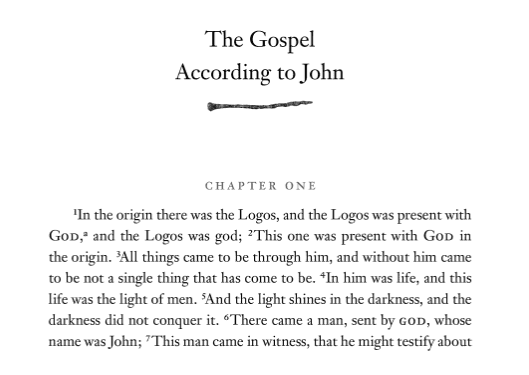
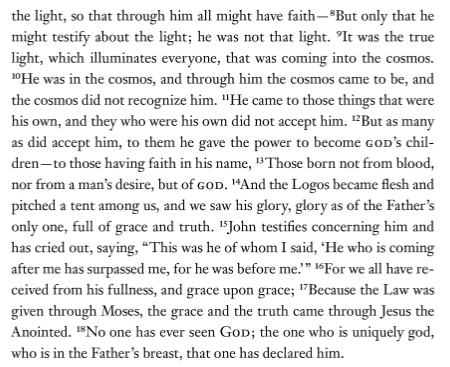
None of us know what is being born, even today. For Christians, though, we know Who is being born, and the terrible saving truth that the baby reveals. That little boy was born to die, so that humankind might live. His mother gave him birth, but she knew even in her moment of joy that her heart would be pierced with sorrow. We cannot separate them. I love David Bentley Hart’s idiosyncratic translation of the beginning verses of the Gospel of John, from his version of the New Testament, published this year:
The word “cosmos” makes all the difference, I think. Typically it is translated into English as “world,” but cosmos is so much richer. It connotes ordered reality. In other words, Christians believe that Jesus was the form of God’s rational activity in Creation. Creation, in the Christian vision, is not random, but ordered and purposeful. The incarnation and birth of the Logos makes explicit the meaning of it all, and indeed establishes once and for all that it has meaning.
It is worth asking ourselves what this tableau, viewed from the vantage of pagan antiquity, would have meant. A man of noble birth, representing the power of Rome, endowed with authority over life and death, confronted by a barbarous colonial of no name or estate, a slave of the empire, beaten, robed in purple, crowned with thorns, insanely invoking an otherworldly kingdom and some esoteric truth, unaware of either his absurdity or his judge’s eminence. Who could have doubted where, between these two, the truth of things was to be found? But the Gospel is written in the light of the resurrection, which reverses the meaning of this scene entirely. If God’s truth is in fact to be found where Christ stands, the mockery visited on him redounds instead upon the emperor, all of whose regal finery, when set beside the majesty of the servile shape in which God reveals Himself, shows itself to be just so many rags and briars.
This slave is the Father’s eternal Word, whom God has vindicated, and so ten thousand immemorial certainties are unveiled as lies: the first become last, the mighty are put down from their seats and the lowly exalted, the hungry are filled with good things while the rich are sent empty away. Nietzsche was quite right to be appalled. Almost as striking, for me, is the tale of Peter, at the cock’s crow, going apart to weep. Nowhere in the literature of pagan antiquity, I assure you, had the tears of a rustic been regarded as worthy of anything but ridicule; to treat them with reverence, as meaningful expressions of real human sorrow, would have seemed grotesque from the perspective of all the classical canons of good taste. Those wretchedly subversive tears, and the dangerous philistinism of a narrator so incorrigibly vulgar as to treat them with anything but contempt, were most definitely signs of a slave revolt in morality, if not quite the one against which Nietzsche inveighed—a revolt, moreover, that all the ancient powers proved impotent to resist.
This is the snow falling in the temple: a baby born in a cave, whose fate was to suffer like us, and to die on a cross, and to rise from the dead. Suffering will go on until the end of time, but it will not have the last word, nor will the throat-slashers, the cathedral-sackers, the child molesters, the hatemongers, the profaners of all creation. Their time is short. They cannot steal redemption.
How beautiful is that baby in the manger, and the face of his mother. Keep that memory of them alive. Strive to see them present today. These images are like snow falling in a temple. A blessed Christmas to you all, especially those most in need of God’s mercy.