Showing posts with label Roger Kimball. Show all posts

Sunday, August 11, 2019

White Supremacy: Like Manna to the Left


By 
https://amgreatness.com/2019/08/10/white-supremacy-like-manna-to-the-left/
August 10, 2019
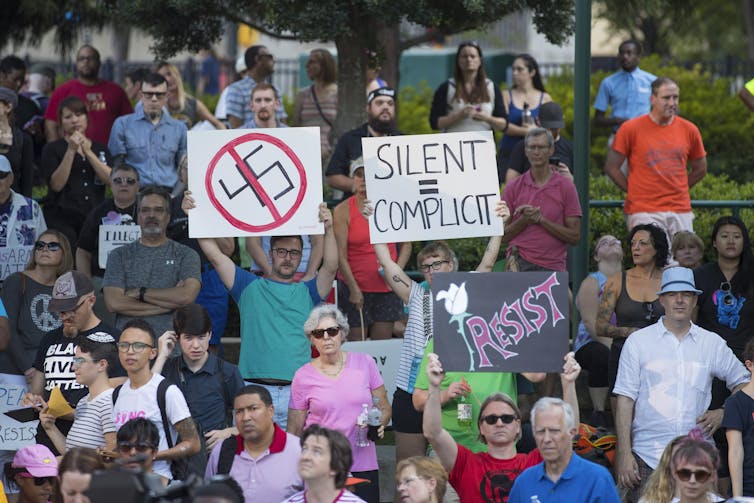
Image result for white supremacist myth
Atlanta 2017 (AP/Todd Kirkland)

Since the world has not heard enough about “white supremacy” lately, I thought I would say a few words about this neglected subject.

Please don’t turn up your nose and say “but ‘white supremacy’ is just a malignant fiction, a fantasy conjured up by the Left in order to beat up on conservatives, Trump supporters, etc.”
This is true. “White supremacy” is in this respect like “climate change”: a bugbear, a horror tale utterly without substance but scary—Oooo so scary!—nonetheless. In Through the Looking Glass, Alice scoffs when the White Queen tells her that she is more than 100 years old. “I can’t believe that!” says Alice.
“Can’t you?” the Queen said in a pitying tone. “Try again: draw a long breath, and shut your eyes.”
Alice laughed. “There’s no use trying,” she said: “one can’t believe impossible things.”
“I daresay you haven’t had much practice,” said the Queen. “When I was your age, I always did it for half-an-hour a day. Why, sometimes I’ve believed as many as six impossible things before breakfast.”
The whole “white supremacy” meme is a bit like that. The number of real, honest-to-goodness, card-carrying, union-affiliated “white supremacists” is vanishingly small. They could be crowded into a middle-school gymnasium in a small town with room left over for the cheerleaders and a popcorn machine. The idea that white supremacists or the ideology of white supremacism represent a threat to American society is preposterous. Everyone knows this, the pathetic commentators on CNN and MSNBC just as much as the gesticulating clowns running for the Democratic presidential nomination.
Yet they keep screaming about “white supremacism,” hoping, I believe, that if they keep repeating the mantra, their incantation will bring the longed-for object into being.
A Religious Fervor
Indeed, it is one of the signal ironies of the campaign against the phantasm denominated “white supremacism” that the people shouting the loudest against it say they abominate everything about white supremacism—“racism,” Donald Trump, etc.—when, in fact, they crave its advent with a fervency that makes St. Theresa look blasé.
You see this every time there is a public act of violence. When the news breaks you can discern a sharp intake of breath on the part of the Confraternity of Leftist Pundits. “Please Comrade God,” you can almost hear them pray, “Please let the perpetrator be a pasty-faced, Trump-voting, Christian white guy.”
Usually, it isn’t. But every now and then their prayers are answered, as they were, sort of, just recently when some wacko who doesn’t like Mexicans murdered 22 people in El Paso. Central Casting is going to have a hard time making the chap in question out to be a “white supremacist,” however, since he was just a mix of nasty congeries of bizarre ideas. But at least he was white. So was the Dayton, Ohio, shooter, who murdered nine people, but he had the misfortune to be a registered Democrat and avid Elizabeth Warren supporter and espoused various left-wing causes, so the less said about him, the better.
Pop quiz: who is James T. Hodgkinson? Can you say without Google’s help? Stumped?
He was the fellow who, in 2017, went to a congressional Republican baseball practice and shot five people, including Steve Scalise, a congressman from Louisiana, who nearly died. You don’t hear much about Jimbo because he was an avid Bernie Bro and Trump-hater. Doesn’t fit the narrative, you see, so (if I may invoke Lewis Carroll again) he has been transformed into a Cheshire cat creature, disappearing bit by bit from the public record.
From Two-Minutes to an Endless Loop of Hate
Here’s another irony about the whole “white supremacist” wheeze. The politicians and their mascots in the commentariat keep screaming about “hate,” but it takes but a moment for anyone to see that the vast majority of hatred is emanating from the supposed opponents of “white supremacism.” So it is that ready-made presidential candidate impersonator “Beto” O’Rourke compares Donald Trump’s campaign events to Nazi rallies or Joaquin Castro, manager of his brother Julián’s presidential campaign, publishesthe names of Trump donors and invites the public to harass them.
Readers of Nineteen Eighty-Four will remember the daily ritual in which the inhabitants Oceania are required to watch a film depicting the hated Emmanuel Goldstein, enemy of the state. In Orwell’s novel, the hate-fest was only two minutes long, whereas the supposed anti-white supremacist fanatics have their propaganda on an endless loop.
Back in May, PJ Media’s Sarah Hoyt put her finger on what the rallies against “white supremacism” are really all about when she noted that “We Don’t Have a Problem with White Supremacy. We Have a Problem with Leftist Supremacy.” Bingo. “The left is obsessed with white supremacists,” Hoyt observed, “the way that children are obsessed with Santa Claus, and for more or less the same reasons.” Santa doesn’t exist, but the presents pile up every December 25 because the right people have a stake in perpetuating the myth of his existence.
Another curious feature of the hysteria over the made-up tort of white supremacism is that its very frenetic quality, instead of highlighting its disingenuousness and absurdity, tends instead to function as a sort of camouflage. Parsing the psychological dynamics of this phenomenon would doubtless take us into deep waters—I’m not at all sure I can explain it—but the Freudians would probably explain in terms of the idea of projection: concealing one’s own unpalatable impulses from oneself by attributing them to another.
Perpetuating the Noxious Myth
There are two reasons that anti-Trump ideologues love the fairy tale of white supremacism. One revolves around the word “white.” Incessantly repeating “white” helps to create a semantic nimbus of racialism. You don’t even need to accuse anyone of particular impermissible acts. All you need to do is utter their names in conjunction with the phrase “white supremacist” and little flecks of racial suspicion adhere to them like iron filings coating a magnet.
Donald Trump is quite right when he denies being racist. He has taken many positions on many issues over his career, but never has he displayed any racist attitudes. (The same can be said, by the way, about the spurious charge that he is anti-Semitic.) But the charge of white supremacism is so precious to anti-Trump stalwarts because it enables them to inject the smudgy ink of racism into a discussion where it is totally out of place. As American society becomes ever less racist, any possible shards of racialist thinking are gathered up like manna for grateful consumption by those who have a stake in perpetuating the noxious myth that America is a uniquely racist society.
The unstable edifice of racial accusation can be kept upright only by constant pressure, like those inflatable toy castles at children’s birthday parties. Turn off the machine pumping in the air and the plaything collapses in upon itself.
The acolytes of white supremacy—by whom I mean not the relatively few who actually espouse it, but the great many who claim to have uncovered it everywhere—are right that the motor of their heart’s desire is hatred, but once again the hatred resides not in the objects of their obloquy but rather in themselves. In this respect, they are unconscious followers of the Roman poet Martial. “Non amo te, Sabidi, nec possum dicere quare / Hoc tantum possum dicere: non amo te.” My unauthorized translation:
I do not like thee, Donald Trump.
Don’t ask me why, you have me stumped.
But this I know, you awful frump:
I do not like thee, Donald Trump.

Wednesday, July 31, 2019

Donald Trump at the Overton Window


By 
https://amgreatness.com/2019/07/30/donald-trump-at-the-overton-window/
July 30, 2019

Image result for trump cummings
President Donald Trump and Congressman Elijah Cummings (D-Maryland)


I shall leave it to the theologians to decide whether it is providential or merely coincidental that it was this very week in 1729, on Tuesday in fact, that the city of Baltimore was founded. I think we can say that, for the genus rattus, the city has been providential, at least since 1967. That was the year Thomas D’Alesandro III—the brother of Speaker of the House Nancy Pelosi (and son of Thomas D’Alesandro, Jr., a former mayor of Baltimore)—began the city’s 50-plus years of uninterrupted Democratic Party rule. (If you except the younger Mr. D’Alesandro’s immediate predecessor, you can push the run of Democratic mayors of Baltimore all the way back to 1947.)
Things have been good for the rats in Baltimore. For homo sapiens sapiens? Not so good. Drugs. Violence. Poverty. Squalor. “The Wire” was more documentary than fiction.
But rats have, as the book of Genesis recommended, been fruitful. Also, they have multiplied. Quoth Catherine Pugh, mayor of Baltimore until just a couple of months ago, when she stepped down because of charges of corruption, rats were so plentiful in Baltimore that “you could smell them.”
But that was in September of last year, before Donald Trump turned his gimlet eye on Baltimore, a city that has suffered not only from more than half a century of local Democratic control but also from nearly 25 years of representation by Elijah Cummings, a race-hustling confidence man right out of central casting.
Over the weekend, the president opened up on “King Elijah” in a series of tweets. “Baltimore, under the leadership of Elijah Cummings,” he wrote in one, “has the worst Crime Statistics in the Nation. 25 years of all talk, no action! So tired of listening to the same old Bull . . . Next, Reverend Al will show up to complain & protest. Nothing will get done for the people in need. Sad.”
The president continued: “Baltimore’s numbers are the worst in the United States on Crime and the Economy. Billions of dollars have been pumped in over the years, but to no avail. The money was stolen or wasted. Ask Elijah Cummings where it went. He should investigate himself with his Oversight Committee!”
In short, Baltimore was “a disgusting, rat and rodent infested mess.”
It was one thing when Christine Pugh dilated on the rodent theme in 2018.
It is quite another when Donald Trump does it in 2019.
The cries of “racism” came fast and furious against the president, from, among many others, the Rev. Al Sharpton. (I always love writing “the Rev. Al Sharpton”: the incongruity is positively giggle-making.)
That did not faze the president, who promptly repeated and broadened his attack. “There is nothing racist in stating plainly what most people already know,” he wrote, “that Elijah Cummings has done a terrible job for the people of his district, and of Baltimore itself. Dems always play the race card when they are unable to win with facts. Shame!” And then there was this on Sharpton: “I have known Al for 25 years. Went to fights with him & Don King, always got along well. He ‘loved Trump!’ He would ask me for favors often. Al is a con man, a troublemaker, always looking for a score. Just doing his thing. Must have intimidated Comcast/NBC. Hates Whites & Cops!”
Politico, along with the rest of the virtue-signaling, chest-less media, sobbed in impotent disbelief. “President Donald Trump on Monday opened new fronts in the bitter tirade he launched over the weekend against Maryland Rep. Elijah Cummings and the city of Baltimore, lobbing insults at civil rights leader Rev. Al Sharpton and 2020 Democratic presidential candidate Bernie Sanders.”
You know that the president’s observation was impermissible because Politico called it “bitter,” which ever since Obama’s “bitter clingers” remark has been code for “right-wing redneck.” But the best thing aboutPolitico’s little melodrama was its description of Sharpton as a “civil rights leader.”
What Al Sharpton really is, as the president noted, is a “con man,” a race-hustling mountebank. Thomas Sowell was less polite but more accurate when he said that Sharpton headed “a trail of slime going back more than a quarter of a century, during which he has whipped up mobs and fomented race hatred from the days of the Tawana Brawley ‘rape’ hoax of 1987 to the Duke ‘rape’ hoax of 2006 and the Ferguson riots of 2014.”
Exactly so.
I suspect that those who see an element of calculation in the president’s tweets about Baltimore, Cummings, and Sharpton are correct. As Monica Showalter noted at The American Thinker, the president has just dramatized a real problem and made the Democrats, and their enablers in the media, defend the indefensible, just as he did with his comments a couple of weeks ago about the racist, anti-Semitic, and anti-American tetrarchy of “the squad.” President Trump, Showalter noted, is “now forcing Democrats to own the urban shambles and filth that characterize one-party blue-city rule, putting all Democrats on their backfoot. That’s what’s behind his surprise Twitter assault that began with Rep. Elijah Cummings and his rat-infested Baltimore district, which pretty much came out of the blue.”
I think that’s probably correct. But there are a few larger issues at play in this episode.
One was articulated several decades ago by the philosopher Sidney Hook, who, writing about the danger of spurious charges of “racism” and kindred epithets, noted
as morally offensive as is the expression of racism wherever it is found, a false charge of racism is equally offensive, perhaps even more so, because the consequences of a false charge of racism enable an authentic racist to conceal his racism by exploiting the loose way the term is used to cover up his actions. The same is true of a false charge of sexism or anti-Semitism. This is the lesson we should all have learned from the days of Senator Joseph McCarthy. Because of his false and irresponsible charges of communism against liberals, socialists, and others among his critics, many communists and agents of communist influence sought to pass themselves off as Jeffersonian democrats or merely idealistic reformers. They would all complain they were victims of red-baiting to prevent criticism and exposure. [Emphasis added.]
You see the dynamic Hook outlined at work everywhere today, not least in the ridiculous charges that Donald Trump is racist because he attacks people who do bad things who also happen to be black.
Their color has nothing to do with his criticisms. Trump attacks “the squad” not because they are female or “people of color,” but because the are anti-American fanatics. He attacks Elijah Cummings not because he is black but because he is a corrupt pol who has done ill by his district. He attacks Sharpton not because he is black but because he is a race-baiting con-man.
Donald Trump is an equal opportunity scourge. He doesn’t care if you are black or white, male or female, if you behave badly and violate the public trust, he will call you out, baldly. And note this above all: If you attack him, he will attack you back. As Brit Hume pointed out recently, “People discerning a racist motive for Trump’s attack on Elijah Cummings are missing a key point: Trump attacks those who criticize him and his administration, black or white.” Hume follows up with an amusing and color-coordinated list of people Trump has put in their place (Bernie Sanders: crazy, Elizabeth Warren: total fraud, Justin Amash: loser, Joe Biden: low IQ, Harry Reid: insane, etc., etc.).
Beyond the elements of political calculation and polemical style, however, Donald Trump’s recent tweet fests suggest that he may be on the threshold of shifting the Overton Window on race.
Named for the policy analyst Joseph Overton, the famous fenestration describes the range of ideas and rhetoric that are acceptable in public discourse, from the unthinkable and radical at one end to popular ideas and settled policy at the other.
Public discourse in America has long been held hostage to a species of racist moral blackmail that has made it almost impossible to tell the truth about many central social realities. Trump opened the window on that paralyzing darkness when he dared to violate the taboo against criticizing failure when it happened to be presided over by blacks. But to do so is not racist. In fact, it is anti-racist, because it dares to hold everyone, blacks as well as whites, to the same standard.
The ethic of one-sided discriminatory intimidation has been the Democrats’ meal ticket from Jim Crow through the comically misnamed “Great Society” right down to our current crop of race hustlers like Elijah Cummings, Al Sharpton, Maxine Waters, not to mention the hundreds of academics who have based their entire careers on race, not scholarship.
Trump was elected partly because he was “politically incorrect”: he dared to bring the engine of common sense to bear against the malodorous carapace of left-wing ideology.
The president has a long way to go. But he has been the first chief executive in a very long time to have the rough courage to challenge the entrenched, sclerotic establishment that promulgates an agenda of dependency in order to protect its power and perquisites, surrounding the whole with the sleepless sentinels of politically correct interdiction.
It is a rotten, and a deeply un-American, spirit that has risen up among us. Donald Trump will not vanquish it single-handedly. But simply by tearing the scab off this festering infection, revealing it to all in its hideous profusion, he has earned the gratitude of everyone who values liberty and the boundless opportunities of what we used to be able to call, without embarrassment, the American way.

Monday, July 15, 2019

Don’t Celebrate Bastille Day


By Roger Kimball
https://amgreatness.com/2019/07/14/dont-celebrate-bastille-day/
July 14, 2019

Prise de la Bastille.jpg
'The Storming of the Bastille' by Jean-Pierre Houel

Since I am writing on Bastille Day, I am prompted to wonder why the French—or anyone else, for that matter—celebrate this infamous date. After all, the “storming” of that royal keep in 1789 was the spark that started the conflagration of the French Revolution. Unlike the American Revolution, in which the rule of law and the institutions of civil society survived the change of governments, the French Revolution was one of the signal bad events in world history. It consumed civil society and the centuries-old institutions of civilization. It was an unalloyed triumph of the totalitarian spirit, and in this respect it presaged and inspired that even greater assault on decency and freedom, the Bolshevik Revolution, the opening act of one of the darkest chapters in human history. The butcher’s bill for the French Revolution is many hundreds of thousands. Soviet Communism was responsible for the deaths of tens upon tens of millions and the universal immiseration of the people whose lives it controlled.
Yet today’s news is full of cheery stories about Bastille Day celebrations. Why?
It is generally a bootless errand, I know, to oppose myth with history. Myth, feeding a deep need, subsumes history. Still, truth demands that the effort be made.
One canard that we were all brought up on is that the Bastille was a loathsome dungeon full of innocent political prisoners. In fact, it harbored not hordes but precisely seven inmates when the mob stormed it. Contrary to what you have been told, the prisoners were detained in good conditions. At least one was attended by his own chef.  Bernard-René de Launay, the governor, was by all accounts a fair and patient man. But that did not save him from the mob’s “revolutionary justice.” They dragged him out of the fortress and stabbed him to death.
By rights, Bastille Day should be a day of national mourning or contrition. That it is not tells us a great deal—about the persistence of human credulousness, for example, and the folly of subordinating the imperfect, long-serving structures of civilization to the demands of impatient people infatuated by their own unquenchable sense of virtue. Tocqueville, in his book on the ancien régime at the eve of the revolution said that the “the contrast between benign theories and violent acts” was one of the Revolution’s “strangest characteristics.”
Strange it may have been, but it has turned out to be a regular feature of the totalitarian sensibility. What could be more benign sounding than slogans about “liberty, equality, fraternity,” O Citoyen, but how oppressive, how murderous, were their implementation “on the ground”? Robespierre cut to the chase when he spoke of “virtue and its emanation, terror.” He knew that the index of the sort of virtue he proselytized—a heady confection inherited from Rousseau—was the rapidity with which le rasoir national, the guillotine, pursued its grisly business. The pursuit of virtue by communists is a hundred, a thousand times bloodier and more soul blighting.
But I do not want to spend Bastille Day rehearsing horror stories from the past. Rather, I’d like to say just a word or two about one feature of the totalitarian impulse that has survived and thrived in modern democratic societies.
I am promoted by a story I saw this morning about Bernie Sanders, the aging socialist Senator from Vermont who is once again running for the presidency of the United States. A tweet from Christina Hoff Sommers alerted me to the report that although Bernie had chosen to spend his honeymoon in the Soviet Union, he never availed himself of the opportunity of visiting Aleksandr Solzhenitsyn when the great writer and moral witness was living as a refugee in Cavendish, Vermont. Some of the comments evinced surprise. Some put it down to ideology, as if Sanders, being a fan of the Soviet Union, made a silent protest by ignoring the famous anti-Soviet figure in his midst.
But I think the deeper reason for Sanders’s neglect was a quality of the socialist or communist or revolutionary sensibility that is too little remarked. I mean its ingrained, indeed its programatic lack of curiosity about other people.
Roger Scruton, in a thoughtful anatomy of the French Revolution, is one of the few people to underscore this feature of the totalitarian habit of mind. “This absence of curiosity,” Scruton notes, “is a permanent characteristic of the revolutionary consciousness. It can be seen in Marx, in his impoverished and impatient descriptions of the ‘full communism’ towards which history is tending.  And it is even more evident in the writings of Lenin, in which blocks of wooden language are constantly shifted so as to conceal the goal of communism from view.”
An important reason for this lack of curiosity (and this was something grasped by Burke and Tocqueville) is the prominent role that abstractions play in the mental and moral metabolism of the totalitarian sensibility. It was articulated with some poignancy by Rousseau who, at the end of his life, sadly observed, “I think I know man, but as for men, I know them not.” Thus it should come as no surprise that Rousseau, in an influential prelude to totalitarian dramas to come, should insist that true liberty consisted in sacrificing all merely individual wills to the imperatives of a “general will” whose dictates were as preemptory as they were abstract. As sage of Geneva put it in The Social Contract, anyone who would dare to undertake the creation of a people must feel himself capable of “changing human nature.”  Human reality is drained of dignity and becomes material to be shaped and formed according to the schemes of utopian power.  Hence the terrifying logic of Stalin’s observation that a single death is a tragedy, but a million deaths is a statistic. Revolutionaries do not trade in individuals, only masses.
I was struck by the story of Bernie Sanders’s curiosity deficit because it seems to be such a widespread liability of our political class. Absorbed by their ideological battles, the political actors of the establishment—and I include here the army of consultants, lobbyists, staffers, and pundits as well as elected officials—seem to have constructed an all-but impenetrable carapace that protects them from the unwanted intrusion of empirical reality. Their lives are given up entirely to politics. They thereby neglect the non- or pre-political reality which is the end for which politics labors, or should labor. This disaster was promulgated by the architects of the French Revolution, for whom there was no private sphere apart from the imperatives of the state, and perfected by Soviet Communism and its progeny, for whom the individual is faceless datum, a “cog” as Lenin put it, in the party machine.
The cruel and suffocating intrusiveness of those dystopian “experiments against reality” are not so seamlessly or so thoroughly and viciously implemented in American society. But I submit that anyone who looks around at the vast, unaccountable, self-engorging bureaucracy of the so-called administrative state, anyone who watches the ignorant and vituperative grandstanding of so many of our elected officials, cannot help but mark the parallels with the remorseless incuriosity that stood behind the totalitarian juggernaut as it systematically discounted truth for the sake of the accumulation of power. All of which is to explain why I regard Bastille Day as a sobering reminder of man’s pernicious folly rather than an occasion for celebration.

Sunday, May 26, 2019

Let’s Call the Russian Collusion ‘Hoax’ What it Really Is


By 
https://amgreatness.com/2019/05/25/lets-call-the-russian-collusion-hoax-what-it-really-is/
May 25, 2019

Image result for mueller clapper comey
Robert Mueller, James Comey, James Clapper, Christopher Steele and John Brennan (Clockwise from top left)

During the Japanese bombardment of Shanghai in 1932, the Austrian essayist Karl Kraus was anguishing over the placement of commas in a column. It might seem futile at such a moment, he told a friend, but “if those who are obliged to look after commas had always made sure they were in the right place, then Shanghai would not be burning.”

Hyperbolic? Perhaps. But the general point holds: words matter, as do the their appurtenances, punctuation. (After all, “Let’s eat Grandma” means something quite different from “Let’s eat, Grandma.”)
George Orwell made a kindred observation about the importance of having the courage to call things by their real names. Euphemism, the counterfeit of good manners, is the enemy of truth, which is the only ally worth having.
I have been thinking about this constellation of ideas recently as the news has been full of talk about the “Russian collusion hoax.” Use of the term “hoax” got a big boost in the aftermath of the Special Counsel Robert Mueller’s report on the question of whether there was actionable cooperation, coordination, or collusion between the Trump campaign and the Kremlin. Two years, $34 million, and a wide swath of debilitating rumor, innuendo, and unrelated indictments and prosecutions later and we know that the answer to that question is “No, there was no cooperation, coordination, or collusion between the Trump campaign and the Kremlin.”
Anyway, we know that if we haven’t locked ourselves in the bunker bulwark, closed our eyes, put our fingers in our ears, and chanted continually the NeverTrump mantras.
I myself have deployed the term “hoax” to describe what happened to Donald Trump and his colleagues—and to the American people—during and after the 2016 presidential campaign. But a couple of friends have pointed out how inadequate the term “hoax” is for what just happened and—to at least some extent—is still happening in the machinery of our government.
According to The American Heritage Dictionary, a hoax is “1. an act intended to deceive or trick” or “2. Something that has been established or accepted by fraudulent means.”
The spectacle of round-the-clock hostile media coverage of the Trump-Russia fantasy certainly was intended to “deceive or trick.” And certainly we learn almost every day a little more about how the various investigations were started on the basis of “fraudulent means” (here’s looking at you Christopher Steele).
But thinking about it, I conclude that the term “hoax” is wholly inadequate to describe the enormity of the political scandal that was perpetrated against Donald Trump, against the office of the president, and ultimately against the American people.
For one thing, the word “hoax” implies something jocular or prankish. The joke might be malicious, but it is still intended to be humorous. There was nothing at all humorous about what just happened in our political life, though the hysteria of the anti-Trump chorus—the pussy-behatted females complaining about how “crude” Trump was, the “comedian” who paraded about with a bloody doll’s head representing the president, the tears and imprecations and jeremiads disgorged by the press and by Trump’s political enemies: all that did have a sort of ghastly if pathetic humor about it.
But when we step back and consider what actually happened over the past three years—and, more, what almost happened—it is clear that the word “hoax” does not begin to cover the reality of what I have been calling for many months the greatest political scandal in the history of the American republic.
Does that, too, sound hyperbolic, like worrying about commas when Shanghai is burning? Some people think so. I’ve have several times said why I think they are wrong.
Perhaps the best way of summarizing my disagreement is by suggesting an alternative to the word “hoax.” It’s not a novel suggestion.
On the contrary, it’s often been used in concert with or as a synonym for “hoax.” But I think it is a better word in this context because it expresses the malign intention behind the multifarious activities directed against candidate Trump and then President Trump. The word I have in mind is “coup.”
Again, I know that that is a dramatic, maybe a melodramatic, word. But I think it accurately expresses the deliberate effort by actors in the Obama Administration, including by President Obama himself, to assure Hillary Clinton’s victory by destroying the reputation of Donald Trump. “Most Presidents leave office,” the commentator L. J. Keith recently wrote, “and essentially step back from public life. Not Barack Obama. Shellshocked by Hillary Clinton’s loss, Obama, Brennan, Clapper, Comey, and Clinton set in motion a series of events that will forever tar his presidency, and decimate the concept of a peaceful transition of power.”
There have been scores if not hundreds or even thousands of columns written about every aspect of this complex story. We all know by now about the deployment of shadowy characters like Alexander Downer, the former Australian Ambassador to the UK and Hillary Clinton supporter (Downer engineered a $25 million contribution from the Australian government to the Clinton Foundation). Downer had drinks with George Papadopoulos, a minor Trump campaign aide, and thereby helped get the ball rolling on the Russia investigation. For a nanosecond, the New York Times said that was where it all started.
But Downer was just the tip—or maybe just a tip—of the iceberg. One of the remarkable things about this story is how many people it has involved and how long it has taken to get a full headcount of the anti-Trump team. Remember when Joseph Mifsud’s name first surfaced? Or Stefan Halper’s? Remember when we learned about Peter Strzok and his alleged paramour, Lisa Page? Then there was Bruce Ohr, former associate deputy attorney general: he had his part to play in the drama, too. But wait! It turned out that his wife is Nellie Ohr and that she worked for Fusion GPS, the company that hired Christopher Steele. Gosh. And what about Steele himself? When we were first introduced to him, he was a former British spy, a “highly respected” operative, who had got the goods on Donald Trump.
Remember how long it took before we learned that Steele had been paid by the Democratic National Committee and the Hillary campaign, and that his dossier was not just “unverified” and “salacious,” as James Comey put it, but was in fact nothing but a scurrilous piece of opposition research made up out of “random” scraps of gossip that Steele had assembled from highly dubious sources? Nevertheless, it was the dossier, and nothing but the dossier, that provided the unverified “evidence” for the supposedly “verified” FISA warrants to spy on Carter Page, an American citizen, and hence to spy on the campaign and then the administration of Donald Trump.
And on and on this kaleidoscopic onion has gone, as one layer after the next has been peeled back only reveal another layer and additional personalities.
Finally, however, I believe we are nearing the hollow center of the onion. The dogged Attorney General William Barr is proceeding methodically, inexorably to lay bare the origins of the spurious Russia investigation.
There are still many details we do not know. Some we may never know. And dogged though Barr may be, many of the principal actors in this attempted coup will probably never be held to account. Will Hillary Clinton? Will Barack Obama? I doubt it.
In fact, it was not so long ago that I was resigned to the eventuality that no one would be held to account, not John Brennan or James Comey, not Peter Strzok or Lisa Page, not James Clapper or Sally Yates or Samantha Power.
Barr’s arrival on the scene has made me rethink my resignation. But whatever happens to those individuals, it now seems clear that Barr’s investigation will reveal for all to see that what began in 2016 or even 2015 and continued until and beyond the day that Robert Mueller deposited his nearly 500-page report clearing the president of “collusion” was not a hoax at all. It was an attempted coup.
We should face up to that unpleasant fact and call things by their real names. The actions taken by the Obama Administration threatened not just Donald Trump and his presidency but the very processes and protocols by which the peaceful transition of power has been effected in the United States. As L.J. Keith observed, “Even in the most contentious elections and after disputed results, there was never been this sort of dangerous, systematic, deliberate rejection of the will of the people. The abrogation of the constitution to use extrajudicial methods to destroy the incoming president. It is the very definition of a coup.”
Indeed. So let’s call it what it is. A coup.

Sunday, April 14, 2019

Pursue Those Indictments!


April 13, 2019
Image result for devin nunes
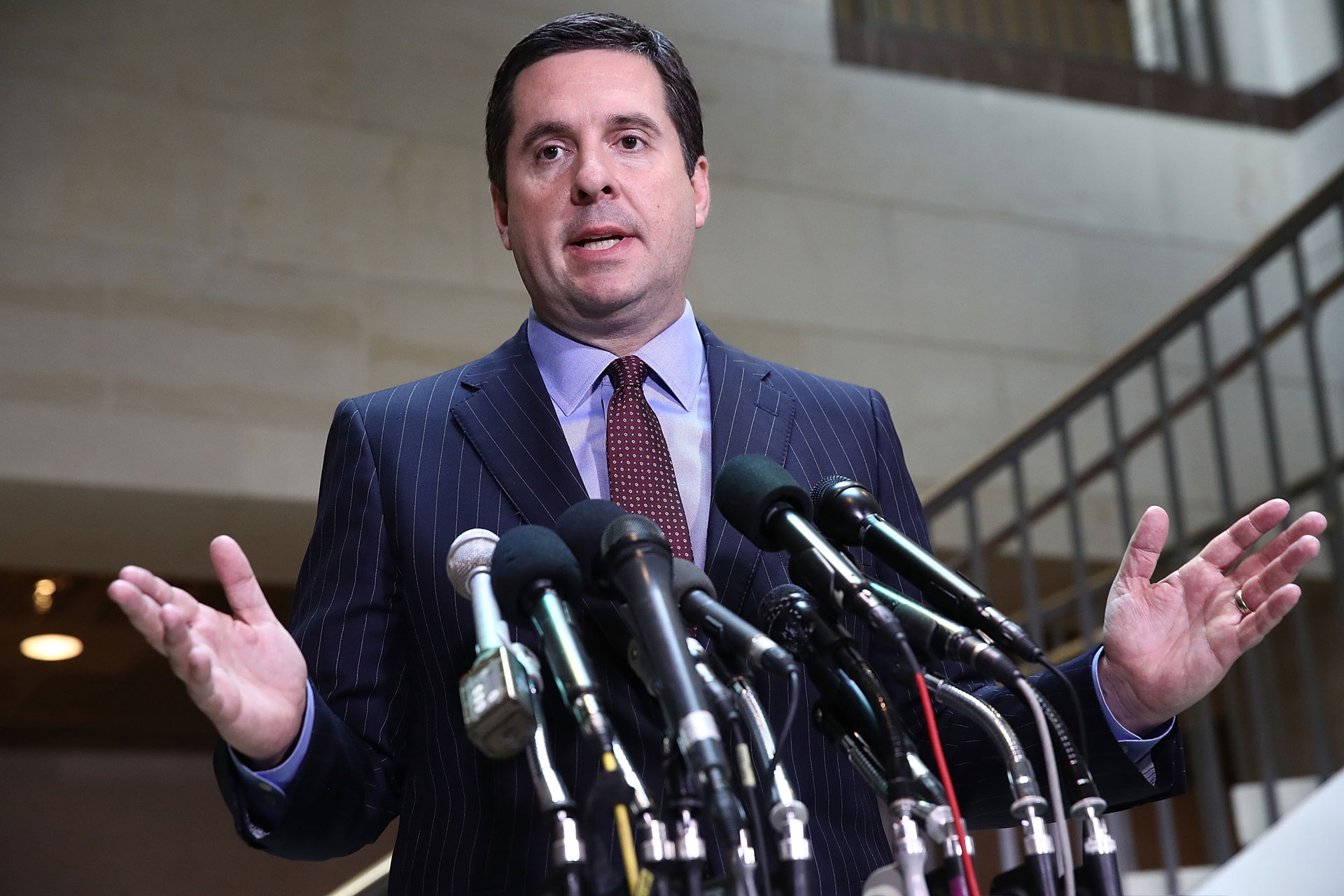
Devin Nunes (Getty Images)
Last month, Chris Buskirk wrote a column for the Spectator USA describing Representative Devin Nunes as “a hero of the Republic.” It was well-deserved praise. Nunes, a Republican Congressman from a from a rural district in California was, until January, chairman of the House Permanent Special Committee on Intelligence (he is now the ranking member). Nunes has worked tirelessly for more than two years to expose what our masters in deep-state Washington would bury from the glare of public scrutiny: the evidence that the entire Trump-Russian collusion narrative was a partisan effort, first, to undermine the Trump presidential campaign and, when that failed, to cover up the effort while still working assiduously to destroy the Trump presidency.
As Buskirk points out, without Nunes’s terrier-like efforts—conducted, it has to be pointed out, against the background of scurrilous and unremitting calumnies from the Democrats and their bought-and-paid-for megaphones in the media—the public would likely be totally in the dark about what really happened over the course of 2016 as the Obama Administration and the Hillary Clinton presidential campaign endeavored to “dirty up” Trump and his colleagues, calmly at first, and then with growing hysteria as Trump, against all the odds, emerged as a serious challenger and eventual victor in the election that all the smartest people knew, just knew, that Hillary had sewn up.
Think about it: without Nunes we wouldn’t know that “Susan Rice, Obama’s National Security Adviser, spied on members of the Trump campaign before the election and then unmasked their names with the likely knowledge that they would be leaked—which they were.” Pause for a moment to think about that. The national security advisor for one administration spied on members of her political opponents in a presidential election and then unmasked their identities and made sure their names were leaked to the press.

If you don’t find that breathtaking you have become too inured to living in a banana republic.
But that is not all. As Buskirk goes on to point out, without Nunes, “We would not have details about the plot in the FBI and DOJ to use the phony dossier paid for by the Clinton campaign, created by Democratic party-aligned opposition research firm Fusion GPS, and circulated by an associate of Republican senator John McCain.”
Savor that tidbit as well: a dossier of unverifiable gossip secretly commissioned and paid for by one campaign covertly injected into the intelligence apparatus of the United States to justify a counterintelligence investigation against an opposing campaign. And note the role of the late “maverick” John McCain, surely one of the most disgusting political actors in recent American history: it was at his request that Christopher Steele wrote the final installment of his vampire fantasy, a.k.a., “the dossier,” and it was through McCain’s intervention that the dossier was given to the FBI and emunctory media outlets like BuzzFeed.

And there’s more. Without Nunes, Buskirk reminds us, “We would not know about [Lisa] Page and [Peter] Strzok. We would not know about the meeting that occurred in the FBI in which they conspired against President Trump and rested sure that at least they had the dossier as an ‘insurance policy.’ And we would not know about the flagrant abuse of the FISA courts. The FBI and DOJ lied to the FISA court three separate times in order to illegally obtain warrants to spy on Trump associates.”
Biggest Scandal in U.S. History
You can see why the Democrats don’t like Devin Nunes. He has been instrumental in exposing the plot to destroy Trump the candidate and then, when that failed, to undermine the Trump presidency.
As I have been saying for a couple of years now, this is the biggest scandal in American history. It dwarfs Watergate. Indeed, it challenges the fundamental integrity of our democratic—i.e., accountable—institutions. It challenges, too, the sacrosanct ideal of the separation of powers. Finally, it challenges the presumption of basic fairness and open competition without which our republic could endure in name only.
Anyone who cares about future of our political system, be he Democrat or Republican, owes Devin Nunes thanks for his efforts. And that debt has just been compounded with Nunes’s announcement that, “now that we have an attorney general,” i.e., William Barr, not Jeff Sessions, he is sending eight criminal referrals to the Department of Justice.
As Nunes explained in an interview with Maria Bartiromo, five of those referrals are “straight-up” referrals about a specific crime: lying under oath, for example, or leaking classified information.
The other three referrals are more complex. One involves conspiracy to lie to the FISA court. A second involves the manipulation of intelligence for partisan political ends. The third involves what Nunes calls “global leaks” of highly sensitive information: a call between the Australian Prime Minister and President Trump, for example, a call between the Mexican president and President Trump, and a call between General Mike Flynn and Russian ambassador Sergey Kislyak. How many people had access to such information? How many were in a position to leak it?
We do not yet know the names of those being referred to the Department of Justice for review. All told, Nunes estimated that the total number might reach “two-dozen” individuals. What the outcome of the referrals will be is anyone’s guess. Disgraced former Deputy Director of the FBI Andrew McCabe has been referred to the U.S. Attorney in Washington, D.C. but as I write he is traipsing about the country on his book tour telling people about how he, Deputy Attorney General Rod Rosenstein, and others thought about trying to get Trump’s Cabinet to go along with a plan to invoke the 25th Amendment to remove him from office. Which is to say, a criminal referral, while not something you would choose for a holiday weekend, is not necessarily the end of the line.
A Lengthy List of Suspects
But who do you think makes the list? Were I a modern-day Koko, my little list would include former CIA Director John Brennan, an implacable enemy of the president and a good candidate for the title of fons et origo of the Trump-Russia investigation.
It would include the FBI’s Peter Strzok, Andrew McCabe, and former Director of National Intelligence James Clapper, former acting attorney general Sally Yates, Bruce Ohr and his wife Nellie who (unbelievably) actually worked for Fusion GPS.
That other James, the oleaginous James Comey, former Director of the FBI, would certainly be on the list, as would several people in the Obama Administration: the aforementioned Susan Rice, for example, and former U.N. Ambassador Samantha Power, who, like Rice, did a lot of unmasking in her final months in office.
There are others—quite a few others, in fact, as anyone who has been keeping up with the reporting on this unfolding scandal knows well. According to Rep. Mark Meadows (R-N.C.), there are more criminal referrals to come. “Overwhelming evidence shows multiple FBI + DOJ executives abused their power to undermine a duly elected President Trump,” he said in a tweet. That, I think, is now undeniable. He concludes: “They will be held accountable.”
But will they? The jury is out on that.
In a recent column for the Washington Examiner, Devin Nunes wrote that “It is astonishing that intelligence leaders did not immediately recognize they were being manipulated in an information operation or understand the danger that the dossier could contain deliberate disinformation from Steele’s Russian sources.” It is in fact so astonishing, he goes on to note, that it is positively incredible, not in the sense of amazing but in the root sense of not credible.
“It’s now clear,” Nunes says, “that top intelligence officials were perfectly well aware of the dubiousness of the dossier, but they embraced it anyway because it justified actions they wanted to take—turning the full force of our intelligence agencies first against a political candidate and then against a sitting president.”
Turning the full force of our intelligence agencies first against a political candidate and then against a sitting president. Let that sink in for a moment. As Nunes notes, the whole Trump-Russia hoax was “a gift to our nation’s adversaries, most notably Russia.” Beyond that, though, the partisan weaponization of our intelligence and police services is a serious blow to the integrity of our democratic institutions.
Primarily a Political Operation
The entire Trump-Russia investigation—the Mueller hoovering operation, of course, but also “Crossfire Hurricane,” the counterintelligence probe that began at the end of July 2016, as well as the preliminary forays into the Trump campaign by shadowy figures like Stefan Halper and other “assets” of British and American intelligence services—the whole kaleidoscopic spectacle has proceeded on two tracks. One track is legal. There were tips, suspicions, insinuations, worries. They provided the pretext for the various investigations and surveillance.
Here we ask questions like, were the CIA and the FBI justified in the courses of action they took? Was it OK to take out a FISA warrant on Carter Page, an American citizen, who has never been charged with a crime? What besides the Steele Dossier, “oppo research” that has been shown to be a tissue of lies and innuendo, justified that extraordinary step? Was it OK to spy on the Trump campaign? Did the CIA and FBI follow their own protocols? Did key individuals break the law in pursuing President Trump and his associates?
The other track is political. Whatever nuggets of suspicious activity British or Estonian intelligence communicated to John Brennan, what are we to make of the machinery he helped set in motion? In my view, the Trump-Russia hoax (to use Nunes’s term) was primarily a political operation. The legal aspects were merely pretexts for the main event, which had two phases: preventing Donald Trump from becoming president, first of all, and then destroying his presidency. A long and tedious process has been set into motion by Devin Nunes and others, and Attorney General William Barr appears determined to see out. But the scary bottom line is this: over the last couple of years, one political party, aided and abetted by a compliant media and a deep-state bureaucracy, conspired to void the results of a free, open, and democratic election because they disapproved of the people’s choice.
Some people think that it would be best if we put this whole episode behind us, that we sharply limit any investigations into wrongdoing and that, especially, we refrain from punishing the highly placed actors who leaked, lied, and conspired against the president. I am not of their number. What just happened in the United States represented an existential threat to the integrity of our institutions. It happened because highly placed individuals had cultivated a sense of entitlement and presumption of higher virtue—what James Comey called a “higher loyalty”—which they believed exempted them from the constraints and procedures that the rest of us must observe. They broke the law because they believed that they answered to a “higher” law. Out of such convictions are revolutions born and countries destroyed. The best safeguard against it happening again—indeed, against it continuing on now—is to hold those responsible to account. It is too early to say whether that will happen.
As I say, some of my friends think it would be a bad thing for the country to pursue high-profile indictments. I, on the contrary, thinking about what the country has just been put through, believe that our best hope of preventing this from happening again is to make an example of those who, smitten with the delicious sensation of their own virtue, did their best to reverse the results of an election because a candidate they did not like had the temerity to win.