Showing posts with label Marriage and Family. Show all posts

Thursday, April 18, 2019

Sports Writer Jeff Pearlman Compares Having More Than Two Kids To Tossing Garbage Into The Ocean


By 
https://thefederalist.com/2019/04/18/sports-writer-jeff-pearlman-compares-two-kids-tossing-garbage-ocean/
April 18, 2019

Image result for large family
Photo credit: Erik Isakson/Getty Images
Sports author and podcaster Jeff Pearlman casually floated the idea of population control on Twitter on Monday: “Just saw a Tweet from a guy I know, announcing how excited he and his wife are to be having child No. 6. Does there come a point when, in the name of earth’s survival and limited resources, we’re allowed to say, ‘Hmm. I dunno, man …'”
No, let’s not share in the joy of acquaintances who are blessing the world with another child. Let’s leverage our indubitable wisdom on climatology and public policy to proclaim “earth’s survival and limited resources” are at stake and question whether they are doing the responsible thing.
Oh, but he didn’t stop there. When a Twitter user named Lisa clapped back with, “As a mom of 6 kids, I’m gonna say no,” our erudite intellectual thoughtfully responded, “Serious Q, Lisa–why? Earth truly can’t sustain this. Not hypothetical, factual.” He then went on to say the estimable Jeff Pearlman-approved number of children to have is, “I dunno. 2?”
Lisa objected, leaning on demographers’ projections that the world population will peak before the end of the 21st century. “I think it’s a slippery slope to start telling people how many kids they can or can’t have. My body, my choice.”
But Chairman Pearlman of the People’s Republic of Know-It-Alls would not be swayed. “It bothers me when people tell me not to throw my garbage in the ocean. My garbage, my choice.”

Population Control Leads to Horrible Policies

The fecundophobia of some members of the American elite has blossomed into full-blown hatred. Around this time last year, comedian Nikki Glaser tweeted “Don Jr. and his wife have FIVE kids. No one should be having five kids. Why are people still allowed to have 5 kids?”
In general, many people in the mainstream feel comfortable dehumanizing and devaluing babies and children, which is why tweets like Pearlman’s (which oddly equates people having as many kids as they want with people throwing garbage in the ocean whenever they want) and Glaser’s must be roundly refuted.
If calling out dangerous, immoral opinions on Twitter were ever cheap sport for pundits with time on their hands, it isn’t anymore. The fact that children born alive after abortions can literally, legally be treated as garbage in the state of New York now should not be lost on you. The fact that 232 Democrats in the House of Representatives have refused to even vote on ensuring all children born alive are treated as children, not garbage, should not be lost on you, either.
If there are a few voices at the back croaking weakly in protest, we can’t hear them over the fascist chants for government to regulate anything and everything in the name of the climate “crisis,” up to and including our own bodies (ironic, for the “my body my choice” crowd).
I wonder if aspiring Population Czar Pearlman realizes how many people have been violated and killed based on exactly the policy he’s referring to in the name of “sustainability.” Would you like to know how many people in India were forcibly sterilized out of fear of a population “bomb” that never existed? Around 8 million men and women.
Would you like to know how many people are missing from the Chinese population due to their one-child policy (now a two-child policy)? An estimated 300 million. More than 20 million Chinese people were sterilized in 1983 alone. Families pregnant with an unauthorized child have been threatened with exorbitant fines they couldn’t possibly afford, thus forcing them to seek abortions or literally pay the price.
In 1990, when a small town protested after the Chinese government violently ripped 250 children from the wombs of their mothers, officials sent an army to occupy the territory. The villagers’ armed resistance triggered what is known as the Barren Massacre—the indiscriminate slaughter of hundreds by the People’s Liberation Army (another bitter pill of irony). We know that forced abortions and sterilizations are still occurring on 1 million mostly Uyghur captives held in internment camps in China, according to the U.N. Committee on the Elimination of Racial Discrimination.

Autonomy Onslaught, Here We Come

The radical environmentalists who ceaselessly lobby government for a turn at the levers of power have never been interested in preserving your autonomy. Every natural human right, including the right to procreation and the right to life itself, must bow down to Nature as god.
There has never been such a thing as effective mass population control without violating the rights of the individual, and there never will be. Solutions range from heavy taxation to biological warfare. Celebrated playwright George Bernard Shaw pleaded for a “humane gas” that would kill “instantly and painlessly” to cleanse the population of those who “cannot pull [their] own weight.” But even something as relatively anodyne as per-child taxation is a strike at the knees of all who would not submit to the desanctification of individual human life.
It’s no wonder we’re having to refute ignorant Twitterati who compare children to garbage when people as supposedly enlightened as bioethicists have claimed that “the life of a newborn baby is of less value than the life of a pig, a dog, or a chimpanzee.” I wonder if Pearlman and Peter Singer ever slouch in overstuffed armchairs, puffing cigar smoke and egotism into each other’s faces as they wax poetic about the golden days of eugenics and the blatant attempts to keep the poor and the “unfit” from breeding. You know, that heyday of the early 20th century when 60,000 Americans were sterilized? Sports, social hygiene—interchangeable disciplines, really.
That’s where we’re really heading, aren’t we? Why would we indiscriminately limit children from every family when we could doso much good for the planet if we uprooted the “weeds” from the garden of society and kept them from breeding. Wait a minute, that sounds familiar.
Ah yes, we’ve heard that from population-control fanatic Margaret Sanger, founder of Planned Parenthood. In the born-alive debate, the left is already leaning almost exclusively on the false notion that all late-term abortions not directly related to maternal health are of fetuses “incompatible with life.” Unfit, you might say.“Lebensunwertes Leben.” It’s almost like some of them haven’t left that awful genetic supremacist ideology behind or something.

The World Isn’t Ending, and Neither Should Families

All this death and oppression building like a violent storm on the horizon is supposedly justified by science, but it’s mostly echo chamber dogma put forth by people whose predictions pretty much always fail to come true. As David Harsanyi has pointed out, sea levels did not rise 20 feet in the 14 years since “An Inconvenient Truth” (nor did they even rise one foot), a billion people did not die of starvation due to overpopulation, and farming hasn’t collapsed due to increased temperatures. Instead, we are more prosperous than ever. Extreme poverty has been cut in half in the last two decades.
The real kicker is, American fertility is already below replacement rate and, in fact, sits at a 30-year low. If this trend continues, we won’t be able to sustain this nation’s massive welfare state because we won’t have enough workers to generate payouts to the old.
If we’re going to keep our sacrosanct entitlement system intact, then whose lives are authorized for neglect now? Whose lives will be devalued for the “greater good”? All those vulnerable senior citizens tucked away in long-term care facilities, who are already getting the message they’re better off dead.
You see, whether the fertility rate goes up or down, whether the overall temperature ticks up or down, the problem isn’t the flawed science so much as the perverted morality that promotes the abuse and murder of individuals in the name of some greater collective goal, for which the science seems all too often just a means to that end.
You don’t get to a point of suggesting population control and comparing babies to garbage just by believing the earth has a fever. You get there by denying that humans are made in the image of God and that their rights derive from Him, not the government.
That’s why refuting bad methodology and cautioning against tenuous conclusions, as important as they are, is not enough to stop the onslaught against the sanctity of human life. There will always be another excuse, another crisis. A crisis doesn’t determine our morality, our morality determines how we deal with a crisis. Maybe Pearlman should take a seat on the bench until he gets his head around this basic rule of civilized society.
Georgi is a Senior Contributor at The Federalist, host of The 180 Cast, and coauthor of "Clocking Out Early: The Ultimate Guide to Early Retirement." Follow her on Twitter.

Wednesday, March 27, 2019

Blacklisting Chick-fil-A


March 26, 2019

Related image

No one is surprised when cities like San Francisco, New York City, and Seattle enact policies driven by the latest progressive imperatives. In Texas, where I live, observers have long believed that a statewide Republican majority would insulate the Lone Star State from such pressure. Capital city Austin’s traditionally liberal politics—its unofficial slogan is “Keep Austin Weird”—have usually seemed like an exception to the statewide rule. But now it appears that San Antonio, the state’s second-biggest city (and seventh-largest in the U.S.), has gotten “woke,” too, blacklisting a well-respected business because of its owners’ political contributions and religious beliefs.  

San Antonio’s left-leaning city council, backed by mayor Ron Nirenberg, recently banned Chick-fil-A from becoming a concessionaire at the city-operated international airport. City officials reportedly cited Chick-fil-A’s political positions as justification for its boycott of the company: “With this decision, the City Council reaffirmed the work our city has done to become a champion of equality and inclusion,” said councilman Roberto TreviƱo. “San Antonio is a city full of compassion, and we do not have room in our public facilities for a business with a legacy of anti-LGBTQ behavior.”

The city is targeting a company that is about as mainstream American as it gets. Chick-fil-A is wildly successful because it offers appealing fast food and courteous service at reasonable prices. The privately owned fast-food chain, based in Georgia, operates more than 2,100 restaurants in 46 states and the District of Columbia (including 32 outlets in the San Antonio area, employing more than 2,000 people). Founded in 1946 by a devout Christian, family-owned Chick-fil-A is famously closed on Sundays. Yet despite operating only six days a week, Chick-fil-A leads the fast-food industry in average sales per restaurant. The company has rapidly expanded, becoming the nation’s third-largest fast food chain, behind McDonald’s and Wendy’s.

The charge that Chick-fil-A is “anti-LGBTQ” is based on its owners’ private contributions (made through the WinShape Foundation) and statements in support of traditional marriage. The city does not claim that the company’s employment practices or business policies are illegal; Chick-fil-A’s personnel policies conform to federal employment law, and the company has issued a statement of respect for all people, regardless of sexual orientation, in an internal document called “Chick-fil-A: Who We Are.” Nonetheless, LGBT activists have targeted Chick-fil-A for years. In 2012, when LGBT groups organized a national campaign to boycott the chain for its owners’ opposition to same-sex marriage, a backlash by the company’s devoted customers—led by former Arkansas governor Mike Huckabee—resulted in record-breaking sales. The public has demonstrated that it does not object to the owners’ allegedly objectionable positions. Yet the activists persist.

San Antonio’s airport boycott may have been influenced by a recent Think Progress report criticizing the company’s corporate donations to charitable groups described as “anti-LGBTQ,” including the Salvation Army, the Fellowship of Christian Athletes, and—prior to 2017—a program for at-risk young men called the Paul Anderson Youth Homes. What these organizations have in common is adherence to traditional Christian beliefs. The city’s blacklisting of Chick-fil-A seeks to punish the company for espousing mainstream beliefs shared by millions of Americans and an overwhelming majority of San Antonio’s residents, many of them Catholic. Prior to the Supreme Court’s 2015 decision in the Obergefell case, Texas did not recognize same-sex marriage, so opposition to it was hardly extreme or improper—and in any case, maintaining that opposition does not amount to discrimination against LGBT employees or customers.

The San Antonio city council, as a government entity, cannot selectively punish constitutionally protected speech based on its content. Google fired engineer James Damore for expressing opinions deviating from progressive orthodoxy, and Mozilla sacked its CEO, Brendan Eich, in 2014 for having contributed $1,000 years earlier to California’s initiative in support of traditional marriage. But Google and Mozilla are not subject to the First Amendment, as a city government is. Government contracts cannot be withheld or withdrawn based on potential vendors’ political or religious views. A similar case arose in New York City, where officials unsuccessfully tried to cancel contracts with Donald Trump, whose company manages a municipal golf course and other franchises; the city backed down when the constitutional violation was demonstrated.

Like many progressive crusades, San Antonio’s campaign against Chick-fil-A is largely symbolic—but important for precisely that reason. When politics become a weapon in the culture war, the stakes quickly escalate. Winning emboldens bullies to become still more aggressive. A lawsuit by Chick-fil-A is almost certain; San Antonio taxpayers will foot the bill for their city council’s vindictive foolishness.

Mark Pulliam is a contributing editor at the Law and Liberty website and blogs at Misrule of Law. He writes from Austin, Texas.  


Thursday, December 13, 2018

Dear Parents: Resist the Madness of Organized Children’s Sports


By Heather Wilhelm
https://www.nationalreview.com/2018/12/organized-children-sports-parents-should-resist/
December 13, 2018

Related image

Brace yourself, parents of America, for I’m about to drop an uncomfortable truth bomb: If you’re stressed out, overscheduled, and fun-starved — and if none of these three problems relate to your job, your finances, your health, or the fact that you’re constantly forced to move between various mysterious small towns because you’re hiding in the federal witness-protection program — the odds are that organized children’s sports might be ruining your life.

It’s a dramatic statement, but it is also true. The havoc wreaked by children’s sports upon the lives and happiness of people who should simply be hanging out and doing nothing on Saturdays is impossible to measure, but it is surely close to the sum of all the heartless and bloody rampages portrayed in every Godzilla movie ever made.
Most Americans intuitively know, for example, that soccer can ruin lives. No offense to four-year-olds, who are frequently delightful people, but who wants to spend their Friday night watching four-year-olds play soccer? Actually, to be fair, no four-year-old is actually playing soccer. Instead, the children are simply running around in spirals or half-heartedly staring into middle distance or cheerfully poking giant, dangerous-looking ant piles with their cleats. They don’t want to be there either! They could be poking dangerous-looking ant piles at home.
Moreover, if your child turns out to eventually be good at soccer, the “reward” involves spending each Saturday for the next ten years of your life driving said child to four separate same-day soccer tournaments held in four different towns each two hours from each other, with the first tournament starting at 5:45 a.m. When viewed from space, these interconnected tournament towns may or may not form the shape of an evil-looking goat sporting an inverted pentagram tattoo, or perhaps even a coded message translating into What if I told you that ruining your weekends would not get your child into Stanford, foolish mortals, ha ha ho ho ha?”
Don’t worry, things get worse — especially as we move up the age scale. Just last night, I was talking to a dear friend who informed me that it costs $2,500 for eleven-year-old girls to join the local volleyball league. If your name is not Colonel Baron Von Oligarch McMoneybags, you likely recognize that this is deranged. (Actually, even Colonel McMoneybags would recognize that this is deranged. How do you think he got so rich? It certainly wasn’t from wasting capital on overpriced volleyball leagues for fifth graders!)
“Across the nation, kids of all skill levels, in virtually every team sport, are getting swept up by a youth-sports economy that increasingly resembles the pros at early ages,” Time reported last year. This phenomenon presents a host of problems, including the sad fact that kids from lower income levels are often shut out of a beloved tradition that frequently no longer exists: The low-key, low-cost, “We won’t try to turn you into a harried and jaded athletic professional at the age of eight” kids’ sports league.
Don’t get me wrong: I like sports! I like playing sports. I like watching sports, as long as they are not soccer. I think organized sports for kids are fine, at least in moderation — but moderation, it seems, is not the American way. One should not be attending 13 lacrosse practices a week.
James Breakwell, the author of the funny new book Bare Minimum Parenting: The Ultimate Guide to Not Quite Ruining Your Child, sees today’s amped-up children’s sports for what they are: “The only things in the universe besides black holes that can literally destroy time.” As an aside, I thoroughly enjoyed Breakwell’s book, even though I did not agree with everything in it. For instance, you should not “let your kids use screens as much as they want,” because that would destroy their lives and melt their brain. Furthermore, you should not give your child a candy bar when they whine, as Breakwell advises. Instead, at the first hint of whining, you should imperiously declare “Whining Does Not Get You What You Want” and move on with your day.
Regardless, these are small quibbles, and Breakwell’s book is entertaining and lighthearted and fun, making it a ray of light in a world where many writers take themselves so dreadfully seriously I get embarrassed for them just thinking about it. With that in mind, let’s get back to the true genius of Bare Minimum Parenting, which is of course where Breakwell agrees with me: the topic of organized children’s sports.
“If you’re a sports parent, don’t take all this as a personal attack on you,” Breakwell writes, after listing the myriad problems that sprout from today’s crazed, over-the-top sports leagues. “I’m not here to destroy your life. You’re doing a good enough job of that on your own. I’m merely trying to give you the greatest gift one parent can bestow upon another: your weekends back.”
Here I will suggest the greatest gift you might possibly give yourself and your children this holiday season, particularly if you are stressed out, overscheduled, and overwhelmed: The gift of doing nothing. Try it for a semester! Try it for a month! It might just change your life. Maybe you could go out to breakfast. Maybe you could sleep in. Maybe you could take a hike. Maybe you could have a family dinner! And if you feel weak, just remember one helpful chart found in Bare Minimum Parenting, helpfully entitled “Number of Soccer Games Attended by the Parents of Famous Historical Figures.” The answer, of course, is zero. Doing nothing, it turns out, has been hot for a long time.

Sunday, May 27, 2018

Deadbeat son is a sign of America’s failure to raise boys


May 26, 2018
Image result for michael rotondo
Michael Rotondo in front of parents' home
Last week, a judge in New York ruled that a 30-year-old man must move out of his childhood home on June 1 after his parents served him with several notices asking him to go. The ruling inadvertently exposed a hidden truth: The boys are not all right.
A generation of damaged boys are turning into impaired men and, as seen by the mocking coverage of this case, we’re treating this development like a joke, encouraged to ridicule and condemn them for it.
For months, Mark and Christina Rotondo asked son Michael to vacate their home. He had lived with them for eight years and, as he approached his 31st birthday, his parents set deadlines encouraging him to leave. They provided him with guidance and gave him money to move on, which he proceeded to spend on other things.
Michael, meanwhile, claimed he didn’t want to remain in their home, especially after they took him off the family phone plan, but he couldn’t seem to motivate out the actual door.
The story is a terrifying real-life version of the 2006 romantic comedy “Failure to Launch” starring Matthew McConaughey and Sarah Jessica Parker. In it, McConaughey’s parents, desperate to get their grown son out of the house, hire Parker to help them do that.
But what was a hilarious premise in 2006 is all too real in 2018. The Rotondo family story is a warning to modern families with no Hollywood love story at the end. While the media lambast Michael as an “entitled millennial,” that only tells part of the story. What’s happening is an all-out failure in how we are raising boys.
A Pew Research poll from 2016 showed that men age 18-36, exactly Michael Rotondo’s demographic, were more likely to be living at home with their parents than alone, with a roommate or with a partner. That’s a startling statistic, especially as the same isn’t true for women. We can’t blame this stagnation on the entitlement of the millennial generation when half of that generation is living their lives as intended.
Part of the problem is we’ve been encouraging girls at the expense of boys. The language of empowerment we use around girls is absent from how we talk to boys. The expectation that males will succeed just because they are male has been smashed, just like feminists wanted, but now what? To shrug our shoulders and not care what happens to a generation of young men is to produce a generation of Michael Rotondos, adrift and living at home as they enter their 30s.
It doesn’t help that this demographic is also finding it so hard to get, and stay, employed. An Economic Policy Institute report from February found that men are absent from the workforce in large numbers. This is a big change from the past. The report noted that “in 1979, only 6.3 percent of prime-age men did not work at all over the course of a year, but that number nearly doubled to 11.9 percent in 2016.” The telling thing is that there isn’t widespread concern about this; instead there is a celebration that women are outpacing men at school and at work.
A 2010 study by psychologist Judith Kleinfeld in the journal Gender Issues found that boys’ issues were going unaddressed. Boys, the study found, had “higher rates of suicide, conduct disorders, emotional disturbance, premature death and juvenile delinquency than their female peers, as well as lower grades, test scores and college attendance rates.”
It’s no wonder a generation of boys are growing into fearful adults who would rather live in their childhood room, and sleep on their old Superman sheets washed by Mom, than take a chance in a world for which they are unprepared.
The rising prominence of Canadian clinical psychologist Jordan Peterson is a development of this. He has been described as a “father figure” to this group of lost boys. His controversial speeches, which are attended overwhelmingly by men and offer direction on getting their lives in order — to literally “clean up their room” — is taking the place of parents who have failed to instruct their children to do the same.
The fact that Peterson’s YouTube videos go viral to a majority male audience, and his book “Twelve Rules for Life: An Antidote for Chaos” is a bestseller, is significant. Despite some of his questionable ideas (such as if white privilege even exists), Peterson is speaking directly to men about something that has become a rarity in our “Future is Female” world.
We tell girls they are amazing and unstoppable by virtue of their gender while telling boys they have to somehow overcome their gender to be great. The result is a slumping male, unsure how to live his life, forced to watch YouTube videos to figure it out.
The Rotondos are right to force Michael to live his own life; they don’t owe him support this far into adulthood. But the message of this case should be taken to heart by us all.
Michael isn’t alone in his failure to launch; there are many others like him. We mock him at our own peril.
We need to start teaching boys how to “clean up their rooms” or not be so surprised that grown-up men still live in them.
FILED UNDER       

Friday, November 03, 2017

The Research Proves The No. 1 Social Justice Imperative Is Marriage

By Glenn T. Stanton
November 3, 2017
A foundational value in our nation is the opportunity for all its citizens to be able to compete for a fair and meaningful shot at the American dream. This begins with access to citizenship, educational opportunity, and securing meaningful work that leads to greater life opportunities via commitment, diligence, and self-sacrifice. But an important contributor to putting and keeping men, women, and children on the escalator toward the American dream is little-known and widely ignored.
Just 70 years ago, social mobility and protection from poverty were largely a factor of employment. Those who had full-time work of any kind were seldom poor. Fifty years ago, education marked the gulf separating the haves from the have-nots. For the last 20 years or more, though, marital status has increasingly become the central factor in whether our neighbors and their children rise above, remain, or descend into poverty. The research is astounding.
Charles Murray of the American Enterprise Institute explains in his important book “Coming Apart: The State of White America” that in 1960, the poorly and moderately educated were only 10 percent less likely to be married than the college educated, with both numbers quite high: 84 and 94 respectively. That parity largely held until the late 1970s.
Today, these two groups are separated by a 35 percent margin and the gap continues to expand. All the movement is on one side. Marriage is sinking dramatically among lower- and middle-class Americans, down to a minority of 48 percent today. No indicators hint at any slowing. It’s remained generally constant among the well-to-do. This stark trend line led Murray to lament, “Marriage has become the fault line dividing America’s classes.” He has company in this conclusion.

Marriage Matters Lots More than Income and Race

Jonathan Rauch writing in the National Journal, certainly no conservative, notes that “marriage is displacing both income and race as the great class divide of the new century.” Isabel Sawhill, a senior scholar at the center-left Brookings Institute, boldly and correctly proclaimed some years ago that “the proliferation of single-parent households accounts for virtually all of the increase in child poverty since the early 1970s.” Virtually all of the increase!
Professor Bill Galston, President Clinton’s domestic policy advisor and now a senior fellow at Brookings, explained in the early 1990s that an American need only do three things to avoid living in poverty: graduate from high school, marry before having a child, and have that child after age twenty. Only 8 percent of people who do so, he reported, will be poor, while 79 percent who fail to do all three will.
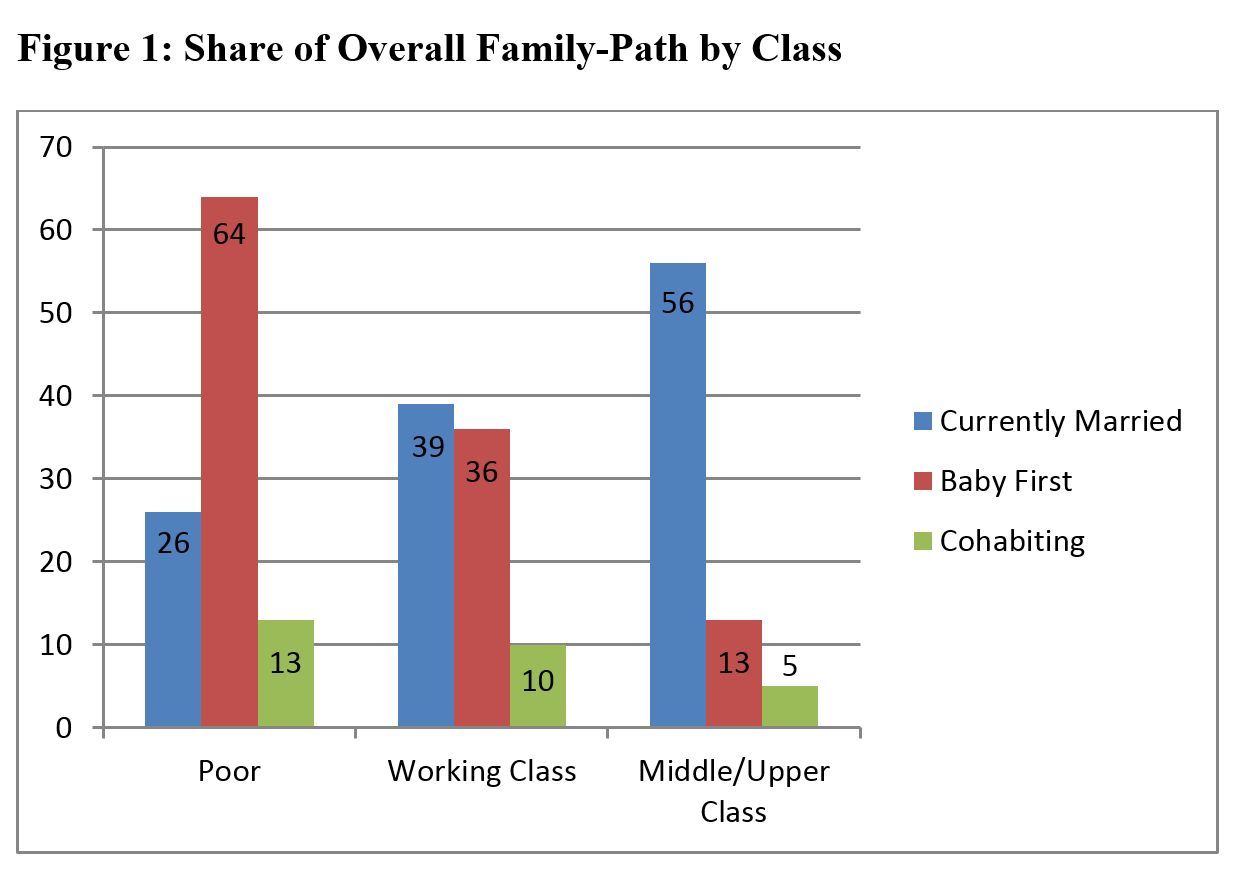
Sociologists have referred to keeping these things in proper order as the “success sequence.” It remains true, according to a new research investigation from the Brookings and the American Enterprise institutes. It takes a deeper look at this “first comes love, then comes marriage” sequence by class and generation.
The increase of baby carriages coming before marriage is terribly alarming among the working poor. Working-class women are nearly three times more likely to have babies out of wedlock than upper-class women. Poor women are about five times more likely. These two groups are far less likely to be married overall and twice as likely to be cohabiting, suffering further from inherent instability of living together without marriage.
These troubling family-path trends leading to decreased life success are unfortunately true for millennials, as well.
recent report on this topic focusing on millennials reports that 97 percent of those who follow the success sequence—earn at least a high-school diploma, work, and marry before having children—will not be poor as they enter their 30s. This is largely true for ethnic minorities and those who grew up in poor families. But sadly, fewer millennials are keeping these things in order, compared to their Boomer and Xer forbearers.
The success sequence of “first comes love” is so much more than moral choice or romantic idealism. These are deeply pragmatic, economic decisions powerfully affecting class mobility, where people live on the social scale, and the opportunities they will be able to provide for their children. This is because of the extraordinary economic power of marriage.

Marriage Boosts Every Measure Of Human Well-Being

A consistent and irrefutable mountain of research has shown, reaching back to the 1970s and beyond, that marriage strongly boosts every important measure of well-being for children, women, and men. Pick any measure you can imagine: overall physical and mental health, income, savings, employment, educational success, general life contentment and happiness, sexual satisfaction, even recovery from serious disease, healthy diet and exercise. Married people rate markedly and consistently better in each of these, and so many more, compared to their single, divorced, and cohabiting peers. Thus, marriage is an essential active ingredient in improving one’s overall life prospects, regardless of class, race, or educational status.

This is why it’s not merely one-parent versus two-parent families that makes the difference. The U.S. Census Bureau finds the poverty rate for children living with two unmarried cohabiting parents is similar to that of single-mother homes than to those living with their married mother and father. Married people, regardless of how much they have, tend to manage their money differently than divorced, single, and cohabiting people.

Only 4 percent of homes with a married mother and father are on food stamps at any given time. But 21 percent of cohabiting and 28 percent of single-mother homes require such public assistance. Likewise, 78 percent of married people own their own home—a central goal in achieving the American Dream—while only 41 percent of cohabiting adults and 44 percent of singles do. Data indicates that marital status boosts home ownership more than home ownership increases marital opportunities.

Shotgun Marriages Also Confer Big Benefits

Robert Lerman, an economist at the Urban Institute, reports the marriage benefit holds for even the most poor, and to a lesser degree but still consequentially for those who marry between conception and the birth of their first child. Despite “academic ability, school completion, family background, race, and age at pregnancy, women who are married between pregnancy and the birth of their first child averaged a 30 percent higher income-to-needs ratio and a 15 percent lower degree of [financial volatility].”

These numbers are not insignificant. Such marriages were associated with reducing the number of years the mother, father, and children spent in poverty by half, compared with those who did not marry before the birth of their first child. Remarkably, this difference was even greater—by substantial margins—for black mothers and those with low educational test scores. Lerman concludes, “Even among the mothers with the least qualifications and highest risk of poverty, marriage effects are consistently large and statistically significant.”

Even women entering marriage between the conception and birth of their first child, regardless of class, education, and race, benefit from a greater standard of living by the following percentages.

  • 65 percent over a single mother with no other live-in adult
  • 50 percent over a single mother living with a non-romantic adult
  • 20 percent over a single mother living with a man
Shotgun weddings are not just a moral action. Even among households with similar incomes, and comparable demographic and educational characteristics, the following statistics demonstrate that, over the past year, married households are at least half as likely to have difficulty meeting their basic monthly living expenses and bills. This was most pronounced for black families.
A major 2014 report from the American Enterprise Institute and the Institute for Family Studies at the University of Virginia reports that:
  • Adjusting for family size, family income is 73 percent higher for married women compared to that of their unmarried peers.
  • Married men benefit from an average annual economic “marriage premium” of at least $15,900 per year compared to their unmarried peers.
  • This investigation also finds that the marriage premium is even more substantial for the most disadvantaged.

Marriage Is Good for People of Every Race

The advantages of growing up in an intact family and being married extend across the population. They apply as much to blacks and Hispanics as they do to whites. For instance, black men enjoy a marriage premium of at least $12,500 in their individual income compared to their single peers. The advantages also apply, for the most part, to men and women who are less educated. For instance, men with a high-school degree or less enjoy a marriage premium of at least $17,000 compared to their single peers.
So marriage is far more than just a personal, sentimental institution, giving folks something to feel-good about at each year’s anniversary. It produces profoundly practical and essential value. The scholars at the National Marriage Project working from the University of Virginia explain this is not simply because the well-to-do are more likely to marry, but that marriage itself is “a wealth-generating institution.” The sociological evidence on this fact is dramatic.
Marriage generates wealth largely because marriage molds men into producers, providers, and savers. Singleness and cohabiting don’t. Nobel-winning economist George Akerlof, in a prominent lecture more than a decade ago, explained the pro-social and market influence of marriage upon men and fathers: “Married men are more attached to the labor force, they have less substance abuse, they commit less crime, are less likely to become the victims of crime, have better health, and are less accident prone.”
Akerlof explains this is because “men settle down when they get married and if they fail to get married, they fail to settle down.” This is precisely why every insurance company offers lower premiums on health and auto insurance to married men. Settled-down men also work more, earn more, save more, and spend more money on their families than on themselves. They boost the well-being of women and children in every important way.
If You Really Care About Inequality, You Support Marriage
The evidence is impossible to ignore or explain away. Even The New York Times noted its importance in a major story some years ago entitled “Two Classes, Divided by ‘I Do.’” Marriage drives well-being and upward mobility. The absence of marriage diminishes it. Thus, the growing class divide. Any smart and compassionate effort to alleviate poverty and increase the well-being of our communities and its citizens cannot ignore this fact.
Today, many unfortunately believe that to be concerned about what kinds of families adults create and raise children in should be no one’s business. It’s a personal matter. Such people have no idea what a family is or does anthropologically. Each family is as much a public institution as it is private, if not more so. Its strength and weaknesses are felt throughout each community in countless ways. Government expands as marriage declines.
Working for healthy, well-formed, enduring marriages is one of the most effective ways we can do the work of social justice. That the effort is not hip and trendy has no bearing on its ability to change lives for the better. Decades of research and the lives of real people make the case over and again every day, for good or for bad. Let’s resolve as a nation to choose and work for the good and halt the ever widening chasm of class.
Glenn T. Stanton writes and speaks about family, gender, and art, is the director of family formation studies at Focus on the Family, and is the author of eight books including "The Ring Makes All the Difference" (Moody2011) and "Loving My LGBT Neighbor" (Moody, 2014). He blogs at glenntstanton.com.