Showing posts with label Robert Spencer. Show all posts

Monday, April 22, 2019

THE SRI LANKA JIHAD MASSACRE AND THE DECLINE OF THE WEST


Robert Spencer
https://www.frontpagemag.com/fpm/273545/sri-lanka-jihad-massacre-and-decline-west-robert-spencer
April 22, 2019

Image result for sri lanka bombing
St. Sebastian's Church, one of eight bomb blast sites in Sri Lanka on Easter Sunday.(AP)
Well over two hundred people are dead, and hundreds more injured, in jihad massacres in churches and hotels in Sri Lanka on Easter Sunday morning, and now the usual denial and obfuscation are in full swing. I’m often asked, when I speak around the country, what it will take to wake people up to the nature and gravity of the jihad threat. For all too many people, the answer, as the Sri Lanka attacks abundantly show, is nothing.
The facts were clear enough, at least if one checked the Indian media. India’s News18.com reported that “two of the six attacks that rocked Sri Lanka this morning are reportedly to be have been carried out by suicide bombers,” that telltale sign that this was a jihad attack, with the bombers hoping to claim the Qur’an’s promise of Paradise for those who “kill and are killed” for Allah (9:111). “The attack at Shangri La hotel,” News18 continued, “was carried out by suicide bomber Zahran Hashim, while Abu Mohammad has been identified as the attacker at the Batticalao church.”
The Hindu, meanwhile, reported on another jihad suicide bomber, Mohamed Azzam Mohamed, who “waited patiently in a queue for the Easter Sunday breakfast buffet at Sri Lanka’s Cinnamon Grand hotel before setting off explosives strapped to his back.” Mohamed was “just about to be served when he set off his devastating strike in the packed restaurant, a manager at the Sri Lankan hotel said.”
What’s more, there was advance warning: AFP reported that “Sri Lanka’s police chief Pujuth Jayasundara issued an intelligence alert to top officers 10 days ago, warning that suicide bombers planned to hit ‘prominent churches’. ‘A foreign intelligence agency has reported that the NTJ (National Thowheeth Jama’ath) is planning to carry out suicide attacks targeting prominent churches as well as the Indian high commission in Colombo,’ the alert said. The NTJ is a radical Muslim group in Sri Lanka that was linked last year to the vandalisation of Buddhist statues.”
Nevertheless, the Roman Catholic Cardinal Archbishop of Colombo, Malcolm Ranjith, said: “It’s a very difficult and a very sad situation for all of us because we never expected such a thing to happen and especially on Easter Sunday.”
Did Jayasundara alert the “prominent churches,” or just the intelligence officers? If he did alert the churches, did Ranjith disregard the warning? We may never know the answers to those questions, but in a larger sense it is easy to see, despite escalating Muslim persecution of Christians worldwide, why Ranjith “never expected such a thing to happen,” and so had no guards at the churches for Easter Sunday: all those who have been for years calling attention to this threat have been branded as “racist,” “bigoted” and “Islamophobic,” and dismissed as “fearmongering.” Everyone in the Catholic Church knows that Islam is a religion of peace; dissenters are shunned and ostracized. Would it have been “Islamophobic” to have Sri Lankan churches guarded for Easter?
The establishment media in the West seemed determined to keep people as much in the dark as Ranjith was. TheNew York Times mentioned the jihad group that Jayasundara had warned about, but didn’t mention any of the names of the jihadis who had been identified in the Indian media. CNN didn’t mention either, and even claimed that “it’s not clear who’s behind the eight explosions that forced the country of 21 million people to go on lockdown.” Buzzfeed was completely mum about who might be behind the attacks. CBS noted a Sri Lankan official’s acknowledgment that “religious extremists,” of unidentified affiliation, were responsible. The BBC insisted that “it remains unclear who carried out the attacks.”
That coverage was representative of how the attacks were reported all over the West, and indicative of how all jihad attacks are covered. The identity and motive of the perpetrator are glossed over, downplayed, or ignored altogether. If that cannot be done, then the focus shifts to Muslims as victims, bracing for an “Islamophobic backlash” that seldom, actually materializes. In this case, the worst take came from Britain’s egregious Prime Minister Theresa May, whose initial response to the massacre was to tweet: “The acts of violence against churches and hotels in Sri Lanka are truly appalling.”
Yes, Ms. May, this was the work of anti-hotel and anti-church building zealots.
Britain’s Prime Minister can’t name the victims — Christians — for fear of offending the Muslim communities in the UK whose votes she desperately needs. For the same reason, she most certainly cannot mention the fact that many of the victims were celebrating Easter, or name the attackers, or explain the basis upon which they chose their targets.
Theresa May epitomizes the cowardice and pusillanimity of modern Western leaders. And that is why her country, and other nations of the West, are in such a precarious state. But it isn’t her fault. The overall response to the Sri Lanka jihad massacre shows why the West’s response to the global jihad is so wholly and comprehensively inadequate.

Saturday, March 23, 2019

ISIS CALIPHATE: DREAM OVER


The jihad will, of course, continue.


March 22, 2019

Heavy smoke rises above the Islamic State (IS) group's last remaining position in the village of Baghouz during battles with the Syrian Democratic Forces (SDF), in the countryside of the eastern Syrian province of Deir Ezzor on March 18, 2019. (AFP)


The Syrian town of Baghouz, the last redoubt of the Islamic State (ISIS), was reportedly liberated on Thursday, and that means that the Islamic State’s caliphate is now definitively a thing of the past.
On June 29, 2014, the group that had up to that point called itself the Islamic State of Iraq and the Levant, or Shams in Arabic (hence the synonymous acronyms ISIL and ISIS) announced that it was forming a new caliphate – the single unified government of all the Muslims and the only government to which Muslims rightly owe allegiance, according to Sunni Muslim thought -- and would henceforth drop the second half of its name and call itself simply the Islamic State.
This claim to constitute a new caliphate became the basis of its appeal to Muslims worldwide, who traveled in unprecedented numbers to Iraq, Syria and Libya to join it: it attracted 30,000 Muslims from 100 different countries.
The reason for this was the appeal of the idea of the caliphate. The caliph is the successor of Muhammad as the military, political, and spiritual leader of the Muslims. From the time of the origins of Islam until 1924, there was always a caliphate somewhere in the world. The Umayyad, Abbasid, and Ottoman caliphates were, at their peaks, massive empires. The caliph is the only person authorized, according to Sunni theology, to wage offensive jihad, and most did.
ISIS, along with al-Qaeda and other jihad groups, considered the abolition of the Ottoman caliphate by Kemal Ataturk in 1924 to be the beginning of the troubles for the Islamic world: disunity, dominance by Western powers, inability to expand the domains of Islam in any concerted manner. All of them shared, and share, the goal of restoring the caliphate. Only the Islamic State ever managed to do so, albeit only for 57 months.
Once it declared itself the new caliphate, the Islamic State swiftly began to consolidate its control over the large expanses of Iraq and Syria that it controlled – an area larger than the United Kingdom with a population of eight million people. Blithely disregarding the world’s universal condemnation of its pretensions, it moved to assemble the accouterments of a state: currency, passports and the like. Its control of oil wells in Iraq quickly gave it a steady and sizeable source of wealth.
And contrary to the confident claims of Barack Obama and a host of non-Muslim leaders worldwide, it imposed Sharia in its domains, and strictly enforced it. It collected the jizya, the Qur’an-mandated tax on the “People of the Book,” from Christians. It severely punished women for not adhering to the Sharia dress code. Its scrupulous care to implement Sharia was part of its international appeal for Muslims, along with its pretensions to the caliphate.
That fact is also why we will see another caliphate, and it will be just as brutal and bloody as the Islamic State, because that brutality and bloodlust against non-Muslims were not eccentricities of a rogue non-Islamic group twisting and hijacking Islam’s peaceful teachings, as John Kerry and so many others insisted. In reality, the cruelty of the Islamic State – stonings, amputations, oppression of women and non-Muslims – is, as I have demonstrated many times from the Islamic texts, mandated in the Qur’an and the teachings of Muhammad.
Of course the Western intelligentsia knows that to say that Islamic violence and oppression is based on Qur’anic teaching is simply a manifestation of “Islamophobia,” and that the Qur’an is full of wisdom and peace. That’s why, when some group of Muslims founds another caliphate somewhere, and it looks very much like ISIS (and Iran and Saudi Arabia and other Sharia states, for that matter), they will be utterly bewildered. Why is this misunderstanding of Islam so widespread and persistent?
Anyway, the collapse of ISIS is due to President Trump. When Obama left office, it looked as if ISIS was here to stay, and was on the path to legitimization, a la the Palestine Liberation Organization. It was finding buyers for its low-priced oil. It had, it has just been revealed, an ambassador to Turkey. If Hillary Clinton had won the Presidency, there is no doubt that it would still be a significant force in Iraq and Syria.
The caliphate is over, but ISIS isn’t. Its dispersed jihadis are focusing on attacking civilians in the West. Unfortunately, few, if any, Islamic State jihadis will take the collapse of the caliphate as a sign that their premises were wrong; they will just go wage jihad somewhere else, which is why Western countries are suicidal to take back the ISIS jihadis who are their citizens.
Robert Spencer is the director of Jihad Watch and a Shillman Fellow at the David Horowitz Freedom Center. He is author of the New York Times bestsellers The Politically Incorrect Guide to Islam (and the Crusades)and The Truth About Muhammad. His new book is The History of Jihad From Muhammad to ISIS. Follow him on Twitter here. Like him on Facebook here.

Wednesday, March 06, 2019

Amazon Bans Tommy Robinson’s Book, ‘Mohammed’s Koran’


BY ROBERT SPENCER
https://pjmedia.com/homeland-security/amazon-bans-tommy-robinsons-book-mohammeds-koran/
March 5, 2019

Related image

On January 7 of this year, I published an article at PJ Media about Amazon removing doormats featuring Qur’an verses from sale because the Council on American-Islamic Relations (CAIR) found them offensive. In that article, I asked:
How long will it be before Hamas-linked CAIR starts demanding that books that criticize jihad terror and Sharia oppression of women, gays, and others also be dropped by Amazon?
The answer turned out to be 51 days.

It’s the British government and the BBC, rather than CAIR, that are likely behind this, but Amazon has just dropped the book Mohammed’s Koran by the renowned British activist Tommy Robinson and Peter McLoughlin -- and apparently only because its censors dislike Robinson. In the last two weeks, Robinson spectacularly embarrassed the BBC by exposing the bias and dishonesty of its reporter John Sweeney. The retaliation has been swift and severe: Robinson has been banned from YouTube and Facebook, and now his book has been withdrawn from sale.

Coauthor Peter McLoughlin states:
[T]his is the twenty-first century equivalent of the Nazis taking out the books from university libraries and burning them. Can you think of another scholarly book on Islam that has been banned by Amazon?Mein Kampf is for sale on Amazon. As are books like the terrorist manual called The Anarchist Cookbook.
McLoughlin is correct that Amazon’s behavior has been wildly inconsistent. He adds that Amazon officials are steadfastly mum on why the book was banned:
[They] refuse to reinstate the book and refuse to explain why it has been banned. So they have banned the No.1 best-selling exegesis of the Koran. I can’t get my head round it. Every few weeks for the past 18 months they had emailed me asking to put it into special sales programmes, as it was selling so well. For 18 months they sought to profit even more from the sales.
“As dark as my vision is,” McLoughlin concludes, “I thought we were 10 to 20 years away from dissenting books from being banned.”

Indeed. Those who object to my labeling Leftist totalitarians “fascists” should take careful note of this story. What group is most famous for burning books? That’s right. And what group is doing it now? Right again. I predicted this, but like Peter McLoughlin, I didn’t think it would come so soon.

This is an extremely ominous development. Amazon and Barnes and Noble -- which is also not carrying this book -- have a virtual monopoly on book sales. When these two giants refuse to carry a book, that book effectively does not exist. If they are now going to ban books that are critical of Islam and opposed to jihad terror and Sharia oppression of women, gays, and others, then an Islam-critical perspective will be almost impossible to find anywhere.

Some will applaud this as the ultimate and laudable demise of “Islamophobia,” but it is actually far more insidious. If the motivating ideology of jihad terrorists cannot be criticized or even discussed openly, jihad terrorists will have an absolutely free hand. They will act with impunity, secure in the knowledge that any criticism of their activities will be shut down the same way Tommy Robinson was shut down.

Whatever anyone thinks of Tommy Robinson or the Qur’an, this is a serious matter that anyone who cares about the freedom of speech should be extremely concerned about.

Mohammed’s Koran is critical of Islam’s holy book. It endeavors to illustrate how violent jihadists justify their actions by referring to Islamic texts and teachings -- and that’s all. Robinson and McLoughlin call for no violence. Their book is accurate.

Anyone who has written a book that is critical of anything should read the writing on the wall and realize that once this censorship begins, it won’t end with Tommy Robinson or Qur’an-critical books. But they won’t. PEN, the international organization that is supposedly dedicated to defending the freedom of speech, is made up of hard-Leftists who won’t utter a whisper in defense of Tommy Robinson’s book, or a murmur of protest that it is not allowed to be sold.

They don’t realize that what is being done to him can be done to them. But it will be.


Wednesday, August 29, 2018

ALL JIHAD, ALL THE TIME


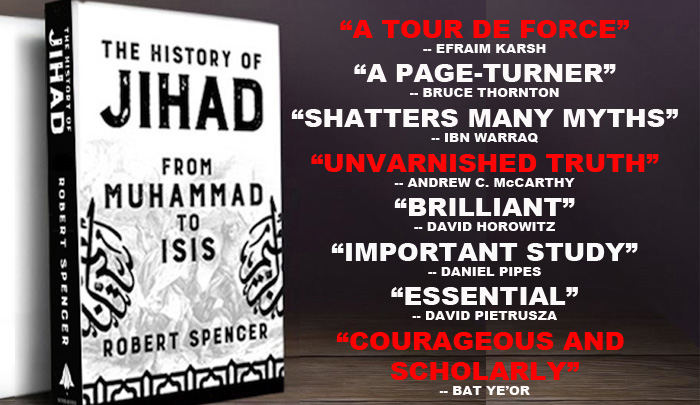
Robert Spencer's essential history of jihad.
August 29, 2018
Image result for robert spencer history of jihad
[To order Robert Spencer's new book, The History of Jihad From Muhammad to ISISCLICK HERE.]
It's good to have something you love to do – something that brings zest and joy to your life. For the Prophet Muhammed, as Robert Spencer graphically establishes in the opening pages of his comprehensive yet concise History of Jihad, that something was murder – often followed by beheading, dismemberment, and ostentatious gloating. When he wasn't committing murder, Muhammed was talking about murder or threatening to murder. Nor, to be sure, was it just ordinary murder. It was jihad – murder for the purpose of expanding the reach of Islam, which, by the time he died in 632, had been spread by the sword to the whole Arabian peninsula. 
Indeed, the reason why the House of Islam continued to expand so fast after Muhammed's death was that he taught his disciples well. The love of murder proved infectious, especially after he informed them – as Allah had informed him – that anyone who died in the act of jihad would go straight to Paradise. Following his death, as Spencer puts it, they pursued “a series of conquests unparalleled in human history for their rapidity and scope.” They totally eradicated one of the two great powers of the day, the Persian Empire, and took a big bite out of the other, the Eastern Roman Empire.  
That was just the beginning. They subdued Spain (al-Andalus). They subjugated India. Everywhere they went, they razed houses of worship and destroyed religious art, and, as their Prophet had taught them, offered their Christian and Jewish victims three choices: convert, die, or live as dhimmis (subordinate peoples) paying a steep jizya (infidel tax). If in some times and places Muslims placed less emphasis on jihad than in others, it was, Spencer notes, not because their doctrine had altered but because of infighting.​
In 732, Muslims from al-Andalus moved northward into France and were repelled at Tours by Charles Martel – who thereby likely saved all of Europe from imminent Islamization. But the next few centuries saw an almost unbroken record of Islamic triumph – in response to which, in 1095, Pope Urban II called on Europeans to reclaim formerly Christian parts of the Holy Land. This was the First Crusade. In 1099, the Crusaders won Jerusalem. But the Second Crusade, ordered in 1145, was a bust. In 1187, Jerusalem was lost to Saladin, the most celebrated jihadist of his time. The Third Crusade saw some gains, but the Fourth failed. There were further efforts, also in vain. By the late thirteenth century, the Crusader era was over, its conquests undone. ​
While admirably frank about the savagery of many of the Crusaders, Spencer leaves no doubt that apologists for Islam such as John Esposito are full of it when they depict the Crusades as ending centuries of “peaceful coexistence” of Christians, Jews, and Muslims under Islamic rule. To buy this lie is, among other things, to wilfully forget how those territories fell under Muslim control in the first place. ​
In any event, the Holy Land was only one of many fronts in the centuries-long clash between jihadists and infidels. In the east, Tamerlane secured India and Georgia for Islam and, in 1405, perished in present-day Kazakhstan on his way to Islamize China. In Spain, over the centuries, Christians took back Iberia one city at a time – Córdoba in 1236, Valencia in 1243, Seville in 1248 – until finally, in 1492, the entire peninsula had been reclaimed. (“To this day,” observes Spencer, “Spain remains one of the few places once ruled by Islam but no longer; usually what the jihadis have conquered, they've kept.” A sobering thought, to put it mildly.) In southeastern Europe, the leaders of what was, by then, the Ottoman Empire subdued Greece and the Balkans over the course of the fourteenth century, seized Constantinople in 1453, and, under Suleiman the Magnificent (the most notorious jihadist of his time), took Belgrade and Buda in 1526 and Baghdad in 1534. On September 12, 1683, came another decisive Christian victory when the Ottomans were turned back at the gates of Vienna. 
After Vienna, jihad against the West went small-scale. For generations, the Barbary pirates raided coastal cities and enslaved infidels. Then, as Western power advanced, Islam fell into decline. Napoleon conquered Egypt. Britain annexed the subcontinent. The Ottoman Empire crumbled and gave way to a secular-run Turkey under Kemal Ataturk – but not before committing the massive act of jihad that is now known as the Armenian genocide. ​
But these changes were largely cosmetic. Islam endured. So did the jihadist imperative. In the twentieth century, new jihad-happy powers arose – Saudi Arabia, the Islamic Republic of Iran. In 2001 came the biggest act of jihad ever. But this time it was different.​
For one thing, the enemy was not a government. For another, this time the West didn't get it – or didn't want to. Six days after 9/11, President George W. Bush went to a mosque and, reciting what would become the West's new mantra, made the stupefying claim that Al-Qaeda had violated the tenets of Islam. Under both Bush and his successor, questioning this preposterous assertion became an act of bigotry. Even as the jihadist massacres multiplied, Western governments continued to welcome Muslim migrants by the million. ​
The history of jihad is a grisly one,  and for inhabitants of the Western world in the early twenty-first century, no story could be more important. For centuries, Europeans might not have known much, but they knew the reality of Islam. It was an ever-present existential peril. They certainly had no romantic illusions about it – the very idea would have seemed a grotesque joke. ​
Alas, our generation of Westerners is suffering from a perfect storm of afflictions. We're ignorant of our own history, and what we do know of it we've been encouraged to feel guilty about. We've been taught that other civilizations are and always have been our victims. We've been trained to see them as having no agency, so that whatever they do to us must be a reaction to something we've done to them. We also live in a secular society in which most of us – our political leaders and mainstream media in particular – are utterly incapable of imagining anyone taking his religion so seriously as to be willing to kill (or die) for it. Hence, even though jihadists have repeatedly made clear their motives, our elites tell us repeatedly that the real motives lie elsewhere. ​
And this is why we're in big trouble. If we aren't familiar with the story told in this book, we're screwed. The good news is that Robert Spencer tells it in a way no one else could. He not only knows all this stuff cold – he knows just how to tell it. Chapter by chapter, anecdote by anecdote, he makes the most of this macabre material. He makes it gripping, and he keeps things moving; he's eminently lucid, vivid, economical. By the time you reach the last chapter, which is darkly but not unjustly entitled “The West Loses the Will to Live,” it could not be clearer what a terrible pickle we're all in. Even if you already know a good deal about the history recounted here, and already grasp its import – which, if you're reading this review, is not unlikely – Spencer recounts it in such a way as to make that last chapter hit home with the power of fresh revelation. The question is, how to get this book into the hands of the smug and ignorant fools who need it the most? Perhaps the best advice is this: buy one for yourself – and another for the person in your life who can best use this vital wake-up call. 

Monday, August 13, 2018

ROBERT SPENCER’S SURPASSING STUDY OF AN AGE-OLD, ONGOING THREAT


If the West manages to avoid doom from the forces of Jihad, it will be in large part due to books like this.


August 13, 2018

Image result for robert spencer history of jihad

Robert Spencer’s The History of Jihad tells, in magnificent measure, the story of how, over 1400 years, the votaries of Islam have observed the religious duty of holy war, or Jihad, warfare against the Unbelievers. Reviewers sometimes insist that “if you can only read one book on the subject, read this one.” Here such insistence is not hyperbole. Spencer tells in lively fashion a deadly story, of how what started with a few dozen followers in a dusty town in western Arabia became today’s ideological empire of 1.6 billion members of the Islamic community or umma, mostly to be found in 57 Muslim-majority countries, but now also including hundreds of millions of Muslims in Europe, North America, and India.
How did this happen? How did Muhammad manage to survive early setbacks in Mecca to become the ruler of Arabia? Spencer offers overwhelming evidence that along with brute force, deceit and terror were Muhammad’s chief weapons. “War is deceit,” he insisted. He told his followers that “I have been made victorious through terror.” These -- brute force, deceit, and terror -- have remained the chief weapons of Jihad throughout history.
Spencer takes us through the campaigns that allowed Muhammad to go from near-fatal weakness to strength. Muhammad’s victory over a much larger enemy at the Battle of Badr in 624 signaled a change in his fortunes; he never looked back. Muhammad relied until 628 only on force to defeat his enemies. But in that year, he agreed to the Treaty of Al Hudaibiyya, which would become the first example of victory through guile. Muhammad had signed a truce treaty (hudna), with the Quraysh tribe of Mecca. It was to last ten years. One of its provisions required Muhammad to return to the Quraysh any member of the tribe who came to him. When a woman of the Quraysh came over to the Muslims, Muhammad broke the treaty (after 18 months) by refusing to send her back, claiming -- wrongly -- that the treaty only required him to send back men, not women. Muhammad was willing to break the treaty because his forces had grown stronger; he was now prepared to take on the Quraysh. The violation of this treaty by Muhammad has been the model for Muslim treaty-making with Unbelievers ever since; it was even mentioned by Yasser Arafat, to signal to his Muslim followers that they need not worry; he had no intention of meeting his commitments under any agreement signed with Israel. It would be salutary if those who today pressure Israel to sign this or that treaty with the “Palestinians” were to learn about the Treaty of Al-Hudaibiyya and, for many Muslims, its enduring significance.
Muhammad was above all a warrior, who took part in nine battles (according to Muslim legend, Spencer tells us, he took part in 27). Once the enemy was conquered, Spencer explains, only three options were available for the Unbelievers: death, conversion to Islam, or permanent status as dhimmis, who were required to pay a special tax called the Jizyah, as well as to submit to many other onerous conditions. This Jizyah became the main source of revenue for the Islamic state. Those three options have not changed in 1400 years.
Spencer relies, for the first three centuries of his history, on Arab sources almost exclusively, from the biography of Muhammad Ibn Ishaq, to the historian of early Islam Al-Tabari, to Bukhari and Muslim, who are considered the most reliable of hadith scholars. He continues to quote often from Arab and Muslim historians and jurists (including Ibn Taymiyya and Ibn Khaldun), which makes it difficult for those Islamic apologists who deplore his work to find a way to undermine his argument or challenge his facts. They have found their answer to this quandary in maintaining a studied silence: not a single Muslim has apparently yet dared to review this book.
Muhammad’s death in 632 did not halt the Muslim armies in their seemingly unstoppable Jihad, or rather, series of Jihads against the Infidels: first they took Syria, then Iraq and part of Sassanid Persia, then the rest of Persia, and Egypt. They carried Islam’s conquests forward in the West, across North Africa, and entered Spain, under the command of a freed Berber slave, Tariq ibn Ziyad. Ziyad was ultimately aided by a Christian, Julian of Ceuta, who wanted to take his own revenge against the last Visigothic ruler of Spain, Roderic, for taking sexual advantage of one of Julian’s daughters. This would not be the last time that Muslims were helped in their conquests by divisions among their enemies.  There have been many such instances since, including the catastrophic effect of the deep divisions between the Catholics and the Orthodox, that prevented an alliance against the rampaging Turks.
Muhammad’s followers continued to fulfill their duty of Jihad in the West, carrying Islam’s conquests forward and up into France, where the Muslim army was halted by Charles Martel in the Battle of Tours in 732. Some apologists for Islam like to claim that Jihad is “defensive” in nature. But it was the rampaging Muslims who first attacked the inoffensive, and often largely defenseless, peoples of North Africa and Spain and France. Charles Martel was only fighting to stop the invaders.
Steuben - Bataille de Poitiers.png
Charles Martel depicted in 'Batailles de Poitiers en Octobre 732' by Charles de Steuben
The history of Jihad is bloody, and the pages of this study are replete with atrocities, but the onward current of Spencer’s vivid narrative pulls us forward. He draws whenever possible, especially in the early centuries, on such Muslim jurists and historians as Ibn Taymiyya and Ibn Khaldun. He keeps reminding us, too, of the passages in the Qur’an and Hadith that explain why Muslims did what they did; every Muslim atrocity is justified by the Qur’anic commands and the example of Muhammad himself.Spencer gives special attention to Spain, quite understandably, for Islamic Spain has been the object in the West of much dreamy misinformation that never dies, but needs constantly to be refuted. A well-versed and deadly debunker, Spencer shows that Islamic Spain, Andalusia, was never the paradise of “convivencia” that many in the West, beginning with Washington Irving and continuing into the present, with Karen Armstrong and Maria Rosa Menocal, have so fondly believed. He details the Muslim attacks on Jews in Spain, including the killing of 4000 in Granada in 1066, and the attacks on Christians, too. After the battle of Sagrajas in 1086, the victorious Muslims prayed on top of heaped-up piles of Christian heads. That “happy coexistence” was, Spencer shows, a fable later constructed in the West. Their wretched condition under Islamic rule explains  why the Christians fought so determinedly for nearly 800 years of the Reconquista to take back their country. There was, Spencer says, as every reviewer of the book has noted, no Muslim Age of Tolerance, no Muslim Era of Good Feelings, not in Spain, and not anywhere else.  
In the early eighth century the Jihad in India began, and as the Hindus and Buddhist were not People of the Book, they did not have the possibility of becoming dhimmis and paying the Jizyah; they had either to convert or be killed. Spencer describes the endless series of mass killings, by the tens of thousands, of Hindus, and the destruction, by the thousands, of their temples. When Tamerlane arrived centuries later, in 1398, he killed many thousands of Hindus, but was still left with 100,000 prisoners. He couldn’t take them with him, and he couldn’t let them free, so he ordered every Muslim under him to kill all the Hindu prisoners each of them held, and in a single day, those 100,000 Hindus were dutifully killed. These killings presage the period of Mughal rule, centuries later, when as many as 70-80 million Hindus, according to the historian K. S. Lal, may have been killed.  
There are telling anecdotes throughout this history; they are not superfluous, but make a deep impression. They add to the narrative. One is about the daughters of the conquered Sindhi king Dahir, who were sent to the caliph Walid as part of his booty. When he took one of them to bed, she told him that she had already been raped by the Muslim general Muhammad ibn Qasim. Despite Muhammad’s success in waging Jihad, this was not enough to save him in the eyes of the Caliph. He ordered “that the victorious general, victories or no, be sewn up into a rawhide sack and shipped to his court. By the time the sack containing Muhammad ibn Qasim arrived, he was already dead.” With the loss of that general, the Jihad in India halted. And the reader remains riveted by such details.
Spencer ends his account of the Battle of Tours in 732, when the Muslim defeat halted their conquest of Europe, with a telling remark looking forward to the present Jihad, and our failure to adequately confront it: “The warriors of jihad would appear again in France, but they would not come close again to gaining control of the whole country until many centuries later, by vastly different means, when there was no longer a Charles Martel to stop them.” He then quotes two Europeans on what Europe might have looked like had the Muslims not been defeated. First, the 18th century historian Edward Gibbon, who imagined the Qur’an would have been taught in the schools of Oxford, “and her pulpits might demonstrate to a circumcised people the sanctity and truth  of the revelation of Mahomet.” He shuddered at the thought. The second European, who regretted that Islam had not conquered Europe, for “Mohammedanism [is] that cult which glorifies heroism and which opens the seventh heaven to the bold warrior alone. Then the Germanic races would have conquered the world. Christianity alone prevented them from doing so” was, Spencer informs us, Adolf Hitler.
Spencer has fun debunking the legend of Harun al-Rashid, the Abbasid caliph, always depicted in Western texts solely as an enlightened patron of the arts. That he may have been, but Spencer tells us that he had another side, putting to death defeated Christians and other non-Muslims, while condemning some to remain alive in conditions of “slavery and degradation.” In his repeated raids on Byzantium, this patron of the arts destroyed hundreds of ancient churches, with their icons, mosaics, and other artifacts, in southeastern Anatolia.
How many of us are aware that Muslim forces attacked Rome itself in 846, but could not penetrate its walls? Those forces retreated nearby, plundering and besieging smaller towns. Meanwhile, the Romans were shoring up their defenses, enough so that Rome remained impervious to Muslim attack. And since Rome is his subject, Spencer allows himself a monitory dose of fast-forward-to-Pope-Francis unreality: “The jihad forces were still in Italy, and the threat was urgent; it had not yet become customary for the Roman Pontiff to proclaim the peacefulness of Islam and benign character of the Qur’an, and decry the building of walls.”
Spencer moves back and forth geographically, as dictated by the chronology of different theaters of Jihad, at different stages of conquest, the main ones being in India, Byzantium, and Spain. Not a single jihad, no matter how larger or small, is overlooked -- both those that succeeded, as the quick conquest of Georgia, and those that failed, such as the ill-fated attempt of Muslim forces to enter China, which was defeated, like Napoleon in Moscow, by General Winter.
Spencer has telling anecdotes, not always involving rivers of blood and piles of Infidel heads, that convey the bottomless cruelty of many of the Muslim leaders. Consider the casual savagery on display against Unbelievers in these stories about Abd al-Rahman, who ruled most of Islamic Spain in the ninth century: “he [Abd al-Rahman] threw himself upon her [one of his 6,300 sex slaves] face to kiss and bite her, and she got disgusted by this and turned her face away, raining on his parade; this so provoked his anger that he ordered the eunuchs to seize her and put a candle to her face, burning and destroying her beauty, until they destroyed her face, burning her badly, and finishing with her.” He [Abd al-Rahman] also came across “a thirteen-year-old Christian boy who had been taken hostage. Entranced by the boy’s beauty, the caliph made amorous advances upon him, only to be rejected; enraged, he had the boy tortured and then beheaded.” He was also cruel to his own men. After a defeat, he ordered the execution, by means of crucifixion, of 300 of his top officers.
In the 11th century, the two main sources of slaves for Muslims had dried up. Slavs had converted to Christianity and no longer sold their own people as slaves, and the Turks had converted to Islam, and thus were no longer to be enslaved by other Muslims. The slave market in Andalusia became the main source of slaves for Muslims elsewhere. One more nail in the coffin of “convivencia.”
In India, at the end of the 10th century, the long dormant Jihad was revived by Mahmud of Ghazni, who terrorized the Infidels in what is present-day northeast Afghanistan, Pakistan, and northwest India. He led 17 major Jihad campaigns into the subcontinent. Everywhere he destroyed many thousands of Hindu temples, smashing tens of thousands of their idols. His men killed Hindus everywhere and pulled down the “idol temples.” At Thanessar, according to the Muslim historian Al-Utbi, “The blood of the infidels flowed so copiously that the stream was discolored, notwithstanding its purity, and people were unable to drink it.” At Shrawa, “the Muslims paid no regard to the booty till they had satiated themselves with the slaughter of the infidels and worshippers of sun and fire.” Vast amounts of gold and silver, rubies and pearls, were taken; wherever Mahmud of Ghazni went, he took treasure and slaves. There were so many slaves that their cost in the slave markets plummeted. Mahmud of Ghazni was also, like Harun al-Rashid, a patron of the arts, and it is this, rather than his bloodcurdling conquests, his cruelty and his greed that, Spender notes mildly but tellingly, “tends to be remembered in the contemporary West.”  
The Jihad kept on, in the East and in the West. Always there were atrocities. In Armenia, the Seljuk Turks rampaged in the city of Ardzen. A Christian chronicler lamented “the sons taken into slavery, the infants smashed without mercy against the rocks, the venerable old men abased in public squares, the gentle-born virgins dishonored and carried off.”
We come then to the Crusades, where more debunking, and setting the historical record straight, is necessary. As Spencer shows, the Crusades were not an offensive war, as so often depicted, but a response to Jihad, including the takeover of the Holy Land by Muslims, who destroyed the Church of the Holy Sepulcher and prevented Christians from making pilgrimages. He does not hold back in describing the barbarism of the Christians, their attacks on Jews as they marched through Europe, and notes the cannibalism of the starving Christians who along the way ate “dead Turks and Saracens.” In Jerusalem the Crusaders behaved no better, burning Jews alive inside their synagogue and slaughtering tens of thousands of Muslims. That number has kept going up, from 20,000 in a 12th century history by a bishop, to 70,000 by a Muslim chronicler in the same century, to 100,000 claimed by a 15th century Muslim historian, to Bill Clinton, that eminent historian, who without any evidence claimed the Crusaders killed every Muslim man, woman, and child on the Temple Mount.
The reader has already been taken by Spencer through the 450 years of uninterrupted Jihad that occurred before the Crusades (which began in 1095), so is well-armed mentally with that  history, which undermines the claim of such well-known apologists for Islam as John Esposito, who has written that there had been “five centuries of peaceful coexistence” before “an imperial-papal power play led to centuries-long series of so-called holy wars that pitted Christendom against Islam and left an enduring legacy of misunderstanding and distrust.” But as Spencer shows in such striking and disturbing detail, there never was “peaceful coexistence” between Muslims and Unbelievers, and the Crusades were not “an imperial-papal power play,” but rather, a reaction by Christians to centuries of Jihad, including the destruction of the Church of the Holy Sepulcher in 1009.  
Statue of Saladin in Damascus
Spencer’s next exercise in myth-busting concerns Saladin, whom he describes as being “to individual Muslims what al-Andalus is to Muslim polities.” He became the exemplar of the “tolerant, magnanimous Muslim warrior,” embodying the nobility of the faith. Not quite. Having defeated the Crusaders at Hattin, he ordered that all the prisoners were to be beheaded. He allowed a motley crew of Muslims -- scholars and Sufis and ascetics and other devout men -- to each kill one Christian prisoner. Saladin is reported to have watched the spectacle, “his face joyful...while the unbelievers showed black despair.” Yet when he reconquered Jerusalem, Spencer tells us, he treated the Christians with magnanimity. Which side of Saladin should we acknowledge? How about both sides?
While the Holy Land was still being contested in the East, in 1258 the Mongols under Hulagu Khan conquered Baghdad and destroyed the Abbasid Caliphate. Hulagu, whose mother was a Nestorian Christian, was well-disposed toward Christianity. In 1260, a Christian Mongol leader, Kitbuka, took Aleppo and Damascus. Still another Mongol, Arghun, a Buddhist, who ruled in Persia, became interested in making common cause with Christians to drive the Muslims from the Holy Land “once and for all.” Arghun is one of many people in this capacious history who pique one’s curiosity. His closest friend was the chief prelate of the Nestorian Church, his vizier was a Jew. Talk about Convivencia! And Arghun wrote to Pope Honorius IV to suggest this alliance. But nothing came of it, because the Christians were too distracted at home, and possibly, Spencer suggests, too distrustful of the Mongols who, they feared, might eventually try to invade Europe. This Mongol-Christian alliance never came into being -- an opportunity lost, which would not come again, as the Mongol ruler in Iraq converted to Islam, and eventually, so did the rest of the Mongols. One cannot help wondering what the world would now look like had Arghun’s proposed alliance come into being.
Meanwhile, in Spain, the Christian Reconquista continued, and the Muslims in Spain had all they could do to hold onto the territories they had. They were in no position to wage offensive Jihad. In 1492, with the Christian conquest of Granada, the Reconquista was complete. This  was the most significant retaking of territory from Muslims until the establishment of the Jewish state of Israel in 1948.  
In the East, the Jihad resumed in India in the late 12th century, under Muhammad Ghori. There was the same gruesome display as under Mahmud of Ghazni two centuries before: at Aligarh, the Muslims put down a Hindu uprising and raised “three bastions as high as heaven with their heads.” There was mass plundering of all the Hindu riches -- gold, silver, gems -- and mass destruction of the Hindu  temples, pulled down by the thousands. In some places, every Hindu male over the age of eight was killed, the women all enslaved. Muslim warriors smashed Hindu idols everywhere they went, placing the broken pieces at the entrance of mosques, to be trodden upon by the faithful.
The Islamic State in India was triumphant. The Hindus were not People of the Book, so could not be dhimmis paying the Jizyah, but they became instead “payers of tribute” who were forced to tender whatever, at any time, was asked of them, and more. If asked for silver, they should offer gold to their Muslim masters. Even Hindus who converted to Islam were to be “treated with continued contempt.” This was “Happy Hindustan,” as a Muslim scholar called it without the slightest irony -- where Islam triumphed, and the Hindus who were not killed lived lives of despair.  
Spencer shifts the scene, as his Jihad timeline dictates, back to Europe, and the renewed Jihad against the Byzantine Empire. This was conducted by the Turks, first the Seljuks and then the Osmanlis, who had converted to Islam. Disunity among Christians helped the Jihadis. The attempt to heal the schism between the Catholics and the Orthodox came to nothing, with Pope Benedict insultingly addressing the Byzantine Emperor and the Eastern patriarchs. Spencer tellingly looks forward to today’s Pope, as he does several times in his history, and bitingly notes that “not until the days of Pope Francis would the See of Rome have an occupant more useful to the jihad force than Benedict XII.”
As he brings the story of Jihad up to the present, the history will be more familiar to readers. But we are not used to thinking of these attacks by Muslims on Infidels as Jihads, prompted by the Qur’an and the example of Muhammad; Spencer corrects this misunderstanding. The Armenian genocide was a classic Jihad: a war of Muslim Turks against Christian Armenians, 1.5 million entirely inoffensive victims of Islamic hate. Western textbooks describe these Armenian massacres as the result of “ethnic conflict.” Perhaps one salutary effect of Spencer’s history will be the more accurate identification of those massacres as what they were: “jihad for the sake of Allah.”  
The war of Muslim Arabs against the Jews of Palestine, which began in the early years of the 20th century, decades before the Jewish state was declared, is another example of a classic Jihad, a holy war that was particularly important for several reasons. First, Palestine had once been under Muslim rule, and therefore it was higher on the To-Do List of Jihadis than territory that had never been under Muslim control. Spain, Greece, Sicily, the Balkans are also on this list, but Israel has pride of place. Second, Jews were not only hated, but were also despised, and the notion that the despised Jews could now be controlling what had been part of Dar al-Islam was especially maddening.
Spencer quite rightly dwells on this Jihad, because it is still going strong with no end in sight and has become the center of worldwide attention. The U.N. devotes more than half of its time to discussions of Israel and “Palestine”; the U.N. Commission on Human Rights spends much of its time passing resolutions denouncing the giant empire of malevolent Israel. Yet even Israel’s dedicated supporters almost never use the word “jihad” to describe the unending war of Arabs and other Muslims against the Jewish state. Perhaps, after reading this book, they will reconsider, and unapologetically use that word to describe the war against Israel, in a spirit of salutary candor.
Related image
Haj Amin al-Husseini and Heinrich Himmler in 1943
In his discussion of the Jihad against Israel, Spencer offers facts likely to be unfamiliar to many. Among them, the most startling is surely the role of Haj Amin al-Husseini, the Mufti of Jerusalem, and leader of the Arabs of Palestine. Al-Husseini consulted with Hitler, urging him not to let any Jews escape to Palestine, but to “burn” them. He raised an S.S. battalion among the Bosnian Muslims, a unit that took part in the Final Solution. From 1941 to 1945, al-Husseini lived in Berlin, where he “became close friends with Adolf Eichmann and Heinrich Himmler.” Spencer adds that Eichmann’s assistant, Dieter Wisliczeny, testified at the Nuremberg Trials “that the Grand Mufti” had repeatedly suggested to Hitler, von Ribbentrop, and Himmler “the extermination of European Jewry....The Mufti was one of Eichmann’s best friends and had constantly incited him to accelerate the extermination measures. I heard him say that, accompanied by Eichmann, he had visited incognito the gas chambers of Auschwitz.” Those morally obtuse people who now, grotesquely, dare to compare the Israelis to Nazis should be reminded, whenever possible, of Haj Amin al-Husseini and his epigones in Hamas and Hezbollah.  
The war against Israel was never, Spencer explains, a mere dispute over borders, but a Jihad that will continue forever, using whatever means prove most effective at a particular time. Israeli territorial concessions will only whet, not sate, Arab Muslim appetites. Fighting in the path of Allah, the “Palestinians” may even sign a “treaty of peace,” but for them all such peace treaties with Infidels are truce treaties, hudnas, intended to be broken whenever the Muslim side feels strong enough to restart hostilities, just as Muhammad did in 628 with the Quraysh tribe, despite the Treaty of Al-Hudaibiyya. The nature of this conflict needs to be thoroughly understood, for the Jihad against Israel is not different in kind from all the Jihads whose horrific history Spencer lays out in this, his most important book.
For 1400 years, Jihad has been conducted, virtually without interruption, somewhere on the globe. Its methods have varied. The Jihad of violent warfare, successful against the Byzantines, the Sassanid Persians, and the Hindus of India, has today been replaced in Europe by what Spencer was the first to call the “stealth Jihad.” This includes a steady chipping away at the institutions and values of the Unbelievers, including the establishment of No-Go areas where the writ of the Unbelievers does not run, the demand for accommodation to Muslim ways, from dress (opposing limits on hijabs, burqas, and niqabs), to the setting aside of both rooms and of times for daily Muslim prayers in schools and at work, to the rewriting of textbooks and curricula to depict Islam in a favorable light, to continuous efforts at Da’wa, the Call to Islam, especially among prisoners, leading in Europe to a steady inexorable rise in the percentage of Muslims in the population, and much, much more.
The last chapter of this surpassing study is devoted to Jihad in the 21st century. It bears a somber title: “The West Loses the Will to Live.” The title is deserved. For Spencer reminds us of the fantastical statements about Islam, beginning with the remarks made by President Bush on September 17, 2001 at the Islamic Center of Washington, where he said that “these acts of violence against innocents violate the fundamental tenets of the Islamic faith...The face of terror is not the true faith of Islam. That’s not what Islam is all about. Islam is peace.” Similar remarks about Islam continued -- and continue -- to be made by Bush, by Obama, by John Brennan (former head of the C.I.A.), by Tony Blair, by Theresa May, by Angela Merkel, by -- most harmfully -- Pope Francis, and by a cast of unthinking collaborators, found among the political and media elites all over the Western world. They never give signs of having read the Qur’an or Hadith, as if these texts, that Muslims read, and recite, and endlessly study, and memorize, were unnecessary for them to know before they self-assuredly pronounce on such matters as what constitutes “authentic Islam.” Along comes Robert Spencer with his many books, and now with this history, and what shall the True Believers and Apologists do? Certainly they have learned not to enter the lists with Spencer. Better to simply deny him a platform by, for example, making it hard for him to be invited to, or to speak freely at, college campuses, without disruption. And why not persuade Google and Twitter and Facebook that he is a hate-monger -- can the Southern Poverty Law Center possibly be wrong? -- and therefore deserves to become harder to find on the Internet. It’s useful, too, to keep accusing him, endlessly, of “racism” (a preposterous charge, for the obvious reason) and of “Islamophobia,” a word intended only to shut down all criticism of Islam.
Before I end, let me mention the main criticism I have: the Index leaves much to be desired. Arghun, Saladin, John Esposito, Karen Armstrong are a few of those who should be, but are not, to be found in that index; Mahmud and Mahmud of Ghazni, the same person, receives two entries. As for our presidents, Barack Obama and Bill Clinton are to be found under the “B’s”; George Bush is found in the “G’s.” This book deserves better.
But to balance the deficiencies in the Index, let me also mention how much I enjoyed learning new words -- logothete, iconodule -- that were Greek to me, but that the author was unafraid to use. When he knows the exact word, he uses it. No dumbing down of the lexicon here.
If the West manages to avoid what Spencer gloomily foresees on his last page (371) as “almost certain doom” from the forces of Jihad, it will be in large part due to books like this. Or rather, since there really are no other books quite like this, it will be due in large part to this very book, which needs to find its readers, in the right places, capable of learning, and acting upon what they have learned, about the history of jihad.

Friday, August 10, 2018

Robert Spencer's 'History of Jihad' Opens Eyes


By Amil Imani
https://admin.americanthinker.com/articles/2018/07/robert_spencers_emhistory_of_jihadem_opens_eyes.html
July 30, 2018

Image result for robert spencer history of jihad
Robert Spencer

When I read Robert Spencer's new masterpiece, The History of Jihad: From Muhammad to ISIS, it was as though George Orwell had summed up Robert Spencer and uttered his famous words: "In a time of universal deceit, telling the truth is a revolutionary act."

Before starting to tell you about this unique documentary book about the history of jihad, I must tell you I have firsthand experience with this ideology.  I confess, there are not many people able to put this into words so accurately and so eloquently and so easy to read and understand as does Robert Spencer.  In the history of jihad, from cradle to grave, Spencer has outlined – irrespective of what the term in "Islam" may mean – the facts on the ground and conclusively demonstrated Islam's violent nature from its very beginnings.  No need for us to go back to the time of Muhammad and re-examine the historical records; Spencer has already done it and provided us with many anecdotal insights.  

It is true: Islam has been imposing its oppressive, intolerant, and deathly dogma without let-up.  This archaic, primitive belief of over 1,400 years' duration has been and continues to be at war with valiant people the world over who refuse to bend their necks to its yoke.  What Spencer has done is turn on the lights brightly for all to see.

Spencer is one the most erudite American authors who understands Islam, perhaps better than 90% of Muslims around the world.  He has constantly faced the vilest of attacks from both liberals and Muslims for simply telling the truth.  I'll add a footnote here: "When one hears the truth, one can only be silent or join the cause."

There are few Islamic scholars out there who are able to write such convoluted subject matter with such clarity.  The History of Jihad: From Muhammad to ISIS clarifies how it happened, why it happened, and what the civilized world should do in order to survive this ongoing jihad.  Spencer gets to the root of jihad and beautifully explains why and how a jihadist surrenders totally to the religion of surrender in exchange for blanket security.

In The History of Jihad, Spencer delves into why the great majority of jihadists emanate from the ranks of those born into the religion of Islam, and why they are the ones who are most thoroughly indoctrinated and influenced by Islamic dogma in their most receptive early years.  He also has perfectly detailed the earlier Islamic wars and conquests, including the prophet Muhammad's participation.  This book clearly explains that Islam is tantamount to violence.  Violence is the lifeblood of Islam, and it has been ever since the time of Muhammad in Medina, by Muhammad's own edict and conduct.

Image result for robert spencer history of jihad

The History of Jihad is a one-of-a-kind book that discusses how Islamic jihad took over country by country and started forced conversion.  It discusses the Jews, Christians, and Zoroastrians (who have almost been eradicated), as well as the Hindus and others.  The prophet Muhammad, during his Mecca years, was ridiculed for his confused sayings by his own tribe of Quraysh.  He was called "shaeron majnoon" – crazed poet.

The death of his first wife and wealthy employer Khadija left Muhammad even more vulnerable to the ridicule and harassment of the Meccans.  He fled from Mecca to Medina and, in the relative safety of that city, with a large tolerant Jewish community, Muhammad found more people willing to join his clique.

Once in Medina, Muhammad hit on a most powerful formula for success.  He justified everything by claiming that Allah wanted it this way.  And Allah was nothing to trifle with.  He held the key to the most magnificent paradise, as well as to a dreadful Hell.  The duty of every good Muslim became unquestioning obedience to everything that Muhammad said and wished.  Muhammad became Allah's gatekeeper to paradise and Hell.

Muhammad's formula worked magic with the Bedouins of Arabia, who thrived on robbery and killing.  His religion spread like a pandemic in no time at all, via jihad against the infidel.

Notably, as Muhammad gathered more and more followers, he turned on the Jewish community of Medina, killed the men, plundered their belongings, and captured their women and children as slaves.  That was the birth of "jihad."  Be meek and deceptive first, until you gather enough power, then unsheathe the sword.  It worked then and it is working today.

In no time at all, the barbarians of Arabia, fascinated by the win-win promise of Muhammad – you kill, you get the booty from your victims in this world (you get killed, and your abode will be the unimaginably glorious sensuous paradise of Allah), sword in hand, sallied forth to lands near and far.

I highly recommend this book for everyone who wants to know the history of Islam and its conquests through jihad.  Order two or more, and send one to your elected representative.  You owe it to your yourself, your children and your country.


Monday, July 23, 2018

1,400 Years of Jihad: Robert Spencer's The History of Jihad


By Pamela Geller
https://www.americanthinker.com/articles/2018/07/1400_years_of_jihad_robert_spencers_emthe_history_of_jihadem.html
July 23, 2018


Image result for robert spencer history of jihad

Robert Spencer has written a great many essential books alerting the world to the truth about the jihad threat, but now he has delivered his magnum opus. The History of Jihad: From Muhammad to ISIS is the first book to provide an overview of the entire history of jihad, against Europe, against India, against Africa, against Israel, against the United States of America, and more. If more of our policymakers knew this history, they would be formulating more realistic and more effective policies, both domestic and foreign, to deal with the jihad threat.

The History of Jihad makes it clear that most of what people in the U.S. think they know about Muhammad, Islam in general, and Islam’s bloody record throughout history, is wrong. The most shocking portions of this book detail the centuries-long and astonishingly bloody jihad against India. The Muslim invaders did not consider the Hindus of India to be “People of the Book” (the Quran’s designation for Jews, Christians, and several other groups), and so they treated them with appalling harshness and laid waste across the Indian subcontinent, destroying Hindu temples and building triumphal mosques wherever they could. Even when the Hindus were granted honorary “People of the Book” status, because there were simply too many of them to kill, the Muslims continued to behave toward them with exceptional brutality.

Spencer is one of the first in the Western world to tell this story, and he does so in the words of people who were there. The History of Jihad is full of the accounts of Muslim chroniclers who watched the jihadis slake their lust for blood and recorded their deeds for posterity, gleefully recounting their brutality as if it were heroism and martial glory. This reliance on eyewitness and contemporary accounts gives this book a shocking vividness -- you’re hearing about what happened from people who were there. There is none of the excuse-making and sugar-coating of modern-day historians, who, when they deign to take notice of the 1,400-year jihad at all, minimize its human toll and turn a blind eye to the innumerable lives and entire peoples that it has destroyed.

Even more important is how Spencer pulls all the various strands of the global jihad together, so that for the first time we can see the whole picture -- not just stretching back in time to the seventh century, but spanning the globe, from Myanmar to New York City. This is one of the first books to explain the Israeli/Palestinian conflict within the context of the global jihad, and to analyze the West’s latter-day failure of nerve and denial of reality in the face of today’s jihad terrorism in light of the long struggle of the forces of Islam to overcome the free world.

The tenth and last chapter of The History of Jihad is titled “The West Loses the Will to Live: Jihad in the Twenty-First Century.” Coming after one reads through fourteen centuries of unremitting and worldwide jihad warfare, this failure strikes the reader as particularly craven and inexcusable. Europe, and notably the Catholic Church, were on the front lines of the defense against the global jihad for centuries; today, as Spencer recounts in breathtaking detail, European leaders, as well as Pope Francis and other Catholic prelates, couldn’t be more eager to welcome Muslims into Europe. They have forgotten history. They have forgotten why they live in free societies today. They have forgotten the heroism and courage of their ancestors, whose exploits fill the pages of The History of Jihad.

But The History of Jihad is also full of stories about many, many people who are truly the ancestors and role models of the likes of Pope Francis, Angela Merkel, Theresa May, and Barack Obama. The history of the advance of jihad around the world is also a history of non-Muslim appeasers, collaborators, opportunists, and useful idiots. It is to them, as much as to the unending stream of jihadis, that we owe the state of the world today. That’s why, among the many things that it is, The History of Jihad is a cautionary tale, and a warning to today’s free societies: the jihad is advancing, as it always has been, and no amount of appeasement will mean that any non-Muslim will be spared.

If the free world does survive today’s jihadi onslaught, it will be to a significant degree because of Robert Spencer’s efforts to sound the alarm.

Click here to preorder The History of Jihad – order two and send one to your representative. It will open his or her eyes.

Pamela Geller is the President of the American Freedom Defense Initiative (AFDI), publisher of The Geller Report and author of the bestselling book, FATWA: Hunted in America, as well as The Post-American Presidency: The Obama Administration’s War on America and Stop the Islamization of America: A Practical Guide to the ResistanceFollow her on Twitter or Facebook.


Read more: https://www.americanthinker.com/articles/2018/07/1400_years_of_jihad_robert_spencers_emthe_history_of_jihadem.html#ixzz5M4XoLRCl
Follow us: @AmericanThinker on Twitter | AmericanThinker on Facebook