Showing posts with label Books and Things. Show all posts

Wednesday, September 25, 2019

Book Review: 'That All Shall Be Saved' by David Bentley Hart


By Thomas Talbott, Ph.D.
https://afkimel.wordpress.com/2019/09/03/book-review-that-all-shall-be-saved/
September 3, 2019
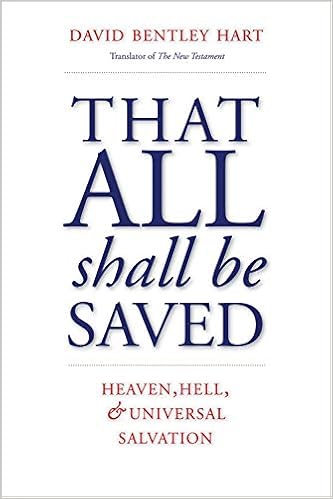
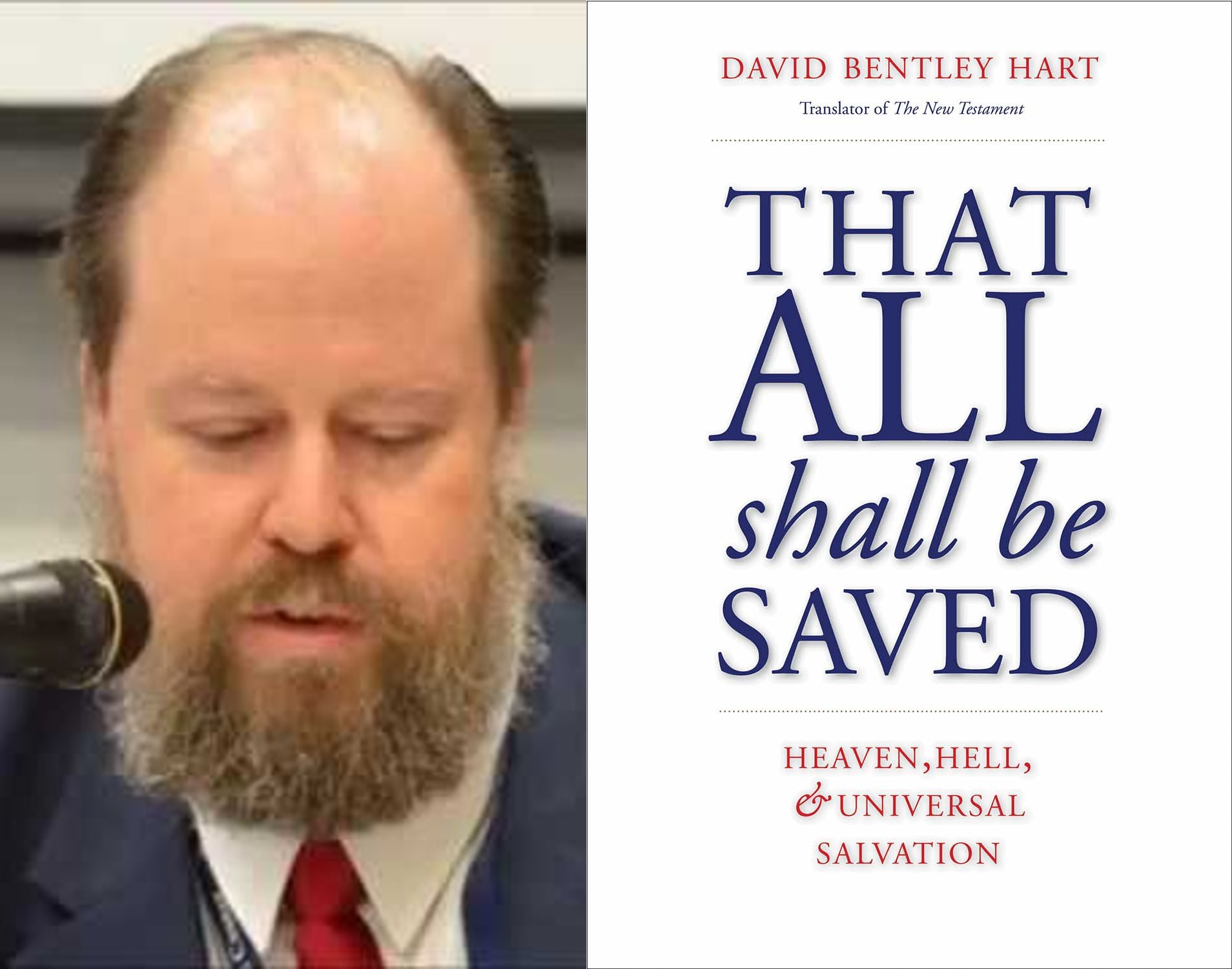
Image result for hart that all shall be saved

Part I: Some Introductory Remarks
At a time when a good many books have been written, some by academics and others by non-academics, on the topic of Christian universalism, David Bentley Hart’s That All Shall Be Saved: Heaven, Hell, and Universal Salvation stands out in several ways. Its author is, first and foremost, an accomplished classicist and expert in the Greek language, one whose previous publications include an important translation of the New Testament. And one of his purposes in this translation was to restore “certain ambiguities” that, so he believes, are “present in the original texts” but have been lost in later translations. He thus writes, “I am firmly convinced that two millennia of dogmatic tradition have created in the minds of most of us a fundamentally misleading picture of the claims made in Christian scripture” (p. 3). He traces much of that misleading picture, most notably the doctrines of limited election and limited atonement, “back to the late Augustine—a towering genius whose inability to read Greek and consequent reliance on defective Latin translations turned out to be the single most consequential case of linguistic incompetence in Christian history” (p. 49). As this quotation already illustrates, Hart pulls few of his punches in this book; and that very fact, whatever else one might think about it, contributes a lot to the book’s rhetorical power.
Hart relentlessly opposes, secondly, the whole idea of unending punishment and any other conception of a final separation from God; he rejects all such ideas as “manifestly absurd” even when they do not rest upon a morally offensive doctrine of limited election. For even “the gentlest, the most morally delicate, the most judiciously reluctant” conceptions of a final separation from God “all start . . . on the far side of a prior existential decision to accept an obviously ludicrous premise” (p. 202). So just what is this ludicrous premise, according to Hart? It is essentially the premise that divine justice, divine love, and divine goodness are compatible with God’s having created someone whose final fate he always knew would consist of everlasting misery and torment. For how could that even be possible? “If ‘justice’ means anything at all,” Hart protests, “it cannot be that; if ‘love’ means anything at all, it cannot be that; if ‘goodness’ means anything at all, it cannot be that” (p. 203). Hart also notes how glibly some speak of eternal conscious torment without seriously considering what such a destiny would truly mean. “Can we [even] imagine,” he asks, “that someone still in torment after a trillion years, or then a trillion trillion, or then a trillion vigintillion, is in any meaningful sense the same agent who contracted some measurable quantity of personal guilt in that tiny, ever more vanishingly insubstantial gleam of an instant that constituted his or her terrestrial life?” (pp. 203-204).
A third unique feature of this book is the extent to which its author refuses to apologize for the hard-hitting nature of his personal manifesto against the “infernalist orthodoxy,” as he calls it. He thus writes:
Custom dictates and prudence advises that here, in closing, I wax gracefully disingenuous and declare that . . . I entirely understand the views of those that take the opposite side of the argument, and that I fully respect contrary opinions on these matters. . . . [But] I believe that I am obeying my conscience with a special rigor in rejecting the majority view that there is a hell of eternal torment, since I am fairly sure that it must be a wicked thing to give one’s intellectual assent to something that one cannot help but find morally repugnant. . . . I make no apologies whatsoever for rejecting the late Augustinian tradition . . . [and] that tradition’s sheer moral wretchedness as a vision of the gospel . . . I have [also] rejected every version of the infernalist orthodoxy, no matter which Christian tradition may have produced it, and no matter how tenderhearted the reasoning that informs it. To have done otherwise would have been dishonest on my part. (pp. 199-200)
Although he rejects this “infernalist orthodoxy,” sometimes in exceedingly harsh terms, as morally intolerable, biblically untenable, and philosophically confused, Hart nonetheless acknowledges that the book he has written “is at odds with a body of received opinion so invincibly well-established” that he “cannot reasonably expect to persuade anyone of anything,” with the possible exception of persuading some of his own sincerity (p. 4). At the same time, however, he laments having written a book that “ought never have needed to be written in the first place” because “the doctrine of eternal hell is prima facie nonsen­sical” (p. 202). And herein lies an insight into his rhetorical strategy, which will, I suspect, make this book difficult for evangelicals and other self-appointed guardians of orthodoxy simply to ignore. Hart himself describes his effort as “a logical and rhetorical experiment” and explains this in the following way:
There is, at the very least, something liberating about knowing that I have probably lost the rhetorical contest before it has even begun. It spares me the effort of feigning tentativeness or moderation or judicious doubt . . . and allows me instead to advance my claims in as unconstrained a manner as possible . . . [I]f nothing else, this book may provide the champions of the dominant view an occasion for honest reflection and scrupulous cerebration and serious analysis (and a whole host of other bracing intellectual virtues of that sort). (p. 4)

 But at this point, I fear, Hart may find himself subjected to an ad hominem argument of the following kind: the criticism that he just regards himself as morally superior to his infernalist opponents. It is a criticism that sort of goes with the territory. After publishing a scathing critique of the Reformed doctrine of reprobation several decades ago, one in which I labeled it “a respectable blasphemy” against God, I understandably received many harsh criticisms in return. The only criticism that touched my heart, however, was exceedingly gentle. It happened when the wife of my best friend in the Reformed church that my wife and I were then attending—a dear woman with some serious physical challenges—hesitantly expressed the worry that I might be regarding myself as more loving than others in the church. That was startling indeed, because I knew without question that others in the church were far more loving in their personal lives than I tend to be in my own. None of us, after all, are fully consistent in our moral lives. So in the end I found myself saying, or at least thinking to myself, things like, “Virtually all Calvinists I have known are far better than the theology they have embraced, even as I am far worse than the theology I have embraced.” But Hart’s own attempt to forestall similar criticisms may be better than my own. “Really,” he asks concerning the infernalist orthodoxy, “could we truly believe it apart from either profound personal fear or profound personal cruelty? Which is why, again, I do not believe that most Christians truly believe what they believe they believe” (p. 204). Some may find such a view counterintuitive, but I do not. For over the course of my own life, I have observed more than a few instances where people have sincerely thought they believed certain things about God only to have some tragic event—such as a husband dying “in unbelief” or a teenage daughter committing suicide—prove that they did not truly believe what they previously had sincerely thought they believed.

In any case, I have found no major theological claim in this book with which to disagree. It would be truly remarkable, of course, were I to agree with every detail of every argument presented therein. But I am prepared to endorse every major theological claim contained in the book, starting with this one, which I take to be the main thesis of the book: “if Christianity taken as a whole is indeed an entirely coherent and credible system of belief, then the universalist understanding of its message is the only one possible” (p. 3—my emphasis). Not even many of those who sympathize with the universalist message are so bold as to declare that, given the New Testament understanding of God, the very idea of someone being lost forever represents a logical (or metaphysical) impossibility. Most find it sufficient to endorse a so-called “hopeful universalism,” even as they acknowledge that an eternal hell is at least logically possible. But I disagree with that, even as Hart does; and the reason we both reject even the logical possibility of an eternal hell should emerge in subsequent installments of this review.
Dr Thomas Talbott is Emeritus Professor of Philosophy at Willamette University and author of the celebrated book on the greater hope, The Inescapable Love of God. He is the author of numerous philosophical articles, as well as a piece published on this blog: “How to Read the Bible from a Universalist Perspective.”

A Detailed Account of America’s Greatest Political Scandal


By Julie Kelly
https://amgreatness.com/2019/09/24/a-detailed-account-of-americas-greatest-political-scandal/
September 24, 2019

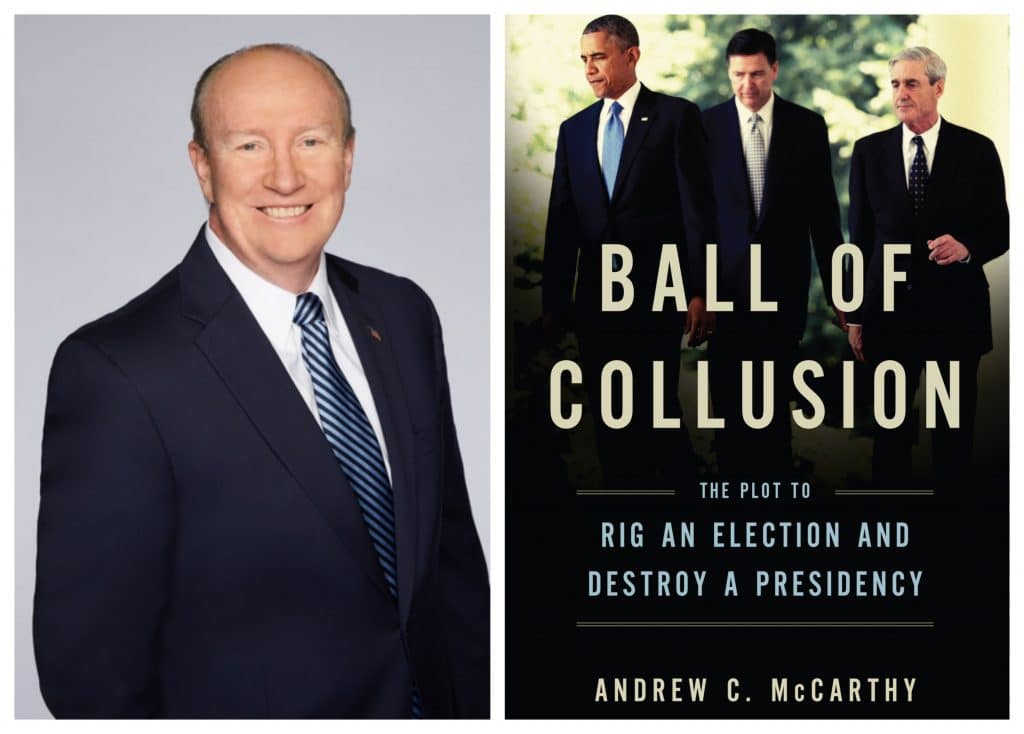
Image result for mccarthy ball of collusion

In early 2017, as the shocking story of how the Obama Administration weaponized the world’s most powerful agencies against Donald Trump began to unfold, very few journalists were willing to confront that scandal amid the cacophony of Trump-Russia collusion. Andrew McCarthy was one of them.
From the pages of National Review to the set of Fox News, McCarthy, a former federal prosecutor, explained complex legal procedures in layman’s terms. Americans unfamiliar with FBI counterintelligence probes or the workings of the Foreign Intelligence Surveillance Court or Special Counsel rules were educated by McCarthy in a way that made it easy for the non-lawyer to grasp. McCarthy, a humble, humorous, and gracious man by nature, offered his expertise without the self-gratifying puffery ingrained in so many prosecutors. (Think James Comey.)
His new bookBall of Collusion: The Plot to Rig an Election and Destroy a Presidency, includes and expands on this crucial work. In careful detail, McCarthy deconstructs the Trump-Russia collusion ruse; the wind-up of Crossfire Hurricane, the unprecedented investigation into a U.S. presidential campaign; and the ramifications of one of the biggest political scandals in American history. In addition to his knowledge and insight, McCarthy knows many of the players involved personally, including former FBI Director James Comey, former Special Counsel Robert Mueller, and Rudy Giuliani, Trump’s attorney.
Further, McCarthy is no fawning booster of the president so his coverage of the scandal was not in the service of protecting Trump, his family, or his presidency. In fact, McCarthy contributed to the infamous “Against Trump” issue published by National Review in February 2016. “The threat against us has metastasized in our eighth year under a president who quite consciously appeases the enemy,” McCarthy wrote. “But the remedy is not a president oblivious of the enemy.”
The ball of collusion, as McCarthy describes at the end of his 456-page book, is “counterintelligence as a pretext for criminal investigation in search of a crime; a criminal investigation as a pretext for impeachment without an impeachable offense; an impeachment inquiry as a pretext for barring Donald Trump from reelection; and all of it designed as a straightjacket around his presidency.” (Don’t let the number of pages scare you out of reading it; the author’s writing takes up about 350 pages.)
The book’s 18 chapters cover a range of central and corollary subjects. The biggest takeaway is how this entire scandal fused the competing interests of the nation’s biggest egos—some of whom clearly suffer from narcissistic personality disorder. This list includes the president, former president Obama, Comey, Mueller, former CIA director John Brennan, former deputy FBI director Andrew McCabe, and the collective Messiah complex of the Washington bureaucratic establishment and the national news media. McCarthy exposes the “small world” of partisan operatives, sycophants, apparatchiks, and deep pockets that populate the Acela Corridor and fuel the day-to-day turbulence of the American political climate.

Clinton Connections

For the last three years, Americans have been tormented by a dangerous power struggle waged by this claque of political actors who will use any means necessary in order to prevail. It is a black mark in history that will fascinate future historians; those historians undoubtedly will draw heavily from McCarthy’s book as a comprehensive account of what happened between 2016 and 2019, when Robert Mueller finally had to admit there was no evidence of a conspiracy between the Trump campaign and the Kremlin to influence the stunning outcome of the 2016 presidential election. As someone who has covered this scandal closely, I learned important new information from McCarthy about the timeline and the culprits involved.
McCarthy offers crucial background about the financial and political ties between Russia and the Clintons—yet somehow Hillary Clinton’s troubling past related to Russia did not provoke any FBI investigation. “Candidate Clinton and her husband had disturbing Russia ties, too,” McCarthy explained in the book’s introduction. “The Clinton campaign had not just Russia contacts; it had Bill Clinton meeting with Putin and taking a huge payment while Russia had important business before the State Department run by his wife,” McCarthy outlines in chapter 10. “It had Russian money pouring into the Clinton Foundation; its chairman, John Podesta, sat on the board of . . . a company into which Putin’s venture capital firm invested $35 million.”
But Carter Page gave a speech in Moscow.

A Multi-Pronged Plot

McCarthy provides an in-depth analysis of Washington’s unsettling relationship with Russia and Ukraine. Chapter four is a must-read: McCarthy explains how the Obama Administration manipulated intelligence for political purposes—yet another egregious example of how the Obama White House got away with bad behavior while their lapdogs in the media either ignored it or covered it up.
“No administration in American history was more practiced in the dark arts of politicizing intelligence than President Obama’s,” McCarthy writes. “Examples are legion.” This unchecked malfeasance led to the creation of the fabricated collusion ruse and the empowerment of ego-maniacs such as Brennan and Comey.
The next several chapters delve into the multi-pronged plot to sabotage the Trump campaign and derail Trump’s presidency. McCarthy confirms that—contrary to dubious claims by the New York Times and faithfully regurgitated by Trump foes—the FBI investigation was not initiated by an alleged drunken conversation between Trump campaign aide George Papadopoulos and an Australian diplomat in the spring of 2016.
That ruse—which McCarthy calls an “unlikely story”—was an attempt to camouflage the way the dossier compiled by British political operative Christopher Steele, who was working on behalf of the Clinton campaign and Democratic National Committee, supplied the probable cause to launch Crossfire Hurricane, the official name of the counterintelligence probe into four Trump associates, three of whom are named in the dossier. (A document filled with still-unproven accusations.)
“Steele’s project was not intelligence-gathering,” McCarthy explains. “It was the crafting of a campaign narrative about a traitorous Trump-Russia espionage conspiracy. That’s why Steele and [Fusion GPS chief Glenn] Simpson peddled the information to the media at the same time Steele was feeding it to the FBI and the Justice Department. The Clinton campaign’s Steele dossier was the sheer political spinning of rank rumor.”

“This Should Never Happen”

McCarthy profiles the various spies deployed to infiltrate and monitor the Trump campaign, easily debunking another faux media narrative that the Obama Administration didn’t spy on Trump.
“The indignant anger over questions about the Crossfire Hurricane undercover operations . . . is misplaced,” he writes in Chapter 12.
The book’s chapter on the FISA warrant against Carter Page offers a crucial primer in advance of the anticipated report by Michael Horowitz, the Justice Department’s Inspector General, on how Comey’s FBI manipulated the secret court to get an order to spy on Page for a year. McCarthy admits his own miscalculation about how FISA might be abused after procedures were loosened following the 9/11 terror attacks.
“Back then, it seemed ridiculous to believe the FBI and the Justice Department would resort to FISA pretextually,” he concedes. “I was wrong. What I didn’t factor in was the possibility that, for political reasons, the upper ranks of the FBI and the Justice Department might decide to do an investigation by themselves. This should never happen.”
But in Trump’s case, of course, it did.
Comey’s “weasel moves” (that he insists he didn’t make but did repeatedly make when it came to Donald Trump) led to his ouster in May 2017. McCarthy is critical of the president’s handling of Comey’s firing, an assessment which is up for dispute. I strongly disagree that Comey was undeserving of his humiliating public dismissal because he “had served the United States well in many capacities over many years.” Comey will be—and should be—remembered for how he defiled the world’s most powerful law enforcement agency to gratify Barack Obama’s contempt for Donald Trump and the Republican Party. The inspector general recommended three criminal charges against Comey in his latest report; it’s very likely Comey will be implicated in more abuses as investigations into his conduct continue. But McCarthy does give an otherwise fair description of one of the most bitter president-FBI director relationships of all time.
The final chapter pores over the stretch of time between Comey’s firing and the appointment of Special Counsel Robert Mueller, which Comey successfully prompted by leaking one of his memos documenting a private conversation with Trump to the New York Times.
“The collusion narrative had served its purpose,” McCarthy concludes. “The collusion narrative, seeded by the Obama administration, tilted by intelligence leaks and tended by constant media care accomplished its objectives. A special counsel . . . was imposed, despite the absence of criminal predicate, to monitor the Trump presidency.”

The Scandal Is Far from Over

If there is any criticism of McCarthy’s book, it is that he gives short shrift to the insidious role played by the anti-Trump news media. While McCarthy offers some examples of how news organizations such as the Times, CNN and the Washington Post eagerly reported classified information to fuel the collusion plotline, the destructive conduct of the media—including reporters, columnists, editors, cable news hosts, and various contributors on both sides of the Trump-hating political aisle—warranted more coverage. For example, MSNBC, which served as a nonstop organ of the collusion deception, only received three mentions in the book.
To his credit, however, McCarthy generously commends other journalists such as The Federalist’s Mollie Hemingway, Tablet Magazine’s Lee Smith, the Daily Caller’s Chuck Ross, and the Wall Street Journal’s Kim Strassel for their invaluable reporting on the scandal.
Even though the Mueller investigation is complete, this scandal is far from over. The public impatiently awaits the results of pending inspector general reports; criminal inquiries into McCabe and former FBI General Counsel James Baker; and an expansive investigation launched by Attorney General William Barr into what the Obama Administration did in 2016 and 2017 to try to destroy Donald Trump.
My guess is that McCarthy will have a chance to write a follow-up to this exceptional book.

Tuesday, September 24, 2019

How identity politics drove the world mad


By Roger Scruton
https://unherd.com/2019/09/how-identity-politics-drove-the-world-mad/
September 2019

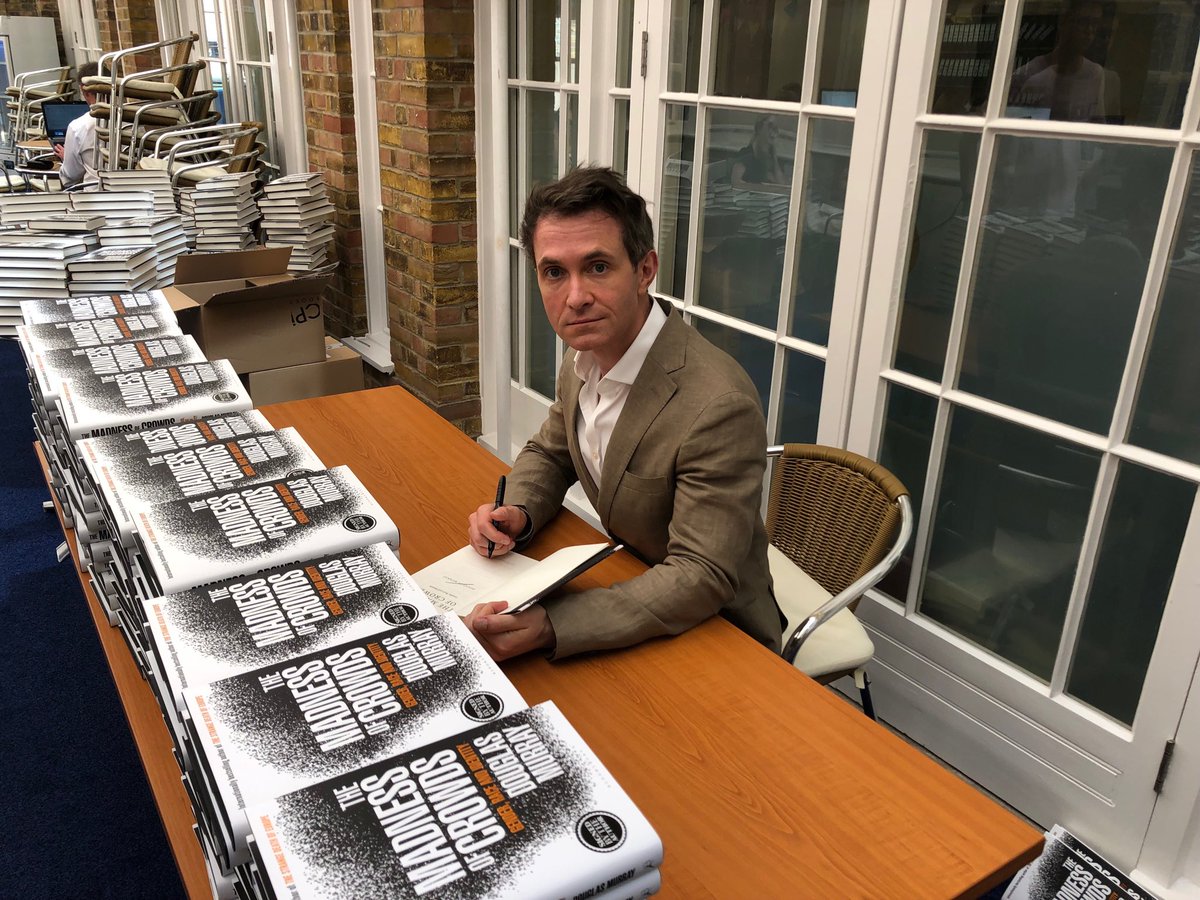
Image result for douglas murray madness of crowds

We thrive on disagreement, but only if we do not also feel threatened by it. In every period of history, therefore, there have been opinions and customs that are dangerous to question, since they provide the firm foundations on which our disagreements rest. Whether religious or political, these established ways of thinking and acting have been protected by law, and embedded in the educational curriculum and the daily customs of the people.


But our situation in Western democracies today is a novel one. There is no shared religion, and the old customs have been torn asunder by a culture of repudiation, which encourages people to shape their lives according to an “identity” of their own. Socialisation no longer means joining or obeying, but “becoming who you are”, regardless of the surrounding norms. This novel situation, which advertises itself as a kind of liberation, has instead produced in my lifetime a totally new kind of censorship and intimidation.
Thirty years ago I naively assumed that, with the collapse of communism, we would no longer see the persecution of dissidents or the imposition of official doctrines, and so I have been as astonished as everyone else by the mass denunciations and targeted character assassinations that enforce prevailing orthodoxies today. They seem as frequent and comprehensive here in Britain as they ever were in the world of totalitarian government.
True, you don’t go to the Gulag for your opinions; nor are there show-trials of “deviationists”, Zionists or the running dogs of capitalism. Nevertheless, you have to be careful what you say, and the punishments for saying, thinking or implying the wrong thing, even if administered by private enterprise and social media rather than by the state, are real, serious and largely impossible to deflect.
The archive of your crimes is stored in cyberspace, and however much you may have confessed to them and sworn to change, they will pursue you for the rest of your life, just as long as someone has an interest in drawing attention to them. And when the mob turns on you, it is with a pitiless intensity that bears no relation to the objective seriousness of your fault. A word out of place, a hasty judgment, a slip of the tongue — whatever the fault might be, it is sufficient, once picked upon, to put you beyond the pale of human sympathy.
As Douglas Murray shows in his impressive and lively survey, The Madness of Crowds: Gender, Race and Identity, the emerging world of censorship is a world without forgiveness, in which people are condemned for what they are rather than what they do, and in which the real virtues and vices that govern our conduct are ignored altogether as irrelevant.
The crimes for which we are judged are existential crimes: through speaking in the wrong way you display one of the phobias or isms that show you to be beyond acceptable humanity. You are a homophobe, an Islamophobe, a white supremacist or a racist, and no argument can refute these accusations once they have been made.
You might, in your private life, have worked for the integration and acceptance of your local Muslim community, or for a wider understanding of the roots of Islamic philosophy. This will be irrelevant when it comes to rebutting a charge of Islamophobia, just as your record in promoting minorities in the workplace will do nothing to clear you of the charge of racism, once the crucial words are out.
For your accusers are not interested in your deeds; they are interested in you, and in the crucial fact about you, which is whether or not you are “one of us”. Your faults cannot be overcome by voluntary action, since they adhere to the kind of thing that you are. And you reveal what you are in the words that define you.
These words may be taken out of context, even doctored to mean the opposite of what you said — as happened recently to me in an interview given to the New Statesman — but this will not affect the verdict, since there is no objective trial, no “case for the defence”, no due process. You are accused by the mob, examined by the mob and condemned by the mob, and if you have brought this on yourself, then you have only yourself to blame. For the mob is by nature innocent: it washes its own conscience in a flow of collective indignation, and by joining it you make yourself safe.
Such is the situation that the brave Murray confronts in his latest book, the title of which (taken from a previous anatomy of human folly by Charles Mackay) implies that it is crowd hysteria, rather than ignorance, that is largely to blame. But, as Murray goes on to show, that suggestion is also too simple. With admirable attention to detail he explores the ways in which the spirit of the mob has entered not only the language of public debate but also the sources of information and the institutions of decision making.
Censorship begins in the media themselves, with the silicon valley elite introducing “machine learning fairness” designed to eliminate “hate speech”, and programmed to recognise as “hate” all those expressions of opinion that violate some norm of political correctness. What Orwell so vividly foresaw — the manipulation of language so as to make heresy inexpressible — is now routine practice.
The result, however, is not a culture of gentle conformity, in which “niceness” is the norm. On the contrary, the clamour for recognition involves a constant assault on those who are assumed to be preventing it. These purveyors of “hate” are given no leeway on social media, and the practice of mass denunciation on grounds of race, tribe, class or social milieu is now an accepted weapon in the identity wars.
Murray gives riveting examples of the way in which whiteness has become a moral fault in the eyes of identity warriors on the American campus. It is, for example, now legitimate to condemn people for the colour of their skin, leading some to try to apologise for being white.
Various devices facilitate the emergence of the censorship culture. Three in particular come to the surface in Murray’s carefully constructed argument. First, there is the art of taking offence. Whole sections of the university curriculum are devoted to explaining to students that words, arguments, comparisons, even questions, are “offensive”, regardless of the intention with which they are used.
Invariably, the offence is given by the old majority culture, and is taken on behalf of some privileged minority. Current concerns about Islamophobia are relevant here: it is offensive, for example, to make jokes about the burqa, but not offensive to appear in public with your face entirely covered, even though the face-to-face encounter is at the root of our shared way of life, as important in showing respect as taking off your shoes when entering a mosque.
More important, from the intellectual point of view, is the attempt to rewrite hardware as software. As Murray shows, identity politics, which insists that everything relevant to our sense of self lies within our power, so that nothing can be imposed on us without our consent, is at odds with the facts of biology. To get round this problem, sex has been re-written as gender, and gender defined as a social construct. In this way, hardware becomes software, and fate becomes choice.
And the result is the “trans” lobby, determined to make all those areas where one sex was hitherto privileged (for example, female sports or female bathrooms) available to whoever wishes to appropriate that sex as his own. The hardware/software confusion has now penetrated the culture, and Murray shows the devastating effect that it has had on our understanding of human difference.
Finally there is the new scourge of “intersectionality”, which encourages people to explore all the ways in which they have lost out in the pursuit of advantage, and to construct their identity accordingly. A kind of reverse hierarchy of privilege emerges, as you come to see that you are disadvantaged as gay man, and then as a black man, and then as a Muslim man, and so on. The result of this scramble for “virtuous disadvantages” occupies Murray over many partly amusing, partly distressing pages.
As he abundantly shows, the attempt to derive a positive philosophy from this assemblage of negatives leads to absurdity and contradiction at every turn. The problem, however, is that contradiction is not regarded by the mob as an obstacle, but merely as further proof of the great conspiracy by which we are surrounded — the conspiracy enshrined in the old majority culture, which told us that we must accept human nature, find our fulfilment within its bounds, and not engage in a futile metaphysical rebellion.
Murray’s comprehensive survey of the prevailing madness will not persuade every reader. But it raises the real questions of our times, which are these: can we reject the idea of a benevolent God and still hold on to our inherited morality, founded on respect for the other and the absolute authority of truth? Can we adopt the posture of forgiveness that Murray is so keen to advocate, without turning to the supreme example that was once given to us?
Can we re-learn the habits of polite disagreement, and address each other as rational beings, capable of forming real communities in which differences are respected and decencies honoured? I want to answer yes to those questions. But as someone who has suffered more than most from the prevailing madness I have my doubts.
My own solution — which is to ignore social media and to address, in my writings, only the interest in the true and the false, rather than in the permitted and the offensive — confines me within a circle that is considerably narrower than the Twittersphere. But here and there in this circle, there are people who do not merely see the point of truthful discourse, but who are also eager to engage with it. And I cling to the view that that is enough, as it was for the Irish monks who kept the lamp of learning alight during the Dark Ages. They may have thought they were losing, but they won in the end.
Douglas Murray’s The Madness of Crowds: Gender, Race and Identity is published by Bloomsbury Continuum

Thursday, September 12, 2019

The Eternal Debate over the Nature of Hell


By Nicholas Frankovich
https://www.nationalreview.com/magazine/2019/09/30/the-eternal-debate-over-the-nature-of-hell/
September 12, 2019

Image result for david bentley hart shall be saved

Does hell exist? It depends on what you mean by “hell.” David Bentley Hart answers the question in the affirmative but gives the term a definition different from that assumed by “apologists for the ‘infernalist’ orthodoxies,” as he calls his adversaries in the perennial debate over the nature of hell.


What is hell? Who goes there? Do they ever leave? Hart embraces universalism, also known as universal salvation, universal reconciliation, and apokatastasis (Greek for “restoration,” as of all creation in the age to come) — the doctrine, sometimes regarded as merely heterodox, other times as outright heretical, “that all shall be saved,” to quote the title of his lively new book on this burning topic.
Saved from what? From death and damnation. Not spared from their clutches, but delivered from them ultimately.
First, death: Each of us can expect to die and, like Christ, “descend into hell,” in the words of an antiquated but not entirely abandoned translation of the Apostles’ Creed. (In an older sense now all but forgotten, “hell” was a reasonable English equivalent of the original Greek — ta katōtata, the parts below, where the dead dwell. To modern ears, of course, to say that Christ went to hell sounds like blasphemy. It causes confusion and illustrates the outsized role that translation decisions have played in the reception — or, as Hart argues throughout, in the corruption — of doctrine down the centuries.) We can also expect, like Christ, to rise from the dead, although our uncertainty about the precise nature of our glorified, spiritual bodies will persist until we receive them at the general resurrection. Only then will we see the promised new reality face to face.
As for damnation, Hart imagines that most of us, even while on earth, spend too much time in hell, that our subjection to hell’s torments is not confined to kingdom come, that we walk through hell’s gates and then lock ourselves in, and that we are helpless to leave until they’re opened for us from the outside. “I do in fact believe in hell,” he explains,
though only in the sense of a profound and imprisoning misery that we impose upon ourselves by rejecting the love that alone can set us free. I believe, in fact, that I have on occasion experienced that hell from within its walls; . . . I suspect that most of us, at least past a certain age, have done so. . . . Practically all of us go through life as prisoners of our own egos, which are no more than the shadows cast by our souls, but which are nonetheless quite impossible for us to defeat without assistance and without grace.
That’s a solid meditation at the intersection of psychology and spirituality. The darkness described by Hart is, as he says, familiar to many. He calls it “hell,” but it doesn’t sound much like the lake of fire in the Book of Revelation, does it? If you’re looking for that, or for a live cam on the lake of ice in the ninth circle of Dante’s Inferno, this is not the book for you. It will leave you cold, unless your rage provoked by the author’s ridicule of your beliefs about the Last Things leaves no room in your heart for such milder emotions as disappointment. Make no mistake: David Bentley Hart is an able rhetorician and polemicist.

What a sharp tongue he has:

There are, I admit — unfortunately, I have met some of them — those Christians who are earnestly attached to the idea of an eternal hell not just because they feel they must be, but also because it is what they want to believe. For some of them, in fact, it is practically the best part of the story. It gives them a sense of belonging to a very special club, and they positively relish the prospect of a whole eternity in which to enjoy the impotent envy of all those writhing, resentful souls that have been permanently consigned to an inferior neighborhood outside the gates. That is the sort of prestige that cannot be bought where the common people shop.


Speaking of prestige: By now, in his mid fifties, the itinerant academic and indefatigable essayist (his full curriculum vitae could probably be its own book) has established himself as one of the best theologians writing in English today and as hands down the best writer among contemporary Anglophone theologians. Behold his literary pyrotechnics. I sometimes wonder whether they distract readers from the hard work of sitting down with him and thinking problems through. I suppose that after a point he gets bored with trying to untangle intractable philosophical knots. He’s capable of mischief. If he ends up doodling in the margins, limning the pages with generous applications of sarcasm and color, to relieve the tedium of, say, a necessary excursus on voluntarist theology, do you blame him?


The book has no endnotes. In a section dedicated to “acknowledgments and bibliographic notes,” Hart cites a few major sources, all of them in English. He’s erudite, and it may be that his final product is a symphony composed of the best, and the worst, but in any case the loudest and boldest that has been thought and said about hell, from Jesus himself to Saint Augustine (one of Hart’s bêtes noires) all the way to Thomas Talbott and a whole roster of present-day thinkers on all sides of the universalism controversy, but it’s hard to say. Hart shows his work, so to speak, only in patches. A convert to Eastern Orthodoxy, he’s wont to quote and reference various of the Greek Fathers with enthusiasm. He loves Origen and Gregory of Nyssa especially. When it comes to modern scholars, though, he names names sparingly. Chalk it up to tact, if you like, in recognition of how much of his work is an exercise in intellectual derision and evisceration. The book is published by a university press and is scholarly, but is it scholarship? One thing it’s not is intellectual history.


Call it an essay. It’s an attempt, from several angles, not to deny hell’s existence but to refute a common assumption about the duration of anyone’s residence there. The duration is finite, Hart maintains, and he pours out a cornucopia of arguments to make his case. He has arguments from reason (philosophy), arguments from faith (scripture and patristics), and arguments that can be understood only as members of both categories at once — any gesture toward philosophical reasoning tends to enjoy a benefit of the doubt from conservative Christians if the author is a Church Father in whom some of the authority of sacred tradition has come to be invested.
The most common “infernalist” accounts lean on the notion that eternal damnation is a corollary of human free will, which entails risk. We can choose evil over good. When we do, we must suffer the consequences of our moral error as surely as we must suffer those of playing with fire in a dry forest or of swimming too far from shore during a storm. The moral law is as blind and unforgiving as any law of nature.
Hart rehearses the counterargument that no one is culpable for breaking the moral law if he errs in ignorance or under deception. To someone who chooses evil over good, the evil appears as good or, on the whole, at least better than the alternative. Otherwise he wouldn’t choose the evil. God warned us about the fruit in the garden, but the serpent had a way with words, and we fell under their spell. Our judgment was clouded. We’re mere creatures, after all, limited in our intelligence and willpower. A punishment of infinite duration would be incommensurate with our finite nature and therefore unacceptable to God not only because he’s all-merciful but also because he’s all-just.


Nice chess move. But so what? God may knock the pieces off the board. He’s been known to do that. His ways are not ours. In Genesis, he commands Abraham to kill Isaac, setting a precedent that instills in the mindful believer a respectful wariness, an attitude of fear and trembling before the inscrutable Almighty.


Moreover, God desists from preventing outrages that nature inflicts on human persons and that human persons inflict on one another. To the dulcet theory that the fall of creation is ultimately fortunate because the response it elicits from God is his salvation plan, which, when fully realized, leaves the cosmos more blessed than it would have been had we never lapsed — to that, we might respond, with Hart: No, God is infinitely resourceful. He could have arranged it so that we would enjoy the deepest, richest happiness without having to suffer the slings and arrows of misfortune first.
Why he didn’t is a mystery. It’s at the heart of the theodicy problem, which is the heart of the matter for the universalist. Hart has no patience for the idea that God might be a capricious judge when deciding our eternal destiny, but God is capricious in other matters all the time, at least from our human perspective. An infant notices his mother’s absence but doesn’t know that it’s only momentary. To him it’s the end of the world. He cries out with all his strength, exercising his lungs and vocal cords almost to the breaking point. We smile at him. We call him “dear.” If you bristle at the suggestion that God rightly does the same to us when we wail over our adult afflictions, over massacres or mass shootings or enormities than which none, we feel, could ever be more heinous, fine. Go ahead and bristle.
No philosophical argument for universalism is unanswerable, as far as I can tell. Hart is at his most cogent and engaging when he leaves philosophy for philology and sifts the Greek of the New Testament and Church Fathers. He may be right that “eternal” is not the obvious best translation of every instance of aiōnios, whose primary meaning is something like “age-long.” Hades, the underworld in Greek mythology, and Gehenna, a valley in Jerusalem, are often conflated under the rubric “hell” in translations of the New Testament but perhaps shouldn’t be. The New Testament provides a wealth of vivid images and strong statements, possibly hyperbolic in many cases, that Christians piece together in different configurations to illustrate competing eschatological visions, some of them more layered than others. What has become the default version, in which hell will endure forever as an abscess of unredeemed evil in a cosmos otherwise perfected and glorified, may be flatter than a close reading of the Greek can support.


Granted, belief in the tragedy of eternal damnation is fertile soil. It nourishes much heartfelt Christian devotion. Without it, no Inferno. No Doctor Faustus, either. Those are not sound reasons for rejecting universalism, but they’re strong reasons. A better reason would be that we’re less likely to avoid grave sin if we think that the hell we will go to for punishment will not be forever, although a reading of the Purgatorio might disabuse us of any complacency. Remember that Catholics who appreciate the severity of what is, in effect, hell with a temporal limit offer fervent prayers for the reduction of purgatorial suffering, their own and that of loved ones and even of strangers.
The best reason for rejecting universalism would be that it’s untrue. Is it, though? “We are, as it were, doomed to happiness,” according to Hart. If we are, so be it. Neither his opinion nor yours changes the fact. Consequently, no book on the controversy can be worth fearing or loathing. Here’s one worth reading.
This article appears as “Hell, Yes. Forever? Maybe Not.” in the September 30, 2019, print edition of National Review.

Will everybody reach heaven? Are fights over hell about to grab some more headlines?


By 
https://www.getreligion.org/getreligion/2019/8/14/will-everybody-reach-heaven-is-hell-about-to-grab-some-more-headlines
August 15, 2019


Chances are churches frequented by your readers and listeners rarely if ever offer sermons about hell and damnation these days. And yet this rather unpleasant topic is eternally (so to speak) fascinating, and may be about to grab some headlines. That’s due to Eastern Orthodox lay theologian David Bentley Hart's acerbic Sep. 24 release from Yale University Press “That All Shall Be Saved: Heaven, Hell, & Universal Salvation.”

Sample sentences: “No one, logically speaking, could merit eternal punishment.”
Also this: “If Christianity is in any way true, Christians dare not doubt the salvation of all,”
Yes, Hart is a Hitler-in-heaven sort of guy (see page 38), and your sources will have interesting responses. Lest Hart seem a rank heretic, the Very Rev. John Behr of St. Vladimir’s Orthodox Theological Seminary blurbs that this book presents “the promise that, in the end, all will indeed be saved, and exposing the inadequacy — above all moral — of claims to the contrary.”
Heretofore Hart was better known for ridiculing non-belief, as in “Atheist Delusions.” The prolific author has held a succession of university appointments, most recently as a University of Notre Dame fellow. Catholic theologian Paul Griffiths (in the news when he resigned over Duke University’s “diversity” policy) proclaims Hart “the most eminent” theologian in the English-speaking world.
Terms Hart applies to centuries of traditional orthodox and Orthodox doctrines on hell and damnation include “absurd,” “ludicrous,” “nonsensical,” “incoherent,” “horrid,” “degrading,” “loathsome,” “diseased,” “perverse,” “cruel,” “wicked” and “morally repugnant.” He is mainly offended by the idea that punishment is everlasting, on grounds that the punishment doesn’t fit the crime. Hart is open to some sort of cleansing to make sorry souls fit for heaven, but doesn’t spell out any version of Western Catholicism’s Purgatory.

“All” is a far cry from the sentimental optimism about humanity preached by officially Universalist churches. Hart argues that the Christian God is not truly God if those he brands “infernalists” are correct. The familiar challenge is how everlasting torment of any person meshes with belief that God is loving.
What about human will and repenatance? Hart adds the less common claim that defiant rejection of God throughout all eternity cannot be “logically possible for any rational being."
The heart of Hart is the contention that the few New Testament verses usually cited on this could refer to “limited term” punishment, while 23 other passages raise hopes that all will be saved. He relies on Bible interpretations by ancient Eastern theologians, especially the 4th Century’s Origen and St. Gregory of Nyassa. He castigates that era’s great Catholic voice, St. Augustine, for “the single most tragically consequential case of linguistic incompetence in Christian history,” based upon the “defective” Latin translation of the Bible. (Speaking of scripture, Yale also published Hart’s recent, idiosyncratic translation of the New Testament, also well worth a sidebar on scholars’ reactions.)
Publicity contact for Hart: Robert Pranzatelli: 203–432-0972 and robert.pranzatelli@yale.edu.
Meanwhile – religion writers note – there’s a related dustup in the news right now linked to the Christian claims of exclusivity per Jesus’ teaching that “I am the way, and the truth, and the life. No one comes to the Father except through me” (John 14:6).
Last week’s Evangelical Lutheran Church in America assembly approved a significant inter-religions relations policy (.pdf here) after handily defeating a bid to remove a soft section that says e.g. the status of believers in other religions “is beyond our knowledge, and even our calling” so “we do not need answers.”
(The ELCA’s own news release slid past this issue, covered by juicyecumenism.com, a reminder that reporters always need to consult varied sources.)
Even conservative Christians are not cut-and-dried on this. The Catholic Church’s Catechism teaches the “baptism of desire,” so a person ignorant of Christian teaching who “seeks the truth and does the will of God in accordance with his understanding of it can be saved,” through means known only to God.
Or consider noted speaker and author Josh McDowell, whose evangelical credentials are unassailable. In “A Ready Defense,” he says the God of Scripture does not wish any to perish (2 Peter 3:9) and will be a righteous judge (Acts 17:31), so it’s reasonable that “no one will be condemned for not ever hearing of Jesus Christ,” although (as in Catholicism) we don’t know the particulars.

Tuesday, September 03, 2019

How To Replace Howard Zinn’s Communist Account Of U.S. History For American Kids


By Joy Pullman
https://thefederalist.com/2019/08/28/replace-howard-zinns-communist-account-u-s-history-american-kids/
August 28, 2019

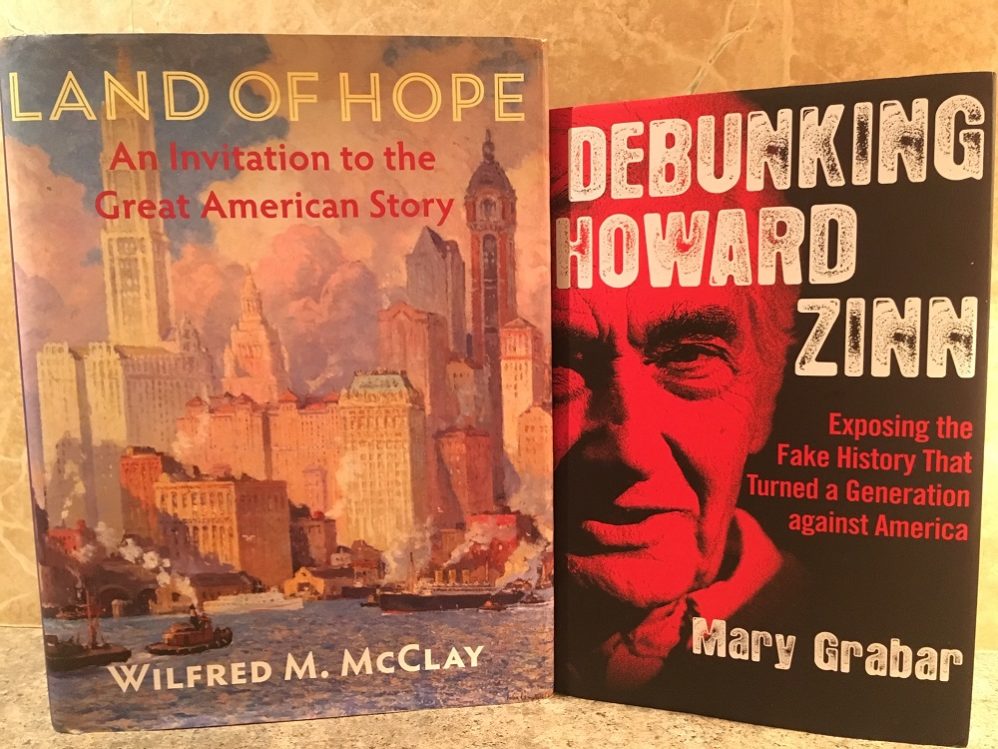
Image result for mary grabar zinn

The perfect companion accompanied my family’s trip West this summer in the modern covered wagon: A new, single-volume book of U.S. history. As our RV motored across the plains, I read of how they were discovered and settled. I looked across the prairies, the badlands, and the mountains and imagined myself coming in an ox-drawn cart instead of a motor vehicle with a gas stove and bathroom.
“Land of Hope: An Invitation to the Great American Story,” by University of Oklahoma historian Wilfred McClay, is extremely readable. It’s written in a conversational but not casual tone, and thus approachable to readers from around age ten onward (if the ten-year-old is accustomed to reading large books like “The Lord of the Rings,” as mine is). An attractive writing style may be its first virtue, because an open door is required for people to enter.
A second virtue is the book’s brevity. To be sure, it is a large and somewhat heavy volume, of 429 pages not including the end material. But that is not too much gas for racing across approximately 500 years of history. I found myself constantly wishing to hear more about the people and ideas in the book, and sad but understanding to instead be whisked away to the next set. Thankfully, McClay provides an extensive “additional reading” list to help satisfy a problem inherent to writing a one-volume overview of American history.
Considering a new book of American history requires, however, more than structural basics like these. Context is extremely pertinent. “Land of Hope” is published in a year in which hatred of America seems bigger than ever.
To take a recent and prominent example, The New York Times, once the United States’ paper of record, has newly released the “1619 Project,” named after the year in which African slaves first arrived on American shores. The project purports to be a work of history: “aim[ing] to reframe the country’s history, understanding 1619 as our true founding, and placing the consequences of slavery and the contributions of black Americans at the very center of the story we tell ourselves about who we are.”
But it is better described as anti-history propaganda. To take just one demonstration of this, its premise and name fully ignores that Native Americans frequently enslaved each other on this continent long before Europeans arrived. It also sidelines the fact that most of the African slaves brought to the Americas were sold by enemy African tribes, who also routinely held their fellow man in slavery going back centuries. Native Americans held black slaves. African Americans held black slaves. The whole world has held slaves.
In other words, if America was founded on slavery, so was just about every civilization. Should they all be razed right now? Just how does one propose to do that, exactly, without creating mass murder and mayhem? Since America is not unique in its regrettable past allowance of chattel slavery, it does not deserve to be singled out as an object of hatred, largely for the left’s political advancement. We can and need to have a conversation about how to judge one’s country for its sins and recover from them, but that requires starting from factual instead of ideological grounds.
Yet surveys have shown for decades that most Americans today know nearly nothing about their history, and when it is taught in public schools and universities it is usually either influenced by or saturated with leftist politics. Most Americans thus have no intellectual defenses against such lies. Knowledge is the starting point for wise reflection and substantive conversation. It is the antidote to propaganda.
This is likely the reason McClay’s history is billeted in marketing materials as “the long-awaited antidote to Howard Zinn anti-Americanism.” “[E]xisting accounts simply fail to tell our country’s story with energy and conviction,” the press release says. “They also disproportionately reflect the outlook of radical critics of American society, whose one-sided accounts lack the balance of a larger perspective and have had an enormously negative effect upon the teaching in high schools and colleges.”
This is all true. But this might make readers expect to read something more polemical, a sort of mirror image of Zinn’s bestselling anti-American propaganda textbooks used in countless U.S. public schools. McClay’s book is not one bit polemical. If anything, it is genial, open-minded, and when critical it is critical out of love for its subject matter, rather than hatred.
It is not a work of advocacy, but of history. McClay presents accusations against America in their context but without covering up genuine wrongs such as slavery. “Land of Hope” comes across more as a balanced and honest account than a specific response to a work that spreads Communist messaging.
As such, it is a good starting point on what should be all American patriots’ quest to revive respect for our country’s achievements and ideals through a better knowledge of their effects and development in history. But its approach is not in itself sufficient to achieve that purpose. More is needed.
To make an analogy, Americans’ affections for and knowledge of their country need to be fed. “Land of Hope” does so. What it does not provide, however, is an antidote to poisoned food. It may strengthen minds enough to toughen them against diseases, but already diseased minds, and minds susceptible to disease, need something stronger than nourishment. They need medicine, an antidote to the poison.
Next on my reading list for books of that character is Victor Davis Hanson’s “Carnage and Culture.” Also recommended as antidote reading, as Joshua Lawson notes in his excellent list here, is Thomas G. West’s “Vindicating the Founders” and “The Political Theory of the American Founding.” Another new book deserves a place on this stack to help minds switch from defense to offense for America’s ideals, history, and traditions: “Debunking Howard Zinn,” by Mary Grabar.
Grabar, whose essays on education I’ve edited for many years now at several publications, does a meticulous takedown of Zinn’s lavishly selling, Hollywood-vaunted work of so-called history, “A People’s History of the United States.” Zinn’s book was first published in 1980 and is now estimated to have sold some 2.6 million copies. College Board’s rewrite of its Advanced Placement U.S. history course features Zinn’s book and embeds his anti-American philosophy.
The tragedy of all this, of course, is that Zinn’s book is concentrated poison. Using a careful review of his source materials and claims, as evidenced by her nearly 1,000 footnotes, Grabar documents quite clearly and conclusively that Zinn is not only a plagiarist but a liar. His presentation of key events and figures of American history, such as Christopher Columbus, slavery, the NAACP, World War II, and the civil rights movement, also straight-up regurgitates Communist propaganda.
Here’s just one example, from page 222 and 223 in Grabar’s book. She shows how Zinn selectively quoted from American documents to make it look like the United States was interested getting Vietnam’s natural resources, not in defending it from a communism our nation understood to be evil and dangerous. The very same documents Zinn quotes actually prove the opposite of the points he makes with them when one reads the material he left out.
“One wonders if Zinn had simply not read the volumes that he presumably edited [of the Pentagon Papers],” Grabar writes. “Either that or he deliberately left out key information.” As she shows, he used this falsifying tactic so many times in “A People’s History” it becomes hard to believe it’s an accident.
Thus not only is Zinn’s book a pack of slipshod lies that even leftist historians will not stand behind, it is a pack of slipshod lies that appear to be told purposefully to set Americans at each others’ throats. And it has been quite effective. Many Americans believe the false and self-immolating narrative that their nation is fundamentally and unreformably racist, sexist, and genocidal.
For all its faults, the United States and the Western civilization that created it have been the best protector of people’s rights and freedoms the world has ever known. We definitely have done many evils. We continue to allow great evils today. But worse societies fill the earth, and historically have been far more common. People who don’t know this gravely endanger what is and has been for hundreds of millions of people the last, best hope of a broken earth.
One of the other sobering reflections upon reading Grabar’s work is this: Why has it taken nearly 40 years to get a systematic, scholarly debunking of Zinn’s evil, destructive lies? How is it that two generations of history teachers and professors lacked the knowledge and love of America to keep this poison book out of the hands of millions of American school children? How was “Land of Hope” not written and used in classrooms 40 years ago instead of this Molotov cocktail barrage aimed at the greatest country in world history? How is it that as governor of Indiana Mitch Daniels was unable to get this book yanked from public school classrooms, and that no other Republican politicians have tried?
Not only did they not stop it, and force taxpayers to pay for their own children’s and the next generation of voters’ mental destruction, legions of these people in positions of authority enthusiastically welcomed a book they should have instantly realized is full of politically motivated falsehoods that are destructive of the country that pays their salaries and made possible just about every good thing in their lives. Can leaders who so terribly fail American children, taxpayers, and the nation deserve any credibility or respect?
Joy Pullmann (@JoyPullmann) is executive editor of The Federalist, mother of five children, and author of "The Education Invasion: How Common Core Fights Parents for Control of American Kids." She identifies as native American and gender natural. Her latest ebook is a list of more than 200 recommended classic books for children ages 3-7 and their parents.