Showing posts with label Television. Show all posts

Thursday, August 22, 2019

Mr. Mercedes Review: David E. Kelley Takes A Disturbingly Fun Ride With Stephen King


By Nick Venable
https://www.cinemablend.com/television/1689479/mr-mercedes-review-david-e-kelley-takes-a-disturbingly-fun-ride-with-stephen-king
August 2017

Image result for mr mercedes season 1
Brendan Gleeson and Harry Treadway

The Dark Tower just recently hit theaters, Spike's The Mist is heading towards its Season 1 finale, and IT's Pennywise will rush through Derry's pipes soon. With more adaptations just beyond the horizon, Stephen King's imagination is alive and well in pop culture, and it's quite possible the best of the bunch is currently hurtling towards audiences. With Audience Network's Mr. Mercedes, legal TV juggernaut David E. Kelley and an A+ cast trade in King's traditional horror for his pulpy crime drama, and the results are as deliciously dark and twisted and fun as fans could've hoped. Perhaps delicious is the wrong word...

A cat-and-mouse dance between the psyches of its protagonist and antagonist -- both polar opposites, save for a shared sense of world-weary fatigue -- Mr. Mercedes hides neither its cat nor its mouse from audiences, clearly uninterested in tethering its story to stock shocks and baffling twists. David E. Kelley and his creative team want viewers to know two things very, very well: what it's like to be inside the alcohol-addled brain of retired detective Bill Hodges, played to perfection by the ever-laudable Brendan Gleeson, and what it's like to be inside the migraine-addled brain of tech-savvy killer Brady Hartsfield, portrayed by a most sinister Harry Treadaway. Spoiler alert: one of those brains is much more disturbing than the other.

The series begins in the same way as the novel does, with a flashback centered on a crowd of people waiting in line falling victim to a thrill kill motorist using a vehicle as his weapon. The heinous brutality of the murders is made all the more disturbing by top notch direction from Kelley familiar Jack Bender, as well as a handful of similar real-life events in recent months. And in the show's present-day reality, the "Mr. Mercedes" case is still unsolved, which factors largely into Hodges' sour moods, as well as his thirst for whatever's most potent.

But while Hodges' social awkwardness with his amorous neighbor Ida (Holland Taylor) is about as good as it gets for his personality, his mental state fractures anew when he starts receiving horrifying messages from the Mr. Mercedes killer. As the episodes go on, viewers start to learn just how obsessive he got about solving the case when it was fresh, as well how quickly he's able to fall right back into that obsession, much to the dismay of his former partner, Det. Peter Dixon (Legion's Scott Lawrence). Brendan Gleeson embodies every bit of the Bill Hodges that Stephen King first put to paper, and TV audiences are all the better for witnessing his judgment-spewing jaunt to live-action.

Hodges is the equivalent of every stereotypical older person who doesn't understand technology, so when he first starts getting messages from his former nemesis (of sorts), Hodges enlists the assistance of his Internet-mentored yard-mower Jerome, played by Moonlight's Jharrel Jerome. While the episodes available for review didn't bring Jerome too deeply into Hodges' mission just yet, their kinship is as naturally uneven as one should be between a teenager and a retiree, and its development should be excellent. Mary Louise Parker enters the story as Janey, the sister of the woman who owned the Mercedes used to run down those initial victims, and Hodges also enlists her mind (and body) in re-attempting to crack the case.

Which brings us to the titular killer, a multi-talented and antisocial chap whose childhood was tailor-made to one day produce an emotionally stunted and bloodthirsty murderer. Coming off a winning turn as Victor Frankenstein on Penny Dreadful, Harry Treadaway inhabits some troublingly grim places as Brady Hartsfield, and Mr. Mercedes interestingly doesn't vilify Brady as often as other dramas might. (Not that his heinous actions are celebrated.) Brady's skills make him a perfect IT tech for a local electronics store, where he deals with an overbearing boss (Robert Stanton) and finds a unexpected and meaningful friendship with his coworker Lou (Breeda Wool). And because this is Stephen King, Brady also drives an ice cream truck around the neighborhoods as a side gig with ulterior motives.

But Brady isn't so much a workaholic as he is the lone surviving Hartsfield male left to get loved on by his mother Deborah, played by Kelly Lynch. That's a softcore way of hinting at the scandalous things that have gone on inside their family home, usually after Deborah drank all the clear liquor in the freezer, and while Brady is dealing with one of his attention-thwarting headaches. As such, Brady keeps himself busy outside of Deborah's reach, spending most of his home time scheming all top-secret-like in the basement.

There's sympathy to be found here, though almost completely for those whose lives Brady has ruined, and while viewers can easily understand that he is a also a victim -- a bi-product of his awkwardly botched upbringing -- Brady and his self-serving perversions are not above getting muffled by justice. Especially with a smile so skeevy.

Mr. Mercedes is the first novel in Stephen King's relatively recent crime trilogy centered around Bill Hodges, and David E. Kelley has done a fantastic job of bringing this dour -- but still often devilishly fun -- story into three dimensions, even if the TV show seems to be embracing the hard-boiled tropes that King turned on their heads. (At least early on, by way of Hodges' alcoholism outweighing his daytime TV obsessions.) If there's one major dispute to be had here, it's that the novel's true standout character Holly Gibney (played by Justine Lupe), didn't show up in those early episodes. Not that it's a real dispute, since she doesn't show up until the middle of the novel anyway, but it does feel weird to judge any form of Mr. Mercedes where she isn't present.

But judge it, I will, and I won't hesitate at all to judge it in high regards. As he did with HBO's Big Little Lies, David E. Kelley brought Mr. Mercedes to life in an engrossing way that burrows under your skin, and all while telling a fairly straightforward story whose biggest narrative trick is flashbacks. And through all the visceral and emotional turmoil, there are still many reasons to grin and cheer, even if it's just about watching a douchebag get just desserts. Why aren't more networks making TV like this? Certainly a vile soul like Brady is capable of collapsing the show's airbag of quality in the second half of the season, but from where I'm sitting, Mr. Mercedes looks to be the best TV adaptation of a Stephen King novel yet. Pretend the rating below is being presented as smiley face stickers on steering wheels.



Thursday, August 01, 2019

Why Didn't Anyone Tell Me, a Loathsome Millennial, That 'Frasier' Was So Good?


By Shane Ryan
July 29, 2019
Image result for frasier tv show
I’m 36 years old, which means I was 10 when Frasier first came on the air and 21 when it ended in 2004. I spent those formative years doing Millennial-type things, such as eating avocado toast, sneering, and skateboarding while neon lights sizzled in the air around me. And sure, I caught the odd Frasier episode on syndication here and there, but I had no concept of what the show was really like. My impression, vaguely held, was that at least half of the episodes revolved around Frasier having two dates at the same time in the same restaurant, and excusing himself to go to the “bathroom” frequently as he rushed back and forth between tables, trying to keep the women from suspecting that anything was amiss. That, no joke, is what I thought Frasier was all about. I would have called it “wacky.”
Why did I think this? Did I actually see that scene play out, at some point? Did I dream it?
No clue.
Turns out, I was very wrong. I have now watched the entire first season of Frasier on Netflix, 24 episodes strong, and I can tell you that the restaurant caper of my imagination is not the plot of a single episode. Maybe it comes up later, but I doubt it. The truth of this show has been revealed to me, and I am furious: Why didn’t any of you tell me it was so staggeringly good? You people, who are supposed to be my friends and family, let me go almost half of a standard male American lifetime completely IGNORANT of a comedic masterpiece.
Because that’s what is! Frasier is an absolute gem, the jokes are stingers, and the storytelling is mind-blowing when you consider the limitations of the 22-minute laugh track sitcom. The writers were clearly virtuosos, to the point that they even manage to tug at my frayed Millennial heartstrings. Point is, holy shit, Frasier really holds up.

I’ll get to the funny stuff, but first I want to talk about the heartstrings. One thing I absolutely hate about old sitcoms is the cheeseball morality you have to sit through, which is presented with all the subtlety of an After School Special written by Aaron Sorkin. That’s why Seinfeld was so great—it didn’t bother trying to uplift anyone. It was the kingdom of the selfish. But Frasier sometimes does bother with it, and what’s wild is that it’s actually good and meaningful.
Let me give you an example: In the Season One finale, called “My Coffee with Niles,” most of the drama hinges on a question Niles presents to Frasier early in the episode: “Are you happy?” It takes Frasier by surprise, and he turns it around on his younger brother, who’s ready with a quick response: “No, but we’re not talking about me.” Frasier won’t let it go, presses Niles as to why. The speech that follows doesn’t seem to belong in a 1990s sitcom:
“I was watching PBS the other night in my study and they were showing this documentary on the Great Depression. Vintage Steinbeck – desperately poor people escaping the Dust Bowl, their meager possessions strapped to rickety old trucks heading to what they thought was their salvation. Then there was this scene with this scruffy boy being handed a brand-new pair of shoes by the Salvation Army. Frasier, if you saw the look on that boy’s face…it was a look of pure and utter happiness. I have never experienced that kind of happiness, not in my whole life.”
Shit, man!
That one really got to me, and while they tried to take the air out of the moment with a joke about Niles’ $400 shoes in the next line, it wasn’t possible—Niles’ words were profound in a way that I’ve never seen in that format before, and they express so much about modern life and the nature of struggle with so few words. It was heartbreaking, actually, and a good reminder that David Hyde Pierce is more than just a brilliant comedic actor.
I’ve thought about that monologue ever since, but it’s not the only example. Throughout the first season, Frasier is constantly at odds with his father Martin, a retired cop who lives with him after a bullet to the hip ended his career. Niles is in a loveless marriage with his hypersensitive waif Maris (who, as Paste’s Keri Lumm pointed out, is the most inexpensive character of all-time, since we never see her), and is falling in love with Daphne, Martin’s live-in caretaker. Frasier’s radio producer, Roz, can’t find love, and his co-worker Bulldog is a wannabe alpha male whose insecurities are all the more painful when they shine through. And yes, everyone takes their shots at each other, and in some cases they are extremely hard shots, but these characters are more than two-dimensional punchline vehicles. Their problems and neuroses and heartaches are always treated with respect, and—warning, this will sound like some 20-year-old discovering jazz for the first time—it changed my opinion about exactly how profound a laugh track sitcom can be, at its best.
Oh, and it’s funny as hell. I also didn’t expect that. I have to admit, my own personal prejudice was that really funny TV shows, by which I mean the kind that can make a depraved idiot like me laugh out loud, started with Seinfeld but mostly came after the turn of the century. This is a kind of blind snobbery, I get that, and I invite you to judge away. But I’m saying, I did not expect Frasier.
I’m about to hit you with a couple examples now, though I would issue the disclaimer that nothing looks quite as funny on paper, and a lot of the humor is wrapped up in the performances.
Anyway, the line I found the funniest came when Niles joined Frasier on his radio show to speak on the theme of siblings. A woman called in and remembered the time she got a terrible haircut, was forced to shave her head, and expected her sisters to mock her ruthlessly. Instead, they shaved their own heads in solidarity. The Crane brothers are moved, and it leads to this exchange:
Frasier: Niles, I would shave my head for you.
Niles: A gesture which becomes less significant with each passing year.
Have you ever heard a better bald joke??!! Have you???
At another point, after Frasier agrees to go on a motor home road trip with Martin, he begins to have regrets. Niles tells him to back out, but Frasier knows he can’t:
Frasier: Oh, I can’t do that. He’s counting on this trip too much. It was his dream. He was going to go on this trip with mom.
Niles: Yes, but she lucked out and died.
There are great one-liners too, emerging in particular each time Niles refers to one of the therapy groups he runs. For instance:
“I’m conducting a seminar on multiple personalities and it takes forever to fill out the name tags.”
“I’m due at my sexual addiction group, and I don’t like to leave them alone too long.”
“I have my ‘fear of abandonment’ workshop today and I’ve already been a no-show twice.”
Frasier: I filled in for you when you were too sick to meet with your “Fear of Intimacy” group!
Niles: I wasn’t sick. They were just getting too close.
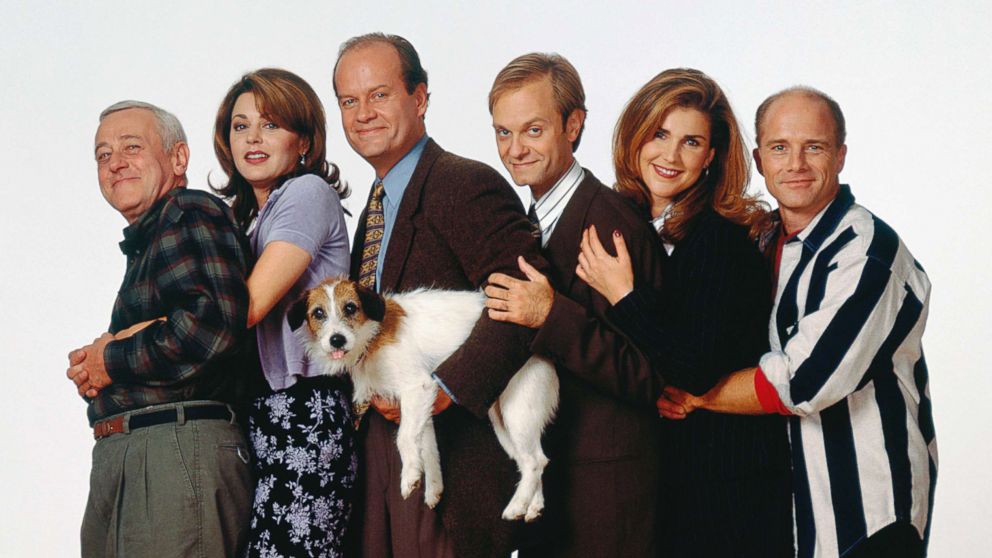
And the performances! They’re all top-notch, but I didn’t quite realize how obscenely funny both Kelsey Grammer and David Hyde Pierce were. Grammer alone is one of those men who can convey six emotions at once using only a single facial expression, and all of them end up being hilarious. And Pierce—who, as you see above, gets many of the best lines—is just magnificent as the prissy, perpetually wounded Niles. That’s not to throw shade on any of the supporting actors, but those two, together, are just a walking (mincing?) tour de force.
Even the conceit of the show is a well-placed joke. Frasier, in my unprofessional opinion, is a godawful shrink. Psychotherapy by radio is already a fraught concept—Niles correctly calls it “psychiatry’s answer to the drive-through window”—but even by that standard, his advice to callers is either dismissive or glib. If you were a fictional character with mental health problems, the only worse shrink you could find is Dr. Hannibal Lecter. And the writers know it, to an extent. Sure, they give Frasier his moments, but they never go easy on the idea that he plies his trade on the radio and cares more about celebrity and status than helping his “patients.”
And, he and Niles are inveterate snobs. One of the most painful episodes came when they took Martin to one of his favorite restaurants, a homey steak joint, and proceeded to mock everything around them until their father left in disgust. It’s not that they lack heart, but unless someone calls them out, they’re totally blind to their own pretensions in ways that can be galling or hysterical, depending on the situation. With Frasier, especially, I found myself going back and forth between wanting to be his friend and wanting to see him get punched.
But it works! Their flaws are not just hinted at, but often exposed, and the process of trying to be good people is not easy for them. There, too, the show excels in its honest treatment of middle-aged, nearly modern men.
There’s also a mandatory warning to convey, re: the era—to enjoy this, you’re going to have look past some problematic material. Niles is always leering at Daphne, or trying to touch her, or trying to get her to touch him. Frasier forces Roz to hug him against her will at one point; Roz also gets slut-shamed by everyone, all the time. The worst moment, though, came when Frasier was deliberating about whether to do a promo for a Chinese restaurant—would it destroy his integrity?—and Bulldog steps in to do the job. He uses the most racist accent ever, and finishes by hitting a gong, all of which could be a commentary on Bulldog himself, at a stretch…except that the laugh track people choose that moment to employ the “breathless laughter followed by ecstatic applause” button. So, you know…judge it for its time, and all that.
For the most part, though, Frasier was well ahead of its time, and that’s why it still hits so hard today. It’s the humor, yes, but it’s also the humanity. There aren’t many shows that can pull them off simultaneously, as in this moment when Frasier recalls waking up on his couch to find his father rubbing his head in a rare gesture of affection:
Niles: Dad?! Did he say anything?
Frasier: Well, he said, “don’t you think it’s time you got a hair cut, you’re starting to look like bozo!” I know he was only covering though. But what do you think?
Niles: Probably wouldn’t hurt to get a trim.
And while the writers clearly mastered the humor, it’s their patience and comfort in the humanity that really makes the show timeless. And ask yourself this: How many sitcoms, for their first ever season finale, would have the courage to hinge the entire episode on that singular, fundamental, and awful question: “Are you happy?”
Shane Ryan is the Politics editor at Paste. Follow him on Twitter here:”https://twitter.com/ShaneRyanHere”.

Sunday, July 14, 2019

How 'Seinfeld' Mastered the Comedy Domain


By Kyle Smith
https://www.nationalreview.com/2019/07/seinfeld-revolutionized-televison-sitcom/
July 13, 2019

Related image

I can’t say whether Larry Charles, Larry David, Alec Berg, Spike Feresten, and the rest of the brilliant writers of Seinfeld were students of F. Scott Fitzgerald, but they might as well have been. Fitzgerald supplied the best advice for sitcom writers:
Start with an individual, and before you know it you find that you have created a type: begin with a type, and you find that you have created — nothing. That is because we are all queer fish, queerer behind our faces and voices than we want anyone to know or than we know ourselves.
Do not say “Seinfeld was a show about nothing” — not in my vicinity, not if you wish to go unbusted in the chops. There could hardly be a more obtuse notion. It would be closer to the truth to say Seinfeld was a show about everything, or everyone, every queer fish in a city that has forever been a leading producer of them. Other sitcom writers labored to create jokes; Seinfeld writers sat around discussing things that had happened to them that day, on the way to work or in line at lunch. A former David Letterman writer remembered that, just around the corner from his office at the Ed Sullivan Theater, there was this strangely ill-tempered fellow who sold soup . . .
All four of the lead characters on Seinfeld were closely modeled on real people. Two of the four characters even carried the names of the people they were based on. True to his reputation, Kenny Kramer started capitalizing on the show with a wacky scheme. He used to have a billboard posted about his bus tour, opposite the storefront held by the Soup Nazi. (Sorry — Soup Man.)

Friends, that other mega-successful NBC sitcom of the ’90s, was set in a denatured, Los Angeles–imagined fantasy of New York City unrecognizable to anyone who lived within 100 miles of Central Park. Its jokes derived not from human foibles but from the grinding gears of a comedy-writing machine. Setup, punch line. Setup, punch line. At any moment, there might be as many as three characters out of six (Phoebe, Joey, Monica) whose comedic function was to stupidly misinterpret the last thing that was said. Once you’ve noticed such a tic, an easy-going show becomes hard to sit through.
Seinfeld, which debuted 30 years ago this month on NBC under the title The Seinfeld Chronicles and today streams on Hulu, blew up the sitcom by declining to pander to the supposed expectations of an audience studio execs firmly believed was barely paying attention and under no circumstances wanted to think. By the time the show really started to hum in its third season (1991–92) — the first time it dazzled me was with an out-of-nowhere parody of the conspiracy theory at the heart of Oliver Stone’s JFK, which was then in theaters — you could tell the writers were doing what they thought was funny, not serving up slop for the masses. If non–New Yorkers didn’t get it, Seinfeld didn’t care. If dumb people didn’t get it, Seinfeld didn’t care. Everyone I knew in New York was watching it in 1992 and thinking, “At last, a show set in New York that’s actually about us! They’ll never get this in the heartland.” The following season it was the third most-watched show on TV, and for the rest of its run it never finished a year below second. Along with Sex and the City, which launched in 1998, it changed the one-word perception of New York City from “dangerous” to “fun.”
If the show centered on characters, its chief subject was mores, or etiquette. Etiquette is a Sierra Nevada of comedy gold, and nobody else had staked much of a claim on it. Should a note making reference to the arrival of a baby employ an exclamation point? What is the minimum distance someone should maintain while engaging in conversation? Is it okay to sleep with the cleaning lady at work? Should you spare a square for your desperate neighbor in the adjoining bathroom stall? Can you re-gift a present? Seinfeldian misunderstandings are grounded in reality, not the contrived dumb-guy misconstructions of Friends’ Joey Tribbiani.

In an exchange related almost verbatim in episode ten of season five, one Seinfeld writer asked a Chinese postman if he knew where a nearby Chinese restaurant was, and the postman took this as a racial inference. But the writer didn’t think Chinese people knew where all the Chinese restaurants are, he thought letter-carriers knew. Such is the fractious nature of this city and its inexhaustible pool of umbrage. Seinfeld captured it beautifully, in the Talmudic spirit of tearing a situation apart from every angle, with such concision that it popularized lots of neologisms and phrases for its various embarrassments and predicaments. Close-talker! Double-dipper! Shrinkage!
Coming up with a catchphrase that actually catches is a feat few writers can ever hope to achieve, but on top of having come up with so many, Seinfeld gets far too little credit for the unprecedented density of its plots, which as the series went on became the most intricate of any comedy series ever seen on the networks. Again dispensing with the suits’ wisdom about the degree to which the audience was paying attention, the writers of the show’s later years successfully intertwined four plots per episode, each of them with its own twists, bringing them together with a hilarious conclusion. A touch of farce decorated the observational comedy at the core of the show.
Though the last couple of episodes slipped a bit (the one about the Puerto Rican Day Parade didn’t work, nor did the May 14, 1998, finale), Seinfeld delivered more 30-minute classics than any TV comedy except The Simpsons. The show about almost everything skirted only one notable topic: race. An episode that was to begin with George saying, “I have never seen a black person order a salad” was nixed by the NBC suits. Even one of the most inventive gangs of writers ever assembled for television could not be allowed to grapple with the world’s touchiest subject, and we’re all the poorer for it.
What’s the deal with network censors?

Monday, June 10, 2019

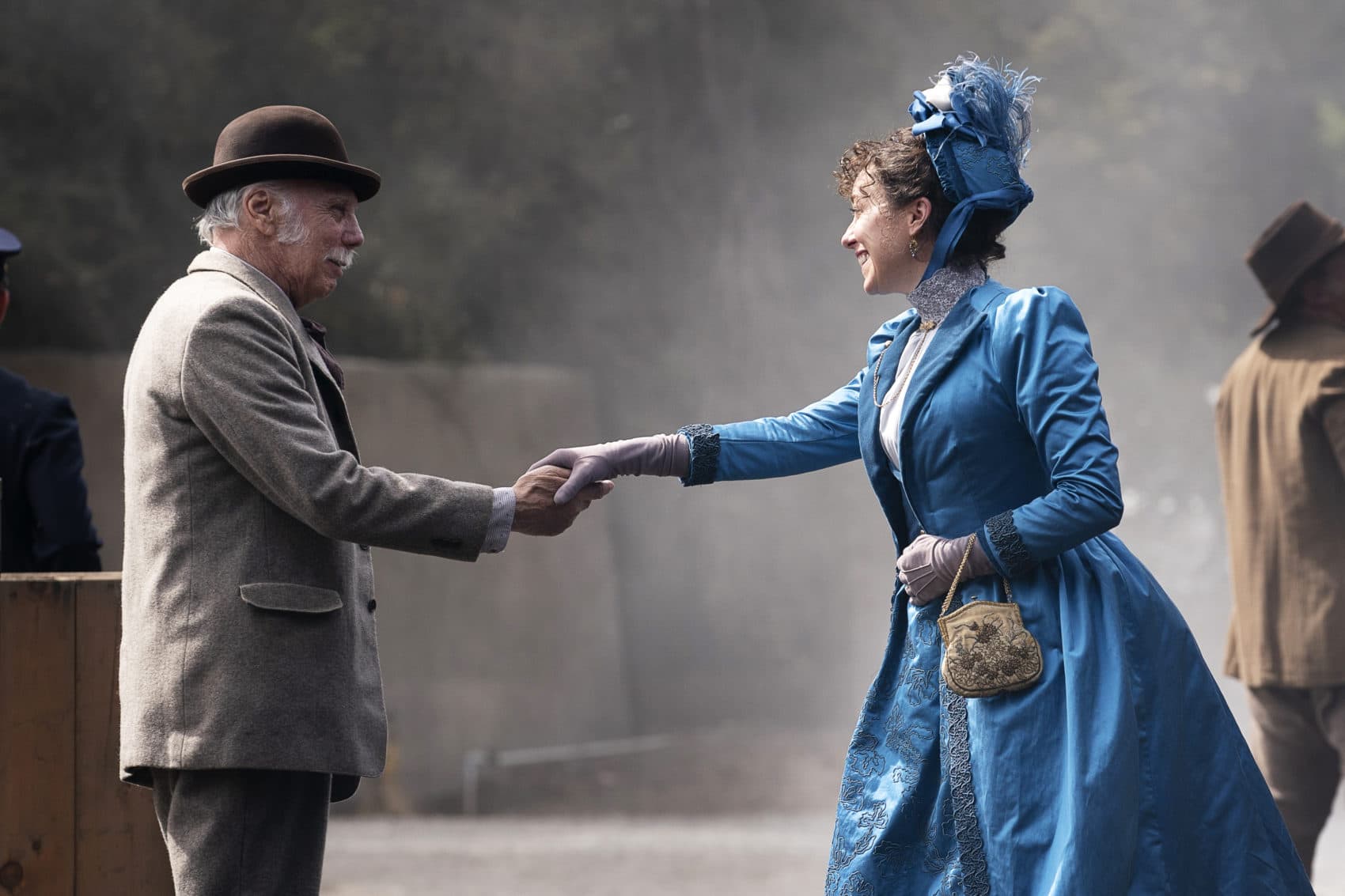
The Gripping History of 'The Looming Tower'


The new Hulu series is a suspenseful, star-studded excavation of the failure to prevent 9/11.

By Sophie Gilbert
March 1, 2018
Related image
In 2017, the third most-read page on Wikipedia.org was an article on Queen Elizabeth. Out of the top 50, Queen Victoria came in at No. 13, Princess Margaret at No. 37, and Prince Philip at No. 44. This sudden surge of interest in the British royal family wasn’t just Anglophilia: It was also related to the popularity of Peter Morgan’s Netflix show The Crown and the PBS/ITV dramaVictoria. Both shows’ adaptation of historic events into modern entertainment had prompted millions of viewers to find out whether what they’d seen on TV had actually happened.
Wikimedia dubbed itself the “second screen,” pointing to a glut of recent series and TV films that re-create real-life moments with just enough latitude to spur the frantic impulse to Google the details—Paramount’s Waco, FX’s American Crime Story, and HBO’s Confirmation among them. The latest is The Looming Tower, the gripping new 10-part Hulu series adapted from Lawrence Wright’s Pulitzer Prize–winning 2006 book about the origins of 9/11. Like The CrownThe Looming Tower takes some dramatic liberties with its source material, turning some characters into composites and creating others anew. But most of what it portrays is true, and all of it seems intended to spur a new engagement with its material, seen through the clearer lens of historical distance.
Produced for television by Wright with the Oscar-winning documentarian Alex Gibney and the veteran showrunner Dan Futterman, The Looming Toweris a taut, tense restaging of the internecine squabbles between the FBI and the CIA in the lead-up to 9/11. Like Wright’s book, it makes the case that the failure of U.S. intelligence agencies to share information thwarted any chance they might have had of stopping the attacks. But where the book focused primarily on the people who conspired to orchestrate the worst terrorist attack on American soil, the series reorients itself around the people who failed to stop them.
On one side is John O’Neill (Jeff Daniels), a larger-than-life FBI counterterrorism chief grappling with the increasing threat of al-Qaeda. On the other is Martin Schmidt (Peter Sarsgaard), O’Neill’s CIA counterpart. O’Neill was a real person; Schmidt is reportedly an amalgam, although there are reasons beyond his initials to deduce whom he’s based on. From the very first episode, O’Neill and Schmidt are at each other’s throats for reasons that are hard to ascertain. Schmidt guards CIA intelligence with fanaticism, while O’Neill resorts to spewing profanities and epithets when he can’t get what he wants.
The show makes clear whose side it’s on. O’Neill might be a womanizing boor but his devotion to his job—and to thwarting attacks on the U.S.—is unmistakable.  Schmidt, by contrast, is a pompous, sneering creep whose primary motivation seems to be power. (If both characters seem somewhat implausible, it appears that they’ve been tamped down for television, if anything.) In the three episodes made available for review, al-Qaeda emerges as an increasingly critical threat to America, perpetrating the 1998 bombings of U.S. embassies in Dar es Salaam and Nairobi, and gaining increasing financial and ideological support. But while Schmidt wants the president to respond by carpet-bombing Afghanistan, O’Neill argues that this will only draw more followers to the cause. And the hostilities between the two agencies mean information is hoarded rather than shared, hampering the pursuit of Osama bin Laden and al-Qaeda.
The show’s strongest scenes tend to involve good old-fashioned spycraft rather than intra-agency feuding. Bill Camp is exceptional as Robert Chesney, an FBI agent sent to Nairobi to seek out information, and a scene in the second episode where he interrogates a subject is a masterpiece in pacing, amping up the suspense for more than eight minutes. Tahar Rahim, playing the real-life FBI agent Ali Soufan, is similarly engaging, traveling to locales from Albania to London to hunt down al-Qaeda sympathizers. One of only eight agents out of 10,000 in the FBI who speak Arabic, Soufan is devoted to O’Neill and outraged by the radicals he sees as perverting the principles of Islam.

In O’Neill, Daniels has a character who’s innately charming, even if it’s hard to square the dark-haired, Mafiosi-esque character in Wright’s book, who has “a strong whiff of the Jersey streets about him,” with the actor’s patrician grace. (If Daniels falters, it’s in persuasively selling some of O’Neill’s cruder remarks.) Sarsgaard is smoothly villainous as Schmidt, running a team of mostly young, inexperienced women (the real-life CIA unit investigating bin Laden was nicknamed the Manson Family) and responding with remarkable hostility to anyone who questions him.
The action in early episodes plays out against the backdrop of the Monica Lewinsky scandal, itself apparently destined for a true-crime excavation by Ryan Murphy before too long. All of which urges the question—what do we gain from so many shows urging a new reckoning with not-so-old history? If dramas like American Crime Story seem intent on enabling a new interpretation of past events, The Looming Tower is a less grandstanding affair. Its mission seems to be simply dramatizing what happened, based on Wright’s 600 interviews and the (limited) information that’s emerged since his book was published. In the end, it’s up to viewers how they make sense of it all: assisted, as always, by Google.

Monday, June 03, 2019

‘Deadwood: The Movie’: A Proper F-ckin’ Farewell for TV’s Unfinished Masterpiece

By Alan Sepinwall
May 31, 2019
This column contains full [Ed note: like, VERY full] spoilers for Deadwood: The Movie.
Image result for deadwood movie
Timothy Olyphant and John Hawkes
In its original run, Deadwood didn’t have much use for meta commentary. This movie, though, can’t help but feel self-aware. It’s not just Alma’s line, but the film opening with Calamity Jane saying, “Ten years gone,” or Charlie Utter reacting to Alma and her daughter Sofia’s arrival with, “What a grand surprise after such a piece of time.” It’s Al Swearengen asking Seth, “Where you been, Bullock?” (“Right up the fucking road, Al,” Seth quips.) It’s everyone reflecting on the passage of time — of Al being sick, of Cy Tolliver being dead and gone, of some figures like Jane being stuck in emotional stasis, while others like Seth have changed considerably since last we saw them. Deadwood: The Movie feels as much about the experience of bringing the show back to life as it feels about this particular story. And this great series having so lived in recollection, it is my considerable happiness to see it again.
The movie is not a flawless piece of work — but then, neither was the show. David Milch’s improvisational approach to writing the series meant that it was often stronger in individual moments than as a long-form narrative. As Timothy Olyphant told me, “My recollection of what made the show great was never the plot. What made the show great was spending time with these characters.” This holds true in the film.
The story feels hastily glued together in spots, like Trixie’s rant at George Hearst alerting him to the fact that Al pulled a fast one on him back in the series finale. It’s unclear whether Hearst has been back at the camp since he rode out at the end of the series finale, “Tell Him Something Pretty.” But even if this is his first return visit, Trixie’s outburst plays more as something Milch simply needed as an inciting incident, rather than something even the show’s most impulsive character (and an extremely pregnant one, at that) would absolutely do in that moment.
The desire to bring back as many former regulars as possible, coupled with the logistical challenges of doing so, contributes to this occasional sloppiness. Molly Parker could only fly down from Vancouver (where she was filming Lost in Space) on weekends, so Alma’s presence feels more like a notable cameo than the full arc someone so important to the series deserved. Some of the supporting players get moments that feel significant and true to character, like Mr. Wu (who now speaks a bit more English) trying in vain to get Al to try his herbal remedies. Others play more blatantly as excuses to shoehorn in old favorites. Why is Con Stapleton now the town minister? Had to give him something to do here, and there’s historical precedence of a former Cy Tolliver henchman becoming a man of God. Why is A.W. Merrick running the auction for Charlie’s land? Because leaving him to just take the perp walk photo of Hearst wouldn’t have felt like quite enough.

Image result for deadwood movie trixie
Dayton Callie and Molly Parker

But Olyphant’s recollection of what made Deadwood great is exactly right. That the story is thin — and in many ways a rehash of the series’ final episodes, with Charlie’s murder standing in for Ellsworth’s — is almost besides the point. Plot-wise, Deadwood: The Movie concludes in no more certain a spot than “Tell Him Something Pretty” did. We end with Hearst locked in Bullock’s jail. We know he’s likely to skate on all involvement in Charlie’s death, but we don’t know how. We have no idea if his next attempt to have Trixie arrested for his attempted murder will be more successful than the one Seth foiled at the wedding reception, nor what Trixie in freedom might do as new owner of the Gem.
And I don’t give a tinker’s damn, because I was enthralled by almost all of this movie, and a weepy fucking mess for the final half hour.
Endings have generally not been David Milch’s strength. Men plan and God laughs, so this man has historically opted not to plan far in advance. But circumstances — first the cancellation, then his Alzheimer’s diagnosis — mean he’s been working on some version or other of this script for years. As a result, the movie has an incredibly satisfying, at times emotionally overwhelming, final act. It’s not much of a conclusion to the story of Deadwood, but it brings the experience of it, as well as the arcs of its two main characters — plus notable supporting figures like Trixie and Jane — to resting places that feel as perfect as they can, given the unusual and often difficult birthing process.
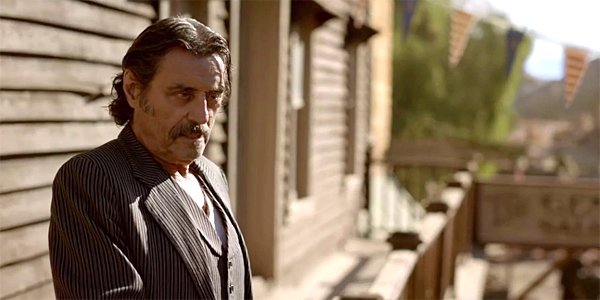
The film’s self-aware nature extends well beyond the idea that the full ensemble is reuniting for the first time in years. Every moment Ian McShane is on screen is informed by Milch’s health problems. Milch pours a bit of himself into all of his characters, but Swearengen got more of his creator’s spirit than anyone else ever has, and that sadly continues here. All the characters have visibly aged, but the others all look as if they’ve grown comfortably into their advancing years. The contrast between Seth and Alma in bed at the Grand Central and the two of them making small talk at the Bullock and Star Hotel is striking, but both are healthy and largely at peace with the choices they’ve made in their lives. (Albeit Seth more than Alma.) From the moment we see Al, though, he looks like death: jaundiced and slow and a shell of the master of the universe he was when the show began. (It’s not just the years, but how he carries himself; compare McShane here to him on American Gods, where he’s playing a far older character who’s nonetheless much fuller of life than Swearengen at this point.) He can’t keep track of the days of the week. As this new trouble with Hearst arises, he’s barely of any use at all. Where once he was the man the camp looked to in times of crisis like this, now he’s largely a passive observer — or, worse, the man the others have to care for on top of trying to find a way out of the mess Trixie created.
Because Al is in such a weakened state in his final days on this earth, the movie is dominated by Bullock in a way the show only was in its first few episodes. I think Olyphant is tougher on his performance in the series than he should be, but he’s also grown significantly as an actor in the years since. The Olyphant of 2006 might not have been up for the complicated journey Deadwood: The Movie takes Bullock on. Present-day Olyphant is, to a spectacular degree. Where other characters have failed to evolve in the passing years — or, in cases like Joanie, have backslid into behavior they had seemed to move beyond — Bullock has finally grown comfortable in his own skin at the time the story resumes. He and Martha have had three sweet, adorable kids in the years since William’s tragic death. He’s a lawman again (a marshal rather than a sheriff, so he’s not subject to any of Hearst’s rigged elections). His businesses with Sol are thriving. He’s become a community leader in a way he never wanted or knew how to be in his early years in the camp. He’s the one Charlie goes to for advice about whether to sell to Hearst, and when Hearst’s goons kill Charlie, it’s Bullock who presides eloquently over the funeral. (It’s a marked change from how distracted and angry he was at Wild Bill’s funeral back in the day; his oratory is the kind that the late Reverend Smith would be proud to hear.)
But then old friends and enemies start returning to the camp, and Bullock’s cozy little life gets upended. Alma’s return is more of a surprise than a genuine threat to his marriage. He’s startled to see her, and still feels a deep connection to her, but he chose Martha all those years ago, and nothing has shaken him from that. (Even Martha seems mostly secure in her understanding of this. There’s a moment when she sees Seth hug Alma after the auction where she briefly looks concerned, but she’s also the one who insists that Seth put the two Ellsworth women up at the hotel.) Alma has a harder time keeping old feelings under wraps, but she’s also embarrassed by that. She gets to do her great deed in keeping Charlie’s land away from Hearst — a fitting act of heroism in a world that always treated money as a more powerful weapon than guns or knives — but otherwise has to content herself to the life she’s had with Sofia and her business holdings.

Image result for deadwood movie trixie
Gerald McRaney

It’s Hearst who provides the greater disruption to the peace in the camp, and in the life of its top cop. The movie covers only a few days (most episodes of the show spanned just one), yet in that time, Charlie, both of Hearst’s assassins, several of Hearst’s bodyguards and Harry Manning(*) are all shot and killed, while poor Samuel Fields is on the verge of dying from injuries suffered in the assassins’ interrupted lynching. Even leaving out Al’s death by natural causes, this is a staggering body count for what is supposed to be an assimilated, civilized American town. Hearst taunts Seth about it from his balcony, even as the industrialist and politician is responsible for most of it, yet it’s Seth who assumes the blame (“not proud of it”). This kind of thing shouldn’t still be happening on his watch, he believes, yet the fact of it threatens to undo all of his emotional maturity and send him back to the raging, repressed, self-destructively stubborn man he used to be. That Seth shoots and kills one of the would-be lynchers to protect Wu’s grandson Mengyao is an understandable, even controlled act. That he then begins savagely beating on the surviving assassin is Bullock going back to an emotional place he hasn’t been since the series, maybe all the way to his tooth-loosening dispatch of Alma’s father at the end of Season One. (In both cases, it’s Sol who has to break the spell — this time taking an inadvertent elbow to the face for his trouble.)
(*) Some of the returning characters get scanter screen time than Harry, but he probably suffers the most from the limitations of doing this as a film. Where a full season of TV might have allowed Milch to introduce a seemingly loyal new deputy, then reveal him as a Hearst mole, there was no runway to make that happen here. So instead Harry — who on the show was a decent guy whose biggest sin was running for sheriff as a roundabout way of starting a fire brigade (still in operation, and sent to put out the fire Seth starts with Hearst’s lumber) — has to be corrupted, with no real explanation, to make the plot work. It’s not hard to imagine Harry growing susceptible to Hearst’s bribery as he gets older and sicker (always complaining of gout), but it’s a big blank to fill in for a relatively minor figure.

With Hearst more insulated than ever due to his elected office in the U.S. Senate, with Swearengen mostly unable to help, and with friends of his being attacked or threatened by outside law-enforcement officials, Bullock turns very reckless over the course of this story. By the time he has once again slapped cuffs on the powerful Hearst, he’s far gone enough to allow a collection of unruly hoopleheads to administer some vigilante justice. Earlier, Seth explains, “My job ain’t to follow the law, Al. My job is to interpret it — then enforce it, accordingly.” But we know that mob justice falls outside his interpretation of the law, going all the way back to the series’ very first scene, where Bullock executed a prisoner himself to prevent a crowd of drunks from doing it. That he stands back for a few moments to let the beating happen is a sign of just how irresponsible he’s become. It’s only the sight of a horrified Martha rushing the kids home that breaks the spell and reminds him of the kind of man, and lawman, he wants to be.
After Jane foils Harry’s assassination attempt, Seth returns to Doc Cochran’s house to be with Samuel in his final moments. The two were never exactly friends (Jane was the one who enjoyed drinking with the man once known as the N—er General), but they share a complicated bond. It was Seth who rescued Samuel from being lynched (with tar, rather than a rope) by Steve the drunk and his pals back in the day, and it was Samuel’s runaway horse that fatally kicked William Bullock not long after. When Seth holds Samuel’s hand and cries as the dying man speaks of God’s witnesses, is he thinking of his late son? Of the fact that he failed to prevent the fate Samuel predicted from the moment Seth and Harry put him in a cell? Of the other failures of this week, or of his entire time in the camp? It could be any of those things, and is probably a combination of all of them. Seth Bullock is a man conditioned to bottle up his emotions — and if one is ever allowed to come out, it’s usually rage. He rarely lets himself stop and consider all the burdens he’s had to carry. But in this quiet moment, after witnessing in short order Alma’s return, Charlie’s funeral, Samuel’s lynching, Sol and Trixie’s wedding and the mob attack on Hearst, he has this quiet moment to reflect on all he’s lost, and all that he’s been unable to prevent, and the grief flows out of him. It’s an incredibly powerful scene, and the kind that the show’s leading man has grown into playing since we last saw him in this role. And it informs the beautiful final moment for the character, where he makes his way to the end of the thoroughfare to find Martha waiting for him on their porch. “I’m home,” he tells her, kissing her passionately and reaffirming the choice he made back in Season Two to commit to her as his wife, rather than as his brother’s widow. Their marriage and their family are palpably real now. The events of the movie briefly throw Seth back out into the mud like the bad old days. But he remembers who he is, and he makes it home to this good woman and their good life together.
That Seth is alive long enough to have that cry, and then that kiss, is thanks to the sharp instincts and sharper marksmanship of Calamity Jane. Jane is the first character we see after all these years (and the first to comment on the passage of time), and she has one of the richest arcs of anyone in the film. As Robin Weigert put it to me when we spoke on the set months ago, “She’s allowed to have a boy-to-man journey, because she’s such a child in the original.” Jane still seems childlike when we catch up to her. She has a new hat and has taken to wearing skirts instead of pants, but underneath the costume, she’s the same immature, insecure, self-loathingly tragic figure she was when we met her traveling with Charlie and Wild Bill to Deadwood. Whatever growth she achieved through her relationship with Joanie has been abandoned (along with Joanie herself). She returns to the camp hoping to make things right with her ex. That happens, but more importantly, Jane’s old friends help her to finally recognize her own value.
When she approaches Charlie (in what neither realizes will be their final conversation) for advice on what to say to Joanie, he tells her that she already knows what to say, and urges her, “Go find your girl! Go get her!” Joanie, fallen back into bad old patterns after inheriting the Bella Union from Cy, isn’t particularly happy to see her. But Charlie’s death brings his mutual friends back together to have some honest conversations about their past and, potentially, their future. And in the moment of the film that made me bawl more than Al’s death, more than Charlie’s funeral, more than the wedding or Seth and Alma’s hug after the auction, or anything else, Jane attempts to ascribe her rescue of Bullock to Wild Bill’s spirit watching over her. “No, Jane,” Joanie tells her, simply but forcefully. “That was you.” This is an idea Martha Jane Canary has needed to understand for her entire life. Charlie and Joanie and others have tried to tell it to her before, but she hasn’t been in a condition to hear or believe these words. In this moment, though, she is. She isn’t just the sidekick, isn’t just the pathetic drunk, isn’t just the butt of everyone’s jokes. She has done good things, even great things, in her life. She’s a goddamn hero, too, and Joanie finally helps her see that. Bravo, Joanie Stubbs. Bravo, Calamity Jane.

Image result for deadwood movie trixie
Paula Malcomson

The movie’s other journey to adulthood comes courtesy of Trixie. She has found some measure of peace in the intervening years, too. She and Sol are still together, and, as she colorfully puts it, “awash in the miracle of a whore my vintage being pregnant at all.” But Jen’s murder — the concluding bit of bloody business necessary to procure the camp’s safe absorption into America — weighs on her more than it does on anyone else. Even Johnny, still smitten with Jen after all this time, doesn’t feel as much guilt, because he’s not the reason she was killed. Trixie is still reckless and filled with regret enough to have that outburst in front of Hearst. She has still refused to marry Sol after all this time, and even her promise to wait until after baby Joshua is born seems a bit hollow. It’s only her awareness of Al’s impending demise that gets her moving on this front.
Which brings us back to Al Swearengen himself. In many ways, his character arc was over long before the series ended. He had already made his transformation from ruthless crime boss to pragmatic but mostly benevolent community leader. He had made peace with Trixie leaving him for Sol, with Alma keeping the lucrative gold claim he foolishly sold her first husband, with the idea that the success of the camp was more important than the size of his own personal fortune. So the movie is less about bringing him emotional closure than simply giving him the chance to say goodbye to his many loved ones, and vice versa. And since many viewers see Al and Deadwood itself as interchangeable, it’s a chance for us to say goodbye as well, to both him and almost certainly to this wondrous experience.

And what a goodbye it is! We’ve seen Al laid low before, in the early Season Two arc where he nearly died from kidney stones. And in that same arc we got to see Doc, Trixie, Dan, Johnny and Jewel all rally around him. This plays differently, though. It’s a quieter, more resigned situation. Al is older. The town is more peaceful and prosperous. He matters to the emotional lives of his employees, past and present, but he’s not as essential to the camp’s well-being in the way he once was. And where the crisis with the troublesome gleet was agonizing and temporarily crippling, here Al is just substantially slowed down from the vibrant hustler we used to know. His time is running out, and everybody understands it — Al most of all. There’s a wounded dignity to McShane’s performance throughout, but particularly in that closing half-hour as Doc’s medicine gives Al the strength to make it through this final, glorious day. This is Al in full Santa Claus mode. He gives away the bride in his bar, after promising to give away his bar to the bride. He encourages Sol to re-enter politics (which the real Sol Star did around this time, holding various local and state offices for the rest of his life) and affirms that Trixie made the right choice of man in the end. He tries bequeathing his remaining cash to Dan and Johnny, though Dan wants no part in profiting from his friend and mentor’s death. He makes fun of Jewel’s singing, but their relationship has long been based on a foundation of chop-busting; when she actually begins to sing “Waltzing Matlida,” he joins in with some of his final breaths.
The song is an anachronism, having been written in Australia in 1895, and not even published until 1903. But then, so is Al’s death, and many of the other events of the story. The real Al Swearengen died penniless, far from Deadwood and years after the movie takes place. The circumstances of Charlie Utter’s death were also much later and very different. Sol Star never married. And so on. That’s what happens when you tell a story that mixes historical figures like Al and Seth with fictional ones like Alma and Trixie. This has never been a straightforwardly factual account of those years in Deadwood. Rather, it’s been David Milch using some of these people and events to tell a story about many of his own interests, like struggles with addiction, or the compromises necessary to live in a community of laws. Now, sadly, Milch himself is sick. He discussed his condition in emails with me, and at some greater length with Matt Seitz and Mark Singer. He was able to complete the script while in the grips of this terrible disease, and to continue making small changes to it throughout production. But he was no more the Milch of old than Al is the Al of old in the movie.
Image result for deadwood movie
Ian McShane
Swearengen is Milch. Milch is Swearengen. Hopefully, the real version has many years left, and many good days (or even good moments) through those years. But it’s not hard to understand why Milch would be focused on mortality in this script — to open it with Jane preparing herself to “lay me down and rise no more” in the same hill where Wild Bill is buried, and to close it with Al dying while Trixie holds his hand. Between Milch’s advancing condition and the sheer difficulty of bringing the cast together again, this will almost certainly be the end of Deadwood as we know it. And Milch manages to give almost everyone a perfect final note, like Jane and Joanie walking arm in arm through the falling snow. He saves the best, of course, for the character closest to his heart.
As Al’s life slips away, tearful Trixie decides it’s finally time to call on a higher authority, praying, “Our father which art in Heaven…” Al finds he has just enough strength for one last rejoinder: “Let Him… fucking… stay there.” Al Swearengen has no more use for God than the Lord would have use for Al. But the almighty creator of this great TV show, and this superb farewell film, bestows exceptional kindness and generosity upon his greatest creation here at the end.
This was fuckin’ Deadwood. Could be combative, but the parts I’m apt to remember most were the ones of profound beauty, compassion and poetry.
Some other thoughts:
* Jane, Alma and others refer to 10 years having passed, even though Season Three’s events took place a dozen years before the movie’s setting. That’s not hard to reconcile, though, because most of these characters were still living in the camp at the time of the series finale. (Alma specifically sells her claim to Hearst so she won’t have to leave town.) So they could have moved away a few years later, thus creating the decade-long gap. That, or Milch just liked the sound of “ten years gone,” and we shouldn’t interrogate it too closely beyond that.
* Not all the surviving regular characters could come back. I imagine Titus Welliver was busy filming Bosch, for instance, and Adams always felt enough of an outsider in the Swearengen crew that it’s easy to imagine him moving on since we last saw him. But it feels very satisfying, and true to form, for Garret Dillahunt to come back as the first drunk to throw something at Hearst after Seth arrests him. Dillahunt had already famously played two roles on the show. This cameo (under a heavy beard and other makeup) felt like an homage to both: like Jack McCall, he’s a resentful hooplehead who feels bitter about the fame and fortune of others in the camp; and like Francis Wolcott, he’s tied to George Hearst.
* Movies and TV shows tend to be shot out of order. As luck would have it, though, I visited the set on consecutive days when consecutive scenes were filmed: Seth and Sol preventing Samuel’s lynching, and Seth confronting Hearst in the thoroughfare with Dan and Johnny backing his play. After the first few takes of the latter scene, director Daniel Minahan gave Olyphant freedom to try alternate versions of Bullock’s scripted reply to Hearst threatening to come for him: “Expect you will, Senator.” Olyphant tried a few that neither of them liked as much as the original line, then noted that if this was Justified, Raylan would say, “Let me know, Senator. I’ll circle the date.”

Image result for deadwood movie trixie
* William Sanderson (above) is, as always, an utter comic delight as the craven E.B. Farnum. He’s mayor again, even as he acknowledges it’s a “largely titular position.” (His pronunciation  of the phrase brings to mind E.B.’s contempt back in the day for the man he referred to only as the “tit-licker.”) Farnum isn’t hugely necessary to the plot, as Bullock could have found out about the threat to Samuel some other way. But Milch clearly wanted to let Sanderson strut his stuff — muttering to himself while playing Peeping Tom inside the hotel walls; his terror and then wonder at using a telephone for the first time; using the phrase “wanton leakage” — and rightly so.
* Bree Seanna Wall never acted on screen again after the original series (nor before it), so Lily Keene steps in as the teenage version of Sofia. It’s interesting watching Sofia watch her mother around Bullock. She was a very little girl, and a very emotionally scarred one, at the time of Alma and Seth’s affair. But she was aware of some of it then, and clearly understands all of it now with the way she becomes so protective of Alma whenever her lost love is nearby.
* In 2019 money, the $3,500 that Charlie’s land was allegedly worth would be close to $100,000, while the $5,000 that Hearst offered him would be about $140,000.
* It wouldn’t be Deadwood without A) someone (Jewel, in this case) putting out the canned peaches, and B) someone (Dan in this case) objecting to its specific use in this setting.
* Finally, though I mostly sang the praises of Olyphant and McShane in this great big whale of an essay, I would be remiss if I didn’t say that everyone in the cast was fantastic. This show meant a lot to all involved. For most of them, these would be the richest characters they would ever play. So nobody sleepwalks through this return, and that energy is palpable from Molly Parker, Robin Weigert, Dayton Callie and Brad Dourif and everybody else. This movie was a reward for us, but it was a reward for them, too. I’m glad we all got it.