Friday, August 25, 2006
townhall.com
"In 376 a large band of Gothic refugees arrived at the Empire's Danube frontier, asking for asylum. In a complete break with established Roman policy, they were allowed in, unsubdued. They revolted, and within two years had defeated and killed the emperor Valens -- the one who had received them -- along with two-thirds of his army, at the battle of Hadrianople."
So writes Oxford's Peter Heather in "Fall of the Roman Empire: A New History of Rome and the Barbarians," who is convinced that Valens' welcoming of the Goths was the decision that sealed the fate of the empire.
As recent headlines tell us of 5 million more immigrants having arrived in America in the last five years, we see now, no longer as through a glass darkly, how America ends.
There are 36 million immigrants here, a number almost equal to all who ever came from Jamestown in 1607 to JFK. We are host to more illegal aliens, 12 million, than all the Jews, English and Irish who came over 400 years.
In George W. Bush's tenure, 6 million intruders have been caught on our Southern border breaking in. One in 12 had a criminal record. Behind them, waiting to see if Bush will grant amnesty or secure the border, are the world's 4 billion to 5 billion people whose average income is less than that of Mexico.
Last year, 155,000 OTMs ("other than Mexicans"), triple the number of 2003, from Latin America, the Middle East, Africa and Asia were caught. Four of five never appeared in court. They vanished into our midst.
These numbers are astronomical by any historical standard, and the mindset of many newcomers is not that of the Ellis Island generation. On May 1, almost a million Hispanics marched under Mexican flags through Los Angeles to demand the rights of U.S. citizenship for all illegals. Aerial shots revealed huge signs reading, "This is Our Land," and, "Chicano Power" In Mexico City, PAN party members marched beside communists and Subcommandante Marcos in solidarity with their kinsmen in America.
"With all due respect to Uncle Sam," declaimed one Mexican TV reporter, "this shows that Los Angeles has never stopped being ours."
Added the respected Mexican pundit Sergio Sarmiento, if Mexicans "have begun the reconquista of the territory that the United States took by force from Mexico between 1835 and 1848, they have been able to do this thanks to the fact that the Americans themselves have permitted it."
And so we have. In 1994, Californians sought to slow the invasion with Proposition 187, restricting welfare to U.S. citizens and legal aliens. After 187 won in a landslide, a federal judge threw it out. "Art" Torres, chairman of the California Democratic Party, exulted, "187 was the last gasp of white America in California."
So it appears to have been.
In the '90s decade, for the first time since the Spanish arrived, the white population of California fell. Native-born Californians are heading over the mountains back to the lands whence their ancestors came. By ethnic origin, California and Texas are already Third World states. Hispanics alone account for 25 percent of the population of Arizona, 34 percent of California and Texas, 43 percent of New Mexico, and growing shares of the population of Nevada, Colorado and Utah, all states carved out of Mexico.
Moreover, ethnic chauvinism is rampant in the barrios. As in the movements of Evo Morales in Bolivia and Ollanta Humala in Peru, barrio talk in America is increasingly about "indigenous peoples" and "European occupiers." A black-brown war has broken out among the underclass in Los Angeles. Three in five Mexicans now believe the Southwest is stolen land that belongs to Mexico.
By 2050, the Census Bureau estimates 102 million Hispanics will live in America, heavily concentrated in the Southwest. The ethnic, linguistic and cultural reconquest of the American Southwest by Mexico is well advanced.
As I write in my new book, "State of Emergency: The Third World Invasion and Conquest of America," George Bush may go down in history as the man who not only lost the magnificent lands won for America by James Polk, but, by refusing to do his duty and halt this invasion, ensured the Balkanization and dissolution of his country.
Not to worry, we are told. The Melting Pot will work its magic. In a generation, the scores of millions who have come here will be assimilated and Americanized, as were the millions who came to Ellis Island.
The hope is delusional. The Melting Pot is broken. Our elites want it smashed forever. They no longer believe in assimilation -- they worship at the altar of diversity. And millions of aliens are adamant about retaining their own language, culture, identity and allegiance to the mother country, not the United States.
The "hyphenated-Americanism" Teddy Roosevelt and Woodrow Wilson decried is today celebrated. On California's campuses there are separate dorms, fraternities, sororities, student centers and graduations for Asian, Hispanic and black students. The tens of millions coming endlessly from countries, cultures and civilizations whose peoples have never before been assimilated into a First World nation may spell the end of America as one nation and one people by mid-century. Why are we taking this risk?
Friday, August 25, 2006


Thursday, August 24, 2006
Thomas Sowell: Race and Economics
August 24, 2006
Thomas Sowell
Andrew Young's statement that blacks have been "ripped off" by stores run by Jews, Koreans, and Arabs has been rightly criticized and he has apologized. But these irresponsible remarks have wider implications than Andrew Young and wider implications than their political repercussions.
For decades, one of the biggest blind spots of most civil rights "leaders" and "spokesmen" for the black community has been their utter lack of knowledge of economics.
As a purely factual matter, prices do tend to be higher -- and the quality of service and products lower -- in stores in low-income neighborhoods. But the knee-jerk assumption that this represents "exploitation" or "racism" ignores the economics of the situation.
Many of the ghetto stores charging high prices are struggling to survive, while supermarkets in other neighborhoods are very profitable charging lower prices. There are many reasons for this.
The reason least likely to be acknowledged by those who blame the store owners is that crime, shoplifting, vandalism, and riots have raised the costs, both directly and by causing insurance rates and the costs of security to be higher in ghetto neighborhoods.
The costs of delivering goods to small neighborhood stores are also higher than the costs of delivering goods to huge supermarkets. Delivering a hundred cartons of milk to a supermarket is cheaper than delivering ten cartons of milk to each of ten local stores scattered around town.
Selling a customer $50 worth of groceries in a supermarket takes less time than selling ten customers $5 worth of groceries in a little neighborhood store. Faster turnover is one of the keys to a supermarket's lower prices.
A supermarket can prosper with one cent of clear profit on each dollar of sales because that dollar comes back to be re-used again and again in the course of a year.
If the inventory of a supermarket sells out in two weeks, that one cent comes back 26 times in the course of a year. This means that a penny of profit on a dollar from each sale becomes more than a quarter on a dollar annually.
Few local stores can match that. Not only are the delivery and overhead costs of the local store likely to be higher, the slowness with which its inventory turns over means that even higher prices may not fully compensate for such differences.
The cumulative effect of such cost differences is that prices are often higher and at the same time profit rates lower in poor neighborhoods.
One of the factors limiting what a ghetto store can charge is that many ghetto residents already shop in other neighborhoods, when the price savings are enough to cover bus fare or taxi fare.
Every increase in prices risks losing still more customers.
Many of the same black "leaders" who accuse local store owners of making exorbitant profits also complain that supermarkets seldom locate in ghetto neighborhoods. Do they think supermarkets are against making money, if ghettos are so profitable?
The poor quality of many goods and of the service in ghetto stores is also a result of what has happened in these neighborhoods over the years.
My niece, living in the same Harlem neighborhood where I grew up in the 1940s, often complained of rude service and bad quality goods, as well as their high prices -- complaints that were not at all what I experienced growing up in that same neighborhood.
There were far more stores back in the 1940s and it would have been financial suicide for any given store to treat its customers the way ghetto stores can get away with treating them today.
What happened in between? Ghetto riots happened, beginning in the 1960s. Many stores that were looted or burned out in those riots never re-opened. Nor were many other people ready to come in from outside to replace them. Nor were local residents.
People who have neither the efficiency nor the courtesy to compete with other stores in middle-class neighborhoods can survive running ghetto stores because of the lack of competition.
Many black "leaders" and "spokesmen" who romanticized ghetto riots as "uprisings" against oppression are now displaying their ignorance of both history and economics. Those ghetto residents who had nothing to do with those riots are still paying the price.
Copyright 2006 Creators Syndicate
Thomas Sowell
Andrew Young's statement that blacks have been "ripped off" by stores run by Jews, Koreans, and Arabs has been rightly criticized and he has apologized. But these irresponsible remarks have wider implications than Andrew Young and wider implications than their political repercussions.
For decades, one of the biggest blind spots of most civil rights "leaders" and "spokesmen" for the black community has been their utter lack of knowledge of economics.
As a purely factual matter, prices do tend to be higher -- and the quality of service and products lower -- in stores in low-income neighborhoods. But the knee-jerk assumption that this represents "exploitation" or "racism" ignores the economics of the situation.
Many of the ghetto stores charging high prices are struggling to survive, while supermarkets in other neighborhoods are very profitable charging lower prices. There are many reasons for this.
The reason least likely to be acknowledged by those who blame the store owners is that crime, shoplifting, vandalism, and riots have raised the costs, both directly and by causing insurance rates and the costs of security to be higher in ghetto neighborhoods.
The costs of delivering goods to small neighborhood stores are also higher than the costs of delivering goods to huge supermarkets. Delivering a hundred cartons of milk to a supermarket is cheaper than delivering ten cartons of milk to each of ten local stores scattered around town.
Selling a customer $50 worth of groceries in a supermarket takes less time than selling ten customers $5 worth of groceries in a little neighborhood store. Faster turnover is one of the keys to a supermarket's lower prices.
A supermarket can prosper with one cent of clear profit on each dollar of sales because that dollar comes back to be re-used again and again in the course of a year.
If the inventory of a supermarket sells out in two weeks, that one cent comes back 26 times in the course of a year. This means that a penny of profit on a dollar from each sale becomes more than a quarter on a dollar annually.
Few local stores can match that. Not only are the delivery and overhead costs of the local store likely to be higher, the slowness with which its inventory turns over means that even higher prices may not fully compensate for such differences.
The cumulative effect of such cost differences is that prices are often higher and at the same time profit rates lower in poor neighborhoods.
One of the factors limiting what a ghetto store can charge is that many ghetto residents already shop in other neighborhoods, when the price savings are enough to cover bus fare or taxi fare.
Every increase in prices risks losing still more customers.
Many of the same black "leaders" who accuse local store owners of making exorbitant profits also complain that supermarkets seldom locate in ghetto neighborhoods. Do they think supermarkets are against making money, if ghettos are so profitable?
The poor quality of many goods and of the service in ghetto stores is also a result of what has happened in these neighborhoods over the years.
My niece, living in the same Harlem neighborhood where I grew up in the 1940s, often complained of rude service and bad quality goods, as well as their high prices -- complaints that were not at all what I experienced growing up in that same neighborhood.
There were far more stores back in the 1940s and it would have been financial suicide for any given store to treat its customers the way ghetto stores can get away with treating them today.
What happened in between? Ghetto riots happened, beginning in the 1960s. Many stores that were looted or burned out in those riots never re-opened. Nor were many other people ready to come in from outside to replace them. Nor were local residents.
People who have neither the efficiency nor the courtesy to compete with other stores in middle-class neighborhoods can survive running ghetto stores because of the lack of competition.
Many black "leaders" and "spokesmen" who romanticized ghetto riots as "uprisings" against oppression are now displaying their ignorance of both history and economics. Those ghetto residents who had nothing to do with those riots are still paying the price.
Copyright 2006 Creators Syndicate
Kenneth R. Timmerman: Just Say No to Khatami

Kenneth R. Timmerman
http://www.FrontPageMag.com
August 24, 2006
Talk is cheap. At least, that’s what we are taught to believe in a society built not just on action, but on a respect for political minorities. But in a society where political minorities are considered enemies of the state, and where political discourse is tightly controlled, talk carries a far greater weight than it does here.
The disgraced former president of Iran, Hojjat-ol eslam Mohammad Khatami, wants to speak in Washington, D.C., next month, and the State Department has already indicated it will welcome his visit.This is pure foolishness of the type Lenin described when he famously noted that the capitalists would sell the rope with which the Communists would hang them.
Although Khatami has not yet formally applied for a visa, his talk at the Washington National Cathedral next month was approved by the office of Undersecretary of State Nicholas Burns, according to the Washington Post.
This is the same Nicholas Burns who said last Friday that the United States would push for United Nations sanctions on Iran if Tehran does not accept a U.S.-backed package of incentives aimed at halting its uranium enrichment and reprocessing activities.
Okay, so this is Washington, where talking out of both sides of the mouth is taken as a career-enhancing fashion statement. Still, it doesn’t require an exceptionally brilliant mind to understand that the terror masters in Tehran plan to use Khatami’s visit to further their goals, not undermine them.
Former president Khatami is not a private individual, as we understand the term. As a senior member of the ruling clerical elite, he can only get an exit permit if the regime determines that his trip suits their needs. (I personally know other senior members of this regime who have had their foreign travel plans cancelled by the regime for various reasons).
So for starters, we need to understand that Khatami is coming to Washington as a standard-bearer for this regime. He is the smiley-face, the beaming turban so beloved by Christian Amanpour and former Los Angeles Times reporter Robin Wright (now a Washington Postie, but still as wrong as ever).
Indeed, it was Robin Wrong who used these breathless tones to break the news of Khatami’s upcoming visit:
Khatami, a former minister of culture once purged by hard-liners, was a dark-horse presidential candidate in 1997 who led a sweeping upset that began a period of freer press, talk of political reform, cultural openings and encouragement of exchanges with the outside world. American tourists even returned to Iran.
She forgot a few key events of Khatami’s presidency. Just one year into his term, his intelligence service murdered in horribly brutal fashion Darioush and Parvaneh Forouhar, leaders of the Iran Nation’s Party, then the best-organized opposition in Iran. The following year, Khatami quashed the student rebellion that began at Tehran University among INP members and sympathizers including Marzeporgohar (Iranians for a Secular Republic) and quickly spread to 18 other cities across Iran.
That was just the beginning of a crackdown on domestic dissent that occurred on Khatami’s watch and on his orders.
Ever since Ayatollah Khomeini seized power in a putsch on the night of Feb. 11-12, 1979, the State Department has been seeking “reformers” and “moderates” in Tehran. Volumes have been written about these efforts. Some of them were contained in classified cables, shredded when the U.S. embassy was taken over by pro-Khomeini “students” in November 1979, and pieced together later on from the shredder sacks by Persian-carpet weavers.
In the beginning, some “moderates” truly opposed Khomeini’s Islamofascist system. Most of them were executed, wound up in jail, or have spent the rest of lives under house arrest.
But Khatami was never one of them. In 1984, as minister of culture and Islamic propagation, he presided over the creation of Hezbollah, Iran’s proxy army of terrorists in Lebanon and elsewhere. He thought that was exactly what the Islamic Republic of Iran needed to do to expand its influence around the world.
As president, Khatami never opposed Iran’s development of nuclear weapons technology, or long-range ballistic missiles to deliver them. On the contrary, it was on Khatami’s watch that Iran accelerated its once-secret nuclear weapons development, and flouted its success to the International Atomic Energy Agency.
Khatami’s top nuclear expert, Hossein Mussavian, explained the ruse in an August 12, 2005, interview with Iranian state television, just days after Ahmadinejad took over as president.
Ahmadinejad supporters were arguing that Khatami had made unacceptable concessions by negotiating with the European Union over Iran’s nuclear program. But those critics did “not know that at that stage – that is, in August 2003 – we needed another year to complete the Esfahan (UCF) project so it could be operational,” Musavian reminded his viewers. (The Uranium Conversion Facility in Esfahan is where Iran today has processed more than 120 tons of enrichment feedstock, enough to manufacture between 10 to 20 nuclear weapons.)
“[T] thanks to the negotiations with Europe we gained another year, in which we completed (the UCF) in Esfahan,” Mussavian said.
Khatami is being sent to Washington by the regime with a similar purpose: use happy talk to distract the United States from crafting serious international sanctions that would inflict real pain on this regime and possibly help spark a home-grown rebellion.
Would Washington have welcomed Nazi Propaganda Minister Goebbels to address the German Bund in 1940?
I don’t think so.
All the more reason why George W. Bush should step up to the plate and Just Say No, because Khatami’is purpose is similar to that of Joseph Goebbels in spreading Nazi propaganda.
If the State Department allows Khatami to visit Washington, they will create a new “paradigm,” a thought-shift in the way the Muslim “street” looks at the United States, Israel, and the West.
“Peace in our time” – that phrase identified with the appeasers of Munich who in 1938 negotiated away the sovereignty of Czechoslovakia and paved the autobahn to Poland. – will from now on be associated in the minds of the Islamofacists with Washington, DC and the State Department of Condoleeza Rice.
What can they possibly be smoking at Foggy Bottom to come up with a decision as contrary to the U.S. national interest as this one clearly is? Or perhaps, they are so cynically short-sighted they figure that during the dog days of August, with Congress in pre-election recess, no one will notice.
“An appeaser is one who feeds a crocodile,” Winston Churchill said famously, “hoping it will eat him last.”
We cannot afford the luxury of appeasement, when this crocodile’s teeth are nuclear.
Click Here to support Frontpagemag.com.
Kenneth R. Timmerman is the author of Countdown to Crisis: the Coming Nuclear Showdown with Iran (Crown Forum, New York), and Executive Director of the Foundation for Democracy in Iran.
Wednesday, August 23, 2006
International AIDS Conference Pushes Politics over Health
By Michael Fumento
http://www.townhall.com/
Wednesday, August 23, 2006
Calls for prevention highlighted the opening day of the 16th International AIDS Conference in Toronto. Alas, it’s too late. On the same day the Washington Post, carried a photo on its front page depicting a man wearing a t-shirt reading: “We all have AIDS.” Toss out those condoms; forget abstinence, and don’t bother getting tested. Or what part of “all” don’t you understand?
Seriously, this bit of propaganda is but one illustration of how efforts against AIDS have always been handicapped by politics. Nobody really believes we all have AIDS. But many have bought into the “Everyone is at risk” nonsense, which clearly works against targeting those truly at risk. The entire science of epidemiology – which began when London physician John Snow mapped out cholera cases in his city and found they clustered around a single water pump – depends on identifying risk factors to ameliorate them. In Snow’s case, he simply removed the pump handle and the epidemic ended.
He was lucky he didn’t have to deal with activists carrying signs reading: “Water doesn’t cause cholera; ignorance and prejudice cause cholera!”
Since 1985, when Life magazine blared in huge red letters: “Now No One Is Safe from AIDS,” activists have fought furiously against the idea that AIDS targets those who engage in selective behaviors. Yet over two decades later AIDS remains in this country overwhelmingly a disease of homosexual males and intravenous drug users. Fewer than 39,000 Americans were diagnosed with AIDS in 2004 (latest data available), and fewer than 16,000 died from it. That’s about one in 770 and one in 1,875 respectively. Fact is, almost everybody is safe from AIDS.
But of course, the focus of this conference is on international AIDS, which we all know is wiping whole continents off the map. A high Ugandan official said that within two years his nation will “be a desert.” ABC News Nightline declared that within 12 years “50 million Africans may have died of AIDS.”
Problem is, those predictions were made in 1986 and 1988. Yet since 1985, Uganda’s population has fully doubled. Nightline’s 50 million dead by the year 2000 proved to be 20 million in 2005, according to the UN’s estimate. Further, “In sub-Saharan Africa, the region with the largest burden of the AIDS epidemic, data also indicate that the HIV incidence rate has peaked in most countries,” according to the 2006 UNAIDS Report.
These figures are from an agency that itself has grossly exaggerated the world AIDS threat. For example, in 1998 it estimated that 12% of Rwandans age 15-49 were infected; now it says it’s only 3%. Whoops. On the other hand, other agencies had estimated a horrific 30% of Rwandans were infected. According to James Chin, a former U.N. official who made some of the earliest global HIV estimates, such concocted figures are “pure advocacy.”
Yet former President Bill Clinton told conference attendees that “It’s difficult to imagine how the world can grow unless we tackle AIDS.” In fact world population growth is fastest in areas hardest hit by AIDS.
As for the bizarre assertion that AIDS remains yet to be tackled, UNAIDS reports that 1.3 million people in low- and middle-income countries received antiretroviral therapy in 2004, up from a fifth that number in 2001. Donated blood is now screened in even the poorest countries. The level of AIDS testing and education in poorer nations has skyrocketed.
Meanwhile, worldwide AIDS spending averaged $1.7 billion between 2002-2004 but reached $8.3 billion for 2005 and is slated to hit $10 billion in 2007. The size of that pie, and the desire to have a slice of it, is all you need to know to understand how the Toronto conference could attract a stunning 24,000 attendees who have been rightly labeled “the AIDS industry.” Nevertheless, insists UNAIDS, that $10 billion isn’t nearly enough.
No matter that even the current AIDS budget swamps spending on malaria and tuberculosis, which together kill about twice as many people annually as does AIDS. Antiretroviral therapy for AIDS cures no one and while it costs relatively little in the Third World – $300-$1,200 per year – compared to North America, TB can be cured with $65 of medicine. Malaria in Africa and Asia can be prevented for a pittance by spraying DDT, yet environmental activists and the European Union have essentially blocked its use in those areas that need it most.
Alas for these victims, they don’t have a politically correct disease. And for that they must die.
http://www.townhall.com/
Wednesday, August 23, 2006
Calls for prevention highlighted the opening day of the 16th International AIDS Conference in Toronto. Alas, it’s too late. On the same day the Washington Post, carried a photo on its front page depicting a man wearing a t-shirt reading: “We all have AIDS.” Toss out those condoms; forget abstinence, and don’t bother getting tested. Or what part of “all” don’t you understand?
Seriously, this bit of propaganda is but one illustration of how efforts against AIDS have always been handicapped by politics. Nobody really believes we all have AIDS. But many have bought into the “Everyone is at risk” nonsense, which clearly works against targeting those truly at risk. The entire science of epidemiology – which began when London physician John Snow mapped out cholera cases in his city and found they clustered around a single water pump – depends on identifying risk factors to ameliorate them. In Snow’s case, he simply removed the pump handle and the epidemic ended.
He was lucky he didn’t have to deal with activists carrying signs reading: “Water doesn’t cause cholera; ignorance and prejudice cause cholera!”
Since 1985, when Life magazine blared in huge red letters: “Now No One Is Safe from AIDS,” activists have fought furiously against the idea that AIDS targets those who engage in selective behaviors. Yet over two decades later AIDS remains in this country overwhelmingly a disease of homosexual males and intravenous drug users. Fewer than 39,000 Americans were diagnosed with AIDS in 2004 (latest data available), and fewer than 16,000 died from it. That’s about one in 770 and one in 1,875 respectively. Fact is, almost everybody is safe from AIDS.
But of course, the focus of this conference is on international AIDS, which we all know is wiping whole continents off the map. A high Ugandan official said that within two years his nation will “be a desert.” ABC News Nightline declared that within 12 years “50 million Africans may have died of AIDS.”
Problem is, those predictions were made in 1986 and 1988. Yet since 1985, Uganda’s population has fully doubled. Nightline’s 50 million dead by the year 2000 proved to be 20 million in 2005, according to the UN’s estimate. Further, “In sub-Saharan Africa, the region with the largest burden of the AIDS epidemic, data also indicate that the HIV incidence rate has peaked in most countries,” according to the 2006 UNAIDS Report.
These figures are from an agency that itself has grossly exaggerated the world AIDS threat. For example, in 1998 it estimated that 12% of Rwandans age 15-49 were infected; now it says it’s only 3%. Whoops. On the other hand, other agencies had estimated a horrific 30% of Rwandans were infected. According to James Chin, a former U.N. official who made some of the earliest global HIV estimates, such concocted figures are “pure advocacy.”
Yet former President Bill Clinton told conference attendees that “It’s difficult to imagine how the world can grow unless we tackle AIDS.” In fact world population growth is fastest in areas hardest hit by AIDS.
As for the bizarre assertion that AIDS remains yet to be tackled, UNAIDS reports that 1.3 million people in low- and middle-income countries received antiretroviral therapy in 2004, up from a fifth that number in 2001. Donated blood is now screened in even the poorest countries. The level of AIDS testing and education in poorer nations has skyrocketed.
Meanwhile, worldwide AIDS spending averaged $1.7 billion between 2002-2004 but reached $8.3 billion for 2005 and is slated to hit $10 billion in 2007. The size of that pie, and the desire to have a slice of it, is all you need to know to understand how the Toronto conference could attract a stunning 24,000 attendees who have been rightly labeled “the AIDS industry.” Nevertheless, insists UNAIDS, that $10 billion isn’t nearly enough.
No matter that even the current AIDS budget swamps spending on malaria and tuberculosis, which together kill about twice as many people annually as does AIDS. Antiretroviral therapy for AIDS cures no one and while it costs relatively little in the Third World – $300-$1,200 per year – compared to North America, TB can be cured with $65 of medicine. Malaria in Africa and Asia can be prevented for a pittance by spraying DDT, yet environmental activists and the European Union have essentially blocked its use in those areas that need it most.
Alas for these victims, they don’t have a politically correct disease. And for that they must die.
Daniel Pipes: Time to Profile Airline Passengers?
Daniel Pipes
http://www.FrontPageMag.com
August 23, 2006
The debate over profiling airline passengers revived after the thwarted Islamist plot to bomb ten airplanes in London on Aug. 10. The sad fact it, due to a mixture of inertia, denial, cowardice, and political correctness, Western airport security services – with the notable exception of Israel's – continue to search primarily for the implements of terrorism, while largely ignoring passengers.
Although there has been some progress since 9/11, most involves the scrutiny of all travelers' actions. For example, in 2003, the Transportation Security Administration, charged with protecting U.S. airplanes, launched a passenger profiling system known as Screening of Passengers by Observation Techniques, or SPOT, now operating in twelve U.S. airports.
Adopting techniques used by the U.S. Customs Service and by Israeli airport security, SPOT is, according to TSA spokeswoman Ann Davis, "the antidote to racial profiling." Relying on "behavioral pattern recognition," it discerns, she says, "extremely high levels of stress, fear and deception." SPOT agents observe passengers moving about the airport, with TSA agents looking for such physical symptoms as sweating, rigid posture, and clenched fists. A screener then engages "selectees" in conversation and asks unexpected questions, looking at body language for signs of unnatural responses. Most selectees are immediately released but about one-fifth are interviewed by the police.
After the London plot, the British authorities have instituted a crash-course in SPOT, learning directly from their American counterparts.
Building on this approach, an Israeli machine, called Cogito, uses algorithms, artificial-intelligence software, and polygraph principles to discern passengers with "hostile intent." In trial runs with control groups, the machine incorrectly fingered 8 percent of innocent travelers as potential threats and let 15 percent of the role-acting terrorists slip through.
While methods that target the whole population have general value – SPOT did discover passengers with forged visas, fake IDs, stolen airline tickets, and various forms of contraband – its utility for counterterrorism is dubious. Terrorists trained to answer questions convincingly, to avoid sweating, and control stress should easily be able to evade the system.
The airport disruptions following the thwarted London plot prompted much discussion about the need to focus in on the source of Islamist terrorism and to profile Muslims. In the words of a Wall Street Journal editorial, "a return to any kind of normalcy in travel is going to require that airport security do a better job of separating high-risk passengers from unlikely threats."
This argument is gaining momentum. A recent poll finds that 55 percent of Britons support passenger profiling that takes into account "background or appearance," with only 29 percent against. Lord Stevens, the former chief of Scotland Yard, endorses focusing on young Muslim men. The Guardian reports that "some EU countries, particularly France and the Netherlands, want to … introduce explicit checks on Muslim travelers."
One politician in Wisconsin and two in New York state came out in favor of similar profiling. Fox News anchor Bill O'Reilly suggests that Muslim passengers ages 16 to 45 "all should be spoken with." Mike Gallagher, one of the most popular American radio talk-show hosts, wants "a Muslim-only [passenger] line" at airports. One author even proposes putting "Muslims on one plane and put the rest of us on a different one."
The British Department for Transport reportedly seeks to introduce passenger profiling that includes taking religious background into account. News from British airports indicates that this has already begun – sometimes even by fellow passengers.
Three conclusions emerge from this discussion. First, because Islamist terrorists are all Muslims, there does need to be a focus on Muslims. Second, such notions as "Muslim-only lines" at airports are infeasible; rather, intelligence must drive efforts to root out Muslims with an Islamist agenda.
Third, the chances of Muslim-focused profiling being widely implemented remain negligible. As the same Wall Street Journal editorial notes: "the fact that we may have come within a whisker of losing 3,000 lives over the Atlantic still isn't preventing political correctness from getting in the way of smarter security."
Noting the limited impact of losing 3,000 lives had in 2001 and building on my "education by murder" hypothesis that people wake up to the problem of radical Islam only when blood is flowing in the streets, I predict that effective profiling will only come into effect when a much larger number of Western lives, say 100,000, have been lost.
Click Here to support Frontpagemag.com.
Mr. Pipes (www.DanielPipes.org) is director of the Middle East Forum and author of Miniatures (Transaction Publishers).
http://www.FrontPageMag.com
August 23, 2006
The debate over profiling airline passengers revived after the thwarted Islamist plot to bomb ten airplanes in London on Aug. 10. The sad fact it, due to a mixture of inertia, denial, cowardice, and political correctness, Western airport security services – with the notable exception of Israel's – continue to search primarily for the implements of terrorism, while largely ignoring passengers.
Although there has been some progress since 9/11, most involves the scrutiny of all travelers' actions. For example, in 2003, the Transportation Security Administration, charged with protecting U.S. airplanes, launched a passenger profiling system known as Screening of Passengers by Observation Techniques, or SPOT, now operating in twelve U.S. airports.
Adopting techniques used by the U.S. Customs Service and by Israeli airport security, SPOT is, according to TSA spokeswoman Ann Davis, "the antidote to racial profiling." Relying on "behavioral pattern recognition," it discerns, she says, "extremely high levels of stress, fear and deception." SPOT agents observe passengers moving about the airport, with TSA agents looking for such physical symptoms as sweating, rigid posture, and clenched fists. A screener then engages "selectees" in conversation and asks unexpected questions, looking at body language for signs of unnatural responses. Most selectees are immediately released but about one-fifth are interviewed by the police.
After the London plot, the British authorities have instituted a crash-course in SPOT, learning directly from their American counterparts.
Building on this approach, an Israeli machine, called Cogito, uses algorithms, artificial-intelligence software, and polygraph principles to discern passengers with "hostile intent." In trial runs with control groups, the machine incorrectly fingered 8 percent of innocent travelers as potential threats and let 15 percent of the role-acting terrorists slip through.
While methods that target the whole population have general value – SPOT did discover passengers with forged visas, fake IDs, stolen airline tickets, and various forms of contraband – its utility for counterterrorism is dubious. Terrorists trained to answer questions convincingly, to avoid sweating, and control stress should easily be able to evade the system.
The airport disruptions following the thwarted London plot prompted much discussion about the need to focus in on the source of Islamist terrorism and to profile Muslims. In the words of a Wall Street Journal editorial, "a return to any kind of normalcy in travel is going to require that airport security do a better job of separating high-risk passengers from unlikely threats."
This argument is gaining momentum. A recent poll finds that 55 percent of Britons support passenger profiling that takes into account "background or appearance," with only 29 percent against. Lord Stevens, the former chief of Scotland Yard, endorses focusing on young Muslim men. The Guardian reports that "some EU countries, particularly France and the Netherlands, want to … introduce explicit checks on Muslim travelers."
One politician in Wisconsin and two in New York state came out in favor of similar profiling. Fox News anchor Bill O'Reilly suggests that Muslim passengers ages 16 to 45 "all should be spoken with." Mike Gallagher, one of the most popular American radio talk-show hosts, wants "a Muslim-only [passenger] line" at airports. One author even proposes putting "Muslims on one plane and put the rest of us on a different one."
The British Department for Transport reportedly seeks to introduce passenger profiling that includes taking religious background into account. News from British airports indicates that this has already begun – sometimes even by fellow passengers.
Three conclusions emerge from this discussion. First, because Islamist terrorists are all Muslims, there does need to be a focus on Muslims. Second, such notions as "Muslim-only lines" at airports are infeasible; rather, intelligence must drive efforts to root out Muslims with an Islamist agenda.
Third, the chances of Muslim-focused profiling being widely implemented remain negligible. As the same Wall Street Journal editorial notes: "the fact that we may have come within a whisker of losing 3,000 lives over the Atlantic still isn't preventing political correctness from getting in the way of smarter security."
Noting the limited impact of losing 3,000 lives had in 2001 and building on my "education by murder" hypothesis that people wake up to the problem of radical Islam only when blood is flowing in the streets, I predict that effective profiling will only come into effect when a much larger number of Western lives, say 100,000, have been lost.
Click Here to support Frontpagemag.com.
Mr. Pipes (www.DanielPipes.org) is director of the Middle East Forum and author of Miniatures (Transaction Publishers).
Robert Spencer: After August 22
 Robert Spencer
http://www.FrontPageMag.com
August 23, 2006
Iran drew concern worldwide for refusing to respond in a timely fashion to the West’s offer of an incentives package in exchange for Tehran’s abandonment of its nuclear program. Iranian officials brushed aside the June 29 deadline set by the West and said Iran would respond on August 22. Some, including Farid Ghadry of the Reform Party of Syria (as I reported several weeks ago) and Islamic scholar Bernard Lewis, suggested that Iranian President Mahmoud Ahmadinejad and the mullahs in Iran’s inner circle may have chosen that date in order to establish a connection with the Islamic prophet Muhammad’s fabled Night Journey, during which Allah is said to have miraculously illuminated the night sky over Jerusalem to facilitate the prophet’s journey from Mecca to Jerusalem, and thence to Paradise. Would Iran’s answer to the West’s tribute package be to illuminate the night sky over Jerusalem again, this time with a nuclear device?
Obviously not – at least not on August 22 itself. That was a cue for some of the loudest advocates of Western appeasement and surrender to the global jihadists to condemn right-wing hysteria, despite the fact that no one who reported on this possibility had ever stated with any certainty that anything in particular would happen on August 22. Brian Whitaker, a columnist for The Guardian who once suggested that Gandhi would admire jihad, sneered: “The purpose of all this scaremongering is obviously to build up fears about an Iranian nuclear attack. The main obstacle to promoting such fears is that Iran does not possess any nuclear weapons but Lewis seems determined not to let that stand in the way and apparently believes that Iran already has a fully-prepared arsenal.” In dismissing these speculations as “scaremongering,” however, Whitaker and others neglect to consider one possibility: that they were correct.
How could this be, when doomsday did not materialize on August 22? Because the Iranian regime has made its desire to illuminate the night sky over Jerusalem abundantly clear. The fact that they first set the date for their reply as August 22, and then delivered a reply that budged not one inch toward conciliation, and made it clear that they had no plans to give up their nuclear ambitions, suggests that such an attack is still in the cards. When Whitaker and his ilk dismiss “fears about an Iranian nuclear attack” as “scaremongering,” they ignore both Iran’s present bellicose activities and clear indications it has been giving of its future plans:
* According to the Times of London, Iran “is seeking to import large consignments of bomb-making uranium from the African mining area that produced the Hiroshima bomb.”
* On August 22 itself, an Iranian warship fired upon a Romanian oil tanker moored in the Persian Gulf; Iranian troops occupied the ship.
* Lethal roadside bombs strong enough to penetrate American and British tank armor are being turned out in large numbers by three Iranian factories. A large cache of other Iranian-made weapons and materiel were discovered last Monday in the Iraqi city of Um Qasr.
* After decisively altering the balance between Hizballah and Israel by supplying military hardware to the Lebanese Shi’ite terror organization, Iran continues even after the ceasefire announcement to ship arms and materiel to Hizballah.
* Ahmadinejad continues to indulge his now well-established taste for pugnacious rhetoric, declaring last week: “If you want to have good relations with the Iranian people in the future, you should acknowledge the right and the might of the Iranian people, and you should bow and surrender to the might of the Iranian people. If you do not accept this, the Iranian people will force you to bow and surrender.” Hardly a promising foundation for the negotiations that American officials so desperately want to initiate with Tehran.
* The Iranian President also threatened George W. Bush during his recent interview with Mike Wallace. Referring to the letter he sent several months ago to Bush inviting him to accept Islam, Ahmadinejad said to Wallace: “We are all free to choose. But please give him this message, sir: Those who refuse to accept an invitation will not have a good ending or fate.”
This is in accord with Islamic tradition. Muhammad, the Prophet of Islam, tells his followers to call people to Islam before waging war against them: “Fight in the name of Allah and in the way of Allah. Fight against those who disbelieve in Allah. Make a holy war…When you meet your enemies who are polytheists, invite them to three courses of action….Invite them to (accept) Islam; if they respond to you, accept it from them and desist from fighting against them….If they refuse to accept Islam, demand from them the Jizya [the tax on non-Muslims specified in Qur’an 9:29]. If they agree to pay, accept it from them and hold off your hands. If they refuse to pay the tax, seek Allah’s help and fight them (Sahih Muslim 4294).” (Muhammad sent a letter much like Ahmadinejad’s to one of Ahmadinejad’s early predecessors, Chosroes, emperor of Persia – who contemptuously tore it to pieces. Muhammad, hearing of this, called upon Allah to tear the Persian emperor and his followers to pieces (Bukhari, vol. 5, book 64, no. 4424)). Ahmadinejad has followed Muhammad’s instruction to the letter both by calling Bush to Islam, and then by warning that his refusal would have bad consequences.
* Iran has in the last few days conducted large-scale military maneuvers and tested a new short-range missile.
* Ahmad Khatami of the Iranian Assembly of Experts said last week on government-controlled Iranian television that if Bush and Olmert “decided to display the slightest aggression against Islamic Iran, they should…fear the day that our missiles, with a range of 2,000 kilometers, land in the heart of Tel Aviv….They should know that playing with Islam is like playing with a lion’s tail.”
* Ahmadinejad continues to call for “elimination of Zionist regime.”
August 22 has come and gone. But the threat of Iran continues to hang over the world. Those who choose to ignore or downplay it may be in before too long for a most unpleasant surprise, courtesy of Mahmoud Ahmadinejad.
Robert Spencer is a scholar of Islamic history, theology, and law and the director of Jihad Watch. He is the author of six books, seven monographs, and hundreds of articles about jihad and Islamic terrorism, including Islam Unveiled: Disturbing Questions About the World’s Fastest Growing Faith and the New York Times Bestseller The Politically Incorrect Guide to Islam (and the Crusades). His latest book, The Truth About Muhammad, is coming October 9 from Regnery Publishing.
Tuesday, August 22, 2006
Thomas Sowell: Point of No Return?
 August 22, 2006
Thomas Sowell
It is hard to think of a time when a nation -- and a whole civilization -- has drifted more futilely toward a bigger catastrophe than that looming over the United States and western civilization today.
Nuclear weapons in the hands of Iran and North Korea mean that it is only a matter of time before there are nuclear weapons in the hands of international terrorist organizations. North Korea needs money and Iran has brazenly stated its aim as the destruction of Israel -- and both its actions and its rhetoric suggest aims that extend even beyond a second Holocaust.
Send not to know for whom the bell tolls. It tolls for thee.
This is not just another in the long history of military threats. The Soviet Union, despite its massive nuclear arsenal, could be deterred by our own nuclear arsenal. But suicide bombers cannot be deterred.
Fanatics filled with hate cannot be either deterred or bought off, whether Hezbollah, Hamas or the government of Iran.
The endlessly futile efforts to bring peace to the Middle East with concessions fundamentally misconceive what forces are at work.
Hate and humiliation are key forces that cannot be bought off by "trading land for peace," by a "Palestinian homeland" or by other such concessions that might have worked in other times and places.
Humiliation and hate go together. Why humiliation? Because a once-proud, dynamic culture in the forefront of world civilizations, and still carrying a message of their own superiority to "infidels" today, is painfully visible to the whole world as a poverty-stricken and backward region, lagging far behind in virtually every field of human endeavor.
There is no way that they can catch up in a hundred years, even if the rest of the world stands still. And they are not going to wait a hundred years to vent their resentments and frustrations at the humiliating position in which they find themselves.
Israel's very existence as a modern, prosperous western nation in their midst is a daily slap across the face. Nothing is easier for demagogues than to blame Israel, the United States, or western civilization in general for their own lagging position.
Hitler was able to rouse similar resentments and fanaticism in Germany under conditions not nearly as dire as those in most Middle East countries today. The proof of similar demagogic success in the Middle East is all around.
What kind of people provide a market for videotaped beheadings of innocent hostages? What kind of people would throw an old man in a wheelchair off a cruise liner into the sea, simply because he was Jewish? What kind of people would fly planes into buildings to vent their hate at the cost of their own lives?
These are the kinds of people we are talking about getting nuclear weapons. And what of ourselves?
Do we understand that the world will never be the same after hate-filled fanatics gain the ability to wipe whole American cities off the face of the earth? Do we still imagine that they can be bought off, as Israel was urged to buy them off with "land for peace" -- a peace that has proved to be wholly illusory?
Even ruthless conquerors of the past, from Genghis Khan to Adolf Hitler, wanted some tangible gains for themselves or their nations -- land, wealth, dominion. What Middle East fanatics want is the destruction and humiliation of the west.
Their treatment of hostages, some of whom have been humanitarians serving the people of the Middle East, shows that what the terrorists want is to inflict the maximum pain and psychic anguish on their victims before killing them.
Once these fanatics have nuclear weapons, those victims can include you, your children and your children's children.
The terrorists need not start out by wiping our cities off the map. Chances are they would first want to force us to humiliate ourselves in whatever ways their sadistic imaginations could conceive, out of fear of their nuclear weapons.
After we, or our children and grandchildren, find ourselves living at the mercy of people with no mercy, what will future generations think of us, that we let this happen because we wanted to placate "world opinion" by not acting "unilaterally"?
We are fast approaching the point of no return.
Copyright 2006 Creators Syndicate
Juan Williams: Ghetto Culture is Killing Civil Rights
 The Washington Post
http://www.washingtonpost.com
August 22, 2006
Have we taken our eyes off the prize? The civil rights movement continues, but the struggle today is not so much in the streets as in the home -- and with our children. If systemic racism remains a reality, there is also a far more sinister obstacle facing African American young people today: a culture steeped in bitterness and nihilism, a culture that is a virtual blueprint for failure.
The emphasis on young people in today's civil rights struggle is rooted in demographics. America's black, Hispanic and immigrant population is far younger than its white population. Those young people of color live in the big cities and rely on big-city public schools.
With 50 percent of Hispanic children and nearly 70 percent of black children born to single women today these young people too often come from fractured families where there is little time for parenting. Their search for identity and a sense of direction is undermined by a twisted popular culture that focuses on the "bling-bling" of fast money associated with famous basketball players, rap artists, drug dealers and the idea that women are at their best when flaunting their sexuality and having babies.
In Washington, where a crime wave is tied to these troubled young souls, the city reacts with a curfew. It is a band-aid. The real question is how one does battle with the culture of failure that is poisoning young people -- and do so without incurring the wrath of critics who say we are closing our eyes to existing racial injustice and are "blaming the victim."
Recently Bill Cosby has once again run up against these critics. In 2004, on the 50th anniversary of the Brown v. Board of Education decision, Cosby took on that culture of failure in a speech that was a true successor to W.E.B. DuBois's 1903 declaration that breaking the color line of segregation would be the main historical challenge for 20th-century America. In a nation where it is getting tougher and tougher to afford a house, health insurance and a college education -- in other words, to attain solid middle-class status -- Cosby decried the excuses for opting out of the competition altogether.
Cosby said that the quarter of black Americans still living in poverty are failing to hold up their end of a deal with history when they don't take advantage of the opportunities created by the Supreme Court's Brown decision and the sacrifices of civil rights leaders from Martin Luther King Jr. to Thurgood Marshall and Malcolm X. Those leaders in the 1950s and '60s opened doors by winning passage of the Civil Rights Act, the Voting Rights Act and fair housing laws. Their triumphs led to the nationwide rise in black political power on school boards and in city halls and Congress.
Taken as a whole, that era of stunning breakthroughs set the stage for black people, disproportionately poor and ill-educated because of a history of slavery and segregation, to reach new heights -- freed from the weight of government-sanctioned segregation. It also created a national model of social activism to advance the rights of women, Hispanics, gays and others.
Cosby asked the chilling question: "What good is Brown" and all the victories of the civil rights era if nobody wants them? A generation after those major civil rights victories, black America is experiencing alarming dropout rates, shocking numbers of children born to single mothers and a frightening acceptance of criminal behavior that has too many black people filling up the jails. Where is the focus on taking advantage of new opportunities to advance and to close the racial gap in educational and economic achievement?
Incredibly, Cosby's critics don't see the desperate need to pull a generational fire alarm to warn people about a culture of failure that is sabotaging any chance for black people in poverty to move up and help their children reach the security of economic and educational achievement. Not one mainstream civil rights group picked up on his call for marches and protests against bad parenting, drug dealers, hate-filled rap music and failing schools.
Where is the civil rights groundswell on behalf of stronger marriages that will allow more children to grow up in two-parent families and have a better chance of staying out of poverty? Where are the marches demanding good schools for those children -- and the strong cultural reinforcement for high academic achievement (instead of the charge that minority students who get good grades are "acting white")? Where are the exhortations for children to reject the self-defeating stereotypes that reduce black people to violent, oversexed "gangstas," minstrel show comedians and mindless athletes?
In order to face this century's class battles, young minds need the self-confidence that comes from examples of inspiring historical personalities, such as a black woman born into slavery who made herself a national leader, Sojourner Truth, or a black man living under rank segregation, A. Philip Randolph, who defied corporate power to break segregation in organized labor. Frederick Douglass had to teach himself how to read before standing up to defeat slavery.
These examples should empower young people to believe in themselves and to organize across racial lines and build institutions with a solid footing in the nation's political and economic power. This is real black culture, and it is based on strong families creating determined, self-reliant young people.
The defining challenge for this generation of Americans dealing with poverty is putting the next generation in a position to move even higher. Individuals must now use the opportunities made available to them by the sacrifices of past generations if they are to achieve victory in America's long and still unfinished civil rights movement.
Juan Williams is a commentator for NPR and a contributor to Fox News.
Monday, August 21, 2006
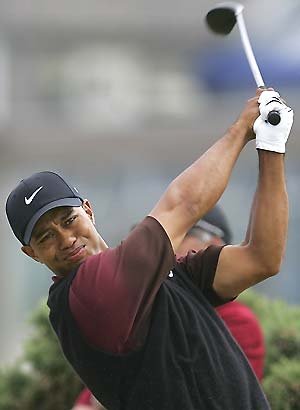
Dave Anderson: Woods' Winning Streak is Burnished With Cunning and Confidence
DAVE ANDERSON
Published: August 21, 2006
The New York Times
NOT long after Tiger Woods completed his 65 on Saturday to share the lead going into yesterday’s final round of the 88th P.G.A. Championship, he was asked a question. After he missed the 36-hole cut with two rounds of 76 in the United States Open at Winged Foot two months ago, could he have imagined being this close to winning three consecutive tournaments, two of them majors?
“Uh-huh,” he said.
“Why?” he was asked.
“If you enter a tournament, your goal is to win a tournament,” he said. “I figured I was going to enter a few tournaments after the U.S. Open, so yes.”
Yes indeed, because when he was asked not long afterward what his best attribute as a golfer was, he quickly replied, “My mind.”
Woods wasn’t boasting. He was just answering the question honestly. And for all of his talent as a ball striker and as a putter, that mind is what has put Tiger Woods up there in the golf clouds with all the other golf gods of all the other golf eras. That mind, with its sheer determination and tactical genius. That mind, which led him to his 12th major title and third P.G.A. Championship yesterday with a four-under-par 68 for an 18-under total at Medinah No. 3.
“I made some nice bombs that I probably shouldn’t have made,” he said, alluding to his putting.
With a 12-foot birdie putt at No. 1, a 40-foot birdie putt at No. 6, a 35-foot birdie putt at No. 8 and a 12-foot birdie putt at No. 12 for a five-shot lead, Woods was playing catch me if you can. And nobody could. Shaun Micheel, the 2003 P.G.A. champion, was five strokes back. Adam Scott of Australia, Sergio García of Spain and Luke Donald of England were each six strokes back.
Asked if he ever felt sorry for his challengers, Woods smiled and said, “No.”
Perhaps nobody in golf, not even Jack Nicklaus or Ben Hogan, possessed the killer instinct that Woods thrives on. And he again won it his way, with as much strategy as power. Just as he mostly used his 2-iron off the tee to win the British Open on the brown, hard Royal Liverpool links, here he often depended on his 5-wood off the tee to Medinah’s pillow-soft green fairways, especially on the dogleg holes.
“The 5-wood fit this course,” Woods said. “I can hit the 5-wood farther than I can hit the 2-iron, so I hit the 5-wood to the corner of the doglegs. If I had hit the 2-iron, I wouldn’t have gotten to the corners.
“With the driver, I would’ve worried about hitting through the fairway into the rough. With the 5-wood, I can take 20 or 30 yards off it and I can juice it as well, step up and hit it further. It was a perfect club.”
Since missing the cut at Winged Foot, where he was a rusty 12 over par for two rounds after eight weeks away from the PGA Tour, Woods has approached perfection. He tied for second at the Western Open at nearby Cog Hill, won the British Open at Royal Liverpool, won the Buick Open in Grand Blanc, Mich., and won the P.G.A. Championship at Medinah for a second time, after winning his second major there in 1999. Over those 16 rounds, he was 71 under par.
There were no tears this time, unlike at the British Open, where he sobbed and shook while hugging his wife, Elin, after holing out on the final green, a reaction to the death of his father, Earl, in May. But one of his headcovers had a Thai phrase on it in honor of his mother, Tida.
“It means, ‘Love from Mom,’ ” Woods said. “It’s her way of saying that she’s always there with me. Even though she can’t be there physically, she’s always there each and every round I play. It’s always comforting to look at that and know she’s always there in spirit.”
•At 30, Woods, with at least two majors in a year for the fourth time in his 10-year career as a professional, has won 12 of his first 40 majors as a pro — eight ahead of Jack Nicklaus’s pace en route to his record 18 majors. Nicklaus needed 48 majors before he won his 12th, the 1973 P.G.A. at Canterbury in Cleveland when he was 33.
“It’s still a long way away,” Woods said, alluding to Nicklaus’s total. “It took Jack over 20 years to do. It’s going to take a career, and I’ve just got to keep plugging along and keep trying. The majors are the most fun to play. I thoroughly enjoy coming down the stretch on the back nine with a chance to win it.”
Woods’s 12 majors, one short of Bobby Jones’s total — which included five United States Amateurs and one British Amateur, which were considered majors in his era — moved him ahead of Walter Hagen’s total of 11. Hagen won two United States Opens, four British Opens and five P.G.A. Championships.
Hagen still holds a record that has eluded Woods — winning a major in six consecutive years, from 1924 to 1929, when he won four P.G.A.’s and three British Opens. Woods won majors in four consecutive years (1999-2002); so did Tom Watson (1980-1983). If you count Jones’s five United States Amateurs, he won majors in eight consecutive years (1923-30).
So add those consecutive-year streaks by Hagen and Jones to Nicklaus’s record 18 majors, if only to give Tiger Woods something else to shoot for. And something for him to think about with that mind.
Sunday, August 20, 2006
DHS gives CAIR officials VIP airport security tour

[This is absolutely one of the most insane and ridiculous news items to ever pass before my eyes...The CAIR mailing list should be in a starter kit used to begin rounding up those who need to be deported or interned. Based on this article alone I'm ready to sign the first "Impeach Bush" petition that I can find. - jtf]
CAIR's caption to this photograph: "Ghazi, Dr. Rifai, Ahmed Rehab, Sheikh Kifah with O'Hare Airport's Chicago Field Officers and Chiefs (US Customs and Borders Protection)."
Controversial Muslim group gets VIP airport security tour
Feds show CAIR latest screening steps, sensitive counterterrorism procedures
Posted: August 18, 2006
1:00 a.m. Eastern
© 2006 WorldNetDaily.com
The Department of Homeland Security took a Muslim group with known past ties to terror organizations on a VIP tour of security operations at the nation's busiest airport at the same time British authorities were working to break up a plot to blow up U.S. airlines.
On June 21, a senior DHS official from Washington personally guided Muslim officials from the Council on American-Islamic Relations on a behind-the-scenes tour of Customs screening operations at O'Hare International Airport in response to CAIR complaints that Muslim travelers were being unfairly delayed as they entered the U.S. from abroad.
CAIR is a spin-off of the Islamic Association for Palestine, identified by two former FBI counterterrorism chiefs as a "front group" for the Palestinian terrorist group Hamas. Several CAIR leaders have been convicted on terror-related charges.
During the airport tour, CAIR was taken on a walk through the point-of-entry, Customs stations, secondary screening and interview rooms. In addition, U.S. Customs and Border Patrol agents were asked to describe for CAIR representatives various features of the high-risk passenger lookout system.
In a meeting, Brian Humphrey, Customs and Border Patrol's executive director of field operations, assured CAIR officials that agents do not single out Muslim passengers for special screening and that they must undergo a mandatory course in Muslim sensitivity training. The course teaches agents that Muslims believe jihad is an "internal struggle against sin" and not holy warfare.
Customs agents involved in the CAIR tour at O'Hare tell WorldNetDaily they were outraged that headquarters would reveal sensitive counterterrorism procedures to an organization that has seen several of its own officials convicted of terror-related charges since 9-11.
"Isn't that nice of CBP," one agent said, to provide a "group like CAIR with a guided, behind-the-scenes tour of our customs facilities, explaining how programs designed to catch Muslim terrorists work."
CAIR says the tour allayed its concerns about profiling and that it "looks forward to continuing the relationship with U.S. Customs and Border Protection offices in the region, and to furthering understanding between the organizations as well as facilitating future communication in order to eliminate problems for Muslim travelers before they even arise."
The Muslim-sensitivity training course at O'Hare is taught by Margaret Nydell, an Arabic professor at Georgetown University, home to a large Saudi-financed center on Islamic studies.
A Customs and Border Protection supervisor described Nydell's instruction, along with CBP's companion training manual and video, as "politically correct drivel."
"It's all about how Islam means peace and tolerance," he told WorldNetDaily. "We're told how to deal with Arabs and Muslims, that they are loving people and not terrorists. That jihad is struggle with sin and has nothing to do with violence."
The Department of Homeland Security invites CAIR itself to conduct sensitivity training for Immigration and Customs Enforcement officers and supervisors (CBP's counterparts) in Chicago. The course is taught by local CAIR officials Christina Abraham and Mariyam Hussain. More than 30 ICE staffers have gone through the CAIR awareness program so far.
CAIR – which is bankrolled by the Saudis and the United Arab Emirates, two countries that formally recognized the Taliban – also offers religious and cultural sensitivity training about Islam and Muslims to the military. In June, for example, CAIR trained more than 300 military personnel at the Marine Corps Air Station in Yuma, Ariz.
Also in June, CAIR was invited by the Pentagon to a ceremony dedicating the first Islamic center in Marine Corps history at Quantico headquarters outside of Washington.
Washington-based CAIR also has regular meetings with the FBI and Justice Department. In fact, FBI case agents complain the bureau rarely can make a move in the Muslim community without first consulting with CAIR, which sits on its advisory board. CAIR in the past has cried racism and bigotry when the bureau has moved unilaterally with investigations and raids in the community.
Roger Scruton: Beware of a religion without irony

MATTERS OF FAITH
'Islamofascism'
The Wall Street Journal
Sunday, August 20, 2006 12:01 a.m. EDT
The term "Islamofascism" was introduced by the French writer Maxine Rodinson (1915-2004) to describe the Iranian Revolution of 1978. Rodinson was a Marxist, who described as "fascist" any movement of which he disapproved. But we should be grateful to him for coining a word that enables people on the left to denounce our common enemy. After all, other French leftists--Michel Foucault, for example--had welcomed the revolution as an amusing threat to Western interests. It is only now that people on the left can acknowledge that they are just as much a target as the rest of us, in a war that has global chaos as its goal.
The word has therefore caught on, not least because it provides a convenient way of announcing that you are not against Islam but only against its perversion by the terrorists. But this prompts the question whether terrorism is really as alien to Islam as we should all like to believe. Despite his communist sympathies, Rodinson was a peaceful soul, who spent seven years teaching in a Muslim school in Lebanon and wrote a biography of Muhammad in which the prophet is portrayed as a mild-mannered campaigner for social justice. But this biography was denounced by the Egyptian authorities as an offense to Islam, was withdrawn from the curriculum of the American University in Cairo, and has ever since been banned in Muslim countries.
This readiness to take offense is not yet terrorism--but it is a sign of the deep-down insecurity of the Muslim psyche in the modern world. In the presence of Islam, we all feel, you have to tread carefully, as though humoring a dangerous animal. The Koran must never be questioned; Islam must be described as a religion of peace--isn't that the meaning of the word?--and jokes about the prophet are an absolute no-no. If religion comes up in conversation, best to slip quietly away, accompanying your departure with abject apologies for the Crusades. And in Europe this pussyfooting is now being transcribed into law, with "Islamophobia" already a crime in Belgium and movements across the continent to censor everything at which a Muslim might take offence, including articles like this one.
The majority of European Muslims do not approve of terrorism. But there are majorities and majorities. According to a recent poll, a full quarter of British Muslims believe that the bombs of last summer in London were a legitimate response to the "war on terror." Public pronouncements from Muslim leaders treat Islamist terrorism as a lamentable but understandable response to the West's misguided policies. And the blood-curdling utterances of the Wahhabite clergy, when occasionally reported in the press, sit uneasily with the idea of a "religion of peace." All this leads to a certain skepticism among ordinary people, whose "racist" or "xenophobic" prejudices are denounced by the media as the real cause of Muslim disaffection.
Now of course it is wrong to give gratuitous offence to people of other faiths; it is right to respect people's beliefs, when these beliefs pose no threat to civil order; and we should extend toward resident Muslims all the toleration and neighborly goodwill that we hope to receive from them. But recent events have caused people to wonder exactly where Muslims stand in such matters. Although Islam is derived from the same root as salaam, it does not mean peace but submission. And although the Koran tells us that there shall be no compulsion in matters of religion, it does not overflow with kindness toward those who refuse to submit to God's will. The best they can hope for is to be protected by a treaty (dhimmah), and the privileges of the dhimmi are purchased by onerous taxation and humiliating rites of subservience. As for apostates, it remains as dangerous today as it was in the time of the prophet publicly to renounce the Muslim faith. Even if you cannot be compelled to adopt the faith, you can certainly be compelled to retain it. And the anger with which public Muslims greet any attempt to challenge, to ridicule or to marginalize their faith is every bit as ferocious as that which animated the murderer of Theo Van Gogh. Ordinary Christians, who suffer a daily diet of ridicule and skepticism, cannot help feeling that Muslims protest too much, and that the wounds, which they ostentatiously display to the world, are largely self-inflicted.
To recognize such facts is not to give up hope for a tolerant Islam. But there is a matter that needs to be clarified. Christians and Jews are heirs to a long tradition of secular government, which began under the Roman Empire and was renewed at the Enlightenment: Human societies should be governed by human laws, and these laws must take precedence over religious edicts. The primary duty of citizens is to obey the state; what they do with their souls is a matter between themselves and God, and all religions must bow down to the sovereign authority if they are to exist within its jurisdiction.
The Ottoman Empire evolved systems of law which to some extent replicated that wise provision. But after the Ottoman collapse the Muslim sects rebelled against the idea, since it contradicts the claims of the Shariah to be the final legal authority. The Egyptian writer and leader of the Muslim Brotherhood, Sayyid Qutb, went so far as to denounce all secular law as blasphemy. Mortals who make laws for their own government, he argued, usurp a power which is God's alone. And although few Muslim leaders will publicly endorse Qutb's argument, few will publicly condemn it either. What to us is a proof of Qutb's fanaticism and egomania is, for many Muslims, a proof of his piety.
Whenever I consider this matter I am struck by a singular fact about the Christian religion, a fact noticed by Kierkegaard and Hegel but rarely commented upon today, which is that it is informed by a spirit of irony. Irony means accepting "the other," as someone other than you. It was irony that led Christ to declare that his "kingdom is not of this world," not to be achieved through politics. Such irony is a long way from the humorless incantations of the Koran. Yet it is from a posture of irony that every real negotiation, every offer of peace, every acceptance of the other, begins. The way forward, it seems to me, is to encourage the re-emergence of an ironical Islam, of the kind you find in the philosophy of Averroës, in Persian poetry and in "The Thousand and One Nights." We should also encourage those ethnic and religious jokes which did so much to defuse tension in the days before political correctness. And maybe, one day, the rigid face of some puritanical mullah will crack open in a hesitant smile, and negotiations can at last begin.
Mr. Scruton is the author, most recently, of "A Political Philosophy: Arguments for Conservatism," just published by Continuum.
Mark Steyn: World is watching as Iraq war tests U.S. mettle
August 20, 2006
CHICAGO SUN-TIMES
One way to measure how the world has changed in these last five years is to consider the extraordinary address to his nation by General Musharraf on Sept. 19, 2001. Pakistan was one of just three countries in the world (along with "our friends the Saudis" and the United Arab Emirates) to recognize the Taliban -- and, given that the Pakistanis had helped create and maintain them, they were pretty easy to recognize. President Bush, you'll recall, had declared that you're either with us or you're with the terrorists -- which posed a particular problem for Musharraf: He was with us but everyone else in his country was with the terrorists, including his armed forces, his intelligence services, the media, and a gazillion and one crazy imams.
Nonetheless, with American action against Afghanistan on the horizon, he went on TV that night and told the Pakistani people that this was the gravest threat to the country's existence in over 30 years. He added that he was doing everything to ensure his brothers in the Taliban didn't "suffer," and that he'd asked Washington to provide some evidence that this bin Laden chap had anything to do with the attacks but that so far they'd declined to show him any. Then he cited the Charter of Medina (which the Prophet Muhammad signed after an earlier spot of bother) as an attempt to justify providing assistance to the infidel, and said he'd had no choice but to offer the Americans use of Pakistan's airspace, intelligence networks and other logistical support.
He paused for applause, and after the world's all-time record volume of crickets chirping, said thank you and goodnight.
That must have been quite the phone call he'd got from Washington a day or two earlier. And all within a week of Sept. 11. You may remember during the 2000 campaign an enterprising journalist sprung on Gov. Bush a sudden pop quiz of world leaders. Bush, invited to name the leader of Pakistan, was unable to. But so what? In the third week of September 2001, the correct answer to "Who's General Musharraf?" was "Whoever I want him to be." And, if Musharraf didn't want to play ball, he'd wind up as the answer to "Who was leader of Pakistan until last week?"
Do you get the feeling Washington's not making phone calls like that anymore?
If you go back to September 2001, it's amazing how much the administration made happen in just a short space of time: For example, within days it had secured agreement with the Russians on using military bases in former Soviet Central Asia for intervention in Afghanistan. That, too, must have been quite a phone call. Moscow surely knew that any successful Afghan expedition would only cast their own failures there in an even worse light -- especially if the Americans did it out of the Russians' old bases. And yet it happened.
Five years on, the United States seems to be back in the quagmire of perpetual interminable U.N.-brokered EU-led multilateral dithering, on Iran and much else. The administration that turned Musharraf in nothing flat now offers carrots to Ahmadinejad. After the Taliban fell, the region's autocrats and dictators wondered: Who's next? Now they figure it's a pretty safe bet that nobody is.
What's the difference between September 2001 and now? It's not that anyone "liked" America or that, as the Democrats like to suggest, the country had the world's "sympathy.'' Pakistani generals and the Kremlin don't cave to your demands because they "sympathize.'' They go along because you've succeeded in impressing upon them that they've no choice. Musharraf and Co. weren't scared by America's power but by the fact that America, in the rubble of 9/11, had belatedly found the will to use that power. It is notionally at least as powerful today, but in terms of will we're back to Sept. 10: Nobody thinks America is prepared to use its power. And so Nasrallah and Ahmadinejad and wannabe "strong horses" like Baby Assad cock their snooks with impunity.
I happened to be in the Australian Parliament for Question Time last week. The matter of Iraq came up, and the foreign minister, Alexander Downer, thwacked the subject across the floor and over the opposition benches in a magnificent bravura display of political confidence culminating with the gleefully low jibe that "the Leader of the Opposition's constant companion is the white flag.'' The Iraq war is unpopular in Australia, as it is in America and in Britain. But the Aussie government is happy for the opposition to bring up the subject as often as they want because Downer and his prime minister understand very clearly that wanting to "cut and run" is even more unpopular. So in the broader narrative it's a political plus for them: Unlike Bush and Blair, they've succeeded in making the issue not whether the nation should have gone to war but whether the nation should lose the war.
That's not just good politics, but it's actually the heart of the question. Of course, if Bush sneered that John Kerry and Ted Kennedy and Howard Dean and Nancy Pelosi's constant companion is the white flag, they'd huff about how dare he question their patriotism. But, if you can't question their patriotism when they want to lose a war, when can you? At one level, the issue is the same as it was on Sept. 11: American will and national purpose. But the reality is that it's worse than that -- for (as Israel is also learning) to begin something and be unable to stick with it to the finish is far more damaging to your reputation than if you'd never begun it in the first place. Nitwit Democrats think anything that can be passed off as a failure in Iraq will somehow diminish only Bush and the neocons. In reality -- a concept with which Democrats seem only dimly acquainted -- it would diminish the nation, and all but certainly end the American moment. In late September 2001 the administration succeeded in teaching a critical lesson to tough hombres like Musharraf and Putin: In a scary world, America can be scarier. But it's all a long time ago now.
CHICAGO SUN-TIMES
One way to measure how the world has changed in these last five years is to consider the extraordinary address to his nation by General Musharraf on Sept. 19, 2001. Pakistan was one of just three countries in the world (along with "our friends the Saudis" and the United Arab Emirates) to recognize the Taliban -- and, given that the Pakistanis had helped create and maintain them, they were pretty easy to recognize. President Bush, you'll recall, had declared that you're either with us or you're with the terrorists -- which posed a particular problem for Musharraf: He was with us but everyone else in his country was with the terrorists, including his armed forces, his intelligence services, the media, and a gazillion and one crazy imams.
Nonetheless, with American action against Afghanistan on the horizon, he went on TV that night and told the Pakistani people that this was the gravest threat to the country's existence in over 30 years. He added that he was doing everything to ensure his brothers in the Taliban didn't "suffer," and that he'd asked Washington to provide some evidence that this bin Laden chap had anything to do with the attacks but that so far they'd declined to show him any. Then he cited the Charter of Medina (which the Prophet Muhammad signed after an earlier spot of bother) as an attempt to justify providing assistance to the infidel, and said he'd had no choice but to offer the Americans use of Pakistan's airspace, intelligence networks and other logistical support.
He paused for applause, and after the world's all-time record volume of crickets chirping, said thank you and goodnight.
That must have been quite the phone call he'd got from Washington a day or two earlier. And all within a week of Sept. 11. You may remember during the 2000 campaign an enterprising journalist sprung on Gov. Bush a sudden pop quiz of world leaders. Bush, invited to name the leader of Pakistan, was unable to. But so what? In the third week of September 2001, the correct answer to "Who's General Musharraf?" was "Whoever I want him to be." And, if Musharraf didn't want to play ball, he'd wind up as the answer to "Who was leader of Pakistan until last week?"
Do you get the feeling Washington's not making phone calls like that anymore?
If you go back to September 2001, it's amazing how much the administration made happen in just a short space of time: For example, within days it had secured agreement with the Russians on using military bases in former Soviet Central Asia for intervention in Afghanistan. That, too, must have been quite a phone call. Moscow surely knew that any successful Afghan expedition would only cast their own failures there in an even worse light -- especially if the Americans did it out of the Russians' old bases. And yet it happened.
Five years on, the United States seems to be back in the quagmire of perpetual interminable U.N.-brokered EU-led multilateral dithering, on Iran and much else. The administration that turned Musharraf in nothing flat now offers carrots to Ahmadinejad. After the Taliban fell, the region's autocrats and dictators wondered: Who's next? Now they figure it's a pretty safe bet that nobody is.
What's the difference between September 2001 and now? It's not that anyone "liked" America or that, as the Democrats like to suggest, the country had the world's "sympathy.'' Pakistani generals and the Kremlin don't cave to your demands because they "sympathize.'' They go along because you've succeeded in impressing upon them that they've no choice. Musharraf and Co. weren't scared by America's power but by the fact that America, in the rubble of 9/11, had belatedly found the will to use that power. It is notionally at least as powerful today, but in terms of will we're back to Sept. 10: Nobody thinks America is prepared to use its power. And so Nasrallah and Ahmadinejad and wannabe "strong horses" like Baby Assad cock their snooks with impunity.
I happened to be in the Australian Parliament for Question Time last week. The matter of Iraq came up, and the foreign minister, Alexander Downer, thwacked the subject across the floor and over the opposition benches in a magnificent bravura display of political confidence culminating with the gleefully low jibe that "the Leader of the Opposition's constant companion is the white flag.'' The Iraq war is unpopular in Australia, as it is in America and in Britain. But the Aussie government is happy for the opposition to bring up the subject as often as they want because Downer and his prime minister understand very clearly that wanting to "cut and run" is even more unpopular. So in the broader narrative it's a political plus for them: Unlike Bush and Blair, they've succeeded in making the issue not whether the nation should have gone to war but whether the nation should lose the war.
That's not just good politics, but it's actually the heart of the question. Of course, if Bush sneered that John Kerry and Ted Kennedy and Howard Dean and Nancy Pelosi's constant companion is the white flag, they'd huff about how dare he question their patriotism. But, if you can't question their patriotism when they want to lose a war, when can you? At one level, the issue is the same as it was on Sept. 11: American will and national purpose. But the reality is that it's worse than that -- for (as Israel is also learning) to begin something and be unable to stick with it to the finish is far more damaging to your reputation than if you'd never begun it in the first place. Nitwit Democrats think anything that can be passed off as a failure in Iraq will somehow diminish only Bush and the neocons. In reality -- a concept with which Democrats seem only dimly acquainted -- it would diminish the nation, and all but certainly end the American moment. In late September 2001 the administration succeeded in teaching a critical lesson to tough hombres like Musharraf and Putin: In a scary world, America can be scarier. But it's all a long time ago now.
Saturday, August 19, 2006
Ann Coulter- Terrorists Win: Deodorants Banned From Airplanes
August 16, 2006
http://www.townhall.com
Last week, British authorities arrested 24 members of a terrorist cell plotting to blow up about a dozen U.S.-bound planes simultaneously. As a result of those arrests, we learned:
Nothing being done by airport security since 9/11 would prevent a bomb from being brought onto an airplane; and
This terrorist plot -- like all other terrorist plots -- was stopped by ethnic profiling.
Last week marked the first official admission that everything government airport screeners have been doing until now is completely pointless -- unless you're an airport security guard with a thing for women's undergarments, in which case it's been highly effective.
As we now know, all the ingredients necessary to blow up an airplane can be carried in small liquid containers. Airport security has not even been looking for small liquid containers. Judging from my personal experience, they seem to have been focusing on finding explosive devices inside women's brassieres.
After five years of submissively complying with bag checks, shoe checks and underwire bra checks, Americans have now been informed that the hell we've been going through at the airports (but which the president and members of Congress do not go through because they refuse to fly commercial air) has been a useless Kabuki theater.
The procedures that have wasted millions of hours of time cannot keep the most basic bomb materials off an airplane. This is like locking your windows to prevent burglaries, while leaving the front door wide open.
Airport security has been using metal detectors to confiscate sharp objects that could be turned into make-shift weapons, which could then be used by terrorists to commandeer control of a plane and fly it into a building.
Except the terrorists can't do that because we've seen that trick before.
After 9/11, airline passengers will never allow a half-dozen terrorists to take control of a plane again. Indeed, on 9/11, passengers on Flight 93 prevented terrorists who had already been given control of the plane from flying it into a building after hearing what had happened to the first three hijacked planes.
To pull off a 9/11-style attack now, literally half the passengers on the plane would have to be terrorists. (At least the airport screeners wouldn't have to worry about confiscating a lot of deodorants.)
I think a planeful of Arabs would attract attention -- except from people who had recently completed a government training program teaching them not to notice anyone's appearance. Not even a group of liberal Democrats flying off to a Renaissance Weekend would stand for that.
The sole objective of airport security post-9/11 has been to accomplish the impossible -- remove all sharp objects from a plane -- in order to prevent an attack that won't ever happen again. (OK -- well, that and finding out what color of lingerie Ann Coulter prefers.)
The plan seems to be to make flying so unpleasant that terrorists -- like the people who write laws about airport security -- will refuse to fly commercial air. On that theory, we could also keep terrorists off planes by forcing passengers to undergo root canal surgery before boarding, making them stand on their heads for an hour, or enacting an "all Whoopi Goldberg in-flight movie" policy.
What stopped last week's terrorist attack was ethnic profiling. We don't know the details of the British intelligence work that nabbed the 24 Muslims because The New York Times has not been able to obtain that classified information and publish it on its front page yet. But it is a fact that you could not catch 24 Muslim terrorists by surveilling everyone in Britain equally.
Without the ethnic profiling going on outside of airports, no security procedure currently permissible inside airports would have prevented a terrorist attack that would have left thousands dead.
Airplanes, ports, bridges, subways and shopping malls cannot ever be sanitized against every type of attack that can be dreamed up by fanatics engaged in asymmetrical warfare. We have to target the fanatics themselves. Baby formula doesn't kill people. Islamic fascists kill people.
http://www.townhall.com
Last week, British authorities arrested 24 members of a terrorist cell plotting to blow up about a dozen U.S.-bound planes simultaneously. As a result of those arrests, we learned:
Nothing being done by airport security since 9/11 would prevent a bomb from being brought onto an airplane; and
This terrorist plot -- like all other terrorist plots -- was stopped by ethnic profiling.
Last week marked the first official admission that everything government airport screeners have been doing until now is completely pointless -- unless you're an airport security guard with a thing for women's undergarments, in which case it's been highly effective.
As we now know, all the ingredients necessary to blow up an airplane can be carried in small liquid containers. Airport security has not even been looking for small liquid containers. Judging from my personal experience, they seem to have been focusing on finding explosive devices inside women's brassieres.
After five years of submissively complying with bag checks, shoe checks and underwire bra checks, Americans have now been informed that the hell we've been going through at the airports (but which the president and members of Congress do not go through because they refuse to fly commercial air) has been a useless Kabuki theater.
The procedures that have wasted millions of hours of time cannot keep the most basic bomb materials off an airplane. This is like locking your windows to prevent burglaries, while leaving the front door wide open.
Airport security has been using metal detectors to confiscate sharp objects that could be turned into make-shift weapons, which could then be used by terrorists to commandeer control of a plane and fly it into a building.
Except the terrorists can't do that because we've seen that trick before.
After 9/11, airline passengers will never allow a half-dozen terrorists to take control of a plane again. Indeed, on 9/11, passengers on Flight 93 prevented terrorists who had already been given control of the plane from flying it into a building after hearing what had happened to the first three hijacked planes.
To pull off a 9/11-style attack now, literally half the passengers on the plane would have to be terrorists. (At least the airport screeners wouldn't have to worry about confiscating a lot of deodorants.)
I think a planeful of Arabs would attract attention -- except from people who had recently completed a government training program teaching them not to notice anyone's appearance. Not even a group of liberal Democrats flying off to a Renaissance Weekend would stand for that.
The sole objective of airport security post-9/11 has been to accomplish the impossible -- remove all sharp objects from a plane -- in order to prevent an attack that won't ever happen again. (OK -- well, that and finding out what color of lingerie Ann Coulter prefers.)
The plan seems to be to make flying so unpleasant that terrorists -- like the people who write laws about airport security -- will refuse to fly commercial air. On that theory, we could also keep terrorists off planes by forcing passengers to undergo root canal surgery before boarding, making them stand on their heads for an hour, or enacting an "all Whoopi Goldberg in-flight movie" policy.
What stopped last week's terrorist attack was ethnic profiling. We don't know the details of the British intelligence work that nabbed the 24 Muslims because The New York Times has not been able to obtain that classified information and publish it on its front page yet. But it is a fact that you could not catch 24 Muslim terrorists by surveilling everyone in Britain equally.
Without the ethnic profiling going on outside of airports, no security procedure currently permissible inside airports would have prevented a terrorist attack that would have left thousands dead.
Airplanes, ports, bridges, subways and shopping malls cannot ever be sanitized against every type of attack that can be dreamed up by fanatics engaged in asymmetrical warfare. We have to target the fanatics themselves. Baby formula doesn't kill people. Islamic fascists kill people.
Mike Lupica: It isn't well-spent, but well-earned
The New York Daily News
19 August 2006
BOSTON - By the time Derek Jeter had cleared the bases with a double in the top of the seventh and the Yankees were about to bat around for the second time in Game 2, on their way to scoring seven in the seventh against the Boston Red Sox, the Yankees and Red Sox had played nearly eight hours of baseball at Fenway Park yesterday.
The Yankees had won Game 1 by a 12-4 score. By the time the top of the seventh ended, a few minutes before midnight, the Yankees were leading, 14-10, against what was left in the boneyard that is the Red Sox bullpen at the present time.
This wasn't the best rivalry in sports anymore. It was like watching relief pitchers do bad auditions for "American Idol," on the worst day the Red Sox have had since they won the World Series.
The Yankees had 17 hits in Game 1 and they also had 17 hits in Game 2. The Yankees had blown leads of 5-1 and 7-5 in Game 2, and things had gotten bad enough that Joe Torre had gone to Ron Villone even though Villone had thrown 42 pitches and two innings the day before against the Orioles. You bring guys back like that in October, not August. The joke around the Yankees sometimes is that the only thing worse than being on Torre's bad side if you're a relief pitcher is being on his good side. Before you know it, you're Paul Quantrill or Tanyon Sturtze and you have been loved to death.
Sidney Ponson started Game 2, an eventual 14-11 Yankee victory, and had nothing. It is hard to see him being around here at the end of next week, much less the end of the month. Then came Villone and then came a fastball kid named Brian Bruney and then came Mike Myers after that and Kyle Farnsworth after Myers. For a while, with Bruney, it looked as if Torre might have thrown in the towel in Game 2, Game 2 of what would eventually be a day-night-morning doubleheader that was about as elegant as mud wrestling.
But the Red Sox have less bullpen than the Yankees these days, and maybe the rest of the way. The Red Sox had less bullpen than anybody in baseball yesterday afternoon and into the night and then into this morning. So the Yankees came back in the top of the seventh, which seemed as long as Rudy Seanez's pathetic effort at the end of Game 1 out of the Red Sox bullpen, as long as Jon Lester's second inning in Game 2, when he managed to get by with a cool 41pitches.
You thought the Red Sox might get out of the seventh with two outs and the bases loaded and Mike Timlin against Jeter. It was 1-1 and 1-2 and 2-2 and finally 3-2. Moving up on eight hours of baseball now at Fenway.
Not too far from midnight. The Yankees trying to get a big sweep, the Red Sox trying not to fall 3-1/2 games behind the Yankees in the American League East.
Jeter, the captain of the team, the guy you want up there in a big spot more than anybody Torre has, reached out and hit one hard toward the right-field corner. By the time everybody stopped running, the Yankees were ahead, 11-10, at Fenway. Then Timlin walked Bobby Abreu intentionally and Alex Rodriguez doubled inside third base, and by the time Timlin managed to get a third out, it was 14-10 and Fenway Park was as loud with boos for the Red Sox as it has been in a long time.
By the time it was Coco Crisp against Scott Proctor, another guy you worry about having an arm fall off, in the bottom of the seventh, Game 2 was past four hours at Fenway, and we were past midnight and this mess of a game and a doubleheader wasn't close to being over.
Game 2 had started at 8:07. After 32 hits for the two teams and 24 runs, the top of the eighth was starting at 11 minutes after 12. There was a time when these two teams played unforgettable baseball at this time of the morning, especially in Game 4 of the 2004 American League Championship Series. Now they had given us Ponson and Lester and Villone and Bruney and Julian Tavarez, Mike Myers and Kyle Farnsworth (who took a wicked shot off his leg and had to leave the game) and Scott Proctor. Maybe it will be a great rivalry today when it is Josh Beckett and Randy Johnson, two old Yankee-killers, one a Yankee now, going against each other.
Maybe it will be that way tomorrow night when it is Curt Schilling against Mike Mussina.
There were so many batting stars for the Yankees yesterday and today, because there have to be when you score the way they did against a boneyard bullpen. Johnny Damon had a couple of home runs and A-Rod hit and Giambi Jason hit and Capt. Jeter had the biggest one of the whole day, of course. And Melky Cabrera, who probably won't have a job here next season, had a huge hit in the middle of the seven-run top of the seventh for the Yankees in Boston.
This was one of those nights to make you wonder how anybody can get the Yankees out when they get back Hideki Matsui and Gary Sheffield.
There is a ridiculous amount of offense on this team even without them, on display in Boston yesterday at a ridiculously long doubleheader that didn't involve a rain delay or extra innings. When the sweep was over, people were comparing it to 1978, when the Yankees came in, during that comeback summer, and beat the Red Sox, 15-3, and swept them four games.
It seemed like a good comparison to make, after all. By the end of this mess, near one in the morning, at the end of the longest nine-inning game in the history of the sport, you had the idea that these two games started right after those four games 28 years ago.
19 August 2006
BOSTON - By the time Derek Jeter had cleared the bases with a double in the top of the seventh and the Yankees were about to bat around for the second time in Game 2, on their way to scoring seven in the seventh against the Boston Red Sox, the Yankees and Red Sox had played nearly eight hours of baseball at Fenway Park yesterday.
The Yankees had won Game 1 by a 12-4 score. By the time the top of the seventh ended, a few minutes before midnight, the Yankees were leading, 14-10, against what was left in the boneyard that is the Red Sox bullpen at the present time.
This wasn't the best rivalry in sports anymore. It was like watching relief pitchers do bad auditions for "American Idol," on the worst day the Red Sox have had since they won the World Series.
The Yankees had 17 hits in Game 1 and they also had 17 hits in Game 2. The Yankees had blown leads of 5-1 and 7-5 in Game 2, and things had gotten bad enough that Joe Torre had gone to Ron Villone even though Villone had thrown 42 pitches and two innings the day before against the Orioles. You bring guys back like that in October, not August. The joke around the Yankees sometimes is that the only thing worse than being on Torre's bad side if you're a relief pitcher is being on his good side. Before you know it, you're Paul Quantrill or Tanyon Sturtze and you have been loved to death.
Sidney Ponson started Game 2, an eventual 14-11 Yankee victory, and had nothing. It is hard to see him being around here at the end of next week, much less the end of the month. Then came Villone and then came a fastball kid named Brian Bruney and then came Mike Myers after that and Kyle Farnsworth after Myers. For a while, with Bruney, it looked as if Torre might have thrown in the towel in Game 2, Game 2 of what would eventually be a day-night-morning doubleheader that was about as elegant as mud wrestling.
But the Red Sox have less bullpen than the Yankees these days, and maybe the rest of the way. The Red Sox had less bullpen than anybody in baseball yesterday afternoon and into the night and then into this morning. So the Yankees came back in the top of the seventh, which seemed as long as Rudy Seanez's pathetic effort at the end of Game 1 out of the Red Sox bullpen, as long as Jon Lester's second inning in Game 2, when he managed to get by with a cool 41pitches.
You thought the Red Sox might get out of the seventh with two outs and the bases loaded and Mike Timlin against Jeter. It was 1-1 and 1-2 and 2-2 and finally 3-2. Moving up on eight hours of baseball now at Fenway.
Not too far from midnight. The Yankees trying to get a big sweep, the Red Sox trying not to fall 3-1/2 games behind the Yankees in the American League East.
Jeter, the captain of the team, the guy you want up there in a big spot more than anybody Torre has, reached out and hit one hard toward the right-field corner. By the time everybody stopped running, the Yankees were ahead, 11-10, at Fenway. Then Timlin walked Bobby Abreu intentionally and Alex Rodriguez doubled inside third base, and by the time Timlin managed to get a third out, it was 14-10 and Fenway Park was as loud with boos for the Red Sox as it has been in a long time.
By the time it was Coco Crisp against Scott Proctor, another guy you worry about having an arm fall off, in the bottom of the seventh, Game 2 was past four hours at Fenway, and we were past midnight and this mess of a game and a doubleheader wasn't close to being over.
Game 2 had started at 8:07. After 32 hits for the two teams and 24 runs, the top of the eighth was starting at 11 minutes after 12. There was a time when these two teams played unforgettable baseball at this time of the morning, especially in Game 4 of the 2004 American League Championship Series. Now they had given us Ponson and Lester and Villone and Bruney and Julian Tavarez, Mike Myers and Kyle Farnsworth (who took a wicked shot off his leg and had to leave the game) and Scott Proctor. Maybe it will be a great rivalry today when it is Josh Beckett and Randy Johnson, two old Yankee-killers, one a Yankee now, going against each other.
Maybe it will be that way tomorrow night when it is Curt Schilling against Mike Mussina.
There were so many batting stars for the Yankees yesterday and today, because there have to be when you score the way they did against a boneyard bullpen. Johnny Damon had a couple of home runs and A-Rod hit and Giambi Jason hit and Capt. Jeter had the biggest one of the whole day, of course. And Melky Cabrera, who probably won't have a job here next season, had a huge hit in the middle of the seven-run top of the seventh for the Yankees in Boston.
This was one of those nights to make you wonder how anybody can get the Yankees out when they get back Hideki Matsui and Gary Sheffield.
There is a ridiculous amount of offense on this team even without them, on display in Boston yesterday at a ridiculously long doubleheader that didn't involve a rain delay or extra innings. When the sweep was over, people were comparing it to 1978, when the Yankees came in, during that comeback summer, and beat the Red Sox, 15-3, and swept them four games.
It seemed like a good comparison to make, after all. By the end of this mess, near one in the morning, at the end of the longest nine-inning game in the history of the sport, you had the idea that these two games started right after those four games 28 years ago.
Friday, August 18, 2006
Tyler Kepner- Jeter's Secret? It's Simple: Play to Win
TYLER KEPNER
The New York Times
Published: August 18, 2006
Derek Jeter was the host of “Saturday Night Live” in 2001, and he was nervous about it all week. He had no acting or comic background, and certainly had never performed on live television at Rockefeller Center.
Jeter thought he might make a fool of himself, but the feeling subsided when he took the stage for his monologue. Everything happened so fast that 90 minutes seemed like 10. The task was remarkably easy.
“They have everything on cue cards for you,” Jeter said. “So as long as you can read, you can do it.”
For all of Jeter’s skills, the most useful is his ability to boil down any job to its essence. In a Yankees season marked by injuries to big hitters and the mystifying mind games of Alex Rodriguez, Jeter’s simple approach has stood out more than ever.
“I think that’s where people get in trouble, when they start complicating things,” Jeter said. “It’s really not that complicated. The more complicated you make it, the more difficult it is on you. You’re playing a game where you fail more than you succeed. You’ve got to try to keep it as simple as possible.”
Jeter has often been hailed for his intangibles, the kind of praise that can come off as a way to excuse his numbers. But this season, especially, Jeter has no need to apologize.
With a .338 average, he is second in the American League to Minnesota’s Joe Mauer. He has the best on-base percentage on the Yankees, at .415, and has a better average with runners in scoring position than Boston’s David Ortiz.
Jeter is hitting .373 with runners in scoring position, compared to .300 for Ortiz, who will try to help the Boston Red Sox wrest first place from the Yankees in this weekend’s five-game series at Fenway Park. Ortiz may be the leading candidate for the A.L.’s Most Valuable Player award, but Jeter is in the discussion.
“He’s definitely been our guy,” said the hitting coach Don Mattingly, who won the award in 1985. “He’s been as consistent as anybody, and he’s done everything you can to win games. So I don’t think there’s any question you can make a case for him.”
Jeter’s home runs are down this season — he has only 10 — but he leads the team in doubles and is on pace for 97 runs batted in. He has 26 steals, 6 shy of his career high. Before his error on Thursday, an ugly one in which he collided with Rodriguez on a pop-up, he had a better fielding percentage (.980) than he did last season, when he won his second Gold Glove at shortstop.
Monday’s game against the Angels was typical for Jeter. In the third inning, with a runner on third and one out, he hit a fly ball to center field. Four innings later, with a runner on first and no outs in a tie game, Jeter bunted the runner over.
In both cases, he got more than he was trying for: the fly ball turned into a homer, and the bunt went for a single. The important thing was that Jeter recognized what each situation demanded, which is easier said than done.
“I wish I could do it a lot more like him,” Johnny Damon said. “I get out of my game sometimes. I’ll go a long time without attempting a bunt, and it’s like, ‘That’s always been part of my game, so why don’t I do it more often?’ ”
Sometimes, Damon admitted, he lets the cozy dimensions of Yankee Stadium seduce him into swinging for homers. Jeter is more disciplined, and it makes him harder to prepare for.
“He may drag bunt one time, and the next time he might try to drive it out of the field on you,” Baltimore Orioles catcher Chris Widger said. “It’s hard, because there’s no one way to pitch him to get him out. He’s one of those rare guys that could bat leadoff or bat third, and he could be very successful anywhere because he’ll adapt his game to whatever the team needs for him to do.”
Jeter had his best statistics in 1999, with a .349 average, 24 homers and 102 runs batted in, all career highs. Asked if this year was his best, Jeter predictably said his best seasons were 1996, 1998, 1999 and 2000 — the years that ended with World Series parades.
Better than any player, perhaps, Jeter lives by the now famous Herman Edwards credo: You play to win the game. That is how he keeps it uncomplicated.
“It’s simple if you look at it as: Try to win,” Jeter said. “That’s the bottom line. If you win, everybody benefits. It’s not like, ‘I won, I lost.’ It’s, ‘We win, we lost.’ That’s the only way I’ve thought about it.”
Jeter talks like this all the time. He says he knows reporters get tired of boring answers, but sometimes there is nothing much to say. He responds politely to questions, but objects to the premise of most.
“People say, ‘Are you more motivated now because you lost?’ ” Jeter said, referring to the Yankees’ years without a title. “How could you be more motivated if you want to win all the time? You’re not extra-motivated. It’s the same thing.”
Widger said he recognized the same attitude in his White Sox teammates last season.
“I just think winning means more to him than all the other stuff does, and if more people did that, your team is better,” Widger said. “In Chicago last year, we had a lot of guys that played the game that way, and that’s why we won. We weren’t the most talented, but everybody played to win.”
Jeter helped create the Yankees’ modern mentality, in which only championship seasons are considered a success. It is an all-or-nothing mind-set that, for some, creates a joyless, pressurized environment.
But for Jeter, it is simply a fact. Every team wants to win as often as possible, so the goal must be a title every season. It is not like this everywhere, but for Jeter, it would be.
“I don’t know what it would be like, but I wouldn’t change,” he said. “Now don’t get me wrong, I do understand it’s a game of numbers and people are going to pay attention to your numbers, say you did this or did that. I would love to hit .400. That would be a lot better than .200. You take pride in how you play. But that shouldn’t be your main focus. Your main focus should be whether you win or lose.”
Closer Mariano Rivera, another straightforward thinker, grew up with Jeter in the Yankees’ organization. Veteran teammates helped form his makeup, Rivera said, and so did early success.
“We won all those championships, and that helps a lot,” Rivera said. “That helps your mental game.”
Jeter has mastered the mental game and continues to make the most of the physical. His skills are exceptional, but a one-dimensional approach controls every move.
“If you constantly sit around worrying about your stats, once you get in a funk, you’ll never get out,” Jeter said. “Because all you’re worried about is yourself. If you’re worried about how we can win today, that’s your only concern.”
Melanie Phillips: Suicide of the West
Denial is no longer a river in Egypt but a British pathology.
http://www.nationalreview.com
18 August 2006
When America was attacked on 9/11 by Islamic jihadis, it was said that this was a doomsday wake-up call for the West. Within a short while, however, much of Britain decided that 9/11 was actually America’s fault and that Israel was at the core of the problem.
When Britain was attacked last year on 7/7 by Islamic jihadis, it was said that this was a doomsday wake-up call for the U.K. Within a short time, however, much of the country decided that it was Britain’s own fault on account of “Islamophobia” and the war in Iraq. Now 25 British Muslims have been arrested for an alleged plot to blast up to ten trans-Atlantic airliners out of the sky. This vast alleged conspiracy, thought to encompass many dozens more plotters from Germany to Pakistan, bears all the monstrous hallmarks of a classic al Qaeda operation. In addition, security sources say that dozens more al Qaeda-linked terrorist cells are at large in the U.K.
From the evidence of one opinion poll this week, the British public has at least woken up to the fact that we are in the throes of a world war. Not so, however, the British establishment and chattering classes. Denial is no longer a river in Egypt but a British pathology. Deputy Commissioner Paul Stephenson of the Metropolitan Police described the plot as a “criminal” act which was “not about communities” but about “people who might masquerade in the community, hiding behind certain faiths.” So an act of holy war to be perpetrated in the name of Islam just happened to use that faith as a random bit of camouflage, just as it might have used Zen Buddhism, say, or Zoroastrianism?
Then there’s the customary chorus that it’s all due to the war in Iraq and Britain’s poodling to America. This was also the premise of the letter last weekend by 38 Muslim groups, MPs, and peers that unless Britain altered its foreign policy it would get more terrorist outrages. This shameful threat to the nation produced a furious denunciation by the home secretary, John Reid, for proposing that terrorists should dictate British policies. But the argument that foreign policy is the cause of the threat to Britain — a claim trotted out by a wide spectrum of people — is itself idiotic beyond measure. As Reid said, there was an al Qaeda plot in Birmingham to blow up Britain back in 2000 — before 9/11, let alone the war in Iraq. Similarly, jihadi attacks on the U.S. began 22 years before 9/11 with the Iran embassy hostage crisis in 1979, followed by two decades of further attacks. Even now, much of Britain fails to understand the apocalyptic messianism now driving the regime in Iran to develop nuclear weapons with which to blackmail the world.
It fails to acknowledge the religious nature of this world war, with even more alarming signs of an emerging Sunni and Shia strategic alliance in Iraq and Gaza, and with al Qaeda supporting Hezbollah in Lebanon. When President Bush said we were in a war against Islamic fascism, he was merely stating a demonstrable truth. But many in Britain simply refuse to acknowledge that the root cause of the threat that Britain faces is Islam. This does not mean that all Muslims sign up to these evil ideas. Hundreds of thousands of British Muslims do not, while across the world Muslims are among the most numerous of its victims.
But an insupportable number do subscribe to extremist ideas. A recent poll revealed that a quarter of British Muslims believed the 7/7 attacks were justified, with the number rising to one third among younger Muslims. Many of these young people live in a kind of cultural limbo, stranded between the repressive culture of the Asian subcontinent and the debauched and degraded culture of Britain. And the terrible message of the jihad is a siren song for those who have been abandoned in a psychic desert and who search for a meaning to their lives. It gives them an identity which provides self respect because it casts them in a heroic mould: fighting to ‘defend’ the kingdom of God. It is an identity built on undiluted hatred, on lies, on paranoia, on mass murder and even attempted genocide. These are ideas that kill. And because they are ideas, some of the most significant recruiting grounds are not the backstreet mosques and madrassahs but those seats of intellectual inquiry, the universities. Britain’s campuses are now the prime hunting grounds of the jihad.
A recent Pew opinion poll across Europe revealed that, while Britain was the most respectful country of all towards its Muslim citizens, they repaid the compliment by hating their home country, the west and the Jews more than Muslims anywhere else. Why? The answer is inescapable. British Muslims are being radicalised by Britain itself. Since Muslims whose minds are already bent by the propaganda of lies and hatred against America, Israel and the Jews pouring out of the Muslim world are further subjected by the BBC and other media outlets to daily — even hourly — diatribes about the evil of America, the evil of Israel and the fact that Britain is a patsy of evil America and evil Israel, who can possibly be surprised that untold numbers of impressionable young Muslims sign up to rid the planet of this apparent scourge?
The BBC, whose global influence is equalled only by its culpability, powerfully incites hatred by persistently misrepresenting Israel’s self-defence as unwarranted aggression, and giving air-time to an endless procession of Islamic jihadists, propagandists, anti-Western activists and bigots with rarely even a hint of a challenge. The British political and security establishment, meanwhile, still fails to understand that it is not enough to thwart terrorist plots and disrupt terrorist cells but it must also combat the ideology of lies, hatred and paranoia driving certain Muslims to these terrible acts. Not only do they fail to do so, but they have even recruited jihadists into the very heart of government as advisers. The mantra justifying this appeasement of extremism is that the vast majority of Britain’s Muslims are “moderate.” True, the vast majority oppose terrorism. But Britain has now effectively defined as a moderate someone who does not support mass murder — and even then, only in Britain. Where are the Muslim public figures condemning those in their community who support suicide bombings in Israel and Iraq? Or those who blame Israel and the Jews for all the ills of the world? Or who claim that the west is a giant conspiracy to destroy Islam? You won’t hear such condemnations from the head of the Muslim Council of Britain — an organisation which venerates Sheikh Yusuf Qaradawi, who endorses suicide bomb attacks in Israel and Iraq — who has said his aim is to get Britain to adopt Islamic values.
Nor from Syed Aziz Pasha, secretary general of the Union of Muslim Organisations of the U.K. and Ireland, who has said he wants public holidays to mark Muslim festivals and Islamic laws to cover family affairs which would apply only to Muslims — a demand which astoundingly the Communities Secretary Ruth Kelly said she would consider.
Are these really moderate attitudes?
The unpalatable fact is that there is actually a continuum of Islamic extremism in Britain. While probably only a small number on this continuum will ever be involved in violence, too many others subscribe to odious beliefs and ideas which maintain the sea of hatred and bigotry in which terrorism swims. The key belief that sustains this continuum and fuels the global jihad is the paranoid falsehood that the West is engaged in a conspiracy to destroy Islam — and that the puppet masters of the West are the Jews.
The centrality of anti-Jewish hatred to the threat to Britain and the West makes Britain’s animus against Israel — and gross inversion of Israel’s 50-year fight to defend itself from extinction — not merely a regrettable prejudice but an act of cultural suicide.
Israel’s many enemies in the U.K. will doubtless be highly satisfied with the United Nations resolution to end the Lebanon war. But by emasculating Israel, this resolution has further empowered Iran and boosted the global jihad against themselves. Israel’s inept prosecution of the war in Lebanon and the resulting ceasefire are not merely a potential disaster for Israel. Al Qaeda and — even more importantly, Iran — will now scent not just Jewish blood but, in the apparent weakness of this key salient in the defence of the West, an opportunity to redouble their efforts to strike directly at Britain and America. For Israel’s fight is the world’s fight. Lose Israel, and the world is lost. By the time Britain finally works out just who are its allies and who are its enemies, it may well be too late.
— Melanie Phillips is author of Londonistan.
http://www.nationalreview.com
18 August 2006
When America was attacked on 9/11 by Islamic jihadis, it was said that this was a doomsday wake-up call for the West. Within a short while, however, much of Britain decided that 9/11 was actually America’s fault and that Israel was at the core of the problem.
When Britain was attacked last year on 7/7 by Islamic jihadis, it was said that this was a doomsday wake-up call for the U.K. Within a short time, however, much of the country decided that it was Britain’s own fault on account of “Islamophobia” and the war in Iraq. Now 25 British Muslims have been arrested for an alleged plot to blast up to ten trans-Atlantic airliners out of the sky. This vast alleged conspiracy, thought to encompass many dozens more plotters from Germany to Pakistan, bears all the monstrous hallmarks of a classic al Qaeda operation. In addition, security sources say that dozens more al Qaeda-linked terrorist cells are at large in the U.K.
From the evidence of one opinion poll this week, the British public has at least woken up to the fact that we are in the throes of a world war. Not so, however, the British establishment and chattering classes. Denial is no longer a river in Egypt but a British pathology. Deputy Commissioner Paul Stephenson of the Metropolitan Police described the plot as a “criminal” act which was “not about communities” but about “people who might masquerade in the community, hiding behind certain faiths.” So an act of holy war to be perpetrated in the name of Islam just happened to use that faith as a random bit of camouflage, just as it might have used Zen Buddhism, say, or Zoroastrianism?
Then there’s the customary chorus that it’s all due to the war in Iraq and Britain’s poodling to America. This was also the premise of the letter last weekend by 38 Muslim groups, MPs, and peers that unless Britain altered its foreign policy it would get more terrorist outrages. This shameful threat to the nation produced a furious denunciation by the home secretary, John Reid, for proposing that terrorists should dictate British policies. But the argument that foreign policy is the cause of the threat to Britain — a claim trotted out by a wide spectrum of people — is itself idiotic beyond measure. As Reid said, there was an al Qaeda plot in Birmingham to blow up Britain back in 2000 — before 9/11, let alone the war in Iraq. Similarly, jihadi attacks on the U.S. began 22 years before 9/11 with the Iran embassy hostage crisis in 1979, followed by two decades of further attacks. Even now, much of Britain fails to understand the apocalyptic messianism now driving the regime in Iran to develop nuclear weapons with which to blackmail the world.
It fails to acknowledge the religious nature of this world war, with even more alarming signs of an emerging Sunni and Shia strategic alliance in Iraq and Gaza, and with al Qaeda supporting Hezbollah in Lebanon. When President Bush said we were in a war against Islamic fascism, he was merely stating a demonstrable truth. But many in Britain simply refuse to acknowledge that the root cause of the threat that Britain faces is Islam. This does not mean that all Muslims sign up to these evil ideas. Hundreds of thousands of British Muslims do not, while across the world Muslims are among the most numerous of its victims.
But an insupportable number do subscribe to extremist ideas. A recent poll revealed that a quarter of British Muslims believed the 7/7 attacks were justified, with the number rising to one third among younger Muslims. Many of these young people live in a kind of cultural limbo, stranded between the repressive culture of the Asian subcontinent and the debauched and degraded culture of Britain. And the terrible message of the jihad is a siren song for those who have been abandoned in a psychic desert and who search for a meaning to their lives. It gives them an identity which provides self respect because it casts them in a heroic mould: fighting to ‘defend’ the kingdom of God. It is an identity built on undiluted hatred, on lies, on paranoia, on mass murder and even attempted genocide. These are ideas that kill. And because they are ideas, some of the most significant recruiting grounds are not the backstreet mosques and madrassahs but those seats of intellectual inquiry, the universities. Britain’s campuses are now the prime hunting grounds of the jihad.
A recent Pew opinion poll across Europe revealed that, while Britain was the most respectful country of all towards its Muslim citizens, they repaid the compliment by hating their home country, the west and the Jews more than Muslims anywhere else. Why? The answer is inescapable. British Muslims are being radicalised by Britain itself. Since Muslims whose minds are already bent by the propaganda of lies and hatred against America, Israel and the Jews pouring out of the Muslim world are further subjected by the BBC and other media outlets to daily — even hourly — diatribes about the evil of America, the evil of Israel and the fact that Britain is a patsy of evil America and evil Israel, who can possibly be surprised that untold numbers of impressionable young Muslims sign up to rid the planet of this apparent scourge?
The BBC, whose global influence is equalled only by its culpability, powerfully incites hatred by persistently misrepresenting Israel’s self-defence as unwarranted aggression, and giving air-time to an endless procession of Islamic jihadists, propagandists, anti-Western activists and bigots with rarely even a hint of a challenge. The British political and security establishment, meanwhile, still fails to understand that it is not enough to thwart terrorist plots and disrupt terrorist cells but it must also combat the ideology of lies, hatred and paranoia driving certain Muslims to these terrible acts. Not only do they fail to do so, but they have even recruited jihadists into the very heart of government as advisers. The mantra justifying this appeasement of extremism is that the vast majority of Britain’s Muslims are “moderate.” True, the vast majority oppose terrorism. But Britain has now effectively defined as a moderate someone who does not support mass murder — and even then, only in Britain. Where are the Muslim public figures condemning those in their community who support suicide bombings in Israel and Iraq? Or those who blame Israel and the Jews for all the ills of the world? Or who claim that the west is a giant conspiracy to destroy Islam? You won’t hear such condemnations from the head of the Muslim Council of Britain — an organisation which venerates Sheikh Yusuf Qaradawi, who endorses suicide bomb attacks in Israel and Iraq — who has said his aim is to get Britain to adopt Islamic values.
Nor from Syed Aziz Pasha, secretary general of the Union of Muslim Organisations of the U.K. and Ireland, who has said he wants public holidays to mark Muslim festivals and Islamic laws to cover family affairs which would apply only to Muslims — a demand which astoundingly the Communities Secretary Ruth Kelly said she would consider.
Are these really moderate attitudes?
The unpalatable fact is that there is actually a continuum of Islamic extremism in Britain. While probably only a small number on this continuum will ever be involved in violence, too many others subscribe to odious beliefs and ideas which maintain the sea of hatred and bigotry in which terrorism swims. The key belief that sustains this continuum and fuels the global jihad is the paranoid falsehood that the West is engaged in a conspiracy to destroy Islam — and that the puppet masters of the West are the Jews.
The centrality of anti-Jewish hatred to the threat to Britain and the West makes Britain’s animus against Israel — and gross inversion of Israel’s 50-year fight to defend itself from extinction — not merely a regrettable prejudice but an act of cultural suicide.
Israel’s many enemies in the U.K. will doubtless be highly satisfied with the United Nations resolution to end the Lebanon war. But by emasculating Israel, this resolution has further empowered Iran and boosted the global jihad against themselves. Israel’s inept prosecution of the war in Lebanon and the resulting ceasefire are not merely a potential disaster for Israel. Al Qaeda and — even more importantly, Iran — will now scent not just Jewish blood but, in the apparent weakness of this key salient in the defence of the West, an opportunity to redouble their efforts to strike directly at Britain and America. For Israel’s fight is the world’s fight. Lose Israel, and the world is lost. By the time Britain finally works out just who are its allies and who are its enemies, it may well be too late.
— Melanie Phillips is author of Londonistan.
Subscribe to:
Posts (Atom)