Thursday, July 11, 2019

A Whole Lot of America


Ross Perot, R.I.P.


Paul Beston
https://www.city-journal.org/ross-perot
July 10, 2019

Image result for ross perot
(USA Today Network via Reuters/Michael Mulvey)

We’re in an era of frantic, “historic” presidential elections. In their book Game Change, John Heilemann and Mark Halperin called the 2008 election “the race of a lifetime,” and it seemed so, with Barack Obama battling with Hillary Clinton in a dramatic Democratic primary before finally securing the nomination—then going on to become America’s first black president by beating John McCain in November, after a general election cycle that also saw the introduction of Sarah Palin. Yet 2008 seemed tame by comparison eight years later, when Donald Trump and Hillary Clinton, the two most disliked presidential candidates that anyone could remember, warred in a year-long race that crossed modern Rubicons for nastiness and culminated in an Election Night shocker that evoked 1948. Even the 2000 race, while dull in its particulars, delivered an unmatchable final act: an electoral deadlock, a month-long recount, a Supreme Court ruling to decide the matter.
Often overlooked in this catalogue of thrills (if one wants to call them that) is the 1992 contest, which, nearly 30 years on, looks more prophetic than any other recent election cycle, as it foreshadowed the populism and anti-systemic politics that have become so prominent today. In the Democratic primaries, the last man standing in Bill Clinton’s path to the nomination was former and not-yet-future California governor Jerry Brown, who, talking protectionism and wearing a union jacket while soliciting donations with an 800 number, played the Bernie Sanders role, but with a twist—Brown supported a flat tax. Playing the Donald Trump role—in fact, forging the Trump coalition—was Patrick Buchanan, who challenged President George H. W. Bush for the Republican nomination and lost, but not before highlighting the issues that Trump would ride to victory 24 years later: free-trade skepticism, border control, American national identity.
Buchanan and Brown were gone when the primaries were over, but the 1992 election’s most distinctive character (and Trump’s true precursor) would stay around to the end, garnering enough support that he earned a place in October on the debating stage with Clinton and Bush: businessman H. Ross Perot, who died yesterday at 89. Perot was the citizen politician whose seemingly offhand remark to Larry King about running for president set off a frenzy of interest and support. Even in 1992, legions of Americans didn’t love either party, and many fell hard for Perot, a Texas billionaire who, as founder and CEO of Electronic Data Systems and later Perot Systems, was one of the wealthiest men in the United States—especially since Perot promised, in one of his many homespun witticisms, to “clean out the barn” in Washington, a gentler version of Trump’s later “drain the swamp.” At other times, Perot would ask: “How stupid do they think we are?”
For a time, Perot led Bush and Clinton in the polls, and it seemed plausible that he could become America’s first independent president. Then, inevitably, the swamp, or the barn, began to envelop him: a man accustomed to being listened to, not shouted at, Perot struggled to field hostile questions from journalists and town-hall voters. He disliked the relentless scrutiny of his life, career, and ideas, and especially the impact this had on his family. He revealed himself as thin-skinned and prone to conspiratorial thinking. His poll numbers headed south, and he dropped out of the race in early summer.
Then he changed his mind and came back, just in time for the post-Labor Day race to the finish line. Showing the genuine appeal of his compelling if often vague message, Perot shot from 7 percent in the polls before the debates began to 19 percent on Election Day, a remarkable gain in such a short period. Nearly 20 million Americans pulled the levers for him, making him the most successful independent presidential candidate of the modern era.
His performance in the debates was a big reason why: here was a completely untrained amateur politician squaring off against a sitting president and an uber-debater who had spent most of his adult life preparing for these competitions. Yet Perot was at ease on stage, never fumbling for answers (as did his unfortunate running mate, the immensely heroic James B. Stockdale, in the vice-presidential debates), and always ready with a good quip. Yet he wasn’t all quips. Here was his answer, in the first debate, to a question on whether he had the proper experience for the presidency:
Well, they got a point. I don’t have any experience in running up a $4 trillion debt. I don’t have any experience in gridlock government, where nobody takes responsibility for anything and everybody blames everybody else. I don’t have any experience in creating the worst public school system in the industrialized world, the most violent crime-ridden society in the industrialized world. But I do have a lot of experience in getting things done. So if we’re at a point in history where we want to stop talking about it and do it, I’ve got a lot of experience in figuring out how to solve problems, making the solutions work and then moving on to the next. I’ve got a lot of experience in not taking 10 years to solve a 10-minute problem. So if it’s time for action, I think I have experience that counts. If there’s more time for gridlock and talk and finger pointing, I’m the wrong man. 
In the third debate, addressing the issue of whether he could win, Perot said: “Now, you got to stop letting these people tell you who to vote for, you got to stop letting these folks in the press tell you you’re throwing your vote away—you got to start using your own head.” 
Like many third-party candidates, Perot railed against “gridlock” as if it were the product of small-minded stubbornness and not ideological disagreement among the representatives that the people themselves had elected. He sold a pleasing vision of “problem-solving” divorced from thorny political realities. Nonetheless, this kind of rhetoric has always been game, set, and match in presidential debates—and for Perot, it wasn’t rhetoric. It was the way he spoke. It was old-fashioned American can-do talk, leavened with a Texas drawl and a sense of humor, and even those who couldn’t bring themselves to vote for him enjoyed the show.
And it wasn’t all show. Though Perot became, almost effortlessly, a classic political performer, behind the presidential run and the infomercial charts and the caricatures and impersonations lay a life that evokes cherished American notions about hard work and ingenuity, about devotion to country and family. The motif of striving—and succeeding—ran through his life. He started his work career at age seven, selling garden seeds door to door, later graduating to paperboy for The Texarkana Gazette, which he delivered on horseback. He was an Eagle Scout at the tender age of 12. He was president of his Naval Academy class. As an IBM salesman, he once made his annual quota in three weeks. At EDS and later Perot Systems, he ran a tight and hugely successful ship. Like some other business pioneers, he was a moral traditionalist, imposing strict dress codes and rules against marital infidelity. His devotion to his own family was well known.
All this Americans saw in 1992—not just the alluring performer’s persona. In the final presidential debate, Perot closed by saying: “To the American people, I’m doing this because I love you.” A sappy political line? Maybe. But tell that to the servicemen and POWs for whom Perot spent countless hours and dollars advocating. In 1969, he chartered two jet airliners, filled them with food and medicine, and flew them to Vietnam, in an attempt to bring aid to American prisoners there. In 1979, he famously engineered, with the help of a retired army colonel, a rescue of two of his company’s employees from an Iranian prison. And tell it to the people who voted for him in 1992, many of whom saw his deficiencies but responded to his campaign’s unspoken theme: that America was great but wouldn’t remain so forever if we stood on the sidelines and let political elites squander our inheritance.
“He was a real Texas legend,” a colleague said, via email. “He has a huge footprint in Dallas–Fort Worth.” That’s for certain. But if there’s a whole lot of Ross Perot down in Texas, it’s also true that there was a whole lot of America in Ross Perot.
Paul Beston is the managing editor of City Journal and author of The Boxing Kings.

Wednesday, July 10, 2019

Jeffrey Epstein Should Cancel the Culture’s Humbert Humberts


By Kyle Smith
https://www.nationalreview.com/2019/07/jeffrey-epstein-roman-polanski-hollywood-sexual-exploitation/
July 9, 2019

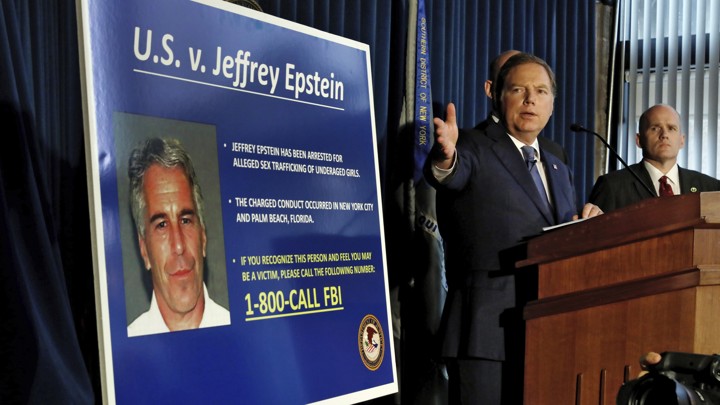
The U.S. attorney for the Southern District of New York speaks during a news conference on Jeffrey Epstein.


Federal prosecutors announce case against Jeffrey Epstein. (AP/Richard Drew)
Perhaps the most historic, in the sense of era-defining, moment in the history of the Academy Awards was that standing ovation Roman Polanski got when he was given Best Director honors in 2003. There they are, leading Hollywood liberals, leaping to their feet to cheer for a man who, at age 43, gave a 13-year-old girl Quaaludes for the purpose of having sex with her and sodomizing her. Polanski suffered in no significant way for his crime, and today it seems obvious he should at the very least be denied the highest honor his profession can bestow.
In 2018, Polanski (along with Bill Cosby) was expelled from the Academy of Motion Picture Arts and Sciences, which suddenly discovered 40 years after his crime that he was no longer in accord with “ethical standards that require members to uphold the Academy’s values of respect for human dignity.” They meant “moral standards,” but acknowledging the existence of morality is still too much to ask of the Academy. Before Harvey Weinstein, the only person ever expelled from the Academy was Carmine Caridi, an actor who appeared in The Godfather. His crime was sharing a DVD screener with a friend, who put it on the Internet.
The Jeffrey Epstein case should end a nearly 50-year era in which the mandarins of our cultures — the intellectuals, writers, and artists — almost unanimously ignored, laughed off, or even outright celebrated sexual exploitation of girls and very young women, even in many cases prepubescent ones. Humbert Humbert somehow became the culture’s idea of a barrier-breaking hero whose predilections provided jokes such as the nickname for Epstein’s infamous ‘Lolita Express’ jet, the one stocked with young flesh. Epstein’s habits were so unremarkable that Bill Clinton and Donald Trump were happy to be associated with him. Clinton and Trump were not outliers. They were simply symptoms of a disease.
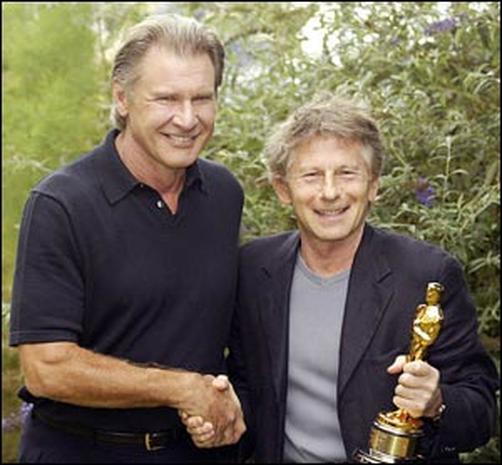
Hugh Hefner fired up a flare lighting the way to an almost anything-goes view of female sexuality, and it reached its apex at the 2003 Oscars. Under the regime of Hefnerism, conservative prudes and often the law stood charged with being uptight and repressive about sex involving girls just over or even under the age of consent. That Polanski became an exile from this country after his crime made him Hollywood’s favorite martyr. The Academy was eager to give him the Oscar both to showcase its view that he had been victimized by prudery and to dunk on conservatives. Attendees didn’t just applaud, they let out a mighty whoop of approval when Polanski’s Oscar was announced by a smiling Harrison Ford. Meryl Streep, Martin Scorsese, Weinstein, and others all jumped to their feet to participate in a chilling standing ovation. Jack Nicholson, at whose house Polanski’s assault took place, looked confused and joined in the applause, but remained seated. So did Nicolas Cage. No one captured by the cameras looked particularly peevish. As far as I know, no one in Hollywood had any problem with lionizing Polanski at the time.
Related image
Harrison Ford presented Polanski with the Oscar in Deauville, France in 2003. (AP)
Polanski is a man of his era. At 33, Ringo Starr had a No. 1 hit singing “You’re 16, you’re beautiful, and you’re mine.” Woody Allen made what felt like an autobiographical movie about a 42-year-old television writer having an affair with a 17-year-old high-school student, and nobody blinked. Time magazine put him on the cover under the legend “American Genius.” (It turned out Allen had had affairs with two teenagers around that time). Urged on by her horrible mother, Brooke Shields built a career around being jailbait, posing nude at age 10 for a Hefner publication called “Sugar and Spice,” then starring as a 12-year-old hooker in Pretty Baby (which began filming when she was 11), then at 14 starring in a film about two teens discovering their sexuality, The Blue Lagoon (though a double did her nude scenes). At 15, she starred in Endless Love, which as filmed initially received an X rating, before most of the nudity was cut to achieve an R. Whatever “controversy” attached to any of this was reported by the press solely to pump up the box office, as though conservative naysayers were aliens from a quaint, slightly daft foreign country. The media itself had no problem with it.
Look at the response to Pretty Baby, which features a nude Shields as a prostitute’s daughter who grows up in a brothel and joins her mother’s profession. (Pretty Baby, like Endless Love, enjoyed the cultural camouflage of being directed by an artistically unimpeachable European, Louis Malle. It can’t be smut if it’s arty, was the general view.) The film “takes a robust and humorous approach to life in a brothel,” wrote then–film critic Judith Martin in the Washington Post, before she became advice columnist Miss Manners. That “a daughter of the house should go into the communal family business is natural,” Martin ruled. “And the fussing and excitement surrounding her debut seem not much different from those associated with more respectable ceremonies to launch young girls. Tea dances, packing to go off to college, weddings — those, too combine titillation with finery and giggles.” Child prostitution, you see, was much like a tea dance. Penelope Gilliatt’s New Yorker review of Pretty Baby combines a panting quality with a yearning to sound tasteful that would have enthralled Humbert Humbert:
The most beautifully intelligent picture to have come out in America so far this year . . . A jammy-mouthed little girl of twelve, who is the child of a whore in the brothel, uses her virginity as a lure. . . . For all her look of the nubile, though, she could nonetheless not pass for a grown-up. . . . This may be a film set in a brothel, but it is no more lewd than a Bonnard of a naked woman in a bath. . . . There are many scenes that buzz gently with the giggles of children in the background.
In years to come, anyone learning about the Jeffrey Epstein case will ask: Why didn’t anybody raise the alarm? “What is so amazing to me is how his entire social circle knew about this and just blithely overlooked it,” the journalist Vicky Ward, who profiled him for Vanity Fair, told the New York Times. “All mentioned the girls, as an aside.” Epstein’s acts had deep cultural roots. But things don’t always stay the same, or get worse. Sometimes attitudes take a turn for the conservative. We should be grateful that standards have evolved in the right direction. The next Epstein or Roman Polanski will have considerably more difficulty getting people to shrug off their deeds, much less join in a standing ovation.

Book Review: 'Smokin' Joe: The Life of Joe Frazier' by Mark Kram Jr.


THOMAS HAUSER
https://www.sportingnews.com/us/boxing/news/book-review-smokin-joe-the-life-of-joe-frazier/12etp1cmmtze41g3g027q9kcbc
June 26, 2019

Image result for joe frazier
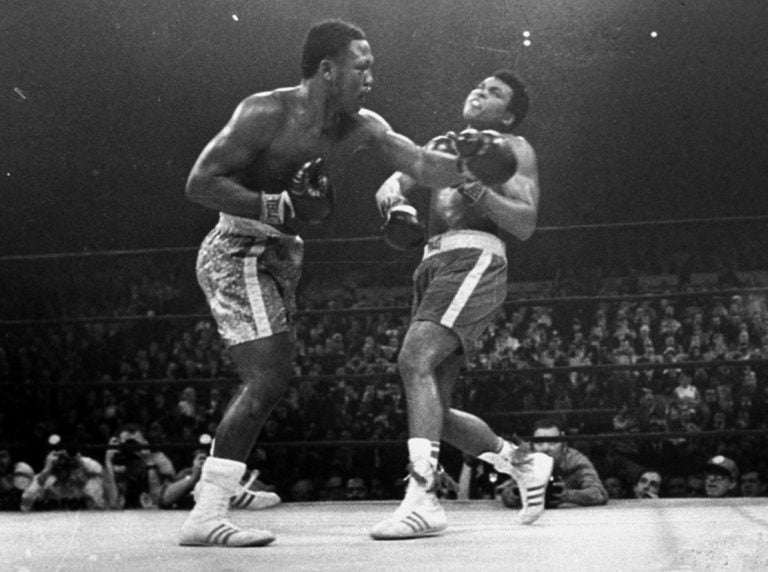
Joe Frazier and Muhammad Ali at Madison Square Garden, March 8, 1971 (AP)
Hundreds of books have been written about Muhammad Ali. As Ali biographer Wilfrid Sheed noted, "He's one of those madonnas you want to paint at least once in your life." But surprisingly few books - and fewer good ones - have been written about the men who, with Ali, defined "the golden age of heavyweight boxing." Joe Frazier, George Foreman and Larry Holmes lent their names to autobiographies. But none of these efforts did justice to their subject.
"Smokin' Joe: The Life of Joe Frazier" by Mark Kram Jr. (published by HarperCollins) does justice to its subject.
Frazier won a gold medal at the 1964 Olympics and engaged in memorable heavyweight championship fights against Jimmy Ellis and George Foreman. But he's best remembered for three fights against Muhammad Ali, historic encounters that are the pyramids of boxing.

At his best, Frazier fought with unrelenting savage fury. "His way was the hard way," Kram writes. "In the ring, he lived and died by the simple yet daring principle of engagement that, in order to deliver one bone-crunching blow, it was frequently necessary to absorb three in exchange. No one would ever have cause to question his heart or his courage under fire."
After fighting Frazier, George Chuvalo declared, "He fights six minutes of every round."
Frazier was born in Beaufort County in South Carolina on Jan. 12, 1944. His parents, Rubin and Dolly Frazier, had 11 children (eight boys and three girls).
A lot has been written about growing up in the midst of ignorance, poverty and disease in the poorest parts of rural America. Kram's treatment of the subject is well-researched and evocatively written. He writes about Frazier's early years in a way that brings "Billy Boy" (as Frazier was known then) and his surroundings to life.
It was a world where, in Kram's words, "Fifty percent of African American males [in Beaufort County] suffered from syphilis which rendered them ineligible for service in World War II. Whatever contrived harmony existed between the races hinged on the adherence by blacks to a wide range of humiliating inequities."
Frazier dropped out of school at an early age. His rural South Carolina vernacular left many with the false impression that he was "slow of mind" - an image that Ali later cruelly propagated. He took a bus north to New York where he stole cars and sold them to a junkyard no-questions-asked to make ends meet. Then he moved to Philadelphia, found work in a slaughterhouse, and took up boxing under the watchful eye of Yank Durham.
Frazier was short for a heavyweight and had a limited reach. But as Kram notes, "Beyond the raw power he spotted in Frazier, Durham ascertained that there was a big engine inside him. To counterbalance Joe's physical shortcomings, he was of the belief that Frazier only had one way to go and that was straight ahead into the chest of his opponent."
That was how Frazier fought.
Kram explores the Philadelphia gym culture and the ring wars that came with it. He chronicles Frazier's pro career from his first fight through the sad coda at the end of his fighting days, an undeserved draw against Floyd "Jumbo" Cummings. He details how, for much of his career, Frazier fought with eye damage that severely limited his vision ("I'd rather be rich and blind than poor and blind," he said).
Frazier, of course, will be remembered forever in tandem with Ali and measured forever against him.
Muhammad Ali, who proclaimed, "I outshine the sun."
"The rivalry between Frazier and Ali," Kram writes, "was a cultural happening that exposed the deep fissures in American society. By an accident of circumstances, they ended up in the crosshairs of an argument far larger than themselves."
In this rivalry, Kram notes, Frazier "came face to face with black-on-black hate language in his exchanges with Ali. Whatever heights of athletic achievement they drove each other to inside the ring, they dragged each other down in a running feud outside of it."
Kram deftly chronicles the burgeoning war of words between Frazier and Ali; a war that verged on violence between the two men on several occasions during Ali's exile from boxing. As the book evolves, all three Ali-Frazier fights are well told.
In the dressing room before Ali-Frazier I, Durham told Frazier, "Win tonight and the road will be paved in gold."
Frazier won. But even then, his dreams weren't fully realized. Ali had turned a substantial portion of the black community against him. The now-undisputed heavyweight champion of the world wasn't able to fully enjoy his reign. He never received the respect he should have as a fighter or a man.
"Smokin' Joe" covers a wide range of subjects from the formation of Cloverlay (the Philadelphia syndicate that financially backed Frazier) to Frazier's unfortunate relationship with Frank Rizzo (the Philadelphia cop who was elected mayor on a platform of not-so-subtle racism aimed at the black community).
It's infused with anecdotal material such as Frazier's effort to launch a singing career (his most notable moment as a singer came in 1970 when he slipped onstage while performing and broke his ankle).
One theme explored in depth is Frazier's profligate womanizing.
Frazier had four children by two different women (Florence Smith and Rosetta Green) before his 19th birthday. He and Florence married on June 25, 1963, while she was pregnant with their third child. They were so poor that Frazier borrowed his sister Mazie's wedding ring to use in the ceremony.
Kram describes Frazier as being "restless at home." That's an understatement. Over the years, he fathered 11 children (six sons and five daughters) by six different women. Florence was the mother of five of the children. In addition to Green, four other women - Joan Mahoney, Sharon Hatch, Janice Cotton and Sheri Gibson - carried a child of Frazier's to term.
"Frazier let the good times roll when it came to women," Kram writes. "He was prolific in his sexual adventures. Although he loved his children and took seriously his obligation to see to their welfare, he felt hemmed in by the sameness of domestic life. Occasionally, as the four walls began closing in on him, he would engage in quarrels at home late at night as a pretext to storm out of the house in search of action. He looked upon his dalliances as a prerogative due him once the [household] bills were paid."

Some of Frazier's children were raised in comfort. Others grew up in inner-city public housing. But he loved all of them. At one point, he took his 1964 Olympic gold medal to a jeweler with instructions to carve it into charms, one for each child.
In 1985, Joe and Florence began litigating a divorce. The proceeding (like a Dickensian tale out of "Bleak House") took 12 years to resolve.
Kram also gives a detailed account of Frazier's long (1968 through 2011) relationship with Denise Menz, the most consistent of his extra-marital lovers. Over the years, Menz became, in Kram's words, Frazier's "confidante, lover, business partner, and, occasionally, indentured servant. Wherever Joe appeared, it seemed that she was never far away. Charged by Frazier with running his office, she kept the books, lined up caterers, helped him choose his wardrobe, decorated the gym and the upstairs living quarters, and even did loads of laundry."
Menz (who was one of Kram's sources in writing "Smokin' Joe") said of her lover, "He would kneel at his bedside and say his prayers the way a small child would. He believed in all of the Ten Commandments except the ones dealing with adultery. He told me, 'The Lord don't care about that.'"
Menz also acknowledged what Kram calls "episodes of turbulence" between Frazier and herself with the emergence of other women in Frazier's later years. "It was the only thing we ever fought about," Menz said. "I knew I was the other woman but not that there were other women."
Frazier and Menz (who is white) also had to deal with the societal pressures of being in an interracial relationship.
"Given how society frowned upon interracial affairs in the 1960s," Kram states, "it would not have gone well for Joe if it became common knowledge that he was engaged in one. Beyond the certain havoc that it would have caused at home, it surely would have hurt his efforts to build a commercial brand."
The decades after Frazier retired as an active fighter are also well-told in "Smokin' Joe." He had always been a drinker. But he drank a lot more than he had before after his days in the ring came to an end.
Eventually, Frazier tried his hand at training fighters. In the late-1970s and 1980s, he worked with his oldest child, Marvis, who'd been born in 1960 when Joe and Florence were 16. Marvis was taller and a much lighter puncher than his famous father. He also had a not-particularly-good chin. Referencing Joe's deficiencies as a trainer, Kram observes, "When it came to passing down his know-how, he only knew the way he had done it. He was not adaptable to fighters' individual skill sets. When he worked with young fighters, it was as if he saw within them the potential to re-create himself."
Commenting on Frazier's my-way-or-the-highway approach to training, Eddie Futch declared, "You'll never be able to convince Joe that he was wrong. Anyone who disagrees with him on anything becomes the enemy."
Marvis won 19 fights as a pro but suffered brutal knockout defeats when overmatched against Larry Holmes and Mike Tyson.
One of Frazier's children is now an attorney. Another died in prison. Nine of Joe's 11 children are alive today. Kram interviewed four of them. Joseph Jordan Frazier (born to Sharon Hatch in the early 1980s) shared the thought, "My father loved the only way he knew how."

Late in life, his money gone, Frazier suffered from diabetes and hypertension. He underwent surgery for neck, back and shoulder problems. While mowing the lawn, he accidentally cut off one of his toes. Worse, he developed cognitive issues of his own, presumably from the many blows to the head he took in boxing. The final blow was liver cancer. He died on Nov. 7, 2011.
There are some nagging factual errors in "Smokin' Joe." For example, Kram writes that Ali was allowed to fight Oscar Bonavena at Madison Square Garden (with Ali-Frazier I on the horizon) because "New York had relented and given him a license on the heels of his comeback in Atlanta." But New York didn't "relent." A federal judge ruled that the New York State Athletic Commission had violated Ali's constitutional rights and ordered the commission to give him a license.
There's also a questionable interpretation of events in the book's final three pages when Kram recounts what some say was a reconciliation that took place at a private dinner between Frazier and Ali during NBA All-Star weekend in 2002. The dinner did happen. And as recounted by Kram, some kind words were spoken. But in truth, Frazier never let go of the bitterness and anger that he felt toward Ali.
Kram acknowledges as much when he begins his book by stating in the prologue, "As the years unfolded and Ali grew infirm, as his speech became slurred and his hands increasingly quivered, Frazier appeared to take cruel pleasure in the adversity that had befallen 'Clay.' 'Look at him, and now look at me.' he told me [Kram] and others. 'Who do you think came out the winner?' He had convinced himself that his signature was embossed on the physical wreck Ali had become. Even as friends reminded him that Ali was a sick man and implored him to back off, Frazier could not help himself from battering his erstwhile rival with verbal haymakers."
Near the end of "Smokin' Joe," hedging on this acknowledgment, Kram writes, "People who knew him for years told me they were sure that Frazier carried his animus for Ali to the grave, that he had been wounded so deeply that he could never let it go. But others were certain that he had come to peace with Ali, particularly those who knew him from his boyhood days in South Carolina. Nearly all told me some variation of 'Billy never hated a soul in his life.'"
But those who knew Frazier "from his boyhood days in South Carolina" were wrong. It's beyond question that, at times in his life, Frazier did hate Ali. Thus, Kram would have done better to end "Smokin' Joe" with his own eloquently worded observation: "Any conclusion either way is perhaps clouded by your own thoughts of how forgiving you would be in the same circumstances. Perhaps some of it also has to do with your own belief in the power of reconciliation, how you define 'unforgivable,' and the enchantment of happy endings."
Thomas Hauser's email address is thomashauserwriter@gmail.com. His most recent book - Protect Yourself at All Times - was published by the University of Arkansas Press. In 2004, the Boxing Writers Association of America honored Hauser with the Nat Fleischer Award for career excellence in boxing journalism.

Mark Kram Jr. on ‘Smokin’ Joe’ Frazier': ‘The ideal champion for Philadelphia, the perfect fighter for this town’


By John Timpane
https://www.inquirer.com/arts/books/mark-kram-smokin-joe-frazier-book-philadelphia-free-library-20190610.html
June 10, 2019

Image result for kram smokin joe

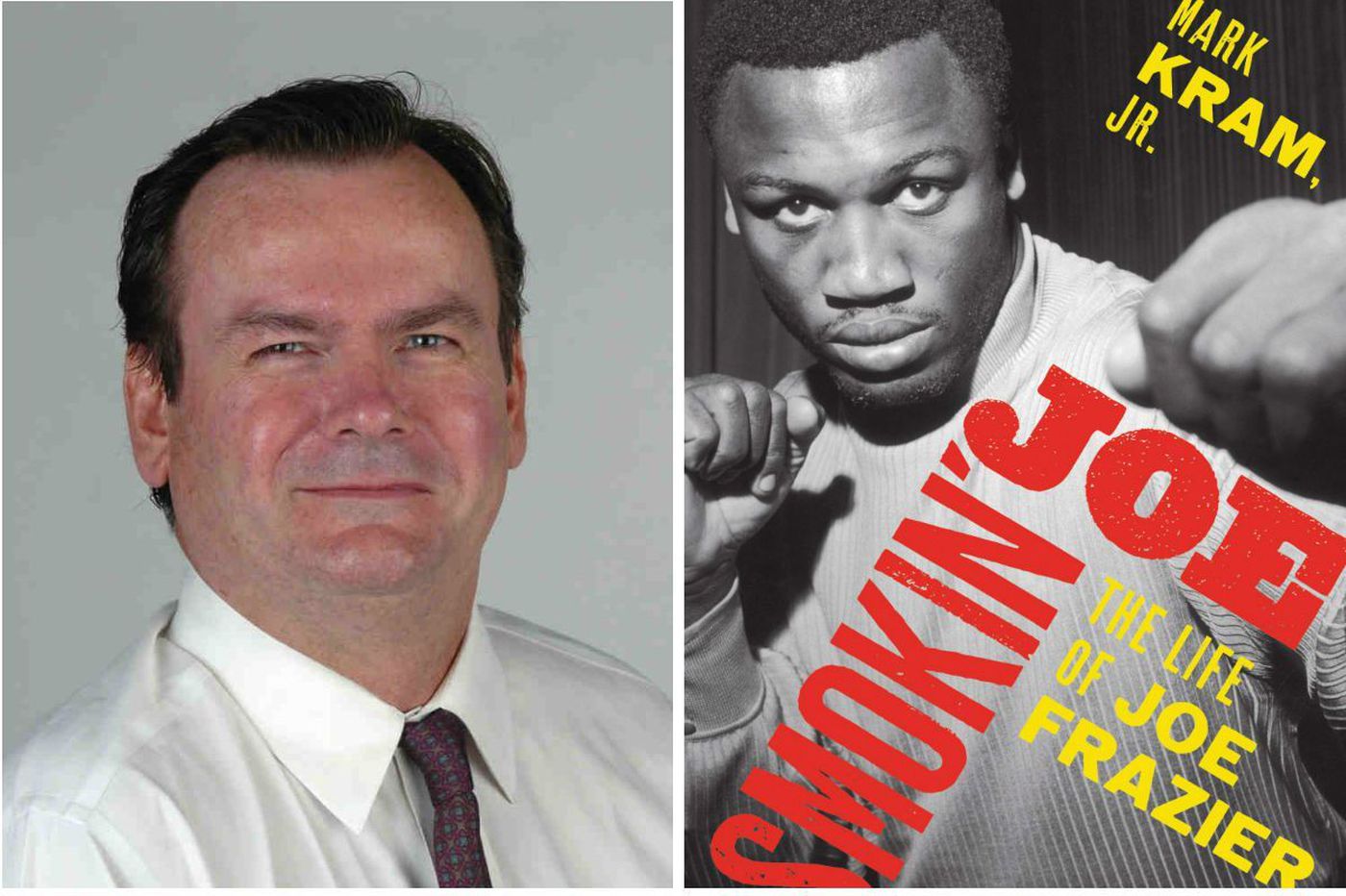
Mark Kram Jr. says that heavyweight great Joe Frazier (1944-2011), who came from South Carolina to become a hometown hero, was “the ideal champion for Philadelphia, the perfect fighter for this town.”

“He worked hard, very hard, and you could see his pride in what he did,“ Kram says over a coffee at La Colombe on Independence Mall. “He might win or he might lose, but he wasn’t going to step back for anything. Life could hit him as hard as it wanted, and he kept coming on. That was his style, and that’s how he did everything.”

Which brings Kram to a central point about Smokin’ Joe, and Philadelphians: “That’s what makes us human. We all face, in our own ways, terrific obstacles every day. But we don’t quit. We keep going at it.”

That determination and fury come through in Kram’s new biography, Smokin’ Joe: The Life of Joe Frazier. In it, Kram deploys all the skills and experience gained during his 1987-2013 tenure at the Daily News. He is the son of Mark Kram Sr., who covered Muhammad Ali for Sports Illustrated from 1964-1977 and wrote the 2001 book Ghosts of Manila, about Ali’s trio of fights with Frazier. The junior Kram happily reports that in working up his own book, he revisited, “with very real delight,” the celebrated work of Daily News sports writers such as Larry Merchant and Stan Hochman.

Why Joe Frazier now?

I’m a freelance writer these days, and one day, the idea of Joe came to me. He’s been much written about, to be sure. I wrote about him a lot at the Daily News and had many experiences with him. But a true biography, I felt, had not yet been done. In 2015 I was in my office, and I got the chills, as if some cosmic traffic light was turning from red to green. I thought, “In 10 years someone’s going to write his life, but by then many people will be gone who are relevant to his story. I have to do this now, while there are still primary sources, people who knew him and can talk about him. I wanted to step back and ask, “What were the complexities in this man and his life?” And believe me, there were many.

Whom did you go to first?

I called Denise Menz, his longtime companion for 40-plus years; and then his daughter, Weatta Frazier Collins, and they opened the doors for me. I had long conversations with people like Martha (Maizie) Rhodan, his last living sibling, who filled in a lot of holes. On that foundation, I began to report it as you would a takeout for the paper.

What were some of those complexities?

When you look at where he came from, this poor dirt farm in South Carolina, with a father who had an idea of maleness that he passed down to his son … and you think of Joe’s travels, from there to Philadelphia, to the Olympic Games, to stardom, to the very top. You see the anger, the maybe-too-much pleasure in partying, the parental and spousal issues, you see those things — and then you see another man.

Another man?

He was fundamentally a very big-hearted man. In the prologue, I tell the story of him driving down Broad Street, going to Atlantic City, and he sees a legless man in a wheelchair, with a can of kerosene in his lap, and Joe stops and takes him home. And he tells his boys: “This is what a man does.” He pulled money out of his sock and helped strangers he met. He visited the hospital and used to sit with the cancer patients and cry. Toward the end of his life, he forgives his manager, Eddie Futch, who he felt had ended the third Ali fight too soon. And there’s, finally, a climactic scene with Ali. Those scenes go right to his character.

Frazier will inevitably be linked with Ali, whom he beat for the first time in Ali’s career in 1970, and from whom he absorbed two murderous beatings in 1975. The book is about Frazier, but their relationship is an important through line in your story.

Joe says it himself at one point: “He said once I would have been nothing without him. But what would he have been without me?” You could argue he resurrected Ali, only to knock him on his can. And his fury at Ali in and out of the ring, it went far beyond Ali. It went back to Frazier’s beginnings, his upbringing, the hard life and hard work, the sense of being seen as less-than.

The arc of a prizefighter’s life is so often tragic. Ali is the best-known example. But you don’t see Frazier’s life as tragic.

Joe was much beloved. As a fighter, he had this get-there-early-stay-there-late ethic, so much in evidence in his work at the gym on Broad Street. Was there diminishment, in the latter stages of his career, and in his final years? Yes, there was diminishment. But he left a mark upon this city, and many people really loved Joe Frazier. Joe was seen as the ultimate overachiever, almost a symbol of the city. On a person-to-person level, he inspired affection and gratitude in hundreds of people. No one is calling him perfect; far from it. But any life like his, you can’t call that tragic.

Monday, July 08, 2019

WHEN BRITISH JUSTICE DIED


By Bruce Bawer
July 8, 2019
Tommy Robinson arriving at the Old Bailey on Friday.
Tommy Robinson arriving at the Old Bailey building on Friday. (Yui Mok/PA)
Trial by trial, imprisonment by imprisonment, dishonest news report by dishonest news report, the miserable bastards who make up the British establishment are steadily transforming Tommy Robinson, a working-class husband and father from Leeds, into an imperishable symbol of the quiet determination, indomitable courage, and love of liberty for which Britain used to be known but which that selfsame establishment has labored effortfully to stamp out during these opening chapters of the Islamization of that once-great nation.
Even those of us who have been closely following Tommy’s treatment by the British courts during the past couple of years – and who, perusing the charges against him, have recognized just how outrageously he has been treated by a judiciary committed not to justice but to the silencing, and if possible personal destruction, of this latter-day Jeremiah – were stunned by the verdict handed down on Friday after a two-day trial.
This was a rehearing of the same case that last year landed Tommy in prison (more specifically, in what amounted, in violation of the Geneva Convention, to solitary confinement), an ordeal from which he emerged, after two months, looking physically and psychologically all but broken. The charges themselves were absurd to begin with: he was taken into custody near the courthouse in Leeds, where he was doing a live report on Facebook video about an “Asian grooming-gang” (i.e. Muslim child-rape) prosecution that was underway inside. He didn’t do or say anything that any BBC or Guardian journalist in similar circumstances might do; but he was arrested anyway – on the grounds that his reporting from out on the street had somehow threatened to prejudice the trial going on inside the building – and was charged with contempt of court.
The speed with which he was tried, convicted, and incarcerated after his arrest in Leeds – the whole process took just a few hours – shocked observers who still thought of British justice as something serious and worthy of respect. His release from prison two months later came after the Lord Chief Justice of England and Wales, in an unusually blistering ruling, declared that the court proceedings against him had been illegitimate in a number of ways, and ordered his immediate release.
That solitary glimmer of fairness from the Chief Justice led some of us to hope that Tommy might, in the end, receive something resembling real justice. But no. Contrary to the expectations of many, a retrial on the same feeble charges was scheduled. At the Old Bailey in London on Thursday and Friday, the weakness of the case against him was painfully obvious. Reporting from a street near the courthouse during a lunch break on Friday, Ezra Levant of Canada’s Rebel Media, who attended the trial (and who himself happens to be a lawyer), pronounced on a YouTube video that “this is as close as it comes to a sham trial as I’ve ever seen in a Western democracy.”
He added – and I’ve made the same point previously in articles about this seemingly endless process of judicial harassment – that if this were happening in someplace like Russia, international human-rights organizations would be shouting about it from the rooftops and calling it out for exactly what it is: namely, the kind of nakedly political prosecution that we like to think happens only in totalitarian countries. But even Levant, at midday on Friday, confessed to feeling positive: the first day and a half of the trial had laid so totally bare the weakness of the prosecution’s case that a conviction seemed inconceivable.
But by the end of the day Levant had been proven wrong. The judges, Dame Victoria Sharp and Sir Mark Warby (whom we are supposed to refer to as The Hon. Mr. Justice Warby, but the hell with that), pronounced Tommy guilty. He may get up to two years behind bars: we don’t know yet. In reporting on the verdict, British court reporters – who every day do exactly what Tommy had been convicted for – could barely constrain their glee at what they saw as his comeuppance. He had taken them on, all of them – the judges and MPs, the reporters and professors, the police chiefs and high-ranking civil servants who run that blighted island (and in doing so are running it into the ground) – and, although he had justice on his side and a large and ever-growing segment of the British populace at his back, he had lost.
But those judges, and their entire network of cronies and confederates in the British political, cultural, academic, and media establishment, are fools indeed if they think this means they have won. Thanks to their fatuousness, knavery, and cowardice, Tommy is – step by step, injustice by injustice – growing into nothing less than a world-historical figure, a living symbol of the determination of the Western multitudes to preserve their free civilization in the face of an elite, at once arrogant and craven, that has plainly decided to stand by and manage its gradual subjugation to an alien tyranny.
Tommy is, if you will, our Nelson Mandela or John Brown, only without blood on his hands; he is our Churchill in the 1930s wilderness, sounding the alarm about a looming menace – except that Winston had a bully pulpit in Westminster, while Tommy appears, once again, to be headed back to jail. Rosa Parks became immortal for refusing to sit in the back of one bus on a single day; Tommy faces worse things than a Montgomery, Alabama, bus driver every day of his life, and doesn’t have an organization with the power and resources of the NAACP behind him. Also, Rosa Parks was the face of a cause of which the mass media of the time fully approved; today’s legacy media view Tommy as an existential threat to the power structures of which they are a part, and treat him, accordingly, with consistent dishonesty and disdain.
On Friday evening, after Tommy’s verdict came down, my friend Valerie Price, who runs Act for Canada and who attended the trial, wrote a posting about it on her Facebook page that concluded as follows: “I fear that if the Crown sends him back to prison, this will be the spark that ignites a class war.” The next morning, in a private missive, she expanded on this thought: after Tommy was pronounced guilty and they all filed out of the Old Bailey, the crowd outside, she told me, was “in a rage and ready to ‘storm the Bastille.’” Well, I’m not entirely sure whether it’s wise or not on my part, but I find myself hoping that if Tommy is sent to prison, his supporters do drop their British restraint down the loo and, just this once, act like an eighteen-century French mob. That may be the only thing that will make the torpid, turpitudinous rogues in Westminster sit up and take notice, and perhaps even cause Her Majesty to look up from her tea.
But of course not even a heaping dose of Gallic-style canaillerie on the part of the Eastenders set will do the job that needs to be done: if there’s any possibility of saving Britain from the fate about which Tommy Robinson has been warning all these years, the first real step has to be a general election that sweeps both major parties out of power and into the dustbin and installs in their place a new government that actually represents, and is willing to act boldly on, the will of the British people – and that, moreover, treats Tommy not with condescension but with the respect he deserves. Which is all by way of saying that I’ll know the UK is headed in the right direction when it has a prime minister who recommends Tommy Robinson for a knighthood.
Bruce Bawer is the author of “While Europe Slept,” “Surrender,” "The Victims' Revolution," and "The Alhambra." "Islam," a collection of his essays on Islam, has just been published.

Today's Tune: Rodrigo y Gabriela - Terracentric

Rodrigo y Gabriela: Acoustic guitar duo playing Bluesfest has roots in Mexican hard rock


By Lynn Saxberg
https://ottawacitizen.com/entertainment/local-arts/rodrigo-y-gabriela-acoustic-guitar-duo-playing-bluesfest-has-roots-in-mexican-hard-rock
July 4, 2019

Image result for rodrigo y gabriela

Gabriela Quintero describes the acoustic guitar as the universal instrument. It’s portable, doesn’t need to be plugged in and you can play any style of music on it. 
“You can be a singer-songwriter, or you can play jazz, classical, Spanish classical, country music, blues, Mexican. There are so many possibilities,” says the guitarist who, along with her musical partner Rodrigo Sanchez, forms the fast-rising guitar duo of Rodrigo Y Gabriela. Their uncompromising acoustic stylings have accomplished the unlikely feat of selling out some of the world’s most legendary venues, including Colorado’s Red Rocks Amphitheatre, The Hollywood Bowl and London’s Royal Albert Hall. They make their Ottawa debut Friday at Bluesfest. 
Compared to the metal onslaught of their first band together, a pair of acoustic guitars is also “easy on the ears for everybody,” she adds. “If we want to play on the streets or in restaurants, we know that a lot of people, including our own families, are not super fans of the metal sound, with the distortion and all that. Luckily we love all music so it wasn’t hard to switch.” 
The former romantic couple, now friends, shifted from electric to acoustic more than 20 years ago, after meeting as teenagers at an art house in Mexico City and spending their early years going to metal shows and playing in a hard-rocking band. Disillusioned by the band’s ambition to be rich and famous, and stymied by the lack of record-company interest, they left the group.
“We decided to quit the band but not the guitar,” Quintero says. “So we changed the electric for two acoustic guitars. We had our own vision of success at that time, and we decided that success was going to be travelling the world to keep playing and keep learning music. So we did that.”
They headed for Europe and ended up spending a year in Ireland, which turned into a fruitful period of artistic development. They shared a small apartment with an Irish couple, practised guitar together every day and busked on the streets to make a bit of money. Covers of hard-rock nuggets like Enter Sandman and Stairway to Heaven kept the spare change coming.
Along the way, Quintero began to develop her unusual percussive style, adapting the bodhrán technique to guitar to create a distinct rhythm. “We saw a lot of this Irish traditional music playing and we saw people playing the bodhrán, an Irish drum. I started to practise the movement and play it on guitar, and it sounded like we had beats.”
In Dublin, one person who stopped to watch them play on the street was singer-songwriter Damien Rice, who had yet to release his breakthrough solo debut. They became friends and when they crossed paths again, Rice was about to release his album, O, and invited the pair to open for him at an industry gig. That night, they met Niall Muckian, who is still their manager. 
Over the years, they’ve released five albums, selling more than 1.5 million units in all, and performed at some of the world’s biggest festivals. Their music has been part of the soundtracks to Puss in Boots and Pirates of the Caribbean: On Stranger Tides, and they’ve appeared on several American talk shows. They also performed at a reception for the President of Mexico hosted by former U.S. president Barack Obama. 
The latest news in a still-growing career is the release of their fifth album, Mattavolution. The main goal, says Quintera, was to avoid repeating themselves. “It was a bit of a struggle for three years,” she reveals. “Then one day, something unlocked and we started to get momentum, and new melodies started coming in. If you listen carefully, they’re like songs.”
The new music reflects their view of the world, which is informed by their interest in Buddhism and regular meditation. “We both meditate. It’s been a very helpful tool for us on the road. It’s easier and cheaper than drinking or pills,” Quintero says. 
“The whole album is conscious of the world, and our vision that it can hold a compassionate human society. The compassion starts with one person, but it’s also an inclusive concept that includes compassion for animals and the natural world, and all other living beings. Just be the best version of yourself and that way we can change the world.”
lsaxberg@postmedia.com
Related:

Rodrigo y Gabriela: They’ve come a long way since busking on Grafton Street-


Rodrigo y Gabriela return to their roots with a new album


By Mark Kennedy
https://www.apnews.com/9c828c73522a423c831abc4982ee9c1a
June 12, 2019

Image result for rodrigo y gabriela

NEW YORK (AP) — Years ago, when Rodrigo Sanchez and Gabriela Quintero would show up at some small European town with their acoustic guitars, they loved to tease the audience.

People would spot the two Mexican artists and assume they should brace themselves for some sort of classical or traditional performance. Then Sanchez would play a little “Stairway to Heaven.” Giggles would fill the pub or community center.

“If we’re playing two nylon-string guitars, you’re not supposed to play Led Zeppelin or Metallica,” Sanchez said. Quintero, of course, was in on the joke: “You break the cliche.”

Rodrigo y Gabriela have been busting musical barriers ever since, melding the power of thrash metal with fiery Spanish melodies. The acoustic, instrumental rock duo has gone back to those memories to create “Mettavolution,” their first album in five years.

“The challenge for me and Rodrigo was to reconnect with that original idea — just doing music that is authentic to us and that is genuine,” said Quintero.

“Mettavolution,” a word they created to mean evolution through compassion, offers six original tracks and one ambitious cover — a 19-minute version of Pink Floyd’s 1971 epic song “Echoes.”

For the album, producer Dave Sardy added some bass, synths and percussion for texture to Sanchez’s mesmerizing finger-picking, and Quintero acts once again as the rhythm section — complete with her drumming on the guitar body.

Intriguingly, the duo added lyrics to many tunes but didn’t record them. “I think it was a very important change in the way we approach music in this album because it made it much more melodic,” Sanchez said. They hinted that perhaps they may one day release the tracks with a real singer aboard.

The pair has long done covers of other artists’ songs and Pink Floyd is a favorite band. They wanted to do their version of “Echoes” for at least 10 years but only attempted it last year for a concert at the Hollywood Bowl. A representative from their record label came and loved it, insisting it appear on their next album — something Rodrigo y Gabriela had quietly wanted.

“Echoes,” with its lyrics about reconnecting to humanity, also works into the theme of the album. “I think we are at that age where you start to think differently now. And to understand that life is about all of us — we are this one entity here,” says Sanchez, 45.

Listening to Sanchez and Quintero play, it’s hard to believe two people playing guitars can make music this powerful and absorbing. It’s even harder to believe that they’re self-taught musicians.

“This is my theory: Because we didn’t go to school, we’ve got no boundaries in our heads,” says Quintero, 46. “For us, it was not sacrilege to try to jam with any piece we both liked. It could be a punk piece to any classic sort of thing.”

Both began their careers playing in a little-known Mexico City speed-metal band. They then teamed up, moved to Ireland, and played unplugged Slayer tunes on the streets of Dublin until the 2006 release of their self-titled U.S. debut.

Along the way they got plenty of advice, particularly from people suggesting they add a vocalist because radio wasn’t receptive to instrumental music. They refused.

“Our meaning of success was playing guitar and traveling the world. So we already made it from that point of view,” Quintero said, laughing.

Looking back, they say they’ve become less perfectionistic. It’s not about playing every note perfectly but being present and letting the music speak.

“I mean the notes have to be the right notes, obviously. But it’s more important to understand that you play with heart, with soul, and if you miss one or two notes, OK. It doesn’t matter if you know the interpretation was good,” says Sanchez.

Asked if they’ve yet reached the limit on what they can do on two acoustic guitars, the pair laughs.

“Twelve notes for everybody, from Mozart to punk. That’s it,” says Quintero. “The acoustic guitar has no limits. It’s just endless.”
___
___
Mark Kennedy is at http://twitter.com/KennedyTwits