Sunday, July 07, 2019

Friendship Among the Inklings


By 
https://theimaginativeconservative.org/2019/07/friendship-among-inklings-bradley-birzer.html
July 5, 2019

Image result for the inklings eagle and child

“Is any pleasure on earth as great as a circle of Christian friends by a fire?” C.S. Lewis once famously asked. Surely not, he continued. “Friendship is the greatest of worldly goods,” Lewis declaimed. “Certainly to me it is the chief happiness of life. If I had to give a piece of advice to a young man about a place to live, I think I should say, ‘sacrifice almost everything to live where you can be near your friends.’” Naturally, as the Zaleskis have so powerfully and persuasively argued, Lewis was referring in these and other discussions on friendship to his own friendship with that group most associated with him and the Oxford of his day, the Inklings.
Given that Lewis had presented himself in his early poetry, in his diaries, and in his letters as a radical individualist in the Nietzschean and Wagnerian fashion, the great Christian apologist almost certainly learned the immense value of friendship while at Oxford—as a student and as a professor. As a student, he learned it from Owen Barfield and, as a professor, he learned it from his colleague, J.R.R. Tolkien.

Tolkien had, after all, always loved friendship and relationships. Having lost his father and his mother at a young age and two of his three closest friends (in the TCBS) to war, he knew how precious friendship was and how fragile it could be in this world of sorrows. He not only held onto friendship for dear life, but he also incorporated it into every aspect of his literary mythology. As such, friendship is a central feature, not a quirk, of Tolkien’s stories.
In The Hobbit, the dwarves and Bilbo bond around the fire in Bilbo’s Hobbit hole and in the last homely house of the West, Rivendell. In The Lord of the Rings, Gandalf and Frodo discuss the most urgent matters imaginable nearby Frodo’s fire in his Hobbit hole. Again, the same would be true around Tom Bombadil’s fire and around Elrond’s. Bilbo even mentions that time has very little meaning in the room where tales are told.
Even in his earliest mythological writings, The Book of Lost Tales, Tolkien based the narrative around the device of the fire.
Eriol saw now that they were in a short broad corridor whose walls half-way up were arrassed; and on those tapestries were many stories pictured whereof he knew not at that time the purport. Above the tapestries it seemed there were paintings, but he could not see for gloom, for the candle-bearers were behind, and before him the only light came from an open door through which poured a red glow as of a big fire. ‘That,’ said VairĂ«, ‘is the Tale-fire blazing in the Room of Logs; there does it burn all through the year, for ’tis a magic fire, and greatly aids the teller in his tale—but thither we now go,’ and Eriol said that that seemed better to him than aught else.
Further, Tolkien writes, as with Elrond’s fire, the effect hits all immediately:
Then all that company came laughing and talking into the room whence came the red glow. A fair room it was as might be felt even by the fire-flicker which danced upon the walls and low ceiling, while deep shadows lay in the nooks and corners. Round the great hearth was a multitude of soft rugs and yielding cushions strewn; and a little to one side was a deep chair with carven arms and feet. And so it was that Eriol felt at that time and at all others whereon he entered there at the hour of tale-telling, that whatso the number of the folk and children the room felt ever just great enough but not large, small enough but not overthronged.
In trying to understand the importance of the Inklings, many scholars have asked if the members of that august group thought alike and arrived at the same answers. Were they all Christian? Were they all middle class? Were they all reactionary? Were they all romantic?
One younger member of the group, John Wain, even thought of the Inklings as a sort of reactionary cell. They were, he claimed, “a circle of investigators, almost of incendiaries, meeting to urge one another on in the task of redirecting the whole current of contemporary art and life.”
To be sure, though, the greater question one should ask is not at what answers did the group arrive, but, rather, what questions did they ask? It was their very questions—and the trust that comes with asking questions—that defined them. As such, they asked about the limits of heroism, the nature of beauty, the connection of the pagan to the Christian, the relationship of holiness and sanctity, the interplay of technology and magic, and the connectedness of flesh and soul. They discussed mythos (story) and logos (idea), and they shared with one another their most intimate thoughts and questions.
An American visitor, Father Chad Walsh, described the conversation of the Inklings as coherent at the moment, but somewhat bewildering in hindsight. “Only in retrospect did I realize how much intellectual ground was covered in these seemingly casual meetings,” Walsh reported. “At the time the constant bustle of Lewis racing his friends to refill empty mugs or pausing to light another cigarette (occasionally a pipe) camouflaged the steady flow of ideas. The flow, I might add, is not a one-way traffic. Lewis is as good a listener as talker.”
One might not even go too far in suggesting that, for the Inklings, friendship had a mystical element. Charles Williams and C.S. Lewis even toyed with the idea that lovers or friends might share their pain with one another, sometimes literally taking the pain away from a friend or lover.
Still, no one should ever take friendship for conformity or squishiness. On this, Warnie Lewis, Jack’s brother, should get the last word:
The ritual of an Inklings was unvarying. When half a dozen or so had arrived, tea would be produced, after which when pipes were alight Jack would say, ‘well has nobody got anything to read us?’ Out would come a manuscript and we would settle down to sit in judgement upon it. Real, unbiased judgement too, for about the Inklings there was nothing of a mutual admiration society; with us, praise for good work was unstinted but censure for bad, or even not so good, was often brutally frank. To read to the Inklings was a formidable ordeal.

Angry About Border Conditions? Blame Congress


By Rachel Bovard
https://amgreatness.com/2019/07/06/angry-about-border-conditions-blame-congress/
July 6, 2019

Rep. Alexandria Ocasio-Cortez (D-NY) addresses the media after touring the Clint, Texas, Border Patrol Facility housing children.
Rep. Alexandria Ocasio-Cortez (D-NY) addresses the media after touring the Clint, Texas, Border Patrol Facility housing children.(Getty Images)

The woke social media over the Fourth of July was something to behold. On America’s birthday, posts were full Trump-baby angstreferences to illegal militias, treasonous criminality, and concentration camps, and carefully styled photos of summer desserts that spelled out “close the camps” on top of seasonal fruit.
Because you know what you do if you think child migrants are actually being tortured by your government and dying in concentration camps? You channel all your first-world, virtue signaling rage into the creation of artsy and seasonally appropriate desserts that are just perfect for that People photoshoot.
But the misplaced rage was not limited to social media. In the annals of Wokes versus People Living in Reality, this week was one for the books. Representative Alexandria Ocasio-Cortez (D-N.Y.), the avatar of lefty rage-emotes everywhere, visited the border and had a complete meltdown.
Ocasio-Cortez told reporters she “was not safe from the officers,” and that migrants were forced to drink out of toilets while being subject to “psychological warfare.”

“This has been horrifying so far,” she tweeted. “It is hard to understate the enormity of the problem. We’re talking systemic cruelty w/ a dehumanizing culture that treats them like animals.”
If what she’s saying is true—members of Congress being threatened for asking questions, migrants housed in World War II-style detention camps with only toilet water to drink, “mass atrocities” being perpetuated by the government—then we are indeed in a crisis.
But none of this is true. None of the migrants housed on the border are being held against their will. While Ocasio-Cortez provided no photos of the toilets from which she claims migrants are forced to drink, those familiar with border detention facilities suggest she is referring to this type of drinking facility which is connected to a toilet—but does not dispense actual toilet water from the faucet, as she claims. And, as former Department of Homeland Security Secretary Jeh Johnson pointed out this week, the practice of holding migrants in “cages” after detention started under President Obama.
In fact, the entire statutory regime under which the Trump Administration is handling the border crisis is the same as it was under President Obama. Because, despite years of reasons to act, Congress has refused to change the laws governing immigration, the agencies in charge of handling it, or the resources available to them. The conditions at the border remain largely the same as they have been for years, and Border Patrol remains overwhelmed and undermined.
Reality Check: 2014 vs. 2019
This is not to say that conditions at the border aren’t terrible. They are. The Border Patrol is out of space and rapidly running out of money, and Health and Human Services, the department responsible for taking care of unaccompanied minors, is underfunded. It’s why the president declared a humanitarian crisis and asked Congress for more resources to house the current influx of migrants. (For over two months, the Democrats called the crisis fake, and blockedhumanitarian funding—including more beds—17 times.)
The problem with the Democrats’ current outrage is not necessarily the subject matter. It’s fine to call out terrible conditions where they exist. But the problem arises when the outrage appears politically expedient. And it’s compounded when Democrats refuse to act on any viable solutions.
Representative Joaquin Castro (D-Texas) joined Ocasio-Cortez on last week’s visit, and expressed the same levels of outrage as she did. However, Castro also visited an Obama-era facility in 2015, with very similar conditions. He called the visit “very emotional,” and joined more than 100 other Democrats in sending a letter to Jeh Johnson, asking him to end the use of family detention facilities.
But missing were the Trump-derangement levels of rage seen from the same Democrats this week, the comparisons to concentration camps, the claims about treating migrants as “animals.”
Nor was there any appreciation for the sheer drastic increase in numbers with which Border Patrol now must contend because of the agitation among immigrant activists who have pushed people to throng our border.
In fiscal year 2014, when President Obama declared a humanitarian crisis, the Border Patrol in the Southwest border sectors apprehended 136,986 migrant families and children. In just the first eight months of fiscal year 2019, Border Patrol agents have apprehended a total of 389,259 families and children—a 184 percent increase.
Moreover, the 2019 total includes adults falsely claiming to be the parents of children who aren’t theirs, or migrants over the age of 18 posing as children. In April, Border Patrol officials said they had identifiedmore than 3,000 of these “fake families,” and the trend is growing.
In Tijuana, groups of men are attempting to purchase or steal children to accompany them to the United States—where entry with a child will facilitate an earlier release into the country where they are supposed to wait for a court date they will never attend. The going rate for a child is reportedly $350.
What Solution Do Democrats Want?
While Democrats howl about conditions at the border and the detention of migrants, it’s worth asking, what is their preferred solution?
Federal law, sensibly, does not allow an immigration official to turn migrants loose as soon as they are apprehended. This is particularly true with unaccompanied children. The law requires detained migrants to be processed, asylum claims adjudicated, and, when it comes to children, a determination of whether or not the adult they are traveling with is, in fact, the child’s parent.
All of this takes time, and more of it when the Border Patrol is overwhelmed with thousands more migrants arriving each day. Many times, adults and families claiming asylum are released into the interior of the country to await a court date years in the future. Unaccompanied children are handed over to Health and Human Services’ Office of Refugee Resettlement, where agency officials work to reunite children with family they already have in the United States, or place them in foster care.
In a bizarre twist during the debate over funding humanitarian resources at the border, House Democratsdemanded that HHS not be able to share information with Immigration and Customs Enforcement when it came to placing children—thereby reducing the ability of HHS to know if it was placing children with safe families.
Everything CBP, HHS, and ICE are doing complies with existing federal law. The agencies, as they have been for years, are underfunded, understaffed, and undermined by the selective outrage of Democrats who apparently have just awakened to these problems and would rather virtue signal than address them meaningfully.
But the underlying question in all of this is, “What policies would Democrats prefer?” Letting unaccompanied children loose into the streets? Releasing everyone who is apprehended coming across the border, with little regard for who they are and what they’re really doing here?
Based on their responses in the last debate, the answer is yes. Democrats either have no solutions to the border crisis, or offer inexplicable ones like “fixing climate change.”
If this is the best they have to offer, Democrats are not a serious or credible participant in addressing conditions at the border—or the statutory regime they’ve had the ability to alter for years. They can scream about Trump all they want, but the reality is, the fault doesn’t lie with his administration or even with previous ones. It sits squarely on the shoulders of the lawmakers who would rather tweet and name-call than reform the law or secure the border.

Saturday, July 06, 2019

Antifa: Terrorists of the Bourgeoisie


By 
https://amgreatness.com/2019/07/04/antifa-terrorists-of-the-bourgeoisie/
July 4, 2019

Related image

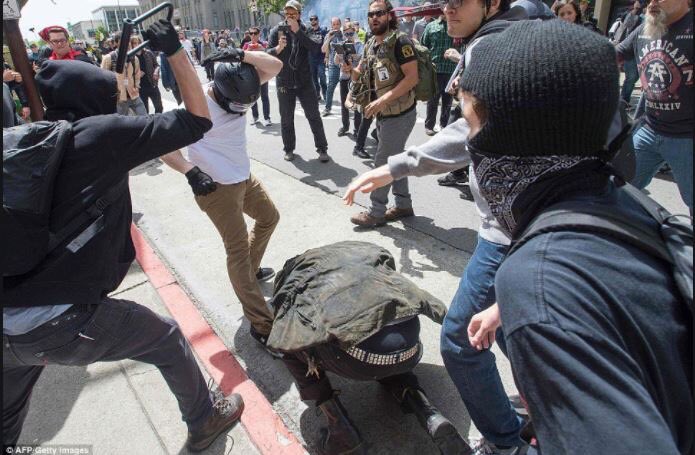
The savage assault on journalist Anti Ngo by leftists in Portland, Oregon, has brought renewed attention to the barbaric Antifa organization.

Ngo, a journalist for center-left online magazine Quillette, was beaten by a mob and sent to the emergency room with a brain bleed while filming demonstrators from the group. He is the victim of a criminal, terrorist act. The only normal, appropriate response is to wish him a speedy recovery—and to demand the swift arrest and prosecution of his attackers.
Here is the danger that journalists like CNN’s Jim Acosta constantly warn about from the comfort of their sinecures. But instead of blaming Antifa, the media responded to an actual assault on a journalist with equivocation and muted indifference. Reporters latched onto a “concrete milkshake”rumor to downplay the fact that Ngo was assaulted. Outside of a few token denunciations, the media ignored the attack, joining the ghoulish scolds who blamed Ngo, the victim, for “provoking” Antifa.
Why this response? Journalists know that Ngo is not one of them, which is to say they are safe. They are “real journalists,” liberal activists who evangelize their “truth” behind a mask of neutrality.
Many on the Right have noticed, with alarm, that the media turns a blind eye to leftist violence, and this is no mistake. Antifa are the untamed, unhygienic foot soldiers of the bourgeoisie. It’s an unfortunate position for so-called Marxists to be in, but it’s true: Antifa does the dirty work that’s too low for even the professional smear artists behind Covington Catholic, Russiagate, and the slander against Brett Kavanaugh.
Instead of calling Antifa “fascists,” which they are not, it would probably upset them more to call them what they really are: communists and anarchists pretending to be dissidents, while enjoying the protection of those in power. They’re rebels without a cause, with all of the adolescent angst that title implies.
Antifa members are plainly terrorists, and their violence is no joke, yet their activism is superfluous, narcissistic roleplay. Antifa justifies violence by appealing to an urgent threat of “bigots” having a platform, as if Big Tech corporations were not already taking care of that for them. Their “revolt” is happening from the top-down, not the bottom up.
The most prestigious papers and universities, the most powerful corporations, share in common with these malcontents a liberal monoculture that has hollowed out and colonized American culture. Their most relevant political ideas—open borders, kooky gender theory—have already been co-opted by the mainstream. Marxism, on the other hand, is an academic philosophy with virtually no relevance to the political world anymore.
Historically, Marxists railed against the bourgeois. Today’s “revolutionaries” are the bourgeois. What could be more horrifying, more injurious to a Marxist’s self-esteem—to be on the same side as Nike?
Leftist revolt is, these days, a contradiction in terms. But a veneer of dissidence is politically necessary for their project. A dominant Left takes up the mantle of the underdog to justify chasing conservatives out of the public square.
Antifa shares with their journalist sympathizers a romantic, misplaced sense that they are persecuted rebels. It must pain Antifa and their cheerleaders in Brooklyn to know that their ideas have been absorbed into mass culture. Having the same viewpoints as Fortune 500 companies and Stephen Colbert isn’t so punk, is it? It’s obviously not edgy or cool, but a desire to role-play as turn-of-the-century labor agitators persists.
The Left therefore has a dilemma: how to be transgressive, when the opportunities for transgression have been taken away? Answer: invent an imaginary, omnipresent threat of Nazis in need of being punched.
This is where the revolutionary make-pretend of Antifa and persecutory delusions of elite journalists solemnly intoning “Democracy dies in darkness” converge: leftism is culturally dominant, but the Left can’t give up the label of the dissident to the very people they are forcing their ideology upon. So the Left convinces itself, and tries to convince everyone else, that there is an ascendant “fascist” threat. Violent public tantrums are rationalized as the necessary pushback.
But these fancies of persecution are all backwards. Even the fringiest leftism is boring, milquetoast, and safe. Despite Trump’s attacks on the “free press,” journalists—at least liberal journalists, anyway—incur no risk when they tattle on Catholic high school boys from the heights of power for “smirking” at a Native American, or print libels about the president of the United States with impunity, or publish op-eds about how toxic the West is.
For journalists in the era of Trump, Trump’s attacks on their largely unchecked power to influence public opinion is imagined as an assault on democracy. But journalists have worked to stifle democracy, not merely by discrediting an election but by forcing their unpopular ideas on a population that has rejected their elite ideology.
Journalists have a grandiose tendency to style themselves martyrs for democracy, but really they are paladins of the powerful, agents of the illiberal liberalism that Americans voted to reject in 2016. Trump’s election was a true bottom-up rebellion at the ballot box against this oppressive monoculture. Their vote was for common sense over political correctness, national identity over open borders.
Related image
Despite Trump’s rise to power, the Left remains firmly in control of the culture. So they invent an imaginary rampant bigotry and romanticize the danger faced by the brave journalists and activists “fighting for democracy” to justify the indefinite advance—by violence, if necessary—of progressivism. What “fighting for democracy” actually means, it turns out, is fighting for leftism at any cost, whether by encouraging violence against dissenters or preaching about the pressing need for Portland, Maine, to accept Third World refugees.
On some level, it must bother the next generation of progressive activists-in-training at elite universities to recognize that they enjoy vastly more privilege than the downwardly mobile whites they castigate as the spawn of Satan. That projection soothes the conscience, keeps the obvious contradiction out of mind: America’s most privileged people are constantly reminding everyone else, especially those on the decline, of privilege they don’t have.
While Antifa’s “revolution” is a complete joke, the movement’s methods are not, and the mainstream Left is still wise enough to maintain a careful distance with token criticism of its violence. But Antifa offers something too useful to be rejected for the bougie progressives who occupy the halls of power. They are a threat, a warning, for those Americans who refuse to bow down before Progress and History.
The media will go to any length to defend the fringe left against even the most moderate conservative. Andy Ngo is hardly right-wing: Quillette prides itself on being a bastion of classical liberal centrism. But liberal centrism, failing to be progressive, is an aberration that the Left hates like a true believer hates a heretic.
More and more conservatives are alarmed by a growing tendency on the left to tolerate worse and worse violence against them. “Milkshaking” is fast giving way to blaming the victims of mob beatings—because they’re on the wrong side. In tolerating Ngo’s attack, the liberal establishment has sent an ominous message: the future of the United States has no room for conservatives or their “bigoted” notions, and conservatives who do not surrender now should expect the worst.
One can only speculate about what motivates individual members of Antifa to wake up every morning, but quite a few of them seem to be mentally ill, maladjusted dropouts. To hazard a guess, activism for Antifa members is a kind of public therapy, an excuse to be terrible people and unleash violent resentments on a scapegoat for their personal problems.
They have a desire to terrorize and inflict harm, but there is nothing for them to fight for that has not already received the sanction of those in power. This is, admittedly, a frustrating situation for people who are desperate to be a part of history, but whose role has already been usurped by Silicon Valley, the FBI, Yale, and CNN.
Such people make for perfect attack drones, and the bourgeois is only too glad for their help.

Friday, July 05, 2019

How Jared Lorenzen inspired so many, including me


By Tommy Tomlinson
https://www.espn.com/nfl/story/_/id/27121708/tommy-tomlinson-how-jared-lorenzen-inspired-many-including-me
July 4, 2019

Related image
Jared Lorenzen looks to pass against the Dallas Cowboys on September 9, 2007 in Irving, Texas (Matt Slocum/AP)

We never got to be friends, exactly. We were more like soldiers who had fought in the same war. We talked in shorthand. I didn't have to explain eating a box of Girl Scout cookies in one sitting. He didn't have to explain trying to find a pair of pants that fit his waist and his thighs at the same time.
In a lot of the important ways, we had lived each other's lives.
In other ways, we hadn't. Jared Lorenzen had been a star quarterback at Kentucky and won a Super Bowl ring with the New York Giants. I'd had desk jobs my whole life, stringing together words for a living. That's why I was writing about him, instead of the other way around. But when we talked -- and we talked a lot, that spring and summer of 2014 -- I felt like I was talking to a mirror.
I'm just now realizing that we never ate a meal together. That would have been fraught for both of us.
I wanted to write about Jared because I was afraid to write my own story. Jared was known as the biggest quarterback anyone had ever seen; he often played at more than 300 pounds, and by the time I met him, he was somewhere about 400. But he wasn't as big as me. That year, I was closing in on a high of 460, and I had this weird two-sided life: I loved my work and loved my wife and loved my friends, but I often hated myself because I couldn't control my weight and I knew one day it would kill me.
For years, I had been hauling around the idea that I should write about all that -- that I should share the most important story of my life. But I was afraid to reveal the darkest parts of myself. And I was terrified of the damage it might do to the people I loved. So I stuffed all that back inside and kept writing about other people.
Telling Jared's story was a substitute for telling mine.
I went to his office. I went to the radio station where he worked part time. I watched him play Wiffle ball with comedian Jay Mohr. I hung out at the apartment he had just moved into, strewn with boxes and clothes and toys belonging to his two kids. The one thing he had managed to do was hook up the TV. On one of my interview tapes, you can hear golf announcers in the background, calling the British Open.
I talked to his mom and his ex-wife and his old agent and a bunch of his coaches. They all loved him and cared about him. None of them knew how to help him.
I try to keep myself out of stories I write about other people. But as I wrote Jared's story, it became clear I had to put myself in. My struggle was the whole reason I was writing about his. I started the story this way:
Jared Lorenzen and I are in love with the same woman. Her name is Little Debbie, and she makes delicious snack cakes.
The story on Jared ran that August and became one of ESPN's most-read stories that year. I got hundreds of emails and messages from readers who had their own weight issues and saw something in Jared's story that made them want to change. I forwarded a bunch of those emails to Jared. He was hearing from a lot of people too. His story moved so many.
One of the people Jared inspired was me. As I listened to him being so open and honest about his weight, I started to think that my story might be worth telling too. I wrote a book proposal for a memoir, and we found a publisher. That book, "The Elephant in the Room," came out this past January. Since then, I've heard from hundreds of more readers who were motivated to change because of the book or who used it as a way to connect with someone they know with a weight problem.
The book would not exist if not for Jared showing me the way.
I sent him a copy when it came out. We had kept in touch off and on over the years. He didn't say much except that he was doing OK. But every once in a while, I saw photos of him online. As I was getting smaller, he was getting bigger.
Jared died on Wednesday. He had gone into the hospital last week with an infection and heart and kidney issues. I don't know for a fact that they were related to his weight, but it seems likely. He was only 38.
After the story came out, he started a company called Throwboy Tees; one of his nicknames as a player was the Pillsbury Throwboy. He worked on the radio team at Kentucky football games. He always had a business idea or two in his head. But I don't know that he ever found anything with the clarity and purpose that football gave him.
A couple of years after the story, he finally went to the doctor and stepped on a scale for the first time in years. He weighed 560 pounds.
For a while, he did a video series called "The Jared Lorenzen Project" about his fight to get back in shape. When ESPN's show, E:60, did a piece on him last year, he had dropped down to 477. This past February, he was the subject of an online documentary series, also called "The Jared Lorenzen Project." The last clip on the series' Facebook page is from two months ago. He looks tired and stressed.
Jared had told the E:60 crew that he was willing to be the face of obesity, to be the one to stand up and say, "I'm fat," and then to show people what it took to get better. He had a desire to change people with the force of his personality, the way I always hope to change people with my words.
Wednesday night, on Twitter, a reader named Noble Brown told a story about reading my story on Jared. At the time, Noble was about to turn 40 and weighed more than 300 pounds. He read the story and stared at the unopened can of Dr Pepper on his desk. He resolved to never drink it. He started eating better and exercising. Now he lifts weights five times a week, and 5K races are a breeze.
His whole thread reads like poetry, and it ends this way:
As strange as it sounds
In some small way
Jared Lorenzen saved my life
I am deeply saddened to hear of his passing
He was younger than I was when I turned my life around
Perhaps in a few years, he might have done the same
I'm honored and humbled that the story on Jared has made a difference for so many. I wish my words had been strong enough to make the difference for Jared. His courage made so much of a difference for me.

Today's Tune: Rodrigo y Gabriela - Mettavolution

America in Full


Tim Rice
https://www.city-journal.org/land-of-hope-american-history-patriotism
July 3, 2019

Image result for wilfred mcclay land of hope

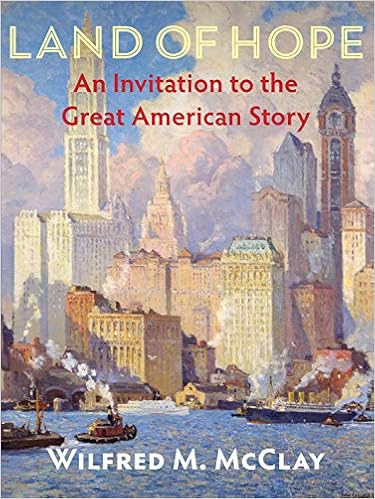
Land of Hope: An Invitation to the Great American Story, by Wilfred M. McClay (Encounter, 504 pp., $34.99)

Wilfred McClay’s Land of Hope wastes no time making its purpose known. The first thing you notice about it is that it looks like a textbook. From its heft and glossy pages to its artistic cover and evocative subtitle (“An Invitation to the Great American Story”), this volume would look perfectly at home on a school desk, in a backpack, or jammed into a locker. Without even opening it, though, you can tell that Land of Hope is very different from that other book with which it is being been compared—Howard Zinn’s A People’s History of the United States.

Land of Hope is a fact-driven history, open to the now radical-seeming notion that America is good. By presenting American history in full, McClay opens the door for a serious, studied patriotism. From the outset, this book sets itself apart from ordinary textbooks. Rather than dutifully marching through the facts and figures that led to the Founding, McClay takes care to situate America in a broader historical context. In quick but effective bursts, he guides the reader from the Crusades to the Reformation, stopping in at each milestone in European social, religious, and political history. At the same time, we see the premodern pilgrimage across the Eurasian land bridge of those who will come to be known as Native Americans.

By the time the first settlers dock at Jamestown, McClay has swiftly dispensed with the usual accounts of pre-eighteenth-century America. Neither winsome idealists nor vicious colonizers, the European settlers of the New World are presented as they would have understood themselves: as the inheritors of centuries of Western civilization. McClay, in turn, shows these settlers to be the most recent batch of rugged individuals, who, over millennia, have come here in search of a better life.

The spirit McClay identifies in this first group of Americans is crucial to his account of the Founding. Through a careful cultural study of the politics and religion of the various colonies, McClay shows that ideas of self-rule and a firm belief in the natural rights of man long preceded the conflicts of the 1770s. He doesn’t view the colonists as fighting to reclaim their rights as Englishmen. He sees the Founding, rather, as something entirely new in history—a revolution in thought based on distinctly American ideas about politics and civic life.

This is a crucial point, as McClay tells the story of America through the lens of the Founding. He takes note of all deviations from the Founders’ ideals, from the “manifest destiny” of the nineteenth century to the administrative revolution in the Progressive Era to Harry Truman’s decision to deploy nuclear weapons in World War II. No person or action is exempted from scrutiny or criticism, regardless of their political leanings or historical circumstances.

This approach becomes especially important as McClay reaches the twentieth century. These chapters are bound to be the most talked about portions of the book. When faced with a full and fair account of twentieth-century history, even the most cynical reader will be shocked at just how biased to the left, in comparison, the mainstream historical narrative has become.

It’s tempting to combat the accepted story of twentieth-century progress with a commensurate tale of decline, one that conservatives often tell: how Woodrow Wilson and his coterie of German professors tossed out the Constitution, creating the conditions in which Franklin Roosevelt sowed the seeds of a soft despotism that remains with us to this day. Instead, McClay presents the upheavals of the twentieth century as the result of an ever-present temptation to deviate from the Founding’s principles. The consistent application of this critique is one of this book’s greatest strengths.

Like other disciplines, the study of American history has fallen victim to a peculiarly modern obsession with facts. But factual accuracy does not guarantee fairness. True, most history textbooks are dull progressions of facts, but only facts that fit a specific leftist narrative. Land of Hope upends the narrative. This is not to say that it’s light on detail—rest assured, you’ll find everything you need to pass the AP exam in this volume. McClay doesn’t sacrifice facts, but instead builds up from them, reintroducing a grandeur to American history all but absent in most books of this kind.

“There is only one thing in life . . . that I must and will have before I die,” says Madeleine Lee, the socialite protagonist of Henry Adams’s 1880 novel Democracy. “I must know whether America is right or wrong.” To hear many historians today tell it, the American past offers a choice: you can love your country or you can learn its history—but not both. McClay rejects this dichotomy. He tells the tale of America in full, inviting readers to take up Lee’s question for themselves. Land of Hope proves that patriotism is not only compatible with a clear view of America’s past—it should proceed from it as well.

Was Thomas Jefferson On The Duke Lacrosse Team?


By Ann Coulter
https://townhall.com/columnists/anncoulter/2019/07/03/was-thomas-jefferson-on-the-duke-lacrosse-team-n2549523
July 3, 2019

Image result for thomas jefferson statue
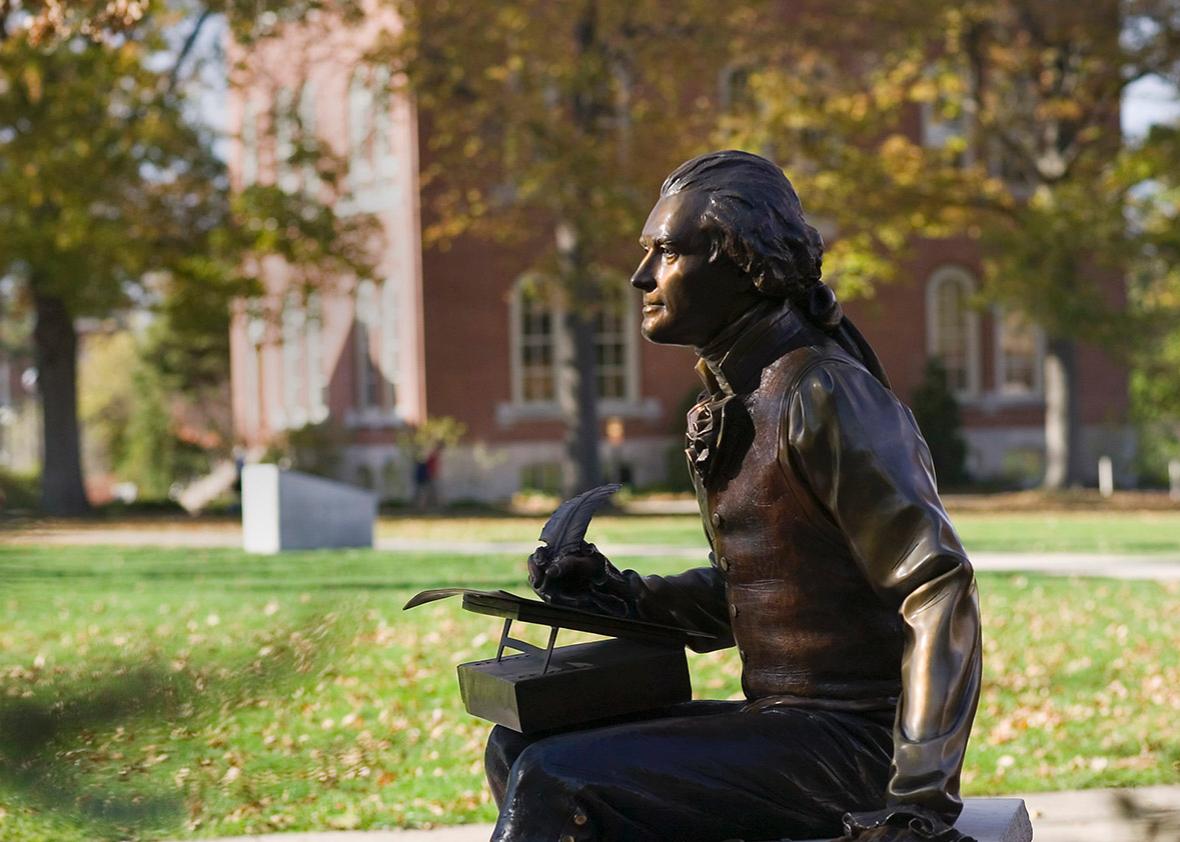
Statue of Thomas Jefferson on the University of Missouri campus


While tearing down everything that's great about our country, the left has always permitted us to celebrate patriotic holidays.

But this year, on the week that we commemorate the unveiling of the Declaration of Independence, Nike yanked a Betsy Ross tribute sneaker off the market because the American flag didn't sit well with Colin Kaepernick.

Rep. Alexandria Ocasio-Cortez, D-N.Y., is telling wild, provable lies about America's border agents.

This Fourth of July, let's look at the tactics used by the left to blacken the reputations of American heroes. To wit, the lie that the principal author of the declaration, Thomas Jefferson, fathered a child with his slave, Sally Hemings.

The charge was first leveled in 1802 by a muckraking, racist, alcoholic journalist, James Callender, who had served prison time for his particular brand of journalism. He had tried to blackmail Jefferson into appointing him postmaster at Richmond. When that failed, Callender retaliated by publicly accusing Jefferson of fathering the first-born son of Sally Hemings -- or, as the charming Callender described her, "a slut as common as the pavement."

No serious historian ever believed Callender's defamation -- not Dumas Malone, Merrill Peterson, Douglass Adair or John Chester Miller. Not one. Their reasoning was that there was absolutely no evidence to support the theory and plenty to contradict it.

The Jefferson-Hemings myth was revived by feminists trying to elevate the role of women in history. Modern pedagogy requires that no period of our past be taught without turning it into a lecture on racism, sexism or homophobia.

Fawn M. Brodie got the ball rolling with her 1974 book, "Thomas Jefferson: An Intimate History," which used Freudian analysis to prove Jefferson kept Hemings as his concubine and fathered all six of her children.

Brodie's book was followed by Barbara Chase-Riboud's 1979 novel "Sally Hemings," a work that imagines Hemings' interior life. When CBS announced plans to make a miniseries out of the novel, Jefferson scholars exploded, denouncing the project as a preposterous lie. The miniseries was canceled.

Finally, a female law professor, Annette Gordon-Reed, wrote "Thomas Jefferson and Sally Hemings: An American Controversy," which accused professional historians of racism for refusing to defer to the "oral history" of Hemings' descendants.

She said "racism," so the historians shut up.

In 1998, a retired pathologist, Dr. Eugene Foster, performed a DNA test on the Y-chromosomes of living male descendants of Sally Hemings, as well as those from Jefferson's paternal uncle. The Y-chromosome is passed from male to male, so, if the story were true, Hemings' male descendants ought to have the Y-chromosome of the Jefferson male bloodline.

What the DNA tests showed was that Hemings' firstborn son, Tom -- the Tom whose alleged paternity was the basis for Callender's accusation -- was not related to any Jefferson male.

Foster's study did establish that Hemings' last-born son, Eston, was the son of some Jefferson male, but could not possibly say whether that was Thomas Jefferson or any of the other 25 adult male Jeffersons living in Virginia at the time, eight of them at or near Monticello.

For Eston to be Jefferson's son, we have to believe that five years after being falsely accused of fathering a child with Hemings, Jefferson decided, What the heck? I may be president of the United States, but I should prove Callender's slander true by fathering a child with my slave!

It would be as if five years after the Duke lacrosse hoax, one of the falsely accused players went out and actually raped a stripper -- in fact, the same stripper.

Nonetheless, Nature magazine titled its article on the study "Jefferson Fathered Slave's Last Child." Hundreds of newspapers rushed to print with the lie, e.g.:

"Study: Jefferson, Slave Had Baby" -- Associated Press Online, Nov. 1, 1998

"DNA Study Shows Jefferson Fathered His Slave's Child" -- Los Angeles Times, Nov. 1, 1998"

Jefferson Exposed" -- Boston Globe, Nov. 3, 1998

Two months after these false "findings" had been broadcast from every news outlet where English is spoken, Foster admitted that the DNA had not proved Jefferson fathered any children by Sally Hemings, merely that he could have fathered one child. Only eight newspapers mentioned the retraction.

The science alone puts the odds of Thomas Jefferson fathering Eston at less than 15% -- less than 4%, if all living Jefferson males are considered, not just the ones at Monticello.

All other known facts about Jefferson make it far less probable still.

There are no letters, diaries or records supporting the idea that Jefferson was intimate with Hemings, and quite a bit of written documentation to refute it, including Jefferson's views on miscegenation and his failure to free Hemings in his will, despite freeing several other slaves.

In private letters, Jefferson denounced Callender's claim -- a denial made more credible by his admission to a sexual indiscretion that would have been more shameful at the time: his youthful seduction of a friend's wife.

None of the private correspondence from anyone else living at Monticello credited the Hemings rumor, though several pointed to other likely suspects -- specifically Jefferson's brother, Randolph.

Eston was born in 1808, when Thomas Jefferson was 64 years old and in his second term as president. His brother Randolph was 52, and Randolph's five sons were 17 to 24 years old. All of them were frequent visitors at Monticello.

While Jefferson was busy entertaining international visitors in the main house, Randolph would generally retire to the slave quarters to dance and fiddle. One slave, Isaac Granger Jefferson, described Randolph in his dictated memoirs thus: "Old Master's brother, Mass Randall, was a mighty simple man: used to come out among black people, play the fiddle and dance half the night."

There is not a single account of Thomas Jefferson frequenting slave quarters. Nor did Jefferson take any interest in Hemings' children. Randolph did, teaching all of Hemings' sons to play the fiddle.

Randolph was an unmarried widower when Eston was conceived. After Randolph remarried, Hemings had no more children.

In response to DNA proof that only one of Hemings' children was related to any Jefferson male -- and her firstborn son was definitely NOT fathered by any Jefferson -- the Thomas Jefferson Foundation, the Monticello Association and the National Genealogical Society promptly announced their official positions: Thomas Jefferson fathered all six of Hemings' children! Guided tours of Monticello today include the provably false information that Jefferson fathered all of Hemings' children.

So now you, at least, know the truth -- not that it matters in the slightest. Happy Fourth of July!

Ann Coulter's Latest Book Resistance Is Futile!: How the Trump-Hating Left Lost Its Collective Mind is available on Amazon

Thursday, July 04, 2019

This Fourth of July, why patriotism is worth defending


July 3, 2019

This Fourth of July, why patriotism is worth defending

For the haters, it’s open season on the American ideal.
Colin Kaepernick doesn’t like today’s American flag because it reminds him of police brutality and he doesn’t like Betsy Ross’ O.G. flag because it reminds him of slavery. I’m starting to think maybe Colin Kaepernick is not so fond of the flag, or of the country that made him rich.
Nike supported him by withdrawing the Betsy Ross-flagged sneaker. That’s right, the American flag, in any form, is now apparently a toxic symbol. The governor of California, Gavin Newsom, actually praised Nike.
Meanwhile, the Charlottesville City Council justvoted to stop celebrating Thomas Jefferson’s birthday in the city where he died on the 50th anniversary of the Declaration of Independence he wrote. American patriotism has just reached a record low entirely because of Democrats, of whom only 22% say they’re “extremely proud” of their country. To celebrate the Fourth, America’s most prominent newspaper is bidding for the trolling Hall of Fame by running a video, titled “Please stop telling me America is great,” that argues how America is “just OK.”
Remember the distant past of 2016, when leading voices of progressivism were saying, “America never stopped being great” (Hillary Clinton) and “America is already great” (Barack Obama)? All that’s over.
American military, economic and cultural power dominates the world (you’ve never heard of the biggest movie made by China or France this year, but they’ve certainly heard of “Avengers: Endgame”). America leads the world in Nobel laureates, and it isn’t close. America leads the world in the success of our middle class, and it isn’t close. True, America has more poor people than some other countries — but that’s because we let in millions of people from poor countries. Saying “America has a poverty problem” is like saying, “Florida has a high death rate.” Florida doesn’t kill people, it just attracts a lot of old ones.
“What about slavery?” is not an irrelevant question to ask about American history. Slavery is indeed our original sin. It’s important. We fought a war over it. You may have heard of it.
But to think of slavery first when you think of American history is like thinking of Charles Manson first when you think of men. America accomplished a few good things as well. America is a radical idea that had never come close to being implemented before — a broad-based democracy with government engineered for the purpose of zealously protecting our natural, or God-given, rights. We zoomed out ahead of the rest of the world, and we never looked back. As late as 1870, only 40% of the men in Britain were entitled to vote. Voting in America was not universal until women got the vote in 1920, but the US was miles ahead of everybody else in allowing its people to be heard.
Even more important, the US was and is miles ahead when it comes to allowing its people to speak. In Britain, people can and do get thrown in jail for things they’ve said on Twitter. (The 2003 Communications Act makes it a crime to type mean things on the internet. No, you don’t get a break for being young, or drunk, or for thinking you’re being darkly funny. The police actually monitor social media looking for people to arrest.) A 2014 headline in The Guardian reads, “Is it right to jail someone for being offensive on Facebook or Twitter?” No, it isn’t right. It is in fact quite wrong, and in America it is unthinkable because we have the world’s strongest protections for speech.
The First Amendment, like everything else about America, has not always worked perfectly (Woodrow Wilson threw Eugene V. Debs in jail under the Sedition Act for opposing World War I) but is a great and noble ideal, and we are far closer to living up to its full potential now than we ever have been in the glorious history of this exceptionally wonderful country.
Don’t take it from me; ask the world. A Gallup survey notes that 150 million people, or one out of 25 adults on the planet, would move to the US if they could. That’s more than the next four countries combined. “America remains unusually attractive to people from all over the world — in a way to which no other country compares,” Gallup reported.
Everybody knows America is number one, which is why, even among the hating class of Americans, no one ever leaves. Ta-Nehisi Coates and Spike Lee haven’t moved to France. Gavin Newsom isn’t moving to Mexico. Colin Kaepernick isn’t moving to Cuba. Lena Dunham, Bryan Cranston, Barbra Streisand and all the other celebrities who threatened/promised to move to Canada are still here. Hell, we can’t even get the Canadian-born whiners and haters (like Seth Rogen and Jim Carrey) to move back.
America didn’t complete the project of freedom on that broiling day in Philly, but that’s like saying your kid’s first day of school is no big deal because your kids can’t do algebra yet. On July 4, 1776, we began setting up the greatest opportunity for human flourishing the world has ever known, and our example continues to be the world’s beacon. The United States of America isn’t perfect. We’re merely the best.

Today's Tune: Shooter Jennings - 4th Of July [Official Live Video]