Monday, June 03, 2019

Norman Rockwell, Realist


By Brian T. Allen
https://www.nationalreview.com/2019/06/normal-rockwell-realist-four-freedoms-paintings/
June 1, 2019

Related image
Arlington, Vermont

For the past few months, the Norman Rockwell Museum in Stockbridge, Mass., has been traveling the Four Freedoms paintings by Norman Rockwell (1894–1978), which the museum owns. Rockwell finished them in 1943. They were quickly published in The Saturday Evening Post and became famous. The show, Enduring Ideals: Rockwell, Roosevelt, and the Four Freedoms, opens this week at the Museum of Fine Arts in Caen in Normandy as part of the 75th anniversary of the D-Day invasion on June 6. Also 75 years ago, in wartime America, these paintings travelled to department stores throughout the country as the calling card for the federal government’s most lucrative war-bond drive ever. It raised $133 million, equal to about $2 billion today.
I’ll write this week and next about these four pictures. They’re the visual mission statement for America’s role in World War II. They’re also part of the visual vocabulary for most Americans thinking about what it means to be an American.
My perspective is possibly unique, since as far as I know, I’m the only art historian in tiny Arlington in southwestern Vermont, where Rockwell lived when he made these images. I know for certain that I’m the only art historian from Arlington who both writes for National Review and knew many of the models Rockwell used. These pictures, as I’ll show, are very much products of the real Vermont as Rockwell experienced it when he lived here between 1937 and 1953.
Rockwell visualized four subjects — freedom of speech, freedom of worship, freedom from want, and freedom from fear — inspired by a 1941 speech President Franklin Roosevelt delivered before a joint session of Congress. Less than a year before the Pearl Harbor attack and as the European war raged, Roosevelt pitched what soon became the heart of America’s wartime mission statement.
First, who saw these pictures? The better question is “who didn’t?” or, today, “who hasn’t?” They’re icons, and it’s worth asking, “icons of what?” The four paintings were done exclusively for publication in The Post, which commissioned the project by Rockwell, who worked as the magazine’s top illustrator. They appeared in the publication, America’s preeminent news and lifestyle periodical, over four weeks in 1943. The Post then had a circulation of about 3 million. Millions bought a special reprint of the series. The Office of War Information (OWI) distributed about 8 million posters advertising the government’s 1943 Series E war bonds. Since the end of the war, countless millions have seen the images, with Freedom of Speech for many years the symbol for the American Civil Liberties Union, before it abandoned its mission of championing unfettered free speech for defending only speech it likes.
What inspired the paintings at that moment? Roosevelt’s Four Freedoms started as fears, or a single “fear of fear itself,” articulated first in his 1933 inaugural speech. Preparing for his 1941 State of the Union speech, Roosevelt first thought he’d develop the theme of fear further by evoking fear of losing free expression and free worship. He added fear of war and fear of a war-torn, collapsed economy.
It was, he thought, an awkward leap. He landed on the theme of freedom, not fear, as the driver of a new international order. He thought it was more positive and aspirational. Five freedoms — freedom to access information, freedom of expression, worship, and the press, and freedom from want — were whittled to four and then refined. When he addressed Congress on January 6, 1941, the four freedoms were freedom of speech and of worship and freedom from want and from fear.
The speech, centered around the new Lend Lease program, was a dud. If it inspired anything, it was anxiety. Was freedom from want and from fear code for socialism? Many thought these two freedoms invited more government intervention and guarantees, and by 1941 big chunks of the public saw the New Deal itself as a dud. Roosevelt kept pushing the Four Freedoms marketing theme without much traction, even after the Pearl Harbor attack. His Office of War Information was often inept. The number of freedoms grew larger and more trivial, including at one point freedom to borrow money at low interest rates. It wasn’t until Rockwell visualized them that the Four Freedoms finally took off. After Rockwell’s conception appeared in The Post, OWI quickly appropriated them and used them with abandon.
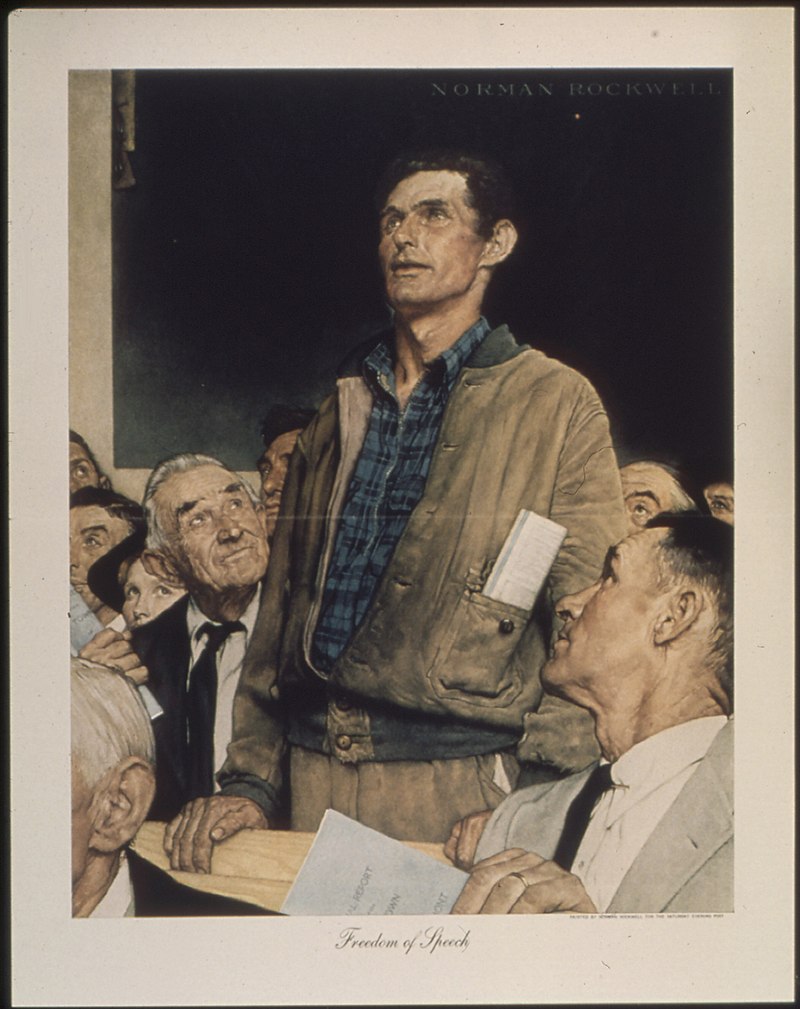
"Freedom of Speech" - NARA - 513536.jpg
Three of these pictures — Freedom of SpeechFreedom of Religion, and Freedom from Want — are among the best-known works of American art. Whistler’s portrait of his mother, Grant Wood’s American Gothic, and Washington Crossing the Delaware, by Emanuel Leutze, are their only competition. When I was in graduate school, intellectuals, especially art historians, viewed Rockwell with contempt. He was an illustrator, so for those believing an impregnable wall separated high art — painting, prints, drawing, and sculpture — from low art, or commercial art, Rockwell was a no-account. That he made a very good living from it was worse. Most academics look with scorn at artists who get rich.
On the one hand, critical opinion dismissed Rockwell as a fantasist, a myth maker, a nostalgia peddler. On the other, Rockwell and his masters at The Post are faulted for presenting as a great, coveted good a world that the artist might have faithfully portrayed but that was too Christian, rural, patriotic, Republican, and what many would call today “heteronormative.” Rockwell’s style was representational. “Bad,” I heard. “That’s for simpletons.” His subjects lacked angst. “What’s life without angst?” Rockwell seemed doomed to cornball obscurity. Sometimes you find people who’ll never be satisfied.
It’s quite a trick to be wrong about so much. Yes, Rockwell was out of fashion even in middlebrow America by the 1970s. His bread and butter — magazine and calendar illustration — was a disappearing art long before he died in 1978, displaced by color photography. His anchor employer,The Saturday Evening Post, folded in 1971. He worked for the Boy Scouts of America until 1976, producing illustrations for his last of 64 years’ worth of annual calendars. In academia, it was not until the American Studies movement blossomed in the 1980s that Rockwell’s work was critically resuscitated. Unpacking Rockwell’s work was a gold mine of American civic myth. But how much of it was myth?
The fact is, Rockwell is a realist in the tradition of the great 19th-century American realists like George Caleb Bingham, Francis Edmonds, William Sidney Mount, and Eastman Johnson. The real fantasists are the academics and highbrow critics who claim that Rockwell’s world didn’t exist.Rockwell depicted the everyday life of what was then called “the common man,” whom Rockwell found in Arlington, Vt.
I combed through the 1940 census to get a demographic sense of Arlington, which no one else has done. I found that the Four Freedoms pictures convey the place with perception and correctness.This is nothing for which the artist — or the art — needs to repent. He was working in Vermont, using Vermont models, and expressing strands of Vermont culture. For Rockwell’s critics, he presents some favorite hate charms. His subjects are rural. They’re working-class. They’re not sodden with weepy grievance.
Overwhelmingly, Arlington was working-class, white, and native-born. Of its 1,418 people, 29 percent lived on a farm. Arlington had one densely populated neighborhood — East Arlington — but was otherwise rural. East Arlington contained a one-road business district of grocery stores, a barber shop, a hardware store, and Hale Furniture Company, a manufacturer of home and office furniture with about 300 non-union employees, and considerable low-density factory housing. There were no African Americans or Asian Americans in Arlington. About 8 percent were foreign-born.
Arlington is in the geographic center of Bennington County. In 1940, half of Bennington County’s rural, non-farm population had some high school education. Only 15 percent were high school graduates. About 5 percent were college graduates. Of non-farm working men, 11 percent were professionals, business owners, or managers. Thirty percent were laborers and factory workers.About 11 percent of working-age men were unemployed in 1940, though this had surely changed by 1943 given a new state of full, wartime employment. The balance were craftsmen, foremen, service workers, clerks, and sales people. Of non-farm females over 21, about a third were employed.
Arlington is about 60 miles from Albany, N.Y. It’s not exactly in the middle of nowhere. In 1932, avant-garde Bennington College opened about ten miles south. Rockwell audited classes there. Historically, Arlington shares something with Carthage, Xian, and Constantinople. It was once a national capital. Vermont was not one of the 13 original states. It’s the 14th state. In 1777, Arlington was the first capital of the Vermont Republic, the wild frontier between New Hampshire and the Hudson River. Ethan Allen and the Green Mountain Boys, the riffraff band of profiteers and guerillas, lived in Arlington, next-door Sunderland, and Bennington. That was Arlington’s time in the spotlight. It faded into rural, workaday insignificance. Its population in 1940 was about the same as in 1800.
Arlington is about 200 miles north of New York City, a few hours’ drive, but light years away in almost every respect, today and in the 1940s. Rockwell was born and raised on the Upper West Side in Manhattan. He lived in Manhattan until he and his wife, Mary, moved to New Rochelle in the early 1930s. When he visited one summer in the mid-1930s, he quickly felt Vermont’s otherness and was direct in describing it. He liked it, too.
Rockwell came to Arlington to withdraw from the city life, and in his autobiography, he was direct in describing Vermont’s attraction. “The people we met were rugged and self-contained . . . none of that sham ‘I am soooo GLAD to know you’ accompanied by radiant smiles,” he said. “They shook my hand, said, ‘how do,’ and waited to see how I’d turn out.” Vermonters were “not hostile but reserved with a dignity and personal integrity which is rare in suburbia, where you’re familiar with someone before you know him.”
“It was like living in another world . . . a more honest one somehow,” Rockwell wrote. “Because almost everyone had lived in the town all his life and had known one another since childhood and even everybody’s parents and grandparents, there could be little pretension.” Rockwell understood that since so many people in town were farmers, there was less of a spirit of competition. “The pressures were very strong, not toward conformity, but toward decency and honesty. . . . A mean-tempered man would soon find soon felt isolated since his neighbors wouldn’t be bothered with him.”
Rockwell drew his themes from everyday life in Arlington, using local people, not professional models. Carl Hess, the model for the central figure in the Freedom of Speech picture, owned a gas station near Rockwell’s house, one of two in town. He was owner, mechanic, and gas pumper. To his left is Bob Benedict, who owned and operated the other gas station. In Freedom of Worship Walt Squires, a carpenter in Arlington, modeled for the vaguely foreign figure, wearing what is likely a kufi. Jim Martin, one of Rockwell’s neighbors, modeled for the chin-stroking agnostic. Rose Hoyt, the young woman holding rosary beads in the picture, was a Rockwell favorite. Her husband was part of the Arlington road crew. He made 38 cents an hour. He and his wife had eight children.These and many of Rockwell’s models were his social set. Aside from Squires, no one disguised his appearance. Rockwell found in the average people in Arlington his Everyman and Everywoman. It’s the real world of 1940s Vermont: simple, reserved, honest, and straightforward.
Next week, I’ll look at each picture, examining what they meant then and now.

Sunday, June 02, 2019

Sohrab Ahmari and Our Existential Struggle


By 
https://amgreatness.com/2019/06/01/sohrab-ahmari-and-our-existential-struggle/
June 1, 2019

Image result for Sohrab Ahmari david french
David French and Sohrab Ahmari

Perhaps the most amusing intramural intellectual squall on the Right these past few days has centered on “Against David French-ism,” Sohrab Ahmari’s recent polemical reflection on liberalism in First Things.


I did not think that Sohrab had all that much to say directly about the man who provided him with the title of his essay, but then I am not, so to speak, a French man. I have never met Pastor French, rarely read him, and generally feel about him the way C. K. Dexter Haven in The Philadelphia Story felt about George Kitteridge, man of the people: “to hardly know him is to know him well.”
The outpouring of indignationfury, and contempt that greeted Sohrab’s column reminded me that opinions about the Pastor vary widely. I group him with Pete Wehner and some other NeverTrump evangelists as a modern incarnation of the Pharos of Alexandria lighthouse, virtue signaling around the clock to the amazement of the world. I know there is disagreement on that score.
As I read it, Sohrab’s essay involved David French only incidentally. There were, I thought, two key passages. The first came near the beginning. “The movement we [conservatives] are up against,” Sohrab writes, “prizes autonomy above all, too; indeed, its ultimate aim is to secure for the individual will the widest possible berth to define what is true and good and beautiful, against the authority of tradition.”
I’ll come to what I think the other key passage is in a moment. First, note what a bold statement Sohrab has made here. Autonomy: aren’t we all for that? Isn’t it the prime Enlightenment virtue? Sapere aude, Kant said: “dare to know!” Priests, superstition, convention, tradition: didn’t the Enlightenment discard all of that for the sake of autonomy? For the sake, that is, of giving the law (nomos) to oneself (autos)?
The Ghost of J. S. Mill
In a word, yes. And it was a project carried on by such Enlightenment heirs as John Stuart Mill, whose On Liberty is a sort of bible of Enlightenment-infused liberalism. I note that Sohrab quotes in passing Mill’s famous line—famous imperative—about the importance of “experiments in living.” “Individual experiments in living,” he writes, “—say, taking your kids to a drag reading hour at the public library—cannot be sustained without some level of moral approval by the community.” Which suggests that the project of autonomy always involves an element of heteronomy: the emancipation from tradition, convention, etc., always seems to yield a new sort of orthodoxy. It was just this tendency, I suspect, that bothered Sohrab.
We see it all around us now. What we call liberalism presents itself not as one view of the world among others but as a neutral (but nevertheless inherently virtuous) state of nature from which no right-thinking (i.e., left-leaning) person could dissent.
The same dynamic was ostentatiously on view in Mill’s radical libertarianism. For anyone interested in understanding the nature of the modern liberal consensus, the extraordinary success of Mill’s rhetoric and the doctrines it advances afford a number of lessons. Above all, it provides an object lesson in the immense seductiveness inherent in a certain type of skeptical moralizing.
Together with Rousseau, Mill supplied nearly all of the arguments and most of the emotional weather—the texture of sentiment—that have gone into defining the liberal vision of the world. His peculiar brand of utilitarianism—a cake of Benthamite hedonism glazed with Wordsworthian sentimentality—accounts for part of Mill’s appeal: it provides a perfect recipe for embellishing programmatic shallowness with a cosmetic patina of spirituality. It is a recipe that has proven to be irresistible to those infatuated with the spectacle of their own virtue.
Mill was exceptionally adroit at appealing to his readers’ moral vanity. When he spoke (as he was always speaking) of “persons of decided mental superiority” he made it seem as though he might actually be speaking about them. Mill said that there was “no reason that all human existence should be constructed on some one or some small number of patterns.” Quite right! Even if persons of genius are always likely to be “a small minority,” still we must “preserve the soil in which they grow.” Consequently, people have a duty to shun custom and nurture their individual “self-development” if they are not to jeopardize “their fair share of happiness” and the “mental, moral, and aesthetic stature of which their nature is capable.”
Mill’s blandishments went even deeper. In On Liberty, Mill presented himself as a prophet of individual liberty. He has often been regarded as such, especially by liberal academics, who of course have been instrumental in propagating the gospel according to Mill. And “gospel” is the mot juste. Like many radical reformers, Mill promised almost boundless freedom, but he arrived bearing an exacting new system of belief. In this sense, as Maurice Cowling argues, On Liberty has been “one of the most influential of modern political tracts,” chiefly because “its purpose has been misunderstood.” Contrary to common opinion, Cowling wrote, Mill’s book was
not so much a plea for individual freedom, as a means of ensuring that Christianity would be superseded by that form of liberal, rationalising utilitarianism which went by the name of the Religion of Humanity. Mill’s liberalism was a dogmatic, religious one, not the soothing night-comforter for which it is sometimes mistaken. Mill’s object was not to free men, but to convert them, and convert them to a peculiarly exclusive, peculiarly insinuating moral doctrine.
This tension in Mill’s work—between Mill the libertarian and Mill the moralistic utilitarian—helps to account for the vertiginous quality that suffuses the liberalism for which On Liberty was a kind of founding scripture.
How Liberalism Corrodes Morality
Mill’s announced enemy can be summed up in words like “custom,” “prejudice,” “established morality.” All his work goes to undermine these qualities—not because the positions they articulate are necessarily in error but simply because, being customary, accepted on trust, established by tradition, they have not been subjected to the acid test of his version of the utilitarian calculus. (Mill elsewhere refers to such calculation as “rational self-conscious scrutiny,” the implication being that anything else is less than completely rational.)
Image result for john stuart mill
John Stuart Mill
The tradition that Mill opposed celebrated custom, prejudice, and established morality precisely because they had prevailed and given good service through the vicissitudes of time and change; their longevity was itself an important token of their worthiness. It was in this sense, for example, that Edmund Burke extolled prejudice, writing that “prejudice renders a man’s virtue his habit. . . . Through just prejudice, his duty becomes a part of his nature.”
Mill overturned this traditional view. Indeed, he was instrumental in getting the public to associate “prejudice” indelibly with “bigotry.” For Mill, established morality is suspect first of all because it is established. His liberalism is essentially corrosive of existing societal arrangements, institutions, and morality.
Mill constantly castigated such things as the “magical influence of custom” (“magical” being a negative epithet for Mill), the “despotism of custom [that] is everywhere the standing hindrance to human advancement,” the “tyranny of opinion” that makes it so difficult for “the progressive principle” to flourish. According to Mill, the “greater part of the world has, properly speaking, no history because the sway of custom has been complete.”
Such passages reveal the core of moral arrogance inhabiting Mill’s liberalism. They also suggest to what extent he remained—despite the various criticisms he made of the master—a faithful heir of Jeremy Bentham’s utilitarianism. And I do not mean only the Bentham who propounded the principle of “the greatest happiness for the greatest number,” but also the Bentham who applauded the proceedings of the Star Chamber, advocated the imprisonment of beggars, defended torture, and devised the “Panopticon”—a machine, he said, for “grinding rogues honest”—to keep miscreants under constant surveillance. Liberty was always on Mill’s lips; a new orthodoxy was ever in his heart. There is an important sense in which the libertarian streak in On Liberty is little more than a prophylactic against the coerciveness that its assumption of virtuous rationality presupposes.
Such “paradoxes” (to put it politely) show themselves wherever the constructive part of Mill’s doctrine is glimpsed through his cheerleading for freedom and eccentricity. Mill’s doctrine of liberty begins with a promise of emancipation. The individual, in order to construct a “life plan” worthy of his nature, must shed the carapace of inherited opinion. He must learn to subject all his former beliefs to rational scrutiny. He must dare to be “eccentric,” “novel,” “original.”
At the same time, Mill notes, not without misgiving, that
As mankind improve, the number of doctrines which are no longer disputed or doubted will be constantly on the increase; the well-being of mankind may almost be measured by the number and gravity of the truths which have reached the point of being uncontested. The cessation, on one question after another, of serious controversy is one of the necessary incidents of the consolidation of opinion—a consolidation as salutary in the case of true opinions as it is dangerous and noxious when the opinions are erroneous.
In other words, the partisan of Millian liberalism undertakes the destruction of inherited custom and belief in order to construct a bulwark of custom and belief that can be inherited. As Mill put it in his Autobiography:
I looked forward, through the present age of loud disputes but generally weak convictions, to a future . . . [in which] convictions as to what is right and wrong, useful and pernicious, deeply engraven on the feelings by early education and general unanimity of sentiment, and so firmly grounded in reason and in the true exigencies of life, that they shall not, like all former and present creeds, religious, ethical, and political, require to be periodically thrown off and replaced by others.
So: a “unanimity of sentiment” (a.k.a. custom) is all well and good as long as it is grounded in the “true exigencies of life”—as defined, of course, by J. S. Mill.
A New “Theocracy”? Oh, Please
A lot more could be said about Mill’s doctrine and its importance for understanding today’s liberal consensus. But for now, I’ll just say that that I suspect it also informs Sohrab’s criticism of our culture’s habit of elevating autonomy into the highest virtue even if—especially if—it circumscribes the individual’s freedom understood as something that cannot flourish apart from a particular community or outside a particular tradition. Edmund Burke caught an important aspect of this dynamic when he observed, “The effect of liberty to individuals is, that they may do what they please: We ought to see what it will please them to do, before we risque congratulations, which may be soon turned into complaints.”

Again, more could be said about all of this, but let me move on briefly to what I think is the other key passage of Sohrab’s essay. It comes at the end. “Progressives,” he writes,
understand that culture war means discrediting their opponents and weakening or destroying their institutions. Conservatives should approach the culture war with a similar realism. Civility and decency are secondary values. They regulate compliance with an established order and orthodoxy. We should seek to use these values to enforce our order and our orthodoxy, not pretend that they could ever be neutral. To recognize that enmity is real is its own kind of moral duty.
This passage was Exhibit A for Sohrab’s critics. Imagine, consigning civility and decency to the status of “second values”! Praising “enmity,” endorsing our own values and (dread word) “orthodoxy.”
Some of Sohrab’s critics seem to think that such passages indicated that he was advocating a new theocracy. I think he is advocating realism when it comes to our opponents in the culture war. What they want is not tolerance but full-throated approbation, whether the issue is bringing children to public libraries to be indoctrinated by sexual freaks, unlimited abortion, radical environmentalism, or the smorgasbord of toxins populating the ideology of identity politics. What they offer is not tolerance, not debate, but an invitation to submit to their view of the world.
In such situations, dissent cannot succeed if it proceeds piecemeal. It must recognize that what is at stake is, in the deepest sense, an anthropology, a view of what man is. We are living among the fragments of a shattered inheritance, morally and socially as well as politically. The so-called liberals (so-called because no one is more illiberal) are bent on scattering those fragments and trampling underfoot the values they represent.
Sohrab Ahmari’s essay is certainly not the last word in how to respond to this onslaught. But it has the inestimable virtue of understanding that this battle is not fodder for a debating club but an existential struggle.