Wednesday, March 13, 2019

Conflicted But Redeemed: James Como’s Life of C.S Lewis


Let me throw the gauntlet down. This is the single finest biographical survey yet written on C.S. Lewis. Yes, I’m quite sincere. No exaggeration, no typical Birzer hyperbole. As far as I know, I’ve read all of the serious biographies over the last 30 years. Of those, Chad Walsh’s 1949 Apostle to the Skeptics is excellent but incomplete; Humphrey Carpenter’s 1978 The Inklings is too scattered, unsure of what it wants to be; Roger Lancelyn Green and Walter Hooper’s 1974 C.S. Lewis: A Biography is too (often) adulatory; and A.N. Wilson’s C.S. Lewis (1995) is too cynical. Each is good, to be sure, but none of them actually capture the personality, purpose, and essence of the endlessly fascinating and complex C.S. Lewis.
(For the sake of sanity, I’m excluding the myriad of bizarrely and superficially pietistic and evangelical treatments of Lewis as quasi saint. In these latter—all too many, we must lament—Lewis comes across as a two-dimensional prig, devoid of will and choice, more fitting as a Precious Moments figurine than as a flesh-and-blood human being. These books are as painful to read as they probably were to write, the saccharine oozing in pustules from each page.)
A poet, professor, public speaker, editor, and essayist, James Como has spent much of his professional life exploring every aspect of C.S. Lewis’s life and writings. Even if Dr. Como had not written this biographical survey, he would always be listed among the greatest of Lewis scholars, especially for his extraordinaryC.S. Lewis at the Breakfast Table. That Dr. Como has finally pieced together over fifty years of his own findings and thoughts on Lewis in A Very Short Introduction perfectly solidifies his position at the top of an impressive and mighty list. Indeed, this book finds the perfect balance between the Lewis that became famous and the Lewis that remained—generally—hidden to the public. To be sure, Dr. Como’s Very Short Introduction is, as advertised, a very short biographical survey, but it’s delightful and reminds me much of Theodor Haecker’s forgotten little 1934 gem,Virgil: Father of the West, in tone and scope. It’s the kind of book that we need far more of. It’s much longer than an Atlantic Monthly expose, but it’s also much shorter than, say, a David McCulloch life and times. It’s the kind of book you can devour in one long sitting and feel quite satisfied after reading it. In a little over one hundred pages, you’ll happily come to know the complexities of the most famous convert to Christianity in the twentieth century and Oxbridge don, Jack Lewis.
Though written as a biographical essay rather than a footnoted academic treatise, Dr. Como’s Very Short Introduction employs the best sources possible, fully understanding the evolution of Lewis’s own thought and writings while also incorporating the finest reminiscences of the man.
In his C. S. Lewis: Apostle to the Skeptics, the first study of Lewis’s work (1949) and a template still very much worth reading, Chad Walsh makes Lewis’s wholeness clear, and his title is perfect; Lewis is the apostle to sceptics, not necessarily atheists. Also well worth reading (for their first-hand accounts of Lewis) are Roger Lancelyn Green’s C. S. Lewis (1963), Jocelyn Gibb’s edited work Light on C. S. Lewis (1965, nine essays that evidence the breadth of Lewis’s work and personality), C. S. Lewis at the Breakfast Table (1979, a collection of essays mostly by those who knew him early and late), Carolyn Keefe’s authoritative C. S. Lewis: Speaker and Teacher (1971), Stephen Schofield’s In Search of C. S. Lewis (1983), and John Lawlor’s beautifully written C. S. Lewis: Memories and Reflections (1998).
No one could find a better summary of the best written about Lewis. Equally important, though, Dr. Como understands Lewis not as an ideologue, pre-programmed to become Christian and spread God’s word, but as a fallible man who more often than not made almost supernaturally wise choices in his intellectual life, if not always in his personal life. Just as Lewis believed every culture possessed some element of the true Christian story—no matter how small—so, too, every man possessed some element of God’s grace, no matter how small.
In his personal life, though, Lewis desperately needed to find and accept that grace, especially when it came to his relations with women—whether Mrs. Moore (his war buddy’s mother), Joy Davidman (his late in life wife), or Ruth Pitter (a poetess he admired more than a friend and hoped to marry after Joy passed away). Indeed, according to Dr. Como, Lewis had a “fraudulent, secret self” against which he had to come to terms and, actually, overcome. “Nevertheless, any consideration of Lewis’s ‘self’ is something of a minefield. He hid, distorted, invented, denied, and finally transcended it. Always he coyly warned us against discussing it,” Dr. Como explains. Those who knew Lewis best as a child and young man—his father and his brother—were horrified by Lewis’s relationship with women, and his closest friends in the 1920s and 30s—such as Owen Barfield and J.R.R. Tolkien—knew absolutely nothing of this aspect of Lewis’s life.
Dr. Como’s writing style is quite enjoyable, a cross between Ernest Hemingway staccato and the more refined intellectualism of Tom Wolfe’s gonzo journalism. Effectively alternating between past and present tenses, Dr. Como’s hard-earned wisdom and life-long learning reveal themselves in every sentence of the book. Dr. Como also possesses the eye of an outstanding biographer, knowing exactly when to make the quirky quirky and when to make it expressive of the norm. In discussing Lewis’s own style, Dr. Como stresses that Lewis feared that a “republic of letters” might very well collapse in upon itself, with each writer thinking himself a pope. Instead, Dr. Como notes, Lewis knew that one must speak and write to his audience, academic or not. Certainly, Lewis’s BBC radically popular radio addresses during World War II convinced him of the necessity of communicating to and with the broadest audience possible. This should not suggest that Lewis did not write for an academic audience. He often did, and, when he did, such as with his Allegory of Love, he did so very well. Unlike most of his academic colleagues, though, he knew that he had a duty to speak to those who did not necessarily agree with him. Frankly, one might readily write the same of Dr. Como’s biographical survey. He has all the scholarship and ability of an academic, but he writes in the voice of the intelligent reader of whatever profession.
Lewis was, as Dr. Como so correctly notes, always his own man, and his own forceful actions toward colleagues, friends, family, and students—tended to attract or repulse those around him, with little middle ground for neutrals. Those who loved him, loved him dearly. Those who despised, despised him just as dearly. Dr. Como brilliant explains Lewis’s playful and deep love of myth, his extraordinary charity (quite similar to that of Russell Kirk), his normalization of the genre of science fiction, his rather complex and sometimes downright bizarre relations with women, and his vast reading of every possible book. The latter, especially, matters to Lewis’s own writings, as many of his articles and books are really gothic autobiographical reflections of his readings (again, quite similar to that of Russell Kirk).
While I have been reading Professor Como’s work for three decades now, I have never had the pleasure of meeting or corresponding with him. After reading this glorious biographical survey of Lewis, though, I’ve just added having a “beer with James Como” to my goals-in-life checklist. As for now, I’m quite content to have read the thoughts of one great man on another.
The Imaginative Conservative applies the principle of appreciation to the discussion of culture and politics—we approach dialogue with magnanimity rather than with mere civility. Will you help us remain a refreshing oasis in the increasingly contentious arena of modern discourse? Please consider donating now.

Tuesday, March 12, 2019

Innterview: Author C.J Box (2017)

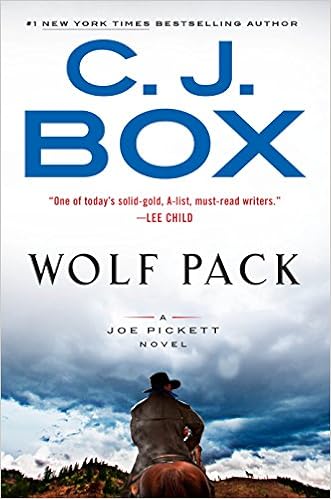
Book review: 'Wolf Pack' by C.J. Box


March 12, 2019
Image result for wolfpack cj box
Hunting season has opened.
And there you sit, waiting. It’s quiet in the woods, where a snapped twig is as loud as a gunshot out there and as urgent. That snick, and your attention is focused, your adrenaline rushed. The question, as posed in “Wolf Pack” by C.J. Box is: which are you, the hunter, or the hunted?
According to Courtney Lockwood at the Forest Service, wolves in Yellowstone Park never strayed beyond the park’s boundaries.
Wyoming Game Warden Joe Pickett knew that was untrue, as did the ranchers in Twelve Sleep County; as if anecdotal evidence wasn’t enough, a black wolf had been caught and contained in a rancher’s horse trailer. It was a magnificent animal, but it was killing the rancher’s heifers.
Like most game wardens, Pickett had a soft spot in his heart for wildlife, the wolf included, just as it bothered Pickett that someone left unchecked traps in his territory. To let any creature needlessly suffer was unimaginable to him; that the trapper left his name and address on the traps was laughable.
But the guy was a “ghost,” which wasn’t funny at all; going by what Pickett could tell, the trapper didn’t exist prior to two years ago. No records, nothing.
The bigger problem, though, was that it was late spring, the elk and deer that survived the winter were fragile, and some idiot with a drone was harassing the animals. Pickett’s colleague in the next county was as peeved about it as Pickett, but the issue was complicated by fact that the harasser appeared to be the father of Pickett’s daughter’s boyfriend.
This wasn’t going to go well at all.
Just outside the county, Pedro Infante knew he was losing control.
Of the four people in the Wolf Pack – three men and Abriella Guzman – Abriella was trouble: beautiful, confident, completely merciless, all good reasons why she wasn’t in charge. Pedro was, but finding their target and assassinating him was taking too much time. Abriella was growing impatient.
The Wolf Pack was getting nervous…
So. How are your fingers? In good shape, are they? Great, because you’ll need them for edge-of-your-seat clinging while you’re reading “Wolf Pack.”
But first, readers may be surprised by an opening chapter that’s kind of clunky and a bit on the prurient side. It’s important to the story, so power through it – what’s to come will more than make up for it, as this tale literally winds up mountains and down through arroyos, between rocks, far above ground, and between bullets. That this book is a thriller is appealing, but the scenery in the story is just as attractive and author C.J. Box tops it off by bringing into this novel many of his best-loved characters.
Just beware that some of them may not make it out.
If you’re new to this author, prepare yourself for a future search for the rest of the series. For fans of Pickett or Box, though, you know what to do about “Wolf Pack”: hunt it down.

The swing change that could make all the difference for Aaron Judge


March 11, 2019
Yankees right fielder Aaron Judge is due a big payday next offseason when he becomes eligible for salary arbitration.
(Butch Dill/USA Today Sports)
TAMPA — Watch Aaron Judge closely this spring and you will notice in batting practice and in games, he will sometimes take his mighty swing with no stride.
No leg kick from the front leg. No toe tap. No stride.
Just a powerful coiled right-handed snap swing. That is especially the case with two strikes, his new two-strike approach.
Judge is doing this to increase contact but also to get to the basics of his swing. To have a starting point. Judge is constantly evolving as a hitter, and this is a step in the process.
Certainly, Judge has shown himself to be one of the most grounded athletes in New York, an All-Star the last two years who is one of the major faces of the game. Now No. 99 is more grounded than ever with this two-strike approach.
Considering his power and strength, the more contact he makes will be a positive for the Yankees. Over the last two seasons, Judge has fired up a .282/.409/.588 slash line and a .993 OPS with 79 home runs, 181 RBIs and 205 runs scored.
Over 1,176 plate appearances the last two seasons, he has struck out 360 times. Last season in 257 at-bats that reached two strikes, he batted .183, walked 45 times and struck out 152 times. Ahead in the count, he hit .290. .173 with two strikes.
Judge rocks and coils before he swings, anchoring his weight on his back leg, then snaps the swing. He creates massive amounts of power with his 6-foot-7, 282-pound frame.
“It’s just basically the roots of it,’’ Judge told The Post over the weekend at George M. Steinbrenner Field. “That’s where it starts for me. I have to start with the no stride and then from there that’s where I can add a leg kick or some type of toe tap.
“For me I have to start with the basics.’’
Much like Ted Williams espoused, there is a science to hitting, and Judge is a student of the game and his swing.
“I think that is where a lot of guys actually get messed up, with their leg kick,’’ Judge said. “There are so many times I tell myself not to worry about it and still get messed up. My swing is pretty simple the way it is, just with a little leg kick and stuff like that, but there are times in the season I don’t even know what [the front leg] is doing. I feel like I am on time but I keep getting beat so I will have the chance to go back to the no stride, where it is kind of a rock to get into my hip and then swing, it’s simple.
“For me, I can always go back to something simple that will produce results,’’ Judge said. “Just be accurate with the barrel. That’s all I want to do.’’
That is great advice to all hitters.
Hall of Famer Reggie Jackson calls it barrel accuracy.
Ted Williams also said: “The way you bring your hips into the swing is directly proportionate to the power you generate.’’
Judge generates power with the hip coil.
“The one thing I was worried about going to the no stride is that I really don’t want to sacrifice power,’’ Judge said. “But when I started hitting in BP with it, I was hitting the ball the same distance as I do with the leg kick, so it really doesn’t matter.”
All this is part of the process and it remains to be seen exactly what will work best for Judge over the coming months. No stride brings him back to his hitting roots. Judge has had phenomenal success these last two years as a Yankee, so this is another component in his growing as a hitter, another tool in his tool box to get the most out of every at-bat, no matter the count.
Judge has homered 83 times over his first 294 career major league games so all the work he has put in to develop his approach and swing is paying off. This is just another component of becoming a more complete hitter, especially with two strikes.
For Aaron Judge, no stride, no problem.

Censoring Judge Jeanine


BY BRUCE BAWER
https://pjmedia.com/homeland-security/censoring-judge-jeanine/
March 11, 2019

Image result for judge jeanine omar

At the beginning of every episode of her popular Saturday evening program on Fox News, Justice with Judge Jeanine, Judge Jeanine Pirro reads what she calls her “opening statement” -- an editorial, as it were, about an issue of current interest. This past Saturday, March 9, Pirro’s “opening statement” was about first-term Rep. Ilhan Omar’s anti-Semitism, which has been an issue before but which last week led to an unprecedented amount of criticism and to calls for a House resolution explicitly condemning the Minnesota Democrat.

Instead of passing such a resolution, however, the House passed one that not only didn’t mention Omar by name but that shifted focus entirely from Omar’s obviously Koran-based Jew-hatred to other matters. For example, the resolution cited a long list of prejudices (against “African Americans, Latinos, Native Americans, Asian Americans and Pacific Islanders and other people of color, Jews, Muslims, Hindus, Sikhs, the LGBTQ community, immigrants, and others”) that it attributed to “white supremacists.” It also devoted several paragraphs to “Islamophobia,” excoriating “the irrational belief that Muslims are inherently violent, disloyal, and foreign” and reprehending “unfair allegations that [Muslims] sympathize with individuals who engage in violence or terror or support the oppression of women, Jews, and other vulnerable communities.”

In short, the resolution was a statement of current PC orthodoxy, which, while pretending that “white supremacists” make up a sizable percentage of the current American population and represent a major threat to American society, denies absolutely everything negative about Islam. Pirro, in her “opening statement,” was rightfully tough on House Speaker Nancy Pelosi, who, in a feeble attempt to defend Omar, absurdly claimed that the young Muslim congresswoman is not hateful but simply naïve -- unaware, somehow, that in her frequent efforts to reprove Israel she just happened to keep employing familiar anti-Semitic tropes. Pelosi, charged Pirro, was appeasing “the rise of anti-Semitism in the Democrat Party,” and all too many of Pelosi’s fellow House Democrats were manifestly eager to “forgive, rationalize, and give a pass to” that ancient hatred.

Pirro then reminded Pelosi and her colleagues of their party’s purported principles -- one of them being a firm intolerance of anti-Semitism. “She’s not getting this anti-Israel sentiment doctrine from the Democrat Party,” Pirro said of Rep. Omar. What, then, Pirro asked, was the source of Omar’s Jew-hatred?

“Think about it,” Pirro went on. “Omar wears a hijab, which according to the Koran 33:59 tells women to cover so that they don’t get molested. Is her adherence to this Islamic doctrine indicative of her adherence to sharia law, which in itself is antithetical to the United States Constitution?”

This question was a perfectly legitimate one. In fact it would have been entirely reasonable for Pirro to phrase the whole thing not as a question but as a statement: for to wear a hijab is, by definition, to be acting in accordance with sharia law. The garment is, quite simply, a Muslim woman’s way of communicating to the world her acceptance of her subordination to men in accordance with the dictates of Allah.

Pirro went on to note the rise of anti-Semitism in Europe, and expressed concern that this phenomenon was now spreading to the United States. She didn’t point out that if Jew-hatred is growing in Europe, it’s because Islam is growing in Europe. Islam teaches contempt for Jews. It’s right there in the Koran. The book reeks with it. Jew-hatred is one of the central tenets of the religion. It’s the reason why European Jews on their way to or from synagogue don’t wear yarmulkes or Stars of David anymore -- if they did so, they might be taking their lives into their hands. It’s the reason why it’s increasingly unpleasant, and downright dangerous, for Jewish kids in many European countries to go to school -- they routinely get harassed and beat up by their Muslim classmates, and all too often their teachers and principals are, like Pelosi and her fellow House Democrats, too cowardly to do anything about it.

I’m a regular viewer -- and admirer -- of Pirro’s show, and this weekend her “opening statement” impressed me even more than usual, because even on Fox News it’s rare indeed to see anybody being quite that frank about the reality of Islam and sharia law -- even if Pirro did frame her main point as a question. Fox News may be better about these matters than CNN or MSNBC or the broadcast network news divisions, but even Fox seems to avoid Islam-related stories that it should be covering. (Has Tommy Robinson ever been mentioned on The Five? I watch it regularly, and I don’t remember ever hearing his name. They should be talking about him constantly.) Fox people also seem to be under orders, when they do discuss Islamic terrorism and other objectionable aspects of the faith, to use terms like “radical Islam” or “Islamic fundamentalism” that falsely distance the religion from its own orthodox doctrines.

Anyway, as I say, I was impressed by Pirro’s apparent departure from the standard Fox News lexicon. I shouldn’t have been surprised, then, to learn that the honchos at Fox News have officially chastised her for her remarks about Omar. “We strongly condemn Jeanine Pirro’s comments about Rep. Ilhan Omar,” read the statement issued by Fox News. “They do not reflect those of the network and we have addressed the matter with her directly.” In short, Nancy Pelosi couldn’t engineer a proper House reprimand of Ilhan Omar’s anti-Semitism, but Fox News managed to give Pirro a public slap in the face for pointing to the obvious truth about the roots of Omar’s hate.

The New York Times, in reporting on the reprimand, also quoted a Fox News producer, Hufsa Kamal, as having tweeted to Pirro: “[C]an you stop spreading this false narrative that somehow Muslims hate America or women who wear a hijab aren’t American enough? You have Muslims working at the same network you do, including myself.” There’s the problem. There are Muslims working all over the Western world today, and all too many of them see it as their duty to pretend that the plain facts of their faith are part of some “false narrative.” The Koran says what it says. The hijab symbolizes what it symbolizes. The monstrous events of 9/11, and the other deadly jihadist attacks that have taken place across the Western world (and elsewhere) in the years since, were not betrayals of Islam but acts of obedience to core Islamic scriptures. It’s vitally important for free people in the West to understand these plain facts. But simply to hint at them, apparently, is as verboten at Fox News as it is at CNN.

Monday, March 11, 2019

WOLF PACK: Five Questions with C.J. Box


By Ryan Steck
https://therealbookspy.com/2019/03/11/wolf-pack-five-questions-with-c-j-box/
March 11, 2019

Image result for c j box

Joe Pickett, America’s favorite game warden, is back in Wolf Pack, the latest novel from #1 New York Times bestselling author C.J. Box. 
When a high-tech drone leads to the death of wildlife in Wyoming, a female game warden follows it into Saddlestring, which, as readers know by now, is Joe Pickett’s territory. That’s how Box opens his latest thriller, and it doesn’t take long for Joe to go after the drone operator, only to be shut down by the FBI—who offer him few details other than the fact that tens of thousands, maybe even millions, of lives are on the line. Things don’t quite add up, and Joe, always one to pursue the truth no matter what, sets out to get to the bottom of things . . . leading to a dangerous encounter with a group of assassins linked to a Mexican drug cartel, and a deadly showdown that’ll leave longtime fans of Box’s series absolutely stunned. 
Those who’ve followed me for a while know how much I love this series. For my money, it’s hands-down the best franchise in print right now, regardless of genre. Now nineteen books in, nobody has developed a cast of characters quite like Box has since introducing readers to Joe and Marybeth Pickett in Open Season. Back then, the Pickett girls, Sheridan, April, and Lucy, were all little kids. Now, they’re young women and only Lucy—a high school senior and the star of the school play—is still living at home.
Their rapidly approaching status as “empty nesters” is just one of many changes Joe and Marybeth are adjusting to when readers catch back up with them here. They’re also settling into a new house, after Joe fought to get his job back following the ending of last year’s The Disappeared, and other issues that are too good to spoil here. Likewise, Nate Romanowski, Joe’s longtime friend, continues his transformation from wanted outlaw to a semi-law-biding citizen. As always, he’s here by Joe’s side when trouble goes down, but even with all they’ve been through, they’ve never faced a danger like this before. And readers should beware . . . not everyone will make it out of this one alive. 
Thankfully, just before heading out on his book tour, Box agreed to go back on the record for our Five Questions segment, and I asked him about everything from what kind of research he did for this book to whether or not he ever worries about running out of good story ideas. See the full Q&A below, then make sure to order your copy of Wolf Pack, in stores everywhere Tuesday, March 12th.
TRBS: Wow! What a book . . . I’ve read everything you’ve ever written, and I honestly think Wolf Pack, for a number of reasons, is your best novel yet. How did you come up with the plot idea for this one?
Box: Thank you – that’s really high praise and I appreciate it.  I start every book with two or three issues or themes I want to research and write about.  Some of them come from the headlines and some come from overheard conversations.  In the case of Wolf Pack, I was interested in the use of drones in hunting and fishing, the explosion of fentanyl use and abuse across the United States, and well-meaning federal programs that can go very bad on the ground.  As I thought about those three ideas and how to link them the book started to take shape.  It’s hard to describe sometimes how the connections get made, but everything came together when I added two female characters in Wyoming game warden Kaitlyn Hamm and ruthless cartel assassin Abriella Guzman.
TRBS: You’re known for doing a lot of research for your books. Whether it’s climbing up into a wind turbine or touring different locations, you always seem to go the extra mile to get things right. What kind of research did you have to do for Wolf Pack before actually sitting down to write it?
Box: To get the perspective of a female game warden in the field, I did a ride-along with Kim Olson, a Wyoming game warden out of Baggs.  We spent time together bouncing around in her pickup, checking the traps of trappers, and sneaking up on antler poachers in the mountains.  We also got stuck in the snow and had to winch our way free.   I learned a good deal about the underbelly of the federal witness protection program from an excellent investigative reporter in Arizona named Robert Anglen.
TRBS: Without giving anything away, there are a lot of surprises in this one. Surprises that will leave longtime readers of your series stunned. Do you plan out big twists and turns, or do some of them just present themselves to you as you’re writing? 
Box:  Both.  Wolf Pack had the feel to me from the first pages as a kind of watershed book where Joe Pickett’s life would be shaken up.   I think that’s a good thing to happen in a series so readers will never know who will make it and who won’t.  
TRBS: You’re now 19 books into this series. Do you ever worry that you might one day run out of story ideas, and do you ever plan out future books or find yourself thinking down the road in terms of what’s to come for Joe, Nate, and the rest of the gang?
Box:  I never think past the book I’m writing when I’m writing it.  I think readers can sense it when an author is holding things back for future books down the road.  I don’t like to do that and I don’t like to read novels in a series when I think the author is not giving one hundred percent effort.  I’d much rather put everything I can into each book and then figure out (with my editors) what should come next.   I haven’t yet had a problem coming up with ideas and I don’t think it’s going to happen.  
TRBS: Lastly, now that Wolf Pack is set to come out, what’s next for you, and when can readers expect to see Joe and the rest of the Picketts again?
Box: The Bitterroots, a Cassie Dewell novel, will publish in August of 2019.  It’s a very dark and twisty journey into the heart of the most dysfunctional ranch family EVER.  As I write this I’m 125 pages into my next Joe Pickett novel and I’m having a blast with it.  The working title is Long Range.
Praised as “one of today’s finest book reviewers” by New York Times bestselling author Gayle Lynds, Ryan Steck (“The Godfather of the thriller genre” — Ben Coes) has “quickly established himself as the authority on mysteries and thrillers” (Author A.J. Tata). Steck also works full-time as a freelance editor and pens a monthly thriller column for CrimeReads. For more information, be sure to follow him on Twitter and Facebook. He currently lives in Southwest Michigan with his wife and their six children.

Review: 'Tolkien: Maker of Middle-earth' at The Morgan Library & Museum


BY: 
https://freebeacon.com/culture/review-tolkien-maker-of-middle-earth-morgan-library-museum/
March 10, 2019

Related image

John Ronald Reuel Tolkien's fantasy world Middle-earth had been decades in the making before The Hobbit was published in 1937. An orphan by age 12, Tolkien cradled a pure, child-like imagination his whole life. He began creating the language of his Elves when he was a teenager, he illustrated fantasy worlds in striking watercolor paintings that would influence his vision for Middle-earth's landscapes, and he began writing lore for the nascent world in a unique, arabesque script that closely resembled that of his deceased mother. Until May 12, these manuscripts, paintings, and other personal items of the author are on view at the Morgan Library and Museum in New York City, in its captivating exhibit "Tolkien: Maker of Middle-earth." It has drawn crowds of fans eager to see the genesis of The Lord of the Rings—last century's most influential and beloved fantasy series described by Tolkien's friend C.S. Lewis as "a lightning bolt from a clear sky."
The exhibit proves that most Middle-earth fans are as invested in Tolkien the man as the lore itself. You're unlikely to find a more polite museum crowd. Quiet visitors patiently waited in lines until their turn to get a close look at photographs from Tolkien's childhood, to read love letters he wrote to his wife, or to get a look at his artwork and manuscripts. No one took photos of the displays, as is common in museums these days—it was as if the papers with sprawling script were delicate relics of Middle-earth itself.
Tolkien was born in 1892 in a small town outside of Capetown. His father was working with the Bank of Africa and died when Tolkien was four years old. Tolkien, his younger brother Hilary, and his mother Mabel moved to a cottage in Warwickshire, outside of Birmingham. The rural life inspired Tolkien's peaceful visions of hobbits and the Shire, while his mother spurred his interest in etymology. When Mabel died in 1904, she left her sons under the care of a Catholic priest.
Tolkien's strict Catholic upbringing is reflected in the spiritual undercurrent of his works, where love, hope, faith, egalitarianism, and courage triumph over evil. Similarly, his years fighting in World War I drove his theme of human responsibility to protect pristine nature against industrial destruction. The emotional torture of war is also indelibly described in The Lord of the Rings.
Love is seen at its most powerful in Tolkien's story of the man Beren and elf maiden Luthien
Tinuviel, which is central to The Silmarillion. He based this story on his own love for his wife, Edith. Many versions of the tale were written, and hand-written manuscripts lie waiting for visitors at the library, beside soft color pencil drawings of emblems for elves.
The most powerful pieces in the entire exhibit showcase Tolkien's talent as an illustrator. He insisted on painting illustrations and the original dust jacket for The Hobbit, and his publishers were delighted with the results. An ink drawing of "The Trolls" is exquisitely detailed, with curling wisps of fire lighting up a thicket of trees. An illustration of the city Rivendell glows with bright color and light—a suitable nestling place for elves in a valley. The drawing of Bilbo floating on a barrel down the river to the "Huts of the Raft-elves" beguiles with its color and composition; the drawing is reminiscent of stained glass.
The exhibit also comes with surprises: Readers of manuscripts will learn that the beloved tree-ent Treebeard was originally cast to be evil, while Gandalf the wizard was almost named Thorin.
Related image
The most exciting manuscripts on view are those of The Lord of the Rings. The three-part series took Tolkien 14 years to write. Before he began, he drew detailed maps—now hanging on the exhibit's walls—which helped situate his world and make the distances his characters traveled as realistic as possible. He developed charts for the characters that explained their backgrounds and connections. Only then did he begin to write his masterpiece.
"It is written in my life-blood," Tolkien said, "such as that is, thick or thin; and I can no other."
Draft title pages show "The Magic Ring" crossed out, with "The Lord of the Rings" written below. When the manuscript was being finalized, Tolkien created a new title page, writing the title in runes at the top, in the Latin alphabet in the middle, and in both the Elvish scripts Tengwar and Quenya at the bottom.
One visitor clutched his friend while reading what could be considered the exhibit's piece-de-resistance: the manuscript containing the famous "Ring Verse."
"One Ring to rule them all, One Ring to find them," the visitor whispered, "One Ring to bring them all, and in the darkness bind them." He then started crying.
Certainly the exhibit aptly demonstrates how Tolkien's work has affected his readers for decades. (Some more than others—you can sort out the indifferent visitors who were dragged along, thinking, "I never knew my friend was this much of a nerd.") What else would you expect, though, when Tolkien's life was utterly devoted to Middle-earth?
But visitors see that he was also a family man, a good father and husband. Despite his work as a professor of English at Merton College, Oxford, he managed to find time to invent stories for his children. The most charming in the exhibit are Father Christmas stories accompanied by delightful watercolor illustrations, with plots that turned stranger and darker as his children grew older. In one tale, Father Christmas and his polar bear friend fend off hordes of goblins.
In 1913, Tolkien painted a bright and wistful watercolor: "There (when you don't want to go from here) & Here (in an exciting place)." A portentous purple, red, and blue-gray mountain at the top of the page represents "there," while "here" is shown in a circle containing chimerical, mushroom-like trees. Tolkien, like any ordinary human being, was afraid of the unknown—much like his hero hobbits Bilbo and Frodo. The hobbit, perhaps, is a reflection of Tolkien himself: a lover of simple pleasures and brimming with child-like wonder, but capable of courage and adventure. The hobbit represents the ability of one single being to make a leap into the unknown and generate incredible waves of change. And what did Tolkien do if not that?

RETURN OF THE SOWELL MAN


March 11, 2019
Image result for thomas sowell fox business
“Even the best things come to an end,” wrote Thomas Sowell in a December, 2016, column headlined “Farewell.” At the age of 86, the great economist had decided to stop writing his column and “spend less time following politics and more time on my photography.” Since then, Sowell has been rather quiet, but current political trends have prompted him to re-emerge.
“Socialism is a wonderful sounding idea,” Sowell recently told Fox Business. “It’s only as a reality that it’s disastrous.” A former Marxist, Sowell began to see the difference between reality and rhetoric. “When you see people starving in Venezuela and fleeing in the neighboring countries and realize that this is a country that once had the world’s largest oil reserves, you realize that that’ve ruined a really good prospect with ideas that sounded good but didn’t turn out well.”
Those who wonder who this guy is might take a cue from NBA great Charles Barkley, who in 2000 quipped that “the best rapper out there is white and the best golfer is black.” As it happens, the best economist is also black, and his name is Thomas Sowell. He dropped out of high school and served as a photographer in the Marines during the Korean War. He was the first in his family to attend college and earned a BA from Harvard, a master’s from Columbia and a PhD from the University of Chicago.
The Hoover Institution scholar has probed the world of ideas in books such as Basic Economics, Economic Facts and Fallacies, and Wealth, Poverty and Politics. He is also the author of The Economics and Politics of Race, Ethnic AmericaAffirmative Action Around the World, and the 1985 Marxism: Philosophy and Economics. Sowell’s conservative economics and criticism of affirmative action have drawn vicious attacks from the left.
Columnist Carl Rowan compared Sowell to Vidkun Quisling and NAACP general counsel Thomas Atkins called him one of the “house niggers” on the plantation. Lani Guinier, a Clinton nominee for Assistant Attorney General for Civil Rights, even questioned Sowell’s blackness. The economist, who was raised in Harlem, does not generally respond in kind, but he was justified to say “I don’t need some half-white woman from Martha’s Vineyard telling me about being black.” Sowell also kept on writing thoughtful, well-researched books such as the 2013 Intellectuals and Race, more relevant than ever with leftists smearing all rivals as racists.
Sowell shows how supposedly “progressive” intellectuals championed eugenics out of fear of the “inferior” races. For progressive sociologist Edward Ross, black Americans were “several million of an inferior race.” Madison Grant, a progressive activist educated at Yale and Columbia, penned The Passing of the Great Race, which Hitler called his “bible.” Author Jack London, a socialist, held that “the inferior races must undergo destruction, or some humane form of economic slavery is inevitable.”
On the correlation between skin color and intelligence, Sowell quotes a tenth-century Muslim scholar who charged that Europeans grow paler the farther north you go, and that the “farther north the more stupid, gross and brutish they are.”
In the view of the current “race industry,” whites who outperform blacks are simply unjust beneficiaries of past discrimination. Likewise, Asians who outperform blacks and Hispanics are beneficiaries of “privilege.” Sowell shows how diversity dogma generally ignores discrimination against Asians and Jews, high achievers despite centuries of persecution in many countries.
At the same time, the intellectuals of the left “pay no price for being wrong, no matter how wrong, or with what catastrophic consequences for millions of other people.” That dynamic was on display in the Union of Soviet Socialist Republics, where socialist Bernie Sanders chose to celebrate his honeymoon, and the Soviet client states in Eastern Europe and Cuba, an all-white Stalinist dictatorship. The American left championed them all, and they now keep the faith as Venezuela’s socialist regime starves and oppresses the people, who flee by the millions.
Sowell, who turns 89 this year, knows that socialism is guaranteed to wreck America. He is troubled by the fathomless ignorance of “rising star” Alexandria Ocasio-Cortez and her fellow Democrat socialists. The great economist may be back in the fight, like Humphrey Bogart in Casablanca, but unlike Victor Laszlo, Sowell is not sure we will win this time.
With willful ignorance, intolerance and bad ideas on the rise, Sowell has “a great fear that, in the long run, we may not make it.”  On the other hand, as he said in his 2016 “Farewell” article, “let us hope that we can learn something from the past to make for a better present and future.”
To that end, everybody should get to know Thomas Sowell, whose books on economics, race and affirmative action, should be part of high-school and college curricula across the nation. If we are going to have a better present and future, as Sowell explained on Fox Business, everybody will have to  “test ideas against facts.” 

Sunday, March 10, 2019

A Tight and Tangled ‘Collusion’ Web


By 
https://amgreatness.com/2019/03/09/a-tight-and-tangled-collusion-web/
March 9, 2019

Political Cartoons by Bob Gorrell


Most people reading this will know Sir Walter Scott’s famous couplet (from the narrative poem Marmion):
Oh, what a tangled web we weave
When first we practise to deceive!

Less well known, but undeservedly so, is the excellent completing couplet by J. R. Pope, published under the sly title “A Word of Encouragement”:
But when we’ve practiced for a while,
How vastly we improve our style!
Indeed. You really have to give it to the suits in Barack Obama’s intelligence services and Department of Justice (many of whom, of course, are still strutting about in Donald Trump’s administration). It was quite a web they wove, and tangled with complexity. Yet their prodigious practice also made it nearly impenetrable to anyone not inside their charmed circle.
That adamantine carapace of impenetrability is a sign of their high style, their assiduity, the reason that a “word of encouragement” did not come amiss.
Put your hand on your heart. Can you really tell me what happened and who all the major players are in the Get Trump farce that has been occupying the nation for more than two years now? There have been various worthy efforts to unpack the drama—I’ve made a few myself—but at bottom it is like Russia according to Winston Churchill, “a riddle, wrapped in a mystery, inside an enigma.”
Part of the problem is the shifting roles of the main players. Or rather, the shifting roles that elevate one or more players at one moment only to demote them back to the chorus a week or two later. How many people were suddenly cast into starring roles only, a few days or weeks later, to find themselves pushed back into bit-player status? George Papadopoulos: remember him? For a brief shining moment, he was the key to the whole “Russian Collusion” mythos. The New York Times told us so. But after he strutted and fretted his hour upon the stage he faded from sight and now is heard no more.
It’s the same with so many other characters—the Russian lawyer who one moment was supposed to have provided the smoking gun for the whole investigation, finally nailing Donald Trump, Jr. if not Sr., but she too sang her one aria and was pushed back to the room marked “Extras.”
Nevertheless, there are a few actors in this Gesamtkunstwerk who, though they started slowly, have exhibited surprising resilience and staying power.
Consider the unlikely power couple Bruce and Nellie Ohr.
As I recall, they first popped up on the radar screen during those heady weeks that brought Andrew McCabe, former Deputy Director of the FBI, and the love birds Peter Strzok, head of the FBI’s counterespionage division, and Lisa Page, an FBI lawyer who worked seriatim on the faux-investigation into Hillary Clinton’s emails, the Russia investigation, Robert Mueller’s grand fumigation team, and was also Andrew McCabe’s conduit to the press for the purpose of leaking sensitive information to sympathetic journalists.
McCabe was fired. So was Strzok, but not before his text duet with Page in August 2016:
Page: [Trump’s] not ever going to become president, right? Right?!
Strzok: No. No he won’t. We’ll stop it.
Public service is a marvelous thing.
Any Day Now
We’re just about out of popcorn for this entertainment. It’s difficult, even for specialists, to keep the whirling kaleidoscope of personalities straight. Once again, for about the tenth time, Robert Mueller is said to be almost, nearly, just about finished with his investigation into—into what? It’s hard to say. Tax evasion decades ago. Working as an unregistered agent for a foreign power (but not, as it turns out, Russia). Misspeaking to the FBI (why does anyone ever talk to the FBI?). And what was it that the jester Roger Stone is supposed to have done? Something very serious, one presumes, to earn a pre-dawn, swat-team enforced, guns-drawn raid on his house.
Maybe we’ll be notified soon that the report is on its way to the attorney general. Maybe some bits of it will be made public. It was supposed to be Friday. But then again, it was supposed to be a couple of months ago, last fall, over the summer. . . . The Mueller Report is a little like that sea battle Aristotle talks about in disabusing us of too-simple a view of necessity: either the battle will take place tomorrow or it won’t take place tomorrow. It would seem that both statements cannot simultaneously be true. This is where the distinction between the potential and the actual comes in. Also contingency: the most humbling reality that our quest for certainty faces. Things happen. When they do, we know, but our knowledge is always glimpsed in a rear-view mirror, never, really, in the road ahead.
But I digress. The news today—well, Friday, really—is that Doug Collins, ranking member of the House Judiciary Committee, released, motu proprio and sua sponte, a transcript of the committee’s interview with Bruce Ohr in August 2018. There are some interesting tidbits in the 250-plus page document. Anyone who has been following this production of “The Mousetrap” knows that Christopher Steele, the former British spook who compiled the infamous dossier of dirt on Donald Trump for Hillary Clinton, was fired by the FBI for leaking material to the press.
But Ohr’s testimony confirms what was suspected, that his firing was no impediment to getting material from Steele to the FBI. Bruce Ohr provided “back channel” access. And his sources were good: his wife, for example, did anti-Trump research for Fusion GPS, which had hired Steele.
For reasons that are mysterious, but not really, Bruce Ohr is still employed by the Department of Justice (though demoted), despite his having failed to report that his wife was working for Fusion GPS. The web, you see, is tangled!
“She provided me with a memory stick,” Bruce Ohr said of his wife, “that included research she had done for Fusion GPS on various Russian figures. And the reason she provided that information to me is [that] . . . . it related to the FBI’s Russia investigation. And she gave me that stick to give to the FBI.” Why didn’t Nellie give the flash drive to the FBI herself? Former Congressman Trey Gowdy (R-S.C.), one of those questioning Ohr, wondered that, too.
Mr. Gowdy: Well, all marriages are different, so I’m trying to envision this cold start to a conversation with, “Here, honey, here’s a thumb drive.” There were no conversations before that?
Mr. Ohr: Well, Nellie was present with me in the end of July, when I first heard Russia information—information relating to the Russia investigation from Chris Steele. So she was present for some of that conversation. So she was certainly aware at that point that Chris Steele was giving me some information about Russia. At some point, I don’t remember when, I became aware that she was looking at some of the same figures as part of her work for Fusion GPS.
And on it goes. Shadowy Russian magnates. Lots of Christopher Steele. Lots of Fusion GPS.
To the Center
Doug Collins said he plans to release additional transcripts, with the minimum redactions necessary for national security, of other interviews—with Lisa Page, for example, and Peter Strzok, and Nellie Ohr.
Why now? Collins explained that his patience had “grown thin” with the Justice Department. They have had the transcripts for months but refused to release them. Why?
It think it all comes back to weaving that web and keeping it tight. A few days ago, we got the news that Paul Manafort was sentenced to “only” 47 months in the slammer. Mueller’s prosecutors were disappointed. They were hoping for 24 years. There is always next week, though, when Paul Manafort comes up before a different (and Obama-appointed) judge who is expected to throw the book at him. Then it will be party time for the prosecutors, who can rejoice that they really have utterly destroyed another victim.
I have no brief with Manafort, who seems to be a pretty slimy operator. But, as Andrew McCarthy just noted, he was one of many such “consultants.” Moreover, Manafort’s financial malfeasance had nothing to do with Russia. He was working for people in the Ukraine, not Russians. But why is Manafort and not other such consultants charged—his partner Richard Gates, for example?
This brings us to the center of the web. As I and others have often had occasion to observe, neither Paul Manafort nor anyone else in this star-studded show would have caught the eye of Robert Mueller had Donald Trump not been, first, a stronger candidate than expected and, second, had he not had the temerity to win an election he was declared to have lost before the voting began. Indeed, not only would no one have caught the idea of Robert Mueller, Mueller would not now be traipsing around with the title special counsel.
Andy explains it thus: “Understand: Paul Manafort would never have been prosecuted if he had not joined Donald Trump’s campaign. He would not have been prosecuted if Hillary Clinton had won the 2016 election and spared Democrats the need to conjure up a reason to explain their defeat.”
And it’s not just Manafort who would still be sporting ostrich-skin jackets. Andrew McCabe, Peter Strzok, Lisa Page, John Brennan, James Comey, James Clapper, and the rest—they all would be up to their old tricks instead of wallowing in various states of disgrace and likely indictment. Had Hillary Clinton become President, all illegal surveillance and FISA warrants against Trump proxies would have been quietly swept under the rug and the Clinton Foundation would still be doing big business.
As it is, several people close to Donald Trump have suffered from that proximity, not because of any “collusion” but simply because they offered convenient scalps that might plausibly lead to the chief scalp, Donald Trump’s.
So far, it hasn’t worked out that way, and from all accounts Mueller’s report will be but a tissue of innuendo with no crimes charged against the president. That indeed is why Jerry Nadler and other Democrats are revving up alternative schemes to hobble and ultimately destroy him. It wouldn’t surprise me at all if impeachment documents were drawn up. It would surprise me greatly were they taken seriously. The chance of their passing the Senate with a two-thirds majority are vanishingly small.
But of course that is not the end of the story. The web spinners are still hard at work. So are the miners, looking for ever deeper shafts into which they can bury news of the complex plots to frame first candidate and then President Trump. The fact that Representative Devin Nunes (R-Calif.) is no longer head of the House Intelligence Committee is a great asset for them.
Working strongly against them, however, is this still under-appreciated development: Donald Trump now has a competent and unhampered attorney general. As will soon become clear, it is not only people on Paul Manafort’s side of the aisle who should be advised to put their affairs in order.