The New Jersey rock scene has suffered a huge loss with the death, tonight, of Pat DiNizio, at 62. The Smithereens singer, guitarist and main songwriter — whose deep, resonant voice was heard on hits such as “Blood and Roses,” “Only a Memory” and “A Girl Like You” — had battled a number of different health issues in recent years, but the cause of death was not immediately announced.
“Today we mourn the loss of our friend, brother and bandmate Pat DiNizio,” said his Smithereens bandmates Jim Babjak, Dennis Diken and Mike Mesaros in a joint statement on the band’s Facebook page. “Pat had the magic touch. He channeled the essence of joy and heartbreak into hook-laden three minute pop songs infused with a lifelong passion for rock & roll. Our journey with Pat was long, storied and a hell of a lot of fun. We grew up together. Little did we know that we wouldn’t grow old together. Goodbye Pat. Seems like yesterday.”
Like countless people involved in the New Jersey music scene, I considered DiNizio a friend. I’ve been writing about him since 1987, when I reviewed a Smithereens concert at Obsessions in Randolph for The East Coast Rocker. I interviewed him many times for The Star-Ledger, where I worked from 1989 to 2014, and then for NJArts.net over the last few years.
I wrote about his albums and shows, of course, but considered him unique among major NJ rock figures in that he was always coming up with new things to do, new ventures to explore. I wrote about him playing house concerts — he was one of the first musicians of his stature to do so — and developing his one-man “Confessions of a Rock Star” show, and his side business in which he wrote songs for fans, for a fee. I wrote about his run for U.S. Senate in 2000; his attempt to play minor league baseball in 2006; Smithereens albums featuring songs of The Beatles, and The Who; and his solo album paying tribute to Buddy Holly.
Recently, I wrote about his, ultimately, unsuccessful attempt to raise enough money to convert the house he grew up in, in Scotch Plains, into a nonprofit center that would host concerts, display memorabilia, and teach music to autistic and special needs children. Just this week, I wrote about a new Smithereens show that had been scheduled to take place in January at the Count Basie Theatre in Red Bank.
“Pat was looking forward to getting back on the road and seeing his many fans and friends. Please keep Pat in your thoughts and prayers,” The Smithereens posted on Facebook, when DiNizio’s death was first announced.
Despite the dark streak in his songwriting, DiNizio was one of the friendliest, open and down-to-earth rock stars I knew. In recent years, I’ve seen him frequently at his semi-regular one-man shows at Crossroads to Garwood, and he was always eager to talk, to catch up, to tell me about his new ideas and projects. When I put together the first benefit concert for NJArts.net in 2016, at Crossroads, he was the first person I asked to perform, and he immediately said yes.
DiNizio grew up in Scotch Plains, where he saw bands such as Black Sabbath perform at Union Catholic High School. He and The Smithereens were always proud of their Jersey roots. In 2004, they titled a two-CD collection of hits, live tracks and rarities From Jersey It Came! The Smithereens Anthology.
“I live in Scotch Plains,” DiNizio told The Aquarian Weekly in 2010. “It’s the only place in the world I feel centered. New Jersey is my home. I lived in England for a while, Chicago, New Orleans, Los Angeles. I’m at the point in my life where I don’t want any more surprises. I’m in Scotch Plains for good.”
Through an ad in the Aquarian, DiNizio connected with Babjak, Diken and Mesaros, all from Carteret, in 1980, and they toiled away in local clubs such as the Dirt Club in Bloomfield, the Court Tavern in New Brunswick and Kenny’s Castaways in New York for years, before breaking through with their 1986 album, Especially for You.
“Knowing that The Smithereens were a staple at my hometown’s Dirt Club early on, actually helped me understand that good songs, hard work, and a love of playing music can be a path to making some kind of life out of it,” Ted Leo wrote in a Tweet, after hearing of DiNizio’s death.
Though released, at first, by the indie Enigma, Especially for You was re-released by Capitol, and The Smithereens stayed on major labels through the mid-’90s.
Among the bands they influenced, with their heavy but melodic sound, were Nirvana, who reportedly had just one cassette in their van —with Especially for You on one side and heavy metal band Celtic Frost on the others — in the days directly before they recorded their debut album, Bleach.
A highlight of recent years came when Tom Petty personally asked The Smithereens to open some shows for him, in 2013. “I asked Tom, personally. I said: ‘Is it bullshit? ‘Cause they’re telling me that you asked for us.’ And he said, ‘No, no. Of course [I wanted the Smithereens],’ ” Babjak told NJArts.net. “He heard our song ‘Sorry’ on the 2011 album, on SiriusXM, and he loved the song.”
Perhaps Petty saw something of himself in DiNizio. They were both, after all, rock ‘n’ roll lifers, deeply versed in the music’s history but tenaciously committed to adding another chapter to the story.
“How many melodies are there left in the world?” DiNizio told the Los Angeles Times in 1990. “But I’ve forced myself to embrace that fear. I have no choice. I’m a professional songwriter and member of a band. But what could be better?”
One of the most debated arguments about Muslims in Europe is the "Eurabia" claim: that high birth rates and immigration will make Muslims the majority on the continent within a few decades. For years, most of the media and analysts dismissed the claim as alarmist and racist. "Dispelling the myth of Eurabia", sniffed a major Newsweek cover.
Not many had the courage to sound an alarm. The great Arabist scholar, Bernard Lewis, sent out a warning more than a decade ago that Europe would turn Muslim by the end of this century, and dissolve into "part of the Arab West, the Maghreb". The late scholar Fouad Ajami also cautioned that "Europe is host to a war between order and its enemies, fueled by demography"; and the Italian writer Oriana Fallaci imagined a continent with "the minarets in place of the bell-towers, with the burka in place of the mini-skirt". Mark Steyn explained that "the future belongs to Islam" with an "enfeebled" West in a "semi Islamified Europe".
Ten years later, since Europe opened its borders to a massive wave of migrants from North Africa and the Middle East, the demographers reviewed their assessments.
New projections by the Washington-based Pew Research Center should be on the table of every European official and politician. The projections foretell that if the current wave of immigrants persists, in thirty years Europe's Muslim population will triple. If high migration continues, the Muslim share of Germany's population, could grow from 6.1% in 2016 to 19.7% by 2050. Even if all current 28 EU members, plus Norway and Switzerland, closed their borders to migrants, the Islamic population will continue to exponentiate. According to Pew's data, Muslims made up 4.9% of Europe's population in 2016, with 25.8 million people across 30 countries, up from 19.5 million people in 2010. Today it is an increase of six million in seven years. And tomorrow?
Pew's researchers looked at three scenarios: "zero migration" between 2016 and 2050; "medium migration", in which the flow of refugees stops but people continue to migrate for other reasons; and "high migration", in which the flow of migrants between 2014 and 2016 continues with the same religious composition.
In the medium migration scenario – considered by Pew "the most likely" - Sweden would have the biggest share of the new population at 20.5%. The UK's share would rise from 6.3% in 2016 to 16.7%. There will be similar percentages everywhere, from Belgium (15%) to France (17.4%). If high migration continues until 2050, Sweden's Muslim share will grow to 30.6%, Finland's to 15%, Norway's to 17%, France's to 18%, Belgium's to 18.2% and Austria's to 19.9%.
Pew's dramatic scenarios do not tell the whole story, however. What will happen in major European cities, where the Muslim communities are currently based? Will London, Marseille, Stockholm, Brussels, Amsterdam, Berlin and Birmingham all have Muslim majorities?
The French demographer Jean-Claude Chesnais in his book "Le Crépuscule de l'Occident" predicted an opulent but sterile continent, one in which population is characterized by death, not birth. According to the national statistics agency Istat, fewer than 474,000 births were registered in Italy last year, down 12,000 from the year before, with an even bigger drop from the 577,000 born in 2008. Italy has "lost" 100.000 births in ten years. The loss has been called "the great Eurosion". The old continent is "frailing".
Moreover, the fastest-breeding demographic group in Europe is also the most resistant to the pieties of a secularized liberal European democracy, which is seen as a sign of moral abdication from the true "path" or "way".
Under the "medium" and "high" projections in Pew's scenarios, how can Europe preserve all its most precious gifts: freedom of expression, separation of church and state, freedom of conscience, rule of law and equality between men and women?
"If tomorrow there were 20, 30 million French Muslims determined to veil their wives and to apply the laws of Sharia, we could only preserve the minimal rules of secularism by dictatorship. That's what Atatürk, Bourguiba or even Nasser understood in their day".
Will Europe retreat into a non-democratic regime to preserve its own freedoms or will it lose these freedoms under the rise of these large Islamic communities? Considering what Europe witnessed in the last couple of years under terrorism and multiculturalism, what will happen in the next thirty years?
Jean-Claude Chesnais rightly called this shift a "crépuscule", a twilight. We are living through the self-extinction of the European societies of the Enlightenment. It has shaped the humanitarian age we live in – but may not any more.
Giulio Meotti, Cultural Editor forIl Foglio, is an Italian journalist and author.
Police stand guard inside the Port Authority Bus Terminal following an explosion near Times Square on Monday, Dec. 11, 2017, in New York. Police said a man with a pipe bomb strapped to his body set off the crude device in a passageway under 42nd Street between Seventh and Eighth Avenues. (AP Photo/Andres Kudacki)
Two attacks on Manhattan in the last six weeks by ISIS-inspired terrorists demonstrate that the jihadi threat is serious and real. Sayfullo Sapiov, the Uzbeki national who murdered eight people with a truck on Halloween, and Akayed Ullah, the Bangladeshi whose pipe bomb appears to have detonated prematurely in the subway system this morning, are adherents of a radical ideology that urges armed struggle against the West. They’re also recent immigrants to the United States, each arriving around 2010 from their respective countries.
According to New York’s political leadership, these terrorists attack America—and New York City, in particular—because they hate our policy of openness to the world. “We are a target by many who would like to make a statement against democracy, against freedom,” said Governor Andrew Cuomo at a press conference this morning. “We have the Statue of Liberty in our harbor and that makes us an international target.” Seconding this theme, Mayor de Blasio announced, “the choice of New York is always for a reason: we are a beacon to the world and we actually show that a society of many backgrounds and many faiths can work . . . and our enemies want to undermine that.”
If we’re to take this logic to its conclusion, Saipov and Ullah acted in violent opposition to American immigration policy. They hate the fact that the United States, alone among the world’s major countries, admits unskilled migrants in huge numbers, and allows recent non-citizen immigrants to sponsor their family members to come here, virtually without limit. According to New York’s governor and mayor, the visa status of Saipov and Ullah is irrelevant (and unmentionable). What’s important is to recognize that these jihadis hate multiculturalism and open borders.
In fact, ISIS and its caliphate have not issued edicts or opinions about U.S. immigration policy—or about our bicameral legislative structure, among many other facets of the American system. Their war on the West is an extension of the jihad on unbelievers, as well as a counterattack on America for invading Muslim lands. When politicians like Cuomo and de Blasio color every terror attack as inspired by the success of our multiculturalist society, they obscure the jihadis’ true motivations, while maintaining the fiction that our immigration policies are successful.
Sayfullo Saipov entered the U.S. through the Diversity Visa lottery, which hands out green cards more or less at random to lucky entrants from countries with low rates of immigration to the United States. Immigration advocates laud the Diversity lottery as an effective way to ensure that unskilled people without family connections in the United States can come here. We don’t know yet why Akayed Ullah was allowed to come here, but Bangladeshis are among the fastest-growing immigrant groups in New York City. The number of Bangladeshi immigrants in the city has jumped from 28,000 in 2000 to approximately 74,000 today. Nearly one-third of Bangladeshis in New York live in poverty, versus 20 percent of New Yorkers generally; their per-capita income is roughly half of the city-wide average. The majority of Bangladeshis report limited English proficiency, despite coming from a country that, prior to its independence, had been a longtime British colony. Few immigrants from Bangladesh are admitted on the basis of their job skills. Of 14,819 Bangladeshis admitted to the United States in 2010, for example, 4,935 were let in because they were “immediate relatives of U.S. citizens,” while 6,006 got in under the category of “family-sponsored preferences.” The Diversity Visa lottery accounted for another 2,800. That leaves about 800 for skills-based entry, with 171 listed as refugees or asylum-seekers.
Critics of President Trump’s travel ban on residents from a handful of Muslim-majority countries have pointed out that neither Uzbekistan nor Bangladesh are on the list—proof, they claim, that the travel ban should be scrapped. The same logic could be used, though, to argue for expanding the travel ban: Why admit any more people from Bangladesh or Uzbekistan unless they can offer a compelling reason for their presence here?
It’s time for the United States to take a serious look at the fundamentals of its immigration policy, beginning with a simple premise: the primary function of America’s immigration system should be not to benefit immigrants, but America.
Seth Barron is associate editor of City Journal and project director of the NYC Initiative at the Manhattan Institute.
Shunned by Shohei Ohtani, the Yankees have wasted no time in giving themselves an even bigger, more expensive Christmas present in Giancarlo Stanton. Enjoy this one for the now, Yankee fans. Deck your halls with boughs of holly over your new twin giants of power because not too far down the road this deal is destined to give the Yankees more regret than the second Alex Rodriguez contract.
It was rather stunning how Stanton fell to the Yankees, especially since they were probably the last team in baseball Derek Jeter wanted to do business with in his first major trade as the new Marlins co-owner. But Jeter — who’s made one public relations blunder after another in the few short months since he and his gazilionaire partner Bruce Sherman bought the team from Jeffrey Loria — made the mistake of announcing to the world his intentions of trading Stanton, his marquee player and 59-homer NL MVP, without first talking to Stanton, who had a no-trade clause in the record $325 million contract he signed in 2014.
To put a no-trade clause in what was already a no-trade contract was ludicrous. But what did Loria care? He knew he wasn’t going to be around to pay the piper on this contract. This was just a further extension of the fleecing he did on Jeter and Sherman.
Jeter’s arrogance in not at least gauging his star player’s feelings about being traded and what teams he might agree to being traded to, resulted in a whole lot of wasted talks between the Marlins and the Giants and Cardinals, both of which offered decent packages for Stanton that were for naught when he turned both trades down. There were only a very limited number of teams to begin with that could take on the remaining 10 years/$295 million left on Stanton’s contract.
At least Stanton said he’d be willing to go to either of the two richest teams, the Dodgers and Yankees, but when even the Dodgers, with the highest payroll ($244 million) in baseball last year and five straight years of paying luxury tax, said a trade would be too rich for them, Jeter was left with only his old pal Brian Cashman to deal with.
He had zero leverage, which is why someone is going to have to explain to me why the Yankees agreed to this deal without insisting the Marlins take back Jacoby Ellsbury’s contract in it?
First of all, it was a deal they didn’t have to make, other than the irresistible thrill of teaming up Stanton and Aaron Judge, the two most prodigious sluggers in the game, in the middle of their lineup seemingly for the next 10 years. From Ruth and Gehrig to Mantle and Maris to Judge and Stanton. Like I said, irresistible.
But the Yankee offense was already more than just fine last year, second in the majors in runs, first in homers with 241. What they lacked — and still lack — is another frontline starting pitcher.
And even with throwing in Starlin Castro and the $21 million owed him the next two seasons, and getting $30 million in cash back from the Marlins, the Yankees, for payroll purposes, will still be paying Stanton roughly $29 million per year for the next 10 years though age 37. That’s all fine — since when did the Yankees ever care about money? — as long as Stanton stays healthy and produces just reasonably consistent to how he did last season.
Unfortunately history — both his own and these monster contracts in general — suggests he won’t. It’s a fact of baseball life that players after the age of 32, start breaking down and Stanton, before last year, already had a number of concerning injury issues.
He missed the final 17 games of the season after being hit in the face with a pitch in 2014. He missed 88 games in 2015 with a broken hamate bone from swinging too hard on a pitch, 44 games in 2013 with a hamstring strain and shoulder soreness, 36 games in 2012 loose knee bodies and abdominal strain, and another 11 games in 2011 with a quad strain.
All these while he was in his early-to-mid 20s. What’s going to be the case when he hits his 30s?
At least, even keeping Ellsbury’s onerous $21 million salary, the Yankees could make this Stanton trade and stay under the $197 million luxury tax threshold — which is all Hal Steinbrenner cared about in approving the deal. There is still enough wiggle room money to re-sign CC Sabathia and add a bullpen piece, but as far as the Yankees’ No. 1 target, Alex Cobb, that’s very problematic now.
With Jeter over the barrel, this was their one best chance of finally ridding themselves of Ellsbury’s contract — or if nothing else make the Marlins take Chase Headley’s $13 million for ’18 as well — to have plenty of remaining money to go after Cobb. Instead, they let the Stanton stars get in their eyes.
No doubt there were high fives aplenty in the Yankee front office Saturday, with visions of Stanton-Judge sugar plums dancing in their heads. I’m sure no one was thinking about four years from now when Judge and Gary Sanchez are coming up on free agency and Stanton will be closing in on 32, with six more years at $29 million per to go. At least, by then, Ellsbury will be off the books.
Nor could Yankee fans care less about four years from now. For them, it’s already a Merry Christmas with giddy visions for a Happy New Year. No longer are the Yankees those lovable over-achieving kids. Overnight they’ve been transformed back to Beasts of the East. For everyone in Yankeeland’s sake, especially Aaron Boone, they better win next year. Because the euphoria over this trade is almost guaranteed to have a short shelf life.
Cancel the Toe-Night Show dugout interviews and all those shenanigans. They were fun while they lasted, but, boom, that time of baseball innocence has passed.
Those lovable Baby Bombers are now the Bronx Behemoths.
Deal with it, haters. The Yankees are back where they belong, as public enemy No. 1.
–– ADVERTISEMENT ––
The Evil Empire is ready again to snuff out the baseball universe. The team with 27 World Series titles is hot on the trail for No. 28.
The 6-foot-6, 245-pound Giancarlo Stanton and his major league leading 59 home runs will join the Yankees and the 6-7, 282-pound Aaron Judge and his AL-leading 52 home runs, thanks to a stunning trade, pending a Stanton physical, with Derek Jeter’s bargain basement Marlins.
Don’t forget Gary Sanchez’ 33 bombs, that’s 144 home runs from those three hitters — Stanton, Judge and Sanchez — last season.
That’s 16 more home runs than the Giants hit last year, the same Giants Jeter thought he had a Stanton trade worked out with — neglecting to run it by Stanton with his full no-trade clause. The NL MVP painted Jeter into a corner, saying he would only accept a trade to the Yankees, Dodgers and Astros.
Stanton, 28, called his trade shot and the Yankees are the big winners, thanks to the Captain’s gift to his old team — just another South Florida deal some might call shady.
The Yankees are going to be loathed this season by everyone who is not a Bombers fan. Goliaths with gobs of cash opposing fans will be rooting against, much like opponents and fans disliked Alex Rodriguez.
This is an organization that has haters anyway and it’s going to be magnified now. Can these Yankees players deal with that kind of adversity and the hateful atmosphere in other ballparks, starting with Fenway Park?
The team with the most home runs in 2017, the Yankees, with a booming 241 blasts, are adding the major league’s home run leader, shades of Babe Ruth joining the Yankees on Dec. 26, 1919, when he was purchased/stolen from the Red Sox for $100,000.
The team that came one win away from going to the World Series, losing the ALCS to the eventual world champion Astros in seven games, has reloaded and the Winter Meetings have yet to officially begin.
The Yankees are back to being the Big Bad Bombers playing in a bandbox.
“It’s going to be a devastating lineup, a force to be reckoned with,’’ one scout told The Post on Saturday. He laughed and added, “They better order another 500 dozen BP balls. That is going to be must-see TV with Sanchez, Judge, Stanton and [Greg] Bird hitting in the same group. I can’t wait until the first warm night in May when the ball is jumping at Yankee Stadium.’’
Noted another scout, “This is the new Murderers’ Row. Stanton is going to take a lot of pressure off Judge and Sanchez.’’
At Minute Maid Park the Yankees managed to score only three runs in four ALCS games, all Yankee losses. Stanton will change that. The days of Didi Gregorius hitting fourth are over.
The mighty Stanton can check his swing and hit one into the right-field seats. After playing in cavernous Marlins Park, Yankee Stadium will be home, sweet home, the ultimate nightmare for opposing pitchers.
Be prepared for a new home run call by the Yankees’ Broadway-loving broadcaster John Sterling — another Stantonian blast.
Aaron Boone is the world’s luckiest manager, going from the broadcast booth to choreographing his near nightly version of the Home Run Derby all within a week.
Sure there are possible problems ahead. Nothing is guaranteed in baseball.
Stanton does not possess Judge’s easy-going nature with the media. He can be overly defensive and that may wear thin in the media capital of the world. Boone has too many outfielders, with no place for young Clint Frazier, but another trade could change that. Jacoby Ellsbury becomes the world’s most expensive pinch-runner and defensive replacement. So be it. Money can’t buy you love, but it can sure pay for home runs.
The Yankees are short on starting pitching at the moment as well, but that could change quickly because general manager Brian Cashman still has his major trade chips.
And yes, in February 2004 the Yankees thought they hit World Series gold with the trade for Rodriguez, but it took time to win a title. That was a Yankees team opposing fans loved to hate.
With this trade the Evil Empire is back. Game on, hate on.
What breed of political animal was Winston Churchill? If this new biopic of the wartime Prime Minister is anything to go by, "a big one" is a reasonable start. As played by Brian Cox, he’s like a distant cousin of a brown bear or a Hereford bull, snuffling and stalking through his subterranean Whitehall war rooms, champing at underlings and barking at his reflection, while cigar smoke uncurls from his nostrils in great, steaming snorts.
In a low moment, he even describes himself as “a clapped-out, moth-eaten old lion whose teeth have been pulled so as not to frighten the ladies” – and Churchill’s commitment to making sense of its title character, and the historical figure into which he evolved, makes it less a period drama than a work of scalpel-sharp political taxonomy.
Rather than trying to encompass an entire lifetime, or even zeroing in on a defining test of character in the style of Joe Wright’s forthcoming Churchill biopic Darkest Hour, which takes place over the turbulent first few weeks of his premiership, Jonathan Teplitzky’sfilm plays out over the 96 hours before theD-Day landings – beginning on the “1,736th day of World War 2”, as an opening caption soberly frames it.
By this time, the Blitz was three long years ago, and the Churchill who galvanised a nation in those terrorised times has become a marginalised figure in the war operation, while Field Marshal Montgomery (Julian Wadham) and General Eisenhower (John Slattery) plot Operation Overlord, the coming Allied invasion of Nazi-occupied France.
For Churchill, the plan smacks of costly old mistakes: specifically, the ruinous Gallipoli Campaign he personally championed almost three decades before. The result then was eight months of fighting that ended in Allied retreat and with more than 100,000 men dead, and the culpability still weighs as heavily on him as if he were carrying one of their bodies on his back.
The one terrain he still can’t be outmanoeuvred on, however, is rhetoric – and we see his talents deployed to subtle but dazzling effect early on, in a "speech" he rehearses like a stadium-rousing set-piece but eventually delivers to a small but vitally important audience of one. This is George VI (James Purefoy), at a meeting of the Allied high command at Southwick House, during which Churchill hopes to persuade the King to back his alternative strategy: less a multi-pronged attack than an entire cutlery drawer of manoeuvres, so as to outflank and outfox the Axis powers, and thereby minimise the risk.
The meat of Teplitzky’s film comes in these verbal confrontations, and its best scenes are all head-to-heads, whether Churchill is butting heads with Monty over a map of the Normandy coast, or grumbling at his wife Clementine (Miranda Richardson) – whose own role in the creation and maintenance of her husband’s political persona is given unexpected, welcome room to breathe.
And while you don’t envy Purefoy for a moment in having to follow Colin Firth’s George VI in The King’s Speech, even at a seven-year distance, he’s quietly tremendous in a scene in which he dissects the strange inconsistencies of a leader’s wartime obligations: “My job is not to fight, not to die…I must exist. That is my duty.”
Without wanting to overplay Churchill’s timeliness, let’s just say the film’s notion that true authority stems from complexity and compromise is a lesson Westminster’s Class of ’17 would do well to heed. Still, if any of them have unexpected spare time on their hands in the immediate future, there’s always a cinema trip.
They might also learn something from Cox, whose brilliant performance here isn’t a superficial Churchill impersonation – though the famous brandy-thickened baritone and lugubrious bearing are both impeccably reproduced – but a restlessly smart interrogation of the statesman’s image, and how the man behind it may or may not have measured up.
The screenplay, by historian Alex von Tunzelmann, is laced with trainspottery detail – minor items of Churchilliana, such as his preference for a hole punch, nicknamed Klop, over clips and staples are dropped in as character-revealing asides – but it’s also refreshingly unafraid to pick over its subject’s carcass.
Churchill isn’t a stop-you-in-your-tracks reinvention of the biopic like Pablo Larraín’s Jackie: it’s still ultimately beholden to the genre’s good manners, with the obligatory pretty cinematography and music. But when Cox finally announces “This is the Prime Minister speaking” as he delivers his D-Day address to a waiting nation, you understand the significance of those six words exactly – both what they mean, and what they need to mean in order to mean anything at all. Now that’s escapism.
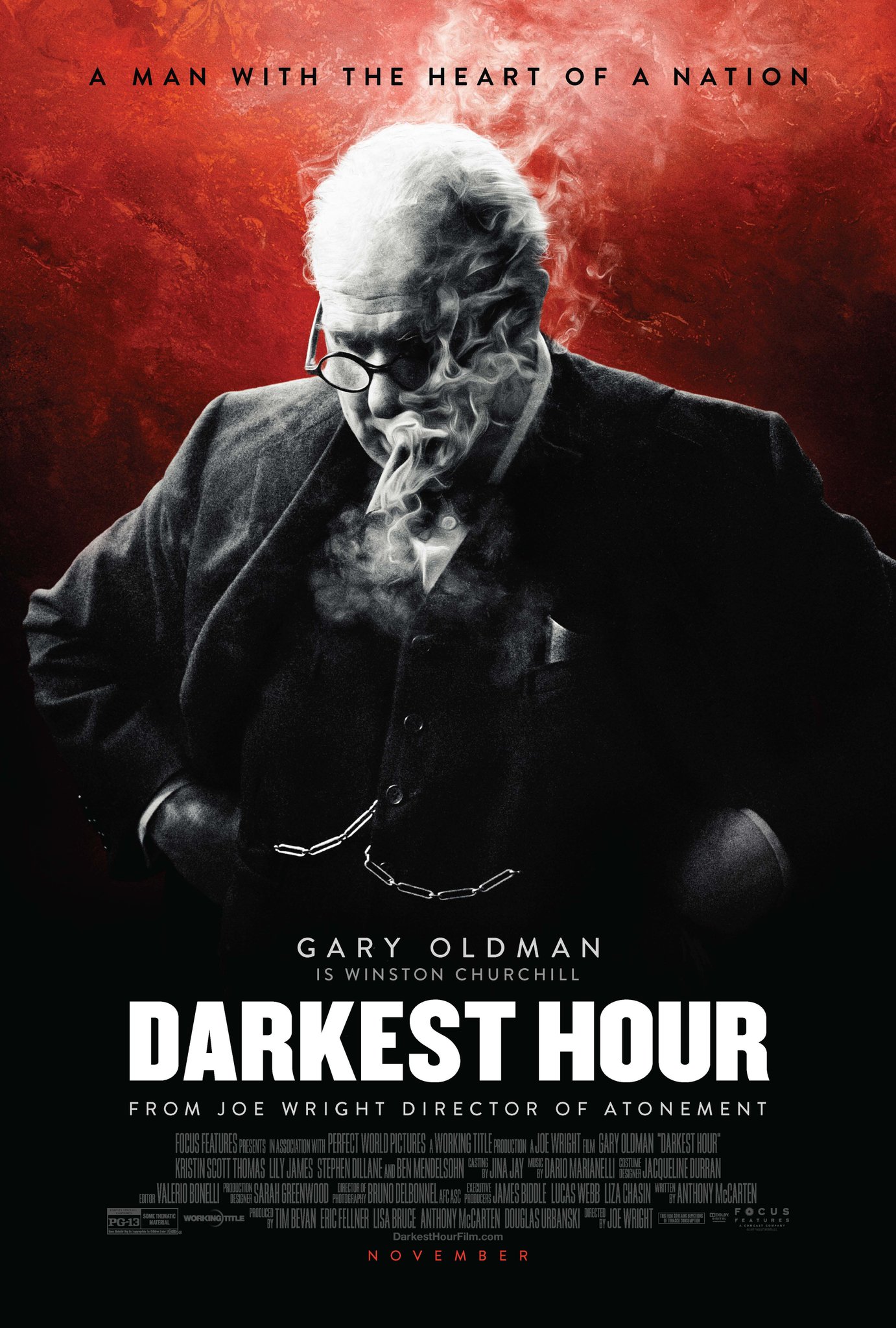
Gary Oldman is a tremendous Winston Churchill in high-octane drama By Peter Bradshaw https://www.theguardian.com/film/ 13 September 2017 Just as Britain negotiates its inglorious retreat from Europe, and our political classes prepare to ratify the chaotic abandonment of a union intended to prevent another war, there seems to be a renewed appetite for movies about 1940. Christopher Nolan has just given us his operatic immersion in Dunkirk, and now Joe Wright — who himself staged bravura Dunkirk scenes in his 2007 film Atonement — directs this undeniably exciting and beguiling account of Winston Churchill’s darkest hour in 1940, as Hitler’s forces gather across the Channel, poised to invade. It is written by Anthony McCarten, who scripted the recent Stephen Hawking biopic The Theory of Everything.
This is not so much a period war movie as a high-octane political thriller: May 1940 as House Of Cards, with the wartime Prime Minister up against a cabal of politicians who want to do him down. It’s interesting for a film to remind us that appeasement as an issue did not vanish the moment that Winston Churchill took over as Prime Minister; despite the famous David Low cartoon, not everyone was right behind him, rolling up their sleeves. Here, his immediate enemies do not seem to be Hitler and Mussolini as much as Chamberlain and Halifax, agitating for a deal with the Nazis and scheming to undermine Churchill’s cabinet and parliamentary position.
They are played respectively by Ronald Pickup and Stephen Dillane, the latter having a malign mandarin impassivity. Dillane makes him a pretty unholy fox. Ben Mendelsohn plays George VI, who is also an appeasement fan at first, though the film gallantly makes him a Churchill convert, conjuring a scene between the two of them in which his job is to stiffen Winston’s sinews. (This film incidentally doesn’t make the mistake in The King’s Speech of implying that Churchill sided with Bertie during the Abdication.)
Darkest Hour has obvious similarities to the recent film Churchill, with Brian Cox; like that drama it imagines a pretty young WAAF figure as his secretary, for him to be at first grumpy and then soppy with - Lily James plays this part here. Miranda Richardson played the exasperated wife Clemmie in the Brian Cox movie and here it’s Kristin Scott Thomas being exasperated and affectionate, helping the impossible old devil dress etc, in more or less the same way - although there’s more here for Scott Thomas to get her teeth into. But this movie packs a much bigger and more effective punch, and that’s down to a more ambitious scale, pacier narrative drive - and the lead performance.
Every time I sit down to another Churchill drama, I promise myself I won’t just roll over for another actor in the latex/Homburg/bowtie/cigar/padding combo and doing the jowl-quivering while speaking in thevoish and the weird cadencesh. And yet there’s no doubt about it, Gary Oldman is terrific as Churchill, conveying the babyishness of his oddly unlined face in repose, the slyness and manipulative good humour, and a weird deadness when he is overtaken with depression. There is a scene (a bit fancifully imagined) with Churchill slumped in a bleakly lit almost unfurnished room, where he looks like something by Lucian Freud. He spends a fair bit of time down in the bunker-ish Cabinet War Rooms yelling at people: these are the “Upfall” scenes, which might get YouTube-subtitled in German in all sorts of irreverent ways. And it is here that Winston reaches his nadir, before the miracle of the little boats has manifested itself. He allows Halifax to send word via the Italians that Britain would be theoretically interested in the Danegeld-price: what might induce Hitler to hold back from Britain and its colonies? Oldman shows Churchill going into a kind of stricken shock.
This is not to say that there isn’t a fair bit of hokum and romantic invention. This film imagines Churchill needing to take a journey on the tube because his official car is held up in traffic. So he meets a quaint cross-section of forelock-tugging British and empire subjects in the underground carriage, from whom he learns something very important — that he is absolutely right!
There is room for a more sceptical movie about Churchill: something revisiting his performance during the Tonypandy Riots or the Siege Of Sidney Street. Or just something that acknowledges that he hated Adolf Hitler for the same reason he hated Mahatma Gandhi: they were both enemies of the British Empire. But Gary Oldman carries off a tremendous performance here, and it’s impossible not to enjoy it. It’s as if his establishment panjandrum George Smiley was suddenly infused with the spirit of Sid Vicious.
An Injustice to Winston Churchill
Joe Wright’s Darkest Hour butchers history to make the British prime minister a much less decisive figure than he actually was.
Because an irresolute and small-minded age applies its own neuroses backward to history, because actors love to portray internal torment, and because we fancy ourselves so sophisticated that we know the official story of the past to be a ruse, movies about important historical figures have become less inspiring and “more human,” at times even iconoclastic. In 1988, Martin Scorsese’s The Last Temptation of Christ presented a very modern Nazarene wracked with anguish about whether he could carry on with his duty, delivering a casual, vernacular Sermon on the Mount from a dusty slope scarcely more elevated than a pitcher’s mound. The Queen (2006) depicted a matter-of-fact Elizabeth II who fixed car engines. The Iron Lady (2011) approached Margaret Thatcher via the Alzheimer’s disease she suffered in her final years. Lincoln (2012) reconceived the most revered orator in American history as a quizzical figure speaking in a high-pitched, soft rasp.
Now it’s Churchill’s turn to be shrunken down to a more manageable size. In Darkest Hour, which is set across May and June of 1940, the English director Joe Wright and his star Gary Oldman conspire to create a somewhat comical, quavering, and very human prime minister. In dramatic terms it’s an engaging picture, and Oldman is terrifically appealing, but if you’re looking for indecision and angst, the person of Winston Leonard Spencer Churchill is a curious place to declare you’ve found it.
Darkest Hour begins with the resignation of Neville Chamberlain (Ronald Pickup) and Churchill’s accession to the premiership on May 10, 1940, building up to the concluding “We shall fight on the beaches” speech he delivered in the House of Commons on June 4, after the miraculous Dunkirk rescue. (The flight of British forces from the Continent takes place almost entirely offscreen here but has been covered in another movie this year. It also inspired a memorable interlude, captured in one of the most elaborate continuous shots ever put to film, in Wright’s own 2007 movie Atonement).
Introduced to us as a kind of rumpled, absent-minded professor with an alarming predilection for drink and a habit of terrifying his secretary (Lily James), Oldman’s Churchill is alternately funny, disarming, wheedling, and unsettled by events in Europe and Washington, from which in a dismal phone call Franklin Roosevelt is heard informing him that the United States cannot by law come to Britain’s rescue. Churchill insists he must at least have the ships he bought: “We paid for them . . . with the money that we borrowed from you.” Yet Roosevelt’s hands are tied. “Just can’t swing it,” he says. Britain must stand alone.
Such moments capture the sense of a Britain gasping for air as Hitler’s fingers tightened their grip around its neck. But then, in its last half-hour, Darkest Hour veers far off the path of truth. Screenwriter Anthony McCarten has claimed, citing Cabinet minutes, that Churchill’s intentions changed virtually from “hour to hour,” and “this is not something that’s ever been celebrated — that he had doubts, that he was uncertain.” All of this is a gross exaggeration. Churchill told his War Cabinet on May 28 “that every man of you would rise up and tear me down from my place if I were for one moment to contemplate parley or surrender. If this long island story of ours is to end at last, let it end only when each one of us lies choking in his own blood upon the ground.” I understand the needs of Method actors, but Churchill was not George McFly.
Hectored by a combination of Chamberlain and his fellow appeaser, Foreign Secretary Viscount Halifax (Stephen Dillane), the prime minister is shown as nearly ready to give in and sue for peace through Mussolini. Buckling under pressure, he rediscovers his resolve only because of last-minute pep talks from his wife Clementine (Kristin Scott Thomas) and King George VI (Ben Mendelsohn). The clincher is that traffic halts the premier’s car and he is forced to take the Underground to Parliament.
Wright and screenwriter Anthony McCarten would have us believe that the ghostwriters of the immortal speech to follow were random Londoners Churchill met on that train, where they gave him both courage and some of the actual words he later used. But these events did not occur; the only time Churchill ever rode the Underground was during the general strike of 1926, according to his biographers William Manchester and Paul Reid. To suggest otherwise trivializes Churchill’s defining speech by reducing it to the level of stenography, while completely misstating the direction of wartime inspiration. Churchill was nothing like the people’s puppet. He felt he was born to lead them. As he would later write, “At last I had the authority to give directions over the whole scene. I felt as if I were walking with destiny, and all my past life had been but a preparation for this hour and for this trial. . . . I was sure I should not fail.”
It is a cliché of the motion-picture industry that, in order to sufficiently excite audience interest, the climactic moments must incorporate a reversal of direction. Since we all know how this chapter of World War II ends — to give Wright and McCarten credit, it’s a stirring, magnificent scene in which Churchill rouses the nation with the 34-minute address one MP called “the speech of 1,000 years” — Darkest Hour simply imposes its dramatic needs upon the days preceding it. For the sake of a good yarn, it mistakes a lion for a jellyfish.