Thursday, May 04, 2017

SWAMP PEOPLE: 47; TRUMP: 0


By Ann Coulter
http://www.anncoulter.com/
May 3, 2017

Image result for trump budget deal

Paul Ryan (Photo by Gage Skidmore / Flickr.)

If this is the budget deal we get when Republicans control the House, the Senate and the presidency, there's no point in ever voting for a Republican again. 

Not only is there no funding for a wall, but -- thanks to the deft negotiating skills of House Speaker Paul Ryan -- the bill actually prohibits money from being spent on a wall. 

At a CYA press conference on Tuesday, Trump's ridiculously chipper budget director, Mick Mulvaney, described the bill's prohibition on building a wall as a MAJOR win. (At least Mulvaney said it in English, unlike his all-Spanish 2014 townhall.) 

True, there will be no wall. But the Democrats graciously agreed to allow the administration to fix broken parts of any existing fences on up to 40 miles of our 3,000 mile border. 

The other big wins, according to Mulvaney, are: 

1) more defense spending, which is fantastic news, because I was worried Boeing and Lockheed Martin CEOs were falling behind Mark Zuckerberg with their gluttonous salaries; and 

2) school choice, an obsession of Washington wonks that is hated out in America, where parents move to high-tax towns for the express purpose of avoiding schools full of disaffected urban youth, and the disaffected urban youth don't want to spend two hours on a bus every day. 

But Mulvaney assures us that this monstrosity of a spending bill has set things up beautifully for the next budget negotiation in October. 

That has become the GOP's official motto: "Next time!" 

We can never win this time. Instead, Republicans' idea is always to surrender this time, in hopes that their gentlemanliness will be rewarded by their mortal enemies next time. Then, next time comes, and Republicans again surrender in hopes of currying favor with the Democrats and the media for the next time.

Mulvaney's most disturbing comment was to say that what upset Trump the most was the Democrats' "spiking the football" on this deal. 

Apparently, Trump's fine with no wall -- and everything else in a bill straight out of George Soros' dream journal -- if only the Democrats hadn't been so rude as to tell the public about it. When your main complaint is that the other side is gloating too much, maybe you're not that great a negotiator. 

Yeah, sure, it's only 100 days in, it's an artificial deadline, the media is dying to say Trump has failed and so on. 

Except: Planning for the wall should have begun on Nov. 9, and a spade should have been put into the earth to begin building it the day after Trump's inauguration. Now, it's 100 days later, and we still don't have the whisper of a prospect of a wall. 

Moreover, this isn't one random bill funding Planned Parenthood (which this bill does). This is the budget deal. There won't be another one like it until next October. 

That's a spectacular failure. Democrats have got to be pinching themselves, thinking, Am I dreaming this? 

It's theoretically possible that Trump could still build a wall, but he's just massively lengthened the odds of ever prevailing. Sure, you can let the other team build a 20-point lead in first half and still come back to beat them, but it's a lot easier if you don't go into halftime 20 points down. 

Trump entered the presidency with the only kind of power that matters. He didn't owe Wall Street a thing. He didn't owe anyone -- not donors, lobbyists nor any political party. What he had was the people, passionately on his side. 

But as soon as he got into office, Trump started giving away his miraculous, unprecedented power. Hey, Wall Street! Even though you didn't give me any money, is it too late to be your friend? 

No amount of abandoning his supporters will get Trump anywhere with Wall Street, Hollywood or the media. Their ferocity will simply shift to ridicule. 

Admittedly, Trump has the enormous handicap of having to work through congressional Republicans, who are feckless cowards. If Speaker Ryan and Senate Leader Mitch McConnell had been around for Reagan's firing of the air traffic controllers, they would have been hysterically screaming, No! You can't do that -- the planes will crash! 

This isn't new information. We knew Washington Republicans were useless. That's why we elected such a comically improbable president as Donald J. Trump. 

The deal was that we were getting the Hollywood version of a New York businessman: an uncouth, incurious rube -- who would be ruthless in getting whatever he wanted. 

In addition to being the only candidate for president in either party taking America's side on trade, immigration, jobs and crime, what set Trump apart was his promise that we would finally win. 

Remember? There would be so much winning, we were going to get "sick and tired of winning," and beg him, "Please, please, we can't win anymore. ... It's too much. It's not fair to everybody else." 

We're not winning. We're losing, and we're losing on the central promise of Trump's campaign. 

How would Trump, the businessman, react if an underling charged with developing a new golf course could never break ground? 

What if the subordinate's progress reports sounded like this: I have given 21 speeches to various chambers of commerce and neighborhood groups, assuring them that there's going to be a golf course. Everywhere I go, I say, "Don't worry about it. It's going to be built!" I have started a commission to study developing a golf course. I have put up a sign saying, "Golf course coming!" And I have caved, and caved, and caved -- so now our opponents know what good guys we are. 

Trump would fire that employee so fast your head would spin. 

We want the ruthless businessman we were promised. 

COPYRIGHT 2017 ANN COULTER 

Wednesday, May 03, 2017

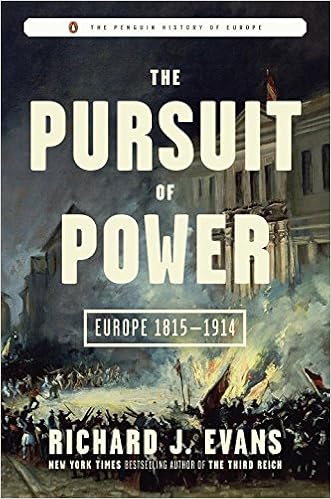
Book Review: 'The Pursuit of Power: Europe, 18-15-1914' by Richard J. Evans

Rise to Dominance

By Donald Critchlow — April 17, 2017, Issue
Image result for evans pursuit of power
The Pursuit of Power: Europe, 1815–1914, by Richard J. Evans (Viking, 848 pp., $40)

At the end of the Napoleonic wars in 1815, Europe lay devastated. A century later, a new Europe had been created, organized around powerful nation-states. It featured expanded suffrage; better diets and health for its citizens; greater rights for the majority of the rural population, women, and religious minorities, notably Jews; increased levels of literacy for the masses; and advanced transportation, communication, and technological systems. By 1914, Europe stood as a global power, with colonies all over the world. Little did Europeans know — as British historian Richard Evans observes in his magisterial, nearly encyclopedic study of their continent’s 19th-century rise — that the world stood on the verge of an incomprehensible catastrophe.

An estimated 5 million people perished during the Napoleonic wars, including one in five Frenchmen born between 1790 and 1795. This was followed by a devastating harvest in 1816, which caused grain prices to skyrocket. Cholera, spread from trade and troop movements in India, broke out in Europe in the 1820s and returned in 1848–49; typhus and other diseases remained persistent public-health problems. In 1815, Austria stood as the most powerful state on the Continent, but hopes for a balance of power in Europe eroded owing to the emergence of a powerful and unified Germany and nationalist rebellions in Central Europe. Greece and Italy became unified nations. Poland, divided by the great powers of Austria, Prussia, and Russia, was the most notable nation that failed to find independence.

The French Revolution left a legacy of social conflict, social equality, and revolutionary outbursts in 1848 and again in the 1870s. Utopian socialism expressed itself in French thinkers such as Fourier and Saint-Simon, while revolutionary Communist ideology was given powerful coherence by Karl Marx; and Mikhail Bakunin provided justification for terrorism by anarchists and nihilists.

Liberals across Europe called for legal and constitutional reform to expand the electorate and allow freedom of the press and recognition of political parties. These reform efforts were most successful in England and, for a brief period in the 1840s, in France. Revolutionary upheavals that swept across Europe in 1848 brought moderate liberals and diehard conservatives “closer together,” Evans observes, “in a shared fear of the masses.” A new breed of politicians, such as Cavour in Italy, Bismarck in Germany, Louis Napoleon III in France, and Disraeli in England, realized that, in Evans’s words, “the preservation of order and stability required radical measures to co-opt the masses into support of the state”; “nationalism was becoming increasingly powerful, indeed unstoppable, and in their different ways they sought to exploit it for their own purposes.”

The rise of nationalism proved integral not just to national-unification movements but also to the strength of colonialism and empires. This coincided with reorganized armies and arms races. The Franco–Prussian War revealed the superiority of the Prussian military. The Prussian king, Wilhelm I, and his prime minister, Bismarck, used the war to unify Germany, setting the stage for the First World War.

In this century of political turmoil, Europe also underwent a technological and economic transformation, with England playing a critical role in industrial innovation, international trade, and finance. By 1890, Britain had a greater tonnage of shipping than the rest of the world put together. British capitalists and engineers financed and supervised the building of an extensive railway system throughout Europe. Chemical and pharmaceutical industries boomed in England, Germany, and France. Electrical companies produced new sources of power for industry and for private citizens. Cities, once squalid and disease-ridden, were provided with hygienic water supplies and improved public health. The middle class grew in numbers and influence as European economies grew.

Evans maintains that Europe surged ahead owing to “specific historical circumstances” — not to its “intrinsic superiority” (Evans’s phrase describing the opinion of some other historians, including Niall Ferguson). Evans discusses Europe’s rise with much erudition and at great narrative length but does not actually detail what he means by the “specific historical circumstances” that were crucial to this advancement. Here he might have turned to historian David Landes, who named three factors that enabled Europe to become a global economic power in this period: a deeply rooted sense of individualism, the rule of law, and property rights. Evans often passes over these factors or suggests them only by implication. In The Wealth and Poverty of Nations (1998), a work not cited by Evans, Landes provides great evidence that Europe’s economic advancement was the direct result of a unique culture founded on political competition, economic freedom, and favorable attitudes toward science and religion, as well as the comparative advantages of its climate.

Evans balances descriptions of material advances in Europe with discussion of growing economic inequality and the pursuit of empire, the latter of which he roots in xenophobia and racism. He dedicates The Pursuit of Power to the late Eric Hobsbawm, a Marxist historian who was quick to note the barbarities in modern European culture and the social inequalities produced by capitalism. Few historians can match Hobsbawm in literary ability, but Evans provides a wider historical understanding of the long 19th century by reaching beyond Europe’s great powers to include the whole continent as far as Russia.

Drawing on recent scholarship on private life, popular and literary culture, and the environment, Evans weaves a rich tapestry of unparalleled historical transformation. In detail and inclusiveness, Evans exceeds Hobsbawm. Evans is neither a historical materialist nor an economic determinist; he understands the role of freedom and accident in history.

His focus, as far-reaching as it is, does tend to downplay the positive role played by religion in this period. Evans emphasizes the growth of secularism that came from the advancement of science, Darwinian evolutionary theory, and literary and cultural criticism. He pays less analytical attention to the role that religion, especially Protestant Evangelical revivalism, played in tempering capitalist greed and inspiring social reform. The 19th century, particularly in England, was swept by religious revivals. This religious spirit fostered moral reform, including anti-slavery, temperance, women’s-rights, and anti-animal-cruelty movements. The wealthy were inspired with a philanthropic impulse to create benevolent societies and to promote better conditions for workers, the indigent, and the ill. Polish national identity survived in large part because of the Catholic Church. Evans discusses these efforts but overlooks the possibility that the 19th century was as much an age of religion as one of secularism.

Evans maintains that, in the course of mass emigration to other parts of the world, “Europe’s social and cultural limits became blurred.” Perhaps, but at the same time British, French, and German literature spread to Asia, Africa, and Latin America; European educational systems were implemented throughout the world; and ideas of Western democracy and the rule of law inspired national reformers in India, China, and Japan, and throughout Africa and the Middle East. Scientific and medical knowledge developed in Europe transformed the world. The impact of European literary, political, technological, and scientific contributions suggests less a “cultural blurring” than a clear, sharp transformation.

The nation-state and the corresponding rise of nationalism characterized the 19th century. Patriotic spirit within the masses of each nation presented the Left in Europe (and the United States) with a political problem: For all their talk of international solidarity, socialist parties and left-wing intellectuals confronted a deeply rooted patriotic spirit within the masses, tapped by right-wing and centrist parties. However much nationalism was founded on what Hobsbawm called “invented traditions” and created national myths, it presented an intractable problem for the Left, as evidenced in the First World War — and today: Nationalism has found new expression in politics following the Great Recession of 2009 and is manifested in Brexit in Britain, Marine Le Pen in France, and anti-immigrant and anti-EU politics throughout Europe.

If the 19th century can be characterized by the rise of the nation-state and nationalism, the 21st century, at least in its first decades, illustrates the power of patriotic expression, a power not easily erased by the global economic integration set in motion two centuries earlier.

– Mr. Critchlow, a professor of history at Arizona State University, is the author of Future Right: The Forging of a New Republican Majority.

He went toe-to-toe with Muhammad Ali — and inspired ‘Rocky’


April 29, 2017
Image result for chuck wepner ali
Chuck Wepner has fought some of the biggest names in professional boxing: Ali. Liston. Foreman.
But taking on those powerhouses was nothing compared to the time he fought a bear. Actually, the two times.
The first was at Asbury Park’s Convention Hall in 1976. “This 1,250-pound bear charged me and pinned me,” Wepner said. “I was supposed to raise my hand if I wanted to stop the fight, but the bear held down my arms. And his [fur] was like Brillo. By the end of the fight, my body was beet red.”
Their rematch went no better: “That bear charged me again, stood on his hind legs and threw me out of the ring,” said Wepner, now 78. “I was [also] asked to fight a kangaroo in South Africa, but I told them to forget about it. Kangaroos hit hard!”
Wepner’s checkered life story — including allegedly inspiring Sylvester Stallone to write “Rocky” — is chronicled in the new movie “Chuck,” starring Liev Schreiber and opening in theaters Friday. It tells the unvarnished tale of a struggling New Jersey fighter who earned the evocative but deprecating nickname “the Bayonne Bleeder” during a fight in which his blood splattered on a reporter sitting ringside.
Indeed, while Wepner won 35 of his 51 pro bouts, he also had some viciously bloody losses — including a 10th-round TKO by Sonny Liston that left him needing more than 70 stitches in his face.
But in 1975, promoter Don King offered Wepner $100,000 — the boxer’s highest-ever payday — to take on Muhammad Ali.
“Ali said he needed an easy fight after [George] Foreman [at 1974’s “Rumble in the Jungle”] and figured he would cut me up,” said Wepner. “But I had a shot to win a title against the most famous man in the world.”
Wepner went the distance, but the match was brutal. The Post called it “a fight between a house painter and an artist.”
Still, “Ali was exhausted from punching Chuck so many times,” Schreiber told The Post. “That’s a testament to Chuck’s spirit and tenacity [to] keep moving forward.”
As for Wepner’s take on it all, he said, “I thought I was ahead during the fight.”
Despite losing by taking a knee 19 seconds before the final bell, Wepner showed the world that he had heart. Ali himself later said, “There’s not another human being that can go 15 rounds like that.”
Image result for chuck wepner ali poster
Sylvester Stallone took notice and allegedly based his Rocky Balboa character on “the Bleeder.” Released in 1976, “Rocky” was a low-budget film with an essentially unknown writer-star (Stallone), but it went on to become the highest-grossing film of the year and win three Oscars, including Best Picture.
“I saw ‘Rocky’ in a Manhattan movie theater, and the crowd went nuts for Rocky,” said Wepner. “And, to be honest, so did I.”
Wepner, meanwhile, was in a weird place. Besides his match with the bear, that summer he had fought wrestler Andre the Giant in front of 42,000 people at Shea Stadium. Manager Al Braverman has said that they took this undignified gig strictly for the money. Wepner was in the midst of a hard-partying binge, including a cocaine habit, that would eviscerate much of his $100K windfall.
Word had gotten out that Wepner was supposedly the inspiration for “Rocky.” He lied to friends, saying that he had been paid for his life rights. “I was upset about [not being compensated] and had a lot of pride,” he said.
Stallone tried to make good on the slight by offering him a role in the sequel. But Wepner handicapped himself: “I had been partying for two days before the audition — drinking, doing coke, not sleeping. Sly saw me and said, ‘Champ, you look a little tired.’ I read but did not do well. I failed to make it.”
Things hit rock bottom in 1985 when, according to Wepner, he “did a friend a favor and brought him an ounce of coke” — although then-Middlesex County prosecutor Alan Rockoff described Wepner as a “mid level” drug dealer in possession of four ounces. The boxer pleaded guilty and was sentenced to 10 years but served three in Newark, NJ’s Northern State Prison.
Although he maintained that he was set up, Wepner also admitted that “going to jail might have been a good thing. Since getting out, I’ve been a good boy.”
These days, Wepner is happily married to his wife of 22 years, Linda, makes a living as a wholesale liquor salesman and drives around with a personalized license plate that reads “Champ.” He’s even come to think of the “Rocky” franchise, which exacerbated his downfall by bloating his ego, as a positive: “Stallone created a legendary character and it rubbed off on me.”
Nevertheless, in 2003, Wepner sued the actor for hijacking his life. Three years later, they settled for an undisclosed sum. “Everyone thinks that Sylvester Stallone and I don’t like one another, but it’s not true,” insisted Wepner. Stallone — who’s favorably portrayed in “Chuck” by actor Morgan Spector — even helped the producers finagle a deal for some potentially pricey fight scenes.
“If we shot it in America, we would have had to pay $2 million,” Wepner said. “Stallone said, ‘I’ll hook you up in Bulgaria, where I shoot my “Rambo” movies.’ ”
Still, Wepner would not mind one more favor from the Hollywood star, who brought the Rocky character back to the big screen for “Creed” in 2015. “If Sylvester Stallone wants me for a movie, he knows where to find me,” he said. “I will happily be available."

Tuesday, May 02, 2017

Venerating Havoc


Academia and the media have learned nothing in the 25 years since the L.A. riots.
May 1, 2017
Image result for la riots 1992 reginald denny
Another five-year anniversary of the 1992 Los Angeles riots, another opportunity for media glorification of racial mayhem. The New York Times outdoes itself this year with a fawning profile of one of the sadists who stomped and bludgeoned trucker Reginald Denny nearly to death on April 29, 1992, as Denny tried to maneuver his truck through the already anarchic intersection of Florence and Normandie in South Central Los Angeles.
Henry Keith Watson, an ex-con who had just assaulted an Asian man, stood on Reginald Denny’s neck and head as others kicked him (pictured above). Watson never served any time for his participation in this grotesque explosion of racial hatred. The Times notes admiringly that Watson apologized to Denny on a talk show.
That forced contrition—an apology was a condition of his probation sentence as well—was short-lived. “Now, 25 years later, Mr. Watson is not in the mood to say sorry,” Times reporter Jennifer Medina writes. Of course not. Why should he be? Watson “called himself ‘an angry black man’ one afternoon this week as he sat on the porch of his home,” Medina reports. “As he has done each anniversary, he is selling Florence and Normandie T-shirts and throwing a block party on Saturday”—a natural way to commemorate a conflagration that took over 50 lives and caused an estimated $1 billion in property damage. The Times does not bother speaking to any of the thousands of victims of that racial mayhem, instead foregrounding Watson’s complaints about ongoing “oppression.” “Nothing has changed, nothing,” Watson grouses. A friend of Watson’s, Nathan Smith, who was on parole in 1992, predicts that another riot is likely. Back then, Smith says, “We all felt like, ‘We’ve been telling you we’re angry and you’re not listening, so now we’re going to show you.” “Showing you” consisted of burning down businesses that have struggled to survive constant robberies and assaults on their employees and have only succeeded due to a fierce work ethic. “Showing you” also consisted of pulling drivers from their cars and mutilating them. Even if there were some legitimate “you” that is responsible for the social chaos of the ghetto, it is certainly not a Korean convenience store owner or a construction worker returning from work.
The familiar “nothing has changed” complaint embodies the entitlement mentality. Its logic is the following: “We destroy the businesses that have served us for decades; we unleash savage violence against every ethnic group other than our own. So why aren’t things better now in our neighborhoods? Government and society owe us reparations in response to our feral rage against other people’s livelihoods and lives.” But a riot is inevitably going to make the local situation worse. Mainstream businesses will be even less willing to move into a riot zone; property values, already depressed by high crime, will plummet further. Though governments usually do respond to riots with cash and programs, such intervention is not going to make any difference unless individuals in the community make better personal choices: paying attention in class, studying, not committing crime, staying in a job, and not having children out-of-wedlock.
The University of California’s massive diversity bureaucracy also got into the game of riot whitewash. UCLA’s Vice Chancellor for Equity, Diversity, and Inclusion, Jerry Kang, is sponsoring a student art competition to commemorate the “social rebellion.” Students can submit performance art, poetry, or visual art to “critically examine the root causes of this historic event . . . and its relevance to contemporary issues of diversity, equity, and inclusion.” Do not expect any installations featuring the charred remains of torched business. To gain “inspiration” for their art works, the competitors had to attend at least one panel in an April 28 conference on the “Los Angeles uprisings,” also organized by the Vice Chancellor of Equity, Diversity, and Inclusion. That conference assembled ethnic studies professors and racial activists; no first responders were included.
One victim of the riots did squeak in, but only because she adopts the mandatory view of racial violence. Carol Park’s memoir of helping to operate her widowed mother’s gas station in Compton, Memoir of a Cashier: Korean Americans, Racism, and Riots, frankly describes the anti-Korean racism regularly directed at her and her mother. Park's mother barely escaped unharmed from the gas station on the first night of riots. When she returned home, she told her children to do their homework but otherwise said nothing about the spreading violence. That admonition tells you everything you need to know about the "oppression" that allegedly lies at the root of ethnic economic differences. Park attributes anti-Korean hatred and rioting, however, to widespread “racial discrimination” and “governmental neglect.”
Jerry Kang moved over from the UCLA law school to become UCLA’s first Vice Chancellor of Equity, Diversity, and Inclusion; as a law professor, he studied “implicit bias.” Kang’s starting salary as Vice Chancellor in 2015 was $354,900, undoubtedly socked away in West Side real estate and financial instruments out of the range of looters. Today Kang busies himself with “building equity” for UCLA’s allegedly oppressed students, who, with their access to boundless academic resources, number among the most advantaged people in human history. Kang’s “equity” mission for privileged students is as delusional as celebrating riots as “social uprisings.”  Instead, such violence should be denounced as murderous rampages that threaten civilization itself.

Monday, May 01, 2017

The Enduring Relevance of G.K. Chesterton


by 
http://www.theimaginativeconservative.org/
April 26, 2017

Related image

Editor’s Note: The following essay is an interview with The Imaginative Conservative‘s Senior Contributor Joseph Pearce with Agustín de Beitia, for the Argentinean newspaper La Prensa.

1) In a recent interview, you agreed with the idea that we are in the middle of a Chesterton revival. I apologize for asking you about this subject again, but I find it fascinating. What are the evidences of this revival and why do you think it’s happening?
We are indeed in the midst of a Chesterton revival. The practical evidence for this can be seen in the number of Chesterton books that are currently in print, compared with, say, twenty years ago, as well as the evident growth in the size and number of Chesterton Societies around the world. The reasons for this are manifold but much is due to Chesterton’s enduring relevance. Chesterton analyzed the problems that plague modernity with a wit and wisdom which is charming and disarming, using the power of paradox and combining clarity with charity in a way that is difficult to resist. His greatest strength, me judice, is the way in which he always insists on the inextricable marriage of faith and reason and uses this marriage to counter the errors of modernism. After reading Chesterton we are inoculated from the poison of modernism and will never again confuse the Heilige Geist with the Zeitgeist, the Holy Spirit with the Spirit of the Age. 
2) In the modern world, we can see an individual detachment from faith, while an intolerant laicism grows among society. Do you find any similarities with the time when Chesterton lived and worked? Would you say he was a visionary?
It is said that the more things change, the more they remain the same. The fact is that secularism is always at war with the Faith and that laicism is always at war with the Church. We can see this in the persecution of the early Christians by the Roman Empire, which established a pattern that has been prevalent in human history ever since, from the Machiavellianism of Henry VIII and Elizabeth I in England, to the French Revolution and its Great Terror, and on into the twentieth century with the secular fundamentalism of the Russian Revolution, the Mexican Revolution, the Third Reich, the Spanish Civil War, etcetera, ad nauseam. Chesterton was a visionary insofar as he recognized this all too often forgotten reality, stressing that Christendom is always the cultural and political expression of the Church Militant, the Church at war with the forces of secularism: Pro Ecclesia contra Mundum!
3) One can—at least—be surprised by the natural way in which Chesterton includes faith and reason in his thoughts, up to an extent in which they seem familiar. Was faith such a politically incorrect issue as it is today? Why do you think it appears to be so easy for Chesterton to address this subject?
At the forefront of Chesterton’s engagement with the errors of his day, which were essentially the same errors that are so prevalent today, is his realism, in the philosophical sense of the word. He is always at war with nominalism and relativism, and always a defendant of the rational essence of reality. It is his absolute insistence, at all times, on the inextricable bond that exists between fides et ratio which makes him such a powerful force for good.
4) Why does reading Chesterton’s work lead oneself to the joy of being a Christian? Is it because of the discovery of faith omnipresence? What reflexion can be made at present time, when faith has been erased from public debate?
At the heart of Chesterton’s joy at being a Christian, a joy which is contagious to anyone who spends time with him in his writings, is the connection between humour and humility which we see in his work, a connection that is encapsulated in the wonderful lines in Orthodoxy about angels flying because they take themselves lightly (humility) whereas the Devil falls through the law of gravity because he takes himself too seriously (pride). It is this animus between levitas and gravitas which animates Chesterton’s work.
5) Chesterton dazzles with his eruditeness and his mastery of the paradox and irony to ridicule his opponent’s ideas. How can you explain such a genius, who was at the same time a novelist, an essayist, a poet, an apologist, and a successful polemicist at a wide range of subjects?
Chesterton astonishes us with his wisdom because he sees with Christ-like eyes. Paradoxically, he sees with the wisdom of Christ because he sees with the innocent wonder of a child. This is the paradox of all perception. As Thomas Aquinas teaches, humility opens the eyes to wonder, and wonder opens the eyes and the heart to the splendor of truth and the glories of God’s omnipresence in His Creation. It is this humble and wonder-filled openness (dilatatio) to reality which enables Chesterton to see with such clarity and charity. This is why he always leads us to God whether we are reading one of his novels or poems, or one of his essays or biographies. Chesterton can start with a piece of chalk and lead us to God. He can be running after his hat and find that he is running after God. He can discuss Dickens and find God, or write history as though it’s His Story. He is a writer and an apologist for whom everything is charged with the grandeur of God.    
6) Chesterton occupied an important place during the English catholic resurgence of the early past century after the initiator: Cardinal Newman. There are some people who believe that even those familiarized with Chesterton don’t appreciate the importance of his writing. Is he comparable to Newman in any way?
Chesterton is very much comparable to Newman. Just as Newman could be seen as the initiator or instigator of the Catholic Revival, through his conversion in 1845 and his powerful works of apologetics thereafter, Chesterton can be seen as the main momentum and catalyst for the second phase of the Revival, his own conversion and powerful works proving to be significant contributors to the conversion of thousands of people in his own lifetime and thousands more since. We might call the first phase of the Catholic Revival the Newman Period, from Newman’s conversion in 1845 till his death in 1890, but the second phase should be called the Chesterton Period, from Chesterton’s first being published in 1900 till his death in 1936. If Newman blazed the trail, Chesterton fanned the flames of faith that Newman had set alight. They are partners in evangelism!
7) Would you say he was less acknowledged as a man of letters and a poet than as an apologist?
Part of the genius of Chesterton is that he defies categorization. He was a poet, a novelist, an essayist, a biographer, a popular and populist historian, an apologist, a wit, a controversialist—and some would say a saint! He might not be larger than life, because no man is larger than life, but he is certainly larger than any of the boxes in which we try to squeeze him!
8) We have talked about a time when the two lines of confrontation in the cultural war were balanced, while at the present time we assist to a complete disproportion of forces (in human terms, of course). A time, also, when those lines were still clear –Chesterton had to deal with anarchism, socialism—while now confusion and ambiguity reign, up to the point that even the Church seems to oppose to itself. Is it possible to conclude that such threats were then barely in the beginning? And what do you think that Chesterton would have done today?
I think we are in danger of accepting the “progressive” presumption that there is an inexorable “progress/regress,” i.e. that things are going to continue getting better or worse in a linear sense. The culture of death is seemingly in the ascendant at the moment but it contains within itself the seeds of its own decay and death. What we are witnessing is not the triumph of secular “progress” but its dissolution, disintegration and ultimate suicide. What secular “progressives” see as recent political triumphs are in fact the acceleration of their own demise. We need to remember, as Chesterton never forgot, that evil is its own worst enemy. If Chesterton were alive today he’d be doing exactly what he did in his own time. He’d be exposing the lies of relativism, secularism and the culture of death and showing our generation, as he showed his, that Christian orthodoxy is the only solution to the world’s dissolution.

Books on the topic of this essay may be found in The Imaginative Conservative Bookstore. This essay was originally published in La Prensa (2016) and is republished with gracious permission from the author. The Imaginative Conservative applies the principle of appreciation to the discussion of culture and politics—we approach dialogue with magnanimity rather than with mere civility. Will you help us remain a refreshing oasis in the increasingly contentious arena of modern discourse? Please consider donating now.

Joseph Pearce is a Senior Contributor at The Imaginative Conservative. He is writer in residence and director of the Center for Faith and Culture at Aquinas College in Nashville, Tennessee. His works include: G.K. Chesterton: Wisdom and InnocenceLiterary ConvertsTolkien: Man and MythSolzhenitsyn: A Soul in ExileThe Quest for Shakespeare and Old Thunder: A Life of Hilaire Belloc. He is the series editor of the Ignatius Critical Editions, and editor of the St. Austin Review. Mr. Pearce has hosted two television series for EWTN on Shakespeare’s Catholicism.

California Squashes Its Young


The Golden State’s suffocating economic policies are driving out a new generation.
April 30, 2017
Image result for california poverty
Skid Row, Downtown Los Angeles
In this era of anti-Trump resistance, many progressives see California as a model of enlightenment. The Golden State’s post-2010 recovery has won plaudits in the progressive press from the New York Times’s Paul Krugman, among others. Yet if one looks at the effects of the state’s policies on key Democratic constituencies— millennials, minorities, and the poor—the picture is dismal. A recent United Way study found that close to one-third of state residents can barely pay their bills, largely due to housing costs. When adjusted for these costs, California leads all states—even historically poor Mississippi—in the percentage of its people living in poverty.
California is home to 77 of the country’s 297 most “economically challenged” cities, based on poverty and unemployment levels. The population of these cities totals more than 12 million. In his new book on the nation’s urban crisis, author Richard Florida ranks three California metropolitan areas—Los Angeles, San Francisco, and San Diego— among the five most unequal in the nation. California, with housing prices 230 percent above the national average, is home to many of the nation’s most unaffordable urban areas, including not only the predictably expensive large metros but also smaller cities such as Santa Cruz, Santa Barbara, and San Luis Obispo. Unsurprisingly, the state’s middle class is disappearing the fastest of any state.
 California’s young population is particularly challenged. As we spell out in our new report from Chapman University and the California Association of Realtors, California has the third-lowest percentage of people aged 25 to 34 who own their own homes—only New York and Hawaii’s are lower. In San Francisco, Los Angeles, and San Diego, the 25-to-34 homeownership rates range from 19.6 percent to 22.6 percent—40 percent or more below the national average.
No big surprise, then, that California’s millennials are more likely to stay at home with Mom and Dad into their thirties. Approximately 47 percent of Americans aged 18 to 34 lived with parents or other relatives in 2015, according to the American Community Survey—but in California, the figure is 54 percent. California’s younger generation, particularly in the cities, seems increasingly destined to live as renters.
The biggest losers from California’s housing crisis are, ironically, the very people whom progressives claim to care about most: the poor and minorities, who also constitute most millennials. Hispanics, now approaching a majority of the state’s population, account for 43 percent of the 25-to-34 cohort. Rates of homeownership for African-American and Hispanic Californians have dropped at four times the rate of Asians and non-Hispanic whites in the last 10 years, while minority homeownership in the Golden State now lags most of the country, notably Texas and the southeast.
Much of this can be traced to California’s long-standing bias against suburban development. Reducing greenhouse-gas emissions remains an obsession. But unless the rest of the country (or the world) adopts California’s strict emissions rules, the state’s regulations are likely to have little or no impact on climate change. Recently passed legislation will make things worse by imposing even more stringent regulations on greenhouse gases, mandating a 40 percent cut from 1990 levels by 2030. This represents the ratcheting up of a regulatory regime that will slow California’s already-torpid rate of issuing building permits, which is well below the national average.
California’s housing policies pose a profound long-term threat to the state’s social stability and economic viability. The state has seen a net loss of about 1.7 million domestic migrants since 2000. After slowing during the Great Recession and its aftermath, out-migration is again growing, even in the booming Bay Area. Some 29,000 more people left the Bay Area than arrived in 2016. The San Francisco metropolitan area saw net migration plunge from plus-15,000 in 2013 to minus-12,000 three years later.
Contrary to some reports, the people leaving California are not predominantly poor and uneducated. IRS data show that California’s outmigration between 2013 and 2014 was concentrated among middle-aged people with higher average incomes than households that stayed in California or moved there. This trend contrasts dramatically with Texas, arguably the state’s strongest economic competitor.
Here again, new policies will only make things worse. The Bay Area’s 2040 regional plan calls for concentrating 75 percent of new housing development on barely 5 percent of the region’s developed land mass. One alternative plan assumes that 78 percent of new housing in the Bay Area would be multi-family and 22 percent single-family (detached and attached). The regional Air Quality Agency has drawn up intrusive plans, seeking to levy tolls on all freeways, ban gas stoves, and urge less meat consumption.
Young people overwhelmingly prefer single-family houses, which represent 80 percent of home purchases nationwide for people under 35. If millennials continue their current rate of savings, notes one study, they would need 28 years to qualify for a median-priced house in San Francisco—but only five years in Charlotte and just three in Atlanta. This may be one reason, notes a recent ULI report, why 74 percent of Bay Area millennials are considering moving out in the next five years.
Regional planners and commercial chambers should indeed look to California as a model—of exactly what not to do. The state’s large metro areas are no longer hot growth spots for millennials, who are flocking to suburbs and exurbs elsewhere. Since 2010, the biggest gains in millennial residents have been in low-density, comparatively affordable cities such as Orlando, Austin, and Nashville. Ultimately, the battle for California’s future—and much of Blue America’s—will turn on how these regions meet the challenge of providing housing and opportunities to a new generation of workers and young families. A California that works only for the wealthy and well-established is not sustainable.
America’s “youth culture” was invented, more or less, in California in the 1960s, from the surfing spots of L.A. and Orange County to the countercultural hotbeds of the Bay Area. But today, California is turning on its young, with policies that ensure that most millennials will never fully “launch,” leaving many destined either to move elsewhere or become wards of an ever-expanding welfare state. The Golden State can still create an environment for growth and family formation—but only if it reclaims its historical role as the nation’s beacon of opportunity and youthful enthusiasm.

Sunday, April 30, 2017

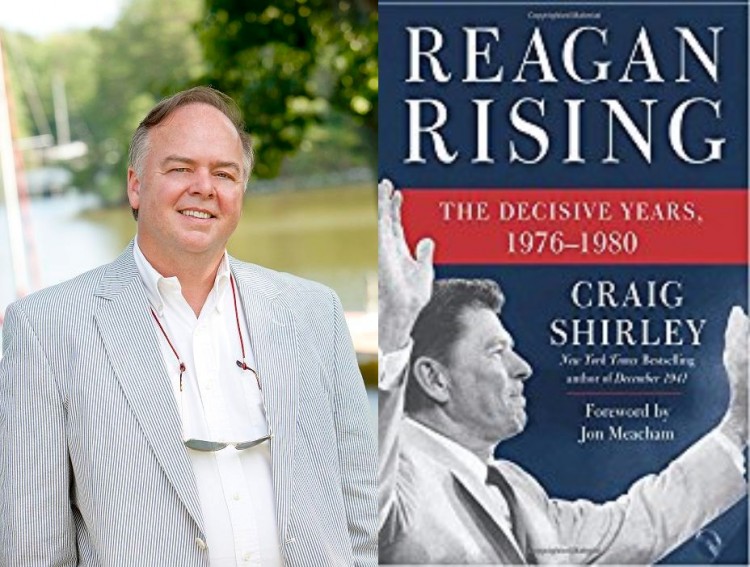
Book Review: 'Reagan Rising' by Craig Shirley

Reagan in the Wilderness
Reagan Rising: The Decisive Years, 1976–1980, by Craig Shirley (Broadside, 432 pp., $29.99)
By Clark S. Judge — April 17, 2017, Issue
Image result for reagan rising
Thucydides had a great advantage over later historians in telling his tale of the Peloponnesian War: As a general in the Greek army, he had been there. Craig Shirley, who is emerging as the most prolific and, in some respects, most insightful chronicler of Ronald Reagan’s political rise, shares that advantage. He was there.

As a young political operative, in roles ranging from press secretary for the surprise winner of a long-shot U.S. Senate bid to a similar position with a prominent governor to heading up a pivotal independent-expenditure committee backing Reagan in 1980, again and again Shirley was perfectly placed to see and understand all that went into one of the most remarkable — and, once in office, successful — political careers in American history.

In earlier volumes, Shirley detailed Reagan’s failed 1976 run for the presidency, his successful bid four years later, and his twilight years after leaving the nation’s highest office following two terms comparable in achievement only to those of Washington, Lincoln, and FDR. Now Shirley has taken on the 40th president’s equivalent of Winston Churchill’s “wilderness years” — the time out of office, when many doubted his ability to return in any serious way to the stage, much less take center stage. This was the period when Reagan’s culminating run for the presidency was born.

While it revolves around Reagan, Shirley’s story also focuses on three other men — Gerald Ford, Jimmy Carter, and George H. W. Bush.

It is widely forgotten now how bitter the division between the Ford and Reagan forces was in the mid 1970s. Shirley takes readers through a compressed account of the 1976 campaign for the GOP nomination — “the tightest two-way race for a major-party nomination in modern political history,” Newsweek (quoted by Shirley) called it — and the fall campaign that followed. Some thought that after Reagan’s strong challenge, Ford should offer him second spot on the ticket. Such was the personal animosity that Ford refused.

With his brilliant, semi-extemporaneous speech on the convention’s last night and impressive appearances before state delegations over the previous week, Reagan emerged as, in the words of prominent columnist Jack Germond, the GOP’s “heir apparent.”

Yet Ford was far from out of the game. He disliked Reagan, who represented a rising but, in the view of moderates, dysfunctional part of the party, and he felt that Reagan had not given his full energies to the general-election campaign, facilitating Carter’s victory. Reagan in turn was disgusted at Ford’s hardball tactics during the nomination fight and opposed Ford’s moderate-Republican approach to the Soviets, the economy, and much else. The rivalry hung over the Republican party even into the 1980 GOP national convention in Detroit. As Shirley tells it, on Carter’s inauguration day, as Ford “jetted off to California” after the ceremonies, he “told a reporter, after dining on shrimp and steak and a couple of dry martinis on the 707 that had been designated Air Force One when he was president, that he was game for another try at the White House in 1980 and that ‘I don’t want anyone to preempt the Republican presidential nomination.’” “Anyone” meant Reagan.

Shirley is surprisingly sympathetic to Carter, who, like Reagan, was cut from populist cloth. As he explains:
Rural populism had sprung up in Carter’s South and Reagan’s Midwest in the 1890s, and was mostly focused on the power of moneyed eastern interests, especially large banks, railroads, and manufacturers. . . . Big government was also a focus of populists’ ire, which Carter acknowledged. . . . Though some racists were involved in the populist movement in its earlier years, both Carter and Reagan abhorred racism.
Shirley highlights another similarity between Carter and his successor. Washington, he says,
did not understand how close Carter was to his wife, Rosalynn. They underestimated this steel magnolia, and for the oft-divorced sophisticates who made up the Washington intelligentsia, such personal closeness between married couples was deemed peculiar. . . . A cultural rift was developing between the uncomplicated Georgians and the unctuous Georgetowners, who would bedevil Carter all through [his presidency].
But though, in cultural respects, they were more like each other than like the establishment of the federal city, Reagan and Carter could not have been more unlike in politics or political ability. Reagan celebrated the American spirit and the American character and looked to restore vibrancy to an economy that was increasingly enmeshed in stagnation and inflation. Carter was soon looking to impose a heavy tax on gasoline, halt dozens of western water projects, and embrace an era of limits. Within months of Carter’s inauguration, columnist George Will would write that he had “opened a multi-front war on numerous American practices, habits, and mores.”

At about the same time, Carter, who had suggested during his campaign that Nixon’s détente policy was too weak-kneed, lectured Notre Dame’s commencement audience to beware of what he called an “inordinate fear of Communism.” Soon he was calling for normalization of relations with China, Cuba, and Vietnam, even as he was cracking down on authoritarian regimes that were, nevertheless, American allies.

Reagan bristled at all of this, but it was Carter’s signing of the treaty (largely negotiated under the Ford administration) turning control of the Panama Canal over to the Panamanian government that gave him an opportunity to act. Almost alone among major American political figures, he opposed the pact and campaigned against it — and though the pro-treaty forces prevailed in the Senate, Reagan won in the country. The nation had seen a man unafraid to take on all comers in defense of what he saw as right.

Despite numerous hints and feints over the next two years, Ford never entered the 1980 race. Instead former congressman, ambassador, Republican National Committee chairman, and CIA chief George H. W. Bush emerged from a crowded field to become Reagan’s chief rival. In 1979, Bush campaigned vigorously and effectively while Reagan stayed off the campaign trail, skipping major events and sticking to his radio commentary, columns, and paid appearances. The reason for this reticence was John Sears, Reagan’s 1976 campaign manager and the man initially in charge of the 1980 run. Shirley is highly critical of Sears’s strategy of aloofness, which came within a breath of killing Reagan’s candidacy.

Across the nation and particularly in Iowa, Bush and his impressive and equally energetic family were everywhere, with the result that Bush won the Iowa caucuses. The next big prize was New Hampshire, five weeks after Iowa. Losing patience with Sears, Reagan took control of his organization and campaigned even more intensively in the Granite State than Bush. Then, the Saturday before the primary, in a showdown debate with Bush, Reagan displayed the same steel and fire that had marked his Panama Canal advocacy. As a local newspaper editor, who was the debate’s moderator, tried to turn off his microphone over a dispute about the role in the debate of other candidates, Reagan, who was sponsoring the forum himself, sternly stopped him with the now famous remark, “I am paying for this microphone, Mr. Green.” By Tuesday night, the nomination was all but in Reagan’s hands.

As he concludes, Shirley offers this assessment of his subject:
Reagan remains one of the most fascinating figures of history and the American presidency, in part because he was a constantly evolving individual. His worldview in 1964 was not his worldview in 1980. His conservatism had changed, from being simply against the intrusion of big government to the more positive advance of individual freedom.
Reading Craig Shirley has become essential for any Ronald Reagan student. Reagan Rising strengthens his already high standing among Reagan biographers.

– Mr. Judge is the managing director of the White House Writers Group and the chairman of the Pacific Research Institute.