Tuesday, October 10, 2017


Norm Macdonald, Comic Nonpareil. (That’s a Word He Might Use.)
By Jason Zinoman
https://www.nytimes.com/2017/05/19/arts/television/norm-macdonald-netflix-tracy-morgan.html
May 19, 2017

If you’re looking for the funniest way to say, “Go kill yourself,” listen closely to Norm Macdonald.
In his new Netflix stand-up special, “Hitler’s Dog, Gossip & Trickery,” he imagines what it would be like to wake up and realize you were wrong about everything you believe. “Then it’s time to go to the rope store,” he says, then recommends a trip to the rickety stool store, too. “Listen,” he levels with his audience, “it’s no coincidence that the rope store and the rickety stool store are always right beside each other.”
Mr. Macdonald is what’s known as a comic’s comic, a performer revered by his colleagues, even if his fame peaked in the mid-1990s, when he was the host of “Weekend Update” on “Saturday Night Live.” Since then, he has starred in a sitcom, led a Comedy Central show and toured the country telling jokes. But he never found a vehicle to catapult him to stardom.
“New York City was the site of my great success,” he wrote in “Based on a True Story,” his delightfully oddball quasi memoir with an unreliable narrator. “I made it there, and then I didn’t make it anywhere else. I guess Frank Sinatra isn’t so smart after all.”
No one said show business was fair. Tracy Morgan, another former “S.N.L.” star who seems to crack up talk-show hosts effortlessly, has also released a boisterously entertaining special, “Staying Alive,” that makes you wonder why he hasn’t headlined his own movie. (In a bit of inspired casting, he is slated to play Redd Foxx in a forthcoming Richard Pryor feature.)
But while Mr. Morgan’s gift is his charismatic style, so singular it inspires impressions by both Eddie Murphy and Alec Baldwin, what distinguishes Norm Macdonald is perhaps more rarefied. What makes Mr. Macdonald truly exceptional is not his well-crafted jokes or his distinctive half-enunciated delivery, but his precise choice of words. As comedians who spend years refining a phrase know, the difference between a good laugh and several of them can be a few unexpected syllables. On this granular level, Mr. Macdonald has no peer today.
The rich language of his material is consistently silly and surprising, colloquial but also deceptively nuanced. His default style is folksy — he says “fella” more than a character in a musical from the golden age of Broadway— and direct, even ostentatiously so. Some of his jokes find laughs simply from the blunt obviousness of the way he explains things. “‘Star Search’ is a show where they search for stars,” he wrote in a characteristic line in his book.
Mr. Macdonald is also very smart about playing dumb: “You know how people have opinions? I don’t got none,” he says in one setup on his special. Don’t be fooled: He does not have the vocabulary of a rube. When his jokes are punched up by an unusual or esoteric word, he isn’t showing off. It’s strategic.
When he mocks a waiter at a fancy restaurant — an utterly mundane target — his language adjusts to suit the character. “Guy shows up, and he’s got a big tray at a canted angle,” he says, employing an adjective that draws attention to itself before shifting into something similar to the overheated prose of an ad for a luxury product. “Every confection known to man is on it.”
Mr. Macdonald’s jokes aren’t just informed by word choice; they are often about it. He has a bit mocking metaphors and making the case for literal speech, and another that zeros in on the opening line of the Gettysburg Address to rib Lincoln gently for his use of the word “score.”
Sometimes his premises just seem like elaborate excuses to say a phrase that tickles him. In the middle of exploring the idea that beauty is in the eye of the beholder, he finds himself searching onstage for another way to say “beauty,” and what he comes up with — “optic trick” — is the highlight of the entire joke, a term with a strong point of view and a pair of rhyming consonant sounds that echo off each other.
On “Saturday Night Live,” Mr. Macdonald could come off as just another sarcastic wise guy with an ironic attitude, a humbler Dennis Miller. And the content of his stand-up right now is pretty banal stuff, often from the well-worn perspective of an older guy marveling at how technology or fame or dining has changed since he was young. But listen to enough of his comedy, and what becomes clear is this ordinary fella has an aesthete’s attention to form.
“Hitler’s Dog” starts in the middle of a joke — comedy in medias res, to use a fancy term he might try out — and it ends abruptly. In bookending his show this way, Mr. Macdonald not only toys with the meaning of a joke, but he also drives home the point that the part can be funnier than the whole.
Never has he subverted conventions more triumphantly than when he delivered a roast of Bob Saget. Instead of the usual insults, he told corny one-liners from an old joke book, but with commitment. The performance baffled the audience and the comics on the dais at first; once it gained cornball momentum, it seemed to be a brilliant spoof of the old-world roots of insult comedy. But it was more than that. In keeping the usual transitions and rhythms of comedy, Mr. Macdonald displayed an earnest affection for the sound of jokes. He ended on a pointedly genuine note, convincingly paying homage to the kindness of Mr. Saget in a way that seemed more emotional than the usual roast pivot away from the vitriol.
Audiences saw something similar when Mr. Macdonald memorably said goodbye to David Letterman (who had Mr. Macdonald do the last stand-up set on “The Late Show”), displaying an emotional side that took many by surprise. “Mr. Letterman is not for the mawkish, and he has no truck with the sentimental,” he said with obvious feeling. “But if something is true, it is not sentimental. And I say in truth, I love you.”
Startlingly straightforward and moving, it was quintessentially the work of this comic. After all, when was the last time you heard anyone use the phrase “has no truck with”?
The Human Stain: Why the Harvey Weinstein Story Is Worse Than You Think
It goes much deeper than one big creep.
By LEE SMITH
http://www.weeklystandard.com/
October 9, 2017

President Clinton and Harvey Weinstein at Hillary Clinton's birthday party circa 2000 (Getty Images)
The New York Times last week broke the story of Hollywood producer Harvey Weinstein’s long record of sexual harassment. Actresses including Rose McGowan and Ashley Judd came forward to detail Weinstein’s depredations, and so did former employees of the man who founded one of the most important independent film companies of the last 30 years, Miramax. The details were so jarring and the trail of abuse so long, that it was impossible to read the story and not come away wondering: How did no one know what he was doing?
But of course people knew about Harvey Weinstein. Like the New York Times, for instance. Sharon Waxman, a former reporter at the Times, writes in The Wrap how she had the story on Weinstein in 2004—and then he bullied the Times into dropping it. Matt Damon and Russell Crowe even called her directly to get her to back off the story. And Miramax was a major advertiser. Her editor at the Times,Jonathan Landman, asked her why it mattered. After all, he told Waxman, “he’s not a publicly elected official.”
Manhattan’s district attorney knew, too. In 2015, Weinstein’s lawyer donated$10,000 to the campaign of Manhattan district attorney Cyrus Vance after he declined to file sexual assault charges against the producer. Given the number of stories that have circulated for so long, Weinstein must have spread millions around New York, Los Angeles, and Europe to pay off lawyers and buy silence, including the silence of his victims. But he had something else going for him, too. He knew his victims would be reluctant to go public because it might suggest that some of their success, their fame even, was a function of their inability to protect themselves from being humiliated by a man who set the bar for humiliating others at the precise level of his own self-loathing.
Hollywood is full of connoisseurs like Weinstein, men whose erotic imaginations are fueled primarily by humiliation, who glut their sensibilities with the most exquisite refinements of shame. A journalist once told me about visiting another very famous Hollywood producer—you’d know the name—who exhibited for my friend his collection of photographs of famous female actresses—you’d know their names, too—performing sexual acts for his private viewing. As with Weinstein, this man’s chief thrill was humiliation, and the more famous the target the more roundly it was savored: Even her, a big star—these people will do anything to land a role; they’re so awful, they’ll even do it for me.
One of the refrains you hear today from media experts and journalists is that they’d known about Weinstein’s transgressions for a long time. The problem, they say, was that no one was able to nail down the story.
Nonsense. Everyone had it, not just Waxman. Sure, reporters hadn’t been able to get any stars to go on the record. But that means the story journalists were pursuing wasn’t really about Weinstein’s sexual depredations. It means that what they wanted was a story about actresses, junior executives, or assistants who had been humiliated, maybe raped, and chose to remain quiet in exchange for money and/or a shot at fame.
Of course no one was going to get that on the record—very few journalists would even want to publish a story like that. But journalists always had the actual story of how a Hollywood producer humiliated and sexually assaulted women. How? Because he victimized journalists.

(Photo: Larry Busacca/Getty Images)
Fox News reporter Lauren Sivan told Huffington Post that a decade ago, Weinstein masturbated in front of her. She says she didn’t say anything at the time, when she was an anchor on a local cable show, because she was “fearful of the power that Weinstein wielded in the media.” She was right and her fear was understandable.
Writing in New York Magazine, Rebecca Traister remembers the time when she asked Weinstein an interview question at a book party, he screamed at her, spit in her face, called her a “c—t,” and then put her boyfriend in a headlock and dragged him to the street. Traister said nothing at the time because she figured she had little chance against “that kind of force.”
I don’t blame her or Sivan for not saying anything, never mind reporting the story. Weinstein is violent, vindictive, and litigious—as well as sexually abusive—facts that the entertainment and political media knew for years. No one wanted to publish that story. But that’s not the same thing as “not being able to nail it down.” “Nailing it down” would have amounted to nothing more than printing a collection of facts under a byline.
The real issue, as Traister notes, was that “there were so many journalists on his payroll, working as consultants on movie projects, or as screenwriters, or for his magazine.” Traister is referring to Talk, the magazine Weinstein started at Miramax with Tina Brown. The catchword was “synergy”—magazine articles, turned into books, turned into movies, a supply chain of entertainment and information that was going to put these media titans in the middle of everything and make them all richer.
Traister and I worked at Talk together in the late ’90s. There were lots of talented journalists but it was still a mess. Outside of “synergy,” there was no idea driving the magazine, and Tina’s search for a vision was expensive. She spent lavishly on writers, art directors, photographers, and parties. Harvey got angry. Every time Tina went downtown to meet with him he screamed at her the whole time. He humiliated her. At least this was the story that went around the office every time she went down there, a story circulating through, and circulated by, several dozen journalists.
Or, to put it another way: More than 20 people in one magazine office alone all had the story about Harvey Weinstein’s “mistreatment” of women.
So why didn’t anyone write it? Not to take anything away from Jodi Kantor’s excellent New York Times piece, but the reality is that everyone had the story.
The reason no one wrote it is not because the press wanted to get Weinstein, but couldn’t prove the story. No, it’s because the press was protecting Weinstein.
Why wouldn’t they? He made terrific movies and he was a big mover in Democratic party politics, raising millions for local and national campaigns, including the Clintons. (Hillary, some readers will recall, was on the cover of Talk’s first issue.)
John Kennedy, Jr. tried to blend politics and entertainment with the magazine he founded, George. His basic insight was correct; but he misunderstood something crucial. And John John misunderstood it because he was, by all accounts, a good man.

Harvey Weinstein is a longtime friend of Democrats Barack Obama and Chuck Schumer. (Photo: Sylvain Gaboury/FilmMagic).
You know the old joke about Washington: That it’s Hollywood for ugly people. Kennedy thought that this was unfair to Washington and that the people in the nation’s capital had the capacity for glamour, too.
But it turns out that the joke works in the opposite direction: Hollywood is for ugly people, too. That was Harvey Weinstein’s essential insight, and how he managed to combine the worlds of politics, entertainment, and media. They’re all repulsive—and I know they’re disgusting or else they wouldn’t be courting, of all people, me.
Thus his fortress was quarried from the misshapen material of human vanity, ambition, and greed. Writers and journalists—the intellectuals, in his mind—were nearly as contemptible as actors. They wouldn’t dream of crossing a guy who could turn them into culture heroes with a phone call. Hey, I just optioned your novel and I already know who’s going to make the movie. And oh yeah, please confirm that you don’t, like I think I may have heard, have a reporter looking into a story about me.
A friend reminds me that there was a period when Miramax bought the rights to every big story published in magazines throughout the city. Why mess with Weinstein when that big new female star you’re trying to wrangle for the June cover is headlining a Miramax release? Do you think that glossy magazine editor who threw the swankiest Oscar party in Hollywood was trying to “nail down” the Weinstein story? Right, just like the hundreds of journalists who were ferried across the river for the big party at the Statue of Liberty to celebrate the premiere ofTalk—they were all there sipping champagne and sniffing coke with models in order to “nail down” the story about how their host was a rapist.
That’s why the story about Harvey Weinstein finally broke now. It’s because the media industry that once protected him has collapsed. The magazines that used to publish the stories Miramax optioned can’t afford to pay for the kind of reporting and storytelling that translates into screenplays. They’re broke because Facebook and Google have swallowed all the digital advertising money that was supposed to save the press as print advertising continued to tank.
Look at Vanity Fair, basically the in-house Miramax organ that Tina failed to makeTalk: Condé Nast demanded massive staff cuts from Graydon Carter and he quit. He knows they’re going to turn his aspirational bible into a blog, a fate likely shared by most (if not all) of the Condé Nast books.
Si Newhouse, magazine publishing’s last Medici, died last week, and who knows what will happen to Condé now. There are no more journalists; there are just bloggers scrounging for the crumbs Silicon Valley leaves them. Who’s going to make a movie out of a Vox column? So what does anyone in today’s media ecosystem owe Harvey Weinstein? And besides, it’s good story, right? “Downfall of a media Mogul.” Maybe there’s even a movie in it.
Rebecca Traister says the stories are coming out now because “our consciousness has been raised.” Between Bill Cosby and Roger Ailes, Bill O’Reilly, and Donald Trump, argues Traister, people are now accustomed to speaking and hearing the truth about famous, sexually abusive men.
This is wrong. It has nothing to do with “raised consciousness”—or else she wouldn’t have left off that list the one name obviously missing. It’s not about raised consciousness or else the Democratic party’s 2016 presidential campaign would not have been a year-long therapy session treating a repressed trauma victim with even its main slogan—“I’m with her”—referencing a muted plea for sympathy for a woman who’d been publicly shamed by a sexual predator.
Which brings us, finally, to the other reason the Weinstein story came out now: Because the court over which Bill Clinton once presided, a court in which Weinstein was one part jester, one part exchequer, and one part executioner, no longer exists.
A thought experiment: Would the Weinstein story have been published if Hillary Clinton had won the presidency? No, and not because he is a big Democratic fundraiser. It’s because if the story was published during the course of a Hillary Clinton presidency, it wouldn’t have really been about Harvey Weinstein. Harvey would have been seen as a proxy for the president’s husband and it would have embarrassed the president, the first female president.
Bill Clinton offered get-out-of-jail-free cards to a whole army of sleazeballs, from Jeffrey Epstein to Harvey Weinstein to the foreign donors to the Clinton Global Initiative. The deal was simple: Pay up, genuflect, and get on with your existence. It was like a papacy selling indulgences, at the same time that everyone knew that the cardinals were up to no good. The 2016 election demolished Clinton world once and for all, to be replaced by the cult of Obama, an austere sect designated by their tailored hair shirts with Nehru collars. “That is not who we are as Americans,” they chant, as Harvey Weinstein’s ashes are scattered in the wind.
Also, in THE WEEKLY STANDARD, from our editors: "Weinstein seems destined to end his career in the same pariah status as Bill Cosby, another show-biz giant whose celebrity not only advanced his long career as a sexual predator but insulated him from exposure and accountability."
Monday, October 09, 2017
"The Last Castle": Book shares untold stories of Biltmore, Vanderbilts
{Denise Kiernan will be at Quailridge Books in Raleigh on October 9th at 7:00pm}
By Bruce C. Steele
http://www.citizen-times.com/
September 15, 2017
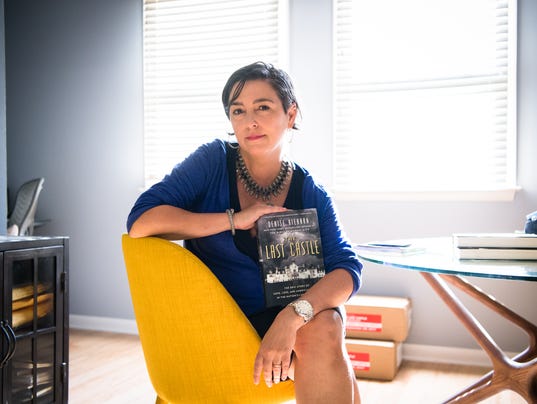
Denise Kiernan at her home in Asheville (Photo: Matt Burkhartt/mburkhartt@citize)
It's a tossup whether author Denise Kiernan loves Biltmore House or Edith Vanderbilt with more fervor, but the edge seems to be with the first mistress of the great Asheville estate.
"I can’t say enough about her," Kiernan says, speaking in her home office not far from Beaver Lake in North Asheville. "I think she’s awesome.”
As a follow-up to her nonfiction best-seller "The Girls of Atomic City" (2013), Kiernan has just published a new book, "The Last Castle," tracing the origins and heyday of the Biltmore Estate and its first family, George and Edith Vanderbilt, and their only child, Cornelia.
The history is not all glamour and parties, although there's plenty of both. "I don’t want to give too many spoilers," Kiernan says, "but Edith endured a lot of tragedy in her life. It’s really difficult to understand what an incredibly resilient woman she was if you don’t understand what she had to go through."
To tell that story, which spans more than seven decades, Kiernan broadened the scope of "The Last Castle" to bring to life the era in which the Vanderbilt family flourished, the Gilded Age of the late 1800s, and the rocky times that followed in the early 20th century. (Kiernan will talk about the book at a ticketed event at Malaprop's Bookstore/Cafe at 6 p.m. Sept. 26; see the box at the bottom of this story for details.)
"What I tried to do was step back and place the house within a much larger historical context," she says, citing the book's many excursions to New York, Washington, D.C., Europe and even India. "I wanted to be able to talk about how the financial crises [of the early 20th century] affected families like this, how they affected houses like this. [And later,] the effect the Jazz Age had on attitudes and women."
So despite its title, "The Last Castle" is "really not just about the house," she says. "It's about the town. It’s about the people. It’s about America."
The "America" line, Kiernan quickly explains, is actually an in-joke she and her husband like to share, since both are freelance writers often asked to explain their work. "It's about America — all of it" is a quote attributed to Asheville's hometown literary lion Thomas Wolfe in the 2016 movie "Genius," as Wolfe delivers to his editor the massive manuscript for "Look Homeward, Angel."
But reading "The Last Castle," the flowing novel-like narrative really is "about America." It's about celebrity culture, wealth disparity, the remarkable charity and foresight of a few wealthy people, the urge to create and maintain a family legacy and, in its darker moments, the ever-present potential for personal tragedy. It's grounded in Kiernan's years of globe-trotting research and yet also immediately relevant to the topics that clog social media in 2017.
For Kiernan, Biltmore "became this little lens and microcosm through which to examine what I think was a really interesting moment in time," she says.
She dabbled in Biltmore research for years before committing to the project after "Atomic City." Realizing all the strands of history and culture that converged on Biltmore, she said, "Something just clicked.”
A worldwide research project
Like George Vanderbilt, Kiernan moved to Asheville as an adult several years ago, after falling in love with the area as a visitor. A self-described "army brat," she grew up all over the place but wound up at Brevard Music Camp the summer before her senior year of high school and spent the next year at the NC School of the Arts.
College and graduate school at New York University, and her parents' NYC roots, anchored her in the Big Apple for many years. It was there she launched her career as a journalist at The Village Voice weekly newspaper. She could probably fill her own nonfiction book with her travels and career digressions thereafter, including as a soccer correspondent, a reporter at a women's conference in Beijing, a ghost writer, four years in Rome and a stint as the head writer on "Who Wants to Be a Millionaire?" ("hands down one of the most interesting gigs I’ve ever had").
She first visited Biltmore as a teenager, and she's been back countless times since. But not for research: The estate politely declined her request for access to its archives in 2013, saying "it wasn't a good time," she recalls.
Biltmore senior public relations manager LeeAnn Donnelly explained that Biltmore received Kiernan's request but "we were unable to move forward due to timing with existing research projects." Nevertheless, Donnelly added, "we wish her success on this project. ... Generations of writers have found inspiration at Biltmore and we are pleased to know the same was true for Ms. Kiernan."
The lack of access to Biltmore's private family collection was only a minor hindrance, Kiernan said, since she knew she'd find most of what she wanted elsewhere. After all, when the Vanderbilts wrote letters, the missives typically came to reside in the recipients' archives, not among the letter-writers' papers.
"I didn’t want to do something unless there were really interesting archives elsewhere," she says. "And I was thrilled with what I found. I found so much more than I thought I was going to. ... I found stuff in the U.K. I found stuff at Yale. I found stuff at the New York Public Library and the Library of Congress. I was off to the races.”
Her goal of capturing an era, not just the history of a house, allowed her to follow leads that took her to parties in Manhattan, gossip in D.C., rural enclaves in England and trans-Atlantic crossings on famous ships (including the Titanic, on which George and Edith had booked passage).
All the expected characters drop into the narrative — not just the Vanderbilts and their siblings and cousins and friends among "the 400," the leading families of New York society, but also Biltmore architect Richard Hunt, legendary landscape architect Frederick Law Olmsted and Biltmore's original foresters, Gifford Pinchot and Carl Schenck.
"We talk a lot today about the 1 percent," Kiernan says. "You know, the 400 was really the original 1 percent.”
The way all these people, traveling in this rarefied realm, kept intersecting Kiernan found especially intriguing. As an example, she recalls "when I put together that Edith's family, when she was a young teenager, had rented a house from the Pinchots — the guy who would go on to do forestry for the husband she hadn’t met yet — it was just like, 'Oh my God, these lives just keep on crossing.' It makes you feel very claustrophobic. And I think that was especially true for the women."
Edith and Cornelia
Edith Dresser Vanderbilt, though, seemed to have something special from early on in her life, growing up with three sisters and one brother after the early loss of both parents. "You read about them [as children] on their little South American adventure, sneaking down [into the crew area of their ship] to watch the crossing of the equator ceremony," Kiernan says. "Even from a young age, these were women who had some sort of crazy spirit instilled in them."
Edith brought that spirit with her to Biltmore after her 1898 marriage to previously "resolute bachelor" George. (They were essentially set up to meet on a ship to Europe and married in Paris less than a year later.)
“I love her," Kiernan says again, unable to contain her enthusiasm for her most vibrant subject. For her entire tenure at Biltmore, Edith was deeply and personally involved in community projects. "Charity for some people [at that time] was like a spectator sport," Kiernan says of the New York society in which George and Edith grew up. "Whereas you’ve got Edith on a horse, taking baskets out to people down here [in Asheville]."
Edith long nurtured a school and business, eventually called Biltmore Industries, that turned traditional Appalachian arts and crafts into careers and marketed their goods (especially "Biltmore Homespun" cloth) in New York and elsewhere. She essentially laid the groundwork for today's thriving artisan culture in and around Asheville.
"I think you can make a very strong argument that a lot of what exists here as far as Southern crafts are concerned is because of Edith and the assistance she paid early on," Kiernan says.
After George's death in 1914 at age 51, Edith almost single-handedly kept the estate together and viable. In 1925, once Cornelia was grown and married, Edith remarried. Her second husband was a U.S. senator from Rhode Island, Peter Goelet Gerry, and Edith soon came to be considered "the first lady of D.C. fashion." In a surprise twist, her new life intersected with her old one, and she had to intervene again to help rescue Biltmore long after leaving Asheville for D.C. — but you'll have to read the book to get that story."
The Last Castle" also follows Edith's daughter, Cornelia, after she left Asheville. The husband she married with great fanfare in Asheville in 1924, British aristocrat John Cecil, she divorced in 1934. In the decades that followed, John stayed in North Carolina (except during World War II), while Cornelia spent most of the rest of her life in England with her two sons, George and William, who went to school in Switzerland.
The stories of Cornelia's two subsequent marriages, her artistic aspirations and her final years in the U.K. have gone largely untold until now. "Where she ended up in England was very rural, very quiet," Kiernan says. Even well past World War II, "she liked riding and didn’t like cars. She liked little river punts. So in that sort of way, I think she was a real Tar Heel, a real product of this area."
But it was John Cecil who may have had the greatest impact on his and Cornelia's children. When the two boys were grown, Kiernan reports, it was their father, the Englishman, who brought the younger boy back to North Carolina from abroad and convinced him to help preserve Biltmore, his grandfather's great legacy. (Both of George's grandsons are still living in Asheville.)
"I wish I had had more papers of John Cecil's," Kiernan laments. "There’s somebody I would love to sit down with. I have always found it fascinating that the Englishman, the descendent of Lord Burghley, comes over here and suddenly he's dairy farming. It’s fascinating stuff."
Shaping Western North Carolina
All in all, "The Last Castle" traces all the unusual and unlikely twists of fate and forces of will that led to Biltmore's construction and, against all odds, kept it largely intact and within the family for more than 120 years.
"A lot of these [great Gilded Age] houses met the wrecking ball or ended up in developers’ hands," Kiernan says. Indeed, only one of the many ornate Vanderbilt mansions along Fifth Avenue in New York remains standing. (It was recently on the market for $50 million.)
But the survival of the house and the innumerable jobs provided by Biltmore Estate, Biltmore Village and the artisan heritage of Biltmore Industries don't encompass the whole picture of the Vanderbilt legacy Kiernan sets out to paint with her book.
“Oftentimes the Vanderbilt family’s impact is discussed with regard to what they built here," she says. "but I think what they didn’t build here also had a tremendous impact on Asheville and the surrounding communities. I think about the efforts that went into restoring lands, restoring forests, doing the best they could not to have them all sold off piecemeal. What that has done is create the incredibly well preserved, beautiful place that we all live in.
'When you think of how many people come here because of how beautiful it is and to climb, to float on the river, to kayak, go hiking — how many of those people would still be coming here if someone like George Vanderbilt had not decided that he really wanted to preserve a huge, huge swath of forest, and if Edith Vanderbilt hadn’t worked to make sure it didn’t wind up in a million different hands?"
The many layers of the Biltmore story are key to the multiyear commitment Kiernan made when she decided to write "The Last Castle." Because even though "Biltmore is pretty unique," she says, "sometimes you just want to tell a story that you think strikes a chord.”
IF YOU GO
Malaprop's Bookstore/Cafe presents "An Evening with Denise Kiernan" in conversation with Karen Abbott at 6 p.m. Sept. 26 at the store, 55 Haywood St., in downtown Asheville. The evening focuses on Kiernan's new book, "The Last Castle: The Epic Story of Love, Loss, and American Royalty in the Nation's Largest Home."
Admission is $34.11 (including fees), which includes a copy of the book. For details or to purchase a ticket, visit www.malaprops.com or call 828-254-6734.
http://www.citizen-times.com/story/life/2017/09/15/last-castle-denise-kiernan-biltmore-stories/634298001/
Saturday, October 07, 2017

Subscribe to:
Posts (Atom)