Wednesday, August 09, 2017


Glen Campbell, Whose Hit Songs Bridged Country and Pop, Dies at 81
By Michael Pollack
https://www.nytimes.com/
August 8, 2017

Glen Campbell, the sweet-voiced, guitar-picking son of a sharecropper who became a recording, television and movie star in the 1960s and ’70s, waged a publicized battle with alcohol and drugs and gave his last performances while in the early stages of Alzheimer’s disease, died on Tuesday in Nashville. He was 81.
Tim Plumley, his publicist, said the cause was Alzheimer’s.
Mr. Campbell revealed that he had the disease in June 2011, saying it had been diagnosed six months earlier. He also announced that he was going ahead with a farewell tour later that year in support of his new album, “Ghost on the Canvas.” He and his wife, Kimberly Campbell, told People magazine that they wanted his fans to be aware of his condition if he appeared disoriented onstage.
What was envisioned as a five-week tour turned into 151 shows over 15 months. Mr. Campbell’s last performance was in Napa, Calif., on Nov. 30, 2012, and by the spring of 2014 he had moved into a long-term care and treatment center near Nashville.
Mr. Campbell released his final studio album, “Adiós,” in June. The album, which included guest appearances by Willie Nelson, Vince Gill and three of Mr. Campbell’s children, was recorded after his farewell tour.
That tour and the way he and his family dealt with the sometimes painful progress of his disease were chronicled in a 2014 documentary, “Glen Campbell: I’ll Be Me,” directed by the actor James Keach. Former President Bill Clinton, a fellow Arkansas native, appears in the film and praises Mr. Campbell for having the courage to become a public face of Alzheimer’s.
At the height of his career, Mr. Campbell was one of the biggest names in show business, his appeal based not just on his music but also on his easygoing manner and his apple-cheeked, all-American good looks. From 1969 to 1972 he had his own weekly television show, “The Glen Campbell Goodtime Hour.” He sold an estimated 45 million records and had numerous hits on both the pop and country charts. He was inducted into the Country Music Hall of Fame in 2005.
Decades after Mr. Campbell recorded his biggest hits — including “Wichita Lineman,” “By the Time I Get to Phoenix” and “Galveston” (all written byJimmy Webb, his frequent collaborator for nearly 40 years) and “Southern Nights” (1977), written by Allen Toussaint, which went to No. 1 on pop as well as country charts — a resurgence of interest in older country stars brought him back onto radio stations.
Like Bobbie Gentry, with whom he recorded two Top 40 duets, and his friend Roger Miller, Mr. Campbell was a hybrid stylist, a crossover artist at home in both country and pop music.
“A change has come over country music lately,” he explained in 1968. “They’re not shuckin’ it right off the cob anymore. Roger Miller opened a lot of people’s eyes to the possibilities of country music, and it’s making more impact now because it’s earthy material, stories and things that happen to everyday people. I call it ‘people music.’
”Glen Travis Campbell was born on April 22, 1936, about 80 miles southwest of Little Rock, Ark., between Billstown and Delight, where his father sharecropped 120 acres of cotton. He was the seventh son in a family of eight boys and four girls. When he was 4, his father ordered him a three-quarter-size guitar for $5 from Sears, Roebuck. He was performing on local radio stations by the time he was 6.
Picking up music from the radio and his church’s gospel hymns, he “got tired of looking a mule in the butt,” as Mr. Campbell put it in an interview with The New York Times in 1968. He quit school at 14 and went to Albuquerque, where his father’s brother-in-law, Dick Bills, had a band and was appearing on both radio and television.
After playing guitar and singing in what he called “fightin’ and dancin’ clubs” in Albuquerque with Mr. Bills’s band, Mr. Campbell moved to Los Angeles at 22 and in 1960 got a job playing with the Champs, a rock ’n’ roll group best known for its 1958 hit “Tequila.” There were stints with other, smaller bands, for smaller money.
But his skills eventually took him into the recording studios as a session musician, and for six years he provided accompaniment for a host of famous artists, including Frank Sinatra, Dean Martin, Nat King Cole, Elvis Presley, Rick Nelson and groups like the Beach Boys and the Mamas and the Papas.
Although he never learned to read music, Mr. Campbell was at ease not just on guitar but also on banjo, mandolin and bass. He wrote in his autobiography, “Rhinestone Cowboy” (1994) — the title was taken from one of his biggest hits — that in 1963 alone his playing and singing were heard on 586 recorded songs.
He could be a cut-up in recording sessions. “With his humor and energetic talents, he kept many a record date in stitches as well as fun to do,” the electric bassist Carol Kaye, who often played alongside Mr. Campbell, said in an interview in 2011. “Even on some of the most boring, he’d stand up and sing some off-color country song — we’d almost have a baby trying not to bust a gut laughing.”
After playing on many Beach Boys sessions, Mr. Campbell became a touring member of the band in late 1964, when its leader, Brian Wilson, decided to leave the road to concentrate on writing and recording. He remained a Beach Boy into the first few months of 1965.
Mr. Campbell had made his first records under his own name in the early 1960s, but success eluded him until 1967, shortly after he signed with Capitol Records, when his recording of John Hartford’s “Gentle on My Mind” hit the charts. Shortly after that, his version of “By the Time I Get to Phoenix” reached the Top 40. National recognition, four Grammy Awards in 1968 and television appearances quickly followed.
After Tommy Smothers of the Smothers Brothers saw Mr. Campbell on Joey Bishop’s late-night show in 1968, Mr. Campbell was signed as the host of the Smothers Brothers’ summer replacement show, whimsically titled “Summer Brothers Smothers Show.” In his review for The Times, George Gent called Mr. Campbell “a handsome, talented and relaxed host who appeared in complete control of some of the crazy goings-on.”
The success of that show led to his own series, “The Glen Campbell Goodtime Hour,” which made its debut on CBS in January 1969. It soon became a hit, despite memos from the front office telling Mr. Campbell to stop booking so many country stars. (One complaint came after a show that featured Mr. Campbell, Buck Owens, Merle Haggard and Johnny Cash.)

Mr. Campbell had his most famous movie role in 1969, in the original version of “True Grit.” He had the non-singing part of a Texas Ranger who joins forces with John Wayne and Kim Darby to hunt down the killer of Ms. Darby’s father. (Matt Damon had the role in a 2010 remake.) The next year, Mr. Campbell and the New York Jets quarterback Joe Namath played ex-Marines in “Norwood,” based on a novel by Charles Portis, the author of “True Grit.”
Mr. Campbell made his Las Vegas debut in 1970 and, a year later, performed at the White House for President Richard M. Nixon and for Queen Elizabeth II in London.
But his life in those years had a dark side. “Frankly, it is very hard to remember things from the 1970s,” he wrote in his autobiography. Though his recording and touring career was booming, he began drinking heavily and later started using cocaine. He would annoy his friends by quoting from the Bible while high. “The public had no idea how I was living,” he recalled.
In 1980, after his third divorce, he said: “Perhaps I’ve found the secret for an unhappy private life. Every three years I go and marry a girl who doesn’t love me, and then she proceeds to take all my money.” That year, he had a short, tempestuous and very public affair with the singer Tanya Tucker, who was about half his age.
He credited his fourth wife, the former Kimberly Woollen, with keeping him alive and straightening him out — although he would continue to have occasional relapses for many years. He was arrested in November 2003 in Phoenix and charged with extreme drunken driving and leaving the scene of an accident. He pleaded guilty and served 10 nights in jail in 2004.
Ms. Woollen, who, like Mr. Campbell, was an evangelical Christian, married him in October 1982. They had both been baptized on a chilly December day in 1981 in Mr. Campbell’s old swimming hole in Billstown.
Throughout the 1990s, Mr. Campbell remained influential. He released a series of gospel albums in the 1990s and in later years made frequent appearances on evangelical TV shows. In 1992 he began performing in Branson, Mo., and in 1994 he opened the Glen Campbell Goodtime Theater there. (The theater was renamed in the 1990s after he ended his association with it.)
“Still in command of his voice and his guitar prowess, he helped launch the careers of such contemporary country stars as Alan Jackson and Bryan White in the 1990s,” Robert K. Oermann wrote in “A Century of Country” (1999).
In 2005, Mr. Campbell and Jimmy Webb performed a program of Mr. Webb’s songs in New York. Stephen Holden of The Times wrote in his review that Mr. Campbell’s “sloppiness detracted only minimally from the power of his voice; at 69, he still conveys the manic optimism of a garrulous rhinestone cowboy crowing under the open skies.”
He also continued to record. On his 2008 album, “Meet Glen Campbell,” seemingly an invitation to a younger audience, he covered songs by U2, Green Day, John Lennon and others. “Ghost on the Canvas” was released in 2011. “See You There,” containing tracks Mr. Campbell had recorded informally during the “Ghost” sessions — including stripped-down versions of many of his old hits — was released two years later. He entered the studio for the last time after completing his farewell tour to record the collection of what his daughter Ashley called “his go-to” songs that became “Adiós.”
In addition to her and his wife, Mr. Campbell is survived by seven other children, Debby, Kelli, Travis, Kane, Cal, Shannon and Dillon; three sisters, Barbara, Sandra and Jane; two brothers, John Wallace and Gerald, and many grandchildren, great-grandchildren and great-great-grandchildren. Three of his children were in the band that backed him on his farewell tour.
Mr. Campbell often acknowledged his debt to the many songwriters behind his hits, notably Mr. Webb; he recorded “Reunion: The Songs of Jimmy Webb” in 1974 and returned to Mr. Webb for the title track to “Still Within the Sound of My Voice” in 1988. But he also wrote: “I can think of only two or three songs out of hundreds I’ve recorded that I performed as originally written. I like to become intimate with the material, and change it to suit me.”
He added: “I’ve done the ‘William Tell Overture’ a thousand times on my live show. That, too, is a challenge, and I don’t think I’ve ever played it perfectly. If I ever do, fans might grow to expect it that way every time.”
Monday, August 07, 2017
France: Churches Vanish, Mosques Spring Up
August 6, 2017

The Chapel of St. Martin in Sable-sur-Sarthe being demolished last month. (Quest-France)
"France is not a random space... fifteen centuries of history and geography determined its personality. Inscribed in the depths of our landscape, the churches, the cathedrals and other places of pilgrimage give meaning and form to our patriotism. Let us demand our civil authorities to respect it". Two years ago, the French journalist Denis Tillinac promoted this appeal, signed by dozens of French personalities, after some French imams requested the conversion of abandoned churches into mosques.
A year later, terrorists who pledged allegiance to the Islamic State assaulted the Catholic parishioners in the church of Saint-Étienne-du-Rouvray, murdering an elderly priest, Father Jacques Hamel, at the foot of the altar. An outpouring of great emotion followed the most serious attack on a Christian symbol in Europe since the Second World War.
After that attack, the French authorities prevented many Islamist plots against the Notre Dame Cathedral in Paris. Last June, police shot a Muslim man outside the cathedral after he tried to attack them with a hammer. Another terror cell of French women, guided by Islamic State commanders in Syria, had previously been foiled before they could attack Notre Dame. France's most famous Catholic house of worship is a prime target for the jihadists. A t the same time, France has been dismissing the religious and cultural heritage of France's Catholic patrimony, which, in a time of religious clashes and revival, should instead be protected as treasures and sources of strength.
Last month, around the time of the first anniversary of the murder of Father Hamel, a wrecking crew demolished the famed Chapel of Saint Martin in Sablé-sur-Sarthe, built in 1880-1886 and deconsecrated in 2015. A parking lot will replace the old Christian building. Photographs and videos posted on social networks, in scenes reminiscent of ISIS' vandalism of churches in Mosul, show the cross being ripped from the church and the church destroyed. A few days earlier, in Rouen, not far from where Father Hamel had been killed, the local authorities ordered the destruction of the Saint-Nicaise Church's presbytery, for "safety reasons".
In 1907, the French state appropriated all church property, and now an increasing numbers of local authorities are deciding they cannot or will not renovate their churches. French mayors call this process "deconstruction".
The year of Father Hamel's martyrdom, France was very busy demolishing churches. The Patrimoine-en-blog website, a platform providing a regular inventory of demolished churches, reports seven demolished churches in France in 2016 alone, and two in the first half of 2017. Along with these destroyed Christian buildings, 26 churches were put up for sale in 2016, and 12 churches were listed for sale in 2015. In 2017, many churches were converted to offices, apartments, "entertainment centers", gyms and art galleries.
The picture is not promising for French Catholicism:
"Over the past two years, Christian associations have sold nearly 40 churches throughout the country, at prices ranging from 100,000 to 400,000 euros. Twenty-seven other churches have been demolished. According to the Catholic Church, more than 1,000 churches are to be sold or demolished throughout France".
According to a report from the Observatory of Religious Heritage, presented at the French Senate, France could lose "5,000 to 10,000 religious buildings by 2030". Every year, 20 churches are sold and converted in France. The art historian Didier Rykner, who runs La Tribune de l'Art, said that "not since the Second World War have we seen churches reduced to rubble".
These authorities and mayors, so lenient when it comes to presenting economic reasons for destroying churches, are always generous when it comes to mosques. "Nearly 2,400 mosques today, compared to 1,500 in 2003, is the most visible sign of the rapid growth of Islam in France, a consequence of a population of immigrant origin and the process of strong re-Islamization", noted an report by the magazine Valeurs Actuelles.
When it comes to Islam, neutrality is abandoned. For example, "the municipality of Évreux voted for the provision of 5000 square-meters of land, for one symbolic euro, for the project of the Union of the Muslim Faith". The author and journalist Élisabeth Schemla detailed how French mayors have become "builders of mosques". This is how, in the last 30 years, more mosques and Muslim prayer centers have been built in France than all the Catholic churches built in the last century.
The Church of Santa Rita used to stand in the fifteenth arrondissement of Paris. A few weeks after Father Hamel was assassinated by the Islamic terrorists, the French police cleared the church. It is now a parking lot. Police dragged out the priests by their legs as a Mass was being celebrated. "When France is moved by the martyrdom of Jacques Hamel and [then Prime Minister] Manuel Valls speaks of financing mosques and training imams, we do not understand that churches are abandoned to their sad fate and demolished", Eloise Lenesley wrote at the time in Le Figaro.
In France, there are laws protecting old trees from indiscriminate cutting. But the state is free to flatten old Christian churches. The vacuums created in the French landscape are already being filled by the booming mosques.
Cowardly French authorities would never treat Islam as they are now treating Christianity.Marine Le Pen pointedly asked: "What if we built parking lots on top of Salafist mosques, instead of our churches?"
Giulio Meotti, Cultural Editor for Il Foglio, is an Italian journalist and author.
Sunday, August 06, 2017
Why Is The New York Times Trying To Rehabilitate Communism?
The New York Times has been hosting a series of fond, nostalgic recollections about the good old days of twentieth-century Communism. Have they learned nothing?
By Robert Tracinski
http://thefederalist.com/
August 3, 2017

Monument of Vladimir Lenin in front of Finland Train Station. Saint Petersburg, Russia.
Has anyone else observed a striking pattern in the New York Times recently? They’ve hosted a series of fond, nostalgic recollections about the good old days of twentieth-century Communism—the optimism, the idealism, the moral authority. Not to mention the gulags, the squalor, and the soul-crushing conformity.
Actually, they don’t usually mention those things. These articles are part of a series called “Red Century,” which is supposedly dedicated to “exploring the history and legacy of Communism, 100 years after the Russian Revolution.” But that history and legacy turn out to be very selectively explored. The editors of the Times could easily spend a year filling their newspaper with a hair-raising litany of Communism’s crimes across the globe, stuff that would keep their readers up at night for weeks. There’s certainly no shortage of material: the terror, the gulags, the Holodomor, the Cultural Revolution, and so on. Yet in this series, the crimes of Communism are mostly just hinted at.
A few articles deal forthrightly with the horrors of the Soviet regime. Others present being a member of the secret police as a morally complex issue—”it was way to build the future and be a part of something larger than themselves”—something I doubt the Times would be foolish enough to publish if it were about a former member of the Gestapo or the Klan.
Disturbingly, most entries are in this vein of talking about the idealism and human warmth and just plain caring of the people who denied the gulags and the mass starvation in Ukraine. Sure, they may have abetted the torture and murder of millions, but their “devotion to creating a more just world was infectious,” “the party was possessed of a moral authority that lent shape and substance…to an urgent sense of social injustice,” and all of it was infused by “an inherent optimism for the future, implied by socialism and progressivism.”
The overall thrust of the series is summed up in a call to try Communism again, but maybe this time try not to have any gulags. No, really.
This time, people get to vote. Well, debate and deliberate and then vote—and have faith that people can organize together to chart new destinations for humanity….We may reject the version of Lenin and the Bolsheviks as crazed demons and choose to see them as well-intentioned people trying to build a better world out of a crisis, but we must work out how to avoid their failures.
Meanwhile, we can actually tune in live and see what happens when someone tries to act on this idea of reviving the Communist ideal. A few years ago, leftist pundits were praising Venezuela as a socialist miracle. Then the socialist regime hit the Thatcher Line: it ran out of other people’s money (in this case, oil company money) and the illusion came crashing down. The result: desperate poverty, shortages, squalor, children dying in hospitals from lack of medicine and equipment, refugees fleeing in makeshift boats.
In other words: your basic rundown for a radical socialist regime. It’s not the first time this has happened. It’s not even the tenth time.
And the socialist “revolutionaries” respond the way they always have: they try to save the revolution by exterminating political freedom. In the past few weeks, while folks at The New York Times were airily speculating about reviving Communism, but in a good way, Venezuela’s socialist revolutionaries staged a flagrantly rigged vote to overturn representative government, and now they have brought back the “midnight knock on the door,” with the arbitrary arrest and imprisonment of opposition leaders.
At home, the Left is calling for “resistance” against the “authoritarianism” of Donald Trump—while their most prominent mouthpieces are actively whitewashing a movement that stands for totalitarianism, and the actual young idealists in places like Venezuela are getting gunned down in the streets by the regime. Some of this has even been reported in The New York Times. Maybe somebody ought to inform the opinion editors.
What is it about a thoroughly discredited doctrine like Communism that just won’t die? My overall sense from the “Red Century” series is that enough years have passed since the fall of the Iron Curtain that Western intellectuals now feel they can get away with downplaying Communism’s crimes and failures and return to rapturous descriptions of its abstract ideals, without the need any longer to take a serious look at what those ideals really meant in practice.
The theory of Communism—the elevation of the collective over the individual and of government dictates above free, private decision-making—is the fundamental cause of all of its evils. But it’s also a moral theory with old roots, on that has established itself in many people’s minds as synonymous with morality itself. Of course everyone should put the collective “public good” over private interests—what could possibly go wrong? Well, we found out what could go wrong, over and over again. We have plenty of reasons to think that individual rights and private interests are actually essential to a free and prosperous society—not to mention that they might help keep us out of the gulag.
But if you can’t bring yourself to question whether the theory of socialism is synonymous with the very idea of morality and progress, you won’t be able to relinquish the socialist dream, even after it has been exposed as a nightmare.
This deep vein of denial has troubling consequences. One sign—still on a very small scale—is the reconstitution of “Young Communist Clubs,” something I haven’t seen much of since I was in college in 1989, the year reality pulled the rug out from under all of the earnest young socialists. This can only be happening again because today’s young people have been allowed to grow up ignorant of the nature of Communism, both in the past and in the present. And this is aided and abetted by publications at the top of the culture, like The New York Times, as they draw a gauzy curtain of nostalgia across the history of twentieth-century Communism.
One of those “Red Century” encomiums to Communist idealism sums up its case by recalling “Rosa Luxemburg’s revolutionary ultimatum: ‘socialism or barbarism.'” But the lesson of history—heck, the lesson of our own time—is that socialism is barbarism.
Don’t let The New York Times send this truth down the memory hole.
Follow Robert on Twitter
Saturday, August 05, 2017
The Scandal That Matters
Democratic IT staff who had access to sensitive data stand accused of fraud.
By Kimberley A. Strassel
August 3, 2017
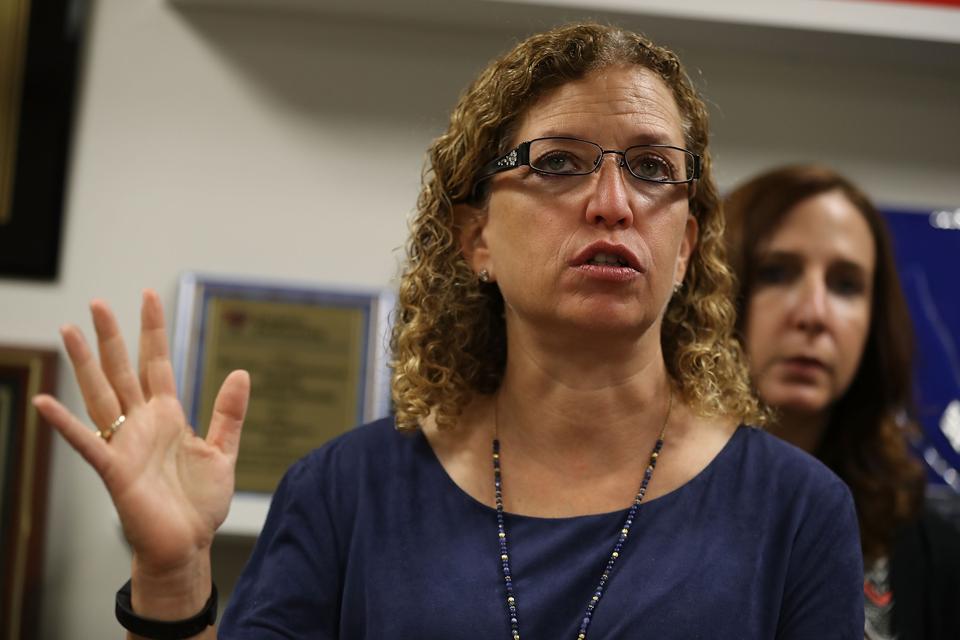
A now fired staffer for Rep. Debbie Wasserman Schultz (D-FL) has been arrested and charged with bank fraud as he attempted to board a flight out of the country. (Photo by Joe Raedle/Getty Images)
Imran Awan was arrested at Dulles International Airport July 24, while attempting to board a flight to Pakistan. For more than a decade the congressional staffer had worked under top House Democrats, and he had just been accused by the FBI of bank fraud.
It was a dramatic moment in a saga that started in February, when Capitol Police confirmed an investigation into Mr. Awan and his family on separate accusations of government theft. The details are tantalizing: The family all worked for top Democrats, were paid huge sums, and had access to sensitive congressional data, even while having ties to Pakistan.
The media largely has ignored the affair, the ho-hum coverage summed up by a New York Times piece suggesting it may be nothing more than an “overblown Washington story, typical of midsummer.” But even without evidence of espionage or blackmail, this ought to be an enormous scandal.
Because based on what we already know, the Awan story is—at the very least—a tale of massive government incompetence that seemingly allowed a family of accused swindlers to bilk federal taxpayers out of millions and even put national secrets at risk. In a more accountable world, House Democrats would be forced to step down.
Mr. Awan, 37, began working for House Democrats as an IT staffer in 2004. By the next year, he was working for future Democratic National Committee head Debbie Wasserman Schultz. Over time he would add his wife, two brothers, a brother’s wife and a friend to the payroll—and at handsome sums. One brother, Jamal, hired in 2014 reportedly at age 20, was paid $160,000. That’s in line with what a chief of staff makes—about four times the average Capitol Hill staffer. No Democrat appears to have investigated these huge numbers or been asked to account for them.
According to an analysis by the Daily Caller’s Luke Rosiak, who has owned this story, the family has collected $5 million since 2003 and “appeared at one time or another on an estimated 80 House Democrats’ payrolls.” Yet Mr. Rosiak interviewed House staffers who claim most of the family were “ghost” employees and didn’t come to work. Only in government does nobody notice when staffers fail to show up.
The family was plenty busy elsewhere. A litany of court documents accuse them of bankruptcy fraud, life-insurance fraud, tax fraud and extortion. Abid Awan, a brother, ran up more than $1 million in debts on a failed car dealership he somehow operated while supposedly working full time on the Hill. One document ties the family to a loan from a man stripped of his Maryland medical license after false billing. Capitol Police are investigating allegations of procurement fraud and theft. The brothers filed false financial-disclosure forms, with Imran Awan claiming his wife had no income, even as she worked as a fellow House IT staffer.
This is glaringly shady stuff, in no way “typical,” yet nobody noticed. Federal contractors are subject to security standards, but individual congressional offices have giant leeway over their hiring—and apparently no quality control. If a private firm had such shoddy employee oversight, it’d be sued into oblivion.
The most recent FBI affidavit accuses Imran Awan of defrauding the Congressional Federal Credit Union by lying about the use of his rental properties to get a $165,000 home-equity loan—which he immediately wrapped into a $283,000 wire transfer to Pakistan. At one point, when the credit union asked Mr. Awan (who was pretending to be his wife on the phone) why he wanted to send money to Pakistan, he replied, “funeral arrangements.”
Told this was not an acceptable reason, Mr. Awan went to “look online for an acceptable reason” and responded “buying property.” The bright bulbs at the credit union approved the transfer. His wife was already in Pakistan. The FBI stopped her at the airport in March, and despite finding $12,400 in undeclared cash (in excess of the legal limit), they let her go. Seriously.
Imran Awan has pleaded not guilty to bank fraud. The law office representing him issued a statement casting the investigation as “part of a frenzy of anti-Muslim bigotry in the literal heart of our democracy.” It calls the accusations “utterly unsupported, outlandish, and slanderous.”
Yes, it is weird that Ms. Wasserman Schultz continued to shield Imran Awan to the end. Yes, the amounts of money, and the ties to Pakistan, are strange. Yes, it is alarming that emails show Imran Awan knew Ms. Wasserman Schultz’s iPad password, and that the family might have had wider access to the accounts of lawmakers on the House Intelligence and Foreign Affairs committees.
Yet even if this never adds up to a spy thriller, it outranks most of the media’s other obsessions. The government, under the inattentive care of Democrats, may have been bilked for ages by a man the FBI has alleged to be a fraudster. That’s the same government Democrats say is qualified to run your health care, reform your children’s schools, and protect the environment. They should explain this first.
Write to kim@wsj.com.
Appeared in the August 4, 2017, print edition.
Friday, August 04, 2017
The long decline – and possible revival – of the African American baseball star
3 August 2017

Willie Mays makes his famous catch off the bat of Cleveland's Vic Wertz in Game 1 of the 1954 World Series, at the Polo Grounds. New York Giants went on to sweep the Cleveland Indians in four games.
(NY DAILY, NEWS)
In 1954, a young black man from Alabama, Willie Mays, took New York and then America by storm. A centerfielder for the New York Giants, he won the 1954 National League MVP and led his team to victory in the World Series, making a catch along the way that became arguably the most famous play in baseball history. But Mays was more than the game’s best player: he became became America’s most popular athlete, especially in the African American community. That popularity was famously captured as he played stick ball with kids on the streets of Harlem.

Fifty years later to the day, artist Thom Ross walked the grass outside an apartment building in upper Manhattan where the Giants’ home, the Polo Grounds, once stood, and calculated the spot where Mays made his phenomenal play. He set up his homage to Willie: a five-sequence life-size panel of “the Catch”. Many passersby stopped to study Ross’s work, but only a few older men could identify the player in those panels. Ross, a lifelong Giants fan, recalled: “I could scarcely find a young black man or teenager who recognized Willie Mays or even knew about the play.”
Ross’s experience demonstrates baseball’s current dilemma. After Jackie Robinson broke baseball’s color barrier in 1947, the National League integrated much faster and more thoroughly than the younger American League. Between 1949 and 1979, 19 African American (and two black Latino) players were their leagues’ MVP.
Then baseball changed.
The 1979 World Series winning Pittsburgh Pirates had five African Americans and one black Latino player among their starters. No championship team in either league has had as many since. (In 2014, neither of the World Series teams – the San Francisco Giants and Kansas City Royals – had a single African American player. Last year, the Boston Red Sox led MLB with four black players in their regular starting line-up.)

The 1979 Pittsburgh Pirates (left to right): Chuck Tanner, Omar Moreno, Tim Foli, Dave Parker, Willie Stargell, John Milner and Bill Madlock
The decline was gradual at first: the percentage of African American players in the 1980s was still close to 20%. Since then it has fallen rapidly. According to the Racial and Gender Report card issued annually by Dr Richard Lapchick of the University of Central Florida’s Institute for Diversity and Ethics in Sport, the percentage of African American players in MLB at the start of the 2016 season had fallen to 7.7%, down from 18% in 1991. In contrast, 69.7% of NFL players are African American; in the NBA, the figure is 74.4%.
There are so many reasons for the remarkable decline of African American players in baseball, it’s hard to know where to start. (It’s important to separate African American players from black players from countries such as Cuba and the Dominican Republic, who continue to thrive in the major leagues.) But the key factor may be summed up by the novelist and historian Kevin Baker, who is currently working on a history of New York City baseball. “Most black people in America live in cities, and there is less and less space in cities – especially New York and other urban areas in the north-east – for baseball to be played,” he says. “A great many New York ballplayers, from Lou Gehrig to Sandy Koufax, learned the game in pick-up games on sand lots. There’s no sand lots any more. If you want to play organized ball, you’re practically forced to get on a bus and head for the suburbs.”
In the suburbs, of course, Little League and Babe Ruth League baseball has become more and more expensive, and parents who want their kids to advance in the game shell out significant sums for private coaching and traveling leagues. That is fueling baseball’s reputation as a rich kid’s sport while a pick-up basketball game in the city requires far less space and equipment: sneakers, a hoop and a basketball.
It’s perhaps little surprise then that just four players on MLB rosters this year are from the New York metropolitan area. “I grew up in an apartment building,” one of those players, TJ Rivera, who is of Puerto Rican descent, told MLB.com. “We played Wiffle ball and football on concrete. We played basketball with a garbage pail. Most of these guys grew up in Florida, where there are parks and fields. It’s hilarious telling them my story.”
And a lack of facilities and training in the cities may be only part of the problem.A 2015 Baltimore Sun article bluntly addressed the lack of role models for young black players: there are simply far fewer African American baseball stars to look up to these days (this may be a wider problem for baseball: ESPN’s 2017 list of the world’s most famous athletes didn’t contain any baseball players; there were 38 soccer players and 13 athletes from the NBA). Perhaps the most eloquent summary of baseball’s shift towards an older and whiter base came from the comedian Chris Rock, himself a New York Mets fan. He perceptively pointed out wider problems for baseball’s future, saying: “If you lose black America, you lose young America.”
Rock is wrong on one point though: that, as he says, “blacks don’t care about history” in baseball. They most certainly do, and part of African American alienation from the game stems from being cut off from that history. What has been largely forgotten is that black Americans have a long and rich history in baseball. For more than 70 years, the Negro Leagues flourished all across the country, from New York, where Mays played as a teenager, to Alabama, where he played his first professional ball for the Birmingham Black Barons, to the midwest and west coast. The vast majority of those teams were owned by African Americans, including Effa Manley, co-owner of the Newark Eagles from 1935-1948, who was the first woman inducted into the Baseball Hall of Fame.
In comparison with other major sports, African American players have also suffered from the lack of attention by colleges. Professional football and basketball have a cost-free minor league system in America’s colleges, but college baseball is not organized to serve MLB, with many young athletes coming into the big leagues from high school. As the Pittsburgh Pirates’ Andrew McCutcheon, one of MLB’s premier black stars, put it: “No matter how good a baseball player you are, you don’t get a full ride in college. Kids from low-income families don’t have the same chance of going to college to play baseball and get an education as kids who play football and basketball.”

Andrew McCutchen (Pittsburgh Pirates)
And that’s a huge shame, because professional baseball has huge advantages for any young athlete. The average salary of a MLB player is $4.4m compared to $2.1m in the NFL. (Average NBA salaries are higher, at $6.2m, but pro basketball teams carry about half the number of roster spots.) Careers in baseball are longer than in any other professional American sport, and MLB has by far the best post-career pension plan.
And baseball is also relatively easy on the body compared to football, with its alarming record of brain trauma. Bo Jackson, winner of the 1985 Heisman trophy as the best college football player in the country, played football for the Oakland Raiders and baseball for the Kansas City Royals. “People often ask me the biggest difference between the two sports,” Jackson once told me. “I’d say it like this: you play baseball every day: that’s fun. You practice football every day: that’s hell.”
So how can baseball win back young African Americans?
One way might be through MLB’s support of urban youth academies through their Reviving Baseball in Inner Cities program. Academies have now been established in a dozen major US cities across, providing young players with coaching, equipment, uniforms and transportation to playing fields. Says Hall of Famer Joe Morgan, who grew up in Oakland: “We need the same kind of programs that have produced so many great players in the Dominican Republic, where all 30 major league teams have set up academies. It makes no sense that we don’t put the same resources into mining talent here as we do in other countries.”
The program provides programs for both boys and girls and is thriving due to support not only from MLB but individual teams and even corporate sponsors. Progress seems to be on the way: from 2012-2017, 41 of 204 first-round draft selections were African American. This year’s draft was just the fourth time the first two picks were African American and was the third year in a row that two of the first five picks were graduates of the RBI program.
And, says Kevin Baker, there are other ways for baseball to promote itself in urban areas. “Change the All-Star break into a series of promotional events in different cities, inviting kids to come for free to celebrity baseball and softball games with rappers, movie stars, comics, and former greats from other sports. The greatest player basketball ever produced was Michael Jordan, and what did he want the most? To play baseball.”
Subscribe to:
Posts (Atom)