Pope Francis (right) talks with Al-Azhar's Grand Imam Ahmed al-Tayeb during a private audience at the Vatican, on May 23, 2016 (AFP Photo/Max Rossi)
Reuters reported Tuesday that “Pope Francis hopes to mend ties with Muslims on his trip to Egypt on Friday but faces criticism from church conservatives for meeting Islamic religious leaders after a spate of deadly attacks against Christians.”
He has to mend ties? After Palm Sunday jihad massacres at two churches in Egypt, shouldn’t it be Egyptian Muslims who are reaching out to him to mend ties?
“A main reason for the trip,” Reuters explains, “is to try to strengthen relations with the 1,000-year-old Azhar center that were cut by the Muslim side in 2011 over what it said were repeated insults of Islam by Francis’s predecessor, Pope Benedict.”
What did Benedict say? Andrea Gagliarducci of the Catholic News Agency explains that after a jihad terrorist murdered 23 Christians in a church in Alexandria 2011, Benedict decried “terrorism” and the “strategy of violence” against Christians, and called for the Christians of the Middle East to be protected.
Al-Azhar’s Grand Imam, Ahmed al-Tayeb, whom Pope Francis welcomed to the Vatican in May 2016, was furious. He railed at Benedict for his “interference” in Egypt’s affairs and warned of a “negative political reaction” to the Pope’s remarks. In a statement, Al-Azhar denounced the Pope’s “repeated negative references to Islam and his claims that Muslims persecute those living among them in the Middle East.”
Benedict stood his ground, and that was that. But in September 2013, al-Azhar announced that Pope Francis had sent a personal message to al-Tayeb. In it, according to al-Azhar, Francis declared his respect for Islam and his desire to achieve “mutual understanding between the world’s Christians and Muslims in order to build peace and justice.” At the same time, Al Tayyeb met with the Apostolic Nuncio to Egypt, Mgr. Jean-Paul Gobel, and told him in no uncertain terms that speaking about Islam in a negative manner was a “red line” that must not be crossed.
So Pope Benedict condemned a jihad attack, one that al-Azhar also condemned, and yet al-Azhar suspended dialogue because of the Pope’s condemnation. Then Pope Francis wrote to the Grand Imam of al-Azhar affirming his respect for Islam, and the Grand Imam warned him that criticizing Islam was a “red line” that he must not cross. And he hasn’t, and won’t. But all those who think that it’s marvelous that the Pope is “respectful” and refuses to “poke them in the eye” should remember: Benedict’s supposed insults to Islam were denunciations of jihad attacks on Christians. Pope Francis won’t be so indelicate. In contrast to Benedict, Francis energetically defends Islam, and leaves the persecuted Christians twisting in the wind, so he is acceptable to al-Azhar.
The worst part about this is the fact that because this man is Pope, all too many Catholics, including some in positions of high authority, treat him as if he were a divine oracle, his every utterance to be revered, respected, studied, and followed. Because of the statement of the Second Vatican Council that “religious submission of mind and will must be shown in a special way to the authentic magisterium of the Roman Pontiff, even when he is not speaking ex cathedra,” and “must be shown in such a way that his supreme magisterium is acknowledged with reverence, the judgments made by him are sincerely adhered to, according to his manifest mind and will,” Catholic leaders and publications tend to think that they must adhere to anything the Pope says about anything.
This leads them into impossible positions. When Pope Benedict XVI appeared to criticize the aspects of Islam that incite and justify violence, they allowed for criticism of Islam. When Francis showed himself to be an Islamic apologist, they became Islamic apologists. All too many Catholic leaders and institutions, in other words, are more interested in being papists than in being truthful. They would rather show loyalty to the Pope, no matter how damaging his utterances, than stand for the truth on their own against the Pope.
The contradiction is clear, and absolute. If the Catholic Church has become one of Islam’s loudest boosters, then those who are aware of the nature and magnitude of the jihad threat, rooted in Islamic texts and teachings, have to make some decisions about where they stand.
“Leave them; they are blind guides. And if a blind man leads a blind man, both will fall into a pit.” (Matthew 15:14)
I discovered the fundamentalist Christian website Pulpit & Pen a year or two ago, when they were hating on Karen Swallow Prior for failing to meet its high standards. They are an excitable lot, the P&P writers. One of them who participated in the attack on KSP later repented, and resigned from P&P, saying:
Unless you’ve been living under a social media rock the last week or so, you’ve no doubt been made aware of the conflict between Pulpit & Pen and Dr. Karen Swallow Prior. As of the time of this publishing, a resolution seems nowhere in sight and the entire ordeal has served nothing more than to fracture the body of Christ greatly. Regretfully, I had a hand in promulgating this conflict by taking part in a podcast at Pulpit & Pen without having researched the facts myself first.
To be clear, I disagree with Dr. Prior’s approach to evangelism in some areas. However, I was out of line to opine the way I did before making myself one-hundred percent clear on the facts of the situation. For that error, I publicly repent and apologize to Dr. Prior and ask her forgiveness for the uncharitable treatment she received from me personally and the ramifications that may have stemmed from my public comments.
He later added:
In the time that has passed since publishing this public apology, as I have grown in my sanctification and reflected on my actions as part of the Pulpit & Pen blog, it has become apparent that I must more clearly and vociferously renounce any association with or subtle endorsement of Pulpit & Pen. I can no longer in good Christian conscience recommend including that ministry to fellow believers. While many of the issues P&P raises are valid, many others are not; and even more attack the brethren unnecessarily and often in unfounded ways. I pray that our Savior may open the eyes of those contributing to come to repentance as He so graciously did for me.
If you take from these statements the idea that P&P writers shoot their mouths off maliciously without knowing what they’re talking about, you’d be correct. Today, the website turns its Eye of Sauron on Orthodox Christianity, which it describes as a “cult.” Jeff Maples of the site went to Hank Hanegraaf’s new Greek Orthodox parish looking for abomination. Lo and behold, he found a-plenty. Excerpts:
Saturday, April 15, known as Holy Saturday in the Orthodox tradition, I along with a couple of friends went to visit St. Nektarios Greek Orthodox Church in Charlotte, NC–the church that Hanegraaff was recently chrismated in. The service began at 11:30 pm, and was still going strong showing no signs of slowing down when we decided to leave at around 2:00 am. While we hoped to have the opportunity to confront Hanegraaff in person, being that we all had to get up early the next morning to worship the living God on Easter morning, we decided to call it a night early.
These knotheads didn’t even realize that they were at the Paschal liturgy. What lovely Christian men, though, to have gone to the holiest church service of the year with the intention of getting up in the face of a new convert. The report is actually pretty funny, if you see it in a certain light, because it reveals profound ignorance. I would not expect a fundamentalist Christian to agree with Orthodox theology and worship, but this is beyond absurd:
1.) I have sat through many Catholic masses. I was married in a Catholic church, and I can definitely say I’ve “been there done that.” But I’ve never sat through anything so long and tedious as the Greek Orthodox mass. Perhaps being a special Saturday night “resurrection service,” this wasn’t the norm, but it was excruciatingly long. 2 1/2 hours in and no sign of slowing down.
2.) The cliche, “bells and smells” is actually a true reality. The burning of incense and ringing of bells was a noxious combination. It reminded me of being in a college dorm smoking weed and blowing the smoke through toilet paper rolls stuffed with dryer sheets.
3.) The liturgy was vain and repetitious. Literally, the same ritualistic prayers and chanting were sung over and over. Every prayer included an invocation of Mary and the Saints.
4.) While there was actually quite a bit of Scripture reading, there was absolutely no teaching. In fact, the vast majority of Scripture reading was sung in the eerie Byzantine chant. You’d really have to pay attention and try to listen really hard to even understand what they were reading or reciting.
5.) The facility was adorned, literally, wall to wall, floor to ceiling in graven images of the saints. The images were painted in such a way that the expressions on their faces were devoid of any emotion. They looked like lifeless figures just floating around in space.
6.) The enthusiasm of the clergy and participants in the service was extremely low. Those participating in the rituals walked around with lifeless expressions on their faces. The entire ritual was empty and dead.
7.) There is obviously little to no pursuit of holiness in this church. Several times during the service, the ushers and deacons could be seen stepping out to take smoke breaks. Many of the women and even some of the younger girls were dressed less than modestly.
8.) Repeatedly, the chanting and liturgy included a summons to God to perform certain acts. It was clear that they believe that God works through and is dependent upon these rituals to activate the work of the Holy Spirit.
9.) The Greek and Eastern Orthodox church is clearly a lifeless church. There was absolutely no gospel in this service. A lost person could not walk into this church and walk out a changed man. It was literally a Pagan practice. Like a seance. Pure witchcraft was going on in this place. In this religion, salvation doesn’t come through Christ’s imputed righteousness and substitutionary atonement on the cross, it comes through these dead rituals that they believe ontologically changes them into divine beings. It was truly one of the most wicked experiences I’ve ever seen.
Pure witchcraft! More:
This is what Hank Hanegraaff has apostatized to. He knows the Bible, he has taught it his entire life. He now rejects it. The bible clearly teaches against the wickedness and error found within the manmade traditions and doctrines of demons in the Orthodox church. It would have been easy for one to let their guard down and become entranced by the production. While in the West it is likely less common for practitioners of the religion to take it that seriously, it’s easy to see how those who do take it seriously could achieve an altered state of mind which would in effect by a spiritual experience for those truly seeking it. After my experience at this church, not only do I fully stand by what I have written, but it is even more clear now that this religion is not of God and should be avoided.
A Catholic reader who sent the link to me writes:
I am reminded of the community in the early stages of Babette’s Feast, trying so, so hard to hate the glories they were tasting.
True. Again, I would not expect a fundamentalist to cotton to Orthodox worship, but this poor knothead did not even understand what he was observing. If you’re going to criticize a thing, you should at least trouble yourself to understand what it is you’re criticizing. The Divine Liturgy of St. John Chrysostom, which Jeff Maples observed, is a highly complex liturgy of ancient origin, having been perfected at the Hagia Sophia in the late fifth century. You can read the text of the liturgy here, but it is impossible to attend a single liturgy and understand everything that is going on unless someone is there to explain it to you. This liturgy has been the standard worship service for Orthodox churches the world over for 1,500 years. Orthodoxy is the second-largest Christian body in the world, behind Roman Catholicism. Yet a young American fundamentalist attends a single Orthodox service, and confidently declares that Orthodox Christianity is a cult, and its worship service is “witchcraft”.
Let me say it again for the sake of clarity: I have no particular problem with Christians who examine what the Orthodox Church teaches, and who conclude that it is wrong. But this Jeff Maples piece sounds like it was written by the equivalent of a rusticated banjo picker who wanders into a performance of Aïda and storms out fuming that that ain’t real music.
Being old doesn’t make a thing correct, but it’s worth considering that Orthodox Christians were worshiping God using that liturgy when Jeff Maples’s and my ancestors in northern Europe were still worshiping trees.
If you taught the artificial brains of supercomputers at IBM Research to write nonfiction prose, and if they got very good at it, they might compose a book like David Grann’s “Killers of the Flower Moon: The Osage Murders and the Birth of the FBI.”
This is not entirely a complaint. Grann’s new book, about how dozens of members of the Osage Indian nation in Oklahoma in the 1920s were shot, poisoned or blown to bits by rapacious whites who coveted the oil under their land, is close to impeccable. It’s confident, fluid in its dynamics, light on its feet.
What it lacks is the soulful, trippy, questing and offhandedly cerebral quality of his last and best-known book,“The Lost City of Z: A Tale of Deadly Obsession in the Amazon”(2009). That volume is deservedly regarded as one of the prize nonfiction specimens of this century.
That was a book with a personality. It seemed to be written by someone who was, as Charles Lamb said of Samuel Taylor Coleridge, an archangel a little damaged. There was some strange junk in its cupboards.
“Killers of the Flower Moon” has cleaner lines, and it didn’t set its hooks in me in the same way. But the crime story it tells is appalling, and stocked with authentic heroes and villains. It will make you cringe at man’s inhumanity to man.
About America’s native people, Saul Bellow wrote in a 1957 essay, “They have left their bones, their flints and pots, their place names and tribal names and little besides except a stain, seldom vivid, on the consciousness of their white successors.”
The best thing about Grann’s book is that it stares, hard, at that stain, and makes it vivid indeed.
“Killers of the Flower Moon” describes how the Osage people were driven from their lands in Kansas onto a rocky portion of northwestern Oklahoma — out of sight, out of mind. It became apparent within a few decades, however, that immense oil deposits pooled below those Oklahoma rocks.
The Osage people became wealthy from leasing their mineral rights; so wealthy that white America, stoked by a racist and sensationalistic press, went into a moral panic, a collective puritanical shudder.
“Journalists told stories,” Grann writes, “often wildly embroidered, of Osage who discarded grand pianos on their lawns or replaced old cars with new ones after getting a flat tire.” A reporter from Harper’s Monthly Magazine wrote, ominously: “The Osage Indians are becoming so rich that something will have to be done about it.”
Something was done about it. The federal government appointed white guardians to monitor many of the Osage members’ spending habits. Even tiny purchases had to be authorized. The chicanery and graft were remarkable. Then things got worse.
Tribe members began to be killed. They were, in the evocative words of a reporter at the time, “shot in lonely pastures, bored by steel as they sat in their automobiles, poisoned to die slowly, and dynamited as they slept in their homes.”
Few if any of these crimes were solved. Who cared about, Grann writes, using the intolerant lingo of the times, a “dead Injun”?
These murders were an embarrassment for the still-green F.B.I., however. J. Edgar Hoover sent a former Texas Ranger, the perfectly named Tom White, to investigate. It was dangerous work, and White had steely nerves and the upright aplomb of Henry Fonda in“Twelve Angry Men.”
“Killers of the Flower Moon” builds to a cinematic court scene filled with outrages and recantations. White gets his man, a local cattleman and a figure of genuine evil. But it is among Grann’s larger points that these murders were hardly the work of one human. It took a village — a “culture of killing,” in his words — to eliminate this many people.
The government estimated that 24 Osage members were murdered. As Grann pores over the evidence, however, he realizes the number was almost certainly higher, perhaps in the hundreds.
He spends time with the descendants of some of those killed, and he pokes through old files and turns up new information. His own outrage, though kept at a simmer, is unmistakable. “While researching the murders,” he writes, “I often felt that I was chasing history even as it was slipping away.”
The period photographs in “Killers of the Flower Moon” are exceptional in their impact; they bore into you. If the book has a heroine, it is an Osage woman named Mollie Burkhart, whose sisters and other family members are picked off one by one. The beautiful and implacable faces of Mollie and her brown-eyed sisters gaze, as if in accusation, across the ages.
Grann isa staff writerat The New Yorker and always a welcome byline to find there. Reading his book reminded me that the magazine’s founding editor, Harold Ross, once dreamed of starting a serious true-crime magazine he planned to call “Guilty?”
This never came to pass. Grann’s book investigates one painful splinter of America’s treatment of its native people, and it snips the question mark off Ross’s title.
KILLERS OF THE FLOWER MOON The Osage Murders and the Birth of the FBI By David Grann Illustrated. 338 pages. Doubleday. $28.95.
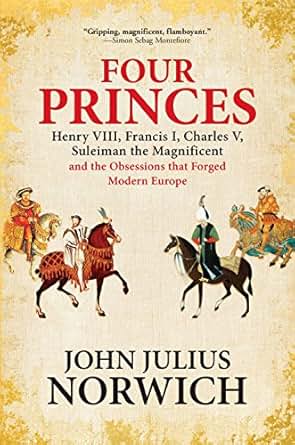
For more than 50 years British historian John Julius Norwich has been generating scores of thoroughly researched, engagingly written books that are damned with the faint praise of being “popular” histories. This is unjust as it is wrong.
All books about historical events should have some resonance with current events and this story of the founding of modern Europe’s nation-states goes a long way to explain how the flaws in its invention 500-plus years ago are showing up todayin Britain’s planned Brexit and the fracturing of culture and politics everywhere else on what not long ago was hailed as the United States of Europe. And then there is the chaos known as the Middle East.
Mr. Norwich is a master of bringing his characters to life as part of the larger canvass of the great events they brought into being. For 10 centuries after the fall of the Roman Empire the people of Europe and the Middle East struggled to regain control over their separated destinies and find a stability despite the surge in populations, the birth of new technologies, the expansion of trade and the need for a unifying religious faith.
But then came these four remarkable princes, all born within 10 years of each other. These occasional allies and perpetual rivals fought over a new structure for Europe, the Middle East and even the New World that kept its shape for five centuries more until it just recently started to come unraveled.
At the beginning, England laid claim to territory inside France, the French kings had seized parts of Italy, and the Holy Roman Empire was divided between Spain, Austria and the Lowlands now known as Belgium and Holland. As for the Turkish Sultans, their empire rimmed both sides of the Mediterranean but their momentum was headed on into Central Europe.
Adding to the confusion, none of our four princes were prime candidates to become rulers when they were born. And then there was the small problem of the Protestant Reformation begin waged by an obscure monk named Martin Luther.
Henry VIII of England was the oldest of the quartet, born in 1491. He was a second son of Henry VII, but the death of both his brother and, then in 1509, his father, young Prince Hal suddenly found himself on the throne with no real idea of how to proceed. That doubt did not last long.
When the man who became Francis I was born in 1494, his father was only a second cousin of the ailing Louis XII who reportedly honeymooned himself to death trying to beget an heir in 1515. The problem first facing Francis was not Henry’s ambitions for more land in France, but with his other Christian rival who was challenging his hold on valuable provinces in Italy and colluding with the pope.
Charles V was not only the most powerful of the four at the start, he also was the ugliest, least intelligent and most religious. He had inherited kingships that included the Lowlands of Burgundy, Aragon in Spain, and also Naples, Sicily and Sardinia. Then, in 1519 with the death of the Holy Roman Emperor Maximilian, Charles was elected successor and thus became ruler over the Hapsburg holdings in Austria and Germany, to which he quickly added Hungary.
This last acquisition was a preventative strategy as was his challenges to French holdings in Italy. If he was to hold what he had been given so easily, he would have to protect it not only against the ambitions of Henry and Francis, but more immediately against the tide of Ottoman Turkey and its hyperambitious young Sultan, Suleiman the Magnificent.
And magnificent Suleiman surely was. Born about the same time as Francis in 1494, he became Sultan 23 years later. He was more secure than the other three princes since his father Sultan Selim the Grim had taken the precaution of murdering any likely rivals among the family beforehand. The Ottoman Empire had already taken over most of the Balkans with only Hungary beyond his reach.
What happened over the next first half of the 1500s is riveting stuff. As Mr. Norwich sums up, “Here, packed into the space of just fifty years, are the High Renaisscence, Luther and the Reformation, the exploration of the Americas and, above all, those four magnificent, memorable monarchs — each of whom, individually, left his indelible imprint over the land he ruled and who together transformed the civilized world.”
This is an important history masterfully written. Read and enjoy.
FOUR PRINCES: HENRY VIII, FRANCIS I, CHARLES V, SULEIMAN THE MAGNIFICENT AND THE OBSESSIONS THAT FORGED MODERN EUROPE
By John Julius Norwich
Grove Press, $26, 304 pages
• James Srodes’ latest biography is “Spies in Palestine, Love, Betrayal and the Heroic Life of Sarah Aaronsohn” (Counterpoint)
Although Russians may have aspired to influence the November election, the real election meddlers were Democrats in the Obama administration who conspired with foreign intelligence agencies against Donald Trump’s campaign, new media reports suggest.
The key player, we are learning, is the already infamous John O. Brennan but FBI Director James Comey also played a role. From January 2009 to March 2013, Brennan was Assistant to the President for Homeland Security and Counterterrorism, and then Director of the Central Intelligence Agency from March 2013 until Obama’s last day as president.
George Neumayr explains at the American Spectator how pro-Islam, pro-Communist Brennan appears to have masterminded the operation.
Seeking to retain his position as CIA director under Hillary, Brennan teamed up with British spies and Estonian spies to cripple Trump’s candidacy. He used their phony intelligence as a pretext for a multi-agency investigation into Trump, which led the FBI to probe a computer server connected to Trump Tower and gave cover to [then-National Security Advisor] Susan Rice, among other Hillary supporters, to spy on Trump and his people.
Drawing from a news article in the Guardian (UK), Neumayr adds:
Brennan got his anti-Trump tips primarily from British spies but also Estonian spies and others. The story confirms that the seed of the espionage into Trump was planted by Estonia. The BBC’s Paul Wood reported last year that the intelligence agency of an unnamed Baltic State had tipped Brennan off in April 2016 to a conversation purporting to show that the Kremlin was funneling cash into the Trump campaign.
Estonians were indeed tense after Trump’s seeming ambivalence about NATO on the campaign trail and the prospect that as president he might leave that former Soviet province at the mercy of Russian President Vladimir Putin. British spy agencies, too, were rife with Trump-haters.
The Guardian reports that Robert Hannigan, then-head of the British foreign surveillance service, Government Communications Headquarters (GCHQ), “passed material” to Brennan in summer 2016.
The claim about GCHQ involvement surfaced a month ago.
On March 16, Fox News contributor Andrew Napolitano accused GCHQ of working with the Obama administration to spy on Donald Trump, citing unnamed sources. The United States and United Kingdom are in fact parties to a multilateral intelligence cooperation pact. This five-way intelligence alliance among the U.S., U.K., Australia, New Zealand, and Canada is called Five Eyes (FVEY). It obligates the countries to work together in the area of signals intelligence (SIGINT). SIGINT is the gathering of intelligence related to communications between individuals (COMINT) and or from electronic signals not directly used in communication (ELINT).
When Brennan took over the CIA, he brought along fellow-travelers.
He dragged along “a raft of subversives and gave them plum positions from which to gather and leak political espionage on Trump,” Neumayr writes. He also “bastardized standards so that these left-wing activists could burrow in and take career positions. Under the patina of that phony professionalism, they could then present their politicized judgments as ‘non-partisan.’”
An official in the intelligence community told Neumayr that “Brennan’s retinue of political radicals didn’t even bother to hide their activism, decorating offices with ‘Hillary for president cups’ and other campaign paraphernalia.”
Neumayr cuts through the obsequious flattery the Guardian article bestows on its intelligence community sources, writing that things were so bad that Brennan’s CIA “operated like a branch office of the Hillary campaign, leaking out mentions of this bogus investigation to the press in the hopes of inflicting maximum political damage on Trump.”
“To ensure that these flaky tips leaked out,” Neumayr writes of the dubious pro-Trump plot by the Kremlin, “Brennan disseminated them on Capitol Hill. In August and September of 2016, he gave briefings to the ‘Gang of Eight’ about them, which then turned up on the front page of the New York Times.”
This was part of Brennan’s audition for the Hillary White House. Eager to retain his CIA post, the perennial excuse-maker for the Muslim Brotherhood also hated Trump for his alleged “Muslim ban,” which offended Brennan’s raging case of Islamophilia. In college Brennan spent a year in Cairo studying Arabic and taking Middle Eastern studies courses. He later was awarded a graduate degree in Middle Eastern studies.
Brennan and crew also helped to torpedo Mike Flynn, President Trump’s first short-lived National Security Advisor, because he “planned to rip up the Obama-era ‘reset’ with Muslim countries.” After reading the transcripts of Flynn’s calls with the Russian ambassador, “[t]hey caught him in a lie to [Vice President] Mike Pence and made sure the press knew about it.”
Not surprisingly, Brennan is one of the key reasons the Obama administration did so little to combat jihadists domestically. After Muslim lobbies supposedly put pressure on him, in 2011 Brennan purged all mentions of Islam and jihad from law enforcement counter-terror training materials. He assured those groups that the Obama administration’s worse-than-useless “Countering Violent Extremism” program had been ideologically purified and pretended the miniscule white-supremacist movement was just as big a threat as head-cutting Muslim savages.
Throughout his service in the Obama administration, Brennan regurgitated the regime’s dangerously idiotic talking points about Islam. It’s not like he needed convincing.
Brennan has spoken of "the goodness and beauty of Islam," which he calls "a faith of peace and tolerance." "The tremendous warmth of Islamic cultures and societies," he said, typically makes visitors from non-Muslim lands feel very "welcomed."
Brennan was the CIA’s station chief in Riyadh, Saudi Arabia. “I saw how our Saudi partners fulfilled their duty as custodians of the two holy mosques of Mecca and Medina,” he said. “I marveled at the majesty of the Hajj and the devotion of those who fulfilled their duty as Muslims by making that privilege — that pilgrimage.”
Former Marine John Guandolo, who worked in the FBI’s Counterterrorism Division, identified Brennan as an enemy operative who converted to Islam.
Brennan admitted he supported the Kremlin-funded Communist Party USA at the height of the Cold War, even voting for CPUSA presidential candidate Gus Hall in 1976. That fact alone should have instantly and permanently disqualified Brennan from all national security-related government posts.
FBI Director Comey’s hands are also not clean.
CNN reports that the FBI relied on the discredited “piss-gate” dossier to win approval from a secret court for permission to monitor the communications of Carter Page, a member of the Trump campaign. That Comey would act based on a dossier that is so ridiculous on its face that, among other things, it accused Trump of paying prostitutes to urinate on a hotel room bed in Moscow, suggests a strong desire on Comey’s part to hurt the Trump campaign.
Meanwhile, the Never Trumpers in the intelligence community can’t stop lying. Now they’ve fed more seeming nonsense to the media in order to keep the fake, faltering Trump-is-a-puppet-of-Putin story alive.
Citing unidentified American sources, Reuters is reporting that an official Russian think tank, the Moscow-based Russian Institute for Strategic Studies, drew up plans “to swing the 2016 U.S. presidential election to Donald Trump and undermine voters’ faith in the American electoral system.”
Three current and four former U.S. officials reportedly “described two confidential documents from the think tank as providing the framework and rationale for what U.S. intelligence agencies have concluded was an intensive effort by Russia to interfere with the Nov. 8 election.” Of course, it is not at all clear that U.S. intelligence agencies have concluded any such thing because no evidence, apart from the same anonymous statements recycled endlessly on CNN, has been made public.
The first document was “a strategy paper written last June that circulated at the highest levels of the Russian government but was not addressed to any specific individuals.” It urged the Kremlin to conduct “a propaganda campaign on social media and Russian state-backed global news outlets to encourage U.S. voters to elect a president who would take a softer line toward Russia than the administration of then-President Barack Obama,” all seven of these mysterious spooks reportedly said.
That Russia could even fantasize about having a bigger Russia-lover in the Oval Office than Barack Obama, the most pro-Russian U.S. president of all time, is difficult to fathom.
Obama advanced Russia’s interests in so many ways, according to Robert G. Kaufman. In 2009 he killed President Bush’s missile defense program for the Czech Republic, Hungary, and Poland. Then he renegotiated the New START nuclear arms agreement, which curbed the U.S. missile defense arsenal while letting the Russians add to theirs. In March 2012 Obama was caught on an open microphone telling then-Russian President Dmitri Medvedev to wait until after the upcoming election when he would be able to make even more concessions on missile defense. As Russia engaged in what one expert called the largest military buildup since the collapse of the Soviet Union, Obama flipped off Mitt Romney during a presidential debate. After Romney on the campaign trail referred to Russia as “without question, our No. 1 geopolitical foe,” Obama mocked him, saying “the 1980s are now calling to ask for their foreign policy back.” And Obama did virtually nothing but talk when Putin invaded Ukraine.
“Thanks to Obama's reset, Putin believes more than ever that he can achieve his consummate objective of reversing the outcome of the Cold War,” Kaufman adds. “No wonder Putin thought he could wage a cyber campaign to delegitimize the outcome of the 2016 presidential election.”
A second document from the institute that was drawn up in October counseled that Hillary Clinton was probably going to prevail in the election. That paper urged Russia to halt its pro-Trump propaganda campaign consisting of efforts by “state-backed media outlets, including international platforms Russia Today and Sputnik news agency, to start producing positive reports on Trump’s quest for the U.S. presidency, the officials said.”
Given that Russia Today and Sputnik are virtually unknown among American news consumers, it is hard to imagine anything they might broadcast or publish having much of an impact on an American election.
But it is becoming increasingly obvious that Russia didn’t do much, if anything, to influence the election.
John Brennan and others in the Obama administration used America’s taxpayer-funded national security apparatus to engage in espionage against an opposition presidential campaign, an incoming administration, and that administration’s transition team.
The whole campaign aimed at convincing Americans that President Trump was a tool of Russia was created by Democrats for their illicit purposes.
Almost every day new evidence emerges proving that point.
On Tuesday morning around 10:45AM, a Muslim named Kori Ali Muhammad walked through Fresno, California, shooting three men dead at random, including one in the parking lot of Catholic Charities. When he was arrested, he screamed “Allahu akbar.” According to the local ABC station, Fresno Police Chief Jerry Dyer “indicated it was ‘still too early’ to know if the shootings were an act of terrorism.”
Of course. And for those who refuse to acknowledge the nature or magnitude of the Islamic jihad against the West, it will always be too early, even if Kori Ali Muhammad presents Dyer with an ISIS membership card and a letter signed by Abu Bakr al-Baghdadi commanding him to carry out this attack. In this case, the familiar dance of denial by non-Muslim authorities intent on absolving Islam of all responsibility for the crimes done in its name and in accord with its teachings is not the central lesson of the attack – that sad charade has played out all too often in the past, and will many more times in the future, and there is nothing new to say about it.
The key story in the murders committed by Kori Ali Muhammad is that they constitute a jihad attack carried out by an apparent member of the Nation of Islam, the racist black supremacist pseudo-Islamic group headed by Louis Farrakhan. According to the Los Angeles Times, “a Facebook profile page for a Kori Ali Muhammad from Fresno paid homage to black pride and black nationalism, with images of the red, green and black Pan-African flag and images of a raised fist. The page listed him as a ‘warrior’ for RBG Nation, referencing red, black and green.”
What’s more, “in recent days, he repeatedly posted images to his frenetic Facebook page with the hashtag #LETBLACKPEOPLEGO. He referenced ‘white devils’ and praised melanoma skin cancer. In a post Monday, he wrote in all caps: ‘MY KILL RATE INCREASES TREMENDOUSLY ON THE OTHER SIDE ASÈ ALLAH U AKBAR.’ Shortly before that, he posted: ‘BLACK WARRIORS MOUNT UP AND RIDE OUT *ASÈ* #LETBLACKPEOPLEGO.’” Ase, according to the Times, “is a term from the Yoruba people of Nigeria, referencing a concept that there is power in our spirituality, words and feelings.” Muhammad also referred to “white devils” and the Nation of Islam’s mythical evil figure who created white people, Mr. Yakub.
If Muhammad is indeed a member of the Nation of Islam, he demonstrates yet again how members of the Nation of Islam, even though orthodox Sunni and Shia Muslims consider the Nation a heretical sect, can identify with the global jihad, and place themselves in its service. The most notorious example of this is the Beltway Sniper, John Allen Muhammad, who along with his accomplice, Lee Boyd Malvo, murdered seventeen people in sniper attacks in the Washington, D.C. area in October 2002. Muhammad had joined the Nation of Islam in 1987; Malvo was discovered to have kept notebooks in which he drew portraits of Osama bin Laden and other jihadis and declared his determination to wage jihad himself.
When Nation of Islam leader Louis Farrakhan spoke at the Nation’s annual gathering in Detroit last February, attendees greeted him with thunderous cries of “Allahu akbar” and listened raptly as Farrakhan railed against not against the Nation’s bogey, white people, but against the Jews: “I want to disabuse the Jews today of the false claim that you are the chosen of God — that Israel or Palestine belongs to you. I want to disabuse you of that. I’m going to tell you about your future. You that think you have power to frighten and dominate the peoples of the world. I’m here to announce the end of your time.”
He has, of course, spoken this way many times before. That Farrakhan would so often use the platform of his racist cult to attack the Jews suggests that he is interested in currying favor with mainstream Muslims who are well aware of how deeply embedded anti-Semitism is in the Qur’an. Orthodox Islam does not blame the evils of the world on white people, but the Nation’s Jew-hatred is certainly mainstream Islam, and an indication of how the Nation is often a way station: African-American men convert to it and then pass from it into orthodox Sunni groups, or turn to jihad even without doing so. Kori Ali Muhammad is just the latest example of this.
If authorities ever decide that the random shooting of three non-Muslims by a Muslim screaming “Allahu akbar” might possibly be terrorism, they might begin investigations that would make all this clear to them and help them prevent it from happening in the future. But nothing seems much less likely.
Tom Wolfe, Noam Chomsky (inset) and Charles Darwin (inset)
Noam Chomsky would seem an irresistible figure for lampooning by Tom Wolfe, whose career has been devoted to eviscerating the preening of America’s bien pensant class. Since the Vietnam war, when he looked like nothing less than Dennis the Menace's father, Chomsky has been the very model of left-wing indignation. In The Kingdom of Speech, Wolfe places him among the brave intellectuals of that era "willing to leave the office, go to the streets, and take part in antiwar demonstrations"—yet whose arrests "were of the token variety that seldom caused the miscreant to miss dinner out." Beginning with his essay "The Responsibility of Intellectuals" (1967), Chomsky has churned out hundreds (make that thousands) of grim, anticapitalist pronouncements and accusations of the United States as a murderous one-party state ruled by a managerial elite.
Yet it is not Chomsky's role as a left-wing gadfly that is Wolfe's major brief here. Before there was Chomsky the political icon there was Chomsky the linguist. His current outsized status is a case of what economists call the multiplier effect. Beginning in the late 1950s, Chomsky awakened the world to the issue of language, providing "the entire structure, anatomy, and physiology of language as a system." His authority moved linguistics from its position as "a satellite orbiting around language studies" to "the main event on the cutting edge." By 1960, linguists were reduced "to filling in gaps and supplying footnotes for Noam Chomsky."
Why the fuss over language, anyway? And why on earth does Tom Wolfe care? It comes down to evolution, a theory embedded in "the very anatomy, the very central nervous system, of all modern people." Wolfe grants the opposable thumb, but not the notion that human speech sprang from the loins of orangutans. Language, in Wolfe's account, is an artifact created by man and, like all of man's tools from slingshots to iPhones, has allowed Homo sapiens to take control of the world. It is the sine qua non of being human. Wolfe's final words, literally, on the subject: "To say that animals evolved into man is like saying that Carrara marble evolved into Michelangelo's David."
Before reaching that point, Wolfe tells two interconnected stories. One concerns the way an idea comes to hold an exalted position over men's minds and changes our ways of thinking about the world. Wolfe's examples of such power are Jesus, Muhammad, John Calvin, Karl Marx, Sigmund Freud, and Charles Darwin. The second story is about the institutional power that transfixes, multiplies, nails down the idea in men's minds—and marginalizes, Palinizes, and slanders those who emerge from low-lying swamps with a different narrative.
Darwin's big idea was the Theory of Evolution. Darwin didn't dare to go so far, but everyone knew that On the Origin of Species (1859) concerned the evolution of humans. Despite the outrage of clerics, the idea was massively promoted by individuals such as Thomas Huxley, who didn't even believe in evolution but was an out-and-out materialist, i.e., atheist. (Understanding the power of language, Huxley wisely coined "agnostic" to describe himself.) Before long, "At the higher altitudes of society, as well as in academia, people began to judge one another socially according to their belief, or not, in Darwin's great discovery." Sound familiar?
It was, of course, language itself that promoted, then institutionalized, Darwinism in newspaper reviews, learned societies, and scholarly articles. Nothing in the fossil record, however, explained the miracle of human communication. Even Alfred Russel Wallace, whom Darwin finessed on the priority issue, denied an animal genealogy for speech. From the get-go, the size of the human brain—which allowed people to think abstractly, to plan ahead (of which no animal is capable), to comprehend space and time—"was so far beyond the boundaries of natural selection" as to render that term meaningless "in explaining the origins of man." In The Descent of Man, his sequel to Origin, Darwin sought to prove that humans were simply very smart parrots, hardwired for speech, thereby bringing the missing Homo sapiens into "the big picture of evolution." The Oxford linguist Max Müller, although without ever naming Darwin, referred to the notion that language had evolved from animal sounds as the "bow-wow theory." Despite his name and birthplace, Müller was also a certified English Gentleman and insisted on a "hard and fast line between man and brute," a "Rubicon." There the matter rested, and studies of the origins of language fell into dogmatic slumber by the turn of the 20th century.
Enter Noam Chomsky, who revived the notion of the biological origin of language by identifying—eureka!—the device in the brain where the capacity for speech was stored. Maybe not an actual device, or gadget, or thing-amabob, but it had a name: language acquisition device, or LAD. Again, we are in "hard-wired" territory, as the LAD represented an "innate" capacity of the human brain. The instant a child, whether in Timbuktu or in Paris, is exposed to human speech, the hypothetical LAD goes into operation. It is programmed with a universal grammar, which likewise does not have to be taught. In the early 1960s, Chomsky's theory acquired the name transformational grammar, or TG, as linguists worked out the theory by churning out analyses that described the rules by which ever-more-complicated linguistic constructions are generated. Thus, "Mary is liked by John" might be considered a transformation of "John likes Mary," generated from an underlying deep structure. All languages, whatever their surface structure, work the same way, and humans easily recognize such variations and are also able to distinguish and to disambiguate—"What annoyed John was being ignored by Mary"—all because of that little LAD.
Chomsky's theory, like Darwin's, was based on what Wolfe calls an "uncontroversial" assumption: that language had evolved, that the human mind had an innate capacity for language, and that all languages share certain universal forms. Chomsky's institutional power has been such that no one has been able to weaken that edifice—even if, Mao-like, Chomsky has revised and retrofitted his doctrine to the point that it resembles a Rube Goldberg device. Despite millions of dollars in funding and decades of research, however, a "language organ" has never been located, while Chomsky's earlier oracular pronouncements simply fall into a deep well of oblivion.
One of Chomsky's updatings to the arsenal of universal linguistic features was recursion, unveiled in 2002. An example: "Mary suspected that John's failure to arrive for their date meant that he could not be counted on to get them to the airport on time." By my count, that sentence nests at least five separate thoughts.
Enter Daniel Everett, who, beginning with a 25,000-word article in 2005, debunked Chomsky's language organ, along with LAD, universal grammar, and deep structure. Unlike Chomsky and his acolytes, Everett actually went out into the field—indeed, into the remotest Amazonian rain forest—where he lived for several decades with the exceedingly isolated Pirahã tribe. Their isolation is reflected in the archaism of their language: Not only does it lack recursion, but it also has no words for "yesterday" or "tomorrow," no way of expressing the past or the future. Thus, while the Pirahã sing and dance and hunt, they create no epics and, aside from the bow and arrow and a primitive scraping tool for making arrows, they produce no artifacts. They do not draw and have no conception of gods or of numbers. (This state of affairs led the Smithsonian Channel to produce a documentary entitled "The Grammar of Happiness" in 2012.) The Pirahã are fully evolved in the physical sense, but in their remarkable isolation, they represent "the most basic prototype of Homo sapiens."
Like the clerics in Victorian England, Chomsky's bulldogs sought to shoot down Everett; but he outflanked them with a bestselling account of his life among the Pirahã (Don't Sleep, There Are Snakes) in 2008, followed by Language: The Cultural Tool in 2012, which, according to Wolfe, shows that language did not evolve from anything; it was "a 'cultural tool' man had made for himself."
Wolfe advances a theory of mnemonics to explain how humans created this artifact. I have not seen any references in the linguistics literature to such a theory, and Wolfe offers no notes; but to my mind, it suggests a very cumbersome way of language processing. I am one of those folks more impressed with a theory that is simple. Yet there may be something to it: Humans, after departing East Africa, did have 100,000 years or so to work out the details, not forgetting that ancient peoples had more prodigious memories than us moderns, even larger than Victorian polymaths.
Although Tom Wolfe does not connect the two, it strikes me that the notion of a linguistic deep structure tells us much about Noam Chomsky's politics. A century ago, Chomsky would have been an unorthodox figure among linguists: Aside from his native English, he is proficient in only a single foreign language, Hebrew, learned as a child. Before the so-called revolution in linguistics that he inaugurated, the field was mostly devoted to recuperating and describing the world's languages. Scholars, and missionaries in particular (such as Daniel Everett), spent their lives traveling in the most wicked and inhospitable terrains—if not to bring the Word, at least to document the rich variety of the earth's tongues. Chomsky, in contrast, disdains fieldwork: As Wolfe notes, he sits instead up high, "very high, in an armchair in an air-conditioned office at MIT, spic-and-span . . . [and] never leaves the building except to go to the airport to fly to other campuses to receive honorary degrees . . . more than 40 at last count."
Thus, the theory of transformational grammar rests on not a single natural language, but purports to offer insight into the functioning of the mind itself. Deep structure, in this theory, is a place in the mind where abstract linguistic functions (nouns, verbs, subject, object, passive voice, etc.) live. These functions resemble Immanuel Kant's conceptual categories, also constituents of the human mind—of all minds, thus "universal." Chomsky has acknowledged his indebtedness to the 18th-century rationalist philosophers, and, of course, the power of their thinking lives on in one of the greatest affirmations of Enlightenment universalism: "We hold these truths to be self-evident, that all men are created equal, that they are endowed by their Creator with certain unalienable Rights, that among these are Life, Liberty and the pursuit of Happiness." Very beautiful—but very abstract, and the United States has spent two-and-a-half centuries seeking to realize these truths.
When he inveighs against the United States, Chomsky is resurrecting Voltaire, railing at the obscurantism of the church or at people who believe in witches. For such hyper-rationalists, there are truths that the mind knows, indeed all minds know: that we should be tolerant of others, should practice what we preach, should love others as we love ourselves—and would do so if our minds were not distorted and diminished by the lying propaganda we so willingly imbibe from self-serving authorities.
Chomsky's vicious attacks on America draw on what is apparently a lifelong revulsion at the disparity between the democratic ideals on which the United States is founded—our deep structure—and what he considers the murderous hypocrisy of our actual behavior—our surface structure. And although Chomsky repeatedly says that he is against all authoritarian governments, his vast linguistic provincialism has blinded him to the full variety of the world. He can only see the sins of the United States of America. His legacy has been misanthropic, indeed antihuman.
Elizabeth Powers is the author of the forthcoming From Velveeta to Brie: A Memoir of How We Had It All.