Tuesday, November 22, 2016

The Muslim Registry that Wasn’t


Despite the media narrative, Trump’s proposed immigration policy is nothing new.

By Rich Lowry — November 22, 2016
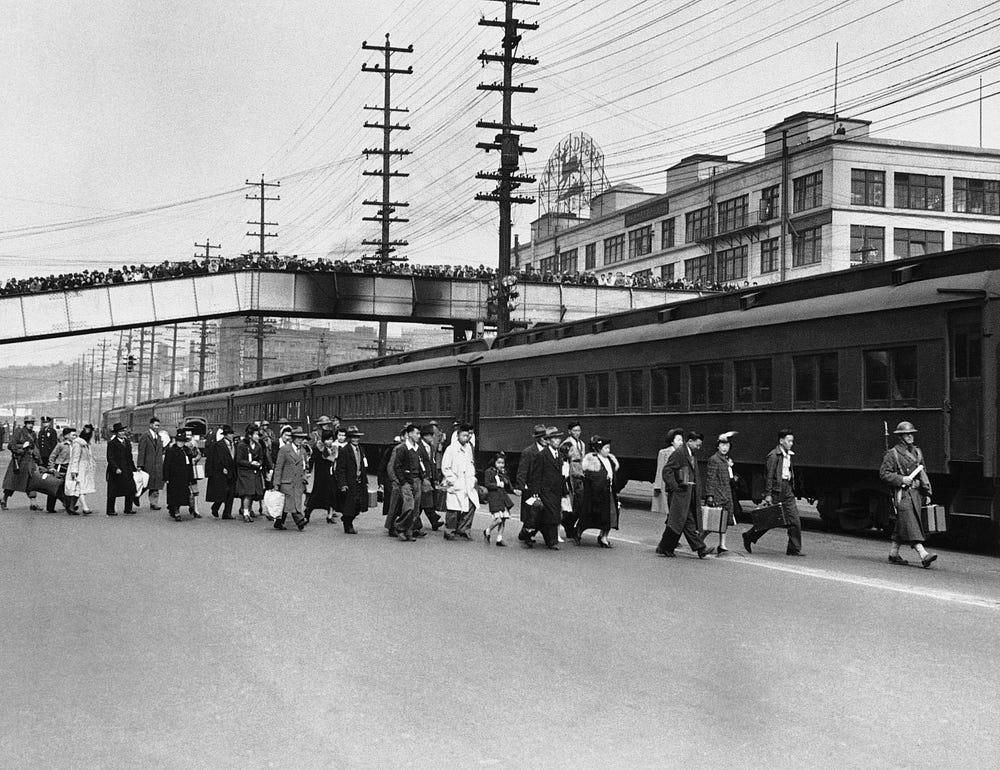
Seattle crowds jam an overhead walk to witness the evacuation of Japanese from Bainbridge Island, Washington, March 30, 1942. Somewhat bewildered, but not protesting, approximately 225 Japanese men, women and children were taken by ferry, bus and train to California internment camps. Evacuation was carried out by the army. (AP Photo)


The first thing to know about Donald Trump’s alleged proposal for a Muslim registry is that it isn’t a Muslim registry.

This has been lost in a freak-out that has some brave souls already promising acts of civil disobedience to disrupt and overwhelm the prospective registry. The controversy tells us much more about how the media will cover the Trump administration — i.e., through the lens of a fact-free hysteria — than about the administration’s immigration-enforcement agenda.

The source of the fracas is a comment from Kansas Secretary of State Kris Kobach, a Trump immigration adviser and (excellent) candidate for Homeland Security director, to Reuters. Kobach noted that the administration might reinstate a Bush-era program tracking visitors to the U.S. from countries with active terrorist threats. This suggestion was spun into a first step toward herding our Muslim neighbors into internment camps.

Kobach was referring to the National Security Entry-Exit Registration System, or NSEERS, which placed special requirements on adult male visitors from countries like Saudi Arabia. Implemented after September 11 — when, you might recall, adult male visitors from Saudi Arabia toppled the World Trade Center — it collected fingerprints and photographs when visitors from the select countries arrived and required them to check in periodically to confirm that they were abiding by the terms of their visas. 

It also required that certain individuals from these countries who were already here go through a process of “special registration,” including an interview with immigration officials.
This is a far cry from Franklin D. Roosevelt’s notorious Executive Order 9066 setting in motion the Japanese internment of World War II.

It is true, as the critics point out, that the selected countries all were, with the exception of North Korea, majority Muslim. But any program concerned with international terrorism will, inevitably, focus largely on Muslim countries (although European countries like France and Belgium have developed an indigenous terror threat). The 9/11 hijackers, notably, all came from majority Muslim countries. 

It is said that the Bush program didn’t lead to the prosecution of any terrorists. According to the Migration Policy Institute, “The New York Times reported in 2003 that, out of roughly 85,000 individuals registered through the NSEERS program in 2002 and 2003, just 11 were found to have ties to terrorism.” 

Although tracking down anyone here who has ties to terrorism isn’t necessarily something to sniff at, the Bush program proved best-suited to identifying visa overstayers. Of the 85,000 initial registrants, nearly 14,000 were put into removal proceedings. For the critics, this is an indictment. Liberal website Vox complains that the program “made it easier to deport someone who then overstayed his visa than it would have been to deport him if he’d refused to register at all.”
But why shouldn’t it be easier to deport visa-overstayers, who constitute about half of the population of illegal immigrants? If we are serious about our immigration rules, our approach to visa-overstayers from all countries should be much more restrictive and hardheaded.

The requirements of the Bush program were watered down over time until it was suspended by the Obama administration in 2011. But the program wasn’t illegal or unconstitutional (the 2nd Circuit Court of Appeals ruled in its favor). Nor was it immoral — foreign visitors should be subject to any reasonable strictures we impose in exchange for the privilege of coming here.

That the so-called Muslim registry is now a thing, a subject of high dudgeon and hot debate, is testament to how the same media that complains about “fake news” is committed to manufacturing and driving its own narratives only loosely connected to reality. Whether the Trump administration revives a version of the Bush program or not, a similar campaign of obloquy will be directed at all of its immigration-enforcement measures. It will have to pursue its agenda against a backdrop of media hostility and constant misinformation.

— Rich Lowry is the editor of National Review. He can be reached via e-mail: comments.lowry@nationalreview.com. © 2016 King Features Syndicate

Monday, November 21, 2016

The Death of Socialism


By Roger Kimball
April 2002
Those who dare to undertake the institution of a people must feel themselves capable, as it were, of changing human nature, of transforming each individual … into a part of a much greater whole, … of altering the constitution of man for the purpose of strengthening it.
—Jean-Jacques Rousseau, 1762
We are all socialists nowadays.
—Edward, Prince of Wales, 1895
The most important political event of the twentieth century is not the crisis of capitalism but the death of socialism.
—Irving Kristol, 1976
Related image
Russian revolutionary leader Vladimir Ilyich Ulianov, a.k.a. Lenin (1870-1924), poses in Gorki, Soviet Union in 1922 with Josef Stalin, who became Secretary General of the Soviet Communist Party that year. (Getty Images)
 
What is socialism? In part, it is optimism translated into a political program. Until he took up gardening, Candide was a sort of proto-socialist; his mentor Pangloss could have been one of socialism’s founding philosophers. Socialism is also unselfishness embraced as an axiom: the gratifying emotion of unselfishness, experienced alternately as resentment against others and titillating satisfaction with oneself. The philosophy of Rousseau, which elevated what he called the “indescribably sweet” feeling of virtue into a political imperative, is socialism in ovo. “Man is born free,” Rousseau famously exclaimed, “but is everywhere in chains.” That heart-stopping conundrum—too thrilling to be corrected by mere experience—is the fundamental motor of socialism. It is a motor fueled by this corollary: that the multitude unaccountably colludes in perpetuating its own bondage and must therefore be, in Rousseau’s ominous phrase, “forced to be free.”
We owe the term “socialism” to some followers of Robert Owen, the nineteenth-century British industrialist who founded New Harmony, a short-lived utopian community on the banks of the Wabash in Indiana. Owen’s initial reception in America was impressive. In an 1825 address to Congress, Joshua Muravchik reports in Heaven on Earth: The Rise and Fall of Socialism,1 Owen’s audience included not only congressmen but also Supreme Court justices, cabinet members, President Monroe, and President-elect John Quincy Adams. Owen described to this august assemblage how his efforts to replace the “individual selfish system” with a “united social” system would bring forth a “new man” who was free from the grasping imperatives that had marred human nature from time immemorial. (And not onlyhuman nature: the utopian socialist Charles Fourier expected selfishness and cruelty to be obliterated from the animal kingdom as well: one day, he thought, even lions and whales would be domesticated.)
The starry-eyed aspect of socialist thinking did not preclude a large element of steel. As Muravchik points out, the French Revolution was “the manger” of socialism. It was then that the philosophy of Rousseau emerged from the pages of tracts and manifestos to strut across the bloody field of history. The architects of the revolution invoked Rousseau early and often as they set about the task of “changing human nature,” of “altering the constitution of man for the purpose of strengthening it.”
This metamorphosis does not come easily. Human nature is a recalcitrant thing. It is embodied as much in persistent human institutions like the family and the church as in the human heart. All must be remade from the ground up if “Liberty, Equality, and Fraternity” are at last to be realized. Since history is little more than an accumulation of errors, history as hitherto known must be abolished. The past, a vast repository of injustice, is by definition the enemy. Accordingly, the revolutionists tossed out the Gregorian calendar and started again at Year One. They replaced the Genesis-inspired seven-day week with a ten-day cycle and rebaptized the months with names reflecting their new cult of nature: Brumaire (fog), Thermidor (heat), Vendémiare (wind), etc. A new religion was born, as imperious as it was jealous. It is significant that the socialist mentality is usually also an atheistic mentality, where atheism is understood not so much as the disbelief in God as the hatred of God—an attitude as precarious logically as it has been destructive in practice. There is an important sense in which religion as traditionally understood reconciles humanity to imperfection and to failure. Since the socialist sets out to abolish failure, traditional religion is worse than de trop: it is an impediment to perfection. (“Criticism of religion,” Marx said, “is the prelude to all criticism.”) In 1793, the churches were closed to worship and ransacked for booty. The anti-clericalism that had been a prominent feature of revolutionary sentiment grew increasingly vicious. Muravchik describes so-called “revolutionary marriages” in which priests and nuns were tied together naked and drowned. Rousseau was always going on about establishing the “reign of virtue.” His far-seeing disciple Maximilien Robespierre spoke more frankly of “virtue and its emanation, terror.”
It is one of the great ironies of modern history that socialism, which promises a more humane, caring, and equitable society, has consistently delivered a more oppressive and mismanaged one. Socialism’s motto— Muravchik optimistically offers it to us as socialism’s “epitaph”—turns out to be: “If you build it, they will leave.”
If, one must add, they are allowed to leave. As Muravchik reminds us in this excellent survey of socialist personalities and socialist experiments, encouraging dissent is never high on a socialist’s agenda. The socialist pretends to have glimpsed paradise on earth. Those who decline the invitation to embrace the vision are not just ungrateful: they are traitors to the cause of human perfection. Dissent is therefore not mere disagreement but treachery. Treachery is properly met not with arguments but (as circumstances permit) the guillotine, the concentration camp, the purge.
In tracing “socialism’s phenomenal trajectory,” Heaven on Earth tells the “story of man’s most ambitious attempt to supplant religion with a doctrine about how life ought to be lived that claimed grounding in science rather than revelation.” It is, to say the least, a cautionary tale. Muravchik provides a devastating anatomy of the socialist dream—a dream that with clocklike regularity becomes a nightmare. If, as Muravchik suggests, “socialism was … the most popular political idea ever invented,” it is also undoubtedly the bloodiest. Of course, many who profess socialism are decent and humane people. And it is worth noting that socialism comes in mild as well as tyrannical versions. Muravchik, who was once a socialist himself, pays frequent homage to the generous impulses that lie behind some allotropes of the socialist enterprise. Nevertheless, he acknowledges that “regimes calling themselves socialist have murdered more than one hundred million people since 1917.” Why? Why is it that “the more dogged the effort to achieve” the announced goals of socialism, “the more the outcome mocked the human ideals it proclaimed”? And why is it that conservatives, who by and large have agreed with Samuel Johnson that “A decent provision for the poor is the true test of civilization,” have regularly been demonized as uncaring brutes?
A large part of the answer lies in the intellectual dynamics of utopianism. “Utopia” is Greek for “nowhere”: a made-up word for a make-believe place. The search for nowhere inevitably deprecates any and every “somewhere.” Socialism, which is based on incorrigible optimism about human nature, is a species of utopianism. It experiences the friction of reality as an intolerable brake on its expectations. “Utopians,” the philosopher Leszek Kolakowski observed in “The Death of Utopia Reconsidered,” “once they attempt to convert their visions into practical proposals, come up with the most malignant project ever devised: they want to institutionalize fraternity, which is the surest way to totalitarian despotism.”
There was also the intervention of Marx. Intellectually, Marxism is the most highly developed—as well as the most influential and most murderous—form of socialism the world has seen. But Kolakowski is surely correct that Marxism’s influence, far from depending on its alleged “scientific character,” depends “almost entirely [on] … its prophetic, fantastic, and irrational elements.” Marxism says that as capitalist societies develop, most people are hounded into abject poverty while a tiny coterie of capitalists thrive. This scenario is presented, à la Hegel, as a “dialectical” inevitability. But in fact capitalism has always made societies richer, much richer. Capitalists get rich, and workers become more prosperous than their grandparents could have ever imagined possible.
Whether or not this is a “necessary” concomitant of market forces, it is an historical fact. The curious thing is that this phenomenon, which any dispassionate observer might count as a refutation, leaves the true-believing Marxist entirely unruffled. Whatever else one can say about it, Marxism is surely one of the most impervious systems of thought ever devised. It is also one of the most protean. It has always, as Kolakowski notes, been able to change “content from one situation to another and [crossbreed] with other ideological traditions.” In part, this is a testimony to its intellectual adaptability; in part, it is simple mendacity. As Marx himself explained in an 1857 letter to Friedrich Engels about an election prediction he had made, “It’s possible that I shall make an ass of myself. But in that case one can always get out of it with a little dialectic. I have, of course, so worded my proposition as to be right either way.”
Image result for muravchik heaven on earth
Muravchik begins his account of the career of socialism with figures like François-Noël Babeuf and Sylvain Maréchal, whose radical egalitarianism and endorsement of violence helped set the tone—and the murderous program—of the French Revolution. Maréchal, who took to signing himself l’HSD (l’Homme Sans Dieu, the man without God), was above all an apostle of radical egalitarianism: equality understood not as a legal postulate but as an existential imperative. “If there is a single man on earth who is richer and more powerful than his fellows,” he wrote, “then the equilibrium is broken: crime and misfortune are on earth.” It is imperative, Maréchal said in his Manifesto of Equals, to “remove from every individual the hope of ever becoming richer, or more powerful, or more distinguished by his intelligence.” Tough work, that removal, but the promised rewards were great: really establish equality, Maréchal argued, and the result would be “the disappearance of boundary marks, hedges, walls, door-locks, disputes, trials, thefts, murders, all crimes … courts, prisons, gallows, penalties, … envy, jealousy, insatiability, pride, deception, duplicity, in short all vices.” Of course, until that happy day arrives there will be plenty of “trials, thefts, murders, … courts, prisons, gallows, penalties” in order to hasten the institution of equality.
Babeuf, who called himself “Gracchus” Babeuf after the legendary Roman land reformer, also put radical equality at the center of his revolutionary program. Since nothing institutionalized inequality more than private property, he reasoned, private property and its distillate, money, must go. Babeuf looked forward to the “general overthrow of the system of private property” as an “inevitable” adjunct of revolution. “Society,” he said, “must be made to operate in such a way that it eradicates once and for all the desire of a man to become richer, or wiser, or more powerful than others.” Like Maréchal—like Robespierre whom he admired as a “regenerator” who “mow[ed] down all that impeded him”—Babeuf (who also called himself “the Marat of the Somme”) believed that “in order to govern judiciously it is necessary to terrorize the evilly disposed, the royalists, papists and starvers of the public. … [O]ne cannot govern democratically without this terrorism.” If the cost of paradise was unfortunately high, it was as nothing compared with the envisioned benefits. “I don’t think it is impossible,” Babeuf enthused to his wife, “that within a year, if we carry out our measures aright and act with all necessary prudence, we shall succeed in ensuring general happiness on earth.”
Today Babeuf is little more than a footnote to the history of tyranny. As with many extremists, the very extravagance of his pronouncements is implicitly taken as a license to dismiss him or deprecate his importance. What fundamentally challenges the status quo is defanged by the rhetoric of extremism: what is extreme is also exceptional, a special case, i.e., not really threatening. But this line of reasoning misunderstands the threat posed by radicals like Babeuf. His extremism was not limited to acts perpetrated in the late eighteenth century. It lived on in the murderous socialist programs he helped to inspire. Babeuf’s importance in the history of socialism was underscored by Marx and Engels. In The Holy Family, their first work together, they fondly note that Babeuf’s attack on private property “gave rise to the communist idea.” (The essence of Communism, Marx correctly observed, can be summed up in a single phrase: the abolition of private property.) Babeuf’s importance was reaffirmed in the founding manifesto of the Comintern in 1919, whose authors saw themselves as “the direct continuators of the heroic endeavors and martyrdom of a long line of revolutionary generations [starting] from Babeuf.” In our own day, the Frankfurt-school Marxist Herbert Marcuse has championed Babeuf’s thought as a tool to battle the seductive evils of advanced capitalism.
Muravchik ranges confidently through the history of socialism, neatly weaving biography, anecdote, and political commentary into a fascinating chronicle of disappointed idealism. A large part of Heaven on Earth is given over to the rise and eventual foundering of what we might call “soft socialism.” Muravchik patiently details the experiments of utopians like Robert Owen, Marxist reformers like Eduard Bernstein (a protégé of Engels), the trade-union movements of Samuel Gompers and George Meany, and mid-twentieth-century redactions of the socialist impulse in Clement Attlee’s Labour government, Julius Nyerere’s Tanzania, and the Israeli kibbutz.
Perhaps his most illuminating pages are devoted to the careers of Mussolini and of Engels. We tend to think of fascism as the antithesis of socialism or Marxism. But as Muravchik reminds us, there are in fact deep continuities between them. Mussolini began as a disciple of Lenin and did not so much repudiate Marxism-Leninism as become a self-declared “heretic.” Thus one of Mussolini’s groups of thugs called itself the Cheka, after Lenin’s secret police. As Muravchik observes, “However fierce they grew in their antipathy to communism, the fascists never ceased mimicking it, implicitly underscoring their claim to be the true or superior heirs to the same legacy.” (Something similar can be said of Hitler, whose party, after all, was called National Socialism. It is true that Hitler was adamantly anti-Communist; at the same time, he acknowledged that he had “learned a great deal from Marxism.”)
st of us think of Engels as the junior partner in the conglomerate of Marxism, Inc. In some ways that perception is accurate. But Muravchik shows that Engels’s contribution to the formation of Marxist doctrine was much larger than is usually recognized. The well-to-do son of a German textile manufacturer, Engels beavered diligently for decades in the Manchester office of Engels & Ermen in order to earn enough money to support his comrade-in-arms. (Engels was always sending Marx money; when he finally retired from the family firm, he made Marx an annuity of £350—several times more than the average family lived on but not enough for Marx, who always adjusted his spending to a level above what his benefactors supplied.) Engels was an indefatigable publicist. It was Engels, for example, who suggested the title “Communist Manifesto” for their jointly authored “confession of faith.” When Marx finally, after innumerable delays, managed to complete the first volume of that great reader-proof tome Das Kapital, Engels flogged it everywhere, taking it upon himself to write ten separate reviews of the book. He also completed volumes two and three of the book, working up Marx’s scattered notes into something resembling a consecutive argument. More substantively, Engels’s 1844 “Outlines of a Critique of Political Economy” articulated many central points of the doctrine we have since learned to call Marxism, above all the thesis that the evolution of capitalism necessarily leads to cutthroat competition among capitalists and poverty and dehumanization for the majority of the populace. Marx himself called it “a work of genius” and incorporated many of its central arguments into his later work.
Muravchik’s argument has two aspects. Like many other disabused commentators, he presents a sobering chronicle of socialism’s delusions and crimes. He reminds us—if we still need reminding—of the central role that the “annihilation … of reactionary races” (Marx), the “extermination” of enemies (Lenin) has always played in “really existing” Marxism. Muravchik also presents the cheering news that daybreak has come at last, that we have finally awakened from the long dream of socialist utopia. It is difficult to argue with the first part of his argument. What about the second? It is certainly significant that the Soviet Union imploded and that its last leader, Mikhail Gorbachev, should have recently acknowledged that Communist claims about economic progress had been “pure propaganda.” Perhaps it is also significant that Tony Blair in Britain should have campaigned on the slogan “Labour is the party of business.” But I cannot help receiving the news of socialism’s death with a certain scepticism. For one thing, the fact that an idea has been thoroughly discredited does nothing to render it impotent. It is part of the perversity of human nature that discredited ideas are often the most successful ideas. Then, too, I see little evidence that socialism’s fundamental tenet—namely, the ideal of equality—is on its way to the dustbin of history. The wheels of egalitarianism may grind away more slowly in liberal democratic countries than in Communist ones, but grind away they do. It would be pleasant to think that in leaving history’s bloodiest century behind, we have also left behind the passions that sparked its unprecedented carnage. But time and again history has taught us that the hunger for equality is among mankind’s most brutal passions. It is for this reason that I believe the philosopher David Stove was correct when he identified “bloodthirstiness” as a central ingredient in the psychology of egalitarianism. Socialism will be conquered to the extent that egalitarianism is conquered. In the meanwhile, I fear that Stove is correct that “very far from communism being dead, as some foolish people at present believe, we can confidently look forward to bigger and better Marxes, Lenins, Stalins, Maos, Kim Il Sungs, Pol Pots, Ceausescus, Baader-Meinhofs, Shining Paths, and all the rest.”
1 Heaven on Earth: The Rise and Fall of Socialism, by Joshua Muravchik; Encounter Books, 400 pages, $27.95.
Roger Kimball is Editor and Publisher of The New Criterion and President and Publisher of Encounter Books. His latest book is The Fortunes of Permanence: Culture and Anarchy in an Age of Amnesia (St. Augustine's Press).
This article originally appeared in The New Criterion, Volume 20 Number 8 , on page 15
http://www.newcriterion.com/articles.cfm/The-death-of-Socialism-1985

Sunday, November 20, 2016

Today's Tune: Leonard Cohen - Show Me The Place

Today's Tune: Leonard Cohen - Ain´t No Cure For Love

Leonard Cohen, the Christ-Haunted


By Joe Heschmeyer
November 17, 2016
Image result for leonard cohen
Among the singer-songwriters who emerged in the latter part of the 1960s, Leonard Cohen was something of an oddity. Alastair Pirrie observed in 1973, in a review of Cohen’s LPSongs of Love and Hate: “[Cohen] says that he has no concept of religion in his life but, strangely enough, he sings a song about Joan of Arc.” At the time, Cohen wrote the song off as an anomaly: “It was a strange song indeed; it was out of myself and contained the notion of reverence. When I recorded that song I will admit to having a strong religious feeling. I don’t think it’ll happen again.”
But in fact, this pattern would characterize his life’s work. Throughout a long and storied career, brought to a close by his death last week, Cohen evinced a remarkable respect for religion and disdain for secularism. Though he would often protest that he “wasn’t really a religious man,” Cohen seemed unable to sing or speak for very long without bringing up God.
He described his lifelong battle with depression as having defined his character: “I could either have gone under with it or luckily fallen upon certain solutions for it that I have. One was that curious activity called art. And again, that curious activity called religion.” For Cohen, these curious activities were often one and the same. Religious themes, often present in his songs, were yet more explicit in his poetry and his interviews.
Long before he became a successful singer, Cohen was an unsuccessful poet. His 1956 compilation Let Us Compare Mythologies contains poems like “For Wilf and His House,” which opens: “When young the Christians told me / how we pinned Jesus / like a lovely butterfly against the wood, / and I wept beside paintings of Calvary / at velvet wounds / and delicate twisted feet.” Cohen’s interest in Christ, coupled with his pain at Christian anti-Semitism, are laid out for the reader.
Click on the link below to read the rest of the article:

Saturday, November 19, 2016

Film Reviews: Hacksaw Ridge


'Hacksaw Ridge' presents a stirring profile of courage


By  Star Tribune
November 3, 2016

Image result for hacksaw ridge poster

Honor, courage and glory come in many forms. For the young volunteer soldier Desmond Doss, they came in ways that redefined many Americans’ understanding of patriotism.
Doss joined the Army in World War II to serve his country, but insisted on doing it on his own terms. His religious faith made him refuse to kill others, or even to carry a weapon into battle. As an unarmed medic caring for wounded infantrymen on the front lines of the Okinawa campaign, he served with astounding bravery, dignity and distinction, becoming the most awarded conscientious objector in U.S. military history and the first to receive the Medal of Honor.
In “Hacksaw Ridge,” Mel Gibson, returning to directing after scandal sidelined him for a decade, reaffirms his reputation as a master storyteller. This could have been another dime-a-dozen war story about rah-rah patriotism, but Gibson has made something much deeper, artistically and morally. Shot, edited and acted dazzlingly, this equals Gibson’s bravura work in “The Passion of the Christ” and “Apocalypto.” “Hacksaw Ridge” is their spiritual sequel.
Gibson has crafted a riveting and inspiring film, exploring the dark side of mankind alongside its heroism. While the film has moments of sentimentality and war movie cliché, Gibson molds the carefully documented facts into believable and powerful drama. He pulls no gut-wrenching punches, and they strike that much harder after we are lulled by the film’s innocent and romantic buildup in its first hour.
After an electrifying, visually stunning battlefield prologue, the story begins in peaceful Lynchburg, Va. This rural Eden is where Desmond, a pious and somewhat naive youngster, introduces himself to sin. During a scuffle with his brother, Desmond hits him with a brick, causing a head injury. Later, when his drunkard father (Hugo Weaving), a traumatized World War I veteran, treats his wife violently, Desmond protects her with a pistol. Humbled by those outbursts, he vows never to touch a weapon again.
Andrew Garfield acts the part superlatively, mixing happy-go-lucky humor, humility and a warm sense of budding manhood as he falls in love with a nurse from the local hospital (charming Teresa Palmer). A generous spirit, he wishes he had enough schooling to become a doctor himself. Gibson uses thoughtful, comfortably tight storytelling to hook our emotions to this likable farm boy’s fate long before it is pulled into the firing line.
Signing up to help promote the war effort, Desmond arrives at boot camp, where his drill sergeant (Vince Vaughn at his best in ages) eyes him and declares, “I have seen stalks of corn with better physiques.” Desmond baffles, then incenses, the enlisted men and officers when he refuses to accept his rifle, respectfully citing his Seventh-day Adventist’s adherence to the commandment “Thou shalt not kill.”
Despite his promises to fulfill all of the Army’s other decrees, cynics call him a coward and beat him. The brass launches a court martial against him. Eventually, the pacifist is sent into battle with the squad as a medic, one of the most highly targeted personnel in the conflict, still scarcely trusted by many of his comrades.
The film’s devastating second half moves us into what one officer calls “the hellfire of battle.” That’s an understatement. The battle for control of Okinawa is presented as a terrifying symphony of blood and mud and flame — imagery as much from apocalyptic theology as history. As grenades and machine-gun fire blow bodies in half, Desmond’s comrades move ahead courageously, and each has been so carefully sketched beforehand that we care about every one. Desmond shows even greater valor crawling to them, tending to them and pulling them back for surgical treatment, stanching their jets of blood and boosting their morale even when we know they’re dying.
Gibson, always a faith-based sermonizer, captures these convulsions with such virtuoso control of film craft that he can express devout associations beyond the narrative. When the saintly Desmond transports men on his shoulders, their wounds bloodying his back, there are clear parallels to Christ carrying the cross. As Desmond is pulled by a rope lift to the top of the towering stone cliff that borders Hacksaw Ridge, it’s a clear parallel to the ascension. Rescuing American and Japanese wounded alike, Desmond endlessly prays for the strength to save “just one more, Lord, just one more.”
Carrying the savagery of “Saving Private Ryan” to a deeper level, this film will trigger more manly tears than any in memory. It earns them.

The Madness and Majesty of 'Hacksaw Ridge'

Related image
From the Blue Ridge Mountains of Virginia, on the trail of the divine, comes Desmond Doss. We see him as a child, played by Darcy Bryce, scrapping with his brother and clouting him with a brick—the sole occasion, in “Hacksaw Ridge,” on which the hero harms another person. Quaking with guilt, and awaiting a whipping from his drunken father (Hugo Weaving), Desmond stares at a picture on the wall and reads the inscription: “Thou shalt not kill.”
Easier said than done, in a time of war. Yet such was the mission of Doss, a Seventh-Day Adventist, who was drafted in 1942 and joined the military as a conscientious objector. He served as a medic with the 307th Regiment, 77th Infantry Division, and was awarded the Medal of Honor for what the citation called “conspicuous gallantry and intrepidity in action,” at Okinawa. Conspicuous is right; after the bulk of the regiment was forced to retreat, Doss, alone and exposed to continual enemy fire, went to the aid of some seventy-five injured comrades, lowering them, one by one, over an escarpment to safety. Only when there was no one else to rescue did he descend. No wonder he became a talisman to the troops; in “Hacksaw Ridge,” preparing for a renewed assault, they calmly delay until Doss has finished his prayers.
All this is a far cry from Doss’s rural home, where he and his brother are seen climbing a ridge not for combat but for fun and for the beautiful view. As a lanky youth, now played by Andrew Garfield, Desmond falls in love with a nurse (Teresa Palmer). He woos her with a gee-whiz grin and, in a benign foreshadowing of the horrors to come, donates blood. She, in turn, gives him a Bible before he goes off to basic training, at Fort Jackson. There a problem arises, for Doss refuses to hold a rifle: a stance that not even Gary Cooper, as the devout pacifist of “Sergeant York” (1941), could match. Such mulishness puts Doss at odds with the other recruits, like the strapping Smitty (Luke Bracey), and with their drill sergeant, played by Vince Vaughn, who equips the character not just with the standard snarl and bark but also with a twinge of genuine curiosity. What is driving Doss, this goofy kid, whose principles are as upstanding as his quiff? Only through the intervention of a loved one does he survive a court-martial, earning the right to enter the battlefield unarmed. He does use a rifle, but only once, as the handle for a homemade stretcher.
Courage of this order reaches beyond recklessness, and during the Okinawa scenes, which consume the final hour of the movie, Garfield’s boyish features are racked and seized in a kind of trance; the agonized effort to save others, we realize, entails a near-ecstasy of suffering. Here, in other words, is a movie directed by Mel Gibson. It has less in common with Clint Eastwood’s “Flags of Our Fathers” and “Letters from Iwo Jima” (2006), say, than with Gibson’s own “The Passion of the Christ” (2004), in which the scourging of Jesus goes on and on, until you can scarcely look, and then goes on again. Is this in line with traditional, if extreme, strains of Christian iconography—with the contorted limbs and the scarified skin of Grünewald’s “Crucifixion,” from the early sixteenth century? Or was the filmmaker at the mercy of a thoroughly modern fixation? More than any other living director, even a fellow-Catholic such as Martin Scorsese, Gibson seems to be gripped by the spiritual repercussions of pain. Within the bounds of his vision, it is quite natural to cut from Doss inside a church, polishing the stained-glass windows, to a nasty accident on the road outside and the impaling of a victim’s leg.
“Hacksaw Ridge” is the strangest release of the year: an implacably violent film about a man who wants no part of violence at all. Gibson asks us to observe the spectacle of spilled viscera, limbs in flight, rats feasting on mortal flesh, and one soldier using the sundered torso of another as a shield, so that we may better comprehend the faith that upholds Doss, inspiring him to bind the wounds of his friends (and even, in one stirring instance, his foe). He burrows down a tunnel as if harrowing Hell, and when, at last, he escapes from Hacksaw Ridge—the site of the climactic battle, its very name designed to bite deep—he is framed against the sun, pouring water over his half-naked figure to wash off the blood of other men. We are meant to imagine someone being baptized and born again. There are reasons to recoil from all this, and what private furies Gibson may be confronting, at the cost of more than forty million dollars, I hate to think. Yet the result, though corny at times, treads close to madness and majesty alike, and nobody but Gibson could have made it.


Friday, November 18, 2016

What to Tell Your Children About Trump


We are the world’s oldest democracy, we are good people, and we’ve been through shocks before.


By Peggy Noonan
November 17, 2016
Eight points and two anecdotes as we continue to digest this astounding election.
You don’t know a tree is hollow until you push hard against it and it falls. The establishments of both parties did not know, a year ago, that they were hollow trees. They thought themselves strong because they always had been, and people think what has been true will continue. Then suddenly the tree is pushed and falls. To me that is the symbol, the image of 2016: the hollowed trees and how easily they fell.
Election night 2016 was not like 1980. That year produced an outcome fully within the political norms: a former two-term governor won the presidency. This year’s outcome went beyond all previous norms. Twenty-sixteen was like nothing in our lifetimes. In the future people will say, “Where were you that election night?” the way they do for other epochal moments.
Much of the mainstream, legacy media continues its self-disgrace. Having failed to killDonald Trump’s candidacy they will now aim at his transition. Soon they will try to kill his presidency. Any journalists who are judicious toward Trump, who treat him fairly or even as a human being, are now accused of “normalizing” him. This is a manipulation: It is a way of warning your colleagues to approach the president-elect with the proper hostility or be scorned. None of this will do our country any good.
The left is in enraged mourning. A better way forward would be: reflect, absorb, gather your strength as the opposition, constructively oppose. Lose the hissing rancor. Use that energy to rebuild your party.
Right now 60 million people are very happy, and hopeful. They haven’t taken to the streets in elation, so we can’t see them. They haven’t broken car windows in their joy. Respect their happiness.
This is my fear: The question we ask after every national election is, “Can we come together?” The question this year is more, “Do we even want to come together?” Have the two nations within our nation reached a point of permanent estrangement? If the cultural left eases up and the economic right loosens up, maybe things can be soothed.
I think many people intuitively sense this: The Trump era either really will work or really won’t. It’s going to be something good or a disaster, but it won’t be a middling thing.
This big, burly country can take it either way. The proper attitude now? Give him a chance, watch close, wish well. Cheer what’s sound, criticize what isn’t.
And this: trust America.
Five days after the election I met an Ethiopian immigrant on a street in Washington. We got to talking. He spoke of how bad it was in his old country, all the killing. He’d been here 15 years. “I love America,” he said. “It gave everything to me.” But he was deeply concerned by the election. He has two sons, 8 and 6. The younger got up Wednesday morning, saw the TV and burst into tears. Trump won! The boy calls Trump “the mouth man.” How could a bully be president? “He wept,” said the Ethiopian. “How do I explain it to him?”
I thought. Finally I said, “Tell him to trust America.” Tell him that we are the world’s oldest democracy, that we are a good people, that we’ve been through shocks and surprises, and that we have checks and balances. “If it turns out good,” I said, “we’ll be happy. If it turns out really bad, America has a way of making your stay in the White House not too long. But tell him to trust America as you did, and it gave you everything.”
He said he’d tell his son that. We warmly shook hands.
This isn’t the first story of frightened children I’ve heard since the election. It’s the third. When I told it to a friend, also foreign-born, and so America-loving that he chokes up when he quotes past presidents, he told me that his 5-year-old woke up after the election and sobbed at the news.
Trump supporters feel that the left did this, demonizing Mr. Trump and making him monstrous. There’s some truth in that. But even truer is that Mr. Trump himself scared the children of America for a solid year with his loud ways and rough manner—“the mouth man.”
What a great thing it would be if Donald Trump would take a day off from the presidential transition, go to a series of schools, bring the press, and speak to children, telling them that he has nothing in his heart but the desire to do good and help people. “I have children and even grandchildren,” he might say. “I love them. I will do my best, and I love you.”
Mr. Trump’s people seem to me right now proud, exhausted and painfully aware that they emerged victorious despite the daily pummeling from the establishment and elite media. No one gave them a break.
And they’re right. It was that way.
But it’s not sissy-ish to respect peoples’ anxieties. It doesn’t legitimize your foes’ criticisms to show sensitivity. All presidents since Washington, “the father of our country,” have been seen as a national father figure. It grates on conservatives to think like that. It grates on me. But that’s inevitable for kids who see the president on TV all the time in an un-parented country.
They need to see a little gentleness and good intent. Their parents would appreciate it. And it’s needed before the inauguration. Impressions will have hardened by then.
I end with a related personal note. I never interviewed Donald Trump throughout this year’s campaign. From the beginning he reminded me of men I grew up with, Trumps with no money—loud, unsmooth, rough opinions. Where you came from and who you were surrounded by has a bearing on your loyalties and can bend your thinking. I judged that I’d see Mr. Trump most clearly from a middle distance. So I didn’t go, talk, interview. Six weeks ago I called a Trump staffer I’d interviewed to check a quote. She returned my call from Trump Force One. We spoke, and then suddenly the phone seemed to drop and I heard, “Who’s that?” Then I heard, “Peggy, this is Donald.”
I won’t quote exactly what was said. No one put it off the record, but it felt off the record, and some of the conversation was personal. But I can describe it. He was dignified, hilarious and modest. He told me that I’d sometimes been unfair to him, sometimes mean, sometimes really, really mean, but that when I was he usually deserved it, always appreciated it, and keep it up. He spoke of other things; he characterized for me my career.
I’d heard of his charm offensive, but I’d be lying if I didn’t say how charming, funny and frank he was—and, as I say, how modest. How actually humble.
It moved me. And it hurt to a degree a few weeks later when I wrote in this space that “Sane Donald Trump” would win in a landslide but that the one we had long seen, the crazed, shallow one, wouldn’t, and didn’t deserve to.
Is it possible there are deeper reserves of humility, modesty and good intent lurking around in there than we know? And maybe a toolbox, too, that can screw those things together and produce something good?
Where there’s life, there’s hope. He’s lively. Let’s hope.
But whatever happens, trust America. She has a way of weathering through.