Wednesday, October 05, 2016

Welcome to the Republic of Bananas


October 4, 2016

Image result for marc turi libya
The Department of Justice has moved to drop the charges filed against Marc Turi (left), who was alleged to have sold arms that were intended for Libyan rebels. The likely reason why is that he threatened to expose former Secretary of State Hillary Clinton’s actions leading up to the Sept. 11, 2012 Benghazi, Libya terror attacks.

Under the current, entirely corrupt federal government, enormities like this one now occur on a daily basis. Unbelievable:
The Obama administration is moving to dismiss charges against an arms dealer it had accused of selling weapons that were destined for Libyan rebels. Lawyers for the Justice Department on Monday filed a motion in federal court in Phoenix to drop the case against the arms dealer, an American named Marc Turi, whose lawyers also signed the motion. 
The deal averts a trial that threatened to cast additional scrutiny on Hillary Clinton’s private emails as Secretary of State, and to expose reported Central Intelligence Agency attempts to arm rebels fighting Libyan leader Moammar Qadhafi. 
Government lawyers were facing a Wednesday deadline to produce documents to Turi’s legal team, and the trial was officially set to begin on Election Day, although it likely would have been delayed by protracted disputes about classified information in the case.A Turi associate asserted that the government dropped the case because the proceedings could have embarrassed Clinton and President Barack Obama by calling attention to the reported role of their administration in supplying weapons that fell into the hands of Islamic extremist militants. 
“They don’t want this stuff to come out because it will look really bad for Obama and Clinton just before the election,” said the associate.
 Can't have the Democrat candidate for president embarrassed in the run-up to the election now, can we?
Under the deal, Turi admits no guilt in the transactions he participated in, but he agreed to refrain from U.S.-regulated arms dealing for four years. A $200,000 civil penalty will be waived if Turi abides by the agreement. 
Turi was indicted in 2014 on four felony counts: two of arms dealing in violation of the Arms Export Control Act and two of lying to the State Department in official applications. The charges accused Turi of claiming that the weapons involved were destined for Qatar and the United Arab Emirates, when the arms were actually intended to reach Libya. 
Turi’s lawyers argued that the shipments were part of a U.S. government-authorized effort to arm Libyan rebels.
Under Obama, our entire government has become a national disgrace and a criminal conspiracy against the American public. But this is what you get when you elect a nobody back-bencher from the corrupt Illinois state legislature whose candidacy was promoted and abetted by a collection of red-diaper babies and other enemies of the people, and who spent almost no time in national politics before landing in the White House as the quintessential stealth, if not to say Manchurian, candidate.

The idea originally was to have Hillary take her turn in 2008-2016, then thrust Obama upon the real American people, but the Punahou Kid jumped the line. Now an ill, bitter shrew makes her last witch's clutch for power and is using every institution of the government in order to make sure it happens.

This is what evil looks like.

Tuesday, October 04, 2016

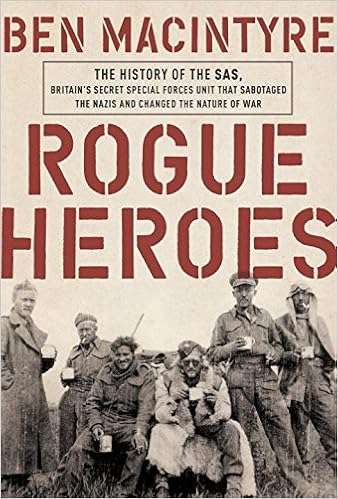
Book Review: ‘Rogue Heroes,’ the Birth of Britain’s Elite Special Forces by Ben Macintyre


http://www.nytimes.com/
October 3, 2016

Image result for ben macintyre sas

Ben Macintyre’s suspenseful new book, “Rogue Heroes,” about the founding of Britain’s S.A.S. during World War II, reads like a mashup of “The Dirty Dozen” and “The Great Escape,” with a sprinkling of “Ocean’s 11” thrown in for good measure. Like earlier Macintyre books set during that war (“Double Cross: The True Story of the D-Day Spies” and “Operation Mincemeat: How a Dead Man and a Bizarre Plan Fooled the Nazis and Assured an Allied Victory”), this volume features an ensemble of eccentrics, mavericks and malcontents. And, in this case, one visionary, David Stirling, who invented an elite commando unit that would become the prototype for a new kind of modern warfare, and the model for special forces around the world, including the Navy SEALs and the Army’s Delta Force.

In 1941, Mr. Stirling, an aristocratic dilettante who found his calling as a soldier, was recuperating in a Cairo hospital from injuries sustained during an ill-judged parachute jump. Studying a map of North Africa — where British forces were facing off against Erwin Rommel’s Afrika Korps — it occurred to Mr. Stirling that small groups of highly trained commandos could operate behind German lines, sabotaging aircraft, runways and fuel depots. Looking for men who could extract “the maximum out of surprise and guile,” he sought soldiers who exhibited independence and self-reliance.

“Recruits tended to be unusual to the point of eccentricity,” Mr. Macintyre writes, “people who did not fit easily into the ranks of the regular army, rogues and reprobates with an instinct for covert war and little time for convention, part soldiers and part spies; rogue warriors.”

Mr. Macintyre draws sharp, Dickensian portraits of these men, and he displays his usual gifts here for creating a cinematic narrative that races along, as Mr. Stirling’s crews find themselves in one harrowing situation after another — trudging through blazing desert heat with precious little water or food; desperately trying to elude snipers and ambushes as they rush to blow up German airplanes and supply lines; attempting to extricate themselves from dire predicaments that would test the resourcefulness, never mind stiff upper lip, of James Bond.

Because this history of S.A.S. (Special Air Service) during World War II — based on documents compiled as the “SAS War Diary” and made public in 2011 — is episodic, it lacks the coherence of Mr. Macintyre’s earlier books, which focused on a particular mission or central character. The colorful Mr. Stirling and his co-conspirator in founding S.A.S., Jock Lewes (who was as austere and disciplined as Mr. Stirling was fond of drink and gambling), only intermittently hold center stage, and many of the men they recruit suffer horrific deaths not long after we get to know them. Besides Mr. Lewes and Mr. Stirling, the one team member who remains firmly wedged in our minds is Paddy Mayne,who has a capacity for “devotion on an almost spiritual level” but is also given to terrifying bursts of violence on the battlefield and off.

Mr. Macintyre is masterly in using details to illustrate his heroes’ bravery, élan and dogged perseverance. He makes us feel the “constructive brutality” of the training that recruits endured — marching up to 100 miles through the desert, carrying a full load of equipment and prohibited from taking a drink of water until the trek’s end. He describes men who died — or were horribly injured — during missions and had to be left behind. And he conveys both the heart-stopping horrors of combat — one fight left 21 men dead, 24 wounded, 23 as prisoners — and the plucky, schoolboy spirit that emerged as their default setting.

“Stirling never relaxed his dress code,” Mr. Macintyre writes. “Whether going into battle or unwinding after it, he always wore a tie. The men chatted idly in the heat, using a shared jargon, weighted with euphemism, black humor, and profanity, a private language unintelligible to a stranger: heading into the desert was ‘going up the blue’; a raid was ‘a party’ or ‘jolly’; grumbling was ‘ticking’; sinking into sand was ‘crash diving’ or ‘periscope work.’”

While individual S.A.S. sabotage and reconnaissance missions (in Libya, Egypt, Italy, France and Germany) are evoked with considerable verisimilitude, Mr. Macintyre has difficulty zooming out from his heroes’ story to give a broader understanding of how their operational work fit into the larger canvas of the war. The story of what happened to the S.A.S. at war’s end feels truncated and rushed, as does the story of how it would be resurrected and copied around the world. At the same time, the book never delves into the mind-set of special forces soldiers with the power and immediacy of “No Easy Day” by Mark Owen (a.k.a., Matt Bissonnette, a member of the Navy SEAL Team 6, which took out Osama bin Laden).

What “Rogue Heroes” does do is provide a gripping account of the early days of S.A.S. and some understanding of just how rapidly it revolutionized a form of modern war that has grown ever more important as governments seek to find alternatives to traditional and costly wars of occupation.

Follow Michiko Kakutani on Twitter: @michikokakutani

VOTER FRAUD RISING

Illegal interference in the battleground states.


October 4, 2016

Image result for voter fraud

There is already evidence that voter fraud is being perpetrated in critical battleground states like Virginia and Colorado a month before Election Day.
Voter fraud is commonplace. Completely eliminating it is impossible. The most policymakers can do is create laws and policies that attempt to minimize it.
Voter fraud is unlawful interference with the electoral process in an effort to bring about a desired result. Voter fraud is also called vote fraud, election fraud, and electoral fraud. It refers to fraudulent voting, impersonation, intimidation, perjury, voter registration fraud, forgery, counterfeiting, bribery, destroying already cast ballots, and a multitude of crimes related to the electoral process.
Reasonable people can disagree over how serious a problem voter fraud is in today's America, but the evidence it actually exists cannot be ignored.
This is where people on the Right and Left differ. Conservatives think fighting voter fraud is important; liberals and progressives don’t care — and many of them go further, arguing that voter fraud is an imaginary problem.
News of the illegal voting in Virginia and Colorado comes as Republican candidate Donald Trump has repeatedly claimed in campaign speeches that the system, including the electoral system, is “rigged.”
Trump has been issuing this warning about the election for months. After a series of anti-voter fraud laws were struck down in several states by federal courts, the candidate raised the possibility that people will vote over and over in the election, voting for which is already underway in many states.
"There's a lot of dirty pool played at the election, meaning the election is rigged," Trump said two months ago. "I would not be surprised. The voter ID, they're fighting as hard as you can fight so that they don't have to show voter ID. So, what's the purpose of that?”
People will be able to vote “multiple times,” he said. “How about like 10 times. Why not? If you don't have voter ID [requirements], you can just keep voting and voting and voting."
In fact the Left has made it easy to commit voter fraud. Bill Clinton’s Motor-Voter law of 1993 opened the floodgates to fraud.
Nowadays the Left unfairly influences election outcomes by fighting electoral integrity laws in the courts, often enjoying great success. On Sept. 9, a federal appeals court blocked a proof-of-citizenship requirement on a federal mail voter registration form in Alabama, Georgia, and Kansas. This year alone federal courts have blocked voter ID laws to varying extents in North Carolina, North Dakota, Texas, and Wisconsin.
The danger of the national vote being compromised is real, according to Homeland Security Secretary Jeh Johnson who has acknowledged that cyber attackers could engage in massive electronic vote fraud. At least 18 states have asked Johnson’s department for help. The agency says the electoral systems of more than 20 states have been targeted by cyber criminals.
Now Americans are learning that there are at least 1,046 non-citizens on the voter rolls in eight counties in Virginia, according to a new report released jointly by the Virginia Voters Alliance and the Public Interest Legal Foundation. No proof of U.S. citizenship is required in Virginia to register to vote.
“Virginia election officials don’t seem to care that thousands of aliens have corrupted their voter rolls,” by unlawfully registering to vote, J. Christian Adams, the former Department of Justice lawyer who now heads the Public Interest Legal Foundation told Breitbart News. “Even worse than doing nothing about it, they are trying to cover it up,” he said.
Virginia Gov. Terry McAuliffe (D), a longtime Hillary Clinton crony, instructed election officials to ignore inquiries about possible electoral irregularities, Adams says. This summer after the Supreme Court of Virginia threw out McAuliffe’s blanket clemency order, the governor defiantly restored voting rights to 13,000 felons and vowed to take that figure to 200,000.
Just a few illegal votes can affect the outcome of an election. Virginia Attorney General Mark Herring (D) defeated Mark Obenshain (R) in 2013 by just 165 votes out of 2.2 million votes cast.
The thousand-odd non-citizens currently on the rolls, all identified by name in the report, may be the tip of the iceberg. The problem “is most certainly exponentially worse because we have no data regarding aliens on the registration rolls for the other 125 Virginia localities.”
“Even in this small sample, when the voting history of this small sample of alien registrants is examined, nearly 200 verified ballots were cast before they were removed from the rolls,” the report states. “Each one of them is likely a felony.”
And in Harrisonburg, Va., local officials and the FBI are investigating after 18 to 20 potentially fraudulent voter registrations were filed in the names of dead people. Democrat Andrew Spieles reportedly admitted filing the documents.
Recent reports also indicate the dead have been voting in Colorado. There are at least 78 dead people currently registered to vote in the Centennial State.
Obviously, fraudulent and inaccurate voter registrations open the door to fraudulent voting.
A 2012 Pew Center on the States study revealed around 24 million — one out of every eight — U.S. voter registrations are no longer valid or are significantly inaccurate. About 2.75 million people are registered to vote in more than one state and more than 1.8 million dead people are still on voter rolls.
Left-wing activists who don't care about voter fraud register millions of voters every election, sometimes with potentially disastrous results. For example, in 2008, ACORN collected more than 1 million voter registrations and 400,000 of those applications "were rejected by election officials for a variety of reasons, including duplicate registrations, incomplete forms, and fraudulent submissions," the New York Times reported at the time.
The infamous left-wing activist group ACORN and at least 54 individuals connected to it have been convicted of voter fraud and related offenses, as I reported in my 2011 book, Subversion Inc.
Voting by illegal aliens and other non-citizens – millions of whom are registered to vote – is widespread, according to a report released two years ago by Jesse Richman and David Earnest, two political science professors at Old Dominion University in Norfolk, Va.
"We find that some non-citizens participate in U.S. elections, and that this participation has been large enough to change meaningful election outcomes including Electoral College votes, and Congressional elections," the professors say, adding that non-citizens favor Democratic candidates over Republican candidates.
"Non-citizen votes likely gave Senate Democrats the pivotal 60th vote needed to overcome filibusters in order to pass health care reform and other Obama administration priorities in the 111th Congress," the authors write. They estimate that 6.4 percent of non-citizens voted in 2008, followed by 2.2 percent of non-citizens in 2010.
Indeed, Al Franken (D) triumphed over incumbent Sen. Norm Coleman (R) in Minnesota in 2009 by a mere 312 votes after a protracted, suspicious recount presided over by leftist Secretary of State Mark Ritchie (D). Illegally cast ballots may put Franken over the top.
As Trump suggested, double-voting and triple-voting are distressingly common.
In California's presidential primary this year, "in just three counties, Contra Costa, Alameda and Santa Clara, 194 people voted twice, suggesting the abuse statewide might run into the thousands," the East Bay Times reported.
Earlier this year, Robert Monroe was sent to jail in Wisconsin after being charged with 13 counts of fraud, including multiple voting and voting twice in the 2012 presidential contest.
Pasco Parker, a Tennessee man was discovered to have who voted in the 2012 presidential election three times in three different states — Florida, North Carolina, and Tennessee. "It's too easy to vote twice; it comes down to your honor," Jay DeLancy of the North Carolina-based Voting Integrity Project, which caught Parker in the act, told Fox News. DeLancy's group found another 148 cases of suspected double-voting and turned its files over to authorities.
In 2013, Cincinnati community organizer Melowese Richardson was jailed for illegally voting five times in different elections. In 2011, Mississippi NAACP executive Lessadolla Sowers was imprisoned for 10 counts of fraudulently casting absentee ballots.
Voter fraud is easy to commit as video journalist James O’Keefe III, the ACORN slayer, has proven over and over again. The Project Veritas founder had little trouble uncovering fraud and questionable election practices in Colorado, New Hampshire, New York, North Carolina, Texas, and Virginia.
This summer O’Keefe set out to show that voter impersonation takes place at the polls. He gave the names of four well-known Michiganders including rapper Eminem to election officials and was offered a ballot in all but one case. In 2012 an O’Keefe colleague gave the name of then-U.S. Attorney General Eric Holder in Holder’s own voting precinct in Washington, D.C. and was offered his ballot.
Some on the Left are in denial about voter fraud and many of the rest know the truth but lie anyway. Earlier this year U.S. District Judge Lynn S. Adelman of the Eastern District of Wisconsin, a Bill Clinton appointee, claimed that “virtually no voter impersonation occurs” in Wisconsin and that “no evidence suggests that voter-impersonation fraud will become a problem at any time in the foreseeable future.”
The Left’s voter fraud denial industry, underwritten by radical billionaires like George Soros and the leftist groups he funds such as Center for American Progress, Demos, Media Matters for America, and the Brennan Center for Justice at New York University, routinely misrepresent the facts about voter fraud and spread propaganda.
If you believe voter fraud exists, you are smeared by these leftists as a racist and a kook.
Which means there are millions of Americans who are about to get smeared by the Left.

Monday, October 03, 2016

Vin, don't go! Scully is as eloquent as ever in his farewell Dodgers broadcast


By Bill Plaschke

http://www.latimes.com/sports/

October 2, 2016


Vin Scully, Willie Mays

Which Nation is (Still) the Number One Sponsor of Terrorism?

by 

The current defense minister in Iran, appointed by President Hassan Rouhani (left), orchestrated the bombing of the Marine barracks in Lebanon in 1983 that killed 241 American soldiers. Foreign Minister Javad Zarif (right) complains the al-Nusra Front is a terrorist organization, even as an Iranian al-Qaeda agent was specifically sanctioned by the US Treasury for distributing cash to the organization.

On September 14, the Iranian Foreign Minister wrote in the New York Times that, "coordinated action at the United Nations to cut off the funding for ideologies of hate and extremism" is needed along with "a willingness from the international community to investigate the channels that supply the cash and the arms" to terrorists. He concluded with an appeal to "join hands with the rest of the community of nations to eliminate the scourge of terrorism and violence that threatens us all."

Given that in 2015 alone there were some 11,774 terrorist attacks in 92 countries, killing 28,300 people, one can agree that such action is needed. The irony, of course, is that the US Department of State released its annual report in June on state sponsors of terrorism, and Iran was the gold medalist for the world's number one terrorist nation -- an honor it has held since 1984. Only two other countries were listed as state sponsors of terror: Syria and Sudan.

Having Iran's Foreign Minister call for an end to terrorism is like having Bonnie and Clyde call for law and order.

The report makes clear, along with other available evidence, that much of the terrorism in the world is Iran's handiwork -- especially the terrorism directed at America.

The report emphasized that Iran "remained the foremost state sponsor of terrorism in 2015, providing a range of support, including financial, training, and equipment, to [terror] groups around the world." Iran provided arms and cash to terrorist groups and to nearly 30 Shia terrorist militias in Lebanon, Syria, Iraq and Afghanistan, especially Hezbollah, as well as Hamas, Palestinian Islamic Jihad, Houthi rebels in Yemen, and Shia militias in Bahrain.

On September 13, 2015, the US Central Command officially reported that Iran is specifically responsible for killing at least 500 American soldiers through the use of Improvised Explosive Devices (IEDs) in Iraq and Afghanistan.

And the current defense minister in Iran, appointed by President Rouhani, orchestrated the bombing of the Marine barracks in Lebanon in 1983 that killed 241 American soldiers.

Overall, the State Department report lists 13 "terrorist safe havens" around the world where "terrorists are able to organize, plan, raise funds, communicate, recruit, train, transit and operate." These safe havens include remote areas in Southeast Asia, the Middle East and South America, virtually all of which have seen terrorist related activity by Iran and its IRGC. In just the Americas, this includes, says the Clarion Project, intelligence and terrorist networks in Argentina, Brazil, Uruguay, Chile, Columbia, Guyana, Trinidad and Tobago, and Suriname.

The State Department report also lists 58 "Foreign Terrorist Organizations," of which over a dozen are allied with Iran. One Iranian al-Qaeda agent was specifically sanctioned by the US Treasury for distributing cash to the same al-Nusra Front the Iranian Foreign Minister complains is a terrorist organization.

Iran has evidently harbored senior Al Qaeda operatives since 9/11, including facilitating the flow of fighters and funds to al-Qaeda through Iran -- a kind of jihadi pipeline. In the mid-1990s, reported the Clarion Project, Iran negotiated an agreement with Osama Bin Laden to allow al-Qaeda terrorists to freely transit Iran.

And, of course, Tehran's senior leadership financed and facilitated, along with Hezbollah, the training of the 9/11 hijackers that killed nearly three thousand people in New York, Washington and Pennsylvania. According to a December 2011 decision by Judge George B. Daniels "Iran and Hezbollah materially and directly supported Al Qaeda in the September 11, 2001 attacks."

But 9/11 was not Iran's first terror attack against the United States. The Iranian government also financed the attack on the Pan Am flight that blew up over Scotland in December 1988, and was also responsible for the 1996 terror attacks against Americans at Khobar Towers in Saudi Arabia, the 1998 bombings of the American embassies in Kenya and Tanzania and the 1983 bombings of our Marine barracks and embassy in Lebanon.

A number of American courts, upon hearing the evidence of Iranian government support for terrorism, found Iran guilty of terrorist attacks against the United States and its citizens, culminating in at least $56 billion in damages, which included being found guilty complicity in the 9/11 attacks.

Even more chilling has been Iran's joint missile and technology cooperation with North Korea, making the potential use of weapons of mass destruction against the US a growing possibility.

If any UN action is taken to stop terrorism, it should start with shutting down the number one source of state-sponsored terrorism in the world -- the Islamic Republic of Iran.
Dr. Peter Huessy is President of GeoStrategic Analysis, a defense consulting firm he founded in 1981, and was the senior defense consultant at the National Defense University Foundation for more than 20 years.

Saturday, October 01, 2016

Why the long, hard hunt for Nazis had to carry on

By Jonathan Kirsch
May 20, 2016
Ten top-ranking Nazis were sent to the gallows in 1946 by the international war crimes tribunal in Nuremberg. Many more escaped justice for decades or forever, some by taking their own lives, some by going into hiding and some merely because all but a few dedicated avengers lost interest in them. In “The Nazi Hunters,” Andrew Nagorski scrutinizes the varying backgrounds, means and motives of the small number of investigators and prosecutors who refused to give up. “Notions of revenge and justice were often intermingled,” Nagorski writes of the effort to punish Nazi war criminals, “whatever the motives of the executioners themselves.”
Nagorski is a veteran author and foreign correspondent whose “Hitlerland: American Eyewitnesses to the Nazi Rise to Power” is the alpha to the omega of “The Nazi Hunters.” Even before the final defeat of Germany, as Nagorski points out, partisans and surviving inmates of liberated concentration camps were subjecting their persecutors to rough justice. For a few years after the first Nazi war criminals felt nooses around their necks, hundreds more were judged and condemned in less-celebrated trials conducted by both the Allied victors and by the countries only recently liberated from German occupation. But Nagorski also allows us to see that the ardor for finding and punishing war criminals quickly abated, and the task fell to a handful of self-appointed seekers of retribution.
Among the Nazi hunters whose lives and work are reprised in Nagorski’s book are figures who are now, like Simon Wiesenthal, nearly mythic. But Nagorski insists on affording both blame and credit wherever they are due. At the heart of his book is the agonizing saga of Nazi hunters such as Tuvia Friedman — who has been mostly overshadowed by Wiesenthal — and Mossad Director Isser Harel and West German Attorney General Fritz Bauer, who both worked to locate and recover Adolf Eichmann. Their tales feature moments of intrepidity and recrimination in equal measure. Indeed, the Eichmann case is not the only one in which Nagorski perceives that the Nazi hunters battled each other as much as they fought those who had served the Third Reich.
That was particularly evident in the case of Kurt Waldheim, who had already served as secretary general of the United Nations and was running for the presidency of Austria in 1986 when his Nazi associations came to public attention. It turned out that Waldheim had served under a superior officer who was later hanged as a war criminal, and questions were raised about Waldheim’s war record. Waldheim went on to win his election, but the revelations “not only ignited a fiery debate on the campaign trail but also led to angry recriminations among rival Nazi hunters, and between the Jewish community in Austria and the New York-based World Jewish Congress,” as Nagorski reports. “No one emerged a clear winner, and many reputations were tarred in the process.”
Nagorski also introduces us to Nazi hunters whose exploits have been mostly overlooked. Jan Sehn, described as “about as original a Nazi hunter as could be imagined,” was a Polish investigative judge who interrogated and prosecuted Auschwitz camp commandant Rudolf Höss. Sehn may have been atoning for his own German ancestry when he dedicated himself to gathering, preserving and presenting hard evidence of the war crimes of Poland’s occupiers. Höss, too, was sentenced to die, but even more important is the testimony that Sehn extracted from him before he was hanged. From the witness stand, Höss provided a flat repudiation to the Holocaust deniers: “The ‘final solution’ of the Jewish question,” he testified, “meant the complete extermination of all Jews in Europe.”
Much of Nagorski’s evidence is archival, but he has also found his way to some firsthand testimony from the last surviving participants in the war-crimes trials. Benjamin Ferencz, for example, was 93 years old when Nagorski interviewed him in Florida in 2013, and Ferencz vividly recounted his experiences as a young war-crimes investigator and prosecutor in postwar Europe. When Ferencz examined a cache of secret reports in a Gestapo file that detailed the shootings of Jews, gypsies and civilians by mobile killing units on the Eastern Front, he went to work with an adding machine. “When I passed the figure of one million, I stopped adding,” Ferencz recalled. “That was quite enough for me.” Armed with documentary evidence, he served as the U.S. prosecutor in the trial of the willing executioners whose fingers were actually on the triggers, a proceeding the Associated Press called the “biggest murder trial in history.”
Nagorski also reminds us of the ugly fact that the West seemed to lose interest in the punishment of Nazi war criminals during the Cold War. At that time, some former Nazis in West Germany were regarded as useful collaborators in the struggle against our new adversaries behind the Iron Curtain — precisely because they had proved to be such ruthless enemies of the Soviet Union during World War II. Thus did the Advisory Board of Clemency, headed by Cold War power broker John J. McCloy, commute the death sentences and reduce the prison terms of various Nazi war criminals, an act that Nuremberg prosecutor Telford Taylor condemned as “the embodiment of political expediency.”
As many as 10,000 participants in Nazi war crimes may have been welcomed to the United States under a law that was meant to shelter the victims of Nazi aggression and persecution. Only the efforts of a few freelance Nazi hunters such as Serge and Beate Klarsfeld, who delivered SS officer Klaus Barbie to a French courtroom in 1987, and a few prosecutors who acted on the available evidence have continued to remind the world of the war criminals who live among us.
Nagorski acknowledges the sharp debate over the diminishing returns of Nazi hunting at a time when the last of the perpetrators are far more likely to die of old age than at the end of a rope. Still, he sees a transcendent and enduring purpose to all these exertions. “Genocide” — a term coined in 1933 by the Polish-Jewish lawyer Raphael Lemkin and first used in court by Ferencz in a trial of Nazi war criminals — is now an established principle of international law. Remarkably, it was Ferencz who delivered the closing argument in the first trial of the International Criminal Court in 2011, when a Congolese rebel leader was convicted of recruiting child soldiers. And a line from his closing argument in the Einsatzgruppen trial was quoted in the proceedings of U.N. tribunals on war crimes in Yugoslavia and Rwanda: “If these men be immune, then law has lost its meaning, and man must live in fear.”
Exactly here is the raison d’etre for Nagorski’s deep and sweeping account of a relentless search for justice that began in 1945 and is only now coming to an end.
THE NAZI HUNTERS
By Andrew Nagorski
Simon & Schuster. 
393 pp. $30
Jonathan Kirsch, book editor of the Jewish Journal, is the author of, most recently, “The Short, Strange Life of Herschel Grynszpan: A Boy Avenger, a Nazi Diplomat and a Murder in Paris.”

Friday, September 30, 2016

The FBI’s Hillary email probe is looking even more like a coverup


September 28, 2016
Image result for hillary clinton email scandal cartoon
It’s bad enough that FBI Director James Comey agreed to pass out immunity deals like candy to material witnesses and potential targets of his investigation into former Secretary of State Hillary Clinton’s illegal private email server.
But now we learn that some of them were immunized despite lying to Comey’s investigators.
In the latest bombshell from Congress’ probe into what’s looking more and more like an FBI whitewash (or coverup) of criminal behavior by the Democratic nominee and her aides, the Denver-based tech who destroyed subpoenaed emails from Clinton’s server allegedly lied to FBI agents after he got an immunity deal.
That’s normally a felony. As a federal prosecutor, Comey tossed Martha Stewart in jail for it and helped convict Scooter Libby for it as well. Yet the key Clinton witness still maintained his protection from criminal prosecution.
With Comey’s blessing, Obama prosecutors cut the deal with the email administrator, Paul Combetta, in 2015 in exchange for his full cooperation and honest testimony. But the House Judiciary Committee revealed Wednesday that he falsely told agents in a Feb. 18 interview that he had no knowledge that emails he bleached from the server were under congressional orders to be preserved as evidence.
In a second interview on May 3, Combetta admitted he in fact did know. But he still refused to reveal what he discussed with Clinton’s former aides and lawyer during a 2014 conference call about deleting the emails.
Instead of asking Attorney General Loretta Lynch to revoke his immunity deal and squeezing him, Comey let him go because he was a “low-level guy,” he testified at the House hearing. It’s yet another action by Comey that has left former prosecutors shaking their heads.
“When I was at the Department of Justice, your reward for lying to a federal agent was a potential obstruction of justice charge,” House Judiciary Committee member Rep. John Ratcliffe (R-Texas) said. “It wasn’t immunity.”
Ratcliffe argued Combetta violated the terms of his immunity agreement and therefore “shouldn’t have immunity anymore.”
Another panel member, Rep. Jason Chaffetz (R-Utah), established that former Clinton chief of staff Cheryl Mills also lied when she told agents she had no idea Clinton maintained a private email server. She once sent the server administrator a message asking “is server ok” after emails she sent Clinton kept bouncing back. Yet Mills continued to get immunity as well.
Comey said he looked “very hard” but couldn’t make an obstruction case “against any of the subjects we looked at.” He claimed not to have the evidence.
But the case suffered from the fact that he was denied evidence by Clinton and her minions, including:
  • A personal Apple email server used by Clinton in her first two months in office.
  • An Apple MacBook and thumb drive that contained her email archives, which was “lost” in the mail.
  • Two BlackBerry devices that were missing SIM cards and SD data cards.
  • 13 mobile devices either lost or smashed with hammers.
  • Two iPads.
  • Server backup files that were deleted.
  • Copies of emails located on the laptops of Mills and another aide who got immunity that were wiped clean with software called BleachBit after the Benghazi committee sought the documents.
  • Clinton’s server email archive, which was deleted using BleachBit by Combetta after the emails were subpoenaed.
  • Backups of the server email files, which were manually deleted.
This mass destruction of evidence was known to Comey. It’s in his investigative case summary. Yet he couldn’t make an obstruction case?
“Any one of those in that long list says obstruction of justice,” Ratcliffe said. “Collectively, they scream obstruction of justice.”
Ignoring such evidence leads “not just reasonable prosecutors but reasonable people to believe that maybe the decision on this was made a long time ago not to prosecute Hillary Clinton,” he added.
In other words, the fix was in.
Either that, or Comey led one of the shoddiest probes in FBI history. God help us if that’s the way he’s investigating the 1,000-plus ISIS terrorist cases now open in all 50 states.

Why Do Some Election Officials Want to Hide Evidence of Non-Citizen Voting?


Here’s a little clue: About 80 percent of non-citizen voters vote . . . Democratic.

By John Fund — September 29, 2016
Image result for arcan cetin
Arcan Cetin at his arraignment. (Brandy Shreve/Skagit Valley Herald via AP)

Arcan Cetin faces five counts of murder after his shooting rampage at a Seattle-area mall last week. But he also turns out to be a non-citizen who has voted three times in state elections since 2014. Liberals claim non-citizen voting fraud is extremely rare, but Cetin’s case should cast light on both just how easy it is to commit and the efforts of federal and state officials to block efforts to uncover it.

Cetin, who is from Turkey, is a legal resident of the United States but not a citizen. In 2014, he registered to vote and voted three times, most recently in May’s presidential primary. 

Washington State, like all but a handful of states, doesn’t require any proof of citizenship. “Our hands are kind of tied,” Secretary of State Kim Wyman told a Seattle TV station, noting that the state doesn’t allow verification of a person’s citizenship for voting purposes. “But make no mistake,” she adds. “We want to make sure that everybody has confidence that people casting ballots are eligible. This is certainly going to be a topic at the next legislative session.” Local registrars can currently use a database to check the age and residence of people who register to vote, but a person’s claim to be a citizen is based on the honor system.

The problem is that not all non-citizens are honorable — or they may be led astray in being told they can vote. In our 2012 book Who’s Counting: How Fraudsters and Bureaucrats Put Your Vote at Risk​, Hans von Spakovsky and I noted numerous cases of non-citizen registration and voting all over the country.

In 2014, a study released by three professors at Old Dominion University and George Mason University, based on survey data from the Cooperative Congressional Election Study, estimated that 6.4 percent of non-citizens voted illegally in the 2008 presidential election and that 2.2 percent voted in the 2010 midterm congressional elections.

Since 80 percent of non-citizens vote Democratic, according to the study, non-citizen participation could have “been large enough to change meaningful election outcomes including Electoral College votes [in North Carolina in 2008], and congressional elections,” such as the 2008 race in Minnesota in which Al Franken was elected to the U.S. Senate, giving Senate Democrats the pivotal 60th vote to pass Obamacare.

The authors’ paper is consistent with other credible reports of non-citizen voting. In 2005, the U.S. Government Accountability Office found that up to 3 percent of the 30,000 people who were called for jury duty from voter-registration rolls over a two-year period in one of the 94 current U.S. district courts were non-citizens. In 2012, a local NBC station in Fort Myers, Fla., found that at least 100 individuals in one county had been excused from jury duty because they were not citizens but were registered to vote. Many had also voted in some elections.

But federal agencies refuse — in direct violation of federal law — to provide citizenship data to state election officials who attempt to verify citizenship status. Kansas and Arizona have put in place new commonsense proof-of-citizenship requirements for registration to prevent illegal voting, but they have been fought tooth and nail by Obama’s Justice Department. The DOJ is even using strong-arm methods to intervene in a lawsuit challenging the right of the U.S. Election Assistance Commission to allow states to require proof of citizenship when registering. Rather than fulfill its duty to represent a federal agency, the DOJ is siding with the League of Women Voters and the NAACP in the case. A federal judge, Richard Leon, has already been rebuked by the DOJ for its “unprecedented” and “extraordinary” refusal to defend a federal agency and its decision instead to side with the plaintiffs suing it.

Take Virginia, where last year Democratic governor Terry McAuliffe vetoed a bill that would have required jury commissioners to forward information to election officials on individuals who were excused from jury duty for not being a citizen. Then James Alcorn, one of McAuliffe’s two Democratic appointees on the Virginia Board of Elections, proposed that rules be changed so that people who left the citizenship question unanswered on the voter-registration form would still be allowed to register. A few years ago, the Fairfax County Electoral Board found close to 300 non-citizens who had illegally registered, about half of whom had also illegally voted in prior elections. No action was taken to prosecute any of those non-citizens.

In Alexandria, Va., local officials could be involved in a cover-up. The Virginia Voters Alliance filed a lawsuit against the city, claiming that the general registrar, Anna Leider, was violating the National Voter Registration Act.The lawsuit charged that Leider failed to make available for public inspection her records related to the city’s voter-list maintenance procedures, records that would obviously include all information about the removal of ineligible voters.

As a result of the lawsuit, the Alliance was finally able to inspect the voter-registration records. Among the items they discovered was a list containing several hundred registrants who had been removed from the voter rolls because they were not U.S. citizens. So far not a single one has been prosecuted for violating the law. And they were caught only because they told the truth when they renewed their driver’s licenses, admitting they were not citizens.

How many non-citizens on the voter rolls don’t make that confession?

When the Alliance asked to photocopy this document, Leider refused. Her attorney said that the state election board was blocking her from releasing that information, a clear violation of federal law.

But other counties were more forthcoming with the Alliance’s requests. In Prince William County, officials produced a list of more than 400 non-citizens who had been removed from the county’s voter rolls. In rural Bedford County, officials gave the Alliance a list of several dozen non-citizens who had been removed from the voter rolls. After the Alliance received the list, the Public Interest Legal Foundation received a telephone call from the Bedford County registrar asking the Alliance to either return or delete the list. She said that Virginia state election officials had contacted her and informed her that she shouldn’t have sent the Alliance the list of removed non-citizens.

The Public Interest Legal Foundation (PILF) has taken up the case and is about to release a full report on the scope of the problem across Virginia. It will also reveal its discovery of hundreds of non-citizens registered to vote in Philadelphia. “There is an active effort to hide the significant voting activity of non-citizens in key swing states,” PILF’s president, Christian Adams, told me. He estimates that in some of the Virginia counties he’s examined, some 40 percent of non-citizen registered voters have voted in at least one election. Virginia has seen two statewide races for attorney general decided by fewer than 1,000 votes in just the last decade.

“Instances of non-citizens attempting to cast a ballot are extremely rare,” the liberal group Project Vote says on its website. “But this drummed-up fear has real consequences: It excludes legitimate voters.” Clearly, though, the potential for non-citizen voting exists. If it didn’t, why are so many officials hiding evidence that would help us establish its extent? As former Democratic senator Chris Dodd of Connecticut said, “We can both make it easy to vote and hard to cheat.” Indeed. We can both show respect for the rights of those within our borders and at the same time prevent people from violating our voting laws and canceling out the votes of legitimate voters.

— John Fund is NRO’s national-affairs correspondent.

Thursday, September 29, 2016

Book on holocaust heroine Irena Sendler sheds light on her long-suppressed life

16 September 2016
Image result for irena's children
SHE was only 4 ft 11 in tall, a wisp of a Catholic girl in her early 30s, a fair-haired blue-eyed beauty, and an unlikely heroine of the Second World War.
Yet before she was interrogated by the Gestapo, savagely beaten and sentenced to death – only to miraculously survive – Irena Sendler helped 2,500 Jewish children escape Nazi death squads. A female Oskar Schindler, Irena smuggled children out of the Warsaw ghetto in suitcases, boxes and in coffins hidden beneath corpses.
She led many through the city’s pestilential sewers and labyrinthine tunnels, hiding Jewish infants with families across German-occupied Poland.
Her story was suppressed for decades after the war, but is now told in the moving new book Irena’s Children, by historian Professor Tilar Mazzeo. “Irena risked her life several times a day throughout the war saving children who faced certain death,” says the author. “If caught, the Nazis would have executed her and her entire family.
She displayed outstanding moral and physical courage. Yet she always lamented that she hadn’t done more, though I don’t know what more she could have done.
“She carried her scars, both physical and mental, her entire life. Even into her 90s she was haunted by the memories of parents handing over their children knowing they would probably never see them again.”
Irena was a Warsaw social worker, horrified when the Germans occupied Poland in 1939 and imprisoned Jews in derelict ghettos where disease and starvation ran rampant.
As the Nazis began systematically exterminating Jews, Irena led an underground Polish network that smuggled Jewish children out of the ghetto and hid them with Polish families under false identities.
“She smuggled babies out in tool boxes concealed among bricks in a truck, helped toddlers escape hidden under dirty laundry, and even brought children out buried beneath fresh corpses in coffins,” says Mazzeo.
“Her network led children out of the ghetto crawling through foul sewers sometimes barely 12 inches high, and through underground passages.
The Germans later filled the sewers with poison gas to discourage escapes. “Sleeping babies fitted snugly inside suitcases.
"Some mothers would wrap their infants in blankets and throw them over the ghetto wall hoping that Irena’s network would find them.”
MAZZEO adds: “Irena smuggled one baby out of the ghetto in a bag, heavily sedated so that it would not cry and expose her. When Nazi troops boarded her bus, Irena had only moments to escape before they were discovered. It was one of countless close calls with death.”
At great danger to herself she kept a list of the children’s original names, their new fake identities and addresses buried in a jar beneath an apple tree, so that Jewish parents could find their missing children after the war. She could not have known that tragically 90 per cent of the parents would not escape the gas chambers of Treblinka.
If discovered, it was a list that would have cost thousands of lives. “It would set in motion a chain of executions,” says Mazzeo.
“The Gestapo would hunt down the Jewish children. They would murder the Polish men and women who had agreed to care for them and hide them.
"And they would kill Irena and her mother.” She was finally captured when a laundress under torture revealed that the social worker was passing messages for the Resistance.
Image result for irena's children
“Irena was brutally tortured, beaten with clubs and metal pipes, and had both legs broken.There were scars and ugly open wounds running in jagged strips across her body that would mark her forever, but she never divulged any information,” says Mazzeo.
“The only reason she wasn’t tortured to death was because the Germans thought she was insignifi cant, not realising that she led the underground network saving Jews.
“Finally she was ordered to be executed, but on her way to the firing squad a German offi cer led her from the prison and told her to run.
"The Resistance had paid its biggest bribe ever for her freedom. “Irena could have gone into hiding, but instead she assumed a false identity, dy"ed her hair, and continued working for the Resistance.”
But while Irena was undeniably a heroine, Mazzeo admits: “She was not a saint. Irena’s love life was anarchic and unruly, and she struggled with the self-knowledge that she was not a good wife or a good daughter.” She had separated from her Catholic husband, Mietek Sendler, before the war, and he found himself in a German prisoner of war camp.
In his absence, Irena had fallen in love with her childhood friend Adam Celnikier, one of Warsaw’s few surviving Jews, hiding under a false identity. “Irena was a great hero, but she suffered human flaws,” says Mazzeo.
She had separated from her Catholic husband, Mietek Sendler, before the war, and he found himself in a German prisoner of war camp.
In his absence, Irena had fallen in love with her childhood friend Adam Celnikier, one of Warsaw’s few surviving Jews, hiding under a false identity. “Irena was a great hero, but she suffered human flaws,” says Mazzeo. “When her husband returned from the POW camp after the war he found her living with her Jewish lover and pregnant with his child. Irena acted selflessly to save thousands, but in doing so she put her mother’s life at constant risk.”
“When her husband returned from the POW camp after the war he found her living with her Jewish lover and pregnant with his child. Irena acted selfl essly to save thousands, but in doing so she put her mother’s life at constant risk.”
After the war, Irena tried in vain to find the buried list of children’s names. “Warsaw was razed in 1945 as the Germans destroyed it street by street,” says Mazzeo. “Irena dug through the rubble, but it was impossible.
"So she and her surviving network recreated the list of children from memory: all 2,500. “However, many of those saved probably never knew they were Irena’s children, almost all their parents died, and in post-war Poland under Soviet authority it was dangerous to be associated with the Resistance, who were viewed by the Soviets as supporting the West.
"Many of those children, now in their 80s and 90s, still don’t know they were saved from the ghetto.