Friday, June 10, 2016

Mr. Hockey was tough right from the start


, Detroit Free Press Columnist
http://www.freep.com/sports/
June 10, 2016


Gordie Howe, Detroit Red Wings 1969-1970.
Gordie Howe, Detroit Red Wings 1969-1970. Detroit Red Wings
The origins of Gordie Howe’s toughness were evident in the first minutes of his life 88 years ago. His mother, Katharine, was chopping wood when she went into labor. She delivered the future king of her nation’s passion without need of medical assistance. One of the lessons of living in rural Saskatchewan during that time was self-sufficiency, relying on whatever necessary to do the job.
Howe applied those same principles on the ice. If subtlety didn’t work with some clever stick work, then he would deliver a not-so-subtle elbow to the head to get the message across. Nobody could move him off the puck. And if you tried, brace yourself for the impending punishment.
There was a perception of indestructibility through 32 seasons of playing professional hockey that advancing years and diminished health never lessened. Even when word first filtered out nearly two years ago that Howe suffered a serious stroke while staying with his daughter in Lubbock, Texas, the immediate reaction was that Howe would tough it out because that’s what he always did. And he did stun his family by rebounding.
But there finally came the one fight Howe couldn’t win. The combination of advanced age, the stroke and dementia took its final toll.
Mr. Hockey died this morning at 88, bringing a sad end to not simply one of the greatest chapters in Detroit sports history but in all of professional sports history.
Murray Howe, one of Gordie’s three sons, told the Free Press in October 2014 after the severe stroke that it felt like “this is his final lap around the rink.” Murray had assumed the worst, but added that “he’s about as strong as they get. If anybody can do it, he can.”
How tough was Gordie?
In his first NHL game in 1946, Howe scored a goal and lost three teeth. His proclivity for physical confrontation coined the "Gordie Howe Hat Trick" (a goal, an assist and a fight), a distinction that still stands today.


He still played at high level at 51 years of age, and shared the ice with his other two sons, Mark and Marty.
Detroit has been blessed with many great athletes, but only two could anyone honestly classify as possibly the best ever in their respective fields — Joe Louis and Gordie Howe. Before Wayne Gretzky rewrote the NHL record book, there wasn’t a more dynamic offensive force than Howe with the Red Wings. And nobody more feared when he went into the corners battling for a loose puck.
But even Gretzky and Bobby Orr — one half of hockey’s Mt. Rushmore — deferred to Howe as the best ever.
In an interview he gave to his protégé Gretzky, promoting Howe’s just released autobiography “Mr. Hockey: My Story,” Mr. Hockey told the Great One that the iconic No. 9 was his second number with the Red Wings.
“Many people may not know that my first number with the Red Wings was No. 17 until early in my first season,” Howe said. “The No. 9 became available and it was offered to me. We traveled by train back then. And guys with higher numbers got the top bunk on the sleeper car. No. 9 meant I got a lower berth on the train, which was much nicer than crawling into the top bunk.”
Gretzky wore No. 99 in honor of Howe.
Those too young to remember Howe and the fabled Production Line patrolling the Olympia ice might never fully appreciate his enduring impact. To them, Gordie Howe was a product of grainy black-and-white images and stories from fathers and grandfathers of days when toughness wasn’t hidden underneath a helmet or hidden behind an eye shield. But they will better understand in the coming days as hockey salutes the passing of a member of its royal family.
Detroit didn’t just lose an icon. The entire sports world did.
Contact Drew Sharp: dsharp@freepress.com. Follow him on Twitter @drewsharp.

A Civics Lesson Needed in San Jose


|
Posted: Jun 09, 2016 12:01 AM


http://townhall.com/


Protesters against Republican presidential candidate Donald Trump chase a man leaving a Trump campaign rally on Thursday, June 2, 2016, in San Jose, Calif. A group of protesters attacked Trump supporters who were leaving the presidential candidate's rally in San Jose on Thursday night. A dozen or more people were punched, at least one person was pelted with an egg and Trump hats grabbed from supporters were set on fire on the ground.
Associated Press


"My nose is broken. I have bruises and scratches all over. I got knocked in the head a lot," Santa Clara's Juan Hernandez, 38, told me. He suffered a mild concussion. That's the price Hernandez paid for attending the infamous Donald Trump rally in San Jose last week at which protesters were seen burning flags and Trump hats, pelting a supporter with an egg and mobbing people who were doing what civics teachers tell students citizens are supposed to do. For his trouble, Hernandez was called names, beaten and bloodied. For dessert, he got to hear politicians suggest it was the fault of his candidate that thugs beat him up. When liberals are on the receiving end, this is known as blaming the victim.

Hernandez does not fit the stereotype of a Trump supporter. He is gay (and a proud member of Log Cabin Republicans) with Mexican roots. He likes Trump's aggressive way of talking, although he thinks the billionaire could be a bit more refined as, for example, when Trump criticized the "Mexican" judge presiding over a lawsuit against Trump University. He knows Democrats who don't like that he's Republican. Now that he's pro-Trump, Hernandez confided, "I have more people against me than I did when I came out as gay."

Talking by phone just before he attended a rally designed to goad San Jose Mayor Sam Liccardo (a Hillary Clinton supporter) and Police Chief Edgardo Garcia "to accept" responsibility for failing to protect Trump supporters, Hernandez described what it was like to leave the Trump rally with a friend. The police presence had dissipated. He saw protesters pick out supporters and sucker punch them. Then he spied six or seven men. "As soon as I locked eyes with them, I knew we were next." Hernandez determined to protect himself by making sure he did not fall down; then the mob would start kicking him.

  "They allowed the police to just stand there," said Hernandez. The chief says police were right to maintain the "skirmish line." The mayor issued a statement promising authorities will investigate and prosecute offenders. Liccardo assured me city officials are "looking for ways to do better." Hernandez says that detectives have shown him photos of suspects; he believes they're serious about arresting and prosecuting violent protesters. Police already have arrested four offenders. The San Jose Police Department is soliciting more information from witnesses. Liccardo told me he expects more arrests shortly.

That's all good, but it's not good enough. It's time for Democrats to stop blaming Trump when left-wing activists pummel his supporters. Liccardo denied that he blames The Donald, even as he offered up his "underlying concern" that Trump's "divisive rhetoric will encourage thugs." Clinton likewise faulted Trump for "inciting violence." Bunk. Trump is responsible for making pro-illegal immigration activists and others angry, but he is not responsible if they choose to intimidate, even beat up, his supporters.

When you call Democrats on their absolution for thugs, they dutifully protest that they do not approve of violence. I don't think they're angry with left-wing activists for throwing punches. Methinks their real objection is, as Los Angeles Mayor Eric Garcetti told the Los Angeles Times, violent protest is "a tactical mistake."

TWA 800: What the CIA Did to Mike Wire, Witness 571


TWA 800 was destroyed twenty years ago this July off the coast of Long Island. Mike Wire was one of the 258 FBI witnesses who reported an apparent missile strike. The New York Times, which owned the story, interviewed not a single one of them. In the absence of real information, the CIA and FBI collaborated to discredit the eyewitnesses and advance an exploding fuel tank theory. Wire’s case is just one shocking example out of many. To learn more, see Jack Cashill’s introductory article in this series or his book, TWA 800: The Crash, The Cover-Up, The Conspiracy (Regnery: July 5).

By Mike Wire
http://www.americanthinker.com/
June 9, 2016

Jim Hall, chairman of the National Transportation Safety Board, looks on as the reconstruction of TWA Flight 800 is moved to a smaller hanger on Sept., 14, 1999. ED BETZ / AP file


Recently the CIA released documents pertaining to the tragic destruction of TWA 800. During review of those documents, I have learned that the CIA had designated me as Witness #1 to the heartbreaking events of that day. For the FBI, I was only Witness #571. How the CIA came to decide upon me is at the heart of this miscarriage of justice.

On July 17, 1996, I was working to get the new Beach Lane Bridge in Westhampton ready to open. The bridge crosses the narrow inland waterway and connects the mainland with a small strip of beach beyond.
As a millwright tradesman, I had been working all day in the mechanical room of the bridge. A little before 8:30 p.m. that night, I surfaced to get some air. I was talking to one of the many men working with me when I saw what looked like a cheap firework rising from beyond the houses along the beach. This wasn’t out of the ordinary for a summer weekday so close to the 4th of July.

I watched as the sparkling white light zigzagged southeast away from shore at about a 40-degree angle. At its peak, it arched over and disappeared. Then I saw what appeared to be an explosion, it expanded into a large fireball, and then I watched the aircraft in flames descend from the fireball and fall to the sea, breaking up as it fell.

After a few seconds had passed, I heard the first of four explosions. The first was the loudest. I could feel a shock wave against my chest.  It shook the bridge enough that the other workers came running up to see what was going on.

At first, I thought it was a mid-air collision. I called my wife Joan at home in Pennsylvania and asked her to watch the news to see if anything was reported. At that point, the other men and I observed a rescue helicopter fly overhead and listened to the aircraft chatter on the PA system from the State Highway communications truck on site. Still unsure of what was unfolding; I went back to work and stayed on the job until after midnight.

The next morning at breakfast I overhead a man, a lawyer as it turned out, telling friends what he saw the night before. It was almost exactly what I saw. The only difference was that I described what I saw as “fireworks.” He was more familiar with the sea and took to describing the light as a “flare.”

Later, when I was back home in Bucks County, my employer called to inform me that the FBI wanted to speak to me. The FBI took my observations seriously enough to send an agent to my house named Andrew Lash. He interviewed me with Joan present on July 29, twelve days after the disaster.

Lash was conscientious and wrote what I said on a yellow legal pad, allowing me to check what he’d written for accuracy. We spoke for about 90 minutes, and that was the last time I talked to the FBI.

After that I followed the news on TWA 800 from a distance. Like most Americans, I trusted that the FBI would do the right thing. In November 1997, I saw the animation of the crash that the FBI showed to close the criminal case. It did not match anything I saw, and I wondered why the CIA was recruited to produce the animation. I presumed it was a temporary measure designed to pacify the public until a final cause for the crash was determined.

I paid little attention to the case after that, until the spring of 2000 when I received a call from Reed Irvine of the media watchdog group, Accuracy in Media. He asked if I was “The Man on the Bridge,” to which I replied that I was.

Irvine had something he wanted me to see. It was a certified word-for-word transcript of a 1999 meeting between the NTSB’s witness group and the CIA analysts who created the animation the FBI used to close the case. I was amazed that I was referenced so much; it seemed that a third of this 81-page document mentioned me (the man on the bridge) in some way.

As it turns out, the CIA based its animation around what I saw. However, there was a big problem. The CIA claimed that the nose of the plane blew off and when it did, the plane soared up for more than 3,000 feet. This, according to the CIA, confused me and other witnesses into thinking we saw a missile. I saw nothing of the kind. I saw an object zigzag up off the horizon at about a 40-degree angle, arch over and culminate in an explosion. After the explosion, the plane fell straight out of the sky.

As the transcript showed, at least two of the NTSB people gave the CIA resistance. They had seen the FBI “302” that Lash prepared, and it honestly reported what I had seen. When cornered, the CIA analyst responded, “He [I] was an important eyewitness to us. And we asked the FBI to talk to him again, and they did.”

This was nonsense. The FBI never spoke to me after the initial Lash interview. The CIA analyst continued, “In his original description, he [I] thought he had seen a firework and that perhaps that firework had originated on the beach behind the house.” This was true.

According to the analyst, though, I was “reinterviewed,” and I changed my statement. According to this fictional second interview, I did not see the light ascend from the beach. I first saw the light appear “as if -- if you imagine a flagpole on top of the house it would be as if it were on the top or the tip of the flag pole.” As a millwright, we do not use flagpoles as an increment of measurement. I would use degrees of angle in this kind of instance as in the original statement.

“Now, when the FBI told us that,” said the analyst, “we got even more comfortable with our theory.”
I do not know who generated this false interview to fit their scenario, but I stand by my original approved statement made to agent Lash. No other statement exists as there were none. The CIA built its case-closing animation around an interview that never took place. I would learn later that the CIA manufactured interviews with several other key witnesses.

This whole experience has left me disillusioned with the FBI, disillusioned with the CIA, and totally disillusioned with the news media that bought this whole story without ever questioning it -- even after the truth about the fake interviews had become impossible to deny.

I never wanted to go public.  However, as a parent, when I think about the people who lost their children on this plane -- 230 people died in all -- I felt compelled to reveal the facts as I saw them first hand. That’s what I would want, the Truth, not a convenient fabrication.

Wire’s testimony is the first in this series. In the weeks that follow readers will hear from family members, whistleblowers, researchers and others who have not given up the pursuit of the truth.


Read more: http://www.americanthinker.com/articles/2016/06/twa_800_what_the_cia_did_to_witness_571_mike_wire.html#ixzz4BAvF28Od
Follow us: @AmericanThinker on Twitter | AmericanThinker on Facebook

Israel Rises in the East


June 10, 2016
Russian President Vladimir Putin, left, walks to shake hands with Israeli Prime Minister Benjamin Netanyahu, second right, at the Kremlin in Moscow, Russia, ...
Russian President Vladimir Putin, left, walks to shake hands with Israeli Prime Minister Benjamin Netanyahu, second right, at the Kremlin in Moscow, Russia, Tuesday, June 7, 2016. Putin is hosting Netanyahu for talks expected to focus on boosting bilateral ties and the situation in Syria. (Maxim Shipenkov/Pool photo via AP)
Originally published by the Jerusalem Post
There was something poetic about the events that bookended the past week of diplomacy. This week began with French President François Hollande’s “peace” conference and ended with Prime Minister Benjamin Netanyahu’s state visit to Moscow.

From the perspective of both substance and style, the contrast between the two events couldn’t have been more striking.

France hosted yet another anti-Israel diplomatic pile-on. Hollande had hoped to show that France was stepping into the void left by the US’s abandonment of its position as world leader. But all the confab served to do was show how irrational and self-destructive France – and Western Europe – has become.

Neither Israeli nor Palestinian representatives were present at the conference which aimed to dictate Israel’s final borders. Their absence made the event seem like a throwback to the era of European colonialism. It was as if Hollande wanted to reenact France’s glory days in Syria and Algeria.

In his opening remarks, Hollande recycled the tired claim that the way to defeat jihad is by forcing Israel to give Judea, Samaria and Jerusalem to Islamic terrorists. The document the French Foreign Ministry circulated among participants ahead of the conference recommended setting a timetable for forcing Israel to give the PLO Judea, Samaria and large swaths of Jerusalem, for the benefit of global security.

The French planned their event before the mobs in Ramallah, Hebron, Jerusalem and Gaza publicly celebrated the cold-blooded massacre of Israeli diners at Tel Aviv’s Sarona Market on Wednesday night. But the latest massacre wasn’t necessary to show the absurdity of France’s plan to defeat jihad by empowering jihadists at Israel’s expense. 

After all, Israel surrendered Gaza to the Palestinians 11 years ago. Far from ameliorating the problem of jihad – in Europe and throughout the world – the scourge of Islamic war has grown geometrically in the past decade.

France’s own recent experience shows that Hollande’s “peace” plan was a delusional.

In 2000, Muslims comprised 10 percent of the population of France.

That year, the state-owned France 2 television network invented the contemporary blood libel of Jews as baby killers with the release and dissemination of its deceptive film which purported to show IDF troops deliberately murdering Muhammad al-Dura.

The Dura libel unleashed the forces of Islamic Jew-hatred in France and throughout Europe. It paved the way for the rise in anti-Jewish violence unseen since the Holocaust. This violence in turn is causing the current exodus of Jews from France and from Western Europe as a whole.

But assaulting Jews didn’t satisfy the jihadists.

As last year’s events made clear, the state authorities’ desire to deflect Islamic extremism onto Jews – in Israel and in France – backfired.

Fifteen years after the Dura blood libel, Muslims now comprise at least 15% of France’s population, and 40% of the population of Marseilles.

And today, the same extremists who have terrorized France’s Jews for a decade and a half, have turned their guns on French society as a whole.

Last year’s Islamic killing spree, from Charlie Hebdo and Super Cacher to Bataclan made clear that as far as the jihadists are concerned, the French Jew-baiters are no different than the Jews.

Even worse, with their hatred legitimized by the Jew-baiters, France’s jihadists feel they have license to direct their rage and guns in whatever direction they choose.

If this weren’t bad enough for the likes of Hollande, despite the elites’ attempt to blame Israel for the rise of jihadist forces in France, the native French see what has happened.

Squeezed between political leaders who pretend the problem is Israel and Islamic radicals who deprive them of the freedom to live as they please without fear, public sentiment in Europe is increasingly desperate, and angry. Rather than address their concerns, Hollande and his fellow elites have sought to repress them.

Consider the case of Brigitte Bardot. The mid-20th-century French sexpot and national icon has been convicted six times in recent years for “inciting hatred.” Her crime? Bardo has written angry books and articles about what she refers to as an “Islamic invasion” that imperils the French way of life.

Rather than recognize that their own people can’t stand their games anymore, and aren’t buying their attempts to blame Israel for the rise of jihadist forces in France, Hollande’s “peace” conference was proof that he and his colleagues have chosen to double down on their anti-Israel scapegoating.

With a tailwind from anti-Israel activists posing as journalists, Hollande believed that the conference could elevate him, and hide from French voters his failure to defend his country.

The Washington Post’s editorial board joined him in this delusion. In an editorial published in the lead-up to his conference, the newspaper argued that the anti-Israel conference should serve as the opening salvo of an escalating diplomatic war against the Jewish state. The culmination of that war, the paper said, should be an anti-Israel resolution at the UN Security Council in the final days of Barack Obama’s presidency.

But if this is what the West’s renewed war against Israel looks like, then Israel has little reason for concern.

In the event, even Hollande’s accessories – the 29 foreign ministers including Secretary of State John Kerry, who attended his meeting – couldn’t maintain the fiction that scapegoating Israel would secure them. In the conference’s closing statement, the most they could muster was a weak condemnation of Jewish construction on the one hand and Palestinian terrorism on the other, coupled with a call for direct negotiations between Israel and the PLO .

If this is the best they could do then it is clear that even if they do pass an anti-Israel Security Council resolution as Obama packs his bags, given the realities on the ground, the resolution will be written on water.

And if Hollande’s failed conference wasn’t humiliating enough, Netanyahu’s trip to Moscow reinforced his humiliation, and demonstrated that Europe’s embrace of anti-Semitism has done nothing for its international stature.

On Tuesday, Netanyahu arrived in Moscow for his fourth meeting with Vladimir Putin in the past six months. Unlike their other meetings, this week’s visit was both ceremonial and substantive.

Moscow and Jerusalem celebrated the 25th anniversary of the restoration of diplomatic ties between Israel and the Soviet Union, which Moscow cut off after the 1967 Six Day War.

Putin lavished the honors befitting a major ally on Netanyahu. In so doing, Putin showed that Israel is anything but isolated, and far from dependent on the goodwill of European basket cases.

Europe and the American Left have seized on Palestinian grievances against Israel as proof that the solution to jihad is anti-Semitism. They have made Israel-bashing the centerpiece of their foreign policy.

In contrast, under Putin, Russia has chosen to base its foreign policy – and its bid to replace the US as the chief power broker in the Middle East – on reality.

As a result, during his meetings with Netanyahu, the Palestinians were given the attention that they deserve, as a minor nuisance.

After paying lip service to the mordant “peace process,” Putin and Netanyahu got down to business. They discussed everything from Iran’s rise in Syria to Israel’s gas industry to free trade to the approaching rapprochement between Israel and Turkey.

The distinction between the business of real statecraft for a real world as practiced by Netanyahu and Putin, and the imaginary statecraft practiced by the French and their guests, is jarring.

Putin is determined to emerge strengthened from the chaos now engulfing the Middle East, and through it, the world as a whole. As a consequence, he is embracing Israel as an ally and a trading partner.

Westerners, whose strategy for surviving the chaos is to turn a blind eye to the dangers, are targeting Israel with unwarranted and self-destructive diplomatic assaults and escalating economic warfare.

This brings us to the US – whose abandonment of its traditional role as the dominant superpower in the Middle East facilitated Russia’s rise to power.

In the twilight of the Obama era, the US is steeped in an identity crisis. The Democratic Party has been radicalized. The Republican Party is in disarray as the forces of populism and prejudice have been unleashed by Donald Trump’s unforeseen rise.

Under the circumstances, and given that the disastrous legacy of Obama’s foreign policy, it is hard to see the US restoring its global leadership in the near future.

Given the intensity of Netanyahu’s discussions with Putin since the Russian leader deployed his military forces to Syria last year, many wonder if a major realignment is in the cards for Israel.

When asked about the prospect of replacing the US with Russia as Israel’s superpower patron, Netanyahu rejected the notion. He explained simply that the US is irreplaceable.

He is right. And not merely because Russia cannot supply spare parts to Israel’s F-16s.

Unlike Britain, which was seamlessly replaced by the US as the leader of the free world in the aftermath of World War II, the US has no clear successor. Moreover, despite its self-destructive tendencies, the US remains the world’s biggest economy and most powerful nation. The significance of America’s loss of the will to lead the world is not that the US will disappear. Rather, it will share the stage with other, rising, powers.

For Israel, this means that while maintaining the US as its primary strategic partner, Israel cannot continue to place all of its eggs in America’s basket. As Netanyahu is doing with Putin as well as with China and India, recognizing America’s new limitations, Israel must diminish its dependence on Washington, while developing noncompeting alliances with other powers, based on shared interests.

What Israel’s attractiveness to other world powers makes clear is that as America’s power wanes, Israel needn’t and oughtn’t seek to replace it with another superpower patron. Israel today is fully capable of fending for itself.

Putin courts Netanyahu because Israel is strong. And the stronger it is, the more leaders will beat a path to our door.

The failure of France’s “peace” conference, on the one hand, and the success of Netanyahu’s fourth visit to Moscow on the other hand, were poetic bookends of the week because they were a vivid exposition of Israel’s true diplomatic and strategic position today. Israel is neither weak nor isolated.

It is embraced by the rising powers. And the waning ones that scapegoat the Jewish state are leading their countries into economic and cultural decline and security chaos.

Thursday, June 09, 2016

Stella Rimington: the day I met the KGB


The former MI5 chief turned novelist discusses over lunch her strangest meal ever, the state of the secret services – and the advantages of owning a dog


15 June 2013

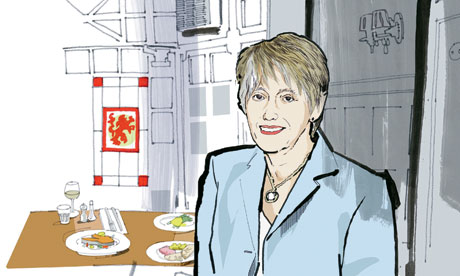
Stella Rimington. Illustration: Lyndon Hayes
The strangest meal Dame Stella Rimington ever had was soon after the Berlin Wall came down, when the senior members of Britain's secret services met their counterparts at the Lubyanka in Moscow. Having spent nearly 40 years Tinker Tailor Soldier Spying on each other, desperate for scraps of information, here they were walking through the front door of the KGB building. "We must have looked like something out of the zoo to them," she says, "and they did to us. We had only defectors' accounts of these people, and suddenly here they all were in front of us."
Was there, I wonder, a sudden sense of shared humanity, a celebration of the final thawing of the cold war?
"No, there wasn't," she says, with a quick laugh. "It was more like wild animals looking at prey they could no longer eat. They were in this highly disturbed state where everything they had taken for granted about the future no longer applied. But one thing was for sure – they were going to hang on to their own positions and power. [Boris] Yeltsin had put a professor in charge in the hope of democratising and modernising them. He didn't last more than a few months."
Old habits dying hard, the Russian intelligence services still followed the Brits around Moscow on that trip and when they had a private dinner they knew their conversation was being recorded and all the ham-fisted waiters were KGB men. "Suddenly we didn't care at all. There was a hysteria around the table so we all started saying various things that caused the waiters to twitch and raise their eyebrows. It was quite the weirdest day of my life."
Rimington, now 78, is recalling these events in the Red Lion and Sun in Highgate,a gastro pub not far from her London home. My recording machine is in plain sight on the table. I guess in retirement all working lives seem another country, but few can seem as foreign a place as that of the ex-head of MI5. She attempts to bridge that gap by writing spy fiction; the seventh of her novels featuring her young alter ego Liz Carlyle is about to be published. She lives mainly in the country, and as she says: "Sitting, as I was doing the other day, in Norfolk imagining someone in difficulty in the Yemeni desert is tremendously relaxing."
Rimington is a surprisingly informal and warm presence, giving hardly a clue in her manner of her former power. Others worry about her security, but she doesn't. If she does venture out for lunch it will almost always be to a gastro pub for which she is spoilt for choice near both her homes. She likes this one because it is "cosy, unfussy and they have kept the original fixtures" and orders decisively the asparagus and salmon with nicoise salad, and a glass of sauvignon blanc. "The nature of my career has made me wary of social things," she says. "Initially, there was the need to not tell people what you did. You would slightly dread the question because you know you would have to make up some story."
Did that come naturally to her?
"It did come quite easily. But you tended not to accept invitations, or cultivate wide circles of friends and I think I am still the same. I am quite reclusive by habit now."
She split up from her husband 30 years ago and, having raised her two daughters, has subsequently lived alone, which she likes. "Loneliness has never occurred to me," she says. "Certainly not when I was working. The fundamental secrecy of the job means that it is a cohesive family unit. You can share things with colleagues that you couldn't share with even your closest friends, which was strange I suppose. And of course there is an easy answer to loneliness: get a dog, which I have now."
The last time I knowingly sat down with a British spook was when I was approached by MI6 after university and had a couple of surreal job interviews in rooms with darkened windows off Pall Mall before it was mutually agreed I was probably not about to become our man in Havana. My abiding sense then was that you would need an unshakeable conviction that what you were doing was right in order to lead so double a life. Having led that life herself, I wonder if she ever doubted its purpose? She must consider herself a great patriot?
She finishes her mouthful of English asparagus. "I suppose so, a bit like Mrs Thatcher in that way – the way she was always talking about her country. I think that sense that we were trying to be on the right side was strong. That came from my father, who fought in the first world war and worked in the steel industry. I came from an era where there were clear-cut enemies. In the cold war we were facing another country that wanted to completely change our way of living and had nuclear missiles aimed at us. Plus there was a covert war going on, with subversive acts aimed at undermining western democracies and making us all communists. My patriotism comes from that. I thought our democracy was clearly worth defending."
Her father fought at Passchendaele, and was "never able to relax after that, a very uneasy soul, difficult to get close to". She joined the intelligence service almost by accident having followed her husband on a work posting to India, and taken up a clerical job in the Foreign Office. After that her mother's influence came to the fore: she had been a formidable coper, having to "prop him and us four children up". One of the things Rimington had to cope with, not long after becoming director general in 1992, was her cover being blown – not by the KGB but by John Major's government. She was to be the first spy to go public.
"MI5 had no press office, so I was on my own. From day one, newspapers, particularly the Sunday Times, got my home number and told me they knew where I did my shopping and who I had lunch with. There was talk of [accessing] my medical details. All of this was dressed up as in the public interest. They published a photo of my house with my daughter's bedroom window open to show how lax security was. It was all quite alarming."
When we have lunch it is after the Boston bombing, but before the Woolwich attack. She must feel relieved every time there is a situation like that where she is no longer the one having to help form a strategy?
"In a way, yes," she says. "But leaving the service [she retired in 1996] was a combination of relief and bereavement. There is a sense of loss that you are no longer at the centre of things. From the outside, I think the service is in a good place having prevented terrorist plots here for a long time. But one day something will happen. That is the worry that lurks in the heart of every director general all the time: is there something we have missed?"
As a surrogate for that sense of anxiety and responsibility, Rimington immerses herself in her writing. How close is her fictional spy to herself?
"It's not all accurate but it's a bit memory lane-ish," she says. "I think she has developed as a person through the books. Less spiky and more nurturing. When she first started she was obsessed with her boss and thought she was in love with him, but he went off with someone else. Put it this way: she is all the things I like to think I once was. Sparky and spiky. I let her say many of the things I thought but didn't always say about all the patronising male colleagues and so on."
By now Rimington has given up on a trencherman's portion of salmon, and waves away thoughts of pudding. She has an appointment to get her dog washed. Before we leave I suggest it seems appropriate that she should be reflecting now on so unlikely and fantastical a life in the form of fiction.
She laughs. "I thought of calling my autobiography A Life of Surprises. I thought I was going to be a county historical archivist and have children. It didn't quite turn out like that."
The Geneva Trap (Bloomsbury, £7.19) is published in paperback on 4 July

The perfect spy: Stella Rimington


The first woman to head up MI5 – and its first chief to be publicly named – Stella Rimington is now a bestselling novelist and chair of the Man Booker prize. There's no doubt she has had a gilded career, but at what cost to herself and her family?


By 


I had arranged to meet Stella Rimington, the former head of MI5, in a London gentleman's club – the sort of place where the chairs are leather, the walls panelled and the newspapers on sticks. She is photographed in one of the main rooms, as befits her status as the grand Dame of the security service, but from 10am non-members, viz women, are allowed only in a distant 'library'.
Experience of an intelligence-gathering nature proves an essential asset in locating this, and once Rimington, with me in tow, has caromed through peg-lined cloakrooms, slotted into cranking lifts and orienteered along complicated corridors, the displacement begins to seem a suitable metaphor for her professional life: central to the Establishment and yet, by necessity, kept tucked away in a distant room on the third floor.
Rimington is Britain's most famous spy, the first woman to rise to the top of MI5 and the first director general to be publicly named: a double whammy. Her career, which spanned 25 important years and covered all three branches of the service (counter-espionage, counter-subversion and counter-terrorism) involved her, Zelig-like, in many of the key events and social changes of the second half of the 20th century.
She was behind the scenes during the Cold War, the miners' strike, CND, the activities of the IRA. But within the service itself she was also representative of a huge shift, from a time in 1968, the year of her recruitment, when women were excluded from operational or intelligence work, to 1992, when 'a housewife superspy', as the tabloids called her, could run the whole shebang – and be photographed on her way to do it.
Her 'outing' was brilliant for PR purposes – look how enlightened we are! – but has caused uneasiness ever since. The demands of transparency don't sit well with those of espionage, or personal safety. When Rimington retired she wrote an autobiography, Open Secret, which, despite revealing very little, caused an awful stink, and since then a series of spy novels – the latest published this July – the publicising of which demand the kind of self-promotion one can't imagine comes naturally to a spook. As she writes in Open Secret, the best agents have an important skill: 'the ability to merge into the background, to be unmemorable'.
Some of us may want all the gossip we can get, but for others, like Bernard Ingham, 'the most effective Secret Service is the one which is secret. She should shut up.' She doesn't though. She talks a lot.
While we tried to find our room we chatted about Brussels; she had lived around the corner from my grandparents in the 1970s (I wondered, hopefully, whether the passing cleaner might think we were talking in code 'Wezembeek … Walloon…'). But in the library she ignored the comfy leather sofa and sat on a hard, upright chair, her hands in her lap, as if being interrogated.
She is 76 but looks extraordinarily youthful; her hair is expensively bobbed, her teeth even and her face, with its penetrating blue eyes, lightly made up. She says 'quite frankly' and 'clearly' a lot, and 'these are real issues', which gives the impression of total disclosure, and sometimes her answers are so long you forget what you asked in the first place (which I suspect is intentional).
To any question directed at MI5 she is practised in the use of abstract generalities. Describing how it has moved on since her departure, she says, 'There are huge changes in the technology, but the gathering of intelligence from technical means and human sources and then the analysis and the decision of what action to take is the progression that will still take place.'
And on a finding of the report into the 7/7 bombings that MI5 was let down by its paperwork: 'I have always said and thought' – separating speech from thought is another habit – 'that the great strength of an intelligence organisation was their record keeping and their ability to know what they know.' Maybe things have slipped since you left? She laughs. 'Any complex organisation ultimately comes down to the activities of individuals within it.'
On her life outside the service, she is altogether less guarded. 'Oh, shut up,' she tells her mobile phone when it rings for the second time, and almost makes me drop my notebook when she suddenly describes two MI6 characters in her latest novel as 'slightly s—ish'.
It is serendipity, she claims, that got her into MI5. 'Looking back, my life has been completely by chance.' Born in 1935, she was a war child, buffeted around the country, from South Norwood to Essex to Barrow-in-Furness to Nottingham. She studied English at Edinburgh university and worked as an archivist before marrying John Rimington, whom she had met while at school.
He was posted to India in 1965, to work for the British High Commission, and it was while she was spinning out her days as a diplomatic wife that her shoulder was tapped and she was employed as a clerical assistant for a security liaison officer.
She hoped to get pregnant, and if she had done so earlier (she was to go on to have two daughters), she says she would probably have called a halt to her career, 'or ended up a county archivist somewhere'. As it was, returning to England in 1969, in an 'unsettled' mood, she approached an MI5 recruiter, was interviewed for the role of junior assistant officer, and got it.
The heroine of her spy series, Liz Carlyle, 'clearly isn't me, but has elements of me when I was her age. I certainly allow her to think and say things that I said.' She corrects herself. 'Probably didn't say, but thought. I have learnt that you get on better by not being over forceful and pushy. You have to get your way by more subtle means. Quite frankly, though, in today's world women are accepted as part of the human race now in a way when I started they certainly weren't.'
When, in the 1970s, the service began running out of colonial military-types, she and other 'well-educated' female contemporaries watched the promotion of men younger and less experienced than themselves. 'It was the beginning of women's lib and sex-discrimination legislation and all that.' Was there a strong feminist movement within the service? 'Absolutely, yes, there was. We were quite a feisty bunch.'
She has no regrets about any of her activities during her service, though she was associated with some of the more controversial aspects, such as investigating the miners. 'No, people didn't like that. But what we did was entirely appropriate. I am not one for regrets, quite frankly. I think you do stuff and some of it goes right and some of it goes wrong and you move on. Life doesn't go exactly as you plan when you are young, but you go with it.'
The hardest thing, she says, was keeping quiet to friends and family about what she did. Her husband, her parents and her brother knew, but 'not in any great detail. I think it does have a huge influence on one's life. Even now, anybody in the service who isn't the director general lives as a sort of undercover [sic]. It is particularly difficult for young people because it's the thing people talk about – their job, their work.'
What did she say if people asked her? 'Various things, depending on the circumstances. You are given advice … But it is a feature of working for a secret organisation. It is never easy. You create a carapace.'
Rimington's marriage broke down under this and other strains in 1984, leaving her as a single mother (though she never actually got a divorce and she and John are still amicable).
'But you do lose friends,' she adds. 'There is no doubt about it.' In her autobiography she writes particularly fondly about a girl at school, and when I ask if she still sees her the answer is insightful. 'We did lose touch. During the middle period when I wasn't able to say what I did. And when I became … a public figure she was quite upset. She is quite Left-wing and she thought I had been intruding into everybody's private life, but we managed to get back on friendly terms again.' She brightens. 'And in fact I went to stay with her last weekend.'
Was it a relief when her name was released? She makes a 'not sure' grimace. 'It made life easier in some ways. But it was a difficulty for the children. We were exposed to a great deal of media attention; they found out very quickly where we lived and it was at a time when the IRA were very active in London.'
Her elder daughter was at university then – 'outside the zone of protection, which was worse' – but she and her younger child, and their dog, Stanley, spent time in a safe house before moving. It was the only time in her career that she felt personally in danger.
'I did for a moment think, "Hang on, should I be doing this?"' In the end she didn't retire from the service until 1996, shortly after being made a dame. She has hardly stopped since – boards of this and that (including Marks & Spencer), though she is learning, she says, to slow down a bit.
She keeps 'a sharp eye' on world events, occasionally spouting her views – anti ID cards, for example – in print. She is a director of the International Spy Museum in Washington and on the board of Refuge, the charity for victims of domestic violence. This year she is chairing the Man Booker prize. 'When I was asked, I thought, "God, this is going to be like herding cats," because I had heard stories of such huge arguments between the judges, but so far it's very jolly.' Her aim is 'to produce a book people will actually read'.
She divides her time between a cottage in north London ('I'm not telling you any more than that') and a house in Norfolk. Is she good at village life? 'Yes, I am, actually. I am patron of the friends of the church and work in a bookshop once a week to raise money for it.' She loves gardening and sitting in a deckchair, listening to the swifts. Is there a man in her life? 'None that I wish to talk about.' She would quite like another dog. 'I feel silly going for walks without one.'
Her daughters don't like her talking about them much, but she has five 'smashing' grandchildren, and clearly dotes upon them all. This summer she is taking the eldest, 12-year-old Charlotte, to New York and Washington where she is giving a lecture on the changing face of national security.
'I take my job as a granny very seriously as you can imagine.' She raises an eyebrow. 'I take everything very seriously.'

Trump is Right to be Suspicious of Judge


June 9, 2016
Donald Trump and U.S. District Judge Gonzalo Curiel
Donald Trump has every right to question the impartiality of a “pro-Mexican” judge presiding over the Trump University lawsuit and doing so does not make him a racist or a bigot of any kind.
The stampede of weak-kneed Republican office-holders tripping over each other in a frenzied rush to denounce the presumptive GOP nominee for president shows how the Left’s pathological ideas about race continue to dominate the thinking even of so-called conservatives who ought to know better. Yell “racist!” and Republicans run for the hills.
As Pat Buchanan opines, “[t]o many liberals, all white Southern males are citizens under eternal suspicion of being racists. The most depressing thing about this episode is to see Republicans rushing to stomp on Trump, to show the left how well they have mastered their liberal catechism.”
To recap, the real estate magnate has said that U.S. District Judge Gonzalo Curiel, an Indiana-born U.S. citizen whose parents emigrated from Mexico, is issuing unfair rulings against him in a high-profile class-action lawsuit. Trump claims the trial judge’s prejudice relates to his promise to crack down on illegal immigration and build a wall along the border with Mexico to keep illegal aliens out.
Curiel ordered that internal documents from Trump University be made public. The ruling caused elation among reporters, including 20 from the Washington Post who are digging for dirt about the candidate, as they began fantasizing about winning the Pulitzer Prize for taking down a Republican presidential candidate.
Trump said it is "just common sense" that Curiel’s connections to Mexico explain his anti-Trump rulings. 
"He's a member of a club or society very strongly pro-Mexican, which is all fine. But I say he's got bias," Trump said Sunday. "This judge has treated me very unfairly. He's treated me in a hostile manner, and there's something going on." Trump also said it is “possible” a Muslim judge might also be biased against him because he advocates a temporary ban on the entry of Muslims into the U.S.
Trump is right. Judges can be influenced, sometimes inappropriately, by their life experiences. 
Besides, Trump was merely echoing remarks by Supreme Court Justice Sonia Sotomayor, a person of Puerto Rican ancestry, who said her ethnicity and upbringing affect her rulings. “I would hope that a wise Latina woman with the richness of her experiences would more often than not reach a better conclusion than a white male who hasn’t lived that life.”
So if Trump’s comments were racist – and in this writer’s opinion they were not – then so were Sotomayor’s. Sotomayor is met with applause; Trump is met with sputtering vituperation.
Despite the hysterical accusations against Trump coming from politicians in both parties, it needs to be pointed out that he never said that there is something about being Mexican or of Mexican ancestry that makes a person incapable of being an impartial judge. It’s not a congenital or a genetic thing. He said that this particular Obama-appointed judge, Gonzalo Curiel, who belongs to a left-wing Latino lawyers’ group, has an axe to grind because his parents came from Mexico.
Curiel is a member of a group called San Diego La Raza Lawyers Association (SDLRLA). SDLRLA’s website identifies National Council of La Raza (NCLR), a race-baiting leftist group that strongly condemns Trump’s immigration policy proposals, as part of its “community.” The group is affiliated with the Hispanic National Bar Association (HNBA) which called Trump “racist” last year for promising to secure the border and vowed to target Trump’s “business interests” with boycotts.
Identity politics and whiny racial grievance-mongering is what SDLRLA and possibly every group with la raza (“the race” in English) in its name is about.
The very concept of la raza is racist, but more on that in a moment.
Trump is right to be concerned about the fact that in 2014, when Curiel certified the class action, he appointed Robbins Geller to act for the plaintiffs. That firm has reportedly shelled out $675,000 in speaking fees since 2009 to Bill and Hillary Clinton.
Former U.S. Attorney General Alberto R. Gonzalez (R), said the circumstances of the case “at least raise a legitimate question to be considered.” 
“Regardless of the way Trump has gone about raising his concerns over whether he’s getting a fair trial, none of us should dismiss those concerns out of hand without carefully examining how a defendant in his position might perceive them — and we certainly should not dismiss them for partisan political reasons.”
The litigation deals with consumer complaints regarding the now-defunct Trump University, a pricey 3-day seminar about selling real estate. The plaintiffs allege that the school was a scam but plenty of former students give it top marks.
It’s not like Trump can blow off questions about the case because it is before the courts. The legal case has become a political issue and Trump is absolutely entitled to defend himself. His opponents bark endlessly about it every day. During primary season, Sen. Marco Rubio (R-Fla.) called it a “fake university” and used it to support his argument that Trump was a “con artist.”
The presidential campaign of Democrat Hillary Clinton has been pounding Trump for days. “Trump U is devastating because it’s a metaphor for his whole campaign: promising hardworking Americans a way to get ahead, but all based on lies,” campaign press secretary Brian Fallon wrote on Twitter.
The great irony in all of this is that the left-wing Latino groups accusing Trump of racism are the real racists.
Created by the far-left Ford Foundation in 1968, the National Council of La Raza argues that la raza “is an inclusive concept, meaning that Hispanics share with all other peoples of the world a common heritage and destiny.” President Janet Murguia claims la raza “simply refers to the Hispanic people and it is a nod to our common heritage.”
Similarly, the SDLRLA claims la raza means “the people” or “the community.”
According to Google Translate, the Spanish noun raza means “race, breed, colorcast.” If these radical groups wanted to express the idea of “people” in their names they could have chosen gentepueblopersonashabitantesnación, or súbditos. For “community,” they could have selected comunidadcolectividadsociedadcomúnunion, ormancomunidad.
Of course, Murguia and Judge Curiel’s group are lying. La raza can be translated as “the master race,” and the concept of the “Hispanic” was only invented in 1972 by President Richard Nixon, four years after NCLR was founded.
As Mark Krikorian of the nonpartisan Center for Immigration Studies (CIS) has explained, the concept of la razaemerged as Nazism gained steam in the 1920s and was the brainchild of former Mexican secretary of public education Jose Vasconcelos. The politician and thinker has been called the “cultural caudillo” of the Mexican Revolution.
La raza “can be traced to the ideas and writings of Jose Vasconcelos, the Mexican theorist who developed the theory of la raza cosmica (the cosmic or super race) at least partially as a minority reaction to the Nordic notions of racial superiority,” New Mexico Highlands University professors Guillermo Lux (history) and Maurilio Vigil (political science) wrote.
They continued:
“Vasconelos developed a systematic theory which argued that climatic and geographic conditions and mixture of Spanish and Indian races created a superior race. The concept of La Raza connotes that the mestizo is a distinct race and not Caucasian, as is technically the case.” 
(Mestizo, by the way, is a Spanish word used in Latin America to refer to someone who is of mixed race, usually the child of a person of Spanish descent and an American Indian. One third of U.S. Hispanics identify as mixed-race while mestizos “represent a racial majority in Mexico[.]”)
So la raza really does mean “the Master Race, but rather than based on notions of racial purity, La Raza’s inherent, biological superiority is based on its hybridity, on the mixing in Latin America of, in Vasconcelos’s words, ‘the black, the Indian, the Mongol, and the white,’” writes Krikorian. La raza really means that “Hispanics, and specifically Mestizos, are superior to those of us unfortunate enough not to be part of the cosmic race.”
La raza “was a source of pride for many Latinos, the most militant of whom adopted the motto: ‘Por la raza todo, fuera de la raza nada’ — ‘For the race, everything, outside the race, nothing,’" according to Jerry Kammer, also of CIS. This la raza ideology animates the reconquista movement which aspires to return the territory the U.S. took from Mexico to Mexican sovereignty. Some radicals wish to recreate Aztlan.
A hero of the Left, labor organizer Cesar Chavez, a natural born American of Mexican ancestry, thought la raza was a dangerous, un-American concept.
“I hear about la raza more and more,” he said.
“Some people don’t look at it as racism, but when you say ‘la raza,’ you are saying an anti-gringo thing, and our fear is that it won’t stop there. Today it’s anti-gringo, tomorrow it will be anti-Negro, and the day after it will be anti-Filipino, anti-Puerto Rican. And then it will be anti-poor-Mexican, and anti-darker-skinned Mexican.”
That Chavez viewed this kind of Mexican race-consciousness as destructive was reinforced by his lieutenant LeRoy Chatfield around 1970.
"Everyone should be proud of what they are, of course, but race is only skin-deep. It's phony and it comes out of frustration; the la raza people are not secure. … He said to me just the other day, 'Can't they understand that that's just the way Hitler started?' A few months ago the Ford Foundation funded a la raza group and Cesar really told them off. The foundation liked the outfit's sense of pride or something, and Cesar tried to explain to them what the origin of the word was, that it's related to Hitler's concept."
Donald Trump may not even realize just how right he happens to be.