Monday, October 12, 2015

We should have rebuilt the Twin Towers


By Nicole Gelinas
http://nypost.com/
October 11, 2015


Robert Zemeckis’ “The Walk” will be a big hit. The director who made “Back to the Future” and “Forrest Gump” knows how to make movies. But people won’t go to the film, which opened this weekend, to see a circus trick. They’ll go for one reason only: to see the real World Trade Center, the only way you can now.
Politicians who are confused about why the electorate is so angry should go, too — to see what the last 14 years looks like to normal people.
“The Walk” has a serviceable enough made-for-TV plot. It’s a “boy makes good” story: Young Philippe Petit dreams of being a tightrope walker. Through talent and persistence, he succeeds, picking up a pretty girl and a band of plucky brothers along the way. He makes global headlines when he walks the void between the towers of Notre Dame in Paris, 30 stories up.
But there’s no blockbuster here, save for the real prize: New York’s Twin Towers. The World Trade Center, circa 1974, is not a prop in this 3-D film, but the star.
In a Paris dentist’s office, Philippe sees a magazine photo feature of the towers under construction — and stops cold. New York is doing what only New York could do: build something at a scale he can’t even comprehend. He has to go to Gotham — and make the buildings his own by walking between them, 1,300 feet up.
His epiphany is extreme.
But it’s a reminder that, for 28 years, the Twin Towers defined New York. After the World Trade Center attacks, newspapers ran stories about how immigrants came here based on nothing but a postcard they had seen — a photo with that distinctive Manhattan skyline.
Left unspoken in the movie is that the World Trade Center defined New York for the terrorists, too. They, too, eventually made the buildings their own — by destroying them.
The most poignant parts of “The Walk” are the towers.
When Philippe gets to Manhattan, he walks onto the construction site and puts his hands on the arches at the base of the buildings. The camera shoots up, close up, to the top, replicating the view so many New Yorkers and visitors once experienced. How could something be so tall?
In shot after shot, we see the old lobbies, the old elevators, the old plaza with the Fritz Koenig “Sphere” sculpture in the middle, the old view of Manhattan out the windows.
And just like Philippe, we see all this close enough to touch it.
When I was watching it, I thought of “Titanic,” James Cameron’s film from nearly two decades ago — another digital recreation of a lost world.
Except that this was our world — and it was our choice to keep it lost.
Al Qaeda set out to mutilate our skyline. They succeeded. New York could have rebuilt new, modern Twin Towers after 9/11. And we could have done it quickly.
But we did not. We spent more than a decade and $4 billion building a tower that could fit on any generic skyline.
To be clear: The city can live with this decision. We are, indeed, living with it.
But we should not pretend that it is not a psychic wound. People care, not just in the city, but around the country and the world.
It’s no coincidence that way back in 2005, none other than Donald Trump seized on architect Ken Gardner’s elegant plan for new Twin Towers. It was typical Trump: a press conference in Trump Tower, a lot of bombast and slamming of impotent politicians, and then . . . nothing, except publicity around a new “Apprentice” season.
Most people today likely don’t remember that stunt — but it was early evidence that Trump was tapping into something more serious pols didn’t see.
At the end of “The Walk,” Philippe notes that after his coup, Port Authority officials gave him a pass to the World Trade Center’s observation deck. The expiration date was crossed out. In its place was the word “forever.” The towers slowly fade to black. By this point, the audience is sniveling.
We don’t need to be told that forever didn’t last very long, and that the towers have now been gone for half the time that they were there.
People aren’t crying for the Twin Towers, though.
We are crying for the past 14 years. We could have done better. And — obviously — not just locally.
Pols should be grateful that the public is angry. When anger turns to acceptance, that’s when we should worry.
Nicole Gelinas is a contributing editor to the Manhattan Institute’s City Journal. 

Book Reviews: 'Columbus' by Lawrence Bergreen

Bio Gets Under the Surface of Christopher Columbus

By Jerelle Krauss
September 24, 2011

11510594
Something always seemed fishy about Columbus. Why would an Italian seek Spanish sponsorship? Why celebrate a man who enslaved and beheaded the people whose homelands he claimed? If Leif Erickson landed in North America 500 years earlier, why does Columbus get the credit?
The answers lie in Laurence Bergreen's ambitious new biography, Columbus: The Four Voyages, a spellbinding epic that's simultaneously a profoundly private portrait of the most complex, compelling, controversial creature ever to board a boat. This scrupulously researched, unbiased account of four death-defying journeys to The New World reveals the Admiral's paradoxical personality. Equal parts megalomaniac and mystic, Columbus was both cunning and charismatic, paranoid and penitent, thin-skinned and tough.
Conflicting chronicles have generated myriad Columbus myths. Mining the vivid trove of primary sources, Bergreen deftly threads eyewitness accounts of Columbus and his crew throughout the narrative. If this remarkable book can be faulted, it's for the occasional repetitions that result from the varied versions.
Always a visionary sailor, Columbus was late to luck, at last securing his long-sought sponsorship in 1492, at age 41. His mission? Beat the Portuguese to pioneering a seaway to Asia. Instead of a new trade route, however, Columbus discovered a new world. The Caribbean island on which he first anchored is unknown, but the headstrong Admiral carried on forever confident that he'd found the gateway to Asia.
Within a single decade, Columbus ventured three additional trips, each more daring, gory and heartbreaking than the last. "Not a day passes," he wrote, "that we do not look danger in the face." There were cannibals, mutinies and an 88-day storm that destroyed sails, devastated rigging and sickened the entire crew.
The islanders — thinking them from India, Columbus called them "Indios" — transfixed him. When the Santa Maria wrecked on reefs, these natives, naked "as their mothers bore them," rushed to his rescue. "In all the world," Columbus wrote, "there is no better people." But as his psyche unraveled, Bergreen makes clear that Columbus treated them barbarically.
The Admiral of the Ocean Sea forswore compasses, maps, and stars in favor of "dead reckoning." A genius at reading movements of sea, sky and birds, Columbus was a peerless navigator. Though he lost men on land, he nearly never lost a sailor at sea. His fourth trip, documented by Columbus' 13-year-old son, sailed the Atlantic in 20 days, a record even now.
Before Columbus' voyages, there was no red sauce for Italy's pasta. Tomatoes were unknown in Europe, as were peanuts, chocolate, corn, turkeys and tobacco. And the New World hadn't witnessed wheat, sugar, alcohol or smallpox, nor did it know coffee, cattle, chickens or horses.
Columbus, a passionately pious seaman who never cursed, hewed to a higher power. It was a Friar friend who presented him to his patrons, Ferdinand and Isabella. But Columbus' craving to convert Indians to Catholicism paled next to his lust for gold and longing for acclaim.
During a tempest, sure that the end had come, our tragic hero cast to sea a barrel containing a parchment record of his virtuosic achievements. It has never been found.


BOOK REVIEW: ‘Columbus: The Four Voyages’

By Philip Kopper
November 11, 2011

To recall Samuel Eliot Morison’s generation-old writings about Christopher Columbus and the Age of Exploration is to summon up memories of arid and aristocratic history written with his signature hauteur. Laurence Bergreen’s new book, refreshingly, is fluid in its style and comprehensive in its research. Richly illustrated and enhanced with maps that are as legible as they are relevant, “Columbus: The Four Voyages” is complex in its themes, intriguing in its substance and sparkling with surprises.

The “Admiral of the Ocean Sea,” in this new view, sailed west in search of gold and glory and more. Sure, he set out to find a short route to China, but he had a larger purpose, too. Mr. Bergreen says Columbus was an evangelist, intent on building an empire in this world and saving souls for the next. We moderns misread the great explorers when we ignore the depth or power of their religion.
As Columbus’ son wrote, “In matters of religion he was so strict that for fasting and saying all the canonical offices he might have been taken for a member of a religious order.” He meant to save souls, just as Isabella and Ferdinand commissioned him to enlarge Christendom.
Witness their decree: “We send Cristobal Colon with three caravels through the Ocean Sea to the Indies on some business that concerns the service of God and the expansion of the Catholic faith and our benefit and utility.” Spain’s “benefit and utility” involved empire and commerce, but, of course, nothing turned out quite as planned. Putting it succinctly, “Instead of establishing a new trade route, he had discovered a new world.”
Elsewhere Mr. Bergreen writes, “His was the discovery that permanently planted the reality of the New World in the imagination and political schemes of the Old…. Columbus’ voyages were just the beginning, setting in motion consequences - political, cultural and scientific - that persist to this day.”
Columbus was “obsessed with his God-given task of finding Asia [and] undertook four voyages within the span of a decade, each very different, each designed to demonstrate that he could sail to China within a matter of weeks and convert those he found there to Christianity.”
On his first, most famous voyage, he found little of intrinsic value but at best loosed “an unstoppable impulse for exploration.” Yet, in describing to his royal patrons where he had been, he put a favorable spin on it. “He omitted references to the menace posed by [hostile] Caribs, the difficulties of replicating his feat of navigation, the vagaries of weather, and, of course, the stupendous misunderstanding of the location of his discoveries.”
In his glowing report, Columbus confided: “I write to inform you how in thirty-three days I crossed from the Canary Islands to the Indies, with the fleet our most illustrious Sovereigns gave to me. And there I found many islands filled with people without number, and of them all have I taken possession for Their Highnesses, by proclamation and with the royal standard displayed, and nobody objected.” (Not that anyone would; the naked Taino people had no idea what was afoot when men in tights and iron breastplates came ashore to stick a flag in the sand.)
As for Columbus’ mindset, “He was bemused rather than displeased to hear that the Indians considered his fleet to have descended from the heavens, especially since the misunderstanding gave him occasion to establish his credentials … . Columbus believed that whatever he encountered was intended by God, even though the Tainos were not exactly what he had in mind.”
Having underestimated the size of Earth, Columbus mistook where he was going and didn’t know where he was when he got there. Yet he “fully understood and appreciated that the earth was round, or nearly so, and certainly not flat,” Mr. Bergreen maintains.
One clever proof he offers is Columbus’ note en route back to Spain that “the nights were very much longer from the narrowing of the sphere” - a clever deduction of Columbus’ geographical savvy on the author’s part. He also specifies that Columbus’ great navigational feat was not finding the New World; any European who sailed west far enough must “discover” whatever he would inevitably bump into. Rather, Columbus’ great feat of navigation was finding his way home again the first time. Then, the subsequent three voyages confirmed his dedication to his causes and his genius as a sailor.
Indeed, he was a superb mariner who, like other exceptional sailors - Polynesians and Bahamians among them - read the very surface of the sea to find his way. He was a seat-of-the-pants navigator whose skills far surpassed the rudimentary tools of his time. Mr. Bergreen shows Columbus to have been exceedingly competent as well as ambitious, tireless, brave and conniving - a man of parts and an exceptional man of his time.
Philip Kopper is publisher of Posterity Press Inc.

Christopher Columbus: Hero or Villain?


Can we still celebrate October 12 as an American holiday?

By Mark Antonio Wright — October 12, 2015
Portrait of a Man, Said to be Christopher Columbus.jpg
Posthumous portrait of Christopher Columbus by Sebastiano del Piombo, 1519. There are no known authentic portraits of Columbus


One man, two narratives:

1. Born to a working-class wool weaver in the port city of Genoa, Italy, Cristoforo Colombo apprenticed as a sailor and went to sea as early as age ten. A self-taught and curious man, Colombo lived by his wits and rose in the heady world of 15th-century sea traders, until he hit upon an ingenious idea: He would outflank the Mohammedan Turks and reach the East Indies by sailing west across the Ocean Sea. After weathering nearly a decade of rejection and failure, in 1492 Colombo won the support of the Spanish Crown and set off on an uncertain journey that inadvertently opened a New World, laying the foundation for that most glittering daughter of the Western heritage: America.

2. Christopher Columbus, a dead white male of the worst variety, was a slaver, a capitalist, and a murderer of millions who embarked on a voyage motivated only by greed, which brought European imperialism to the shores of the “New World” and laid waste the ancient indigenous peoples there. Columbus deserves little credit (Leif Erikson had “discovered” the “new” continent 500 years earlier) and much blame for the horrors of the Columbian Exchange — the vast transfer of people, animals, and plants between the Western and Eastern Hemispheres. In his wake, the “New World” suffered smallpox, starvation, the cruel subjugation of the indigenous peoples, and the establishment of that most dastardly spawn of the West: America.

Writing in The Atlantic in 1992, in the run-up to the 500th anniversary of Columbus’s landfall on the island of San Salvador in the Bahamas, Arthur Schlesinger Jr. noted that the “great hero of the nineteenth century seems well on the way to becoming the great villain of the twenty-first.”

The accusations were heavy. “Columbus, it is now charged,” Schlesinger continued, “far from being the pioneer of progress and enlightenment, was in fact the pioneer of oppression, racism, slavery, rape, theft, vandalism, extermination, and ecological desolation.”

The Internet is full of condemnation of Columbus: the Daily Dot: “8 Reasons to Hate Columbus Day”; the Huffington Post: “Columbus Day? True Legacy: Cruelty and Slavery”; and snarky Columbus Day e-greeting cards: “Columbus: A Real Illegal Alien.”

In June, a statue of Columbus in Boston’s North End was vandalized with red paint and the phrase “Black Lives Matter.”

In September, the Graduate Student Senate at the University of Oklahoma, my alma mater, passed a resolution (unanimously) renaming Columbus Day “Indigenous Peoples Day.”

San Francisco, Seattle, and Minneapolis, among other American cities, have extirpated their Columbus Day parades. Even Columbus, Ohio, has ditched its official celebration.

“We proposed this to give everyone a day of healing,” said Jesse Robbins of Indigenize OU after the vote to boot Columbus from Oklahoma’s flagship public university. The implication being that we all carry wounds inflicted at Columbus’s hands.

But what are we to make of this Genoese sailor and his appointed day? Should we celebrate the man who led three little wooden ships across an ocean and changed the course of history? Or was Columbus a greedy psychopath who today would be vilified as a genocidal war criminal?

First, to dispel a myth, Columbus Day is actually not the Italian-American equivalent of St. Patrick’s Day for Irish-Americans — although Italian-Americans have (and rightly so) long taken pride in Columbus’s Italian origins. There were celebrations in New York City commemorating the 300th anniversary of his journey in 1792, long before Italians had settled in the city in any numbers.

In fact, Columbus has been celebrated on this continent and in this country for over two centuries. King’s College in Upper Manhattan became Columbia College in 1784, and the nation’s capital was established in the District of Columbia in 1791. “Hail Columbia” competed with “The Star-Spangled Banner” as the nation’s unofficial national anthem until 1931. And, for a brief period after the American Revolution, there was even a movement to name the new country simply “Columbia.”

For most of American history, Columbus Day was associated with a celebration of the American experience. President Benjamin Harrison, in 1892, proclaimed “the 400th anniversary of the discovery of America by Columbus, as a general holiday for the people of the United States.”

“On that day,” President Harrison continued, “let the people, so far as possible, cease from toil and devote themselves to such exercises as may best express honor to the discoverer and their appreciation of the great achievements of the four completed centuries of American life.”

President Roosevelt unashamedly credited Columbus and his men as “harbingers” of the great movement of people from the Old World to the New. In the midst of a world war, Roosevelt asked the American people to “contemplate the estate to which the world has been brought by destructive forces, with lawlessness and wanton power ravaging an older civilization, and with our own republic girding itself for the defense of its institutions,” but knowing “we can revitalize our faith and renew our courage by a recollection of the triumph of Columbus after a period of grievous trial.”

Ronald Reagan, on the approach to the quincentennial, did not hesitate to root Columbus firmly in the American family, remarking that he “was a dreamer, a man of vision and courage, a man filled with hope for the future and with the determination to cast off for the unknown and sail into uncharted seas for the joy of finding whatever was there.”

“Put it all together and you might say that Columbus was the inventor of the American dream,” Reagan said. “Yes, Columbus Day is an American holiday, a day to celebrate not only an intrepid searcher but the dreams and opportunities that brought so many here after him and all that they and all immigrants have given to this land.”

That’s a hell of an endorsement. But what of the accusations of disaster and genocide brought against Columbus? Should we indict the man, his voyages, and, in turn, ourselves and our country for the all that followed from contact between the Old World and the New?

Arthur Schlesinger thought we should have a bit of perspective: “Revisionism redresses the balance up to a point; but, driven by Western guilt, it may verge on masochism.”

Columbus, Schlesinger believes, might have benefited from a bit of perspective as well: “Had Columbus foreseen even a portion of all the sins he would be held accountable for five centuries later, he might never have bothered to discover America.”

Let us dispense with any pretense that the indigenous peoples of the Americas lived in a peaceful idyll in harmony with their neighbors and with nature, and that the advent of Columbus destroyed a noble paradise. The great civilizations of the Western Hemisphere were indeed advanced, and yet, like Europeans, Asians, and Africans, the American peoples used their technology to subjugate. Anyone familiar with the expansionist and warlike cultures of the Aztec and Inca Empires should know that the tables would have been turned had it been the New World that “discovered” the Old and possessed the power to conquer it. Human nature, tainted with original sin, is what is and has been — of that we can be certain.

Europeans, beginning with Columbus, treated the Indians pitilessly — that should not be whitewashed or forgotten — but, in the same way, we should not ignore the genuine good that has come down to us as a result of the course of human events — namely, the space for a unique idea to grow and flourish: the self-government of a free people, with an ever-expanding idea of who can partake of that promise.

How much is Columbus personally responsible for all of this — for the good and the ill? Only as much as any one man can be. As the historian William J. Connell has written, “What Columbus gets criticized for nowadays are attitudes that were typical of the European sailing captains and merchants who plied the Mediterranean and the Atlantic in the 15th century. Within that group he was unquestionably a man of daring and unusual ambition.”

Connell concluded that “what really mattered was his landing on San Salvador, which was a momentous, world-changing occasion such as has rarely happened in human history.”

Unlike Martin Luther King Jr. Day, Columbus Day marks an event — landfall in the New World — not one man’s birthday. As such, it is akin to the greatest American holiday, Independence Day. The two serve as important markers in our journey as a people: the opening act and, then, the promissory note of our long and complicated struggle.

A great and complicated people should not shirk its history on a date meant for the commemoration of a great man and his great achievement.

— Mark Antonio Wright is an assistant editor at National Review.

Sunday, October 11, 2015

The Muslim Madness of Merkel


7.36 million Muslims invade Germany.


October 9, 2015

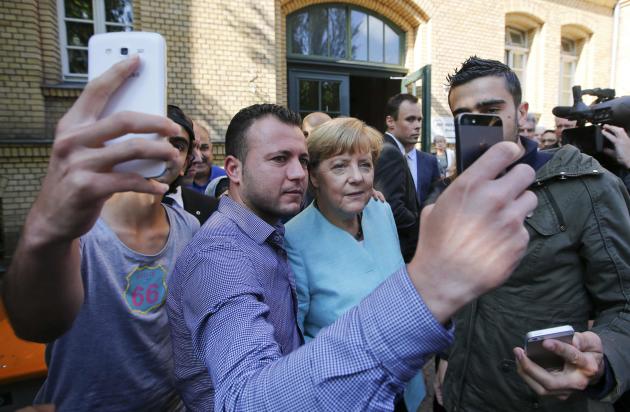
Migrants from Syria and Iraq take selfies with German Chancellor Angela Merkel outside a refugee camp near the Federal Office for Migration and Refugees after their registration at Berlin's Spandau district, Germany, September 10, 2015. REUTERS/Fabrizio Bensch


German Chancellor Angela Merkel insisted that refusing to take in Muslim migrants is a “danger for Europe.” Merkel as usual had it backward. It’s her program of taking in Muslim migrants that represents the gravest threat to the freedom and future of Europe since the fall of the Soviet Union.
Merkel may have already doomed Germany. The Bild newspaper published a leaked secret government document estimating that the number of migrants invading Europe this year might reach 1.5 million.
And that bad news gets much worse because the document estimates that each migrant will bring in as many as eight family members once they’re settled in, bringing the year’s true total to 7.36 million.
That’s almost 10 percent of the population of Germany. In just one invasion.
And the migrants are mostly young men entering a rapidly aging country whose young male population is under 5 million. Germany’s Muslim population already approaches 5 million. The median age of Germany’s Muslim population is 34, while the median age for the overall population is 46.
Merkel has rapidly sped up the rate at which Germany’s young male population becomes Muslim.  
The document predicts up to 10,000 invaders entering every day. It foresees no end to the arrivals even when it gets cold. These words add up to the end of Germany and the end of Europe.
With numbers like these it’s no wonder that Merkel is frantically trying to shift the burden, berating Eastern European countries for their nationalism and failing to learn from history even though as a former Communist and a German leader, she represents the two political forces that historically did the most to deprive these nations of their national rights and their independence.
Merkel invokes the Berlin War to claim that fences don’t work. But the Berlin Wall kept people from leaving. The fences that Hungary has built are constructed in self-defense, not to keep Hungarians in, but to keep invading Muslims out. It’s Merkel whose EU totalitarianism represents a new Berlin Wall that mandates open borders for Muslim migrants while preventing countries from leaving the EU.
When Merkel states, “The refugees won’t be stopped if we just build fences. That I’m deeply convinced of, and I’ve lived behind a fence for long enough,” she is not only deliberately mangling the moral difference between a fence that keeps invaders out and a fence that keeps people in, but her own complicity in these fences. East Germany needed a fence because people wanted to flee its totalitarian regime. The European Union needs political fences to keep countries from escaping its political regime.
The choice isn’t between open borders and the Berlin Wall. Rather the open borders that Merkel advocates are another form of the Berlin Wall. Communist countries don’t make immigration difficult. They make emigration impossible. Free countries make immigration difficult, but emigration easy.
That’s how democracy is supposed to work. It allows the people of a nation to decide who can enter while allowing anyone to leave. Merkel’s EU brings back the USSR’s ‘Prison of Nations’ where everyone can enter, but no one can leave.
Merkel warns European countries that refusing Muslim immigrants is “not negotiable.” This is the type of language that totalitarian regimes use.
Europeans are told that they will lose their credibility if they don’t take in Muslims. “Who are we to defend Christians around the world if we say we won’t accept a Muslim or a mosque in our country?” she asks. “That won’t do.”
But taking in Muslims has prevented Germans from defending Christians even in their own country, not only in the Middle East.
Christian refugees in Germany report being persecuted, threatened and beaten by Muslims. An Iranian Christian refugee spoke of death threats from Syrian Muslim migrants. An Iraqi Christian family was beaten and told, “We will kill you and drink your blood.”
A Lutheran pastor says that he is asked by refugees, “Will we have to hide ourselves as Christians in the future in this country?”
That question is better addressed to Angela Merkel and her mad Muslim vision for Germany.
Islamizing Germany will not enable it to defend Christians in the Middle East. Instead it will make the government even more vulnerable to terrorist blackmail and political pressure from Muslims. And if Merkel were really concerned about Christians, she wouldn’t be fighting European countries that want to take in Christian refugees instead of Muslim migrants. Not only hasn’t her appeasement of Muslims done anything to help Christians in the Middle East, but it has endangered Christians in Germany.
Despite resistance from her own party, Merkel continues doubling down. She has seized control of refugee policy from her own interior minister, who was skeptical of her action and who may have helped leak the Bild document, and she continues to ignore calls for refugee limits from her own party.
Meanwhile Muslims in Germany are vocal about refusing to accept any limitations of Muslim immigration.
Merkel isn’t really an open borders fanatic. She’s a political hack who made a tragic mistake and is desperately trying to dump it on the rest of Europe. After originally taking the correct line, Merkel folded and rather than admit that she made a mistake whose implications will destroy her country, she is desperately manufacturing one ridiculous excuse after another to defend her actions.
Her calls for sharing the burden amount to dumping the consequences of her unilateral policy on the rest of Europe. It’s exactly the type of behavior she condemned from Greece, only to hypocritically practice a version of it that is far more disastrous, both from the standpoint of security and economics.
Merkel’s plan is to unilaterally demand that the rest of Europe “share” in the welfare, crime and terrorism of the Muslim migrants that she chose to take in. And there’s nothing fair about that.
But the Eurocrats can’t wrap their heads around the idea of border fences. The closest they can come to the idea is to hypocritically plead with Turkey to secure the borders that they refuse to secure.
The Turkish solution still requires Europe to take in another 500,000 Muslims from Turkey in exchange for its tyrannical Islamist ruler agreeing to secure its borders. This means outsourcing European border security to a hostile Muslim country whose ruler dreams of reviving the Ottoman Empire and boasted, “The mosques are our barracks, minarets our bayonets, domes our helmets, the believers our soldiers.”
That’s the sort of man that Europe will be turning over its security too. Meanwhile those 500,000 Muslims will also have to be “shared” all across Europe.
Merkel claims that the migrants “present more opportunities than risks.” What opportunities are these exactly? Halfthe Muslim “youth” in Germany are already unemployed.  Barely a third of Muslim immigrants earn a living through professional employment.
What opportunities will adding millions of Muslims to the welfare rolls accomplish except to create more jobs for the government bureaucrats who sign their welfare checks?
Merkel’s allies claim that she deserves the Nobel Prize. She certainly does. Hitler and Stalin were both nominated for the Nobel Peace Prize. And Merkel has done more damage to Germany and Europe than any leader since these two worthy gentlemen before her had.
 Tags: germanyIslamrefugees

Saturday, October 10, 2015

Film Review: 'Sicario'

Action thriller ‘Sicario’ is a must-see knockout

By Kyle Smith

September 17, 2015


In the superb drug thriller “Sicario,” a rugged FBI field agent (Emily Blunt) asks her new boss (Josh Brolin) what exactly his plans are as he convenes a task force of several federal agencies to take on Mexican drug lords. He smiles. “To dramatically overreact,” he says cheerfully. It’s a line to file next to “Terminate . . . with extreme prejudice.” Cue hellfire.

“Sicario,” which combines dizzying action scenes with a taut script, ravishing photography and an otherwordly musical score, is a knockout film from Quebecois director Denis Villeneuve, who propelled himself into the front rank of directors with the harrowing 2013 kidnapping drama “Prisoners.”

“Sicario,” which begins with a helicopter inviting itself into a house, is equal parts an action saga and a tough-minded drama about power — ultimately, the indefatigable force that is drug addiction.
Kate (Blunt), who busts down doors in Arizona for the FBI, is casually recruited by Brolin’s Matt, a “DoD adviser,” which is what you call yourself when you’re CIA.

She is a superfluous presence on his all-star team of grizzled operatives, plus he won’t even tell her what her new colleagues are up to. A mission in “the El Paso area” turns out to mean a sojourn to Mexico to kidnap the brother of a drug lord so he can be tortured into giving up the location of a secret tunnel across the border. Matt’s top aide (Benicio del Toro) describes himself as a former Mexican prosecutor who also has ties to Medellín, Colombia. “Nothing will make sense to your American eyes, and you will doubt everything we do,” he advises her. “But in the end, you will understand.”

Villeneuve, cinematographer Roger Deakins and composer Jóhann Jóhannsson combine to make the action scenes gorgeous, scary and exciting, while the script by Taylor Sheridan is mordant and smart, with not a wasted word. It’s unfortunate that Blunt’s character — by-the-books, married to her job — is underdeveloped, but she is such a determined presence that you may not notice. Great as she is, though, Del Toro, coiled as a cobra, is even better, while Brolin — merry and lethal, a warrior in flipflops — is my favorite of the lot.
“Sicario” (“hit man” in Spanish) is like a fixed-up version of 2013’s “The Counselor,” a film with both merits and flaws galore, and it, like “Traffic” and “Chinatown,” elegantly carries the grim burden of knowing that in its world there is no triumph, no solution, no redemption. As Del Toro puts it, “This is a land of wolves now.”

The 97 Percent Solution


By Ian Tuttle — October 8, 2015
http://www.nationalreview.com/


Unable to address Texas senator Ted Cruz’s questions about “the Pause” — the apparent global-warming standstill, now almost 19 years long — at Tuesday’s meeting of the Senate Judiciary Subcommittee on Oversight, Sierra Club president AaronMair, after an uncomfortable pause of his own, appealed to authority: “Ninety-seven percent of scientists concur and agree that there is global warming and anthropogenic impact,” he stated multiple times.

The relevant exchange begins at 1:39 (though the whole segment is worth watching):


The myth of an almost-unanimous climate-change consensus is pervasive. Last May, the White House tweeted: “Ninety-seven percent of scientists agree: #climate change is real, man-made and dangerous.” A few days later, Secretary of State John Kerry announced, “Ninety-seven percent of the world’s scientists tell us this is urgent.”

“Ninety-seven percent of the world’s scientists” say no such thing.

There are multiple relevant questions: (1) Has the earth generally warmed since 1800? (An overwhelming majority of scientists assent to this.) (2) Has that warming been caused primarily by human activity? And, if (1) and (2), is anthropogenic global warming a problem so significant that we ought to take action?

In 2004, University of California-San Diego professor Naomi Oreskes reported that, of 928 scientific abstracts from papers published by refereed scientific journals between 1993 and 2003, “75% . . . either explicitly or implicitly accept[ed] the consensus view; 25% dealt with methods or paleoclimate, taking no position on current anthropogenic climate change. 
Remarkably, none of the papers disagreed with the consensus position.” Also remarkably, the papers chosen excluded several written by prominent scientists skeptical of that consensus. Furthermore, the claims made in abstracts — short summaries of academic papers — often differ from those made in the papers themselves. And Oreskes’s analysis did not take up whether scientists who subscribe to anthropogenic global warming think the phenomenon merits changes in public policy.

The “97 percent” statistic first appeared prominently in a 2009 study by University of Illinois master’s student Kendall Zimmerman and her adviser, Peter Doran. Based on a two-question online survey, Zimmerman and Doran concluded that “the debate on the authenticity of global warming and the role played by human activity is largely nonexistent among those who understand the nuances and scientific bases of long-term climate processes” — even though only 5 percent of respondents, or about 160 scientists, were climate scientists. In fact, the “97 percent” statistic was drawn from an even smaller subset: the 79 respondents who were both self-reported climate scientists and had “published more than 50% of their recent peer-reviewed papers on the subject of climate change.” These 77 scientists agreed that global temperatures had generally risen since 1800, and that human activity is a “significant contributing factor.”

A year later, William R. Love Anderegg, a student at Stanford University, used Google Scholar to determine that “97–98% of the climate researchers most actively publishing in the field surveyed here support the tenets of ACC [anthropogenic climate change] outlined by the Intergovernmental Panel on Climate Change.” The sample size did not much improve on Zimmerman and Doran’s: Anderegg surveyed about 200 scientists.

#share#Surely the most suspicious “97 percent” study was conducted in 2013 by Australian scientist John Cook — author of the 2011 book Climate Change Denial: Heads in the Sand and creator of the blog Skeptical Science (subtitle: “Getting skeptical about global warming skepticism.”). In an analysis of 12,000 abstracts, he found “a 97% consensus among papers taking a position on the cause of global warming in the peer-reviewed literature that humans are responsible.” “Among papers taking a position” is a significant qualifier: Only 34 percent of the papers Cook examined expressed any opinion about anthropogenic climate change at all. Since 33 percent appeared to endorse anthropogenic climate change, he divided 33 by 34 and —voilà — 97 percent! When David Legates, a University of Delaware professor who formerly headed the university’s Center for Climatic Research, recreated Cook’s study, he found that “only 41 papers — 0.3 percent of all 11,944 abstracts or 1.0 percent of the 4,014 expressing an opinion, and not 97.1 percent,” endorsed what Cook claimed. Several scientists whose papers were included in Cook’s initial sample also protested that they had been misinterpreted. “Significant questions about anthropogenic influences on climate remain,” Legates concluded.

Studies showing a wider range of opinion often go unremarked. A 2008 survey by two German scientists, Dennis Bray and Hans von Storch, found that a significant number of scientists were skeptical of the ability of existing global climate models to accurately predict global temperatures, precipitation, sea-level changes, or extreme weather events even over a decade; they were far more skeptical as the time horizon increased. Most did express concerns about global warming and a desire for “immediate action to mitigate climate change” — but not 97 percent.

A 2012 poll of American Meteorological Society members also reported a diversity of opinion. Of the 1,862 members who responded (a quarter of the organization), 59 percent stated that human activity was the primary cause of global warming, and 11 percent attributed the phenomenon to human activity and natural causes in about equal measure, while just under a quarter (23 percent) said enough is not yet known to make any determination. Seventy-six percent said that warming over the next century would be “very” or “somewhat” harmful, but of those, only 22 percent thought that “all” or a “large” amount of the harm could be prevented “through mitigation and adaptation measures.”

And according to a study of 1,868 scientists working in climate-related fields, conducted just this year by the PBL Netherlands Environment Assessment Agency, three in ten respondents said that less than half of global warming since 1951 could be attributed to human activity, or that they did not know.

Given the politics of modern academia and the scientific community, it’s not unlikely that most scientists involved in climate-related studies believe in anthropogenic global warming, and likely believe, too, that it presents a problem. However, there is no consensus approaching 97 percent. A vigorous, vocal minority exists. The science is far from settled.

– Ian Tuttle is a William F. Buckley Jr. Fellow in Political Journalism at the National Review Institute.


At a Monastery in Sight of Islamic State

‘Our lives and hearts are in the hands of God,’ says one of the four remaining monks.


By Bernard-Henri Levy
October 8, 2015

The Mar Mattai monastery in northern Iraq.
The Mar Mattai monastery in northern Iraq. PHOTO: ZUMAPRESS.COM ? DAVID HONL/ZUMA PRESS/CORBIS
On a mountainside in Iraq’s Kurdish region, at the end of a road that winds through sparse olive trees, stands the fourth-century Mar Mattai monastery. It is Iraq’s oldest monastery, named for the hermit monk who retired here at the dawn of Christianity. The forces of Islamic State are a little more than two miles away. When the weather is clear on the plain of Nineveh, you can see the Islamic State front lines defending Mosul about a dozen miles in the distance.
The vast monastery perched high on Mount Alfaf is hewed from stone, its passages, stairways and terraces exposed to the sun and weather. In the courtyard on the ground level live two families who fled Mosul and the persecution of Christians there.
Four monks live at Mar Mattai. There should be several dozen to judge by the empty rooms along the esplanade. But only these four remain, clad in their black robes and caps embroidered with white crosses. In the Eastern Rite church on the upper level, the monks are standing in the crypt at the far end, their eyes closed, intoning one of the “chants of the Greek church” described by Chateaubriand in his 1811 “Record of a Journey From Paris to Jerusalem and Back.” He admired the Kyrie eleison (Lord, have mercy) with its notes “held by different voices, some bass, others treble, executing andante and mezza voce, the octave, fifth, and third.” Its beauty, he said, was enough to cure him of a fever.
I am with a documentary-film crew that records this moment, and am reminded of the “sadness and majesty” that Chateaubriand found in the “remnant of the ancient singing of the primitive church.”
When the monks finish, they indicate that they are ready to talk. In an adjacent room, we discuss the Syrian Orthodox rite, so distinctive and affecting.
Their prayer books, open on a repository, translated from Greek to Arabic and transcribed in Syriac characters.
Their friendly relations with the Jews who, like them, have felt at home in the region since the Babylonian exile.
And then we speak of Islamic State and its mystifying savagery.
“Of course we had problems with the Persians, Mongols, Arabs and Ottomans,” says Raban Yousiff, a cheerful monk of about 40, acting as spokesman for the bishop, whom we recognize by his purple sash and who says nothing. “But never has this region seen such perversity as these men who, while claiming to be fighting in the name of God, are killing him.”
The monk tells us about the fall of Mosul in June 2014. About the “Nazarenes” who were given a few hours to choose between conversion and death by the sword. About the 300 families who flocked here in panic. Two months later, after the barbarians took Qaraqosh and everyone feared that the monastery would be destroyed by the jihadists—as they had wrecked Mar Behnam, south of Mosul—the families fled again.
“Do you think,” I asked the monk, “that these savages can win and that this land might become not only Judenfrei but also cleansed of the Christians who are the last in the world still speaking the language of Jesus?”
He doesn’t hesitate: “Yes, barring a miracle, yes. What sort of miracle? That your countries come in to reinforce the brave Kurdish fighters who are protecting us but who will not be able, by themselves, to liberate the plain of Nineveh.”
I ask him what he tells those of the faithful who have remained but are considering leaving. This time he pauses for a moment.
“I try to enlighten them. But I leave the choice to them. Didn’t our Lord Jesus Christ say that we would be persecuted to the end because of his name?”
Then I ask him if, under the circumstances, he and his companions foresee joining the exodus. He answers before I finish the question.
“No, because we are shepherds. As long as there remains a single member of the flock lost in these villages where, as in the Bible, it is no longer possible to tell right from left, we will be there to guide.”
And if, God forbid, Islamic State breaks through the Kurdish lines and reaches the monastery? He had shown us only moments earlier a tunnel dug into the mountain rock. Would he take it? He smiles.
“I don’t know. Our lives and hearts are in the hands of God. For now we are here. And we, too, are his sentinels.”
As if to clarify the “we, too,” he gestures toward the armed escort who had followed us into the monastery. To my mind comes the philosopher’s phrase, “ultimi barbarorum”—along with a sickening apprehension that we might be in the company of a handful of the ultimi christianorum, whose dispersal after so many centuries would carry fateful portents for the region, for civilization, for the world.
Mr. Lévy’s books include “Left in Dark Times: A Stand Against the New Barbarism” (Random House, 2008). This op-ed was translated from the French by Steven B. Kennedy.Excerpts from Chateaubriand translated by A.S. Kline.