Saturday, November 25, 2006

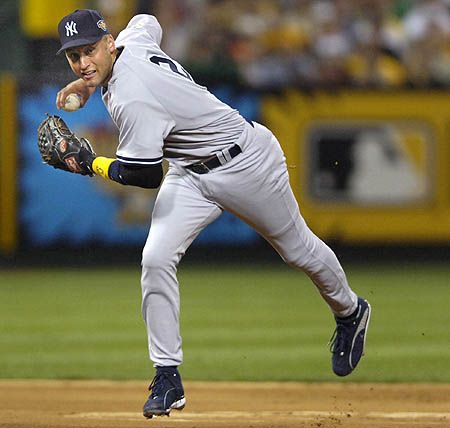
Bob Klapisch: Derek Jilted


[Obviously, I'm still not over the absurd outcome of the AL MVP selection process...Justin Morneau had a good season for a good team but Joe Mauer was the Twin's MVP...excellent defensive catchers who win batting titles are somewhat rare. That being said, Jeter should have won the award. - jtf]

Wednesday, November 22, 2006
BERGEN COUNTY RECORD

The beauty (and curse) of voting for the MVP award is that it's so ill-defined, just like the strike zone. Umpires don't call balls and strikes; they interpret them. The same blurry formula applies to judging baseball's most talented players, which is another way of saying: Good luck to anyone entrusted with a ballot.

I was one of the two New York-area writers asked to pick the American League's MVP this year. My vote went to Derek Jeter, with Justin Morneau second and Johan Santana third. In an election between right and right (there were no wrong choices here), it was Jeter's average with runners in scoring position that set him apart. For all the years we've heard that Jeter's value to the Yankees could only be quantified by intangibles, finally there was a cold, hard statistic that backed him up.

At .381, Jeter was nearly 100 points better than the industry's most feared hitter under pressure, David Ortiz. Not only did Jeter keep his cool, he did so in June and July, back when the race in the AL East was for real. Jeter was relentless when the Yankees needed him most, while Hideki Matsui and Gary Sheffield were on the disabled list and Alex Rodriguez was sunning himself in Central Park. The Yankee captain didn't hit the most home runs or pile up the RBI like traditional MVP winners, but in terms of rescuing his team, there wasn't a better day-in and day-out product on the market.

Of course, Jeter is no machine; he's a man, and an imperfect one at that. His range is limited at short, he strikes out too often for a No. 2 hitter (once every six at-bats). Jeter has yet to smooth A-Rod's path in New York, which, like it or not, is part of his responsibility as Yankee captain. Jeter should stick up for all his teammates, the way he did for Jason Giambi after the first baseman reportedly admitted to using steroids while testifying at the BALCO grand jury.

Jeter isn't the friendliest Yankee of this era. He doesn't have Bernie Williams innocent charm, nor does he have Mariano Rivera's off-the-field compassion. But none of that matters when you're standing in the batter's box in the ninth inning with the game on the line. Jeter is on his way to the Hall of Fame precisely because he's so coldblooded; he chooses this demeanor because it helps the Yankees, it suits his career and it makes it impossible for outsiders (like the press and fans, you and me) to get too close to him.

That's why we'll never know how Jeter really feels about being denied the MVP -- at age 32, most likely his best and last chance to win the award. If Jeter is burning inside, he'll never admit it. In a statement released by the Yankees, the shortstop called Morneau a "special player" whose first-place finish was "well deserved." Good for Jeter. Stoicism is out of fashion in this ESPN-highlight era, so to hear (or, to be more precise, to not hear) Jeter's from-the-heart response only heightens his mystique.

Thing is, there's no mystery in explaining his greatness in 2006. He beat opposing pitchers when it counted because of his enormous focus and concentration. In that sense, Jeter was the anti A-Rod, not worrying about the crowd reaction, the next day's headlines or a George Steinbrenner rebuke if he were to strike out in the ninth inning. That's why Jeter was able to single-handedly end the Red Sox' season during the historic five-game sweep at Fenway.

His two-out, two-strike RBI single off Jon Papelbon in the ninth inning on Aug. 20 did more than send the game into extra innings and lead the Yankees to an eventual 8-5 win. It broke the Red Sox' hearts. There was Papelbon, throwing his blistering 96 mph, two-seam fastball -- an impossible pitch to elevate. But Jeter somehow found a way to lift the ball into shallow right field, scoring Melky Cabrera with the tying run. That kind of hitting takes more than talent -- A-Rod has more power, speed -- it takes an internal decision to simply not fail.

A few players have it, most don't. Even Morneau conceded, "With all the pressure [Jeter] deals with, the way he handles it, he definitely deserves something like this [award]."

That's not to say a vote for Morneau was wrong, or that it's proof of an anti-Yankee bias around the country. If that were the case, A-Rod would've never won last year. Instead, there were enough voters who were more impressed with the Twins' need for grace under pressure through September, which Morneau, who drove in 130 runs, 33 more than Jeter, delivered. The Star-Ledger's Ed Price, who had the area's other MVP ballot, was swayed by that very reason.
In an e-mail Tuesday, Price wrote, "I voted Morneau first because his team was in a closer race, and I thought the way he played when the Twins got hot and got back in the race made him more instrumental to his team's finish."

Ironic, isn't it, that the Yankees' success worked against Jeter. Had they limped into the playoffs with, say, 90 wins, he would've likely routed the field. Instead, Jeter will have to live without an MVP award, the one he's waited for his entire career.

Unjust? Probably. But don't expect Jeter to complain. Being cool, even as No. 2, means never asking for a recount.

E-mail: klapisch@northjersey.com

Friday, November 24, 2006

Editorial: A Profiling in Courage

INVESTOR'S BUSINESS DAILY
Posted 11/22/2006

Homeland Security: Kudos to US Airways. Risking fines and a boycott, it did the right thing this week by removing a group of Muslim men from a flight to protect its crew and passengers.

By most accounts, the six bearded men were behaving suspiciously at a time when airports were on high alert for sky terror during the holidays. "There were a number of things that gave the flight crew pause," an airline spokesman said. According to witnesses and police reports, the men:

• Made anti-American statements.

• Made a scene of praying and chanting "Allah."

• Asked for seat-belt extensions even though a flight attendant thought they didn't need them.

• Refused requests by the pilot to disembark for more screening.

Also, three of the men had only one-way tickets and no checked baggage.

Police had to forcibly remove the men from the flight, whereupon they were taken into custody.
A search found no weapons or explosives, and they were released to continue on their journey.

Within hours, the men enlisted a Muslim-rights group to make a stink in the press, insisting they were merely imams returning home from an Islamic conference in Minneapolis. They say they were "harassed" because of their faith.

But were they victims or provocateurs?

All six claim to be Americans, so clearly they were aware of heightened security. Surely they knew that groups of Muslim men flying together while praying to Allah fit the modus operandi of the 9/11 hijackers and would make a pilot nervous. Throw in anti-U.S. remarks and odd demands about seat belts, and they might as well have yelled, "Bomb!"

Yet they chose to make a spectacle. Why? Turns out among those attending their conference was Rep.-elect Keith Ellison, D-Minn., who will be the first Muslim sworn into Congress (with his hand on the Quran). Two days earlier, Ellison, an African-American convert who wants to criminalize Muslim profiling, spoke at a fundraiser for the Council on American-Islamic Relations, the Muslim-rights group that wasted no time condemning US Airways for "prejudice and ignorance."

CAIR wants congressional hearings to investigate other incidents of "flying while Muslim." Incoming Judiciary Chairman John Con-yers, D-Mich., has already drafted a resolution, borrowing from CAIR rhetoric, that gives Muslims special civil-rights protections.

While it's not immediately clear whether the incident was a stunt to help give the new Democratic majority cover to criminalize airport profiling, it wouldn't be the first time Muslim passengers have tried to prove "Islamophobia" — or test nerves and security.

Two years ago a dozen Syrian men caused panic aboard a Northwest Airlines flight by passing bags to each other as they used the lavatory. As the plane prepared to land, they rushed to the back and front of the plane speaking in Arabic.

Then there's the case of Muhammed al-Qudhaieen and Hamdan al-Shalawi, two Arizona college students removed from an America West flight after twice trying to open the cockpit. The FBI suspected it was a dry run for the 9/11 hijackings, according to the 9/11 Commission Report.
One of the students had traveled to Afghanistan. Another became a material witness in the 9/11 investigation.

Even so, the pair filed racial-profiling suits against America West, now part of US Airways. Defending them was none other than the leader of the six imams kicked off the US Airways flight this week.

Turns out the students attended the Tucson, Ariz., mosque of Sheikh Omar Shahin, a Jordan native. Shahin has been the protesters' public face, even returning to the US Airways ticket counter at the Minneapolis airport to scold agents before the cameras.

In an Arizona Republic interview after 9/11, he acknowledged once supporting Osama bin Laden through his mosque in Tucson. FBI investigators believe bin Laden set up a base in Tucson.

Hani Hanjour, who piloted the plane that hit the Pentagon, attended the Tucson mosque along with bin Laden's onetime personal secretary, according to the 9/11 Commission Report. Bin Laden's ex-logistics chief was president of the mosque before Shahin took over.

"These people don't continue to come back to Arizona because they like the sunshine or they like the state," said FBI agent Kenneth Williams. "Something was established there, and it's been there for a long time." And Shahin appears to be in the middle of it.

CAIR asserts the imams are peace-loving patriots. "It's inappropriate to treat religious leaders that way," a spokesman said.

Yeah, they all wear halos. Omar Abdul-Rahman, a blind sheikh, is serving a life term for plotting to blow up several New York landmarks. Imam Ali al-Timimi, a native Washingtonian, is also behind bars for soliciting local Muslims to kill fellow Americans. Imams in New York were recently busted for buying shoulder-fired missiles. Another in Lodi, Calif., planned an al-Qaida terror camp there.

We could go on and on. Imams or not, US Airways did right by its customers. Shahin is calling on Muslims to boycott the airline; that might actually work in its favor. US Airways has been flooded with calls from Americans saying it just became the safest airline.

William F. Buckley: The Phony World of Minimum Wage

November 24, 2006
William F. Buckley

Nancy Pelosi, the new speaker of the House, has told us that she will call up as maybe the very first order of business increasing the minimum wage. Here are the relevant facts:

The federal minimum wage, enacted in 1938, was last raised in 1997. From that point on, with certain exceptions, you could not lawfully hire someone to work without paying him or her at least $5.15 per hour. Paying that much would yield $206 per week, or $10,712 per year. A different federal agency defines poverty as annual earnings of $9,827 or less for a single person.
The mathematics of the above informs us that the existing federal minimum wage barely keeps a single worker out of poverty.

Of course, many states and localities have enacted higher minimum wages than the federal one. In San Francisco, you need to pay a worker $8.50 an hour; in New York state, $6.75; in Wisconsin, $5.70.

We learn that 60 percent of minimum-wage earners -- two-thirds of them women -- are working in restaurants and bars; 73 percent, by the way, are white, and 70 percent have high-school diplomas. Nearly 60 percent work part time.

Now we can leech from these figures several observations:

(1) It can be very difficult to tell what a minimum wage worker is actually making. Many of those who work in restaurants and bars receive tips; then again, the minimum wage is substantially lower for people in that situation.

(2) A high-school diploma will not in and of itself give the worker merchandisable skills o'erleaping the minimum wage.

(3) Since there are part-time workers who receive only the minimum wage, a moment's reflection makes it obvious that they receive, by whatever means, income that makes life possible.

Now on the matter of what to do about it, we should begin by acknowledging that any argument for circumventing the market wage is sophistry. The market will tell you, even in San Francisco, what you need to pay in order to hire an hour's labor. But sophistry is sometimes in order. We do not allow child labor -- except in certain circumstances: Peter Pan, at the neighborhood theater, is allowed to work even if he is only 12 years old.

Monopolies are not permitted to set prices. The idea is that in a free society, you must not tolerate any constriction in production. But again, sophistry is permitted, because labor unions, in many fields of endeavor, practice exactly that -- a monopoly on the price of labor. What do we do about that? Exactly what we do about waiters who don't list their tips: We ignore it.

We learn that one individual American last year received compensation of $1.5 billion. This leads us indignantly to our blackboard, where we learn that the average chief executive officer earns 1,100 times what a minimum-wage worker earns. What some Americans are being paid every year is describable only as: disgusting. But that disgust is irrelevant in informing us what the minimum wage ought to be. The one has no bearing on the other.

We are bent on violating free-market allocations. Doing this is not theologically sinful, but it is wise to know what it is that we are doing, and to know that the consequence of taking such liberties is to undermine the price mechanism by which free societies prosper.

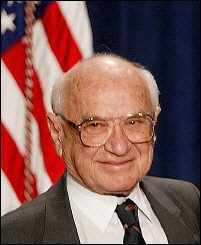
Milton Friedman taught that "the substitution of contract arrangements for status arrangements was the first step toward the freeing of the serfs in the Middle Ages." He cautioned against set prices. "The high rate of unemployment among teenagers, and especially black teenagers, is both a scandal and a serious source of social unrest. Yet it is largely a result of minimum-wage laws." Those laws are "one of the most, if not the most, anti-black laws on the statute books."

Professor Friedman is no longer here to testify, but his work is available -- even in San Francisco.

Copyright 2006 Universal Press Syndicate

Alan Dershowitz: The World According to Carter

Alan M. Dershowitz
http://www.FrontPageMag.com
November 24, 2006

Sometimes you really can tell a book by its cover. Former president Jimmy Carter’s decision to title his new anti-Israel screed Palestine: Peace Not Apartheid tells it all. His use of the loaded word “apartheid,” suggesting an analogy to the hated policies of South Africa, is especially outrageous, considering his acknowledgement buried near the end of his shallow and superficial book that what is going on in Israel today “is unlike that in South Africa—not racism, but the acquisition of land.” Nor does he explain that Israel’s motivation for holding on to land it captured in a defensive war is the prevention of terrorism. Israel has tried, on several occasions, to exchange land for peace, and what it got instead was terrorism, rockets and kidnappings launched from the returned land.

In fact, Palestinian terrorism is virtually missing from Carter’s entire historical account, which blames nearly everything on Israel and almost nothing on the Palestinians. Incredibly, he asserts that the initial violence in the Israeli/Palestinian conflict occurred when “Jewish militants” attacked Arabs in 1939. The long history of Palestinian terrorism against Jews—which began in 1929 when the Grand Mufti of Jerusalem ordered the slaughter of more than 100 rabbis, students and non-Zionist Sfardim whose families had lived in Hebron and other ancient Jewish cities for millennia—was motivated by religious bigotry. The Jews responded to this racist violence by establishing a defense force. There is no mention of the long history of Palestinian terrorism before the occupation, or of the Munich massacre and others inspired by Arafat. There is not even a reference to the Karine A, the boatful of terrorist weapons ordered by Arafat in January 2002.

The Carter book is so filled with simple mistakes of fact and deliberate omissions that were it a brief filed in a court of law it would be struck and its author sanctioned for misleading the court. Carter too is guilty of misleading the court of public opinion. A mere listing of all of Carter’s mistakes and omissions would fill a volume the size of his book. Here are just a few of the most egregious:

* Carter emphasizes that “Christian and Muslim Arabs had continued to live in this same land since Roman times,” but he ignores the fact that Jews have lived in Hebron, Tzfat, Jerusalem, and other cities for even longer. Nor does he discuss the expulsion of hundreds of thousands of Jews from Arab countries since 1948.

* Carter repeatedly claims that the Palestinians have long supported a two-state solution and the Israelis have always opposed it. Yet he makes no mention of the fact that in 1938 the Peel Commission proposed a two-state solution with Israel receiving a mere sliver of its ancient homeland and the Palestinians receiving the bulk of the land. The Jews accepted and the Palestinians rejected this proposal, because Arab leaders cared more about there being no Jewish state on Muslim holy land than about having a Palestinian state of their own.
He barely mentions Israel’s acceptance, and the Palestinian rejection, of the U.N.’s division of the mandate in 1948.

* He claims that in 1967 Israel launched a preemptive attack against Jordan. The fact is that Jordan attacked Israel first, Israel tried desperately to persuade Jordan to remain out of the war, and Israel counterattacked after the Jordanian army surrounded Jerusalem, firing missiles into the center of the city. Only then did Israel capture the West Bank, which it was willing to return in exchange for peace and recognition from Jordan.

* Carter repeatedly mentions Security Council Resolution 242, which called for return of captured territories in exchange for peace, recognition and secure boundaries, but he ignores the fact that Israel accepted and all the Arab nations and the Palestinians rejected this resolution. The Arabs met in Khartum and issued their three famous “no’s”: “No peace, no recognition, no negotiation” but you wouldn’t know that from reading the history according to Carter.

Carter faults Israel for its “air strike that destroyed an Iraqi nuclear reactor” without mentioning that Iraq had threatened to attack Israel with nuclear weapons if they succeeded in building a bomb.

* Carter faults Israel for its administration of Christian and Muslim religious sites, when in fact Israel is scrupulous about ensuring every religion the right to worship as they please—consistant, of course, with security needs. He fails to mention that between 1948 and 1967, when Jordan occupied the West Bank and East Jerusalem, the Hashemites destroyed and desecrated Jewish religious sites and prevented Jews from praying at the Western Wall. He also never mentions Egypt’s brutal occupation of Gaza between 1949 and 1967.

* Carter blames Israel, and exonerates Arafat, for the Palestinian refusal to accept statehood on 95% of the West Bank and all of Gaza pursuant to the Clinton-Barak offers of Camp David and Taba in 2000-2001. He accepts the Palestinian revisionist history, rejects the eye-witness accounts of President Clinton and Dennis Ross and ignores Saudi Prince Bandar’s accusation that Arafat’s rejection of the proposal was “a crime” and that Arafat’s account “was not truthful”—except, apparently, to Carter. The fact that Carter chooses to believe Yasir Arafat over Bill Clinton speaks volumes.

* Carter’s description of the recent Lebanon war is misleading. He begins by asserting that Hezbollah captured two Israeli soldiers. “Captured” suggest a military apprehension subject to the usual prisoner of war status. The soldiers were kidnapped, and have not been heard from—not even a sign of life. The rocket attacks that preceded Israel’s invasion are largely ignored, as is the fact that Hezbollah fired its rockets from civilian population centers.

* Carter gives virtually no credit to Israel’s superb legal system, falsely asserting (without any citation) that “confessions extracted through torture are admissible in Israeli courts,” that prisoners are “executed” and that the “accusers” act “as judges.” Even Israel’s most severe critics acknowledge the fairness of the Israeli Supreme Court, but not Carter.

* Carter even blames Israel for the “exodus of Christians from the Holy Land,” totally ignoring the Islamization of the area by Hamas and the comparable exodus of Christian Arabs from Lebanon as a result of the increasing influence of Hezbollah and the repeated assassination of Christian leaders by Syria.

* Carter also blames every American administration but his own for the Mideast stalemate with particular emphasis on “a submissive White House and U.S. Congress in recent years.” He employs hyperbole and overstatement when he says that “dialogue on controversial issues is a privilege to be extended only as a reward for subservient behavior and withheld from those who reject U.S. demands.” He confuses terrorist states, such as Iran and Syria to which we do not extend dialogue, with states with whom we strongly disagree, such as France and China, with whom we have constant dialogue.

And it’s not just the facts; it’s the tone as well. It’s obvious that Carter just doesn’t like Israel or Israelis. He lectured Golda Meir on Israeli’s “secular” nature, warning her that “Israel was punished whenever its leaders turned away from devout worship of God.” He admits that he did not like Menachem Begin. He has little good to say about any Israelis—except those few who agree with him. But he apparently got along swimmingly with the very secular Syrian mass-murderer Hafez al-Assad. He and his wife Rosalynn also had a fine time with the equally secular Yasir Arafat—a man who has the blood of hundreds of Americans and Israelis on his hands:

Rosalynn and I met with Yasir Arafat in Gaza City, where he was staying with his wife, Suha, and their little daughter. The baby, dressed in a beautiful pink suit, came readily to sit on my lap, where I practiced the same wiles that had been successful with our children and grandchildren. A lot of photographs were taken, and then the photographers asked that Arafat hold his daughter for a while. When he took her, the child screamed loudly and reached out her hands to me, bringing jovial admonitions to the presidential candidate to stay at home enough to become acquainted with is own child.

There is something quite disturbing about these pictures.

The Carter book is so biased that it inevitably raises the question of what would motivate a decent man like Jimmy Carter to write such an indecent book. Whatever Carter’s motives may be, his authorship of this ahistorical, one-sided and simplistic brief against Israel forever disqualifies him from playing any positive role in fairly resolving the conflict between Israel and the Palestinians. That is a tragedy because the Carter Center, which has done much good in the world, could have been a force for peace if Jimmy Carter were as generous in spirit to the Israelis as he is to the Palestinians.

Click Here to support Frontpagemag.com.

Thursday, November 23, 2006

Harvey Araton: Intangibles Separate Rodriguez and Jeter


The New York Times
Published: November 23, 2006

Derek Jeter lost the American League Most Valuable Player award this week to Justin Morneau, one year after Alex Rodriguez outpolled the most notorious Yankee killer of the 21st century.

A-Rod, fall guy for Yankees fans, beats out David Ortiz of the hated Red Sox, but Jeter, Mr. October and November, comes up short against Morneau, a Minnesota Twin. How, exactly, do we who claim to understand the proper order of all things Yankee explain this breach of common baseball sense that anoints A-Rod, not Jeter, as an M.V.P.?

Tuesday’s decision for Morneau, hardly outrageous or even an egregious example of anti-New York bias by any objective examination of the numbers, speaks more to the ecological imbalance that has befallen the Yankees in the six years since their last World Series was won.

Here at the onset of the hot-stove season comes another chilly reminder that the Yankees don’t spin on their axis the way they once did. There is always some wobble at the end of their rotation.

If you have been paying attention for the past 11 years, if you understand the symbiosis of Jeter’s relationship with his manager, Joe Torre, then you know how badly the organization wanted Jeter to win his first M.V.P. award, probably more than Jeter wished it for himself.

The years pass, the failures mount, but Jeter remains the standard of excellence, the embodiment of all those team-first intangibles the Yankees would have us believe were invented in the Bronx. Jeter may be alone someday, with Bernie Williams possibly exiting the stage soon, leaving him, Mariano Rivera and Jorge Posada as the true-blue ring bearers among the wealthy and winless, the clubhouse wing most epitomized by A-Rod and the richest contract in the history of the sport.

He, of course, sacrificed his natural position, shortstop, to be a Yankee, to play alongside Jeter, but has spent the past three years trying to reach Jeter’s champion’s perch. A-Rod climbs and climbs, inflating his Hall of Fame statistics along the way, only to stumble over himself and roll back down the hill at the end of the season.

He was not the only Yankee to flame out this fall, but how surprising, in retrospect, was his 1-for-14 division series against Detroit after all those advance alibis in Sports Illustrated? Was it really so unreasonable for an exasperated Torre to throw up his hands and bat A-Rod a humiliating eighth in Game 4?

Quickly, the Yankees squelched inevitable speculation that they had had enough and were ready to send A-Rod away, if only he would agree to go. He and his agent, Scott Boras, insist he doesn’t want out of New York. That he loves being here. With Gary Sheffield and his right-handed power bat gone, A-Rod probably has to be. But does he really buy into this whole Yankee thing, or did he come to New York “to be Mr. Madison Ave.” — as his marketing representative, Steve Fortunato, told USA Today last June?


Corny as it all may seem, scripted as Jeter can sound, he typically puts the best franchise face forward. At a memorial service last month in California several days after pitcher Cory Lidle’s death in a Manhattan plane crash, there was Jeter, right alongside Torre. Where was Rodriguez? He is not the manager, or the captain, as is Jeter, but what about his alleged standing as the team’s reigning superstar, its most scrutinized player, A-lightning-Rod?
Too many times — as with the Sports Illustrated confessional on the eve of the playoffs — Rodriguez seems to miss the impact of his actions, or inaction.

Last Wednesday, after attending his own charity poker tournament in Manhattan, he canceled on a major fund-raiser the next night at the Yogi Berra Museum in Little Falls, N.J. According to a person in the Rodriguez camp who spoke yesterday on condition of anonymity, A-Rod’s mother, Lourdes, had suddenly been hospitalized — certainly a legitimate excuse and far better than the reason David Wright’s people gave for him not showing. (Wright had been inadvertently double-booked that night.)

But Wright is a Met, A-Rod a Yankee, and because he has a history around town of blowing off events (including one of Torre’s last year), because the call to the museum to cancel was made not by Rodriguez but by one of his employees, because there was an A-Rod sighting last Friday night at courtside of the Knicks-Heat game in Miami, the museum people and the Berra family and even the Yankees’ president, Randy Levine, were said to be in a snit, with the impression that A-Rod too often gives: he just doesn’t get it.

A personal call to Berra a day or two or even three after the event is all it would have taken to deliver an expression of sincerity, to let Berra and the Yankees know that A-Rod does respect the tradition, the legacy and, in this case, the patriarchal standing of Berra, 81, as the greatest living Yankee.

Raw power may make you a most valuable player, but A-Rod, as talented and hard-working as he is, still hasn’t mastered the subtleties of team interaction, the intangibles that postseason awards typically don’t address. Without them, there is no way for A-Rod to reach the pedestal on which Jeter still stands.

E-mail: hjaraton@nytimes.com

George Will: Thankful From the Beginning

George F. Will
The Washington Post
Thursday, November 23, 2006; Page A39

"Twas founded be th' Puritans to give thanks f'r bein' presarved fr'm th' Indyans, an' . . . we keep it to give thanks we are presarved fr'm th' Puritans."
-- Finley Peter Dunne


But the Pilgrims who bequeathed to us Thanksgiving were not Puritans, at least as we use that term to denote busybodies bent on extirpating dissipation, meaning fun. Excessive merriment was not a pressing problem for the half of the Mayflower's 102 passengers who survived the first few months in wintry Massachusetts.

True, the Pilgrims left Holland for America in part because the Dutch had too much fun, even on Sunday, when the Pilgrims' services would last four hours, the congregation standing throughout. And two Pilgrim brothers did quarrel because one said the other was "blinded, bewitched and besotted" by his wife, a "bouncing girl who wore whalebones in her breast, an excessive deal of lace and a showish hat."

But the Pilgrims went to America, writes Godfrey Hodgson, not to become American but to remain English and devout. Rather than tarry among the licentious Dutch, they would risk life among Indians who, they had heard, flayed prisoners with scallop shells. Soon a Pilgrim was instructing Indians in the Ten Commandments, "all of which they harkened unto with great attention, and liked well of; only the seventh commandment they excepted against, thinking there were many inconveniences in it, that a man should be tied to one woman."

Hodgson is a British journalist and historian. His "A Great and Godly Adventure: The Pilgrims and the Myth of the First Thanksgiving" makes clear that the Pilgrims embarked on the angry North Atlantic in storm season not because they wanted to impose their strict ways on anyone but to avoid being bothered by anyone.

It was not until the Cold War in the 1950s that American historians, seizing upon John Winthrop's sermon ("we shall be as a City upon a Hill, the eyes of all people are upon us"), suggested that the Pilgrims pioneered "American exceptionalism" by adopting a universal mission to cure this fallen world of corruptions. An American cold warrior, Ronald Reagan, was to wield that "city upon a hill" trope 30 years later while ending the Cold War.

The first Thanksgiving feast involved a few dozen English settlers and perhaps a few hundred Native Americans who, Hodgson reports, "protected themselves from cold, insect bites and so on with a thick layer of fat or grease. This may have made them smelly at close quarters though hardly smellier than the Europeans, who changed their clothes rarely." The dinner probably did not include turkey, which was rarer in Massachusetts than in England, where it had been introduced from the Mediterranean, hence its name.

This year, when one of the Transportation Security Administration's 43,000 airport screeners (perhaps two times more numerous than were Native Americans in 1620 in what is now eastern Massachusetts) confiscated a traveler's too-large tube of toothpaste, the traveler perhaps thought: Life is hard. So it is timely for Hodgson to remind us of the admiration that is due "as a tiny band of men and women, determined to follow what they believe to be the ordinances of their God, entrust themselves to the wild freezing ocean; confront disease, starvation, ferocious enemies and justified fear."

Thanksgiving, Hodgson notes, is an echo of the breaking of bread at the heart of Christian worship, and of a Jewish Seder. It also is a continuation, in today's abundance, of harvest festivals around the world, which began millennia ago, when abundance was so rare as to seem miraculous. Hodgson thinks that Thanksgiving expresses "the deepest of all American national feelings" -- gratitude. It is the inclusive gratitude "of a nation of immigrants who have lived for the most part in peace and plenty under the rule of law as established with the consent of the governed." Celebrated by turning inward with family, Thanksgiving is, Hodgson thinks, a counterpoint to Americans' other great civic festival, the Fourth of July:

"It is good to celebrate the public glories and the promise of American life with fireworks and speeches, better still to celebrate the mysterious cycle of life, the parade of the generations, and the fragile miracle of plenty, in the small warm circle of family, the building brick of which all prouder towers have always been constructed."

An Englishman (Samuel Johnson) said that people more often need to be reminded than informed. Sometimes Americans need a sympathetic foreigner, such as Hodgson, to remind them of the dignity of what they are doing, on this day and all others.

georgewill@washpost.com

Ann Coulter: What can I do to make your flight more uncomfortable?

November 22, 2006
http://www.anncoulter.com

Six imams removed from a US Airways flight from Minneapolis to Phoenix are calling on Muslims to boycott the airline. If only we could get Muslims to boycott all airlines, we could dispense with airport security altogether. Witnesses said the imams stood to do their evening prayers in the terminal before boarding, chanting "Allah, Allah, Allah" — coincidentally, the last words heard by hundreds of airline passengers on 9/11 before they died. Witnesses also said that the imams were talking about Saddam Hussein, and denouncing America and the war in Iraq. About the only scary preflight ritual the imams didn't perform was the signing of last wills and testaments.

After boarding, the imams did not sit together and some asked for seat belt extensions, although none were morbidly obese. Three of the men had one-way tickets and no checked baggage.

Also they were Muslims.

The idea that a Muslim boycott against US Airways would hurt the airline proves that Arabs are utterly tone-deaf. This is roughly the equivalent of Cindy Sheehan taking a vow of silence. How can we hope to deal with people with no sense of irony? The next thing you know, New York City cab drivers will be threatening to bathe. Come to think of it, the whole affair may have been a madcap advertising scheme cooked up by US Airways.

It worked with me.

US Airways is my official airline now. Northwest, which eventually flew the Allah-spouting Muslims to their destinations, is off my list. You want to really hurt a U.S. air carrier's business? Have Muslims announce that it's their favorite airline.

The clerics had been attending an imam conference in Minneapolis (imam conference slogan: "What Happens in Minneapolis — Actually, Nothing Happened in Minneapolis"). But instead of investigating the conference, the government is now investigating my favorite airline.

What threat could Muslims flying from Minnesota to Arizona be? Three of the 19 hijackers on 9/11 received their flight training in Arizona. Long before the attacks, an FBI agent in Phoenix found it curious that so many Arabs were enrolled in flight school. But the FBI rebuffed his request for an investigation on the grounds that his suspicions were based on the same invidious racial profiling that has brought US Airways under investigation and into my good graces.

Lynne Stewart's client, the Blind Sheik, Omar Abdel-Rahman, is serving life in prison in a maximum security lock-up in Minnesota. One of the six imams removed from the US Airways plane was blind, so Lynne Stewart was the one missing clue that would have sent all the passengers screaming from the plane.

Wholly apart from the issue of terrorism, don't we have a seller's market for new immigrants? How does a blind Muslim get to the top of the visa list? Is there a shortage of blind, fanatical clerics in this country that I haven't noticed? Couldn't we get some Burmese with leprosy instead? A 4-year-old could do a better job choosing visa applicants than the U.S. Department of Immigration.

One of the stunt-imams in US Airways' advertising scheme, Omar Shahin, complained about being removed from the plane, saying: "Six scholars in handcuffs. It's terrible." Yes, especially when there was a whole conference of them! Six out of 150 is called "poor law enforcement." How did the other 144 "scholars" get off so easy?

Shahin's own "scholarship" consisted of continuing to deny Muslims were behind 9/11 nearly two months after the attacks. On Nov. 4, 2001, The Arizona Republic cited Shahin's "skepticism that Muslims or bin Laden carried out attacks on the World Trade Center and Pentagon." Shahin complained that the government was "focusing on the Arabs, the Muslims. And all the evidence shows that the Muslims are not involved in this terrorist act."

In case your memory of that time is hazy, within three days of the attack, the Justice Department had released the names of all 19 hijackers — names like Majed Moqed, Ahmed Alghamdi, Mohand Alshehri, Ahmed Ibrahim A. Al Haznawi and Ahmed Alnami. The government had excluded all but 19 passengers as possible hijackers based on extensive interviews with friends and family of nearly every passenger on all four flights. Some of the hijackers' seat numbers had been called in by flight attendants on the planes. By early October, bin Laden had produced a videotape claiming credit for the attacks. And by Nov. 4, 2001, The New York Times had run well over 100 articles on the connections between bin Laden and the hijackers — even more detailed and sinister than the Times' flowcharts on neoconservatives! Also, if I remember correctly, al-Qaida had taken out full-page ads in Variety and the Hollywood Reporter thanking their agents for the attacks.

But now, on the eve of the busiest travel day in America, these "scholars" have ginned up America's PC victim machinery to intimidate airlines and passengers from noticing six imams chanting "Allah" before boarding a commercial jet.

COPYRIGHT 2006 ANN COULTER

Tuesday, November 21, 2006

Al Gore is Captain Planet


November 21, 2006 7:00 AM
http://www.nationalreview.com

And POTUS, too, if he has his way.
By Iain Murray

The DVD version of Al Gore’s An Inconvenient Truth is released this week. In addition to the movie, the DVD will feature a new 30-minute interview with the former vice president updating his argument. It is unlikely that he will use the segment to admit to any of the inconvenient truths I or my colleagues have pointed out, but he has bigger fish to fry: his movie has been nominated for an Academy Award. His latest intervention in global politics — a column in the British newspaper the Sunday Telegraph, objecting to a pair of articles downplaying the threat of global warming from Mrs. Thatcher’s old adviser Lord Monckton — suggests that this is a man on a mission; his likely victory speech in the Kodak Theater next February 25 could be the launch of something more.

In his article, Gore is doing again what he does best, exaggerating the arguments in favor of action on global warming while disparaging and misrepresenting the arguments against it. He has had a lot of practice at this, having repeated the same misleading points over 1,000 times in lectures all over the world. So full of holes, however, is his argument, that it is difficult to know where to begin.

We might start with the nature of scientific peer review, which Gore asserts is there to keep out ideas scientists disagree with. We should be thankful this is not the case; otherwise prevailing scientific theories would never be challenged. Peer review is actually there to elicit criticism, not suppress it. Editors ask their reviewers whether the article is worth publishing, not whether it is right. Sadly, in the case of climate science, peer review seems to be working exactly as Al Gore describes and not as the scientific model would suggest. Leading scientific journals routinely turn down articles that challenge the alarmist stance, even when they come from researchers concerned about global warming.

Gore is especially angry that Lord Monckton suggests that the Earth might not be that sensitive to the presence of greenhouse gases. Gore asserts that climate sensitivity, which represents how much temperature increase — all other things being equal — we can expect from a doubling of carbon dioxide in the atmosphere, is in the order of 3 degrees C. The Intergovernmental Panel on Climate Change admits that there is a wide amount of uncertainty in their models as to how much temperature change we can expect from a doubling of CO2 — from 1.5 to 4.5 degrees C.
Yet when Robert Douglass and Robert Knox of the University of Rochester examined the real world effects of the eruption of Mount Pinatubo, they found a climate sensitivity of only 0.6 degrees C — well below the 3 degrees Gore claims “the real world evidence” shows.

Gore also dismisses criticism of the “hockey stick” graph of historical temperatures, saying that the National Academies of Science had validated it. This is quite blatant spin. The National Academies’ report most assuredly did not state that “the late 20th-century warming in the Northern Hemisphere was unprecedented during at least the past 1,000 years and probably for much longer than that.” It found that current temperatures were the warmest in 400 years (which no one disputed); that the claim that temperatures were the warmest in a millennium was merely “plausible”; and that we could place very little confidence in reconstructions of temperature records before that. The report also upheld every methodological complaint against the shoddy science that produced the “hockey stick” in the first place. The “hockey stick” is most assuredly broken.

Gore also seriously misrepresents the peer-reviewed literature (ironically enough) on the relationship between disasters and climate change. Roger Pielke Jr. of the University of Colorado characterized Gore’s approach here as “deciding to uphold scientific standards only when politically convenient” and contributory to a “pathological politicization” of science. It is the ultimate irony that, when Al Gore complains about people misrepresenting the science, given his massive audience he is probably guilty of more far-reaching misrepresentation than anyone else.

As for the economics, it is no surprise that Gore lauds the Stern Review, which follows his approach in taking a worst-case scenario and exaggerating it to produce an estimate of the cost of global warming and then comparing that figure against a cost of mitigation that is well below the accepted cost estimates of such policies.

Gore also quotes Margaret Thatcher, just as he did Winston Churchill in his movie. In the chapter on global warming in her last book, Statecraft, Mrs. Thatcher warned against “the usual suspects on the left [who] have been exaggerating dangers and simplifying solutions in order to press their agenda of anti-capitalism.” Al Gore’s article fits that admonition exactly.

The former vice president has invested a lot of time and effort into making this not only his signature issue, but making it a moral, not a technical issue. He has been quite explicit in comparing the issue to the war on terror as an issue for our time. In his Telegraph article he actually concludes by saying, “At stake is nothing less than the survival of human civilisation and the habitability of the earth for our species.” Think about the implications of that for a moment. Not only is this breath-taking hyperbole, it sets Gore himself up as nothing less than the Savior of the entire Earth.

Such arrogance is surely egregious, but it also raises a question. What opportunity is there coming up for Al Gore to put himself in a position to change the course of history? Perhaps future historians will mark the opening of Al Gore’s 2008 presidential bid as Oscar night, February 25, 2007.

—Iain Murray is a senior fellow at the Competitive Enterprise Institute.

Clinton Pardoned Hasting's Co-Conspirator

November 20, 2006 10:25 PM
http://www.nationalreview.com

The convicted felon who went to jail rather than testify against Alcee Hastings.

By Byron York

William Borders was a prominent Washington, D.C. lawyer when, in 1981, he was charged with conspiring with his good friend, federal judge Alcee Hastings, to solicit bribes from defendants seeking lenient treatment in Hastings’s courtroom. Hastings was charged, too, though the men were tried separately. When it was all over, Borders was convicted, disbarred, and sentenced to five years in jail. Hastings was acquitted, but later impeached and removed from office.

In addition to his sentence, Borders went to jail two other times as a result of the Hastings matter, both times when he refused to testify against his friend. In the first instance, after his sentencing in 1982, Borders was ordered to cooperate with the continuing grand jury investigation into Hastings’s conduct. Borders refused to talk, was cited with contempt, and sent to jail. He served about six weeks before being released at the end of the grand jury’s term.

Later, in 1989, after the House passed articles of impeachment against Hastings, Borders was called to testify at the Senate trial. He was given immunity for his testimony but again refused to talk. The Senate threatened him with contempt. Borders would not budge. Finally, the Senate referred the matter to a federal judge, who ordered Borders to testify. Borders again refused, and the judge sent him to jail. “Borders has refused to testify in this impeachment proceeding as well as in all other proceedings in which, if Judge Hastings’ version of the facts is true, Borders could have established Judge Hastings’ innocence,” House impeachment manager Rep. John Bryant told the Senate on October 18, 1989. “Borders is in jail today at this moment and will be until this body votes, and he is in jail for refusing to testify before the impeachment trial committee despite a grant of immunity. I ask you, on behalf of the House managers, why would he go to jail, again, if by his testimony he could honestly vindicate his close friend of so many years?”

The answer to that question, Bryant concluded, was that Hastings was guilty, and Borders knew it. “The fact is that Borders will not talk, because if he tells the truth he must acknowledge Judge Hastings’ role in the conspiracy, and if he does not tell the truth he risks placing himself in violation of the law again,” Bryant argued. “And that is why he refused to testify, and that is why the judge did not call Borders to testify at his own trial.”

Borders never talked. He was behind bars for about eight weeks, and was released when the trial ended, after the Senate had voted to remove Hastings from office.

At various times over the years, Borders has tried to have his license to practice law in the District of Columbia restored. But his episodes of contempt, in addition to his original conviction for bribery, led the legal bodies involved to conclude that, even though he had done his time, he did not feel remorse for his actions nor a respect for the law under which he was punished. He remains disbarred today.

None of that, however, stopped President Bill Clinton from granting Borders a full and unconditional pardon as part of the flurry of controversial pardons Clinton issued during his last hours in office. The pardon documents listed Borders’s crime this way: “Conspiracy to corruptly solicit and accept money in return for influencing the official acts of a federal district court judge (Alcee L. Hastings), and to defraud the United States in connection with the performance of lawful government functions; corruptly influencing, obstructing, impeding and endeavoring to influence, obstruct and impede the due administration of justice, and aiding and abetting therein; traveling interstate with intent to commit bribery.” The document did not mention Borders’s contempt. (That same day, Clinton also pardoned another contemnor, Whitewater figure Susan McDougal, who went to jail rather than reveal whether the president testified truthfully at her trial.)

Borders’s pardon surprised some of those who were most familiar with the Hastings case. “Some [names on the pardon list] will raise eyebrows,” Reid Weingarten, who as a Justice Department attorney prosecuted Hastings and Borders, told the Washington Post. “For example, I was Bill Borders’ prosecutor and, while I have sympathy for the man, I thought his crimes were unpardonable.”

The entire Borders/Hastings issue would not be coming up now but for the fact that Hastings, who ran for and won a seat in Congress in 1992, is in line to become chairman of the House Intelligence Committee, one of the most sensitive posts on Capitol Hill. Republicans who would like to see Hastings passed over, and nervous Democrats who would like to see the same thing, are poring through old records of the impeachment, trying to reconstruct what happened in the case and how it might reflect on Hastings’s fitness for the chairmanship.

The issue is so sensitive that some observers have questioned whether Hastings, given his impeachment and removal from office for conspiring to take bribes, would qualify for the security clearances needed to serve as chairman. The answer, according to sources on the Hill, is yes. According to those sources, if you’re a member of the House of Representatives, you’ve already got the clearance you need. “The best way to understand it is that, by virtue of having been elected by their constituents, members are already granted the privilege of access to classified government information,” says Jamal Ware, a spokesman for the Intelligence Committee. “Members are given access to the classified information they need to carry out their job.”

Ware explains that members of Congress sign an oath pledging not to reveal classified information, and that members who join the Intelligence Committee sign a second oath specific to work on the committee. The first, more general, oath is not mandatory — indeed, there are a few members who refuse to sign — but it, along with the second oath, is required for service on the Intelligence Committee. In any event, Hastings, despite his record, would not be barred from becoming chairman.

Monday, November 20, 2006

In Memoriam: Milton Friedman

From OpinionJournal:

IN MEMORIAM

Freedom Man

Milton Friedman had both genius and common sense.


BY THOMAS SOWELL
Saturday, November 18, 2006 12:01 a.m.

PALO ALTO, Calif.--Milton Friedman was one of the very few intellectuals with both genius and common sense. He could express himself at the highest analytical levels to his fellow economists in academic publications and still write popular books such as "Capitalism and Freedom" and "Free to Choose" that could be understood by people who knew nothing about economics. Indeed, his television series, "Free to Choose," was readily understandable even by people who don’t read books.

Milton Friedman may well have been the most important economist of the 20th century, even if John Maynard Keynes was the most famous. No small part of Friedman’s achievement was rescuing economics from the pervasive and virtually unquestioned Keynesian orthodoxy that reigned in many places.

Ironically, Friedman began his career as a believer in both Keynesian economics and in the liberals’ vision of the world with which it was so compatible. Yet, in the end, no one did more to dethrone both. It is doubtful whether Ronald Reagan could have been elected president in 1980 without the changes in public opinion produced by Friedman’s work in the previous decades.

The Keynesians’ belief that government policy could wisely make trade-offs between rates of inflation and rates of unemployment was epitomized in the Phillips Curve, which seemed to lend empirical support to that belief. Friedman dealt that analysis a body blow when he argued that it was not the rate of inflation which reduced unemployment but the fact that inflation exceeded expectations.

In other words, even a high rate of inflation would not reduce unemployment if inflationary policies became so common as to be expected. The "stagflation" of the 1970s--with simultaneous double-digit inflation and double-digit unemployment--validated what Friedman had said, in a way that no one could ignore.

Unlike so many intellectuals who have aspired to positions of power, Friedman preferred to remain outside of government and independent of politicians. His influence was nevertheless great because his ideas moved others, whether in the economics profession, in the general public or among policy makers.

Friedman’s many contributions to economics, recognized by the Nobel Prize that he received in 1976, were only part of his contributions to society at large. His decades-long campaign to promote school vouchers has been enshrined in the foundation named for him and his wife, the Milton and Rose D. Friedman Foundation for Educational Choice. He was a compassionate conservative long before that term was coined, for the rich obviously do not need vouchers to get a decent education for their children.

Friedman’s own personal background made him familiar with the problems of those who begin life without the privileges of the elite--and of the importance of education as a way to advance beyond their beginnings. Born in Brooklyn in 1912 to immigrant parents, he grew up in New Jersey, living over his family’s store, and worked his way through Rutgers University. Later, he went on to postgraduate work at the University of Chicago. The rest, as they say, is history.

As the central figure in the "Chicago School" of economists, and an outstanding teacher, Friedman over the years sent forth into the world--overseas as well as in the U.S.--a stream of economists who influenced the thinking, and in some cases the policies, of countries all around the world. These students, along with his writings, are part of his enduring legacy. His popular writings, speeches and television appearances spread his ideas through successively wider circles of people, who passed these ideas on to others, many of whom may never had known where these ideas originated.

As one of those privileged to have studied under Friedman, I felt a special loss at his death but also a sense of good fortune to have learned from him, not only when I was at the University of Chicago but also in the years and decades since then. He was a tough, no-nonsense teacher in the classroom but a kind and generous human being outside.

Students were not allowed to walk into his classroom after his lecture had begun, distracting others. Once, I arrived at the door just minutes after Friedman began speaking and had to turn around and go back to the dormitory, wondering all the while whether what he taught that day would be on the next exam. After that, I was always in my seat when Friedman entered the classroom. He was also a tough grader. On one exam, there were only two B’s in the whole class--and no A’s.

The other side of Friedman was his generosity with his time to help students, and even former students. In later years, long after I had left the University of Chicago, he helped me with his criticisms and advice on my work--only when asked. When I was offered an appointment to the Federal Trade Commission in 1976, he was asked by the White House to urge me to accept but he declined to do so. It was the best non-advice I ever got. I would have been miserable at the FTC.

Although in recent years we were both members of the Hoover Institution at Stanford University, we each lived miles away and neither of us was physically present there with any great frequency, so the chance that we would both be there on the same day was virtually nil. The last time I saw Friedman in person was in 2004, when we were jointly interviewed on television. Afterwards, he gave me a ride in his little sports car over to the Stanford faculty club, where we joined a group for lunch. Then he drove back to his home in San Francisco, 30 miles away, though he was at the time in his 90s.

More recently, I happened to chat briefly with Friedman on the phone a few days before his death, and found his mind to be as clear and sharp as ever. That will always be a special memory of a very special man, one of the giants of our time--intellectually, morally, and as a human being.

Friday, November 17, 2006

Bob Klapisch: Yanks Hoard Money

Friday, November 17, 2006
BERGEN COUNTY RECORD


NAPLES, Fla. -- There's not much that can shock the dollar-hardened baseball fan these days, but see if this doesn't flex your eyebrows: With free agency about to explode (again), the Red Sox are already the market's most aggressive check-writers, while the Yankees are actually sticking to a sensible business plan.

Must be some alternative universe we've been transported to. The Sox' $51 million posting fee for Daisuke Matsuzaka is only the beginning of what will ultimately turn into an $80 million transaction -- a stunning transformation for a team that didn't want to shell out $22 million for Bobby Abreu last summer.

The Yankees? They offered $31 million for Matsuzaka, and even that sum made them nervous. According to one major league official familiar with the Bombers' thinking, general manager Brian Cashman was already experiencing buyer's remorse about having spent too much -- and was secretly relieved that the Sox blew away the field with their historic offer.

Cashman insists "we made an aggressive offer," but concedes Boston made "a more aggressive offer." Which leads to the obvious question: Since when do the Yankees allow themselves to be out-bid for a can't-miss free agent?

It's all part of Cashman's blueprint to bring sanity back to the Yankees' fiscal empire and, as he put it, "to keep us at a championship caliber for years to come."

It worked for them last winter, when the GM successfully waited out Johnny Damon's demand for a seven-year contract. Cashman ultimately prevailed over agent Scott Boras, getting Damon to agree to a four-year, $53 million deal. And once again, the Yankees are laying low while the market accelerates.

The Blue Jays, for instance, are finalizing a deal with Frank Thomas for two years at $23 million -- a huge payoff for the production he gave the A's last year. The real time to sign Thomas, of course, would've been last year; now it's too late for shrewd bargaining.

The Mets similarly had to overpay for 40-something Orlando Hernandez and his fragile bones; more than $6 million a year through 2008. And now Barry Zito, another Boras client, is looking for a seven-year deal for at least $15 million per.

At that rate, there's virtually no chance the Yankees will engage Zito. Instead, they'll find pitching help on their own roster, including Carl Pavano and Phil Hughes and even Scott Proctor, who will be converted into a starting pitcher this spring.

"We have choices in-house," Cashman said at the conclusion of the general managers' meetings. "The have-to-do-something [option] has been eliminated. That's why we can be aggressive, but on our terms. We can pick our spots."

Since when has a Yankee GM spoken so logically about money? For the last decade the team has been baseball's equivalent of Microsoft, yet Cashman appears ready to close out the era of blowing out the budget. Maybe it's better that way: Imagine the national outrage had it been the Yankees, not the Sox, who emptied the coffers for Matsuzaka.

For now, Cashman seems determined to curtail spending and keep his payroll under $200 million. It's not just that the Yankees want to save money (and increase profits), but Cashman himself decided in midseason that the unrestrained spending wasn't helping the on-field product, anyway.

The turning point came after George Steinbrenner publicly put Cashman and Joe Torre on the hot seat, saying the two men were responsible for the Yankees' successes and failures. Cashman told colleagues that if he was going to take the blame, then he was going to run the franchise his way.

Indeed, one person in the organization said, "The days of the [Steinbrenner] signing a player because Billy Connors likes him are definitely over."

Now, the Yankees' transactions have Cashman's fingerprints all over them. Bench coach Lee Mazzilli was summarily dismissed. Mike Mussina is coming back, but for a 33 percent pay cut.
The Yankees traded Gary Sheffield to the Tigers for a promising pitching prospect, Humberto Sanchez. And they moved Jaret Wright to the Orioles with the hunch that the right-hander's run of over-achievement in the second half of the season wouldn't carry over into 2007.

What remains to be seen, of course, is whether Cashman's financial maturity will deliver the Yankees to the World Series. It's been six years since their last championship and, in the past, every impatient urge has been met with the same response: fire up the ATM.

But that philosophy only filled the roster with mistakes like Kevin Brown and Javier Vazquez and, to a lesser degree, Randy Johnson. Pavano's tenure in New York has also been a disaster, although Cashman keeps insisting the right-hander will be reborn by spring training.

The problem is that the magic bullet doesn't really exist from the Yankees' perspective. Zito, they believe, costs too much and is probably better suited for the National League. And Matsuzaka was just a blind date that made Cashman nervous.

That's why the Yankees weren't particularly panicked or embarrassed at how they were smoked by the Red Sox this week. In this brave, new world of watching your millions, the Yankees were happy to let the Sox bleed instead.

Whether Boston was very smart or very reckless in its pursuit of Matsuzaka, Cashman wouldn't say. But his thin smile spoke volumes: Sometimes the best check is the one you never write.

E-mail: klapisch@northjersey.com

Film Review: 'Casino Royale'


Renewing a License to Kill and a Huge Movie Franchise


By MANOHLA DARGIS
The New York Times
Published: November 17, 2006

The latest James Bond vehicle — call him Bond, Bond 6.0 — finds the British spy leaner, meaner and a whole lot darker. Now played by an attractive bit of blond rough named Daniel Craig, Pierce Brosnan having been permanently kicked to the kerb, Her Majesty’s favorite bad boy arrives on screens with the usual complement of cool toys, smooth rides, bosomy women and high expectations. He shoots, he scores, in bed and out, taking down the bad and the beautiful as he strides purposefully into the 21st century.

It’s about time. The likable Mr. Brosnan was always more persuasive playing Bond as a metaphoric rather than an actual lady-killer, with the sort of polished affect and blow-dried good looks that these days tend to work better either on television or against the grain. Two of his best performances have been almost aggressively anti-Bond turns, first in John Boorman’s adaptation of the John le Carré novel “The Tailor of Panama,” in which he played a dissolute spy, and, more recently, in “The Matador,” a comedy in which he played a hit man with a sizable gut and alarmingly tight bikini underwear. Mr. Brosnan did not demolish the memory of his Bond years with that pot, but he came admirably close.

Every generation gets the Bond it deserves if not necessarily desires, and with his creased face and uneasy smile, Mr. Craig fits these grim times well. As if to underscore the idea that this new Bond marks a decisive break with the contemporary iterations, “Casino Royale” opens with a black-and-white sequence that finds the spy making his first government-sanctioned kills. The inky blood soon gives way to full-blown color, but not until Bond has killed one man with his hands after a violent struggle and fatally shot a second. “Made you feel it, did he?” someone asks Bond of his first victim. Bond doesn’t answer. From the way the director, Martin Campbell, stages the action though, it’s clear that he wants to make sure we do feel it.

“Casino Royale” introduced Bond to the world in 1953. A year later it was made into a television drama with the American actor Barry Nelson as Jimmy Bond; the following decade, it was a ham-fisted spoof with David Niven as the spy and a very funny Peter Sellers as a card shark.
For reasons that are too boring to repeat, when Ian Fleming sold the film rights to Bond, “Casino Royale” was not part of the deal. As a consequence the producers who held most of the rights decided to take their cue from news reports about misfired missiles, placing their bets on “Dr. No” and its missile-mad villain. The first big-screen Bond, it hit in October 1962, the same month that Fleming’s fan John F. Kennedy took the Cuban missile crisis public.

The Vatican later condemned “Dr. No” as a dangerous mixture of violence, vulgarity, sadism and sex.

Ka-ching! The film was a success, as was its relatively unknown star, Sean Connery, who balanced those descriptive notes beautifully, particularly in the first film and its even better follow-up, “From Russia With Love.”

In time Mr. Connery’s conception of the character softened, as did the series itself, and both Roger Moore and Mr. Brosnan portrayed the spy as something of a gentleman playboy. That probably helps explain why some Bond fanatics have objected so violently to Mr. Craig, who fits Fleming’s description of the character as appearing “ironical, brutal and cold” better than any actor since Mr. Connery. Mr. Craig’s Bond looks as if he has renewed his license to kill.

Like a lot of action films, the Bond franchise has always used comedy to blunt the violence and bring in big audiences. And, much like the franchise’s increasingly bloated action sequences, which always seem to involve thousands of uniformed extras scurrying around sets the size of Rhode Island, the humor eventually leached the series of its excitement, its sense of risk. Mr. Brosnan certainly looked the part when he suited up for “GoldenEye” in 1995, but by then John Woo and Quentin Tarantino had so thoroughly rearranged the DNA of the modern action film as to knock 007 back to zero. By the time the last Bond landed in 2002, Matt Damon was rearranging the genre’s elementary particles anew in “The Bourne Identity.”

“Casino Royale” doesn’t play as dirty as the Bourne films, but the whole thing moves far lower to the ground than any of the newer Bond flicks. Here what pops off the screen aren’t the exploding orange fireballs that have long been a staple of the Bond films and have been taken to new pyrotechnic levels by Hollywood producers like Jerry Bruckheimer, but some sensational stunt work and a core seriousness. Successful franchises are always serious business, yet this is the first Bond film in a long while that feels as if it were made by people who realize they have to fight for audiences’ attention, not just bank on it. You see Mr. Craig sweating (and very nice sweat it is too); you sense the filmmakers doing the same.

The characteristically tangled shenanigans — as if it mattered — involve a villainous free agent named Le Chiffre (the excellent Danish actor Mads Mikkelsen), who wheels and deals using money temporarily borrowed from his equally venal clients. It’s the sort of risky global business that allows the story to jump from the Bahamas to Montenegro and other stops in between as Bond jumps from plot point to plot point, occasionally taking time out to talk into his cellphone or bed another man’s wife. Mr. Craig, whose previous credits include “Munich” and “The Mother,” walks the walk and talks the talk, and he keeps the film going even during the interminable high-stakes card game that nearly shuts it down.

If Mr. Campbell and his team haven’t reinvented the Bond film with this 21st edition, they have shaken (and stirred) it a little, chipping away some of the ritualized gentility that turned it into a waxworks. They have also surrounded Mr. Craig with estimable supporting players, including the French actress Eva Green, whose talent is actually larger than her breasts.

Like Mr. Mikkelsen, who makes weeping blood into a fine spectator sport, Ms. Green brings conviction to the film, as do Jeffrey Wright and Isaach de Bankolé. Judi Dench is back as M, of course, with her stiff lip and cunning. But even she can’t steal the show from Mr. Craig, though a human projectile by the name of Sébastien Foucan, who leads a merry and thrilling chase across Madagascar, almost does.

“Casino Royale” is rated PG-13 (Parents strongly cautioned). The sex is demure, the violence less so.

CASINO ROYALE
Opens today nationwide.

Directed by Martin Campbell; written by Neal Purvis, Robert Wade and Paul Haggis, based on the novel by Ian Fleming; director of photography, Phil Méheux; edited by Stuart Baird; music by David Arnold; production designer, Peter Lamont; produced by Michael G. Wilson and Barbara Broccoli; released by Columbia Pictures. Running time: 144 minutes.

WITH: Daniel Craig (James Bond), Eva Green (Vesper Lynd), Mads Mikkelsen (Le Chiffre),
Judi Dench (M), Jeffrey Wright (Felix Leiter), Giancarlo Giannini (Mathis), Caterina Murino (Solange), Simon Abkarian (Dimitrios), Ivana Milicevic (Valenka), Sébastien Foucan (Mollaka), Jesper Christensen (Mr. White), Tobias Menzies (Villiers), Tsai Chin (Madam Wu), Lazar Ristovski (Kaminovski), Urbano Barberini (Tomelli), Veruschka (Gräfin von Wallenstein), Tom So (Fukutu), Ade (Infante), Charlie Levi Leroy (Gallardo) and Isaach de Bankolé (Steven Obanno).

Thursday, November 16, 2006

Michael Lewis: Coach Fitz's Management Theory

[I had the pleasure of meeting UNC soccer coach Anson Dorrance last evening and we wound up discussing Michael Lewis' book "Coach". This article appeared in The New York Times a couple of years ago and was later published in book form. It is a trechant assessment of current youth sports culture...I can't recommend this piece strongly enough. - jtf]


The New York Times
Published: March 28, 2004

When I was 12, I thought that when The New Orleans Times-Picayune wrote about the ''struggle for control of the West Bank,'' it meant the other side of the Mississippi River. I thought that my shiny gold velour pants actually looked good. I kept a giant sack of Nabisco chocolate-chip cookies under my bed so that they might be available in an emergency -- a flood, say, or a hurricane -- that made it harder to get to the grocery store. From the safe distance of 43, ''12'' looks less an age than a disease, and for the most part, I've been able to forget all about it -- not the events and the people, but the feelings that gave them meaning. But there are exceptions. A few people, and a few experiences, simply refuse to be trivialized by time. There are teachers with a rare ability to enter a child's mind; it's as if their ability to get there at all gives them the right to stay forever. I once had such a teacher. His name was Billy Fitzgerald, but everybody just called him Coach Fitz.

Forgetting Fitz was impossible -- I'll come to why in a moment -- but avoiding him should have been a breeze. And for 30 years I'd had next to nothing to do with him or with the school where he coached me, the Isidore Newman School in New Orleans. But in just the past year, I heard two pieces of news about him that, taken together, made him sound suspiciously like something I never imagined he could be: a mystery. The first came last spring, when one of his former players, a 44-year-old financier named David Pointer, had the idea of redoing the old school's gym and naming it for Coach Fitz. Pointer started calling around and found that hundreds of former players and their parents shared his enthusiasm for his old coach, and the money poured in. ''The most common response from the parents,'' Pointer said, ''is that Fitz did all the hard work.''

Then came the second piece of news: after the summer baseball season, Fitz gave a speech to his current Newman players. It had been a long, depressing season: the kids, who during the school year won the Louisiana state baseball championship in their division, had lost interest. Fitz grew increasingly upset with them until, following their final summer game, he went around the room and explained what was wrong with each and every one of them. One player had wasted his talent to pursue a life of ease; another blamed everyone but himself for his failure; a third agreed before the summer to lose 15 pounds and instead gained 10. The players went home and complained about Fitz to their parents. Fathers of eight of them -- half the team -- had then complained to the headmaster.

The past was no longer on speaking terms with the present. As the cash poured in from former players and parents of former players who wanted to name the gym for the 56-year-old Fitz, his current players and their parents were doing their best to persuade the headmaster to get rid of him. I called a couple of the players involved, now college freshmen. Their fathers had been among the complainers, but they spoke of the episode as a kind of natural disaster beyond their control. One of the players, who asked not to be named, called his teammates ''a bunch of whiners'' and explained that the reason Fitz was in such trouble was that ''a lot of the parents are big-money donors.''

I grew curious enough to fly down to New Orleans to see the headmaster. The Isidore Newman School is the sort of small private school that every midsize American city has at least two of -- one of them called Country Day. Most of the 70 or so kids in my class came from families that were affluent by local standards. I'm not sure how many of us thought we'd hit a triple, but quite a few had been born on third base. The school's most striking trait is that it was founded in 1903 as a manual training school meant largely for Jewish orphans. About half my classmates were Jewish, but I didn't know any orphans. In any case, the current headmaster's name is Scott McLeod, and, he said, the school he'd taken charge of in 1993 was different from the school I graduated from in 1978. ''The parents' willingness to intercede on the kids' behalf, to take the kids' side, to protect the kid, in a not healthy way -- there's much more of that each year,'' he said. ''It's true in sports, it's true in the classroom. And it's only going to get worse.'' Fitz sat at the very top of the list of hardships that parents protected their kids from; indeed, the first angry call McLeod received after he became headmaster came from a father who was upset that Fitz wasn't giving his son more playing time.

Since then McLeod had been like a man in an earthquake straddling a fissure. On one side he had this coach about whom former players cared intensely; on the other side he had these newly organized and outraged parents of current players. When I asked him why he didn't simply ignore the parents, he said, quickly, that he couldn't do that: the parents were his customers.
(''They pay a hefty tuition,'' he said. ''They think that entitles them to a say.'') But when I asked him if he'd ever thought about firing Coach Fitz, he had to think hard about it. ''The parents want so much for their kids to have success as they define it,'' he said. ''They want them to get into the best schools and go on to the best jobs. And so if they see their kid fail -- if he's only on the J.V., or the coach is yelling at him -- somehow the school is responsible for that.'' And while he didn't see how he could ever ''fire a legend,'' he did see how he could change him. Several times in his tenure he had done something his predecessors had never done: summon Fitz to his office and insist that he ''modify'' his behavior. ''And to his credit,'' the headmaster said, ''he did that.''

Obviously, whatever Fitz had done to modify his behavior hadn't satisfied his critics. But then, from where he started, he had a long way to go.

When we first laid eyes on him, we had no idea who he was, except that he played in the Oakland A's farm system and was spending his off-season, for reasons we couldn't fathom, coaching eighth-grade basketball. We were in the seventh grade, and so, theoretically, indifferent to his existence. But the outdoor court on which we seventh graders practiced was just an oak tree apart from the eighth grade's court. And within days of this new coach's arrival we found ourselves riveted by his performance. Our coach was a pleasant, mild-mannered fellow, and our practices were always pleasant, mild-mannered affairs. The eighth grade's practices were something else: a 6-foot-4-inch, 220-pound minor-league catcher with the face of a street fighter hollering at the top of his lungs for three straight hours. Often as not, the eighth graders had done something to offend their new coach's sensibilities, and he'd have them running wind sprints until they doubled over. When finally they collapsed, unable to run another step, he'd pull from his back pocket his personal collection of Bobby Knight sayings and begin reading aloud.

This was new. We didn't know what to make of it. Sean put it best. Sean was Sean Tuohy, our best player and, therefore, our authority on pretty much everything. That year he would lead our basketball team to a 32-0 record; a few years later, he'd lead our high school to a pair of Louisiana state championships; and a few years after that, he'd take Ole Miss to its first-ever Southeastern Conference basketball title. He would set the S.E.C.'s record for career assists (he still holds it) and get himself drafted by the New Jersey Nets -- not bad for a skinny six-foot white kid in a game yet to establish a three-point line. Sean Tuohy had fight enough in him for three. But one afternoon during seventh-grade basketball practice, Sean looked over at this bizarre parallel universe being created on the next court by this large, ferocious man and said, ''Oh, God, please don't ever let me get to the eighth grade.''

As it turned out, eighth grade was inevitable, though by the time we got to it Fitz had moved on to coach at the high school. My own experience of him began the summer after my freshman year -- after he quit the Oakland A's farm system and became the Newman baseball and basketball coach. I was 14, could pass for 12 and was of no obvious athletic use. It was the last night of the Babe Ruth season -- the summer league for 13-to-15-year-olds. We were tied for first place with our opponents. The stands were packed. Sean Tuohy was on the mound, it was the bottom of the last inning and we were up, 2-1. (These things you don't forget.) There was only one out, and the other team put runners on first and third, but, from my comfortable seat on the bench, it was hard to get too worked up about it. The first rule of New Orleans life was that whatever game he happened to be playing, Sean Tuohy won it. Then Fitz made his second trip of the inning to the pitcher's mound, and all hell broke loose in the stands. Their fans started hollering at the umps: it was illegal to visit the mound twice in one inning and leave your pitcher in. The umpires, wary as ever of being caught listening to fans, were clearly inclined to overlook the whole matter. But before they could, a well-known New Orleans high-school baseball coach who carried a rule book on his person came out from the stands onto the field and stopped the game. He, the umps had to listen to: Sean Tuohy had to be yanked.

Out of one side of his mouth Fitz tore into the rule-book-carrying high-school coach -- who scurried, ratlike, back to the safety of his seat; out of the other he shouted at me to warm up. The ballpark was already in an uproar, but the sight of me (I resembled a scoop of vanilla ice cream with four pickup sticks jutting out from it) sent their side into spasms of delight. I represented an extreme example of our team's general inability to intimidate the opposition.
The other team's dugout needed a shave; ours needed, at most, a bath. (Some unwritten rule in male adolescence dictates that the lower your parents' tax bracket, the sooner you acquire facial hair.) As I walked out to the mound, their hairy, well-muscled players danced jigs in their dugout, their coaches high-fived, their fans celebrated and shouted lighthearted insults. The game, as far as they were concerned, was over. I might have been unnerved if I'd paid them any attention; but I was, at that moment, fixated on the only deeply frightening thing in the entire ballpark: Coach Fitz.

By then I had heard (from the eighth graders, I believe) all the Fitz stories. Billy Fitzgerald had been one of the best high-school basketball and baseball players ever seen in New Orleans, and he'd gone on to play both sports at Tulane University. He'd been a top draft pick of the Oakland A's. But we never discussed Fitz's accomplishments. We were far more interested in his intensity. We heard that when he was in high school, when his team lost, Fitz refused to board the bus; he walked, in his catcher's gear, from the ballpark at one end of New Orleans to his home at the other. Back then he played against another New Orleans superstar, Rusty Staub. While on second base, Staub made the mistake of taunting Fitz's pitcher. Fitz raced out from behind home plate and, in full catcher's gear, chased a terrified future All-Star around the field.
I'd heard another, similar story about Fitz and Pete Maravich, the basketball legend. When Fitz's Tulane team played Maravich's L.S.U. team, Fitz, a tenacious defender, had naturally been assigned to guard Maravich. Pistol Pete had rung him up for 66 points, but before he finished, he, too, had made the mistake of taunting Fitz. It was, as the eighth graders put it, a two-hit fight: Fitz hit Pistol Pete, and Pistol Pete hit the floor. But it got better: Maravich's father, Press, happened to be the L.S.U. basketball coach. When he saw Fitz deck his son, he ran out and jumped on the pile. Fitz made the cover of Sports Illustrated, with Pete in a headlock and Press on his back.

And now he was standing on the pitcher's mound, erupting with a Vesuvian fury, waiting for me to arrive. When I did, he handed me the ball and said, in effect, Put it where the sun don't shine. I looked at their players, hugging and mugging and dancing and jeering. No, they did not appear to suspect that I was going to put it anywhere unpleasant. Then Fitz leaned down, put his hand on my shoulder and, thrusting his face right up to mine, became as calm as the eye of a storm. It was just him and me now; we were in this together. I have no idea where the man's intention ended and his instincts took over, but the effect of his performance was to say, There's no one I'd rather have out here in this life-or-death situation. And I believed him!

As the other team continued to erupt with joy, Fitz glanced at the runner on third base, a reedy fellow with an aspiring mustache, and said, ''Pick him off.'' Then he walked off and left me all alone.

If Zeus had landed on the pitcher's mound and issued the command, it would have had no greater effect. The chances of picking a man off third base are never good, and even worse in a close game, when everyone's paying attention. But this was Fitz talking, and I can still recall, 30 years later, the sensation he created in me. I didn't have words for it then, but I do now: I am about to show the world, and myself, what I can do.

At the time, this was a wholly novel thought for me. I'd spent the previous school year racking up C-minuses, picking fights with teachers and thinking up new ways to waste my time on earth. Worst of all, I had the most admirable, loving parents on whom I could plausibly blame nothing. What was wrong with me? I didn't know. To say I was confused would be to put it kindly; ''inert'' would be closer to the truth. In the three years before I met Coach Fitz, the only task for which I exhibited any enthusiasm was sneaking out of the house at 2 in the morning to rip hood ornaments off cars -- you needed a hacksaw and two full nights to cut the winged medallion off a Bentley. Now this fantastically persuasive man was insisting, however improbably, that I might be some other kind of person. A hero.

The kid with the fuzz on his upper lip bounced crazily off third base, oblivious to the fact that he represented a new solution to an adolescent life crisis. I flipped the ball to the third baseman, and it was in his glove before the kid knew what happened. The kid just flopped around in the dirt as the third baseman applied the tag. I struck out the next guy, and we won the game.
Afterward, Coach Fitz called us together for a brief sermon. Hot with rage at the coach with the rule book -- the ballpark still felt as if it were about to explode -- he told us all that there was a quality no one within five miles of this place even knew about, called ''guts,'' which we all embodied. He threw me the game ball and said he'd never in all his life seen such courage on the pitcher's mound. He'd caught Catfish Hunter and Rollie Fingers and a lot of other big-league pitchers -- but who were they?

A few weeks later, when school started again, I was told the headmaster wanted to see me in his office. I didn't need directions. (My most recent trip, a few months earlier, had come after I turned on an English teacher and asked, ''Are you always so pleasant or is this just an especially good day for you?'') But this time the headmaster had good news. Fitz had just spoken to him about me, he said. There might be hope after all.

But there wasn't, yet. I had thought the point of this whole episode was simple: winning is everything.

I confess that the current headmaster didn't clarify matters for me. Fitz had modified his behavior -- he was, the headmaster agreed, mellower than before -- and yet his intensity was more loathed than ever. Anyway, his unmodified behavior is the reason his former players want to name the gym for him. The school had given me a list of every player Fitz ever coached, most of whom I didn't know. I called up about 20 of them to ask them how they felt now about the experience. Their collective response could be fairly summarized in a sentence: Fitz changed my life. They all had Fitz stories, and it's worth hearing at least one of them, to get their general flavor. Here is Philip Skelding, a 30-year-old student at Harvard Medical School, who played basketball for Fitz:

''I wasn't a natural athlete -- I had to work at it. It was my junior year -- the first year we won the state championship -- and no one thought we'd be any good. We had just finished second in the John Ehret tournament. When we got back to the gym, Fitz was pretty quiet in his demeanor and jingling the coins in his pocket, as he always would. He had our runner-up trophy in his hand. 'You know what I think about second place?' he said. 'Here's what I think about second place.' And he slammed the trophy against the floor, and we all flinched and covered our eyes, because these tiny shattered pieces were flying all over the place. The little man from the top of the trophy landed in the lap of the guy next to me. I loved that moment. We took the little man and put him up on top of the air conditioner. We touched the little man on our way out of the locker room, before every game. Second place: yeah, that wasn't our goal, either. . . . I still think about Fitz. In moments when my own discipline is slipping, I will have flashbacks of him.''
The more I looked into it, the more mysterious this new twist in Fitz's coaching career became.
The parents never confronted Fitz directly. They did their work behind his back. The closest to a direct complaint that I could tease from the parents I spoke with came from a father of one of the team's better players. ''You know about what Fitz did to Peyton Manning, don't you?'' he said. Manning, now the quarterback of the Indianapolis Colts and most valuable player of the N.F.L. last season, played basketball and baseball at Newman for Fitz. Fitz, the story went, had benched Manning for skipping basketball practice, and Manning challenged him. They'd had words, maybe even come to blows, and Manning left the basketball team. And while he continued to play baseball for Fitz, their relationship was widely taken as proof, by those who sought it, that Fitz was out of control. ''You ought to read Peyton's book,'' the disgruntled father says. ''It's all in there.''

And it is. Manning wrote his memoirs with his father, Archie, and understandably, they are mostly about football. But it isn't his high-school football coach that Manning dwells on: it's Fitz. He goes on for pages about his old baseball coach, and while he says nothing critical, he does indeed reveal what Fitz did to him:

''One of the things I had to learn growing up was toughness, because it doesn't seem to be something you can count on being born with. Dad . . . says he may have told me, 'Peyton, you have to stand up for this or that,' but the resolve that gets it done is something you probably have to appreciate first in others. Coach Fitz was a major source for mine, and I'm grateful.''

Of course you should never trust a memoir. And so I called Peyton Manning, to make sure of his feelings. He might be one of the highest-paid players in pro football, but on the subject of Fitz, he has no sense of the value of his time. ''As far as the respect and admiration I feel for the man,'' Manning said, ''I couldn't put it into words. Just incredibly strong. Unlike some coaches -- for whom it's all about winning and losing -- Coach Fitz was trying to make men out of people. I think he prepares you for life. And if you want my opinion, the people who are screwing up high-school sports are the parents. The parents who want their son to be the next Michael Jordan. Or the parent who beats up the coach or gets into a fight in the stands. Here's a coach who is so intense. Yet he's never laid a hand on anybody.''

It was true. Fitz never laid a hand on anyone. He didn't need to. He had other ways of getting our attention.

It had been nine months since I'd established, to my satisfaction, my heroic qualities. I was now pitching for the varsity, and we had explicit training rules: no smoking, no drinking, no drugs, no staying out late. We signed a contract saying as much, but Fitz had too much of a talent for melodrama to leave our commitment to baseball so cut and dried. There were the written rules; and there were the rules. Over Easter vacation, half of adolescent New Orleans decamped for the Florida beaches, where sex, along with a lot of other things, was unusually obtainable. Fitz forbade anyone who played for him from going to Florida and, to help them resist temptation, held early-morning practices every day. Once, he discovered that two of our players had driven the eight hours to Florida and back, in the dead of night, between morning practices. He herded us all into the locker room and said that while he couldn't prove his case, he knew that some of us had strayed from the path, and that he hoped the culprits got sand in an awkward spot where it would hurt for the rest of their lives.

Graduating from Babe Ruth to the varsity with only the slightest physical justification (I now resembled less a scoop of vanilla ice cream than a rounder hobbit) meant coping with an out-of-control hormonal arms race. A few of our players had sprouted sideburns, but their players retaliated by growing terrifying little goatees and showing up at games with wives and, on one shocking occasion, children. I still had no muscles and no facial hair, but I did have my own odor.
I smelled, pretty much all the time, like Ben-Gay. I wore the stuff on my perpetually sore right shoulder and elbow. I wore it, also, on the bill of my cap, where Fitz had taught me to put it, to generate the grease for a spitball that might, just, compensate for my pathetic fastball.
Everywhere I went that year I emitted a vaguely medicinal vapor, and it is the smell of Ben-Gay I associate with what happened next.

What happened next is that, during Mardi Gras break, I left New Orleans with my parents for a week of vacation. I had thought that if I was a baseball success -- and I was becoming one -- that was enough. But it wasn't; success, to Fitz, was a process. Life as he led it and expected us to lead it had less to do with trophies than with sacrifice in the name of some larger purpose:
baseball. By missing a full week of practices over Mardi Gras, I had just violated some sacred but unwritten rule. Now I was back on the mound, a hunk of Ben-Gay drooping from the brim of my cap, struggling to relocate myself and my curveball. I didn't have the nerve to throw the spitter. I'd walked the first two batters I faced and was pitching nervously to the third.

Ball 2.

As I pitched I had an uneasy sensation -- on bad days I can still feel it, like a bum knee -- of having strayed from the Fitz Way. But I had no evidence of Fitz's displeasure; he hadn't said anything about the missed practices. Then his voice boomed out of our dugout.

''Where was Michael Lewis during Mardi Gras?''

I did my best not to look over, but out of the corner of my eye I could see him. He was pacing the dugout. I threw another pitch.

Ball 3.

''Everyone else was at practice. But where was Michael Lewis?''

I was now pitching with one eye on the catcher's mitt and the other on our dugout.

Ball 4.

The bases were now loaded. Another guy in need of a shave came to the plate.

''I'll tell you where Michael Lewis was: skiing!''

Skiing, in 1976, for a 15-year-old New Orleanian, counted as an exotic activity. Being exposed as a vacation skier on a New Orleans baseball field in 1976 was as alarming as being accused of wearing silk underpants in a maximum-security prison. Then and there, on the crabgrass of Slidell, La., Coach Fitz packed into a word what he usually required an entire speech to say: privilege corrupts. It enabled you to do what money could buy instead of what duty demanded. You were always skiing. As a skier, you developed a conviction, buttressed by your parents' money, that life was meant to be easy. That when difficulty arose, you could just hire someone to deal with it. That nothing mattered so much that you should suffer for it.

But now, suddenly, something did matter so much that I should suffer for it: baseball. Or, more exactly, Fitz! The man was pouring his heart and soul into me and demanding in return only that I pour myself into the game. He'd earned the right to holler at me whatever he wanted to holler. I got set to throw another pitch in the general direction of the strike zone.

''Can someone please tell me why Michael Lewis thinks it's O.K. to leave town and go . . . and go . . . and go? . . . ''

Please, don't say skiing, I recall thinking as the ball left my hand. Or, if you must say skiing, don't shout it. Just then, the batter hit a sharp one-hopper back to the mound. I raised my glove to start the face-saving double play at the plate, but with my ears straining to catch Fitz's every word. And then, abruptly, his shouting stopped.

When I regained consciousness, I was on my back, blinking up at a hazy, not terribly remorseful Fitz. The baseball had broken my nose in five places. Oddly enough, I did not feel wronged. I felt, in an entirely new way, cared for. On the way to the hospital to get my nose fixed, I told my mother that the next time the family went skiing -- or anyplace else, for that matter -- they'd be going without me. After the doctor pieced my nose back together, he told me that if I still wanted to play baseball, I had to do it behind a mask. Grim as it all sounds, I don't believe I had ever been happier in my adolescent life. The rest of that season, when I walked out to the pitcher's mound, I resembled a rounder hobbit with a bird cage on his face; but I'd never been so filled with a sense of purpose. Immediately, I had a new taste for staying after baseball practice, for extra work. I became, in truth, something of a zealot, and it didn't take long to figure out how much better my life could be if I applied this new zeal acquired on a baseball field to the rest of it. It was as if this baseball coach had reached inside me, found a rusty switch marked Turn On Before Attempting to Use and flipped it.

Not long after that, the English teacher who had the misfortune also to experience me as a freshman held me after class to say that by some happy miracle, I was not recognizably the same human being I'd been a year earlier. What had happened? she asked. It was hard to explain.

I hadn't been to a Newman baseball game since I last played in one. On a sunny winter day this February, Fitz had arranged for his defending state champions to play a better team from a bigger school, 20 miles outside New Orleans. His hair had gone gray and he was carrying a few more pounds, but he retained his chief attribute: the room still felt pressurized simply because he was in it. ''I definitely have a penchant for crossing the line,'' he said in his prison cell of an office before the game. ''And some parents definitely think I'm out of control.'' The biggest visible change in his coaching life was a thicker veneer of professionalism. His players now had fancy batting cages, better weight rooms, the latest training techniques and scouting reports on opposing players. What they didn't have, most of them, was a meaningful relationship with their coach. ''I can't get inside them anymore,'' he said. ''They don't get it. But most kids don't get it.''

By ''it'' he did not mean the importance of winning or even, exactly, of trying hard. What he meant was neatly captured on a sheet of paper he held in his hand, which he intended to photocopy and hand out to his players, as the keynote for one of his sermons. The paper contained a quote from Lou Piniella, the legendary baseball manager: he will never be a tough competitor. he doesn't know how to be comfortable with being uncomfortable. ''It'' was the importance of battling one's way through all the easy excuses life offers for giving up. Fitz had a gift for addressing this psychological problem, but he was no longer permitted to use it. ''The trouble is,'' he said, ''every time I try, the parents get in the way.'' About parents, he knew more than I ever imagined. Alcoholism, troubled marriages, overbearing fathers -- he was disturbingly alert to problems in his players' home lives. (Did he know all this stuff about us?)

Fitz's office wasn't the office of a coach who wanted you to know of his success. There were no trophies or plaques, though he'd won enough of them to fill five offices. Other than a few old newspaper clips about his four children, now grown, there were few mementos. What he did keep was books -- lots of them. He was always something of a closet intellectual, though I was barely aware of this other side of him. I remember: when I first met him, he taught eighth-grade science and had a degree in biology. There were other clues that, as easily as he could be typecast as the Intense Coach, he had other dimensions: he was a devoted father. His wife, Peggy, was so pretty she made us all blush, and more to the point, she didn't seem to be the slightest bit intimidated by her husband. He had friends who didn't bite, and he even made small talk. Away from the game he had the ease and detachment of an aristocrat. But as a boy, I paid no attention to how he was away from the game. All I knew was that he cared about the way we played a game in a way we'd never seen anyone care about anything. All I wanted from him was his intensity.

''What really happened in your fight with Pete Maravich?'' I asked him.

And he laughed. He never beat up Pete Maravich. (The truly brave thing he did was ask his Tulane coach for the job of guarding Maravich.) And though he did appear with Maravich on the cover of Sports Illustrated, he was guarding him, not throttling him. He never chased around after Rusty Staub either. Why would he be chasing Rusty Staub? he wondered. They'd gone to the same high school, though not at the same time; Staub was a senior when he was in the eighth grade. He never walked home after his high-school team lost -- they seldom lost -- though he had once, at Tulane. (''I got to the parish line and thought, hmm, is this really a good idea?'') So where did they come from, these stories we told one another? They came from the imaginations of 14-year-old boys, in search of something even well-to-do parents couldn't provide.

In the corner of his office lay, haphazardly, an old stack of inspirational signs, hung by Fitz in the boys' locker room and removed for the current renovation -- the one that will leave the gym named for him. I picked one up and brushed the dust away: ''What is to give light must endure burning. -Viktor Frankl.''

He laughed. ''I don't think we'll be putting that one back up.''

Later, at the ballpark, a few of the fathers who had complained about Fitz clustered behind home plate. On the other end of the otherwise empty bleachers sat another man. His name was Stan Bleich, and he was a cardiologist who had grown up in Brooklyn. Both details were significant. He wasn't, like a lot of the dads, a lawyer. And he'd lived in New Orleans only 20 years, so by local standards he was an arriviste, an outsider. ''I've had three kids go through Newman -- I have 39 school years of Newman parent life,'' he said. ''And I've never once called the headmaster.''

That changed last summer. One of the fathers, upset about Fitz's speech to his son, called Stan to encourage him to join the group and file a formal complaint. Instead, Stan went to see the headmaster and make the case for the defense. ''The story had gotten so exaggerated,'' he told me. ''One parent said, 'Fitz called my kid fat.' But all Fitz said to that kid was, 'You promised me you'd lose 15 pounds, and you gained 10.''' Bleich said the parents told the headmaster that because of Fitz, the kids left with a bad taste in their mouths. ''I said: 'Wait a minute, shouldn't they leave with a bad taste in their mouths? They skipped practice. They didn't try.' The game when Fitz missed his grandson's christening, three of the kids took off for Paris.'' Stan said Fitz reminded him of a college professor he had -- and was grateful that he had. ''Ninety percent was not an A. One hundred percent was an A. Ninety percent was an F.'' He motioned to the group of fathers on the other end of the bleachers. ''A couple of those guys won't talk to me,'' he said, ''because I defended Fitz. But what can I do? My goal in life is not for my son to play college ball. Fitz has made my kid a better person, not just a better athlete. He's taught him that if he works at it, anything he wants, it's there for him.''

What was odd about this little speech -- and, as the game began, it became glaringly apparent -- was that Stan Bleich's son was far and away the team's best player. At last count more than 40 colleges were recruiting Jeremy Bleich to play baseball for them -- and he was still only a junior.
The question wasn't whether he would be able to play Division I college ball; the question was would he skip college to sign with the Yankees out of high school? He was a 16-year-old left-handed pitcher with a decent fastball, great command, a big-league change-up and charm to burn. He had no obvious baseball social deformity, other than his love for his coach, but that fact alone, it seemed, alienated him from his teammates. Someone had recently pelted the Bleich home with eggs. The older kids on the team poked fun at Jeremy but, in keeping with the spirit of their insurrection, never directly. ''I've never had anyone say anything to my face,'' Jeremy told me later. ''It's all behind my back. Like, last year, they started calling me 'J. Fitz.' I'm 15 years old and the seniors are making fun of me. I had no idea how to deal with it. They don't like me because I work hard? Because I care about it? I'm like, I can't change that.'' He never knows exactly what the other players might be saying about him, but he knows what they say about Fitz: ''They think his intensity is ridiculous.'' And maybe they do. Of course, one fringe benefit of laughing at intensity is that it enables you to ignore the claims that a new kind of seriousness makes upon you.

An invisible line ran from the parents' desire to minimize their children's discomfort to the choices the children make in their lives. A week after my trip to New Orleans, two days before the start of the 2004 regular season, eight players were caught drinking. All but one of them -- two team captains, two members of the school's honor committee -- lied about it before eventually confessing. After he handed out the obligatory school-sanctioned two-week suspensions to the eight players, Fitz gathered the entire team for a sharp little talk. Not two days before, he had the patience for a long sermon about the dangers of getting a little too good at displacing responsibility. (''You're gonna lose. You're gonna have someone else to blame for it.
But you're gonna lose. Is that what you want?'') Now he had the patience only for a vivid threat: ''I'm going to run you until you hate me.'' The first phone call, a few hours later, came from the mother of the third baseman, who said her son had drunk only ''one sip of a daiquiri'' and so shouldn't be made to run. She was followed by another father who wanted to know why his son, the second baseman, wasn't starting at shortstop instead.

There was always a question about whether Fitz controlled his temper, or his temper controlled him, or even if it mattered. In any case, the summer of 1976 was especially uncomfortable. Fitz had entered us in a new league, with the bigger, Catholic schools. Defeat followed listless defeat until one night we lost by some truly spectacular score. Twice at the end of the game Fitz shouted at our baserunners to slide, and perhaps not seeing the point when down by 15-2 in getting scraped or even dirty, they went in standing up. Afterward, at 11 o'clock or so, we piled off the bus and into the gym. Before we could undress, Fitz said, ''We're going out back.'' Out back of the gym was a surprisingly low-budget version of a playing field. The dirt was packed as hard as asphalt and speckled with shell shards, glass, bottle caps and God knows what else. Fitz lined us up behind first base and explained we were going to practice running to third. When we got there, we were to slide headfirst into the base. This, he said, would teach us to get down when he said to get down. Then he vanished into the darkness. A few moments later we heard his voice, from the general vicinity of third base. One by one, our players took off. In the beginning, there was some grumbling, but before long the only sound was of Fitz spotting a boy coming at him out of the darkness, shouting, ''Hit it!''

Over and again we circled the bases, finishing with a headfirst slide onto, in effect, concrete. We ran and slid on that evil field until we bled and gasped for breath. The boy in front of me, a sophomore new to Fitz, began to cry. Finally, Fitz decided we'd had enough and ordered us inside. Back in the light we marveled at the evening's most visible consequence: ripped, muddy and bloody uniforms. We undressed and began to throw them into the laundry baskets -until Fitz stopped us. ''We're not washing them,'' he said. ''Not until we win.''

Well, we were never going to win. We were out of our league. For the next few weeks -- seven games -- we wore increasingly foul and bloody and torn uniforms. We lost our ability to see our own filth; our appearance could be measured only by its effect on others. In that small community of people who cared about high-school baseball, word spread of this team that never bathed. People came to the ballpark just to see us get off the bus. Opposing teams, at first amused, became alarmed and then, I thought, just a tiny bit scared. You could see it in their eyes, the universal fear of the lunatic. Heh, heh, heh, those eyes said nervously, this is just a game, right? The guys on the other teams came to the ballpark to play baseball -- at which they just happened to be naturally superior. They played with one eye on the bar or the beach they were off to after the game. We alone were on this hellish quest for self-improvement.

After each loss we rode the bus back to the gym in silence. When we arrived, Fitz gave another of his sermons. They were always a little different, but they never strayed far from a general theme: What It Means to Be a Man. What it meant to be a man was that you struggled against your natural instinct to run away from adversity. You battled. ''You go to war with me, and I'll go to war with you,'' he loved to say. ''Jump on my back.'' The effect of his words on the male adolescent mind was greatly enhanced by their delivery. It's funny that after all these years I can recall only snippets of what Fitz said, but I can recall, in slow motion, everything he broke. There was the orange water cooler, cracked with a single swing of an aluminum baseball bat. There was a large white wall clock that hung in the Newman locker room for decades -- until he busted it with a single throw of a catcher's mitt.

The breaking of things was a symptom; the disease was the sheer effort the man put into the job of making us better. He was always the first to arrive and always the last to leave, and if any kid wanted to stay late for extra work, Fitz stayed with him. Before one game he became ill. He climbed on the bus in a cold sweat. It was an hour's drive to the ballpark that day, and he had the driver stop twice on the highway so he could get off and vomit. He remained sick right through the game and all the way home. When we arrived at the gym, he paused to vomit, then delivered yet another impassioned speech. A few nights later, after a game, in the middle of what must be the grubbiest losing streak in baseball history, I caught him walking. I was driving home, through a bad neighborhood, when I spotted him. Here he was, in one of America's murder capitals, inviting trouble. It was miles from the gym to his house, and he owned a car, yet he was hoofing it. What the hell is he doing? I thought, and then I realized: He's walking home! Just the way they said he'd done in high school, every time his team lost! It was as if he were doing penance for our sins.

And then something happened: we changed. We ceased to be embarrassed about our condition. We ceased, at least for a moment, to fear failure. We became, almost, a little proud. We were a bad baseball team united by a common conviction: those other guys might be better than us, but there is no chance they could endure Coach Fitz. The games became closer; the battles more fiercely fought. We were learning what it felt like to lay it all on the line. Those were no longer hollow words; they were a deep feeling. And finally, somehow, we won. No one who walked into our locker room as we danced around and hurled our uniforms into the washing machine and listened to the speech Fitz gave about our fighting spirit would have known that they were looking at a team that now stood 1-12.

We listened to the man because he had something to tell us, and us alone. Not how to play baseball, though he did that better than anyone. Not how to win, though winning was wonderful. Not even how to sacrifice. He was teaching us something far more important: how to cope with the two greatest enemies of a well-lived life, fear and failure. To make the lesson stick, he made sure we encountered enough of both. I never could have explained at the time what he had done for me, but I felt it in my bones all the same. When I came home one day during my senior year and found the letter saying that, somewhat improbably, I had been admitted to Princeton University, I ran right back to school to tell Coach Fitz. Then I grew up.

I'd gone back to New Orleans again. The Times-Picayune had just picked the Newman Greenies to win another state championship. The only hitch was that after the drinking suspensions, they didn't have nine eligible ballplayers. It was a glorious Saturday afternoon and they were meant to be playing a nonleague game, but the game had been canceled. Fitz said nothing to the players about the cancellations but instead took them onto the field out back and began to hit ground balls to the infielders and fly balls to the outfielders. His face had a waxen pallor, he was running a fever and he was not, truth to tell, in the sweetest of moods. He was under the impression that he was now completely hamstrung -- that if he did anything approaching what he'd like to do, ''I'll be in the headmaster's office on Monday morning.''

Nevertheless, a kind of tension built -- what's he going to do? what can he do? -- until finally he called the team in to home plate. On the hard field in front of him, only a few yards from the place where, years ago, another group of teenage boys slid until they hurt, they formed their usual semicircle. Fitz has a tone perhaps best described as unnervingly pleasant: it's pleasant because it's calm; it's unnerving because he's not. In this special tone of his, he began by telling them one of Aesop's fables. The fable was about a boy who hurls rocks into a pond until a frog rises up and asks him to stop. '''No,' says the boy, 'it's fun,''' Fitz said. ''And the frog says, 'What's fun for some is death to others.''' Before anyone could wonder how that frog might apply to a baseball team, Fitz said: ''That's how I feel about you right now. You are like that boy. You all are all about fun.'' His tone was still even, but it was the evenness of a pot of water just before the fire beneath it is turned up. Sure enough, a minute into the talk, his voice began to simmer.

''When are you consciously going to start dealing with the fact that this is a competitive situation? I mean, you are almost a recreational baseball team. The trouble is you don't play in a recreational league. You play serious, competitive interscholastic baseball. That means the other guy isn't out for recreation. He wants to strike you out. He wants to embarrass you . . . until your eyeballs roll over.''

The boys were paying attention now. The man was born to drill holes into thick skulls and shout through them. I was as riveted by his performance as I'd been 26 years ago -- which was good, as he was coming to his point:

''One of the goodies about athletics is you get to find out if you can stretch. If you can get better. But you've got to push. And you guys don't even push to get through the day. You put more effort into parties than you do into this team.''

He cited a few examples of parties into which his baseball players had put great effort. For a man with such overt contempt for parties, he was distressingly well informed about their details -- including the fact that, at some, the parents provided the booze:

''I know about parents. I know how much they love to say, 'I pay $14,000 in tuition, and so my little boy deserves to play.' No way. You earn the right to play. I had a mom and dad, too, you know. I loved my mom and dad. My dad didn't understand much about athletics, and so he didn't always get it. You have to make that distinction at some point. At some point you have to stand up and be a man and say: 'This is how I'm going to do it. This is how I'm going to approach it.' When is the last time any of you guys did that? No. For you, it's all 'fun.' Well, it's not all fun. Some days it's work.''

Then he wrapped it up, with a quote he attributed to Mark Twain, about how the difference between animals and people, the ability to think, is diminished by people's refusal to think. Aesop to Mark Twain, with a baseball digression and a lesson on self-weaning: the whole thing took five minutes.

And then his mood shifted completely. The kids climbed to their feet and followed their coach back to practice. He faced the most deeply entrenched attitude problem in his players in 31 years. His wife, Peggy, had hinted to me that for the first time, Fitz was thinking about giving up coaching altogether. He faced a climate of sensitivity that made it nearly impossible for him to change those attitudes. He faced, in short, a world trying to stop him from making his miracles.
And on top of it all, he had the flu. It counted as the lowest moment, easily, in his career as a baseball coach. Unfairly, I took the moment to ask him, ''Do you really think there's any hope for this team?'' The question startled him into a new freshness. He was alive, awake, almost well again. ''Always,'' he said. ''You never give up on a team. Just like you never give up on a kid.'' Then he paused. ''But it's going to take some work.''

And that's how I left him. Largely unchanged. No longer, sadly, my baseball coach. Instead, the kind of person who might one day coach my children. And when I think of that, I become aware of a new fear: that my children might never meet up with their Fitz. Or that they will, and their father will fail to understand what he's up to.

Michael Lewis is a contributing writer for the magazine. His most recent book, ''Moneyball,'' will be published in paperback next month.