Friday, August 11, 2006

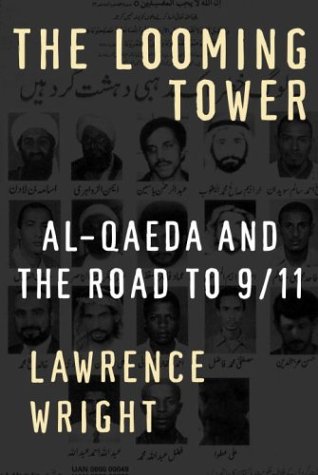
Book Review: The Looming Tower

The Plot Against America

Review by DEXTER FILKINS
The New York Times
Published: August 6, 2006

THE LOOMING TOWER
Al-Qaeda and the Road to 9/11.
By Lawrence Wright.
Illustrated. 469 pp. Alfred A. Knopf. $27.95.


Related
First Chapter: ‘The Looming Tower’ (August 6, 2006)

Readers’ Opinions
Forum: Book News and Reviews
When Mohamed Atta and his four Saudi confederates commandeered a Boeing 767 and steered it into the north tower of the World Trade Center, they began a story that still consumes us nearly five years on, and one that seems, on bad days, to promise war without end.

But the events of Sept. 11, 2001, were in many ways less the start of a tale than the end of one, or at least the climax of one, begun many years before in many different precincts: in the middle-class suburbs of Cairo, in the mosques of Hamburg, in Jidda, in Islamabad, in the quiet university town of Greeley, Colo.

In its simplest terms, this is the story of how a small group of men, with a frightening mix of delusion and calculation, rose from a tormented civilization to mount a catastrophic assault on the world’s mightiest power, and how another group of men and women, convinced that such an attack was on the way, tried desperately to stop it.

What a story it is. And what a riveting tale Lawrence Wright fashions in this marvelous book. “The Looming Tower” is not just a detailed, heart-stopping account of the events leading up to 9/11, written with style and verve, and carried along by villains and heroes that only a crime novelist could dream up. It’s an education, too — though you’d never know it — a thoughtful examination of the world that produced the men who brought us 9/11, and of their progeny who bedevil us today. The portrait of John O’Neill, the driven, demon-ridden F.B.I. agent who worked so frantically to stop Osama bin Laden, only to perish in the attack on the World Trade Center, is worth the price of the book alone. “The Looming Tower” is a thriller. And it’s a tragedy, too.

In the nearly five years since the attacks, we’ve heard oceans of commentary on the whys and how-comes and what-it-means and what’s nexts. Wright, a staff writer for The New Yorker — where portions of this book have appeared — has put his boots on the ground in the hard places, conducted the interviews and done the sleuthing. Others talked, he listened. And so he has unearthed an astonishing amount of detail about Osama bin Laden, Ayman al-Zawahiri, Mullah Muhammad Omar and all the rest of them. They come alive.

Who knew, for instance, that bin Laden, far from being a warrior-stoic fighting against the Soviet Union in Afghanistan, was actually a pathetic stick-in-the-mud who would fall ill before battle? That the combat-hardened Afghans, so tired of bin Laden’s behavior, declared him and his Arab associates “useless”? Or that he was a permissive father and indulgent husband? Or that he is only six feet tall?

More important, who knew — I sure didn’t — that bin Laden had left behind such a long trail of words? Wright has found them in books, on film, in audio recordings, in people’s notebooks and memories. This has allowed him to draw an in-depth portrait of bin Laden, and to chart his evolution from a self-conscious step-child growing up in Jidda, Saudi Arabia, to the visionary cave-dwelling madman who mimics the Holy Prophet in his most humdrum daily habits.

Wright takes the title of his book from the fourth sura of the Koran, which bin Laden repeated three times in a speech videotaped just as the hijackers were preparing to fly. The video was found later, on a computer in Hamburg.

“Wherever you are, death will find you, Even in the looming tower.”

There is poetry, too. Here is a particularly chilling bit, found on another videotape, which bin Laden had read aloud at the wedding of his 17-year-old son, Mohammed. The celebration took place not long after a pair of Qaeda suicide bombers, riding in a tiny boat filled with explosives, nearly sank the billion-dollar guided missile destroyer Cole. At least with regard to his abilities as an author, bin Laden was unusually modest: he let someone else write the words. “I am not, as most of our brothers know, a warrior of the word,” he said.

A destroyer, even the brave might fear,
She inspires horror in the harbor and the open sea,
She goes into the waves flanked by arrogance, haughtiness and fake might,
To her doom she progresses slowly, clothed in a huge illusion,
Awaiting her is a dinghy, bobbing in the waves.

“The Looming Tower” is full of such surprising detail. Al Qaeda’s leaders had all but shelved the 9/11 plot when they realized they lacked foot soldiers who could pass convincingly as westernized Muslims in the United States. At just the right moment Atta appeared in Afghanistan, along with Ramzi bin al-Shibh, Ziad al-Jarrah and Marwan al-Shehhi, all Western-educated transplants, offering themselves up for slaughter. The game was on.

Just as dramatic as the portraits of bin Laden and Zawahiri is Wright’s account of the roots of Islamic militancy — the intellectual, spiritual and material world from which the plotters came. Wright draws a fascinating picture of Sayyid Qutb, the font of modern Islamic fundamentalism, a frail, middle-aged writer who found himself, as a visitor to the United States and a student at Colorado State College of Education in Greeley in the 1940’s, overwhelmed by the unbridled splendor and godlessness of modern America. And by the sex: like so many others who followed him, Qutb seemed simultaneously drawn to and repelled by American women, so free and unselfconscious in their sexuality. The result is a kind of delirium:

“A girl looks at you, appearing as if she were an enchanting nymph or an escaped mermaid,” Qutb wrote, “but as she approaches, you sense only the screaming instinct inside her, and you can smell her burning body, not the scent of perfume, but flesh, only flesh. Tasty flesh, truly, but flesh nonetheless.”

It wasn’t much later that Qutb began writing elaborate rationalizations for killing non-Muslims and waging war against the West. Years later, Atta expressed a similar mix of obsession and disgust for women. Indeed, anyone who has spent time in the Middle East will recognize such tortured emotions.

WRIGHT shows, correctly, that at the root of Islamic militancy — its anger, its antimodernity, its justifications for murder — lies a feeling of intense humiliation. Islam plays a role in this, with its straitjacketed and all-encompassing worldview. But whether the militant hails from a middle-class family or an impoverished one, is intensely religious or a “theological amateur,” as Wright calls bin Laden and his cohort, he springs almost invariably from an ossified society with an autocratic government that is unable to provide any reason to believe in the future. Islam offers dignity, even in — especially in — death. Living in the West, Atta and the others felt these things more acutely, not less. As Wright notes:

“Their motivations varied, but they had in common a belief that Islam — pure and primitive, unmitigated by modernity and uncompromised by politics — would cure the wounds that socialism or Arab nationalism had failed to heal. They were angry but powerless in their own countries. They did not see themselves as terrorists but as revolutionaries who, like all such men throughout history, had been pushed into action by the simple human need for justice. Some had experienced brutal repression; some were simply drawn to bloody chaos. From the beginning of Al Qaeda, there were reformers and there were nihilists. The dynamic between them was irreconcilable and self-destructive, but events were moving so quickly that it was almost impossible to tell the philosophers from the sociopaths. They were glued together by the charismatic personality of Osama bin Laden, which contained both strands, idealism and nihilism, in a potent mix.”

In John O’Neill, bin Laden almost met his match. The supervisor of the F.B.I.’s New York office and of the team assigned to track Al Qaeda in the United States, O’Neill felt, as strongly as anyone in the government, that Al Qaeda was coming to America. He was a relentless investigator, a volcanic personality and sometimes his own worst enemy. In the end he broke himself on a government bureaucracy that could not — and would not — move as quickly as he did. O’Neill and others like him were in a race with Al Qaeda, and although we know how the race ended, it’s astonishing — and heartbreaking — to learn how close it was.

Some of the F.B.I.’s field agents, as we now know, had premonitions of what was coming. When the supervisor of the Minneapolis field office was admonished, in August 2001, for expressing fears that an Islamic radical attending flight school might be planning a suicide attack, he shot back defiantly that he was “trying to keep someone from taking a plane and crashing into the World Trade Center.” Amazing.

The most gut-wrenching scenes are the ones that show F.B.I. agents trying, as 9/11 approached, to pry information from their rivals inside the United States government. The C.I.A., Wright says, knew that high-level Qaeda operatives had held a meeting in Malaysia in January 2000, and, later, that two of them had entered the United States. Both men turned out to be part of the team that hijacked the planes on Sept. 11. The C.I.A. failed to inform agencies like the F.B.I. — which might have been able to locate the men and break up the plot — until late in the summer of 2001.

The fateful struggle between the C.I.A. and F.B.I. in the months leading up to the attacks has been outlined before, but never in such detail. At meetings, C.I.A. analysts dangled photos of two of the eventual hijackers in front of F.B.I. agents, but wouldn’t tell them who they were. The F.B.I. agents could sense that the C.I.A. possessed crucial pieces of evidence about Islamic radicals they were investigating, but couldn’t tell what they were. The tension came to a head at a meeting in New York on June 11, exactly three months before the catastrophe, which ended with F.B.I. and C.I.A. agents shouting at each other across the room.

In one of the most remarkable scenes in the book, Ali Soufan, an F.B.I. agent assigned to Al Qaeda, was taken aside on Sept. 12 and finally shown the names and photos of the men the C.I.A. had known for more than a year and a half were in America. The planes had already struck. Soufan ran to the bathroom and retched.

Great stuff. I just wish Wright had given us something, even a chapter, on the hijackings themselves; as it is, he takes us right up to the moment, and then straight to the burning towers. Perhaps he felt that ground was too well-trodden. My other complaint is more substantive.
Through the enormous amount of legwork he has done, tracking down people who worked with bin Laden and Zawahiri over the years, Wright has drawn up verbatim reconstructions of entire conversations, some of which took place more than a decade ago. Many of these conversations are riveting. Still, in some cases, it’s hard to believe that memories are that good.

“The Looming Tower” ends near the Pakistani border, where Zawahiri, or someone who looked like him, rode through a village on horseback and then disappeared into the mountains. It’s not a definitive ending; there is no closure. And that’s the point. For as amazing as the story of Al Qaeda and the road to 9/11 is, it’s not over yet.

Dexter Filkins is a Baghdad correspondent for The Times.

Stephen Schwartz: The Problem of British Islam

Don't LET Up
The transatlantic air plot and the problem of British Islam.
http://www.weeklystandard.com
08/10/2006 3:15:00 PM

BRITISH AUTHORITIES have been slow to acknowledge openly the Pakistani-Muslim background of the suspects arrested in the mass terror conspiracy that brought chaos to British and American airports Thursday. At first, official sources in the United Kingdom would confirm only that they were working with "the South Asian community" on the case; then it was disclosed that the Pakistani government was involved in the investigation.

This reticence in naming the focus of so significant a terrorism inquiry is a symptom of the larger problems of Islam in Britain, and of "Euro-Islam" more generally. Put plainly, Pakistani Sunnis in Britain--more than a million strong--are the most radical Muslims in Europe. British Islam is dominated by Pakistan-born clerics. It is saturated with extremist preaching, media, and charity efforts which support the recruitment of terrorists.

News from Pakistan itself indicates the main trail from there to Heathrow. British and Pakistani sources linked the plan to the Pakistani government's house arrest of Hafiz Muhammad Saeed, founder of the armed paramilitary movement Lashkar-e-Taiba (LET, or Army of the Righteous). LET, which is designated a terrorist organization by the State Department, is an ally of al Qaeda and is present wherever Pakistani Sunnis congregate and violence is hatched.
In America, LET was behind the Northern Virginia jihad network, whose members were jailed beginning in 2003 and sentenced to varying federal prison terms for terrorism-related acts. LET was also accused in the Bombay train bombings in India last month. It has significant resources in Pakistan, Britain, and elsewhere.

Yet notwithstanding the courage of Tony Blair, the British government appears paralyzed in dealing with this radical influence over British-Asian Muslims. Instead of confronting Pakistani-born extremist imams on British territory, the Brits organized a roadshow in their Muslim communities under the rubric of "the radical middle way"--an extraordinarily inept promotional conceit--in which young Muslims are called to renounce extremism.

The British and other media are referring to the arrested suspects in the airline conspiracy--as they did when bombs exploded in the London Underground last year--as "homegrown." If history is any guide, politicians will soon wring their hands and ask why people brought up in the West turned so violently against it. Leftists and isolationists will blame the war against terror for terror.

But the force that drives mosque congregants and their children to build bombs in Britain does not originate in social conditions experienced by Muslims in Europe. Rather, it represents a doctrine brought from the Arab world, via Pakistan and well-funded groups like Lashkar-e-Taiba, to communities from Birmingham, England, to Fairfax, Virginia.

Britain must take off the blinders of political correctness when examining Islam in its Pakistani population and should insist on British training for Muslim clerics officiating on its soil.
Otherwise, London's 7/7 bombs and the latest transatlantic travel conspiracy could mark the emergence of Britain as the main theater of jihadist violence in Western Europe.

Stephen Schwartz is a frequent contributor to The Weekly Standard.

Peter Schweizer: Gore's Green Hypocrisy

Peter Schweizer
USA Today
August 11, 2006
http://www.usatoday.com

Al Gore has spoken: The world must embrace a "carbon-neutral lifestyle." To do otherwise, he says, will result in a cataclysmic catastrophe. "Humanity is sitting on a ticking time bomb," warns the website for his film, An Inconvenient Truth. "We have just 10 years to avert a major catastrophe that could send our entire planet into a tailspin."

Graciously, Gore tells consumers how to change their lives to curb their carbon-gobbling ways: Switch to compact fluorescent light bulbs, use a clothesline, drive a hybrid, use renewable energy, dramatically cut back on consumption. Better still, responsible global citizens can follow Gore's example, because, as he readily points out in his speeches, he lives a "carbon-neutral lifestyle." But if Al Gore is the world's role model for ecology, the planet is doomed.

For someone who says the sky is falling, he does very little. He says he recycles and drives a hybrid. And he claims he uses renewable energy credits to offset the pollution he produces when using a private jet to promote his film. (In reality, Paramount Classics, the film's distributor, pays this.)

Public records reveal that as Gore lectures Americans on excessive consumption, he and his wife Tipper live in two properties: a 10,000-square-foot, 20-room, eight-bathroom home in Nashville, and a 4,000-square-foot home in Arlington, Va. (He also has a third home in Carthage, Tenn.) For someone rallying the planet to pursue a path of extreme personal sacrifice, Gore requires little from himself.

Then there is the troubling matter of his energy use. In the Washington, D.C., area, utility companies offer wind energy as an alternative to traditional energy. In Nashville, similar programs exist. Utility customers must simply pay a few extra pennies per kilowatt hour, and they can continue living their carbon-neutral lifestyles knowing that they are supporting wind energy. Plenty of businesses and institutions have signed up. Even the Bush administration is using green energy for some federal office buildings, as are thousands of area residents.

But according to public records, there is no evidence that Gore has signed up to use green energy in either of his large residences. When contacted Wednesday, Gore's office confirmed as much but said the Gores were looking into making the switch at both homes. Talk about inconvenient truths.

Gore is not alone. Democratic National Committee Chairman Howard Dean has said, "Global warming is happening, and it threatens our very existence." The DNC website applauds the fact that Gore has "tried to move people to act." Yet, astoundingly, Gore's persuasive powers have failed to convince his own party: The DNC has not signed up to pay an additional two pennies a kilowatt hour to go green. For that matter, neither has the Republican National Committee.

Maybe our very existence isn't threatened.

Gore has held these apocalyptic views about the environment for some time. So why, then, didn't Gore dump his family's large stock holdings in Occidental (Oxy) Petroleum? As executor of his family's trust, over the years Gore has controlled hundreds of thousands of dollars in Oxy stock. Oxy has been mired in controversy over oil drilling in ecologically sensitive areas.

Living carbon-neutral apparently doesn't mean living oil-stock free. Nor does it necessarily mean giving up a mining royalty either.

Humanity might be "sitting on a ticking time bomb," but Gore's home in Carthage is sitting on a zinc mine. Gore receives $20,000 a year in royalties from Pasminco Zinc, which operates a zinc concession on his property. Tennessee has cited the company for adding large quantities of barium, iron and zinc to the nearby Caney Fork River.

The issue here is not simply Gore's hypocrisy; it's a question of credibility. If he genuinely believes the apocalyptic vision he has put forth and calls for radical changes in the way other people live, why hasn't he made any radical change in his life? Giving up the zinc mine or one of his homes is not asking much, given that he wants the rest of us to radically change our lives.


Peter Schweizer is a research fellow at the Hoover Institution and author of Do As I Say (Not As I Do): Profiles in Liberal Hypocrisy.

Monday, August 07, 2006

Paul Sperry: Rehabbing Islamic Extremists

Paul Sperry
http://www.FrontPageMag.com
August 7, 2006

Could you imagine the New York Times running a saintly profile of a skinhead who said he hoped the U.S. would be a Nazi country ruled by the Fourth Reich? Of course not. It would never happen. Nor should it.

So why did the paper recently run a glowing feature of a Muslim cleric who said he hopes the U.S. would be a Muslim country ruled by Islamic law? The Times even ran it -- in the middle of a war on Islamic terror -- on its front page.

"Every Muslim who is honest would say, I would like to see America become a Muslim country," imam Zaid Shakir admitted in the last paragraph of a long story that spent the preceding 2,862 words trying to convince us how progressive and moderate Shakir is.

Talk about burying the lead. If this is the new voice of moderate Muslims in America, God help us (and I don't mean Allah).

Ironically, the story was titled, "American Muslim Clerics Seek a Modern Middle Ground."
Modern? Islamic law is based on 1,400-year-old Bedouin justice that metes out beheadings, amputations and stonings. It also sanctions polygamy, denies women basic rights and merges mosque and state.

The Times also profiled Shakir's California partner, Sheik Hamza Yusuf, also described as "hip" and popular with Americanized Muslim students and converts. The pair tours college campuses speaking to packed auditoriums.

These aren't your father's imams, the Times says. They are "a new generation of imams who can reconcile Islam and American culture" -- even as at least one of them hopes for the Islamization of American culture.

"They say that Islam must be rescued from extremists," the story said. "The two are challenging the influence of Islam's more reactionary sects, like Wahhabism and Salafism, which has been spread to American mosques and schools by clerics trained in Saudi Arabia."

Hmm. A check of Yusuf's bio reveals he himself studied Islam in Medina, Saudi Arabia, a fact not mentioned in the piece.That's not all that was left out.

Yusuf just two days before 9-11 made an ominous prediction in a California speech that triggered an FBI investigation, according to the Washington Post.
"This country is facing a terrible fate" for occupying Muslim lands, Yusuf warned. "The reason for that is that this country stands condemned like Europe stood condemned because of what it did."

And lest people forget that Europe suffered two world wars after conquering the Muslim lands, Europe's countries were devastated, they were completely destroyed," he added. "Their young people were killed."

FBI agents paid the imam a visit to question him about the incendiary remarks, according to the Post's account. When they knocked on his door, his wife answered and told them he wasn't home. "He's with the president" in Washington, she said.

The agents thought she was joking, but she wasn't. Yusuf was one of many Muslim leaders invited by the White House to meet and pray with President Bush in the weeks after 9-11. (He's the cleric who convinced Bush to ditch "Infinite Justice" as the name for the Afghan war since it might offendMuslims.)
The rehabilitation of Yusuf's image was already in progress, thanks to his Muslim friends in the administration such as Suhail Khan. Now the Times is taking it to the next level, no doubt pleased with Yusuf's political activism, which has included taking vanloads of Arabs to antiwar protests outside the Republican National Convention. The paper is willing to apologize for even Yusuf's past anti-Semitic remarks. In 1995, for example, he called Judaism "a most racist religion."

"Both Mr. Shakir and Mr. Yusuf have a history of anti-American rhetoric," the Times allowed, "but with age, they have tempered their views."

The Times wants us to believe that these leopards have matured and lost their radical spots. But are they really gone? Or did they temporarily disappear as 9-11 brought more scrutiny?Shakir, who still hopes to replace the U.S. Constitution with the Quran, once praised the effectiveness of "armed struggle" such as the one that brought the Taliban to power. A copy of the pamphlet he wrote was found in the apartment of a suspect in the first World Trade Center bombing.

Never mind all that, the Times says. The imams are now just a couple of tweedy, goatee'd moderates "encouraging tolerance." Uh-huh, that's certainly what they'd have us believe anyway.

Click Here to support Frontpagemag.com.

Paul Sperry is a Hoover Institution media fellow and author of "Infiltration: How Muslim Spies and Subversives Have Penetrated Washington." He can be conacted at Sperry@SperryFiles.com.

Saturday, August 05, 2006

Thomas Friedman: Time for Plan B

THOMAS L. FRIEDMAN
The New York Times
Published: August 4, 2006

It is now obvious that we are not midwifing democracy in Iraq. We are baby-sitting a civil war.

When our top commander in Iraq, Gen. John Abizaid, tells a Senate Committee, as he did yesterday, that “the sectarian violence is probably as bad as I’ve seen it,” it means that three years of efforts to democratize Iraq are not working. That means “staying the course” is pointless, and it’s time to start thinking about Plan B — how we might disengage with the least damage possible.

It seemed to me over the last three years that, even with all the Bush team’s missteps, we had to give our Iraqi partners a chance to produce a transitional government, then write a constitution, then hold an election and then, finally, put together their first elected cabinet. But now they have done all of that — and the situation has only worsened.

The Sunni jihadists and Baathists are as dedicated as ever to making this U.S.-Iraqi democracy initiative fail. That, and the runaway sectarian violence resulting from having too few U.S. troops and allowing a militia culture to become embedded, have made Iraq a lawless mess.

Yes, I believe it was and remains hugely important to try to partner with Iraqis to create one good example in the heart of the Arab world of a decent, progressive state, where the politics of fear and tribalism do not reign — the politics that has produced all the pathologies of unemployment, religious intolerance and repression that make the Middle East so dangerous to itself and others.

But the administration now has to admit what anyone — including myself — who believed in the importance of getting Iraq right has to admit: Whether for Bush reasons or Arab reasons, it is not happening, and we can’t throw more good lives after good lives.

Since the Bush team never gave us a Plan A for Iraq, it at least owes us a Plan B. It’s not easy. Here are my first thoughts about a Plan B and some of the implications.

I think we need to try a last-ditch Bosnia-like peace conference that would bring together all of Iraq’s factions and neighbors. Just as Bosnia could be solved only by an international peace force and the Dayton conference — involving Russia, Europe and the U.S., the powers most affected by Bosnia’s implosion — the civil war in Iraq can be quelled only by a coalition of those most affected by Iraq’s implosion: the U.S., Russia, Europe, Japan, India, China, Turkey, Saudi Arabia, Egypt, Iran, Syria and Jordan. As in Bosnia, any solution will have to be some form of federalism, a division of oil wealth and policing by an international force, where needed.

For such a conference to come about, though, the U.S. would probably need to declare its intention to leave. Iraqis, other Arabs, Europeans and Chinese will get serious about helping to salvage Iraq only if they believe we are leaving and it will damage their interests.

What would be the consequences of leaving without such a last-ditch peace effort, or if it just fails? Iraq could erupt into a much wider civil war, drawing in its neighbors. Or, Iraqis might stare into this abyss and actually come to terms with each other on their own. Our presence may be part of the problem. It’s hard to know.

If Iraq opts for all-out civil war, its two million barrels a day will be off the market and oil could go above $100 a barrel. (That would, however, spur more investment in alternative fuels that could one day make us independent of this volatile region.)

Some fear that Iran will be the winner. But will it? Once we are out of Iraq, Iran will have to manage the boiling pot next door. That will be a huge problem for Iran. The historical enmity toward Iran by Iraqi Arabs — enmity temporarily focused on us — will re-emerge. And Iran will also have to compete with its ally Syria for influence in Iraq.

Yes, the best way to contain Iran would have been to produce a real Shiite-led democracy in Iraq, exposing the phony one in Tehran. But second best is leaving Iraq. Because the worst option — the one Iran loves — is for us to stay in Iraq, bleeding, and in easy range to be hit by Iran if we strike its nukes.

Finally, the war in Iraq has so divided us at home and abroad that leaving, while bringing other problems, might also make it easier to build coalitions to deal with post-U.S. Iraq, Iran, Hezbollah and Syria. All these problems are connected. We need to deal with Iran and Syria, but from a position of strength — and that requires a broad coalition.

The longer we maintain a unilateral failing strategy in Iraq, the harder it will be to build such a coalition, and the stronger the enemies of freedom will become.

Friday, August 04, 2006

Book Review: Simply Christian

by Raymond J. Keating

On the Church and Society
July 25, 2006
http://www.orthodoxytoday.org

Few books manage to be inspirational, moving, illuminating, challenging, and even a bit annoying all at the same time. But that is the case with N.T. Wright's "Simply Christian: Why Christianity Makes Sense" (HarperSanFrancisco, 2006).

Wright is a prolific author and the Anglican Bishop of Durham in England. The purpose of this book is rather daunting. "My aim," Wright explains, "has been to describe what Christianity is all about, both to commend it to those outside the faith and to explain it to those inside."

Given the attacks on Christianity from both the outside world and within the church, this is an important time for such an explanation. But does Wright stay true to the traditional Christian faith, or stray into the deceptive revisionism that has distressingly plagued so much of the church in recent times?

Some doubts might be raised in the few instances where Wright veers into the political. For example, he proclaims that "what the world needs now, in fulfillment of some of scripture's deepest plans, is global economic justice." And a bit later, Wright calls for Christians to campaign on "global debt," and the church to develop an agenda on issues like "globalization and fair trade."

But what, specifically, does "economic justice" and "fair trade" mean, and does Christianity really dictate certain positions on such issues? These unnecessary intrusions into Wright's book have nothing to do with what being simply Christian really means. Thankfully, they are rare.
Experience also shows that an emphasis on such political issues often pushes aside the central themes of Christianity. Fortunately, though, that is not the case with Wright. He is a rare breed in that misguided political intrusions do not signal an overarching sloppy theology as well.

For example, Bishop Wright does not ignore the problem of sin. He observes: "It's no part of Christian belief to say that the followers of Jesus have always got everything right. Jesus himself taught his followers a prayer which includes a clause asking God for forgiveness. He must have thought we would go on needing it."

Wright does not even shy away from the radioactive question of sex and marriage: "Throughout the early centuries of Christianity, when every kind of sexual behavior ever known to the human race was widely practiced throughout ancient Greek and Roman society, the Christians, like the Jews, insisted that sexual activity was to be restricted to the marriage of a man and a woman. The rest of the world, then as now, thought they were mad. The difference, alas, is that today half the church seems to think so, too."

More important to this book is Wright's emphasis on those glorious places where heaven and earth meet. He observes: "This sense of overlap between heaven and earth, and the sense of God thereby being present on earth without having to leave heaven, lies at the heart of Jewish and early Christian theology."

The book traces this interlocking theme from the Old Testament to Jesus Christ. Wright explains that "in Jesus of Nazareth heaven and earth have come together once and for all. The place where God's space and our space intersect and interlock is no longer the Temple in Jerusalem. It is Jesus himself. We recall that 'heaven,' in Jewish and Christian thought, isn't miles away up in the sky, but is, so to speak, God's dimension of the cosmos. Thus, though Christians believe that Jesus is now 'in heaven,' he is present, accessible, and indeed active within our world."

Wright goes on to highlight where heaven and earth come together for us today. He points out that "those in whom the Spirit comes to live are God's new Temple," and "are, individually and corporately, places where heaven and earth meet." He also speaks beautifully and compellingly about prayer, the sacraments, with particular emphasis on Holy Communion, and reading Holy Scripture as "places to go where God has promised to meet with his people."

There is much more to mine and relish in "Simply Christian," including on truth, worship, liturgy, the arts, the meaning of Messiah, the divinity of Jesus, the role of the church, spirituality, Christian history, and trust in the Gospels. Bishop Wright's book not only introduces Christianity, but also spurs all Christians to reflect more deeply on their faith, and what it means for the world at large.

"Simply Christian" ranks as a marvelous achievement.

Raymond J. Keating, also a columnist with Newsday, can be reached at ChurchandSociety@aol.com.

Copyright © Raymond J. Keating

Simply Christian: Why Christianity Makes Sense
N.T. Wright$14.92
Posted: 25-Jul-06

Victor Davis Hanson: The Brink of Madness

http://www.nationalreview.com
August 04, 2006, 5:27 a.m.

The Brink of Madness
A familiar place.
By Victor Davis Hanson

When I used to read about the 1930s — the Italian invasion of Abyssinia, the rise of fascism in Italy, Spain, and Germany, the appeasement in France and Britain, the murderous duplicity of the Soviet Union, and the racist Japanese murdering in China — I never could quite figure out why, during those bleak years, Western Europeans and those in the United States did not speak out and condemn the growing madness, if only to defend the millennia-long promise of Western liberalism.

Of course, the trauma of the Great War was all too fresh, and the utopian hopes for the League of Nations were not yet dashed. The Great Depression made the thought of rearmament seem absurd. The connivances of Stalin with Hitler — both satanic, yet sometimes in alliance, sometimes not — could confuse political judgments. But nevertheless it is still surreal to reread the fantasies of Chamberlain, Daladier, and Pope Pius, or the stump speeches by Charles Lindbergh (“Their [the Jews’] greatest danger to this country lies in their large ownership and influence in our motion pictures, our press, our radio, and our government”) or Father Coughlin (“Many people are beginning to wonder whom they should fear most — the Roosevelt-Churchill combination or the Hitler-Mussolini combination.”) — and baffling to consider that such men ever had any influence.

Not any longer. Our present generation too is on the brink of moral insanity. That has never been more evident than in the last three weeks, as the West has proven utterly unable to distinguish between an attacked democracy that seeks to strike back at terrorist combatants, and terrorist aggressors who seek to kill civilians.

It is now nearly five years since jihadists from the Arab world left a crater in Manhattan and ignited the Pentagon. Apart from the frontline in Iraq, the United States and NATO have troops battling the Islamic fascists in Afghanistan.
European police scramble daily to avoid another London or Madrid train bombing. The French, Dutch, and Danish governments are worried that a sizable number of Muslim immigrants inside their countries are not assimilating, and, more worrisome, are starting to demand that their hosts alter their liberal values to accommodate radical Islam. It is apparently not safe for Australians in Bali, and a Jew alone in any Arab nation would have to be discreet — and perhaps now in France or Sweden as well. Canadians’ past opposition to the Iraq war, and their empathy for the Palestinians, earned no reprieve, if we can believe that Islamists were caught plotting to behead their prime minister. Russians have been blown up by Muslim Chechnyans from Moscow to Beslan. India is routinely attacked by Islamic terrorists. An elected Lebanese minister must keep in mind that a Hezbollah or Syrian terrorist — not an Israeli bomb — might kill him if he utters a wrong word. The only mystery here in the United States is which target the jihadists want to destroy first: the Holland Tunnel in New York or the Sears Tower in Chicago.

In nearly all these cases there is a certain sameness: The Koran is quoted as the moral authority of the perpetrators; terrorism is the preferred method of violence; Jews are usually blamed; dozens of rambling complaints are aired, and killers are often considered stateless, at least in the sense that the countries in which they seek shelter or conduct business or find support do not accept culpability for their actions. Yet the present Western apology to all this is often to deal piecemeal with these perceived Muslim grievances: India, after all, is in Kashmir; Russia is in Chechnya; America is in Iraq, Canada is in Afghanistan; Spain was in Iraq (or rather, still is in Al Andalus); or Israel was in Gaza and Lebanon. Therefore we are to believe that “freedom fighters” commit terror for political purposes of “liberation.” At the most extreme, some think there is absolutely no pattern to global terrorism, and the mere suggestion that there is constitutes “Islamaphobia.”

Here at home, yet another Islamic fanatic conducts an act of al Qaedism in Seattle, and the police worry immediately about the safety of the mosques from which such hatred has in the past often emanated — as if the problem of a Jew being murdered at the Los Angeles airport or a Seattle civic center arises from not protecting mosques, rather than protecting us from what sometimes goes on in mosques.

But then the world is awash with a vicious hatred that we have not seen in our generation: the most lavish film in Turkish history, “Valley of the Wolves,” depicts a Jewish-American harvesting organs at Abu Ghraib in order to sell them; the Palestinian state press regularly denigrates the race and appearance of the American Secretary of State; the U.N. secretary general calls a mistaken Israeli strike on a U.N. post “deliberate,” without a word that his own Blue Helmets have for years watched Hezbollah arm rockets in violation of U.N. resolutions, and Hezbollah’s terrorists routinely hide behind U.N. peacekeepers to ensure impunity while launching missiles.

If you think I exaggerate the bankruptcy of the West or only refer to the serial ravings on the Middle East of Pat Buchanan or Jimmy Carter, consider some of the most recent comments from Hezbollah chief Hassan Nasrallah about Israel: “When the people of this temporary country lose their confidence in their legendary army, the end of this entity will begin [emphasis added].” Then compare Nasrallah’s remarks about the U.S: “To President Bush, Prime Minister Olmert and every other tyrannical aggressor. I want to invite you to do what you want, practice your hostilities. By God, you will not succeed in erasing our memory, our presence or eradicating our strong belief. Your masses will soon waste away, and your days are numbered [emphasis added].”

And finally examine here at home reaction to Hezbollah — which has butchered Americans in Lebanon and Saudi Arabia — from a prominent Democratic Congressman, John Dingell: “I don’t take sides for or against Hezbollah.” And isn’t that the point, after all: the amoral Westerner cannot exercise moral judgment because he no longer has any?

An Arab rights group, between denunciations of Israel and America, is suing its alma mater the United States for not evacuating Arab-Americans quickly enough from Lebanon, despite government warnings of the dangers of going there, and the explicit tactics of Hezbollah, in the manner of Saddam Hussein, of using civilians as human shields in the war it started against Israel. Demonstrators on behalf of Hezbollah inside the United States — does anyone remember our 241 Marines slaughtered by these cowardly terrorists? — routinely carry placards with the Star of David juxtaposed with Swastikas, as voices praise terrorist killers. Few Arab-American groups these past few days have publicly explained that the sort of violence, tyranny, and lawlessness of the Middle East that drove them to the shores of a compassionate and successful America is best epitomized by the primordial creed of Hezbollah.

There is no need to mention Europe, an entire continent now returning to the cowardice of the 1930s. Its cartoonists are terrified of offending Muslim sensibilities, so they now portray the Jews as Nazis, secure that no offended Israeli terrorist might chop off their heads. The French foreign minister meets with the Iranians to show solidarity with the terrorists who promise to wipe Israel off the map (“In the region there is of course a country such as Iran — a great country, a great people and a great civilization which is respected and which plays a stabilizing role in the region”) — and manages to outdo Chamberlain at Munich. One wonders only whether the prime catalyst for such French debasement is worry over oil, terrorists, nukes, unassimilated Arab minorities at home, or the old Gallic Jew-hatred.

It is now a cliché to rant about the spread of postmodernism, cultural relativism, utopian pacifism, and moral equivalence among the affluent and leisured societies of the West. But we are seeing the insidious wages of such pernicious theories as they filter down from our media, universities, and government — and never more so than in the general public’s nonchalance since Hezbollah attacked Israel.

These past few days the inability of millions of Westerners, both here and in Europe, to condemn fascist terrorists who start wars, spread racial hatred, and despise Western democracies is the real story, not the “quarter-ton” Israeli bombs that inadvertently hit civilians in Lebanon who live among rocket launchers that send missiles into Israeli cities and suburbs. Yes, perhaps Israel should have hit more quickly, harder, and on the ground; yes, it has run an inept public relations campaign; yes, to these criticisms and more.

But what is lost sight of is the central moral issue of our times: a humane democracy mired in an asymmetrical war is trying to protect itself against terrorists from the 7th century, while under the scrutiny of a corrupt world that needs oil, is largely anti-Semitic and deathly afraid of Islamic terrorists, and finds psychic enjoyment in seeing successful Western societies under duress.

In short, if we wish to learn what was going on in Europe in 1938, just look around.

— Victor Davis Hanson is a senior fellow at the Hoover Institution. He is the author, most recently, of A War Like No Other. How the Athenians and Spartans Fought the Peloponnesian War.


Thursday, August 03, 2006

Peggy Noonan: No Mas

Castro may be dead. It's time to kill Castroism.

The Wall Street Journal
Thursday, August 3, 2006 12:01 a.m. EDT

It has long been my bitter hunch that the man I can't help think of as the last monster of the 20th century, Fidel Castro, creator and warden of the floating prison to our south, would die of old age in a big brass bed, a snifter of brandy in one hand and a good cigar in the other. No firing squad, no prison. He'd leave thinking he got away with it all. He had that kind of luck. The devil takes care of his own.

I hated that hunch.

Now Cuban authorities say Castro has temporarily stepped down due to ill health. And it is possible this is true. It is just as possible that Castro is dead, and that what we are witnessing is not the graceful and temporary relinquishing of power--that would be unlike our Fidel, whose frozen fingers would more likely have to be peeled off the steering wheel with the back of a hammer--but the spinning of the death of a monster whose sudden departure might shock the people of Cuba into something like movement toward progress. And so Fidel is "sick" and his brother "stepping in." One suspects that in the coming weeks Castro will "take a turn for the worse," and that Raul Castro will take to hurried midnight visits to an empty hospital room, offering afterward to the waiting media both color coverage and play by play: "The tubes have been taken out. He mouthed the words, 'Tell the people I love them, and leave them in good hands.' "

Then, once the spontaneous mourning demonstrations have been arranged, will come word of his passing.

The pre-positioning of Raul solves a potential struggle for succession and inhibits competitors. The world gets used to him. Things continue as they were. Forty-seven years becomes 48, and 49 . . .

**********

What to do now?

How about this: Treat it as an opportunity. Use the change of facts to announce a change of course. Declare the old way over. Declare a new U.S.-Cuban relationship, blow open the doors of commerce and human interaction, allow American investment and tourism, mix it up, reach out one by one and person by person to the people of Cuba. "Flood the zone." Flood it with incipient prosperity and the insinuation of democratic values. Let Castroism drown in it.

The American economic embargo of Cuba is 40 years old. It has been called ineffective--it did not produce Fidel's downfall. It has been called effective--it kept the squeeze on, demonstrated what communism reaped and reaps. In any case it was right to deny a monstrous regime contact with, and implicit encouragement from, the American democracy.

All fair enough. But the monster may be dead and is surely dying. In any case, what remains of Cuban communism dies with him. Cubans don't know what they are economically except one thing: poor.

Castro survived the ruin of his economy--he had the guns--and he used his resistance to isolation to enhance his mystique. Fearless Fidel faced down the yanqui. Still, he was forced to swerve and pivot. In 1994, after Soviet cash supports had ended, he was forced to allow some modest individual self-employment.

With Castro gone, why not seize the moment for some wise, judicious, free-market love-bombing?

As in: Allow Americans to go to Cuba. Allow U.S. private money into Cuba. Let hotels, homes, restaurants, stores be developed, bought, opened, reopened. Use Fidel's death to reintroduce Cubans on the ground to Americans, American ways, American money and American freedom.
Remind them of what they wanted, what they thought they were getting when the bearded one came down from the Sierra Maestre. Use his death/illness/collapse/disappearing act as an excuse to turn the past 40 years of policy on its head. Declare him over. Create new ties. Ignore the dictator, make partnerships with the people.

Yes give more money to Radio Marti and all Western government efforts to communicate with the people of Cuba. But also allow American media companies in. Make a jumble, shake it up, allow the conditions that can help create economic vibrancy and let that reinspire democratic thinking. The Cuban government, hit on all fronts by dynamism for the first time in half a century, will not be able to control it all.

That is how to undo Fidel, and Fidelism. That's how to give him, on the chance he's alive, a last and lingering headache. That's how to puncture his mystique. Let his people profit as he dies.
If he is actually ill, why not arrange it so that the last sounds he hears on earth are a great racket from the streets? What, he will ask the nurse, is that? "Oh," she can explain, "they are rebuilding Havana. It's the Hilton Corp. Except for the drills. That's Steve Wynn. The jackhammer is Ave Maria University, building an extension campus."

Imagine him hearing this. It would, finally, be the exploding cigar. That's the way to make his beard fall off.

**********

What is the reason we don't do this--open Cuba as far as we can, retake it with soft, individual, and corporate power, let the marketplace do the heavy lifting? Tradition, habit, prevailing concepts. Politics. As all but children know, Florida is a swing state, and Cubans forced to flee Castro--and their children, grandchildren and great grandchildren--justly and rightly hate Fidel, dictatorship, all dictatorships. Their vote is significant and can swing the swing state. Cuban Americans know how to cohere and to show loyalty and antipathy within the democratic drama. Good. But I hope they are thinking about how to defeat Castroism now, today, with today's conditions. They're in the right war, but all good fighters know to shift troops, weapons and tactics when the landscape changes.

There is little President Bush can do, which, considering the politics of the matter, would be a relief to the White House. The president's hands are pretty much tied by the 1996 Helms-Burton Act, which keeps the U.S. government from lifting sanctions on Cuba or changing current arrangements until Castro frees his political prisoners and announces authentic elections.
Assuming he's too dead to do that, it won't happen. It wouldn't happen anyway, as he never admitted he had political prisoners or didn't hold real elections.

Congress could repeal Helms-Burton, and the administration could flood the zone, drowning Castroism in it. This could yield a great public good not only for the people of Cuba, and America, but the world.

Ms. Noonan is a contributing editor of The Wall Street Journal and author of "John Paul the Great: Remembering a Spiritual Father," (Penguin, 2005), which you can order from the OpinionJournal bookstore. Her column appears Thursdays.

Kenneth R. Timmerman: Finish the Job

Kenneth R. Timmerman
http://www.FrontPageMag.com
August 3, 2006

Kiryat Shemona, Israel (Aug 2, 2006) – Israel needs to “finish the job” against Hezbollah in Lebanon, former Israeli prime minister Benjamin Netanyahu told me in this northern Israeli town on Tuesday.

Hezbollah’s Iranian- and Syrian-supplied rockets have emptied this normally bustling agricultural and manufacturing center, and have turned most of northern Israel into ghost towns.

But the few residents who remain behind are defiant.

An impassioned woman blasted the government for pussy-footing around in its ground offensive in Lebanon, and said she was ready to stay “six months in the shelters” if that was needed in order to finish off the Hezbollah rocket attacks.

“The people of Israel are sending the government of Iran a message,” government spokesman Daniel Seaman said.

“The Israeli public is demanding that the government finish the job, to put an end to the threat we have been facing from Iran’s proxy army, Hezbollah. If Hezbollah thought public opinion was our weak point, they were wrong,” he told me in Metulla yesterday.

While the United States has been leading diplomatic efforts to achieve a lasting solution that would remove Hezbollah as an effective fighting force, the Bush administration must not pressure Israel into an early ceasefire. To do so would be against American interests, and would embolden our enemies.

Israeli politicians cannot accept a halt to military operations against Hezbollah until they have crippled it as an effective fighting force and can prevent future missile attacks against Israel.

Opinion polls in Israel show overwhelming support – way over 90% - for the government’s ongoing military operations against Hezbollah.

25-year old Lt. Lynat Bruck, a female reservist who was called up to active duty in the military police, told me yesterday on the front lines in Metulla that she never hesitated when her call-up orders came.

She lives in Ramat Naftali, just twenty minutes from the border. “My home is close, so I feel like I am defending my home,” she said. “It’s like I’m fighting in my own backyard.”

Dozens of other soldiers – reservists and young conscripts – expressed similar sentiments in interviews all along the front lines in northern Israel.

Secretary of State Condoleeza Rice showed that she has a political tin ear on Sunday when she announced in Jerusalem a 48-hour Israeli pause in airstrikes, without having first finalized the agreement with Prime Minister Olmert and his government.

Rice’s entourage leaked the impending Israeli “pause” to American reporters in Jerusalem after midnight the night before, even as discussions with the Israeli government were ongoing.

This is why Olmert felt compelled to contradict Rice in an unusual statement several hours after she left Jerusalem on Sunday. He said the Israeli air force would continue to hit targets in Lebanon if intelligence showed Hezbollah was preparing to fire rockets into Israel. “Rice thought this was just about diplomacy,” an Israeli official told me. “But this is also about politics.”

Israelis understand that this war is not just about Israel and Hezbollah, however. It is part of Iran’s larger proxy war against Israel and America.

Among the many dangers if Israel is not allowed to finish Hezbollah off as a fighting force will be to embolden Iran to position longer-range missiles in Lebanon’s Bekaa Valley or in Syria, to blackmail Europe.

The goal of Iranian blackmail is clear: to convince Europe that the cost of joining international efforts to compel Iran to abandon its nuclear weapons program will be high.

But there are other, more immediate consequences should the U.S. and the United Nations try to force Israel into a premature ceasefire.

In a joint press conference in Tehran on June 15, Iranian defense minister Mostafa Mohammad Najjar and his visiting counterpart from Syria, Hassan Turkmani, announced they had signed a mutual defense pact.

This latest Syrian-Iranian agreement formalizes de facto agreements between the two countries that have allowed Iran to send weapons to Hezbollah through Syria over the past two decades.

And more importantly, the new agreement extends Iran’s nuclear umbrella to Syria.

"Our cooperation is based on a strategic pact and unity against common threats. We can have a common front against Israel's threats," Turkmani told reporters after two intensive rounds of talks with Najjar.

Iran "considers Syria's security its own security, and we consider our defense capabilities to be those of Syria," the Iranian defense minister said.

Al Sharq al Awsat in London reported on June 16 that the pact included major new arms sales from Iran to Syria, as well as massive financial aid.

“Iran has agreed to finance Syrian military deals with Russia, China, and Ukraine, to equip the Syrian army with cannon, warheads, army vehicles, and missiles manufactured by the Iranian Defense Industries, and to enable Syrian navy drills,” the paper reported. "Syria, on its part, has renewed its previous agreements with Iran which allow Iranian ammunition trucks to pass [through Syria] into Lebanon..."

Americans need to understand the larger picture.

“This is a test-fire, test-firing of rockets into a Western country,” former prime minister Netanyahu told me. “Iran is committed to the destruction of Israel. It denies the Holocaust while preparing a new Holocaust. But Iran is also committed to a demented branch of Shiism which sees an apocalyptic war of millions of casualties in which Shiism will rise and the West will go down. We may be the first target, but we’re not the last target.”

Through its proxy in Lebanon, and its proxy in Gaza, Iran “has established two beachheads,” he added.

“Let the citizens of the world beware,” Netanyahu cautioned. “What you see here is what you’ll get later.”

Click Here to support Frontpagemag.com.

Kenneth R. Timmerman is the author of Countdown to Crisis: the Coming Nuclear Showdown with Iran (Crown Forum, New York), and Executive Director of the Foundation for Democracy in Iran.

Wednesday, August 02, 2006

Joseph Knippenberg- Cynthia McKinney: Going, Going, Gone?

The American Enterprise
2 August 2006

Earlier this year, I received my new voter registration card, informing me that my house was now located in Georgia’s Sixth Congressional District, represented by Republican Tom Price, instead of the Fourth, which had been reclaimed by Cynthia McKinney after a two-year absence. Having been ignored by her for the better part of ten years, I was then only too happy for the Republican-controlled state legislature to work its redistricting magic, moving my little, largely Republican enclave out of a heavily Democratic district and into one where the member’s office might actually return my phone calls. (For the record, Rep. Price’s office answers emails with some alacrity.)

Now, however, I’m longing for the bad old days, for I might have had the chance again to boot McKinney out of office, perhaps this time for good.

We seized our first opportunity in 2002, when Denise Majette, with the assistance of many “malicious” crossover voters like me, unseated McKinney in the Democratic primary. But Majette, a conventionally liberal African-American Democrat, abandoned what could have been a safe seat to make a quixotic run for the Senate seat now held by Republican Johnny Isakson, paving the way for McKinney’s return.

Some thought that McKinney might have learned from her defeat to keep her head down and attend to the bread-and-butter, bricks-and-mortar needs of her “mature” suburban district—the Atlanta analogue of Maryland’s Prince Georges County, with decaying close-in suburban communities, uneven economic development, and a rapidly growing African-American middle- and upper-middle-class population. Indeed, in the Georgia delegation there are models she could have emulated—if not John Lewis, whose impressive biography makes him beyond reproach, then Sanford Bishop and David Scott, who quietly but effectively represent diverse constituencies.

No such luck.

With Cynthia McKinney, what we saw before is what we got back. Her current campaign is classic McKinney, with a website containing dark insinuations about voting machine malfunctions in the July 18th primary, a letter accusing the Atlanta Journal-Constitution’s impeccably liberal editor Cynthia Tucker of writing a libelous column this past Sunday, and lots of links to various “alternative” “news” websites, as well as to two documentaries dealing with her favorite themes (voting fraud and 9/11 conspiracies). On the night of the primary election, the guest of honor at her campaign party was Cindy Sheehan.

Now, however well this might play in certain hard left precincts of the Democratic Party, I’m not sure it will stand her in good stead in her district. Having failed to garner the necessary majority in a three-way primary race, she faces a run-off challenge from the newly invigorated campaign of Hank Johnson, twice elected to the Dekalb County Commission from a constituency that comprises a substantial portion of the Fourth District. A recent poll gave Johnson a double-digit lead over McKinney, and an analysis of last month’s election returns showed her losing strength in her traditional strongholds.

Of course, in a low-turnout run-off, anything can happen. McKinney’s organization, cultivated over twelve years, ought to stand her in good stead. She ought to be able to get her loyalists to the polls. But, not surprisingly, money has been flowing into Johnson’s campaign coffers. And while McKinney has gotten some high-profile endorsements, so has Johnson. Perhaps most important, however, are the Georgia campaign laws, about which McKinney constantly complains. Georgia permits open primary voting and does not require voters to declare a party affiliation when they register. All they must do when they vote is request one or the other party ballot, which means that anyone can be a “Republican” or a “Democrat” for a day. To be sure, those who selected Republican ballots on July 18th can’t turn around and request a Democratic ballot on August 8th, but there are surely more than a few first-round non-voters who might be motivated to the polls with the prospect of booting McKinney from office.

These challenges have led McKinney to go negative with a campaign ad accusing Johnson of ethics violations and financial misconduct, charges she repeated at every opportunity during Monday evening’s televised debate. She also accused him of being, in effect, a Republican, since he had attracted some contributions from prominent Republicans and evinced a willingness to work with colleagues across the aisle to get things done.

Johnson, a mild-mannered and plodding campaigner whose voting record on matters that actually come before Congress would likely not be very different from McKinney’s (save perhaps in one respect, noted below), responded in the debate by calling attention to the out-of-state money she has attracted. If, as she implied, politicians do the bidding of their donors, whose interests will McKinney be serving? I wish that Johnson had gone for the jugular here. He could have noted, as did Daniel Pipes during the 2004 election campaign, that a substantial portion of McKinney’s reportable individual contributions during this election cycle came from Arab- and Muslim-Americans, most of whom were out-of-state. Why, he might have asked, are they so interested in supporting McKinney?

Indeed, by comparison with McKinney, Johnson is a paragon of moderation on the Iraq war. We should pull out, he says, “as soon as is possible, sensible, and ethical.” He continues, “When our military experts advise that Iraq is a more stable and viable state, we should begin to disengage and bring our men and women home as quickly as possible.”

But Johnson’s strategy is not to focus on national issues, but rather to be the anti-McKinney, insisting that he will scrupulously pay attention to the needs of the district and work across party lines for its sake. Rather than playing to an extremist national stage, winning plaudits in Ithaca and Berkeley, he’ll pay attention to the folks in Decatur, Lithonia, and Conyers.

McKinney counters by claiming that Congress.org ranked her the most “powerful” Democrat in the Georgia delegation, exceeding even John Lewis in influence and stature. As if. The rankings I find have her near the bottom of the delegation, which is what I would have expected of someone with her meager record of legislative accomplishment and extraordinary capacity for embarrassing herself and her colleagues.

McKinney may have reached the end of the line. Perhaps she’ll find the time to finish her doctoral dissertation and find a place in an institution where her views are closer to the mainstream. Come to think of it, in her last spell out of office, she had a named professorship at Cornell. I wonder if they’d take her back?

But I wouldn’t wish that on anyone anywhere.

Joseph Knippenberg is a professor of politics and associate provost for student achievement at Oglethorpe University in Atlanta. He is a weekly columnist for The American Enterprise Online and a contributing blogger at No Left Turns.

Robert Spencer: Stage-Managed Massacre

Robert Spencer
http://www.FrontPageMag.com
August 2, 2006

“The Israeli air strike on the Lebanese village of Qana early Sunday morning did more than kill 57 civilians,” says Jefferson Morley in the Washington Post. “According to a wide range of commentary in the international media, it inflamed already boiling public opinion in the Arab world against Israel, undermined what little support the United States has among the Lebanese people, and illuminated the continuing inability of Israel and the United States to achieve their goal of decisively weakening Hezbollah.” The Hindustan Times editorialized that “with Qana, one senses that the Israelis’ definition of ‘collateral damage’ has started to bear a striking resemblance to that of the very terrorist organisation that they are keen to destroy.” At a rally outside the State Department building protesting the Qana “massacre” on Monday, Leftist protestors chanted, “Hey, Rice! What do you say? How many kids have you killed today?”; “Israel Out of Lebanon! Ceasefire, Now”; and “Shame! Shame! Shame, on you!” An Australian Muslim in Qana told Australia’s Herald Sun: “I would say a few hundred have died. This isn’t war, it’s genocide.”

Except for one little detail: it is increasingly clear that the Qana “massacre” was a stage-managed Hizballah production, designed precisely to enflame international sentiment against Israel and compel the Israelis to accept a ceasefire that would enable the jihad terrorist group to gain some time to recover from the Israeli attacks. Some of the principal evidence for this:

* The Israeli bombardment took place about midnight, but the house where the civilians were gathered reportedly did not collapse until 8AM. Said Brigadier General Amir Eshel of the Israeli Air Force, “It is difficult for me to believe that they waited eight hours to evacuate it.” Indeed, it strains credulity that not only did these Lebanese civilians remain in a house that had been bombed for eight hours, but peacefully went to sleep in it after the bombing – since the victims were all apparently sleeping, despite continuing Israeli air bombardment in the area, when the building collapsed. Eshel suggested that “it could be that inside the building, things that could eventually cause an explosion were being housed, things that we could not blow up in the attack, and maybe remained there” – in other words, Hizballah bombs and/or weapons.

* Photos of the rescue operation, which were transmitted all over the world and appeared on the front page of the New York Times and other major newspapers, are extremely suspicious. The blog EU Referendum has done important work scrutinizing the photos, finding numerous anomalies. Most notably, the dating of the various photos suggests that the same bodies were paraded before reporters on different occasions, each time as if they had just been pulled from the rubble. In a rebuttal to this charge, AP’s David Bauder rather lamely asserts: “web sites can use such stamps to show when pictures are posted, not taken.” Responds Richard North of EU Referendum: “Note, however, the use of the word ‘can’. He does not say that the ‘date stamps’ are wrong.” EU Referendum has also uncovered strange anomalies in the photos themselves: some workers are wearing different gear in different photos, yet clearly carrying the same corpse. Richard North comments about one of these workers: “It stretches belief to breaking point to argue that, on his way to the ambulance, he took off his helmet, his fluorescent waistcoat and his flack jacket just in order to pose for the cameras putting the body in the wagon – especially as we have the body being placed on the ‘guerney’ – which means the scenes are totally inconsistent.”

* The very existence of these pictures raises more questions. As Israel Insider puts it: “While Hezbollah and its apologists have been claiming that civilians could not freely flee the scene due to Israeli destruction of bridges and roads, the journalists and rescue teams from nearby Tyre had no problem getting there.”

* The Christian Lebanese website LIBANOSCOPIE has charged that Hizballah staged the entire incident in order to stimulate calls for a ceasefire, thereby staving off its destruction by Israel and Lebanese plans to rid themselves of this terrorist plague: “We have it from a credible source that Hizbullah, alarmed by Siniora’s plan, has concocted an incident that would help thwart the negotiations. Knowing full well that Israel will not hesitate to bombard civilian targets, Hizbullah gunmen placed a rocket launcher on the roof in Qana and brought disabled children inside, in a bid to provoke a response by the Israeli Air Force. In this way, they were planning to take advantage of the death of innocents and curtail the negotiation initiative.”

* According to the German scholar Matthias Küntzel, “the Berlin daily the Tagesspiegel published a letter-to-the-editor from Dr. Mounir Herzallah, a Shiite from the South of Lebanon. Dr. Herzallah reports on how Hezbollah-terrorists came to his town, dug a munitions depot and then built a school and a residence directly over it. He writes: ‘Laughing, a local sheikh explained to me that the Jews lose either way: either because the rockets are fired at them or because, if they attack munitions depot, they are condemned by world public opinion on account of the dead civilians.’ Hezbollah, he says, uses the civilian population ‘as a human shield and then when they are dead as propaganda.’”

Muhammad, the Prophet of Islam, declared that “War is deceit.” Specifically, he taught that lying was permissible in battle.[1] While the doctrines of religious deception (taqiyya and kitman) are most often identified with Shi’ite Islam, and ostensibly rejected by Sunnis, because they were sanctioned by the Prophet, they can still be found in traditions that Sunni Muslims consider reliable, and are practiced among Salafis. Jihadists today have spoken of the usefulness of deceptive practices.

Americans and Westerners are not used to dealing with carefully orchestrated and large-scale deception of this kind. It is time that it be recognized as a weapon of warfare, and an extremely potent one at that. Qana has already largely accomplished what it was supposed to. It will now take its place beside the Danish cartoons, Abu Ghraib, Guantanamo and all the rest as a useful focal point for Muslim outrage and a magnet for jihad recruitment. The dhimmi Leftist Western press is happy, for it can again show America and Israel as guilty in the world’s site. The mujahedin are happy, for jihad and Sharia will advance still more. The only people who couldn’t possibly be happy with this are the Israelis and others on the front lines of the jihad worldwide.

But who cares about them?

Notes:

[1] Bukhari, vol. 4, book 56, no. 3030; Muslim, vol. 4, book 32, no. 6303.

Click Here to support Frontpagemag.com.

Robert Spencer is a scholar of Islamic history, theology, and law and the director of Jihad Watch. He is the author of five books, seven monographs, and hundreds of articles about jihad and Islamic terrorism, including Islam Unveiled: Disturbing Questions About the World’s Fastest Growing Faith and the New York Times Bestseller The Politically Incorrect Guide to Islam (and the Crusades). His latest book, The Truth About Muhammad, is coming October 9 from Regnery Publishing.

Tuesday, August 01, 2006

Time Off: Jon Landau Interview

TIME OFF WEB EXCLUSIVE:
JON LANDAU by Sean Sennett
July 29, 2006

Jon Landau, rock manager extraordinaire, is on his laptop and flipping through the I-Tunes library. Calling up ‘Bring Them Home (If You Love Your Uncle Sam)’, Landau is previewing Bruce Springsteen’s latest recording. A protest song inked by Pete Seeger during the Vietnam War, the tune is particularly apt in 2006. Next on the play list is Bruce’s reinterpretation of Blind Alfred Reed’s ‘How Can A Poor Man Stand Such Times And Live?’ Springsteen has updated the depression era tune with new lyrics to reflect the handling of the New Orleans’ Hurricane Katrina disaster. Landau brought the song to Bruce’s attention earlier this year.

The pair have shared a creative partnership for over three-decades. Landau, who had worked for Rolling Stone and produced records for the MC5, came on board as Bruce’s co-producer, and later manager, around the time of Born To Run in 1975. Along the way Landau has also produced the likes of Jackson Browne and managed the careers of Shania Twain and Natalie Merchant. Springsteen has always remained a priority.

Bruce’s latest album We Shall Overcome: The Seeger Sessions grew out of an exchange of tapes between the pair. With Bruce keen to release more material, he began evaluating his archives. ‘We Shall Overcome’ had been recorded for a Seeger tribute album, Where Have All The Flowers Gone in 1997. Over the next decade a loose ensemble of New York City based musicians were called upon to occasionally record with Bruce at his New Jersey farmhouse.

Hearing the material Landau, as Bruce say’s, ‘made another ‘I think we’ve got something here’ calls’. “It’s a Bruce driven project,” Landau begins, “I just contributed, as I usually do, with my feedback. He had his own ideas. As soon as we started talking about it, it felt great. Simultaneously, I think he was very interested in performing this music. He thought he could he could make a great show out of it.”

“Bruce has just been very immersed in music for these last few years. To my ear, this group of folk songs just jumped out. There remains a substantial amount of material for some sort of Tracks II idea,” he admits. Springsteen, by his own admission, is keen to release more records at a faster clip, without a reduction in quality. “Bruce and I have been working together for thirty years, in one way or another,” continues Landau. We’ve all just learned how to do our thing better. I think Bruce, in the last eight to ten years, has gotten more comfortable with finishing things. It’s a less a tortuous process than it once was."

“We brought new people into the process on The Rising (2002) and Devils And Dust (2005). [Producer] Brendan O’Brien was a big help; that was something new. We’ve had our own homegrown team of my dear friend Chuck Plotkin, myself (until I took myself out of it), Toby Scott [engineer] and Bob Clearmountain. We’ve brought in some fresh blood starting with The Rising. That was something different and very stimulating. I think working with these different musicians for right now provides another source of ideas.”

Landau describes last year’s Born To Run reissue project as ‘a pure joy’. The slim-line box set included a DVD on the making of the album, as well as the concert DVD and ensuing live album Live At The Hammersmith Odeon. Rumour has it that concert film from the 1978 Darkness On The Edge Of Town may also be released at some point in the future. “We have been paying more attention to the video archives,” admits Landau. “I think we’re now on a track where, in between releases, we’re going to find more and more ways of releasing stuff of Bruce’s. We should get a lot of stuff out. I think twenty-five years ago we were sort of the opposite. Unless it was perfect and met certain criteria, [Bruce] didn’t want anybody to hear it. Now, it’s just so much more relaxed … we’ve all gotten much more relaxed as time goes on. Releasing great music is still the aim.”

Springsteen has admitted that a new E-Street Band album is next on the agenda. “I sure hope so,” chimes Landau. “The last one we made with Brendan, The Rising, I believe it took eight or nine weeks. The old days of two-year albums … well, we look back on that sometimes and laugh trying to remember exactly what took two years!

“We looked at some of the songs that we left off when we were doing Tracks and it’s like ‘Who’s idea was it not to put ‘Roulette’ on the album?’ I’m like ‘Bruce … it was your idea …’, and he’s like ‘Jon, don’t kid me … don’t you remember’ (laughs).

So whose decision was it to leave ‘Because The Night’ and ‘Fire’ off Darkness On The Edge Of Town?
“You can safely tell your readers that not putting those tunes on the album wasn’t my idea (laughs).”

Of late the web has been abuzz with rumours of the Holy Grail for Springsteen enthusiasts, an ‘electric’ Nebraska. Bruce trialed the songs with the band while working on tapes that eventually became Born In The U.S.A. “Before Bruce made the decision to put out the Nebraska sessions as is, we sort of looked at the possibility of it as a blue-print for a studio album,” continues Landau. “We spent a certain amount of time in the studio recording band versions of a few of the songs. They weren’t, in my judgment … (thinking) … we made the right decision. The right version of Nebraska came out. I don’t know if that is particularly meaningful stuff. It’s not something we focused on. I’d go slow with that idea.”

On his recent Seeger Sessions tour, Springsteen was able to make available a live concert clip each night for eighteen-nights straight. After recording ‘How Can A Poor Man Stand Such Times And Live?’ fans were able to view the song on-line almost immediately. It’ll be interesting to see how the web affects Bruce’s releases in the future.

“For us, I think every approach has validity for the person to whom it’s suited,” continues Landau. “We’re album guys, that’s what we grew up on and we’re used to making albums. Whether or not we’re going to get into using the internet for smaller groups of songs … I think that we might. I think the album, as long as it continues to exist, is going to be our top priority. I think when an album is successful creatively, it’s greater than the sum of its’ parts. When you get a group of songs that create a vision that is bigger than themselves - that’s fantastic. One thing that Bruce, and myself as well, have always been interested in is communicating a vision. Bruce really communicates a vision embedded in the music and lyrics and I think we’ll find ways to do that.”

While reluctant to put back on a full-time producers’ hat, Landau remains enthusiastic about his position.

“I’m very content with what I’ve done,” he explains. “I couldn’t begin to tell you … there’s something about a particular relationship I’ve had with Bruce. We’re such close friends; we’ve sort of grown up together. To sustain a relationship like this through all the twists and turns, and through all the things each of us has had to deal with … we’ve had to grow as people to accommodate changing lives. It’s been an incredible ride. It continues to be … I’m as excited about this tour right now as I was about Born In The U.S.A or Born To Run … because the music is fabulous and in the end the work, for both Bruce and myself, is musically driven. When you feel you’re a part of something you really believe in creatively … that’s great, it’s really great.”

Mark Davis: Yates Jury is Wrong

August 01, 2006
The Dallas Morning News
Mark Davis

Did anyone notice that, during her entire trial, Andrea Yates managed to refrain from killing anyone? And far shy of that, she managed to avoid flailing about on the defense table or screaming that the devil was after her?

How can this be?

Maybe it's because, even though she is a certified mental patient, she is prone to long periods of relative lucidity. This is the usual rhythm, even with people suffering the most grievous disorders. Sometimes they are in control, and sometimes they are not. So how does anyone magically know how coherent she was when she methodically drowned her five beautiful children on June 20, 2001?

She did manage to appear appropriately catatonic as her not guilty verdict was read Wednesday, delivered by a jury that had been snowed into believing it knew her mental state that dark day.

In March 2002, jurors rightly found that while she was indeed deeply mentally ill, they were not sufficiently clairvoyant to know that she was unable to restrain herself from killing the kids nine months earlier. Thus, they reasonably held her responsible for her actions.

How does this become an acquittal years later?

The retrial itself was not a problem. If a prosecution witness lies on the stand, it's fair to expect a second shot at blemish-free justice. But Ms. Yates hit the jackpot as the jury pool stars aligned to rescue her from the conviction she so richly deserved and had previously earned.

The fabrication of a barely relevant fact by a doctor on the witness stand in 2002 changed none of the criteria of her guilt when the first jury returned its proper verdict. Now we are told that with the same evidence before them, a second jury finds a reason to send her not to prison but to a mental hospital, where, if she snaps out of this pesky insanity sometime down the road, she may well walk free.

This is an affront to justice, logic and decency. Justice is denied to her victims and endangered for future victims. Logic is turned on its ear with the notion that witnesses and, thus, juries somehow retroactively know defendants' states of mind months or years after crimes. And it is contemptible to make this case some referendum on our collective sensitivity about postpartum pathology or mental illness in general.

But that's just what defense attorney George Parnham proudly did, calling the verdict a "watershed event in the treatment of mental illness."

That is stunningly perverse. The surest way to hijack justice is to sacrifice it on the altar of some modern feel-good motive. Sadly, such attempts are met with plenty of public support. Heaps of scorn await those who actually suggest that even the mentally ill might be accountable sometimes. When I praised the first Yates jury, I was accused of despising the mentally afflicted, marginalizing the pain of postpartum depression and - my favorite - hating women.

No one needs to feel one bit less caring or sensitive for recognizing that the Yates case called for a conviction. If these jurors were at least as caring and sensitive about her victims or the need for sensible justice, we would not have this sorry result.

So do such ridiculous extrapolations occur in every murder case now? Does every defendant who can come off as sufficiently deranged months or years later score a get-out-of-jail-free card because this precedent says any symptom of mental illness is a guarantee that the illness was indeed raging at full strength the day of the crime? We deserve better justice than that. Noah, John, Paul, Luke and Mary Yates certainly deserved better justice than that.

So now, as Ms. Yates is committed to a mental hospital stay of indefinite length, I hope at least we can be spared more sickening public pronouncements from ex-husband Rusty, who saw fit to share how pleased he was that Andrea was acquitted.

I'm sure his relief is deep. Now his abominable decision to make more babies with a mentally ill wife is no longer a murder to which he would be viewed by many as an accessory.

The rest of us are left to mourn for the Yates children, whose suffering we can scarcely comprehend. That hurt is compounded by how preventable this tragedy seems to have been.

And the final blow is a justice system that failed to do the right thing.

Mark Davis is a columnist for the Dallas Morning News. The Mark Davis Show is heard weekdays nationwide on the ABC Radio Network. His e-mail address is mdavis@wbap.com.

Joe Kaufman: Young Muslim's Secret Camp

Young Muslims’ Secret Camp
By Joe Kaufman
FrontPageMagazine.com August 1, 2006

The Young Muslims are in hiding. They are hiding the location of their August 2nd youth camp, and the public has a right to know why.

The Young Muslims (YM) was founded well over a decade ago, as a subsidiary of the Islamic Circle of North America (ICNA), an organization that was created specifically to emulate the violent Muslim Brotherhood of Pakistan, Jamaat-e-Islami. Through ICNA, YM holds events that feature as speakers some of the most radical individuals in the Islamic community. These events include youth camps, which, prior to the attacks on 9/11, were referred to as “jihad camps.”

The latest YM camp, themed ‘Deen and Dunya: Finding the Balance,’ will be held tomorrow, August 2nd through August 6th. The organization has worked hard to keep the location of the destination under wraps. On the YM website, people are explicitly told not to discuss the matter.

Originally, the event was to be held in Villanova, Pennsylvania, at the 23-acre Foundation for Islamic Education (FIE), where many YM events are held throughout the year. [This includes one last April featuring UK Imam Sheik Riyadh ul-Haq, who, just two months later, was banned from entering Canada, “because his views could incite terror and hatred.”] However, the camp was to be a five-day affair – a violation of local zoning regulations – and after years of infractions perpetrated by FIE, the residents complained and got the Township of Lower Merion, where FIE is located, to threaten an injunction against the group.

YM had previously held its August 2004 camp at FIE, the theme of which was ‘A Few Good Men.’ Controversy erupted over it, when, shortly before the camp was to begin, one of the invited speakers, Mazen Mokhtar, had his house raided and his computers confiscated by the FBI. Mokhtar, currently the Youth Director for the New Jersey chapter of the Muslim American Society (MAS), prior to 9/11, created a mirror (replica) website of a site that raised funds and recruited terror fighters for Al-Qaeda and the Taliban. The site was also used as a portal to the official website of Hamas, a group that Mokhtar has called “heroic.” He has also said he supports suicide bombings.

Mokhtar was an invitee to lecture at this year’s camp, as well. The “confirmed” list of speakers are as follows:

  • Siraj Wahhaj, the Imam of the Masjid At-Taqwa mosque in Brooklyn and an individual listed as a potential co-conspirator to the 1993 bombing of the World Trade Center, who has stated about the United States in a taped sermon, “In time, this so-called democracy will crumble, and there will be nothing. And the only thing that will remain will be Islam.”

  • Abdul Malik, the chaplain of the New York City Metropolitan Transit Authority and former Office Manager of CAIR-New York, who likened President George W. Bush to a “slave master” and, in a speech entitled ‘Service to Society: The Key to Reformation,’ stated, “Assalam alaikum [crowd responds: ‘wa alaikum assalam’]. I look forward to hearing that one day in the White House, and then paint it black.” And “…we don’t want to democratize Islam, we want to Islamize democracy.”

  • Faisal Hamouda, who is a leading volunteer for Islamic Relief, a charity that Israel has named a front for Hamas.

  • Nouman Ali Khan, a former representative of the Muslim Students Association (MSA), who, in February of 2005, gave a speech sponsored by the MSA of Hofstra University, entitled ‘Preparation for Death.’

  • Shamsi Ali, the Deputy Imam of the Islamic Cultural Center of New York and Director of the Jamaica Muslim Center, who was the moderator at a February 2006 demonstration against Danish cartoons of Muhammad held outside the Danish Consulate in Manhattan, where a poster was seen being waived which read, “Insult the Prophet, you will pay, Allah’s wrath is on the way.

The speakers are not the only problem with the YM camp. There is also a problem with the campers. Numerous pictures from previous camps depict the children fighting each other, as their fellow camp-mates stand around watching. It is not apparent whether or not there is any supervision while this is occurring, but given who their guest speakers are, that probably doesn’t make much of a difference.

One reason why the members of Young Muslims don’t want the location of tomorrow’s camp divulged is because there may be more impediments – zoning or otherwise – with the new locale, which could cause a cancellation. A further explanation could be because they don’t want what is being said by their guest speakers known to the public. Yet another reason could be far far worse. But we won’t know, because they’re not telling.

Law enforcement needs to find out -- now.

Beila Rabinowitz, Director of Militant Islam Monitor, contributed to this report.


Joe Kaufman is the Chairman of Americans Against Hate and the host of The Politics of Terrorism radio show.