Friday, June 15, 2018

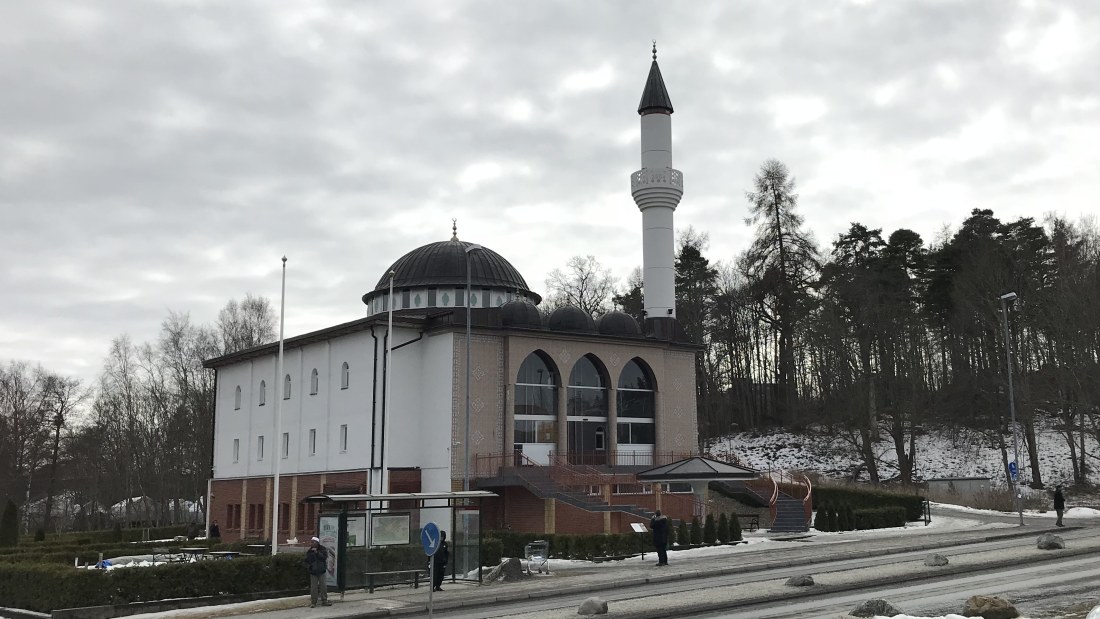
Sweden: "It's Fun to Build a Mosque"

FROM 9/11 TO SPYGATE: THE NATIONAL SECURITY DEEP STATE


The men that failed on 9/11 used their new powers to suppress the truth about Islamic terror.


June 14, 2018


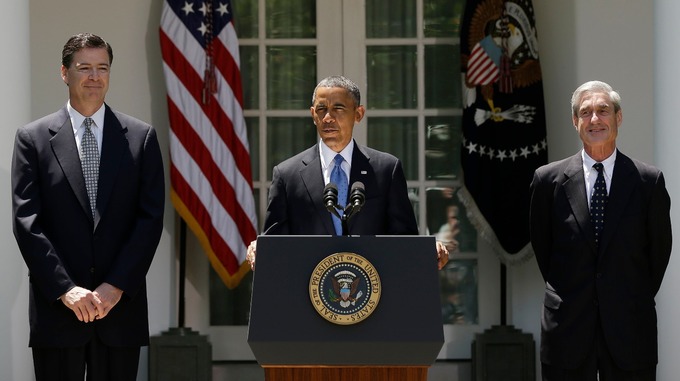
Image result for obama mueller comey

James Comey, Barack Obama and Robert Mueller
On September 4, 2001, Robert Mueller took over the FBI. At his confirmation hearings, fraud had overshadowed discussions of terrorism. And as FBI Director, Mueller quickly diverged from the common understanding that the attacks that killed 3,000 people had been an act of war rather than a crime.
In 2008, Abdullah Saleh al-Ajmi, who had been unleashed from Guantanamo Bay, carried out a suicide bombing in Iraq. Al-Ajmi had been represented by Thomas Wilner who was being paid by the Kuwaiti government. 
Wilner was a pal of Robert Mueller. And when the families were having dinner together, Mueller got up and said, "I want to toast Tom Wilner. He's doing just what an American lawyer should do."
“I don't know what he was doing from inside the government. I'd like to find out,” Wilner mused.
We know some of what Mueller was doing. The same official who paved the way for raiding the president’s lawyer, who illegally seized material from the Trump transition team and whose case is based in no small part on illegal eavesdropping, fought alongside Comey against surveilling terrorists. Materials involving the Muslim Brotherhood were purged. Toward the dawn of the second Obama term, Mueller met with CAIR and other Islamist groups and a green curtain fell over national security.
But the surveillance wasn’t going anywhere. Instead it was being redirected to new targets.
Those targets were not, despite the wave of hysterical conspiracy theories convulsing the media, the Russians. Mueller’s boss was still quite fond of them. Barack Obama did have foreign enemies that he wanted to spy on. And there were plenty of domestic enemies who could be caught up in that trap.
By his second term, the amateur was coming to understand the incredible surveillance powers at his disposal and how they could be used to spy on Americans under the pretext of fighting foreign threats.
Two birds. One stone.
While the Mueller purge was going on, Obama was pushing talks with Iran. There was one obstacle and it wasn’t Russia. The Russians were eager to play Obama with a fake nuke deal. It was the Israelis who were the problem. And it was the Israelis who were being spied on by Obama’s surveillance regime. 
But it wasn’t just the Israelis.
Iran was Obama’s big shot at a foreign policy legacy. As the year dragged on, it was becoming clear that the Arab Spring wouldn’t be anything he would want to be remembered for. By the time Benghazi went from a humanitarian rescue operation to one of the worst disasters of the term, it was clearly over.
Obama was worried that the Israelis would launch a strike against Iran’s nuclear program. And the surveillance and media leaks were meant to dissuade the Israelis from scuttling his legacy. But he was also worried about Netanyahu’s ability to persuade American Jews and members of Congress to oppose his nuclear sellout. And that was where the surveillance leapfrogged from foreign to domestic.
The NSA intercepted communications between Israelis and Americans, including members of Congress, and then passed the material along to the White House. Despite worries by some officials that "that the executive branch would be accused of spying on Congress", the White House "believed the intercepted information could be valuable to counter Mr. Netanyahu's campaign." 
The precedent was even more troubling than it seemed. 
Obama Inc. had defined its position in an unresolved political debate between the White House and Congress as the national interest. And had winkingly authorized surveillance on Congress to protect this policy in a domestic political debate. That precedent would then be used to spy on members of the Trump transition team and to force out Trump’s national security adviser.
National security had become indistinguishable from the agenda of the administration. And that agenda, like the rest of Obama’s unilateral policies, was enshrined as permanent. Instead of President Trump gaining the same powers, his opposition to that agenda was treated as a national security threat.  
And once Obama was out of office, Comey and other Obama appointees would protect that agenda.
We still don’t know the full scope of Spygate. But media reports have suggested that Obama officials targeted countries opposed to the Iran sellout, most prominently Israel and the UAE, and then eavesdropped on meetings between them and between figures on the Trump team.  
Obama had begun his initial spying as a way of gaining inside information on Netanyahu’s campaign against the Iran deal. But the close election and its aftermath significantly escalated what had been a mere Watergate into an active effort to not only spy, but pursue criminal charges against the political opposition. The surveillance state had inevitably moved on to the next stage, the police state with its informants, dossiers, pre-dawn raids, state’s witnesses, entrapments and still more surveillance. 
And the police state requires cops. Someone had to do the dirty work for Susan Rice.
Comey, Mueller and the other cops had likely been complicit in the administration’s abuses. Somewhere along the way, they had become the guys watching over the Watergate burglars. Spying on the political opposition is, short of spying for the enemy, the most serious crime that such men can commit. 
Why then was it committed?
To understand that, we have to go back to 9/11. Those days may seem distant now, but the attacks offered a crossroads. One road led to a war against our enemies. The other to minimizing the conflict.
President George W. Bush tried to fight that war, but he was undermined by men like Mueller and Comey. Their view of the war was the same as that of their future boss, not their current one, certainly not the view as the man currently sitting in the White House whom they have tried to destroy.
Every lie has some truth in it. Comey’s book, A Higher Loyalty, his frequent claims of allegiance to American ideals, are true, as he sees it, if not as he tells it. Men like Comey and Mueller believed that the real threat came not from Islamic terrorists, but from our overreaction to them. They believed that Bush was a threat. And Trump was the worst threat imaginable who had to be stopped by any means. 
What Comey and Mueller are loyal to is the established way of doing things. And they conflate that with our national ideals, as establishment thugs usually do. Neither of them are unique. Washington D.C. is filled with men and women who are registered Republicans, who believe in lowering taxes, who frown at the extremities of identity politics, but whose true faith is in the natural order of government.
Mueller and Comey represent a class. And Obama and Clinton were easily able to corrupt and seduce that class into abandoning its duties and oaths, into serving as its deep state against domestic foes.
Quis custodiet ipsos custodies? It’s the old question of who watches the watchmen that no society has found a good answer to. And the answer is inevitably that the watchers, watch themselves and everyone else. What began as national security measures against Islamic terrorism was twisted by Obama and his deep state allies into the surveillance of the very people fighting Islamic terrorism. 
Spygate was the warped afterbirth of our failure to meaningfully confront Islamic terrorism. Instead, the political allies of the terrorists and the failed watchmen who allowed them to strike so many times, got together to shoot the messengers warning about the terror threat. The problem had never been the lack of power, but the lack of will and the lack of integrity in an establishment unwilling to do its job.
After 9/11, extraordinary national security powers were brought into being to fight Islamic terror. Instead those powers were used to suppress those who told the truth about Islamic terrorism.

Wednesday, June 13, 2018

ANNE MARIE WATERS LEAVES THE LEFT, DEFENDS FREEDOM


When the political elites betray the people, the people find new leaders.


June 13, 2018


Image result for waters beyond terror

This is not a clash between equally moral positions; it is a battle between freedom and oppression, compassion and barbarism, civilised behaviour and violence. We need to decide what side we are on, and fight for that side to win.”
Those stirring words are the conclusion of Anne Marie Waters’ remarkable new book, Beyond Terror: Islam’s Slow Erosion of Western Democracy. This is the account of Waters herself, who up until not very long ago was a reliably Leftist member of the UK’s Labour Party, deciding what side she is on, and beginning to fight for that side to win. Realizing the threat that jihad terror and Sharia oppression of women, gays and others poses to Britain and to the free world in general, Waters recounts how and why she left Labour and became an activist for human rights, and particularly for women’s rights.
Waters calls herself “an anti-sharia campaigner,” and forthrightly explains: “I’m fighting a battle against a religion which is new to Europe, and it’s something that I feel frightened of, and I’m not ashamed to admit that is because of how it treats women. When you talk about women, you’re talking about me; you’re talking about my freedom and my autonomy and my right to live in a way that makes me happy.”
Yet despite the clarity and obvious rightness of this, Beyond Terror is a book about betrayal. Above all, of course, there is the betrayal of the people of Western Europe and North America by their governments. One of the most remarkable and portentous developments of the last few years has been the increasing alienation of the political elites of Western Europe and North America from the people they are supposed to represent. It is now taken for granted by vast numbers of people that the broad mainstream of the political spectrum is dominated by individuals and groups who do not have their best interests at heart.
But there are other betrayals in this book as well. Exiting Labour, Waters joins UKIP, the UK Independence Party, whose leader, Nigel Farage, was one of the principal proponents of the Brexit initiative. Waters admired Farage: “his frankness was jaw-dropping. He inspired and energised, and that was, I felt, exactly what politics needed.” But after Farage resigned the UKIP leadership, the increasingly prominent Waters became a candidate to replace him – only to be denounced as “racist” and “Islamophobic,” and even as a Nazi, by UKIP apparatchiks who lacked the courage to confront the greatest challenge Britain faced since Hitler.
After being denounced by Farage (an ugly act of cowardice on his part that Waters passes over in silence in the book), Waters finished second in the UKIP leadership race to the colorless Henry Bolton. “In hindsight,” she states, “the UKIP leadership election could not have gone better. The primary reason was the exposure of UKIP’s leaders for what they really are: professional politicians more concerned about negative press attention than telling the truth and standing up to the greatest threat to Britain since the Second World War. The public now knew for certain that UKIP did not have the courage or principles to defend the country against any and all enemies. It was an important lesson for them to learn.”
The betrayers included Farage: “Following the result, even the messiah Farage made known his capitulation to the mainstream press. After years of being called a racist for wanting out of the European Union, Farage would then imply that others are racist for opposing an incredibly dangerous religion which, at that time, had prompted the murder of scores of Britons and the rape of thousands.”
UKIP’s loss, however, could be a gain for the free people of Britain. After the UKIP betrayal, Waters recounts how she founded her own party, For Britain. This couldn’t come at a more propitious time. All over the West today, a new group of citizen leaders is arising – people who are not professional politicians, and who are determined to defend their nations not least against those very political classes that have betrayed their own people. Donald Trump is, of course, the most successful, but there are many others. If Britain is to survive as a free nation, it will be because Anne Marie Waters and other citizen activists have taken it upon themselves to do what their government has failed to do: protect its own people from threats foreign and domestic.
Beyond Terror is one woman’s story, but if Britain and any other nation is going to survive as a free society, this book should be taken as a template for what must be done, and for how everyone who values freedom must now become an activist – before it’s too late.
Robert Spencer is the director of Jihad Watch and a Shillman Fellow at the David Horowitz Freedom Center. He is author of the New York Times bestsellers The Politically Incorrect Guide to Islam (and the Crusades) and The Truth About Muhammad. His new book is The History of Jihad From Muhammad to ISIS. Follow him on Twitter here. Like him on Facebook here.

Tuesday, June 12, 2018

3 Things I Learned From Attending Jordan Peterson’s Sold-out Show In DC


By 
http://thefederalist.com/2018/06/11/i-attended-jordan-petersons-show-here-are-three-things-i-learned/
June 11, 2018


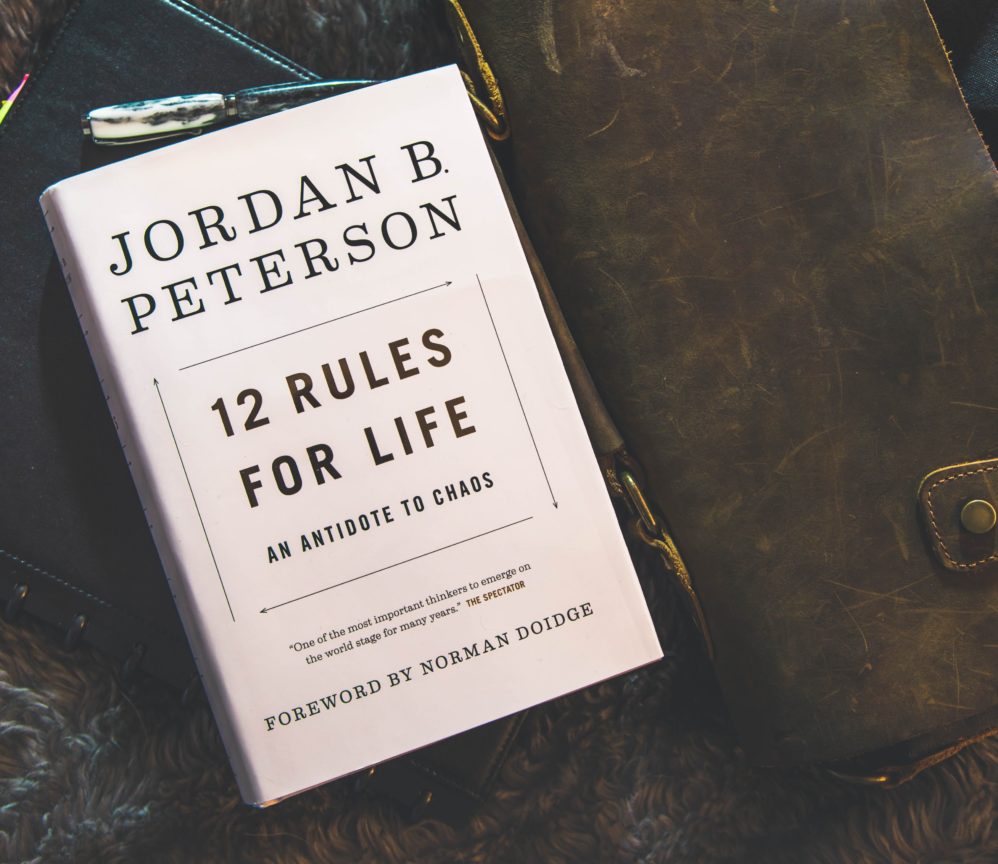
Image result for jordan peterson warner theater

Photo by Travis Rupert of Pexels

Renowned psychologist Dr. Jordan Peterson took the stage at the sold-out Warner Theater in Washington DC Friday night. The crowd got on its feet and started cheering, ecstatic to hear him speak.

Peterson gained fame after opposing a Canadian bill that criminalized using the wrong pronouns for transgender persons. His notoriety only grew from there after a video of his interview with British broadcaster Cathy Newman went viral. Now, he’s got a cult following who call themselves “lobsters” (in reference to an example in the viral interview) and a best-selling book titled “12 Rules for Life.”

That night, Peterson worked through only nine of the twelve rules, drawing from clinical psychology, philosophy, and common sense. Before he started walking through his rules, he talked about what motivated him.
Earlier that day, he and Dave Rubin, a YouTube personality who opened the show and appeared on The Federalist Radio Hour last week, were at the Lincoln Memorial when a young man walked up to them. This man’s brother had been going through a divorce when he started watching Peterson lectures online. The advice Peterson gave helped turn his brother’s life around. Peterson said these experiences were the highlight of what he did.
“It’s personal, not political,” he said.
It’s an important clarification, because most of the coverage of Peterson has been only the latter. He’s either a spokesman for alt-right hatred or the last defense against stifling political correctness. Yet Peterson is a clinical psychologist. According to him, his aim is to help people.
Before attending this event, I had very little knowledge of Peterson and his views. I had seen clips of his famous interview and glanced at his 12 rules, but lacked an understanding of him and his work. Here are three things I learned about Jordan Peterson after attending his show.

1. Peterson Is Not an Alt-right Demagogue

Many on the Left have criticized Peterson and his followers as disgruntled white men, hiding their pent-up racism and sexism behind pseudo-intellectual talk. A columnist from The Nation states that Peterson has a “far-right political agenda” and advises her reader to avoid dating one of his fans.
Peterson certainly doesn’t play the alt-right type by wearing a three-piece navy-blue suit and drinking Perrier. Throughout his lecture, he paced the stage, not goose-stepped, and took frequent pauses in order to word his next thought carefully. This is not the demeanor of a brazen white nationalist.
Neither was his message. He did not blame women or minorities for the problems in his followers’ lives. Rather, it actually targeted his followers themselves. Peterson asked the crowd repeatedly, “If your life is truly miserable, are you actually doing all that you can to make it better?” He also has called for people to restrain themselves from violence and focus on managing themselves rather than attempting to manipulate or bully others.
Additionally, his rules called for vulnerability and personal suffering rather than blood and soil. His first rule is probably the best example of this. It states: Stand up straight with your shoulders back. At first glance, one might pounce on this as a command to show the world who’s boss. That is not the case. Peterson told the crowd to be open to the wounds of the world, so they can experience its suffering and learn from it. His message does not seek to oppress or dehumanize. Rather, it seeks truth and meaning.

2. Peterson Can Help You Help Yourself, But Not Save You

Because Peterson is seeking out truth and meaning, he can’t avoid questions of faith. In fact, he calls the propositions on which he bases his rules “religious, because they’re about the fundamental reality of life.” His propositions are these:
1. Life is tragic.
2. The world’s tragedy is touched with malevolence, because humans often make their suffering worse.
3. In order to contend with this suffering, one must have a “noble goal to justify your existence, clear your conscience, and get yourself out of bed.”
Most world religions contain the first two premises in some form. Even secular humanism acknowledges that the world is a broken place. Peterson noted that “’You’re perfectly okay the way you are’ is the most pessimistic advice you can receive.” If this is the best humanity can do, we all will start staring into the abyss very soon. In fact, our society has already done a good deal of that lately.
Peterson’s third conclusion doesn’t meet his prior statement. He claims that he’s become an optimist about the human condition because he’s such a pessimist about the state of the world. “The grandeur of the human spirit” is enough to confront the worst pain that we face today, he says.
These rules can repair and improve things like mindset, work ethic, and family life, which are very important things. However, they fall short in addressing the brokenness of the human soul. That’s because, even at our best, we can’t follow Peterson’s 12 rules perfectly. Even if we could, we wouldn’t be immune to senseless tragedies like death and illness. Our hurt stretches far deeper than his moral guidelines can reach.
To be fair, I don’t think Peterson believes that his 12 rules are the cure-all for the world’s brokenness. However, for his many secular followers, this is the sole semblance of religion they have, so they are going to treat it as such.

3. Peterson Isn’t Going Anywhere Any Time Soon

Natalie Wynn, a transgender person, responded to Peterson in a NSFW video, admitting, “[People] have this need to have purpose in the face of suffering and like not just complain about patriarchy.” Peterson recognizes that it is not enough to stand against bad ideology; people also need a positive belief system.
Peterson engages the common YouTuber in questions of truth and meaning. He acknowledges and fills a gap in society. He doesn’t show open disdain for people who haven’t read Plato, but speaks to his crowds at their level, showing how complex philosophy has the potential to improve one’s life.
Peterson also engages with his fame well. He treats it with caution and doesn’t revel in his spotlight. During the question and answer, he said he thinks his fame “will end in catastrophe at any moment.” This mindset gives his message endurance over the fleeting fame that so many viral stars chase. It is unlikely he’ll burn out like Milo Yiannopolous, an actual provocateur. Peterson’s tour is only halfway through, and his videos still rack up millions of views all over the Internet.
As I left the theater, I noticed that the woman sitting in the row in front of me wore lobster earrings. As I walked out, I saw a man who had donned a lobster hat, complete with antennae. He waved his red foam claw around and shouted that this was the best show he had ever been to. Peterson’s message is one focused on finding meaning, not fueling hate. Although it’s not a saving message, it’s one we’ll be hearing for a long time.
Juliana Knot is an intern at the Federalist.

Monday, June 11, 2018

Rafael Nadal has two key edges on clay – he doesn’t believe he can lose and no opponent believes they can beat him


By Cathal Kelly
https://www.theglobeandmail.com/sports/tennis/article-rafael-nadal-has-two-key-edges-on-clay-he-doesnt-believe-he-can/
June 10, 2018

Image result for rafael nadal french open

In 2001, former Wimbledon champion Pat Cash was in Mallorca playing in an exhibition tournament.

He was scheduled to face Boris Becker in the closer, but the German withdrew with an injury. Organizers suggested Cash play a local high-school freshman instead.

Cash was 36 years old – retired, but still in his prime.

The kid won the first set. The Spanish crowd was irritatingly delighted. Cash buckled down and won the second. The third set went to a tiebreaker. The kid won.

“I came in the locker room after and the guys sort of looked at me, just to see my reaction,” Cash later said. “And my reaction was I’d just lost to a 14-year-old.”

Of course, the kid was Rafael Nadal.

In the years since, Cash has retroactively amended his disappointment: “I took heart by thinking I had lost to a future Roland Garros champion.”

Losing hurts, but it must hurt a lot less when you do it to Nadal on his favoured surface and in Paris. You can’t regret failing to achieve something you never had a chance at doing.

Nadal won his 11th French Open title on Sunday. Despite hand cramps, he steamrolled Austria’s Dominic Thiem 6-4, 6-3, 6-2.

Thiem, 24, is the flag bearer of tennis’s next generation. That may sound young, but it isn’t in tennis terms. Bjorn Borg retired at 26.

The problem is Nadal and his friendly nemesis, Roger Federer. As long as those two continue on as they have, tennis’ next generation is in danger of becoming the Prince Charles of global sport – aged out of their inheritance.

Along with Tiger Woods, Federer is the emblematic athlete of the 21st century. Nadal is instead all of history’s great specialist.

His winning percentage at the French Open is .977. His 11 championships at Roland Garros alone tie him for fifth-most Grand Slams among mens’ players.

It is now conceivable he will end his career having won more French Opens than any man except Federer has won all majors.

Observers have spent years trying to dissect what exactly makes Nadal so good on clay. He has many advantages – having been raised on it; left-handedness; remarkable movement; his second serve; a mathematician’s ability to construct points and so on and so forth.

But by now, Nadal’s key edge is that he does not believe he can lose. More important, no one else believes they can win.

Federer has conceded the issue by giving up on the clay-court season altogether. At this stage of the Swiss’s career, why bother playing if you’re doing it for money rather than trophies?

Federer managed to sneak in a single French Open title in 2009. That year, Nadal had one of his two – two! – tournament defeats. The man who beat him, Robin Soderling, won 10 ATP titles and made US$10-million in prize money over his career, but he’s best known for a single act of giant killing.

Had he not done it, Federer might not posses a career Slam, and might not now be considered the greatest player ever. It would at least go from an undeniable fact to a decent bar argument.

(Federer owns plenty of houses. He ought to give Soderling one of them.)

With Federer having one-third retired from the game, Nadal has tightened his hold on that piece of territory.

He’s been blighted by injuries throughout his career, but they have not often afflicted him at this time of year. It’s as if his body knows it has to pull things together for a few weeks in May and early June, and is free to fall apart once summer arrives.

After he won for the first time in France 13 years ago, Nadal told The New York Times his greatest concern was losing his grip on reality.

“I hope this all won’t change me,” he said. “I would like to stay the same as I have always been.”

He’s managed that. Although not particularly charismatic off the court, no great modern athlete seems nicer than Nadal. He’s never feuded with anyone, or rubbished an opponent or seemed angry during play at anyone but himself.

In interviews, he has retained the shy courtliness of a well-raised teenager. Most athletes who arrive in their youth get polished up by the star system. By their 30s, they have the shiny look of the professionally styled.

If anything, Nadal, 32, has become less groomed over time. The same crooked smile; an unwillingness to concede he’s losing his hair; an approaching gauntness that suggests he will not fatten in middle age, but wither slightly. He’s got a 50-year-old head on a 21-year-old body, in both the literal and metaphoric senses.

He has grown more wistful over the years. These victories get hold of him in a different way. His celebrations were muted on Sunday. He cried, but just for a moment.

The closest he came to flashing some edge was in congratulating Thiem: “I’m sure you will win here …” – an almost imperceptible pause – “… in a couple of years.”

In other words, “whenever I decide to call it a day.”

There was a moment around 2016 when it appeared Novak Djokovic was the new king of clay. But the Serb fell off and Nadal reappeared. He’s not just playing as well as he ever has. He’s playing better than that.

Getting to 10 French Open wins last year was one sort of finish line. It has allowed Nadal some emotional distance.

“I know the years are going quick,” he said before Sunday’s final. “There is not 10 more chances to keep playing here.”

But surely four or five? Once he feels the end rushing up on him, he can pull a modified Federer – giving up on grass – or hard-court majors in order to hoard his strength for just one.

Whatever he decides, his legacy is already secure. Titles are only part of it.

Perhaps more than any player of his generation, Nadal did not allow stardom to change him.

He was tapped for greatness at 14. All he’s done in the two decades since is prove people were right.

Germany's Migrant Rape Crisis: "Failure of the State"


by 
Ali Bashar, Susanna Maria Feldman

The rape and murder of a 14-year-old Jewish girl by a failed Iraqi asylum seeker has cast a renewed spotlight on Germany's migrant rape crisis, which has continued unabated for years amid official complicity and public apathy.

Thousands of women and children have been raped or sexually assaulted in Germany since Chancellor Angela Merkel welcomed into the country more than one million mostly male migrants from Africa, Asia and the Middle East.

The latest crime, entirely preventable, is uniquely reprehensible in that it highlights in one act the many insidious consequences of Germany's open-door migration policy — including the failure to vet those allowed into the country and the practice of releasing migrant criminals back onto German streets instead of incarcerating or deporting them.

The crime also exposes the gross negligence of Germany's political class, which appears to be more concerned with preserving multiculturalism and the rights of predatory migrants than protecting German women and children from them.

Police say that Ali Bashar, a 20-year-old Iraqi Kurd, raped Susanna Maria Feldman, strangled her and then dumped her body in a wooded area alongside railroad tracks on the outskirts of Wiesbaden. Bashar then fled to Iraq on false identity papers.

Feldman had been missing from her home in Mainz since May 22. Her mother filed a missing person report on May 23. Police, however, did not even begin to search for the girl until more than a week later, when an unnamed 13-year-old boy, a migrant living in the same refugee shelter as Bashar, contacted the police. Feldman's body was finally recovered on June 6.

Bashar arrived in Germany in October 2015, at the height of the migrant influx, along with his parents and five siblings; claiming to be refugees, they turned out to be economic migrants. Bashar's asylum request was rejected in December 2016. He should have been deported, but after he filed an appeal, German authorities allowed him to stay.

During his three years in Germany, Bashar chalked up an extensive criminal record, including physical assault of law enforcement officers, violent robbery at knifepoint and possession of illegal weapons.

Police said that Bashar was also a suspect in the March 2018 rape of an 11-year-old girl living in the same refugee shelter where he and his family were staying.
Bashar was able to flee Germany under a false identity because of bureaucratic incompetence: federal border police failed to check if the name on his plane ticket matched the name on his identity papers.

Bashar was arrested in northern Iraq on June 8 and was extradited to Germany a day later. He is currently being held at a correctional facility in Wiesbaden.
Susanna's murder was the fourth German teenager to be murdered by illegal migrants during the past 18 months.
  • October 16, 2016. Maria Ladenburger, a 19-year-old medical student from Freiburg, was raped and murdered after returning home from a party hosted by her school's medical faculty. Her attacker was Hussein Khavari, who entered Germany in November 2015 without identification papers. He claimed to have been born in Afghanistan in November 1999. Because of his alleged age (16), he was granted asylum as an underage unaccompanied migrant and placed with a foster family.
    After Khavari was arrested as a suspect in the Ladenburger case, the newsmagazine Stern reported that in February 2014, Khavari had been sentenced to ten years in prison for attempted murder for pushing a 20-year-old woman over a cliff on the Greek island of Corfu. The woman survived the attack and Khavari was released after serving 18 months in prison, based on an amnesty for juvenile offenders. He then migrated to Germany.
    During his trial in Greece, Khavari told the court that he had been born in Iran in January 1996 and had arrived in Europe in January 2013.
    During his trial in Germany, Khavari confessed to raping and killing Ladenburger. It emerged that Khavari was born in Iran on January 29, 1984 and that at the time he killed Ladenburger, he was actually 32. On March 22, 2018, Khavari was sentenced to life in prison for rape and murder, but according to German law, he may apply for parole after serving 15 years.
  • December 27, 2017. Mia Valentin, a 15-year-old girl from Kandel, a small town in the federal state of Rhineland-Palatinate, near the German border with France, was stabbed to death at a local drugstore. Her attacker was Abdul Mobin, a failed Afghan asylum seeker who claimed to be 15 years old.
    Valentin and her attacker had been in a relationship for several months, but after she ended it in early December 2017, Mobin began to threaten her. On December 15, the girl's parents filed a formal complaint to police. Police visited Mobin on December 17, and again on the morning of December 27. Later that day, Mobin followed Valentin into the drugstore and stabbed her with a kitchen knife he had purchased at the same store. The girl died a short time later.
    Mobin had arrived in Germany in April 2016 and initially resided at a refugee shelter in Frankfurt. He was later transferred to a refugee shelter in Germersheim, a small town in the federal state of Rhineland-Palatinate, and then to a youth facility in nearby Neustadt. His asylum claim was rejected in February 2017, but he was not deported. Mobin, who was known to police after he punched a student at Valentin's school, is being held in custody while German authorities try to determine his true age.
  • March 12, 2018. Mireille Bold, a 17-year-old girl from Flensburg, wasstabbed to death by Ahmad Gulbhar, an 18-year-old asylum seeker from Afghanistan. He allegedly became enraged and killed her after she refused to wear a headscarf convert to Islam. Gulbhar had arrived in Germany in 2015 as an underage unaccompanied migrant. His asylum application was rejected but he was never deported.
    Bold, who lived in the same building as her attacker, had called police for help at least once before she was killed. A good friend of Bold's family told the newspaper Bild:
    "Ahmad was a jealous rooster who always wanted to control her. They have been in a relationship since January 2016, but there were constant rows. He insisted that she convert to Islam and always wear a headscarf. 
    "She wasn't sure. Whenever she went scarfless there was trouble. Mireille told me that he fled alone from Afghanistan and had a great longing for his family. He was supposed to have a job in a civil engineering company. Once when she met with him he called her every two minutes on her phone demanding to know what was happening."
    The attacker is being held in pre-trial detention.
As with the deaths of the other teenagers, Susanna's murder prompted the usual barrage of political posturing and feigned outrages from German politicians and media.

The level of public outrage over Susanna's case, however, suggests that Germany may be reaching a tipping point: the German government is finally being held to account for its role in the migrant rape crisis.

"The government should beg for forgiveness from Susanna's parents," said the mass circulation Bild. "The only thing that is worse than the murder of a child is the murder of a child by a criminal who should not have been in our country."
The leader of the Free Democrats (FDP), Christian Lindner, said that the crime raises many questions: "Why are rejected asylum seekers not deported more consistently? Why could the perpetrator and his family flee under a false identity?"

"This is typical of our German security agencies," FDP politician Alexander Graf Lambsdorff said. "There are simply too many gaps in this system. This has been terribly upsetting for many years."

SPD manager Carsten Schneider said what had to be quickly clarified was "how the suspect was able to escape, and how he can be brought to court in Germany as quickly as possible."

"The Federal Interior Minister must ensure that the existing control mechanisms are also used during entry and exit," said Burkhard Lischka, an SPD spokesman. "With such questionable papers and in view of the destination, the Federal Police could have determined with a simple fingerprint comparison that a criminal is on the run."

"The cruel murder of Susanna fills me with great sadness and anger," saidEckhardt Rehberg of the CDU. "As a politician responsible for the budget, I say...the entire asylum process needs to be fundamentally reshaped. We will provide the money for that."

The Alternative for Germany (AfD), the anti-immigration party, called for the resignation of the entire federal government. In a video posted on Twitter, AfD co-leader Alice Weidel said:
"Susanna is dead. Maria from Freiburg; Mia from Kandel; Mireille from Flensburg; and now Susanna from Mainz.... 
"Susanna's death is not a blind stroke of fate. Susanna's death is the result of many years of organized irresponsibility and the scandalous failure of our asylum and immigration policies. Susanna is victim of an out-of-control leftwing multicultural ideology that stops at nothing to impose its sense of moral superiority. Susanna is also another victim of Chancellor Angela Merkel's hypocritical and selfish welcome policy. 
"Legally, Ali Bashar should never have been allowed into Germany. His asylum request was rejected more than two years ago, and he should have been deported. Bashar was known to police for physical assault, attacking police officers, and possessing illegal weapons. In March 2018, he was suspected of raping an 11-year-old girl at a refugee shelter. According to the law, Bashar should have had to leave Germany a long time ago or be arrested. 
"An absurd asylum law and a grotesque asylum policy...it is lenient toward asylum cheaters and criminals but ignores the genuine concerns of German citizens. 
"Ali Bashar, his parents and five siblings lived here on the taxpayer's dime, they could not be deported, but after his Ali's crime, they somehow found the money to flee Germany on falsified documents. No problem in a Germany with open borders. 
"On the day of Susanna's murder, you [Merkel] testified in parliament that you have handled the migrant crisis responsibly. Do you dare to repeat that claim to Susanna's parents? Well, no. Your hard-heartedness and self-righteousness means you feel you are above offering the victims of your policies a personal word. This is unacceptable to us citizens. Will you finally accept responsibility, Mrs. Merkel? You and your entire cabinet should resign to make possible another asylum policy so that the parents in this country no longer need to fear for the safety of their children."
The newsmagazine Stern concluded:
"The emotional reactions to Susanna's case illustrate how Germany has changed. Already in the summer of the refugee crisis, when hundreds of thousands of people came into the country, there were warnings that the mood in the population could tip.... 
"The case of Susanna awakens the image of a loss of control, an overstretched state that no longer has a grip on asylum policy — especially in a society that loves law and order. There are now repeated demands for stricter laws. The current scandal over maladministration at the Federal Office of Migration and Refugees [immigration officials accepted cash bribes in exchange for granting asylum to more than 1,200 migrants] seems to emphasize the impression of a failure of the state."
Soeren Kern is a Senior Fellow at the New York-based Gatestone Institute.