Friday, July 28, 2017

'The Russian Revolution' is a superb account of this seminal event


Bard College professor Sean McMeekin is a reliable guide to a complex story and his book moves seamlessly and clearly across a vast landscape of people and events.
June 1, 2017

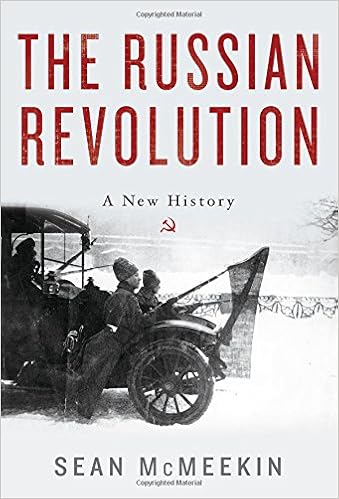
Image result for the russian revolution sean mcmeekin

The Russian Revolution of 1917 was one of the landmark events of the 20th century. Yet when compared to some of the century’s equally momentous developments­ such as the outbreaks of World Wars I and II, the birth of the nuclear age in 1945, and even the collapse of the Soviet Union in 1991, the radical changes that reshaped Russia are little understood in the West.

But in recent years, a new generation of scholars has begun to mine the Communist party’s once sealed archives and that, coupled with the 100th anniversary of these revolutionary events, has led to renewed attention to the origins and impact of the Russian Revolution.

In The Russian Revolution: A New History, Bard College professor Sean McMeekin has written a superb and eye-opening account of this important chapter in 20th century history that will be indispensable reading for those anxious to learn more about this seminal event and the aftershocks that followed.

The story begins in 1905, when Russia was utterly defeated in the Russo­-Japanese War. In the middle of this conflict, a protest in St. Petersburg turned violent and the "Bloody Sunday” massacre briefly radicalized the population. Later that same year, a mutiny in the armed forces and a general strike forced Tsar Nicholas II to make concessions that included, for the first time, the creation of a parliament with very limited powers known as the "Duma.” Aided by the imposition of martial law, the unrest dissipated.

Somewhat surprisingly, after this near-death experience, the regime enjoyed a resurgence of domestic prestige and the economy boomed. In the first decade of the new century, the Russian economy was "growing at nearly 10 percent annually, turning heads just as dramatically as a surging China has in the twenty-first.” This, along with modest land reform, seemed to herald a new day. But internal political stability rested on the maintenance of peace.  And, unfortunately for the Tsar, when World War I broke out, Russia eagerly moved against Germany and the Austro-Hungary Empire.

Contrary to conventional wisdom, the fighting was going reasonably well for the Russians. But on the home front, especially in Petrograd (as St. Petersburg had been renamed to make it sound “less German” during the war), food and fuel shortages coupled with political unrest led by liberals led to the February Revolution that, after a "bewildering series of events,” quickly toppled the Tsar. He abdicated in favor of his brother Grand Duke Michael, who then immediately abdicated to "the Provisional Government.”

When the politicians finally sorted things out, 36-year old Alexander Kerensky found himself in charge. He soon faced a new challenge: Because the United States had recently entered the war, Germany wanted to get Russia out of the war to move more troops to the Western front. To do this, the Germans allowed Vladimir Lenin and a handful of aides to travel from neutral Switzerland through Germany and into Russia. Not only did they deliver him to Petrograd, they gave him ample funds to sow chaos once he arrived in April. Lenin was the German choice because he was, in the words of one German diplomat, "much more raving mad” than the rest of Russia’s socialists.

Sow chaos he did. Unlike Kerensky, who wanted to continue to fight, Lenin called for "revolutionary defeatism" – that is, turning Russian military units against the war – in hopes of forging a peace settlement. Over the next six months, Lenin's approach gained adherents and Kerensky's government proved shockingly inept. Eventually, the Bolsheviks seized control of Petrograd and Moscow and took charge of the government.

But the Communists did not control the country, even after they signed the draconian Treaty of Brest-Litovsk with the Germans. By July 1918, "Russia had been reduced to a shadow of its former self." Czechs, Slovaks, Turks, and various groups of Cossacks controlled large parts of the country and a million German troops occupied formerly Russian Poland, the Baltic, White Russia, and Ukraine. And the economy was in a shambles.

But Lenin was lucky. As the German armies collapsed on the Western front, Lenin reestablished the Russian army and, with the leadership of Minister of War Leon Trotsky, began the long and complicated task of expelling foreign armies. After the foreign powers withdrew in late 1920, Lenin moved to subdue his countrymen – mostly peasants – who had not accepted the Bolsheviks. Red Army troops beat and starved the proletariat into submission.  Huge challenges remained­, including famine and bankruptcy, but the revolutionary changes were in place. Lenin and the Soviets would rule Russia for the next 70 years.

"The Russian Revolution" is a carefully researched, well-written assessment of the complex and confusing events that did so much to shape the last century. McMeekin is a reliable guide to a complex story and the book moves seamlessly and clearly across a vast landscape of people and events.

Several themes dominate the book. First, McMeekin makes clear that there was nothing inevitable about the outcome. Before, during, and after 1917, all parties – the Tsar, Kerensky, and Lenin – made serious mistakes and the outcome could easily have been different.

Second, the indiscriminate and continuous use of terror that we associate with the Soviet Union was on display from the start. Indeed, Lenin and the Bolsheviks were so ruthless that even the German army was taken aback.

Finally, McMeekin makes clear that a small number of key figures played central roles and that what these individuals did (or did not do) shaped the outcome. Nicholas II was hapless and hopelessly out of touch. Kerensky was simply overwhelmed. Lenin had both the vision to turn the soldiers against the war and German money to finance the project. But he was remote – and often out of the country during crucial events – and lacked the personal courage of Leon Trotsky.

Historians often debate whether individuals make history or history makes individuals. In the case of the Russian Revolution and the emergence of the Soviet Union, it's clear that what individuals did, or did not do, at crucial times decisively shaped the outcome.


Thursday, July 27, 2017

The Missing Weapon at Dunkirk


By Steve Feinstein
http://www.americanthinker.com/
July 27, 2017


Back in the sky: This iconic Mark 1 plane was among the first built in March 1940, but Spitfire P9374 never made it to the Battle of Britain as it crash-landed over Dunkirk in May 1940. In 1980 the wreckage was discovered when part of it was spotted poking out from its sandy grave


Back in the sky: This iconic Mark 1 plane was among the first built in March 1940, but Spitfire P9374 never made it to the Battle of Britain as it crash-landed over Dunkirk in May 1940. In 1980 the wreckage was discovered when part of it was spotted poking out from its sandy grave. (http://www.dailymail.co.uk/)


Although most people under 40 are astonishingly ignorant about it, a great worldwide armed conflict known as World War II took place from 1939-1945 in the European and Pacific regions. It is relevant and important to know and understand because the outcome of World War II put into place the political, economic and geographical conditions and relationships that make the world what it is today. An understanding of the ramifications of WWII is central to comprehending how today’s world came to be. People under 40—heck, even under 60—would do themselves a huge favor if they learned some history and saw how that history affected today’s world.

The 1939 war in Europe was caused mostly by the consequences of the unresolved complications and volatile conditions that persisted following the end of World War I in 1918. World War I took place from 1914 to 1918 and was a struggle for the control of Europe, primarily between the Germans on one side against the French and British (aided by America after 1917) on the other side. Germany remained particularly unstable in the years after the end of the Great War (as WWI came to be known) and in retrospect, many historians now feel that another war in Europe was inevitable.

The inevitability of another European war after 1918 became reality on Sept. 1, 1939 when Germany turned eastward and attacked Poland. Having built up its military forces in direct contravention to post-WWI treaties, Germany overwhelmed Poland in a matter of a few short weeks, using their newly-developed blitzkrieg tactics. Unlike the ponderous, static, slow-motion trench warfare that dominated World War I, Germany saw the potential of combining fast-moving armored forces with close-support air power (dive bombers and fast low-altitude bombers) to deliver a decisive, overpowering blow to their enemy’s critical targets in the very early stages of the action. (Germany’s blitzkrieg tactics were so successful that the term has now become part of the popular lexicon, meaning any quick, overwhelming action, whether in sports or business or some other endeavor.)

Following a relatively uneventful 1939-1940 winter (a time period that came to be known as the “Phony War”), Germany resumed its hostilities against Europe in the spring of 1940, turning its attention westward. German forces blasted through the “Low Countries” of the Netherlands and Belgium and swung around to invade France from a point behind its main defensive eastern border with Germany. Following World War I, France fortified its eastern border with Germany with a massive wall of concrete and armament called the Maginot Line in an effort to prevent any future invasion by Germany. But Germany attacked the Netherlands and Belgium to the north and west of Germany, through the supposedly impenetrably dense Ardennes forest and then swung into France from behind the Maginot Line. France’s expensive, foolproof defense against German aggression proved to be a worthless folly.

As German forces poured into France, the French military was disoriented, confused and demoralized. Despite having numerical superiority over Germany in planes and equipment, the French utterly failed to mount an effective defense of their homeland. Desperate and panicked, France pleaded with Britain to send men and materiél to their aid.

The British did so, in the form of the British Expeditionary Force (BEF), consisting of several hundred thousand troops along with tanks and aircraft. It was a wasted effort, as the British could not buttress the listless and disorganized French forces against the brilliantly trained, highly motivated German army. Germany’s blitzkrieg tactics decimated the allied formations, inflicting severe losses and taking great swaths of French territory.

Sometimes, what might seem to be a small decision at the time can have huge long-range consequences, with repercussions that last decades into the future, even to the point of altering the course of history. Such was the case in the battle for France in May of 1940. 
British Air Marshal Lord Hugh Dowding made the decision to not send any of Britain’s valuable Spitfire fighter aircraft to France for the fight against the Germans. The Spitfire was generally regarded as the best fighter plane in the world at the time (narrowly edging out Germany’s BF-109). Dowding correctly recognized that Britain would soon be in a one-on-one fight for survival against Germany and any hope Britain had of fighting off the German air force (the Luftwaffe) rested squarely on the shoulders of their small contingent of Spitfires.

As I wrote in 2008:
The British proved themselves prescient when they sent only second-line Hurricane fighters to fight against the Germans in France. In spite of vehement French protests, Air Marshal Lord Dowding (head of Britain's Fighter Command) refused to allow any of Britain's valuable front-line Spitfire fighter planes to be "wasted" in what he knew would be a losing effort in France. Better to husband them for England's solitary fight to come against the Germans after France's capitulation. 
By the end of May, the German forces had cornered the remnants of the allied armies into a small, vulnerable pocket in Dunkirk, near the coast of France.  It appeared that the European war would soon be over, as the German army was poised to finish the job. Exactly what happened next is the subject of some controversy, but the lessons for military planners reverberate as clearly today as they did then, some 68 [77] years ago. 
Rather than sending in their armored, tank-equipped Panzer divisions to destroy the virtually defenseless allied forces, the Germans held them back. Instead, the finishing task was given to Germany's air force, the Luftwaffe. Military historians have posited that perhaps Germany's armored Panzer divisions were stretched too thin and had outrun their supply lines, and thus needed time for rest and recuperation. Another popular theory has it that the head of the Luftwaffe—Hermann Göring—was envious of the glory that his Army counterparts were getting from their numerous overwhelming victories, and he wanted to prove that his air force was worthy of similar accolades. 
But regardless of the reason, the German air force was given the responsibility, and it failed. That decision remains one of the greatest military blunders of all time. The Luftwaffe flew sortie after sortie, attacking the Allied armies, but couldn't finish the job. Instead, the British organized an amazing sea-borne rescue effort and sent hundreds of ships and boats of all kinds across the Channel to rescue the beleaguered soldiers. Everything from Royal Navy transport ships to private fishing boats participated in the effort. The RAF flew cover and fought off the German air attacks. Although their losses were high and virtually all their equipment was left on the beaches of Dunkirk, almost 400,000 Allied soldiers were rescued, and survived to fight another day.
The Spitfires were the missing weapon in the Fall of France. If the British had sent Spitfires to France and wasted those invaluable, irreplaceable front-line fighter planes and pilots in the weeks prior to Dunkirk in a hopelessly futile effort to save France from the German onslaught, then surely the German Luftwaffe would have succeeded in destroying the Allied armies on the beaches of Dunkirk. Absent the Spitfire, there were no British fighter planes that could defeat the BF-109 in head-to-head combat. British Hawker Hurricane was less than equal to the 109 while the Bolton Paul Defiant was completely outclassed. In the likely event of significant Spitfire losses in the battle for France (even if just mostly from normal high-stress military service attrition and accidents), the Germans would have ruled the skies over Dunkirk and their bombers—unhindered by numerically-significant Spitfire opposition—would have exacted a decisive, fatal toll on both the trapped Allied soldiers on the beach and the beleaguered British ships and boats that were trying to help.

But that was not the case. There were enough (barely enough!) Spitfires to keep the German air force at bay in the skies over Dunkirk. Lord Dowding’s decision to withhold Britain’s priceless Spitfires from the losing, pointless exercise in France was unquestionably one of the most important, consequential decisions in military history. Few history books even mention it and neither does the otherwise-excellent current movie Dunkirk, but the “no Spitfires sent to France” decision ranks as one of the very most important military judgments of all time.

A clear indication of the Spitfire’s unmatched excellence came from an unlikely source, none other than General Adolf Galland, high-ranking German ace, who became head of all of Germany’s fighter forces later in the war. When asked by Hermann Göring (Reichsmarschall of the Luftwaffe) what he needed to be more successful in battle, Galland famously replied, “I should like a staffel[squadron] of Spitfires for my gruppe!”

At the very end of the movie Dunkirk, there is a dedication screen that reads, “Dedicated to all the individuals whose lives have been impacted by the events at Dunkirk.” It’s an intentionally subtle and brilliant statement by director Christopher Nolan, since everyone in the world since 1940 has been “impacted” by the events that took place there. Had the Germans won the war in Europe—and they were within a hairsbreadth of doing that at Dunkirk—the world would be a drastically different place today. Everyone’s lives would have been impacted. But Britain’s heroic Royal Air Force—led by those courageous pilots flying their Spitfires—didn’t let that happen.


Read more: http://www.americanthinker.com/articles/2017/07/the_missing_weapon_ay_dunkirk.html#ixzz4o35glh4u
Follow us: @AmericanThinker on Twitter | AmericanThinker on Facebook

Imran Awan Case Needs Special Counsel 100X More than Russiagate


July 26, 2017

Related image
Imran Awan with Bill Clinton / Facebook

To the embarrassment, more accurately the humiliation, of Deborah Wasserman Schultz, Nancy Pelosi, not to mention dozens of Democratic congressmen and women -- all of whom used Imran Awan for help with their government computers -- the Pakistani-born IT specialist was arrested Tuesday by the FBI at Dulles Airport for alleged bank fraud. He was trying to flee the country for Qatar.  (Yes, that Qatar!)

But that's just what the shrinks call "the presenting complaint."  There may be a lot more to it -- a whole lot more.

At best, Awan is a fraudster who, working with his family, bilked the U.S. taxpayers out of over four million in IT fees and overpriced computer equipment.  At worst he's an agent of Pakistan's ISI in league with Al Qaeda, the Muslim Brotherhood, or even ISIS. There are other possibilities in between that are also of a frightening nature, including (although more remote) the mysterious death of Seth Rich.

Hello, what?

To take the worst first, for those who do not know the ISI, if you Google "Which intelligence service is the best in the world?" Pakistan's ISI is number one, followed by India's RAW, Israel's Mossad, the CIA, and MI6.  Russia's FSB doesn't make the cut. More on the ISI:
After fall of the Soviet Union, the ISI provided strategic support and intelligence to the Afghan Taliban against the Northern Alliance during the civil war in Afghanistan of the 1990s. [2] During more recent times, however, it has come under increasing criticism from both civilian and military circles for not having kept terrorist forces in society in check, especially against harbouring terrorists and acts against military forces, particularly those in neighbouring India. Recent political commentators and journalists, including Seymour Hersh, have noticed how dreaded terrorists like Osama Bin Laden had taken refuge close to military headquarters in Abottabad, Pakistan, and how it would be "impossible for the ISI not to know".
For years, Imran Awan had access to the secret data and correspondence of many House committees, including foreign affairs. What did he do with it?  As I said, that's the worst case scenario (I guess).  But I don't want to bury my own lede in a welter of ledes, so here it is:

Jeff Sessions should immediately appoint a special counsel in this case whose tentacles are so vast they reach the highest levels of our government.  The FBI, working unsupervised, has already been tainted by its heavily-criticized investigation of Hillary Clinton's emails, an investigation that actually may turn out to be related to this one.  It cannot be trusted to do this by themselves. We need a special counsel.

Further, unlike Russiagate, this is an investigation that already has a crime (Awan will be arraigned August 21).  It isn't in search of one.  It's just trying to find out its extent wherever it leads.  That's what special counsels do.  And in this case, Sessions should make sure that, unlike Mueller, the new special counsel picks associates on both sides of the aisle.  Unlike the biased Russia investigation, this should be even-handed.  We want to believe its conclusions in the end.

There are a lot of shoelaces to be tied up here.  Among them:
  1. Why did Debbie Wasserman Schultz keep this man in her employ right up until he was arrested Tuesday night when he has been under suspicion for months.  Does he have something on her or other people?
  2. Why did Nancy Pelosi lie when she said she never heard of Awan? Email revealed by Wikileaks says Awan had access to Pelosi's iPad. (Wiklileaks has never been shown to be inaccurate.)
  3. What is on the smashed hard drives Awan is trying to retrieve from the FBI?  (Oh, those Democrats and their hard drives.)
  4. Why is Awan suddenly being legally represented at the highest level by Clinton ultra-loyalist Chris Gowan -- a fact-checker for Bill Clinton's memoir of all things? (They are already using the same right-wing conspiracy baloney they used in the Lewinski case.)  Does this make sense if Awan's just a low-life fraudster? Why not let him dangle?
  5. Just what is the relationship, if any, between the Awan case and the unsolved Seth Rich murder?  Is it entirely an accident that Debbie Wasserman Schultz's brother Steven is accused of blocking the investigation? Denials from Debbie aren't worth much anymore.
  6.  Where did the Wikileaks come from anyway? Was it really Russia?
That is, as they say, the tip of the proverbial iceberg.  As for why Awan was chosen in the first place, well, if there's anything Democrats fear, it's being called an Islamophobe or in any way politically incorrect. Who better than someone of Pakistani origin to do your IT work?  It proves just what a wonderful person you are, doesn't it?

Do it, Jeff!

Roger L. Simon is an award-winning novelist, Academy Award-nominated screenwriter and co-founder of PJ Media.  His latest book is I Know Best:  How Moral Narcissism Is Destroying Our Republic, If  It Hasn't Already.  He tweets @rogerlsimon.

C.J. Box thinks outside the box with serial-killer thriller


By David Martindale
July 25, 2017
Image result for c.j. box
Sometimes a guy simply needs a change of scenery.
That was the case for C.J. Box, the Edgar Award-winning novelist best known for thrillers that feature wily Wyoming game warden Joe Pickett.
Box loves writing that series, which began with “Open Season” in 2001 and has built a loyal fan base over the years. Book No. 18 in the series, “The Disappeared,” will come out in March 2018.
“But there are some things I want to write that aren’t right for a Joe Pickett novel,” Box says.
His latest, “Paradise Valley,” is that kind of book. It takes place in North Dakota and Montana and it involves the hunt for a cunning highway serial killer. “Wrong state, wrong subject matter,” Box says.
But it’s the right book for any reader daring enough to spend a few unnerving evenings exploring the mind of a twisted predator.
We chatted with Box, whose book tour brings him to the Half Price Books on Northwest Highway in Dallas on Aug. 2, about “Paradise Valley.”
The book, being promoted as a standalone, is actually the fourth in a series. Is it necessary for people to have read the earlier books before picking up this one?
I didn’t set out to write a sort of loosely connected series when I wrote “Back of Beyond” (in 2012). But there have been four books now with what is more or less the same cast of characters.
One of them is Cassie Dewell, my protagonist in “Paradise Valley.” She was introduced in the second book, “The Highway” (2013), and she was the main character two years ago in “Badlands.”
The villain, who’s known as the Lizard King, was introduced in “The Highway” as well. With this book, I felt there needed to be a conclusion to the tension and pursuit between Cassie and the Lizard King.
But no, I don’t think it’s necessary to have read the other books to be able to follow and enjoy this one.
“The Lizard King” is a piece of work. In this book, he abducts people, fits them with dog collars rigged with remote-controlled explosives and starts to think of them as his new family.
The Pickett books have had some strange customers in them over the years, but nothing on this scale.
A lot of readers have had a visceral reaction to the Lizard King and were very disturbed by him. I know this because, at every book signing I do, somebody will ask me about him.
Hopefully this book will give those readers some satisfaction.
You quote Jim Morrison, aka the Lizard King, and the Doors song “Riders on the Storm” (“There’s a killer on the road; his brain is squirming like a toad …”). Was any of that in your mind when you created the character?
He’s called the Lizard King because he preys on truck-stop prostitutes and because truck drivers often refer to these women as lot lizards. That’s where it came from.
But I will admit the song did get stuck in my head from time to time.
When you write about places and things in your books — like the rugged terrain at Yellowstone (where this book ends), or the Bakken Oil Boom in North Dakota (a kind of modern-day Wild West), or what it’s like to live as a long-haul trucker — how in-depth does your research get?
When I’m setting a book someplace that I’m not that familiar with, I make a point of personally going there and experiencing what’s in the books.
For example, several years ago, I wrote a book called “Cold Wind,” in which a body was left hanging from one of the blades of a giant wind turbine. I wanted to see what it was like to climb up there, just like the character in the book, so I did.
In this case, a few years ago, I rode cross country with a married couple who were truckers. I’m no expert, but I got a feel for what it’s like to live as a long-haul trucker. At night, I would stay in a hotel by the truck stop, but they would stay in the truck. They literally lived in the truck. It’s a unique lifestyle.
MEET THE AUTHOR
C.J. Box will be at the Half Price Books Flagship store, 5803 E. Northwest Highway in Dallas, at 7 p.m. Aug. 2 to discuss “Paradise Valley” and to sign copies.


Read more here: http://www.star-telegram.com/living/books/article163513963.html#storylink=cpy


Read more here: http://www.star-telegram.com/living/books/article163513963.html#storylink=cpy


Read more here: http://www.star-telegram.com/living/books/article163513963.html#storylink=cpy

Read more here: http://www.star-telegram.com/living/books/article163513963.html#storylink=cpy


Read more here: http://www.star-telegram.com/living/books/article163513963.html#storylink=cpy

‘Paradise Valley’ brings Highway Quartet to a gripping conclusion


BY OLINE H. COGDILL, The Associated Press
July 26, 2017
Image result for c.j. box paradise valley
“Paradise Valley” reaches the same level of frightening realism that made C.J. Box’s “The Highway” so terrifying. “Paradise Valley” makes an excellent conclusion to Box’s gripping Highway Quartet novels that have evolved into a hunt for a serial killer who works as a long-haul trucker.
The realistic fright factor soars, because Box uses the FBI’s highway serial killer task force as a base for “Paradise Valley” and “The Highway.”
In “Paradise Valley,” Cassie Dewell, chief investigator in the Bakken County, N.D., sheriff’s department, is obsessed with finding Ronald Pergram, an independent trucker who preys on truck stop prostitutes. When a sting operation to entrap Pergram goes horribly wrong, Cassie is forced to resign. But Cassie holds firm to her mission of arresting Pergram, who is nicknamed the Lizard King.
The disappearance of three people where Pergram has been seen leads Cassie to believe that Pergram has kidnapped them. One of those missing is Kyle Westergaard, a troubled child for whom Cassie feels responsible. Working on her own, Cassie follows her instincts to track down Pergram.
Box keeps “Paradise Valley” taut, with twists that are as suspenseful as they are believable. Terrifying scenes at a truck stop, at a remote cabin and on a hilltop are not easily forgotten. Although Box never allows sympathy nor empathy for Pergram, Box does show a glimmer of humanity that remains in this killer.
Box has become one of the best purveyors of stories about the new American West. He vividly recounts how this part of North Dakota has gone from a boom town to a near bust. As “Paradise Valley” moves to Montana, Box shows that the best travel writing delves into a region’s environs.
Box, winner of the Edgar Award, again proves his superior storytelling skills in “Paradise Valley.”


Read more here: http://www.kentucky.com/entertainment/movies-news-reviews/article163813773.html#storylink=cpy


Read more here: http://www.kentucky.com/entertainment/movies-news-reviews/article163813773.html#storylink=cpy

Wednesday, July 26, 2017

UK Terrorism: 'Enough' is Not 'Enough'


by 
https://www.gatestoneinstitute.org/
July 26, 2017

Image result for theresa may terrorism 2017 june

Theresa May delivers a statement outside 10 Downing Street following the attack in London on June 3, 2017. (Bloomberg)

On June 3, Britain underwent its third Islamist terror assault in just ten weeks. Following on from a suicide bombing at Manchester Arena and a car- and knife-attack in Westminster, the London Bridge attacks seemed as if they might finally tip Britain into recognising the full reality of Islamist terror.

The attackers that night on London Bridge behaved as such attackers have before, in France, Germany and Israel. They used a van to ram into pedestrians, and then leapt from the vehicle and began to stab passers-by at random. Chasing across London Bridge and into the popular Borough Market, eye-witnesses recorded that the three men, as they slit the throats of Londoners and tourists, shouted "This is for Allah."

A day later, British Prime Minister Theresa May made another appearance on the steps of Downing Street, to comment on the latest atrocity. In what appeared to have become a prime ministerial tradition, she stressed that the terrorists were following the "evil ideology of Islamist extremism", which she described as "a perversion of Islam". All this was no more than she had said after the Manchester and Westminster attacks, and almost exactly what her predecessor, David Cameron, had said from the same place after the slaughter of Drummer Lee Rigby on the streets of London in 2013, as well as after the countless ISIS executions and atrocities in Syria in the months that followed.

Yet Prime Minister May's speech did include one new element. She used her speech on June 4to go slightly farther than she had previously done. There had been "far too much tolerance of extremism" in the UK, she said, before adding, "Enough is enough".

It was a strong statement, and seemed to sum up an increasingly disturbed public mood. Were attacks like this simply something that the British public would have to get used to, as the Mayor of London, Sadiq Khan, had suggested? What if the public did not want to get used to them? As with one of Tony Blair's statements after the July 7, 2005 London transport attacks -- "The rules of the game are changing" -- Theresa May's statement seemed full of promise. Perhaps it suggested that finally a British politician was going to get a grip on the problem.

Yet now that we are nearly two months on from her comments, it is worth noting that to date there are no signs that "enough" has been "enough". Consider just two highly visible signs that what Britain has gone through this year has been, in fact, no wake-up call at all, and that instead, whatever might have been learned has been absorbed into the to-and-fro of political events, passing like any other transient news story.

The first was an event that took place only a fortnight after Theresa May's claim that something had changed in the UK. This was the annual "Al-Quds Day" march in London, organised by the badly misnamed Islamic Human Rights Commission (IHRC). Apart from organising an annual "Islamophobe of the Year" award -- an award which two years ago they gave to the slaughtered staff of the French satirical magazine Charlie Hebdo -- this Khomeinist group's main public activity each year is an "Al Quds Day" in London. The day allows a range of anti-Semites and anti-Israel extremists to congregate in central London, wave Hezbollah flags and call for the destruction of the Jewish state, Israel.

Photo: Rachel Megawhat/Breitbart London

As Hezbollah is a terrorist group, and any distinction between a "military" and "diplomatic" wing of the group exists solely in the minds of a few people in the British Foreign Office, waving the flag of Hezbollah in public is waving the flag of a terrorist group. If the rules of the game were indeed changing after the followers of a Hezbollah-like creed had slaughtered citizens on a bridge in London, then the promotion of a terrorist group in the same city only days later would not have gone ahead. Nor would the speeches from the "Al Quds Day" platform have been allowed to be completed without arrests being made. The speeches to the 1,000-strong crowd included the most lurid imaginable claims.

These included a speech by the chairman of the IHRC, Nazim Ali. Mr Ali used his time before the public to make a connection between the horrific fire in a tower-block in West London days before the march and the Jewish state. According to Mr Ali, the roughly 80 victims of the fire at Grenfell Tower "were murdered by Theresa May's cronies, many of which are supporters of Zionist ideology." He went on:
"Let us not forget that some of the biggest corporations who were supporting the Conservative Party are Zionists. They are responsible for the murder of the people in Grenfell, in those towers in Grenfell, the Zionist supporters of the Tory party... It is the Zionists who give money to the Tory party, to kill people in high rise blocks... Careful, careful, careful of those rabbis who belong to the Board of Deputies [of British Jews], who have got blood on their hands."
Does Mrs. May regard this as "enough"?

The same question arises over another event, held in the very heart of Westminster only a couple of weeks later. On the weekend of July 8-9, the Queen Elizabeth II Centre (right opposite Westminster Abbey and the Houses of Parliament) was host to a "Palestine Expo" event. This occasion was advertised as "the biggest social, cultural and entertainment event on Palestine to ever take place in Europe".

Speakers included Tariq Ramadan, the dauphin of the Muslim Brotherhood, who used his speech to try to minimise the violence of the terrorist group Hamas. Ramadan used his speech to pour scorn on the idea that the knife and vehicle attacks carried out by Hamas, and those people inspired by its Islamist message in the Middle East, have any connection at all to the knife and vehicle attacks such as the one which had recently claimed the lives of four people crossing Westminster Bridge, as well as that of a policeman at the gates of Parliament. The site of the slaughter was just opposite the conference centre in which Ramadan was speaking:
"As if al-Qaeda is exactly like Hamas and the Palestinian resistance. By saying that they are all terrorists, that's exactly the game. And we are saying we condemn terrorism. But there is a legitimate resistance to your state terrorism."
Other speakers at the Palestine Expo event included the South African preacher Ebrahim Bham. Among his own previous gems is his claim from earlier this year regarding people who are not Muslims: "They are like animals! No, they are worse than animals!"

All of this took place in the weeks immediately after Theresa May said that "enough was enough." That the UK authorities allowed the Al-Quds march to proceed through the streets of London and for Palestine Expo to assemble such an array of speakers just down the road from one of this year's terror attacks suggests that all that has happened this year in Britain is extremely far from "enough". So, rather than expecting resilience, the British people will have to be prepared to accept still more terror -- and doubtless more pointless platitudes to follow each attack -- as surely as they have followed all the attacks before.
Douglas Murray, British author, commentator and public affairs analyst, is based in London, England.
  • Follow Douglas Murray on Twitter

The Charlie Gard Story Exemplifies the Left’s War on Parents


The state continues to encroach on parents’ control of their children.

By Ben Shapiro — July 26, 2017
Chris Gard, the father of critically ill baby Charlie Gard finishes reading out a statement next to mother Connie Yates, right, at the end of their case at the High Court in London, Monday, July 24, 2017. The parents of critically ill baby Charlie Gard dropped their legal bid Monday to send him to the United States for an experimental treatment after new medical tests showed that the window of opportunity to help him had closed. (AP Photo/Matt Dunham)
On Monday, two very different videos went viral. The first featured an eleven-year-old boy, Tyler, from Conyers, Georgia. Tyler was 18 months old when his stepfather, Don Gause, entered his life. The video shows Tyler approaching his stepfather and reading a letter: “When I was one and a half years old, something happened to me: God sent me a real dad. . . . Dad, I have been your child in love since I can remember, but I want to be your son legally. Will you please adopt me?” Don says yes, at which point he embraces the crying boy in a bear hug.

It’s nearly impossible not to have the odd speck of dust in your eye while watching it.

Meanwhile, another heartrending video made the rounds. This was video of Chris Gard and Connie Yates, parents of infant Charlie Gard, announcing that they would no longer attempt to remove Charlie from the United Kingdom for treatment. Charlie suffers from a rare degenerative condition that ends in death; the Great Ormond Street Hospital refused to release him to his parents so that they could fly him to the United States to seek experimental treatment, instead deciding that little Charlie should “die with dignity.”

Chris stated, “We knew our son, which is why we continued fighting. Charlie has been left with his illness to deteriorate, devastatingly, to the point of no return.”

Juxtaposing these two videos is awkward for the political Left. It’s awkward because while the Left likes to claim that it stands with parents, it actually promulgates policies antithetical to parental control of their children. The Left will pay lip service to motherhood and apple pie, but if a mother gives her child too much apple pie, it will call on the state to do something about it.

That’s what happened with Charlie Gard. The question isn’t whether you agree with Gard’s parents or not — perhaps the doctors were right, and his parents were grasping at straws in a desperate attempt to ignore the agonizing reality of the situation. The question is whether parents have the right to make such decisions to begin with. We’re not talking about abusive parents who physically harm their children; we’re not talking about a child endangerment scenario. We’re talking about parents choosing a culture of life with which the prevailing leftist sentiment disagrees. There is no objective standard suggesting that so-called death with dignity should overcome the value of preservation of life; that’s a subjective decision at best. Yet the hospital, the U.K. government, and the European Union decided that they knew better than Charlie Gard’s parents.

They don’t. The judges who decided Charlie Gard’s fate have never met Charlie Gard. They never spent hours crying by his bedside or rubbing the fuzz on his head. Had Charlie been healthy, they wouldn’t have been aware of him at all. Yet they know better than Charlie’s parents what ought to happen.

The devaluation of parenting on the left isn’t restricted to life-and-death decisions. It reaches down to the basics of parenting: what value system should be taught to children. Last month, the British government threatened to shut down an Orthodox Jewish girls’ school for the crime of not teaching children the LGBT agenda: Inspectors said that failure to teach children about leftist views of sexual orientation “restricts pupils’ spiritual, moral, social and cultural development and does not promote equality of opportunity in ways that take account of differing lifestyles.” This despite the fact that the inspectors acknowledged that the “school’s culture is . . . clearly focused on teaching pupils to respect everybody, regardless of beliefs and lifestyle.”

In Ontario, Canada, legislators recently passed a regulation that would allow the government to remove children from the home if parents refused to accept a child’s self-perception as transgender. Their excuse: Failure to do so might result in damage to the child. Instead, the government could take hold of the child, place them in the system, and then promote sex transition. Once again, this has nothing to do with science and everything to do with politics.

The roots of this disdain for parenting lie in Rousseau and the romantics, who saw parents as a burden on childhood freedom and exploration. But the truth is far less sunny for children who lack parental guidance: They have higher rates of depression and suicide, higher rates of drug use, higher rates of involvement in crime. We need more Chris Gards and more Don Gauses, not more bureaucrats certain that they know what’s best for a child they’ve never met and don’t care about. The Left, however, seems determined to write parents out of the story of their own children’s upbringing. The state knows best how to care for your child, on everything from nutrition to sexual education to life itself. If that means death for a baby, so be it: At least the state’s view of the value of life has been promulgated.


— Ben Shapiro is the editor in chief of the Daily Wire.

THE COMPLETE INFIDEL'S GUIDE TO FREE SPEECH (AND ITS ENEMIES)

Robert Spencer delivers another indispensable book.


July 25, 2017

Image result for robert spencer free speech

[To order "The Complete Infidel's Guide to Free Speech (and Its Enemies)," CLICK HERE.]
What would we do without Robert Spencer? In over a dozen definitive books, and on his invaluable Jihad Watch website, he has served as a one-man truth squad on the subject of Islam, providing readers with lucid, cogent accounts of the belief system itself, of the Koran, of jihad, and of the life of Muhammed. In Stealth Jihad (2008), he described the ways in which Islamic law is being forced upon America, subverting the nation's constitutional freedoms in aggressive but peaceful and even, at times, seemingly reasonable ways. Now, in The Complete Infidel's Guide to Free Speech (and Its Enemies), he looks at the same phenomenon from the other side – providing a compendious if not comprehensive history of the ways in which Western governments, media, and others in positions of authority have enabled stealth jihad and punished its critics.
Needless to say, it's a depressing story. In my 2009 book Surrender, I told it up to that point – the Salman Rushdiefatwa, the murders of Pim Fortuyn and Theo van Gogh, the Danish cartoons. As it happens, Spencer kicks off his account with the cartoons, reminding us that the good guys (notably Danish Prime Minister Anders Fogh Rasmussen, who refused to discuss freedom of speech with Muslim ambassadors) were outnumbered by the bad guys (the UN's Louise Arbour and Doudou Diène, the EU's Javier Solana, and – surprise! – Bill Clinton, all of whom condemned the cartoons). Spencer then takes a long leap back – not to Rushdie, but all the way back to Muhammed, who himself, Spencer points out, initiated the time-honored Islamic practice of eliminating critics tout de suite. After each of several poets – among them Ka'b bin a'l-Ashraf, Abu Afak, and Asma bint Marwan – publicly mocked Islam, Muhammed, prefiguring Henry II, asked aloud, “Who will rid me of [insert poet's name here]?” Each of these versifiers was promptly dispatched by one of his faithful followers. And a beloved Islamic custom was born.
Spencer doesn't just focus on Islam. By way of demonstrating to American readers that they shouldn't put too much faith in the indelible, rock-solid nature of the First Amendment, he harks back to the 1798 Sedition Act – under which several individuals were imprisoned for mocking then-President John Adams – and the 1917 Espionage Act, under which Socialist Party leaders were jailed for opposing the draft. History, warns Spencer, “shows that First Amendment protections of free speech are most likely to be curtailed in a time of serious and imminent threats to the nation.” Have we reached that point now? After all, look at the procedural encumbrances that have been placed on the Second Amendment in many jurisdictions. Who's to say that the same can't happen to the First?
It's not as if it such limitations haven't been entertained at the highest levels. Spencer reminds us of a failed 2015 House resolution that decried “violence, bigotry, and hateful rhetoric towards Muslims”; of Hillary Clinton's 2016 statement that “every constitutional right and amendment can be tailored in an appropriate way without breaching the Constitution”; of Hillary's promise, in a 2011 Istanbul speech, to use “old-fashioned techniques of peer pressure and shaming” to silence Islam's critics; of President Obama's support for a UN Human Rights Council motion calling for the criminalization of “negative racial and religious stereotyping”; and of an Assistant Attorney General's refusal “to affirm that the Obama Justice Department would not attempt to criminalize criticism of Islam.” 
And of course Spencer revisits the Benghazi killings, every aspect of which, we're reminded, was pure evil – Hillary's mendacious attribution of the killings to an anti-Islam video; her promise to a victim's father that its producer, Nakoula Basseley Nakoula, would be “arrested and prosecuted”; Nakoula's actual arrest and year-long (!) imprisonment (allegedly for a minor violation of probation); the cruelly cynical condemnations of the video by Obama himself as well as by innumerable administration flunkies, such as UN Ambassador Susan Rice. Every one of these actions, of course, was a betrayal not only of the First Amendment but of the dead in Benghazi, of the American people, and of the truth itself. Spencer quotes the estimable Kenneth Timmerman (whose 2016 book Deception: The Making of the YouTube Video Hillary and Obama Blamed for Benghazi I don't think I've even heard of before) as calling Nakoula “the first victim of Islamic Sharia blasphemy laws in the United States.” During the presidential campaign, Democrats complained endlessly about conservatives' supposed harping on Benghazi; in fact Hillary's heinous conduct in this matter – forget everything else she's ever done – should have been more than enough reason for a decent-minded electorate to repudiate her entirely. And to think that this wretch dared to call half of America deplorable!
There are details in Spencer's book that will be familiar to some readers but new to others. For example, I didn't know – or had forgotten – that on the very day after the massacre at that San Bernardino Christmas party in December 2015, then Attorney General Loretta Lynch, speaking to a Muslim group, focused not on that jihadist atrocity but on the purported danger of “anti-Muslim violence,” and instead of committing the Justice Department to enhanced anti-terrorism measures made comments that seemed to many to suggest that she was prepared to prosecute anti-Muslim speech acts. One of the very few politicians to call her on these reprehensible remarks was former New York Governor George Pataki, who, in a tweet, dared her to arrest him for wanting to see jihadists annihilated. (Similarly, when Terry Jones, an obscure Florida pastor, announced his intention to burn copies of the Koran, drawing protests not only from Obama and Hillary but also from Sarah Palin and General David Petraeus, the good guy was New York Mayor Michael Bloomberg, who instead of upbraiding Jones affirmed his First Amendment rights.)
Spencer reminds us that the FBI officials knew of Major Nidal Hasan's terrorist contacts and pro-jihadist statements before he committed the Fort Hood massacre, but let him alone, for the same reason that British authorities kept mum for years about the systematic rape of children (ultimately over 1400 of them) by Muslims in Rotherham: because they didn't want to be called Islamophobes. At the other end of the cowardice-to-courage spectrum, Spencer tells us how a terrorist plan to kill soldiers at Fort Dix was foiled by a young Circuit City clerk, Brian Morgenstern, whom the plotters paid to transfer jihad videos from VHS to DVD. When Morgenstern noticed the alarming contents of the videos, he hesitated to say anything to anybody for fear he was being “racist,” but overcame his fear, informed authorities, and saved lives. As Spencer notes, Morgenstern's hesitation was a perfect example of the kind of “peer pressure” and “shaming” that Hillary Clinton celebrated in Istanbul.
“Americans,” laments Spencer, “are internalizing Islamic blasphemy law.” Well, that's certainly the case with despicable Doonesbury cartoonist Garry Trudeau, who accused the murdered Charlie Hebdo cartoonists of “hate speech” and of having “brought a world of pain to France.” It's also true of the execrable novelist Joyce Carol Oates, who (along a couple of hundred other writers) criticized a posthumous award by PEN, the authors' rights organization, to the Charlie Hebdo victims. Far from all of the dhimmis have been on the left: among those who objected to the 2015 Draw Muhammed event in Garland, Texas, were Bill O'Reilly, Laura Ingraham, Rep. Peter King (a leading anti-jihad voice in Congress), and, alas, Donald Trump. Spencer reminds us that in the midst of the Satanic Versescontroversy, the Vatican denounced Salman Rushdie; that Pope Benedict, after causing a ruckus by censuring Islam in his 2006 Regensburg speech, quickly tendered a groveling apology; and that Pope Francis responded to theCharlie Hebdo massacre by calling for limits to the right to criticize somebody else's beliefs, suggesting that if you “make fun of the faith of others” you should “expect a punch.”
One of this book's big pluses is the attention it draws to unsung heroes – and villains – in the counterjihadist struggle: I've never heard of Natalie Merchant or her rock group, 10,000 Maniacs, but kudos to her for deciding to stop covering Cat Stevens's “Peace Train” (which had apparently been a big hit for her) after he expressed support for the Rushdie fatwa.
Near the beginning of this work, Spencer quotes 9/11 hijacker Mohamed Atta, who told the passengers on American Airlines Flight 11: “Just stay quiet and you'll be okay.” Well, as we all know now, they weren't okay. In the days and weeks after that fateful day, we should all have gotten busy learning things that would have entirely altered the grim history related in these pages. The tragic fact, alas, is that during the sixteen years since 9/11, the forces of ignorance and submission have been on the ascendant in the West, aiding stealth jihad and squelching its critics. Atta's seven simple words have become the refrain of the CAIR crowd and the pro-Islamic left – and tens of millions of men and women in the West have listened, held their tongues, and buried their heads in the sand. Atta's promise – his assurance, his admonition – echoes throughout this book, in which Spencer, at appropriate moments, quotes it again and yet again, reminding us that it was, and is, nothing but a deadly lie. The cumulative effect is powerful, even haunting. As we reach the volume's concluding pages – in which Spencer covers some of the latest acts of campus violence by the fascist anti-fascists known as Antifa and offers up sage advice for President Trump (who we can only hope will read this book) – we find Atta's chilling words ringing in our ears. No: as Spencer has made abundantly, authoritatively, and illuminatingly clear, staying quiet will not make everything okay.
Related: