Friday, June 24, 2016

Britain Exits, Democracy Lives, And Everything Has Changed


A dispatch from liberated London.


By CHRISTOPHER CALDWELL
http://www.weeklystandard.com/
24 June 2016


A man carries an umbrella past a polling station for the EU referendum in central London Thursday. (Reuters)

London feels like a city liberated by one side in an ongoing civil war. The papers on the newsstands seem to come from a foreign country—yesterday's country. At twenty minutes to five this morning, it became apparent that Britain's citizens had voted by a 4-point margin to leave the 28-nation European Union. Most Londoners, politicians across Europe, and virtually all pundits and politicians are in a state of shock and rage.

The EU has always found, by hook or by crook, the wherewithal to forestall populist outrage against it. A poll released on election eve showed that those who favored remaining in the EU would scrape through pretty easily. But so deep is the cleavage between those who profit from the present order and those who feel screwed by it that the latter have become unfathomable to, and unpollable by, the former. Despite driving rains across Britain on Thursday, voter turnout was at record highs—72 percent, higher than in last year's general election. Within hours, prime minister David Cameron, who led the Remain side, had announced he would resign. Labour party leader Jeremy Corbyn was facing a party vote of no confidence. The pound had fallen to its lowest level against the dollar since 1985, and people were dancing in the streets of various European capitals and calling for referenda of their own.
"It was a noble idea for its time," said the former conservative London mayor Boris Johnson, Cameron's rival since their days together at Eton, and now his probable successor. "It is no longer right for this country." The universe of what is politically possible has expanded—and not just for Britain.
Remain was backed by the leaderships of all three major parties, not just Cameron's Conservatives but also Labour and the Liberal Democrats. Yet British people have never particularly liked the European Union, and Remain never aspired to convince them to. Instead, in an extraordinarily well-funded and well-choreographed campaign, it trundled out one high-ranking functionary after another to warn that outright catastrophe would befall the U.K. should it retake control of its political destiny. Cameron and his colleagues coordinated anti-Leave interventions by the IMF, various economists, and even Barack Obama, who, during a visit, threatened to discipline an independent Britain by sending it to the "back of the queue" on trade relations.
People derided this coordinated effort as "Project Fear," but it was highly effective. This created a rallying and broadening of the establishment. Even the usually conservative Mail on Sunday made its peace with the EU, editorializing: "The great chorus of economists, businessmen, educators, historians, scientists and others who have urged that we remain in the EU cannot simply be brushed off as if their opinions are so much babble."
Brushing off those opinions was exactly what Leave intended to do and, ultimately, succeeded in doing. As Leave saw it, those whom Remain called "experts" were nothing more than what voters in a more democratic age used to call "bosses" and "elites." The conduct of the EU's leaders provided eloquent proof. European Commission president Jean-Claude Juncker spent half his time urging Britain to unite with its European partners in brotherhood, love and solidarity; and half the time, warning that, should it decide to leave the EU, he would personally see to it that the country was chopped off at its knees. What is more, he insisted, there would be "no kind of renegotiation" of any agreements on immigration even should Britain opt for remain.
The well-read Tory cabinet minister Michael Gove reacted to this daily procession of prominent naysayers by citing an anecdote about Albert Einstein, whose theories had been denounced in the late days of the Weimar Republic, in a book called A Hundred Authors Against Einstein. Einstein replied, "If they were right, one would have been enough." To his old ally Cameron, this was likening Remain to Nazis. Cameron said Gove had "lost it." Ultimately fear was all the Remain side had.
But the Leave side did not have much more. Leave was split, rather like the Republican party of the Reagan era, between sunny free-trading libertarians like Gove and former London mayor Boris Johnson (who joined a movement called Vote Leave), and romantic pessimists, like Nigel Farage of the U.K. Independence party (who rallied behind a group called Leave.eu). This split worked to Leave's benefit. Voters in politically correct Britain, who would be embarrassed to associate with UKIP, could identify themselves with Johnson and Gove's cosmopolitans, but the issue that really rallied many of them to the Leave cause was immigration, and it was only Farage who dared mention it.
Net migration into England is perceived as being out of control. It runs to over 370,000 people a year, most of it from non-EU countries. On Wednesday June 15, Farage unveiled a poster reading "Breaking Point"—it showed mobs of Middle Eastern migrants moving across Europe towards Britain. Not a good word was said about it in the press but it made its impression. The only solution the EU has proposed for stopping this migrant flow is accelerating negotiations to bring Muslim Turkey into the Union, a process Cameron supports. Cameron could not assuage voter fears about that. Remain called it racist even to discuss such things, but it was evidently out of desperation. The migration issue was swinging polls sharply towards Leave.
And then, the following day, the whole narrative of the campaign changed. Jo Cox, a young and pretty Labour party member with a bent for solidarity campaigns abroad and multiculturalism in Britain, was murdered on the street in her Yorkshire constituency by a psychopath with ties to American neo-Nazis. The incident very much resembled the attack on US congresswoman Gabby Giffords in 2011, and it left Britons even more shaken. Two strong narratives had been established in the campaign—Remain evoked fear of chaos, Leave evoked fear of foreigners—and here was an event that seemed to support the former. If Leave had ever had a chance, it seemed to evaporate with Cox's death.
It turned out not to be decisive. Apparently there was too much at stake. Odd as it sounds, there were always signs that Britons wanted to leave. Although most polls showed roughly equal numbersvoting for each side, very different results emerged when the Independent newspaper asked people how the results would make them feel. Forty-four percent said they would be "delighted" with a Leave vote and only 28 percent would be delighted with Remain. Only 33 percent said they would be "disappointed" with an exit from the EU, versus 44 percent who said they would be disappointed staying in. The referendum resembled many such mimetic phenomena in which a people tries to work up its gumption against its elites. It is possible that two-thirds of the country wanted to leave the EU. They just didn't know whether they had elites' permission to want it.
But there were sharp divisions in how those attitudes were spread. Remain seemed to be a coalition of those who owned second homes and those for whom English was a second language. A YouGov poll showed that voters who could be described as upper-class favored Remain, 53 percent to 38 percent. What you could call working-class people were for Leave, 52 to 29. Remain won in rich London 60 to 40, and its top 3 English results came in the heavily immigrant boroughs of Lambeth, Haringey and Hackney. When Boris Johnson emerged from his house in London to head to Vote Leave headquarters, he was met by what the BBC called a "sea of boos." Remain also won Brighton, the university towns of Oxford and Cambridge, and the immigrant hubs of Manchester, Birmingham and Liverpool as well as Scotland and Northern Ireland. Leave won overwhelmingly everywhere else—by margins running as high as 75 percent in parts of Lincolnshire.
At midday on Thursday, the leader of Scotland's devolved government warned that she would not see her country taken out of the EU against its will and said she had been in touch with Sadiq Khan, London's newly elected Muslim mayor, who had shared her sentiments. Such political moves were a more important and more ominous story than the various shifts in the market that the media have grown used to prioritizing—the fall the pound, the drop in home-building stocks, both of which seemed to be moderating by midday, anyway. These can be seen as merely the responsible revaluing of a mispriced asset: democratic consent.
It is worth remembering that that asset has been mispriced in every Western country, and that in all of them some turbulence will result from the British decision to leave. There will be rejoicing in the streets of Athens. In Italy last week, the populist, Euroskeptic Five-Star movement took the mayor's office in Rome and Turin. Forty-eight percent of Italians—who helped found the EU—now say they would leave if they could. Fifty-eight percent of the French want their own referendum.
And consider the United States. There was a debate on the Tuesday before the vote pitting Johnson and two Leave MPs on the side against Khan and two Remain leaders. It may have tipped the balance. Khan had little to offer but invective and shaming, accusing the other side of "lies." His sidekick, the Scottish Remainer Ruth Davidson, deferred to Obama's remarks about sending Britain to the back of the queue. But the Leavers scored points when talking about migration, bureaucracy and economics. "The European Union has 10,000 officials who earn more than the English prime minister," MP Andrea Leadsom reminded voters, "and you're paying for them." Johnson sought to dispel worries that Europe would erect tariff barriers against an independent U.K. by noting that Germans exported a fifth of their automobiles there. Did anyone serious believe they would be so stupid as to endanger that?
Indeed, Johnson's view was confirmed the day before the vote by Markus Kerber of the Germany's federal body of industries, Kerber said it would be "very, very foolish" to raise tariff barriers. This is a version of Donald Trump's notorious view that Mexico "would pay for a wall" on the U.S. border. It amounts to saying that, contrary to recent financial orthodoxy, governments consider a trade surplus an asset worth protecting. One hopes now that talk about "legacies"—which politicians indulge in with such Promethean arrogance—will now die down a bit. Legacies get figured out by historians, not by history's actors, to whom they are unknowable. The UKIP leader Nigel Farage, the founding father of the idea of British departure from the EU, can no longer be dismissed as a clown, as he was almost universally in the British press until 24 hours ago. He is a political figure of major dimensions.
Everything is being revalued. Political institutions, too. Economic issues, fear, immigration—these all caught Britons' attention and rallied them to the polls. But at its core this was a battle over definitions of democracy and freedom. This may have been Britain's last chance to exit peacefully and democratically from a democracy-destroying, elite-flattering, and inequality-producing machine. You can say that Britain finds itself in a constitutional crisis today, but that crisis was revealed, not created, by the referendum vote. Most U.K. citizens repudiate the claim of foreign bureaucrats to rule them, and yet, on what turns out to be the defining issue of British politics in this generation, 478 of its elected members of Parliament favored Remain, and only 159 Leave. That will change.
Britain is, as David Cameron said in his resignation statement, a "special country." Its citizens are going to pay a price for flouting markets and European bureaucracies. They have gambled that what they now recover—control of their own laws—makes that price worth paying. Look at their history. They are probably right.

Britain and Obama’s ‘Back of the Queue’


By Andrew Roberts
http://www.wsj.com/
June 17, 2016

P1340539
Franklin D Roosevelt and Winston Churchill in the ’50 Years of Peace’ statue on New Bond Street. This statue was unveiled on 2 May 1995 as a gift from the members of The Bond Street Association to the City of Westminster and the people of London to commemorate 50 years of peace.

On June 23 the British people will be going to the polls to choose whether they want to continue with the present system whereby 60% of British laws are made in Brussels and foreign judges decide whether those laws are legitimate or not, or whether we want to strike out for independence and the right to make all of our own laws and have our own British judges decide upon them.
It’s about whether we can recapture the right to deport foreign Islamist hate preachers and terrorist suspects, or whether under European human-rights legislation they must continue to reside in the U.K., often at taxpayers’ expense. The European Union is currently experiencing migration on a scale not seen since the late 17th century—with hordes of young, mostly male Muslims sweeping from the southeast into the heart of Europe. Angela Merkel invited them in and that might be fine for Germany, but why should they have the right to settle in Britain as soon as they get a European passport?
Surely—surely—this is an issue on which the British people, and they alone, have the right to decide, without the intervention of President Obama, who adopted his haughtiest professorial manner when lecturing us to stay in the EU, before making the naked threat that we would be sent “to the back of the queue” (i.e., the back of the line) in any future trade deals if we had the temerity to vote to leave.
Was my country at the back of the line whenWinston Churchill promised in 1941 that in the event of a Japanese attack on the U.S., a British declaration of war on Japan would be made within the hour?
Was Great Britain at the back of the line when America was searching for allies in the Korean War in the 1950s?
When America decided to liberate Kuwait from Saddam Hussein in the Gulf War in the early 1990s, was Britain at the back of the line when we contributed an armored division that fought on your right flank during Operation Desert Storm?
Were we at the back of the line on 9/11, or did we step forward immediately and instinctively as the very first of your allies to contribute troops to join you in the expulsion of the Taliban, al Qaeda’s hosts, from power in Afghanistan?
Or in Iraq two years later, was it the French or the Germans or the Belgians who stood and fought and bled beside you? Whatever views you might have over the rights or wrongs of that war, no one can deny that Britain was in its accustomed place: at the front of the line, in the firing line. So it is not right for President Obama now to threaten to send us to the back of the line.
Britain is the largest foreign investor in the U.S.—larger even than China—so it makes no economic sense for you to send us to the back of the line. Yet quite apart from your economic or strategic best interests, it also makes no moral sense for America to treat your genuine friends (you also see this phenomenon in the case of Israel, of course) as though they are your enemies, while all too often you treat your rivals and enemies—Cuba, China, Venezuela and others—as though they’re your friends. In what sane world does America put Iran at the front of the line for trade deals, while sending Britain to the back?
President Obama might be very clever intellectually, but he hasn’t grasped the central essence of American foreign policy over the centuries, which is the honorable one of being a strength and beacon to your allies and a standing reproach and constant source of anxiety to your enemies and to the enemies of freedom.
Fortunately, the best kind of Americans instinctively understand that truth, and outside the Obama administration nobody seems to want to relegate my country to the back of the line. Anglo-American friendship is far stronger than any one administration or government. I’ve lost count of the number of times that I’ve read the obituaries of people who have written the obituary of the Special Relationship. It survives because it lives on in the hearts of our two peoples—who have so much more in common than that which separates us—rather than just in the pages of venerable treaties and history books.
The good news is that the British people don’t seem to have taken much notice of President Obama—indeed, on the day he left the U.K., the Leave campaign actually saw a 2% increase in the polls. (As it’s neck and neck at the moment, perhaps we should invite him back?)
The endless threats about trade deals and GDP per capita from the EU and the IMF and the World Bank and the OECD, instead of cowing the British people, seem merely to have excited their bloody-mindedness. They recognize that they might indeed take a short-term financial hit, but there are some things more important than money.
Imagine if a bunch of accountants had turned up at Valley Forge in that brutal winter of 1777 and proved with the aid of pie-charts and financial tables that Americans would be better off if they just gave up the cause of independence. George Washington would have sent them off with a few short, well-chosen words on the subject—probably derived from the Anglo-Saxon.
Winston Churchill was warned repeatedly by the Treasury that it was bankrupting Britain to continue her lonely and seemingly doomed struggle against the power that utterly dominated the entire European Continent in 1940 and 1941, but he treated all such warnings with his characteristically coruscating ire. That is what people do who love their country, and that is what I hope my countrymen will do on June 23.
And if we do vote to leave the EU on Thursday, I hope that Americans with a sense of history, Americans with a sense of tradition who honor friendship past and future, above all Americans who know what self-government means to a free people, will rally to the cause of an independent Britain.
Mr. Roberts is the author of “Napoleon: A Life” (Viking, 2014). This is adapted from his remarks upon receiving a Bradley Prize from the Lynde and Harry Bradley Foundation at the John F. Kennedy Center for the Performing Arts in Washington, D.C., June 15.

Brexit Vote Has Huge Ramifications for U.S. Politics


BY ROGER L SIMON
https://pjmedia.com/
23 June 2016


Boris Johnson

News flash: The revolt against elites is real in the UK and America and it's only getting started. Maybe there will always be an England.

In a surprise, Leave won the Brexit referendum on whether to stay in the European Union by an equally surprising amount. British sovereignty won. David Cameron lost. Jeremy Corbyn lost. The EU lost. Bureaucrats lost. Angela Merkel lost. Barack Obama lost. Globalism lost. Authority figures almost everywhere lost. And, most of all, unlimited immigration lost.
So what happened to the vaunted British betting market that is almost invariably correct and was predicting by 80 percent a Remain victory? Or all those recent polls that were tilting Remain?

Answer: Those same elites had convinced each other they would win and therefore convinced the usual suspects—media, pollsters and, sadly, financial markets—that they were right. They were wrong. Watching them now on the BBC they still cannot comprehend  what has happened. The peasants have revolted—oh no, oh no. There must be some mistake. Didn't they get the memo? The sky would fall if they left the EU.

Earth to elites: Citizens of truly democratic countries don't want unlimited immigration into their countries by people who couldn't be less interested in democracy. They also don't want to be governed by the rules and regulations of faceless bureaucrats whose not-so-hidden goals are power and riches for themselves and their friends. Simple, isn't it?

This vote is of immense help to Donald Trump if he is smart enough to seize it properly and doesn't bobble the ball. Many, probably most, Americans feel exactly the same as their brothers and sisters across the pond. They despise the same elites and want to save their country. Trump, now fortuitously in Scotland (I know—they voted Remain, but not in the numbers they were supposed to), should show his support. The  UK is America's closest ally.  We should be the first to extend a hand, negotiate free trade, etc., and get her rolling again.

That most elite of presidents, Barack Obama, who opened his morally narcissistic mouth supporting the Remain side and warning the British people, as he is wont to do, that there would be "consequences" if they voted to leave the EU, is in no position to do anything, even if he wanted to.  And he doesn't.

Hillary Clinton is so elitist she practically defines the term. She was probably up all night figuring out what to do about the situation. I have a suggestion—move to Brussels.
Meanwhile, Trump should take up the gauntlet for the U.S. and the UK now. Why wait? Act like the president—we could use one.  Donald has a natural ally in the leading Leave spokesperson conservative Boris Johnson. The two men are said to be similar and in many ways they are.

Long live the Anglosphere. Remember the Magna Carta and all that. This is a day truly to celebrate, even if stock markets are crashing around the world. They'll come back. Look on it as a buying opportunity. A bubble has broken, but it isn't a stock bubble. It's a human bubble consisting of elites who seek to govern in a manner not all that distant from Comrade Lenin, just hiding under a phony mask of bureaucratic democracy. They've taken a big body blow from the citizens of England. Churchill would be proud.  Time for America to follow suit.

But don't get cocky.  This is only one small victory—a non-blinding referendum—but make no mistake about it, still a victory after all.  Just follow the instructions of Sir Winston and "never, never give up."  Yes, I know the quote is falsely attributed, but it's good advice nevertheless.

Roger L. Simon is a prize-winning novelist, Academy Award-nominated screenwriter and co-founder of PJ Media.  His next book—I Know Best: How Moral Narcissism Is Destroying Our Republic, If It Hasn't Already—just published by Encounter Books June 14, 2016.  You can read an excerpthere. You can see a brief interview about the book with the Wall Street Journal’s Opinion Journal here. You can hear an interview about the book with Mark Levin here. You can order the book here.

Why Britain Was Right to Leave


by DAVID PRYCE-JONES
http://www.nationalreview.com/corner
June 24, 2016 8:55 AM 


The British have risen to the occasion, and voted to leave the European Union. They were offered the choice to remain the people they always had been, or to throw in their lot irrevocably with other people. Prime Minister David Cameron and many Conservatives, the Labour Jeremy Corbyn and almost the whole parliamentary opposition, the trades unions, the BBC (and how!), the banks and corporations, President Obama and a myriad of other opinion-makers, all applied pressure to stay in the EU, and took every possible measure, underhand or not, to fix the vote in their favor. To leave the EU, they hammered, would mean disaster on the scale of the biblical plagues God inflicted on Egypt. 

And it hasn’t worked, it couldn’t work. The EU was a good idea in 1945, but it has long outlived its initial purpose of reconciling Germany and France. What stands out is that heads of state and politicians in Europe have been surreptitiously building a much wider political entity. Voters are not asked for their consent. Absence of legitimacy is the EU’s main feature. Since there is no procedure for the democratic right to throw out the [expletive deleted], the EU has developed into something never seen before in the world, an oligarchy with soft totalitarian symptoms. Conflicting national interests and global economic factors lead inexorably to the hardening of these totalitarian symptoms. 

Germans are a most remarkable people and they have remade themselves since the Second World War, but successive chancellors have evidently been afraid that they might go ape again – in a phrase of Chancellor Helmut Kohl’s — and they have made themselves responsible for steering the EU through its travails. It is not deficiency of character but just an accident of history that Germany is in the driving seat, turning weaker EU states into protectorates, profiting from the euro while others suffer from it, imposing movements of population that will have demographic consequences, confining free speech, and much besides that is unpopular, not to say alarming. There is only one way out of this predicament, and that is to amalgamate all the nation-states of the EU into a genuine federation, with political and fiscal unity that is even more unpopular and alarming. 

The British perceive that this empire must end in full-blown totalitarianism or catastrophic failure, and their vote shows that they want no part of either. Another accident of history underlies the British preference for independence and democracy, never mind if these come at a cost. However, about half a dozen EU countries already look likely to follow the British lead, and if they did so, then the whole mistaken experiment of the EU could fall apart. As long ago as 1805 William Pitt the Younger faced a similar crisis with famous words, “England has saved herself by her exertions, and will, as I trust, save Europe by her example.” 

Yes, yes, and yes again.

Read more at: http://www.nationalreview.com/corner

This was the day the British people defied their jailers

24 June 2016
Dawn breaks behind the Houses of Parliament and the statue of Winston Churchill in Westminster, London
Dawn breaks behind the Houses of Parliament and the statue of Winston Churchill in Westminster, London CREDIT: STEFAN WERMUTH/REUTERS

There were two referendums on Thursday. The first was on membership of the EU. The second was on the British establishment. Leave won both, and the world will never be the same again.
It’s impossible to overstate how remarkable this victory is. Twenty years ago, Euroscepticism was a backbench Tory rebellion and a political cult. It was a dispute located firmly on the Right with little appeal to Labour voters. It took Ukip to drag it into the centre of political life –given momentum by the issue of immigration – and slowly it has emerged as a lightning rod for anti-establishment activism.
Even so, the circumstances of the referendum were not ripe for victory. David Cameron only called it to hold his own party together; and once it was called,he decided to turn the British and global establishment against it. Out came the Treasury, the IMF, even the President of the United States to argue that Britain had to stay. This was textbook politics, how things used to be done – and it worked back in 1975 when the UK voted overwhelmingly on good advice to stay in the Common Market.
But this time the establishment consensus coincided with a historic loss of faith in the experts. These were the people who failed to predict the Credit Crunch, who missed the greatest economic disaster to hit us since the Great Depression. And we were supposed to believe them? Slowly the consensus came to resemble not just a conspiracy but, worse, a confederacy of dunces.
Even so – even as Leave pulled ahead in the polls – it was still impossible to think it could win. The murder of Jo Cox convinced me that it wouldn’t. I suspected that it would cement in most people’s minds a link between Brexit and risk: Leave forced this referendum, Leave created the febrile debate, Leave had to bear some responsibility for the air of chaos. Even I would’ve preferred the referendum to be cancelled. The whole thing made me feel sick to my stomach. There was talk of Leave support wilting and turnout dropping, while Remain was surging. Remain’s Project Fear evolved, inexplicably, into Project Tolerance. Now a vote for the EU was a vote for love. And if the British couldn’t be terrified into voting Remain, surely they could be guilted into doing it?
No. People wanted to have their say and they did. Up and down the country they defied the experts and went with their conscience. Labour voters most of all: the northeast rebelled against a century of Labour leadership. I am astonished. Staggered. Humbled. I should never have lost faith in my countrymen. Those bold, brave, beautiful British voters.
Why did they do it? That, we’ll pick apart in the next few weeks. I think that Leave genuinely ran the better campaign, more hopeful and upbeat. Immigration mattered a great deal – although one YouGov poll ranked it third behind democracy and the economy. It’s possible that voters grasped the essential point about this referendum better than we the commentators did. It was a vote of confidence in Britain. Should we run our affairs or should we delegate it to foreign bureaucrats? When I was leaving my polling station, I said to a chap: “I found voting quite emotional.” He replied that this was the day we got our freedom back. That’s how it feels for millions of Britons.
Not how it feels, perhaps, for Londoners or Scots. We’ve seen a new division emerge within our country. Scotland increasingly defines its politics as Left-wing and Europhile. London is simply a different country: the metropolis triumphant. The young may have overwhelmingly voted Remain, too – but, hey, they will grow older someday. The young who voted Remain in 1975 overwhelmingly voted Leave in 2016. In part, perhaps, because they didn’t like being characterised as ancient bigots by the Remain side. Top tip for winning future elections: don’t call the electorate “thick” or “losers”. It, er, turns them off.
What happens now? We drink. We be happy. We sing a song. Then we piece back the country and get on with the great project of building the British century. We voted the right way because we’re a nation with a sense of destiny. The world is ours now. Go get it.

How ‘The Legend of Tarzan’ Got Modernized


http://www.wsj.com/
June 23, 2016


Some Tarzan fans remember the original novels by Edgar Rice Burroughs, first published in 1914. Others will picture a grunting Johnny Weissmuller fighting lions in a loincloth in the dozen Tarzan adventures, originally made in the 1930s and ’40s, which played as TV reruns for years after. Ron Ely played him in a television series; Christopher Lambert was “Greystoke”; Disney animated him in 1999.


“The Legend of Tarzan,” a high-stakes, big-studio movie coming July 1 and starring Alexander Skarsgard of “True Blood,” sets out to introduce the iconic, if dusty, character to a new generation.
“I wouldn’t say I was a massive fan,” said director David Yates, talking about the films he watched as a child starring Weissmuller, an Olympic gold-medal swimmer. “They always felt like they were B movies. Even as a kid I recognized they were cutting in the footage from some wildlife film they had from Africa.”
Mr. Yates, best known as the director of the four final “Harry Potter” films, and his collaborators have given the story a modern makeover.
This Jane doesn’t wilt in Tarzan’s arms. She is feisty and independent. When in jeopardy, she fights back. The animals are hyperrealistic—all are computer-generated except a few village goats. The African characters are mostly valued allies, not just servile or menacing figures in the background. Tarzan is more psychologically complex.
“It’s a very 21st-century approach to that singular story and that person,” Mr. Yates said. “Those notions of ‘Me, Tarzan,’ You, Jane’...aren’t interesting at all.”
“Here we have a character who has a kinship and an empathy and a deep understanding of the natural world. That to me is a very contemporary, interesting character to explore.”
Tarzan has deeper motives for his tree-swinging heroics in this case: uncovering slavery in the Congo in the late 19th century. He is aided by George Washington Williams, an American soldier played by Samuel L. Jackson. Williams is based on a real African-American soldier who traveled to the Congo and criticized the colonists’ treatment of the natives; some of Mr. Jackson’s lines come from an old letter, Mr. Yates said.
“The real hero is George Washington Williams in some ways,” he added.
“The Legend of Tarzan” introduces its protagonist years after he left the jungle, where he was raised by apes. He is living a life of nobility as John Clayton in London with his wife Jane, an American whom he met in Africa.
When he hears from Williams that Belgian colonists have instituted slavery, he agrees to return, reluctantly allowing Jane to come along.
There is a hostile tribe awaiting him, however the true bad guys aren’t the natives but those who come to exploit them.
The real villain is Christoph Waltz as Leon Rom, envoy to King Leopold of Belgium, who kidnaps Jane. Played by Margot Robbie, she engages in intellectual sparring with her captor and works with her Kuba friend Wasimbu to try to escape.
Making Africa seem authentic was especially important to the filmmakers because they shot the movie in England, except for six weeks in Gabon filming background without the cast.
A working waterfall and a 100-foot-long collapsible pier were assembled at Warner Bros.’ Leavesden studios, where the “Harry Potter” films were shot and where Mr. Yates is currently finishing up J.K. Rowling’s “Fantastic Beasts and Where to Find Them.” To spend more time in Africa would have made the budget, a reported $180 million, even higher.
Write to Lucy Feldman at Lucy.Feldman@wsj.com

Wednesday, June 22, 2016

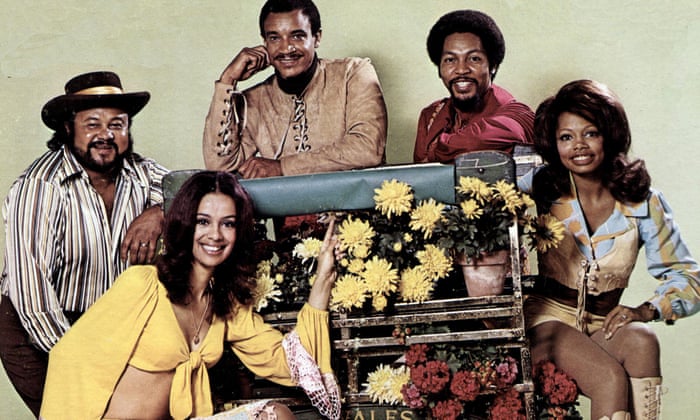
Today's Tune: The Fifth Dimension - Aquarius/Let The Sunshine In

Cult heroes: the 5th Dimension – elegant pop crooners who wowed the mainstream


The opulent harmonies of these five suburban Californians in hits like Aquarius made every song they covered pure joy


https://www.theguardian.com/music/
21 June 2016


The 5th Dimension circa 1970, (left to right) Ron Townson, Marilyn McCoo, Lamonte McLemore, Billy Davis Jr and Florence LaRue. (Photo by GAB Archive/Redferns) Photograph: GAB Archive/Redferns

My parents owned only two albums that weren’t folk or opera. One was the original Broadway cast recording of the musical Hair, which was famous for a scene in which the entire lot were naked; the other was The Age of Aquarius by the 5th Dimension. Both arrived in their record collection around 1975, several years after they had been released (in 1968 and 1969, respectively). My mother bought The Age of Aquarius because she’d been beguiled by the 5th Dimension’s run of gilded pop hits, and was then spurred to investigate Hair because The Age of Aquarius’s title track was a song from the musical.
My formative albums, then: a Broadway show whose selling point was nudity, and cocktail soul by a vocal group whose smoothness got them a rejection from Motown. Of the two, the 5th Dimension moved me more: their tremendous harmonies were uplifting and elegant, and the two female singers, Florence LaRue and Marilyn McCoo, approachably glamorous. (I barely noticed male members Ron Townson, Billy Davis Jr and Lamonte McLemore; they were the worker bees, while McCoo and LaRue were the queens.) McCoo’s soprano and LaRue’s alto were a rich mix – breezy or imploring as the song demanded, or a tangy complement to the men’s baritones. It was, McCoo said later, “a very mellow, overdubbed kind of sound”, while McLemore’s term for it was “champagne soul”. Unexpectedly, Nick Drake was a fan. 
In keeping with the zodiac theme, the group’s star signs were printed inside The Age of Aquarius’s gatefold sleeve, revealing that LaRue and Townson were actual Aquarians. My admiration wasn’t affected by the fact that portly Townson, clearly the odd one out, was holding a pipe in one picture – not some hippie bong thing, but the kind smoked by suburban dads. Their music and look, Townson notwithstanding, were pure joy.
For me, loving them was the right thing to do, and not just because of their talent. They also made me aware of Jimmy Webb, Laura Nyro and Ashford & Simpson, who were young unknowns when the 5th Dimension covered their songs. Two canonical examples of 60s pop – Webb’s Up, Up and Away and Nyro’s Stoned Soul Picnic – got their first airing as Dimension singles, andtheir version of Nyro’s Wedding Bell Blues outclasses the songwriter’s own recording of it. Their opulent harmonies and arrangements made every song they covered definitively theirs, the track Aquarius being a prime example. The Broadway cast original had a dash of high-school musical, but the Dimension version was a thing of celestial beauty, with a distinctly trippy undercurrent.
There were so many more wonders before the original lineup split in 1975, with McCoo and Davis departing to work as a duo. Though not songwriters themselves, they had access to the best: Bacharach and David’s One Less Bell to Answer was a majestic hurricane of heartbreak, while a reworking of Dave Mason’s Feelin’ Alright embodied drivetime Californian exuberance. They even gave Elton John’s Border Song some sophisticated welly. 
The band were anomalies: a black group aimed directly at the “mainstream” (which then meant white audiences); five Californians whose sound reflected Los Angeles’s suburban optimism rather than the disquiet of its inner-city districts. Their first big hit, 1967’s Up, Up and Away, conveyed such boundless anti-gravitational delight that it was adapted by Trans World Airlines into the most memorable of all airline jingles. (TWA recreated the vocals with anonymous session singers, prompting the group to sue on the basis that their recording had been imitated. TWA won.)
It’s obvious why Motown decided they wouldn’t fit in; sonically, they were closer to the Mamas & the Papas than to anything on the Detroit label. And the Motown slogan, “the sound of young America”, excluded the over-30s who comprised thei band’s core following. McLemore later contended that his group “bridged the gap” between young and old, and he was right, inasmuch as they appealed to children as well as parents, but the one bunch they never reeled in was the one between childhood and married suburban adulthood. Even with its subtle flower-power underpinnings, their escapist pop was too lightweight for teenagers and twentysomethings, and their sporadic attempts to engage with current events, such as their cover of Sam Cooke’s A Change Is Gonna Come, seemed tokenistic.
Playing a show at the White House for president Richard Nixon in 1970 only cemented the idea that they were part of the establishment, though LaRue – the only original member who still tours under the 5th Dimension name – has said they were no fans of Nixon. “It was an honour to perform for the president of the United States, [but he] wasn’t necessarily the president of our choice.” No matter; they couldn’t undo what we would now call the reputational damage, despite the fact that one of the songs they played at the White House was The Declaration, a powerful folk-pop appeal for racial unity.
They had formed in 1965 as the Versatiles, a name so dated that their label made them change it as soon as they signed, so they were out of step with the counterculture from the beginning. The Vietnam war and racial inequity were beginning to preoccupy rock by the time they became popular, but the 5th Dimension gravitated to love songs and sunny celebration. When they did address racial politics, as with the Cooke cover, fans responded by sending it to No 60 in the US pop chart. Tellingly, it didn’t make the slightest impact in the R&B chart. Few of their singles did, not even The Declaration. It can be explained not just by the Nixon episode, but by the perception that they “sang white”, though this gets short shrift from McCoo. “When a black artist comes along, we’re always expected to sound like we came out of the church, I feel it also indicates the lack of knowledge that these critics have of the varied backgrounds of black Americans. That was one of the things we were constantly fighting.”
Yet the reason they eventually broke up, after six Grammys and 20 US Top 40 singles (the British were less susceptible to their charms, with only Aquarius and Wedding Bell Blues making any impression), was that in the mid-70s, pop slowly shape-shifted. Rhythm became pre-eminent, overshadowing the Dimension’s strong suit, melody and harmonies. By the time my mother brought home The Age of Aquarius, the 5th Dimension were well past their commercial peak. But what a glorious peak it was.

Horror and Hush-Up in Twin Falls, Idaho


Three boys from Muslim-country immigrant families accused of raping a five-year-old girl, and journalists are angry at . . . the whistleblowers who uncovered it.

By Michelle Malkin — June 22, 2016
Fawnbrook Apatments, prosecutor Grant Loebs

Something wicked happened in Idaho’s rural Magic Valley. The evil has been compounded by politicians, media, and special-interest groups doing their damnedest to suppress the story and quell a righteous citizen rebellion.

On June 7, a brief news item appeared on local Twin Falls, Idaho–based KMVT about a “reported sexual assault that possibly occurred near the Fawnbrook Apartments” five days earlier. 

Unconfirmed accounts of the alleged crime on conservative-leaning websites, plus reports from area members of anti-jihad activist Brigitte Gabriel’s Act for America group and longtime watchdog Ann Corcoran’s Refugee Resettlement Watch blog, culminated in coverage on the powerhouse Drudge Report.

The social-media groundswell, untethered from the constraints of political correctness, forced government authorities to respond.

Police and the local prosecutor’s office grudgingly confirmed that an investigation had begun into the incident. The victim: a mentally disabled five-year-old girl. The alleged perpetrators: Three boys, ages 7, 10, and 14, from Sudanese and Iraqi immigrant families (predominantly Muslim) who have been in the country for less than two years — all but confirming that they are refugees.

What happened? The case is under seal because it involves minors, but prosecutor Grant Loebs said there is videotape of the alleged sexual assault (a fact that local activists first divulged). Two of the boys are in custody. It’s not clear what happened to the third.

Here’s the sickening thing: The people who should have been asking tough questions — like, you know, mainstream journalists — have spent more time attacking local whistleblowers and bloggers than they have spent demanding answers and holding public officials accountable.

Why? Consider the backdrop. Residents in Twin Falls have been worried about the impact of an increasing influx of refugees, many from jihad-coddling countries, over the past several years. Their concerns about crime, welfare, health care, and schools echo those of communities across the country that are bearing the coercive brunt of Beltway bleeding hearts’ refugee-resettlement policies enacted in a shroud of secrecy.

Members of the Twin Falls City Council smugly likened refugee-resettlement critics to “white supremacists.” Regional newspapers including the Idaho Statesman and the Spokane Spokesman-Review rushed to discredit the on-scene reporting of Internet writers such as Leo Hohmann, who had interviewed a witness to the crime for World Net Daily.

“Jolene Payne, an 89-year-old retired nurse who lives at the complex” told Hohmann that she spotted one of the boys “taking pictures with a camera” outside the apartment complex’s laundry room. She went inside and found the five-year-old naked with two of the younger boys naked standing over her. “The worst thing was the way they peed all over her clothes,” she recounted.

Pro–mass-immigration advocates may not like the sources of some of the original reporting that forced the case into the sunlight, but the watchdogs got more right than wrong. These critics now have Twin Falls’s political leaders sputtering to cover their backsides and police brass defending themselves against explosive charges that they dragged their feet.

Instead, the “professional journalists” dwelt on a few early factual errors about whether the boys were from Syria and whether a knife was used — and filled their dismissive articles with “can’t we all just get along” propaganda from refugee-resettlement advocates and contractors with vested financial interests in the game.

The callousness of local officials and indifference of local and national media remind me very much of an international incident that went viral on YouTube earlier this year in the eastern German town of Bad Schlema — located in a region overrun by Muslim refugees.

A concerned grandfather whose granddaughter under the age of ten was sexually harassed by Muslim migrants protested to mayor Jens Muller. In response to his plea for help, Muller told the elderly man to direct his family to “not walk in areas” where refugees would be.

“Just don’t provoke them and don’t walk in those areas.”

The grandfather lamented at the public meeting: “You’re not allowed to walk in your own city anymore.”

To which the jaded mayor replied: “This is the way it is.”

Thank goodness there are Americans still fighting against the collective shrug of sovereignty surrender. Louder, please.

— Michelle Malkin is a senior editor at Conservative Review. For more articles and videos from Michelle, visit ConservativeReview.com. ©2016 Creators.com

Related:

PROSECUTOR: ANTI-REFUGEE MOVEMENT SPREADING FALSE CLAIMS ABOUT SYRIAN CHILD RAPE

Tuesday, June 21, 2016

The Far Empty by J. Todd Scott


May 31, 2016
Having traveled around the word for twenty years as a DEA special agent, J. Todd Scott knows the drill when it comes to law enforcement procedures. With his upcoming debut novel THE FAR EMPTY, Scott creates a modern western environment, set in the small town of Murfee, in the Big Bend area of Texas. There, two men join forces to take down an untouchable figure that commands the town. Chris Cherry is a once promising high school football hero who has to come back to Murfee and become a deputy under the orders of Sheriff Standford “Judge” Ross. Caleb Ross, on the other hand, is Judge Ross’ son, and believes his father might be responsible for the death of his mother. Together, Chris and Caleb form an unlikely partnership to defy the sheriff, and find many skeletons in the town’s closets.
Scott already had the book’s opening line (My father has killed three men…) written down for quite some time, but only managed to carry on after deciding to set the story in the Big Bend.  Instead of creating a straightforward period piece western, Scott decided to set THE FAR EMPTY in modern days, in order to tackle many of the issues he got to know during his years as a law enforcement agent, such as drug and alien smuggling and corruption. That meant a lot of research on the region, which also served the book’s two upcoming sequels, one of which is already finished.
Westerns being a cinematic genre by definition, Scott draws lots of influence from classic and spaghetti western, and also later movies like Unforgiven, The Assassination of Jesse James by the Coward Robert Ford and  Appaloosa, as well as the True Grit and 3:10 to Yuma remakes. William Fridekin’s To Live and Die in L.A., adapted from a book by former U.S. Secret Service Agent Gerald Petievich was also an inspiration. The author wanted to do for the Big Bend what that movie did for Los Angeles.
But can all this roughness and grit affect the literary quality of a novel? “Ultimately, I want the places in my books to feel real, to seem truly three-dimensional, even if the characters that inhabit these places make dramatic and often unwise decisions,” the author explains. “I also try to capture some lyricism in language, even when I’m writing about darkness and violence. The descent of Duane Dupree in the course of the narrative as he succumbs to meth addiction is a prime example. In order to really show his mind’s inexorable disintegration, I put him through several vivid, dramatic hallucinations. It’s tough at times for Duane to know what’s real, and I imagine that’s true for the reader as well.”

Asked about the first thriller he ever read, and what made it memorable, Scott mentions many of Robert Ludlum’s books, such as The Bourne Identity, Michael Crichton’s Congo, David Morrel’s First Blood and Peter Benchley’s Jaws. “My parents were voracious readers and their books were always around the house, so I was exposed to all of these in the early eighties, just as I was entering high school,” he states. “Although as a writer I never felt I could plot on the scale of Ludlum with his broad, world-class spy thrillers, or master the amazing science in Crichton’s works, I appreciated their ability to get the reader in me to turn the page.”
Scott borrowed grit and realism from his background in law enforcement for THE FAR EMPTY, which might not have happened had the author followed his early plan of taking an MFA in Writing at the college. “Ultimately I did what I thought I was most practical: I got married and went to law school,” he says. “And although writing was my first love, I’d always had a keen interest in federal law enforcement too, so when I had the opportunity to join the DEA as a Special Agent I jumped at it. For the next twenty years, I traveled all around the world chasing bad guys. Not a bad way to make a living at all.” It’s not a choice he regrets, looking back, as a novel like THE FAR EMPTY wouldn’t be likely to survive the hothouse of an MFA program. “I think writing itself is the key, whether you do it at your kitchen table or in a classroom. Just get the work done, one word after another.”
*****

J. Todd Scott has been a federal agent with the DEA for more than twenty years, working cases investigating international maritime smuggling, domestic meth labs, and Mexican cartels. He has a law degree from George Mason University and is a father of three. A Kentucky native, he now resides in the Southwest, which provided the backdrop for THE FAR EMPTY, his first novel.
To learn more about J. Todd Scott, please visit his website.