Monday, December 04, 2006

UNC women win soccer championship


North Carolina plays its high-pressure game to perfection, smothering Notre Dame's prolific attack and getting goals from Heather O'Reilly and Casey Nogueira on the way to its 18th NCAA title

Rachel Carter, Staff Writer
The Raleigh News & Observer
4 December 2006

CARY - Heather O'Reilly went out a winner.

The North Carolina senior forward scored one goal and assisted on another to help the Tar Heels achieve their yearly aim -- an NCAA championship.

With a 2-1 victory over Notre Dame on Sunday, UNC soothed some of the pain from the previous two seasons where it saw fantastically talented teams fail to capture the title.

"I honestly couldn't be happier," said O'Reilly, who was named the most valuable offensive player in the College Cup. "I think this team, from the beginning, I knew it was special."

The team's quality was on display at SAS Soccer Park as UNC thoroughly dominated the nation's top scoring offense en route to its 18th NCAA championship. Freshmen made up more than half of UNC's lineup; yet they played the classic Carolina pressure game superbly.

Leading that charge was O'Reilly, who knows better than any current Heels player how cruel the climb to a national championship can be.

As a freshman, O'Reilly was an integral part of the 2003 national title team, a squad so dominant it outscored opponents 32-0 in the NCAA Tournament. But after the Heels were eliminated in 2004 and 2005, O'Reilly was devastated.

She leaves the Heels -- she will join the U.S. national team to train for the Women's World Cup next semester -- as a team keenly aware that just being Carolina isn't enough. She made sure in her final game to remind them, repeatedly warning, "Don't settle."

Nowhere did the Heels (27-1-0) take it to heart more than on defense.

During the NCAA quarterfinals, UNC center back Jessica Maxwell broke her left ankle, which threatened UNC's ability to effectively run its semi-flat back 3 defense -- a high-risk system that depends on good communication.

But with junior Robyn Gayle at center back, the Heels displayed so much speed and skill that they kept top-ranked Notre Dame (25-1-1) from establishing its offense for 75 minutes.

"The philosophy we had in this game was to try and play the game in their half," UNC coach Anson Dorrance said. "Their attacking personalities are wonderful, so we didn't really want to play it in our end."

The Fighting Irish brought the nation's top offense into the game, having scored 84 goals. But Notre Dame struggled to get the ball to Kerri Hanks and Michele Weissenhofer -- its offensive playmakers -- and when it did, UNC's defense was just a bit quicker.

In the 18th minute, UNC took Notre Dame further out of the game. With four Irish players around her near the midfield, freshman Casey Nogueira reversed the ball to create space and sent a diagonal pass to a streaking O'Reilly.

O'Reilly's speed allowed her to burst past two Irish defenders and take possession near the corner of the 18-yard box. Goalie Lauren Karas raced out to meet O'Reilly, but the UNC forward put a quick touch on the ball to beat Karas.

Three Irish players desperately tried to block the net, but O'Reilly chipped the ball over two and the defender Kim Lorenzen couldn't get there in time.

"I thought once that goal, with the way it happened, with that kind of breakdown, the game turned for them," Notre Dame coach Randy Waldrum said.

O'Reilly was the first field player out of the locker room after the half, warming up by herself.
Soon after, she fed Whitney Engen, whose cross was converted by Nogueira on a header in the 47th minute, giving UNC a 2-0 lead.

Although the Irish got their game going late -- when the Heels rested O'Reilly and Nogueira -- it was too late to prevent UNC from capturing another title.

The accomplishment is more impressive given the youth of the squad. UNC started seven freshmen in the second half, indicating a bright future for the Heels.

But Sunday, the future wasn't nearly as important as celebrating a return to the top.

"I haven't really grasped the feelings and emotions of it," said Gayle, a member of the Canadian national team. "It's not just to bring Carolina back, it's something for the program, for the alumni. I'm so happy for Heather, Libby [Guess], [Jennifer] Perkins, and [Elizabeth Lancaster] to be able to leave with this title. They more than deserve it
"... Growing up in Canada, even before playing soccer, this is were I wanted to be. Right now in this moment is where I've wanted to be all my life."

Staff writer Rachel Carter can be reached at 829-8953 or rcarter@newsobserver.com.

UNC reclaims soccer title


By JACK DALY : The Durham Herald-Sun
jdaly@heraldsun.com
Dec 4, 2006 : 12:16 am ET

CARY -- With seven North Carolina freshmen seeing extensive action, it would be easy to say the Tar Heels' 2-1 win over Notre Dame in Sunday's NCAA Championship game was the start of something big. But this is the UNC women's soccer program, where just about every feat -- no matter how noteworthy -- has been accomplished once, twice or three times over. So the best way to describe the victory might be to call it a continuation. And a perfect ending to Heather O'Reilly's UNC career.

The Tar Heels won their 18th NCAA title -- 19th overall -- with a combination of youth, speed and skill the Fighting Irish couldn't match at SAS Soccer Park. By topping previously undefeated Notre Dame (25-1-1) in mostly dominant fashion, UNC (27-1-0) showed its rivals that the program is as potent as ever.

"I honestly couldn't be happier," said O'Reilly, a senior who split her season between the UNC and U.S. national teams. "I wouldn't rather win with another group of girls. It's truly an honor to play for the U.S., to play for your country, to score for your country. "But there's something special about playing for the University of North Carolina -- the tradition involved, the dynasty that we're now proving that we're continuing. ... Today is one of the best days of my life."

To that, UNC coach Anson Dorrance offered a quick, "Me, too."

Before Sunday's championship, the Tar Heels had gone 141-6-7 in the past six-plus seasons but had only claimed one national title. That led some to say the dynasty wasn't what it used to be.

"Ever since we've been here we've been asked about Carolina this and Carolina that and the aura of Carolina," Notre Dame coach Randy Waldrum said after the defeat. "It's a great legacy. But there is so much parity now in women's college soccer it's not going to be duplicated."

Parity or no, the Tar Heels controlled just about all the action in the first 80 minutes on Sunday, forcing most the play into the Fighting Irish's end. After a couple of dangerous moments from O'Reilly and Yael Averbuch, Casey Nogueira got the Tar Heels rolling in the 18th minute. The freshman from Raleigh fed O'Reilly with a beautifully paced ball that arced from the right side of midfield to the left side of Notre Dame's penalty box. With O'Reilly galloping toward the loose ball, Notre Dame keeper Lauren Karas came out of her net to challenge, a decision both Waldrum and O'Reilly called a mistake.

"I saw her coming out and I know that speed is one of the things I have in my back pocket, so to she her coming off her line like that, I think my eyes got wide I got so excited because I knew that I could beat her to the ball," O'Reilly said. "It was just a matter of then what?"

Then what?

Then O'Reilly elevated the ball into the right side of the net as Notre Dame defender Kim Lorenzen tried to kick it away. The Tar Heels continued to dominate the rest of the half, repeatedly outrunning Notre Dame players to loose balls to build a 10-2 shot advantage.

"That's a credit to the speed training that we do," O'Reilly said. "We have a lot of great athletes on our team. I think more than our speed, I think our fitness really helped us today. I think we were the fitter team."

With the Irish still reeling after halftime, UNC scored in the 47th minute when freshman Whitney Engen sent a cross into the box from near the right corner-kick flag. Nogueira's forehead met the ball just before it returned to earth, knocking it into the left side of the net for a 2-0 edge.

While O'Reilly was named the College Cup's most outstanding offensive player, a case could've been made for Nogueira, who also had the game-winning goal in UNC's 2-0 semifinal win over UCLA on Friday. That performance earned the 17-year-old her first collegiate start Sunday.

"As we were walking in here, I was asking her if this is an aberration or if we were ever going to see this again," Dorrance said. "She assured that there's a chance we might see it again, so I'm excited."

The Irish finally got their wits about them in the game's final 10 minutes, scoring in the 81st minute when Brittany Bock converted a header off a set piece. Notre Dame had a flurry of chances in the final moments, but Hermann Trophy winner Kerri Hanks missed a free kick from just outside the box on its last, best opportunity.

Shortly thereafter, UNC began to celebrate on the field it won its last NCAA Championship in 2003. Dorrance believed that team, which outscored opponents 32-0 in the NCAA Tournament, was one of the best ever.

He didn't go so far with his current bunch, but it was remarkable in its own right. With Nogueira playing so well and freshman keeper Ashlyn Harris subbing in for Anna Robenbough at halftime, UNC had seven freshmen -- Nogueira, Harris, Engen, Ali Hawkins, Tobin Heath, Kristi Eveland and Nikki Washington -- on the field at the start of the second half. That was the first that that had ever happened in UNC history. Is that a portend for things to come?

"Nothing ever's assured," said junior Robyn Gale, who was named most outstanding defender. "I thought our team last year was pretty amazing and we weren't assured anything. But I think the freshmen are in a great position. They're only freshmen by title. Everything else they play like seniors out there. "They have three more years -- the potential is endless. But in our program, potential doesn't mean anything."

Sunday, December 03, 2006

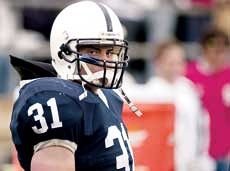
Posluszny ready for long week on awards circuit


Additional Stories
Central's Wisniewski expected to choose Penn State
PSU leads Big Ten in graduation rates
PSU accepts Outback Bowl invitation
PSU takes time to heal before bowl
Paterno, defense get to rest before bowl game

By Sam Ross Jr.
PITTSBURGH TRIBUNE-REVIEW
Sunday, December 3, 2006

Penn State linebacker Paul Posluszny is a contradiction, a linebacker who routinely plies his trade in front of more than 110,000 fans at Penn State home games, yet one who prefers relative anonymity.

That is no longer an option. He's already highly decorated, having established a Penn State career tackles record, earned multiple All-America recognitions, and come home from the awards circuit last season as the winner of the Bednarik and Butkus awards.

This week Posluszny, a former Hopewell High School star, will fly around the eastern and southern United States on the postseason college football awards circuit, neither loving it, nor hating it. Others might revel in the spotlight. For Posluszny, it's an exercise in going with the flow.

His father, Paul, and his mother, Jackie, will accompany him on this awards swing, which begins Tuesday in New York City, where Posluszny is one of 17 finalists for the Draddy Award, the academic Heisman that recognizes a combination of athletic and academic excellence.

The family continues on to Houston Wednesday, where Posluszny is a finalist for the Rotary Lombardi Award, along with Texas offensive guard Justin Blaylock, Ohio State defensive tackle Quinn Pitcock and Michigan defensive end LaMarr Woodley.

The trip concludes in Orlando, Fla., where Posluszny is in competition with Ohio State's James Laurinaitis and Mississippi's Patrick Willis for the Butkus Award, and with teammate Dan Connor and Woodley for the Bednarik Award.

Projected as a first-round pick in the NFL draft, and with just one game -- the Jan. 1 Outback Bowl -- remaining in his college career, Posluszny has been just short of deified among the Penn State family for his combination of athletic and academic excellence. Yet he remains largely unaffected by his accolades.

"I'm a very, very simple person," Posluszny said. "I love to play football. I love spending time with my friends, watching movies. And I love being with my family."

And the trips are fine with his family.

"We like to travel. It's fun meeting some new people," Posluszny's father said. "And nobody knows who I am. That's OK with me."

"We prefer not being in the limelight," Jackie said. "We're proud of him, but it's almost embarrassing to hear so many nice things said about him. There are a lot of great guys out there."

The football player is an apple who has not fallen far from the family humility tree.

"Football is the ultimate team game. For one person to do well, the 10 other guys on the field have to be doing well also," Posluszny said. "It's hard to single out one guy and say he's a great player. If you're a great player, you play on a great team."

Others are not as reluctant to single out Posluszny for praise.

"He's a guy who's going to represent Penn State to the fullest any chance he can get," fellow Penn State linebacker Connor said. "That's what he is. He's a blood and guts Penn State guy. He bleeds blue and white."

Tom Bradley, the man who recruited Posluszny to Penn State from Hopewelll, the coach who in his role of defensive coordinator presided over his four-year career, was emotional speaking of Posluszny after the regular-season finale against Michigan State.

"I have a close bond with Paul. I told him I was going to miss him," Bradley said. "I wrote him a long letter because I knew my emotions would well up a little bit with this being his last (home) game. But he knows how I feel about him."

Jack Ham, a former All-American linebacker at Penn State who enjoyed a Hall-of-Fame career with the Steelers and since has done extensive pro and college broadcasting, sees a bright future in pro football for Posluszny.

"He'll be a No. 1 pick, an outstanding pro," Ham said. "There's no problem with his knee. His burst is outstanding. He's so solid in pass coverage, so that won't be a liability in the pros.
"Plus, he's a smart guy. With that 3.5 or whatever in finance, he'll be able to handle his own money."

Season of transition

The seeming fairy tale that has been Posluszny's Penn State career has not transpired without rough spots.

He began playing in the fifth game of his freshman season and was a starter in the last game of that 2003 campaign, but both that season and his sophomore year produced losing records for the Lions.

Last January, late in what would be a triple-overtime win against Florida State in the Orange Bowl, a win that would conclude an 11-1 season and put the Lions at No. 3 in the final rankings, Posluszny injured his right knee. The diagnosis of partial tears of the posterior cruciate and medial collateral ligaments did not require surgery. But the injury did shelve Posluszny and end his thoughts of possibly entering the NFL draft as a junior.

When Posluszny retook the field this season, a brace on his knee. it was as an inside linebacker instead of his customary outside role.

"I'm sure if he had his druthers, he'd have loved to have played outside again," said Ham, who had created a stir last season when he labeled Posluszny the best linebacker ever to play for the Lions. "My senior year, I had to go to the middle and play inside and it is such a change, it's like your freshman year all over again.

"The keys are all different. You have to think longer before you react to realizing what you're seeing. The last five or six games this year, he really came on."

Posluszny's assessment of his transition, designed to get talented sophomore Sean Lee on the field, was similar.

"It was just a mental thing. The reason why I was able to play the outside position so well was I just really felt comfortable. I knew the ins and outs," Posluszny said. "This year, it took me a little longer mentally to get everything squared away in my mind."

Posluszny still led the team with 108 tackles, seven for loss.

Bradley sees that Posluszny has mastered the new position, as he knew he would.

"There is no one playing better at linebacker than he is in this country," Bradley said. "I will be disappointed if he doesn't win the Butkus again."

Posluszny hadn't expected to win the Butkus Award, emblematic of the nation's top linebacker, last year. He'd said then that Ohio State linebacker A.J. Hawk deserved it.

Posluszny will accept any outcome this year.

"I think I'm a much better linebacker this year than I was last year," he said. "Whatever that goes into, I'm not sure. We'll see. The other two candidates, they're great linebackers as well."

Family ties

The work ethic that has produced football and academic success for Paul at Penn State was honed at home.

"We were strict," his mother, Jackie, said. "Our children didn't get a lot of toys the other kids got. They didn't get to stay out late like other kids. As they got older, they appreciated it
"After Paul's freshman year in college, he said, 'Mom, when I have kids I want to raise them like you raised us.' "

His family, Paul said, has been an "enormous" factor in his success. "I'm lucky enough to have two great parents and great brothers and sisters that have always been there for me and always supported me. For that I am extremely fortunate."

Paul is the middle of five children, with an older brother, Stan, an outfielder who plays in the Seattle Mariners farm system, and an older sister, Mary, who works as a pharmacist in Kansas City, Mo. A younger brother, David, is a standout football prospect who has completed his junior season at Hopewell High School, and a younger sister, Annie, attends Pitt.

Jackie credits Paul's team-first attitude in part to his place in the birth order.

"I think being No. 3 might have helped Paul. He knew you have to be part of a family," she said. "He never said he wished he was an only child like two oldest ones did.

"Paul has had a good work ethic since he was young. He actually has more drive, makes himself work harder than my husband or I would. He puts more stress on himself to do good. I think it's his type-A personality."

Posluszny's father was an athlete at a younger age.

"I played Little League, Pop Warner, all the sports kids played," he recalled of a childhood in Bayonne, N.J. "I played baseball and football in high school (Bayonne Marist) but gave up football when the other kids all got bigger than me. I saw the writing on the wall."

But the elder Paul, a mechanic for U.S. Airways, is quick to give credit for the athleticism of his offspring -- both daughters also played high school basketball -- to wife Jackie, a gym teacher who works at Our Lady of Fatima in Hopewell Township and Holy Trinity in Robinson Township.

"She grew up on a farm. She had to do all the chores," he said.

This elicits a laugh from Jackie.

"I don't think so," she said. "I didn't play any sports. I was too busy working on our farm (in Summit Township, Butler County). I came from a big family (one brother and five sisters). My parents were not about to haul us around to play sports."

Jackie had modest expectations when Paul went to Penn State.

"I didn't expect him to play until his junior year, and play a little more as a senior," she said. "I figured at least he was getting his education paid for.

"But in his sophomore year, it seemed like he was doing pretty good. I thought, OK, maybe he has chance of realizing his dreams of going to the pros. Before that, I didn't think there was any hope. I never thought it would really work out. It seems like so few guys get there. How was my little boy going to make it?"

Paul Posluszny awards travel itinerary:

Dec. 5: Travels to New York City for 9:30 a.m. press conference and National Football Foundation and Hall of Fame dinner that night at Waldorf-Astoria Hotel. Paul is a foundation scholar-athlete and a finalist for the Draddy Award, the so-called Academic Heisman.

Dec. 6: Travels to Houston for Rotary Lombardi Award activities and dinner. Paul is a finalist for the award.

Dec. 7: Travels to Orlando for the College Football Awards Show and Butkus Award reception. Paul won the Butkus Award last season and is a finalist for that and the Bednarik Award, which he also won in 2005, again this year.

Dec. 8: Participates in children's hospital visit and Butkus Award luncheon and returns to State College.

Posluszny also is a finalist for the Lott Trophy to be awarded Dec. 10 in California. He will not attend that because of a conflict with Penn State's football banquet.

Bednarik Award: Given to college football defensive player of the year

Butkus Award: Given to nation's top college linebacker

Draddy Award: Given to player who best combines outstanding athletic, academic and community achievements.

Lott Trophy: Given to college football's IMPACT (Integrity, Maturity, Performance, Academics, Community and Tenacity) player of the year.

Rotary Lombardi Award: Given to nation's top college offensive or defensive lineman or linebacker

Sam Ross Jr. can be reached at sross@tribweb.com or (724) 838-5144.

Richard J. Neuhaus: In Turkey, the Pope built bridges without backing down


3 December 2006
The New York Daily News


What was Pope Benedict doing in Turkey, and was the trip a success? Media attention focused on smoothing troubled relations between Muslim leaders and the Christian West. Keep in mind that whether or not we think the West is still Christian, it is very much the Christian West in the minds of most Muslims. The Pope is understandably viewed as the voice of Christendom. He is, after all, the leader of the greater part of the more than 2 billion Christians in the world.

The encounter in Turkey, and especially in Istanbul, was filled with high historical drama. Istanbul was once Constantinople, established in the fourth century as the western capital of the Roman Empire and named for the Christian emperor Constantine. Conquered by Muslims in 1453, it was renamed Istanbul. Islam had experienced a run of successful conquests since the seventh century, until it was turned back at the gates of Vienna in 1683. Such is the long history of Christian-Muslim relations, filled with defeats and resentments that fuel the resolve of some radical Muslims to go on the offensive with a jihad, or holy war, aimed at the West's submission to Islam.

The Pope's visit, of course, came in the aftermath of his Sept. 12 address at Regensburg University in Germany - where he raised the question of whether Muslims agree that violence has no place in advancing religion. Violence, he said, is contrary to reason, and "to act against reason is to act against the nature of God." In reaction to the suggestion that Islam may be prone to violence, thousands of Muslims violently protested in the Middle East and elsewhere, torching Christian churches and killing a Catholic nun in Somalia.

Some claimed the Pope had been unnecessarily provocative in Regensburg. Others were grateful that, at last, someone on the world stage had the courage to challenge the silence and even the complicity of Muslim leaders in connection with terrorist attacks on the West.

During his days in Turkey, all the diplomatic niceties were observed, but Benedict did not back away even 1 inch from the challenge he raised at Regensburg. On the contrary, he repeatedly asserted that religion must repudiate violence, and underscored the duty of states to protect religious freedom.

The last point is a very touchy issue in overwhelmingly Muslim Turkey, where Christians are less than one half of 1% of the population. Despite all the attention to Christian-Muslim relations, the chief purpose of the Pope's trip was to express solidarity with Bartholomew I, the ecumenical patriarch of Constantinople and the symbolic leader of the world's 300 million Eastern Orthodox Christians. Confined by the Turkish government to a small area of Istanbul called the Phanar, the ecumenical patriarchate is under siege and denied the most elementary rights to own property or conduct its own ministries.

Contrary to some media reports, notably in The New York Times, the Pope did not bless Turkey's admission to the European Union. Rather, he and Bartholomew issued a joint statement that such admission must be conditioned upon respect for "the inalienable rights of the human person, especially freedom. In every step toward unification, minorities must be respected, with their cultural traditions and the distinguishing features of their religion."

So was the visit to Turkey a success? If success is measured by clarifying the challenge of radical Islam and expressing solidarity with religious minorities under Islamic rule, the answer is certainly Yes.

Father Neuhaus is editor in chief of First Things, a monthly magazine of religion and public life.

Friday, December 01, 2006

Patrick Buchanan: The War of All Against All

1 December 2006
http://www.realclearpolitics.com
Patrick Buchanan

A few days back, the "Today" show, speaking for NBC News, declared Iraq a "civil war," and said the network and CNBC and MSNBC would henceforth use that term to describe it.

President Bush and White House Press Secretary Tony Snow angrily objected. A civil war, said Snow, is when two identifiable armed forces war with each other for control of a government and nation. And Iraq is not that.

Contradicting Snow and the president are most journalists and Colin Powell. Speaking in Dubai, Powell declared, "I would call it a civil war ... because I like to face reality," a smart slap across the face of the president who made him secretary of state by a soldier who feels badly used by Bush, Cheney, Rumsfeld and the neoconservatives.

Is this a matter of politics and semantics?

Yes, but it is also far more than that. Those who insist on calling Iraq a civil war are consciously undercutting Bush's case that Iraq is "the central front in the war on terror," that we fight them over there so that we will not have to fight them over here.

Believing him, half the country is convinced we cannot retreat, cut-and-run, for that would mean the terrorists win in Iraq and bring the terror war to the United States. But if Iraq is but a "civil war," most American would say that it's not America's war -- let's go home.

This battle over definitions recalls Vietnam. Those who wanted to stay the course in Vietnam argued that it was the central front in the Cold War against communism, which threatened Southeast Asia today but America tomorrow. Those who had supported the war, but concluded it was no longer worth it, suddenly changed their story to declare it was now a civil war and none of America's business.

What is happening today is that those who once cheered Tommy Frank's march to Baghdad to liberate Iraq from Saddam are trying to rationalize their throwing Iraq to the wolves that the invasion unleashed. America's elite does not wish to admit the truth: that it has no stomach for fighting this ugly and unpopular war into which it foolishly marched the United States.

The baby boomer elite arrogantly and ignorantly led us into a quagmire, as their fathers did in Vietnam -- and now, just like their fathers, they lack the stamina, courage and perseverance to see it through. As they don't want to be held accountable for losing the war, they have seized upon the rationale that it was never our war to fight.

Calling it "a civil war" is a cover for people who wish to cut and run.

What is the truth? Is it a civil war, like the Spanish Civil War of 1936-1939, when Franco led his armies out of North Africa into Spain to overthrow a regime and end an anarchic situation where priests and nuns were being murdered and Bolsheviks seemed about to ascend to power? No, it is not.

The war in Iraq consists rather of many small wars. The Kurds in the north are seizing and ethnically cleansing Kirkut in anticipation of a day of secession that will give them a nation. Al-Qaida and the Baathists in Anbar are fighting U.S. Marines to expel them from Iraq.

Al-Qaida attacked the Golden Mosque and perpetrated atrocities against Shia civilians to incite the Shia to reprisals and ignite a Sunni-Shia sectarian war. Zarqawi, before we got him, succeeded. He set off the chain reaction that has now a momentum of its own.

The Shia initially backed the Americans and Brits against the Sunni insurgents. Having won power, however, they now are fighting each other over how orthodox the regime should be, and whether the Shia should, like the Kurds, break away and set up an independent state.

The twin pillars of Iraqi Prime Minister Nouri al-Maliki's government are the U.S. military and Moqtada al Sadr, mortal enemies who have fought bloodily before and may well be preparing for a decisive Battle of Baghdad.

Iraq seems to this writer less a classic civil war, like the Spanish and the Russian civil war between "Reds" and "Whites" from 1919 to 1921, than a version of bellum omnium contra omnes, the war of all against all. That is the Latin phrase Thomas Hobbes gave to human existence in the state-of-nature thought experiment he conducted in "Leviathan."

Even our War Between the States was not truly a civil war. For the South did not seek to overturn Lincoln's election, capture the capital or rule the country. The South wanted only to secede from the Union of Abraham Lincoln as their fathers had seceded from the England of George III.

Yet, this argument about whether Iraq is or is not a civil war is deeply consequential for what it exposes. Our elite senses this war is lost, and they are preparing alibis for their roles in what may yet prove the greatest strategic blunder in American history.

Copyright 2006 Creators Syndicate

Thursday, November 30, 2006

Paul Sperry: Imams Gone Wild


Paul Sperry
http://www.FrontPageMag.com
November 30, 2006

The Council on American-Islamic Relations is demanding Congress investigate US Airway's removal last week of six imams from one of its flights. The Muslim-rights group claims the imams, who were behaving suspiciously, posed no threat.

It's "very, very inappropriate to treat religious leaders that way," a spokesman fumed.

According to CAIR, imams are as harmless as Buddhist monks and deserve no less respect. Tell that to flight attendant Kimberly Banducci.

According to police reports I've obtained, the Delta Air Lines veteran was assaulted by a Muslim cleric in a bizarre attack aboard a flight from Miami International Airport three years ago. The wild scene, which involved federal air marshals and local police, was never reported in the media.

Here's what happened: On Oct. 23, 2003, Sheikh Ahmed Hamman Mahmoud Hamman claimed he needed assistance as he boarded Delta Flight 1586. Banducci, who was flight coordinator that day, escorted the Egyptian imam, dressed in a flowing robe, to his seat. As she helped him get seated, Hamman remarked in heavily accented English how good she smelled and asked her name.

As she began to recoil from the bearded man's passes, he suddenly grabbed her face with one hand and wouldn't let go. Banducci told him he was hurting her and asked for help from passengers in the immediate area. She was able to pull away, but then His Most Holiness grabbed both her breasts and again would not release his grip. Banducci yelled at him to let go, but he refused, squeezing even harder. Only after she screamed for help and two air marshals broke cover did the man back down.

As authorities questioned him, Hamman acted like he couldn't speak any English. The Miami-Dade Police Department took him into custody where he was booked the next day for felony battery, the police report says. Delta did not press charges, however, and kept the incident from the press.

US Airways, which has been flooded with positive calls from customers for its stand against the six obnoxious imams, is poised to take over Delta in a proposed merger, making it the nation's largest carrier.

A local Muslim leader bailed the violent groper sheikh out of jail. Authorities say a man named Sofian Abdelaziz (aka Sofian Zakout, aka Sofian Abdelaziz-Zakout, aka Sofian Zakkout) representing the American Muslim Association of North America, or AMANA, posted bond for the 35-year-old Hamman, who was visiting Florida during Ramadan. Abdelaziz-Zakkout, a Kuwaiti native, was his trip sponsor.

He's also a radical Islamic activist who is a close personal friend of the notorious Shukrijumahs of South Florida, a Saudi family whose son, Adnan, is an al-Qaida operative thought to be in line to head an encore attack on America. The FBI calls him "the next Mohamed Atta." His late father was a local Wahhabi imam on the Saudi payroll.

Not surprisingly, Abdelaziz-Zakkout recently defended an accused al-Qaida confederate of Adnan Shukrijumah at his trial. He also opposed the U.S. strikes on Afghanistan after 9/11, and the U.S. assassination of al-Qaida terrorist Abu Musab al-Zarqawi in Iraq.

Back to the Saintly Six imams kicked off US Airways Flight 300. Their ringleader Omar Shahin whined, "What happened to us is terrible." No, what happened on 9/11 is terrible, and airlines and their passengers will be damned if they'll tolerate any more treacherous tricks from packs of truculent Muslim men on board their flights.

Shahin knows of such shenanigans. At his former mosque in Tucson, Ariz., he ministered to two college students removed from an America West flight after twice attempting to open the cockpit. The FBI suspected it was a "dry run" for the 9/11 hijackings, according the 9/11 Commission Report. One of the students, Hamdan al-Shalawi, had trained for attacks in Afghanistan, the report says. The other, Muhammed al-Qudhaieen, became a material witness in the 9/11 investigation.

Even so, the pair filed racial-profiling suits against America West, now part of US Airways. Defending them was none other than Shahin, the public face of the Slighted Six imams who returned to the US Airways ticket counter at the Minneapolis airport to scold agents before the cameras, and then staged a protest at Reagan International Airport in Washington.

In an "Arizona Republic" interview after the 9/11 attacks, he acknowledged once supporting Osama bin Laden through his hardline Saudi-backed mosque in Tucson. FBI investigators believe bin Laden operated a cell there. Hani Hanjour, the hijacker who piloted the plane that hit the Pentagon, attended the Tucson mosque along with bin Laden's one-time personal secretary, according to the 9/11 Commission Report. Bin Laden's former chief of logistics was president of the mosque before Shahin took over.

"These people don't continue to come back to Arizona because they like the sunshine or they like the state," said FBI agent Kenneth Williams. "Something was established there, and it's been there for a long time." And Shahin, a native of Jordan, appears to be in the middle of it.

Shahin now heads the North American Imams Federation, which is affiliated with the innocuous-sounding American Open University, where he teaches Islamic studies. The radical Islamic school, known by law enforcement as "Wahhabi Online," has raised a number of red flags at the FBI, including the fact that:

-- It's founder and chairman, Jaafar Idris, is a Sudanese radical on the Saudi payroll who was recently deported for visa fraud and spreading extremism in America.

-- A co-founder, Salah As-Sawi, is a professor at Al-Azhar in Egypt, a bastion of the dangerous Muslim Brotherhood. In fact, American Open University is a fully accredited satellite campus of Al-Azhar. As-Sawi worked with Idris at the Institute of Arabic and Islamic Sciences in Washington, a propaganda center set up by the Saudi Embassy to spread Wahhabism in America. It was raided after 9/11 and is still under surveillance by federal authorities.

-- Alumni of the "university" include convicted members of the Virginia Jihad Network.

-- The school has received funding from a suspected al-Qaida front that has expressly advocated suicide attacks and using airliners as weapons. The Islamic Assembly of North America, or IANA, is bankrolled by the Saudi religious minister who stayed at the same Washington-area hotel as the hijackers the night before they attacked the Pentagon. (He feigned a heart attack when FBI agents tried to question him and was subsequently evacuated with other Saudi officials on White House-approved escape flights after 9/11.)

A former CAIR official, Bassem Khafagi, headed IANA. He pleaded guilty to terror-related charges and was deported.

CAIR, which is listed as a partner organization to Shahin's North American Imams Federation, insists American imams are peace-loving "patriots."

Oh? Would that include Omar Abdul-Rahman, the blind sheikh serving life for plotting to blow up several New York landmarks? Or Imam Ali al-Timimi, a native Washingtonian, also behind bars for soliciting local Muslims to kill fellow Americans? Or fugitive cleric Anwar Aulaqi, the U.S.-born imam who prepared some of the 9/11 hijackers for martyrdom?

How about imams Mohammed al-Hanooti and Siraj Wahhaj (a CAIR and NAIF board member), both unindicted co-conspirators in the 1993 World Trade Center bombing conspiracy?

Perhaps CAIR is referring to other imams in New York who were recently busted for buying shoulder-fired missiles. Or the one in Lodi, Calif., who planned to build an al-Qaida terror camp there, and on and on.

Yup, they all wear halos all right. Or is that orange jumpsuits? Oh, that's right, they're all so misunderstood and mistreated. Boo-hoo, somebody call the wha-a-a-a-ambulance.

Click Here to support Frontpagemag.com.

Paul Sperry is a Hoover Institution media fellow and author of Infiltration: How Muslim Spies and Subversives Have Penetrated Washington. He can be conacted at
Sperry@SperryFiles.com.

Ann Coulter: Coulter Gets Results!


November 29, 2006
http://www.anncoulter.com

The six imams removed from a US Airways flight last week have apparently adopted my suggestion that if they really want to protest the airline, instead of boycotting US Airways, they should start flying it frequently. The spokesman for the imams — or as I believe it's phrased in their culture, "designated liar" — Omar Shahin, staged a protest at Reagan Washington National Airport on Monday, after which, according to The Associated Press, "he and other religious leaders boarded a US Airways flight to demonstrate their determination to continue praying and flying."

The original six imams removed from the flight last week first attracted attention when they said prayers to Allah on traditional Muslim prayer rugs in the boarding area. After boarding, they changed seats, spreading themselves throughout the plane. They were also overheard spouting anti-American rhetoric. Witnesses said the six men appeared to be either Islamic fanatics or U.S. Army chaplains on leave from Guantanamo.

Following the lead of FEMA in keeping Americans safe, the Homeland Security Department's Office for Civil Rights and Civil Liberties is investigating the removal of the imams from the US Airways flight. (Talk about coincidences — I'm currently investigating the removal of the Office for Civil Rights and Civil Liberties from the Department of Homeland Security!)

Imam spokesman Shahin is a great example of why airport security ought to be profiling Arabs. Shahin's predecessor at the Islamic Center in Tucson was Osama bin Laden's financier and head of logistics — until he was arrested in Saudi Arabia in 2002. Instead of aggressively distinguishing himself from his terrorist predecessor, judging by news reports, Shahin spent the five years after 9/11 denying that Muslims were behind the attacks and complaining of phony anti-Islamic "hate crimes" — as opposed to the pro-Islamic hate crimes he presumably endorses.

In 2003, for example, Shahin alleged that a woman in Arizona had thrown shoes at children at the mosque. This is the most transparent hoax I've heard since, "If I did it, here's how I would have done it." This is like the joke about a speaker at an American communist rally opening with: "Workers and peasants of Brooklyn!" Shahin has so little insight into this country, he can't even invent a believable hate crime.

It's Arabs who have a thing about shoes being a sign of disrespect, not Americans. When Iraqis toppled the statue of Saddam Hussein, the crowd immediately pelted it with shoes. Saddam installed a mosaic of the first president Bush's face on the ground floor of his palace so that visitors would be forced to disrespect Bush by walking on his visage in their shoes. Shahin himself couldn't get away from this pan-Arabic shoe fetish, adding: "The incidents of Muslims being attacked kind of shocked me in my shoes."

Note to imams trying to fabricate hate crimes against Muslims: Americans don't share your shoe neurosis. At Reagan National this week, Rabbis joined the Muslims at the prayer protest — though one imagines they did not share this prayer from the Hadith: "And the Jews will hide behind the rock and tree, and the rock and tree will say: 'O Muslim, O servant of Allah, there is a Jew behind me, come and kill him!'" In fairness, they usually save that one for the high holidays, like the "Festival of the Six Dead Jews" or "Honor Killing Week."

Nor this one, also from the Hadith: "The Prophet said: 'The Hour will not take place until the Muslims fight the Jews, and the Muslims kill them. The Muslims will kill the Jews. Rejoice! Rejoice in Allah's victory!'" (Is it just me, or might some fanatic twist those words into an excuse to kill Jews?)

Also strange was that the NAACP has piped in to complain about racial profiling of Muslims. The only reason Americans feel guilty about "racial profiling" against blacks is because of the history of discrimination against blacks in this country. What did we do to the Arabs? I believe Americans are the victims in that relationship. After the attacks of 9/11, profiling Muslims is more like profiling the Klan.

COPYRIGHT 2006 ANN COULTER

Wednesday, November 29, 2006

Michael E. Bailey: Napoleon Blown Apart


Touchstone Magazine
October 2006

Michael E. Bailey on the Pauline Aliens of Preston, Idaho

Napoleon Dynamite entered American movie theaters in 2004, having earlier garnered unexpected buzz at the Cannes Film Festival, and within a short time became a cultural phenomenon. Two years after its release, the comedy remains a perennial student film favorite as measured by the all-authoritative standard for college campus life, FaceBook, as well as by the ubiquity of “Vote for Pedro” t-shirts.

It follows the struggles of young Napoleon Dynamite, a Preston, Idaho teenager whose social ineptness at high school compounds the misery and loneliness of his wretched home life. An orphan, his family consists of his guardian grandmother, a short-tempered woman who lives a mysterious double life of fun on the sand dunes, and Kip, his unemployed 32-year-old stay-at-home brother, whose chief activity is chatting for hours “with babes” on-line.

Napoleon’s Hope

Hope enters Napoleon’s life when he befriends new classmate Pedro, an immigrant from Juarez, Mexico, and Deb, a girl who meets him while selling glamour shots door-to-door. The plot, insofar as the movie can be said to have a plot, revolves around their awkward but developing friendship as they campaign for Pedro’s improbable candidacy for school president.

Complicating matters is the overbearing Uncle Rico, who serves as guardian to Napoleon and Kip(!) when their grandmother is injured in a bizarre dune buggy accident. Uncle Rico and Napoleon clash immediately and continuously, and Uncle Rico does not hesitate to humiliate Napoleon in front of his new friends. Home is no refuge for Napoleon, and Uncle Rico’s actions threaten to undermine his friendships and only source of dignity.

At first glance, the movie’s appeal to young people is no surprise; after all, it’s a teen movie with lots of physical humor and distinctly defined characters with highly imitable voices. Yet it stays remarkably clear of most teen-movie props and clichés: It is virtually free of profanity—Napoleon says “Gosh!” and “Dang it”—and it features neither female nudity nor a randy male trying to lose it or have sex with pies.

Napoleon Dynamite is a funny teen movie, but its refusal to play by the rules of most teen movies indicates that it is not, well, just another teen movie. Certainly the bookends of the movie, which show Napoleon on two forms of transportation, suggest that something important has happened to him in between.

In the movie’s opening scene, a sullen and sighing Napoleon, wearing a wild stallion t-shirt, boards a school bus with children half his age and works his way to the back. In the movie’s closing sequence, Napoleon rides a “wild honeymoon stallion” to his brother’s wedding, looking half-like another famous Napoleon.

At the risk of elaborately describing the clothes of a perfectly naked emperor, I think that the underlying theme of Napoleon Dynamite is (though the movie was made by Mormons) consistent with the moral anthro-pology of Christianity: to show us how we become genuinely human.

The point of the movie seems to be this: “Flying solo,” that is, the individualistic pursuit of one’s own happiness apart from the good of others, culminates in misery, and the only way to grow as a human, or even to become human, is through a thick community of support, responsibility, and love. Playing by oneself, as Napoleon is wont to do at the tetherball pole, is unrewarding and pitiful.

The “Decroded” Heart

Since Napoleon Dynamite may well be the most quoted movie in recent years, it seems fitting to elaborate upon three key lines that compactly reveal its meaning. Napoleon utters the first to buoy up his friend Pedro before he gives a campaign speech to the student body. He says: “Pedro, just listen to your heart. That’s what I do.”

Napoleon’s life is such a study in frustration and stunted hopes that it is difficult to believe that he actually follows his heart. But follow his heart he does. Consider the opening lines of the movie. Napoleon plops down on the last seat of the school bus and a boy less than half his age asks him, “What are you going to do today, Napoleon?” To which he responds peevishly, “Whatever I feel like I want to do. Gosh!” And then he proceeds to do exactly what he wants—though he rarely gets what he wants—for the rest of the movie.

But Napoleon is still miserable. What does it matter to follow one’s own heart when one’s heart is small and petty or, to use a favorite word of Napoleon’s, “decroded” (i.e., decayed and corroded)? Thus the film reveals a radical deficiency of individualism: Following your heart does not bring you happiness.

What if our pursuit of our heart’s every desire causes our hearts, like the Grinch’s, to become two sizes too small? What if our feverish pursuit of individual happiness causes us to neglect the communities that, in reality, make us happy? What if, like Napoleon, in our isolation or in our broken communities we have little chance of ever realizing our potential even when we follow our hearts?

Napoleon throws out of the bus window a doll-sized action hero attached to a string. I do not think it much of a stretch to conclude that this doll represents Napoleon. For the greater part of his life, he has been strung and bounced along the road of life face down in the dirt. Life is largely something that happens to Napoleon.

Napoleon is, in effect, the anti-Ferris Bueller. He doesn’t want to have fun so much as simply to survive. He has no friends (at least at first), he gets bullied at school, and he is scared of chickens. In his fantasy life, in contrast, he is a superhero who shoots wolverines, joins gangs who want him for his skills, and forges alliances with wizards and our “underwater ally,” the Loch Ness Monster.

Seek happiness all you want, the movie seems to suggest, but if your heart is decroded, you will still be miserable, a man in body, perhaps, but still just an unhappy boy on the school bus.

No Man Should Be an Island

The absence of Napoleon’s parents is the key to unlocking the underlying serious message of the movie. The threat of social isolation, of loneliness—of being left behind—looms constantly in the film. Virtually every time the filmmakers show a house, it stands by itself, isolated.

Apart from a few school sequences, there are perhaps ninety seconds in the film that show what could be described as a neighborhood or community. This is a movie of vast empty fields, lonely playgrounds, and isolated houses. In one of the film’s few visually arresting scenes, Napoleon, who has been abandoned by his Uncle Rico and is late for the school dance, is shown running to town on an open road that cuts through an immense and remote valley. The scenery mirrors Napoleon’s life.

Certainly the filmmakers go out of their way to show how Napoleon is a misfit. Another way of saying this—a Pauline way of saying this—is that Napoleon is an alien, that is, he is alienated from the world in which he lives. He is not at home in Preston, Idaho. To make sure we don’t miss the point, in the credits sequence the first item taken out of Napoleon’s wallet is a card with his name on it and a picture of—what else?—an alien.

The film’s other characters are also ill at ease in the world. Napoleon’s friend Deb is a very sweet but notably plain girl who runs a glamour studio. Pedro is literally an alien, an immigrant, living in a puzzling new land. But at least he is comfortable in the world of reality, unlike Napoleon’s brother Kip, who lives in the Internet world of chat-rooms and on-line dating.

Uncle Rico is hilariously unerotic about the present yet hopelessly romantic about the past. One of the more subtle jokes in the film is that Uncle Rico attempts to time-travel back to 1982, when the town is still stuck in 1982, judging by the music and fashion styles of the place. His attitude about the present is revealed in this line: “We can’t afford the fun pack.”

True Dreams

The film follows Thomas Hobbes in suggesting that life without community is isolated, nasty, brutish, and possibly even short. But it also suggests that life in community is possible, if difficult. Even in light of alienation, the film ends hopefully, even cheerfully. Just as Pedro predicts. In his campaign speech for school president, Pedro had concluded by saying, “If you vote for me, all of your wildest dreams will come true.”

This is the second key line of the film. The moviemakers seem to be saying through Pedro that if this kid can become class president, then anyone’s wildest dreams really can come true. But here’s the rub: Pedro’s dreams cannot come true without the support of the community. Through Pedro, the filmmakers call on the community to support him and, indirectly, one another.

The movie teaches us that friendship and community, like God’s grace, can come when least expected and in the least expected manner. Several times in the movie, we see Napoleon, like Blanche DuBois in A Streetcar Named Desire, being rescued by the kindness of strangers. Recall Napoleon on that isolated road, running back to town to meet his date for the dance. Abandoned by his uncle, Napoleon is given a lift and thereby saved from his predicament by strangers, Pedro’s tough-cut cousins.

Pedro himself is an outsider to the community, whose friendship emboldens Napoleon and gives him new direction and purpose. Deb offers him an unexpected source of friendship and caring that is otherwise missing in his life. The individuals who should have been his bulwark and support—his brother, his Uncle Rico, and his grandmother—fail him completely, so Napoleon builds a kind of family with Pedro and Deb.

Not by Bread Alone

Food plays a weirdly prominent role in this movie. Scarcely five minutes roll by without some reference to or shot of food or drink. In the cafeteria, Napoleon stores up tater tots like a squirrel. Nachos, hot dogs, eggs, cake, “danged kesadillas” (pronounced by Napoleon’s grandmother “case-a-dill-a”), steak, fruit, bleached milk, “chimini changas,” and delicious bass all make appearances.

The characters are clearly starving. But what are they hungry for? Security? Respect? Love? Or just food? The movie credits begin by identifying characters through plates of food, a visual metaphor playing off the phrase, “You are what you eat.”

But is that true, are we just the stuff we eat? Or do we live by something more than bread alone? Is life nothing more than keeping the body free from pain and death for as long as possible?

Scripture says that he who wishes to save his life will lose it, and he who is willing to lose it for God’s sake will find it. The movie confirms this view. Napoleon subjects himself to near-certain humiliation by performing an elaborate (and comical) dance in front of the student body for the sake of Pedro’s election campaign. That the students go wild for his performance should not cause us to overlook his incredible daring.

Napoleon’s dance is an act of love. That the movie wraps up in a lovely package of warmth and hope immediately following Napoleon’s dance reveals the central message of the story: We are made complete only by first becoming vulnerable for the sake of love. No one is beyond love’s redemptive power.

Kip utters the third important line of the movie, when he says of his now in-the-flesh love: “Lafawnduh is the best thing that’s ever happened to me. I’m a hundred percent positive she’s my soul mate.” Lafawnduh, met on-line, is a woman who arrives in Kip’s life from Detroit, sight unseen, of unknown history and of questionable profession. She is black. After meeting her, Kip, who is unquestionably the single whitest character in the history of film, wears bling and works on his street moves for her.

From initial appearances, the relationship is ill-fitted if not just plain nuts. But who doesn’t believe that he is better off with Lafawnduh? Any real human lover for Kip is better for his soul—that is, makes for a better soul mate—than the relationship he had with his beloved technology. Kip’s virtual life was pathetic. His new life is weird and unorthodox but, by comparison, a ride into the sunset.

Love Triumphant

Napoleon Dynamite is a humorous but touching critique of the inevitable loneliness and meaninglessness of individualism when it is stripped of the context of genuine community. Its message is consistent with a Christian moral anthropology, that human beings are not intended to “fly solo,” but made to live in a community marked by the vulnerability and sacrifice of love.
The movie ends in a quietly triumphant celebration of love and friendship. Pedro has won the presidency. Kip marries Lafawnduh. Uncle Rico is possibly united with his girlfriend. And Napoleon is no longer playing tetherball by himself, but is now playing with Deb, who is looking lovely and womanly. One can imagine them growing up to live happily together.
As Napoleon would say, “ Lucky!”

Michael E. Bailey is Associate Professor of Government at Berry College in Mount Berry, Georgia. He serves as Deacon at First Presbyterian Church in Rome, Georgia, and is married and has three daughters.

“Napoleon Blown Apart” first appeared in the October, 2006 issue of Touchstone. Click here for a printer-friendly version.
If you enjoyed this article, you'll find more of the same in every issue. An
introductory subscription (ten copies for one year) is only $34.95.

Robert T. Miller on the Pope's Comments Regarding Wealth Ditribution

From http://www.firstthings.com
November 29, 2006

Speaking about the many people in the world who go hungry, Pope Benedict XVI says that we need “to eliminate the structural causes linked to the system of government of the world economy, which allocates the greater part of the planet’s resources to a minority of the population.” (See the ZENIT Daily Dispatch for November 12, 2006.)

In focusing on the allocation of goods, however, Benedict misdiagnoses the problem, which really concerns economic growth. Like most non-economists, he speaks as if the world’s stock of goods and services were fixed, the only issue being how properly to distribute them. In fact, the total amount of goods and services in the world has been increasing very rapidly for a long time. According to the United Nations Statistics Division (from which all the statistics below are taken), the aggregate gross domestic product of all countries in the world—that is, the total value of all goods and services produced in the world—has increased from about $3.26 trillion in 1970 to about $40 trillion in 2004 (all measured in current U.S. dollars).

In other words, the world nowadays produces twelve times the goods and services it did thirty-five years ago, and, apart from recessions (defined as two or more successive quarters of declining GDP), we will produce even more in the future. This is why we are much better off than we were in the past.

But economic growth is very uneven, with the economic output of some countries increasing much faster than that of others. If you want to know why some countries have become wealthy and others have stayed poor, therefore, you need only compare the growth of their respective GDPs per capita. Consider South Korea and Zimbabwe. In 1970, their respective GDPs per capita were virtually identical: $290 for Zimbabwe and $291 for South Korea. By 2004, Zimbabwe’s GDP per capita had hardly budged, having increased to just $351, meaning that the average Zimbabwean was only marginally better off in 2004 than 1970. In South Korea, however, GDP per capita increased to $14,266, an astonishing forty-nine-fold increase. (In fact, matters are even worse than these numbers imply, for Zimbabwe’s GDP per capita had been as high as $867 in 1982, and from 1997 to 2004 it declined every year, from $735 to $351.) Comparisons for similar pairs of nations—e.g., Singapore and Zambia—yield similar results.

It is thus true, as Benedict says, that the greater part of the planet’s resources is enjoyed by a minority of the population, but this is because the greater part of those resources is produced by that same minority of the population. The world economy is not rigged in favor of the rich nations. South Korea did not get rich, and Zimbabwe did not stay poor, because the captains of industry and the Wall Street bankers met in a smoke-filled room and decided that they loved South Korea but hated Zimbabwe. The South Koreans got rich because they earned their riches and continue to do so, year in and year out. Zimbabweans are poor because they produce little—and less now than twenty years ago. People who produce wealth naturally think they are entitled to keep most of it for themselves and their children. I don’t dispute that such people ought to give away more of what they have, but we should be clear that they have this wealth in the first place because they are producing it themselves, not wrongfully taking it away from others.

When some people are producing a tremendous amount of wealth and others are producing little, it is fine, as a stopgap measure, to tell those producing much that they should share what they produce with those producing little. The immediate needs of the poor must be met. But any permanent solution to the problem requires that those producing little start producing more. The conditions needed to generate sustained economic growth are well known: political stability, transparent and just government, respect for the rule of law, strong property rights, free trade, free flows of capital, disciplined monetary policy, and an educated and hard-working population. Most people in the poor nations are willing to work hard, but the other conditions for economic growth rarely obtain in such nations. This is the fault, primarily, of their leaders—sometimes, it is true, aided and abetted by the governments of developed countries—who have largely prevented the emergence of the other factors needed for sustained growth. The tyranny of Zimbabwe’s Mugabe is a particularly spectacular example, but the conditions for economic growth are fragile, and pathological political, legal and economic regimes nowhere near as bad as his are quite sufficient to stifle economic growth.

In our fallen condition, such problems may be intractable. After all, we have it on good authority that we shall always have the poor with us. Still, we have to try to help when we can, and doing so begins with understanding clearly why the poor nations are poor. The problem is one of production, not distribution. Pretending otherwise only makes the problem harder to solve by obscuring its true nature.

Robert T. Miller is an assistant professor at the Villanova University School of Law.
10:21 AM

John Berlau: The Case of the DDT Deniers

November 29, 2006 7:00 AM
http://www.nationalreview.com

Kenya crazy talk.
By John Berlau

Poor little Kenya. That’s the message the media have been sending as the United Nations and European nations hold out this African country as the poster child of America’s environmental sins. In the weeks leading up today’s presentation of oral arguments in Massachusetts v. EPA — the Supreme Court case in which northeastern states are suing the Bush administration to regulate carbon dioxide as a “pollutant” under the Clean Air Act — global-warming alarmists and the media have been pointing to malaria epidemics in the cooler regions of Kenya as proof of the harmful effects of human-induced “climate change.”

At the United Nations global-warming summit earlier this month in Kenya’s capital city of Nairobi, the Associated Press breathlessly filed a dispatch citing Kenya as the prime example of how “a warmer world already seems to be producing a sicker world.” The article proclaimed that because global warming was “disrupting normal climate zones” in Kenya, “malaria epidemics have occurred in highland areas where cooler weather historically has kept down populations of the disease-bearing mosquitoes.”

The AP article followed the predictable pattern of blaming America for not ratifying the Kyoto Protocol, describing how the mostly Europeans signatories were discussing “how to draw the United States into a plan for mandatory emission caps.”

Many friend-of-the-court briefs point to recent cases of malaria appearing in the world’s cooler regions to try to persuade the Supreme Court that carbon dioxide is already affecting public health and thus should be regulated. With examples such as Kenya, they are likely trying to persuade swing justices, such as Anthony Kennedy, who increasingly weigh international considerations in their judgments about laws.

Al Gore’s book and DVD, An Inconvenient Truth, also showcases Kenya. Recent malaria outbreaks in the city of Nairobi, Gore proclaims, show that “now, with global warming, the mosquitoes are climbing to higher altitudes.” At the Nairobi summit, U.N. head Kofi Annan also turned up the heat by proclaiming that climate change “is a threat to health, since a warmer world is one in which infectious diseases such as malaria … will spread further and faster.” Annan then pointed his finger at what he called “the few diehard skeptics” that “try to sow doubt,” concluding that “they should be seen for what they are: out of step, out of arguments, and out of time.”

But when it comes to global warming and malaria, many of the “diehard skeptics” who are “out of step” with Annan and the media are prominent scientists who have produced studies published by the U.N.’s own World Health Organization. Research papers from the World Health Organization and the U.S. Centers for Disease Control and Prevention show not only that global warming is not to blame for malaria in Nairobi and the highlands, but that flawed environmental policies are the real culprit. We indeed should cry for Kenya, but our tears need to be directed at the right target. In Kenya and elsewhere, it is modern environmentalism that is “producing a sicker world.” And it is now primarily the U.N. and Europe that are blocking Kenya from using the best tool to fight her malarial epidemics. That tool is the “environmentally incorrect” insecticide DDT.

If the AP and other news services had bothered to talk to critics of global-warming alarmism or had even done a simple Google search with words such as “Kenya,” “malaria,” and “history,” they would have discovered a remarkable fact: Epidemics of malaria in Nairobi and in the highlands are nothing new under Kenya’s sun. They have occurred many times before in this century. In those regions of Kenya, as elsewhere, malaria was greatly reduced by the use of DDT to combat the mosquitoes spreading the disease. And there as elsewhere, malaria came back with a vengeance after DDT use was halted due in large part to the scare-mongering of Rachel Carson and other enviros.

If Annan, Gore or the AP had bothered to look at a comprehensive 1999 WHO report published in conjunction with the U.N. and World Bank’s Roll Back Malaria partnership, they would have come across this startling conclusion about malaria in the Kenyan highlands: “malaria among highland populations is better described as a re-emerging [underlining in original] problem rather than a new, unprecedented phenomena.” This paper, written by scientists at the Kenya Medical Research Institute, documents that malaria “[e]pidemics in highland Kenya, varying in magnitude, location, and effect, were to recur throughout the 1940s.”

As for Nairobi, that city experienced malaria outbreaks in the 1920s, ’30s, and ’40s, according to the WHO report, which is entitled “The epidemiology, politics, and control of malaria epidemics in Kenya: 1900-1998.” What brought an end to malaria in these regions for decades until it recently resurfaced? In substantial part, the spraying of DDT.
“Following concerted attempts to interrupt transmission during the 1950s and 1960, … malaria risks declined significantly,” says the WHO study. And DDT was a large component of these “concerted attempts.” According to the WHO paper, authorities in Kenya began spraying DDT in the 1940s, with an immediate 98 percent reduction in some regions. The report credited this spraying in substantial part for malaria not reoccurring in Nairobi after a flood in 1961.

The WHO report also casts a skeptical eye on climate playing any significant role in Kenya malaria resurgence. Measuring temperature and rainfall in Kenya’s Kericho district in the highlands, the study states that “there is no obvious effect of ‘warming’ in this area since 1967.” The U.S. CDC reported similar findings in 2005. The CDC study concluded: “Doubts exist as to the plausibility of climate change as proximate cause of epidemic malaria because global warming cannot explain the World War II epidemics. Dramatic increases in malaria in the 1990s are not mirrored by prospectively collected climate data.” And malaria researchers have also noted that the disease was endemic in many of other regions of the world, including the American South, until DDT eradicated malaria in those places after World War II.

But the malaria increases do seem to be mirrored in the reduction of DDT use. After the unfounded hysterics of Silent Spring author Rachel Carson and other eco-activists, DDT began to be used in Kenya less and less. Supply was restricted by U.S. and other nations’ bans, and in 1990 Kenya itself outlawed the insecticide’s use. Now there is extensive debate in Kenya, as elsewhere, about bringing back DDT. Two of the things that may be holding Kenya back from doing this, according to the online magazine Science in Africa, are the United Nations and the European Union. Although the WHO has commendably now called for DDT’s use in anti-malaria efforts, the U.N. Treaty on Persistent Organic Pollutants phases out DDT. It does have an exception for health reasons, but imposes expensive paperwork requirements on countries that use the substance. The European Union is also shedding crocodile tears for Kenya. “Europe is tightening its restrictions on insecticide residues on East African products,” according to the magazine, and this is discouraging DDT’s use, even though it would not be used in agriculture.

Imposing strict Kyoto-like reductions on carbon dioxide may worsen Kenya’s public-health systems, as well as those of other countries including our own, by making electricity use more expensive in setting such as hospitals. My colleague Marlo Lewis delves into more of these details in his report, “A Skeptic’s Guide to An Incovenient Truth.” Critics of global-warming alarmism are often slammed as “deniers.” But to save Kenya and other poor nations from the ravages of malaria, we need to stand up to the activists and bureaucracies who should be called the DDT deniers.

— John Berlau, a policy director at the Competitive Enterprise Institute, is author of the just-published Eco-Freaks: Environmentalism Is Hazardous to Your Health.

Tuesday, November 28, 2006

Bob Ryan: A No Vote For McGwire


[I don't have a fully formed opinion on this subject...even after reading...and reading...and reading ad infinitum on this subject. I do like Bob Ryan immensely so here are his thoughts on Mr. McGwire's HOF possibilities. - jtf]

For this voter, Cardinal's sins are unforgivable on election day
By Bob Ryan, Boston Globe
November 28, 2006

The time has come, and the answer is no.

Mark McGwire may get into the Baseball Hall of Fame on the first ballot, but it won't be unanimous. I know one vote he's not getting.

This is the voting hot potato we've been waiting for, and now it's here with the release of the ballot yesterday . A while back, I would have said "dreading." But I dread no longer. I'm comfortable with my decision. If someone wants to vote for him, fine. But I'm not going to do it. I'll also wager that more people are thinking my way than are thinking the other way. I doubt that he'll get in, at least this time.

To those who will ask, "Where were you in '98, when he was hitting baseballs into places baseballs had never been hit before?" I answer, "Watching and enjoying." I was sent to St. Louis for that Labor Day weekend when he was breaking the Roger Maris record of 61 home runs. I enjoyed it all. I told people it was the most fun event of its type I had ever been around.

It was a weekend celebration of baseball. The Cardinals were playing the Reds and the Cubs, and none of them were in a pennant race. It was all about Mark McGwire and Sammy Sosa, and mostly about Mark McGwire, who had come home from a road trip with 59 home runs.

Would McGwire get your vote?

What I loved about that weekend was the way everyone was into it. McGwire was into it. Sosa was into it. Tony La Russa was into it. Reds manager Jack McKeon was so into it he proclaimed that he would deviate from his normal policy and pitch to McGwire, regardless of circumstance. Cubs skipper Jim Riggleman was into it, stating, "We have a fascination with power." We sure did.

Everything was temporarily subservient to McGwire's quest for the record. Aside from McGwire's at-bats, I remember nothing about the games themselves. Did the Cardinals win or lose? I'd have to look it up. I truly have no idea.

What I do know is that Mark McGwire hit No. 60 off Cincinnati lefthander Dennis Reyes , No. 61 off Chicago veteran righthander Mike Morgan , and the record-breaking No. 62 off Chicago righthander Steve Trachsel . I remember the strange nature of No. 62, a low liner that, at a measured 341 feet, was McGwire's shortest of the season. I remember him almost missing first base. I remember him being greeted by his son. I remember him embracing Sosa. I remember him going into the stands to be congratulated by the Maris family. I remember even the most cynical members of the press being enormously moved and entertained by the whole thing.
Steroids were not an issue.

That seems difficult to believe now; I realize that. I had read about Associated Press writer Steve Wilstein seeing the bottle of androstenedione in McGwire's locker, but I paid that story little attention. I just didn't follow up on it. Sorry. I do recall being struck by the size of McGwire's biceps and forearms during one of his news conferences, but I attributed that to weight training and went onto other matters.

Call that approach to the issue naive, and I won't argue. Call it ignorant, and I won't argue. Call it inexcusable and what am I supposed to say? It probably was. I'm neither cynical nor suspicious by nature, except when it comes to things people say. My long years of experience in this business have taught me that owners, administrators, coaches, and players far too frequently either lie or find nothing wrong with being laughably disingenuous. I must report to you that in the world of sport, honesty and candor are not exactly valued traits.

Anyway, Mark McGwire hit his 70 homers in 1998 and his 65 in 1999 before beginning his quick decline, which we came to learn was almost undoubtedly due to the harm he had done his body by use of something that turned out to be very bad for him. I don't know what he was on, but it became clear to me, and many others, that he was on something sinister.

I don't know for sure when he started going on the juice, but if you look at his record, you notice a dramatic increase in home run frequency in 1995, when he hit 39 homers in 317 at-bats, thus reversing a decline dating from 1992. You can either take it at face value that he just got healthy that year, or you can put 2 and 2 together. I opt for the arithmetic.

We will never know how many home runs he hit that would have died at the warning track absent the extra oomph provided by the juice. 10? 30? 50? 100? It's impossible to say. I know that some voters will do an estimate and say, "OK, we'll subtract that total from the 583 he hit and, hey, he still would have hit (fill in the blank) 450, 500, however many. That's a lot of homers, and I'm voting for him." And that's their call. It's just not going to be mine.

That glorious weekend in St. Louis eight years ago? I now feel I was used. And I'm sorry, but I cannot get past that sad day in March 2005 when Mark McGwire appeared before the House Government Reform Committee and became the first American citizen to invoke the 4 1/2 Amendment. Asked if he had used performance-enhancing substances, he said, "My lawyers have advised me that I cannot answer these questions without jeopardizing my friends, my family, and myself."

And then there was this classic: "I'm not here to talk about the past," he whimpered.

Well, Mark, if you can't bring yourself to talk about your past, I don't see any reason why we should waste time evaluating it. Tony Gwynn, Cal Ripken, Jim Rice, Goose Gossage, Dave Concepcion, and perhaps one or two others will get my vote. You won't.

Bob Ryan is a Globe columnist. His e-mail address is ryan@globe.com.

Alcee Hastings: I'm An Innocent Victom of Politics

November 28, 2006 8:04 AM
http://www.nationalreview.com

He says his impeachment was a political hit job. The record says otherwise.

By Byron York

“Should impeachment in and of itself prevent me from being chair of a committee in Congress?” asks Rep. Alcee Hastings, the man who, as a federal judge, was charged with conspiring to solicit bribes and then impeached and removed from office. In a “Dear Colleague” letter sent last week to all Democratic members of the House, Hastings, now in line to run the House Intelligence Committee, answers his own question with a resounding No.

“There are several reasons why it should not,” Hastings writes. The first and most important is that Hastings, while convicted in the Senate in 1989, was acquitted in a criminal trial on similar charges several years earlier. “It is amazing how little importance is given to this fact,” Hastings writes. “It is also baffling.”

In his letter, Hastings argues that the difference between his criminal acquittal, on the one hand, and his House impeachment and Senate conviction on the other, is crucial to understanding his case. The criminal acquittal was based on a jury’s careful examination of the evidence, Hastings says, while the impeachment proceedings against him were a purely political process. “In a jury trial, the evidence is the only consideration,” Hastings writes. “In an impeachment, politics is central.”

“Obviously, I could write a book or two about the politics of my impeachment.”

But a review of the record of Hastings’s impeachment suggests that members of the House Judiciary Committee quite consciously tried to approach the matter with the thoroughness and fairness of a criminal trial — in spite of efforts by Hastings himself to stop, slow, and undermine the process.

The procedures of the impeachment were discussed extensively at a July 26, 1988, meeting of the committee in which members unanimously voted in favor of articles of impeachment. At the meeting, Michigan Democratic Rep. John Conyers, who chaired the subcommittee which investigated Hastings, addressed the political issue head-on. “It was said at times during the course of the subcommittee’s inquiry that impeachment is a political process, and that may be true, but it is also misleading,” Conyers said. “Impeachment is political in the sense that it is committed to the House of Representatives, a popularly elected and, therefore, political body. Impeachment, however, is not, nor should it be, treated in the way that we treat a piece of legislation.”

“An impeachment decision must be based upon the facts. It would be inappropriate, in my opinion, for any member of Congress to make factual determinations based upon polls or letters received or calls coming into one’s office or from any other secondary matter. “We must weigh the evidence and reach conclusions based upon what that evidence discloses, and not upon anything else.”

Conyers, who at the beginning of the proceeding said he had initially doubted the charges against Hastings case and therefore took particular pains to make sure Hastings received fair treatment, then went on to list what the committee had done. He did not want to “rubberstamp” any previous investigation, Conyers said, so he and his investigators re-reviewed everything. “We reconstructed all of the hearings, trial materials, [and] grand jury information concerning the allegations,” Conyers said.

“We obtained complete records of the proceedings involving Judge Hastings before the Eleventh Circuit Judicial Council, the transcript of Judge Hastings’ criminal trial, and the transcript of the criminal trial of [Hastings’s alleged co-conspirator] William Borders. Independent interviews of numerous persons were conducted.”

All that would have been a time-consuming process under any circumstances. But Conyers told the committee that the investigators’ work was made more difficult by Hastings. “During the course of the inquiry, the subcommittee sought certain records from the courts,” Conyers continued. “Judge Hastings, despite his assertions that he was interested in a full and complete disclosure of the facts, resisted these efforts. The matters were litigated and ultimately the committee prevailed. The delay occasioned by the litigation, however, has probably doubled the amount of time spent conducting the inquiry.”

None of what Conyers said in 1988 is consistent with Hastings’s contention that he, Hastings, was the victim of an unfair political process. Just the opposite: Conyers explained several times during the process that, because of the nature of the case, he tried to be particularly careful. “From the outset, as many on my subcommittee will attest, I did not hide my skepticism about the attempt to bring to this forum an outspoken black public official, charismatic and progressive, who appeared to be targeted based on conduct that had been heard in another arena,” Conyers explained at the meeting. “So I was more than determined in this matter to conduct a thorough and fair investigation.”

Conyers played a key role — perhaps the key role — in the House impeachment. Because Hastings was black, and because Conyers, a founding member of the Congressional Black Caucus, had a great interest in issues of race and justice — at one point in the committee hearing, Conyers explained that he joined the Judiciary Committee “because of my concern for the impact of racism on the judicial system” — many lawmakers looked to Conyers’s opinion as the final word on whether the charges against Hastings were valid. “Conyers was the decider,” says Terence Anderson, the University of Miami law professor who has defended Hastings for decades. “If Conyers had said no, I think the House would not have proceeded.”

But Conyers said yes. And as chairman of the investigating subcommittee, he had the authority to conduct a long and detailed inquiry into the case — an inquiry that Hastings tried to stop back in the 80s and is still trying to discredit today.

— Byron York, NR’s White House correspondent, is the author of the book The Vast Left Wing Conspiracy: The Untold Story of How Democratic Operatives, Eccentric Billionaires, Liberal Activists, and Assorted Celebrities Tried to Bring Down a President — and Why They’ll Try Even Harder Next Time.

Dennis Prager: Ellison Wishes to Take Congressional Oath on Koran

America, Not Keith Ellison, decides what book a congressman takes his oath on
By Dennis Prager
Tuesday, November 28, 2006
http://www.townhall.com

Keith Ellison, D-Minn., the first Muslim elected to the United States Congress, has announced that he will not take his oath of office on the Bible, but on the bible of Islam, the Koran.
He should not be allowed to do so -- not because of any American hostility to the Koran, but because the act undermines American civilization.

First, it is an act of hubris that perfectly exemplifies multiculturalist activism -- my culture trumps America's culture. What Ellison and his Muslim and leftist supporters are saying is that it is of no consequence what America holds as its holiest book; all that matters is what any individual holds to be his holiest book.

Forgive me, but America should not give a hoot what Keith Ellison's favorite book is. Insofar as a member of Congress taking an oath to serve America and uphold its values is concerned, America is interested in only one book, the Bible. If you are incapable of taking an oath on that book, don't serve in Congress. In your personal life, we will fight for your right to prefer any other book. We will even fight for your right to publish cartoons mocking our Bible. But, Mr. Ellison, America, not you, decides on what book its public servants take their oath.

Devotees of multiculturalism and political correctness who do not see how damaging to the fabric of American civilization it is to allow Ellison to choose his own book need only imagine a racist elected to Congress. Would they allow him to choose Hitler's "Mein Kampf," the Nazis' bible, for his oath? And if not, why not? On what grounds will those defending Ellison's right to choose his favorite book deny that same right to a racist who is elected to public office?

Of course, Ellison's defenders argue that Ellison is merely being honest; since he believes in the Koran and not in the Bible, he should be allowed, even encouraged, to put his hand on the book he believes in. But for all of American history, Jews elected to public office have taken their oath on the Bible, even though they do not believe in the New Testament, and the many secular elected officials have not believed in the Old Testament either. Yet those secular officials did not demand to take their oaths of office on, say, the collected works of Voltaire or on a volume of New York Times editorials, writings far more significant to some liberal members of Congress than the Bible. Nor has one Mormon official demanded to put his hand on the Book of Mormon.
And it is hard to imagine a scientologist being allowed to take his oath of office on a copy of "Dianetics" by L. Ron Hubbard.

So why are we allowing Keith Ellison to do what no other member of Congress has ever done -- choose his own most revered book for his oath?

The answer is obvious -- Ellison is a Muslim. And whoever decides these matters, not to mention virtually every editorial page in America, is not going to offend a Muslim. In fact, many of these people argue it will be a good thing because Muslims around the world will see what an open society America is and how much Americans honor Muslims and the Koran.

This argument appeals to all those who believe that one of the greatest goals of America is to be loved by the world, and especially by Muslims because then fewer Muslims will hate us (and therefore fewer will bomb us).

But these naive people do not appreciate that America will not change the attitude of a single American-hating Muslim by allowing Ellison to substitute the Koran for the Bible. In fact, the opposite is more likely: Ellison's doing so will embolden Islamic extremists and make new ones, as Islamists, rightly or wrongly, see the first sign of the realization of their greatest goal -- the Islamicization of America.

When all elected officials take their oaths of office with their hands on the very same book, they all affirm that some unifying value system underlies American civilization. If Keith Ellison is allowed to change that, he will be doing more damage to the unity of America and to the value system that has formed this country than the terrorists of 9-11. It is hard to believe that this is the legacy most Muslim Americans want to bequeath to America. But if it is, it is not only Europe that is in trouble.

Dennis Prager is a radio show host, contributing columinst for Townhall.com, and author of 4 books including Happiness Is a Serious Problem: A Human Nature Repair Manual.

Thomas Sowell: Who Really Cares?

November 28, 2006
http://www.realclearpolitics.com
Thomas Sowell

More frightening than any particular beliefs or policies is an utter lack of any sense of a need to test those beliefs and policies against hard evidence. Mistakes can be corrected by those who pay attention to facts but dogmatism will not be corrected by those who are wedded to a vision.

One of the most pervasive political visions of our time is the vision of liberals as compassionate and conservatives as less caring. It is liberals who advocate "forgiveness" of loans to Third World countries, a "living wage" for the poor and a "safety net" for all.

But these are all government policies -- not individual acts of compassion -- and the actual empirical consequences of such policies are of remarkably little interest to those who advocate them. Depending on what those consequences are, there may be good reasons to oppose them, so being for or against these policies may tell us nothing about who is compassionate or caring and who is not.

A new book, titled "Who Really Cares" by Arthur C. Brooks examines the actual behavior of liberals and conservatives when it comes to donating their own time, money, or blood for the benefit of others. It is remarkable that beliefs on this subject should have become conventional, if not set in concrete, for decades before anyone bothered to check these beliefs against facts.
What are those facts?

People who identify themselves as conservatives donate money to charity more often than people who identify themselves as liberals. They donate more money and a higher percentage of their incomes.

It is not that conservatives have more money. Liberal families average 6 percent higher incomes than conservative families.

You may recall a flap during the 2000 election campaign when the fact came out that Al Gore donated a smaller percentage of his income to charity than the national average. That was perfectly consistent with his liberalism.

So is the fact that most of the states that voted for John Kerry during the 2004 election donated a lower percentage of their incomes to charity than the states that voted for George W. Bush.

Conservatives not only donate more money to charity than liberals do, conservatives volunteer more time as well. More conservatives than liberals also donate blood.

According to Professor Brooks: "If liberals and moderates gave blood at the same rate as conservatives, the blood supply of the United States would jump about 45 percent."

Professor Brooks admits that the facts he uncovered were the opposite of what he expected to find -- so much so that he went back and checked these facts again, to make sure there was no mistake.

What is the reason why some people are liberals and others are conservatives, if it is not that liberals are more compassionate?

Fundamental differences in ideology go back to fundamental assumptions about human nature. Based on one set of assumptions, it makes perfect sense to be a liberal. Based on a different set of assumptions, it makes perfect sense to be a conservative.

The two visions are not completely symmetrical, however. For at least two centuries, the vision of the left has included a belief that those with that vision are morally superior, more caring and more compassionate.

While both sides argue that their opponents are mistaken, those on the left have declared their opponents to be not merely in error but morally flawed as well. So the idea that liberals are more caring and compassionate goes with the territory, whether or not it fits the facts.
Those on the left proclaimed their moral superiority in the 18th century and they continue to proclaim it in the 21st century. What is remarkable is how long it took for anyone to put that belief to the test -- and how completely it failed that test.

The two visions are different in another way. The vision of the left exalts the young especially as idealists while the more conservative vision warns against the narrowness and shallowness of the inexperienced. This study found young liberals to make the least charitable contributions of all, whether in money, time or blood. Idealism in words is not idealism in deeds.

Copyright 2006 Creators Syndicate