Thursday, April 18, 2019

Why we wept for Notre Dame


By Brendan O'Neill
https://www.spiked-online.com/2019/04/16/why-we-wept-for-notre-dame/
16 April 2019

Image result for notre dame paris


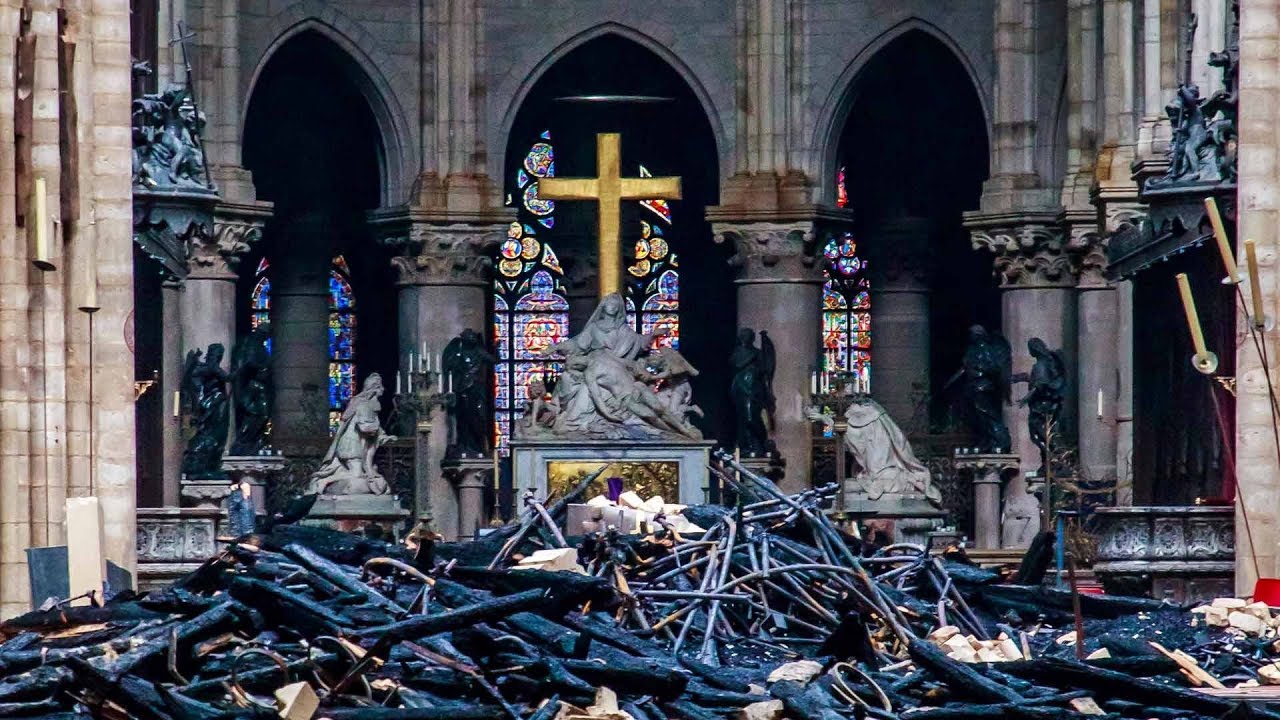
Two of the magnificent rose windows in Notre Dame cathedral in Paris date back to the 1250s. Astonishingly, much of the stained glass in these windows that dapple the cathedral and its worshippers in blue and red sunlight is the original glass. It’s the glass that was salted and stained and infused with metal by Parisian glassworkers nearly 800 years ago. It is staggering to think of who has had the sunlight filtered on to their faces by this centuries-old glass. King Henry VI, who was crowned in Notre Dame in 1431. Napoleon, coronated as emperor there in 1804. Charles de Gaulle, who led the celebrations of the liberation of France inside the cathedral in 1944. Also me, and very possibly you, given that, as much of the coverage of yesterday’s inferno reminded us, Notre Dame is the centre of Paris, the heart of the city, and the most popular tourist site in Western Europe. Millions of people – kings, cardinals, presidents, workers, paupers, tourists – have been illuminated by the same glass that has survived religious wars, revolutionary tumult, Nazi occupation and, now, fire.
The windows survived the blaze. As did much of the church’s interior, the two bell towers, the religious relics, and many artworks. The spire fell and it is feared some artworks were destroyed. The response to the fire was extraordinary. In Paris itself there was an outpouring of grief. People said they felt as if they were watching a loved one die. Catholics gathered near the cathedral as it burned to sing ‘Ave Maria’. The radical leftist Jean-Luc Mélenchon captured very well how French people felt when he said the reason they adore Notre Dame, the reason they are drawn to its power and glory, is because they know ‘human beings have surpassed themselves in bringing Notre Dame into the world’. In Notre Dame, even those convinced of the ‘absurdity of the human condition’ can see ‘the apotheosis of the intellect and the labour of thousands of men and women over the centuries’, he said. The Eiffel Tower might be a magnificent feat of engineering, but Notre Dame is something different. It is, in the words of Victor Hugo, ‘the offspring of a nation’s labour’. It is the wisdom and legacy of France itself in concrete form.
Of course it is even more than that. It is the legacy of humanity in concrete form. This is why the profound concern for Notre Dame spread so far beyond France’s own borders yesterday. Let’s leave to one side the deranged woke tweeters who laughed at the inferno on the basis that France, when it was an imperial power, burnt down its own fair share of buildings, blah blah blah. Such Francophobia and misanthropy was very much in the minority. The vast majority of people recognised that something of immeasurable human worth was under threat. What the widespread humanist concern for the fate of Notre Dame spoke to is people’s continued attachment to the ideal oflegacy, to what is in many ways the founding principle of human civilisation: that we transmit culture and knowledge and art from one generation to the next. We recognised that the flames were consuming more than wood and stone; they were consuming tradition, the past itself. And for all of today’s cult of the new, most people recognise that our societies and our lives only make sense as a result of the gains of the past transmitted to us by our elders, which we then transmit to the next generation.
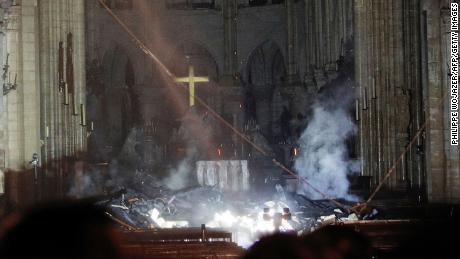
Notre-Dame Cathedral on fire
In the words of Hugo – author, of course, of The Hunchback of Notre Dame – wonders of architecture such as the Notre Dame may spring from the minds of ‘men of genius’, but they are ultimately ‘a deposit left by a whole people’. Great structures like Notre Dame are ‘the piled-up work of centuries’, ‘the residue of successive evaporations of human society’, a ‘species of formation’, he wrote. ‘Each wave of time leaves its alluvium’, he said. This is why Notre Dame is viewed as such a powerful symbol of human civilisation: because it is human civilisation; it is a stone expression of the transmissions that distinguish human beings from all other creatures. Too often today the idea of legacy is sneered at. The past is viewed as a source of shame. The Year Zero worldview is all the rage in elite circles. It can be seen in the efforts of bourgeois student radicals to tear down ‘offensive’ statues. Even in the propaganda of the European Union, which presents the birth of the EU as the starting point of peaceful, civilised Europe – witness how many pro-Brussels propagandists speak of Europe in the pre-EU era as a hotbed of war and extremism that only our technocratic betters managed to tame. Notre Dame, this deposit left by a whole people, is a permanent rebuke to such Year Zero arrogance.
People mourned for Notre Dame when it was in flames because they value tradition, they yearn for legacy, and they see the past, not as a series of shameful episodes best forgotten, but as the source of what we know and who we are and what we ourselves must now do for future generations. They felt grief-stricken because they want Notre Dame to stand for the rest of time. It will.
Brendan O’Neill is editor of spiked and host of the spiked podcast,The Brendan O’Neill Show. Subscribe to the podcast here. And find Brendan on Instagram: @burntoakboy

Wednesday, April 17, 2019

Holy Smoke


Reflections on a fire.


April 17, 2019


Image result for notre dame paris

One thing that jumped out at me, as I watched Notre Dame burn in real time on BBC and Sky News, was the statement of some reporter or commentator or architectural expert that the cathedral could and would be rebuilt, although perhaps the new structure would be “more modern” than the old one. Later that evening, in his speech to the nation, President Macron vowed: “We will make the Cathedral of Notre Dame even more beautiful.”
More modern? More beautiful? My alarm bells went off, and they weren’t fire alarms.
----
In November, Sir Roger Scruton was named to a government commission in Britain that, after at least a half century of ugly architecture, is tasked with ensuring that new public housing will be beautiful. Throughout his long and varied career, Sir Roger has had a lot to say about beauty. He has spoken wisely about the connection among the good, the true, and the beautiful, and has strongly opposed those who place beauty on a lower level of importance than goodness and truth. He is one of a relatively small and brave band of cultural critics who have linked the contemporary decline of beauty as a criterion, not just in architecture but also in art, music, and literature, and the accompanying ascent of what can only be called a cult of ugliness, to a broader rise in social and cultural decadence throughout the Western world. Emblematic of that cult of ugliness are such buildings as La Défense and the Pompidou Center. As one after another of these hideous creations went up in recent decades, blighting the skyline of the City of Light, the eight-centuries-old Cathedral of Notre Dame, in the very heart of the French capital, stood as an enduring rebuke to them and everything they represented.
On April 10, an interview with Sir Roger Scruton was posted on the website of the New Statesman. Several of his remarks were instantly dubbed controversial. Among them was a statement to the effect that Europe has been invaded by tribes of Muslims from the Middle East.” True. In addition, Sir Roger said that the word Islamophobia had been “invented by the Muslim Brotherhood in order to stop discussion of a major issue.” Also true. But if you want to be a mainstream public figure in western Europe these days, you’re not allowed to say such things. Almost immediately, Sir Roger was kicked off the beauty commission. Their loss.
----
Among the consequences of the Islamic invasion of Europe has been the widespread vandalism of churches. Coincidentally, only the day before the Notre Dame fire, Raymond Ibrahim noted at the Gatestone Institute website that in 2018 there had been 1,063 reported acts of damage to Christian churches, statues, etc., in France, and that while it’s an open secret that the overwhelming number of perpetrators are Muslims, the local authorities and news media routinely obscure this fact, while the national and international media almost entirely stay mum on these incidents. As Notre Dame went up in smoke, it was only natural to wonder if adherents of the Religion of Peace had decided to go for the big time and commemorate the start of Holy Week by taking down France’s most iconic church. Even after the government declared that the fire had not been caused by terrorists, that same government’s readiness to conceal the jihadist motives of hundreds of church desecrations made it understandable that some. people continued to wonder. Even during the fire, Fox News reporter Shepard Smith cut off interviewee Philippe Karsenty –  famous for his valiant exposure of the French media’s use of staged videos to “document” claims of IDF atrocities – when he dared to mention France’s current rash of jihadist church attacks and to suggest that the Notre Dame fire just might fall into the same category.
----
While some European churches are being vandalized in the name of Islam, others are being turned into mosques. Three days before the Notre Dame fire, Hege Storhaug reported that a historic mission house in Fredrikstad, Norway, had been snapped up by a Muslim congregation, a transaction that the local bishop and mayor both considered peachy keen. Then, on the very day of the Notre Dame fire, Storhaug reported that a Pentecostalist church in Egersund that had recently been converted into a mosque had gone up in flames twice during the course of a few hours. As of yet, no suspects have been identified.
----
One thing was clear about the fire at Notre Dame. Even if Muslims hadn’t set it, many cheered it. Donald Trump was mocked during the 2016 presidential campaign when he said that New York-area Muslims had cheered the Twin Towers’ collapse. But there was no Facebook in 2001. On April 15, as the skies over Paris filled with smoke, the Facebook pages for Al Jazeera and France 24, among others, were awash in gleeful reactions to the conflagration, written in English, French, and Arabic by people with Arabic-sounding names, many of whom used thumbs-up, smiley-face, and laughter emojis. When some counterjihadist sites dared to report on these celebratory responses, sites like Buzzfeed pushed back, denying that any Muslims had applauded the fire when in fact it was evident that thousands and thousands, at the very least, had done so.
----
Not so very long ago, Paris was widely considered the heart of Western civilization and culture. And at its heart was the Cathedral of Notre Dame. In recent decades, as the number of Muslims in greater Paris has risen into the millions, and the city has gained notoriety for its no-go zones and car burnings, that sometime capital of Western civilization has instead become, for many, a symbol of Western civilization’s decline. So it is that when one hears talk of a the construction of new Notre Dame that will be “more modern” or “more beautiful” than the original, it’s only natural – especially given that the cathedral, like all such structures in France, belongs not to the Catholic Church but to the French state –  to picture a building that, in the eyes of national and municipal officials, their interfaith advisors, and whatever cockamamie commission of postmodernism-loving architectural experts they end up putting together, ends up being some multipurpose multicultural monstrosity centered on a non-denominational worship area and/or containing different spaces for different faiths, with plenty of prayer rugs, wudu units, etc., for Muslims.
After all, in today’s Paris, Muslims already make up the majority of people who go to a house of worship at least once a week, n’est-ce pas? And given the way that these things work in most of Western Europe nowadays, it seems a foregone conclusion – barring some powerful, persuasive, and unprecedented movement to the contrary – that the voices that prevail as this project goes forward will be those arguing that the new Notre Dame must be a Notre Dame (although of course something needs to be done about that name) for the twenty-first century, for an increasingly non-Christian Paris, for an era of fundamental transformation in regard to matters spiritual. Why, after all, resurrect a cathedral that was already mainly a museum, a tourist mecca, a reminder of dead glories, when you can replace it with a spectacular mosque that will be a living place of worship for armies of believers, and will thereby serve as a dynamic, forward-looking symbol of the Paris, the France, the Europe of the twenty-first century and beyond, and hence affirm Paris’s place as the heart of a dramatically transformed Europe and – Allah willing – usher in a new Belle Époque?
I hope I’m wrong in imagining such a future for that sad, scorched plot on the Île de la Cité. But I wouldn’t bet against it.

Thank God for western values


The debt of the West to Christianity is more deeply rooted than many might presume


20 April 2019
Image result for notre dame paris cross
Declarations of hope that Notre Dame can be resurrected have been much in evidence this Holy Week. Such is the lesson of Easter: that life can come from death. Unlike the Eiffel Tower, that other great emblem of Paris, Notre Dame provides the French with evidence that their modern and secular republic has its foundations deeply rooted in the Middle Ages. Notre Dame has always been more than just an assemblage of stone and stained glass. It is a monument as well to a specifically Christian past.
Last summer, one of the world’s best-known scientists, a man as celebrated for his polemics against religion as for his writings on evolutionary biology, sat in another cathedral, Winchester, listening to the bells peal. ‘So much nicer than the aggressive-sounding “Allahu Akhbar”,’ Richard Dawkins tweeted. ‘Or is that just my cultural upbringing?’ A preference for church bells over the sound of Muslims praising God does not just emerge by magic. Dawkins — agnostic, secularist and humanist that he is — absolutely has the instincts of someone brought up in a Christian civilisation.
Perhaps, then, the debt of the contemporary West to Christianity is more deeply rooted than many — believers and non-believers alike — might presume.
Today, as the flood-tide of western power and influence ebbs, the illusions of European and American liberals risk being left stranded. Much that they have sought to cast as universal stands exposed as never having been anything of the kind. Free-thinkers who mock the very idea of a god as a sky fairy, an imaginary friend, still hold to taboos and morals that palpably derive from Christianity. In 2002, in Amsterdam, the World Humanist Congress affirmed ‘the worth, dignity and autonomy of the individual and the right of every human being to the greatest possible freedom compatible with the rights of others’. Yet this — despite humanists’ stated ambition to provide ‘an alternative to dogmatic religion’ — was nothing if not itself a statement of belief. The humanist assumption that atheism and a concern for human life go together was just that: an assumption. What basis — other than mere sentimentality — was there to argue for it? Perhaps, as the humanist manifesto declared, through ‘the application of the methods of science’. Yet this was barely any less of a myth than the biblical story that God had created humanity in his own image. It is not truth that science offers moralists, but a mirror. Racists identify it with racist values; liberals with liberal values. The primary dogma of humanism — ‘that morality is an intrinsic part of human nature based on understanding and a concern for others’ — finds no more corroboration in science than did the dogma of the Nazis that anyone not fit for life should be exterminated. The wellspring of humanist values lies not in reason, not in evidence-based thinking, but in the past, and specifically in the story of how a cult inspired by the execution of an obscure criminal in a long-vanished empire emerged to become — as the great Jewish scholar Daniel Boyarin has put it — ‘the most powerful of hegemonic cultural systems in the history of the world’.

The Easter story lies at the heart of this narrative. Crucifixion, in the opinion of Roman intellectuals, was not a punishment just like any other. It was one peculiarly suited to slaves. To be hung naked, helpless to beat away the clamorous birds, ‘long in agony’, as the philosopher Seneca put it, ‘swelling with ugly weals on shoulder and chest’, was the very worst of fates. Yet in the exposure of the crucified to the public gaze there lurked a paradox. So foul was the carrion-reek of their disgrace that many felt tainted even by viewing a crucifixion. Certainly, few cared to think about it in any detail. Order, the order loved by the gods and upheld by magistrates vested with the full authority of the greatest power on earth, was what counted — not the elimination of such vermin as presumed to challenge it. Some deaths were so vile, so squalid, that it was best to draw a veil across them entirely.
The surprise, then, is less that we should have so few procedural descriptions in ancient literature of what a crucifixion might actually involve, than that we should have any at all. Nevertheless, amid the general silence, there is one major exception which proves the rule. Four detailed accounts of the process by which a man might be sentenced to the cross, and then suffer his punishment, have survived from antiquity. These accounts are to be found, of course, in the New Testament. There is no reason to doubt their essentials. Even the most sceptical historians have tended to accept them. In the words of one of the most distinguished, Geza Vermes, ‘The death of Jesus of Nazareth on the cross is an established fact, arguably the only established fact about him.’
Altogether more controversial, of course, are the stories of what happened next. That women, going to the tomb, found the entrance stone rolled away. That Jesus, over the course of the next 40 days, appeared to his followers, not as a ghost or a reanimated corpse, but resurrected into a new and glorious form. That he ascended into heaven, and was destined to come again. Time would see him hailed, not just as a man, but as a god. By enduring the most agonising fate imaginable, he had conquered death itself. ‘Therefore God has highly exalted him and bestowed on him the name which is above every name, that at the name of Jesus every knee should bow, in heaven and on earth and under the earth…’
The utter strangeness of all this, for the vast majority of people in the Roman world, did not lie in the notion that a mortal might become divine. The border between the heavenly and the earthly was widely held to be permeable. Divinity, however, was for the very greatest of the great: for victors, and heroes, and kings. Its measure was the power to torture one’s enemies, not to suffer it oneself. Even Christians, in the early years of the cult, might flinch at staring the manner of Jesus’s death full in the face. They were as wise to the connotations of crucifixion as anyone. Paul, the most successful and influential of early missionaries, readily described Christ’s execution as a ‘scandal’. The shame of it was long felt. Only centuries after the death of Jesus did his crucifixion at last start to emerge as an acceptable theme for artists. By 400 ad the cross was ceasing to be viewed as something shameful. Banned as a punishment decades earlier by Constantine, the first Christian emperor, crucifixion had come to serve the Roman people as an emblem of triumph over sin and death. An artist, carving the scene out of ivory, might represent Jesus in the skimpy loincloth of an athlete. Far from looking broken, he would be shown as no less muscled, no less ripped than any of the ancient gods.
We are the heirs to a later, much more unsettling way of portraying Christ’s crucifixion. The Jesus painted or sculpted by medieval artists, twisted, bloody, dying, was a victim of torture such as his original executioners would have recognised. The response to the spectacle, though, was far removed from the mingled revulsion and disdain that had typified that of the ancients to crucifixion. Christians in the Middle Ages, when they looked upon an image of their Lord upon the cross, upon the nails smashed through the tendons and bone of his feet, upon the arms stretched so tightly as to appear torn from their sockets, upon the slump of his thorn-crowned head on to his chest, did not feel contempt, but rather compassion, and pity, and fear. That the Son of God, born of a woman, and sentenced to the death of a slave, had perished unrecognised by his judges, was a reflection fit to give pause to even the haughtiest monarch. This awareness could not help but lodge in the consciousness of medieval Christians a visceral and momentous suspicion: that God was closer to the weak than to the mighty, to the poor than to the rich. Any beggar, any criminal, might be Christ. ‘So the last will be first, and the first last.’
Christianity had revealed to the world a momentous truth: that to be a victim might be a source of strength. No one in modern times saw this more clearly than the religion’s most brilliant and unsparing critic. Because of Christianity, wrote Friedrich Nietzsche, ‘the measure of a man’s compassion for the lowly and suffering comes to be the measure of the loftiness of his soul’. The commanding heights of western culture may now be occupied by people who dismiss Christianity as superstition; but their instincts and assumptions remain no less Christian for that. If God is indeed dead, then his shadow, immense and dreadful, continues to flicker even as his corpse lies cold. The risen Christ cannot be eluded simply by refusing to believe in him. That the persecuted and disadvantaged have claims upon the privileged — widely taken for granted though it may be today across the West — is not remotely a self-evident truth. Condemnations of Christianity as patriarchal or repressive or hegemonic derive from a framework of values that is itself nothing if not Christian.
Familiarity with the Easter story has desensitised us to what both Paul and Nietzsche, in their very different ways, instinctively recognised in it: a scandal. The cross, that ancient tool of imperial power, remains what it has always been: the fitting symbol of a transfiguration in the affairs of humanity as profound and far-reaching as any in history. ‘God chose the weak things of the world to shame the strong.’ It is the audacity of it — the audacity of finding in a twisted and defeated corpse the glory of the creator of the universe — that serves to explain, more surely than anything else, the sheer strangeness of Christianity, and of the civilisation to which it gave birth.
Today, the power of this strangeness remains as alive as it has ever been. It is manifest in the great surge of conversions that has swept Africa and Asia over the past century; in the conviction of millions upon millions that the breath of the Spirit, like a living fire, still blows upon the world; and, in Europe and North America, in the assumptions of many more millions who would never think to describe themselves as Christian. All are heirs to the same revolution:
a revolution that has, at its molten heart, the image of a god dead upon an implement of torture.

Tuesday, April 16, 2019

◄ Notre Dame de Paris, Paris [HD] ►

Standing the test of time: Notre-Dame Cathedral in Paris

PBS - Cathedral - David Macaulay

No Words


In Paris, as Notre Dame burned


April 16, 2019


Image result for notre dame

My doorbell rang insistently. It was my father. “Notre Dame is on fire,” he said through the intercom. I rushed downstairs. “It’s burning to the ground,” he said. I was speechless.

He had been evacuated. He had not brought his phone or his glasses. “You’ll stay with me,” I said. He wanted to go home. He lives by the cathedral. It has been part of his daily life for 20 years. My grandfather gave a recital there once, when I was a child, playing the organ in the stone platform above the West portal. Inevitably, I think of him whenever I hear that organ. (Thankfully, the organ has been saved.)

We walked toward his home together. It was horrible to see. The spire was no longer there. How could that be? It’s always there, rising against a stormy horizon or a clear morning, juxtaposed against the sky. It will always be there, even when we’re long gone, a permanent thing in an impermanent world. But it isn’t. My grandfather is in that cathedral, somehow, and my father will be, too, and somehow, like this, civilization endures. But it doesn’t.

The police wouldn’t allow us back. They were worried that the fire would spread to the neighboring buildings, or that parts of the cathedral would collapse on top of them. So we stood across the Seine and watched it burn, the forest of symbols that had gazed on us with familiar glances.

A pitiful parabola of water from the fire trucks disappeared into the flames. Like everyone, we were stupefied. “Do you want a drink?” My father asked.“No. Do you?”

“No.”

Someone tried to rally our spirits by singing the Marseillaise. No one joined the chorus. I felt terrible. I joined him. Together we sang the first words:

Allons enfants de la Patrie
Le jour de gloire est arrivé
Contre nous de la tyrannie
L'étendard sanglant est levé—

Then someone else in the crowd said, Bah ouais, softly, and we both fell silent. Everyone murmured what you’d expect them to murmur. “It’s not just our cathedral, it’s the world’s.” “It’s our heritage.” “Eight hundred years.” “It’s a friend.” “It’s unspeakable.” “There are no words for it.”

There are no words for it. I said to my father that the cathedral is always the metaphor; we compare things to cathedrals; what do you say when the cathedral itself burns before your eyes?

“It’s a bad omen.”

I've walked past that cathedral so many times and thought, “That will be here even when we’ve all turned to dust.”

Later in the evening, the firefighters’ spokesman warned that they might not be able to save any of it. It might all burn to the ground. I thought of everything in the cathedral.

Medieval cathedrals are designed for the illiterate; everything in them, however seemingly trivial, is meant to aid the memory. The cruciform shape, the statues, the altars and reliquaries, the chapels and windows, the asps and the gargoyles, the Stations of the Cross—cathedrals are memory-palaces, every detail meant to allow everyone who sees them, everyone, to understand and remember the story they tell. The medievals’ assumptions about the human mind and memory are the opposite of the principles that rule the Internet. Yet they work extremely well. I can’t stop remembering everything in the cathedral.


In 1904, Marcel Proust published La mort des cathédrales. If the French Republic were to be secularized, he asked, what would become of the cathedrals, the highest achievement of French art and civilization? Proust himself was agnostic, but he well understood how inextricable the cathedrals and their rites were from French civilization. “Never has a sight comparable to such a giant mirror of knowledge, of the soul, and of history as this been presented to man’s eyes and understanding,” he wrote of the medieval cathedral.

There is therefore more than one way of dreaming before this artistic realization—the most complete ever, since all of the arts collaborated in it—of the greatest dream to which humanity ever rose; this mansion is grand enough for us all to find our place in. The cathedral, which shelters so many saints, patriarchs, prophets, apostles, kings, confessors, and martyrs that whole generations huddle in supplication and anxiety all the way to the porch entrances and, trembling, raise the edifice as a long groan under heaven while the angels smilingly lean over from the top of the galleries which, in the evening’s blue and rose incense and the morning’s blinding gold do seem to be “heaven’s balconies”—the cathedral, in its vastness, can grant asylum both to the man of letters and to the man of faith, to the vague dreamer as well as to the archeologist. All that matters is that it remain alive and that France should not find herself transformed overnight into a dried-up shore on which giant chiseled shells seem marooned, emptied of the life that once lived in them and no longer able even to give to an ear leaning in on them a distant rumor from long ago, mere museum pieces and icy museums themselves. 

Had he seen what I saw, I’m sure he would have conceded that becoming a museum piece was not the worst fate that could befall a cathedral.

I brought my father back to my place to sleep. My cats curled in his arms to comfort him. The horrible sight reminded him, he said, of the lines at the end of Brideshead Revisited, from Lamentations. He couldn’t remember them exactly, and neither could I. “Civitas, civitas,” he fretted, until he fell asleep.

We both slept badly. This morning, the police allowed him to return to his apartment. It was undamaged. The wind had been blowing in the other direction. He sent me the words for which he had been groping: Quomodo sedet sola civitas plena populo! Facta est quasi vidua domina gentium; princeps provinciarum facta est sub tributo (How doth the city sit solitary, that was full of people! how is she become as a widow! she that was great among the nations, and princess among the provinces, how is she become tributary!).


Claire Berlinski, a City Journal contributing editor, is a freelance writer who lives in Paris.

Notre Dame’s loss is too much to bear


https://blogs.spectator.co.uk/2019/04/notre-dames-loss-is-too-much-to-bear/
15 April 2019

Related image

Civilisation only ever hangs by a thread. Today one of those threads seems to have frayed, perhaps snapped. It is impossible to watch the footage coming out of Paris, all that can be done is to groan and turn away. It is not possible to watch the spire of Notre Dame collapse. It is not possible to watch the great cathedral consumed by fire.
Evelyn Waugh once said that in the event of a fire in his house, if he was able only to save his children or his library, he would save his library because books were irreplaceable. Only at a moment such as this is it possible to concede the slightest truth in that remark. Almost anything could be borne rather than the loss of this building.
There will be recriminations, of course. There will be disputes about budgets, and overtime and safety standards and much more. It is worth reading this piece from two years ago about the funding problems that existed around the cathedral’s restoration. But if Notre Dame can burn then all this is as nothing, because it tells us something too deep to bear. As I said a couple of years ago in a book, in some ways the future of civilisation in Europe will be decided by our attitude towards the great churches and other cultural buildings of our heritage standing in our midst. Do we contend with them, ignore them, engage with them or continue to revere them? Do we preserve them?
Though politicians may imagine that ages are judged on the minutiae of government policy, they are not. They are judged on what they leave behind: most of all on how they treat what the past has handed into their care. Even if today’s disaster was simply the most freakish of accidents, ours would still be the era that lost Notre Dame.We would have to tell future generations what it was like, this treasure that we lost. At the start of this decade I was living part of each week in Paris, commuting back and forth to a little flat on the edge of Le Marais. Each time I headed out to the earliest Eurostar on a Monday morning I would see the great cathedral first as I turned into the street. One winter morning heavy snow was falling and as I headed to the station I stopped dead, alone in the street with the cathedral and just drinking in the sight of a building I had seen a hundred times before. When I got into London a friend could see I was just beaming still, radiating far too much joy for such a time of the week. He asked how I was and I remember simply saying, ‘This morning I saw Notre Dame in the snow’. It was like that.

Behold Thy Mother: Notre Dame


By Michael Brendan Dougherty
April 16, 2019
Image result for notre dame
Puis il dit au disciple, “Voilà ta Mère.” And then he said to the disciple, “Behold thy Mother.”
It’s one of the most gripping scenes in the Gospels of Holy Week. From the cross, Christ says to his mother, “Woman, behold thy son.” To his disciple, he says, “Behold thy mother.” This is the moment that Mary becomes, for all Christians, Our Mother. And “Our Lady.” In French: “Nôtre Dame”
When I heard two years ago that Our Lady in Paris was falling apart, the victim of neglect by the French state and the church acting in perverse concert, I said that I felt impelled to make plans to travel to Paris to see it before it was too late. Alas, whenever I do see it, it will be different.
My mind had already been in France. On Saturday morning, I met NR’s occasional Paris correspondent, Pascal-Emmanuel Gobry, in New York City, just ahead of his flight back home. And tonight he sent me texts, shell-shocked at the enormity unfolding in his city, relaying the awful smell of smoke that swirled over him with the change of the wind, an awful image of burning incense being offered from what was once the heart of Christendom.
It is hard not to see the burning of a sacred structure as a kind of vision of apocalypse itself. I felt stomach-sick in recent years as ISIS exploded ancient temples of Eastern Syria and shrines to the biblical prophet Jonah. The French were also so moved today. Bernard Pivot, a beloved 83-year-old French journalist, a “man of letters” in the way the term used to be understood, was staggered by the sight of Our Lady burning and collapsing. He wrote: “When the burning spire fell, it was as if, all together, faith and history and beauty had given up in the face of barbarism.”
But not all is lost. No one was killed. Priests report that the process of renovation itself that may have been a proximate cause of the fire meant that many pieces of artwork and holy relics had already been removed from the church before the fire. The Holy Eucharist had been saved from the destruction. And as night settled over Paris, firefighters reported that the façade and two towers had been saved from the utter destruction. President Emmanuel Macron announced, “This Cathedral will be rebuilt.”
Image result for notre dame

But that rebuilding will be a massive undertaking. The spire fell. The interior is damaged. The 200-million-dollar renovation that had been funded primarily by Americans will look like a drop in the bucket compared with the cost of restoring the cathedral from this fire.
But some things are unrecoverable. Some of the medieval techniques and the late-19th-century techniques used in a previous restoration are poorly understood or lost to history entirely. And of course, what is lost also is some of the venerable warp and woof of the place. The first stone was laid in 1163, and the last in 1345, an amazing testament to the high Middle Ages and the ability of Christians to see through a project over many centuries. Even rebuilt, it will be introduced to new people, people as yet unborn, as destroyed in 2019 and restored later.
I’ve been tempted in the past to make Notre Dame’s disrepair into a symbol of the disrepair of the Catholic Church itself, of the decay of Christianity in France specifically and Europe more generally. But the fact is, it is also an operating cathedral that attracts regular worshippers from Paris as well as tourists who make of Notre Dame a one-Mass pilgrimage. It is a symbol of medieval greatness, of French culture, and Parisian splendor. But it also a church in which worshippers still commune with the divine, in which the bell rings and men and women fall to their knees, honoring Notre Dame, and adoring her son, God Incarnate.

MORE IN RELIGION


The World Sinks to Ruin


By 
https://amgreatness.com/2019/04/15/the-world-sinks-to-ruin/
April 15, 2019

Image result for notre dame
The steeple of the Notre Dame Cathedral in central Paris collapses on April 15, 2019. (AFP/Getty Images)

In the aftermath of the sack of Rome by Alaric and his Goths, St. Jerome wrote:
The world sinks into ruin: yes! But shameful to say our sins still live and flourish. The renowned city, the capital of the Roman Empire, is swallowed up in one tremendous fire; and there is no part of the earth where Romans are not in exile. Churches once held sacred are now but heaps of dust and ashes; and yet we have our minds set on the desire of gain. We live as though we are going to die tomorrow; yet we build as though we are going to live always in this world. Our walls shine with gold, our ceilings also and the capitals of our pillars; yet Christ dies before our doors naked and hungry in the persons of His poor.

I am writing these words as the cathedral of Notre-Dame de Paris is burning to the ground.
It is hard for an American to imagine the shock that men felt when Rome, the ruler of the great Mediterranean world, was put to the torch. Rome had not been sacked in 700 years. Hannibal had been at the gates, but he never got inside. Catiline sought to ruin it from within, but Cicero checkmated him. A corrupt senate, massive dislocations of a once-stable agricultural populace, armies loyal not to the state but to their free-dealing commanders, and ambitious aristocrats nearly destroyed the state, but the steel-cold Augustus Caesar triumphed over his rivals and set the stage for 200 years of relative peace. And now this same Rome had been overrun.
Or had it? What is Jerome really talking about? Not the churches that are “heaps of dust and ashes,” but Christians who live as if they were not wayfarers in this world on an appointment with the grave and judgment. They eat, drink, and make merry, living for the passing day, but they scramble up their riches, as if they were never going to die. They live high, and despise the low, especially the poor, in whose persons they scorn and mock the Christ they say they worship.

Jerome could say such things, because the true edifice of his Christian civilization was very much intact.
I feel no such comfort today.
As I write, no one knows whether the fire was accidental or the work of arsonists. I will not speculate here. People in such moments will grasp at what comfort they can find. I have heard it said that the loss is merely cultural, not spiritual. “Merely” is a word I will never place before “cultural.” Those who do so imply unwittingly that the substance, the culture, is already gone. No man says, while the flames reduce his home to cinders, “Well, it was only a home where our family has lived for a hundred years.” There is no such thing, for man, as only a home.
The French are duly mourning the loss. A sour Jerome would doubtless say that they might do better to mourn their sins. But there is a strange connection between dry eyes, all these years, and the tears now.
A family not warmed by love might mourn all the more the loss of a place, because without the house, the half-home, they have so little else. A people who have forgotten or forsaken Christ might mourn all the more the loss of the cathedral, because they have in his place only the great Nothing of our world, a Nothing of creature comforts, easy sex, shallow entertainment, and the restlessness of acedia.
I mourn the empty cathedral.
We have been evacuating cathedrals for a long time now.  Burning them, too, and a lot of other things. We have been burning libraries, as Ray Bradbury tried to teach us. We burn them by our scorn for quiet, and for the good rich books of our heritage. We have been burning churches. Philip Larkin, atheist with a guilty conscience about it, could call a church a serious place on serious ground. Our intelligentsia are not nearly so honest or generous. They like to play with matches.
We have been burning schools. The schola is a place of leisure, of education for man when he is free; we have turned them into dens of politics, engines of human manufacture, sinks of dullness. We have been burning universities. Millennia of human wisdom? To the torch.
And Notre-Dame de Paris burns.
People are saying that we cannot build such a thing now. That is true. We lack the artisans. We do not have the techne: we likely could not fashion a single many-colored jewel in the 16-rayed north window, with the Virgin Mary and the Christ Child in the center of all. We cannot make the glass. We cannot mix the colors. We would have to guess and do our best.
But we would not build it now. It is not just that our hands lack the skill. Our hearts do not beat warmly enough, and our minds do not see. Think of that Mother and Child. What did it mean? The whole of creation and the life of man revolve, like the spokes of a wheel, about the submission of a woman to the will of God, and the humility of Christ, who emptied himself, and came to dwell among us in human form, not as an Alaric or Augustus, but as a servant, obedient unto death.
What have we built? What do we love?
Try to imagine it. Carpenters, glazers, masons, sculptors, smiths in lead, iron, copper, silver, and gold; with shovels, pulleys, winches, sledges, hammers; scaffolding everywhere; men like high-wire artists hundreds of feet in the air; decades of work, under the direction of bishop and master builder, one after another; and stories, hundreds of stories, of Christ and Mary and the apostles, of patriarchs and prophets, of teachers and martyrs, men and women, kings and common laborers; culture bearing a hundredfold in the very beings of the people who raised the towers high.
Try to imagine it, and weep.