Wednesday, April 10, 2019

Virginia's redemption story becomes one for the ages


By Pat Forde
April 9, 2019
Image result for virginia champions
MINNEAPOLIS — Ty Jerome had just descended the ladder after cutting his souvenir strand of national championship net. He was asked a few questions by a reporter, gave a few answers. Then, when he was about to walk off and sit down and watch himself play a starring role in "One Shining Moment," he tapped me on the arm.
"You're going to have to write a different article now," the Virginia guard said with a smile.
Yes. Yes, I am.
Here's an article on the greatness of Virginia. Here's an article on one of the most remarkable one-year journeys a program has ever made. Here's an article on a group that wouldn't be denied, beating Texas Tech in a game that far exceeded its aesthetic premise, 85-77 in overtime Monday night.
From worst (loss) to first, the Virginia redemption story is one for the ages. From laughingstock to last team standing is the stuff of legend. From the historic nadir of March Madness to its zenith — in the most dramatic manner imaginable — is a profound example of what makes sports so irresistible.
When the Cavaliers gagged against No. 16 seed UMBC last year as the overall No. 1 seed in the NCAA tournament, I broke out the bayonet and ran it through Tony Bennett's team. In a regrettable flourish of overstatement, I ended the column with this declaration: "A team cannot win it all this way. It cannot come close."
Welp. So much for that opinion.
I found out Sunday afternoon how much that column dug under Jerome's skin. The starting players do individual breakout interview sessions on the day before the championship game, and I sat in on Jerome's session for a while. Right when I was leaving, he figured out who I was and made mention to the remaining reporters of reading my rip job the day after the UMBC loss while sitting in a doctor's office, waiting for an appointment to check an injured toe.
I heard about Jerome's anecdote 30 minutes later, then happened to see him as he was walking to the U.S. Bank Stadium exit. I stuck out a hand and introduced myself, saying, "I heard you were looking for me." He shook my hand and laughed.
I told him I regretted some of the tone of the column. Jerome shrugged and said, "It's nothing personal." And he's right about that — none of it was personal.
Sometimes teams play poorly. Sometimes columnists write poorly.
Fortunately, both Virginia and I got another shot at this thing. And, man, did they deliver some material. I thank the 'Hoos for that.
The details of this heart-pounding run are ridiculous. Try to wrap your head around this: Virginia trailed within the final 15 seconds of regulation in its final three games of this tourney. And still won them all.
The Cavaliers were all but dead until a buzzer-beating basket to end regulation against Purdue in the regional final, then won in overtime. They were all but dead Saturday night in the national semifinal against Auburn, until a controversial foul call sent Kyle Guy to the foul line to win it in the final second. And Monday night, they trailed Tech by three when Jerome came flashing upcourt and drove into the lane, then fired a pass to De’Andre Hunter in the corner for a 3-pointer with 12 seconds left to force OT once again.
As was the case against Purdue and Auburn, the opponent made a small but crucial error that Virginia exploited for big returns. A missed Ryan Cline free throw came back to bite the Boilermakers. A missed Jared Harper free throw did the same to the Tigers. And Monday night, the Red Raiders' defensive tenets became a problem when they collapsed on Jerome's drive.
At that point, letting Jerome score a layup and staying out on all 3-point shooters would have been the wiser play — Texas Tech would have been inbounding with the lead and Virginia would have been forced to foul. But an entire season of muscle memory and instinctive response can be hard to undo in the heat of the moment, and so Tech star Jarrett Culver dropped in to contest Jerome and left Hunter wide open for the tying shot.
Thus the final three games of this Virginia season ended regulation with a combined score of Cavaliers 201, opponents 200. They walked the precipice like few champions ever in the 80-year history of this event.
Image result for virginia champions
Virginia becomes the sixth NCAA tourney champion to endure two overtime games on the way to winning it all. (The others: North Carolina 1957, Texas Western '66, UCLA '75, Louisville '80 and Arizona '97). When you throw in the Auburn escape — and an oh-god-not-again, 14-point deficit in the opening NCAA game against No. 16 seed Gardner-Webb — this is arguably the most near-death experiences survived by a champion since North Carolina State '83.
Yet for all the escapes, there also were the blown leads, too. As if Virginia had to make this journey as difficult as humanly possible. The 'Hoos were up six with 5:52 to play against Purdue, then needed the Mamadi Diakite jumper at the buzzer to extend the game. They were up 10 with 5:24 left against Auburn, then went scoreless for five minutes. They were up eight with 6:35 left Monday night — and up four with 1:44 to play — before giving away those advantages.
Still, they persevered.
"We were built to last, and built to outlast," Guy said. "We were built to win in overtime."
Said Jerome: "We just play until that buzzer sounds."
When the buzzer sounded Monday, Hunter hurled the ball skyward. Guy sprinted nearly the full length of the court before being hug-tackled by a teammate, then tore back to midcourt to jump on Hunter. Meanwhile, the Texas Tech players filed off in various stages of grief — fifth-year senior Brandone Francis bent over and heaved sobs, stomping his right foot as he bawled.
Bennett, eternally classy in victory and defeat, sought out Culver to console him. Shortly thereafter, he came face-to-face with the most reluctant man to set foot in the stadium — his father, Dick.
The old coach, who took Wisconsin to the 2000 Final Four and largely pioneered the plodding playing style that his son now teaches, couldn't bring himself to come Saturday night. He's a stress case, and sitting in the stands watching Tony's teams play is a form of torture he largely avoids.
Dick forced himself to go to the South region final against Purdue, to see Tony's Final Four breakthrough. And he forced himself to go Monday night.
"I had to be here," Dick Bennett said. Not that it was easy.
"I can't let the game go, and I tend to look on the negative," he said. "I was always on edge, worrying about what was coming next."
What Dick Bennett has never had to worry about is how his son would handle the extreme highs and lows of his profession. The UMBC loss was devastating for many, but not so much for the head coach who took the most blame. He's just not wired to let the outcome of a game crack his worldview.
Now, that doesn't mean regrouping post-UMBC — Virginia's fifth straight ugly ouster from the NCAA tourney — was a joy ride. When your players are getting death threats and have to be escorted by law enforcement to their hotel rooms, that's a lot to process. Bennett has been open about how that loss led him to deepen his religious faith.
So, too, did the game fundamentally change his players. Guy, the Final Four Most Outstanding Player, publicly posted a couple of long and candid missives after the UMBC game, disclosing his struggles with anxiety in one of them.
Eventually, and somewhat incredibly, Virginia began referring to the UMBC debacle as a gift. The individual and collective growth from it was profound.
"I knew what we were capable of," Jerome said. "I watched us take our work ethic to a new level."
Monday night, the fruits of that labor were all on display. There was Guy, playing all 45 minutes and draining so many big shots on his way to 24 points. There was Hunter, exploding out of an extended offensive funk during this tourney for a career-high 27. And there was Jerome, racking up 16 points, six rebounds and eight assists while navigating his way through what was the No. 1 defense in America, according to Ken Pomeroy.
That junior nucleus had been the fall guys a year ago. On Monday night, they were the heroes.
"It don't feel real, bro," Guy said to Jerome on the dais in the postgame interview.
"It still don't feel real," Jerome responded. "Still doesn't feel real. Come on, bro. Talk properly."
There were laughs all around. Only one team gets to end this enthralling, three-week competition with laughter, and at long last it was Virginia.
That's a different article. And a fun one to write.

Tuesday, April 09, 2019

How extraordinary was Virginia’s title run? Just count up the miracles.

April 9, 2019
Image result for virginia champions
De’Andre Hunter and Kyle Guy embrace after winning the NCAA title game in overtime.
 Virginia saved its best for last. If they hadn’t, the Cavaliers would not have won their first national championship here on Monday night.
Trailing Texas Tech 73-70 early in overtime, Virginia went on an 11-0 run to finally take control of the national championship game and walk away with an 85-77 victory — a score that didn’t begin to reflect the extraordinary drama of the game.
Once again, they survived, having trailed a tough and talented Texas Tech team 68-65 with less than 20 seconds to go in regulation. It was a familiar script for a team that will now be known forever as the team of redemption.
The way they redeemed themselves was something straight out of a Disney movie — except if you attempted to sell the story line to Disney you would probably get laughed out of the pitch meeting.
Consider: Team becomes the first No. 1 seed ever to lose to a No. 16 seed in the NCAA tournament. Not only that, it loses by 20 points, a complete humiliation.
Then it puts together a 29-3 regular season to again become a No. 1 seed. And what happens? It falls behind another 16 seed, Gardner-Webb, by 14 points in the first half in its first game of the tournament.
“I remember thinking, ‘We can’t go through this again,’ ” Coach Tony Bennett said earlier this weekend. “At halftime, I told them I could accept losing, but I couldn’t accept anything less than every single thing they had to give.”
The Cavaliers didn’t have to go through it again. They rallied to win. Then they won a routine second-round game against Oklahoma and a tight game against Oregon in the round of 16.
After that began the story even Disney couldn’t possibly believe.
There was the escape from Purdue in the region final when freshman point guard Kehei Clark miraculously found Mamadi Diakite for the tying jumper at the end of regulation.
Call it The Pass and The Shot. The Cavaliers won in overtime. That was Miracle 1.
Then came Saturday’s national semifinal against Auburn. Virginia led by 10 late and blew the lead. The Tigers led 62-60 when Guy was fouled with less than a second to play. Or maybe he wasn’t fouled. Or maybe Ty Jerome double-dribbled a couple of seconds earlier. It didn’t matter. Guy coolly made all three free throws and U-Va. escaped, 63-62.
The Free Throws. Miracle 2.
And then came Monday night. Virginia again had a 10-point lead, but this was a team that did nothing easily. By the time the Red Raiders had taken a 68-65 lead with 22 seconds left, the Cavaliers had the Red Raiders right where they wanted them.
To lead the Cavaliers was to simply bring out the best in them. U-Va. could have settled for a two-point basket and then fouled quickly. Instead, Jerome drove to the basket and just when it looked as if he was going to go up for a layup, he flipped a pass to De’Andre Hunter in the corner.
Hunter had been awful in the first half — 1 for 8 — but he was almost perfect in the second: 7 of 8 from the field to finish with 27 points. None were as big as the three-pointer he drilled from the corner off Guy’s pass with 14 ticks left before overtime.
“We work on that play every day in practice,” Texas Tech Coach Chris Beard said. “Three things: deny the three-point line, don’t give up an and-one and get the defensive rebound. It looked like they were going for a quick shot inside but then there was a really good pass to set Hunter up.”
Texas Tech had one more chance, but Culver missed a three. Overtime. The Red Raiders actually led 73-70 but Guy made two free throws and Hunter made a three for the final lead change of the season and a 75-73 lead. Texas Tech was gassed.
This time it was The Three. And, most important, Miracle 3. Job done. Redemption complete.
Before the game began, the NCAA decided to show the final seconds of North Carolina State’s stunning victory over Houston in the 1983 championship game. That team was known as the Cardiac Kids. These will be the Cardiac Cavs.
They were a team that never lost their poise in critical moment after critical moment. U-Va.’ s three stars all starred on Monday night: Hunter was brilliant throughout the second half — not only with his shooting but his defense, holding Culver to 5-of-22 shooting for the game. Guy, the hero on Saturday, finished with 24 points. Jerome had 16 points, six rebounds and eight assists — none bigger than the final one in regulation.
In all, the three pals — all part of Virginia’s 2016 recruiting class — scored 67 of U-Va.’ s 85 points.
To say that Texas Tech was a worthy opponent is a vast understatement. Even with Hunter making life miserable for Culver; even with their best inside player, Tariq Owens, playing on an ankle sprain that needed a pregame cortisone shot just so he could play, the Red Raiders refused to go away.
Every time Virginia built a working margin, Tech dug in and battled back and had a very real chance to win. Just like Purdue did. Just like Auburn did. In fact, they almost certainly would have won against a lesser team.
A year ago, Villanova made winning the national championship look easy. This year, Virginia made it look almost impossibly hard.
Before this final game, Bennett reminded his players that perhaps no team had ever faced more pressure than they had — especially in the first half of the Gardner-Webb game when things again looked so bleak.
“All of that is why you’re ready to play on this stage,” he told his team.
Both teams were ready to play on this stage. It took more than 43 minutes of playing time before anyone blinked. It was an extraordinary game with, of course, a fairy-tale finish.
When the clock ran out and the confetti fell, Bennett, a deeply religious man, sat on a stool in Virginia’s bench area, head bowed, giving thanks.
Bennett often quotes the Bible to his players. One of his favorites is, “Don’t grow weary of doing good.”
This Virginia team, almost miraculously, never grew weary. And it did good. Historically good.
Perhaps no team has ever done more to deserve a national championship.
For more by John Feinstein, visit washingtonpost.com/Feinstein.

No one can question this Virginia group ever again


April 9, 2019
Image result for virginia champions
MINNEAPOLIS — The clutch kid who fought to free himself from the clutches of anxiety. The savvy kid from New Rochelle. The lottery pick from Philadelphia who sat helplessly with a broken wrist on the bench on the worst night of his teammates’ basketball lives, having the best night of his. The cat-quick freshman guard from California. The blond big man from Guinea. The 6-foot-8 transfer from Alabama. The coach who promised his players there would be light at the end of a tunnel that had never been darker, one fateful March night a year ago.
Virginia.
A national joke then.
A national champion now.
Virginia.
The first 1-seed to lose to a 16-seed. The first 1-seed to lose to a 16-seed and win a national championship the next season.
Virginia.
Redeem Team.
Ralph Sampson never could win a national championship for Virginia. These guys became the first who did.
There were no tears on this night, only cheers and joy inside U.S. Bank Stadium after the Cavaliers had beaten Texas Tech 85-77 in an overtime spine-tingler.
Go ahead, Kyle Guy, and change that Twitter avatar of you bent over in anguish and disbelief moments after UMBC made history against you, before the death threats followed you and your teammates. You don’t need to be reminded of your personal hell anymore. None of you do.
You will not be remembered as chumps. You will be remembered as champs.
And so one by one, these Virginia players ridiculed and piled on by too many who for reasons known only to them equate sports to life and death, one by one they climbed the ladder, this ladder to success, to cut down the nets.
It was 12:09 a.m. when Guy, as anxiety-free as a kid can be, waved the strand over his head on the top step and wore a smile that could have stretched back to Charlottesville.
“I’m speechless,” Guy said. “I’m humbled and grateful to be in this position. I was a small part of this success, and I’m just happy to be a part of it.”
Moments earlier, he had made the mad dash he had dreamed of making, to the warm, sweet embrace of his parents and fiancée.
“That’s what I wanted to do. When we lost last year, that is the moment that I was waiting for,” Guy said. “To be able to run in the stands, and hug my family. That’s what I wanted to do, and to be able to do that’s amazing.”
Soon he was on the podium with his teammates wearing his blue national championship T-shirt and white hat gazing up at “One Shining Moment”.
Tony Bennett’s father, Dick, a respected former coach who is an emotional wreck watching his son coach, decided he had to be at U.S. Bank Stadium for this one after staying away from the semifinal.
“I thought it was more important to be here in case they lost,” Dick Bennett said on the court. “To not be there at a moment when things don’t go right, that’s I think when parents need to be around. He didn’t need me here, but I guess I felt I needed to.”
There couldn’t have been a happier father in America.
“Words aren’t very accurate when your emotions outrun them, and that’s kinda where I am right now,” he said.
Dick Bennett was proud of his son long before this night.
“Last year was about as tough as it could be, but because he handled it so well, it made it easier on the rest of us,” he said. “Had he been so broken-hearted, it would have been very difficult. … He has a higher view of things.”
Towards the end, as a De’Andre Hunter 3 on a feed from Ty Jerome, that savvy gamer from New Rochelle, gave Virginia a 75-73 lead after Texas Tech had erased a 10-point second-half deficit, and the ball went off Davide Moretti’s fingertips with 1:06 left, and Jerome sank a pair of free throws with 41.5 seconds left and then Guy sank a pair of free throws with 31.2 seconds left, Dick Bennett was coaching along with his son in the stands, imploring his team to get back on defense.
“I probably do that when I’m sleeping,” he said.
He had hugged his wife when it ended.
“I’m just very happy and we’re truly blessed,” she said.
Her champion son organized a family photo on the court with his wife, son, daughter and parents.
This time Virginia didn’t need a last-gasp ‘J’ from Mamadi Diakite to stay alive. This time Virginia didn’t need a controversial last-second foul and three free throws from Guy.
This time the Cavaliers rode a career-high 27 points from Hunter, who could not play against UMBC, 22 of them after intermission.
It was only fitting that he was the one to fling the ball skyward as Monday night’s game ended.
“I was just trying to be aggressive from the start,” Hunter said.
His corner 3 had tied the game toward the end of regulation. I asked him about the remarkable contrast of emotions from a year ago.
“It was a terrible feeling,” he said, “but now I feel like I’m on top of the world.”
Texas Tech threw the kitchen sink at Virginia, a sink filled with hungry, under-recruited players who try to play like Lawrence Taylor in sneakers on defense.
And Virginia laughed, played better defense than the Red Raiders, and shot the ball (11-for-24 from downtown) as if they were born for this moment, this stage.
Destiny’s darlings.
“U-V-A, U-V-A, U-V-A,” chants washed down on them this time.
This was a death struggle where every single possession mattered.
The mentally toughest team you will ever see had its redemption.
“We can forget about UMBC now,” a smiling former Cavalier named Tiki Barber said on the court. “This is a history remaking team. It’s amazing.”
Virginia had finished writing the last chapter of a miracle comeback story that will serve as inspiration to anyone or any team that has ever been knocked to the ground, and isn’t sure if it has the strength and courage to get back up.

Monday, April 08, 2019

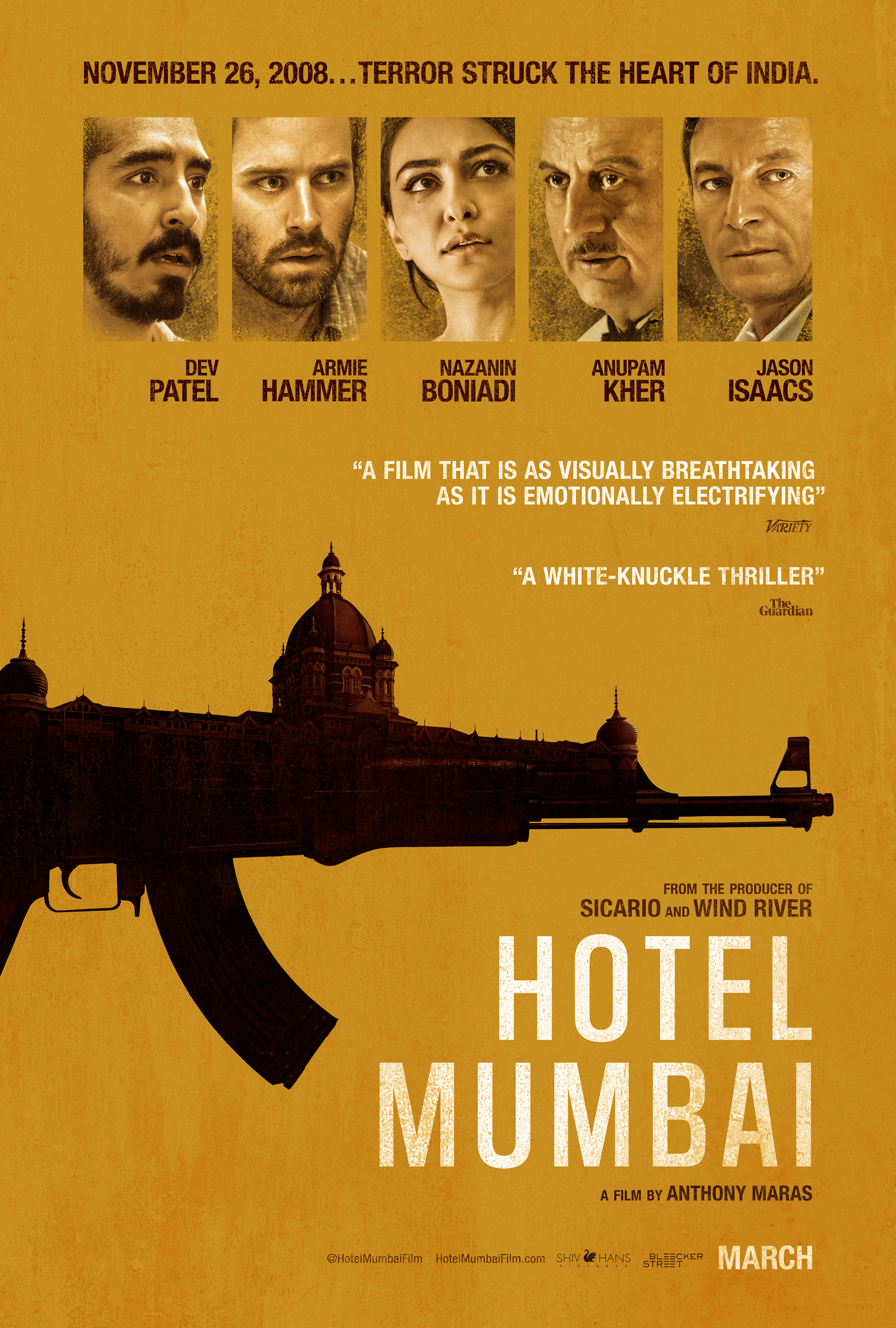
Film Review: 'Hotel Mumbai'


Jihad on the Big Screen
At last, cinéma vérité for the Islamic supremacist onslaught.

https://www.frontpagemag.com/fpm/273409/jihad-big-screen-lloyd-billingsley
April 8, 2019
Related image
“Based on true events,” Hotel Mumbai explains up front, a helpful introduction for a nation that has forgotten the 2008 jihadist attacks in India that claimed 166 victims from many nations. This movie is an Australian production, a good thing because the American film industry, long dominated by the left, would never be up to this level of cinéma véritéwith Islam.
As Hotel Mumbai opens, jihadists in small landing craft prepare to kill infidels in the name of Allah. Their Pakistani-based controller, codenamed “Bull,” adds the familiar Allahu akbar to his deadly instructions for jihad.  The well-equipped team of young jihadists targets a train station, restaurants, and the Taj Mahal Palace Hotel, where most of the action takes place.
Viewers see the pious Muslims invoking Allah as they toss grenades and mercilessly gun down victims, young and old, male and female, with Americans a prime target. Bull instructs the jihadists to leave their phones on, so he can hear the screams. Viewers will be hard pressed to find a more realistic portrayal of what Islamic terrorism is all about. On the other hand, viewers might wonder about the authenticity of the various guest characters in the hotel.
These include the naïve American ordering a hamburger, the malevolent Russian who served in Afghanistan, the elderly woman who wonders about a Sikh waiter’s beard and turban. The portrayal likely understates the bravery and suffering of hotel guests and staff and neglects the real heroes.
The Indian special forces, known as the Black Cats, are late to the scene but quickly take down most of the terrorists. Unfortunately, the most important member of the jihadist death squad gets no screen time at all.
As this writer explained in January of 2013, their key planner was Daood Gilani, born to a Pakistani father and American mother. He made five trips to Pakistan to train at camps operated by the terrorist organization Lashkar e Tayyiba, (LeT), which coordinated operations with Pakistan’s intelligence service, the ISI.
In 2006 Gilani changed his name to David Coleman Headley to facilitate travel to India, and between 2006 and 2008 he made five trips to Mumbai. There he shot surveillance videos of the Taj Mahal Palace Hotel, the Chabad House Jewish community center, a train station and a children’s hospital. After each trip he traveled to Pakistan and gave the videos to LeT.
That intelligence work enabled the terrorists to kill innocent civilians with great efficiency while being guided from Pakistan. Hotel Mumbai does not reveal that the Chabad House Jewish community center was a primary target and the victims included Ben Zion Chroman, Gavriel and Rivkah Holtzberg, Sandeep Jeswani, Alan Scherr, his daughter Naomi Scherr and Aryeh Leibish Teitelbaum.
Nanny Sandra Samuel safely escaped with Moshe, the Holtzberg’s toddler son. Rivkah was pregnant at the time and the jihadists tortured the victims before murdering them, all the while following instructions from their controller in Pakistan. So for all its welcome realism, Hotel Mumbai fails to show the full horror of the attacks and the fathomless depravity of the jihadists.
David Coleman Headley, who helped set it all up, was arrested in 2009 and sentenced to 35 years. Indian officials thought the sentence was too light and in 2012 duly hanged Mohammed Ajmal Kasab, the terrorist who the Black Cats managed to capture alive. As the film notes, the Pakistan-based mastermind of the operation has never been caught.
Hotel Mumbai recalls another Australian film, the 1980 Breaker Morant, set during the Boer War. As Morant (Edward Woodward) says, that guerrilla conflict was “a new kind of war for a new century.” The combatants no longer wore uniforms, and the attacker could be any civilian of any age. In similar style, Hotel Mumbai dramatizes the new kind of war for this century. 
Islamic jihadists attack based on commands from the Quran. They attack non-Muslim “infidels” hoping to please Allah and gain a heavenly reward. So the jihadists show no mercy, and sing praise to Allah as they kill. And since jihad is based on Islam, it is not going to diminish any time soon, if ever.
Many countries will surely ban Hotel Mumbai as “Islamophobic,” “racist” and so forth. In America, CAIR will doubtless be protesting in force, along with Ilhan Omar, Rashida Tlaib and other prominent Democrats, possibly joined by a few spineless Republicans. More reason for viewers to show support at the box office.
Hotel Mumbai might inspire President Trump to adopt the Bush doctrine of no distinction between terrorists and the regimes that harbor them. Since the Mumbai victims included six Americans, the president might team Navy SEALs with India’s Black Cats to find Bull and take him down with extreme prejudice. As the hit on Osama bin Laden shows, the SEALs can get the job done.
A film of that operation would make a great sequel to Hotel Mumbai, based on “true events” with an important lesson. If you only play defense against jihad, many innocent people will die.

All the Progressive Plotters


April 7, 2019
Image result for trump inauguration
Right after the 2016 election, Green Party candidate Jill Stein—cheered on by Hillary Clinton dead-enders—sued in three states to recount votes and thereby overturn Donald Trump’s victory in the Electoral College. Before the quixotic effort imploded, Stein was praised as an iconic progressive social justice warrior who might stop the hated Trump from even entering the White House.
When that did not work, B-list Hollywood celebrities mobilized, with television and radio commercials, to shame electors in Trump-won states into not voting for the president-elect during the official Electoral College balloting in December 2016. Their idea was that select morally superior electors should reject their constitutional directives and throw the election into the House of Representatives where even more morally superior NeverTrump Republicans might join with even much more morally superior Democrats to find the perfect morally superior NeverTrump alternative.
When that did not work, more than 60 Democratic House members voted to bring up Trump’s impeachment for vote. Trump had only been in office a few weeks. Then San Francisco billionaire Tom Steyer toured the country and lavished millions on advertisements demanding Trump’s removal by impeachment—and was sorely disappointed when he discovered that billion-dollar-fueled virtue-signaling proved utterly bankrupt virtue-signaling.
When that did not work, celebrities and politicians hit social media and the airwaves to so demonize Trump that culturally it would become taboo even to voice prior support for the elected president. Their chief tool was a strange new sort of presidential assassination chic, as Madonna, David Crosby, Robert de Niro, Johnny Depp, Snoop Dogg, Peter Fonda, Kathy Griffin, and a host of others linguistically vied with one another in finding the most appropriately violent end of Trump—blowing him up, burning him up, beating him up, shooting him up, caging him up, or decapitating him. Apparently, the aim—aside from careerist chest-thumping among the entertainment elite—was to lower the bar of Trump disparagement and insidiously delegitimize his presidency.
When that did not work, during the president’s first year in office, the Democrats and the media at various times sought to invoke the 25th Amendment, claiming Trump was so mentally or physically impaired that he was not able to carry out the duties of president. At one point, congressional Democrats called Yale University psychiatrist Dr. Bandy X. Lee to testify that Trump was unfit to continue. In fact, to prove her credentials, Lee edited The Dangerous Case of Donald Trump that offered arguments from 27 psychiatrists and other mental health experts. In May 2017, acting FBI Director Andrew McCabe and Deputy Attorney General Rod Rosenstein met secretly in efforts to poll Trump cabinet members to discover whether they could find a majority to remove Trump from office—again on grounds that he was mentally unbalanced. According to McCabe, Rosenstein offered to wear a wire, in some sort of bizarre comic coup attempt to catch Trump off-guard in a confidential conversation.
When that did not work, 200 congressional Democrats in late 2018 sued in federal court to remove President Trump, claiming he had violated the esoteric Emoluments Clause of the Constitution that forbids federal officials from taking gifts, jobs, and titles from foreign governments. They alleged Trump’s presidency has enhanced his overseas real estate holdings and interests. Yet, according to some sources, the various Trump companies have lost some $1 billion in value after he took office—to the delight of the same critics who swore he has profited enormously as president.
When that did not work, the ongoing “Resistance” both covertly and overtly sought ways to retard or destroy the Trump presidency—often by leaking presidential memos, conversations, and phone calls. An anonymous op-ed published in the New York Times on September 15, 2018 boasted of a plan of resistance to his governance and initiatives from those in the administrative state from inside the Trump Administration, most of them allegedly establishment Republicans.
Allegedly, Trump’s acquiescence to Daniels’ veritable blackmail demands had now impaired her own opportunities of further profiting to a far greater degree from the past alleged tryst with a now President Trump. Until his recent indictment for a number of felonies, Avenatti himself had translated his work with Daniels into media celebrity-hood, appearing over 100 times on cable news shows to damn Trump, predict his impeachment, and prep his promised 2020 presidential run against Trump.
When that did not work, federal law enforcement officials stormed the offices of Trump lawyer Michael Cohen, in search of incriminating materials. Cohen quickly was leveraged by federal attorneys, flipped, and offered anti-Trump testimonies and documents in exchange for leniency. He produced stealth tapes of private conversations with his own client Trump—and shortly afterward was disbarred by the New York State Supreme Court for pleading guilty to a series of felonies.
When that did not work, Russian collusion hysteria continued to sweep the country. The moribund phony Steele dossier (that had failed to derail the Trump campaign and transition) was reignited by the media and progressive politicos after the firing of FBI director James Comey, leading to the recusal of Attorney General Jeff Sessions, and the emergence of Deputy Attorney General Rosenstein.
Rosenstein then appointed Robert Mueller as special counsel—in a series of events prompted by none other than fired James Comey, who admitted that he illegally leaked confidential, if not some classified, presidential memos to create the conditions necessary for such a special appointment. Mueller’s subsequent media darling attorneys—praised as the “dream team,” “all-stars,” “army,” “untouchables,” and “hunter-killer team”—of mostly Democratic partisans, some Clinton donors, and a few who had defended either the Clinton Foundation or Clinton aides then spent 22 months, and between $30-40 million trying to build a case. In the end, they leveraged mostly minor Trump satellites on process crimes, misleading testimonies, or past business deals in hopes of finding collusionary guilt. Leaking was a Mueller team trademark as each week the collusionary media announced another “bombshell” or “noose tightening” around the neck of Donald Trump—or mysteriously showed up at the home of the next Mueller victim, to wait for the arrival of SWAT teams to swoop into make an arrest.
When that did not work, congressional committees and the left-wing mob next went after William Barr, Trump’s “hand-picked” attorney general (are not all AGs “hand-picked” by the president?). Barr’s crime was that he had followed the law to the letter. And so Barr spent a few days after the arrival of the exonerating Mueller collusion report to ensure first, before releasing it to the public, that it did not endanger national security or besmirch the reputations of innocent named individuals. If in a blink, “collusion” had died, soon in its death throes it birthed “obstruction”—as if Trump’s objections to vast resources wasted on chasing an imaginary non-crime of collusion was obstruction.
When that did not work, congressional committees mobilized to sue and force Trump to release at least six years of his private income tax records, elements of which already in bits and pieces had been leaked.
Are such efforts in the future to be institutionalized?
Will the Left nod and keep still, if Republicans attempt to remove an elected Democratic President before his tenure is up? Are appeals to impeachment, the 25th Amendment, the Emoluments Clause, the Logan Act, and a Special Counsel the now normal cargo of political opposition to any future elected president?
Is it now permissible in 2020 for Trump’s FBI director to insert an informant into the campaign of the Democratic presidential nominee? If Joe Biden is the 2020 nominee, will the Trump Justice Department seek FISA warrants to monitor the communications of Biden’s campaign team—in worries that Biden son’s business practices in the Ukraine had earlier compromised Biden who had intervened on his behalf by threatening to cut off aid to Ukraine? Will they investigate Biden’s propensity to hug and kiss under-aged girls? Will Trump’s CIA director contact foreign nationals to aid in spying on Biden’s aides? Will National Security Advisor John Bolton request that the names of surveilled Biden campaign officials become unmasked as a way of having them leaked to the media? Will Trump hire a British ex-spy to gather together rumors and gossip about Biden’s previous overseas trips and foreign contacts, especially in the Ukraine, and then see them seeded among the Trump CIA, FBI, Justice Department, and State Department? Is that the sort of country we have now?
America over the last half century had been nursed on the dogma that the Left was the guarantor of civil liberties. That was the old message of the battles supposedly waged on our behalf by the ACLU, the free-speech areas on campuses, and the Earl Warren Court.
Not now. The left believes that almost any means necessary, extra-legal and anti-constitutional or not, are justified to achieve their noble ends. Progressive luminaries at CNN and the New York Times have lectured us that reporters need not be disinterested any more in the age of Trump—or that it might be a crime to shout “lock her up” at a Trump rally. Will those standards apply to coverage of future Democratic presidents?
No reporter seems to care that Hillary Clinton hired a foreign national to work with other foreign nationals to sabotage, first, her opponent’s campaign, then his transition and his presidency, along with the wink and nod help from key Obama officials at the Department of Justice, State Department, National Security Council, FBI and CIA.
The final irony? If the CIA, FBI, and DOJ have gone the banana republic way of Lois Lerner’s IRS and shredded the Constitution, they still failed to remove Donald Trump.
Trump still stands. In Nietzschean fashion what did not kill him apparently only made him stronger.

Sunday, April 07, 2019

What Is Behind the Opposition to Peace with Israel?


by 
Palestinian leader Mahmoud Abbas speaks at the United Nations Security Council on February 20, 2018 in New York (AFP/Timothy A. Clary)

Palestinian leader Mahmoud Abbas speaks at the United Nations Security Council on February 20, 2018 in New York (AFP/Timothy A. Clary)


Peace with Israel is purportedly a form of surrender and submission that will harm the dignity of Arabs and Muslims.

This is the theme of a massive campaign being waged by Palestinians and other Arabs in preparation for the announcement of the US administration's plan for peace in the Middle East, also known as the "deal of the century." The plan, according to US officials, is expected to be announced sometime after the general elections in Israel, slated for April 9.
The latest campaign is designed to thwart the "deal of the century" and terrorize Arabs and Muslims who may wish to accept the US administration's peace plan.

As part of an effort to raise awareness to the dangers of the "deal of the century," an increasing number of Palestinians and Arabs are now trying to explain to their people why peace and normalization of ties with Israel is totally unacceptable.

The latest effort came in the form of an online campaign called "The International Anti-Normalization Campaign."

The organizers of the campaign say they are worried that some Arab states and leaders may cooperate with the "deal of the century." They are concerned because they see that some Arab states and leaders are already engaged in various forms of normalization with Israel.

The campaign clearly aims to send a warning not only to ordinary Arabs and Muslims, but also to their leaders, about the "dangerous repercussions" of making peace with Israel.
According to the organizers of the anti-peace campaign, "normalization [with Israel] is the miserable outcome of a culture of surrender and submission" -- and concessions and peace are only shameful and degrading.

For them, the words peace and compromise (with Israel) seem associated with extremely negative connotations such as retreat, defeat and surrender.

Recognizing Israel's right to exist is also seen by many Arabs and Muslims as a humiliation to their values, their culture, their political power and their economic traditions. They have been educated to see Israel as an alien body and a "colonial project" planted in the Middle East by Western powers. They therefore cannot accept the presence of Jews -- in what they regard as their own sovereign state -- on lands they believe belong solely to Muslims.
Even Palestinian Authority President Mahmoud Abbas, who is often described by Western media outlets and officials as a "moderate" and "pragmatic" Arab leader, shares the view that Israel is nothing but a "colonial project." In a speech before PLO delegates in Ramallah last year, Abbas quoted Egyptian intellectual Abdel-Wahab El-Messiri, saying:
"The functional nature of Israel means that it was evoked by colonialism in order to fulfill a specific function, and thus it constitutes a colonialist enterprise that has nothing to do with Judaism."
Abbas added:
"[Oliver Cromwell] came up with the idea of transferring the Jews from Europe to the Middle East... because they wanted this region to become an advanced post to protect the interests and the convoys coming from Europe to the East... He asked Holland, which owned the largest fleet in the world, to transfer the Jews, but the project was unsuccessful. This was in 1653."
In the past year, Abbas has also repeatedly announced his rejection of the unseen "deal of the century." He has referred to the plan as a "conspiracy" and the "slap of the century." How then can he turn to his people and suddenly accept it -- or any deal that might recognize Israel's right to exist?

"Normalization [with Israel] is tantamount to defeat," explained Mohammed al-Adloni, secretary-general of an anti-Israel group, "The International Coalition for Supporting Jerusalem and Palestine."

He went on to warn that making peace or normalizing ties with Israel would constitute a threat to the "consciousness" of Arabs and Muslims. Making peace with Israel, al-Adloni said, would be like "a complete occupation of the consciousness [of Arabs and Muslims]."

Al-Adloni and other anti-Israel activists in the Arab and Islamic countries appear worried that, should they make peace with the "Zionist entity," their people might be exposed to democratic values and freedom of expression. They seem concerned that Arabs and Muslims wake up one morning and start demanding free and democratic elections like the ones held every few years in Israel.

The anti-peace camp in the Arab and Islamic world appears not to want its people exposed to advanced Israeli technology, including medical care. This camp seems to want its people to continue living in misery and under dictatorships, so that it is easier to recruit people to jihad against Israel and the West. Also, if people are lifted from poverty and misery, and their living conditions are improved so they begin to enjoy the fruits of modern civilization, there is a chance that Arabs and Muslims will move away from Islam and even start endorsing the inadmissible values of the West.

This camp, extremists, seem not to care about lowering the high rate of unemployment among Arabs and Muslims, improving the living conditions of its people or offering young Arabs and Muslims hope for a better future. They seem instead to want their people to continue living in misery so that their anger, again, can be directed more easily towards Israel and the West.

The anti-Israel campaign in the Arab and Islamic world sees peace with Israel -- and not failed leadership, bad economic policies and corruption -- as the biggest threat to Arabs and Muslims. The message that the anti-peace activists are sending to their people says: "Peace with Israel is the worst thing that could happen to us Arabs and Muslims because these Jews will invade our minds and our culture."

Yasser Qadoura, who represents a Lebanon-based group called "The Popular Committee for Palestinians in the Diaspora," says that his organization is now making a big effort to educate Arabs and Muslims about the "dangers" of peace and normalization with Israel. He said that his followers and he are planning topublish a "list of shame" containing the names of Arabs and Muslims who are caught promoting peace and normalization or trying to make peace with Israel.

Anyone whose name appears on the list will immediately be denounced by Arabs and Muslims as a "traitor." Treason, in many of the Arab and Islamic countries, is a charge punishable by death. The "list of shame" would therefore be seen by Arabs and Muslims as a license to kill anyone who dared even to talk about peace with Israel.

Last month, a large group of Arab and Islamic activists who met in the Lebanese capital of Beirut ruled that "all forms of normalization with the Zionist entity are an act of treachery." According to the group, an Arab or Muslim who even engages in sports, cultural and artistic activities with the "Zionist entity" would be considered a "traitor." In the eyes of the Arab and Islamic activists, including Islamic religious leaders, anyone who plays soccer or attends a cultural event with a Jew would be condemned as a "traitor."

If and when US President Donald J. Trump's administration finally publishes its plan, it will discover that many Arabs and Muslims have already launched a campaign of intimidation to stop their leaders from making peace with Israel. If an Arab or Muslim child is prohibited from playing soccer with a Jew, how can the Trump administration expect the Arabs and Muslims to recognize Israel's right to exist?

The Trump administration will soon discover what every child in the Arab and Islamic world already knows: that the Israeli-Arab conflict is not about a settlement or a checkpoint or a security fence, but about Israel's very right to exist in the Middle East. The Trump administration will also learn that peace with Israel is seen by many Arabs and Muslims as nothing but an unacceptable threat that must at all costs be stopped.

Bassam Tawil is a Muslim Arab based in the Middle East.