Thursday, December 21, 2017

No, the West Did Not 'Demonize' Muhammad as PR for the Crusades


December 20, 2017

Related image

To understand any phenomenon, its roots must first be understood. Unfortunately, not only do all discussions on the conflict between Islam and the West tend to be limited to the modern era, but when the past, the origins, are alluded to, the antithesis of reality is proffered.

We hear that the West -- itself an anachronism for Europe, or better yet, Christendom -- began the conflict by intentionally demonizing otherwise peaceful and tolerant Muslims and their prophet in order to justify their “colonial” aspirations in the East, which supposedly began with the Crusades. Bestselling author on Islam and Christianity Karen Armstrong summarizes the standard view: “Ever since the Crusades, people in the west have seen the prophet Muhammad as a sinister figure. … The scholar monks of Europe stigmatised Muhammad as a cruel warlord who established the false religion of Islam by the sword. They also, with ill-concealed envy, berated him as a lecher and sexual pervert at a time when the popes were attempting to impose celibacy on the reluctant clergy.”

That nothing could be further from the truth is an understatement. From the very first Christian references to Muslims in the Seventh Century to Pope Urban’s call to the First Crusade more than four centuries later, the “Saracens” and their prophet were consistently abhorred.

Around 650, John of Nikiu wrote that “Muslims” -- the Copt is apparently the first non-Muslim to note that word -- were not just “enemies of God” but adherents of “the detestable doctrine of the beast, that is, Mohammed.”[i] The oldest parchment that alludes to a warlike prophet was written in 634 -- a mere two years after Muhammad’s death. It has a man asking a learned Jewish scribe what he knows about “the prophet who has appeared among the Saracens.” The elderly man, “with much groaning,” responded: “He is deceiving. For do prophets come with swords and chariot? Verily, these events of today are works of confusion. … you will discover nothing true from the said prophet except human bloodshed.”[ii] Others confirmed that “there was no truth to be found in the so-called prophet, only the shedding of men’s blood. He says also that he has the keys of paradise, which is incredible.”[iii]

Muhammad is first mentioned by name in a Syriac fragment, also written around 634. Only scattered phrases are intelligible -- and all revolve around bloodshed: “[M]any villages [in Homs] were ravaged by the killing [of the followers] of Muhammad and many people were slain and [taken] prisoner from Galilee to Beth.” “[S]ome ten thousand” people were slaughtered in “the vicinity of Damascus.”[iv] Writing around 640, Thomas the Presbyter mentions Muhammad: “there was a battle [Adjnadyn?] between the Romans and the Arabs of Muhammad in Palestine twelve miles east of Gaza. The Romans fled … Some 4,000 poor villagers of Palestine were killed there … The Arabs ravaged the whole region”; they even “climbed the mountain of Mardin and killed many monks there in the monasteries of Qedar and Bnata.”

A Coptic homily, also written around the 640s, is apparently the earliest account to associate the invaders with (an albeit hypocritical) piety. It counsels Christians to fast, but not “like the Saracens who are oppressors, who give themselves up to prostitution, massacre and lead into captivity the sons of men, saying, ‘we both fast and pray.’”[v]

Even so, it is only towards the end of the Seventh and beginning of the Eighth centuries that learned Christians began to scrutinize the theological claims of Islam. The image of Muslims went from bad to worse.

The Koran -- that “most pitiful and most inept little book of the Arab Muhammad” -- was believed to be “full of blasphemies against the Most High, with all its ugly and vulgar filth,” particularly its claim that heaven amounted to a “sexual brothel,” to quote Eighth Century Nicetas Byzantinos, who had and closely studied a copy of it. Allah was denounced as an impostor deity, namely Satan: “I anathematize the God of Muhammad,” read one Byzantine canonical rite.[vi]

But it was Muhammad himself -- the fount of Islam -- who especially scandalized Christians.
“The character and the history of the Prophet were such as genuinely shocked them; they were outraged that he should be accepted as a venerated figure,” writes Norman Daniel, an expert on Christian views of Islam throughout the centuries.[vii] Then and now, nothing so damned Muhammad in Christian eyes as much as his own biography, written and venerated by Muslims. For instance, after proclaiming that Allah had permitted Muslims four wives and unlimited concubines (Koran 4:3), he later declared that Allah had delivered a new revelation (Koran 33:50-52) offering him, the prophet alone, a dispensation to sleep with and marry as many women as he wanted. In response, none other than his favorite wife, Aisha, the “Mother of Believers,” quipped: “I feel that your Lord hastens in fulfilling your wishes and desires.”[viii]

Based, then, on Muslim sources, early Christian writers of Semitic origins -- foremost among them St. John of Damascus (b. 676) -- articulated a number of arguments against Muhammad that remain at the heart of all Christian polemics against Islam today.[1] The only miracle Muhammad performed, they argued, was to invade, slaughter, and enslave those who refused to submit to him -- a “miracle that even common robbers and highway bandits can perform.” The prophet clearly put whatever words best served him in God’s mouth, thus “simulating revelation in order to justify his own sexual indulgence”[ix]; he made his religion appealing and justified his own behavior by easing the sexual and moral codes of the Arabs and fusing the notion of obedience to God with war to aggrandize oneself with booty and slaves.

Perhaps most importantly, Muhammad’s denial of and war on all things distinctly Christian -- the Trinity, the resurrection, and “the cross, which they abominate” -- proved for Christians that he was Satan’s agent. In short, “the false prophet,” “the hypocrite,” “the liar,” “the adulterer,” “the forerunner of Antichrist,” and “the Beast” became mainstream epithets for Muhammad among Christians for over a thousand years, beginning in the late Seventh Century.[x]

Indeed, for politically correct or overly sensitive peoples who find any criticism of Islam to be “Islamophobic,” the sheer amount and vitriolic content of more than a millennium of Western writings on Muhammad may beggar belief.

Even temperate and charitable modern historians such as Oxford’s Norman Daniel -- who rather gentlemanly leaves the most severe words against Muhammad in their original Latin in his survey of early Christian attitudes to Islam -- makes this clear: “The two most important aspects of Muhammad’s life, Christians believed, were his sexual license and his use of force to establish his religion.” For Christians, “fraud was the sum of Muhammad’s life. … Muhammad was the great blasphemer, because he made religion justify sin and weakness”; due to all this, “[t]here can be no doubt of the extent of Christian hatred and suspicion of Muslims” (Daniel, 274, 107, 265).

Even the theological claims behind the jihad were examined and ridiculed. In his entry for the years 629/630, Theophanes the Confessor wrote: "He taught his subjects that he who kills an enemy or is killed by an enemy goes to Paradise [Koran 9:111]; and he said that this paradise was one of carnal eating and drinking and intercourse with women, and had a river of wine, honey and milk, and that the women were not like the ones down here, but different ones, and that the intercourse was long-lasting and the pleasure continuous; and other things full of profligacy stupidity."[xi]

Similarly, in a correspondence to a Muslim associate, Bishop Theodore Abu Qurra (b.750), an Arab Christian, quipped: “[S]ince you say that all those who die in the holy war [jihad] against the infidels go to heaven, you must thank the Romans for killing so many of your brethren.”[xii]

In short, the widespread claim championed by the likes of Karen Armstrong -- that European views of Muhammad as a “sinister figure,” a “cruel warlord,” and a “lecher and sexual pervert” began only as a pretext to justify the late Eleventh Century Crusade, which itself is the source of all woes between Islam and the West -- is an unmitigated lie.

The sooner more people in the West understand the roots of the animosity, the sooner the true nature of the current (or rather, ongoing) conflict will become clear.

-------

[1] Many modern academics portray this fact -- that the polemics first made against Islam continued to be made with little variation centuries later -- as proof that medieval Christians mindlessly copied and mimicked the early arguments against Islam without much reflection. On the contrary, because these early polemics were so comprehensive and well thought out they continue to be cited to this day by former Muslims as cause for them to apostatize.
[i] Donner, Fred (ed), The Expansion of the Early Islamic State, 2008, 122.
[ii] Ibid., 115
[iii] Hoyland, Robert G, Seeing Islam as Others Saw It, 1997, 57.
[iv] Ibid., 117.
[v] Ibid., 119-121.
[vi] Bonner, Michael (ed), Arab-Byzantine Relations in Early Islamic Times, 2004, 217-226; see also John Tolan, Saracens, 2002, 44.
[vii] Daniel, Norman, Islam and the West: The Making of an Image, 1962, 67.
[viii] Sahih Bukhari 6:60:311.
[ix] Daniel, 4.
[x] All quotes from John of Damascus, in Bonner, 217-226.
[xi] The Chronicle of Theophanes, trans. Cyril Mango, 1997, 465.
[xii] Bonner, 223.

Wednesday, December 20, 2017

Europe's "Arab Street" Rises Up

December 20, 2017

Image result for protests jerusalem capital berlin

Following President Trump's announcement about the status of Jerusalem, the fabled "Arab Street" rose up in Europe. In Germany, crowds of people recently imported into the country burned the Star of David. Pictured: Several thousand, mostly Muslim, protesters in Berlin, on December 8, 2017. (Photo by Sean Gallup/Getty Images)

It is now a fortnight since President Trump made his historic announcement about the status of Jerusalem. The speech which announced that America would drop the pretence that Jerusalem is not the capital of the State of Israel was relayed live around the world. Across the major networks and the world's front pages the response was almost unanimous. They proclaimed this a major foreign policy blunder which would lead to any number of problems including -- many predicted -- an immediate "third intifada."

The world's cameras immediately turned to Bethlehem where a small group of enterprising Palestinians burned an American flag for the cameras. This picture went around the world. Otherwise, not very much appeared to be happening. Hamas called for a "Day or Rage" -- as opposed to the days of peace and harmony the terrorist group ordinarily calls for -- but this did not spill out very far. The Friday immediately following the announcement might have been a flashpoint, tempers being famously frayed after the act of afternoon worship. And yet, as the BBC's veteran reporter Jeremy Bowen tweeted from the scene, "At Damascus Gate in Jerusalem press pack outnumbering demonstrators." The fabled "Arab Street" had been meant to rise up. And it did rise up. But not in the Arab world.

In London, the American Embassy was the scene of a protest called for by a number of prominent left-wing and Labour party activists as well as a some Muslim groups. The Labour MP Andy Slaughter was among those who addressed the crowds. This swiftly arranged protest soon degenerated into the usual anti-Semitic rally, with the crowds chanting "From the Rivers to the Sea Palestine will be free" (that is "There will be no Israel at all, not even a sliver of the land"). And the crowd also chanted "Khaybar Khaybar, ya yahud, Jaish Muhammad, sa yahud". That is, "Jews, remember Khaybar, the army of Muhammad is returning." For the crowd outside the American embassy in London, threatening Jews with the memory of the seventh century obliteration of a Jewish community near Medina was clearly an entirely appropriate move.

Meanwhile, in Amsterdam, a man carrying a Palestinian flag and wearing a keffiyah headed to a heavily Jewish quarter of the city. There he proceeded to smash in the windows of a kosher restaurant. The whole thing was caught on camera. Again it appeared to make perfect sense to the assailant. The American president recognised Jerusalem as the capital of the state of Israel and this man headed out to carry out a replay of Kristallnacht at a Jewish business on a Dutch street.

Further north, the situation was worse. In Sweden, the nation's new local traditions immediately followed President Trump's speech. Spontaneous protests erupted in the city of Malmö on the Thursday and Friday evenings after the Jerusalem announcement. In a city whose name has become a byword for the new, imported form of European anti-Semitism, the crowd shouted chants such as "We're going to shoot the Jews". Further north, in the city of Gothenburg, things got even uglier. On Saturday night, a group of around 20 masked men attacked the local synagogue, hurling objects and Molotov cocktails. At the time of the attack, there was a youth event happening at the community centre connected to the synagogue. The 20-30 young people attending the event were herded down into the building's basement as the gasoline began to be smelled. In Stockholm, meanwhile, the new "locals" contented themselves with setting light to the Star of David rather than to real live Jews as their compatriots in Gothenburg had tried to do.

In Germany, crowds of people recently imported into the country burned the Star of David, as well. Although German politicians condemned the action, taking place as it did in the centre of Berlin, there is little they can do about it. Last year there were 470 anti-Semitic incidents in the German capital alone. This constituted an increase of 16% in the single year from 2015 to 2016. Stories like that of a Jewish schoolchild -- the grandson of Holocaust survivors -- being forced to leave his Berlin school earlier in the year after being attacked by Muslim students, is just one story that is making some Germans nervous.

In Germany, however, as in Sweden, Holland, Britain and every other country in Western Europe, there is no point in merely being nervous. It appears that the instinct that really has a point is willful optimism. After this recent spate of attacks, the former Swedish politician Carl Bildt summed up the view of an entire establishment. While lamenting the anti-Semitism and misogyny of many migrants from the Arab world, Bildt wrote:
"Most refugees coming to our country from Muslim countries have adjusted to the values of tolerance central to our society. The fact that many of these people have often fled different systems of intolerance helps that process."
Mr. Bildt, like so many other politicians of his generation, is now willing to admit some truths about the effects of mass migration which he would never have admitted even a few years ago. But the successor to silence turns out to be this blind, willful optimism. It recognises that, sure, some of the migrants come to us with rampant Jew-hatred. And sure, some of them do not like women or gays. But in time they will become as friendly towards Jews as any other European.

Perhaps Mr Bildt is right to have his optimistic vision of the migrants becoming just like everyone else. Or perhaps -- and a lot rides on this -- he is wrong. Considering that possibility, all of these recent events present the most ominous possible warning-sign. Events such as those since President Trump's announcement should be sending up the clearest possible flare. Yet it is one that too few people are still willing to see. It is taking people time to recognise that the fabled "Arab Street" did light up in recent days. But it lit up in Europe.
Douglas Murray, British author, commentator and public affairs analyst, is based in London, England. His latest book, an international best-seller, is "The Strange Death of Europe: Immigration, Identity, Islam."

In 'Darkest Hour,' Churchill refuses to bend the knee


By John Kass
http://www.jewishworldreview.com/
December 19, 2017

Image result for darkest hour churchill

The two questions most people ask about a new movie are: Do I really want to see it? And, is it worth the price?

"Darkest Hour," the film starring Gary Oldman as Winston Churchill, is definitely worth seeing now, not later. It is worth the price.

And it is required.

Because in a West under siege, in a West -- particularly the European West -- that often seems lost and almost eager to capitulate to a diminished future, "Darkest Hour" isn't merely a good film.

It is a necessary film.

It reminds us that heroes don't require magic swords, superpowers, spandex costumes or comic-book inspiration.

Heroes can be quite human, even dumpy and old and fat, egotistic and self-indulgent.
They may have lived lives of politics, which is to say lives of ambition, scheming and lies. They can drink and smoke and sleep in the afternoon.

Yet all that fades away when the time comes. It comes for everyone, and the core is revealed, if only to yourself, when you are alone.

But those times come for every nation, too, and it came for England with the British Expeditionary Force trapped at Dunkirk and Churchill's government pressing him to kneel to Germany.

What is required is an iron will, an epic stubbornness, a refusal to listen to reasonable voices that would reasonably help bend the knee.

In "Darkest Hour," and in the other films about Churchill that I've seen, there is a hint about where the iron will comes from: the expectations of the British aristocracy on the young; the severe schools, the punishments, the obligations placed on the ruling class to serve the empire.


In America, we infantilize our young, and some remain boys and girls until middle age, and we make heroes of athletes and actors and entertainers. But not in the England of that time.

For the aristocracy, the will was also molded by the kind of literature that helped shape the empire, which, along with the British Navy and its guns, reinforced Great Britain's place, ruling the seas.

It was the literature that reinforced all this in the minds of its ruling class, that they were the conservators of the West. And Churchill was a most literate man.

Many Churchill films -- including this one -- rely on the writings of the Whig statesman, Lord Thomas Babington Macaulay, to illustrate this point.

Oldman's Churchill recites from Macaulay while at his darkest hour, facing enemies and allies who want the nation to kneel because it would be the prudent thing to do.

"And how can man die better/ Than facing fearful odds/ For the ashes of his fathers/ And the temples of his Gods."

Others have pointed out one glaring false note in the film: Churchill reciting Macaulay while riding on the underground train, talking with the people about what they want to do.

But his admiration for Macaulay was not false. He devoured Macaulay as a young man. And Macaulay's version of Horatio at the Bridge is the story of England in World War II, the story of Winston Churchill in the Londonbunker in the dark with his whiskey and his cigar.
Why is Churchill so fascinating, even today?

He was a great orator, a fine writer, devious in the use of rhetoric, and all that -- plus his appetites -- make him a fascinating character.

But we have seen other fine orators, most recently, orators silky and smooth and beloved by modern mythmakers. And as the oratory fades, the blood and chaos of Libya and Syria overwhelm much of Europe.

What makes Churchill fascinating isn't the oratory.

He refused to bend his knee. He refused to listen to the voices of reason that told him appeasement with Germany was the prudent course to save his people.

And with his army trapped at Dunkirk, with the United States avoiding the war, with the United Kingdom exhausted, those voices of reason became even more reasonable, powerful and insistent.

If he had capitulated, and Germany took Englandthe United States could never have invaded FranceGreat Britain would have belonged to Hitler.

So the story is absolutely compelling. And the acting is so good, you forget Oldman is acting.
He should win an Oscar for his Churchill, the meatiest, most intimidating role for a British actor.

Brendan Gleeson did a great job with Churchill in "Into the Storm," although that film didn't have the budget of this one. Richard Burton and Albert Finney have played him, and Brian Cox has a new Churchill movie too.

Even the late Simon Ward, the actor cursed with a pretty Englishman's face, was excellent playing a callow youth in "Young Winston."

And Gary Oldman has the Oscar buzz now.

"You're asked to play who many would consider the greatest Brit who ever lived, an iconic British figure with all the ghosts of the other people who have played him," Oldman was quoted as saying. "I thought, I don't know what I could bring to it."

He brought himself. That was enough. And the filmmakers brought Macaulay.
Lord Macaulay isn't Churchill's alone. Macaulay greets me every morning at the Tribune tower, as one of his quotes is carved into stone above a door.

"Where there is a free press, the governors must live in constant awe of the opinions of the governed."

Do yourself a favor.

See "Darkest Hour."

You might think it necessary, too.


Read more at http://www.jewishworldreview.com/1217/kass121917.php3#pqOCUvVklr8alcBi.99


Tuesday, December 19, 2017

How Obama Appeased Iran by Turning a Blind Eye to Hezbollah’s Crimes


A new report shows that in its efforts to reach a nuclear deal with Tehran, the administration went so far as to stop the DEA from cracking down on Hezbollah drug-running.

By David French
December 18, 2017

Image result for obama iran

Secretary of State John Kerry talks with Iranian Foreign Minister Mohammad Javad Zarif in 2014 in Vienna. (Pool photo by Ronald Zak/Associated Press)

Over the weekend Politico’s Josh Meyer published a blockbuster report that can’t be allowed to disappear into the void of the holiday season. In painstaking detail, it documents claims that the Obama administration crippled Drug Enforcement Administration operations against Hezbollah as part of its effort to reach a nuclear deal with the Iranian regime.
Why would the DEA, of all agencies, target an international terrorist organization? It turns out that Hezbollah had become a major player in international cocaine trafficking and was using proceeds from its drug-running and arms-dealing to finance — among other things — the purchase of explosively formed penetrators (EFP’s), the deadliest IEDs used against American soldiers in Iraq.

Hezbollah had transformed itself into an “international crime syndicate that some investigators believed was collecting $1 billion a year.” The DEA’s “Project Cassandra” was designed to disrupt this syndicate. And just as the operation began reaching into the highest echelons of one of the world’s worst terrorist organizations, the Obama administration started to shut it down:
The Justice Department declined requests by Project Cassandra and other authorities to file criminal charges against major players such as Hezbollah’s high-profile envoy to Iran, a Lebanese bank that allegedly laundered billions in alleged drug profits, and a central player in a U.S.-based cell of the Iranian paramilitary Quds force. And the State Department rejected requests to lure high-value targets to countries where they could be arrested.
Some former Obama administration officials justified these actions on the basis that the DEA may have interfered with more important anti-terror operations conducted by other intelligence organizations. As one former official put it, the administration couldn’t let the CIA, the DEA, or any other agency “rule the roost.” But other sources confirmed that the administration in fact hindered the DEA for the sake of the Iran deal. For example, former Obama Treasury Department official Katherine Bauer testified to the House Committee on Foreign Affairs that “under the Obama administration . . . these [Hezbollah-related] investigations were tamped down for fear of rocking the boat with Iran and jeopardizing the nuclear deal.”

The consequences were deadly. In the most personally painful part of the Politico piece, Meyer details Hezbollah’s role in funding EFPs that “were ripping M1 Abrams tanks in half.” I remember the power of these weapons quite well. A smaller version of an EFP was used to kill men that I knew in Iraq. The mere threat of EFPs at one point shut down all ground supply routes into our base near the Iranian border. It’s a strange feeling indeed to ride down Iraqi roads knowing that there’s a weapon out there that would render all the armor surrounding you virtually irrelevant. EFPs killed hundreds of American soldiers, and they were supplied by the Iranian government and its Hezbollah allies.

But never mind. The Iran deal had to get done. The deal, at least in the Obama administration’s fantasyland, wasn’t just a nuclear deal. It was a step toward hopefully normalizing relations with Iran, bringing the Islamic Republic back into the community of nations. It was a legacy play, and it depended on a complete misunderstanding of the nature of our enemy.

You see, the Obama administration was in many ways captive to the “legitimate grievances” theory of jihad. This theory, outlined most famously in Obama’s 2009 Cairo speech, holds that jihad’s appeal is rooted at least in part in identifiable American and western abuses of the Islamic world. It was the root of the Obama administration’s deluded efforts to initiate a “new beginning between the United States and Muslims around the world.” The administration would act to address credible Islamic grievances, and that action would and should trigger a good-faith response that would bring us closer to peace.

It all seems so quaint now. When Obama pulled back, our enemies surged. When he gave them an inch, they took a mile. There was no good-faith response, only the gleeful exploitation of newfound strategic advantage. When Obama finally re-engaged, American force was able to stop our enemies’ advance. But by then, the damage was done, and we’re still learning the extent of it today. We already knew that Obama gave Iran piles of cash, prisoners, an immense economic stimulus, and access to international arms markets in exchange for signing the nuclear deal. We now know — thanks to Politico — that the administration’s mercies extended even to Iran’s vicious terrorist allies.

And for what? Obama’s defenders cling to the hope that Iran’s nuclear program has been delayed (a hope that relies a great deal on trusting Iran, which has never proven wise in the past), but in the meantime we’ve merely strengthened our enemy. We’ve addressed those “legitimate grievances,” and Iran has taken our gifts and our goodwill and thrown them right back in our face. Iran and Hezbollah — with Russia’s help — have nearly completed their genocidal reconquest of Syria’s most populated regions. In Iraq, an Iranian general played a key role in the seizure of Kirkuk from our Kurdish allies. Iran hasn’t retreated one inch from its anti-Americanism or its commitment to international jihad. It’s even sending aid (including senior commandos) to the Taliban in Afghanistan.

Three years ago, I wrote an extended piece arguing that Obama was idealistic about our enemies. He didn’t understand the depth of their hate. He fell for ridiculous academic theories about American culpability in the rise of jihadist violence. Little did we know how far the ideological rot went. Obama administration mistakes empowered the biggest state sponsor of terrorism in the Middle East, relieving the pressure on the violent, extremist forces it pays for. These mistakes must be known. They must be remembered. And they must never, ever be repeated. America’s jihadist enemies cannot be appeased.


— David French is a senior writer for National Review, a senior fellow at the National Review Institute, an attorney, and a veteran of Operation Iraqi Freedom.

McCabe and Mr. Mueller


By Daniel John Sobieski
http://www.americanthinker.com/
December 19, 2017

Image result for mccabe mueller
James Comey, Robert Mueller and Andrew McCabe

As Fox News has reported, Deputy FBI Director Andrew McCabe has rescheduled his testimony before the House Intelligence Committee with the Justice Department telling the network that it was due to a “routine scheduling error.” More likely it is due to the need for everyone to get their stories straight as the details of the fix that was in for Hillary Clinton are being, er… unmasked and the details of the deep state coup against President Trump bubble to the surface from the depths of the swamp:
…Fox News was told by those familiar with the matter that the intelligence committee is suspicious of the purported scheduling error. One source said they believe the schedule issue arose after Fox News' report Monday night on Department of Justice official Bruce Ohr. 
Ohr was recently demoted from one of his two senior posts. Fox News reported that Ohr’s wife, Nellie Ohr, worked through last fall for Fusion GPS, which was behind the anti-Trump dossier… 
“McCabe has an Ohr problem,” one congressional source said.
McCabe has many problems and is at the heart of the criminal conspiracy to protect Hillary and unseat President Trump. The “Ohr problem” relates to Bruce Ohr and his wife Nellie and their connections to Fusion GPS, the firm paid indirectly by the Clinton campaign and the DNC to work with former British spy Christopher Steele and Russian sources to put together a fake dossier likely used by the FBI to fraudulently obtain FISA surveillance warrants on Team Trump:


Fox reported on Monday that Nellie Ohr worked last year for Fusion GPS, which commissioned the dossier. The company investigated Donald Trump on behalf of the Clinton campaign and DNC. 
Bruce Ohr, a high-ranking Justice Department official, also has connections to both Fusion GPS and Christopher Steele, the former British spy hired by Fusion to conduct the investigation of Trump. 
Ohr met prior to the election with Steele. He met several weeks after Trump’s victory with Simpson. It remains unclear what Ohr discussed during those meetings.
Another McCabe problem relates to FBI lead investigator in the Clinton probe, Agent Peter Strzok, whose text messages to his FBI mistress, Lisa Page, lend both intent and motive to the Clinton cover-up and the animus toward President Trump. A letter from Homeland Security Committee chairman Sen. Rob Johnson, R-Wis., shows McCabe’s role in the altering and drafting of the James Comey memo exonerating Hillary Clinton:
The letter reveals specific edits made by senior FBI agents when Deputy Director Andrew McCabe exchanged drafts of Comey's statement with senior FBI officials, including Peter Strzok, Strzok's direct supervisor, E.W. "Bill" Priestap, Jonathan Moffa, and an unnamed employee from the Office of General Counsel (identified by Newsweek as DOJ Deputy General Counsel Trisha Anderson) -- in what was a coordinated conspiracy among top FBI brass to decriminalize Clinton's conduct by changing legal terms and phrases, omitting key information, and minimizing the role of the Intelligence Community in the email investigation. Doing so virtually assured that then-candidate Hillary Clinton would not be prosecuted.
McCabe was the ringleader of the damage control team trying to fudge the evidence of Hillary’s crimes and soften the tone of Comey’s exoneration memo so there would be fewer questions when the fix was revealed. McCabe was also aware of Strzok’s fears of a Trump victory and determination to undermine it:
Out of all the damning, politically charged anti-Trump text messages released, one text from Strzok to Page on August 15, 2016, raised the most suspicion. It referred to a conversation and a meeting that had just taken place in "Andy's" (widely believed to be Deputy FBI Dir. Andrew McCabe's) office. According to Rep. Jim Jordan (R-OH), Strzok had texted this: "I want to believe the path you threw out for consideration in Andy's office [break]... that there's no way he gets elected. I want to believe that... But I'm afraid we can't take that risk... We have to do something about it."
If McCabe had any honor, he would have dismissed Strzok instantly and revealed the corruption his words exhibited. But McCabe was part of the corrupt criminal enterprise.
McCabe was in a key position overseeing the investigation of Hillary Clinton’s scandalous and treasonous handling of classified emails on her private server, a position from which he could assist FBI Director James Comey in putting the fix in. As Judicial Watch notes
Judicial Watch today released Justice Department records showing that FBI Deputy Director Andrew McCabe did not recuse himself from the investigation into former Secretary of State Hillary Clinton’s unsecure, non-government email server until Tuesday, November 1, 2016, one week prior to the presidential election. The Clinton email probe was codenamed “Midyear Exam.” 
While working as Assistant Director in Charge of the Washington Field Office, McCabe controlled resources supporting the investigation into former Secretary of State Hillary Clinton’s email scandal. An October 2016 internal FBI memorandum labeled “Overview of Deputy Director McCabe’s Recusal Related To Dr. McCabe’s Campaign for Political Office,” details talking points about McCabe’s various potential conflicts of interest, including the FBI’s investigation of Clinton’s illicit server, which officially began in July 2015:
While at [Washington Field Office] did Mr. McCabe provide assistance to the Clinton investigation? 
After the referral was made, FBI Headquarters asked the Washington Field Office for personnel to conduct a special investigation. McCabe was serving as [Assistant Director] and provided personnel resources. However, he was not told what the investigation was about. In February 2016 McCabe became Deputy Director and began overseeing the Clinton investigation.
The Overview also shows if asked whether McCabe played any role in his wife’s campaign, the scripted response was: “No. Then-[Assistant Director] McCabe played no role, attended no events and did not participate in fundraising or support of any kind.”
Of course, that statement was a lie. McCabe is a Democratic loyalist whose wife campaigned for state office in Virginia as a Democrat with heavy Democratic financial support. In fact, McCabe’s efforts on behalf of his wife are now the subject of multiple federal probes:
Acting FBI Director Andrew McCabe, a central player in the Russia election case, is the focus of three separate federal administrative inquiries into allegations about his behavior as a senior bureau executive, according to documents and interviews. 
The allegations being reviewed range from sexual discrimination to improper political activity, the documents show… 
Circa reported Monday that former supervisory special agent Robyn Gritz, a decorated counterterrorism agent, has filed a sexual discrimination and retaliation complaint that names McCabe and other top FBI officials…
Gritz also filed a complaint against McCabe with the main federal whistleblower agency in April, alleging social media photos she found show he campaigned for his wife’s Virginia state senate race in violation of the Hatch Act… 
In addition, the Justice Department Inspector General is investigating allegations from Senate Judiciary Committee Chairman Charles Grassley, R-Iowa, that McCabe may not have properly disclosed campaign payments to his wife on his ethics report and should have recused himself from Hillary Clinton's email case.
McCabe is probably not a happy camper right now and certainly has no love lost for Michael Flynn, who was a potential witness on behalf of one of McCabe’s accusers. As PJ Media reports:
In 2014, Flynn, then director of the Defense Intelligence Agency, personally intervened on behalf of Supervisory Special Agent Robyn Gritz by writing a letter vouching for her on his official Pentagon stationary and offering to testify on her behalf. He also supported her case in a radio interview in 2015… 
The FBI, for its part, claimed that Gritz had become "underperforming, tardy to work, insurbordinate, possibly mentally ill or emotional and deserving of a poor performance review."… 
Flynn argued just the opposite in his May 9, 2014 letter: “SSA Gritz was well-known, liked and respected in the military counter-terrorism community for her energy, commitment and professional capacity, and over the years worked in several interagency groups on counter-terrorism targeting initiatives.”
McCabe did not disclose Democratic contributions to his wife’s campaign in Virginia in financial disclosure forms, donations that raise questions about both his integrity and objectivity. As Fox News Politics reports:
The records, obtained through a Freedom of Information Act request, show FBI Deputy Director Andrew McCabe left the box blank for wife Dr. Jill McCabe's salary, as a doctor with Commonwealth Emergency Physicians. And there is no documentation of the hundreds of thousands of campaign funds she received in her unsuccessful 2015 Virginia state Senate race.
As first reported by The Wall Street Journal, Clinton confidant and Virginia Gov. Terry McAuliffe urged McCabe’s wife to run for statewide office shortly after news reports were published that Hillary Clinton used a private email server and address for all her government business while serving as secretary of State.   
For the reporting period of October through November 2015, McCabe's campaign filings show she received $467,500 from Common Good VA, a political action committee controlled by McAuliffe, as well as an additional $292,500 from a second Democratic PAC.


Connect those dots, Democrats and others looking for Russians hiding under Republican beds. We have a Deputy FBI Director, Andrew McCabe, campaigning for his wife, who receives huge sums of money from the Democratic Party of Clinton political ally Terry McAuliffe. After Clinton blames Russia for her election loss, Flynn becomes a target of an FBI probe in which his identity is illegally unmasked. He was a character witness on behalf of one of McCabe’s accusers. Was Mrs. McCabe’s largesse a quid for a future quo? Was Flynn’s unmasking McCabe’s revenge?


An unindicted coconspirator in the pro-Hillary and anti-Trump conspiracy is Special Counsel Robert Mueller, leading a team of Clinton lawyers and donors, running an investigation which began with no crime and has found no proof of any collusion between Team Trump and Russia. So desperate has he become that he has cast any remaining ethics aside and should be removed. As Fox News’ Greg Jarrett writes:
Special Counsel Robert Mueller is accused of acting in complete disregard for the law and must be removed.  And so, too, must his entire team. 
There is devastating new evidence to suggest that Mueller and his staff of lawyers improperly, if not illegally, obtained tens of thousands of private documents belonging to President-elect Trump's Presidential Transition Team (PTT). The material includes emails, laptops and cell phones used by 13 PTT members. 
Critically, a "significant volume of privileged material" was taken by Mueller, according to the Trump transition lawyer, and then used by the special counsel team in its investigation. Mueller's staff apparently admits this egregious violation, which the law strictly forbids.
Under the law, the only remedy is Mueller's dismissal from the case…
The Presidential Transition Act states that all records of transition operations are private and confidential.  
On November 16, 2016, roughly ten days after Trump was elected president, the Chief Records Officer of the U.S. Government sent a letter to all federal agencies reminding them that "the materials that PTT members create or receive are not Federal or Presidential records, but are considered private materials." 
Yet Mueller seems to have ignored the law. Without a warrant or subpoena, his team of lawyers brazenly demanded these private records from the General Services Administration (GSA) which held custody of the materials.  The GSA does this as a service to all incoming presidents out of courtesy, but it neither owns the documents nor is authorized to release them to anyone under any circumstances because they are deemed entirely private.
Robert Mueller, like Andrew McCabe and the rest of the anti-Trump criminal conspirators, consider themselves above the law and on a divine mission to unseat Trump.  Mueller’s conflicts of interest, starting with his relationship with James Comey, are well documented. His role, along with Deputy Attorney General Rod Rosenstein, in covering up the FBI’s early investigation into Russia’s nuclear bribery in the Uranium One case are also a matter of public record.

McCabe and Mr. Mueller are the leaders in the criminal conspiracy of the century, a silent coup against a sitting president that does indeed make Watergate look like a third-rate burglary.

Daniel John Sobieski is a free lance writer whose pieces have appeared in Investor’s Business DailyHuman EventsReason Magazine and the Chicago Sun-Times among other publications.


What Led Germany to Accept a Tsunami of Migrants?

December 18, 2017

To my astonishment, I see that it's been a full six years since I reviewed Tuvia Tenenbom's I Sleep in Hitler's Room: An American Jew Visits Germany. The book, an account of the author's encounters with anti-Semitism and Jew-obsession in a country that claims to have thoroughly repudiated its Nazi past, was, I wrote, “deeply sobering, depressing even,” yet “so chatty and engaging and laugh-out-loud funny that it's hard to put down.” I praised Tenenbom as “an acute observer of his fellowman, but also a born entertainer, a comedian, who approaches his interview subjects – of whom there are dozens, ranging from leading political and cultural figures to folks he runs into on the street – as a combination inquisitor and tummler.”

And he does it all, I emphasized, “on a human level: he's not a journalist taking notes but a fellow human being, intense in his curiosity and incapable of hiding his emotions. He challenges his interlocutors, posing questions nobody has ever asked them before, and he's relentless, always demanding the truth, wanting to know what these people really think and feel, rejecting their canned answers, the things they say because they think that's what he wants to hear.” And even when he doesn't exactly like what they say, he often turns out “to like them anyway, able to separate his intellectual revulsion at their ideas from his personal response to them as human beings.” Indeed, although he's revolted by German attitudes, he admits that “somewhere deep inside me...I love the Germans.”

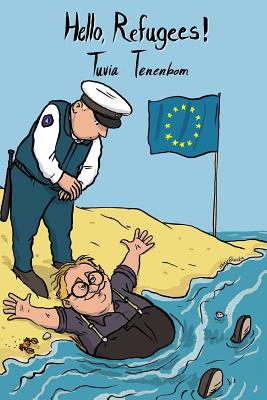
Image result for tuvia tenenbom hello

Pretty much everything above applies as well to Tenenbom's new book, Hello, Refugees! Like I Sleep in Hitler's Room, it's grim yet entertaining, and – most of all – supremely human. This time, as the title suggests, he's concerned with the migrant issue – specifically, with the consequences of Angela Merkel's decision to open the floodgates to undocumented foreigners. Journeying from one refugee camp in Germany to another, and to various hotels where migrants are being put up at taxpayer expense, he meets some newcomers who are gentle, civilized, educated, grateful to be in Europe, and absolutely in love with Germany, and others who are angry, violent, and seething with hostility and contempt toward infidels in general and Germany in particular. (In order not to earn the instant hatred of Muslim migrants, he speaks to them in Arabic and pretends to be one of their coreligionists.)

Although Tenenbom recognizes that it was unwise to admit veritable armies of people from the Levant into Germany and to cram them all together – despite volatile religious, ethnic, and national tensions among them – into crowded camps, he's able to feel outrage at the execrable food they're served and the poor sanitary conditions they're forced to endure. (“Germany might have saved their bodies, but it is killing their souls.”) He even develops attachments to some of them – notably Thawanni, a young woman “with a million watts of warmth,” and two or three others whose empty lives and medical issues he finds “heartbreaking.” At the same time, he doesn't hesitate to call others on their lies, game-playing, and poisonous hatred for Americans and Jews. (Several of the Muslims he met believe that the U.S. and Israel are behind ISIS).


During his travels, Tenenbom also sets up meetings with “right-wing” leaders who fiercely oppose Merkel's immigration policy and who, he's been told, are bigoted monsters, the spawn of Satan, indifferent to the fate of suffering foreigners. Among them is Götz Kubitschek, a publisher with whose family Tenenbom is invited to eat dinner. Kubitschek proves to be a blunt, straight-talking, sensible fellow of whom Tenenbom ends up being very fond. (“The villain and the devil I was dreaming of turned out to be a nice guy.”) Later, he meets Frauke Petry, head of the upstart conservative party Alternativ für Deutschland (AfD), who at first puts him off with her Teutonic intellectualization of everything, but who eventually opens up her human side and wins his affection. (“It took her some time to warm up to me, but once she did, it was real....I like this lady.”) He also meets Lutz Bachmann, the head of Pegida (Patriotic Europeans against the Islamization of the West), who is widely smeared as a neo-Nazi, but finds his views on immigration to be no more far-out than those of “the average New Yorker.”

He's not crazy about everybody. At “German Catholic Day” in Leipzig, Tenenbom asks Cardinal Reinhold Marx, Archbishop of Munich and chairman of the German Bishops' Conference, why representatives of a faith based on the teachings of Jesus, who excluded no one, have banned the leaders of the AfD and the NPD (a far-right party) from the gathering. Marx's dodgy non-answer doesn't impress him: “The Holy Man facing me has no guts to say what he thinks. He is no Frauke.” By contrast, Tenenbom turns out to like Aiman Mazyek, head of the Central Council of Muslims in Germany, who talks a very smooth game and has some liberal views (he doesn't force women into hijab) but who, I've read elsewhere, has savaged Danish Muhammed cartoonist Kurt Westergaard and is not terribly fond of gays. I don't think I'd like him and I don't think he'd like me.

In I Sleep in Hitler's Room, there was one question Tenenbom kept coming back to in his interviews: “What does it mean to be German?” In Hello, Refugees!, there are a couple of recurring queries. He asks the refugees what they make of Germany; he asks the opponents of open borders what it is about Germany, as opposed to other European countries, that has led it to accept a tsunami of migrants in the last couple of years. Kubitscheck explains: “Germany wants to show the world that it is not the heartless country that it is known for, but a land of people with a great heart.” Petry essentially agrees: “It has to do with the feeling of guilt that has been implanted into many Germans for decades after the Second World War.”

When he poses the same question to ordinary citizens, the answer is the same, only expressed more bluntly: if Germans don't let in more refugees than any other European country, they'll be viewed as Nazis. So what if they take in so many refugees that it breaks the national budget and results in violent crime on an apocalyptic scale? Anything's better, apparently, than being called Nazis. Besides, letting in all these refugees allows Germans, finally, to regard themselves as virtuous and to say straight out what they've always thought about Israel but have, until now, owing to historical guilt, been careful about voicing: that, as two young men in Munich tell Tenenbom, the Jewish state is “aggressive” and “inhumane.”

Tenenbom finds one contradiction highly bemusing. On the one hand, it's Germans' historical guilt that opened the floodgates and leads millions of them to continue to “defend Islam and Muslims at all costs”; no matter how many terrorist acts are committed, Germans won't admit that “too many Muslims have gone nuts, in almost every Islamic country and in non-Muslim countries as well.” And yet these same Germans are quick to demonize Israel – and Jews. Tenenbom tells a truly reprehensible (if not terribly surprising) story about a couple of German Amnesty International workers who can't praise Muslim refugees highly enough but who make clear their utter contempt for Jews. They're not alone. Here, as in I Sleep in Hitler's Bed, Tenenbom tells a good many disturbing anecdotes that reveal an enduring anti-Semitism on the part of Germans that is every bit as irrational as their unqualified Islamophilia.

“Why,” Tenenbom wonders, “is it that good people who care about refugees, and about human rights in general, somehow are unable to view Jews as human?” The answer, as he himself recognizes, is that the Germans who think of themselves as being the most big-hearted aren't really good at all – they're just desperate to be seen as good. As they see it, Hitler ruined their image, and Merkel is rehabilitating it. But an unhealthy obsession with national image is how they got into that whole Nazi mess in the first place; and indeed, the more closely you examine the childish, selfish thinking that guides their current policies, the more it brings to mind the mentality that made possible the goose-stepping, sieg-heiling bad old days.

This book, then, explores a good deal of chilling terrain. The upside is that Tenenbom is at once an expert guide and a traveling companion who keeps your spirits up even through the worst of it.

.