Walter Isaacson’s biography portrays a man obsessed with knowledge and almost impossible to know.
October 16, 2017

In Renaissance Florence, a number of designated boxes placed throughout the city allowed citizens to make anonymous denunciations of various moral crimes—in 1461, for example, the artist-monk Filippo Lippi was accused of fathering a child with a nun. But the crime that the government was really trying to control was sodomy, so notoriously prevalent that contemporary German slang for a homosexual was Florenzer. The common nature of the offense did not erase the threat of serious consequences. In 1476, Leonardo da Vinci, on the verge of his twenty-fourth birthday, was named as one of four men who had practiced “such wickedness” with the seventeen-year-old apprentice of a local goldsmith. There is little doubt that Leonardo was arrested. Although any time he may have spent in jail was brief, and the case was dismissed, two months later, for lack of corroborating witnesses, he had plenty of time to ponder the possible legal punishments: a large fine, public humiliation, exile, burning at the stake. It is impossible to know if this experience affected the artist’s habit, later cited as a mark of his character, of buying caged birds from the market just to set them free. But it does seem connected with the drawings he made, during the next few years, of two fantastical inventions: a machine that he explained was meant “to open a prison from the inside,” and another for tearing bars off windows.
These drawings are part of a vast treasury of texts and images, amounting to more than seven thousand surviving pages, now dispersed across several countries and known collectively as “Leonardo’s notebooks”—which is precisely what they were. Private notebooks of all sizes, some carried about for quick sketches and on-the-spot observations, others used for long-term, exacting studies in geology, botany, and human anatomy, to specify just a few of the areas in which he posed fundamental questions, and reached answers that were often hundreds of years ahead of his time. Why is the sky blue? How does the heart function? What are the differences in air pressure above and beneath a bird’s wing, and how might this knowledge enable man to make a flying machine? Music, military engineering, astronomy. Fossils and the doubt they cast on the Biblical story of creation. “Describe,” he instructs himself, “what sneezing is, what yawning is, the falling sickness, spasm, paralysis, shivering with cold, sweating, fatigue, hunger, sleep, thirst, lust.” He intended publication, but never got around to it; there was always something more to learn. In the following centuries, at least half the pages were lost. What survives is an unparalleled record of a human mind at work, as fearless and dogged as it was brilliant. And yet, despite occasional jottings—a grocery list, a book to be borrowed—these notebooks were in no way a diary or a personal journal; they contain none of the self-exploration of Augustine or Thoreau. Consumed with the desire for knowledge, Leonardo told us more about the world than seems possible, and next to nothing about himself.
His biographers have a hard time, at once starved and overwhelmed, tasked with constructing a man around the spectacular evidence of this disembodied mind. The paintings offer little more in the way of knowledge. Arguments persist even about the identity of the woman known as Mona Lisa, or why Leonardo never delivered the portrait to the husband who commissioned it, if indeed it was her husband who commissioned it. Our deepest sense of this most famous artist remains subject to change. The systematic publication of the notebooks, beginning in the late nineteenth century, tipped our understanding of his goals from art toward science, and opened questions about how to square the legendary peacefulness of his nature with his designs for ingeniously murderous war machines. More recently, the sensationalizing notion at the center of Dan Brown’s mega-selling book “The Da Vinci Code”—that one of the apostles depicted in Leonardo’s “The Last Supper” is actually, and visibly, a woman—connects him with our current preoccupation with gender fluidity. And this sense of connection isn’t entirely imposed. Leonardo’s works do show a striking fixation on androgyny, a term often used about his figures—a fixation that became unignorable with the rediscovery, in the nineteen-nineties, of a long-lost pornographic drawing. Is there nothing in Leonardo that can’t be found once we start looking? Who will he be for us today?
Walter Isaacson, at the start of his new biography, “Leonardo da Vinci” (Simon & Schuster), describes his subject as “history’s consummate innovator,” which makes perfect sense, since Isaacson seems to have got the idea for writing his book from Steve Jobs, the subject of his previous biography. Leonardo, we learn, was Jobs’s hero. Isaacson sees a particular kinship between the men because both worked at the crossroads of “arts and sciences, humanities and technology”—as did Isaacson’s earlier subjects, Benjamin Franklin and Albert Einstein. For all the unfamiliar challenges this book presents, in terms of history and culture, Isaacson is working a familiar theme. As always, he writes with a strongly synthesizing intelligence across a tremendous range; the result is a valuable introduction to a complex subject. He states right off that he takes the notebooks, rather than the paintings, as his starting point, and it isn’t surprising that he has the most to say when he slows his pace and settles into a (still brief) discussion of optics, say, or the aortic valve. The most sustained and engrossing chapter is largely devoted to Leonardo’s water studies—vortices, floods, cloud formation—and depends on one of the remaining complete notebooks, the Codex Leicester. The codex is currently owned by Bill Gates, who (as Isaacson does not point out) had some of its digitized pages used for a screen saver on the Microsoft operating system.
Isaacson’s Leonardo is a comparably modern figure, not merely “human,” as the author likes to point out, but a blithe societal misfit: “illegitimate, gay, vegetarian, left-handed, easily distracted, and at times heretical.” True enough, although Isaacson sometimes strains the relatability. His Leonardo is lucky to have been born illegitimate—because he was not expected to follow his father into the notary business—and lucky, too, to have been only minimally educated, in math and writing, rather than schooled in the Latin authors reserved for youths of higher rank. Untrammelled by authority, he was free to think creatively. As for being easily distracted, Isaacson warns that a young Leonardo today might well be medicated out of his creative urges. Beneath its diligent research, the book is a study in creativity: how to define it, how to achieve it. Isaacson’s answer, repeated like a mantra, lies precisely in the Leonardesque (or Jobsian) refusal to distinguish art from science, observation from imagination, and to attain a “combinatory creativity.” And this goal isn’t just the prerogative of genius; we can all approach it.
The most up-to-date if occasionally dismaying aspect of the book is its framing as a self-help guide, along the lines of “How Leonardo Can Change Your Life.” Isaacson explains that, while working on the book, he taught himself to be more observant, and it isn’t hard to respect his good intentions—he mentions sunlight, eddying water—until he writes, “When I saw the hint of a smile come across someone’s lips, I tried to fathom her inner mysteries.” One hopes that she shook him out of it. Fortunately, the book contains several clear and absorbing pages about the “Mona Lisa” ’s famously mysterious smile, particularly in relation to Leonardo’s studies of lip muscles, which he dissected, and drew, alternately, with skin on and skin off. Most important, Isaacson tells a powerful story of an exhilarating mind and life, which is rewarding even if it doesn’t set you on the path to enlightenment.
What’s more, he brings news. Five hundred and sixty-five years after Leonardo’s birth, in 1452, we at last know who his mother was. Her first name, Caterina, was previously all we had, although it had been assumed that she was of lower station than Leonardo’s father, Piero, who left the tiny Tuscan town of Vinci for bustling Florence around the time his son was born, and married a highly respectable woman within a year. Speculation about Caterina has been rampant. Mark Lankford’s “Becoming Leonardo” (Melville House) builds on theories that she was a slave, possibly of North African origin, thus adding “mixed race” and “cross-cultural” to the artist’s twenty-first-century credentials. Isaacson, though, relays the findings of a new work of documentary scholarship, Martin Kemp and Giuseppe Pallanti’s “Mona Lisa: The People and the Painting” (Oxford), which establishes Caterina as a sixteen-year-old orphan from a neighboring hamlet, quickly married off to a local farmer to avoid awkward situations. But many questions remain. Did the boy ever live with his mother? Whom did he love, and who loved him? Being illegitimate was not a disgrace; although the status carried legal limitations, Leonardo’s baptism was a well-attended event, and he seems to have grown up mostly with his father’s family, while Caterina (who soon had other children) lived a short distance away. Still, he was a country boy of few prospects. Left-handed, he had trouble writing except in reverse, from right to left, each letter backward on the page—perhaps a trick he’d taught himself to keep from smearing his ink, or for keeping secrets, but a habit that no one seems to have bothered correcting. All he could certainly do was draw.

Mona Lisa
He moved to Florence to live with his father at about the age of twelve, shortly after Piero’s wife and their only child died. The exact year is uncertain, as is the year, not long after, when he became an apprentice in the workshop of Verrocchio, a leading artist and his father’s client. The city must have been a revelation to Leonardo: enormously wealthy, with numerous palazzi built by the newly dominant business class, room after room to be filled with art. There were more wood-carvers in town than butchers, and the streets were a living gallery of works by Donatello, Ghiberti, and Brunelleschi—the revolutionary generation that had just passed. Verrocchio provided a practical education, not only in painting and sculpture but also in metalwork and engineering. And Leonardo, even in his teens, made a strong impression. He was reportedly a boy (and later a man) of exceptional good looks and grace, and art historians have conjectured that he might have posed for Verrocchio’s delicate, curly-haired bronze David, described by Isaacson as “a slightly effeminate and strikingly pretty boy of about fourteen,” whose face bears the hint of a smile. The identification is appealing (if not the established fact that Isaacson ultimately suggests). Most fascinating, however, is the way that Leonardo transformed this lightly boyish charm into a radiantly pure yet sensual ideal of male beauty.
He had an affinity for angels. In Verrocchio’s painting “The Baptism of Christ,” the Master’s hardy, pug-nosed angel seems to stare in wonder at the rapt creature beside him, one of the earliest works of Leonardo, its noble profile trailing a cascade of golden curls. The divide between the two is technical as well as imaginative: Leonardo used oil paint, not old-fashioned egg-based tempera, and applied it in multiple thin layers, each a luminescent veil, so that his angel appears to be modelled in light. Giorgio Vasari, who wrote the first authoritative biographies of Renaissance artists, in 1550, claimed that Verrocchio gave up painting when he saw what his pupil had done, an exaggeration meant to stress the unprecedented nature of Leonardo’s genius, and of the generation he introduced.
Yet Leonardo’s reputation, unlike Michelangelo’s and Raphael’s after him, was slow to rise. He does not seem to have been conventionally ambitious: he stayed with Verrocchio for roughly a decade, far longer than the usual term, both working and living with the Master. Another angel he painted in this period, part of an “Annunciation” now in the Uffizi, was distinguished by scrupulously naturalistic bird wings. Although they were crudely overpainted sometime later, one can make them out, short and strong: real wings to give fantasy flight. Clearly, Leonardo’s mind was already roaming beyond the studio.
He was still living with Verrocchio when he was charged with sodomy in 1476. As soon as he was cleared, he left town for a year, to work on a project in Pistoia. Some have speculated that the charges caused a break with his father—who, by now remarried, went on to have several legitimate sons. Others have wondered if the accusations (there was a second one, soon after the first) contributed to the evident disfavor of Florence’s most important patron, Lorenzo de’ Medici. Although Leonardo had already produced his first indisputable masterpiece—a poetic portrait of a local banker’s daughter, Ginevra de’ Benci, which is now a treasure of the National Gallery in Washington—and had established his own studio on returning to Florence, his name was notably absent from a list of the best painters in the city that Lorenzo provided to the Pope, in 1481. (Botticelli, Perugino, and Ghirlandaio were among those who made the cut and were hired to paint the walls of the newly built Sistine Chapel.) But there were other possible reasons for the omission. Leonardo had never painted in fresco, the durable technique favored for wall paintings. And he was already known for leaving things unfinished. Indeed, by 1483, he had abandoned two important commissions and departed for Milan. He was thirty years old, and had accomplished little. In a long and detailed letter that reads like a job application, he offered his services to the local ruler, Ludovico Sforza, as a military engineer. As a seeming afterthought, he mentioned that he could also paint.
A chariot fitted with enormous whirling blades, slicing men in half or cutting off their legs, leaving pieces scattered; guns with multiple barrels arranged like organ pipes to increase the speed and intensity of firing; a colossal missile-launching crossbow. Leonardo made many such frightening drawings while in the employ of Ludovico, who gained the title of Duke of Milan only after poisoning his nephew, some years later, but who effectively served in that role throughout the seventeen years that Leonardo spent in the city. Partly because Ludovico’s claim was shaky, Milan was under frequent siege by rival powers, and Leonardo offered him skills—“I have methods for destroying any fortress or redoubt, even if it is founded on solid rock”—that seem both opportunistically savvy and fantastical, rather like the drawings. He had never demonstrated any military skills before, and his intention in these drawings remains a matter of dispute. Was he an unworldly visionary or a conscienceless inventor? Isaacson wants it both ways: “I believe his proposal was serious,” he writes of the fearsome crossbow, pointing to some thirty preparatory drawings, yet he believes that the design was nevertheless “a work of imagination rather than invention,” for the plain reason that it wouldn’t have worked—and didn’t work, even when constructed by modern engineers, for television, in 2002. This argument blurs the question of intent, but suggests the complexities involved in making any moral judgments about the man.
It was a new life in Milan, which is perhaps just what Leonardo wanted. He was not put to work on military matters, or indeed on any major project, for years—his first job was to fix a plumbing problem—but he proved his worth by designing the elaborate pageants that were a hallmark of Ludovico’s regime, a theatrical form of family propaganda. This sort of work, however, was ephemeral, and has left almost nothing behind, to the immense regret of art historians, who have often fretted that he was wasting his time. Yet Leonardo appears to have been content. The hedonistic court life suited him: he became something of a dandy, dressing in pinks and purples, satins and velvets, his hands scented with lavender. He completed portraits, much admired, of Ludovico’s mistresses, and set up a workshop that turned out devotional pictures for a wealthy clientele. He enjoyed the company of colleagues in widespread disciplines, from architecture to mathematics. Even the damp Lombard weather seems to have suited him; its blue-gray mists, so different from Tuscan sunlight, become the weather of his paintings. And it was in Milan that he began to keep notebooks. Kenneth Clark, whose book on Leonardo, written in the nineteen-thirties, remains indispensable, observes that the range of his activities led him to write down his ideas, in his strange right-to-left script, and to annotate his drawings, beginning with simple pieces of machinery and ending with the world.
“Thief liar obstinate greedy”: with these four exasperated words, written in 1491, after a decade in Milan, Leonardo described the figure with whom he had the most enduring relationship of his life. Gian Giacomo Caprotti was ten years old when he entered the workshop, the previous year. A poor boy of extraordinary beauty, he was brought in as a servant, probably also as a model, and to be trained as a painter—he later had a modest career—and stayed for twenty-eight years. He seems to have resembled one of Leonardo’s angels. Vasari wrote about his beauty and particularly about his “lovely curling hair which Leonardo adored.” Since, however, he was in the habit, early on, of stealing purses, silverpoint pens, and anything else he could get his hands on, Leonardo gave him the nickname Salaì—Little Devil, more or less—and that is how he has been known to history.
It seems fair to assume that they became lovers when Salaì was in his teens. Another of Leonardo’s early biographers, Giovanni Paolo Lomazzo, writing in about 1560, invented a dialogue between Leonardo and the Greek sculptor Phidias, in which Leonardo replies to the question of whether he and Salaì ever played “that ‘backside game’ which Florentines love so much” with a boisterous affirmative: “Many times!” By way of explanation, he recalls Salaì’s beauty, “especially at about fifteen.” Modern scholars have identified a number of drawings presumably of Salaì, mostly at a later age, when the hair is still curly but the chin is weak and the flesh already somewhat slack. If he does not entirely impress us, though, he continued to impress Leonardo, whose most touching portrait shows the maturing man sketched lightly, almost absentmindedly, around a drawing of the human heart.
It was while he was making notes on the flight patterns of birds, and particularly the fork-tailed red kite, that he was reminded of an early experience, and wrote the only passage about his childhood in the notebooks. Disregarded until Freud wrote a small book about it, in 1910, the passage still commands attention. In this memory—or, as Freud suggested, this fantasy—a kite flew down on the artist in the cradle, “and opened my mouth with its tail, and struck me several times with its tail inside my lips.” Freud was apologetic about pointing out that the fantasy “corresponds to the idea of an act of fellatio,” which readers might well consider a grave insult to the artist, although “tradition does in fact represent Leonardo as a man with homosexual feelings.” Feelings that, Freud believed, did not have a sexual outlet: the very existence of the notebooks, in his view, was evidence of the redirection of Leonardo’s sexual energies into his obsessional researches. Leonardo himself was not a stranger to such thoughts, writing, in one of the notebooks, “Intellectual passion drives out sensuality.” It is impossible to know if he was alluding to the experience of an afternoon or of a lifetime, but it isn’t hard to imagine what he would have made of Freud’s assertion that he had never known sexual passion.
Freud’s study has been discredited on many counts, the most profound being his theory that the “psychical genesis of homosexuality” lies in a boy’s erotic attachment to a too-loving mother. Working backward from this theory, he concluded that “poor, forsaken” Caterina must have lived alone with her son for at least the first three years of his life. Surprisingly, the most admirable of Leonardo’s modern biographers—Serge Bramly, writing in 1988, and the richly nuanced Charles Nicholl, writing in 2004—while hardly uncritical of Freud’s analysis, consider his thoughts about the artist’s relationship with his mother to be of enduring value. Isaacson is almost refreshing in his sweeping rejection not only of Freud but of any attempt to psychoanalyze a man who lived five hundred years ago (although he occasionally bends his own rule). As he sees it, the bird, tail and all, reflects nothing more than Leonardo’s interest in flight. Whether or not this is true—who can say?—it is good to have a major biography that (at last) presumes no need to put forth a reason for the artist’s sexuality.
Long before Freud, critics noted that Leonardo painted figures that displayed what Freud called the “blissful union of the male and female natures.” The ravishing angel in each of the two versions of “The Virgin of the Rocks,” commissioned in Milan, is a clear descendant of the early Florentine angels, and confounds any attempt to assign the figure a pronoun—perhaps conveying a theological ideal as well as a personal one. In fact, the preparatory drawing, used for both figures, is of a woman. (Michelangelo elided gender in a comparably obsessive way: his heavily muscled female figures—the Libyan Sibyl on the Sistine Ceiling, Night in the Medici Chapel—were clearly modelled on men, as the drawings attest.) In more openly erotic territory, Leonardo’s late painting of St. John the Baptist is notoriously epicene (Isaacson writes of its “come-hither naughtiness”) and some have seen it as an idealized Salaì. Stranger still, there is a resemblance between this St. John and the woman in the painting often called the “Nude Mona Lisa,” who sits with breasts exposed, against a misty landscape, turning to look the viewer in the eye. At least eight copies of this softly smiling, seminude portrait exist, in emphatically Leonardesque style, and a finished drawing may show the Master’s own corrections. Evidently, his studio fed an appetite for more than Madonnas.
But no one was prepared for the emergence, in 1991, in New York, of a drawing of a hollow-eyed, wingless angel, a sure but dissipated cousin to these other figures, sporting both the suggestion of a woman’s breasts and a huge erection, just slightly blurred where attempts to erase it had failed. Playful caricature? Hermaphroditic pornography? Isaacson suggests both, but even a thick volume devoted to the drawing, edited by a leading Leonardo expert, Carlo Pedretti, fails to provide any answers. One story has it that the drawing was part of a secret cache of obscene Leonardo material held in the Royal Collection at Windsor Castle. The works were allegedly stolen, in the nineteenth century, prompting not legal prosecution but relief.
It was often Leonardo’s ambition that kept him from completing things, or that ruined the things he completed. A bronze horse that he designed for Ludovico was so enormous that it proved impossible to cast; Ludovico finally dispatched the raw bronze to a neighboring state to be turned into cannons, in preparation for a threatened attack by the French. It may have been Ludovico’s fear that the French would make off with “The Last Supper” that caused Leonardo to execute the painting directly on the wall of the refectory of Santa Maria delle Grazie, the church that Ludovico had chosen for his tomb. Again, the scale was enormous—twenty-nine feet wide, fifteen feet tall—and Leonardo was in a predicament about technique. He liked to work slowly, to rethink, to add layer upon layer, none of which was possible with fresco, which dried quickly and bonded to the wall. Yet he wasn’t sure how to make his preferred medium—oil paint—bond successfully. Experimenting, he concocted a mixture of oil and tempera, and, sometime around 1495, he went to work. Using everything he had learned, in years of study, about anatomy, perspective, light, color, and the physical manifestations of human emotion, he painted one of the world’s most celebrated masterpieces, completed by early 1498, and flaking off the wall by 1517. Leonardo was alive then, and would have known.
The French were unable to pry the painting from the wall, it’s true, although they gave it serious thought almost as soon as they stormed the city, in 1499, driving Ludovico out. They were more successful, however, with the painter. Leonardo was soon on cozy terms with Louis XII’s occupying force, earning unspecified “obligations to His Majesty the King of France.” It was only the threat of Ludovico’s return that made him leave the city and go back to Florence, where he made the acquaintance of an even greater master of Realpolitik, Niccolò Machiavelli. At the time, Machiavelli was an envoy for the Florentine Republic, negotiating to keep the infamous warlord Cesare Borgia from attacking the city. It seems to have been under Machiavelli’s auspices that, in 1502, Leonardo became Borgia’s military engineer. He inspected fortresses, made maps, and designed weapons—he may also have acted as a spy for Florence—as Borgia conquered towns through central Italy in a trail of slaughter that rattled even Machiavelli. Leonardo lasted eight months in the job.
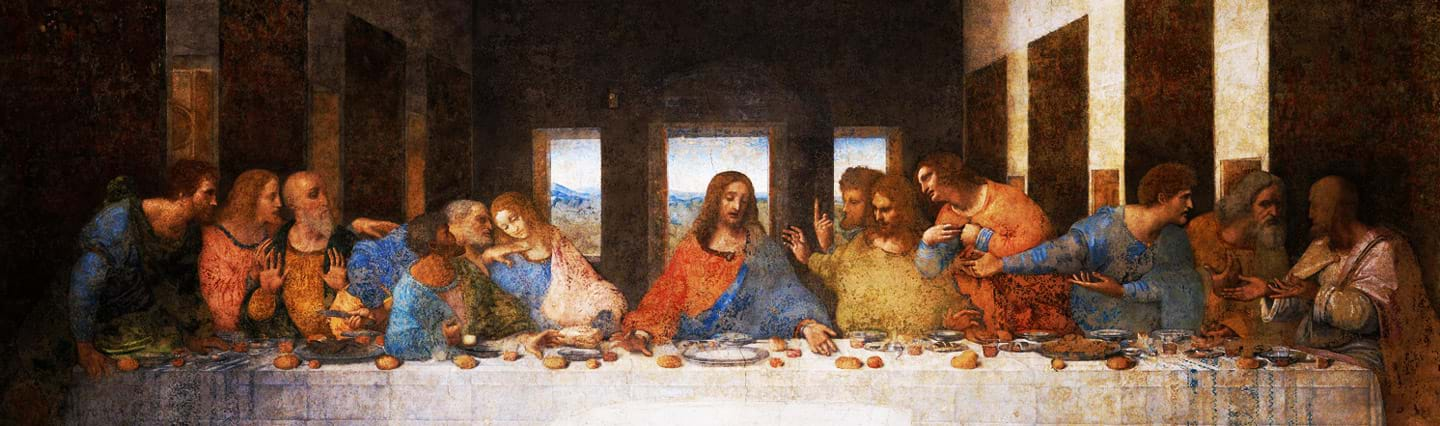
The Last Supper
Back in Florence, where the fame of “The Last Supper” had spread, he was greeted as a great master come home. Crowds flocked to see a new work on display; he turned aside commissions from the titled and the rich. But he accepted the commission for a patriotic battle scene on a wall of the city’s Great Council Hall and completed a preparatory cartoon that was among the most powerful works he ever made. “The Battle of Anghiari” has been viewed as both a monument to the passions of war and a passionate antiwar statement: men’s faces savagely twisted, horses tearing at one another’s flesh, one horse screaming in pain, like something out of a Renaissance “Guernica.” Just as he was readying himself to work on the painting itself, though, the city government commissioned Michelangelo to paint another wall in the same room, deliberately spurring a competition between Florence’s two greatest artists.
Michelangelo loathed Leonardo. It’s clear from their work why they might not have got along. Michelangelo’s hard-edged line, even in painting, was sculptural, and deliberately antithetical to the softened atmospherics that Leonardo pursued. But the animus was also personal. Michelangelo, then in his mid-twenties, was gruff, hardworking, ill-kempt, and, by his own account, celibate, because of what appears to have been his severely repressed and spiritualized homosexuality. At one point, he insulted Leonardo on the street, with a taunt about the bronze horse that had been left unfinished, reportedly leaving Leonardo standing red-faced. The witness to this incident found it worth noting that Leonardo, ever beautiful in his person, went around Florence in a rose-pink tunic, and it is irresistible to infer how irritating Michelangelo must have found the older artist, with his peacock clothes and his perfumed air, and with what now amounted to an entourage of swankily dressed assistants.
Leonardo seemed to delight in adding fuel to the fire. Some months before Michelangelo was commissioned to paint alongside Leonardo, in early 1504, there was a meeting to view his nearly completed statue of David and to decide where in the city it would stand. All the important artists in town were present—Botticelli, Perugino, Filippino Lippi (child of the artist-monk and the nun)—but Leonardo alone objected to the figure’s exposed nudity, and pronounced the need for “decent ornament.” A tiny sketch he made on the spot shows the statue with its offending member neatly hidden by what Isaacson describes as “a bronze leaf.” It’s hard to believe that the man whose notebooks contain a section, “On the Penis,” in which he argues against “covering and concealing something that deserves to be adorned and displayed with ceremony” was truly offended by what he saw. Yet his objections prevailed. The genitals of the marble colossus were covered, and stayed that way for some forty years.
It isn’t hard to imagine the defiant mood in which Michelangelo set about producing his rival cartoon for the Council Hall. Instead of a battle scene, he depicted a whole troop of naked, twisting, posing, and extremely well-muscled men, who are caught bathing in a river just as the battle alarm sounds. (As Jonathan Jones notes, in “The Lost Battles,” this work, like Leonardo’s, quickly became a school for younger artists.) But, before Michelangelo could begin to paint, the Pope summoned him to Rome for another commission. Leonardo had seen enough to comment on certain artists who made figures so conspicuously muscled that they resembled “a sack of walnuts.” Still, he was nonplussed by the aggressive younger artist, and was temperamentally ill-suited to this sort of head-on competition. Worse, he had continued to experiment with materials, and as he worked he discovered that, yet again, the paint was not adhering to the wall. When Michelangelo suddenly returned, in 1506, Leonardo abandoned the project and fled back to Milan. As it happened, Michelangelo, consumed by other tasks, never even began his painting. All that remains of either work are a few sublime preparatory drawings—the monumental cartoons are both lost—and later copies.
Among the paintings that Leonardo took away with him was the portrait later known as the “Mona Lisa,” begun around 1503 and soon admired for its astonishing naturalism. Although most scholars agree that it represents Lisa del Giocondo, the wife of a local silk merchant, there is no consensus on why the artist chose such a comparatively lowly subject when he was evading requests from the Marchioness of Mantua. As for the “Mona Lisa” ’s haunting smile—“Mona,” a contraction of “Madonna,” is a title akin to Lady or Madam—it, too, remains a mystery. Was Leonardo recalling his mother’s smile? Or Salaì’s? Both theories have been proposed. Or was the smile just a clever allusion to the fact that the lady’s last name, Giocondo, means “cheerful”? (In France, the portrait has always been known as “La Joconde.”) Whatever this portrait meant to Leonardo—the biggest mystery of all—he chose never to relinquish it, but went on, year after year, adding small perfecting strokes and glazes. Nonetheless, he increasingly turned away from painting, anxious to complete his studies and to order the contents of his notebooks. He was in his fifties and feared that he was running out of time.
In Milan, he acquired the services of another beautiful boy who became central to his life. Francesco Melzi, however, was in every other way Salaì’s opposite: aristocratic, educated, serious, a devoted amanuensis, and ultimately something of a son. When political changes forced Leonardo to leave Milan in 1512, he (and Salaì) stayed with the Melzi family outside the city, before moving on to pass three mostly miserable years in Rome. His reputation for not finishing things meant that he no longer received big commissions, a situation that he generally felt as a relief, except when confronted with the galling achievements of Michelangelo and Raphael, in their positions as favorites of the Pope. (It was one thing to be free from unwanted work, another to be ignored.) Although he was universally revered, Leonardo still needed money, and so required a patron with more patience than this class of person usually displayed. Fortunately, Francis I, the new King of France, just twenty-one years old, was eager to import Italian art, and very much in the market for a grand old man of the Renaissance. All that Leonardo needed to supply, in exchange for a stipend and a small château, was his wisdom.
We get a last glimpse of him in 1517, well ensconced in France but frail, when the secretary for the Cardinal of Aragon recorded a visit. Leonardo is still in possession of a portrait of “a certain Florentine lady,” and two other paintings that appear equally impressive. He shows off his notebooks, calling them “an infinity of volumes,” and the account continues, “If these were to be brought to light they would be both useful and delightful.” None of the notebooks had been brought to light by the time Leonardo died, in May, 1519, at the age of sixty-seven. Instead, the task fell to Melzi, who inherited most of Leonardo’s estate, the notebooks included. He managed to organize the notes on painting, and did his careful best—the selling of pages did not begin until after his death—but was finally overwhelmed. A single lifetime was not enough.
We get a last glimpse of him in 1517, well ensconced in France but frail, when the secretary for the Cardinal of Aragon recorded a visit. Leonardo is still in possession of a portrait of “a certain Florentine lady,” and two other paintings that appear equally impressive. He shows off his notebooks, calling them “an infinity of volumes,” and the account continues, “If these were to be brought to light they would be both useful and delightful.” None of the notebooks had been brought to light by the time Leonardo died, in May, 1519, at the age of sixty-seven. Instead, the task fell to Melzi, who inherited most of Leonardo’s estate, the notebooks included. He managed to organize the notes on painting, and did his careful best—the selling of pages did not begin until after his death—but was finally overwhelmed. A single lifetime was not enough.
Melzi was with Leonardo at the end, but Salaì was living in Milan. He had left the entourage on its way to France, and, despite reported visits to Leonardo, it has been easy to assume a serious break. Leonardo, in his will, left Salaì only half of a property he owned near Milan, leaving the other half to a favorite new servant. Many biographers, including Isaacson, assume that Salaì was essentially cut off. The will, moreover, makes no mention of the paintings, an omission that has been the source of much scholarly agitation. A document detailing Salaì’s effects, made out after his death, only five years later, lists a number of paintings identified by Leonardesque titles (“La Ioconda”), but leaves it unclear whether these were originals or copies. Isaacson concludes, somewhat rashly, that Salaì (in his late thirties) “lived up to his reputation as a sticky-fingered little devil, one who was somehow able to get his hands on things.”
But another document, not discussed by Isaacson, suggests a happier possibility. Brought to light in 1999 by the scholar Bertrand Jestaz, it shows that, in 1518, while Leonardo was still alive, Francis I’s treasurer in Milan issued a small fortune to Salaì in exchange for a group of paintings. According to Jestaz, the sum involved was so large that they can only have been Leonardo’s originals; several of his paintings did indeed enter the King’s collection and are now in the Louvre. (The ones still in Salaì’s possession at his death fell steeply in value soon after and were surely copies.) The art historian Laure Fagnart plausibly concludes that Leonardo left so little to Salaì in his will because he’d already provided for him very well.
Salaì’s reputation has never been the best, and Isaacson’s suggestion hardly does further damage. But the two interpretations say very different things about Leonardo. No one believes anymore that a great artist must be a saint, and there are many things we will never understand about the man. The way that he treated the grownup child who had been the love of his life, as that life was coming to an end, may not be on the same moral plane as the issues raised by his machines of war, but it offers at least one answer to the question of who Leonardo really was.
Leonardo seems to have found peace in his final years, closely attended by the young King—who lived in a château just a few hundred yards away—organizing court celebrations and pondering geometric puzzles to his heart’s content. His last certain work was not a painting, or even a drawing, but a party he put on in his gardens, in honor of the King, in the summer of 1518. There was an enormous canopy of sky-blue cloth decorated with gold stars, supported on columns covered with ivy. There was music. A spectacle titled “Paradiso” was performed, with players costumed as the planets, surrounded by the sun, the moon, and the twelve celestial signs. Four hundred torches were set burning, so that, as a letter-writer of the time recalled, “the night was chased away.” And in the morning all of it was gone. ♦
Claudia Roth Pierpont has contributed to The New Yorker since 1990, and became a staff writer in 2004. She has written on numerous subjects, ranging from Ballets Russes to the Chrysler Building to the philosophy of Friedrich Nietzsche. Pierpont is the author of “American Rhapsody: Writers, Musicians, Movie Stars, and One Great Building,” “Roth Unbound: A Writer and His Books,” and “Passionate Minds: Women Rewriting the World,” a collection ofNew Yorker essays about the lives and works of women writers, including Hannah Arendt, Gertrude Stein, Anaïs Nin, Margaret Mitchell, and Zora Neale Hurston, which was nominated for a National Book Critics Circle Award.
Pierpont has received a Whiting Award, a Guggenheim Fellowship, and a fellowship at the Cullman Center for Scholars and Writers, of the New York Public Library. She lives in New York City.


