Monday, May 08, 2017

What Happened in France?


May 7, 2017

Image result for emmanuel macron election
BOB EDME / AP

How could Marine Le Pen have lost in a landslide?

Why, after the Brits chose Brexit, and Americans chose Trump, did the Dutch fail Wilders, and the French fail Le Pen?

How could a country that has been hit by several major terrorist attacks in recent years, and that has undergone a more profound social transformation owing to Islamic immigration, vote for business as usual?

Wilders, buoyed by the Brexit and Trump victories, said that 2017 would be a “Year of the Populist.” So far, alas, it's not turning out that way.

Yes, there are positive signs. The Sweden Democrats are on the upswing. And Wilders did gain seats in the Dutch Parliament.

But if you've witnessed the reality of Islamization in cities like Rotterdam and Paris and Stockholm, you may well wonder: what, in heaven's name, will it take for these people to save their own societies, their own freedoms, for their own children and grandchildren?

I'm not the only one who's been obsessing for years over this question. I've yet to see a totally convincing answer to it.

One way of trying to answer it is to look at countries one by one. For example, the Brits and French feel guilty about their imperial histories, and hence find it difficult to rein in the descendants of subject peoples. The Germans feel guilty about their Nazi past – and the Swedes feel guilty about cozying up to Nazis – and thus feel compelled to lay out the welcome mat for, well, just about anybody. The Dutch, similarly, are intensely aware that during the Nazi occupation they helped ship off a larger percentage of their Jews to the death camps than any other Western European country, and feel a deep need to atone.

Postmodernism, of course, is a factor. According to postmodern thinking, no culture is better than any other – and it's racist to say otherwise. No, scratch that – other cultures are, in fact, better than Western culture. Whites, by definition, are oppressors, imperialists, and colonialists, while “people of color” are victims.

And Muslims are the biggest victims of all.

Not that that makes any sense. Over the centuries since the religion was founded, Muslim armies have gained control over much of north Africa, the Middle East, and large parts of Europe. Islam itself, by definition, is imperialistic. And whenever Islam has conquered non-Islamic territories, it has proven itself to be profoundly oppressive, offering infidels exactly three options: death, subordination, or conversion. But to say these things has become verboten.

Living in a Muslim neighborhood of Amsterdam in early 1999, I read up on Islam and realized very quickly what Europe was up against. Two and a half years later, when the terrorist attacks of 9/11 occurred, I assumed pretty much everyone else would get it, too.

But it didn't work that way. Yes, some people did get it almost instantaneously, in both America and Europe. They caught up on a lot of reading, did a great deal of soul-searching, and underwent a major philosophical metamorphosis.

But even after other horrific attacks occurred – in Madrid, London, and elsewhere – a lot of people refused to accept the plain truth. The plainer the truth got, in fact, the more fiercely they resisted it. And as skilled propagandists began to represent Muslims as the mother of all victim groups, many Westerners were quick to buy into it all.

How, again, to make sense of this?

Yes, the mainstream media have played a role, routinely whitewashing Islam, soft-pedaling the Islamic roots of jihadist terror, and staying silent about the dire reality of everyday Islamization. But no one who actually lives in western Europe has any excuse for ignorance about these matters. The truth is all around them. Even in the remotest places, however dishonest the mainstream media, the truth can be found on the Internet.

But – and this is a fact that some of us are thoroughly incapable of identifying with, and thus almost thoroughly incapable of grasping – some people don't want to know the truth. And if they do know the truth, they want to un-know it.

Orwell understood. He called it doublethink. You can know something and yet can will yourself not to know it. And thereby give free rein to totalitarianism.

For those of us to whom the truth matters, and who wouldn't be able to live with ourselves if we didn't face the truth, however difficult, and try to act responsibly on it, it can be hard to conceive that not everything thinks about these things in the same way that we do.

And I'm not talking about people who are just plain obviously rotten through and through. I'm taking about people who, in everyday life, come across as thoroughly good and decent – but who, when push comes to shove, just don't want to rock the boat. That's a lot of people. Maybe most. People who are nice so long as it's easy to be nice. The sort of people who – if they'd been, say, Christians living in the pre-war Netherlands – would've been the best of friends to their Jewish neighbors next door; but who, when those neighbors came to them and begged to be hidden from the Gestapo, would've refused.

No, come to think of it, you don't even have to take it to the point where the Gestapo is on your tail. There are kind people who, the minute there's any hint of trouble – which means, way before the death-camp round-up begins – prefer to lie low. Their highest value isn't truth or virtue or beauty or even long-term security for them and their families but the ability to buy another day without major trouble.

You'd think they'd be able to look forward at least some distance into the future and dwell on that grim prospect. Able to see their children, their grandchildren, and so forth, living under sharia law. If, indeed, lucky to be living at all.

But I think it needs to be recognized that for some people, seeing that far into the future is just beyond their intellectual grasp. Or beyond what they dare to envision.

Yes, they see Islam taking over. Bit by bit, here and there. Everything in their lives, everything familiar to them, is being transformed, in some cases at a terrifying pace. Perhaps their own lives haven't been turned upside down – yet. But they know people who have suffered greatly because of these changes.

No, come to think of it, you don't even have to take it to the point where the Gestapo is on your tail. There are kind people who, the minute there's any hint of trouble – which means, way before the death-camp round-up begins – prefer to lie low. Their highest value isn't truth or virtue or beauty or even long-term security for them and their families but the ability to buy another day without major trouble.

You'd think they'd be able to look forward at least some distance into the future and dwell on that grim prospect. Able to see their children, their grandchildren, and so forth, living under sharia law. If, indeed, lucky to be living at all.

But I think it needs to be recognized that for some people, seeing that far into the future is just beyond their intellectual grasp. Or beyond what they dare to envision.

Yes, they see Islam taking over. Bit by bit, here and there. Everything in their lives, everything familiar to them, is being transformed, in some cases at a terrifying pace. Perhaps their own lives haven't been turned upside down – yet. But they know people who have suffered greatly because of these changes.

In America we're taught (or, at least, used to be taught) that our leaders work for us; we learn (or used to) that it's not only our right but our duty as individuals to stand up to those leaders when we think they're wrong – especially when we think they're exceeding their powers and infringing on our rights. But Europeans aren't brought up that way. Not really. Yes, there's lip service to the idea of freedom. But when it comes right down to it, they're raised to bow down to the state – to prioritize not themselves, not the individual, but the society, the commonweal, that abstract ideal known as “solidarity.”

So it is that even in a secret ballot, it takes European voters a remarkable amount of nerve to resist the thunderous chorus of voices from above urging them to vote against their own interests; it feels like nothing less than an act of treason to heed the meek little voices in their own heads begging them to do the opposite – to do what's actually best for themselves and their loved ones. They've been psychologically manipulated to the point where they truly believe, on some level, at least in some Orwellian doublethink kind of way, that acting in clear defense of their own existence, their own culture, their own values, and their own posterity, is an act of ugly prejudice.

These, for what it's worth, are the places my mind has wandered since the vote from France came in. At this point I've lived in Europe for just short of twenty years, and have spent every day of that time observing Europeans and trying to understand what makes them tick when it comes to such matters. It helps to be an outsider, even after you've been an outsider so long that you're not really an outsider any more. Frankly, Le Pen's devastating loss doesn't really surprise me. But I still can't say that I get it.

Emmanuel Macron, Useful Idiot of Islamism


May 7, 2017

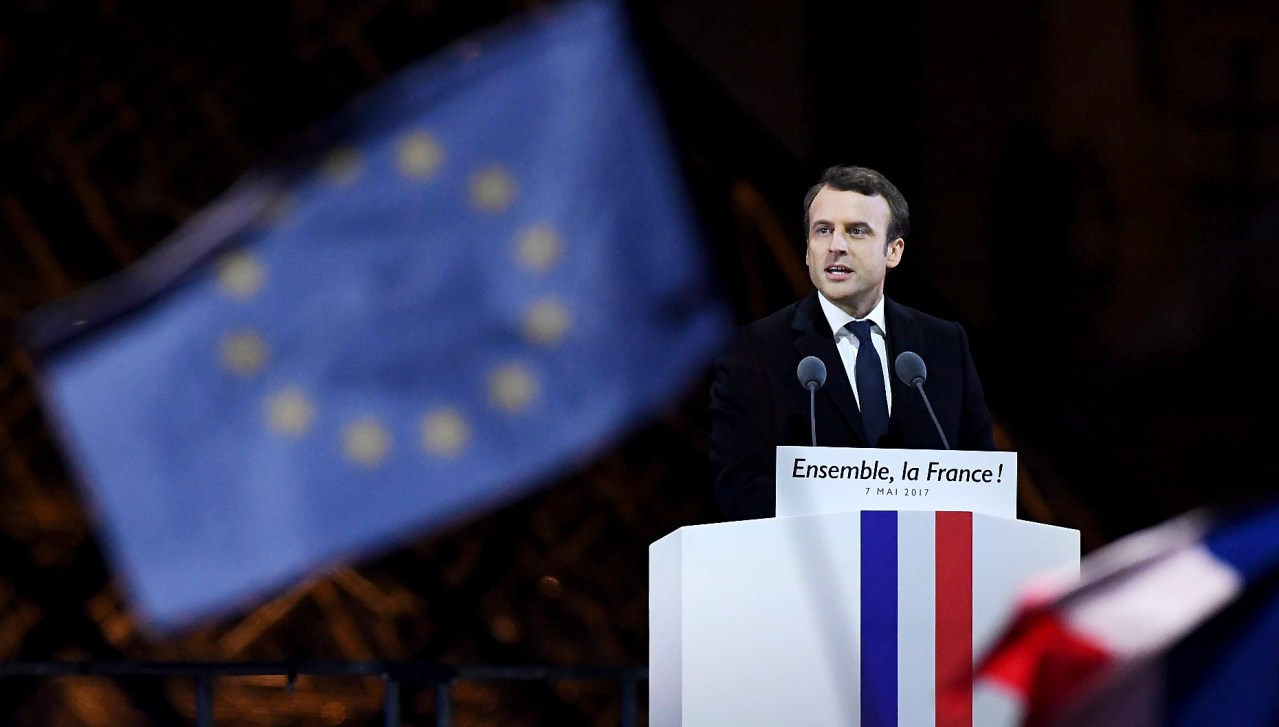
Image result for emmanuel macron

Emmanuel Macron wins French presidential election 

During the cold war with the Soviet Union, they were called "Useful Idiots". These people were not members of the Communist Party, but they worked for, spoke in favor of and supported the ideas of Lenin and Stalin. In the 21st century, Communism is finally dead but Islamism has grown and is replacing it as a global threat.

Like Communism, Islamism -- or Islamic totalitarianism -- has been collecting its "Useful Infidels" the same way Communism collected its Useful Idiots. There is, however, an important difference: under the Soviet Union, Useful Idiots were intellectuals. Now, Useful Infidels are politicians, and one of them may be elected president of France today.

Emmanuel Macron, Useful Infidel, is not a supporter of terrorism or Islamism. It is worse: he does not even see the threat. In the wake of the gruesome attacks of November 13, 2015 in Paris, Macron said that French society must assume a "share of responsibility" in the "soil in which jihadism thrives."

"Someone, on the pretext that he has a beard or a name we could believe is Muslim, is four times less likely to have a job than another who is non-Muslim," he added. Coming from the direction of Syria and armed with a Kalashnikov and a belt of explosives would, according to him, be a gesture of spite from the long-term unemployed?

Macron comes close to accusing the French of being racists and "Islamophobes". "We have a share of responsibility," he warned, "because this totalitarianism feeds on the mistrust that we have allowed to settle in society.... and if tomorrow we do not take care, it will divide them even more ".

Consequently, Macron said, French society "must change and be more open." More open to what? To Islam, of course.

On April 20, 2017, after an Islamist terrorist killed one police officer and wounded two others in Paris, Macron said: "I am not going to invent an anti-terrorist program in one night". After two years of continuous terrorist attacks on French territory, the presidential candidate said he had not taken the country's security problems into account?

Moreover, on April 6, during the presidential campaign, professor Barbara Lefebvre, who has authored books on Islamism, revealed to the audience of the France2 television program L'Emission Politique, the presence on Macron's campaign team of Mohamed Saou. It was Saou, apparently, a departmental manager of Macron's political movement, "En Marche" ("Forward"), who promoted on Twitter the classic Islamist statement: "I am not Charlie".

Sensing a potential scandal, Macron dismissed Saou, but on April 14, invited onto Beur FM, a Muslim French radio station, Macron was caught saying on a "hot mic" (believing himself off the air): "He [Saou] did a couple things a little bit radical. But anyway, Mohamed is a good guy, a very good guy".

"Very good", presumably, because Mohamed Saou was working to rally Muslim voters to Macron.

Is Saou an isolated case? Of course not. On April 28, Mohamed Louizi, author of the book Why I Quit Muslim Brotherhood, released a detailed article on Facebook that accused Macron of being a "hostage of the Islamist vote". Republished by Dreuz, a Christian anti-Islamist website, Louizi's article gave names and dates, explaining how Macron's political movement has largely been infiltrated by Muslim Brotherhood militants. It will be interesting to see how many of them will be candidates in Macron's movement in the next parliamentary elections.

On April 24, the Union of Islamic Organisations of France (UOIF), generally known as the French representative of Muslim Brotherhood, publicly called on Muslims to "vote against the xenophobic, anti-Semitic and racist ideas of the National Front and [we] call to massively vote for Mr. Macron."

Why?

Is Macron an open promoter of Islamism in France? It is more politically correct to say that he is a "globalist" and an "open promoter of multiculturalism". As such, he apparently does not consider Islamism a national threat because, for him, the French nation, or, as he has said, French culture, does not really exist. Macron has, in fact, denied that France is a country with a specific culture, a specific history, and a specific literature or art. On February 22, visiting the French expatriates in London, Macron said: "French culture does not exist, there is a culture in France and it is diverse". In other words, on French territory, French culture and French traditions have no prominence or importance over imported migrant cultures. The same day, in London, he repeated the offense: "French art? I never met it!"

Conversely, in an interview with the anti-Islamist magazine, Causeur, he said: "France never was and never will be a multiculturalist country".

Because he is a politician, Macron is not addressing the French people as a whole. He is addressing different political customer bases. When visiting Algeria, Macron said that colonization was a "crime against humanity". He evidently hoped this remark would help him to collect the votes of French citizens of Algerian origin.

During the presidential campaign, Macron was always saying to people what they wanted to hear. French people may well be on their way to discovering that for Macron, belonging to a homeland, thinking of borders and defining oneself as belonging to a mother language or a specific literature or art, is nothing more than junk.
Yves Mamou is a journalist and author based in France. He worked for two decades for the daily, Le Monde, before his retirement.

Saturday, May 06, 2017

Fact Check: It's a Lie That the GOP Healthcare Bill Abandons People With Pre-Existing Conditions


By Guy Benson
May 5, 2017
FILE - In this Friday, March 24, 2017, file photo, protesters gather across the Chicago River from Trump Tower to rally against the repeal of the Affordable Care Act, in Chicago. The Republican push to replace the Affordable Care Act was revived by a small change to their plan designed to combat concerns over coverage for those with pre-existing health conditions. But experts say the change, which helped the bill squeak through the House of Representatives, Thursday, May 4, 2017, may be too small to make much difference in the hunt for affordable coverage for these patients. (AP Photo/Charles Rex Arbogast, File)
In this Friday, March 24, 2017, file photo, protesters gather across the Chicago River from Trump Tower to rally against the repeal of the Affordable Care Act, in Chicago.  (AP Photo/Charles Rex Arbogast, File)
As we described yesterday, there are some concerning policy elements of the House-passed American Health Care Act, which the Senate would be wise to explore and rectify over the coming weeks. The bill -- and that's all it is at this point: a work in progress -- repeals and alters significant portions of the Democratic Party's failing experiment in "affordability."  But based on rhetoric from elected Democrats and the Left generally, one might assume that Obamacare was called the "Pre-existing Conditions Coverage Act" (side-stepping the whole "choice and affordability" fairy tale they peddled), and that the Republican bill obliterates those protections. The proposed law would be a "death warrant" for sick women and children, they shriek, casting Obamacare opponents as the moral equivalent of accessories to murder. This is demagogic, hyperbolic, inaccurate nonsense. To review the actual facts, even under an exceedingly unlikely scenario in which the Senate passed the House bill without making a single alteration, people with pre-existing conditions are offered several layers of protection:
Layer One: Insurers are required to sell plans to all comers, including those with pre-existing conditions. This is known as "guaranteed issue," and it's mandated in the AHCA. No exceptions, no waivers. I spoke with an informed conservative news consumer earlier who was stunned to learn that this was the case, having been subjected to 24 hours of unhinged rhetoric from the Left.

Layer Two: Anyone with a pre-existing condition and who lives in a state that does not seek an optional waiver from the AHCA's (and Obamacare's) "community rating" regulation cannot be charged more than other people for a new plan when they seek to purchase one -- which, as established above, insurers are also required to sell them.
Layer Three: Anyone who is insured and remains continuously insured cannot be dropped from their plan due to a pre-existing condition, and cannot be charged more after developing one. So if you've been covered, then you change jobs or want to switch plans, carriers must sell you the plan of your choice at the same price point as everyone else. Regardless of your health status. This is true of people in non-waiver and waiver states alike.
Layer Four: If you are uninsured and have a pre-existing condition and live in a state that pursued (and obtained after jumping through hoops) a "community rating" waiver, your state is required to give you access to a "high risk pool" fund to help you pay for higher premiums. The AHCA earmarks nearly $130 billion for these sorts of patient stability funds over ten years.
It is simply a lie to say that the AHCA guts protections for people with pre-existing conditions. One can argue that perhaps $130 billion (not $8 billion, as some are dishonestly pretending) might at some point prove insufficient to covering the people described in layer four, but I think any such assessment is at best hypothetical and premature.  Either way, it's a very different critique than the scare-mongering going around right now.  Also, I'll repeat: The number of "uninsurable" Americans with pre-existing conditions within the individual market represents a tiny sliver of the overall population.  Helping these people was one of the few credibly-popular selling points and actual achievements of Obamacare.  But the existing law's track record on this front helps illustrate how limited the scope of that particular problem is:
The peak enrollment in Obamacare's Pre-existing Condition Insurance Plan was less than 115,000 people.https://twitter.com/KamalaHarris/status/860210539204628482 

Obamacare created a "bridge" program that allowed previously-uninsurable consumers with pre-existing conditions to get coverage in between the law's 2010 passage and full implementation a few years later. At its peak, it attracted less than 115,000 takers. Those people matter, and they were helped. But that statistic helps contextualize the problem, especially compared to Obamacare's overriding flaw: Unaffordability, leading to lack of participation, leading to unsustainable risk pools, leading to insurers pulling out and hiking premiums, leading to unaffordability, leading to further lack of participation, etc.  As for the moral bullying about the AHCA supposedly leading to thousands of deaths (with these pronouncements coming from the very same people who lied incessantly and made spectacularly wrong predictions about Obamacare, by the way), consider this data-based evidence:
Public-health data from the Centers for Disease Control confirm what one might expect from a health-care reform that expanded Medicaid coverage for adults: no improvement. In fact, things have gotten worse. Age-adjusted death rates in the U.S. have consistently declined for decades, but in 2015 — unlike in 19 of the previous 20 years — they increased. For the first time since 1993, life expectancy fell. Had mortality continued to decline during ACA implementation in 2014 and 2015 at the same rate as during the 2000–13 period, 80,000 fewer Americans would have died in 2015 alone. Of course, correlation between ACA implementation and increased mortality does not prove causation. Researchers hypothesize that increases in obesity, diabetes, and substance abuse may be responsible. But thanks to the roughly half of states that refused the ACA’s Medicaid expansion, a good control group exists. Surely the states that expanded Medicaid should at least perform better in this environment of rising mortality? Nope. Mortality in 2015 rose more than 50 percent faster in the 26 states (and Washington, D.C.) that expanded Medicaid during 2014 than in the 24 states that did not.
If conservatives wanted to turn liberals' demagoguery against them, they could cite these numbers to claim that Obamacare is killing tens of thousands of people -- especially in Medicaid expansion states -- and that Democrats have blood on their hands. Murderers! Let's not match their repugnant hackery. But we should make them aware of evidence that could build that deeply uncharitable and specious narrative. And speaking of Medicaid, I've seen a lot of hyperventilating about "deep cuts" to the program, which was already suffering poor health outcomes and restricted accessbefore Obamacare's huge expansion of it. The AHCA does eventually transition to a major reform of the dysfunctional program, but it does so via a gradual tapering and eventual halt of Medicaid's expansion several years from now, with existing recipients (including new additions under the continued expansion) grandfathered in. May I repeat: There are flaws in the bill that need to be addressed. But the fact-challenged, emotional, manipulate meltdown on the Left is designed to scare people, not inform them. And it has the side effect of distracting from the spiraling betrayals of Obamacare, a program the Left put in place last time they were in charge. I'll leave you with this strong editorial from the Wall Street Journal:

Ending ObamaCare, Part One

House Republicans take a giant step toward better health care.


The Wall Street Journal

May 4, 2017
Image result for health care act protests
Pete Caster (pcaster@chronline.com)
The media template for covering the 115th Congress apparently goes like this: When Republicans fail to pass a bill, they’re doomed. But when they succeed, they’re also doomed. Thus the same media sages who said the House could never repeal ObamaCare are now saying that the replacement the House passed Thursday can’t pass the Senate.
The wish is the mother of this analysis, and predictions about the Senate are worth about as much as the guarantees of President Hillary Clinton. The reality is that the House success, however narrow the 217-213 vote, is the first essential step toward fulfilling the GOP’s top campaign promise.
While the job was messier than it should have been, the result shows that Republicans can hold a governing majority despite unprecedented media, interest-group and Democratic hostility. The majority spanned the GOP conference from Michigan libertarian Justin Amash to moderate Carlos Curbelo, who deserves special notice for political courage considering his swing Miami district. If you doubt this is a big moment, imagine the media obituaries for Republicans if they had failed.
Credit goes to House leaders for sticking with their essential product and working around the edges to cajole a majority. The bill that passed is remarkably similar to the one that GOP leaders first introduced. The changes demanded first by the Freedom Caucus and then some moderates are tweaks that don’t alter the reform’s core architecture.
The bill includes deregulatory steps to pave the way for a variety of insurance coverage that more people can afford; the largest entitlement reform in decades by devolving control over Medicaid to the states; a $1 trillion spending cut over a decade; tax credits for individual insurance that begin to equalize the tax treatment of health care for individuals and businesses; and the repeal of ObamaCare taxes totaling $900 billion over 10 years.
The bill doesn’t repeal all of ObamaCare because it can’t without Democratic help under the Senate’s budget rules. But the bill marks a giant step away from the Democratic march to government-run health care, which is why the political and cultural left have been so vitriolic in their denunciations.
The Senate will now put its stamp on the policy, and no doubt there will be many perils of Rand Paul-ine moments with only a 52-seat GOP majority. The House bill will change, but reporters who think it is doomed should get off Twitter and make some calls. Majority Leader Mitch McConnell has been counting votes and calculating necessary compromises for some time.
House Republicans should be prepared that some of their planks may not survive Senate budget rules. They’ll have to be flexible enough to accept the compromises that are inevitable in a bicameral legislature. The trump card, so to speak, is that this process will yield a binary political choice: Either Members vote for what emerges from the House and Senate, or live with the status quo of ObamaCare.
That status quo is deteriorating as this week’s decision by Aetna to withdraw from Virginia’s health exchanges shows. Republicans need to act within weeks to clarify the rules of the individual insurance market for 2018. The lobby for the insurance industry issued a generally supportive statement on House passage, which offers some hope that congressional action can forestall a market collapse. Republicans will be blamed for that collapse whether or not they pass repeal and replace.
A word about the legislative process and political hypocrisy. Democrats and the media are howling that Republicans passed their bill before the Congressional Budget Office issued its final score of the budget and insurance impact. They have a point, but anyone voting Thursday had ample time to understand the policy choices.
As for CBO’s score, really? We don’t recall the same media concern for budget exactitude when Democrats rammed through ObamaCare on a partisan vote with more gimmicks than a traveling carnival. Remember the Class Act on long-term care that gilded the deficit numbers until it was quickly repealed? And don’t forget the government takeover of the student-loan market that was packaged with ObamaCare because CBO said it would save taxpayers money. Now loan defaults are bleeding red ink.

***

Which brings us to the main Republican weakness, which has been the failure to make the public case for this reform. House leaders have been preoccupied with twisting arms, leaving critics unrebutted.
President Trump deserves credit for his inside game of persuasion, and the bill wouldn’t have passed without his one-on-one lobbying. But a President also has a unique public platform, and Mr. Trump needs to use it to make a sustained case for the benefits and necessity of this reform. Tweets aren’t enough. He needs to make speeches that include persuasive details beyond superlative adjectives.
But these challenges wouldn’t matter if House Republicans had failed this week. Now it’s the Senate’s turn to fulfill seven years of promises to replace ObamaCare.
Appeared in the May. 05, 2017, print edition.

Friday, May 05, 2017

Health Care, from the Top


We cannot vote away scarcity.

By Kevin D. Williamson — May 5, 2017
Image result for health care
Our ongoing troubles with health care stem from an unwillingness to deal with certain facts. One of those facts is scarcity.

“Scarcity” is a term from economics, and it refers to the fact that there is never enough of anything to satisfy every possible desire — the universe holds only so much, and human desire has a way of outgrowing whatever we have. So we have to come up with a way of dividing up that which is scarce. We have tried many different ways of doing that — war, caste systems, central planning — though mostly we’ve relied on the fact that everybody wants lots of different things, which makes it possible to trade. But buying and selling stuff is not, to be sure, the only way to divide up that which is scarce.

Medical care is scarce: There are only so many doctors and hospital rooms; the pill factories can make only so many pills, and there are real limitations on the raw materials used to make those pills; heart stents don’t grow on trees, but, even if they did, they would be scarce, like apples and oranges and pears and avocados.

An example: A few years ago, a friend of mine was deathly sick with a chronic cardiac condition. He learned that a doctor in another country — on another continent — had developed an experimental treatment for his condition. The chances of its working were not very high, but it had worked on others. The problem was, there were something like three doctors in the world who did that procedure, and approximately one who had done it with a great deal of success. His insurance would not pay for it, and the public-health system in his country would not even think of paying for it. But my friend was vastly wealthy, so he called up that doctor, offered him what I assume was a very large sum of money, put him on an airplane, and rented out space in the finest private hospital money could buy. Unhappily, the procedure was not successful, and he died.

We cannot offer the same level of care to everybody with the same condition. They number in the millions, and the doctors who can perform that procedure number about three. (Or, at least they did ten years ago.) Even if they worked 16-hour shifts, seven days a week — even if we pressed them into slavery — they could see only so many patients and perform so many procedures, and those would amount to a tiny fraction of the number of people who might benefit from their attention.

Because of scarcity, medical care eventually reaches the point where one of three things happens: Somebody puts out his hand and says “Pay me,” an officer of the government or an insurance company refuses to approve some treatment, or you die.

Because we are a largely cooperative species, we do not like that very much. It seems unfair and unkind. So we try to make an end run around scarcity with things such as health insurance and government medical plans, both of which are based on the same economic principle: Someone else pays. But scarcity does not care who is paying: Scarcity is scarcity. In the most monopolistic public-health systems (e.g., the ones in the United Kingdom and Canada), there is a lot of saying “No,” though it is what we might call a “Japanese no” — saying “no” without actually saying it. They put you on a waiting list and hope you die before they actually have to say “No,” or they simply expect you to accept that some services and treatments are categorically unavailable. There is a reason New York City’s hospitals are full of rich Canadians who cannot afford the free health care at home.

But a polite, indirect “No” is still a “No.” No means no.

Insurance companies say “No” all the time, and we hate them for it. That is because of another fact that we refuse to deal with like mature, responsible adults: Insurance is not a medical product — it is a financial product. Most of us do not need to spend a great deal of money on health care during any given year for most of our lives. I myself pay for most of my medical expenses out-of-pocket, and, in any given year, they rarely add up to what my health-insurance premiums cost. But I do not have health insurance, and pay premiums for that health insurance, in order to have somebody else pay for my annual check-up or routine dental work. I have insurance because I might get hit by a bus or cancer or a heart attack, and, secondarily, because one day I will be old, if I am lucky, and old people have lots of medical expenses.
Scarcity exists because of the nature of the physical universe, not because insurance executives are big meanies.
Scarcity exists because of the nature of the physical universe, not because insurance executives are big meanies. (It’s okay to hate insurance executives — everybody hates insurance executives.) Insurance companies have to say “No” a great deal, whether they are run by nice people or by the sort of people who ordinarily run insurance companies. The Canadian government health-care system is in essence a big, generous insurance company owned by its customers and perfectly happy to run large losses indefinitely, and it still has to say “No” pretty often.

Putting mandates on insurance companies is not a cure for scarcity. Sometimes, it makes things worse. Insurance companies operate by making a very careful study of actuarial information, which allows them to make remarkably accurate predictions about the medical needs of large populations with known demographic characteristics. Nobody knows whether any given 60-year-old man will have a heart attack this year, but stack up 10 million of them, and the pointy-headed actuarial nerds can tell you with a high degree of accuracy how many of them will. But we want insurance to be something different: We want it to be the conqueror of scarcity. So we do things like mandate coverage of preexisting medical conditions, which is to say, we demand that they place bets against things that already have happened. The usual metaphor here is offering fire insurance after the house already has burned down, and that is apt. We are asking them to bet against the Patriots in the 2017 Super Bowl after the fact, in 2018, in 2019, 2020, etc.
What might a health-care program that deals with reality look like?

We could probably lower the cost of prescription drugs significantly by making the approval process less cumbrous and expensive, and maybe by tweaking a few intellectual-property procedures. We could do the same with medical devices and the like, though the so-called Affordable Care Act took the opposite approach, taxing those devices and making them scarcer. 
If we want more doctors, there are probably 1 million top-shelf physicians from around the world who would immigrate to the United States yesterday if we gave them the go-ahead. (Yes, that probably would lower the incomes of native-born doctors; we are going to be adults for the moment, and this is a question of trade-offs.) We could reduce the regulatory burden on insurance companies in an effort to lure more of them into the market, whereas the ACA added to their burdens and drove many of them from the marketplace.
We could try to make ordinary, non-emergency medical care more of an ordinary product, one that people pay for the way they pay for food and housing and cars and World of Warcraft expansion packs.
We could try to make ordinary, non-emergency medical care more of an ordinary product, one that people pay for the way they pay for food and housing and cars and World of Warcraft expansion packs and the other necessities of modern life, allowing insurance to be insurance: a financial product that helps to mitigate certain risks related to unexpected health-care costs. This would allow for the emergence of robust, competitive, consumer-oriented markets like we have in cellphones and pornography and other innovative markets where choices abound and prices keep going down because the consumer is king.

But there will be scarcity. Somebody will put his hand out and say, “Pay me.”

This brings up something economists call “elasticity of demand.” That is a fancy way of saying that when you roll into the local BMW dealer and find out that that i8 costs $150,000, you say, “No, thanks,” and you get a Honda Civic instead, but when you are rolled into the emergency room with a broken leg or a non-functioning heart, you don’t talk about prices at all, and, even if you did, you aren’t normally going to say “No” to any price when the alternative is sickness and pain and death. But not every medical procedure is a life-and-death matter, and, even in the matter of serial chronic conditions such as diabetes, there is opportunity for comparison shopping and negotiating. The other kind of medical problem is why you have insurance.

We have perfectly functional markets in all sorts of life-and-death goods. They expect you to pay up at the grocery store, too, but poor people are not starving in the American streets, because we came up with this so-crazy-it-just-might-work idea of giving poor people money and money analogues (such as food stamps) to pay for food. It is not a perfect system, but it is preferable, as we know from unhappy experiences abroad, to having the government try to run the farms, as government did in the Soviet Union, or the grocery stores, as government does in hungry, miserable Venezuela. The Apple Store has its shortcomings, to be sure, but I’d rather have a health-care system that looks like the Apple Store than one that looks like a Venezuelan grocery store.

There is a certain libertarian tendency to look at messes such as the Affordable Care Act and the American Health Care Act and throw up one’s hands, exclaiming: “Just let markets work!” We should certainly let markets work, but not “just.” We aren’t going to let children with congenital birth defects suffer just because they might have stupid and irresponsible parents, and we are not going to let old people who have outlived their retirement savings die of pneumonia because we don’t want to spend a couple of thousand bucks treating them. But we also do not have a society in which everybody is on Section 8 and food stamps, nor do we want one. Developing sensible, intelligently run, reasonably generous welfare programs for those who cannot or simply have not done it for themselves is a relatively small project, but trying to have government impose some kind of political discipline on the entirety of the health-care system — which is as explicit a part of the current daft Republican health-care program as it is of Obamacare — is a different kind of project entirely.

Scarcity is not an economic theory. You can experience it for yourself any time you like, on a desert island or the streets of New York City. It is an aspect of reality, and the health-care reformers eventually will have to get around to taking reality into consideration.

READ MORE:

— Kevin D. Williamson is National Review’s roving correspondent.