Wednesday, April 12, 2017

The Incoming Roar


By Mark Steyn
April 11, 2017

Image result for st petersburg terrorism
Saint Petersburg Metro -  April 3, 2017. © AFP

Last week was a fairly typical one in 21st century headlines:

~On Monday, 14 victims were killed in an Islamic terrorist attack on the St Petersburg Metro;

~On Friday, four victims were killed in an Islamic terrorist attack by a homicidal truck driver on Queen Street in Stockholm;

~On Palm Sunday, at least 45 victims were killed in an Islamic terrorist attack on two Coptic churches in Egypt.

In other news, the United States bombed Syria after a chemical-weapons attack, and UK, Canadian and other newspapers reported on the treatment a Berlin schoolboy received after revealing to his Muslim classmates that he's Jewish. Meanwhile, Giulio Meotti wrote for the Gatestone Institute on the closure of 500 churches in London, and the opening of 423 mosques.

The US bombing raid got the most headlines - because, after eight years of Obama, it was unusual. It's also the simplest, cleanest act: Identify a military target and fire missiles at it. What do you do about the others? In column inches (or whatever unit of measure now applies), the attention they commanded followed the cynical formula of old-time editors: One dead American equals ten dead Europeans equals one hundred dead Russians equals one thousand dead Africans.

And so it proved. Nevertheless, the Palm Sunday bombings were the most significant event of the week. They demonstrate that hardcore Islam is serious about expunging the remnants of Christianity from the region in which it was born. This is not a small thing.

It was a clever attack. The first suicide bomber hit St George's Church in Tanta. The second struck northwest, at St Mark's Cathedral in Alexandria, seat of the Coptic papacy. Pope Tawadros II had just left the cathedral after hearing about the Tanta attack. Nevertheless, ISIS and its affiliates came within minutes of killing the Coptic pontiff - at worship on Palm Sunday.

As I said, not a small thing. But it doesn't seem to make a lot of news. Other Christian leaders, friom Pope Francis and the Archbishop of Canterbury on down, seem to have more to say about potential, hypothetical upticks in "Islamophobia" than about the sustained attempt to eradicate the oldest adherents of their own faith. Western politicians don't seem to have much to say about it, either, perhaps out of shame: On America's watch, public expression of Christianity was obliterated in Iraq, and the last Christian church in Afghanistan razed to the ground. Almost exactly two years ago, when 148 students were slaughtered at a school in Kenya, President Obama could not bring himself to identify them as Christian, even though their killers had gone to great pains to separate their captives according to their faith, releasing the Muslims and killing the Christians. As I remarked somewhat mordantly, apparently black lives don't matter when they're Christian.

Image result for egypt st mark's alexandria coptic palm sunday terrorism

Mourners carry the coffin of one of the victims of the blast at the Coptic Christian Saint Mark's church in Alexandria the previous day during a funeral procession at the Monastery of Marmina in the city of Borg El-Arab, east of Alexandria on April 10, 2017. Egypt prepared to impose a state of emergency after jihadist bombings killed dozens at two churches in the deadliest attacks in recent memory on the country's Coptic Christian minority. (AFP)

The Islamic supremacists' assault on Christianity is not confined to the Holy Land and the more benighted parts of the developing world. Monday's subway bloodbath in St Petersburg was also celebrated by Isis as making "a metro to Hell for worshipers of the Cross". It's doubtful that most of the victims, who included many students, would have seen themselves as such. But that's the point: you might not think of yourself as a "worshiper of the Cross", but that's how the guys who want to kill you see you.

And so it went in Stockholm also. As in Egypt, it was a symbolic target: the flagship Åhléns department store. I bought some socks there last summer. Good times. The owners announced after the bloodbath that they'd be selling off at bargain-basement prices all the merchandise damaged when the truck came crashing through the window. For prices you can't beat, look for the tire tracks on our cashmere sweaters! For one incredible sale only, our prices have fallen lower than our run-over customers! Eventually, someone explained to the store that this was not in the best of taste, and the sale was canceled before this savvy marketing opportunity could spread elsewhere on the Continent. (Galeries Lafayette in Rouen: We've cut our prices like the neck of a Catholic priest!)

But the secular, consumerist utopia attracts the ire of the Islamic imperialists, too. The killer in Stockholm was, like his comrade in St Petersburg, an ethnic Uzbek. But what he was principally was a Muslim, and one who divided the world into two groups, believers and non-believers. Among the dead was Chris Richardson, an Englishman who worked in Sweden for the music-streaming service Spotify. The people who create such billion-dollar boutique diversions assure us that they are the future, and that the likes of the Stockholm jihadist are momentary aberrations, freakish eruptions in the otherwise smooth progress to a world in which the seductive siren of the unending song can be piped directly into your cerebral cortex 24 hours a day. The killers of Stockholm, Petersburg and Alexandria are betting otherwise.

In a too pat symbolism, the Westminster Bridge attack claimed among its victims the window cleaner of Churchill's country home, Chartwell. More tellingly freighted, the toll of the dead in Stockholm numbered Maïlys Dereymaeker, the young mother of an 18-month-old baby: She'd worked as a psychologist at several Belgian migrant centers helping "refugees" whose asylum bids had been turned down. Her killer could have used her assistance: Rakhmat Akilov had had his application for Swedish asylum rejected last year, but the authorities couldn't be bothered to rouse themselves to deport him. She was, in a certain sense, on his side. But he killed her anyway, because that's not how he saw it.
The Jewish schoolboy in Berlin isn't really news, is he? That's just daily life in many European cities in the 21st century:
The 14-year-old, who cannot be named under child protection laws, was beaten, kicked and threatened with a replica gun after he revealed to fellow pupils that he was Jewish. 
He endured a campaign of intimidation by Muslim pupils who told him "Muslims hate Jews. All Jews are murderers."
Why put the boy in such a school? Ah, well. The mother believed the Official Propaganda:
Emma said she and her husband had originally been attracted to the school, Friedenauer Gemeinschaftsschule, which has a large proportion of Arab and Turkish children, by the fact it was so multicultural.
Yes, it's so multicultural, they all hate the Jews.

When there are no Jews left, who will they hate? In London, the churches close. But that's not really news, either, not this deep into Matthew Arnold's long, withdrawing roar:
The Sea of Faith
Was once, too, at the full, and round earth's shore
Lay like the folds of a bright girdle furl'd.
But now I only hear
Its melancholy, long, withdrawing roar...
Almost right. The churches close and the mosques open, and it happens so gradually you don't notice that the melancholy, long, withdrawing, roar is now in fact the triumphant incoming roar of what comes after. CNBC paraphrased London Mayor Sadiq Khan's reaction to the Westminster attacks this way:
Terrorists Can't Stand London's Thriving Multiculturalism
On the contrary, they understand very well that it's not "thriving", that "multiculturalism" is merely an interim phase, and that what comes after will be more unicultural.

The Coptic cathedral attacked in Egypt stands in Alexandria, a city I've visited from time to time. Woody Allen said years ago that he spent much of his time in his own preferred metropolis looking for "Cole Porter's New York". Because I'd read his quartet of novels as an impressionable lad, I wander around Egypt's great port city looking for Lawrence Durrell's Alexandria. But it no longer exists. As I write in The [Un]documented Mark Steyn:
[Durrell's] cast of characters would be entirely bewildering to contemporary Alexandrians: an English writer (of course), a Greek good-time girl, a homosexual Jew, a wealthy Copt. In the old days, Alexandria bustled with Britons, Italians, and lots and lots of Greeks. All gone. So are the Jews, homo- and hetero-, from a community 50,000 strong down to some four dozen greybeards keeping their heads down. I got an e-mail a year or so back from the great-grandson of Joseph Cattaui, a Jew and Egypt's finance minister back in the Twenties: These days, the family lives in France — because it's not just that in Egypt a Jew can no longer be finance minister, but that in Egypt a Jew can no longer be. Now, in the absence of any other demographic groups to cleanse, it's the Copts' turn to head for the exits — as in Tripoli and Benghazi it's the blacks'. In the once-cosmopolitan cities of the Arab world, the minority communities are confined to the old graveyards, like the rubbish-strewn Jewish cemetery of broken headstones, squawking chickens, and hanging laundry I wandered through in Tangiers a while back. Islam is king on a field of corpses.
In western cities, the field of corpses is already quite high - with Belgian psychologists who devoted their lives to helping "refugees", and French priests who gave Catholic property to their Muslim neighbors to worship on, and daughters of EU bigwigs who ask that in their murdered child's memory donations be given to migrant-assistance charities. Until they abandon their illusions, they are on the same "metro to Hell" as Alexandria and the other post-diversity cities of the Muslim world.

Tuesday, April 11, 2017

Get Up, Stand Up


All who cherish free expression, especially on campuses, must combat the growing zeal for censorship.
April 9, 2017
Image result for heather mac donald claremont mckenna
Where are the faculty? American college students are increasingly resorting to brute force, and sometimes criminal violence, to shut down ideas they don’t like. Yet when such travesties occur, the faculty are, with few exceptions, missing in action, though they have themselves been given the extraordinary privilege of tenure to protect their own liberty of thought and speech. It is time for them to take their heads out of the sand.
I was the target of such silencing tactics two days in a row last week, the more serious incident at Claremont McKenna College in Claremont, California, and a less virulent one at UCLA.
The Rose Institute for State and Local Government at Claremont McKenna had invited me to meet with students and to give a talk about my book, The War on Cops, on April 6. Several calls went out on Facebook to “shut down” this “notorious white supremacist fascist Heather Mac Donald.” A Facebook post from “we, students of color at the Claremont Colleges” announced grandiosely that “as a community, we CANNOT and WILL NOT allow fascism to have a platform. We stand against all forms of oppression and we refuse to have Mac Donald speak.” A Facebook event titled “Shut Down Anti-Black Fascist Heather Mac Donald” and hosted by “Shut Down Anti-Black Fascists” encouraged students to protest the event because Mac Donald “condemns [the] Black Lives Matter movement,” “supports racist police officers,” and “supports increasing fascist ‘law and order.’” (My supposed fascism consists in trying to give voice to the thousands of law-abiding minority residents of high-crime areas who support the police and are desperate for more law-enforcement protection.)
The event organizers notified me a day before the speech that a protest was planned and that they were considering changing the venue from CMC’s Athenaeum to one with fewer glass windows and easier egress. When I arrived on campus, I was shuttled to what was in effect a safe house: a guest suite for campus visitors, with blinds drawn. I could hear the growing crowds chanting and drumming, but I could not see the auditorium that the protesters were surrounding. One female voice rose above the chants with particularly shrill hysteria. From the balcony, I saw a petite blonde female walk by, her face covered by a Palestinian head scarf and carrying an amplifier on her back for her bullhorn. A lookout was stationed about 40 yards away and students were seated on the stairway under my balcony, plotting strategy.
Since I never saw the events outside the Athenaeum, which remained the chosen venue, an excellent report from the student newspaper, the Student Life, provides details of the scene:
The protesters, most of whom wore all black, congregated outside Honnold/Mudd Library at 4 p.m. to stage the action.
“We are here to shut down the fucking fascist,” announced an organizer to a crowd of around 100 students. The protesters subsequently marched to the Ath around 4:30 while chanting. An organizer shouted “How do you spell racist?” into a megaphone; the marchers responded “C-M-C.”
When they arrived, the protesters were greeted by around two dozen Campus Safety officers and Claremont police officers, stationed at various locations around the building. Protestors ignored the officers (who did not obstruct them) and the makeshift white fences sectioning off areas of Flamson Plaza, enveloping each of the Ath’s entrances with multiple rows of students linking arms. White students were encouraged to stand in front to form a barrier between students of color and the police.
The protesters continued their chants, including “hey hey, ho ho, Heather Mac has got to go,” “shut it down,” and—most frequent and sustained—“black lives matter.” Some of the officers appeared visibly uncomfortable during chant of “from Oakland to Greece, fuck the police.”
Keck Science professor Anthony Fucaloro pushed against and grappled with the crowd of protesters in an unsuccessful attempt to reach the door Garrett Ryan CM ‘17 brought a large speaker to the Hub’s patio, blasting Sousa’s patriotic march “The Stars and Stripes Forever” to provoke the protesters. A woman who ran up to him managed to steal his audio cable after a brief scuffle, cutting off the music and garnering cheers from the protesters when she returned to the crowd.
“It was not well-received,” Ryan told TSL.
Steven Glick PC ’17, the co-editor-in-chief of the conservative Claremont Independent publication, attempted to livestream the protest, but he was swarmed by protesters who blocked his phone.
Several administrators attended the protest and stood to the side. They told TSL that they saw their role as ensuring student safety, but they also sympathized with the protesters’ views.
“Black Lives Matter is really at my heart,” said Pomona Associate Dean Jan Collins-Eaglin.
Of all the chants, “How do you spell racist?” “C-M-C,” was the most absurd. “Racist” CMC is so desperate for “diverse” students that it has historically admitted black and Hispanic students with an average 200-point lower SAT score than white and Asian students. Such racial preferences satisfy CMC’s desire for racial virtue but set the alleged beneficiaries up for academic struggles, if not failure.
Shortly before 6 PM, I was fetched by an administrator and a few police officers to take an out-of-the-way elevator into the Athenaeum. The massive hall, where I was supposed to meet with students for dinner before my talk, was empty—the mob, by then numbering close to 300, had succeeded in preventing anyone from entering. The large plate-glass windows were covered with translucent blinds, so that from the inside one could only see a mass of indistinct bodies pounding on the windows. The administration had decided that I would live-stream my speech in the vacant room in order to preserve some semblance of the original plan. The podium was moved away from a window so that, as night fell and the lights inside came on, I would not be visible to the agitators outside.
I prefaced my speech by observing that I had heard chants for the last two hours that “black lives matter.” I therefore hoped that the protesters were equally fervent in expressing their outrage when five-year-old Aaron Shannon, Jr., was killed on Halloween 2010 in South-Central Los Angeles, while proudly showing off his Spiderman costume. A 26-year-old member of Watts’s Kitchen Crips sent a single bullet through Aaron’s head, and also shot Aaron’s uncle and grandfather. I said that I hoped the protesters also objected when nine-year-old Tyshawn Lee was lured into an alley in Chicago with the promise of candy in November 2015 and assassinated by gang enemies of Tyshawn’s father. The gangbangers’ original plan had been to cut off Tyshawn’s fingers and send them to his mother. While Black Lives Matter protesters have in fact ignored all such mayhem, the people who have concerned themselves are the police, I said. And though it was doubtful that any of the protesters outside had ever lost a loved one to a drive-by shooting, if such a tragedy ever did happen, the first thing he or she would do is call the police.
I completed my speech to the accompaniment of chants and banging on the windows. I was able to take two questions from students via live-streaming. But by then, the administrators and police officers in the room, who had spent my talk nervously staring at the windows, decided that things were growing too unruly outside to continue. I was given the cue that the presentation was over. Walkie-talkies were used to coordinate my exit from the Athenaeum’s kitchen to the exact moment that a black, unmarked Claremont Police Department van rolled up. We passed startled students sitting on the stoop outside the kitchen. Before I entered the van, one student came up and thanked me for coming to Claremont. We sped off to the police station.
The previous night, I actually succeeded in delivering a talk on policing to the audience who had come to hear it; such heretofore ordinary circumstances are now noteworthy. My hosts, the UCLA College Republicans, had titled my presentation “Blue Lives Matter,” which campus activists viewed as an unspeakable provocation. After I finished speaking and welcomed questions, pandemonium broke out. Protesters stormed the front of the classroom, demanding control of the mike and chanting loudly: “America was never great” and “Black Lives Matter, They Matter Here,” among other insights. After nearly 10 minutes of shouting, one of the organizers managed to persuade some students to line up for questions. The College Fix paper captured the subsequent interaction:
A black female asked whether “black victims killed by cops” mattered.
“Yes,” Mac Donald replied. “And do black children that are killed by other blacks matter to you?”
At that the room erupted in gasps and angry moans and furious snaps, and the young lady who asked the original question began to yell at Mac Donald, pointing her finger and repeating the original question. . . .
“Of course I care [that black victims are killed by cops], and do you know what,” Mac Donald said. “There is no government agency more dedicated to the proposition that black lives matter than the police.”
Again, gasps and moans filled the auditorium.
“Bullshit! Bullshit!” a young woman off camera could be heard screaming. Mac Donald continued: “The crime drop of the last 20 years that came to a screeching halt in August 2014 has saved tens of thousands of minority lives. Because cops went to those neighborhoods and they got the dealers off the street and they got the gang-bangers off the street.”
Mac Donald took more questions and at times was able to articulate her points during the Q&A, but was also often interrupted by angry audience members shouting out things such as:
“I don’t trust your numbers.”
“Why do white lives always need to be put above everybody else? Can we talk about black lives for one second?”
“The same system that sent police to murder black lives . . . ”
“You have no right to speak!”
“What about white terrorism?!”
To the inevitable claim that poverty causes gun violence, I responded that if students really believed in that causation, they should be concerned that mass low-skilled immigration was driving down wages for the American poor. That provoked a new chant: “Say it loud! Say it clear! Immigrants are welcome here.”
At 8 PM, the organizers decided to end the event, and I was hustled out of the room with a police escort.
To my knowledge, the UCLA administration has not addressed the disruption of my presentation and interaction with students. The Claremont McKenna administration did, however, respond. Two days before my speech, the director of the Rose Institute, Andrew Busch, sent out an email decrying the use of the epithet “racist” “as a bludgeon with which to shut up critics or keep friends in line.” Busch optimistically put matters in the conditional: “If we ever accept that approach we will have taken a giant step toward surrendering freedom of thought and expression”—as if intmidation via the R-word is not already routine on and off campuses. Busch graciously tried to provide a neutral summary of my views and noted that I, too, aim to protect black lives.
A few minutes after I was escorted out of the Athenaeum, a campus-wide missive from Vice President for Academic Affairs & Dean of the Faculty Peter Uvin expressed disappointment that people could not attend the lecture, but lauded the fact that the lecture was live-streamed. Uvin, a government professor specializing in development and human rights, went on to establish his bona fides with the social-justice crowd. “I fully understand that people have strong opinions and different—often painful—experiences with the issues Heather Mac Donald discusses. I also understand that words can hurt. And in a world of unequal power, it is more often than not those who have a history of exclusion who are being hurt by words. I support everyone’s right to make this world a better one.” This may not have been the best moment to reaffirm the idea that undergirds such silencing protests: that speech can damage allegedly excluded or marginalized minorities.
The next day, CMC president Hiram Chodosh, a former international law professor, weighed in. He explained the failure to intervene against the protesters: “Based on the judgment of the Claremont Police Department, we jointly concluded that any forced interventions or arrests would have created unsafe conditions for students, faculty, staff, and guests. I take full responsibility for the decision to err on the side of these overriding safety considerations.” Chodosh said that students who violated school policies by blocking access to buildings would be held accountable.
poorly written editorial in the student newspaper attributed to me positions I have never taken and quoted me wildly out of context. Such misunderstanding goes with the territory. But the editorialists’ explanation for why my talk had to be shut down revealed the “racism is everywhere” brain-washing that students at even a once relatively conservative campus like Claremont now receive: “If we allow her to speak at the Ath or attend her talk, we are amplifying her voice and enhancing her credibility. Last month, we proposed that writing and publishing an article, even if it’s ‘free of opinion,’ is not passive. This is a throughline for many of our editorials this year: many actions that seem neutral in theory are actually entrenched in unconscious bias.”
Last week’s events should be the final wakeup call to the professoriate, coming on the heels of the more dangerous attacks on Charles Murray at Middlebury College and the riots in Berkeley, California, against Milo Yiannapoulos. When speakers need police escort on and off college campuses, an alarm bell should be going off that something has gone seriously awry. Of course, an ever-growing part of the faculty is the reason that police protection is needed in the first place. Professors in all but the hardest of hard sciences increasingly indoctrinate students in the belief that to be a non-Asian minority or a female in America today is to be the target of nonstop oppression, even, uproariously, if you are among the privileged few to attend a fantastically well-endowed, resource-rich American college. Those professors also maintain that to challenge that claim of ubiquitous bigotry is to engage in “hate speech,” and that such speech is tantamount to a physical assault on minorities and females. As such, it can rightly be suppressed and punished. To those faculty, I am indeed a fascist, and a white supremacist, with the attendant loss of communication rights.
Hyperbole is part and parcel of political speech. But I would hope that there are some remaining faculty with enough of a lingering connection to reality who would realize that I and other conservatives are not a literal threat to minority students. To try to prevent me or other dissenting intellectuals from connecting with students is simply an effort to maintain the Left’s monopoly of thought. The fact that this suppression goes under the title of “anti-fascism” is particularly rich. I am reluctant to wield the epithet “fascist” as promiscuously as my declared opponents do. But it must be observed that if campus conservatives tried to use physical force to block Senator Elizabeth Warren, say, from giving a speech, the New York Times would likely put the obstruction on the front page and the phrase “fascist” would be flying around like a swarm of hornets, followed immediately by the epithet “misogynist.” And when students and their fellow anarchists start breaking glass, destroying businesses, and assaulting perceived opponents, as they did during the Milo riots and at Middlebury College, it is hard not to hear echoes of 1930s fascism. 
It is not enough for professors to sign statements in support of free speech (and surprisingly few have actually done so). When word goes out of a plan to “shut down” non-conforming political views, that plan must be taken deadly seriously. Claremont McKenna took obvious pains to protect my talk, but they were not enough. I will not second-guess president Chodosh’s decision not to arrest the mob blocking access to the Athenaeum. Administrators and campus police are loathe to do anything that might necessitate the use of force against student darlings, as the deplorable passivity of the UC Berkeley campus (and Berkeley city) police during the anti-Milo riots on February 1 revealed. But if arrests are all but foreclosed, enough police manpower must be summoned to maintain open access through sheer command presence. Before a planned blockade, the faculty must reaffirm in their classes the campus’s belief in free expression. And the faculty must show up to the threatened event itself to give meaning to the ideal of free speech; they must shame the students trying to prevent their fellow students from hearing ideas that challenge campus orthodoxies. Fortunately, the campus thugs are too dim-witted to understand that by trying to shut down nonconforming speech, they are only giving it a greater cachet, as President Chodosh ruefully noted in his post-blockade email.
Retroactive punishment for violating school rules is necessary, as Charles Murray has persuasively written. President Chodosh should follow through on his promise to hold the censors accountable; if he does, it will be a first, since punishment violates the consumerist ethos of American higher education.
We are cultivating students who lack all understanding of the principles of the American Founding. The mark of any civilization is its commitment to reason and discourse. The great accomplishment of the European enlightenment was to require all forms of authority to justify themselves through rational argument, rather than through coercion or an unadorned appeal to tradition. The resort to brute force in the face of disagreement is particularly disturbing in a university, which should provide a model of civil discourse.
But the students currently stewing in delusional resentments and self-pity will eventually graduate, and some will seize levers of power more far-reaching than those they currently wield over toadying campus bureaucrats and spineless faculty. Unless the campus zest for censorship is combatted now, what we have always regarded as a precious inheritance could be eroded beyond recognition, and a soft totalitarianism could become the new American norm.
Heather Mac Donald is the Thomas W. Smith Fellow at the Manhattan Institute and a contributing editor of City Journal.

Monday, April 10, 2017

'The Case for Christ': A Personal Love Story About an Atheist's Resurrection


April 8, 2017

Image result for the case for christ movie

As Christians enter Holy Week, the seven days between Palm Sunday and Easter, a new movie about Jesus' resurrection explains the reason for the season. But unlike many other films in the much-maligned Christian genre, The Case for Christ (2017) is real, personal, and nuanced. Atheists are taken seriously, and the plot is understated for the genre.

The movie tells the true story of Lee Strobel (Mike VogelCloverfield 2008), an atheist award-winning journalist who embarks on a journey of discovery about Christianity. The journey begins when his wife, Leslie (Erika ChristensenParenthood 2010-2015), becomes interested in God, a development the proud atheist Strobel cannot accept.

"You're cheating on me with Jesus!" the husband declares in one of many marital spats. But his wife has the opposite impression, saying, "I love you more now than I ever have ... since I accepted Jesus."

This tension drives the narrative, as other events in the husband's life — along with his intense intellectual journey to prove Christianity wrong — push him closer to the truth. All the while, his long-suffering wife prays a prayer adapted from Ezekiel 36:26, "I will give you a new heart and put a new spirit in you; I will remove from you your heart of stone and give you a heart of flesh."

As anyone aware of the book can surmise, God answers this prayer. But this nuanced miracle is not fake, forced, or driven through preachy narrative the way many expect from a Christian movie. The plot moves beat by beat, in a realistic and messy story that feels genuine. While it is occasionally on the nose, The Case for Christ surprises through understatement.

In an interview with Religion News Service, the real Lee Strobel described it as "the story of an atheist who lives a very immoral and drunken and profane and narcissistic life, and that was uncomfortable to have that side of me portrayed on screen." While Strobel does frequent the bar at tense times in his marriage, his flaws feel very human and understandable. At no point does he come across as a villain or an unsympathetic character.

From the beginning, the atheist's skepticism is taken seriously and presented as a viable alternative to faith. The miraculous coincidence that inspires Leslie Strobel's acceptance of God can be dismissed as a lucky break, and throughout the story, no one moment feels engineered to be miraculous. The story has just enough hint of God to prompt faith, but never more than is believable.

Lee Strobel comes across as flawed, but determined. A hard-nosed rationalist, he explains that he is an atheist because he believes in what he can taste and see and touch. This skepticism meets its match as he embarks on a quest to disprove the central event in Christianity — the resurrection of Jesus Christ.

As his coworker, Kenny London (Mike PniewskiShots Fired 2017), declares, "The entire Christian faith hinges on the resurrection of Jesus." If Strobel can disprove that, the entire faith collapses "like a house of cards." So the intrepid journalist goes in search of ways to disprove that Jesus rose again from the dead.

One of the film's best virtues is the compelling way it makes the case for the resurrection. Rather than list off the arguments for and against, the movie follows Strobel as he hunts down one expert after another, and the conclusions are astounding.

But The Case for Christ does not pretend that faith is all about reason alone. While Strobel's belief comes grudgingly, and only after his skeptical arguments are proven false, he still has to take a leap of faith.

One of the best moments in the film actually comes after Strobel goes through the arguments against the resurrection, one by one, and concludes that he cannot dismiss this pivotal miracle. London, his Christian coworker, turns to him saying, "Stop blaming me, stop blaming the church, and do your job. Stock up the evidence, add up the facts, and write the story."

The rest, they say, is history. Strobel is most famous for The Case for Christ: A Journalist's Personal Investigation of the Evidence for Jesus, which has become a phenomenal bestseller. He wrote the story, and millions have read it.

His book remains essential because the resurrection of Jesus Christ is indeed the hinge of the entire faith. As 1 Corinthians 15:17 puts it, "And if Christ has not been raised, your faith is futile; you are still in your sins." According to Christian doctrine, Jesus died on the cross to take the penalty for the sins of the world and rose from the dead to demonstrate His divinity, and to give all Christians hope that they will rise from the dead as He did.

Jesus' resurrection, which is celebrated at Easter, is arguably the most important moment in the history of the world, and the early disciples testified to it with their gruesome deaths. As the film notes, people do not die for something they know to be a lie. The movie addresses the reliability of the gospels, the "swoon theory" that Jesus didn't die on the cross, and even the argument that the disciples had a mass hallucination.

All this history and debate does not bog down the plot with unnecessary explanations, however. The Case for Christ is not a documentary, and it never feels like one. At times, it even feels like a CSI thriller, as Strobel writes down the arguments on a whiteboard, complete with pictures, diagrams, and the haphazard organization of a criminal investigation.

But the film is clear throughout that it wasn't just Strobel's investigation of the historical resurrection of Jesus which brought him to faith. His wife played a huge role, as did a few other elements in his life, told movingly in the film.

From beginning to end, the actors and actresses play their parts well, delivering performances which tug on the audience's heartstrings. While the plot seems small-scale — a marriage is at stake, along with a journalist's integrity — the acting brought these very intimate struggles to a satisfying emotional climax.

Ultimately, The Case for Christ will not dominate the box office. It isn't a masterpiece of film, and on its own, it won't bring a nonbeliever to faith in God. But it is a well-made, moving tale with monumental implications, and it deserves high marks for telling the story with nuance, depth, and genuine emotion.

Like The Passion of the Christ (2004) and Risen (2016), this movie is a very good film to watch during Holy Week. In addition to the moving story and excellent acting, it presents the reasons for Christianity, and the historical proof for the event Christians celebrate on Easter.

Still against Intervention in Syria


The U.S. has no vital national interest in joining its civil war.

By Andrew C. McCarthy — April 7, 2017
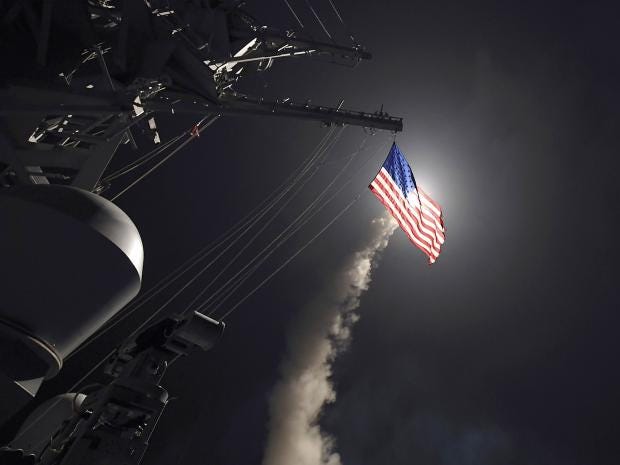
us-missiles-syria-2.jpg
(AP)

When it came to foreign policy, I was worried that the 2016 election would be a case of Clinton delivering the third Obama term. Instead, we have Trump giving us the third Clinton term.

President Donald Trump has now done what candidate Donald Trump committed not to do: He has launched a military strike against a foreign regime — a repulsive one, to be sure — in the absence of any threat, much less any attack, against the United States, in furtherance of no vital American interests.

Trump’s act of war is in violation of the Constitution, which requires congressional authorization for such an offensive use of military force, provoked by no aggression against our nation. Or, as someone once said:

What will we get for bombing Syria besides more debt and a possible long term conflict? Obama needs Congressional approval.

Mind you, that’s just one in a series of “Syria is NOT our problem” tweets in which Trump ripped Obama for not recognizing that “the so called ‘rebels’ may be just as bad (or worse)!”

The U.S. attack is an impulsive intervention in a civil war in which both sides — the Damascus/Tehran/Moscow alliance and its Sunni-jihadist/sharia-supremacist opposition — are hostile to the United States. It is a war in which Bashar al-Assad’s continuation in power, dismal as that prospect may be, is in no way the worst conceivable outcome for American national security.

Further, the missile strike offends sound policy: If the United States has not been attacked or threatened, congressional approval should be sought, not merely for legal purposes but also to ensure that complexities have been thought through and public support for a risky intervention has been won. Here, quite apart from the want of American legal footing, Trump lacks even the fig leaf of international legitimacy — there are none of those cryptic U.N. mandates that progressives prefer to our quaint Constitution.

Supporters of Trump’s aggression indignantly focus on Assad’s latest war crime, the barbaric use of chemical weapons — an apparent sarin-gas attack said to have killed 80 civilians. (It is necessary to qualify media reports of “civilian casualties” in the Syrian conflict, since Assad’s jihadist opposition is frequently referred to as “civilian.”)

I guess Obama’s gone, so we’re all in on “R2P” now. But, to repeat, Trump acted without congressional authorization; and as explained by Harvard’s Jack Goldsmith (a former Bush Defense and Justice Department official), in the absence of a cause rooted in self-defense or a Security Council resolution, there is no international-law justification for military attacks against another country — even one whose regime uses poisonous gases against its own people.

In any event, count me out of the virtue-preening that obsesses over the type of monstrous weapons employed when the issue is the monster using the weapons — of any kind. Both Assad and his opposition jihadists regularly commit atrocious war crimes targeting civilians. It is not beneath Assad, his enablers, or his enemies — al-Qaeda, ISIS, and their fellow militant Islamists, all of whom seek and would use weapons of mass destruction — to enter a village and firebomb or shoot up several dozen civilians (including women, children, and “beautiful babies”) with conventional arms. That is a commonplace, and it is horrifyingly typical of internecine Muslim conflicts, which are happening throughout the region.

The barbarism characteristic of Syria’s years-long civil war is not materially different because chemical weapons have been used, or because President Trump is now inflamed by the graphic images of death and destruction he has seen in government and media reports.

For those of us who have argued for years against Syrian intervention (see, e.g., hereherehere, and here), the situation has not changed. There is no American interest is deposing Assad if he would be replaced by (a) a Sunni sharia-supremacist regime that is more likely than Assad to make Syria a platform for jihadist attacks against our homeland and interests or (b) a Libyan-style failed state that has the same effect. To prevent that would entail a resource-intensive, open-ended commitment of U.S. forces for which the public has no appetite and the cost of which, in the absence of vital American interests, is prohibitive.

Moreover, the principal American enemy pulling Assad’s strings is Iran — now empowered by eight years of Obama’s appeasement and emboldened by an alliance with Putin. Until we have a strategy for both vanquishing the Sunni jihadists and choking the regime in Tehran (which supports the jihadists against us when it is not fighting them on behalf of Assad), attacking the Syrian regime is pointless.

In fact, it may be worse than pointless. Trump has been telling Americans for over a year that our myopic focus in Syria should be ISIS. He has been wrong about this (Iran aside, al-Qaeda has extended its influence while ISIS grabs the headlines); but at least it was a strategy based on the reality that ISIS, more than Assad, posed a significant threat to attack the U.S. and our allies. Accordingly, accommodations had been made with Russia — particularly in sharing air space — in order to promote U.S.-led coalition attacks against ISIS. Last night’s missile strike against the Syrian air base puts an end to those accommodations. Is the Assad attack worth it if it makes the ISIS campaign more difficult?

In response to such arguments, Trump’s supporters tout the “proportionality” of last night’s Tomahawk strike. Thus do progressive Republicans continue to join Democrats in distorting this military concept. Proportionality means that a use of force, and the collateral damage it is sure to entail, should be reasonably related to the military value of a lawful objective. It does not mean that an unauthorized, unprovoked attack is legitimate as long as it’s not too big.

An aggressive missile attack on another country is an act of war. If we were on the receiving end of it, we would not be very impressed by claims that it was “proportional.” Recall how Obama was skewered — from the left as well as the right — for making similar arguments about his unprovoked attacks on Libya. And what are we going to say when Putin cites last night’s strike as justification for his own unilateral but “proportional” attacks in Eastern Europe?

Perhaps mindful of these considerations, Trump officials are busily assuring everyone today that last night’s aggression was just a one-off. Indeed, Secretary of State Rex Tillerson provided the dizzying explanation that an attack on the Syrian regime did not signal any change in our policy of not attacking the Syrian regime, except to the extent that we were previously against pushing for regime change but now “steps are underway” to achieve regime change.

Got that?

And what is going to replace Assad? The administration will have to get back to us on that one.

If these signals mean what they appear to mean, last night’s attack will be a Clintonesque pin prick: Lob a few missiles, appear to act forcefully for U.S. public consumption, but achieve nothing while emboldening our enemies — convincing them that we are impulsive, unserious, and united on neither a commitment to fight nor an objective to be achieved. Meanwhile, we are unlikely to change Assad’s behavior — it is apt to get worse with the saber-rattling about regime change. And we will encourage more bad behavior from Russia, which means more bad behavior from Iran.

At least, that’s what Donald Trump used to say.

— Andrew C. McCarthy is a senior policy fellow at the National Review Institute and a contributing editor of National Review.

READ MORE: