Thursday, March 09, 2017

'IMMIGRANT PRIVILEGE' DRIVES CHILD RAPE EPIDEMIC


By Ann Coulter
http://www.anncoulter.com/
March 8, 2017

Image result for thom tillis immigration bill
Sen. Thom Tillis (left) with fellow N.C. Republican Sen. Richard Burr in 2015 (Carolyn Kaster/AP)

Read more here: http://www.charlotteobserver.com/opinion/op-ed/article126941659.html#storylink=cpy

Before breathing a sigh of relief that, unlike Western Europe, we don't have Muslim rapists pouring into our country, recall that we have Mexican rapists pouring into our country. 

Almost all peasant cultures are brimming with rapists, pederasts and child abusers. Latin America just happens to be the peasant culture closest to the United States, while the Muslims are closest to Europe. 

According to North Carolinians for Immigration Reform and Enforcement, immigrants commit hundreds of sex crimes against children in North Carolina every month -- 350 in the month of April 2014, 299 in May, and more than 400 in August and September. More than 90 percent of the perpetrators are Hispanic. 

They aren't even counting legal immigrants. Aren't those worse? Only certain Republicans get excited about the difference between legal and illegal immigrants. The rest of America is trying to understand the point of the last 40 years of legal immigration. Why was this necessary? 

Below is a very short excerpt from a few days in November 2013. As Stalin is supposed to have said, sometimes quantity has a quality all its own. 

-- Abundez, Jose, Juan (11/12/2013): Felony Sex Offense -- Parental Role 

-- Aguilar-Sandoval, Jersson, Iss (11/21/2013): Felony First Degree Sexual Offense; Felony First Degree Rape; Felony First Degree Kidnapping 

-- Aguilar, Rafael (11/04/2013): Felony Indecent Liberties With Child 

-- Aguilar, Rigoberto, Castellano (11/04/2013): Felony First Degree Rape; Felony Indecent Liberties With Child; Felony Stat Rape/Sex Offn Def>4-<6yr nbsp="" span="">

(Note: That's sex with a child between 4 and 6 years old.) 

-- Manzano, Gustavo, Adolfo (11/20/2013): Felony Indecent Liberties With Child; Felony Rape of Child 

-- Monje, Alcides, Aguilar (11/18/2013): Felony Stat Rape/Sex Offn Def >=6yr; Felony Indecent Liberties With Child, 13. 

The list, for a single month in a single state, goes on in the same vein through 87 separate offenders. When not providing North Carolina meatpackers with cheap labor, immigrant workers seem to spend all their time raping little girls.


To be fair, there are also Asian names, such as Y'Hon Nie (Indecent Liberties With Child, First Degree Sex Offense-Child, Second Degree Sexual Offense); and David Vo Minh (First Degree Sex Offense-Child, Indecent Liberties With Child). 

North Carolina's cheap labor advocates better be paying Sen. Thom Tillis well. It sure isn't the average North Carolinian demanding that he shill for amnesty. Illegal immigration alone costs North Carolina taxpayers billions of dollars per year. 

Our nation's epitaph, with a photo of Sen. Tillis, could be: "We built a powerful economic engine that attracted people, but then some businessmen saw their chance to screw the country and make a pile for themselves. Let's bring in low-wage workers so we can externalize our costs to the taxpayer!” 

Except North Carolina's businesses aren't just externalizing their costs to the taxpayers. They're externalizing their costs to little girls. 

The reason websites like North Carolinians for Immigration Reform and Enforcement are so important is that the government and the media hide immigrant crime from the public. 

They cite bogus studies that compare immigrants to America's criminal class. (We didn't want immigrants who are only slightly less criminal than our worst inner cities.) 

Or they announce their impressionistic conclusions. (I heard about a crime in Montana -- that state must have a lot of crime, is not a scientific way to argue.) 

Or they refuse to count any criminal without an ICE detainer against him as an immigrant, at all. (Is the court translator a hint that the defendant isn't a 10th-generation American?) 

The way to determine how many immigrants are committing crime is to count them. Why does the government refuse to do this? 

The number of immigrants in prison would be a good start, but that's only the tip of the iceberg. 

Immigrant criminals flee back to their own countries after arrest. Prosecutors deport illegals rather than imprison them -- and then the illegals come right back. Some George Soros-inspired prosecutors allow illegals to plea guilty to a minor offense, to prevent them from being deported. 

To get the full picture, government investigators will need to talk to crime victims, police and prosecutors, too. 

And we want honesty -- not studies that count anchor babies and second-generation immigrants as "the native population.” 

The media is the government's co-conspirator in hiding immigrant crime. I have approximately 1,000 examples of media subterfuges on immigrant crime in Adios, America! The Left's Plan to Turn Our Country Into a Third World Hellhole

Here are a few recent examples from Sen. Tillis' North Carolina. 

Headline: "Burke County man convicted of raping 13-year-old girl," Charlotte Observer, Feb. 1, 2017 (Ricardo Solis Garcia -- an illegal whom Mexico refused to take back); 

Headline: "Burlington man charged with child rape," The Times News, Jan. 19, 2017 (Felipe Samuel Rivera Rodriguez); 

Headline: "Angier man accused of having sex with 14-year-old girl," The Fayetteville Observer, Aug. 29, 2016 (Estevan Roberto Silva). 

NOTE TO READERS: The North Carolina Estevan Roberto Silva -- sex with a 14-year-old girl -- should not be confused with the Texas Esteban Villa Silva -- sex with a 12-year-old girl about 60 times -- or the Alabama Esteban Silva Jr. -- 42-year-old man convicted of sex with a 12-year-old girl. All these child rapes were revealed in coded headlines like "Man pleads to sexual relationship with girl.” 

Other informative North Carolina headlines: 

Headline: "Man, 42, arrested for sexual offense with girl under 13" (Carlos Gumercindo Crus); 

Headline: "Man charged with sexual assault of a minor" (Jose Freddy Ambrosio-Gorgonio); 

Headline: Man Pleads Guilty in Child Rape Case (Luis Perez-Valencia). 

It's too relentless to be a coincidence. 

There have been more stories in the American media about a rape by white lacrosse players that didn't happen than about thousands of child rapes in North Carolina that did. 

I'm pretty sure our media is opposed to rape. But evidently, not as opposed as they are to America. 

COPYRIGHT 2017 ANN COULTER 

Wednesday, March 08, 2017

Today's Tune: Chris Knight - House and 90 acres (Acoustic)

American Elements - Chris Knight Teaser

WikiLeaks' CIA Download Confirms Everybody's Tapped, Including Trump


March 7, 2017

Image result for cia

Remember the old joke about the definition of a paranoid -- someone who knows all the facts?

Well, we're all paranoids now because -- since Tuesday's, unprecedented in size and scope, Wikileaks document dump of massive cyber spying by the CIA -- everything we ever thought in our wildest imaginations is true... and then some.

To channel the late Preston Sturges, privacy is not only dead, it's decomposed.  The CIA's Remote Devices Branch, known as UMBRAGE, is capable of -- or is -- watching you everywhere you go, even when you think they're not or such surveillance would seem impossible.

The question about whether President Trump was tapped has been reduced to a joke.  The real questions are how often and from how many places.  The answer would probably shock us, if we were ever to learn the truth.  (And did President Obama know what they were doing?  Either that or the CIA, FBI or NSA wasn't telling him. You decide.)

The Wikileaks documents (everyone believes their downloads now) show how the CIA, via their eerily named "Weeping Angel" program, has devised a method of listening to us through our smart TVs.  Even when we think they're off, they are able to keep them on -- and recording -- through a "fake-off" program.

Just how many smart TVs does Donald Trump -- a known television addict -- watch in a day?  Who is he talking to at the time?  A foreign leader perhaps?  And what is he saying in supposed confidence?

These days it's hard to buy a television that isn't a smart TV.  The Wikileaks documents show only the popular Samsung has been hacked, but since the agency assiduously hacks both Apple and Android cellphones, one can assume all major brands are covered.  (They're not stupid.  We are.)

And that's far from their only way of listening in.  Tyler Durden -- considerably more tech savvy than I -- expresses the amazement of that community that the CIA was able to bypass the purportedly powerful cellphone data security apps (Signal, Telegram) so many business executives, politicians and journalists rely upon, even to using our own anti-virus programs (McAfee, etc.) to spy on us.  They also, apparently, can control our cars through the latest automobile computers.  (NOTE TO SELF: Skip the Apple CarPlay upgrade.)

Further, Durden quotes Twitter star Kimdotcom's instant observation that the DNC/Russian hacking connection is also now a joke (at least highly suspect) since the CIA also has a program, via UMBRAGE again, to imitate Russian hacking techniques and leave the Russkies' "fingerprints"  on their own handiwork. Could the CIA have hacked the DNC and then blamed it on the Russians for some purpose?  It seems unlikely, but anything's possible in this crazy and increasingly bizarre and alienating world.  If it is true, don't look now, but our country just exploded.

Our hope, for now, is in the congressional investigations, but it's hard to have much confidence in them.  The media, of course, is ludicrous.  They have clearly become the witting/unwitting lackeys of all manner of leakers from any number of intelligence agencies. It's become dizzying as the internal contradictions mount up daily.  (Who told you there was a FISA order again? Oh, wait...)  The New York Times and the Washington Post, among others, have reached self-parody in their cock-eyed denials of what they asserted only weeks ago, while the CIA grows progressively more partisan and ominously totalitarian in its values and methods.

Pretty soon every citizen is going to need a SCIF (Sensitive Compartmentalized Information Facility) of his or her own.

Whatever the case, we all have to do some serious thinking -- way beyond the general superficiality and contrived drama of congressional hearings or indeed the quick in-and-out of an op-ed.  What is being revealed here is a sea change in the human condition that is almost evolutionary in its implications. What are our lives like without the presumption of privacy?  What kind of creatures will we become in this brave new world that appears already to have arrived?   It's not fun to contemplate. Even the medieval peasantry had moments of escape from their feudal lords.

While initially critical of the Snowdens, Assanges or, for that matter,  the mystery man behind this latest literally Earth-shattering dump, I now have somewhere between mixed and positive feelings towards them. (Well, maybe not Snowden.) With all the problems we have, having visited the Soviet Union, the Russian Republic and Communist China (when they were still in Mao suits), I know those countries are mostly little more than giant prisons and we are still (again for now) the good guys.  Nevertheless, I am increasingly concerned we are creating our own "digital prison" that will make Darkness at Noon seem like child's play.  At least in Arthur Koestler's novel of the Stalinist purge trials the inmates could communicate by tapping on the walls.  What do we do?

Roger L. Simon is an award-winning novelist, Academy Award-nominated screenwriter and co-founder of PJ Media.  His latest book is I Know Best:  How Moral Narcissism Is Destroying Our Republic, If  It Hasn't Already. You can find him on Twitter @rogerlsimon. 

Tuesday, March 07, 2017

If We Are Not Just Animals, What Are We?


By Roger Scruton
https://www.nytimes.com/
March 6, 2017

Image result for human beings eye contact
Caravaggio's 'The Fortune Teller' (1595)

Philosophers and theologians in the Christian tradition have regarded human beings as distinguished from the other animals by the presence within them of a divine spark. This inner source of illumination, the soul, can never be grasped from outside, and is in some way detached from the natural order, maybe taking wing for some supernatural place when the body collapses and dies.

Recent advances in genetics, neuroscience and evolutionary psychology have all but killed off that idea. But they have raised the question of what to put in its place. For quite clearly, although we are animals, bound in the web of causality that joins us to the zoosphere, we are not just animals.

There is something in the human condition that suggests the need for special treatment. Almost all people believe that it is a crime to kill an innocent human, but not to kill an innocent tapeworm. And almost all people regard tapeworms as incapable of innocence in any case — not because they are always guilty, but because the distinction between innocent and guilty does not apply to them. They are the wrong kind of thing.

We, however, are the right kind of thing. So what kind is that? Do any other beings, animal or otherwise, belong to it? And what follows? These questions lie at the center of philosophical inquiry today, as they have since the ancient Greeks. In a thousand ways we distinguish people from the rest of nature, and build our life accordingly. We believe that people have rights, that they are sovereign over their lives, and that those who live by enslaving or abusing others are denying their own humanity. Surely there is a foundation for those beliefs, just as there is a foundation for all the moral, legal, artistic and spiritual traditions that take the distinctiveness of human life as their starting point.

If, as many people believe, there is a God, and that God made us in his own image, then of course we are distinct from nature, just as He is. But talk of God’s image is a metaphor for the very fact that we need to explain, namely that we treat the human being as a thing apart, a thing protected by a sacred aura — in short, not a thing at all, but a person.

Much 20th-century philosophy is addressed to the question of how to define this fact in secular terms, without drawing on religious ideas. When Sartre and Merleau-Ponty write of “le regard” — the look — and Emmanuel Levinas of the face, they are describing the way in which human beings stand out from their surroundings and address one another with absolute demands of which no mere thing could be an object. Wittgenstein makes a similar point by describing the face as the soul of the body, as does Elizabeth Anscombe in describing the mark of intentional action as the applicability of a certain sense of the question “Why?”

Human beings live in mutual accountability, each answerable to the other and each the object of judgment. The eyes of others address us with an unavoidable question, the question “why?” On this fact is built the edifice of rights and duties. And this, in the end, is what our freedom consists in — the responsibility to account for what we do.

Evolutionary psychologists tell another story. Morality, they argue, is an adaptation. If organisms compete for resources, then a strategy of cooperation will be more successful in the long run than a strategy of pure selfishness. Hence cooperative features of an organism will be selected over time. And all that is special in the human condition can be understood in this way — as the outcome of a long process of adaptation that has conferred on us the insuperable advantage of morality, whereby we can resolve our conflicts without fighting and adjust to the demands that assail us from every side.

The astonishing moral equipment of the human being — including rights and duties, personal obligations, justice, resentment, judgment, forgiveness — is the deposit left by millenniums of conflict. Morality is like a field of flowers beneath which the corpses are piled in a thousand layers. It is an evolved mechanism whereby the human organism proceeds through life sustained on every side by bonds of mutual interest.

I am fairly confident that the picture painted by the evolutionary psychologists is true. But I am also confident that it is not the whole truth, and that it leaves out of account precisely the most important thing, which is the human subject. We human beings do not see one another as animals see one another, as fellow members of a species. We relate to one another not as objects but as subjects, as creatures who address one another “I” to “you” — a point made central to the human condition by Martin Buber, in his celebrated mystical meditation “I and Thou.”

We understand ourselves in the first person, and because of this we address our remarks, actions and emotions not to the bodies of other people but to the words and looks that originate on the subjective horizon where they alone can stand.

This mysterious fact is reflected at every level in our language, and is at the root of many paradoxes. When I talk about myself in the first person, I utter propositions that I assert on no basis and about which, in a vast number of cases, I cannot be wrong. But I can be wholly mistaken about this human being who is doing the speaking. So how can I be sure that I am talking about that very human being? How do I know, for example, that I am Roger Scruton and not David Cameron suffering from delusions of grandeur?

To cut the story short: By speaking in the first person we can make statements about ourselves, answer questions, and engage in reasoning and advice in ways that bypass all the normal methods of discovery. As a result, we can participate in dialogues founded on the assurance that, when you and I both speak sincerely, what we say is trustworthy: We are “speaking our minds.” This is the heart of the I-You encounter.

Hence as persons we inhabit a life-world that is not reducible to the world of nature, any more than the life in a painting is reducible to the lines and pigments from which it is composed. If that is true, then there is something left for philosophy to do, by way of making sense of the human condition. Philosophy has the task of describing the world in which we live — not the world as science describes it, but the world as it is represented in our mutual dealings, a world organized by language, in which we meet one another I to I.

Review: “The Americans” Delivers Timely Story In Season 5


John Hanlon
https://townhall.com/
March 7, 2017

Image result for the americans season 5

The Americans feels timelier than ever, a great surprise considering that the show is set more than thirty years ago. The FX drama, which airs its fifth season premiere tonight, focuses on a couple from the Soviet Union — brought together through marriage — who spy on the United States in the early 80s.

With the news that Russia reportedly attempted to influence the election of 2016, it feels oddly discomforting to watch a fictionalized story about Russian spies but the show’s well-written characters and plot story will keep audiences enthralled.

Matthew Rhys and Keri Russell star as Philip and Elizabeth Jennings, the parents of two naïve teenagers. The couple attempted to bring their daughter Paige (Holly Taylor) into the business last season but their attempts to sugarcoat their horrific behavior have been in vain. Ever the idealist, she continues to question her parents’ immoral choices.

Paige, who struggles with her parents’ behavior, has also started seeing Matthew Beeman (Danny Flaherty), the son of neighbor Stan (Noah Emmerich) who happens to be an FBI agent on the lookout for KGB spies.

Paige’s role on the show has increased in recent seasons and the program has brought a renewed freshness to its premise by forcing this innocent teen into their messy world.

In the early episodes of the fifth season (which were made available for review), the show introduces some intriguing new characters and stories. The Jennings — posing as an American couple with an adopted Vietnamese son — have befriended a Russian family that has defected to the United States. The father of the Russian family spends much of his time criticizing the Soviet Union, setting up an uncomfortable situation for the Jennings.

The couple is forced to hear about their former homeland and the food and housing shortages that are plaguing the nation. The Jennings are forced to reckon with the man’s stories despite their best attempts to deny the truth.

Even as they hear horror stories about their homeland, they sit and watch waiting for their inevitable strike.

Unlike the fourth season, which stumbled with a few unnecessary storylines, this fifth season showcases the dynamic strengths of this series. The characters have become more realized over the years and it’s exciting to watch them struggle with their teenage daughter’s rebellious behavior. An additional plot about a conspiracy in the American agricultural department adds a new twist to the story.

Emmerich, too, is given a rich storyline here as he questions the FBI’s handling of Oleg (Costa Ronin), a Russian who aligned with the United States at the end of season four and prevented his nation from stealing a chemical weapon from the American military. When the CIA notes that it wants to use Oleg’s humanity to recruit him, Stan responds “I don’t know what kind of organization we are if we punish him for that.” Another particular highlight of the show is Stan’s budding friendship with Philip — a relationship that really showcases who these men are outside of their professions.

There are a lot of moral lines in The Americans and it’s clear that the showrunners are willing to delve into the messy side of the Cold War. For some, the show’s pacing might be slow but more accurately, it’s diligent. This is a program that has the patience to set up high stakes and major tension in order to tell its story.

With the cast delivering stellar performances and the plot getting deeper and more enticing with each new season, this FX drama continues to stand out as one of the best shows on television.


Looking for something to watch about true American patriots? Here’s our list of 10 movies that celebrate American patriots.

While You Weren’t Looking, the Democrat–Media Election-Hacking Narrative Just Collapsed


That supposed FBI investigation of collusion with the Russians? Never mind . . .

By Andrew C. McCarthy — March 6, 2017
Image result for trump fisa obama
They’re in retreat now. You may have missed it amid President Trump’s startling Saturday tweet storm, the recriminations over president-on-candidate spying, and the Jeff Sessions recusal — a whirlwind weekend. But while you weren’t looking, an elaborate narrative died.

For months, the media-Democrat complex has peddled a storyline that the Putin regime in Russia hacked the U.S. presidential election. There is, of course, no evidence that the election was hacked in the sense that the actual voting process was compromised. Rather, there is evidence that e-mail accounts of prominent Democrats were hacked months before the election, and thousands of those e-mails were published by WikiLeaks in the months leading up to the election.

Into this misleading “Russia hacked the election” narrative, the press and the Dems injected a second explosive allegation — or at least an explosive suspicion that they’ve wanted us to perceive as a credible allegation meriting a serious investigation. The suspicion/allegation is: Not only did Russia hack the election, but there are also enough ties between people in the Trump orbit and operatives of the Putin regime that there are grounds to believe that the Trump campaign was complicit in Russia’s hacking of the election.

Transparently, the aim is to undermine the legitimacy of Trump’s election victory.

Finally, the third prong, without the support of which the stool would collapse: the impression that the FBI has been feverishly investigating what is said to be the Trump campaign’s collusion in what is said to be the Russian hacking of the election. This reporting is designed to get you saying to yourself: “Why would there be such a zealous investigation by FBI agents — in addition to several other intelligence and law-enforcement agents — unless there really were grave reasons to believe the shocking election-hacking conspiracy narrative?”

Thus, details about investigative activity have been leaked to the media. The press and the Democrats then exploit the leaks to spin the “Trump complicity in Russian election-hacking” story. It seems not to matter how objectively ill-conceived the Russian election-hacking claim is, or how woefully insufficient the purported Trump–Russia ties are to support an inference of campaign collusion in the hacking. The specter of an investigation — breathless media reports of FISA-court applications, wiretaps, surveillance of agents of a foreign power, and mysterious servers; painstaking analysis of shady financial transactions involving Russian banks and funding streams — seems to make the outlandish conspiracy impossible to dismiss out of hand.

New York Times report perfectly illustrates the three-prong scheme. On January 19, under the alarming headline “Intercepted Russian Communications Part of Inquiry into Trump Associates,” the paper began its report as follows:
WASHINGTON — American law enforcement and intelligence agencies are examining intercepted communications and financial transactions as part of a broad investigation into possible links between Russian officials and associates of President-elect Donald J. Trump, including his former campaign chairman Paul Manafort, current and former senior American officials said. 
The continuing counterintelligence investigation means that Mr. Trump will take the oath of office on Friday with his associates under investigation and after the intelligence agencies concluded that the Russian government had worked to help elect him. As president, Mr. Trump will oversee those agencies and have the authority to redirect or stop at least some of these efforts.
Could what’s going on be more obvious? The Times would have you believe that the Russians “worked to help elect” Trump because the intelligence agencies have said so. With this ballyhooed conclusion as the premise, law-enforcement and intelligence agencies are conducting a “counterintelligence investigation” — meaning that there may be crimes involved, as well as activities of a foreign power in the United States — to determine the nature of links between Russian officials (who, remember, helped elect Trump) and Trump associates connected to the Trump campaign. The probe, we’re further told, is “broad” and includes “intercepted communications” — which, to any informed person, strongly suggests that the FBI went to a federal court and laid out probable cause of improprieties, which prompted one or more judges to authorize wiretaps and potentially other forms of electronic surveillance (e.g., e-mail intercepts).

Is there an innocent interpretation of all this? Of course there is. After all, the underlying allegation of an election-hacking conspiracy between the Putin regime and the Trump campaign is nonsense, so there must necessarily be an innocent interpretation. And, lo and behold, the Times itself provides it — further down in the story, after all the sensational conspiracy mongering:
It is not clear whether the intercepted communications had anything to do with Mr. Trump’s campaign, or Mr. Trump himself. It is also unclear whether the inquiry has anything to do with an investigation into the hacking of the Democratic National Committee’s computers and other attempts to disrupt the elections in November.
See? It is entirely possible that the FBI and other investigative agencies are not pursuing, and have never pursued, a Trump-campaign angle on the hacking. It is entirely possible (though I have doubts about this) that there are no FISA national-security wiretaps directed at Trump associates — maybe the “intercepted communications” touted by the Times came from surveillance targeting Russian operatives whom Trump associates, perhaps unwittingly, happened to run into while doing business that had nothing to do with the campaign. I think, based on all the reporting we’ve seen (some of which, as the Weekly Standard’s Steve Hayes observes, is thinly supported), it is more likely that the feds got FISA surveillance authorization for some associates of Trump (the names of Paul Manafort, Roger Stone, and Carter Page are mentioned). But maybe the probable cause for any such surveillance involved those associates’ own business dealings with Russia — having nothing to do with Trump or the Trump campaign.
But the innocent interpretation, the more likely interpretation, is not what the media and Democrats have wanted us to believe.

For months, they have titillated their audience with the election-hacking conspiracy fantasy. When they cover their behinds by mentioning the possibility of innocence, it is in the fine print.
But still, the media and Democrats have always had a serious vulnerability here — one they’ve never acknowledged because they’ve been too swept away by the political success of the fantasy narrative. It is this: At a certain point, if compelling evidence of collusion between the Trump campaign and Russia to steal the election did not materialize, the much more interesting question becomes “How did the government obtain all this information that has been leaked to the media to prop up the story?”

The most plausible answer to that question: The Obama administration, through the Justice Department and the FBI, was investigating the associates of the opposition party’s presidential nominee, and perhaps even the nominee himself, during the campaign. Otherwise, what explanation can there be for all of the investigative information — much of it classified, and thus illegal to disclose — that has been funneled to the press?

In short, the media and Democrats have been playing with fire for months. The use of law-enforcement and national-security assets to investigate one’s political opponents during a heated election campaign has always been a potentially explosive story. Let’s not kid ourselves: If the roles were reversed, and a Republican administration had investigated officials tied to the campaign of the Democrats’ nominee, we would be drowning in a sea of Watergate 2.0 coverage.

Well, this weekend, the potentially explosive story detonated. It happened in the now familiar way: jaw-dropping tweets by President Trump.

Given the abundance of indications that the Obama Justice Department scrutinized his campaign, or at least his associates, it was odd that the president chose to tweet the one allegation in the whole mess that appears insupportable — viz., that President Obama had had candidate Trump wiretapped. To my knowledge, no such suggestion has ever been publicly reported. At most, it has been reported (but not proved) that there was a FISA application in June that “named Trump” – but, as I’ve pointed out, saying someone was named in an application does not mean that person was targeted for eavesdropping. And, in any event, the reporting tells us that if there was such an application, the FISA court denied it. Thus, I know of no basis to believe that Trump himself was wiretapped; and if the president’s objective was to sensationalize the story, it would surely have been enough to tweet out a colorable fear that surveillance of him — as a Russian agent — had been proposed.

But was the overstatement slyly intentional? Was Trump trying to make a point?

Maybe not. It is certainly possible that the president was angry and the tweets result from a fit of pique. On the other hand, though, how much crazier is it for Trump to contend that Obama ordered spying on Trump than for the media and Democrats to have contended, for month upon month, that Trump’s campaign conspired with the Putin regime to steal the American presidential election and turn the Oval Office into occupied Kremlin territory?

It is probable that both allegations are ludicrous. There is a good case, though, that there’s more support for the former than the latter.

Here’s the most interesting part: Now that they’ve been called on it, the media and Democrats are gradually retreating from the investigation they’ve been touting for months as the glue for their conspiracy theory. It’s actually quite amusing to watch: How dare you suggest President Obama would ever order surveillance! Who said anything about FISA orders? What evidence do you lunatic conservatives have — uh, other than what we media professionals been reporting — that there was any investigation of the Trump campaign?

You will hear more righteous indignation in the coming days, no doubt. The first brushback pitches came this weekend: the claim that if President Trump dares to demand that the FBI and Justice Department show him the supposed FISA applications, he will be engaged in unprecedented political interference in the independence of law enforcement. It’s a silly assertion; as I explained over the weekend, FISA surveillance is not law enforcement, it is national security. A chief executive who demanded to review FISA information (obtained by exercise of the executive’s power) would be doing his main job — to protect the country — not interfering in a judicial proceeding.

But have you noticed? While all this head-spinning legal jibber-jabber goes back and forth, the foundation of the false narrative we’ve been hearing since November 8 has vanished. Now that we’re supposed to believe there was no real investigation of Trump and his campaign, what else can we conclude but that there was no real evidence of collusion between the campaign and Russia . . . which makes sense, since Russia did not actually hack the election, so the purported objective of the collusion never existed.

Trick or tweet?

— Andrew C. McCarthy is a senior policy fellow at the National Review Institute and a contributing editor of National Review.

Monday, March 06, 2017

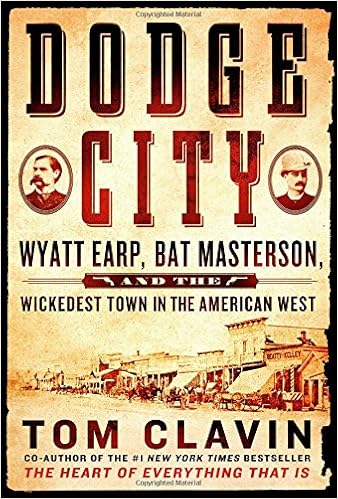
Book Review: 'Dodge City' by Tom Clavin

How two badass sheriffs tamed the most dangerous town in the Wild West


February 26, 2017

Image result for tom clavin dodge city

Any man fool enough to look for trouble in 1870s Dodge City could count on two things: finding it, and finding himself knocked over the head by the butt of a gun. And if he was especially unlucky or stupid, he could find a third thing: himself full of lead.
The infamous Kansas cow town had bloody beginnings, and violence, or the threat of it, was rarely far away. It started with buffalo. The seemingly endless herds on the nearby plains, coupled with demand for skins and tongues (considered a delicacy back East), birthed a buffalo hunting industry. And that industry, in turn, created a leathery class of buffalo hunters — skilled marksmen who could shoot from the saddle, subsist in harsh conditions and not shy from the sight of blood.
Out of these hunters’ ranks came two of the most fabled lawmen of the American West: Wyatt Earp and Bat Masterson, whose fascinating careers are brought to life in Tom Clavin’s “Dodge City: Wyatt Earp, Bat Masterson, and the Wickedest Town in the American West.
In the decades after the Civil War, Dodge City stood at the edge of the West, a boomtown at the intersection of buffalo hunting and cattle driving that boasted saloons, gambling halls and brothels to entertain men lonely from weeks in the wilderness. A colorful cast of characters swaggered through town, with names like The Stuttering Kid, Shoot ’Em Up Mike, Light Fingered Jack (not to be confused with Shoot His Eye Out Jack) and Stink Finger Jim. Poor Jim.
A town like Dodge City danced a delicate do-si-do between keeping these cowboys in line — i.e., not letting them break and shoot everything in sight — and being a hospitable place to blow off steam. After all, the city filled its coffers by catering to carousing cowpokes, and it couldn’t afford to drive the drovers out of Dodge.
Enter professional law enforcement to referee these paying rowdies.
In 1872, Bill “Bully” Brooks became the first peace officer in Dodge, and he was by all accounts bad at his job. Brooks’ approach to policing was marked by a trigger finger so itchy, he’d shot over a dozen people in his first month. Brooks was also something of a coward — perhaps any person so besotted with needless gunplay is — and few were sad when he got the hell out of Dodge.
When Earp and Masterson were eventually installed a few years later, things changed. Earp was appointed deputy marshal in the spring of 1876, and the then-28-year-old set about putting together a force to help him keep Dodge City in line. Among the half-dozen officers Earp brought onto the Dodge City force, his most important hire was his former buffalo-hunting companion, Masterson.
This unlikely pair couldn’t have been more different. Earp was a taciturn teetotaler who carried himself with a steely sureness of self, the very model of a no-BS cop. Masterson, though also tough, was a beloved raconteur, and no stranger to drink or the gaming table. Along with several other noted lawmen like Bill Tilghman and Bat’s brothers Sam and Jim, they brought a rickety order to a place that had none.
Unusual for a lawman of his time and place, Earp established guidelines for his deputies that discouraged deadly force. Officers were to avoid violence and first try to reason with wrongdoers; after all, when men were talking, they were not shooting. If a lawman did have to use his gun, he was to wound and not kill — all the better to avoid retaliation and an escalation of violence.
But Gandhis they weren’t.
These former buffalo hunters were expert practitioners of a technique known as “buffaloing”: incapacitating miscreants by knocking their heads with their pistol butts. “Buffaloed” men may have woken up with goose eggs on their noggins, and they may have found themselves in the “calabaloose” (Dodge City’s jail), but it was better than not waking up at all.
The most effective tool in their arsenals, however, may have been their reputations. As word of Dodge City’s law officers spread, it gave pause to anyone considering mischief. Having a close encounter with Wyatt Earp would put an end to anyone’s fun, so why start something?
As a result of their policing, over the next three years, gun violence in Dodge City fell, and arrests rose to somewhere in the neighborhood of 300 a month. The lawmen were able to implement a new law banning horses and other animals from saloons. And they enforced the “Dead Line,” an east/west division in town. North of the Dead Line, respectable businesses, merchants and residents could work and live in peace; south of the Dead Line, anything went. And did it ever. That Dodge City did not fall into utter bedlam, or burn to the ground, is a testament to the lawmen’s success.
Over the next few years, Earp and Masterson periodically would leave and return to lawing in Dodge City, seeking their fortunes as gamblers and saloon owners themselves. This was especially true during the quiet winter months, while the summer cattle-drive period was high season for corralling crooks.
After his heyday in Dodge, Earp went on to greater renown as one of the chief combatants in the Gunfight at the O.K. Corral in Tombstone, Arizona Territory, in 1881. Though it burnished his fame as a gunslinger, the aftermath of the O.K. Corral was hard on him; violent reprisals killed his brother Morgan and crippled his brother Virgil, and the whole affair sapped the veteran lawman’s spirit.
Masterson, too, left Dodge City for other adventures. In the years following, he worked as a gambler, a casino dealer, a boxing promoter and, yes, a law officer.
The two would reunite briefly in Dodge City in 1883, to help a friend in a potentially violent political conflict there, the so-called “Dodge City War.” (The “war” was so called by the press, eager for a bleeding headline; in the end, no blood was shed.)
Masterson later moved east at the urging of another old buffalo-hunting friend: Teddy Roosevelt.
He spent his autumn years as a Broadway bon vivant, serving as sports editor and columnist for The Morning Telegraph, a New York City broadsheet. He made such an impression on a young Damon Runyon that Runyon named one of his “Guys and Dolls” characters Sky Masterson in Bat’s honor.
Earp bounced around the West, and his attempts to strike it big in mining, gambling and other businesses failed. He lived to his 80s, and after he died in Los Angeles, his legend as a gunslinger grew. His story has been told time and again in movies and TV, usually more fiction than fact.
Earp, Masterson and their compatriots didn’t “clean up” Dodge City so much as make the town safe enough for the cattle trade and the “sinful” businesses that operated there. Amazingly, at a time when there wasn’t much of it, Earp and Masterson kept the peace — even if that meant cracking a few skulls.

OBAMA’S WIRETAPS?


Details of a Watergate-style conspiracy against Trump emerge.


March 6, 2017

Image result for obama trump wiretap

President Donald Trump caused a media firestorm by claiming over the weekend that then-President Obama wire-tapped telephones at Trump Tower in Manhattan during the final leg of last year's election campaign.
Seeing the writing on the wall, tainted FBI Director James Comey promptly and publicly urged the Department of Justice to reject Trump’s claims. Although it is an attempt at a cover-up, it is an admirably transparent one.
Now the outlines of a Watergate-like conspiracy are emerging in which a sitting Democrat president apparently used the apparatus of the state to spy on a Republican presidential candidate. Watergate differed in that President Nixon didn’t get involved in the plot against the Democratic National Committee until later as an accomplice after the fact. Here Obama likely masterminded, or oversaw someone like the diabolical Benghazi cover-up artist Ben Rhodes, masterminding the whole thing.
Throughout his agonizingly long presidency, Obama serially abused his powers as the nation’s Chief Executive to undermine his political opponents. It might be said that every day of his presidency he committed at least one impeachable offense.
Obama used the IRS to target conservative and Tea Party nonprofits, along with Catholic, Jewish, and pro-Israel organizations. He brazenly lied about it, too. His Justice Department surreptitiously obtained telephone records for more than 100 reporters. He did nothing while Health and Human Services Secretary Kathleen Sebelius repeatedly violated the Hatch Act, an anti-corruption statute.
This is hardly an exhaustive list of Obama’s misdeeds in office. Books have been written about his corruption and many more such volumes will follow.
First thing Saturday morning, Trump tweeted, “Terrible! Just found out that Obama had my ‘wires tapped’ in Trump Tower just before the victory. Nothing found. This is McCarthyism!”
He followed that with “Is it legal for a sitting President to be ‘wire tapping’ a race for president prior to an election? Turned down by court earlier. A NEW LOW!”
That was followed by, “I'd bet a good lawyer could make a great case out of the fact that President Obama was tapping my phones in October, just prior to Election!” and “How low has President Obama gone to tapp [sic] my phones during the very sacred election process. This is Nixon/Watergate. Bad (or sick) guy!”
A spokesman for Obama, who now lives in former Bill Clinton press secretary Joe Lockhart’s walled mansion with Valerie Jarrett on Washington’s Embassy Row so he can pursue his unprecedented, taxpayer-subsidized post-presidential war against Trump, denied Obama ordered that Trump Tower be wiretapped.
“A cardinal rule of the Obama administration was that no White House official ever interfered with any independent investigation led by the Department of Justice,” according to a carefully-worded statement. “As part of that practice, neither President Obama nor any White House official ever ordered surveillance on any U.S. citizen. Any suggestion otherwise is simply false.”
Of course, as others quickly pointed out, the denial is misdirection.
Former federal prosecutor Andrew C. McCarthy wrote yesterday that the denial “seems disingenuous on several levels.” When a warrant is obtained under the Foreign Intelligence Surveillance Act (FISA), “it is technically the FISA court that ‘orders’ surveillance.” Moreover, under the law, “it is the Justice Department, not the White House, that represents the government in proceedings before the FISA court.”
McCarthy wrote presciently on Jan. 11 that “[t]he idea that FISA could be used against political enemies always seemed far-fetched. Now it might not be.”
Besides, Obama and his gang have generally been smart enough to hide their tracks when carrying out political dirty tricks. The Departments of Justice and Homeland Security, FBI, CIA, and NSA, aren’t headquartered in the White House. Obama could wage war against Trump by creating multiple layers of plausible deniability. That’s what a community organizer from Chicago does.
Predictably, former Obama speechwriter Rhodes went on Twitter to lie. Replying to a Trump tweet, the Iranian mullahs’ best friend wrote, cheekily, that, “No President can order a wiretap. Those restrictions were put in place to protect citizens from people like you.”
In fact, as Zero Hedge notes, Chapter 36 of Title 50 of the US Code, War and National Defense, Subchapter 1, Section 1802, states that under certain specific conditions:
Notwithstanding any other law, the President, through the Attorney General, may authorize electronic surveillance without a court order under this subchapter to acquire foreign intelligence information for periods of up to one year …
To no one’s surprise, the mainstream media was quick to slap down the president’s claim without even investigating, claiming Trump was recklessly microblogging without evidence. Perhaps the loudest media figure was the Trump Derangement Syndrome sufferer, Wall Street Journal columnist Bret Stephens, who was effectively a Hillary Clinton surrogate during the campaign. He said he wanted Trump to be “so decisively rebuked that the Republican Party, the Republican voters will forever learn their lesson that they cannot nominate a man so manifestly unqualified to be president in any way, shape or form.”In response to Trump’s claim, the increasingly wacky Stephens tweeted Saturday, “When will Republicans acknowledge that the President of the United States is mentally ill?”
Most mainstream journalists were loath over the past eight years to call the exhaustively documented and at times bald-faced lies and misdeeds of President Obama, Vice President Joe Biden, Secretaries of State Hillary Clinton and John Kerry, National Security Advisor Susan Rice, Attorneys General Eric Holder and Loretta Lynch, and HHS Secretary Sebelius. It would seem uncovering government corruption is only a journalist’s duty when a Democrat resides at 1600 Pennsylvania Avenue.
While it may be true that Trump offered little supporting evidence on Twitter – he provided some evidence by tweeting that an earlier request for surveillance was turned down by a court – it does not follow, nor is it true, that there is no evidence of his claim.
In reality the evidence does exist that Obama spied on Trump and it is "overwhelming," according to talk show host and Landmark Legal Foundation president Mark Levin. He explained on "Fox and Friends" Sunday that evidence of secret court-approved eavesdropping of Trump Tower had already been reported months ago by the New York Times, McClatchy media outlets, Heat Street, and the U.K.-based Guardian newspaper.
Levin said:
Donald Trump is the victim. His campaign is the victim. His transition team is the victim. His surrogates are the victim. These are police state tactics. I am telling you this as a former chief of staff to an attorney general. If this had been done to Barack Obama all hell would break loose, and it should.
Let’s recount what former British Member of Parliament Louise Mensch reported at Heat Street on Nov. 7, the day before the U.S. election.
Two separate sources with links to the counter-intelligence community have confirmed to Heat Street that the FBI sought, and was granted, a FISA court warrant in October, giving counter-intelligence permission to examine the activities of ‘U.S. persons’ in Donald Trump’s campaign with ties to Russia.
Contrary to earlier reporting in the New York Times, which cited FBI sources as saying that the agency did not believe that the private server in Donald Trump’s Trump Tower which was connected to a Russian bank had any nefarious purpose, the FBI’s counter-intelligence arm, sources say, re-drew an earlier FISA court request around possible financial and banking offenses related to the server. The first request, which, sources say, named Trump, was denied back in June, but the second was drawn more narrowly and was granted in October after evidence was presented of a server, possibly related to the Trump campaign, and its alleged links to two banks; SVB Bank and Russia’s Alfa Bank. While the Times story speaks of metadata, sources suggest that a FISA warrant was granted to look at the full content of emails and other related documents that may concern US persons.
The FBI agents who talked to the New York Times, and rubbished the ground-breaking stories of Slate (Franklin Foer) and Mother Jones (David Corn) may not have known about the FISA warrant, sources say, because the counter-intelligence and criminal sides of the FBI often work independently of each other employing the principle of ‘compartmentalization’.
Both of the FISA court applications should be made public and Congress should be given the daily intelligence briefings over the last year or so, Levin said.
We already knew that days before Trump’s inauguration, it was reported that Obama green-lighted a disturbing relaxation of the rules regulating the National Security Agency’s ability to circulate globally intercepted personal communications among the other 16 intelligence agencies, some of which are more politicized than the NSA, before applying important longstanding privacy-protection protocols. Before the policy was altered, the NSA screened out the identities of innocent people and irrelevant personal information before passing intercepted communications along to other agencies like the CIA or the FBI’s intelligence units.
Put another way, 17 days before President Trump was sworn in, NSA was unleashed against his embryonic administration, newly empowered to share raw intelligence gathered from telephone calls and emails that go through network switches outside the country, as well as messages between people outside the U.S. that go through domestic network switches.
WikiLeaks offered a refresher course in Obama’s treachery on Twitter Sunday, noting that “Obama has a history of tapping & hacking his friends and rivals[,]” and providing plenty of examples.
The newly discovered Trump Tower scandal further undermines the Left’s false narrative painting Trump as fascistic. After all, Obama, not Trump, was the great, power-mad centralizer using heavy-handed tactics and the vast resources of the federal Leviathan against his enemies, including Trump.
As hardcore Never Trumper David French has been forced to admit, Trump is “less authoritarian than Obama.”
Trump’s administration, “through policy or personnel, appears to be signaling that the executive branch intends to become less intrusive in American life and more accountable to internal and external critique.”
And despite the growing mass media hysteria, there is still no publicly available evidence the Trump campaign somehow colluded with the Russian government last year. Sources in newspaper articles are never identified. There is not a scintilla of proof of improper conduct. All we have is the alleged say-so of faceless CIA spooks whose motives are questionable, to put it charitably.
As more evidence surfaces of Obama’s under-handed surveillance of Trump, it should become crystal clear who the real authoritarian is.
Matthew Vadum, senior vice president at the investigative think tank Capital Research Center, is an award-winning investigative reporter and author of the book, "Subversion Inc.: How Obama’s ACORN Red Shirts Are Still Terrorizing and Ripping Off American Taxpayers."