Thursday, April 07, 2016

A Look Inside Britain's Muslim Sex Grooming Gang Scandal


April 6, 2016
For the past few decades, British authorities have been caught up in the pervasive meme of multiculturalism -- the falsehood that all cultures are equal and that to believe otherwise is to commit the worst modern day offense -- to be “racist.”
Under this fallacy, the British government in 2001 introduced a series of restrictive speech codes that criminalized criticism of Islam, followed by a Racial and Religious Hatred Bill imposing fines and even imprisonment for speech that “incited hatred against a person for their religious or racial background.”  
These laws have victimized a number of Britons. Hoteliers Ben and Sharon Vogelenzang were prosecuted for “insulting” a Muslim guest. Liberty Great Britain party chairman Paul Weston was arrested on suspicion of racial harassment after publicly reading a passage critical of Muslims from Winston Churchill’s The River War. Dr. Vladislav Rogozov, a Czech-born, UK cardiac anesthesiologist, is being investigated by Sheffield's Royal Hallamshire Hospital for giving an online interview about his 2013 confrontation with a Muslim surgeon who refused to replace her blood-specked hijab with the proscribed, operating-theater headgear.
In this context and political climate, with racism conflated with religion – one specific religion – it is easy to see how government and public service employees would fear professional and legal repercussions (up to seven years in prison) merely for speaking up about criminal behavior by Muslims who justify their actions citing the Koran. In this way, teachers, police, child care workers, government officials and others have been silent about the growing menace of Muslim gangs who sexually groom and exploit children in the UK.
In his riveting book, Easy Meat: Inside Britain’s Grooming Gang Scandal(World Encounter Institute/New English Review Press, 2016. 328 pp., $17.20) author Peter McLoughlin explains how multiculturalism-inspired political correctness along with its companion, willful blindness concerning Islamic doctrine, has jeopardized the safety and well-being of children. McLoughlin posits that, since 1988, this nationwide sexploitation has resulted in the shattering of lives of between 100,000 to 1 million girls. The author documents how the fear of being deemed racist and facing criminal charges, dismissal or even threats of violence, has led to suppression of information and a stunning lack of intervention on behalf of young victims. In essence, an extensive, insidious operation that targets children for sexual grooming and enslavement has been covered up because of political correctness and fear of Muslim retribution.
The book’s title comes from former UK Home Secretary, Jack Straw, who saw Muslim perpetrators viewing non-Muslim British victims as “easy meat.” Indeed, some Muslim sex-gang groomers actually blame the girls, some as young as 11 years old, for being purposely alluring and sexually advanced to corrupt Muslims
In his research on Muslim groomers, McLoughlin uncovered an unusual distinction between them and non-Muslim pedophiles. Non-Muslim pedophiles are typically lone adults who groom children for sex in reclusive secrecy, worry about being prosecuted by law enforcement, meet accusations with defensive denial and worry about being discovered, shamed, and criticized by friends or relatives. Muslim perpetrators, however, work in gangs, see nothing wrong with their shariah-sanctioned activities, receive collusive support from their communities and feel they are above the law. During his investigations, McLoughlin found not one case of non-Muslim men grooming Muslim girls, although 95% of men in Britain are non-Muslims.
News coverage of the crimes has been mostly obfuscated by a complicit media that characterizes the overwhelmingly Muslim perpetrators as generic “Asians.” According to McLoughlin’s research, limited press coverage by mainly self-censoring journalists and lenient, if any, criminal charges have enabled the gangs to act with relative impunity since 1988.
The author describes how Muslim flesh-peddlers operate as part of a well-organized extensive network of taxi drivers, shop and restaurant owners, and security guards. Girls, mainly between the ages of 11 and 14, the majority from state-run children’s homes, are ensnared while traveling from school to home, at shopping malls, restaurants, bus stations and similar public venues. They are enticed with flattery, feigned friendship, gifts, alcohol and drugs. Alarmingly, a footnote in the book references a quotation from a city outreach worker with the Children’s Society who states, “every girl living in a children’s home in the city of Birmingham is being sexually exploited.”
McLoughlin makes reference to the staggering profitability of the sex grooming enterprise for the Muslim community. He cites a 2007 expose, Mothers of Prevention by Julie Bindel, a feminist writer and founder of the legal reform group, Justice for Women.
Bindel estimated that a pimp can make $325,000 to $550,000 annually with one 16-year-old girl. From that, Bindel extrapolated that over the average 15-year-per-girl pimping period, the annual value of this criminal activity could amount to approximately £300 million or $425 million.
McLoughlin does a good job of portraying the frustration and desperation of victim’s families who have sought help to no avail for well over a decade from local councils, law enforcement, child care professionals and journalists. Remarkably, for the most part, UK authorities have failed to warn parents that young girls are at risk or to recommend extra supervision and vigilance. No organized programs to educate girls and parents exist and authorities have largely refused interviews with the media on the topic. Teachers and school administrators have failed to secure the school perimeter to stop sex grooming gangs from lying in wait for girls outside of school premises.
The author reports that police routinely dismiss parents’ concerns and have failed to set up surveillance operations at strategically significant locations. Police have even arrested parents for trying to save their children. In one such case, fathers, who were able to track down their daughters and tried to rescue them were arrested by police. In fact, McLoughlin discloses that law enforcement officers have actually returned wayward girls to their pimps.
McLoughlin reveals that local authorities – social workers, teachers’ unions, educational organizations and childcare agencies – have made no effort to intervene or draw public attention to the pervasive threat. He submits that feared charges of racism preclude their mandated responsibility for the protection of children. In fact, the author reports how major teachers' unions are behind an organization – Unite Against Fascism – that blocks the publicizing of the sex grooming gang phenomenon and its Muslim community participation.
In 2008, a taxpayer-funded national education film, My Dangerous Loverboy, commissioned by the United Kingdom Human Trafficking Centre, was produced ostensibly to warn and educate girls about generic sex grooming gangs. But no mention was made of Muslim involvement or the victims’ young ages. According to McLoughlin, the film has been difficult to obtain and has not been shown to the intended audience: girls, parents, social workers, police officers, school nurses, doctors, teachers, youth workers, sexual health practitioners. My own extensive, month-long efforts to locate a copy were unproductive and met with denials of the crimes’ Muslim connection.
In Easy Meat, McLoughlin laments the very limited prosecution of Muslim sex grooming and pimping crimes. In the rare instances of successful criminal litigation, typical sentences are minimal and usually partially served, if at all, despite existing sentencing guidelines. Gang members have been known to assert Muslim supremacy, make accusations of Muslim victimhood and racism, and threaten retaliation against the girls and their families. Some have clearly cited religious motivations for their crimes in court.
Astonishingly, few victims receive any special protection during the trials. Protection of defendants’ rights supersedes that of victims, even with child victims. The 1989 Children’s Act, a statute requiring the child’s welfare be the court’s paramount consideration, doesn’t seem to make the slightest difference in the proceedings and outcome. More distressing is the fact that the greater the Muslim population density in an area, the lower the conviction rate.
The backdrop for sexual grooming and enslavement of children lies in Islamic doctrines outlined by McLoughlin. He reviews the pervasive slave-taking history of Islam from the 7th century, as well as Islamic doctrine from the Koran citing Islam's view of non-Muslims, its treatment of women and sexual slaves, and the permissibility of sex with children by Mohammed’s example with his nine-year-old third wife, Aisha. McLoughlin explains how sex as rape has historically been used as a weapon of war to assert Islamic supremacy. Islamic doctrine encourages the rape and enslavement of non-Muslims, even with married infidel women as a legal and moral enterprise.
Further, the required first and foremost allegiance to the Umma, or Muslim community, and the inbred obligation of enmity toward non-Muslims facilitates the pimping of non-Muslim girls and hinders any attempts at exposing its criminality and eventual prosecution. Sexual slavery has historically been used as a religious weapon to advance the domination of Islam. 
In Easy Meat, McLoughlin details how the sexploitation and enslavement of girls, once viewed as a great evil in Western society, has become a pervasive, routine, and almost pedestrian part of everyday life in the UK. On this issue, the courageous author effectively deals with the contention that Western civilization is fighting for its very existence in a clash between civilization and barbarism. His book serves as a grave warning for other countries as they consider increased levels of Muslim immigration.

Wednesday, April 06, 2016

Bill Nye, Not the Philosophy Guy


April 6, 2016
Bill Nye: 5 Misunderstandings About Philosophy
Judging from a recent video in which Bill Nye, "the Science Guy," discussed the relation between science and philosophy, I can only tell you that he sure is not the "philosophy guy."
In a rambling and largely incoherent response to an interlocutor who wondered whether philosophy is still relevant, Nye denigrated the discipline, stating that philosophy never deviates from common sense, that it doubts the reality of sense experience, and that it engages in speculation about whether we might be part of an intergalactic ping pong match!
In regard to the first observation, I would say that, pretty much from Socrates on, philosophers have practically specialized in deviating from common sense. In regard to the second (which flatly contradicts his first assertion), I would say that some philosophers -- Descartes most famously -- speculated along these lines in order to perform a sort of epistemological experiment and certainly not to prove the non-existence of the physical world. In regard to the third, I can only say that this has more to do with someone on an LSD trip than any serious philosopher that I'm aware of.
I don't want to spend any more time engaging Nye's rather silly claims, but I do want to address an issue that undergirds everything he says and that is infecting the minds of many young people today, namely "scientism."
Not to put too fine a point on it, scientism is the reduction of all knowledge to the scientific form of knowledge. In other words, it is a strict identification of the rational with the deliverances of the scientific method developed in the late sixteenth century. That this method -- empirical observation, followed by hypothesis, followed by experimentation, followed by confirmation through repeated experimentation -- has indeed rendered abundant fruit is obvious to anyone. And that its accompanying technology has benefitted the world in countless ways is beyond dispute. But the very success of the sciences invites the distortion of scientism, an epistemological imperialism which consigns extra-scientific forms of rationality to the intellectual ash-heap. And what an impoverishment this produces!
At the very dawn of philosophy, Plato spoke to us of prisoners chained up inside a cave. All they can see are flickering shadows on the cave wall. One prisoner managed to free himself from the chains, escape from the cave, and find an upper world of light and substance. He realized that the shadows that he had spent his life watching were but simulacra of what is truly real. Finally, he gazed up to the sun, whose brilliant light made all things visible.
This splendid fable is the metaphorical representation of the process by which one moves from knowledge of the evanescent world of nature to knowledge of the more permanent things and finally to the source of all knowledge and being. Plato's disciple Aristotle presented the same idea in a more prosaic manner, speaking of the transition from physics (the study of matter in motion) to mathematics (the study of numeric relations), and finally to metaphysics (the study of being as such). Neither philosopher despised what we would characterize today as science -- in fact Aristotle can credibly claim the title as father of Western science -- but they both recognized that there are things the sciences can't know, things that are, in point of fact, the most important, lasting, and fascinating.
The physical sciences can reveal the chemical composition of ink and paper, but they cannot, even in principle, tell us anything about the meaning of Moby Dick or The Wasteland. Biology might inform us regarding the process by which nerves stimulate muscles in order to produce human action, but it could never tell us anything about whether a human act is morally right or wrong. Optics might disclose how light and color are processed by the eye, but it cannot possibly tell us what makes the Sistine Chapel's ceiling beautiful. Speculative astrophysics might tell us truths about the unfolding of the universe from the singularity of the Big Bang, but it cannot say a word about why there is something rather than nothing or how contingent being relates to non-contingent being.
How desperately sad if questions regarding truth, morality, beauty, and existence qua existence are dismissed as irrational or pre-scientific.
The scientism that I've been describing and criticizing is but a symptom of a more far-reaching problem, namely, the fading away of the humanities in our schools. If the study of literature, the arts, and philosophy is regarded as impractical and "soft" in comparison to the study of the sciences, we will produce a generation of prisoners chained inside of Plato's cave. They will know a great deal about the evanescent world of nature, but they won't know anything about how to live a decent life, how to differentiate between the sublime and the mundane, how to recognize God.
So listen to Bill Nye as he leads you through an experiment, but please don't listen to him in regard to the higher questions and the more permanent things.
Bishop Robert Barron is an auxiliary bishop of the Archdiocese of Los Angeles and the founder of Word on Fire.

When Mark Steyn struck back


 | 
More from Barbara Kay | @BarbaraRKay

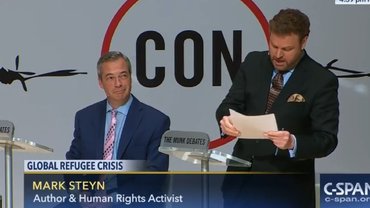
Nigel Farage (L) and Mark Steyn

I was one of the lucky attendees last Friday at the Munk Debate in Toronto’s Roy Thompson Hall. The motion before the house concerned refugee policy: “Be it resolved: Give us your tired, your poor, your huddled masses yearning to breathe free.” On the pro side: Louise Arbour, former UN Human Rights commissioner and historian Simon Schama; on the con side journalist Mark Steyn and Britain’s UKIP party leader Nigel Farage.
The Munk tradition is to poll the audience before and after the debate. On this occasion, the audience was, as one might expect with a Toronto audience, heavily salted with elite liberal culturati, and the first poll was 77 per cent for the motion, 23 per cent con. After the debate, the pro vote was 55 per cent and the con 45 per cent, a huge shift in opinion, and therefore a handy win for the cons.
I’m not going to recap the whole debate, as you can watch it online. Summarizing Arbour and Schama: imagine all the kumbaya bromides Justin Trudeau would nod and smile to, and that’s the gist of what they said. I prefer to elaborate on what I consider to have been the tipping point favouring the con side, because it illuminated an important attitudinal gap between progressives and conservatives with regard to our culture.
In his opening statement, Steyn reviewed the present tumultuous situation in Europe. He made it clear that the majority of people streaming into and across the continent are not traditional refugees at all, but male economic migrants, mostly not from war-torn Syria. He, and later Farage, painted a grim picture of the impact that culturally sanctioned aggression is having on communities exposed to critical numbers of migrants, particularly on women and young girls — Steyn cited actual disturbing cases — who are bearing the brunt of the radiating anarchic dynamic inherent in the circumstances.
To some audience members (not to me, but for example to my furiously tweeting companion, a young colleague who happens to bear the same last name as me), Steyn dwelt excessively on the sexual crimes we’ve all read about in Cologne, Hamburg, Malmö and elsewhere. So it apparently seemed to Arbour and Schama, because they mocked Steyn for it in their rebuttals. Arbour sneered at both Steyn and Farage as “newborn feminists” (she got a laugh), while Schama disgraced himself with “I’m just struck by how obsessed with sex these two guys are, actually. It’s a bit sad, really.” (That got a very big laugh.) I took one look at Steyn’s glowering face after that remark — Schama will regret having said it to his dying day, I know it — and I kind of felt sorry for those two liberals, because I knew what was coming.
Steyn slowly rose and riposted, in a tone of withering contempt, “I wasn’t going to do funny stuff. I was going to be deadly serious. (But) I’m slightly amazed at Simon’s ability to get big laughs on gang rape.” Vigorous applause. He went on, “Mme Arbour scoffs at the ‘newfound feminists.’ I’m not much of a feminist, but I draw the line at a three year old … and a seven year old getting raped.” Vigorous applause.
I think that was the moment those of the audience who did change their minds got it. The pro side was happy to talk about “your tired, your poor, your huddled masses,” because they’re abstract images, which liberals like. The words were fresh and meaningful then, but today merely a nostalgic homage to a 19th century immigration adventure with no deep similarities to today’s situation. They’re feel-good words but that shouldn’t make the poet who wrote them in 1883 the author of global refugee legislation in 2016. When Arbour and Schama didn’t like the opposition’s message — no images, just descriptions they interpreted as racist — they chose to shoot the messenger with ridicule, a debating error and an intellectually dishonest strategy.
A civilized culture, which takes centuries of painstaking collaborative work to create, can be easily destroyed, and quickly. This is a reality conservatives understand, but liberals, consumed by guilt for past collective sins, and morally disarmed before the Other, choose to ignore. The Munk debate illuminated this important distinction, and for a change, realism won.
National Post
kaybarb@gmail.com
Twitter.com/BarbaraRKay

Related

'Indentured' scathes NCAA over control of student-athletes


Bill Savage

March 10, 2016
http://www.chicagotribune.com/
Joe Nocera and Ben Strauss, authors of "Indentured." (Fred Conrad photo / Penguin Random House)
People go to college for lots of reasons: to continue a family tradition or to grasp at bootstraps to raise themselves. To prepare for medical school or law school. To study a beloved subject or to play a favorite sport.
If a young person falls into that last category, their education will be fraught with financial, practical and legal complications thanks to one of the most powerful non-governmental organizations in the United States, the National Collegiate Athletic Association. The NCAA, with its 400-page rule book, has power over almost every aspect of an athlete's life, from high school curriculum (the NCAA mandates high school core courses) to college schedule (forget about taking any class offered during mandatory, or even "volundatory," practice times) to financial situation (don't try to make any money on your own athletic ability or reputation or you'll be ruled ineligible and lose your scholarship).
Many people in academia and the sports media have long held up the NCAA as an exemplary system, one that maintains the purity of college sports by insisting that players be amateur student-athletes rather than paid professionals.
But a growing number of people — including a former head of the NCAA, an erstwhile shoe-contract promoter, active and retired athletes, as well as economists, lawyers, judges and journalists — have begun to question and combat this status quo.
Joe Nocera and Ben Strauss' blistering new book, "Indentured: The Inside Story of the Rebellion Against the NCAA," tells the stories of these rebels. In their vivid portraits and page-turning narratives, Nocera and Strauss clearly demonstrate how the NCAA belies its own purported ideals in ways that betray fundamental American values.
To keep things academic here, I will examine "Indentured" as a proposed curriculum for an interdisciplinary study of sports in higher education, to show what it has to teach its readers, dedicated NCAA fans or sports agnostics alike.
Four academic disciplines matter most for Nocera and Strauss: Economics, law, media studies and history.
First, economics: They agree with many critics who claim that the NCAA is a cartel, an organization of economic entities that cooperate to fix prices or wages for its own benefit, beyond what is "reasonable and necessary." Nocera and Strauss make extensive use of the work of economists Andy Schwarz, Dan Rascher and Ernie Nadel, whose article "Neither Reasonable nor Necessary: 'Amateurism' in Big-Time College Sports" laid the intellectual foundation for a critique of the NCAA's business model. These writers were outraged by the fact that television networks, schools, conferences and coaches make millions of dollars, while the athletes do not directly share in the vast profits their labor creates. Such cartel behavior violates basic free-market principles.
One example: the mistaken idea that television rights are so expensive because coaches' salaries are so high (in most American states, the highest paid state employees are the flagship universities football and men's basketball coaches).
Schwarz writes that "(c)ollege sports broadcast rights are not expensive because it costs a lot to hire coaches .... Coaches are well paid because college sports broadcasts sell for good money and a good coach helps get those broadcast contracts — and the fund-raising that comes with a good team." Nocera and Strauss continue: "Schools wanted money, says Schwarz, and then blamed the market they themselves created."
As for the arguments against paying players, Schwarz utterly demolishes them in "Excuses, Not Reasons: 13 Myths About (Not) Paying College Athletes," which is included here as an appendix, along with his essay comparing college athletes to colonial-era indentured servants, the source of Nocera and Strauss' title.
Of course, labor economics comes into play, and the book explores former Northwesternquarterback Kain Colter's attempt to unionize football players, with the help of longtime activist Ramogi Huma, founder of the National College Players Association, and theUnited Steelworkers union. (Full disclosure: Northwestern is my employer; I have had no extensive personal or professional contact with the NU players, coaches or administrators depicted in this book.) The National Labor Relations Board's final ruling is a study in paradox, as it simultaneously acknowledged that "the players worked long hours under the direction of their coaches and were paid for it (in the form of scholarships)" and rejected their attempt to unionize by saying they student-athletes, not employees.
Second, there's law: Nocera and Strauss depict several lengthy courtroom dramas that could have been as dry and boring as the three-yards-and-a-cloud-of-dust offenses that once defined the Big Ten. Instead, their vivid portraits of the lawyers, plaintiffs, NCAA officials and judges bring these courtroom dramas to life.
Readers get a legal education: we learn the difference between a Supreme Court ruling about pay for assistant coaches and a dicta (a judicial digression, apart from the judgment and theoretically irrelevant) about the theoretical value of amateurism. We explore the world of due process — "the idea that people have legal rights that the state must respect, including the right to defend themselves when accused of wrongdoing" and how the NCAA denies that right to the athletes it investigates. Their stories of many victims of the NCAA's zealous and arbitrary enforcement officers, especially perhaps Ryan Boatright and Aaron Adair, will break any reader's heart.
Then there's NCAA media studies: The NCAA clearly shows that it's not about the story, it's about how you tell the story.
For example, various "reform" efforts, led by the likes of late NCAA President Myles Brand, were merely the reframing of narratives to make the NCAA look as though it were reforming itself. The NCAA increased graduation rates by redefining the relevant span from six to eight years, and subtracting athletes who didn't flunk out but transferred. Sportswriters, long invested — even complicit — in the NCAA's story, paid little attention to such maneuvers.
And so, in Nocera and Strauss' course, we learn how it took an investigation into the NCAA's practices by journalists who were not sportswriters to expose the hypocrisy of coaches and administrators making millions while athletes go to bed hungry (due to NCAA regulations limiting when they could be fed).
One especially egregious example: An athletic director at Ohio State University got a bonus of about $18,000 (an extra week's pay) because a wrestler won an individual NCAA championship. If he'd given one dime of that money to the athlete whose thousands of hours of practice and competition and sacrifice brought that windfall, the athlete would have lost his eligibility and had his championship voided.
Then there's history: Nocera and Strauss also walk us through the NCAA's own forgotten annals and then connect the organization's practices to the fundamental American issue of race.
Once, scholarships — now used to justify not paying the players — were considered a violation of the intrinsic values of amateurism. Back in the day, the NCAA established its authority over universities and made millions of dollars by limiting the number of football and men's basketball games that could be shown on national TV. Then cable TV happened, followed soon after by a revolt of football-centric universities and conferences, which have made billions of dollars more by scheduling games whenever networks will pay to televise them.
But the strongest point in "Indentured" is the way Nocera and Strauss make it crystal clear that the NCAA's injustices have an undeniable racial component.
They summarize the critique of the NCAA by Sonny Vaccaro, the man who first conceived of exclusive shoe contracts, then dedicated his retirement to fighting the NCAA:
How could the basketball establishment deprive young men, most of them black and poor, from being able to make a living when they wanted to? Why was it always black athletes who were targeted? So many of the NCAA's rules surrounding amateurism discriminated against players who lacked money and means. Black athletes from disadvantaged neighborhoods were the ones most likely to struggle in college, because they had gone to subpar high schools — and they were also the ones most often accused of academic fraud. And of course they received no remuneration even as they were making everyone around them rich.
They continue on to cite an explosive 2011 Atlantic article by Taylor Branch:
"Look at the money we make off predominately poor black kids," Dale Brown, the former basketball coach at Louisiana State University told (Branch). "We are the whoremasters." In the most incendiary line in his article, Branch wrote that the NCAA lets off "the unmistakable whiff of the plantation."
In the end, as millions of Americans fill out their office betting pool brackets for the NCAA men's basketball tournament, not everyone will want to hear about these issues. Discussing whether a No. 16 seed will ever upset a No. 1 seed is far more fun.
But to be truly educated requires confronting uncomfortable realities. Anyone interested in higher education, college sports and fundamental American values of due process, fairness and equality should read Nocera and Strauss' book to hear the case they so forcefully and eloquently make against the NCAA.
Bill Savage teaches Chicago literature at Northwestern University.
"Indentured"
By Joe Nocera and Ben Strauss, Portfolio/Penguin, 369 pages, $30
Copyright © 2016, Chicago Tribune
A version of this article appeared in print on March 13, 2016, in the Printers Row section of the Chicago Tribune with the headline "Flunking the NCAA - Joe Nocera and Ben Strauss' `Indentured' hits the mark in investigating college sports" — Today's paper | Subscribe

Tuesday, April 05, 2016

A new Catholic clergy sex-abuse scandal comes into the spotlight


By Mary Kane
April 1, 2016
(AP)
Like many longtime reporters, I celebrated the Oscar victory for “Spotlight” and the fearless journalism that exposed the Catholic Church’s clergy sex abuse scandal.
I would soon see the story, and the scandal, from a very different perspective.
Two days after the Oscar ceremony, news broke about another widespread church coverup. I found myself poring over a grand jury report outlining insickening detail the abuse of hundreds of children by at least 50 priests and religious leaders in western Pennsylvania’s Altoona-Johnstown Diocese — in my hometown.
I moved away long ago, but I still have family there. I visit regularly, and my mom was a devoted parish volunteer during her lifetime. I figured I might recognize a few of the accused or some of the churches. I quickly realized things stretched far beyond that.
The names of priests and parishes from my childhood appeared, one after another, all familiar. My grade school priest. Not one but two pastors from my neighborhood parish, a half block from my childhood home. The principal, vice principal and music director from my high school. A priest I once met with to consider officiating my wedding. The priest at the church my four nieces and nephews attended. The chaplain of the nearby Catholic hospital, where my mom volunteered.
I couldn’t believe what I was reading. Two of the priests, leaders at Bishop McCort High School, where my parents sent me and my three brothers in the 1970s to receive a quality religious education, were “sexual partner[s]” who worked together to molest a 13-year-old boy, the report said. They coordinated visits to his house. Once one priest had “satisfied himself,” the report said, the other “took advantage of a victim he believed to be compliant.”
One had been my religion teacher.
First, I called my brothers, to vent. Then I tried comprehending the scale of the abuses. The Spotlight team identified about 80 predatory priests in an archdiocese of 1.8 million Catholics. The grand jury report found at least 50 priests and religious leaders in a diocese of fewer than 100,000. That was stunning enough. But there was more.
“Spotlight” depicted the Catholic clubbiness of Boston that allowed for abuse. In small-town Pennsylvania, corruption extended into all corners of the community. The church exercised “overwhelming access and influence,” even handpicking community leaders, including the police and fire chiefs. “The mayor would have them come to me, and I would interview them and I would tell him which I would pick,” a top bishop’s aide testified.
I appreciated how “Spotlight” highlighted the crucial role that journalism plays in challenging the powerful. In my home town, however, I saw how it sometimes falls short. George Foster, manager of an outdoor billboard advertising company and a former high school classmate of mine, emerges as the hero — not an investigative reporting team.
Foster’s brother was a priest; the two heard rumors of abuses and began looking into them. In 2002, Foster wrote an op-ed for the local paper, calling on the church to clean up its house.
Immediately, he was inundated with tips and evidence from victims, attorneys and even the police. He also did something no journalist had: He went through the files at the Blair County Courthouse from the 1994 civil trial of the Rev. Francis Luddy, a priest accused of molesting boys. The lawsuit against Luddy was filed in 1987, but records were sealed at the church’s request. They became public during the trial.
Foster found in the files documents showing church officials knew of credible allegations against many additional priests but kept them secret. He confronted then-Bishop Joseph Adamec. If this were a movie, outraged authorities would have taken action. But that didn’t happen. Adamec rebuffed him.
Finally, in 2014, state investigators in a different child abuse case contacted Foster, and he provided his files. The report cited them extensively and called Foster’s actions “nothing short of heroic.”
I wondered where the journalists had been. Local media covered the Luddy trial, and the Johnstown paper, tipped off by Foster, wrote about the Luddy files in 2002. But none of it drew national attention. I called Richard Serbin, the attorney in the Luddy case, who regularly represents clergy sex-abuse victims. There wasn’t a paper with the prestige of the Boston Globe to make an impact, Serbin said. It happened in a small community in decline, and few noticed or cared. “The facts were all there, back in 1994,” Serbin said. “And no one bothered to look at them.”
“Spotlight” ends with a lengthy list of investigations of church abuses worldwide. In Pennsylvania, the grand jury report offers prayers that the current bishop makes the right choices going forward. I hope that works. I’m not exactly in the mood for prayer.

Sunday, April 03, 2016

Obama Gives Iran Access to the U.S. Financial System, Flouting the Terms of His Cherished Iran Deal


By Andrew C. McCarthy — April 2, 2016


Obama Iran speech (Alex Wong / Getty)
(Alex Wong/Getty Images)

President Obama and his subordinates blatantly lied to Congress in order win approval — or, more accurately, to escape disapproval — of his Iran nuclear deal. At a time when jihadist mass-murder attacks are surging, and when the Syrian regime’s war crimes are abetted by Iran’s jihadist armed forces (which include Hezbollah and the Quds Force, both formally designated terrorist organizations), Obama’s deal infuses Iran, the world’s leading state sponsor of terrorism and an unapologetic enemy of the United States, with over $100 billion in sanctions relief . . . some slice of which, the Obama administration admits, will be diverted to terrorism.
This is old news, of course. Yet, it is worth repeating, for two reasons.

First, these are impeachable offenses of the first order. As I recounted in Faithless Execution, the Framers of our Constitution counted presidential dishonesty in dealings with Congress and presidential concealment of dealings with foreign powers as among the most egregious high crimes and misdemeanors.

Second, Obama is doing it again.

To persuade the Republican-controlled Congress to refrain from rejecting the Iran deal, even under the shamefully indulgent Corker-Cardin process to which GOP leaders agreed, the Obama administration made two key promises. The first was that, if Congress went along with Obama on dismantling nuclear sanctions (for the purportedly greater good of winning the terror regime’s commitment not to build nuclear weapons), the administration would stand strong on other sanctions — sanctions that punish Iran for its terror promotion, ballistic-missile development, and related aggression. The second promise was that Iran would continue to be banned from the U.S. financial system.

The latter is a critical restraint on the mullahs. Because the dollar is the world’s reserve currency, the inability to transact in dollars is a significant impediment to commerce — and thus a fitting punitive measure against a rogue nation that bankrolls jihadists. Moreover, because Iran’s economy is dominated by a terrorist entity (the Iran Revolutionary Guard Corps), a key component of which is the Quds Force (again, formally designated as a terrorist organization), insulating our financial system from Iran’s prevents our banks and commercial actors from supporting Iranian terrorism (after all, Obama is already doing quite enough of that).

Now, having gotten his deal past Congress, Obama is reneging on both commitments.
Between Obama’s bizarre desperation to strike a deal with our enemies and Secretary of State John Kerry’s incompetent statecraft, the administration’s treachery was inevitable. Although Congress was promised that the administration would snap sanctions back into place if Iran violated the nuclear agreement, the text of the deal notes Iran’s position that “if sanctions are reinstated in whole or part,” that creates “grounds [for Iran] to cease performing commitments” under the deal.

Thus, every time the administration even hints at serious enforcement, Iran threatens to walk away from its obligations (now that it has already pocketed substantial benefits). And since Iran has seen that its intransigence works, it now wins concessions by threatening to abandon the deal in the face of any American policy of which it disapproves. For example, when Congress reacted to December’s jihadist attacks in Paris by enacting restrictions on travel to the United States from countries that are terrorist hot spots, Tehran claimed that applying the restrictions to Iran would violate the deal. Naturally, Obama caved: claiming that it was somehow in the “national security interests of the United States” to waive the anti-terror restrictions for those who travel through the world’s worst terror-sponsoring nation.

This is how Iran eviscerated the non-nuclear sanctions Obama vowed to uphold. It bleated that, to obtain Iran’s agreement, Obama and Kerry had promised to lift sanctions that target various sectors of Iran’s economy. But, as analyst Omri Ceren points out, many of those sanctions do not target Iran’s nuclear program — they relate to terrorism, ballistic missiles, money laundering, etc.

To appease the mullahs, and despite what the administration had represented to Congress, Obama essentially deemed the non-nuclear sanctions to be nuclear. This signals to business corporations and financial institutions considering business with Iranian entities that these sanctions may be considered inoperable — even though, under American statutory law, they remain in effect.

And now this week it emerged that, after struggling to keep the matter under wraps, Obama is preparing to give Iran access to the U.S. financial system. The scheme would start out small at first: Currency conversion into dollars would be permitted in the intermediary steps of commercial transactions with Iranian entities as long as Iranian banks were not involved and American dollars were not directly exchanged for Iranian rials. Even this step, however, is an outrageous betrayal of repeated assurances that White House, State, and Treasury officials gave Congress while the Iran deal was being negotiated. Furthermore, it would begin an inevitable and rapid progression to full-blown Iranian participation in our markets, effectively co-opting American commerce for the purpose of legitimizing the regime and its nefarious activities.
Regarding the administration’s deceitfulness and the aid and comfort it is giving to our enemies, a few final observations are in order.

As I made as clear as I could in Faithless Execution, the Framers intended impeachment to be a vital congressional check on maladministration by the executive branch. I do not say that to be provocative; I say it to be clinical: This is the way the system is designed — with the expectation that presidents who lie to Congress and abet our enemies will be impeached. If impeachment becomes a dormant or illusory check, our system lacks adequate means to contain a rogue president.

With respect to some executive misconduct, especially in the realm of foreign affairs, Congress’s power of the purse is not a practical check, especially if Congress has already funded the government for the year. If Congress forswears impeachment, not only of the president but of subordinate executive officials who carry out his derelictions, there simply is no other adequate countermeasure. With a president like Obama, who is committed to radical change and who has no other elections to face (i.e., no incentive to rein in his radicalism), the choice is either to start impeaching executive officials or to accept that we are in for another 300 days of profound damage to the United States.

Finally, to mitigate the damage, it will be necessary to play Obama’s game. The president rules by executive action because there is sparse congressional support for his transformative agenda. But he is nothing if not shrewd. Unable to get legislation enacted or treaties approved, he is seeking to take executive steps, including ones for which he has no authority, that will dramatically alter the facts on the ground. The idea is to spawn so many new contractual arrangements and international entanglements that, as a practical matter, the next president will be unable to undo them. The strategy is to bring about a new order by radically changed circumstances — a raw power politics that renders the absence of legal support irrelevant.

Consequently, Republicans cannot wait until there is a new president to fight back. The fight must be underway now: a fight to prevent the changed circumstances. In the case of the Iran deal, this means that presidential candidates and congressional leaders must make clear the commitment to enforce current law in the next administration — including prosecutions and civil actions against any businesses or financial institutions that violate statutory sanctions against Iran.

Obama’s deal is a mere executive agreement. As I have pointed out before, there is an argument that Congress gave Obama the authority to waive nuclear sanctions permanently; that is by no means certain, though, and it would not affect the viability of other sanctions in any event.

The president can pretend that he has boundless waiver authority, but he does not. He has no power in our constitutional system to repeal congressional statutes by fiat. He has no power to impose new international obligations without congressional approval in the form of law or a ratified treaty — no matter how many times he gets the U.N. Security Council to be his rubber stamp. And while the president’s pardon power is unreviewable (i.e., he could theoretically pardon individuals and businesses that flout the sanctions), this power extends only to criminal offenses (it would not insulate offenders from civil lawsuits), and it does not cover future wrongs (Obama cannot prospectively excuse sanctions violations committed after he is no longer president).

The radically changed circumstances Obama is trying to forge will happen only if individuals, businesses, financial institutions, and foreign actors believe that Obama’s lawlessness authorizes them to be lawless. If they are made to understand that it does not — that the sanctions are still in force and the next president fully intends to enforce them — then the players will refrain from actions that expose them to legal jeopardy. The status quo, though frayed, can be maintained.

And then Iran that can start worrying about radical change come January 2017.

— Andrew C. McCarthy is a senior policy fellow at the National Review Institute and a contributing editor of National Review.


Celebs calling for a revolution are as delusional as it gets


April 1, 2016
Susan Sarandon listens as Democratic presidential candidate Bernie Sanders appears on stage during a campaign appearance in Mason City, Iowa. Photograph: Eugene Garcia/EPA
Some liberal celebrities are threatening to leave the country if Donald Trump becomes president. Samuel L. Jackson proposes moving to South Africa, though if Jackson is worried about xenophobia, South Africa is not a great place to avoid it.
Miley Cyrus vows, “I am moving if this is my president! I don’t say things I don’t mean,” and Jon Stewart topped them all by saying he would leave the planet if Trump is elected, but Stewart is having a hard time getting attention these days, so let’s discount that as hyperbole, although he’s probably rich enough to build his own space station.
Other liberals take a more nuanced view of the rise of Trump. What if a President Trump were to cause so much anger that a number of Americans simply rejected the results of the ballot box and took up arms against his administration? That would be kind of cool, wouldn’t it?
So argues Susan Sarandon, a Bernie Sanders supporter whose second choice appears to be Trump. Sarandonista’s goal is to turn the United States into a socialist wonderland, and since Hillary Clinton is, according to the actress, little interested in that, voting Trump might be a paradoxically effective way to bring some hammer-and-sickle mojo to the United States at last.
“Some people feel Donald Trump will bring the revolution immediately if he gets in,” said the Oscar winner. “Then things will really, you know, explode.” Which, she made clear, is a worthy goal.
When asked whether advocacy of mass political violence is at all a “dangerous” idea, Sarandon said that, on the contrary, it’s the status quo that ought to really make us blanch with fear.
“The status quo is not working, and I think it’s dangerous to think that we can continue the way we are with the militarized police force, with privatized prisons, with the death penalty, with the low minimum wage, with threats to women’s rights, and think that you can’t do something huge to turn that around.”
It turns out that Sarandon recently had an opportunity to choose sides between those fascists in law enforcement and a band of merry men who sought merely to redistribute some of the wealth held by a super-rich individual. Sarandon, whose assets are valued at $50 million, wasn’t home when one or more freelance revolutionaries carried out an exercise in easing income inequality by breaking into Sarandon’s apartment and making off with a few trinkets.
Sarandon promptly called those “militarized police” rather than hailing the proto-revolutionary action of the wealth-redistributors.
“Inequality will not go away on its own,” Sarandon once tweeted. True, but how are revolutions supposed to gain any momentum when even petty criminals risk being pursued by paramilitary police forces for striking a blow against one-percenters?

Inequality Will Not Go Away On Its Own. Here’s How to Close the Gap. via @thenation http://www.thenation.com/article/inequality-will-not-go-away-on-its-own-heres-how-to-close-the-gap/ 

Photo published for Inequality Will Not Go Away On Its Own. Here’s How to Close the Gap.


Sarandon doesn’t seem to understand how revolutions work. Maybe she should step away from Twitter, pick up a pitchfork and brandish it at the nearest millionaire, perhaps herself. That seems to be the solution proposed by Donald Sutherland, who has said he hopes his Hunger Games movies will lead to a revolution.
“I hope that they will take action because it’s getting drastic in this country.”
Sutherland continued, “You know the young people of this society have not moved in the last 30 years. . . . They have been consumed with telephones . . . tweeting.” He added, “Hopefully they will see this film and the next film and the next film and then maybe organize. Stand up.”
His interlocutor added that Sutherland was “quite serious about the call to arms” but couldn’t resist mentioning wryly, “We are high up in a Four Seasons hotel overlooking Beverly Hills, sunlight glinting off mansions and boutiques below.”
Admittedly, working out the exact parameters of the Revolution can be tricky, as actor Russell Brand confessed in an interview in which he called for “a socialist egalitarian system based on the massive redistribution of wealth, heavy taxation of corporations, and massive responsibility for energy companies and any companies exploiting the environment.”
When pressed for details, Brand complained, “Don’t ask me to sit here in an interview with you, in a bloody hotel room, and devise a global utopian system.” Brand produced a book called “Revolution,” which The Atlantic declared “wasn’t about revolution” and was, moreover, “unreadable.”
Brand bristled at suggestions that, with a net worth in the tens of millions, he was ill-equipped to make the case that some people are unacceptably wealthy. The chauffeur-driven limousine in which he films revolutionary rants is, he has said, “the anesthetic of privilege, the prison of comfort.”
Looks like 2016 is going to be yet another frustratingly revolution-free year in America. At least celebrities can continue deluding themselves in their prisons of comfort.