Wednesday, July 24, 2013

The Naked City


By  Mark Steyn
July 23, 2013

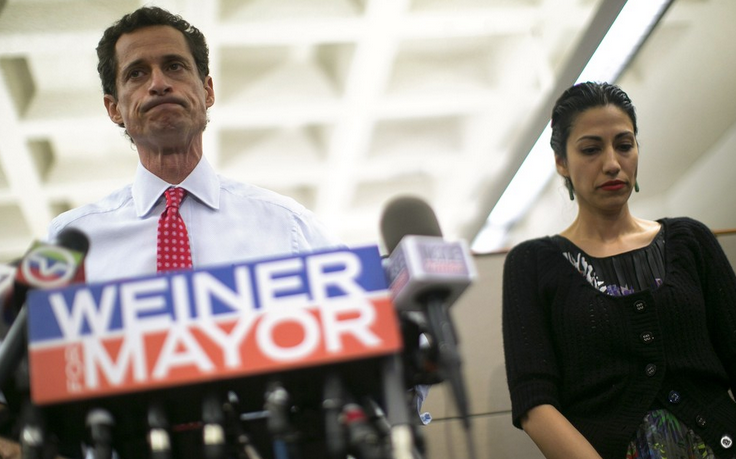
Anthony Weiner, a leading candidate for New York City mayor, stands with his wife Huma Abedin during a press conference on July 23, 2013 in New York City. Weiner addressed news of new allegations that he engaged in lewd online conversations with a woman after he resigned from Congress for similar previous incidents.
(Source: John Moore/Getty Images North America)

I wandered in on the end of the Weiner press conference and, in a healthy political culture, this man, notwithstanding his particular pathologies, would be simply too ridiculous to be a credible political candidate.

“I’m not going to get into a back and forth,” he told a journalist. Au contraire, he’s happy to get into a back and forth for hours on end (warning: Not safe for work).
“This was something in front of us that we knew might come up,” he said. You cansay that again (warning: Even less safe for work). 

These “sexts” and “selfies” are from less than a year ago. I link to them not because of their literary or artistic quality but because the euphemistic gentility of the American media serves to protect Weiner. If you watch Wolf Blitzer talking about it with Gloria Borger and Dana Bash on CNN, you would never know that the likely next Mayor of New York is a man who photographs his penis and emails it to strangers.

And that ties in to Charlie and Jonah’s porn discussion below. I incline more to Charlie’s side – I’m a free-speech absolutist – but the problem here is not what’s legal but what’s accepted. What’s the point of regulating porn in a world in which voters are willing to elect a serial porn fantasist who uploads his erections? Who needs Larry Flynt?

America has a peculiarly schizophrenic attitude to this: If you show a nipple on network TV, CBS will get fined by the regulators. But, if you show your penis to the planet, you can get elected to high office (and appoint the regulators).

Weiner now says that he and Huma have put what they always knew was in front of them behind them. New Yorkers are the fools of the planet if they follow that advice.
(Headline via the ancient cop show: There are eight million stories in the Naked City – and that’s just Weiner.)

UPDATE: In related news, CNN reports that man “hunted the dildo to extinction“. If only their reporters showed the same kind of doggedness with the Weiner.

Tuesday, July 23, 2013

Will Weiner Finally Go Away Now?


July 23, 2013


When allegations about his “sexting” first surfaced, Anthony Weiner’s reaction was to lie, deny, claim he’d been hacked, and orchestrate a character-assassinationcampaign against Andrew Breitbart. It was not authentic contrition that caused him to fess up; he was backed into a corner by his own conduct and conflicting explanations. That is why he admitted guilt and resigned his seat in Congress.

With the help of a sympathetic media, he has attempted a political comeback that would have been impossible in a different time and place. His mayoral campaign got some traction (though lately he has sagged in the polls), but even in contemporary New York City, that can only be because most people believe the revelations of his conduct caused him to seek redemption, change his ways, etc. Now, as Greg Pollowitz notes at the Feed, it turns out he continued sexting long after his resignation from Congress (and no doubt well into his comeback plans), under at least one pseudonym, “Carlos Danger.”

Weiner appears to have tried to reduce the shock and revulsion this new revelation will cause by straining to portray it as old news – under the cover of having previously admitted that “these things that I did” caused “challenges” in his marriage “that extended past my resignation from Congress.” That formulation is ambiguous regarding whether what continued after the original scandal was the “things I did” or the “challenges” they caused. He is banking on that ambiguity, along with the fact that the screenshots of his newly revealed “chats” are not date-stamped.

As Sterling Beard observes here on the Corner, in confessing to the newly revealed sexting episode, Weiner was careful not to comment on the timing of it. Clearly, Weiner is hoping voters can be hoodwinked into believing the newly revealed sexting is just part of the original scandal they’ve already forgiven him for. Maybe his media friends will even help him maintain the illusion that there is nothing new worth noticing. And indeed, some news accounts reporting the newly revealed sexting take pains to say, “The chats are not dated” (as Business Insider puts it).

As us litigator types know, however, there is more than one way to fix a timeframe on a recorded conversation. One is to have as a witness one of the interlocutors, who will be in a position to testify about when the conversation occurred. Reportedly, the 22-year-old woman who had the online sexting relationship with Weiner says she was involved with him from July to November 2012 – over a year after his June 2011 resignation.

Another way is to date a conversation is to examine the conversation itself. This is where I think Weiner is toast. I don’t recommend reading the whole conversation, which Sterling linked to earlier (here). It is sexually explicit and, in a pathetic way, very depressing. But I can quote this comparatively tame section, which bears on the question of timing:
Woman:     . . . I was attracted to you way before all that happened . . .
Weiner [“Danger33”]:   i’ve found the perfect woman. Gorgeous, sexy and like a bit of my crazy
Woman:     I basically worship the ground you walk on. You’re incredible.
Weiner:      so you won’t tell me what picture of me you like the most or turned you on the most? only tv?
Woman:     Specifically your health care rants were a huge turn on
Weiner:      sadly my pics are out there to look at. have you ever?
Woman:     Yes. And I must say I was quite impressed.
Weiner’s reference to “my pics” certainly appears to be a reference to the pictures that forced his resignation the year before. The woman’s response that she “was quite impressed” by the “pics” is consistent with the overall context of what – apart from the passage I’ve quoted – is a very bawdy conversation.

(Interestingly, the New York Times quotes from the same passage I’ve excerpted above, but cuts off the passage after the woman says, “Specifically your health care rants were a huge turn on,” That is, the Times omits Weiner’s reference to “my pics” out there [i.e., on the Internet] and his asking whether the woman had checked them out.)

If my interpretation is correct, then over a year after resigning in disgrace, and over six months after his wife gave birth to their son, Weiner was not only still engaging in similar behavior but actually exploiting the scandalous images that forced his resignation as part of the new round of sexting.

If he can survive that, it is not he but New York City that is beyond saving.

Mrs. Thatcher: A Woman in Full


A new biography gives the former prime minister her due. 

Ryan Braun doped, lied and cared only for himself


By Jeff Passan
July 23, 2013

The call went to Major League Baseball a few days ago. Ryan Braun was ready to deal. He wasn't going to admit everything. Truth is, he didn't really admit anything – no details about all the performance-enhancing drugs the league knew he had used, no straightforward admissions of guilt. He just wanted to end this 19-month charade, and if that meant bargaining for a suspension, so he would.
Of the many things Ryan Braun is – a liar nonpareil, a serial doper, a raging narcissist – he is, above all, a self-preservationist. Never did he show that instinct more than when he publicly impugned Dino Laurenzi Jr., the innocent man who happened to collect a vial of Braun's urine that started baseball down the sordid, tortuous path that found its first measure of closure Monday when Braun accepted a suspension for the rest of the season: 65 games gone, hundreds of apologies owed, $3 million-plus lost and one man left to sort through the damage done by his decisions and his alone.
What we know of Braun today is no different than what we knew of him before: He is a cockroach. He understood what accepting a suspension would mean to MLB. It would give the league the pelt of a former MVP. It would affirm the believability of Anthony Bosch, the founder of the Biogenesis clinic that provided PEDs to Braun and a host of other baseball players – especially with Alex Rodriguezand his harem of private investigators doing everything they can to discredit Bosch. If he could lessen his penalty by volunteering – keep it to 50 games for violating the league's Joint Drug Agreement and 15 more, one person deemed it, as an "asshole tax" for criticizing the drug program and putting Laurenzi through hell – and ensure a return in 2014, when his Milwaukee Brewers might not stink like they do now, even better.
Brewers left fielder Ryan Braun is suspended for the remainder of the MLB season. (USA Today Sports)It was a bargain baseball accepted, for the above reasons and many more. Already MLB had been dragged through an arbitration case with Braun, one it lost rightfully on a chain-of-custody issue, and the league refused to risk getting beaten twice. Beyond sending the message to players about Bosch's information, Braun's deal proved that MLB could and would suspend a player without a current positive test. More than that, the evidence against Braun in Bosch's notebooks didn't even merit a mention from the Miami New Times in its original bombshell report. Plenty of the remaining two dozen or so players, including Rodriguez, were tied to stronger substantiation – and that was before Bosch spoke.
If not for Bosch’s help, MLB almost certainly would have gone to arbitration with all the players it wants to suspend. The league sued Bosch and called him a shady drug dealer, flipped him state’s evidence and allowed one of the players it was pursuing to validate his word. That’s some gangster maneuvering there, and if MLB is willing to do that – to take those sorts of steps to go after alleged PED users – the league certainly will leave some players with remarkably difficult decisions.
For Rangers outfielder Nelson Cruz and Tigers shortstop Jhonny Peralta, do they accept a suspension now, serve the 50 games (or whatever they bargain to) and return in time for the playoffs? Or do they appeal any penalty, go to arbitration, likely play out the season and head into free agency with a long suspension and neutered market hanging over them? This is no easy decision. Team or self. Present or future.
If MLB’s telephones start ringing, the league can thank Braun. As much as Bosch emboldened the investigation, Braun made it into more than a witch hunt. In such cases, the witches don’t exist. No matter what sort of fancy wording he used in his statement, Braun's agreeing to take more than 50 games was a nod and wink that, yes, he was a witch indeed.
For baseball, he was a coup, too. Public perception is important to the league, and the Biogenesis case had a chance to turn ugly. It wasn't just the about-face on Bosch. The vast majority of players involved in Biogenesis were Latin American, as are a disproportionate number suspended for PED use in the minor leagues. Even if the drugs are far more available in foreign countries than the U.S., where they're federally regulated, it nevertheless would be a bad look to pursue only the Latino players.
In Braun, baseball had its proof that even the boy next door can run afoul of the league's drug program – and that MLB, for so many years having profited on the backs of PED users, had grown enough spine to spend millions of dollars in pursuing and punishing those who violate it. Superstar or non-superstar. Kid born into privilege in California or into poverty in Santo Domingo. It doesn't matter. Baseball, whether it's right or wrong, cares more about the drugs than the person.
Braun previously avoided a PED suspension when he won an arbitration hearing with MLB. (USA Today Sports)What Braun represented, on the other hand, did matter. He was the walking, talking epitome of hubris. It enraged people in the game. The way he stood up that spring-training day and ripped the drug program and the collector and said he would "bet my life" that the synthetic testosterone in his urine hadn't ever entered his body. How he kept going on: "I've always had tremendous respect for the game of baseball." And: "I've tried to handle the entire situation with honor, with integrity, with class, with dignity and with professionalism because that's who I am." It smelled. The entire thing stunk from the start, through the middle and all the way to the end, when the guy flipped on himself and his Brewers teammates sat there and thought: Good.
They remember. The day he gave that speech, he stood up in front of them and asked for their support. This is wrong, he said. Some kind of mistake, he said. He would never do this, he said. And because they were his teammates, and because he was so convincing, they believed him, stood up for him publicly, because that's what teammates do. They don't lie to one another. They just don't.
Today, they're mad, and they have every right to be. In their midst is someone who asked for their trust when it wasn't warranted. Across baseball, Braun's suspension was celebrated because there has been a monumental shift among clean players and in front offices, one reflected bravely by MLB Players Association executive director Michael Weiner: We should not defend those who do not respect the game, those who have no honor, integrity, class, dignity or professionalism.
That is Ryan Braun. He is not brave for doing this. He is not some hero. He's just a guy looking out for himself, and he always was, all the way back to that February 2012 day when he cast doubts on the fake testosterone in his urine by wondering aloud whether the test collector might've tampered with the sample. Braun didn't name him. He didn't have to.
Because earlier in the day, I received an email. It was from somebody in Braun's camp, I would later confirm, who wrote me and other reporters under a pseudonym. Here it is in its entirety:
"To Whom It May Concern: The purpose of this email is to tell the other side of the story about Ryan Braun's positive drug test. I have reason to know that the circumstances surrounding his testing are very suspicious. You might be interested to know that the person who administered the test, Dino Laurenzi, a collection agent for Comprehensive Drug Testing, is an athletic trainer as well as the director of rehabilitation at United Hospital Systems in Kenosha, WI. This means that Laurenzi would have unfettered access to lab equipment and, if he was so inclined, would provide him the necessary resources and opportunity to tamper with the test. He lives in Kenosha, WI. I'm writing this because I think that Braun's reputation is being unfairly attacked because of the lack of information regarding his side of the story. The information regarding Laurenzi in this email will lead you down the proper path to discover the irregularities involving Ryan's test. I hope that this information is useful to you so that you may conduct your own investigation and I'm confident that you'll be blown away by what you discover."
That, too, is who Ryan Braun is. He is the guy who takes performance-enhancing drugs, gets caught, lies about it, wins and still feels it necessary to smear a completely innocent man who did his job exactly how protocol said he should. He is someone willing to lie to teammates, to fans, to everyone, building this tower of propaganda that Monday toppled all over him.
He is a cockroach. And on Monday, he went splat.

Monday, July 22, 2013

Today's Tune: Van Morrison - Sometimes I Feel like a Motherless Child

Dennis Farina 1944-2013: An unmistakably Chicago face on screen


By Rick Kogan
Chicago Tribune
http://www.chicagotribune.com
July 22, 2013


Dennis Farina had the sort of Chicago neighborhood face you’d find behind the tap at a corner tavern, standing at first base on a softball diamond or lugging your new icebox up the stairs. As he said to a Tribune reporter nearly 20 years ago while sitting high above the city of his birth, riding the Navy Pier Ferris Wheel: “I spend all day walking around this city. I always come back here. This is where I’m comfortable.”

The actor — famous for his work in such films as “Get Shorty,” “Saving Private Ryan” and “Midnight Run,” and in television shows such as “Crime Story” and “Law & Order” — died suddenly Monday morning in Scottsdale, Ariz., after suffering a blood clot in his lung. He was 69.

Though he spent much of his time in warm climes, Farina still had a home here, the better to keep in close touch with family members and lifelong friends. They kept him grounded because they all knew what the TV-watching, movie-going public never could: Farina was self-effacing and shy at his core.

“I know guys who look at themselves on TV, in movies. Not me,” he told the Tribune in 2010. “I’m afraid if I ever did I’d just sit there saying, ‘Why the hell did they ever hire me?’”

Dennis Farina was born on Feb. 29, 1944, the youngest of the seven children (three brothers, three sisters) of Iolanda, a homemaker, and Joseph Farina, a Sicilian immigrant doctor. He grew up in the Old Town neighborhood, where he attended St. Michael Grammar School and St. Michael Central High.

After a hitch in the Army he went to work in the South Water produce market for a time. At the suggestion of one of his brothers, he took and passed the entrance exam for the Chicago Police Department and started as a patrolman on the North Side; he became a detective four years later.

His acting career began in 1981 when director Michael Mann — in Chicago scouting locations for his film “Thief” — met Farina and gave him a bit part in the movie. A friend suggested that Farina circulate his picture to various Chicago agents, which, in turn, led to his being cast in an episode on “Chicago Story,” where he met John Mahoney, who convinced Farina to audition for a role in “A Prayer For My Daughter,” at Steppenwolf. Farina subsequently appeared in “Streamers” at Columbia College; “The Time of Your Life” at the Goodman; “Class C Trial in Yokohama” at the Theater Building; in TV shows such as “Hunter,” “Miami Vice” and “Remington Steele,” and in such locally-filmed movies as “Code of Silence” and “The Naked Face.”

“When I first got into acting, I never had any long-term goals, never had any plan,” he said to the Tribune in 1988. “I just thought it would be a good way to make some extra money.”

His work on Chicago stages remains the stuff of legend, and stories such as this:

His first stage appearance was in “A Prayer For My Daughter.” Fellow cast member Mahoney sent a nervous Farina out on stage before the house lights had gone down. “I was scared to death,” Farina said. “John took advantage of that.”

Farina retaliated: One night, Mahoney was awakened at his house by the wail of police sirens. He looked out the windows and saw three police cars parked in the street in front of his building — a mess of sirens and lights. Mahoney watched in dread as a policeman approached his building and rang his bell.

“John Mahoney?” said the officer.

“Yes,” said Mahoney. “What’s the problem?”

“You’re under arrest,” said the officer.

“What … what for?” said the stunned Mahoney.

“Impersonating an actor,” said the officer.

In 1985, Farina was cast opposite William L. Petersen in “Manhunter” and set to start filming episodes of a new TV series titled “Crime Story.”

He turned in his badge after nearly 20 years, and from that year forward his career was one of enviably steady employment, with parts large and small in such films as “Get Shorty,” “Snatch” and “Midnight Run”; and dozens of TV appearances, including his role as host of “Unsolved Mysteries” and the high-profile part of natty Det. Joe Fontana on “Law & Order,” from which he departed in 2006.

“I had made a two-year deal, and I was just tired of the part,” he told the Tribune in 2010. “There is a lot of exposition on the show. There wasn't a lot of opportunity for the character to expand. It’s a plot-driven show.”

Farina was a friendly and warm person but he never did like sitting still for interviews, and one of the reasons was that “former cop” hung from him like love beads on an investment banker. It was yesterday’s fashion — increasingly old news — and he wanted to be done with it. But it lingered as a novelty, a quick hook for idea-starved writers.

“One interviewer asked me how many people I had to kill when I was a cop,” said Farina in a 1988 Tribune interview. “Can’t anybody understand that that life is over?”

Farina continued to make his home in Chicago, near Taylor Street, in what remains of one of the South Side’s great Italian neighborhoods. He had a home in southwestern Michigan. In Arizona, he played a lot of golf, a late-life passion.

“Sometimes I do pinch myself about the life I’ve had,” he said in a 1995 Tribune interview.

In December 2010 he spent 18 cold winter days in Chicago filming “The Last Rites of Joe May.” He played the title character, described in the script as “late-sixties, handsome but frail looking (with) fine white hair (and) meticulously trimmed mustache.”

Tim Evans, a longtime presence on the local theater scene and an admirer of Farina’s, was one of the producers of the film. “Dennis was one of those larger-than-life guys you just wanted to be around,” Evans said. “He was generous and kind to everyone, especially the working folks.

“He was an old-fashioned guy … sentimental, romantic, told great stories.”

On the film’s outdoor set on the West Side, shivering between takes, Farina told a Tribune reporter, “I always thought of myself as being fortunate to have the life I have. But I’ll tell you, now I’m really lucky because I get to sleep in my own bed at night.”

Farina is survived by three sons, Dennis Jr., Michael and Joseph, from his first marriage, which ended in divorce in 1980; six grandchildren; and longtime companion Marianne Cahill. Funeral services are pending, and in lieu of flowers his family has asked for donations to The 100 Club of Chicago, the civilian organization that provides for the families of police officers, firefighters and paramedics who have lost their lives in the line of duty.

rkogan@tribune.com

From Chicago cop to celebrity, Dennis Farina never forgot what he learned in grammar school -

The Decline of the Civil-Rights Establishment


Black leaders weren't so much outraged at injustice as they were by the disregard of their own authority.


By Shelby Steele
The Wall Street Journal
July 21, 2013


The verdict that declared George Zimmerman not guilty of murdering Trayvon Martinwas a traumatic event for America's civil-rights establishment, and for many black elites across the media, government and academia. When you have grown used to American institutions being so intimidated by the prospect of black wrath that they invent mushy ideas like "diversity" and "inclusiveness" simply to escape that wrath, then the crisp reading of the law that the Zimmerman jury displayed comes as a shock.
On television in recent weeks you could see black leaders from every background congealing into a chorus of umbrage and complaint. But they weren't so much outraged at a horrible injustice as they were affronted by the disregard of their own authority. The jury effectively said to them, "You won't call the tune here. We will work within the law."
Corbis
Martin Luther King Jr. sits in a jail cell at the Jefferson County Courthouse in Birmingham, Alabama in October 1967
Today's black leadership pretty much lives off the fumes of moral authority that linger from its glory days in the 1950s and '60s. The Zimmerman verdict lets us see this and feel a little embarrassed for them. Consider the pathos of a leadership that once transformed the nation now lusting for the conviction of the contrite and mortified George Zimmerman, as if a stint in prison for him would somehow assure more peace and security for black teenagers everywhere. This, despite the fact that nearly one black teenager a day is shot dead on the South Side of Chicago—to name only one city—by another black teenager.
This would not be the first time that a movement begun in profound moral clarity, and that achieved greatness, waned away into a parody of itself—not because it was wrong but because it was successful. Today's civil-rights leaders have missed the obvious: The success of their forbearers in achieving social transformation denied to them the heroism that was inescapable for a Martin Luther King Jr. or a James Farmer or a Nelson Mandela. Jesse Jackson and Al Sharpton cannot write a timeless letter to us from a Birmingham jail or walk, as John Lewis did in 1965, across the Edmund Pettus Bridge in Selma, Ala., into a maelstrom of police dogs and billy clubs. That America is no longer here (which is not to say that every trace of it is gone).
The Revs. Jackson and Sharpton have been consigned to a hard fate: They can never be more than redundancies, echoes of the great men they emulate because America has changed. Hard to be a King or Mandela today when your monstrous enemy is no more than the cherubic George Zimmerman.
Why did the civil-rights leadership use its greatly depleted moral authority to support Trayvon Martin? This young man was, after all, no Rosa Parks—a figure of indisputable human dignity set upon by the rank evil of white supremacy. Trayvon threw the first punch and then continued pummeling the much smaller Zimmerman. Yes, Trayvon was a kid, but he was also something of a menace. The larger tragedy is that his death will come to very little. There was no important principle or coherent protest implied in that first nose-breaking punch. It was just dumb bravado, a tough-guy punch.
The civil-rights leadership rallied to Trayvon's cause (and not to the cause of those hundreds of black kids slain in America's inner cities this very year) to keep alive a certain cultural "truth" that is the sole source of the leadership's dwindling power. Put bluntly, this leadership rather easily tolerates black kids killing other black kids. But it cannot abide a white person (and Mr. Zimmerman, with his Hispanic background, was pushed into a white identity by the media over his objections) getting away with killing a black person without undermining the leadership's very reason for being.
The purpose of today's civil-rights establishment is not to seek justice, but to seek power for blacks in American life based on the presumption that they are still, in a thousand subtle ways, victimized by white racism. This idea of victimization is an example of what I call a "poetic truth." Like poetic license, it bends the actual truth in order to put forward a larger and more essential truth—one that, of course, serves one's cause. Poetic truths succeed by casting themselves as perfectly obvious: "America is a racist nation"; "the immigration debate is driven by racism"; "Zimmerman racially stereotyped Trayvon." And we say, "Yes, of course," lest we seem to be racist. Poetic truths work by moral intimidation, not reason.
In the Zimmerman/Martin case the civil-rights establishment is fighting for the poetic truth that white animus toward blacks is still such that a black teenager—Skittles and ice tea in hand—can be shot dead simply for walking home. But actually this establishment is fighting to maintain its authority to wield poetic truth—the authority to tell the larger society how it must think about blacks, how it must respond to them, what it owes them and, then, to brook no argument.
The Zimmerman/Martin tragedy has been explosive because it triggered a fight over authority. Who gets to say what things mean—the supporters of George Zimmerman, who say he acted in self-defense, or the civil-rights establishment that says he profiled and murdered a black child? Here we are. And where is the authority to resolve this? The six-person Florida jury, looking carefully at the evidence, decided that Mr. Zimmerman pulled the trigger in self-defense and not in a fury of racial hatred.
And here, precisely at the point of this verdict, is where all of America begins to see this hollowed-out civil-rights establishment slip into pathos. Almost everyone saw this verdict coming. It is impossible to see how this jury could have applied the actual law to this body of evidence and come up with a different conclusion. The civil-rights establishment's mistake was to get ahead of itself, to be seduced by its own poetic truth even when there was no evidence to support it. And even now its leaders call for a Justice Department investigation, and they long for civil lawsuits to be filed—hoping against hope that some leaf of actual racial victimization will be turned over for all to see. This is how a once-great social movement looks when it becomes infested with obsolescence.
One wants to scream at all those outraged at the Zimmerman verdict: Where is your outrage over the collapse of the black family? Today's civil-rights leaders swat at mosquitoes like Zimmerman when they have gorillas on their back. Seventy-three percent of all black children are born without fathers married to their mothers. And you want to bring the nation to a standstill over George Zimmerman?
There are vast career opportunities, money and political power to be gleaned from the specter of Mr. Zimmerman as a racial profiler/murderer; but there is only hard and selfless work to be done in tackling an illegitimacy rate that threatens to consign blacks to something like permanent inferiority. If there is anything good to be drawn from the Zimmerman/Martin tragedy, it is only the further revelation of the corruption and irrelevance of today's civil-rights leadership.
Mr. Steele is a senior fellow at Stanford University's Hoover Institution. Among his books is "White Guilt" (HarperCollins, 2007).
A version of this article appeared July 22, 2013, on page A17 in the U.S. edition of The Wall Street Journal, with the headline: The Decline of the Civil-Rights Establishment.

Obamacare’s Branch of the NSA


Community organizers will use a Federal Data Hub to sign up people for subsidies — and even ballots. 

Cut Penn State’s sanctions? Sure, for right reasons


Penn State coach Bill O'Brien leads the football team onto the field before playing Ohio State on Oct. 27, 2012, at Beaver Stadium.
About Dejan Kovacevic
Pittsburgh Tribune-Review Sports Columnist Dejan Kovacevic can be reached via e-mail

By Dejan Kovacevic 
Pittsburgh Tribune-Review
http://triblive.com/sports/
Published: Sunday, July 21, 2013, 10:33 p.m.

Bill O'Brien is one tough B.O.B. Give him that, no matter your feelings about Penn State or your fandom in college football. The man took on an impossible challenge amid the stench and sanctions of the Jerry Sandusky scandal, and he stirringly came up roses.
Coach of the year?
Try coach of forever.
Because of that, and, infinitely more important, because of concrete action the university and O'Brien have taken to address child abuse, I hope the NCAA considers reducing its sanctions on the football program.
Really, I do.
But there's a catch: It's got to be the university and O'Brien leading the charge.
Not the Paterno wackos.
Excuse the brusque term. It's not meant to be broad. Rather, it isolates on the small, radical but strangely influential wing of alumni who prioritize the exoneration of Joe Paterno over, you know, serial child rape.
They can't be allowed to prevail here.
They can't be allowed to succeed through the May lawsuit filed by the Paterno family and others — not the university — that purports to seek the elimination of sanctions but, in reality, is a transparent attempt to clear Paterno of the public perception that he enabled the monster Sandusky.
That's all the lawsuit is about. It's got nothing to do with football or current or future athletes, and absolutely nothing to do with, you know, serial child rape. The naive thinking is that, if the NCAA loses, the Freeh Report is discredited, Paterno's statue comes out of storage, and it's a Happy Valley all over again.
The good part: It won't win.
The NCAA will never cave on any aspect of its ruling — $60 million fine, four-year postseason ban, loss of scholarships — if it's seen as an exoneration of anyone involved. And you'd better believe that includes Paterno, lest anyone forgets how boldly — but rightly — NCAA president Mark Emmert stripped away those 111 coaching wins.
The bad part: The Paterno wackos still muddle the process of what the university and the coach hope to get done.
So, what's O'Brien to do?
Fortunately, he's tough and smart. He's learned to suffer the fools around him, including the cardboard caricature formerly known as Franco Harris. He's learned to avoid the scandal and, most deftly, Paterno. (Yes, some lingering JoePa worshippers in the Central Pennsylvania media still ask O'Brien about him.)
O'Brien's top priority must be to hold firm to that stance, and he's off to a great start. Listen to this from a conference call Friday: “I understand exactly why the sanctions are in place. It's about putting an end to child abuse. It's about the victims. I get that. I really do. And we're doing our part to put an end to child abuse. But at the same time, I want to do what's right for this program, and I think this program is headed in the right direction in behaving well.”
Tough and smart.
O'Brien didn't indicate if/when Penn State might approach the NCAA, but he stressed it would be through discussion, not legal action. He expressed hope the NCAA could “meet us halfway.” Maybe it will happen soon. Tuesday marks the one-year anniversary of the sanctions.
Here's hoping that works out to the satisfaction of all.
But here's also hoping O'Brien continues to keep the Paterno wackos at arm's length, as their public image only deteriorates by the day.
Happen to catch the item on Deadspin.com the other day?
It told of how the folks behind Framingpaterno.com — that's what it's called, I swear — uncovered legit documentation of Paterno being interviewed by the state attorney general's office Oct. 24, 2011, just before Sandusky's arrest. Most of the interview is about the infamous 2001 incident when then-assistant coach Mike McQueary told Paterno of witnessing a sexual encounter between Sandusky and a young boy in the Lasch Building showers. It's the example most used to illustrate Paterno knew of Sandusky's behavior and took no action beyond telling his immediate superiors a full day later.
In this extraordinary interview — and who knows why Framingpaterno.com put it out? — Paterno acknowledges McQueary told him he saw “touching ... whatever you want to call them, privates.” Paterno uses the term “sexual” four times in reference to what McQueary described.
Paterno's lone defense for staying silent for a decade: “I have no authority over Jerry.”
There's more, all damning.
Asked if he'd ever heard back from those superiors as to what action had been taken on Sandusky, Paterno replied: “No, no, I didn't. I had other things to do. We had ... as I said, Jerry was not working for me.”
That's a smoking gun no one should have to pick up.


Read more:http://triblive.com/sports/dejankovacevic/dejancolumns/4377726-74/paterno-brien-sandusky?printerfriendly=true#ixzz2Zlc8iFeG 
Follow us: @triblive on Twitter | triblive on Facebook

Sunday, July 21, 2013

UNESCO’s Grotesque Embrace of Che Guevara


Posted By Claudia Rosett On July 19, 2013 @ 9:02 pm In Uncategorized | 13 Comments

With an impeccable instinct for venerating murderous thugs, the United Nations Educational, Scientific and Cultural Organization (UNESCO) has now added to its Memory of the World Register the writings of Cuba’s Ernesto “Che” Guevara. That means that the documents generated by Che during his bloody career will now be treated as historical treasures [1], protected and cared for with the help of UNESCO. What’s next? The teachings of Stalin and Pol Pot?

For those who know nothing about Che except that he wore a beret, smoked cigars and continues to turn up as a splash of radical chic on t-shirts and adolescent wall posters, UNESCO’s move might sound reasonable. But if you bother to learn anything about who Che really was, or what he did, that impression curdles fast. Writing on Slate [2] in 2004, author Paul Berman gave an excellent summary of Che’s character and career:
Che was a totalitarian. He achieved nothing but disaster. Many of the early leaders of the Cuban Revolution favored a democratic-socialist direction for the new Cuba. But Che was a mainstay of the hardline pro-Soviet faction, and his faction won. Che presided over the Cuban Revolution’s first firing squads. He founded Cuba’s “labor camp” system — the system that was eventually employed to incarcerate gays, dissidents and AIDS victims.
Berman went on to say, “The modern-day cult of Che blinds us not just to the past but also to the present … I wonder if people who stand up to cheer a hagiography of Che Guevara … will ever give a damn about the oppressed people of Cuba — will ever lift a finger on behalf of the Cuban liberals and dissidents.”

Well, not at UNESCO they won’t.  Che’s works were nominated for UNESCO’s special attentions by Cuba and Bolivia, and to be added to the UNESCO Register the nomination had to be endorsed by UNESCO’s director-general, Irina Bokova. You might suppose that as a former Bulgarian government functionary, from the days when Bulgaria orbited the Soviet Union, Bokova would be aware of the horrors behind Che’s radical “cool.” But Bokova appears to suffer from a longstanding infatuation with Cuba’s repressive regime. Just last November she dropped by Havana [3] to sing the praises of Cuba’s educational system — either oblivious or indifferent to the censorship and dreary ideological  indoctrination that are the hallmarks of Cuban schooling.

To endorse the Cuban-Bolivian nomination of Che’s papers for UNESCO enrollment, Bokova had to wade through such blathering propaganda as the following excerpts from the nomination form [4]:
Ernesto Che Guevara de la Serna (1928-1967) embodies an outstanding combination of action and ideas forever inscribed in the political thinking of Latin America. … His contribution to revolutionary action and theory … enabled him to inject Marxist theory with creative, anti-dogmatic and humanistic elements … a new emancipatory ideal. … His works and his ethical symbology are of permanent value to all alternative processes of change that human kind may undertake.
The nomination goes on in this vein for 14 pages. Perhaps we should give Bokova the benefit of the doubt, and suppose that in her general enthusiasm for the Cuban regime she simply didn’t bother to wade through this paeon to the totalitarian founder of Cuba’s labor camps before endorsing it. Nonetheless, one might wish for a UN cultural organization endowed with at least some hint of a moral compass.

But this is the real world UNESCO, the one that seats the likes of Cuba, Syria, Belarus, Zimbabwe, Saudi Arabia, Vietnam, China and Russia on its executive board [5], and on top of that seats Syria on its main policy committee dealing with human rights (a committee with the Kafkaesque name of the Committee on Conventions and Recommendations [6]).

To this scene, let us add a note that since UNESCO’s General Conference over-rode U.S. objections in 2011 and admitted the Palestinian Authority to full membership, the U.S. government has been required by U.S. law to withhold funding from UNESCO. Regardless of U.S. law, UNESCO has been lobbying Washington for the money, and the Obama administration has been trying to persuade Congress to waive America’s own law in order to resume bankrolling UNESCO — proposing a top-up of more than $233 million [7] in U.S. taxpayer money to this organization. How about sticking to U.S. law, and if UNESCO, from its palatial Paris headquarters, wants to glorify Che Guevara, then let Cuba, Bolivia and their ideologically ruinous cohorts come up with the dough.

Article printed from The Rosett Report: http://pjmedia.com/claudiarosett

URL to article: http://pjmedia.com/claudiarosett/unescos-grotesque-embrace-of-che-guevara/

URLs in this post:

[1] now be treated as historical treasures: http://abcnews.go.com/International/wireStory/che-manuscripts-added-unesco-heritage-program-19714954
[2] Writing on Slate: http://www.slate.com/articles/arts/culturebox/2004/09/the_cult_of_che.html
[3] dropped by Havana: http://pjmedia.com/claudiarosett/meanwhile-unesco-chief-is-romancing-cuban-education/
[4] nomination form: http://www.unesco.org/new/fileadmin/MULTIMEDIA/HQ/CI/CI/pdf/mow/cuba_bolivia_che_en.pdf
[5] its executive board: http://www.unesco.org/new/fileadmin/MULTIMEDIA/HQ/GBS/SCX/pdfs/ELECTORALGROUPS_2011-2013.pdf
[6] Committee on Conventions and Recommendations: http://www.unesco.org/new/fileadmin/MULTIMEDIA/HQ/GBS/SCX/pdfs/TABLEAU2011-2013-e.pdf
[7] proposing a top-up of more than $233 million: http://www.nationalreview.com/article/346837/let-french-pay-unesco