Thursday, December 28, 2006

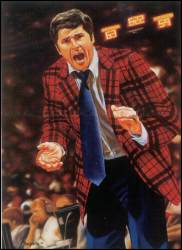
Knight, Smith reach top taking different routes


By Robyn Norwood,
Los Angeles Times Staff Writer
December 25, 2006

Bob Knight and Dean Smith share little in image or personal style, but their ideas on basketball often converged.

Knight, poised to break Smith's record of 879 victories as a Division I men's coach as soon as Thursday, once said Michael Jordan — who played for Smith at North Carolina and for Knight in the 1984 Olympics — described the differences most memorably.

"One time he said Dean Smith was the master of the four-corner offense and I was the master of the four-letter word," Knight wrote in his 2002 autobiography, "Knight: My Story."

"But he would always say that we had the same end in what we were trying to do."As Knight closed in on the record, tying it Saturday when Texas Tech beat Bucknell, The Times spoke to three contemporaries of the two men, quizzing them on a series of superlatives that ranged from serious to jesting.

Jim Calhoun has coached two NCAA championship teams at Connecticut and is a member of the Naismith Memorial Basketball Hall of Fame.

Gene Keady was Knight's adversary for many years when Knight was at Indiana and Keady was at Purdue.

And broadcaster Dick Vitale has known both for decades, referring to them admiringly as "Robert Montgomery Knight" and "Michelangelo."

Best coach with a five-point lead and two minutes left:

• Calhoun: Bob Knight. When he had his best players, it was almost like they were in some kind of trance. I've heard other coaches say that. They played with such discipline.

• Keady: That's an even one. I played them both, and I want to say there wasn't much difference. Both were very well-organized, great strategists, with great players.

• Vitale: I want to be a politician here, but when you're coming down the stretch, a guy like Knight, he holds a lead.

Best down five with 20 seconds left:

• Calhoun: The greatest coach ever, down any number, put Dean Smith. I have never seen a guy able to manipulate the clock like that, at a minute and a half, two minutes, 30 seconds. Nobody else could make some of the comebacks I saw his teams make over the years.

• Keady: Probably Knight. I remember one time, we were up one, and he got it inside to Dean Garrett and he stuck it in. (Purdue was ranked No. 2 in 1988 when Garrett's go-ahead basket with five seconds left helped Indiana to an 82-79 upset.)

• Vitale: Dean Smith, Michelangelo, for years was really, really great when he was behind. It was unbelievable, so many miracle wins.

Best judge of talent:

• Vitale: They were both recruiting blue-chippers throughout their careers. That was synonymous with Carolina and Indiana. But Dean could take a super player and get him to blend in and play as a team. People don't realize how difficult it is to have McDonald's All-Americans all the time.

• Calhoun: Dean could judge talent probably better than anybody. Michael was a name out of high school, but he wasn't like you have today. Dean took players and made them into much better players. And he also made great players into semi-role players. It was rare for a player to take over a game.

• Keady: Smith.

Best with less talent:

• Keady: Knight.

• Vitale: Knight could take even mediocre talent and get them to play their hearts out, to play to the best of their ability.

• Calhoun: Anybody who played for Knight instantly became better. He determined their role. I would say both could judge talent, and both could mold it. Steve Alford was a better college player because of Knight.

Best in a coaches' clinic:

• Vitale: I remember being a high school coach listening to Knight early in his career. I was absolutely in awe. So many concepts. He relishes those settings. Dean didn't like the public eye.

• Keady: They're probably equal clinicians.

• Calhoun: Dean is not as great a clinician, because he's a little secretive. He's probably most interested in social issues. I'd probably rather hear from Dean on social issues now.

Best at a booster club meeting:

• Vitale: I would give that edge without a doubt to Knight. Dean would rather not be part of a scene like that. Bob Knight can be hilarious when he's on a roll. He can rock the place.

• Keady: Probably Knight was the funniest at booster club meetings. I never heard Dean at one.

• Calhoun: No question, Bob is one of the most captivating speakers I've ever heard. I've heard Colin Powell, Mario Cuomo, Bill Clinton. Incredible. I put Bob Knight in the top five or six I ever heard speak.

Best NCAA tournament coach:

• Keady: I'm not touching that one.

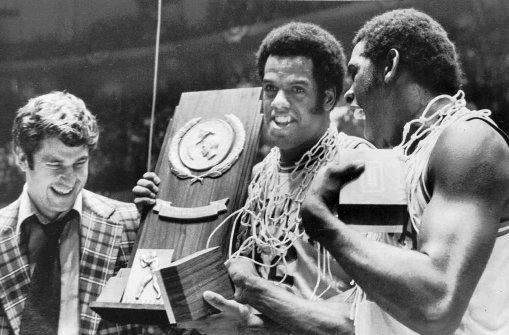
• Calhoun: I don't really think you can pick. Bob Knight won three and Dean won two.

• Vitale: Two guys, five national titles. They're in the Hall of Fame. I'm in the hall of shame!

Best Olympic coach:

• Keady: There was the boycott when Bobby was coaching in '84 in L.A., but I would say equal.

• Calhoun: You're talking now about two great racehorses.

• Vitale: I mean, they both won the gold. How can you pick one over the other?

Best if he were coach of the Lakers:

• Vitale: Knight's not a guy who's crazy about the NBA, but if he were coaching the Lakers, he'd get the utmost respect from Kobe [Bryant].

• Calhoun: Knight. Put him and Kobe together.

• Keady: Smith. I don't think Knight could put up with their baloney.

Best if he were coach of the Sparks:

• Vitale: Dean Smith is such a teacher from within. I think personally he'd do a great job with the Sparks.

• Calhoun: You couldn't put Bob with the Sparks. You just couldn't do that. I think Dean could coach anybody.

• Keady: The Sparks?

Best behind closed doors with his team:

• Keady: Bobby.

• Vitale: I think that's where both excelled. They were masters on a 94-by-50 court. There's no way I'd give an edge. That's their greatest asset.

• Calhoun: Bob Knight. I heard one of his meetings once, at the Great Alaska Shootout. We were sitting in the lounge and could hear it. It was an hour long. I wanted to go out and play. It was so captivating, we didn't move.

I think Dean was so much tougher behind closed doors than people know, and he was much tougher at practice than you would guess.

Best behind closed doors with his university president:

• Keady: Smith with the president.

• Calhoun: They're both good in their own way. There's no facet of history Bob Knight can't talk about, and Dean is very good on social issues. They did share one thing: Both men, when they were coaching their own institution, Dean at Carolina and Knight at Indiana, there was no other institution in the world. Duke has that now with Mike [Krzyzewski]. Mike thinks there's one place in the world that has basketball and that's Duke. It was the same way with them. There are very few guys who are part of the fiber of the institution like that.

• Vitale: That's easy. That's got to be Michelangelo!

Best companion on a hunting trip:

• Keady: Knight on a hunting trip, as long as he doesn't shoot you.

• Vitale: That would have to be Dean. I don't trust Bob with a loaded gun.

• Calhoun: Bob. I don't hunt, but I'd like to be with him.

Best companion on a golf course:

• Keady: That's not even close, Smith. All those Carolina guys are excellent golfers. Smith, Bill Guthridge, Larry Brown.

• Calhoun: Dean is a very good companion on a golf course, but he complains a lot about his game.

• Vitale: I've never played golf with either guy, but with Bob's reputation for having a temper, I'd give an edge to Dean.

Best player each ever coached:

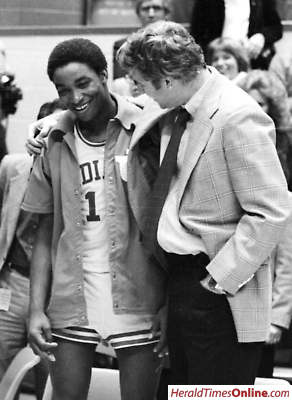
• Keady: That's easy. Michael Jordan and Isiah Thomas.

• Calhoun: It seems obvious, but was Michael Jordan as good when he was at Carolina as some other guys? You could make cases for others — [Sam] Perkins, [James] Worthy, Al Wood. I'll give you an example at UConn. Clifford Robinson was a good player at UConn, but he's gone on to be a 20-year pro. Khalid El-Amin was a great player here and part of six Big East championships, a national championship and two final eights, and he played one year in the NBA.

For Knight, Isiah.

• Vitale: Knight probably, I know, would not agree, but Isiah. Knight loved Quinn Buckner.For Dean, Michael.

Best remembered for:

• Keady: I think for Dean, his multiple defensive schemes. He was hard to play against. And Knight, probably for simplicity. He would keep it simple, but his simplicity beat you.

• Vitale: Both will be remembered for doing it the right way, with integrity and no NCAA violations. They had certain principles that never changed. Their philosophy of stressing the importance of the classroom to me will be remembered for generation after generation. And they learned more in their 94-by-50 classroom than basketball. They learned life skills in pressure situations, work ethic, pride.

• Calhoun: I think with Dean, the word "program." He turned a team into a program. I think he was the first in my life I ever heard express it that way. But from the moment he recruited somebody until they die, they're a Carolina guy. They all come back every year, Billy Cunningham, all of them, are there every single year. And I learned more about the fastbreak from Dean than anybody.

I think Bob Knight gets his kids able to focus. I heard him say once, "Never take a shot unless it's in earnest." But Bob, I think, is known much more for his volatility than sometimes he is known for his gifts, and, quite frankly, for being as clean a coach as ever went down the line. All the various things, grad rates, NCAA rules, he is truly exemplary.

*Times staff writer Mike Hiserman contributed to this report.

Wednesday, December 27, 2006

Fred Barnes: The Underappreciated President


Gerald R. Ford, 1913-2006.

http://www.weeklystandard.com
12/27/2006 2:00:00 PM

Gerald Ford was an underappreciated president. His greatest feat, leading America out of the traumas of Watergate and Vietnam, has routinely been viewed as an important but hardly towering achievement. But it was no small accomplishment. It was not something that any politician who stepped into the presidency, unelected, in August 1974 could have pulled off. It took a strong personality and guts.

Ford was a genial, likeable man, not entirely guileless but still an antidote to Richard Nixon, whom he replaced as president. Ford saw the best in people and assumed that even his political adversaries--he insisted he had no enemies--usually had good intentions. Nixon saw his opponents as sinister. Nixon was paranoid. Ford wasn't.

His appealing personality--his openness, his unperturbed reaction to critics, his cheerfulness and warmth--was a necessary factor in suturing the wounds left by the bitter political battles over Watergate and Vietnam. But imposing his personality on the nation wasn't sufficient for the task. That's where Ford's guts came in.

The fallout from the pardon, which Ford issued a month into his presidency, was predictable. His approval rating was instantly cut in half--from the 70s to the 30s. His election to a full term in 1976 became problematic at best, impossible at worst. And, as expected, he lost to Jimmy Carter narrowly in the 1976 race.

Ford knew the political downside of the pardon. But he went ahead anyway, and it had an extraordinarily benign effect in two ways. The pardon spared the nation the trauma of bringing a former president to trial, a polarizing drama that would have lasted for years. And it allowed Ford to govern without the distraction of a Nixon prosecution. Absent the pardon, Ford would have been a crippled caretaker in the White House.

By the time he became president, Ford was fast becoming a politician of the past. He was representative of an earlier era--the post-World War II years--and a fading brand of non-ideological Republicanism. He was a moderate who got along famously with Democrats, especially the crusty conservatives from the South and West. He felt strongly, as others did in that era, that politics should stop at the water's edge. In other words, he believed the foreign policy pursued by presidents, whether Republican or Democrat, should have bipartisan support.

But bipartisanship in foreign affairs had died in Vietnam. And Ford had to preside in 1975 over the fall of South Vietnam to the army of communist North Vietnam. This occurred after Congress, with its lopsided Democratic majorities, cut off funds to the South Vietnamese over Ford's fervent objections. As best he could, he sought to put the defeat in Vietnam behind him and prevent it from being a national obsession.

Ford was more or less a small government conservative. His favorite saying in speeches was: "A government big enough to give you everything you want is a government big enough to take from you everything you have." In his 29 months as president, Ford vetoed 66 bills, mostly on the grounds they cost too much.

Though he defeated Ronald Reagan for the 1976 Republican presidential nomination, Ford did not embody the party's future. Reagan did. Ford, with Henry Kissinger as his Secretary of State, championed détente with the Soviet Union and its bulging empire. Reagan rejected co-existence and pursued victory in the Cold War as his goal, and he achieved it.

It was two decades before Ford's success as president began to be appreciated. When presidential scholar Fred Greenstein of Princeton developed a half-dozen non-partisan, non-ideological measures for judging modern presidents, he found that Ford scored surprisingly well. Greenstein labeled Ford "underappreciated."

Ford's greatest strength, Greenstein wrote in his book The Presidential Difference, was his "emotional intelligence." This is the quality of emotional soundness that allows a president to avoid distractions, not be intimidated by his high office and its obligations, and to take criticism and even policy defeats with equanimity.

Greenstein wrote: "Ford's own remark about himself upon assuming the vice presidency in December 1973 was that he was 'a Ford, not a Lincoln.' In the second half of the 1970s, it was more to the point for the nation that he was not an emotionally roiled Lyndon Johnson or Richard Nixon."

As a young reporter, I covered Ford as vice president and then as president. And, like a handful of other reporters, I got to know him quite well. Ford was the last president who actually liked reporters. His fondness grew out of his experience with the press in the friendly atmosphere of Capitol Hill, and he refused to let the harsher media environment at the White House alter his dealings with the press. Best of all, he didn't let what reporters wrote or broadcast faze him in the least.

Every year since he left the White House in 1977, Ford held a dinner in Washington in which he gathered with officials from his administration. Not only were reporters who covered him invited, they showed up as well. My wife and I always did.

The last time I talked to Ford was several years ago. He called me after reading a piece I'd written for the Wall Street Journal, a piece that mentioned Hillary Clinton. Into his 90s, Ford kept up with politics and he had an insight about her that he wanted to pass on. I was flattered he called.

Ford had spent time with Hillary Clinton in the mid-1990s when she and President Clinton visited him at his vacation home in Vail, Colorado. He found her a bit scary but also very formidable. He was more impressed with her than with her husband, or at least I got that impression. She was someone to watch, he said, a woman with a political future. And of course he was quite right.

Fred Barnes is executive editor of THE WEEKLY STANDARD.

Paul Kengor: A Pair for History


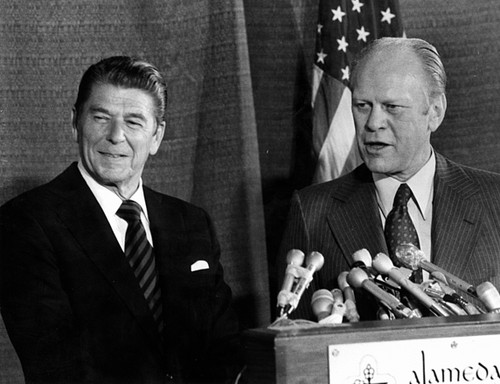
Presidents Ford and Reagan.

http://www.nationalreview.com/

December 27, 2006

On the day after Christmas 2006, 30 years after he lost his only presidential bid, Gerald R. Ford, the nation’s 38th president, was called home. At age 93 and five months, he was the longest-living president, outlasting Ronald Reagan, who died at 93 and four months.

The Ford-Reagan link in death is both appropriate and ironic, given the deep and intertwined history the two Republican presidents share.

It was the Gerald Ford/Ronald Reagan relationship of 1975-76 that provided the ultimate contrast between the two one-time rivals, and that defined Ford’s presidency, both in policy and in style.

Disgruntled with Ford’s pursuit of détente with the Soviets, Ronald Reagan in 1975 decided to seek the seemingly impossible: to challenge the incumbent president from his own party, thereby breaking Reagan’s own “Eleventh Commandment:” “Thou Shall Not Speak Ill of Another Republican.”Reagan fired unceasingly at Ford’s support of détente. “We are blind to reality if we refuse to recognize that détente’s usefulness to the Soviets is only as a cover for their traditional and basic strategy for aggression,” he said in October 1975. “Détente is for the Soviet Union a no-can-lose proposition.”

Reagan opposed Ford’s signing of the Helsinki Accords in August 1975, a product of détente which Reagan perceived as a human-rights farce. He said it was nothing more than a “propaganda plus” for the Kremlin. By signing the accord, the United States had, in effect, “agreed to legitimize the boundaries of Eastern Europe, legally acquiescing in the loss of freedom of millions of Eastern Europeans.” Worse, said Reagan, Helsinki did nothing to constrain the Soviets outside of Eastern Europe. “After Helsinki,” wrote Reagan correctly, “the Soviet Union quickly made it clear that the so-called ‘wars of national liberation’ of which they are so fond, would not be affected by the document.”

Reagan hit détente so hard throughout the campaign that there was a consensus that President Ford stopped using the term because Reagan had made it a dirty word. So successful was Reagan that the New York Times, in a May 14, 1976, editorial titled “Mr. Reagan’s Veto,” claimed that the former California governor had “won something approaching veto power over the Ford Administration’s foreign policy.” As Reagan did, Ford dropped in the polls. In another editorial, titled, “President Under Seige,” The Times opined: “Governor Reagan has become a credible candidate while President Ford has slipped from almost certain victor to underdog.”

Reagan was making a dent, and Ford knew he was now vulnerable in the primaries. After New Hampshire, Ford had surged to five consecutive decisive victories, at times by big margins. These wins came mostly in the liberal northeast. As Reagan aide Martin Anderson remembered, the unasked question to Reagan by his campaign staff was, “When are you going to quit?” Reagan, however, was adamant. “I’m taking this all the way to the convention in Kansas City,” he declared defiantly, “and I’m going even if I lose every damn primary between now and then.”

Immediately after that decision, Reagan won North Carolina, claimed a huge triumph in Texas, and followed with victories in Indiana, Georgia, and Alabama. The Ford team began shaking in its boots. In a stunning turnabout, a new question was posed: Could Reagan go to the Republican convention in August and win enough delegates on the first ballot? Reagan estimated a “very great possibility, if not probability,” that he could do just that.

Suddenly, Ford not only dropped the word détente but replaced it with the preferred phrase of Reagan: “peace through strength.” In a pronouncement that signaled a startling concession before the convention, a waffling President Ford declared: “Our policy for American security can best be summarized in three simple words of the English language: peace through strength.” Reagan chuckled, noting it was “a slogan with a nice ring to it.”

All of this came to a head on August 19, 1976, when Republicans held their convention at the Kemper Arena in Kansas City, where Reagan, in the end, did not get the nomination, crushing his supporters. And it was then, at that precise moment, that Gerald Ford’s immeasurable graciousness was again put on display before the entire nation:

President Ford had just finished speaking. As a gesture of reconciliation and supreme good will, he waved from the podium to the Reagans, seated in a skybox. He beckoned Reagan to come down to speak. The Republican faithful exhorted, “Ron! Ron! Ron!” They chanted “Speech! Speech! Speech!”

A blushing Reagan refused, gesturing his hands downward, pushing delegates to sit down and shut up. “It’s his night,” he muttered to friends, deferring to Ford. “I’m not going down there.” Ford pressed on: “Ron, will you come down and bring Nancy?” National television audiences watched in anticipation, as ABC, CBS, and NBC news anchors peered through binoculars with moment-by-moment commentary.

Reagan eventually obliged. As he trotted down the corridors on his way to the podium, he said to Nancy, “I haven’t the foggiest idea what I’m going to say.”

Reagan soon resolved the problem, giving one of the most memorable convention speeches in American history. Official biographer Edmund Morris later wrote of the extemporaneous talk: “The power of the speech was extraordinary. And you could just feel throughout the auditorium the palpable sense among the delegates that [they had] nominated the wrong guy.”

The race for the GOP presidential nomination had come down to the wire, and Ronald Reagan fell frustratingly short. He missed by only 117 votes, grabbing 47.4% of delegates in an 1187 to 1070 contest. The winner needed 1130.Three months later, Gerald Ford lost the presidency to Jimmy Carter.

From 1974-79, during those Ford-Carter years, the Soviets picked up eleven proxy or satellite states around the world. America was losing the Cold War. The third and most disastrous year of Carter’s presidency — 1979 — ended with Americans taken hostage in Iran in November and the Soviets invading Afghanistan in December. Now, much of America agreed with Reagan that détente was a joke. His time would come a year later.

The Ford-Reagan relationship in the 1970s was a metaphor for Ford’s presidency: His policy toward the Soviets was flawed, and he was neither a notably effective nor inspiring president, but his kindness as a person was hard to surpass.

Gerald Ford’s contribution to history came in his service as a transitional figure, one who no doubt helped heal a divided nation during a critical post-Watergate period, which he achieved through that gentle demeanor. Quite unintentionally, he made another contribution: like Jimmy Carter, he offered an example of what not to do in Cold War policy. By giving détente a chance, and thus an opportunity to show its true colors, he unwittingly revealed it to be a failed route, paving the way for Ronald Reagan to be successful not in 1976 but in 1980, and thereby allowing Reagan to later make a much deeper impact on history.

It is always difficult to look back and say that a certain president was a failure in the strict sense of being a step backward. Ford was probably the right man for the right place in time. The contours of American history have a wonderful almost magical way of somehow weaving together, coming into focus and making sense only in retrospect. Gerald Ford’s brief, unelected tenure has its own place in the mosaic.

— Paul Kengor is author of The Crusader: Ronald Reagan and the Fall of Communism and associate professor of political science at Grove City College in Grove City, Pa. He is also director of the Center for Vision & Values at Grove City College.

Bob Klapisch: Go west, old man


Wednesday, December 27, 2006
BERGEN COUNTY RECORD


It was late last week when Randy Johnson sent word to the Yankees that he was open to any exit strategy that would free him from New York, its loud, rude fans and, mostly, the American League's power-hitting culture.

Of course, Johnson wasn't quite so blunt; the left-hander merely said he wants to be closer to his family in Arizona. But the Bombers nevertheless seized the opening. They're moving closer to ending this failed marriage, which is good news for Joe Torre's clubhouse, if not his rotation.

Clearly, the Yankees realize Johnson can't help them -- at least not in the way they'd once hoped. A person familiar with the Yankees' off-season plans say Barry Zito would become a prime target to replace the Unit, although it's unclear whether general manager Brian Cashman wants to engage in a bidding war with the Mets and Rangers. The Mets seem braced for that possibility. One insider said, "If one [team] wants to blow everyone else out of the water, there's not much we're going to be able to do about it."

Whether or not Zito is lured to the Yankees, and apart from Johnson being traded, the Yankees still are targeting Roger Clemens, willing to make room for him in the rotation if and when he wants to wear pinstripes again. While no one expects Clemens to make up his mind about 2007 for several more months, one Yankee insider said, "All he has to do is say so" and a deal would be struck.

The Yankees' eagerness to sign The Rocket is borne, in part, by their disappointment in Johnson. From the first day he became a Yankee, it was obvious the Unit didn't like being questioned about his diminished fastball. He didn't like questions, period. Johnson was distant and aloof -- and that was on a good day. More often, the Unit was just angry, giving off a dark vibe that made teammates uncomfortable. One Yankee official said one day last summer:
"Randy was the kind of guy who, if you asked him, 'How's it going?' he'd stare you down and say, 'What do you mean by that?' He was the most socially awkward person I ever met around here."

Maybe it was nerves, maybe it was the constant pain from a herniated disk in his back. Maybe it was Johnson's idea of acting tough in a big-market environment. Whatever the cause, Johnson never lived up to the promise of being a Clemens-like savior, despite his 34 wins in two seasons. Torre spent a full summer in 2005 covering for Johnson, explaining that the former National League Cy Young Award winner needed time to adjust to a new league. But by 2006, everyone stopped waiting for the old Unit to resurrect.

He degraded into a seven-inning, four-run pitcher -- which, these days, is enough for journeymen such as Ted Lilly and Gil Meche to earn $10 million a year. But the game's greatest left-hander wasn't supposed to be this mortal. The Yankees were shocked to see how many middle-of-the-plate, 93 mph fastballs Johnson threw, coupled with a slider that was a pale imitation of the pitch that swallowed up right-handed hitters in the NL.

The more Johnson tried to reignite the engines of his past, the more frustrated and withdrawn he became. He talked to no one, it seemed, spending his time at his locker with his back to the room. When Johnny Damon tried to pump up the slumping Yankees one day in August, standing in the clubhouse shouting, "Come on you [bleepers], let's go," he was met with a cold stare from Johnson. Damon was so unnerved by the reaction, he later asked a team executive, "Did I do something wrong?"

Apparently, none of this is deterring the Diamondbacks, Padres, Angels and Mariners, all of whom are interested in prying Johnson away from the Yankees. Cashman has been given the latitude to make the best possible deal, and if it requires swallowing some of the $16 million Johnson is owed in 2007, the Yankees will do so.

Of course, Cashman will have to spin Johnson's creaky peripheral stats; the left-hander's 5.00 ERA last year was the highest of his career, and the 179 strikeouts were the lowest full-season total in 19 years. But the Yankees already are telling suitors that was all attributable to a bad back, which has since been surgically repaired.

At least one baseball executive seemed willing to believe the Yankees. He said, "I happen to believe if you put Johnson back in the National League, closer to home, he can still be a factor."

Maybe not as a No. 1, but Johnson still throws hard enough to tame most NL hitters, even at age 44. With the D-Backs, the Unit instantly would become a No. 2 starter behind Brandon Webb.
Maybe everyone will walk away happy, or at least wiser. Johnson came to New York thinking he could shut out the noise and the frenzy, bullying reporters, distancing himself from teammates.
The Unit assumed he could make it to the World Series (and career victory No. 300) without any emotional investment in the Yankees or New York.

Turns out Johnson had neither the stuff nor the personality to become a star in the Bronx. But that's not Cashman's fault; Johnson's acquisition represents the final gasp of the George Steinbrenner era -- the last of a long line of marquee players who, despite their on-paper talent, somehow shrank in New York.

At least Johnson recognizes how wide the gap became between expectation and reality. This is one divorce that won't be contested.

E-mail: klapisch@northjersey.com

Jim Litke: Knight's long road to record


Dec 27, 2:39 PM EST
By JIM LITKE AP Sports Columnist

Nobody should begrudge Bob Knight his next win, the one that nudges him past Dean Smith and into first place on college basketball's all-time Division I men's list. If it helps, think how much earlier Knight might have reached this milestone if he hadn't wasted so much time bullying the hired help and throwing tantrums.

But enough about that for a moment.

Turn on TV to catch a game and much of what you see on the floor Knight drew up some four decades ago. Just about every team runs some version of his motion offense, or man-to-man defense, but only he still runs both religiously. It's Knight's notion of what the game should look like at any moment, a snapshot that's proved remarkably resilient in this digital age, when kids want to leap straight into prime-time highlights, then dunk and never come down.

Before he ever coached a game, Knight was the sixth man on an Ohio State team that was as talented as they come and a lot more mature than they get nowadays.

Using his time on the bench wisely, Knight cooked up a perpetual-motion scheme that made it possible for any kid - and not just stars like John Havlicek or Jerry Lucas - to wind up with the best shot, provided both he and the basketball were moving often enough. Belief in that system is the reason anybody who drives across Indiana sees backboards hanging above every patch of gravel or concrete across the countryside or braced against a telephone poll.

For all that, more than nostalgia props up the legend. Knight hasn't won a really big game in a long time - the last of his three national titles came in 1987, his last conference title in 1993, and his team's haven't advanced past the second round of the NCAA tournament in the past dozen years. He was losing recruiting battles regularly even before then, refusing to cater to a generation that valued exposure as much as excellence and daring anybody to make him change.

The talent deficit, though, eventually caught up with Knight. You could have stacked all the videotapes of a red-sweatered menace crossing the line with players, assistants, referees, reporters and even administrators outside his office door in Bloomington, but it wasn't until Knight started losing too many big games that Indiana pulled the rug out from under him. When he resurfaced a year later at Texas Tech, he knew the talent gap would only widen.

Knight put down roots in Lubbock anyway, a move that at the time seemed less about reclaiming past glory than methodically overtaking Smith and the D-I record. Little has happened since to change the perception. Knight has upgraded slightly the caliber of players who might consider playing there, and he's had to relax some dearly held rules about haircuts and tattoos to accomplish even that.

But he's brought respectability and 20-win seasons to another town, and the same system that once drew the best players in the country to him like a magnet worked well enough with middling talent to put Knight even with Smith heading into Thursday night's game against UNLV. If Knight doesn't get that one, he's almost certain to take sole possession of the top spot in either of the two home games that follow.

Some milestones carry a significance beyond their numbers, and when Smith went past Adolph Rupp back in 1997, more than a few members of the fraternity saw it as the fitting conclusion to an era of exclusivity.

The cold-hearted Kentucky baron stood astride the game for more than 40 years, but only one black played basketball there during that stretch. Smith made integration a cornerstone of his program at North Carolina, not simply benefiting from the cause but actively championing it.
That's why in the days leading to his supplanting Rupp at the top, Nolan Richardson - who is black and won a national title at Arkansas - said he would "sleep much better at night knowing Dean is the man."

There have been dozens of tributes to Knight already, and more to follow in the coming days. All of them will be about how he graduated kids and never, ever cut corners, but mostly about how much he bequeathed all the coaches who followed him. That will be Knight's legacy, plain and simple.

Some of those disciples, most notably Duke coach Mike Krzyzewski, who played point guard for Knight at Army and served his coaching apprenticeship there, too, soaked up the lessons and moved on. Knight is too competitive to wish Coach K or anybody else luck trying to go past him. But when - if - that time comes, Knight won't have any problems waving him by and even fewer regrets.
---
Jim Litke is a national sports columnist for The Associated Press. Write to him at jlitke@ap.org

Michael Ledeen: Good Knight


December 27, 2006 11:00 AM
An alternative view of Bob Knight.
http://www.nationalreview.com

Thursday evening the Texas Tech men’s basketball team plays at home — Lubbock —against the University of Nevada at Las Vegas, UNLV, once a superpower now fallen from grace. If Texas Tech wins, their coach, Robert Montgomery Knight, will become the winningest coach in the history of the sport. And since most of the hunting pack that has pursued Knight throughout his career will recount his many sins, it’s only fair you hear the bright shining side of this knight errant.

Yes, he’s got a temper. I have never known a winning coach in any sport who did not have a terrible temper. A few years ago I went to the Final Four in Indianapolis and watched Wisconsin lose to Florida. The Wisconsin coach was named Bennett, and everybody loved him. At a certain point one of his players committed a stupid foul and he called timeout, walked onto the court, and let fly at this poor kid with a torrent of abuse that would have made Knight blush (which is saying something). We were sitting two rows down from the Arctic Circle, and we heard every epithet. But there was no mention of it in the press coverage, because the hunting pack had decided the guy was lovable. Knight loses his temper and throws a chair across the court — aimed badly, I suppose, he didn’t hit anyone — and it’s good for an encyclopedia of evil. And that chair’s civil rights have been better protected than mine.

Red Auerbach used to say that Knight is one of a handful of coaches who have created modern basketball, along with the likes of John Wooden and Pete Newell. Other coaches look for role players, they need centers and point guards and forwards and shooting guards. Not Knight. He runs a motion offense in which everyone is supposed to be able to do everything; it all depends on how the other team reacts. When it works as it’s designed, it’s one of the most fascinating and entertaining of all sports spectacles.

In the world of big-time college athletics, overpopulated with fakes and cheats, Knight is the real deal. He recruits according to the rules, and he insists that his players take real courses and pass them, and then graduate. This is not what the boy wonders of hoops want from life, and they rarely go to play for Knight. They want to be coddled and enriched and tutored and given a free ride and then cash in.

Not Knight’s players.

I once interviewed a member of his first team at Indiana, an all-American who met with Knight shortly after the coach’s arrival in Bloomington. Knight glared at him and said, “I’ve just looked at your transcript. You’re not going to class, you’re not doing your work. If you miss class, you won’t practice. And if you don’t practice, you won’t play. If that’s too tough for you, I’ll help you transfer to some place where they don’t give a damn.”
The all-American called his father in a panic, only to find that his dad was thrilled. “Thank God,” he said, “now you’ve got a chance in life.”

No one has gotten more success out of less talent than Bob Knight. And those guys more often than not go on to success in life.

He’s got some interesting friends: George Will, David Halberstam, Clarence Thomas. They know that Knight’s a very smart man, and a real scholar of military history. I heard him introduce Halberstam to a high-level seminar at Indiana early one morning. Knight spoke for about ten minutes, no notes, no ands or uhs, an elegant overview of Halberstam’s work, a brief expression of gratitude for coming out to Bloomington, and a thoughtful wish for the success of our work. No full professor could have done it better.

Keep these things in mind when he sets the record, whether it’s Thursday or later on. He’s a stormy petrel, to be sure. But he’s a real American, a feisty, outspoken, cantankerous, brilliant guy who has done wonders on and off the court for generations of young men. And when you hear all those stories about his temper and his bluntness, remind yourself that the kids who chose to play for him knew exactly what they were getting into. But they thought it would be worth it, both because they’d learn a lot and because they’d have tested themselves at the highest level of character.

Which is a hell of a lot more than you can say about the hunting pack.

Thomas Sowell: A Dangerous Obsession, Part II

Wednesday, December 27, 2006
http://www.townhall.com

The media and academic obsessions with economic "disparities" have gone international. Recent news stories proclaim that most of "the world's wealth" belongs to a small fraction of the world's people.

Let's go back to square one. Just what is "the world's wealth"?

You can check in your local phone book, surf the Internet or do genealogical research: There is no one named "The World." How can a non-existent being own wealth?

Human beings own wealth. Once we put aside lofty poetic nonsense about "the world's wealth," we at least have a fighting chance of talking sense about realities.

Who are these minority of the world's population who own a majority of the world's wealth?
They are the population of the United States, Western Europe, Japan and a few other affluent countries. How did these particular people come to possess so much more wealth than other people?

They did it the old-fashioned way. They produced the wealth that they own. You might as well ask why bees have so much more honey than other creatures.

The rhetoric of clever people can verbally collectivize all the wealth that was produced individually, and then they become aghast at the "disparities" that are magically turned into "inequities" in the distribution of "the world's wealth."

Have all the people in the world had an equal chance to produce wealth? No, nowhere close to an equal chance -- either in the world or within a given society.

Geography alone makes the chances grossly unequal. How were Eskimos supposed to grow pineapples or the bedouins of the desert learn to fish?

How were people in the Balkans supposed to have an industrial revolution like that of Western Europe, when the Balkans had neither the raw materials required by an industrial revolution nor any economically viable way of transporting raw materials from other places?

The geographic handicaps of Africa would fill a book. French historian Fernand Braudel said: "In understanding Black Africa, geography is more important than history."

What are we supposed to do about these disparities? File a class-action lawsuit against God?

The 9th Circuit Court of Appeals might accept such a lawsuit but they are unlikely to be able to do much about the situation.

Geographic disparities are just the tip of the iceberg. Innumerable cultures have evolved differently in different places and among different peoples in the same places. No given individual controlled this process and each generation began with the particular culture that generations before them had created.

Some cultures proved to be more economically productive at given places and times, and other cultures proved to be more economically productive at other places and times.

In our own time, the economic effects of these cultural differences often dwarf the effects of differences in material things like natural resources.

Natural resources in Uruguay and Venezuela are worth several times as much per capita as natural resources in Japan and Switzerland. But income per capita in Japan and Switzerland is about double that of Uruguay and several times that of Venezuela.

Nobody likes to see poverty in a world where technology and economic know-how already exist that could give everyone everywhere a decent standard of living.

All you have to do is change people. But have you ever tried to do that?

The quick fix is to transfer wealth. But more than half a century of trying to do that with "foreign aid" has left a dismal record of failure and even retrogression in Third World countries.

Some countries have themselves made changes that lifted them from poverty to prosperity.
Indeed, the affluent countries of today were once living in poverty.

But they didn't do it with quick fixes or by turning a dangerous power over to politicians.

Thomas Sowell is a senior fellow at the Hoover Institute and author of Basic Economics: A Citizen's Guide to the Economy.

Tony Blankley: A Year For the Forces of Darkness


December 27, 2006
The Washington Times
Tony Blankley

Two thousand six is coming to an end much as it began: with war, terrorism, bloodshed and moral confusion. From Afghanistan to Iraq to Somalia in the Horn of Africa, warfare continues between regular military establishments and irregular radical Islamist forces (which range from straight-out terrorist groups to private militias, death squads, warlords and criminal elements).

In the Horn of Africa, historically Christian Ethiopia has declared war -- not on the Somali government with which it is allied -- but against the Council of Islamic Courts, an Islamist entity in Somalia with probable al Qaeda connections that aspires to govern -- perhaps a la the Taliban. As of Tuesday morning, the Ethiopian attack with tanks, helicopters and fighter jets is advancing "decisively" on all fronts.

But just as American military forces moved decisively in Iraq in 2003, only to face rising irregular opposition, we probably have not heard the last of the Ethiopian/Somali conflict -- which could enflame the entire Horn and environs from Sudan to Eritrea, Djibouti, Kenya and Tanzania -- as well as Somalia and Ethiopia. According to the Associated Press, some observers believe that the Horn is being targeted as the third front (after Iraq and Afghanistan) "in militant Islam's war against the West."

On the terrorist front, the Associated Press reported on Christmas Eve from London that: "Islamic militants want to attack the Channel Tunnel between England and France during the holiday season, a British newspaper said Sunday, citing French and U.S. security sources. The Observer said the French foreign intelligence service, DGSE, warned the French government of the threat in a Dec. 19 report after a tip-off from the CIA.

"The newspaper cited unidentified French officials as saying the plot was being directed from Pakistan and involved militants in western Europe, possibly Britons of Pakistani descent. ... The newspaper also said that militants with links to al Qaeda were plotting a wave of attacks on an unidentified European country, with the plot planned and run from Syria and Iraq. ... British officials warned Friday that there is a high threat of an attempted terrorist attack over the Christmas and New Year period ... "

Of course, rumors of terrorist attacks have become the background noise of our times -- to such an extent that they are largely discounted by most of the public. Also in that background noise of civic life is the growing assertiveness of many Muslims in the West. The year 2006 began with the Danish cartoon publications, the alleged blasphemy of which drove violent Muslim demonstrations around the world. Later in the year, Pope Benedict's lecture on reason, violence, Islam and the West also generated worldwide violent demonstrations by some Muslims -- including the murder of a Christian nun.

The year also saw the provocative acts of the "flying Imams," which were used by various American-Muslim "civil rights" advocates to try to persuade airlines and law enforcement officials to not challenge Muslims whose conduct would naturally arouse suspicion and fear. Were these assertions legitimate expressions of concern for unfair treatment of Muslims, or are they part of a calculated campaign of intimidating both our government and the public into exempting Muslims from normal and legitimate law enforcement scrutiny? And if the latter -- to what end?

This fall, an article in a scholarly military journal analyzed the doctrine behind the increase in American Special Forces troops to about 50,000 currently -- toward a target of about 65,000 troops. This unprecedented increase in Special Forces is premised, pointed out the article, on the probable need to fight radical Muslim terrorists in rough country such as -- but not limited to -- Afghanistan, Iraq and Somalia. But the burden of the article was the assessment that the Special Forces build up was premised on the assumption that such places would be where terrorists would gather and work. However, the article pointed out, there is increasing evidence that the terrorists are also likely to assemble in the urban cities of Europe -- a terrain in which we would need different fighting (and legal and diplomatic) tactics which would require either re-trained Special Forces or other military/intelligence/law-enforcement-type American forces and doctrines.

Let me emphasize, to my knowledge it is not currently American military doctrine to plan and train for European urban warfare between American and Islamist terrorist forces. But serious scholars and analysts are beginning to wonder whether it should be. Of course specialists have to think about even remote contingencies. Whether such a contingency is remote, nonexistent or likely is at this point speculative.

Indeed, there is little about the threat from radical Islam that is not speculative. Those of us who find the darker potentialities sufficiently plausible to require active American and Western preparation are considered alarmists by those who expect the future to vary only by degree from the present state of relative inter-civilizational peace. I hope they are right.

But as we come to the end of the difficult year 2006, nothing has emerged to refute these darker fears, and in fact, evidence -- admittedly ambiguous -- continues to assemble to support them. Certainly from Iraq and Afghanistan to Africa, Europe and America, 2006 has been a good year for the forces that may be out to destroy our way of life.

Tuesday, December 26, 2006

Mike Schmidt: More deserve Hall recognition


Sunday, December 24, 2006
By MIKE SCHMIDT
ASSOCIATED PRESS

One of the most popular discussions in all of sports relates to the baseball Hall of Fame -- who's in, who will be, who should be and who isn't.

As a member, I am always intrigued by the members' meetings in Cooperstown when we discuss the Veterans Committee ballot.

Everyone has their guy, their crony, a past teammate they feel is being underrated. That's great that so many people, including the members, are concerned about the guys who just didn't make the grade -- not to mention the real vote by the baseball writers, who now have to consider juiced balls, bats and bodies.

Having said that, ponder this question I posed at a recent meeting: Doesn't a voter's opinion on a particular player have a great deal to do with how the voter himself perceives the Hall of Fame?

No one truly believes the Hall is exclusive to the all-time greatest, and no one believes the Hall should honor mediocrity. There is a happy medium somewhere, and where you fall in that range should determine your voting philosophy.

You can't have strict criteria when judging one man and then flexible criteria when judging another. You can't allow politics to enter into it in any way, but in many cases it has made the difference. With all due respect to current members Ryne Sandberg and Bruce Sutter, how can Dale Murphy and Lee Smith be kept out? Their careers are identical and in certain areas, better.

Jim Kaat, again with due respect: How can a guy with 283 wins, 16 Gold Gloves and 24 years as a player and another 30 as a baseball ambassador not be a lock choice? Don't get me started on comparisons related to Kaat! He's even got all the politics covered.

The big issue confronting the writers voting this month concerns Mark McGwire. He was baseball's superman. The public wanted to see his giant biceps and long bombs, and could care less what he was putting in his milk.

Now you want to vilify him because he doesn't want to own up, or admit, or even refute an involvement with steroids? Whoa! I'd ask the voters to look past the basic question -- did he or didn't he? -- and consider the era and what fueled it.

So what does "Hall of Fame" say about a player? How good does one have to be? How can certain guys slide in and others with similar careers can't?

Originally when opened, there were fewer players, a smaller game, so picking Hall members was easy -- the best of the best.

Everyone knew the Hall of Fame was for Ruth, Gehrig, Cobb, Foxx and Young. Then it was for DiMaggio, Williams, Mantle, Musial, Mays, Aaron and all the Robinsons. And as the game grew bigger came Koufax, Seaver, Palmer, Kaline, Killebrew, Jackson, Bench, and then Ryan, Brett, Carlton. Now Gwynn, Ripken and on and on, the best of the best.

That was the plan, but someone decided the baseball writers' vote slighted a few players along the way and the Veterans Committee was created to right what was apparently wrong.
No longer was it cut and dried. If you were passed over you got a mulligan. In the first round, your career was just a little short of HOF caliber; in round two, for some reason, the career got better.

That's OK, because it's a subjective vote and a lot of little things go into it. Maybe you didn't play in New York, maybe you were quiet and didn't look for attention or weren't as cooperative with the media as some.

Thomas Sowell: The Media's Dangerous Obsession

December 26, 2006
Thomas Sowell

The media and academia are continuously obsessed with "gaps" and "disparities" in income. As one talk show host put it, "It makes no sense" that a corporate executive makes over $50 million a year.

Ninety-nine percent of all the things that happen in this world "make no sense" to any given individual. Do you understand how your automobile's transmission works? Could you repair it if something went wrong?

Do you understand how aspirin stops headaches? How to make yogurt?

Years ago, a famous essay pointed out that nobody knows how to make a simple lead pencil.

That is, there is no single individual anywhere who knows how to grow the wood, mine the graphite, produce the rubber, and manufacture the paint.

Complex economic processes cause all these things to be done and coordinated by a wide variety of people, just in order to produce something as simple as a lead pencil. Multiply that by a hundred or a thousand when it comes to the complexity of producing a car or a computer.

If you cannot understand something as simple as making a lead pencil, why should you be surprised that you don't understand why someone is making a lot more money than somebody else?

Moreover, if this obsession with income disparities is to be something more than mere hand-wringing or gnashing of teeth, obviously the point is that somebody ought to "do something" to change what you don't understand.

Usually that means that the government -- politicians -- should impose policies based on your ignorance of what is going on. Can you imagine anything more dangerous than allowing politicians to decide how much money each of us can earn?

Of course, such political control of incomes is usually advocated only to deal with "the rich." But, when income taxes were imposed in the early 20th century, they applied only to "the rich" and they took a very small percentage of their income.

Once the floodgates are opened to this kind of political power, however, we have seen with the income taxes that they not only spread far beyond "the rich," they took a serious share of even middle class incomes.

Moreover, the income tax has spawned an intrusive bureaucracy, creating so much complexity and red tape that millions of ordinary citizens have to go get some accountant to fill out the forms for them -- and then sign under penalty of perjury that it was done right.

If you knew how to do it right, you wouldn't have to go to somebody else to have it done, would you?

Incidentally, it took a Constitutional amendment to enable the federal government to impose an income tax. The people who wrote the Constitution were wise enough to understand what a dangerous thing it would be to allow government to take money from people just because those people had it.

Unfortunately, "progressives" were foolish enough, or envious enough, to single out "the rich" for a process that would inevitably spread across society and become insatiable in its demands.

Today's "progressives" want to expand political control of incomes even more. They call it "social justice" but you could call it Rumpelstiltskin and it would still mean politicians deciding how much money each of us can be allowed to have.

It is also worth noting that the people who are said to be earning "obscene" amounts of money are usually corporate executives. There is no such outrage whipped up when Hollywood movie stars make some multiple of what most corporate executives make.

This is social or ideological bias added to envy and ignorance. It makes quite a witches' brew on which to base national policy.

Lofty talk about "social justice" or "fairness" boils down to greatly expanded powers for politicians, since those pretty words have no concrete definition. They are a blank check for creating disparities in power that dwarf disparities in income -- and are far more dangerous.

Jamie Glazov: Nifong's Folly


http://www.FrontPageMag.com
December 26, 2006

Frontpage Interview's guest today is KC Johnson, a professor of history at Brooklyn College and the CUNY Graduate Center. With a B.A. and Ph.D. from Harvard University, he specializes in 20th century U.S. political, constitutional, and diplomatic history. He writes a blog, Durham-in-Wonderland, which offers comments and analysis about the Duke/Nifong case.


FP: KC Johnson, welcome back to Frontpage Interview.

Johnson: Thank you for having me.

FP: So, with the lack of DNA evidence, the prosecutor has now dropped the rape charges against the three Duke University lacrosse players. But he has kept the other charges (sexual offense and kidnapping) in place.

What could possibly be left of a case if the accuser, who for months insisted that she was raped, is now – as demented as all of this is – no longer even certain that vaginal intercourse occurred in the first place? What possible credibility can there be here to anything she says? She has already given investigators more than a dozen different versions of the alleged assault and DNA samples were found from five unknown men.

What gives here? What prosecutor with any integrity would even continue with this case?

Johnson: In a word, no prosecutor with any integrity would continue with this case—but if we have learned nothing else over the past nine months, Mike Nifong is not a man of integrity.

At this point, no pretense exists that anything but self-preservation motivates Nifong. By dropping the rape charges, Nifong effectively impeached his only witness. On April 4, the accuser was shown photographs of the 46 white players on the Duke lacrosse team. In that lineup, the accuser made multiple errors (for starters: claiming to have seen two players who could prove they weren't at the party and incorrectly identifying the player who made the broomstick comment). But she identified four people as possible attackers, and Nifong chose three to indict.

She did more than identify, however: she described what each of the alleged attackers did to her. By offering a new version of events 282 days after the party, Nifong argues for disbelieving the accuser's on-tape descriptions of acts from the April 4 ID session.

But Nifong needed to impeach the accuser to help his own cause. In a December 15 court session, Dr. Brian Meehan, head of a private DNA lab, stated under oath that he and Nifong entered into an agreement to intentionally withhold exculpatory DNA evidence. This move violated North Carolina's Open Discovery Law and contradicted the principle of the Brady decision, which requires turning over any potentially exculpatory material to the defense.

Like a prospective defendant in an ethics or possibly even criminal case, Nifong needed to find ways to minimize the significance of the exculpatory evidence he and Meehan conspired to prevent the defense from seeing.

The bizarre decision to drop the rape charges but retain the others can only be explained by looking at Nifong's legal needs. By claiming that no rape occurred, Nifong can, perhaps, rationalize the decision reached by Meehan and him that the DNA from five, unidentified males was irrelevant to the case, and therefore should be excluded in Meehan's report.

Ironically, his action should have no effect on the ethical problems the Meehan revelations will pose Nifong: even if the allegations are sexual assault rather than rape and sexual assault, DNA from five other males as part of the rape kit is clearly exculpatory material, and no justification exists for withholding it.

FP: This is all isn't about the truth, of course, but about a leftist political agenda. The motives are clearly sinister, no? Even as Nifong's case unravels, Duke's faculty is still overwhelmingly hostile. How could this possibly be? Can you give us some of the details and your interpretation?

Johnson: Even at this late stage, 18 times more Duke faculty members have issued statements or taken actions critical of the lacrosse players than have either defended the players' character or publicly attacked Nifong's behavior.

In early April, 88 members of Duke's arts and sciences faculty signed onto a public statement that said "thank you" to campus protesters who had branded the lacrosse players rapists. The story, it seems, was irresistible to those who see the world through a race/class/gender worldview. One signatory, Wahneema Lubiano, even wrote that the players were "perfect offenders"; another, Mark Anthony Neal, wrote that the affair showed the need for Duke to adopt a "progressive" curriculum.

Ironically, for figures who were so eager to condemn others, some members of the Group of 88 have less than pristine personal backgrounds. Take Lubiano, for instance. On her CV, she has listed two books as forthcoming, in 1997—one from Verso press, the other from Duke University Press. Neither book has seen the light of day; neither press has any record of either book on its website.

For the Group of 88 and their ideological allies, this issue isn't about justice or Nifong's misconduct: it's about exploiting the case to advance their own pedagogical or ideological agendas.

FP: Tell us about the continued hypocrisy of the NAACP.

Johnson: Before this incident, the North Carolina NAACP had a recent record of aggressively demanding procedural changes that would ensure fairness for criminal defendants. For instance, the state NAACP backed a 2004 law mandating that prosecutors turn over their entire files to the defense; and also had championed new eyewitness ID procedures calling for use of seven filler photos for every suspect and other due process-friendly changes.

In this case, Nifong created a lineup confined to suspects (the lacrosse players), while on December 15, the head of a private DNA lab admitted under oath that he and Nifong agreed to withhold exculpatory DNA evidence.

Yet not only has the state NAACP not protested the prosecutor's actions, it has consistently defended Nifong. A defense motion requesting a change of venue laid out the extent of the NAACP's actions, which included a posting on the organization's website containing demonstrably false statements about the lacrosse players. Meanwhile, the group designated a case "monitor,' NCCU professor Irving Joyner, who has aggressively bolstered Nifong's case in interviews, falling back on the argument that the prosecutor "must have something" that hasn't been revealed and wholly ignoring the procedural misconduct.

In light of its behavior in this case, it would be difficult to take seriously anything we hear in the future from the NAACP about the civil liberties of criminal defendants.

FP: So what does all of this say about rape/sexual assault law? Aside from Susan Estrich, where are all the prominent feminists who should be saying something? Why are they deafeningly silent?

Johnson: Susan Estrich deserves enormous praise—initially somewhat supportive of the prosecution, she has transformed into a biting critic of Nifong's actions. In part, she's done so because she has recognized that this case will harm real victims of rape.

Unfortunately, other major feminist groups have taken a different approach. In June, NOW issued a statement condemning the defense attorneys and the media in the case, suggesting that any criticism of the accuser's veracity (this in a case where the accuser gave at least ten different versions of events, and never told a police officer the same story twice) constituted an assault on her privacy.

Ironically, most criticism (from attorneys and from both the mainstream media and the blogosphere) has focused on Nifong, not the accuser. The impression that many feminists have left—whether intentional or not—is that any criticism of a rape case prosecution, even of a prosecutor who's behaving in an unethical fashion, constitutes unacceptable attacks on the accuser. That isn't a tenable position.FP: As Jeff Taylor has pointed out the other day in Reason Magazine, this case has served as a reminder that sometimes federal oversight is necessary. Your thoughts?

Johnson: Playing off the suggestion of North Carolina congressman Walter Jones, Taylor pointed to Attorney General Alberto Gonzales as "the key to protecting basic civil liberties in what should be a routine criminal prosecution by local officials."

By fantastically claiming that the accuser can no longer "remember" central aspects of the version of events he used to indict the three players but that he still wants to send the players away to prison for dozens of years, Nifong positioned himself as the caricature of a reckless, malicious prosecutor—unintentionally confirming the argument that Jones made in his letter to Gonzales.

Sometimes, in short, federal oversight is the only option.

FP: KC Johnson, thank you for joining us.

Johnson: Thanks for having me.

Jamie Glazov is Frontpage Magazine's managing editor. He holds a Ph.D. in History with a specialty in U.S. and Canadian foreign policy. He edited and wrote the introduction to David Horowitz’s Left Illusions. He is also the co-editor (with David Horowitz) of The Hate America Left and the author of Canadian Policy Toward Khrushchev’s Soviet Union (McGill-Queens University Press, 2002) and 15 Tips on How to be a Good Leftist. To see his previous symposiums, interviews and articles Click Here. Email him at jglazov@rogers.com.

Appreciation: James Brown


Eternal Soul
James Brown's Musical Impact Is Everlasting

By Richard Harrington
Washington Post Staff Writer

Tuesday, December 26, 2006; Page C01

This time James Brown is gone. No more faux faints to the floor, no more hasty cape-covering or furious cool-down fanning by concerned band members trying to get the inevitably, and dramatically, exhausted Godfather of Soul to leave the stage. Death chose Christmas Day to declare that 73 years was enough for one rhythm revolutionary who danced and sang America though cultural changes in the '60s and '70s.

Last Christmas, Brown and Washington's Chuck Brown, the Godfather of Go-Go, shared a bill at the 9:30 club -- a Godfather Summit, as it were -- marking James Brown's return to the stage following a short retirement after prostate cancer in 2004. Just a few days earlier, he had called from Augusta, Ga., and asked me to "tell Chocolate City I'm on my way! And I'm ready! We're goin' to take care of business. I feel great."

On Thursday, NPR.org will offer the full performance of last December's concert by James Brown and Chuck Brown at the 9:30 club. It was originally webcast as part of NPR Music's live concert series from "All Songs Considered"; an MP3 version is also available for download.

While that gig clearly wasn't the Apollo or the Howard Theater in the '60s, the fact that James Brown could still command a stage in his 70s was astonishing.

The first time we'd talked was in 1986, when Brown was a charter inductee into the Rock and Roll Hall of Fame and was also enjoying an increasingly rare visit to the pop charts with "Living in America" from "Rocky IV."

"It seems like I've been around a long time," Brown conceded then. "Hey, I'm here and I thank God I'm here. Thank God the people still want me. Thank you for having me in your life so long."

He said it personally but meant it universally.

Awaiting the ceremony, the Godfather seemed larger than life: stocky, sweaty in his form-fitting suit and silk shirt, sturdy in the manner of someone who knows what he's done and what it's meant. Almost 20 years later, Augusta's city fathers unveiled a 6-foot, 600-pound bronze likeness of Brown on James Brown Boulevard near the park he once danced in for spare change. Even with a cape and microphone, the statue was nowhere near as imposing as its inspiration, and even a million watts could not have matched his natural smile.

At the 9:30 a year ago, Brown understandably was not up to the pure, relentless physicality of past performances. He let the band carry much of the show, but he still projected more raw power than performers a third his age as he tapped into his sometimes-overlooked roots as a soul singer and balladeer extraordinaire on "Please, Please, Please" and "It's a Man's Man's Man's World."

But Brown understood that folks were there to experience firsthand the funk he pretty much invented in the same way Ray Charles invented soul. "Papa's Got a Brand New Bag," "The Payback," "I Got You (I Feel Good)," "Get Up (I Feel Like Being a) Sex Machine," "Cold Sweat" -- there were lyrics, but Brown's guttural growl was mostly given to a symphony of shouts, grunts and slogans. As usual, he kicked off the show with a jubilant invitation to "Get Up Offa That Thing," but, really, was there a choice? As for Brown's frequent query, "Do you wanna get funky?" -- it ranks as one of the most rhetorical questions of our time.

Only James Brown could turn a simple Huh ! into something with multiple meanings -- all of them thoroughly convincing.

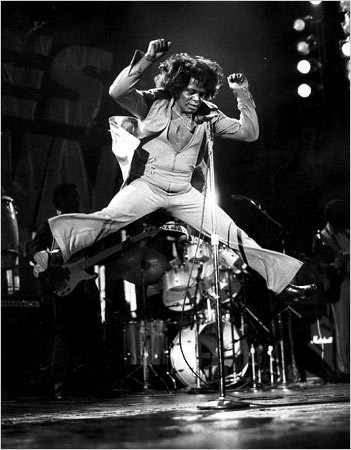
Thankfully, whether 40 years ago or 40 years from now, you never just hear James Brown. Whether on the radio or whatever big playback machine you choose, you'll feel his sweat as any of several dozen songs conjure images as timeless as the music: J.B. gliding on a cushion of air, moonwalking decades before Michael Jackson or Neil Armstrong; J.B. slamming to the floor in seemingly painful acrobatic splits, yet popping up immediately in full spin; J.B. falling to a knee, microphone in hand, a beggar man for love or attention. There will still be nonstop flash in the feet, fire in his soul.

Generations of musicians listened to James Brown, looked at him and took what they could, regardless of the kind of music they played. Much imitated, he was ultimately inimitable.
Someone once suggested Brown was to rhythm what Bob Dylan was to lyrics, and there's no arguing that when it comes to foundations of American popular music, Brown is right there with Louis Armstrong, Duke Ellington, Jimmie Rodgers, Hank Williams, Elvis Presley and Dylan -- creators whose innovations changed everything around them.

But first Brown had to find his own sound, which would come out of the ongoing collision of gospel and rhythm and blues in the mid-'50s. Tellingly, his first group, the Gospel Starlighters, would evolve into the Famous Flames, though with Brown writing or co-writing most of the group's material and proving from the start to be a superb showman, it was inevitable that he would become a solo act, albeit always closely tied to one superb backing band or another.

The early years are populated by classy but not quite classic R&B songs like "Please, Please, Please" and 1958's "Try Me," which sounded equal parts early career frustration and invitation. The first hint of the future -- pressure-cooked grooves, skintight arrangements and brain-melting horn blasts -- was 1962's "Night Train." Three years later, "Papa's Got a Brand New Bag" articulated a new musical and cultural soundscape. Along the way, Brown earned the titles: Soul Brother No. 1, the Sex Machine, Mr. Dynamite, the Heavyweight Champion of Soul, the Hardest Working Man in Show Business, the Funky President-- that fitted him as well as any of his body-hugging suits.

By the late '70s, Brown's hitmaking had pretty much ground to a halt, superseded by genres that were essentially his progeny: funk, disco and, later, hip-hop. Disco was more palatable to the mainstream, while funk's freakiness seemed more appealing to new generations. As for hip-hop, it would have happened even without James Brown, but it would never have sounded so compelling or rhythmically taut had not rappers in the late '70s and early '80s made him the world's most sampled artist -- although Brown seldom got paid for his "contributions," an ongoing source of irritation, along with unhappiness over some of rap's message.

"I didn't really mind rappers," he told me in 1993. "I didn't like what they were saying, and I have very strong feelings about the lyrics. I wanted to see some conscience in our lyrics, to prepare a future for our kids and not tear it down in lyrics. Vulgarity got too far gone, and we've got to withdraw from that." That was particularly important to a man who in the '60s had crafted messages of black pride and self-sufficiency with "I Don't Want Nobody to Give Me Nothing" and "Say It Loud (I'm Black and I'm Proud)."

In the afternoon hours before the 9:30 club show, Brown was still rigorously putting the band through its paces, sharpening the dynamics, tightening the focus, deepening the groove. It was as if that night's show was a debut, not the career celebration everybody in the audience clearly envisioned.

When his statue was dedicated, Brown had told the crowd, "God bless you and God is good, and please, please, please don't forget me."

Never going to happen.

James Brown, the 'Godfather of Soul', Dies at 73


By JON PARELES
The New York Times

Published: December 26, 2006

James Brown, the singer, songwriter, bandleader and dancer who indelibly transformed 20th-century music, died early yesterday in Atlanta. He was 73 and lived in Beech Island, S.C., across the Savannah River from Augusta, Ga.

Mr. Brown sold millions of records in a career that lasted half a century. In the 1960s and 1970s he regularly topped the rhythm-and-blues charts, although he never had a No. 1 pop hit. Yet his music proved far more durable and influential than countless chart-toppers. His funk provides the sophisticated rhythms that are the basis of hip-hop and a wide swath of current pop.

Mr. Copsidas said that Mr. Brown had participated in an annual Christmas toy giveaway in Atlanta on Friday but had been hospitalized on Saturday. After canceling performances planned for midweek, Mr. Brown on Sunday night got his doctor’s approval to perform on Saturday in New Jersey and on New Year’s Eve at B.B. King’s nightclub in New York.

Mr. Copsidas said Mr. Brown used one of his best-known slogans to convey his dedication to his fans: “I’m the hardest working man in show business, and I’m not going to let them down.”

Through the years, Mr. Brown did not only call himself “the hardest working man in show business.” He also went by “Mr. Dynamite,” “Soul Brother No. 1,” “the Minister of Super Heavy Funk” and “the Godfather of Soul,” and he was all of those and more.

His music was sweaty and complex, disciplined and wild, lusty and socially conscious. Beyond his dozens of hits, Mr. Brown forged an entire musical idiom that is now a foundation of pop worldwide.

“I taught them everything they know, but not everything I know,” he wrote in an autobiography.

The funk Mr. Brown introduced in his 1965 hit “Papa’s Got a Brand New Bag,” was both deeply rooted in Africa and thoroughly American. Songs like “I Got You (I Feel Good),” “Cold Sweat,” “Get Up (I Feel Like Being a) Sex Machine” and “Hot Pants” found the percussive side of every instrument and meshed sharply syncopated patterns into kinetic polyrhythms that made people dance.

Mr. Brown’s innovations reverberated through the soul and rhythm-and-blues of the 1970s and the hip-hop of the next three decades. The beat of a 1970 instrumental “Funky Drummer” may well be the most widely sampled rhythm in hip-hop.

Mr. Brown’s stage moves — the spins, the quick shuffles, the knee-drops, the splits — were imitated by performers who tried to match his stamina, from Mick Jagger to Michael Jackson, and were admired by the many more who could not. Mr. Brown was a political force, especially during the 1960s; his 1968 song “Say It Loud — I’m Black and I’m Proud” changed America’s racial vocabulary. He was never politically predictable; in 1972 he endorsed the re-election of Richard M. Nixon.

Mr. Brown led a turbulent life, and served prison time as both a teenager and an adult. He was a stern taskmaster who fined his band members for missed notes or imperfect shoeshines. He was an entrepreneur who, at the end of the 1960s, owned his own publishing company, three radio stations and a Learjet (which he would later sell to pay back taxes). And he performed constantly: as many as 51 weeks a year in his prime.

Mr. Brown was born May 3, 1933, in a one-room shack in Barnwell, S.C. As he would later tell it, midwives thought he was stillborn, but his body stayed warm, and he was revived. When his parents separated four years later, he was left in the care of his aunt Honey, who ran a brothel in Augusta, Ga. As a boy he earned pennies buck-dancing for soldiers; he also picked cotton and shined shoes. He was dismissed from school because his clothes were too ragged.

He was imprisoned for petty theft in 1949 after breaking into a car, and paroled three years later. While in prison he sang in a gospel group. After he was released, he joined a group led by Bobby Byrd, which eventually called itself the Flames. At first, Mr. Brown played drums with the group and traded off lead vocals with other members. But with his powerful voice and frenzied, acrobatic dancing, he soon emerged as the frontman.

In 1955 the Flames recorded “Please Please Please” in the basement studio of a radio station in Macon, Ga. A talent scout heard it on local radio and signed the Flames to a recording contract with King Records. A second version, recorded in Cincinnati in 1956, became a million-selling single.

Nine follow-up singles were flops until, in 1958 a gospel-rooted ballad, “Try Me,” went to No. 1 on the rhythm-and-blues chart. Mr. Brown followed up with more ballads, although the Flames’ stage shows would turn them into long, frenzied crescendos. His trademark routine of collapsing onstage, having a cape thrown over him and tossing it away for one more reprise, again and again, would leave audiences shouting for more.

In 1960 Mr. Brown’s version of “Think” put a choppy, Latin-flavored beat — hinting at the funk to come — behind a sustained vocal and pushed him back into the R&B Top 10 and the pop Top 40.

Mr. Brown had his first Top 20 pop hit in 1963 with “Prisoner of Love,” a ballad backed by an orchestra. But before those sessions he had done a series of shows at the Apollo Theater in Harlem and the one on Oct. 24, 1962, was recorded. His label had not wanted to record the shows; Mr. Brown insisted. Released in 1963, “Live at the Apollo” — with screaming fans and galvanizing crescendos — revealed what the rhythm-and-blues circuit already knew, and became the No. 2 album nationwide.

James Brown and the Famous Flames toured nonstop through the 1960s. They were filmed in California for the “The T.A.M.I. Show,” released in 1965, which shows Mick Jagger trying to pick up Mr. Brown’s dance moves.

By the mid-1960s Mr. Brown was producing his own recording sessions. In February 1965, with “Papa’s Got a Brand New Bag,” he decided to shift the beat of his band: from the one-two-three-four backbeat to one-two-three-four. “I changed from the upbeat to the downbeat,” Mr. Brown said in 1990. “Simple as that, really.”

Actually it wasn’t that simple; drums, rhythm guitar and horns all kicked the beat around from different angles. “Papa’s Got a Brand New Bag” won a Grammy Award as best rhythm-and-blues song, and it was only the beginning of Mr. Brown’s rhythmic breakthroughs. Through the 1960s and into the ’70s, Mr. Brown would make his funk ever more complex while stripping harmony to a bare minimum in songs like “Cold Sweat.” He didn’t immediately abandon ballads; songs like “It’s a Man’s Man’s Man’s World,” a No. 1 R&B hit in 1966, mixed aching, bluesy lines with wrenching screams.

Amid the civil rights ferment of the 1960s Mr. Brown used his fame and music for social messages. He released “Don’t Be a Dropout” in 1966 and met with Vice President Hubert H. Humphrey to promote a stay-in-school initiative. Two years later “Say It Loud — I’m Black and I’m Proud” insisted, “We won’t quit movin’ until we get what we deserve.”

When the Rev. Dr. Martin Luther King Jr. was murdered in 1968, Mr. Brown was due to perform in Boston. Instead of canceling his show, he had it televised. Boston was spared the riots that took place in other cities. “Don’t just react in a way that’s going to destroy your community,” he urged.

By the late 1960s Mr. Brown’s funk was part of pop, R&B and jazz: in his own hits, in songs by the Temptations and Sly and the Family Stone, and in the music of Miles Davis. It was also creating a sensation in Africa, where it would shape the Afrobeat of Fela Kuti, the juju of King Sunny Ade and the mbalax of Youssou N’Dour.

Musicians who left Mr. Brown’s bands would also have a direct role in 1970s and 1980s funk; the saxophonist Maceo Parker, the trombonist Fred Wesley and the bassist Bootsy Collins were part of George Clinton’s Parliament-Funkadelic, and Mr. Parker also worked with Prince.

Through the early 1970s Mr. Brown’s songs filled dance floors. His self-described “super heavy funk” gave him No. 1 R&B hits and Top 20 pop hits with “Give It Up or Turnit a Loose” and “Mother Popcorn” in 1969, “Super Bad Pts. 1 & 2” in 1970, “Hot Pants” and “Make It Funky” in 1971, “Get on the Good Foot Pt. 1” in 1972 and “The Payback Pt. 1” in 1974. He provided soundtracks for blaxploitation movies like “Black Caesar” and “Slaughter’s Big Rip-Off,” and performed at the 1974 “Rumble in the Jungle” boxing match between Muhammad Ali and George Foreman in Zaire.

The rise of disco — a much simplified version of Mr. Brown’s funk — knocked him out of the Top 40 in the late 1970s. But an appearance in “The Blues Brothers” in 1980 started a career resurgence, and in 1985 Mr. Brown had a pop hit, peaking at No. 4, with “Living in America,” the song he performed in the movie “Rocky IV.” It won him his second Grammy Award for Best Rhythm and Blues Recording. That year he was inducted into the Rock and Roll Hall of Fame as one of its first members.

Meanwhile hip-hop had arrived, with Mr. Brown’s music often providing the beat. LL Cool J, Public Enemy, De La Soul and the Beastie Boys are among the more than 100 acts that have sampled Clyde Stubblefield’s drumming on “Funky Drummer” alone. In 1984 Mr. Brown collaborated with the influential rapper Afrika Bambaataa on the single “Unity.” He kept recording into the 21st century, including a 2002 studio album, “The Next Step.”

Mr. Brown maintained a nearly constant touring schedule despite a tumultuous personal life. During the 1970s the Internal Revenue Service demanded $4.5 million in unpaid taxes; the jet and radio stations were sold. His oldest son, Teddy, died in a car accident in 1973.

In 1987, intoxicated on PCP, he burst into an insurance seminar adjoining his own office in Augusta, then led police on a car chase across the South Carolina border. He was sentenced to prison for carrying a deadly weapon at a public gathering, attempting to flee a police officer and driving under the influence of drugs, and was released in 1991.

In 1998 after discharging a rifle and another car chase, he was sentenced to a 90-day drug rehabilitation program. He was officially pardoned by South Carolina in 2003, but arrested again in 2004 on charges of domestic violence against his fourth wife, Tomi Rae Hynie, a former backup singer. “I would never hurt my wife,” he said in a statement at the time. “I love her very much.”

She survives him, along with their son, James Brown II, and at least five other children.
In 1999, Mr. Brown made a deal to receive more than $25 million in bonds against advance publishing royalties. This year, however, he sought to refinance the bonds with a new loan. The banker who had made the original deal, David Pullman, objected to the terms, and Mr. Brown filed a lawsuit against him in July.

But Mr. Brown’s status as an American archetype had long since been assured. A definitive collection, “Star Time” (Universal), was released in 1991. He received a Grammy Lifetime Achievement Award in 1992 and a Kennedy Center Honor in 2003, the same year that Michael Jackson presented him with a BET Award for lifetime achievement. In a 1990 interview with The New York Times, he said, “I was always 25 years ahead of my time.”

John O’Neil contributed reporting.

Sunday, December 24, 2006

Wilfred McClay: God Rest Ye Merry


On Celebrating the Darker Meaning of Christmas
http://www.touchstonemag.com

A number of years ago, our friend Joseph Bottum, editor of First Things, made a nice observation about his experiences of successive Christmases, one that has stuck in my mind as equally true for me, and perhaps for many of us. He observed that every year there seems to be a particular Christmas carol that grabs his attention early in the season, often because one particular line or image in that carol suddenly opens itself, revealing a fresh meaning that he’d never before noticed.

I’ve had the same experience. I remember being struck a couple of years ago when, in listening to the French carol we call “O Holy Night,” a song I always tended to find both schmaltzy and tedious, I noticed the words “Long lay the world in sin and error pining,/ Till he appeared, and the soul felt its worth.”

Maybe it was just a quirk of timing, but those last six words hit me with unexpected force, and I wondered why I had never noticed them before, even though I’d long ago committed the lyrics to memory. It could have been partly because there are several extant “translations” into English, which vary in the way they render that phrase (and bear little resemblance to the French). But the more general point stands. And I now listen to “O Holy Night” with new respect.

I believe others have similar tales to tell, of carols that somehow come suddenly to life for them. The experience of hearing and singing and sharing these familiar carols every year, year after year, is like the best experience of liturgy, in its combination of familiarity and fresh moments of discovery, when universally known words that have for years passed through one’s lips in rote repetition suddenly blaze forth with meaning, vividly and achingly true.

Like the oldest and best liturgies, these songs are no one’s personal property, time and usage having wiped away nearly all distracting fingerprints of authorship and “originality.” Instead, they belong to all of us. They are old friends to us, and like the best old friends, they are comfortable and reassuring, and yet also full of mysteries and surprises and strange, hidden delights. Our Christmas carols are among the most precious shared possessions of our fragmenting, fraying culture, and for all that we abuse them and demean them, they seem to remain imperishable.

This year, somehow it’s been “God Rest Ye Merry Gentlemen” that has stuck in my brain, and particularly these words, in the first verse: “To save us all from Satan’s power/ When we were gone astray.” We move through these sibilant words so quickly and rhythmically. I know I always have. And yet how plainly those few words sketch in a somber background, a whole universe of presuppositions without which the song has a very different, and diminished, meaning.

The merriness being urged upon the gentlemen (one should always remember that, in the lyrics, there is a comma between “merry” and “gentlemen”—they are not “merry gentlemen” being encouraged to “rest”) comes amid a great darkness, a darkness that never disappears, that beckons and threatens, a darkness whose presence is subtly conveyed by the minor key with which the song begins and ends. The black ship with black sails lingers on the far horizon, silent and waiting.

Dark Reminders

There are constant reminders of this darkness, if one has ears to hear them, running through the great liturgy of our Christmas carols, with their memorable evocations of bleak midwinter, snow on snow, sad and lonely plains, the curse, the half-spent night. The spooky and antiseptically sterile depiction of winter in C. S. Lewis’s The Lion, the Witch, and the Wardrobe and its cinematic adaptations is, in that sense, very close to the spirit of the older carols, and to the biblical account of the matter—much closer than the hearty merriment of rosy-cheeked seasonal songs like “Sleigh Ride” or “Let It Snow, Let It Snow, Let It Snow.”

The older lyrics are laced with just such evocations of darkness. They help us remember why it is symbolically right, even if historically wrong, to celebrate Christ’s birth in winter.

We are constantly reminded to “keep Christ in Christmas” and to remember “the reason for the season.” And of course we should. But, if I may be permitted to put it this way, we must also keep Satan in Christmas, and not skip too lightly over the lyrics that mention him.

For he and the forces he embodies are an integral part of the story. It utterly transforms the way we understand Christmas, and our world, when we also hold in our minds a keen awareness of the darkness into which Christ came, and still must come, for our sake.

Later in “God Rest Ye Merry Gentlemen” the visiting angel tells the shepherds in the field that Christ has come “To free all those who trust in him/ From Satan’s power and might.” Being subject to that “power and might” is, as we are likely to put it these days, the default setting of our human existence. But the Christmas story plays havoc with all such defaults.

It reveals the putatively normal and settled features of our world to be something very different: the ruins and aftereffects of a great and ancient calamity, the tokens of a disordered order. It lifts the veil of illusion about who we are and what we were made to be. Which means that the “comfort and joy” of which the song speaks are not merely outbursts of seasonal jollity.

Captives’ Gratitude

They bespeak the ecstatic gratitude of captives and cripples who recognize that, in and through Christ, the entire cosmos has been transformed, and their lives have been made new. Nothing can ever be the same again.

The darkness does not go away. Not now, not yet. But the light that shines into it can make even the bleakest midwinter into a landscape glistening with promise. So may it be for each of us, this and every Christmas.

—Wilfred M. McClay, for the editors

“God Rest Ye Merry” first appeared in the December, 2006 issue of Touchstone.

Notes on above painting:
“The Nativity at Night,” oil painting by Geertgen tot Sint Jans, late 15th century; in the National Gallery, London