Wednesday, December 19, 2018

What's the Deal With All This Unrest in Paris?


BY BRUCE BAWER 
https://pjmedia.com/trending/media-confusion-are-paris-riots-fading-or-getting-more-organized/
December 18, 2018
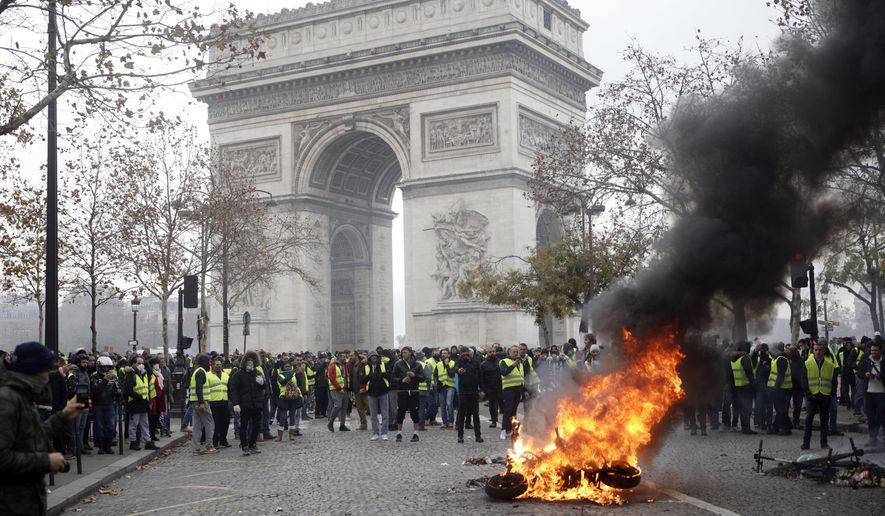
Image result for paris protests 2018
Demonstrators, called the yellow jackets, gather around the Arc de Triomphe as they protest against the fuel taxes, in Paris, France, Saturday, Nov. 24, 2018. French police fired tear gas and water cannons to disperse demonstrators in Paris Saturday, as thousands gathered in the capital and staged road blockades across the nation to vent anger against rising fuel taxes and Emmanuel Macron's presidency. (AP Photo/Kamil Zihnioglu)


It's getting hard to keep track of the rioting in Paris these days. The City of Lights has just experienced its fifth weekend of protests by the gilets jaunes, or yellow vests. On the one hand, several news media reported that the rage seemed to be dying down. On the other hand, no less a source than Vogue confided, in an article posted Saturday evening, that the rioters, who have already been photographed bringing chaos to the Champs-Élysées and vandalizing the Arc de Triomphe, are making life awfully difficult for high-end Christmas shoppers.

“The screens of the ATMs on the Rue du Faubourg Saint-Honoré were shattered next to a Missoni store,” wrote the style rag's Lynn Jaeger. “A section of the Tuileries fence had been pulled down; the windows of the Chanel shop on Rue Cambon and Zadig & Voltaire on the Rue de Rivoli, both of which were looted last weekend, were discretely boarded up.” The point is made, but hey, let's have a little more ritzy name-dropping: “On Friday night, you could look out the window of the second floor of Le Castiglione restaurant and see gray mesh screens nailed to Louis Vuitton’s facade. Two guys were unloading a truck full of planks and methodically covering the glass of stores up and down the street. Isabel Marant opted for plain wood; Goyard had cheerful, color-block panels. Walking past Balenciaga, you noticed that not only was the shop boarded up, but the place was also empty -- the shelves cleared of every last dad sneaker and striped handbag.

Even as the gilets jaunes were ruining the holiday season for the French capital's richest consumers and most deluxe emporia, a whole different set of protesters tried to disrupt the metropolis’s high-culture scene. On Sunday evening, a mob of two to three hundred migrants, asylum seekers, and illegal aliens, mostly of African origin, stormed the Comédie Française, where a performance of Victor Hugo's play Lucrezia Borgia was underway. Their goal was reportedly to compel, or convince, the deputy manager of the legendary theater to arrange an appointment for them with Minister of the Interior Christophe Castaner, and thereby help them to secure residency documents. An odd approach, to say the least, but maybe this sort of thing makes more sense in France, where high culture, after all, rules. In any event, the mob was successfully repelled, first by the theater guards, then by a large cohort of gendarmes who arrived on the scene with a celerity that one does not immediately associate with French cops. But of course the police in every country have their own priorities: while British bobbies, for example, are quicker to check out reports of online Islamophobia than of Muslim gang rape, it would only make sense for their Gallic counterparts to be more concerned about productions of Victor Hugo dramas in the first arrondisement than about honor killings outside the Périphérique.

In a statement explaining their decision to focus on the Comédie Française, of all places, the two immigrant-aid organizations that plotted the action said that theaters are “privileged settings” in which actors frequently make extravagant speeches about “hospitality”; by storming that particular venue, the rioters were essentially challenging the theater people to take concrete action to back up their lofty rhetoric.

(Not a bad idea, really. I mean, take somebody like Lin-Manuel Miranda, the creator and star of the Broadway musical Hamilton, tickets to which are currently selling for upwards of $235 apiece. Last June, at a demo, Miranda sang a lullaby dedicated “to kids whose parents were taken from them at the border.” Wouldn’t it be cool if a couple of hundred illegal immigrants -- and their kids -- invaded the Richard Rodgers Theater during a performance of Hamilton and camped out there indefinitely? Or if a few dozen of the Guatemalans who've made it to Tijuana hiked the extra 150 miles to Barbra Streisand’s Malibu spread and pitched tents on her lawn, their boomboxes blaring the songs on her new pro-open borders album,Walls?)

I began this article by suggesting that it's getting hard to keep track of these demonstrations in France. In fact, when you come right down to it, the whole thing is really pretty simple. On one side you've got these mobs of immigrants, most of whom have no business being in France in the first place, but who, instead of keeping a low profile and showing some gratitude for what the French state has already given them, have a breathtaking sense of entitlement that makes them feel free to charge the very temples of French culture and issue arrogant demands. On the other side, you have humble French workers, most of them from the provinces, who have seen their wages stagnate, in large part because of the mass influx of competitive immigrant labor, and seen their taxes soar, in large part because of the government's need to fund ballooning social-welfare benefits for immigrants who choose not to work.

During the last couple of years, more and more commentators have suggested that America is splitting into two countries -- one composed of immigrants and favored identity groups and their politically correct cultural-elite allies and the other of disgruntled red-state patriots who feel used, neglected, betrayed, and fed up -- and that the country is inevitably headed for civil war. That may or may not be an exaggeration. But one thing is clear: a very similar split has long been taking shape -- and is even more pronounced -- in Western Europe, where the immigrant tide is higher and its impact on the daily lives of ordinary natives even more severe. It’s scarcely a surprise that mass demos motivated by these concerns are making their debut in France, where public protest is the national pastime, but no one should be surprised if large-scale revolts by both the invaders and the invaded begin to be weekly fare in other Western European countries, too. After all, the pressure is mounting all around, and eventually something's got to give.

CAN TRUMP BE EUROPE’S SALVATION?


One Islam expert says yes


Bruce Bawer
https://www.frontpagemag.com/fpm/272182/can-trump-be-europes-salvation-bruce-bawer
December 19, 2018


Hege
Hege Storhaug


Islam: Europe Invaded, America Warned is a new English translation of a book that has sold 50,000 copies since appearing in Norwegian three years ago – a figure that, given Norway’s small population, is equivalent to over three million copies in the U.S. Its author, Hege Storhaug, who -- full disclosure – is a longtime friend, former employer, and (frankly) heroine of mine, began her career as a left-wing feminist writing about the rights of women and girls and ended up becoming a supposedly right-wing critic of Islam because she recognized the Religion of Peace as, by far, the greatest threat to females in Norway.
Hege has now been fighting on the Islam front for a quarter-century. She’s advised members of the Norwegian parliament on the subject, handed them tons of material documenting the social and economic consequences of Muslim immigration, and made a number of specific proposals that have resulted in legislation (and, alas, many more proposals that have gone nowhere). Unsurprisingly, her work has made her enemies not only among the nation’s Muslims but also on the radical left, members of which, on New Year’s Eve 2006/7, broke into her Oslo home and beat her up. She now lives in a secret location outside the city, and since the Norwegian edition of her book came out she’s routinely been accompanied to her public events by a cohort of armed police officers. The cops didn’t even tell her beforehand that they’d decided to start guarding her: she found out about it on November 4, 2015, the day before her book’s official publication date, when she showed up at a small-town community center to deliver a lecture and found three – count 'em, three – police cars parked out front.
“I’m the first person in Norway ever to require such protection,” she told me when we spoke the other day. Of course it’s a sign of the times – a reflection of the very real menace that Islam now poses to its outspoken critics in this once placid land. Not surprisingly, the mainstream Norwegian media have kept mum about Hege’s unique security status. Entirely. A naïve observer might think they’d consider it big news that in Norway, in 2018, a writer – a writer! – needs to be followed around by uniformed men packing heat (this in a country where you hardly ever see a cop with a gun). You might also think the Norwegian media – which are notorious for their habit of debating to death the most niggling, nugatory issues you can imagine – would consider this grim sign of the erosion of free speech in Norway worth discussing. Nope. After all, if they reported on Hege’s police escorts, they’d have to acknowledge that Islam really is a threat – and that’s verboten.
Still, the word about Hege’s police escorts has gotten around, so that now, when she’s planning to give a talk, she hears from admirers who’d like to attend but who tell her they’re freaked out by the cop angle – after all, if there’s a police presence, that means there’s a real danger of violence. (Perhaps this is the best place to mention that the American woman who translated Hege’s book into English has chosen, out of sheer fear, to remain anonymous.)
In short, it isn’t easy being Hege Storhaug. Though she may well be the most admired woman in Norway, the media are constantly at her throat. And hard as she works at trying to save Norway from Islam, she often feels as if she’s banging her head against the wall. During the last couple of years, she admitted to me, the reception she’s received from politicians has been particularly frustrating. She had hoped that her book's huge success might make them sit up and take notice – the sales figures, after all, confirm that the Norwegian people are deeply concerned about what Islam is doing to their country – yet elected officials, she laments, have been less responsive than ever to her urgent calls for action.
Image result for hege storhaug
It’s not that they don’t get it. Hege met recently with some Labor Party politicians, and asked them what they think will happen to the pubs in Oslo when that city turns majority Muslim – a development that isn’t so very far off. They shrugged. They know what’s coming. They just don’t know what to do about it. Haven't a clue. Even those who might want to take action, moreover, have to deal with a single massive obstacle that goes by the name of Erna Solberg. Solberg is Norway’s prime minister, and used to be known as “Iron Erna” because of her purported toughness. But top politicians have told Hege that Solberg won’t listen to a word about Islam. She not only refuses to talk about it; she refuses to allow members of her government to discuss it.
In this regard, of course, Solberg is pretty  much on the same page as Theresa May and Angela Merkel. Why, I asked Hege, is Solberg so pigheaded? What is it with these politicians? “They don’t know what to do,” Hege said simply. “They hope it’ll go away, even though they know it won’t. They care too much about their careers, and know that if they say anything they’ll be stigmatized. So they just figure that when the time comes, they’ll hand the problem over to their successors.” Hege emphasized that she wasn’t criticizing all politicians. “Next week,” she told me, “I’m having lunch with two top Labor Party people and two top Progress Party people. But they didn’t want to meet at a restaurant or café in Oslo.” God forbid they should be seen in public with Hege Storhaug! “So we’re meeting someplace private.”
Hege learned about Islam firsthand in Pakistan, which she’s visited seventeen times, often staying for long periods. She has good friends there who consider themselves to be Muslims, but who don’t go to mosque, and who are, in fact, distressed by the increasing radicalism of their countrymen. While working on her new book, Hege told me, there were times when she felt exhausted by the daunting amount of research involved, and at one point she told the adult daughter of her Pakistani best friend that she was close to throwing in the towel. “Hege,” replied the young woman with real intensity, “you have to write this book! People need it!” The point being that even in Pakistan, there are people who, while nominally adherents of the Religion of Peace, understand that, as the original Norwegian title of Hege’s book puts it, Islam is indeed a plague.
That young Pakistani woman and her mother, Hege pointed out, have visited Norway from time to time over the years, and have thus been able to follow the Islamization of Oslo. “And they’ve been shocked,” Hege said. “Hijab is now a more common sight in Oslo than in Pakistan.” Hege has spent time in London too, and says of niqab, the garment that covers everything but the eyes, “I’ve never seen as many niqab in Pakistan as I have in London.”
Which country in Western Europe is in the worst shape? For my part, I sometimes think it’s Sweden, sometimes Britain or maybe Belgium, although the Yellow Jacket riots in Paris lifted France to the top of my current list. Hege was way ahead of me on this one. Her book contains a long, harrowing chapter entitled “Marseille: Report from the Lost City.” Another friend of mine, Claire Berlinski, in her important 2006 book Menace in Europe, held Marseille up as an example of relatively successful multicultural mixing; her chapter on the city (which is now 35% Muslim) was entitled “The Hope of Marseille.” Today, Hege sees no hope in Marseille or anywhere else in France. “The situation in France is much worse than the surface picture might suggest,” Hege said. (We spoke before the terror attack in Strasbourg.) At the end of her chapter on Marseille, she writes: “I believe that France has reached a ‘point of no return.’” In other words, all hope is gone. “After I wrote that sentence,” she told me, “I took it out. It sounded too stark. But then I thought, no, this is what I believe; I might as well say it. So I put it back in.”
Although she does consider France a lost cause, Hege wouldn’t make predictions about the rest of Western Europe. “There are so many things that could happen,” she said. “What will Erdogan do? What if there’s a massive terror attack in Norway or Sweden or the UK? Will the EU take control of its borders and the Mediterranean?” Perhaps some politicians will grow a spine. Perhaps the rioting in Paris will intensify and lead to political crisis. It has already spread to the Low Countries; perhaps it will continue to spread. All Hege knows for sure is that, at present, “not one country in Western Europe, except maybe Austria, has a government that’s taking the proper action.”
As for the U.S., the main reason Hege was eager to get her book translated into English was that she wanted to do her part to help America avoid Western Europe’s fate. She fully supports the idea of the U.S. subjecting potential immigrants to an ideological test that would weed out freedom-lovers from sharia-lovers. “It may seem extreme,” she admitted, “but we have to save our free societies.” Her friends in Pakistan, she noted, would pass such a test with flying colors. In our conversation, she was fervent in her expression of hope that Donald Trump would be able to introduce a test of this kind. It would not only rescue America, she contended; it could also rescue Western Europe, because if Trump actually took such a step, his Western European counterparts might actually screw up the courage to do the same thing.
“Trump,” she summed up, “can be Western Europe’s salvation.”  
 Tags: Donald Trump, Europe, Islam

The Globalist Mindset: They Hate You


By 
https://amgreatness.com/2018/12/16/the-globalist-mindset-they-hate-you/
December 16, 2018

Related image
George Soros/Hillary Clinton


Against what or whom is the contemporary Western public pushing back?
The French non-Parisians against new green taxes on already unaffordable gasoline? Broke southern European Union nations against the financial demands of German bankers? The Eastern Europeans against French and German open-border mandates?
The British masses against both the EU and their own government that either cannot or will not follow the will of the people and implement Brexit? The American populists against outsourcing, offshoring, and illegal immigration?
The common target of all these populist pushbacks is an administrative and cultural elite that shares a set of transnational and globalist values and harbors mostly contempt for the majority of their own Neanderthal citizens who are deemed hopelessly unwoken to environmental, racial, gender, and cultural inevitabilities.
In a word, the Ivy League, Oxbridge, and the Sorbonne masters of the universe assume that the world is on a predetermined trajectory. We are to follow an arc of history bending toward state-managed social justice if you will—to end up as a sort of global Menlo Park, Malibu, Upper West Side, Saint-Germain-des-Prés, Schwabing, or Kensington. No wonder, it is their ethical duty of transnationals to goad the fated, but sometimes stalled, process along.
Like Aristocrats of Old
Voters in consensual societies are often assumed too ignorant of the world beyond their borders, too encumbered with traditional racial, ethnic, gender, religious, and nationalist prejudices, and too ill-informed to know what is good for them. No wonder that sometimes hoi polloi must either vote repeatedly until they get it right, or follow executive and judicial fiats issued from their betters on high. In the globalist mindset, Brexit passed not because it was felt to be good by a majority or even advantageous for the United Kingdom, but because racists, xenophobes, nativists, protectionists, and chauvinists deluded the clueless public into thinking a pre-EU, and more racist and sexist Britain was somehow superior.
A postelection depressed Hillary Clinton had to travel all the way to Mumbai, India to find a more enlightened audience that would appreciate her insight that the ogre Trump had beat her because:
If you look at the map of the United States, there is all that red in the middle, places where Trump won. What that map doesn’t show you is that I won the places that own two-thirds of America’s Gross Domestic Product. I won the places that are optimistic, diverse, dynamic, moving forward. And his whole campaign, Make America Great Again, was looking backwards. You don’t like black people getting rights, you don’t like women getting jobs, you don’t want to see that Indian American succeeding more than you are, whatever that problem is, I am going to solve it.
The globalist elite is certainly transnational and is sickened by localism, traditionalism, and autonomy. Monsieur Macron shares much more in common with Barack Obama, Hillary Clinton, or Justin Trudeau than he does with rural Frenchmen. It is almost as if in 2019 our elites are emulating the interlocking aristocratic families of late 19th-century Europe, but instead of being common descendants of Queen Victoria they are the godchildren of Menlo Park, Brussels, Strasburg, Davos, and Wall Street.
Donald Trump’s efforts to deregulate the U.S. economy, demand reciprocal trade with China, Mexico, or Germany, rout ISIS, open up federal lands for natural gas and oil exploration, build pipelines, lower taxes, and grow the economy at best are seen as misguided parochial boosterism and at worse the sort of selfish nationalism that ignores expert global and world-is-flat consensus. In either case, the common denominator is that the world community can ill afford another U.S. president who has not been stamped, vetted, or audited by an Ivy League law or business school, a prior Washington D.C. federal office, or Wall Street firm.
Image result for globalists soros obama merkel
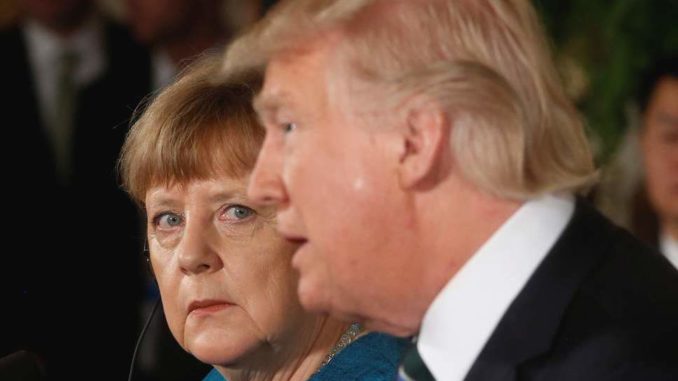
Angela Merkel and Donald Trump
Angela Merkel—who recently pronounced that nations must be “prepared to give up their sovereignty”—and her ilk are representations of the same sort of values as those of Hillary Clinton’s circle. Elites do not see their fellow citizens in exceptional terms of the affinities of a common language, shared history, or sovereign geography. Instead, they envision themselves as Socratic citizens of the world. They are an international siblinghood with common blue-chip educations, wealth, and long service in the administrative state. The anointed alone “see” and “grasp” what is really going on with the world, and therefore what really needs to be done right now, at all costs, regardless of the opposition from what Hillary wrote off as “all that red in the middle.”
International Crusading
Globalism is both an ideology and a culture of behavior. The creed is that the Western world, given its colonial and imperialist past, has a duty both to make amends to the former third world through magnanimously lending the global community elite Western expertise—whether through Kyoto- or Paris-like climate accords, foreign interventions guided by Western humanitarian principles, asymmetrical trade agreements, open borders, or U.N. mandates.
The globalist alone knows how global warming threatens us and how the ignorant masses must sacrifice to cool things down, how nationalism supposedly causes world wars, how sexism, racism, and homophobia have warped Western, but non-necessarily non-Western, society, and how human nature can be modified to avoid these pathologies through greater coercion, more relevant social education, improved material conditions, and greater secular ecumenicalism—a far better religion than calcified Christendom. The Western consumer—fat, “lazy,” played out—surely does not need any more affluence or income. His nation, therefore, can afford to subsidize, through his superfluous lifestyle, far nobler international crusades for mankind.
The nation-state then is passé. Transnational organizations, the larger and more powerful the better, tame mindless Western chauvinism, while enhancing and making invaluable alternative post-Western paradigms. The Secretary-General of the United Nations, the chief executive officer of the World Bank, the Secretary-General of NATO, the Director-General of the World Trade Organization, a Nobel Peace Prize Laureate, the President of the Council of Foreign Relations, the president of CNN Worldwide, all these are certainly to be listened to in a way an elected senator from Kansas, the nuts who stirred up the gilets jaunes, the unhinged Poles and Bulgarians who wanted to build fences on their borders, or renegade British MPs pushing for Brexit should not be.
Globalist penance for past sins is accomplished in a variety of ways. Non-Westerns are not to be held to symmetrical value systems. Islamic countries can destroy churches, Western nations consider mosques sacrosanct. Illegal immigration force feeds diversity onto a tired and exhausted Western public in dire need of having its horizons expanded by the other. Dumping, patent and copyright theft, and technological appropriation are sins only for wayward Westerners.
The elite must never be subject to the sometimes unfortunate ramifications of their own ideologies—any more than a laboratory scientist need be singed when he recklessly puts the wrong volatile ingredients into his beaker mix. Open-borders architects in the U.S. need not put their children in schools overwhelmed by illegal immigrants. Walls are useless on borders but effective around Malibu and Napa estates. The elite need not live in neighborhoods where European languages are rarely spoken; others less liberal need such exposure and enlightenment. French citizens must pay high gas taxes for their huge carbon footprints, French elites fly private jets to conduct profitable business in the carbon-rich Gulf, India, and China.
“Noble” Ends, Unethical Means
Globalists generally assume that their own privileged material conditions are pitiful wages for the greater good they do and so justify their material hypocrisies, as if they were wounded wild fawns forced to rely on rich artificial shrubbery of suburban gardens. They often share the greatest disdain for the rural and muscular classes of their own countries who lack the sophistication of the elite and the romanticism of the distant poor. If worse comes to worst, such impediments can simply die off and be replaced by more fertile, more energetic immigrants from the former Third World happy to have a shot at Western material conditions and the general welfare state, and who are at least thankful and appreciative of their benefactors and so more than willing to be receptive to globalist, transnational, and redistributive bromides.
Globalism ultimately is an offspring of elite progressive universities, think tanks, foundations, government institutions, and borderless corporatism. All the old progressive boilerplate—anti-trust legislation, prohibitions on monopolies, product liability—ceases when vast multibillion-dollar tech fortunes put their money into progressive causes, and thereby remind us that sometimes noble ends justify unethical means of obtaining them.
Facebook, Google, and Twitter have a perfect right to monopolize, to warp political expression, and to censor free speech if they devote their billions to enacting global climate, political, or social justice change, in the manner that here at home the Justice Department, the FBI, the CIA, and NSA—at times in conjunction with their foreign counterparts—justifiably had to monitor, use informants, and spread libelous smears on reckless Cro-Magnons like Donald J. Trump, who would harken us back to an embarrassing nationalist and sovereign past. Illegality has its uses.
Whom do the globalists despise?
The carbon spewing Winnebago owners, the snowmobilers, the jet skiers, the Glock packers, the Elks Clubbers, the lathe workers, the 101st Airborners with molôn labé tattooed on their arms, the 7-11 owners, the nutty Brit who speaks reverentially of Churchill, the dumb grubby French guy on a tractor who has no clue that his diesel engine must soon be replaced by three-hour batteries, the wacko Greek who cannot appreciate a boatload of noble Libyans landing on the beach below his ancestral olive grove in Crete, the limited Czech who clings to the hokey belief that residents in the Czech Republic should still speak Czech—in other words, all the autonomous cranks, and odd ballers who did not get the message, are not yet on board, and should have been by now long past woke.

Tuesday, December 18, 2018

Follow the (Climate Change) Money


By Stephen Moore
https://townhall.com/columnists/stephenmoore/2018/12/18/follow-the-climate-change-money-n2537638
December 18, 2018

Image result for green energy
(Shutterstock)

The first iron rule of American politics is: Follow the money. This explains, oh, about 80 percent of what goes on in Washington.

Shortly after the latest "Chicken Little" climate change report was published last month, I noted on CNN that one reason so many hundreds of scientists are persuaded that the sky is falling is that they are paid handsomely to do so.

I said, "In America and around the globe governments have created a multibillion dollar climate change industrial complex." And then I added: "A lot of people are getting really, really rich off of the climate change industry." According to a recent report by the U.S. Government Accountability Office, "Federal funding for climate change research, technology, international assistance, and adaptation has increased from $2.4 billion in 1993 to $11.6 billion in 2014, with an additional $26.1 billion for climate change programs and activities provided by the American Recovery and Reinvestment Act in 2009."

This doesn't mean that the planet isn't warming. But the tidal wave of funding does reveal a powerful financial motive for scientists to conclude that the apocalypse is upon us. No one hires a fireman if there are no fires. No one hires a climate scientist (there are thousands of them now) if there is no catastrophic change in the weather. Why doesn't anyone in the media ever mention this?

But when I lifted this hood, it incited more hate mail than from anything I've said on TV or written. Could it be that this rhetorical missile hit way too close to home?

How dare I impugn the integrity of scientists and left-wing think tanks by suggesting that their findings are perverted by hundreds of billions of dollars of taxpayer handouts. The irony of this indignation is that any academic whose research dares question the "settled science" of the climate change complex is instantly accused of being a shill for the oil and gas industry or the Koch brothers.

Apparently, if you take money from the private sector to fund research, your work is inherently biased, but if you get multimillion-dollar grants from Uncle Sam, you are as pure as the freshly fallen snow.

How big is the climate change industrial complex today? Surprisingly, no one seems to be keeping track of all the channels of funding. A few years ago, Forbes magazine went through the federal budget and estimated about $150 billion in spending on climate change and green energy subsidies during President Obama's first term.

That didn't include the tax subsidies that provide a 30 percent tax credit for wind and solar power -- so add to those numbers about $8 billion to $10 billion a year. Then add billions more in costs attributable to the 29 states with renewable energy mandates that require utilities to buy expensive "green" energy.

Worldwide the numbers are gargantuan. Five years ago, a leftist group called the Climate Policy Initiative issued a study that found that "global investment in climate change" reached $359 billion that year. Then to give you a sense of how money-hungry these planet-saviors are, the CPI moaned that this spending "falls far short of what's needed" a number estimated at $5 trillion.

For $5 trillion we could feed everyone on the planet, end malaria, and provide clean water and reliable electricity to every remote village in Africa. And we would probably have enough money left over to find a cure for cancer and Alzheimer's.

The entire Apollo project to put a man on the moon cost less than $200 billion. We are spending twice that much every year on climate change.

This tsunami of government money distorts science in hidden ways that even the scientists who are corrupted often don't appreciate. If you are a young eager-beaver researcher who decides to devote your life to the study of global warming, you're probably not going to do your career any good or get famous by publishing research that the crisis isn't happening.


Monday, December 17, 2018

Michael Flynn’s Ordeal and Ours


December 16, 2018

Image result for michael flynn
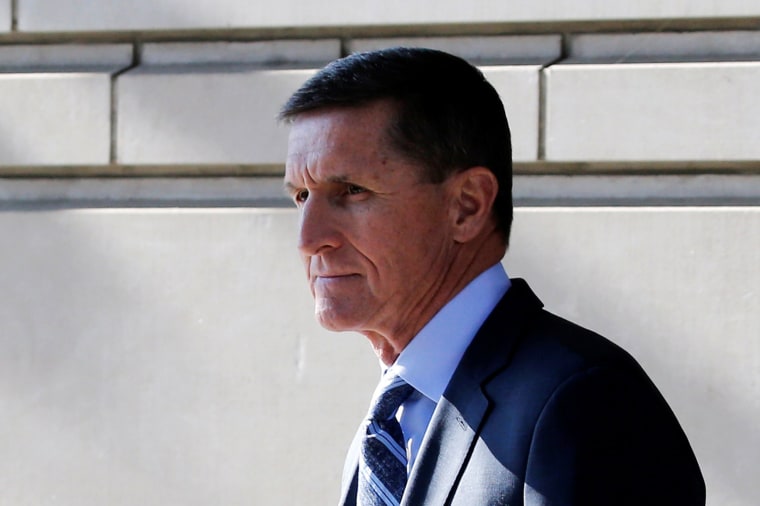
General Michael Flynn

U.S. District Judge Emmet Sullivan is scheduled to sentence General Mike Flynn on Tuesday morning, and there’s a lot at stake. To begin with, there’s the future of a fine man who transformed the way we do battlefield intelligence and the ensuing operations against our enemies in Iraq, where we won in large part because Flynn’s (and General Stan McChrystal’s) new tactics, and then in Afghanistan, again in tandem with McChrystal.

General Flynn’s radical reforms were not embraced by our top brass in the Pentagon, or by officials in the intelligence community. because he effectively relocated our warfighting decisions from Washington to the battlefield, weakening the bureaucrats and strengthening our men and women in the field. He thereby greatly increased the speed and accuracy of our operations. He also enhanced the status of lower-level officers and enlisted soldiers.

Second, is the importance of slapping down a corrupt justice and intelligence leadership, whose behavior in the Flynn affair should enrage and frighten all concerned citizens. It is incredible to say that after two years, we do not know what happened. We do know that Flynn’s principal FBI accusers have mostly been fired for lying, while Flynn still faces a possible jail sentence. But no CIA or NSA or NSC officials, who illegally “unmasked” Flynn to the Washington Post, have been charged with anything. Justice still refuses to release documents that might explain it all. Intolerable! Hell, we don’t even know who called whom as between McCabe and Flynn. And the bureau apparently has caused to disappear the 302 of the Strock/Pientka/Flynn conversation. And Comey’s claims change daily.

I’ve been told, I believe reliably, that General Flynn had either ordered, or intended to order, a full accounting of decades of intelligence community malfeasance. This was likely to reveal vast sums of money that were never spent to carry out the missions for which they were appropriated. This would have intensified the IC’s desire to get rid of him.

We need such trailblazers, and I hope he will be freed from the shackles that special consel Robert Mueller has attached to him. We badly need better intelligence, and General Flynn is a real rarity. Whether in or out of government, his is an invaluable voice and should be heard as widely as possible.

Then there is the Robyn Gritz scandal. Ms Gritz is a decorated retired FBI agent, who worked the counterterrorism beat, with laudable results. Then she found that she’d been singled out for harsh treatment. She filed a sexual discrimination suit, and the bureau—think Comey and McCabe—poured it on. Flynn, who had worked with Gritz, voluntarily wrote a letter to the court that attested to her high moral and ethical standards. No doubt the men atop the bureau feared Flynn might testify against their judgment, providing yet another motive to go after him.

In short, we need to know a lot more, but what we do know paints a very ugly picture of an FBI that makes up stories to fit their current political dreams, whether just to get rid of General Flynn, or to thwart Trump’s election, or to somehow get him out of the White House. The bureau acts as if it has a lot to hide, and I hope that Judge Sullivan knows the details, or will know them when he pronounces sentence.

I am not a lawyer, but I think the explanations for the dreadful behavior of FBI agents, Obama NSC officials, and others are political, not legal. So far as I can tell, General Flynn committed no crime either in talking to the Russian ambassador or in describing it to others, mainly the FBI agents and then Vice President Pence. I think he pleaded guilty because of the misery to which he and his family were subjected. So, paradoxically, I believe he lied when he “confessed” to lying, but not because he had lied in the first place.

Third, it is vital to unravel the Russians’ efforts to manipulate the American political system. I don’t see how you can take seriously the charges against Flynn without a full investigation of the Uranium One story and the relationship between the Clinton Foundation and various Russian individuals and entities. And it worries me that Adam Schiff, who will shortly replace Devin Nunes as chairman of the House Intelligence Committee, is both wildly partisan and invents stories—as when he claimed on NPR, discussing Flynn’s book, that the general was somehow pro-Russian, when the book clearly stated he considered Putin “an enemy.”

But the Russians ARE here, and they work closely with the Democrats, as they have for a long time. But none of the big shots in the swamp seems to care. Let’s hope Judge Sullivan does.

Lou Berney's terrific 'November Road' is a different kind of JFK assassination story


By Chris Vognar
https://www.dallasnews.com/arts/books/2018/11/21/lou-berneys-terrific-november-road-different-kind-jfk-assassination-story
November 21, 2018

Image result for lou berney dallas
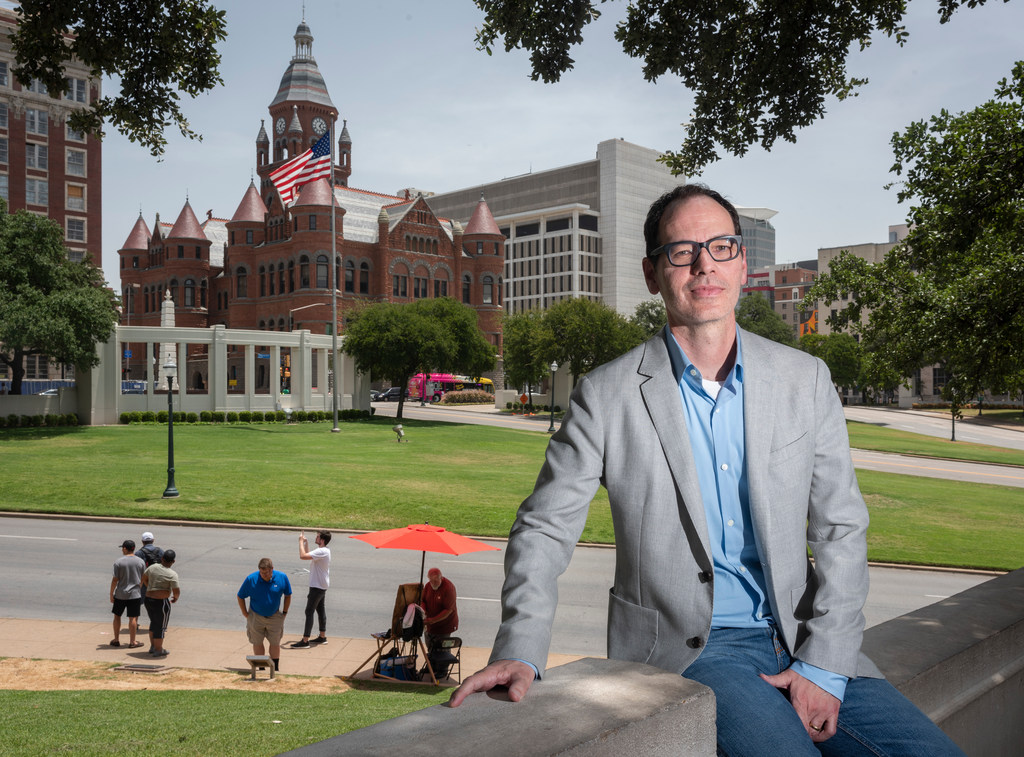
Lou Berney in Dallas
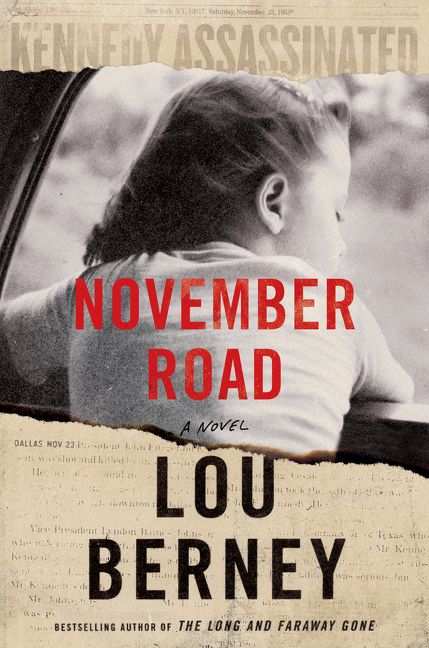
To say that Lou Berney's terrific new novel, November Road, is about the JFK assassination is sort of correct. The story is set in motion by that fateful November day 55 years ago, a day that Berney, born eight months later in Oklahoma, heard about throughout his childhood. But that's just the starting point.
"My mother always told me that I was conceived the night Kennedy was shot, but that is a little sketchy, a little bit off," Berney says over lunch in New York this summer. "But it's plausible. My mom was also a really good storyteller, so I'm never quite sure."
Berney must have picked up the tale-weaving gene. November Road (William Morrow, $26.99, on sale Tuesday, Oct. 9), his fourth novel, tells a propulsive, romantic and danger-laden story centered on two people taking to the open road, running from past mistakes. One, the smooth-talking New Orleans hood Frank Guidry, is a peripheral patsy in the JFK shooting, orchestrated here (and in the minds of many conspiracy theorists) by Bayou mob boss Carlos Marcello. The other, a rebellious Oklahoma housewife named Charlotte Roy, is fleeing a bad marriage from an alcoholic lay-about.
Charlotte packs up her two young daughters and heads West. Frank is going that way, too, and when Charlotte's car breaks down he sees an opportunity to pose as a family man. On their heels is Paul Barone, a killer who takes pride in a job well done.
In Berney's hands, these are the ingredients of a crime novel with a rare combination of emotional weight and gunshot speed. You'll probably foresee Frank falling for Charlotte, but Berney gets inside his characters so gradually and gracefully that November Road easily transcends genre conventions. All that, and he keep things moving at a lively clip.
"I always wanted it to be about the characters, but I also wanted the reader to keep turning the page," he says. "I like books and movies that do both. I don't like just people sitting in a room talking."
That's not a problem with these people. They talk, and kill, and run and make love. They plan and they plot. They make side deals. Charlotte is perhaps the fullest character in the book; Berney's female characters aren't window dressing.
Some of them, in fact, are downright fascinating. Take Seraphine, the Creole criminal mastermind who has Marcello's ear in all matters. (Marcello was a real man; Seraphine is a Berney creation). She's a past love interest for Frank, and the brains behind the sprawling Marcello crime operation. She's the Louisiana spice in Berney's stew.
"I just wanted a character that was a little bit unexpected for the right hand of the king," Berney says. "New Orleans is the one place it might make sense to have a mixed-race woman in that role, and that made her a much more interesting character to write, more fun than a typical guy. I've seen The Godfather a million times and I love Tom Hagen, but I wanted do something different."
November Road is indeed something different. There's no shortage of JFK fiction, but this one belongs up there with the best.

John F. Kennedy’s assassination sets a thriller in motion in ‘November Road’


By Bill Sheehan
https://www.washingtonpost.com/entertainment/books/john-f-kennedys-assassination-sets-a-thriller-in-motion-in-november-road/2018/10/04/f13595c8-bc47-11e8-be70-52bd11fe18af_story.html?noredirect=on&utm_term=.19126a0d32be
October 4, 2018

Image result for november road lou berney

It is a moment in history we return to again and again: the assassination of John F. Kennedy. Entire libraries have been filled with volumes generated by this single event, an event that novelist Don DeLillo called “an aberration in the heartland of the real.” These include official reports, personal reminiscences and all manner of conspiracy theories, not to mention a substantial amount of fiction. Novelists, like journalists and historians, have felt compelled to confront and come to terms with an act so consequential that its mysteries continue to trouble the American psyche more than 50 years later.
The most prominent of these novelists is DeLillo, whose magisterial “Libra” traces the tragic arc of Lee Harvey Oswald’s sad and angry life. “American Tabloid,” by James Ellroy, places the assassination at the center of an epic portrait of crime and endemic corruption, while Stephen King’s “11/22/63” is an impassioned fantasy about a time traveler who hopes to prevent the assassination to set the future on a saner, less destructive path. Lou Berney’s “November Road” is the latest novel to explore this explosive material, and the result is one of the most distinctive, unexpected crime novels of recent years.
Berney’s previous work, including the Edgar Award-winning “The Long and Faraway Gone,” bears comparison to the late Elmore Leonard. “November Road” is his first attempt at historical fiction, and it is impressive. The narrative begins in New Orleans on the eve of the assassination. Right away, Berney resolves one of history’s lingering questions: Who, among many possible suspects, ordered Kennedy’s death? In Berney’s version of events, the culprit is New Orleans mob boss Carlo Marcello, longtime enemy of both John and Robert Kennedy. Having established this basic scenario, Berney sets in motion the three narrative threads that will dominate the novel.
The first concerns Frank Guidry, high-ranking operative in the Marcello organization. Guidry is a cheerfully amoral grifter who treats women as disposable conveniences and casually betrays a friend to certain death for a momentary advantage. Shortly before the assassination, Guidry had been given a seemingly innocuous task: delivering a getaway car to a lot near Dealey Plaza in Dallas. When news of the assassination reaches him, he realizes that he is, however unintentionally, complicit in the death of a president, and that he has become a dangerous loose end. When other such loose ends begin dying around him, he leaves his old life behind, adopts a new identity and hits the road.
At the same time, a very different scenario plays out in the small town of Woodrow, Okla. Charlotte Roy is a young mother of two married to an irresponsible alcoholic. As cataclysmic events unfold in the wider world, she comes to a decision that is reckless, impulsive and ultimately correct. Along with her daughters, her minuscule savings and a cheap camera that will become her lifeline to the world, she too leaves her old life behind, heading toward a future she cannot yet envision.
The third leg of the narrative belongs to a professional hit man known only as Barone, whose primary job is cleaning up the Marcello family’s more spectacular messes. He does so with typical efficiency until only one loose end remains: Frank Guidry. Following instructions, he picks up Guidry’s trail and sets off in pursuit.
What follows is both a road novel and a first-rate thriller in which Barone’s relentless pursuit stretches from New Orleans to Las Vegas, leaving a trail of bodies in its wake. Most centrally, it is — or eventually becomes — a surprising but credible love story, as a chance encounter between Guidry and Charlotte and her children assumes unexpected dimensions. They meet on the road, and Guidry cynically attaches himself to them, using them as a form of protective camouflage. Gradually, he falls into the rhythms and routines of Charlotte and her daughters and finds himself wishing for something he has never known and never wanted: a family.
The evolving relationship between Guidry and Charlotte forms the emotional centerpiece of the book, and Berney handles it all with delicacy and restraint. Ultimately, the novel stands or falls on Berney’s ability to convince us that an amoral criminal is capable of changing so completely. “November Road” could easily have descended into sentimental cliches, but — thanks largely to the character of Charlotte — it never does. Charlotte, who is based in part on Berney’s own mother, is an extraordinary woman just beginning to discover her own capabilities. Faced with a series of debilitating crises, she persists, moving steadily forward toward a larger, more meaningful life. The result is a quietly moving evocation of public and private trauma, of individuals searching for new lives in a radically altered world. This is Berney’s best book to date. It deserves the wide, appreciative readership it seems likely to find.
Bill Sheehan is the author of “At the Foot of the Story Tree: An Inquiry into the Fiction of Peter Straub.”

Sunday, December 16, 2018

Stanford beats Nebraska in five sets for NCAA volleyball final


By 
http://www.startribune.com/stanford-beats-nebraska-in-five-sets-for-ncaa-volleyball-final/502867961/
December 16, 2018

Stanford celebrated after defeating Nebraska 3-2 in the NCAA DI volleyball championship match Saturday night.
Aaron Lavinsky/Star-Tribune

Asked for a big-picture view of his team’s eighth NCAA championship, Stanford volleyball coach Kevin Hambly was at a loss for words. “I’m too tired,” he said, “to think about what this means.”
Hambly knew it would take some time to fully appreciate the exhausting, exhilarating match he had just witnessed Saturday night. The top-seeded Cardinal beat Nebraska 3-2 at Target Center, prevailing in a back-and-forth, 2½-hour thriller that broke the Huskers’ hearts and an NCAA record. With the 28-26, 22-25, 25-16, 15-25, 15-12 victory, Stanford now has more NCAA women’s volleyball titles than any other team, breaking a tie with Penn State.
The nation’s top-ranked team at the beginning and end of the season, Stanford won its final 32 matches, the longest win streak in program history. The Cardinal finished 34-1, while seventh-seeded Nebraska ended 29-7.
Stanford libero Morgan Hentz, with 28 digs, and outside hitter Kathryn Plummer, with 19 kills and 10 digs, shared the most outstanding player award. Nebraska outside hitter Mikaela Foecke finished her college career with a bravura performance, with a match-high 27 kills on .296 hitting, plus 11 digs and two blocks.
The Cornhuskers, the defending champions, clawed back from a poor third set to dominate the Cardinal in the fourth. Stanford got the final punch, though, as two Nebraska serving errors and one Huskers blocking error in the fifth set helped the Cardinal win.
“It was an all-out battle,” Nebraska senior Kenzie Maloney said. “I thought both teams played really well. I really felt like we had the win, and we didn’t.”
The match featured the two most successful teams in NCAA tournament history. Stanford has won 124 tournament matches, the most ever, and Nebraska is second with 113. The two schools also are 1-2 in Final Four appearances; Stanford made the field for the 22nd time, and Nebraska was at its 16th Final Four.
Nebraska outhit Stanford .271-.250 and had 73 kills to the Cardinal’s 64. Stanford had 11.5 blocks to the Huskers’ nine.
“I don’t know that I’ve been part of a match that was more interesting, more hard-fought,” a hoarse-voiced Hambly said. “We have a lot of respect for [Nebraska], how hard they play, how they defend and how they scrap. We knew we had to match that from the beginning.
“That was the difference in the sets that we won and the sets that they won. I’m really proud of our young women for the turnaround after the fourth [set] and staying together. It could have been easy for us to fracture.”
Though the hometown Gophers were not there after losing in the regional semifinals, Nebraska fans traveled en masse to give Target Center a home-court feel. The crowd was announced at 18,113, a sellout, and it was a roaring sea of Huskers red.
Plummer was off her game early in the title match, as Nebraska sprinted to a quick lead. The Cardinal stormed back to go ahead 19-18 and won the set after the Huskers fended off three set points to tie it at 24.
The teams swapped the lead in the second set until Nebraska went on a 5-1 spurt, capped by two Foecke blasts. Stanford was able to climb within two points, but a Cardinal net violation gave the set to Nebraska, 25-22. Foecke had eight kills in the set, including three of the Huskers’ final four points.
In the third set, Stanford got five blocks and rolled to a big early lead that held up. Nebraska committed several costly errors to contribute to seven consecutive Stanford points. But they turned things around completely in the fourth set. Behind six kills from Lauren Stivrins, the Huskers raced to a 9-1 lead and led the set the entire way.
Nebraska held a 3-1 lead in the fifth set before Stanford scored four in a row. The Huskers were able to tie the score but never took the lead.
“Going into the fifth set, we said, ‘Hey, we’ve got to lay it all out there, give it everything we have,” Stanford’s Hentz said. “It took us a while to get there. Nebraska kept coming back. They put up an amazing fight, but we were able to fight back.”