Showing posts with label Roger Scruton. Show all posts

Tuesday, September 24, 2019

How identity politics drove the world mad


By Roger Scruton
https://unherd.com/2019/09/how-identity-politics-drove-the-world-mad/
September 2019
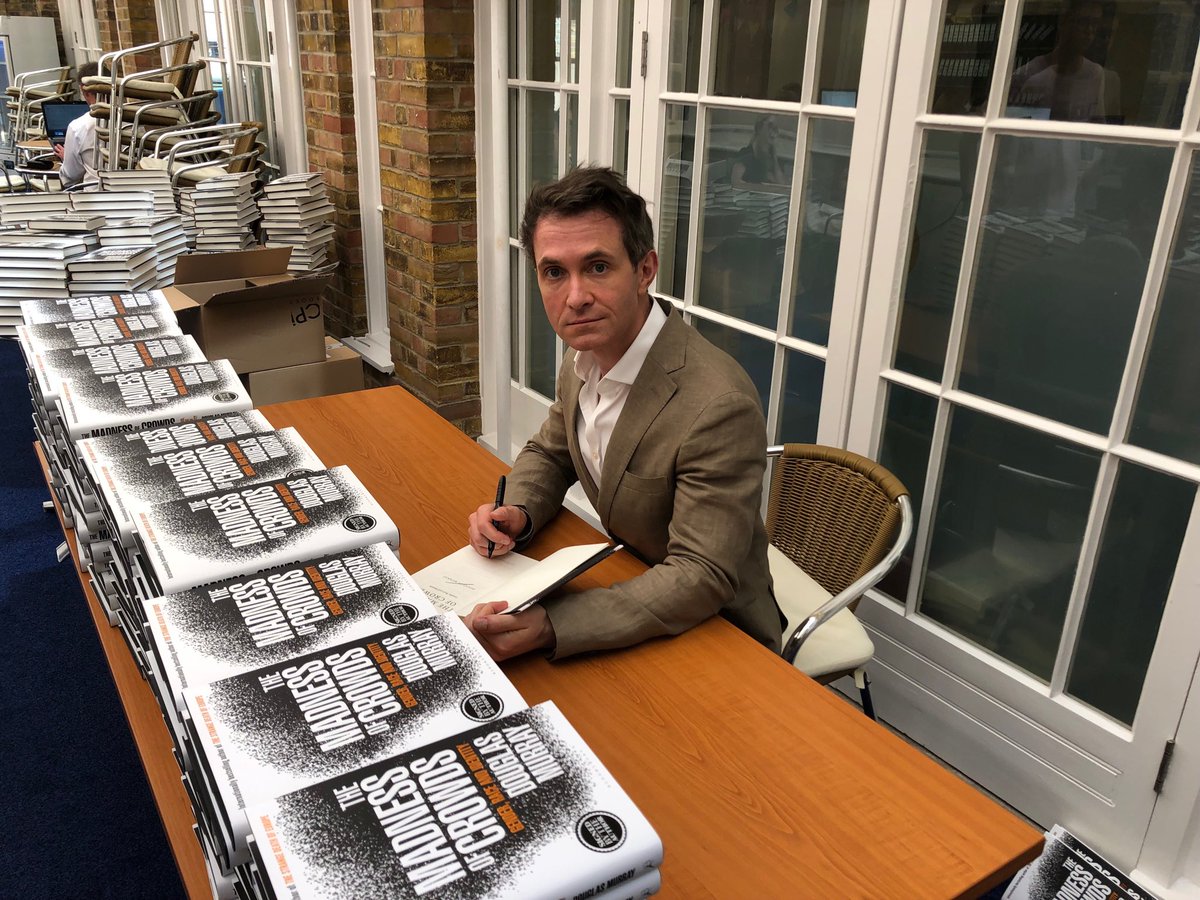
Image result for douglas murray madness of crowds

We thrive on disagreement, but only if we do not also feel threatened by it. In every period of history, therefore, there have been opinions and customs that are dangerous to question, since they provide the firm foundations on which our disagreements rest. Whether religious or political, these established ways of thinking and acting have been protected by law, and embedded in the educational curriculum and the daily customs of the people.


But our situation in Western democracies today is a novel one. There is no shared religion, and the old customs have been torn asunder by a culture of repudiation, which encourages people to shape their lives according to an “identity” of their own. Socialisation no longer means joining or obeying, but “becoming who you are”, regardless of the surrounding norms. This novel situation, which advertises itself as a kind of liberation, has instead produced in my lifetime a totally new kind of censorship and intimidation.
Thirty years ago I naively assumed that, with the collapse of communism, we would no longer see the persecution of dissidents or the imposition of official doctrines, and so I have been as astonished as everyone else by the mass denunciations and targeted character assassinations that enforce prevailing orthodoxies today. They seem as frequent and comprehensive here in Britain as they ever were in the world of totalitarian government.
True, you don’t go to the Gulag for your opinions; nor are there show-trials of “deviationists”, Zionists or the running dogs of capitalism. Nevertheless, you have to be careful what you say, and the punishments for saying, thinking or implying the wrong thing, even if administered by private enterprise and social media rather than by the state, are real, serious and largely impossible to deflect.
The archive of your crimes is stored in cyberspace, and however much you may have confessed to them and sworn to change, they will pursue you for the rest of your life, just as long as someone has an interest in drawing attention to them. And when the mob turns on you, it is with a pitiless intensity that bears no relation to the objective seriousness of your fault. A word out of place, a hasty judgment, a slip of the tongue — whatever the fault might be, it is sufficient, once picked upon, to put you beyond the pale of human sympathy.
As Douglas Murray shows in his impressive and lively survey, The Madness of Crowds: Gender, Race and Identity, the emerging world of censorship is a world without forgiveness, in which people are condemned for what they are rather than what they do, and in which the real virtues and vices that govern our conduct are ignored altogether as irrelevant.
The crimes for which we are judged are existential crimes: through speaking in the wrong way you display one of the phobias or isms that show you to be beyond acceptable humanity. You are a homophobe, an Islamophobe, a white supremacist or a racist, and no argument can refute these accusations once they have been made.
You might, in your private life, have worked for the integration and acceptance of your local Muslim community, or for a wider understanding of the roots of Islamic philosophy. This will be irrelevant when it comes to rebutting a charge of Islamophobia, just as your record in promoting minorities in the workplace will do nothing to clear you of the charge of racism, once the crucial words are out.
For your accusers are not interested in your deeds; they are interested in you, and in the crucial fact about you, which is whether or not you are “one of us”. Your faults cannot be overcome by voluntary action, since they adhere to the kind of thing that you are. And you reveal what you are in the words that define you.
These words may be taken out of context, even doctored to mean the opposite of what you said — as happened recently to me in an interview given to the New Statesman — but this will not affect the verdict, since there is no objective trial, no “case for the defence”, no due process. You are accused by the mob, examined by the mob and condemned by the mob, and if you have brought this on yourself, then you have only yourself to blame. For the mob is by nature innocent: it washes its own conscience in a flow of collective indignation, and by joining it you make yourself safe.
Such is the situation that the brave Murray confronts in his latest book, the title of which (taken from a previous anatomy of human folly by Charles Mackay) implies that it is crowd hysteria, rather than ignorance, that is largely to blame. But, as Murray goes on to show, that suggestion is also too simple. With admirable attention to detail he explores the ways in which the spirit of the mob has entered not only the language of public debate but also the sources of information and the institutions of decision making.
Censorship begins in the media themselves, with the silicon valley elite introducing “machine learning fairness” designed to eliminate “hate speech”, and programmed to recognise as “hate” all those expressions of opinion that violate some norm of political correctness. What Orwell so vividly foresaw — the manipulation of language so as to make heresy inexpressible — is now routine practice.
The result, however, is not a culture of gentle conformity, in which “niceness” is the norm. On the contrary, the clamour for recognition involves a constant assault on those who are assumed to be preventing it. These purveyors of “hate” are given no leeway on social media, and the practice of mass denunciation on grounds of race, tribe, class or social milieu is now an accepted weapon in the identity wars.
Murray gives riveting examples of the way in which whiteness has become a moral fault in the eyes of identity warriors on the American campus. It is, for example, now legitimate to condemn people for the colour of their skin, leading some to try to apologise for being white.
Various devices facilitate the emergence of the censorship culture. Three in particular come to the surface in Murray’s carefully constructed argument. First, there is the art of taking offence. Whole sections of the university curriculum are devoted to explaining to students that words, arguments, comparisons, even questions, are “offensive”, regardless of the intention with which they are used.
Invariably, the offence is given by the old majority culture, and is taken on behalf of some privileged minority. Current concerns about Islamophobia are relevant here: it is offensive, for example, to make jokes about the burqa, but not offensive to appear in public with your face entirely covered, even though the face-to-face encounter is at the root of our shared way of life, as important in showing respect as taking off your shoes when entering a mosque.
More important, from the intellectual point of view, is the attempt to rewrite hardware as software. As Murray shows, identity politics, which insists that everything relevant to our sense of self lies within our power, so that nothing can be imposed on us without our consent, is at odds with the facts of biology. To get round this problem, sex has been re-written as gender, and gender defined as a social construct. In this way, hardware becomes software, and fate becomes choice.
And the result is the “trans” lobby, determined to make all those areas where one sex was hitherto privileged (for example, female sports or female bathrooms) available to whoever wishes to appropriate that sex as his own. The hardware/software confusion has now penetrated the culture, and Murray shows the devastating effect that it has had on our understanding of human difference.
Finally there is the new scourge of “intersectionality”, which encourages people to explore all the ways in which they have lost out in the pursuit of advantage, and to construct their identity accordingly. A kind of reverse hierarchy of privilege emerges, as you come to see that you are disadvantaged as gay man, and then as a black man, and then as a Muslim man, and so on. The result of this scramble for “virtuous disadvantages” occupies Murray over many partly amusing, partly distressing pages.
As he abundantly shows, the attempt to derive a positive philosophy from this assemblage of negatives leads to absurdity and contradiction at every turn. The problem, however, is that contradiction is not regarded by the mob as an obstacle, but merely as further proof of the great conspiracy by which we are surrounded — the conspiracy enshrined in the old majority culture, which told us that we must accept human nature, find our fulfilment within its bounds, and not engage in a futile metaphysical rebellion.
Murray’s comprehensive survey of the prevailing madness will not persuade every reader. But it raises the real questions of our times, which are these: can we reject the idea of a benevolent God and still hold on to our inherited morality, founded on respect for the other and the absolute authority of truth? Can we adopt the posture of forgiveness that Murray is so keen to advocate, without turning to the supreme example that was once given to us?
Can we re-learn the habits of polite disagreement, and address each other as rational beings, capable of forming real communities in which differences are respected and decencies honoured? I want to answer yes to those questions. But as someone who has suffered more than most from the prevailing madness I have my doubts.
My own solution — which is to ignore social media and to address, in my writings, only the interest in the true and the false, rather than in the permitted and the offensive — confines me within a circle that is considerably narrower than the Twittersphere. But here and there in this circle, there are people who do not merely see the point of truthful discourse, but who are also eager to engage with it. And I cling to the view that that is enough, as it was for the Irish monks who kept the lamp of learning alight during the Dark Ages. They may have thought they were losing, but they won in the end.
Douglas Murray’s The Madness of Crowds: Gender, Race and Identity is published by Bloomsbury Continuum

Wednesday, May 01, 2019

The Scruton tapes: an anatomy of a modern hit job


How a character assassination unfolded on Twitter


https://www.spectator.co.uk/2019/04/the-scruton-tapes-an-anatomy-of-a-modern-hit-job/
27 April 2019

Related image

Sometimes a scandal is not just a scandal, but a biopsy of a society. So it is with the assault on Sir Roger Scruton, who in recent weeks has been smeared in the media, fired by the government and had his life’s work assailed. Scruton is the latest, though far from the first victim of the modern outrage mob.
It is now four years since the Nobel prize-winning scientist Tim Hunt was fired by University College London (among other institutions who were lucky to have him). That happened after one member of the audience at a conference in Korea tweeted something he had said about working with women and professed outrage at the comment’s alleged sexism. None of the institutions which dropped Hunt asked if there was any case for the defence. They all just behaved as almost everyone in authority now does: they saw a potential fight and ran. And though they left their man behind — as is also the new way — they also relied on the assumption that the world would soon forget and everyone (except the trampled victim) would move on.
In January, we saw the Covington Boys scandal in America, when a group of schoolboys became the subject of a two-minute hate for allegedly surrounding and taunting a native American tribal elder. By the time the facts came out (there had been no taunting, the boys had done nothing wrong) they had been denounced as racists in front of millions. But if winning a Nobel prize in science is no mitigation in being falsely accused, what chance do schoolboys or the rest of us have? Anyone, it seems, can claim a scalp using Twitter: twist the words of your victim and let the outrage mob do the rest.
The hit job on Sir Roger can be seen as a classic of the genre: he was sacked within five hours of the Twitter storm breaking. His fate offers a perfect case study in the art of modern character assassination. Except that in this instance, it unravelled and the whole nature of the trick can now be exposed. It is worth examining in some detail.
Last month, Scruton agreed to be interviewed in his London flat by George Eaton, one of the deputy editors of the New Statesman. In November the philosopher had been appointed to be the unpaid chair of a government quango called ‘Building better, building beautiful’, but Scruton was led to believe that the discussion would be about his books, a number of which had recently been reissued.

The lunchtime before the resulting interview’s publication, Eaton declared on Twitter that ‘the government adviser and philosopher Roger Scruton has made a series of outrageous remarks’, and included a link to the interview. The supposed offences were listed with salivation. Scruton was alleged to have talked outrageously about ‘Hungarian Jews’. He was alleged to have been racist about ‘the Chinese’. He was alleged to have described ‘Islamophobia’ as ‘a propaganda word invented by the Muslim Brotherhood in order to stop discussion of a major issue’. He had described accusations of anti-Semitism against Viktor Orban as ‘nonsense’ and talked of Muslim ‘tribes’. Outrage and resignation calls soon followed. The perfect Twitter storm had been started.
In response, the Conservative MP Tom Tugendhat issued a condemnation of racism — which, as he must have known would happen, was reported as a call for Scruton’s firing. His fellow Conservative MP (and fellow former soldier) Johnny Mercer declared that sacking Scruton was now a ‘no brainer’ — adding, slightly too revealingly: ‘Let’s not take our time on this.’ Thus did two Conservative leadership wannabes thoughtlessly throw one of Britain’s only conservative thinkers before the mob. George Osborne of the Evening Standard joined in condemning Scruton for his ‘bigoted remarks’ and calling for his sacking. Lord Finkelstein of the Timesagreed. By teatime James Brokenshire, the minister who had appointed Scruton last autumn, had announced that he had been fired.
This was treated with jubilation — especially by Eaton, who posted on Instagram (and subsequently deleted) a photo of himself online necking a bottle of champagne. His caption: ‘The feeling when you get right-wing racist and homophobe Roger Scruton sacked as a Tory government adviser.’
The rest of the media piled in: ‘PM’s housing guru Roger Scruton sacked after going on racist rant,’ read one headline the next day. ‘No. 10 adviser sacked over “white supremacist” views,’ ran another, the additional libel having been added courtesy of the Labour MP Dawn Butler.
But what had the philosopher actually said — and had he been fairly represented? No one who called for his resignation tried to find out. Not Mercer, Tugendhat, Finkelstein, Osborne, Brokenshire or any of the rest of them. The story was too good. Scruton later asked for the tape of the interview that got him sacked to be released, so everyone could hear what he said (or did not say). Many others then joined this call, but Mr Eaton went very quiet. Having acquired a copy of the recording of the interview, I know why.
Rather than a set of ‘outrageous’ remarks, let alone a ‘rant’, the recording shows Scruton speaking in his usual calm, thoughtful, professorial manner (though audibly labouring through a chest infection). Eaton asks the following question of a man he will subsequently label a ‘homophobe’: ‘On homosexuality you’ve been criticised by some for saying, for instance, homosexuality’s not normal. But that seems to be a statement of fact…’ This is said with a laugh. Answering, Scruton carefully explains his views on homosexuality, saying his remarks came from a book about sexual desire that he wrote 30 years ago. ‘I actually argued that it’s not a perversion,’ he says. ‘But that it is different. Then people take little sentences out of context.’ He adds that ‘the learned editors of [the website] Buzzfeed’ like to take such remarks out of context and ‘put together a kind of patchwork of offences without bothering to examine arguments or anything like that. So you get caricatured as a particular kind of thing. As though you were somebody who wants to stone homosexuals to death or something. Just because you said that it’s different.’

And the supposedly ‘outrageous remarks’ about ‘Hungarian Jews’? It is an interesting reminiscence about Viktor Orban. Scruton has known Orban since communist days and criticised him. ‘I think power has gone to his head,’ he says. ‘He’s made some decisions which are very popular with the Hungarian people. Because the Hungarians were extremely alarmed by this sudden invasion of, um, huge tribes of Muslims from the Middle East. And you have to remember that their history of their relation with Islam is not a happy one.’
Is ‘invasion’ the most diplomatic word to use about the migrant wave of 2015? Perhaps not (at another point, Scruton talks about how Momentum ‘invaded’ the Labour party) but the question really ought to be: does the government regard use of this word as a sackable offence?
He is invited to recall that he had previously been accused of anti-Semitism for using the phrase ‘Soros empire’. ‘Is that what I did wrong?’ he laughs. ‘I was talking about Hungary at the time, wasn’t I? And anybody who doesn’t think that there’s a Soros empire in Hungary has not observed the facts.’ The facts, in this case, are that the Soros operation is famously large. But how can this remark be seen to be anti-Semitic? By not including what he said next. ‘It’s not necessarily an empire of Jews — I mean that’s such nonsense.’ He then laments the ‘legacy of anti-Semitism in Hungary’, adding ‘If you had a political movement in Hungary which excluded the Jews in some way you’d be damn foolish, because they are the ones with the minds.’ A little harsh on Hungarian gentiles, perhaps, but hardly an example of the anti-Semitism his interviewer would accuse him of once he’d left.
Again and again, Eaton tries to lure Scruton on incendiary matters (‘Some conservatives would say knife crime is really a black problem’) but to no avail. After laboriously trying to get comment on the leadership contenders in both main parties, he finally asks: ‘How do you feel about humanity’s future?’ Scruton is a bit thrown. ‘Um, gosh. You’re talking about all the trans-humanist stuff or all that?’
Eventually he goes on to say: ‘I think there are difficulties around the corner that we are ignoring, like the rise of China. There is something quite frightening about the Chinese sort of mass politics and the regimentation of the ordinary being. I think that the… We invent robots, and they are in a sense creating robots out of their own people, by so constraining what can be done that each Chinese person is a kind of replica of the next one and that’s a very frightening thing. Maybe I don’t know enough about it to be confident in making that judgment but the politics is like that, and the foreign policy is like that. And the concentration camps have come back, largely there to “re-educate” the Muslims and so on.’
So not a racist rant, but a measured and careful expression of concern about the Chinese authorities, concluding with a reference to the appalling mistreatment of China’s Uighur Muslims. A reference that was never included in the interview since it would complicate the picture of the philosopher as an ‘intemperate’ bigot. As would his similarly unpublished observation that ‘Muslims who settle into the Meccan way of life are obviously perfect citizens. They have the inner serenity that the citizen should have. We ought to learn to appreciate that — and encourage it.’ Hardly the cry of the vicious anti-Muslim figure Eaton would go on to describe.
These manipulations of Scruton’s words had their desired effect. In a way, the Scruton case offers a parable of our times. For generations, interviewers have sought to make mischief with quotes — but before, they tended not to result in people being fired before teatime. There is now an established pattern. Once an ostensibly reputable source spins a line, the Twittersphere finds its latest object of outrage. As soon as prominent people join the mob (celebrities, activists), the campaign against the individual intensifies. Weak politicians who want to be seen to be reacting fast try not to get caught behind developments. As Henry Kissinger said recently: ‘Information threatens to overwhelm wisdom.’
But while certain Conservative politicians seem set on appeasing what they take to be the spirit of the age, they might have misjudged the turn. Soon after Scruton’s sacking, it started to become apparent that the quotations had been manipulated and that the philosopher had lost his job because government had cowered in front of the mob. Jason Cowley, the magazine’s editor-in-chief, said: ‘The New Statesman takes journalistic good practice seriously. As any responsible media organisation would, we are conducting an internal review in light of allegations of misrepresentation. George Eaton has already apologised for his behaviour on social media and his thoughtless Instagram post, which he deleted.’ Mercer and Tugendhat both ended up being forced to issue half-apologies. Those who were most angry were young people, who have grown to loathe this social media hate-mongering.
Their instincts are right. Our world is replete with complex matters that need discussing. We need philosophers, thinkers and even politicians of courage to help us find our way through this. We live in the age of character assassination. What we now desperately need is a counter-revolution based on the importance of individuals over mobs, the primacy of truth over offence, and the necessity of free-thought over this bland, dumb and ill-conceived uniformity.

Tuesday, April 30, 2019

Peter Hitchens On The Scruton Scandal


April 29, 2019
Image result for roger scruton
Regular readers will remember my story of the UK academic friend — a 1960s defector from a communist country — who told me a few years back that Western culture is starting to remind him and his wife (who defected with him) of their youth in communist Eastern Europe. He told me that the eagerness of left-wing people to lie for the sake of destroying the careers and lives of ideological opponents is the chief characteristic of this new soft totalitarianism. This is exactly how it started back home, he said.
We’ve seen this happen again and again here in recent years. The Covington Catholic boys were the latest and most prominent American example. In the UK, it was the disgusting smearing of Sir Roger Scruton by a smart-ass young left-wing journalist, George Eaton, aided and abetted by cowardly Tory politicians. Peter Hitchens commented on this in his Sunday column. Excerpts:
The case of Sir Roger Scruton, a guileless academic driven from public life by the twisting of his words and the howling of the electronic mob, is a warning to us all of a fast-approaching future.
The Left will win in the end because it recognises no limit on how wicked it can be to get its way. It will also win because the ‘Conservative’ Party is a rabble of cowards, which is so afraid of the Left it runs away from a fight before it has even been attacked.
Interestingly, two of the worst poltroons in the Scruton case were Tory MPs who certainly don’t keep quiet about their military careers – Tom Tugendhat and Johnny Mercer. I’ve seen much braver pacifists. But the proper Right, you see, still has morals. It cannot do what the Leftist journalist George Eaton and the New Statesman magazine did to Sir Roger Scruton. Take Mr Eaton’s glee after Sir Roger had been disowned by the Tory Government.
He posted a portrait of himself swigging champagne, accompanied by the words: ‘The feeling when you get Right-wing racist and homophobe Roger Scruton sacked.’
He has since grovelled a bit about this, but I don’t doubt that it is a better picture of his true feelings and nature than the pretend-civilised withdrawal and apology he later made.
Hitchens explains how he could take Eaton out by employing the same methods of lying and twisting words that Eaton used against Sir Roger. But he won’t, because it’s cruel and dishonorable. Even Sir Roger has said that he does not want revenge on Eaton.
Nor do I believe he should be sacked, or chased by a mob, or have people celebrate his humiliation by swilling champagne. And that, disgustingly, is why his side will win and mine will lose. Because I and my allies are not like him.
The frequent commenter in these parts Matt from VA often argues that this is what is wrong with the Right today: that the Left is willing to fight dirty, and we aren’t. I can’t see any moral justification for embracing the degraded standards of George Eaton and New Statesman, nor of the lying liars of the media and activist mob who tried to destroy innocent high school boys for the high crime of wearing MAGA hats. I favor using every legal measure to compel them to answer for their libels, but never can we stoop to their level. Alas, as Hitchens says, this is probably why they will win and we will lose.
But what will they win? They will tear each other to shreds, having proved that they are nothing but a pack of hyenas. And they will lose the consent of the rest of us to be governed by them, with consequences that cannot be predicted.
Sir Roger went on Britain’s Today program to defend himself — and got more of the same. Read the transcript. It’s remarkable how dishonest so many journalists are. I don’t know what’s worse: the possibility that they are malicious, or the possibility that they really are as willfully ignorant as they sound. For what it’s worth, Sir Roger has acquired the audio tape of his interview with George Eaton, and posted it to his YouTube channel. 
Anyway, I’m off later today to Bratislava, Slovakia, for the rest of the week, where I’ll be giving a couple of speeches at the Hanus Days Christian ideas festival. I’ll also be meeting with some anti-communist dissidents from the old days, and starting interviews for my next book, which will be about learning from those dissidents strategies for identifying and defying the new totalitarianism arising in the West. The book is now under contract; I’ll tell you more about that when I can.

Saturday, April 13, 2019

Roger Scruton for Architecture Czar!


April 12, 2019
Image result for roger scruton
Dismal news over the wire from Blighty: Sir Roger Scruton, the greatest living conservative philosopher, has been dismissed as chair of the British government’s Building Better, Building Beautiful Commission after making a few anodyne remarks to the New Statesman about the Communist Party of China. “They’re creating robots out of their own people,” quoth Sir Roger, “each Chinese person is a kind of replica of the next one and that is a very frightening thing.”
Predictably, the Wets and Labourites are offended on behalf of totalitarians over this nonexistent racial slight. Meanwhile, normal people are offended by the CPC’s latest experiment in social engineering, the Social Credit system, which is indeed meant to turn the populace into well-managed and safely predictable automata. To call the Communists’ machinations “frightening” is positively charitable.
Sir Roger also noted that “anybody who doesn’t think that there’s a Soros empire in Hungary has not observed the facts.” This was, apparently, anti-Semitic. Yet you’ll remember that the Financial Times named Mr. Soros its Person of the Year for 2018, calling him “a standard bearer for liberal democracy, an idea under siege from populists.” To the best of my knowledge, nobody at the FT was sacked for anti-Semitism.
There’s no question that Mr. Soros is throwing his fortune around trying to undermine Viktor Orbán and his Fidesz party, just as there’s no doubt he’s throwing his fortune around trying to undermine President Trump and the Republican Party. He certainly isn’t a progressive hero for making billions off his hedge funds. Sir Roger simply holds the improper view of Mr. Soros’s activities, and now faces the wrath of Mr. Soros’s other clients and beneficiaries.
You’ll also remember that Sir Roger’s position was honorary and unpaid. He wasn’t getting fat off the taxpayer’s dime. Nor was he a determining force in the UK’s foreign policy. Sir Roger is the most renowned living aestheticist, and his formidable talents were being put to good use: he was voluntarily assisting the government in making British cityscapes more beautiful.
This, in retrospect, may have been the most offensive aspect of Sir Roger’s appointment. Postmodernist architecture is widely unpopular with the people who actually have to live among it. Victorian and (especially) Georgian buildings are greatly preferred. On the main, it doesn’t cost a great deal more to build attractive buildings than it does these hideous, “utilitarian” people-kennels.
Yet all the world’s major cities, from New York and London to Abu Dhabi and Hong Kong, are now dominated by mortar-and-glass monstrosities. This is the most obvious triumph of Cultural Marxist thinking. For nearly a century, Brutalists exercised unquestioned control over the modern and “modernizing” world. For reasons nobody could quite explain, our metropolises were in a race to see which could most resemble a Soviet ghetto.
The Tories’ decision to buck this trend was the only really “conservative” thing a Conservative government has done since the death of Lord Salisbury (poisoned by his own ulcerated leg, alas) in 1903. That must have frightened the Left awfully, which is why they put such an extraordinary effort into destroying this great scholar’s life. Every insane accusation conceivable was hurled against him, from Islamophobia to Judeophobia. Even Hitler had the decency to choose just one.
I was an ardent Anglophile growing up, and I suppose I still am. But I wouldn’t move to Blighty now for all the tea in Buckingham, and I’m a man who likes his tea. Still, I have the deepest reverence for true Englishmen like Sir Roger who keep up the fight to save their country even when their countrymen repay them with nothing but venom and bile.
All the same, if he’s now a free agent, I say we petition the Trump administration to create its own Building Beautiful Commission and recruit Sir Roger to serve as its chairman. Even those of our cities that have long resisted the tide of “modernization”—Baltimore, Philadelphia, and my own beloved Boston—are beginning to succumb. By fighting back, Mr. Trump would earn the acclaim of ordinary Americans for generations. He and Sir Roger would go down in history as the men who saved this country’s rich architectural heritage. Let’s just make sure we pay Sir Roger for his efforts, hm?
Michael Warren Davis is associate editor of the Catholic Herald. Find him at www.michaelwarrendavis.com.
Related:

The ‘Islamophobia’ Smear Against Scruton-

Thursday, April 11, 2019

The real Roger Scruton scandal


By Brendan O'Neill
https://www.spiked-online.com/2019/04/11/the-real-roger-scruton-scandal/
11 April 2019

Image result for roger scruton


The Roger Scruton scandal is indeed disturbing. Not because of what Roger Scruton said, but because of what the New Statesman did. In order to score a hit against a conservative philosopher cum Tory adviser who has always rubbed leftists up the wrong way, the New Statesman’s deputy editor dispensed with the ethics of journalism, wilfully distorted a quotation, and inferred racism where, to the best of our knowledge, none exists. Scruton’s comments were not particularly shocking, but the New Statesman’s behaviour was.
Scruton had been a housing adviser to the Conservative government. Yesterday he was sacked for his ‘unacceptable comments’ in the New Statesman interview, as the minister of housing put it. Reading the general media coverage of the scandal, and the New Statesman’s promotion of the interview online, you could be forgiven for thinking that these ‘unacceptable comments’ from Scruton included anti-Chinese racism and anti-Semitism. But they didn’t; it only looks that way because of the New Statesman’s unethical sleight of hand and virtual misquotation – usually a huge no-no in the world of respectable journalism.
All those who think Scruton expressed racial hatred against Chinese people and Jews really should read the interview. They might find that they have more questions for the New Statesman’s deputy editor, George Eaton, who conducted the interview, than they do for Scruton. Take the claims of anti-Chinese racism. In his Twitter-summary of Scruton’s comments, Mr Eaton has the philosopher saying the following: ‘Each Chinese person is a kind of replica of the next one and that is a very frightening thing.’ That would indeed be a racist thing to say, playing on the stereotype that all Chinese people look and behave the same. But that isn’t what Scruton said. He said: ‘They’re creating robots out of their own people… each Chinese person is a kind of replica of the next one and that is a very frightening thing.’
So Scruton, it seems, was talking about the Chinese Communist Party and its expectation of conformism from the populace, not the Chinese people. By taking his comments out of context, Mr Eaton, quite wilfully it seems, turned criticism of a tyrannical government into a racist slur against a whole people. But it’s even worse than that. Mr Eaton did not only take the comments out of context – he also changed them, in a small but nonetheless important way. In his tweet, his use of a capital ‘E’ on ‘Each’ – in order to make the sentence ‘Each Chinese person is a kind of replica of the next one and that is a very frightening thing’ look like a standalone comment – is, to all intents and purposes, a misquotation. In the actual interview article, the ‘each’ has a small ‘e’, and is preceded by ellipsis, because it was clearly part of a broader comment by Scruton on the authoritarian nature of contemporary China. A journalist has misrepresented the views of a public figure to make him seem racist – isn’t that more scandalous than Scruton’s strong-worded critique of what he views as Chinese conformism?
What about anti-Semitism? Again, Scruton says nothing in the interview that could be construed as anti-Jewish hatred, and yet theNew Statesman infers that he did. Scruton made critical comments about the ‘Soros empire’ in Hungary. He was referring to George Soros, the Hungarian-American philanthropist who funds many so-called ‘progressive’ think-tanks and institutions. Soros is Jewish, and according to some liberal observers, this means any criticism of him is by definition anti-Semitic. This is a perverse idea. Is there a ‘Soros empire’ in Hungary? That’s certainly not a phrase I would use, but it is an indisputable fact that Soros funds various groups inside Hungary and across Europe. The depiction of all anti-Soros criticism as anti-Semitic is dodgy on two levels in particular. First, it demonises and seeks to silence all public discussion of a billionaire and his political interests. And secondly, it seriously harms the crucial struggle against resurgent anti-Semitism by weaponising accusations of anti-Semitism to the cynical end of silencing dissent on Soros and his political role – and this can only deepen the depressing cynicism that already exists towards the seriousness of anti-Semitism.
Let’s put it like this. If someone were to say that Ed Miliband is a wily, puppeteering political figure who uses his North London connections to do down ordinary people, that would clearly be anti-Semitic. But if someone said Mr Miliband was a piss-poor leader of the Labour Party who hasn’t got two ideas to rub together, that is not anti-Semitic. Do you see? Likewise, if a Hungarian hard-right agitator says Soros is a sinister, octopus-style figure puppeteering the Western world, that is anti-Semitic. But if someone – Scruton, say – says Soros funds various campaign groups that have a detrimental impact on conservative values, that is not anti-Semitic.
In order to fortify the smear that Scruton is anti-Semitic – despite the fact that he said nothing about Jews in the interview – Mr Eaton refers to an old speech Scruton made in which he seemed to suggest that Hungarian Jews are part of the ‘Soros empire’. Gross, right? Only, once again, his comments are taken out of context. He said, in the speech titled ‘The Need for Nations’, delivered in Hungary a few years ago, that ‘many of the Budapest intelligentsia are Jewish, and form part of the extensive networks around the Soros Empire’. Why did he make this claim? He said many of these Jewish intellectuals are ‘rightly suspicious of nationalism’, because of the anti-Semitic horrors of the 1930s and 40s, and they are also confronted with the ‘indigenous anti-Semitism [that] still plays a part in Hungarian society and politics’. These past and present experiences are an ‘obstacle to the emergence of a shared national loyalty among ethnic Hungarians and Jews’, he said. So he was sympathising with the plight of Hungary’s Jews. Did Mr Eaton not have space to point this out?
Scruton’s other ‘unacceptable comments’ include saying that Hungarians in recent years have been ‘alarmed’ by ‘the sudden invasion of huge tribes of Muslims from the Middle East’. This is indeed very worrying language. It is the one part of the interview that feels ugly. So why not challenge it? Why simply cite it as evidence for why Scruton is unfit for public life? For a public role that has precisely nothing to do with immigration or Islam?
Scruton also said that Islamophobia is a word ‘invented by the Muslim Brotherhood in order to stop discussion of a major issue’. What’s wrong with that? I would dispute that the Muslim Brotherhood invented the word. There are so many competing claims as to who invented it. And in the UK context, it was the Runnymede Trust that popularised it. But it strikes many of us as utterly uncontroversial to suggest that accusations of Islamophobia are used to close down discussion about Islam, Islamist extremism, social and cultural tensions, and so on. Because Scruton thinks Islamophobia is a phrase used to chill public debate, he deserves to be sacked? That’s crazy.
Here’s the truth of it: most of Scruton’s comments were not particularly alarming or surprising. He criticised China’s enforcement of conformism, repeated his concerns about George Soros’s growing influence, and called for a more open debate about issues relating to Islam. Demanding someone’s scalp because you disagree with their views is one of the most depressing features of our age. In the interview, Scruton was doing what Scruton has always done – provoke and challenge and irritate. It is the New Statesman that has changed. A once prestigious magazine now distorts and virtually misquotes as part of a transparent hit job against a philosopher whose views it doesn’t like. In this scandal, it is the dishonesty and anti-intellectualism of the New Statesman that should concern those who care for the state of public life.
Brendan O’Neill is editor of spiked and host of the spiked podcast, The Brendan O’Neill Show. Subscribe to the podcast here. And find Brendan on Instagram: @burntoakboy

Friday, January 04, 2019

ROGER SCRUTON MAKES CONSERVATISM INTELLIGENT AGAIN


Conservatism’s star philosopher traces our intellectual heritage.


January 4, 2019

Image result for roger scruton
Roger Scruton, Wiltshire, England, November 2011


The English love to hate their intellectuals. W. H. Auden captured it in clever doggerel: “To the man-in-the-street, who, I’m sorry to say, Is a keen observer of life, The word ‘Intellectual’ suggests right away, A man who’s untrue to his wife.” If we gloried in our cerebral caste, as do the French, Sir Roger Scruton would be a celebrity, with British television networks washing his feet with champagne.
I first stumbled on a Lilliputian book by this Brobdingnagian philosopher when I was Artistic Director at Liverpool Cathedral. I was nonplussed by the Cathedral’s devotion to tasteless tat masquerading as empyrean art. To my relief, the deplorables working in the Cathedral detested the parading of this sanctified kitsch. They mocked the neon sign lit in prostitute purple just above the West door calling it a billboard for a brothel.
The sign was the creation of Tracey Emin, England’s shock-jock artist, who sold her unmade bed at Christie’s for £2.54 million. Its message was steamily suggestive: “I felt you and knew that you loved me.” Cathedral Dean Justin Welby, now Archbishop of Canterbury, was in awe of Emin and refused to consign the purple anamorphosis to the trashcan of history.  
A student at Liverpool Hope University, where I taught halftime, saved me from the hokum Welby & Co were using to defend the gargoylish monstrosities. She gave me Scruton’s book on Beauty. Like Samson with the jawbone of an ass, Scruton’s arguments felled Welby’s Philistine aesthetics to the ground.
Scruton has recently responded to Philistines who accuse conservatism of intellectual vacuity. In his book Conservatism: An Invitation to the Great Tradition, Scruton argues that conservatism’s best-kept secret lies in a vigorous intellectual genealogy that conserves the best of the past but adapts itself to the challenges of each new age.
Scruton’s genius lies in identifying the unique contribution each intellectual giant has made to the ever-flowing stream of conservatism and showing how this input has emerged in response to a particular zeitgeist.
Conservatism emerges at the Enlightenment in defiance of liberal individualism, but it goes back to Aristotle, observes Scruton. Why? Well, it takes seriously aspects of the human condition that are universal. Further, conservatism reforms itself in order to conserve.
Enlightened reason isn’t enough. There is a need to balance the ‘we’ of social membership against the ‘I’ of individual ambition. Classical liberalism pits individual liberty against the power of the sovereign; socialism flattens individual liberty with its steamroller of equality. In these twin political ponds, modern conservatism begins in Britain and France as “a qualification of liberal individualism,” writes Scruton.
That’s why conservatives and classical liberals share a symbiotic spirit in today’s Left-dominated stratosphere and make common cause against Leftist hegemony. Scruton’s pre-history of conservatism takes the reader on a whistle-stop tour from Aristotle to Aquinas, Marx to Montesquieu and Hooker to Hobbes, pausing to explore the roots of Britain’s Tory party.
Both liberals and conservatives uphold individual liberty. Liberals see “political order as issuing from individual liberty;” conservatives see “individual liberty as issuing from political order.” For liberals, liberty comes first. For conservatives, order comes before liberty. “Liberty is not the foundation of social order but one of its by-products,” quips Scruton.
“Conservatism is therefore also about the limits to freedom.” This distinguishes it from liberals and libertarians. Scruton’s second chapter explores how this finds its manifestation in The Federalist Papers and the Bill of Rights in the US and Adam Smith’s justification of the free market in Britain.
But freedom and free market need an anchor in “religion and family as forms of collective wisdom.” Social capital and traditions, as the legacy of past generations is to be valued, not scorned, “because they enable a society to reproduce itself.” Moreover, “contempt for the dead leads to the disenfranchisement of the unborn,” a tragic error repeated by all subsequent revolutions.
Scruton upholds Burke’s “little platoon”—voluntary groups of family, church, teams and regiments as the heart of conservatism and the bedrock of society. This is how society organizes itself bottom-up, as against a top-down revolutionary dictatorship or faceless bureaucracy.
“Only where customs and traditions exist will the sovereignty of the individual lead to true political order rather than to anarchy; only in a community of non-contractual obligations will society have the stability and moral order that make secular government possible,” writes Scruton, as he makes a foray into German and French conservatism (and its detractors) dissecting Kant, Hegel, Rousseau, Chateaubriand, Maistre and Alexis de Tocqueville.
At this point (the end of the nineteenth century) conservatism takes on a new mission against socialism and the state. At the same time, it enters minor culture wars with a rather odd cast of intellectuals—poets Coleridge, Arnold, and Eliot; writers Ruskin and Huxley; Prime Minister Benjamin Disraeli; and American academics Leo Strauss and Allan Bloom. Each, in his unique way, parachutes political conservativism into literature and academia.
The big battle at this stage is with the emerging managerial state as a juggernaut for a ‘just’ society. The word ‘liberal’ in America changes meaning. It no longer refers to championing individual sovereignty over against state supremacy, limited government, private property, market economics and free association. ‘Liberal’ becomes a swear word—meaning a ‘leftist’ who supports marginalized groups, uses the state to fight for ‘social justice’ and insists on equal distribution of wealth. “Anyone who defends the classical liberal position is likely to be regarded, now, as a conservative,” notes Scruton.
It is Austrian-born Friedrich von Hayek, a towering crusader for market choice, who castigates ‘social justice’ for its “unjust expropriation of assets gained by free agreements.” Justice, in the tradition of Aristotle, is giving to each person what is due but the weasel word ‘social’ sucks out the meaning of ‘justice’.
With President Roosevelt’s New Deal, socialism is the new cancer in American society. American sociologist James Burnham and his Suicide of the West (1964) provides conservatives with the language and vision to confront communism. Burnham correctly characterizes the ‘liberals’ as burdened by guilt over their privileges, unable to affirm the good things that encompass them, and excusing every fault in their enemies by naming some fault of their own.
Scruton’s final chapter brings us to the present where conservatism is fighting for Western civilization against political correctness and Islamic extremism and Orwell’s prophecies are rapidly coming true. Although Scruton is able to point to a miniscule number of conservative intellectuals in Britain (most of them are immigrants) it is the United States of America that is the only place where “you can confess to being a conservative without being socially ostracized,” he thinks.
Today’s conservative movement in the US owes its strength to individuals like William F. Buckley who establish journals like the National Review and define conservatism as a “political movement, in which ideas have a leading role.” Conservatives now have to fight against bulldozing Supreme Court judges who read new ‘rights’ like abortion and same-sex marriage into the Constitution rather than remaining faithful to the original intention of the Founders.
American conservatives are leading the way in rediscovering the roots of secular government in their Christian and spiritual inheritance without which it will be impossible to respond to the Islamist threat. If Islam sees God, not politics, as the ultimate source of law, then a robust response to it demands “a credible alternative to the absolutes with which the extremist conjures,” writes Scruton.
Scruton ends by looking back to the Western spiritual inheritance of Christianity, and to the two great laws of Christ, who commanded us to love God entirely and to love our neighbor as ourselves, as the only foundation of a shared national identity and the only solution to our current problems.
I honestly cannot think of a better compendium of and companion to our great tradition of conservatism. Scruton is truly making conservatism great again.
The Rev’d Dr Jules Gomes, BA, BD, MTh, PhD (Cantab) is a journalist, academic and editor of Rebel Priest(www.julesgomes.com).

Saturday, November 10, 2018

Who’s Afraid of Sir Roger Scruton?


By Madeleine Kearns
November 9, 2018
Image result for roger scruton
Interesting thinkers, of whom there are few, tend to express themselves in more than 280 characters. Take Sir Roger Scruton, for example, the British philosopher and writer who has written over 50 books on philosophy, aesthetics, and politics and who was knighted two years ago for “services to philosophy, teaching, and public education.”
Scruton is also a conservative and an old, straight, white male. In modern-day Britain, Scruton’s politics are considered to be a pathology — or, rather, multiple pathologies. This week, the appointment of Sir Roger as unpaid chairman of a government housing commission, Building Better, Building Beautiful, was met with a campaign to get him sacked.
Why? Apparently because the “news and gossip” website The Red Roar revealed that he had made allegedly anti-Semitic comments and voiced other opinions that “some view as outright prejudice.” The Labour party, which is only just recovering from an actual anti-Semitism scandal, has been spearheading the attack. One obscure MP told BuzzFeed:
Nobody holding those views has a place in modern democracy. The prime minister needs to finally show some leadership and sack Scruton with an investigation into how he was appointed in the first place.
But what are “those views,” exactly? Scruton has written hundreds of thousands of words over the course of his career. So where to start? A good place would be Critical Thinking 101 — identify the thesis.
First, Red Roar objected to this sentence uttered by Scruton in a 2014 lecture: “Many of the Budapest intelligentsia are Jewish and form part of the extensive networks around the Soros Empire.”
Awkward declarative clauses . . . followed by an argument opposing anti-Semitism:
Many of the Budapest intelligentsia are Jewish and form part of the extensive networks around the Soros Empire. People in these networks include many who are rightly suspicious of nationalism, regard nationalism as the major cause of the tragedy of Central Europe in the 20th century, and do not distinguish nationalism from the kind of national loyalty that I have defended in this talk. Moreover, as the world knows, indigenous anti-Semitism still plays a part in Hungarian society and politics and presents an obstacle to the emergence of a shared national loyalty among ethnic Hungarians and Jews.
Scruton argued that Jews in Eastern Europe have legitimate grievances against nationalism and that anti-Semitism continues to pose a serious problem to Hungarian society. Red Roar also claimed that Scruton is cozy with Hungarian prime minister Viktor Orban, which the Guido Fawkes blog rebuts:
In fact Scruton only knows Orban because he helped him and a few other Hungarian students set up an independent law school in the late 1980s in Communist Czechoslovakia. Scruton lectured in that law school, as part of his drive to get young people to work for their country’s freedom. Attacking Scruton for this is pathetic …
Scruton actually took on Orban and lobbied hard against his move to close down the Central European University in Budapest last year. The university founded by George Soros. … Attempting to force Scruton out of a non-political government appointment on the basis of quotations taken out of context and a highly selective use of historical facts is dishonest. The only people guilty of illiberalism are the ones pursuing student union-style attempts to purge the ranks of civil society of any vestiges of conservative thought. …
Quite.
Next, some have taken issue with the following extract from Scruton’s 2005 lecture “Sexual Morality for Heathens”:
Whole new crimes have come into existence, like this supposed crime of “date rape.” What that means is — of course there is no such crime — but nevertheless, when a woman cries “date rape,” what she means is “the whole thing went too quickly,” you know, “I was not prepared,” and so consent is withdrawn, as it were, in retrospect.
Before introducing this argument, however, Scruton spent nearly 30 minutes framing the incoherency of “consent” as a moral stand-alone: Part of which is the severity of the crime of rape. In other words, the premise that “sex is merely a pleasurable sensation” contradicts the intuitive belief that rape is among the worst violations possible. Throughout his lecture, Scruton argued that interpersonal relationships are an essential facet of sexual morality, which is why “date rape” as a separate category misses the point. He was not negating consent but adding to it. As he said in the same talk: “The victim of rape has not just been abused and taken advantage of, but her being has somehow been destroyed. She’s been desecrated.”
Scruton also faces the charge of “homophobia,” apparently because of a 2007 article for the Telegraph in which he wrote of homosexuality: “it is not normal.” (For his views on this topic in more than four words, see his book Sexual Desire.) And accusations of “Islamophobia” for describing “Islamophobia” as a “propaganda-word.” (For more on this, see his book The West and the Rest. Or read my interview with him from earlier this year.)


As Scruton himself has pointed out, reputational destruction is now a bully tactic to drive conservatives from public life. But unlike those punished for historic dumb-joke tweets (such as Toby Young, who was fired from the Office for Students), Scruton is being attacked for a serious contribution to modern philosophy. It’s the very same contribution that earned him the title of knight, fellow of the British Academy and the Royal Society of Literature and which — when explored even slightly — exposes the idiocy of his detractors.
That such a witch hunt has taken off in the first place is really only explainable by sheer ignorance or prejudice, neither of which bodes well for public discourse. Nor for interesting thought.
Related: