By Victor Davis Hanson https://townhall.com/columnists/victordavishanson/2019/07/18/the-war-over-americas-past-is-really-about-its-future-n2550201 July 17, 2019 The summer season has ripped off the thin scab that covered an American wound, revealing a festering disagreement about the nature and origins of the United States. The San Francisco Board of Education recently voted to paint over, and thus destroy, a 1,600-square-foot mural of George Washington's life in San Francisco's George Washington High School. Victor Arnautoff, a communist Russian-American artist and Stanford University art professor, had painted "Life of Washington" in 1936, commissioned by the New Deal's Works Progress Administration. A community task force appointed by the school district had recommended that the board address student and parent objections to the 83-year-old mural, which some viewed as racist for its depiction of black slaves and Native Americans. Nike pitchman and former NFL quarterback Colin Kaepernick recently objected to the company's release of a special Fourth of July sneaker emblazoned with a 13-star Betsy Ross flag. The terrified Nike immediately pulled the shoe off the market. The New York Times opinion team issued a Fourth of July video about "the myth of America as the greatest nation on earth." The Times' journalists conceded that the United States is "just OK." During a recent speech to students at a Minnesota high school, Rep. Ilhan Omar (D-Minn.) offered a scathing appraisal of her adopted country, which she depicted as a disappointment whose racism and inequality did not meet her expectations as an idealistic refugee. Omar's family had fled worn-torn Somalia and spent four years in a Kenyan refugee camp before reaching Minnesota, where Omar received a subsidized education and ended up a congresswoman. The U.S. Women's National Soccer Team won the World Cup earlier this month. Team stalwart Megan Rapinoe refused to put her hand over heart during the playing of the national anthem, boasted that she would never visit the "f---ing White House" and, with others, nonchalantly let the American flag fall to the ground during the victory celebration. The city council in St. Louis Park, a suburb of Minneapolis, voted to stop reciting the Pledge of Allegiance before its meeting on the rationale that it wished not to offend a "diverse community." The list of these public pushbacks at traditional American patriotic customs and rituals could be multiplied. They follow the recent frequent toppling of statues of 19th-century American figures, many of them from the South, and the renaming of streets and buildings to blot out mention of famous men and women from the past now deemed illiberal enemies of the people. Such theater is the street version of what candidates in the Democratic presidential primary have been saying for months. They want to disband border enforcement, issue blanket amnesties, demand reparations for descendants of slaves, issue formal apologies to groups perceived to be the subjects of discrimination, and rail against American unfairness, inequality, and a racist and sexist past. In their radical progressive view — shared by billionaires from Silicon Valley, recent immigrants, and the new Democratic Party — America was flawed, perhaps fatally, at its origins. Things have not gotten much better in the country's subsequent 243 years, nor will they get any better — at least not until America as we know it is dismantled and replaced by a new nation predicated on race, class and gender identity-politics agendas. In this view, an "OK" America is no better than other countries. As Barack Obama once bluntly put it, America is only exceptional in relative terms, given that citizens of Greece and the United Kingdom believe their own countries are just as exceptional. In other words, there is no absolute standard to judge a nation's excellence. About half the country disagrees. It insists that America's sins, past and present, are those of mankind. But only in America were human failings constantly critiqued and addressed. America does not have to be perfect to be good. As the world's wealthiest democracy, it certainly has given people from all over the world greater security and affluence than any other nation in history — with the largest economy, largest military, greatest energy production, and most top-ranked universities in the world. America alone kept the postwar peace and still preserves free and safe global communications, travel and commerce. The traditionalists see American history as a unique effort to overcome human weakness, bias, and sin. That effort is unmatched by other cultures and nations, and explains why millions of foreign nationals swarm into the United States, both legally and illegally. These arguments over our past are really over the present — and especially the future. If progressives and socialists can at last convince the American public that their country was always hopelessly flawed, they can gain the power to remake it based on their own interests. These elites see Americans not as unique individuals but as race, class and gender collectives, with shared grievances from the past that must be paid out in the present and the future. We've seen something like this fight before, in 1861 — and it didn't end well.
President Trump recently ordered and then called off a retaliatory strike against Iran for destroying a U.S. surveillance drone. The U.S. asserts that the drone was operating in international space. Iran claims it was in Iranian airspace.
Antiwar critics of Trump’s Jacksonian rhetoric turned on a dime to blast him as a weak, vacillating leader afraid to call Iran to account.
Trump supporters countered that the president had shown Iran a final gesture of patience—and cleared the way for a stronger retaliation should Iran foolishly interpret his one-time forbearance as weakness to be exploited rather than as magnanimity to be reciprocated.
The charge of Trump being an appeaser was strange coming from leftist critics, especially given Trump’s past readiness to bomb Syrian President Bashar al-Assad for allegedly using chemical weapons, his willingness to destroy ISIS through enhanced air strikes, and his liberation of American forces in Afghanistan from prior confining rules of engagement.
The truth is that Iran and the United States are now engaged in a great chess match. But the stakes are not those of intellectual gymnastics. The game is no game, but involves the lives, and possible deaths, of thousands.
The latest American-Iranian standoff is not like that of 1979-1981, when theocratic revolutionaries removed the Shah, stormed the U.S. Embassy in Tehran, and took American hostages for 444 days—and humiliated America.
Iran fears there are now no such American liabilities. Forty years later, America has no presence in Iran. It has long since given up on bringing Tehran back into the Western fold.
There are no Americans in Iran to be kidnapped and no Iranian allies inside Iran to be saved. Iran has no leverage over the United States, at least not as it did in 1979.
Nor is the current confrontation reminiscent of the 2003-2011 tensions in the region. The United States is not fighting a ground war in the Middle East, much less one on the border of Iran.
The U.S. no longer believes in nation-building the autocratic Middle East into Western-style democracies. American troops are not in jeopardy from Iranian ground attacks. Americans have no financial or psychological capital invested in liberalizing Iraq, much less Iran and its environs.
Nor is the situation like the chronic Iranian tensions of the last 40 years in which an oil-dependent U.S. feared Iran closing the Strait of Hormuz, or the sudden cutoff of imported oil, ensuring Nixon-era gas lines.
America is now the largest producer of gas and oil in the world, soon to be the largest exporter as well. The U.S. economy is booming. Iran’s is imploding.
The economies of China, Japan and Europe depend on the free flow of Middle Eastern oil. But China is currently in a trade war of nerves with the United States. An appeasing Europe doesn’t have the desire to help ramp up sanctions on Iran to prevent its nuclearization, nor is it eager to accede to U.S. entreaties to increase defense spending and enhance the NATO alliance. Japan is trying to deny Iranian aggression in fear that the global oil market might spike on news of Persian Gulf tensions.
In other words, both allies and enemies expect the United States to ensure that their shipping and their oil are safe.
Nor are we too concerned for our longtime ally Israel with regard to Iran. An impoverished Iran is bereft of allies and remains an international pariah, desperate to sell its embargoed oil to any rogue autocracy shameless enough to buy it. Israel is nuclear and has never been militarily stronger. It is now self-sufficient in oil and gas.
Israel has forged new ties with China, Russia and the European Union, and renewed its traditionally close relationship with the United States. Iran’s neighbors in the Arab world are either in a mess or clandestinely allied with Israel. The Palestinian Authority and Hamas have never been weaker vis-a-vis Israel.
Time is on the American side. Each day Iran grows weaker and poorer, and the U.S. stronger and richer.
Iran’s only hope is to draw the Trump administration into a messy Iraq-like ground war, or, at worst, a Balkans-style, months-long bombing campaign—with plenty of CNN footage of civilian collateral damage.
How, then, can the U.S. deter Iranian escalation without getting into an unpopular war before the heated 2020 election? It merely needs to persist in the present standoff: Ramp up the sanctions even tighter and ignore pathetic Iranian attacks on foreign ships.
If Tehran preemptively attacks an American ship or plane, it will be met by a disproportionate response, preferably one aimed not at civilian infrastructure but at the Iranian military hierarchy, Revolutionary Guard and theocratic elite.
Otherwise, the Trump administration can sit back and monitor Iran’s international ostracism and economic isolation while remaining unpredictable and enigmatic, ready to hit back hard at any attack on Americans but without being suckered into an optional war with Iran in the perennial Middle East quagmire.
Democrats have grown infuriated by Attorney General William Barr’s indifference to their hysteria over the Trump-Russia collusion narrative.
Barr recently released a brief summary of special counsel Robert Mueller’s conclusions that Donald Trump did not collude with the Russians to warp the 2016 election. Barr added that Mueller had not found enough evidence to recommend that Trump be indicted for obstruction of justice for the non-crime of collusion.
Progressives, who for 22 months had insisted that Trump was a Russian asset, were stunned. But only for a few hours.
Almost immediately, they redirected their fury toward Barr’s summation of the Mueller report. Yet few rational people contested Barr’s synopses about collusion and obstruction.
Both the Mueller report and Barr’s summation can be found on the internet. Anyone can read them to see whether Barr misrepresented Mueller’s conclusions.
Again, there have been few criticisms that Barr was wrong on his interpretation that there was no collusion and not enough evidence to indict on obstruction of justice.
But now Democrats are calling for Barr to resign or be impeached for not regurgitating the unproven allegations against Trump. In other words, Barr acted too much like a federal prosecutor rather than a tabloid reporter trafficking in allegations that did not amount to criminal conduct.
The besmirching of Barr’s conduct is surreal. He certainly has not done anything even remotely approximating the conduct of former President Obama’s two attorneys general.
Has Barr dubbed himself the president’s “wingman” or called America a “nation of cowards,” as did former Attorney General Eric Holder?
Has Barr’s Department of Justice monitored reporters’ communications or ordered surveillance of a television journalist? Has Barr used a government jet to take his family to the Belmont Stakes horse race, as did Holder?
Has Barr met secretly on an airport tarmac with the spouse of a person his Justice Department was investigating, as did former Attorney General Loretta Lynch, who had such a meeting with Bill Clinton?
The Mueller report ignored the likely illegal origins of the Christopher Steele dossier, the insertion of an FBI informant into the Trump campaign, the unlawful leaking of documents, and the conflicted testimonies of former high-level intelligence officials.
All of those things were potential felonies. All in some way yielded information that Mueller drew on in his investigation. Yet Mueller never recommended a single indictment of any of the Obama-era officials who likely broke laws.
Mueller was instead fixated on possible collusion with Russia. But it is a crime to knowingly hire a foreign national to work on a presidential campaign—in other words, to “collude.” That is exactly what the Hillary Clinton campaign and the Democratic National Committee did when they paid British subject Christopher Steele to smear Trump.
Did Mueller argue that the possible crimes of John Brennan, James Clapper, James Comey, Andrew McCabe and other former government officials—lying to federal investigators, perjury, obstruction of justice, deceiving the Foreign Intelligence Surveillance Court, planting an informant into a political campaign, unmasking and leaking the identities of individuals under surveillance—were only peripheral to his investigation?
Not really. After all, Mueller indicted Michael Flynn, Paul Manafort, George Papadopoulos, Roger Stone and others for crimes that had nothing to do with collusion and were far less serious than the improper behavior of top Obama administration bureaucrats.
So what really explains the furor now directed at Barr?
One, progressives are terrified that a number of Trump’s critics—Brennan, Clapper, Comey, McCabe—may soon be indicted. They apparently seek to preempt such indictments by attacking Barr, a seemingly no-nonsense prosecutor who will likely follow up on any criminal referrals from any inspector general that reach his desk.
Two, the 2020 progressive agenda—whether defined as the Green New Deal, a wealth tax, Medicare for All or open borders—will not compete well with Trump’s currently booming economy. Impeaching Trump for collusion and obstruction is seen by progressives as the best (or perhaps only) way to return to power. That effort so far is failing, causing even more hysteria.
Three, the Mueller investigation is over, finished after 22 months, $34 million and a 448-page, two-volume report.
There will be no indictments of Trump for either collusion or the obstruction of justice during the investigation of that non-crime. So now what?
Since late 2015, Trump, as the supposed Russian puppet or the Machiavellian obstructer of justice, was nightly cable-TV news fare. Now, such fantasies are shattered. But progressives are not willing to let the Mueller investigation rest in peace and move on with their lives.
Perhaps they feel in the political sense that there is nothing to move on to. And they are probably right.
In a recent op-ed, fired FBI Director James Comey was back again preaching to the nation about the dangers of Donald Trump and his capacity to corrupt any top-ranking federal official of lower character than Comey’s own.
Comey seems to have become utterly unhinged by Donald Trump, especially when the president, in his thick Queens accent, scoffs in the vernacular—quite accurately, given the transgressions of the FBI hierarchy—about “crooked cops.” What an affront to Comey’s complexity, his subtlety, his sophistication, his feigned Hamlet-like self-doubt—at least as now expressed in his latest incarnation as Twitter’s Kahlil Gibran.
One can say a number of things about the timing of Comey’s latest sermon and his characteristic projection of his own sins on to others.
First, Comey’s unprofessionalism was home-grown and certainly did not need any help from President Trump. His schizophrenic behavior both as a prosecutor and investigator in the Hillary Clinton email matter was marked by exempting Clinton aides Cheryl Mills and Huma Abedin from indictment, despite their lying to his own federal officials about their knowledge of a private Clinton email server. Comey wrote his summation of the Clinton email investigation before he had even interviewed the former secretary of state. He was hardly independent from a recused Attorney General Loretta Lynch in the Clinton email investigation. As her rubbery courier he bent to her directives on all key decisions that led to de facto exoneration of likely next president Hillary Clinton.
Second, Attorney General William Barr is soon to receive a number of criminal referrals from Congress, inspectors general, and perhaps other prosecutors. He won’t allow collusion hysteria to cause him to recuse himself in the manner in which Jeff Sessions sidelined himself and elevated Rod Rosenstein.
In anticipation of that bleak reality, Comey seems to be prepping his own defense by a transparent preemptive attack on the very official who may soon calibrate Comey’s own legal exposure. Comey should at least offer a disclaimer that the federal prosecutor he is now attacking may soon be adjudicating his own future—if for no other reason than to prevent a naïf from assuming that Comey’s gambit of attacking Barr is deliberately designed to suggest later on that prosecutor Barr harbored a prejudicial dislike of likely defendant Comey.
How ironic that Comey who used to lecture the nation on “obstruction” and the impropriety of Trump’s editorializing about the Mueller prosecutorial team, is now attacking—or perhaps “obstructing”—the Attorney General before he has even issued a single indictment.
Three, Comey somehow remains seriously delusional about the abyss between his sermonizing and his own unethical and likely illegal behavior.
Remember, James Comey assured the nation that the Steele dossier, contra the testimony of his subordinate Andrew McCabe (already facing criminal referrals) was not the chief evidence presented to a FISA court. That is likely untrue. And if it is not, Comey’s other evidence he presented is likely to be just as compromised.
Comey also misled a FISA judge by not admitting 1) that his submitted dossier evidence was compiled by a contractor paid by Hillary Clinton; 2) that ex-British spy Christopher Steele’s work was unverified; 3) that Steele’s relationship with Comey’s FBI has already been severed due to Steele’s unprofessional behavior; and 4) that submitted news accounts of “collusion” were in circular fashion based on the dossier itself. Had Comey’s behavior ever become standard procedure in FISA applications, there could be no longer a FISA court.
Comey also misled about his meetings with President Trump, as memorialized in his now infamous memos. He briefed the president on the Steele dossier—without telling Trump that it had been paid for by Hillary Clinton.
Comey likely also lied in telling Trump he wanted to brief him on the dossier in worries that the press might otherwise report on it first. In fact, his meeting with Trump by design was the necessary imprimatur the press had been waiting for to leak information from the dossier, which shortly followed.
Comey likely misled the president into thinking both that he was not under investigation by the FBI and that the FBI hierarchy did not leak confidential information to the press. In fact, neither assertion was true; both his deputy Andrew McCabe and Comey himself were chronic leakers. Comey swore under oath that he had never authorized anyone in the FBI to leak to the press, while his deputy McCabe swore in contrast that Comey was well aware that his subordinates were talking freely with the press in order to leak information selectively.
When he was no longer a U.S. government employee, Comey illegally took personal possession of at least seven confidential memos of presidential conversations, written on FBI time and equipment and thus still government property. He leaked at least three memos that were likely classified, apparently to seed his narratives to the media and to prompt the appointment of a special prosecutor as payback for his own firing.
That trick worked out well, since his friend Robert Mueller was soon appointed special counsel amid the general Russian “collusion” hysteria that Comey himself had long ago helped ignite. If any lower echelon employee had leaked in a similar manner to Comey, he would face an array of felony indictments.
Comey, remember, on more than 240 occasions reportedly claimed under oath he could not remember or did not know the answers to questions from Congressional inquirers. If a private citizen tried that with the IRS, he world likely face perjury charges.
Comey has never adequately explained his role in inserting FBI informants into a presidential campaign, and the degree to which his decision might have been taken in conjunction with other intelligence agencies or with the knowledge of the then-attorney general or President Obama. The New York Times of all publications is apparently investigating the use of FBI informants to sandbag the Trump campaign—during Comey’s directorship. To my knowledge, no previous FBI director—perhaps not even J. Edgar Hoover—had unilaterally placed FBI informants into a presidential campaign during the general election.
One way of looking at John Brennan’s and James Clapper’s nonstop cable news announcements of Trump’s “treason,” the Comey-McCabe whirlwind book tours and television confessionals, the Adam Schiff furrowed-brow predictions of huge bombshells soon to go off, and the general progressive media hysteria over the last two years or so is to appreciate a transparent effort at preemptive defense.
That is, Russian “collusion” and its bastard child “obstruction,” sought to divert attention from massive Obama Administration efforts at the CIA, FBI, Justice Department, and National Security Council to use the powers of government to first ensure that Trump was not elected and then, failing that, to distort and ruin his transition and presidency.
The effort initially was so easily green-lightened, because none of these Washington fixtures had any idea of the nature of the “smelly” Walmart folks or the supposedly toothless sorts who live apart from the two coasts, and thus they bet on the wrong horse—convinced that Hillary Clinton was a sure landslide winner, and their own skullduggery would be rewarded as loyalty in extremis by someone who trumped them all in skullduggery.
When Clinton crashed and burned, phase two of the now “resistance” was comprehensive stonewalling. The culpable adopted a preventative defense by accusing the very victim of their prior assault of being a disloyal, unpatriotic victimizer of American institutions—no doubt in their mind leading to Trump’s emasculation or impeachment and thus their own exoneration.
For a while, they got away with all that and more as Representative Devin Nunes (R-Calif.) was for a time sandbagged off the investigation of Russian collusion at the House Intelligence Committee, as Attorney General Jeff Sessions recused himself, as his conflicted deputy Rod Rosenstein took over the investigation and may have trafficked in Andrew McCabe’s melodramatic but ultimately ridiculous coup efforts—and as the media, in insult to injury fashion, put on television many of the very principals who had acted so unethically and illegally to contextualize and analyze their own crimes.
The only remaining mystery of this entire sordid mess is how the rotten onion will be peeled away. When indictments come down, will the likes of Fusion GPS co-founder Glenn Simpson or James Baker or Bruce and Nellie Ohr be leveraged to inform on the likes of the Brennan, Clapper, Comey, and McCabe high stratum—that in turn will provide clarity about still higher officials to learn what Barack Obama, Joe Biden, Loretta Lynch, Susan Rice, Samantha Power, and Sally Yates knew and when they knew it?
In the meantime, expect James Comey to continue his frenetic pace on TV, radio, and in op-eds attacking William Barr and Donald Trump in deathly fear that his illegal behavior may finally have a legal accounting.
Victor Davis Hanson is an American military historian, columnist, former classics professor, and scholar of ancient warfare. He was a professor of classics at California State University, Fresno, and is currently the Martin and Illie Anderson Senior Fellow at Stanford University’s Hoover Institution. He has been a visiting professor at Hillsdale College since 2004. Hanson was awarded the National Humanities Medal in 2007 by President George W. Bush. Hanson is also a farmer (growing raisin grapes on a family farm in Selma, California) and a critic of social trends related to farming and agrarianism. He is the author most recently of The Second World Wars: How the First Global Conflict was Fought and Won (Basic Books).
Hillary Clinton recently editorialized about the second volume of special counsel Robert Mueller’s massive report. She concluded of the report’s assorted testimonies and inside White House gossip concerning President Trump’s words and actions that “any other person engaged in those acts would certainly have been indicted.”
Psychologists might call her claims “projection.” That is the well-known psychological malady of attributing bad behavior to others as a means of exonerating one’s own similar, if not often even worse, sins.
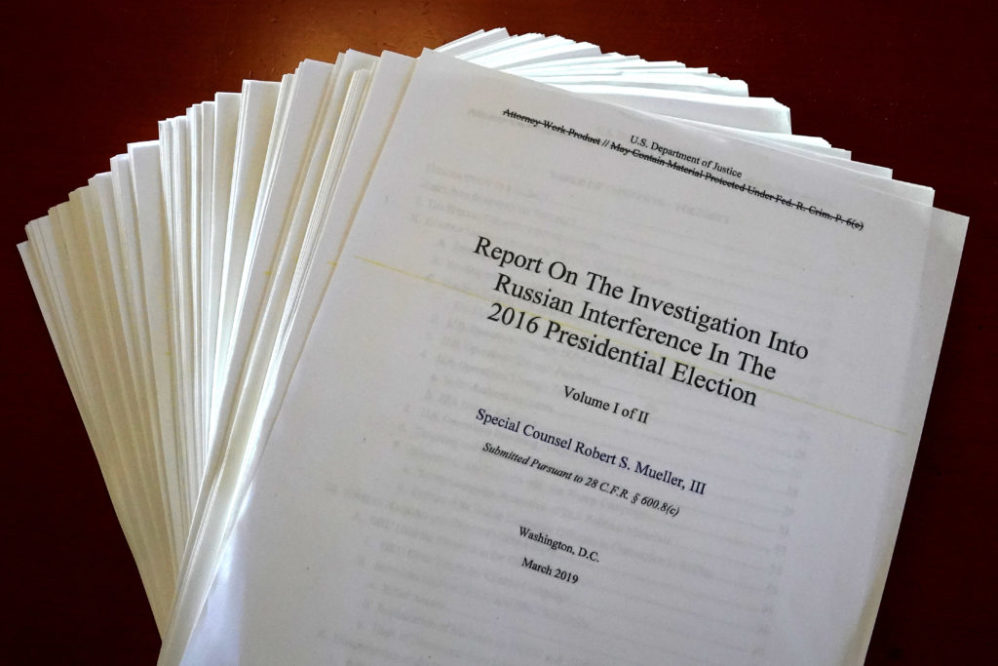
After 22 months of investigation and $34 million spent, the Mueller report concluded that there was no Trump-Russia collusion—the main focus of the investigation—even though that unfounded allegation dominated print and televised media’s speculative headlines for the last two years.
While Mueller’s report addressed various allegations of Trump’s other roguery, the special counsel did not recommend that the president be indicted for obstruction of justice in what Mueller had just concluded was not a crime of collusion.
What Mueller strangely did do—and what most federal prosecutors do not do—was cite all the allegedly questionable behavior of a target who has just been de facto exonerated by not being indicted.
What Mueller did not do was explain that much of the evidence he found useful was clearly a product of unethical and illegal behavior. In the case of the false charge of “collusion,” the irony was rich.
Russians likely fed salacious but untrue allegations about Trump to ex-British spy Christopher Steele, who was being paid in part by the Hillary Clinton campaign and the Democratic National Committee to find dirt on Trump.
The Russians rightly assumed that Steele would lap up their fantasies, seed them among Trump-hating officials in the Barack Obama administration and thereby cause hysteria during the election, the transition and, eventually, the Trump presidency.
Russia succeeded in sowing such chaos, thanks ultimately to Clinton, who likely had broken federal laws by using a British national and, by extension, Russian sources to warp an election. Without the fallacious Steele dossier, the entire Russian collusion hoax never would have taken off.
Without Steele’s skullduggery, there likely would have been no Foreign Intelligence Surveillance Act Court-approved surveillance of Trump aide Carter Page. There might have been no FBI plants inserted into the Trump campaign. There might have been no subsequent leaking to the press of classified documents to prompt a Trump collusion investigation.
Given the Steele travesty and other past scandals, it is inexplicable that Clinton has not been indicted.
Her lawlessness first made headlines 25 years ago, when she admitted that her cattle futures broker had defied odds of one in 31 trillion by investing $1,000 from her trading account and returning a profit of nearly $100,000. Clinton failed to report about $6,500 in profits to the IRS. She initially lied about her investment windfall by claiming she made the wagers herself. She even fantastically alleged that she mastered cattle futures trading by reading financial newspapers.
To paraphrase Clinton herself, anyone else would have been indicted for far less.
The reason that foreign oligarchs are no longer donating millions of dollars to the Clinton Foundation, and that Bill Clinton is not being offered $500,000 for speaking appearances in Moscow, is simply because Hillary Clinton is not secretary of state. She is no longer in a public position to hector her colleagues into approving pro-Russian commercial deals, such as the one that gave Russian interests access to North American uranium.
As secretary of state, Clinton also sidestepped the law by setting up a home-brewed email server. She transmitted classified documents over this insecure route and lied about it. And she destroyed some 30,000 emails that were in effect under subpoena. Anyone else would have been indicted for far less.
In truth, Clinton was at the heart of the entire Russian collusion hoax. Even after the election, she kept fueling it to blame Russia-Trump conspiracies for her stunning defeat in 2016. Unable to acknowledge her own culpability as a weak and uninspiring candidate, Clinton formally joined the post-election “resistance” and began whining about collusion. That excuse seemed preferable to explaining why she blew a huge lead and lost despite favorable media coverage and superior funding.
For much of her professional life, Hillary Clinton had acted above and beyond the law on the assumption that as the wife of a governor, as first lady of the United States, as a senator from New York, as secretary of state and as a two-time candidate for the presidency, she could ignore the law without worry over the consequences.
For Clinton now to project that the president should be indicted suggests she is worried about her own potential indictment. And she is rightly concerned that for the first time in 40 years, neither she nor her husband is serving in government or running for some office, and therefore could be held accountable.
Special counsel Robert Mueller’s two-year, $30 million, 448-page report did not find collusion between Donald Trump and Russia.
Despite compiling private allegations of loud and obnoxious Trump behavior, Mueller also concluded that there was not any actionable case of obstruction of justice by the president. It would have been hard in any case to find that Trump obstructed Mueller’s investigation of an alleged crime.
One, there was never a crime of collusion. Mueller early on in his endeavors must have realized that truth, but he pressed ahead anyway. It is almost impossible to prove obstruction of nothing.
Two, Trump cooperated with the investigation. He waived executive privilege. He turned over more than 1 million pages of administrative documents. He allowed then-White House counsel Don McGahn to submit to over 30 hours of questioning by Mueller’s lawyers.
Three, anyone targeted by a massive investigation who knows he is innocent of an alleged crime is bound to become frustrated over a seemingly never-ending inquisition.
Trump’s reported periodic rages at the Muller investigation are regrettable but not unnatural, given that Mueller expended a huge amount of government resources to confirm what many knew at the outset: that there was never any collusion with the Russian government to warp the 2016 election.
Yet Mueller’s team went down every blind alley relating to its investigation—except where Obama-era officials were likely culpable for relevant unethical or illegal behavior.
The Foreign Intelligence Surveillance Act warrants were integral to Mueller’s investigations. But there is no mention of how the FISA court was deceived by not being told that the chief evidence used to obtain the warrants was an unverified dossier paid for in part by the Hillary Clinton campaign and the Democratic National Committee.
Some of the collusion narrative Muller examined was based on FBI informants’ unverified stories. Yet strangely, the Mueller team did not investigate whether it was legal in the first place for the FBI, possibly with CIA help, to use informants to spy on a presidential campaign.
Former FBI Director James Comey figures into the Mueller report. But there is no curiosity about whether he broke the law in leaking what may well have been four classified memos of private presidential conversations to the press for the purpose of forcing an appointment of a special counsel.
The Christopher Steele dossier likewise makes an appearance in the Mueller report. But for a team investigating the alleged collusion of foreigners in a U.S. election, there is silence about the salient fact that Steele, a foreign national, enlisted other foreign nationals to dig up dirt on Trump to weaken his election chances—with part of the funding for this research provided by the Clinton campaign and the DNC.
What bothers many Americans about the collusion hoax is the accompanying sanctimony of the so-called investigators. The Mueller team could have helped itself had it just noted that much of the evidence it looked at was a product of Obama-era officials’ unethical or illegal behavior.
Comey wrote a memoir, “A Higher Loyalty.” Its eponymous themes are Comey’s own ethics and principles. But Comey may well have misled the FISA court and possibly lied under oath to a House committee. He was not candid with federal investigators and leaked confidential and classified government memos.
Former FBI Director Andrew McCabe also wrote a memoir, “The Threat.” Its argument is that FBI kingpins such as McCabe protect America from dangers such as Donald Trump. But McCabe himself is under criminal referral for lying to federal investigators. His sworn congressional testimony cannot be reconciled with Comey’s. McCabe also likely misled the FISA court. And he apparently contemplated staging a near-coup to remove an elected president through the deliberate misuse of the 25th Amendment.
Former CIA Director John Brennan is a paid analyst for MSNBC who often railed about Trump’s “treason” and predicted his indictment. Yet Brennan himself has lied under oath to Congress on two occasions. He likely misled Congress about his role in trafficking in the Steele dossiers. And Brennan’s CIA may well have helped the FBI use informants abroad to entrap Trump campaign aides in efforts to find dirt on Trump.
Former Director of National Intelligence James Clapper is a CNN analyst who often predicted that a supposedly treasonous Trump would be indicted. Clapper, too, has lied to Congress under oath. He once denied and then admitted to leaking confidential documents.
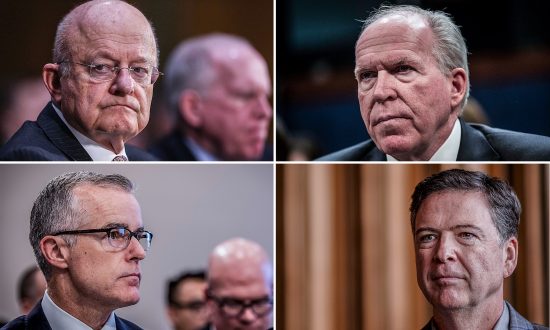
The problem with the Muller investigation, and with former intelligence officials such as Brennan, Clapper, Comey and McCabe, is pious hypocrisy. Those who have lectured America on Trump’s unproven crimes have written books and appeared on TV to publicize their own superior virtue. Yet they themselves have engaged in all sorts of unethical and illegal behavior.
The only mystery left is whether our elite investigators actually believe their own delusions. Or were they constantly broadcasting their virtue as a preventive defense against growing evidence of their own moral lapses?
James Clapper, John Brennan, James Comey and Andrew McCabe (Clockwise starting top left)
From late 2015 until April 2019, the media, the Left, and the Obama administrative state hierarchy warned us nonstop that candidate, president-elect, and inaugurated President Trump “colluded” with Russia to defeat Hillary Clinton, to assemble a suspect cabinet, and to rule in treasonous fashion in the interests of Vladimir Putin. The former head of the CIA and the director of national intelligence were birthed as permanent analysts at MSNBC and CNN to sermonize—with wink-and-nod assurances that their past billets and security clearances substantiated their authority—that the treasonous Trump would likely be impeached, indicted, or quit.
A mostly progressive team of lawyers, with an unlimited budget, no restrictions on time, and with enormous legal powers found all of that to be a lie.
Unable to find Trump likely guilty of either collusion or obstruction of investigating the non-crime of collusion, they instead salted their report with innuendo and rumor of what the enraged Trump was supposedly thinking about, raging about, and talking about among his closest confidants, including the insurrectionary statement of his press secretary who allegedly sinned by exaggerating the extent of FBI rank and file unhappiness over the firing of James Comey.
All that was a long, slow distraction over real culpability on the part of a number of our supposed best and brightest. And here are some of their most absurd moments from the Orwellian hunt for collusion.
Claptrap
Former Director of National Intelligence James Clapper swore under the oath to the House Intelligence Committee that he did not leak the contents of the Steele dossier to the media or disclose to them an intelligence briefing to the newly elected president of the dossier’s contents. When such news accounts were nevertheless reported in the media, a shocked-in-Casablanca Clapper expressed “profound dismay” at such leaks and expressed his regret to President-elect Trump. With furrowed brow and assurance that such unprofessionalism did not come from the “intelligence community,” Clapper elaborated that these unauthorized disclosures were “extremely corrosive and damaging to our national security.”
Later Clapper admitted that he himself had been one of the sources—what James Comey called a “news hook”—of the very “extremely corrosive and damaging” leaks that he had so damned, through passing on information to CNN’s Jake Tapper, et al., Clapper mysteriously was later hired by CNN as a national security analyst.
Fox in the Henhouse
Deputy Attorney General Rod Rosenstein replaced Attorney General Jeff Sessions on all oversight of matters relating to “Russian collusion” on the theory that, unlike Sessions, the Obama-era Justice Department official was nonpartisan, not conflicted, and thus could decide whether to appoint a special counsel, and, if so, whom.
Yet Rosenstein himself had himself signed one of the FISA warrant extensions that continued surveillance of former Trump campaign Carter Page, a fact of some importance to Special Counsel Robert Mueller’s subsequent investigation. Rosenstein, in fact, appointed Mueller, who was a longtime associate who had worked with him on prior investigations. Rosenstein had also drafted the memo justifying Trump’s firing of FBI Director James Comey, which directly led to Mueller’s appointment.
Rosenstein would then meet with Comey’s replacement, acting FBI Director Andrew McCabe, allegedly, to discuss the possibility of removing the elected President Trump on grounds under the 25th Amendment that he was mentally unfit. Rosenstein’s angst, apparently, arose because Trump had taken Rosenstein’s own advice to fire Comey, which had in turn prompted McCabe to launch new investigations, which Rosenstein, again apparently, then sort of joined—in theory then to investigate in circular fashion himself?
A Higher Ego
Fired FBI Director James Comey wrote a book called A Higher Loyalty, with the theme that Comey had always put allegiance to “the Truth” over all careerist and partisan concerns.
Yet Comey signed off on a FISA warrant request without apprising the court that the chief evidence for such a writ was paid for by losing presidential candidate Hillary Clinton. Comey’s own sworn testimony about the dossier to a Senate Judiciary Committee was not consistent with the actual evidence in the dossier presented to the court. Comey also claimed he needed to brief Trump on the dossier because the media was going to publish its contents, when, in fact, it was only Comey’s staged meeting with Trump about the dossier that offered enough official sanction for the dossier to convince Buzzfeed finally to release it.
Yet Comey on FBI time and machines wrote memos memorializing his confidential meetings with President Trump, and then leaked seven of them to the media in order to create enough fury to lead to the appointment of a special counsel.
Despite Comey’s denials, four of the seven memos may well have contained some classified information and thus were probably illegally leaked by Comey, who succeeded in prompting the appointment of a special counsel—his longtime friend Robert Mueller. Yet Comey in his December 2018 congressional testimony, admitted under oath over 200 times that he did not know the answer to the questions asked or did not remember.
Yet Comey’s testimony cannot be reconciled with sworn statements of his own deputy Andrew McCabe. Comey’s real message is not about a higher loyalty, but rather that when one does not tell the truth, one must apparently continue not to tell the truth—at least until the edifice of the aggregate untruth collapses by its own weight.
Collusion Delusion
Robert Mueller investigated a supposed crime of Trump-Russian collusion that early on in his investigation was discovered to hinge on the Christopher Steele dossier, which to this day has had none of its contents verified but lots of its assertions proved impossible or inaccurate.
The mandate of the Mueller investigation was to discover which foreign nationals tried to interfere with the 2016 election, with the help of the Trump campaign, in order to warp its outcome. While the contents of the dossier that prompted his investigation were never substantiated (no sane person believes that Alexander Downer’s happenstance meeting with campaign volunteer George Papadopoulos prompted the entire collusion hoax), its author and sources were very much authenticated: foreign national and British subject Christopher Steele, and Russian anonymous sources whom Steele contacted and may have paid for the information that wound up in the dossier.
In other words, the Mueller investigation failed to find any Trump foreign collusion, but knew that its birth was initiated by the efforts of a foreign agent to work with other foreign sources to alter the 2016 election: real collusion created the Mueller investigation that looked in vain for false collusion. If that seems surreal, then perhaps the real purpose of the investigation soon was to sweep up enough innuendo and dirt on the president and to publish such extraneous allegations as some sort of justification for finding no collusion.
The No Stars
Robert Mueller had to assemble an independent and unbiased special counsel’s legal team, ostensibly to avoid the partisanship of an all-Republican Department of Justice hierarchy investigating the Republican Trump. But Mueller, a Republican, appointed almost all non-Republican lawyers; among them many donors to Hillary Clinton’s 2016 campaign; among them lawyers of the former Obama Justice Department who had been briefed by Bruce Ohr on the contents of the Steele dossier at a time when Fusion GPS and members of Obama Administration were doing their best to seed the gossip mill among the media; and among them a few lawyers who variously had either represented the Clinton Foundation or former Clinton aides or former Obama Administration officials; and among them Lisa Page and Peter Strzok, who earlier had sent each other hundreds of text messages, many of them expressing not just loathing of the object of their investigation, but also vows to ensure that Trump would not become president.
In the end, the “dream team” and “all stars” spent $34 million and 22 months, and wrote over 400 pages to confirm what was self-evident from the outset of this ill-starred inquest: Donald Trump did not “collude” with the Russians to defeat Hillary Clinton; Trump did not impede the nonsensical investigation of absurd charges; and the horde of lawyers who found no crimes were frustrated to the point of including anything in their report they could to embarrass Trump—except the proof of collusion for which they were tasked to find.
Legacies
The Mueller fiasco likely will end any talk of any special counsel investigation for a generation. Eventually, Brennan, Clapper, Comey, and McCabe, along with others, will feel what it is like to have a federal prosecutor leveraging them, but this time about real, not made-up, crimes.
The liberal television media and their administrative state partisan “experts” likely will not gain back their former audiences, who were duped with two years of fabrications dressed up as “the walls are closing in” psychodramatic news. The hard Left, “Impeach Trump!” Democratic presidential field will no longer have an excuse to avoid explaining to the American people their weird agenda: a fundamental transformation of the country antithetical to the visions of the American Founders and likely on every issue opposed by a majority of Americans. And we the people will learn yet again that our best and brightest just may be among our worst and dumbest.
Disclosure requires at the outset that I mention Victor Davis Hanson wrote a very generous foreword to my book on President Trump, though from a somewhat different angle. I would have declined this assignment if it required, in all honesty, to write a less than favorable review. That is not a problem. This is, and as any Hanson reader would expect, an excellent book. The title is in some respects misleading, as the author does not make the case for Trump as an advocate; he neutrally presents the reasons why an adequate number of Americans, conveniently distributed electorally, chose him as president.
Trump pulled off an extraordinarily perceptive analysis of the areas of discontent—identified both intuitively and by polling carefully. Trump recognized that the post-Reagan presidency and Congress had alienated a large and ever-growing section of public opinion stretching, with rare dissident patches, from upstate New York and Pennsylvania to the Rocky Mountains, and apart from Minnesota and Illinois, from Canada to the border and Gulf of Mexico. This has become the great Republican torso of America, and Hanson limns in always interesting insights about the steadily increasing disaffection of traditional, white, working and middle-class Americans at what they consider the desertion of their interests by the Democratic Party and the disparagement of them and of their opinions by the leadership of the Democratic Party.
Tens of millions of Americans, not necessarily immensely politically sophisticated, but well aware of what they liked and disliked, were steadily more offended by President George H.W. Bush’s frivolous renunciation of his infamous Clint Eastwood-imitative promise: “Read my lips—no new taxes,” and by his, as they perceived it, post-Gulf War foreign policy that was overly deferential to America’s enemies and to free-loading allies. Iraqi dictator Saddam Hussein had been removed from Kuwait yet crowed that he had survived, was developing nuclear weapons and was the tip of the spear of militant, secular Islam. Bush’s support for continued Ukrainian and other ethnic republics’ adherence to the Soviet Union, and praise for the “confederation” of Yugoslavia, vaguely annoyed many Americans, especially when his son led us back into Iraq a decade later. The senior President Bush’s answer to a recession at home was just to spend more, even if it was borrowed, and even if doing so did nothing for the dwindling manufacturing sector of America.
In time, the people that Bill Clinton assured “I feel your pain,” evolved, in considerable measure, into the people that Barack Obama would asperse as “clinging to guns and religion.” They too were irritated. This was hard to take from a man who sat contentedly for twenty years in the pews of racist and anti-American pastor Jeremiah Wright, who dispensed his violent religion in fiery terms to the Obama family. The same loyal Democrats going back to the Roosevelt and Truman and Kennedy and Johnson years were singularly unimpressed by 2016 candidate Hillary Clinton’s consignment of them to the “basket of deplorables,” racists male chauvinists, rednecks, reactionaries, and bigots.
All politically informed people generally knew about this, but Hanson meticulously cites the Democratic leaders and describes Donald Trump’s cunning and well-thought-out pitch to what Richard Nixon called in a different context: “The silent majority.” Despite unprecedented media derision, Trump—once he got going as a candidate—exploited the rather muted proposals for tinkering with the decaying status quo of his talented group of Republican opponents, successful governors and former governors (Jeb Bush, Chris Christie, Mike Huckabee John Kasich, Rick Perry, Scott Walker), and prominent senators (Rand Paul, Marco Rubio, and Ted Cruz). They were a capable and previously respected group.
But as the debates opened, Trump—though gratuitously abused by a vast echelon of the media—apparently was in the lead. In the early days, prominently placed among the contenders, only he dissented from the group-think of the other candidates of both parties. Only he wanted the NATO allies to pay more for their defense that the United States was providing, though it was distant from the possible source of danger, Russia. Only Trump called for the end to unequal trade deals, to a policy of truckling to China which enjoyed a $365 billion trade surplus with the United States and yet extracted exorbitant concessions from American companies to do business in China, and from disadvantageous trade agreements with Mexico, Japan, and Western Europe. Only Trump debunked the Palestinians as a serious interlocutor for peace.
Only Trump, among Republicans and Democrats, despite socialist senator Bernie Sanders’ supposed championing of the American working class, attacked globalism with its implications of supposed allies enticing American companies into their countries from which they would export unemployment back to the United States. All the other candidates in both parties were generally silent on these points, but Americans noticed, and as the primaries rolled by, the conventional wisdom than Trump was just brand-building and creating a great infomercial, gave way to hysterical attempts to “Stop Trump” on the Republican side, and then distance the party and its candidates at other levels from him.
Finally, in effect, they joined Hillary Clinton in protecting the United States from the “great ogre,” the unimaginable prospect of Donald Trump, blow-hard and checkered billionaire, sexist, racist, know-nothing, crook, tax-cheat, and ultimately Manchurian candidate-stooge of the Kremlin, being elected to the presidency. Most noteworthy, only Trump of all the candidates on both sides appeared to be serious about stopping the flow of millions of illiterate peasants across the southern border, contributing to a deadly influx of lethal narcotics. All the other candidates of both parties just repeated the tired platitude of “comprehensive immigration reform,” which everyone understood to mean, naturalizing millions of illegal arrivals and making purposeful (and inconsequential) noises about stopping the future flow of them.
Hanson makes the point very rigorously that Hillary Clinton was the one prominent Democrat who had a more dubious career than Trump’s, despite his less salutary business ventures, such as the unutterable hucksterism of Trump University. It was a fiercely nasty campaign, with both sides regularly charging the other with crimes. If there had been a Democratic nominee apart from the tainted Clinton and socialist Sanders, perhaps even the frequent blunderbuss Vice President Joe Biden, he might have won.
Hanson describes vividly the resonance of Trump’s key campaign arguments: “We don’t win anymore.” No one, he implied, was defending the national interest, and the middle and working classes had been put over the side and were overtly despised by the Democratic leaders over whose backs they had climbed to power, and they were selling America out to foreigners. How was the national interest served by allowing American allies to poach factories from the United States, export back into the country, creating more unemployment, and inducing the profit-making American corporations not to remit profits back to our shores, while Mexico in particular, made the arrangements even more one-sided by exporting illegally into the United States millions of impoverished and unskilled people, who then shipped back $30 billion to Mexico? Trump’s enemies replied that he was a racist, that providing in this way for the welfare of the underdeveloped world built international security and progress, and that it was in America’s interest and was its moral duty also. Only Trump realized that enough of the country was no longer buying into this to win an election with it.
Trump was running against the fading echoes of the Cold War, more than 25 years after the Cold War ended. Hanson, uniquely, makes the case that only Trump of the Republican candidates, could have made these points, (though Rand Paul approached some of them), and that only Hillary Clinton was more vulnerable than Trump was to the imputation of low ethics. When there is added to this the energy and careful targeting and tactics of the Trump campaign, his astonishing victory, the greatest upset in American presidential history, seems more comprehensible. He knew he had no chance in the states where the demographics militate against his positions, especially California and New York, most of New England, and Obama’s home state of Illinois. He focused relentlessly and ingeniously and with all the skills of populist communication he had learned in pulling more than 25 million viewers every week to his reality television production, on susceptible audiences with his very focused message.
Hanson recounts Trump’s generally successful record as president for two years, the astounding economic strength of the country, and his initial successes in facing down trade rivals and the North Korean regime. And he inserts the results of the midterm elections, where, in effect, NeverTrump pretend-Republicans were replaced by Democrats in the House, and the Republicans gained a seat in the Senate and replaced three Republicans hostile to the president with supporters. This enabled his supporters, who now thoroughly control the congressional Republican Party which was skeptical and uncooperative at first, to respond in the Senate to the much-heralded House Democratic investigations into every aspect of Trump’s life. The Mueller report’s benign conclusions for the president came after the book was finished, but only confirm the author’s views.
As only Hanson can, he muses on the possible destiny of this president as a tragic hero like Ajax or Oedipus, whose achievements could be made possible, but also limited, by his excesses. An interesting diversion follows, mentioning a number of literary and film figures.
But Trump could also be a successful president who is not a hero. Not every elevation to high office is a tragedy or a triumph of a hero. I think the betting must now be that Trump will be quite successful and will leave office relatively well regarded by most people. Appalling though it still is, the hatred of him is much less vituperative and self-confident than at the start of his term. And the changes he is seeking to the alliance system and the nature of international power alignments could be substantially realized, and be a stabilizing adjustment to post-Cold War conditions. Mideast peace, NATO, relations with China, all needed reassessment. And freed of the dirigisme and excessive taxation Obama had placed on it, the American economy is flourishing in a way that Trump’s predecessor said could only be achieved with a “magic wand.”
This is an exemplary, fair, and even-sided account of this president, his success as a candidate, and his prospects. It makes no pretense to being a biography and conveys almost nothing about Trump’s life until his emergence as a serious claimant on the presidency. But it is a much-needed and balanced perspective on the Trump phenomenon almost four years after he announced his candidacy to immense hilarity and ridicule.