Showing posts with label Duke Lacrosse Scandal. Show all posts

Wednesday, March 16, 2016

The Media Learned Nothing From The Duke Lacrosse Hoax


By Scott Greer
http://dailycaller.com/
March 15, 2016
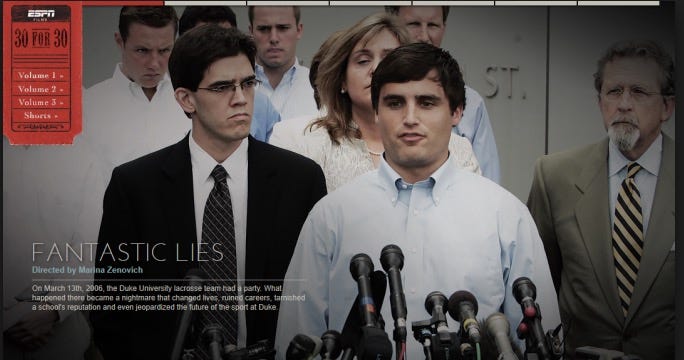


ESPN 30 for 30: Fantastic Lies
Ten years have passed since a woman falsely accused three Duke University lacrosse players of rape. The claim led to a months-long media frenzy and spurred national outrage at the alleged crime of the young defendants.
Every outlet under the sun was willing to believe wholeheartedly the story that district attorney, Mike Nifong, was propagating and took it as fact that the three white Duke students viciously raped a black woman.
Since that time, America learned that the story was completely bogus. Authorities zealously pursued it because one district attorney thought it would help him get re-elected. (Note: it actually did.)
ESPN aired a documentary on the event Sunday which castigated its media compatriots — while excluding itself — who bought into the insidious lie and exposed how unthinking outrage forever ruined the lives of three innocent young men.
Looking back at the affair naturally begs the question: Did we learn anything from this particular rape hoax?
The answer is one big hell no.
Over the last few years the media has fallen for a host of stories that turned out to be completely different than what was originally reported. Throughout 2012 and 2013, we had the shooting death of Trayvon Martin. The initial narrative was one of cold-blooded murder perpetuated by a man with hate in his heart against an innocent black child. Eventually, it turned out the gunman shot Martin in self-defense after having his head repeatedly bashed to the pavement by the 17-year-old.
In 2014, we had two big lies dominate the news cycle: the police shooting death of Michael Brown in Ferguson, Missouri and the University of Virginia gang rape hoax.
For months, the mainstream media spread the false notion Brown had his hands up and was not a threat when he was fatally shot. The “hands up” story helped fuel the riots that tore up Ferguson and inspired the creation of the Black Lives Matter movement. Even after the shooter, Officer Darren Wilson, was cleared of any wrong-doing by the St. Louis County district attorney, there were still a large number of liberals who still pushed the idea Brown was murdered without justification.
Later on, Eric Holder’s Department of Justice confirmed what local authorities had already determined, and the “hands up” narrative went down the memory hole. (RELATED: It’s Official: DOJ Will Not Charge Darren Wilson In Federal Probe)
Right around the time the riots were dying out in Missouri, Rolling Stone published “A Rape on Campus.” This depicted a brutal gang rape that supposedly done by members of a University of Virginia fraternity. Dozens of articles were written about how the story showcased the horrific rape culture lurking within American higher education and UVA suspended its entire fraternity system.
However, the story turned out to be an eerie replication of the Duke lacrosse hoax as the “gang rape” turned out to be a twisted fantasy concocted by a demented young woman. (RELATED: University Of Virginia Student’s Catfishing Scheme Revealed)
If there’s anything we “learned” from the Duke lacrosse case, it’s that powerful figures and institutions in our society will blindly believe and promote outright lies if they fit a certain narrative.
Liberals want to believe rich white kids get away with horrific crimes, particularly against minorities, because of their skin color and wealth — that’s why they bought the deranged woman’s tale of three Blue Devils sexually assaulting her. Liberals want to believe cops routinely brutalize innocent black youth without repercussion — that’s why they continued to tell us Michael Brown had his hands up. Liberals want to believe there’s a widely-ignored campus rape culture that gives license to frat boys to sadistically rape co-eds — that’s why Rolling Stone published a massive disgrace to proper journalism.
Ten years after Duke, our anointed guardians of truth are as willing as ever to buy lies that conform to their political prejudices.


Read more: http://dailycaller.com/2016/03/15/the-media-learned-nothing-from-the-duke-lacrosse-hoax/#ixzz433xEzbaV

Sunday, March 13, 2016

Jay Bilas: A 2006 open letter to Duke Magazine on leadership and justice


Editor's note: The following is the letter current ESPN analyst and Duke alum Jay Bilas wrote to the editor of Duke Magazine in 2006 in the wake of the controversy surrounding the university's lacrosse program. In the end, the publication chose not to publish the letter. For more on this unforgettable timeline of events, watch the latest 30 for 30 documentary "Fantastic Lies"which premieres on Sunday, March 13, 2016 at 9 p.m. EST on ESPN -- the 10-year anniversary of the off-campus party that shook Duke, and the surrounding community, to its core.


Duke University President Richard Brodhead fields questions during a news conference announcing the suspension of the men's lacrosse team schedule in Durham, N.C., Tuesday, March 28, 2006. (AP Photo/Sara D. Davis) 


Dear Editor,
A true leader has the vision and courage to recognize what is right, especially in the face of adversity, and fears not the consequences of unreasonable response. A true leader needs not the benefit of hindsight to make clear the right path. From March 2006 to date, President Brodhead's mishandling of the challenges presented has proven him incapable of effectively leading Duke into the future.
While President Brodhead can point to a few ineffectually communicated words here and there for a feeble claim that he "emphasized" the protection of the rights of Duke's students, his claim fails the laugh test. The vast majority of his words and actions, and in many cases his silence, emphasized an aura of guilt of the students and of the university. From the beginning, President Brodhead abdicated his responsibility as Duke's leader to stand up for fairness and truth. Instead, President Brodhead chose the path of political expediency. He failed to effectively counter factually inaccurate and inappropriate statements about Duke and its students, failed to forcefully speak out against procedural irregularities, and failed to take appropriate action in response to repeated attacks upon the due process rights of Duke's students. That is unacceptable.
If such failures in leadership are not enough, for the same reasons that President Brodhead forced the resignation of lacrosse coach Mike Pressler -- because confidence in his ability to lead had been compromised, and a need to move forward in a new direction -- President Brodhead should resign or be dismissed. And, based upon [trustee chair] Bob Steel's letter of April 11, 2007, in which Mr. Steel stated that the board agreed with the principles President Brodhead established and the actions he took, the resignation of Mr. Steel and any board members that acted in lock step with President Brodhead are also appropriate.

Jay Bilas '86, J.D. '92
Charlotte, North Carolina

Friday, March 11, 2016

New ESPN '30 for 30' documentary to look back at Duke lacrosse case

March 9, 2016
From left to right: David Evans, Collin Finnerty and Reade Seligmann, the three members of the 2006 Duke lacrosse team who were falsely accused of sexual assault.(Getty Images)
The story was one of the most sensational of the 2000s, a bad brew of race, class, sports, and in the end, significant prosecutorial misconduct against three former Duke University lacrosse players accused of sexually assaulting a stripper. After months of press attention and an irrevocable stain on the Duke athletic program, North Carolina attorney general Roy Cooper declared on April 11, 2007 in exonerating lacrosse players Reade Seligmann, David Evans, and Collin Finnerty: “In the rush to condemn, a community and a state lost the ability to see clearly.”
ESPN Films vice president John Dahl said his division had been thinking about doing a 30 for 30 documentary on Duke Lacrosse since 2012, but they could never land on the right filmmaker. That changed last year when Dahl re-connected with Marina Zenovich, director of the 2008 Emmy-winning documentary "Roman Polanski: Wanted and Desired," who Dahl had met years earlier. Dahl said he had always wanted to work with Zenovich and through Lightbox, a multiplatform media company run by Academy Award and Emmy-winning producers Simon Chinn and Jonathan Chinn that has employed Zenvoich, a match was made last fall. 
The wait was worth it for ESPN. Zenovich has delivered a highly compelling and well-paced 102-minute film called “Fantastic Lies,” which debuts March 13 at 9 p.m. ET, exactly 10 years to the day the Duke lacrosse players hosted their infamous party. 
“For me this case is about prosecutorial misconduct and false accusations mixed with a prosecutor and police department that did not have anyone to answer to,” Zenovich said. “The issues of prosecutorial misconduct and police misconduct are very alive and very scary for people who end up that in situation. I hope people will say, 'Hey, next time I won’t jump to conclusions' but I think we live in a time where they do.”
The film took about a year from conception to completion. The toughest challenge: convincing the families of the players and those connected to Duke to talk on camera. Zenovich said she tried for months to get parents and players to do so, but received no after no. The same went for Duke University authorities (all requests for Duke administrators were turned down.) Dahl said he first saw an 83-minute rough cut in mid-July and at that point there was no parents or any players on film. 
Slowly, Zenovich gained the trust of a handful of parents including Tricia Dowd, the mother of lacrosse player Kyle Dowd, and that opened the door to others. Eventually, Phil and Kathy Seligmann (the parents of Reade Seligmann), and Kevin Finnerty (the father of Collin Finnerty) spoke for the piece. The parents are far and away the most impactful people in the film. Reade Seligman, Collin Finnerty and Dave Evans, the three indicted players, declined interviews, citing a shared belief that they wanted to put the case behind them. The focus of the film is very much on the three accused, as well as fellow player Ryan McFadyen (who wrote an infamous email that became misconstrued as an admission of guilt) and the case's lawyers. 
Zenovich was able to convince two members of the team—Tony McDevitt and Rob Wellington—to do on-camera interviews. 
“This was still very alive and such a painful event for so many people,” Zenovich said. “It was a tough film to make and I am very proud of it. We tried very hard to be fair in the storytelling.”
As for the other principles in the story, Zenovich said she went to a correctional facility in Raleigh to meet with Crystal Magnum, the stripper at the party who is currently serving a jail term for second-degree murder in another case. Mangum agreed to an interview, but ESPN’s request was turned down by the Durham prison authorities. “She still seemed to have a different idea of what actual happened other than the facts that I gathered,” Zenovich said. “I didn’t know how that interview would go but I would have done it.”
Zenovich said she made both personal and third-party attempts to interview Mike Pressler, the former Duke lacrosse coach, but he was unwilling to go on camera. The filmmakers ended up interviewing author and former SI staffer Don Yaeger, who co-wrote Pressler’s book It’s Not About the Truth. Zenovich said she ran into Duke President Richard Broadhead by accident in Durham at an inn and introduced herself. 
“He said something to the effect of, ‘That’s a very old story,’” Zenovich said. “He didn’t want to touch it.” 
Zenovich also discussed the project with Mike Nifong, the disbarred and disgraced former Durham County district attorney who prosecuted the case, on two occasions (November 2014 and April 2015). He declined their interview request. “I wanted to try to understand what he thought he was doing,” Zenovich said. “Ambushing him for an interview would not have accomplished what we wanted to do.”
Dahl said he believed the Duke Lacrosse story was particularly relevant today given social media and how fast stories can spread. “What happened in that case speaks to a lot of what we deal with today,” Dahl said. 
Check it out. It’s worth your time.

Saturday, April 25, 2015

Duke still gets an F for handling of Mike Pressler firing


By  GLOBE STAFF  


Mike Pressler is in his ninth year as Bryant University’s lacrosse coach and he has shaped the Bulldogs into a plucky, stubborn opponent. They have won the Northeast Conference championship each of the last three seasons and last year dumped mighty Syracuse, 10-9, before falling to Maryland in the quarterfinals of the NCAA Tournament.

Pressler, 55, clearly knows what he’s doing, and he is also a man who previously paid a steep price for sticking by his players and living by his convictions. In 2006, amid trumped-up claims that three of his players at Duke raped a black female stripper hired for a team party in off-campus housing, school officials bumrushed him into resigning after 16 years as the Blue Devils’ coach.
The forced resignation, CBS reporter Armen Keteyian noted in a “60 Minutes’’ story that aired last Sunday, made Pressler the “sacrificial lamb needed to appease protesters and protect the school’s gold-plated image.’’
Everything about the woman’s story was bogus. The three players, all indicted on rape and kidnapping charges, were exonerated more than a year later. Yet when all the smoke cleared, Pressler was out on the street, out of work, a coaching pariah. He was turned down repeatedly for college coaching vacancies until Bryant officials had the courage to back a guy whose fatal flaw in Durham was telling Duke administrators that he believed his players were innocent, that he refused to abandon them, that they deserved due process of law.
He knew his players were guiltless, said the resolute Pressler, and he felt they deserved his loyalty and that of the university.
“It’s everything,’’ he told Keteyian of his sense of loyalty. “Without that, as a man, you have nothing.’’
Out of work, Pressler took action against Duke for wrongful termination and settled early in 2007 for an undisclosed sum. He then sued the school only a few months later, claiming that Duke broke confidentiality terms outlined in the settlement and further contending a school official slandered him. Some three years later, Duke settled the suit before trial, terms again confidential, and issued Pressler an apology. It took the prospect of court proceedings for Duke to start making things right with its former employee.
By then, thankfully, Pressler was already working his magic in Smithfield, R.I., transitioning the Bulldogs from Division 2 to 1. He was paving his road to redemption the way all coaches prefer, with a whistle dangling from a string attached to one hand and an eye fixed on winning.
Amid Pressler’s redemptive tale told so artfully by “60 Minutes’’ stood Chris Kennedy, virtually a Duke lifer, though he earned his undergraduate degree at Georgetown (’71) as well as a master’s there in ’74 before beginning his workaday life at Duke in 1977. Today, Kennedy is the school’s senior deputy director of athletics.
Early this year, Duke dedicated a tower on its athletic fields to Kennedy, an homage to his decades of service in the athletic department. He is a respected, remarkable guy, which came through vividly when he spoke to “60 Minutes.’’ His son, Joe, played for Pressler at Duke and captained the team in 2005, the season before the rape accusation.
Keteyian noted in the story that Kennedy commented on camera for “60 Minutes’’ even though he was advised to remain silent by school officials, warned that talking would not be in his or the school’s best interest.
Kennedy obviously didn’t care about the warning, or simply felt it was time to stop remaining silent, because silence is too often damning, even cruel. His comments made clear that Pressler had been wronged by the school. Further, Kennedy said the ordeal had been arduous on him, too, sharing with Keteyian, “Other than the death of my wife, it’s the worst thing I’ve ever been through.’’
“It was painful,’’ added Kennedy, “because you had 46 kids [lacrosse teammates] who were really suffering, who knew for a long period of time, that two, three, four . . . some number were going to be indicted based on no evidence whatsoever. Imagine the stress of that on the kids, their parents . . . ’’
No one had to imagine the price Pressler paid. It was all too real. A Bryant spokesperson, contacted early last week by the Globe, said Pressler would not make himself available for an interview in the wake of the “60 Minutes’’ report.
“In some quarters of the [Duke] administration,’’ Kennedy told Keteyian, “there was some belief that [the alleged crime] may have happened, and if that’s the case, they had to respond.’’
The three student-athletes eventually cleared their names and gained their lives back. The accuser was exposed as an utter fraud, the charges dropped. Nitwit district attorney Michael Nifong, who led the public’s rush to judgment with his histrionics and hearsay, was shown to be a rogue prosecutor who ignored the facts, seemingly as a cheap, hurtful ploy to try to get reelected.
And Pressler? Besmerched by all of it and forced to quit by then-Duke athletic director Joe Alleva. Prior to landing the Bryant gig, Pressler told “60 Minutes,’’ one school was so reluctant to have him on campus to talk about a coaching opportunity that it requested the job interview take place at a highway rest area in Lynchburg, Va. Ah, the bravado of academia.
Some nine years after the firing, his words measured and firm, Kennedy said that Duke officials blew it.
“I think that a lot of officials at the university have come to the realization, or came to the realization within a year or so,’’ said Kennedy, “that probably Mike shouldn’t have lost his job.’’
Good on Kennedy. He said what needed to be said, amid a climate and culture in which he was encouraged to keep his mouth closed.
We send our kids to these schools, pay obscenely high tuition rates, for them to learn how to succeed in an increasingly sophisticated and demanding world. Urging students to tell the truth, admit mistakes, correct wrongs, speak truth to injustice, and be decent, compassionate human beings are lessons all schools should be expected to teach.
Too often, as was the case with Duke, they flunk the course themselves.
Kevin Paul Dupont can be reached at dupont@globe.com. Follow him on Twitter @GlobeKPD.

A tale of two college presidents


  • By Stephen J. Nelson

    Posted Apr. 24, 2015 at 2:01 AM
  • http://www.providencejournal.com/

    Bryant University President Ronald Machtley (Credit: Bryant University)

    With its recent story about former Duke University lacrosse coach Mike Pressler, “60 Minutes” reopened a scab on Duke's reputation. Pressler was forced out of his job nine years ago this month, after allegations broke about the team’s hiring of strippers at an off-campus party. This contretemps quickly came to be known as the Duke Lacrosse Fiasco.
    Along with his players, Pressler was vilified. He departed Duke under a cloud of criticism and suspicion. His players became prisoners of their own university. The local district attorney pressed charges against three of them, all of whom subsequently left the university feeling shut out of the community without any due process and muzzled rather than permitted to defend themselves. Pressler was targeted along with them, largely because he refused to turn on the players and to join the mob throwing them overboard.
    Pressler’s fate was intertwined with two university presidents. The contrast between these two men, as leaders and individuals, could not be starker.
    Despite his handling of the Lacrosse Fiasco, Richard Brodhead remains Duke president to this day. During the controversy, Brodhead cowered, unable to stand up to protect the basic principles of a university community and to prevent a horrific rush to judgment. The DA manipulated Brodhead to sign onto what instantly turned out to be a manufactured interpretation of events. Without any parallel detective work to get at the facts, Brodhead bought the allegations brought against the players. The concept that these young men were members of the Duke community, and deserving of justice, eluded this president.
    Brodhead had numerous opportunities to stop the train, but, ignoring senior advisors, he stubbornly refused to do so.
    Brodhead has never apologized to anyone for his snap judgments, for failing to get at the truth, and for letting a DA who was looking for publicity in his quest for reelection call the tune.
    Pressler was sidelined from what he loved: coaching lacrosse. He was an enormously accomplished NCAA Division I coach, his Duke teams perennial contenders for the national men’s lacrosse championship. But now he was a pariah in the collegiate athletic culture.
    His alma mater, Washington and Lee, a Division III force, interviewed him, but at a truck stop hundreds of miles from the campus. It would not touch him with an offer. Pressler resorted to long walks in Duke’s forest yelling at the trees. He endured the trial of trying to figure out how to get his reputation back, a reputation unfairly stolen by Brodhead.
    In contrast to Brodhead, Ronald Machtley, the president of Rhode Island's Bryant University, was willing to give Pressler a second chance, hiring him as men’s lacrosse coach. He believed Pressler’s account of what actually happened at Duke. Like Pressler, he was a leader who strongly believed in personal loyalty. Loyalty was a key aspect of Machtley’s leadership compass, and he was convinced it was also something at Pressler’s core.
    Making inquiries in the college lacrosse and coaching world, Machtley became a believer in Pressler’s commitment to coaching and to his players and teams. That was what he wanted at Bryant.
    Pressler has built the Bryant program from mid-ranks of Division II to the top 20 in Division I. He claims not to care “about the Roman numerals.” He simply wants to coach because that is where his heart and his passion are. It is that identity and commitment that Brodhead ripped away without compassion, understanding or any attempt to learn the truth.
    Machtley’s relationship with Pressler has only deepened during his eight-year tenure at Bryant. His judgment of his coach’s character was repeatedly affirmed. Pressler has refused to use lucrative offers to go elsewhere as leverage to make Bryant pay him more.
    In the “60 Minutes” interview, Machtley, in a grand understatement, declared that Pressler was treated shabbily at Duke. Such a public calling-out of one college president by another is very rare. But Machtley was absolutely spot on.
    Of the two presidents, one was up to his job. Because of that, Pressler’s story has had a deservedly decent ending.
    Stephen J. Nelson, an occasional contributor, is an associate professor of educational leadership at Bridgewater State University and senior scholar with the Leadership Alliance at Brown University.


Monday, April 13, 2015

60 Minutes: Rush to Judgement in the Duke Lacrosse Rape Scandal

Former Duke lacrosse coach discusses his forced resignation during the 2006 Duke rape scandal and his hard road back to coaching


Friday, April 10, 2015

Ex-Duke coach on rape scandal, resignation

The lacrosse coach forced to resign in Duke rape scandal shows Bryant University the loyalty that he says Duke failed to show him


Mike Pressler (CBS News)

http://www.cbsnews.com/
April 9, 2015

Above all be loyal. It could be the motto of Bryant lacrosse coach Mike Pressler. It's the reason he hasn't taken other colleges' offers to triple his salary. He's loyal to Bryant, because it hired him after Duke University showed him zero loyalty when it forced him to resign nine years ago in the "Duke rape scandal" that turned out to be a big lie. Pressler speaks at length about his life during and after the scandal for a 60 Minutes story reported by Armen Keteyian, which also includes a Duke athletic department director in a rare interview expressing regret over Pressler's treatment. Keteyian's report will be broadcast Sunday, April 12 at 7 p.m. ET/PT.
Bryant University in Rhode Island hired Pressler a few months after he was forced to resign by Duke amid the lacrosse team rape scandal caused by the false accusations of a stripper. The national scandal frightened even his own college alma mater; it would only agree to meet him off of its campus for a job interview.
Pressler appreciated Bryant's offer. After the three Duke lacrosse players were declared innocent, other schools sought to hire the former Division I coach of the year. But Pressler turned down the big money. "[Loyalty] is everything...everything. And without that, as a man, you have nothing," he tells Keteyian.
At Bryant, he so improved the lacrosse program that the Division II team was moved up a notch to Division I, where it distinguished itself against some of the nation's top teams. Ron Machtley, Bryant's president, says Pressler is an inspiration to the team and society. "He's never come to me and said, 'Ron, can you match this offer?' He has made a commitment to stay here and that kind of loyalty, which he showed to his team and which his team ultimately showed back to him is something that's very rare in society today."
To turn down the money and the fancy perks that came with it was the only way, says Pressler. "Got to go back to the events of the summer of '06. For me to turn and-- and leave a place... the administration that has given me and my family so much...I couldn't live with myself," he tells Keteyian.
As the false accusations took wind in 2006, he says he was advised to distance himself from his team. "That was, like, blasphemy...We don't run...don't quit, you know...you finish what you start at all costs," says Pressler. The costs were high. He received hate mail and calls, hate signs were placed in front of his home mocking his support of "the Duke rapists." "Google up one of the boys' names, my name...you saw the word 'rape,' 'sexual assault' next to your name... that just was-- even today, I get emotional about it," says Pressler. At the height of the scandal, Duke told him to resign or risk being fired.
Chris Kennedy, senior deputy director of athletics at Duke, says there was a chaotic atmosphere on campus. Duke was in the national news every day over a false story framed by class, race and sex in a Southern town. He felt for the players. "It was painful because you had 46 kids who were really suffering who knew for a long period of time...some number were going to be indicted based on no evidence whatsoever," he says. "Imagine the stress of that on the kids and on their parents and everything." Kennedy says many at the university have come to regret what it did to Pressler. "I think that a lot of officials at the university have come to the realization or came to the realization within a year or so that probably, Mike shouldn't have lost his job."

Thursday, December 04, 2014

The 'Rolling Stone' Saga: Everything That's Wrong with How We Deal with Campus Rape


The rights of the accused, and the need to hear both sides of a story, are falling by the wayside. 

No recent article on the issue of campus sexual assault has attracted as much attention as Sabrina Rubin Erdely’s lengthy piece in Rolling Stone. Detailing an alleged gang rape at a University of Virginia fraternity — an incident that the accuser never reported to law enforcement — the story (if true) suggests utter depravity, with the accused students deserving lengthy prison sentences. Erdely’s writing has already prompted policy changes at the university, including the suspension of all fraternities.

The Virginia case raises two broader points about the campus sexual-assault debate. The first is the disturbing state of campus culture, which seems intent on denying a meaningful role for the police in investigating allegations of campus sexual assault, to the detriment of accusers and the accused alike. The second is the willingness of too many in the media to accept as truth allegations of campus sexual assault.

Assume, for the sake of argument, that the story as reported by Erdely is accurate. The assault involved a conspiracy of several men who laid in wait in a darkened room, executed an attack that lasted several hours, and have (it seems) maintained silence since the incident.

Given the nature of this alleged attack, it would seem obvious that any investigation would require subpoena power, chiefly to obtain access to contemporaneous e-mails or text messages from the alleged conspirators. The accuser, identified only as Jackie, didn’t seek medical attention immediately after the alleged assault, even though, as Reason’s Robby Soave pointed out, “according to the story, everybody involved was basically rolling around in broken glass for hours.” Jackie’s account would benefit from a full examination of both her medical records and those of the accused students. But the University of Virginia, like all universities, cannot force students to turn over e-mails, text messages, or medical records to the school. (UVA’s proposed new policy admits as much, noting that the school can obtain such information only “subject to the consent of the applicable party.”) 
Finally, a successful investigation of this incident might require entertaining plea bargains, with those involved on the fringes of the attack given lighter sentences or not being charged at all in exchange for providing evidence against the leader or leaders of the alleged conspiracy. But the University of Virginia, like all universities, cannot enter into plea bargains with its students.

If, then, Jackie was brutalized, it would be in her interests, as well as those who sympathize with her plight, to see the police, and not the university, investigate this incident. This approach, of course, also would introduce a measure of due process that the University of Virginia’s proposed new sexual-assault policy denies.

In the criminal-justice system, the accused students’ attorney could fully participate at trial, including the right to cross-examine the accuser and other relevant witnesses. The students would receive the right, under Brady, to discovery of all potentially exculpatory evidence and the right to be tried by a jury of their peers. UVA’s proposed new sexual-assault policy gives an accused student none of these rights.

The finding of culpability is made by a single investigator who has to rely on interviews that don’t occur under oath and on whatever evidence he can obtain on a voluntary basis. Under the procedure, the accused student lacks the right to cross-examine anyone and cannot even be present for the investigator’s questioning of his accuser and other inculpatory witnesses. Instead, he obtains only the evidence that the investigator deems “relevant” and chooses to share in his final report. The accused student’s lawyer can be present only for her client’s meeting with the investigator — and even then cannot speak on his behalf, under threat of removal if the university believes she failed “to abide by the limitations on [the lawyer’s] participation.” Finally, a hearing occurs only to determine the penalty, and even there the accused student can be denied a jury of his peers, if the accuser demands a panel of faculty or staff only.

The lesson of the UVA story (again, assuming the allegations to be true) is that the criminal-justice process would protect the accuser by increasing the likelihood that all evidence of the attack would be uncovered, and it would protect the accused by ensuring necessary due-process protections and a fair inquiry. The university, on the other hand, should have no formal role in the investigation.
But it’s very unlikely that most academics, journalists, and politicians of both parties will learn this lesson. Indeed, the primary thrust of sexual-assault policy over the last four years has been in precisely the opposite direction: The federal government, anti-due-process activists on campus, and self-described sexual-assault survivors have acted to separate the criminal-justice system from campus sexual-assault cases.

In an excellent New Republic piece, Judith Shulevitz observed that while universities aren’t overtly discouraging accusers from filing criminal reports, “the proliferating procedures for handling campus sexual assault and the seemingly systemic distrust of the police — communicated either explicitly or implicitly in mandatory orientation sessions as well as when students come in to file complaints — leads to the sense among students that local police are just one option among many, and not an appealing one.” Consider, for instance, Stanford law professor Michele Dauber, an architect of Stanford’s new sexual-assault policy, which removed the former requirement that only a unanimous vote of the disciplinary panel would suffice to brand the accused student as a rapist. Now, if four of the five panelists believe the accuser, even if they are only 50.01 percent certain, the student is convicted. Dauber celebrated her school’s new policy on grounds that it removed the “mock trial” aspect of rape cases (this coming from a professor of law), and she deemed the Stanford approach necessary on the grounds that the county’s local prosecutor had failed to file a sufficient number of sexual-assault cases. It’s hard to imagine any student influenced by Dauber or her policies filing a criminal charge.

In the event, the Obama administration has made clear that it prefers to separate the campus process from police and prosecutors. In a 2013 settlement with SUNY, which previewed recommendations that were similar to those in the 2014 White House task force on sexual assault, the administration required SUNY to conduct its own investigation even when the police had concluded that an accuser was lying. The implicit message: Campus procedures should be so tilted in favor of the accuser that even false accusers might find their story believed.

Perhaps the most shocking element I witnessed when covering the Duke lacrosse case was the reaction of the Duke faculty — especially the notorious Group of 88. Any fair-minded person would have hoped that Crystal Mangum’s allegations were untrue, since they suggested that a local woman had suffered horribly and three of Duke’s own students had committed a monstrous crime. Instead, these professors seemed as if they desperately wanted to believe that three of their students had committed a brutal rape, since this would confirm the professors’ preexisting biases on issues of race, class, and gender.

That mindset too often has dominated how the media has covered campus sexual-assault allegations — all the more so since 2011, when the Obama administration’s Office for Civil Rights issued a formal letter demanding that colleges change their procedures to increase the likelihood that students accused of sexual assault would be found guilty.

In recent days, Richard Bradley, Bret Stephens, Robby Soave, and Ashe Schow have raised serious questions about Erdely’s journalistic objectivity. Perhaps the most troubling piece of evidence on this front came from a highly sympathetic portrayal in the Washington Post, in which Erdely refused to say if she had even attempted to contact the accused students to obtain their side of the story. 
Nothing in the Rolling Stone article gives any indication that she made this effort, though in a follow-up interview with Slate’s Hanna Rosin, Erdely cryptically remarked, apparently referring to the fraternity leadership but not the suspects, “I reached out to them in multiple ways. . . . They were kind of hard to get in touch with.”

It’s possible that Jackie is telling the whole truth. But don’t journalists need to get information from both sides — especially in a story such as this, in which the allegations are so serious and Jackie was unable to present any physical evidence (even contemporaneous photographs) to bolster her version of events?

There are few areas in journalism in which telling a story solely from one side — and, like the Group of 88 Duke professors in the Duke case, simply assuming that the preferred side is telling the truth — would be deemed acceptable. But campus sexual assault is one of those areas, perhaps because too many reporters (like the Group of 88) are ideologically inclined to believe the accuser. To take one example from Rolling Stone: Erdely uncritically quotes from a person she describes as “attorney Wendy Murphy, who has filed Title IX complaints and lawsuits against schools including UVA.” There’s no reference to the fact that Murphy was caught in guilt-presuming, factually inaccurate statements over and over and over again in the Duke lacrosse case. Murphy confirmed Erdely’s preferred narrative; that her source should have no credibility was irrelevant.

Erdely is a model of objectivity compared with the three most active reporters on this issue, the New York Times’s Richard Pérez-Peña, BuzzFeed’s Katie Baker, or Huffington Post’s Tyler Kingkade. Pérez-Peña’s treatment of former Yale quarterback Patrick Witt, in which the New York Times went to print even though it didn’t know the identity of the woman who had accused Witt or the allegations that she made, stands as an examplar of journalistic malpractice.

In the coming weeks, we’ll doubtless learn more about events at Virginia, and we’ll see whether Erdely’s story holds up under scrutiny. But if it doesn’t, don’t expect any meaningful changes in the rush-to-judgment attitude that permeates the nation’s campuses.

— K. C. Johnson is professor of history at Brooklyn College and blogs on higher-education issues at Minding the Campus.