Showing posts with label Far East. Show all posts

Tuesday, October 16, 2018

Book Reviews: 'Vietnam: An Epic Tragedy, 1945-1975' by Max Hastings

Max Hastings' Vietnam: An Epic Tragedy, 1945-1975 is his best book yet


https://www.telegraph.co.uk/books/what-to-read/max-hastings-vietnam-epic-tragedy-1945-1975-best-book-yet/
21 September 2018

Image result for max hastings vietnam


The fall of Saigon to the communist Viet Cong and North Vietnamese in 1975 marked the end of a brutal 30-year conflict in which both French and US forces had been humiliated, as some people saw it, by peasant revolutionaries. It produced in America a long period of soul-searching that found expression in some impressive anti-war literature and a host of brilliant films, such as Apocalypse Now, Platoon, Full Metal Jacket and Born on the Fourth of July.
Then came two events that altered the mood: the collapse of the Soviet Empire, and the successful US military ventures in Kuwait and Iraq. Suddenly, there were no more mea culpa books and films. America and capitalism could feel good about themselves again.
The post-9/11 invasions of Afghanistan and Iraq changed all that, and the time is now right for a proper historical overview of the most significant conflict since World War II and Max Hastings' epic new history will surely set the benchmark for years to come.
One of the overarching themes of Hastings' book is that neither side emerges from the story with much credit. Many in the West - particularly Left-wing intellectuals - were quick to assume that if their own country " had embraced a bad cause, the other side's must be a good one". Yet, as Hastings points out, the North's victory in 1975 "caused the South Vietnamese people merely to exchange oppression by warlords and landlords in favour of even harsher subjection to disciples of Stalin".
By taking a long view of the conflict, Hastings demonstrates that nothing in history is inevitable. Vietnam's subjection to communism, for example, might have been averted if France, its original colonial overlord, had announced its intention to quit the country in 1945, while at the same time embarking upon "a crash transition process to identify credible indigenous leaders and prepare them to govern, as did the British before quitting Malaya".
Instead, still smarting from the humiliation of the Nazi wartime occupation, the French tried to regain control of Vietnam by defeating the communist Viet Minh insurgents, thus inaugurating a decade-long "dirty war" that cost 90,000 French lives and ended in humiliating defeat.
Not that Vo Nguyen Giap, the Viet Minh commander, had it all his own way. If he had been a Western general, writes Hastings, his succession of crippling defeats in 1951 would have cost him his job. But, crucially, he retained the confidence of his political chief, Ho Chi Minh.
Moreover, the significance of Giap's greatest victory - at Dien Bien Phu in 1954 - was the beginning of the end for the French, who had launched it with the "explicit purpose of bringing the Viet Minh to battle", and then lost by "epic bungling". Within a year, the French had withdrawn from Vietnam and the country was partitioned near the 17th Parallel between the communist North and the pro-West South.
The French experience in Vietnam should have served as a warning. It was ignored because, for the US, much bigger Cold War issues were at play. As early as 1947, Harry S Truman had told Congress that it must ever be US policy "to support free peoples who are resisting attempted subjugation by armed minorities or by outside pressure". This so-called Truman doctrine was chiefly directed against international communism, particularly in Vietnam where, from 1950, the US was paying for France's war.
As France faced defeat at Dien Bien Phu, Dwight Eisenhower coined the term "domino theory" to explain that if Vietnam was lost to the communists, the rest of south-east Asia would "go over very quickly". He even appealed to British PM Churchill to support the intervention by evoking their countries' shared endeavours in World War II. But Churchill would not bite. Having failed to save India for herself, he said, Britain was not about to save Indo-China for France.
Instead, successive US governments took a unilateral decision to support South Vietnam, first with money, then with troops, to prevent a communist takeover. One of the great counterfactuals of the war is: would the US have sent combat troops to Vietnam if John F Kennedy had not been assassinated in November 1963?
The answer, says Hastings, is yes. There is, he writes, "overwhelming" evidence "that the president's thinking was dominated by the requirements of his forthcoming re-election campaign", and that, as Kennedy put it to a friend: "I can't let Vietnam go to the Communists and then go and ask [American voters] to re-elect me."
Kennedy had already authorised the dispatch of 16,000 US "advisors", and it was their presence in Vietnam, says Hastings, that tied the hands of his successor, Lyndon B Johnson.
Hastings is excellent on the motivations of politicians and generals on both sides. But he also charts the grim experience of war through the eyes of Viet Cong guerrillas, NVA soldiers, American grunts and Vietnamese civilians. I haven't read a better description of the challenges GIs faced in trying to stay alive in an unfamiliar environment than the 12 pages that Hastings devotes to the subject: "It was tough for junior leaders to exercise control in thick bush, where hand signals could not be seen and shouts were inaudible above a cacophony of exploding grenades, automatic fire, screams of pain and fear."
He reminds us that American troops won victories and inflicted heavy casualties on their opponents - particularly during the communist Tet Offensive of 1968. Yet this success was pyrrhic because it convinced many Americans, appalled by the carnage, that the war had to end. That it took another five years, and cost a further 22,000 American lives, before the last US soldier was withdrawn from Vietnam was because Johnson's successor, Richard Nixon, did not think it was politically viable to abandon the South Vietnamese until he had agreed some form of political settlement with the communists. That the deal was unenforceable - and ultimately doomed South Vietnam - was not Nixon's concern.
Was the whole war pointless, as many believe? Not quite, says Hastings, as it may have saved Thailand, Malaysia, Indonesia and even Australia from communist domination.
"Yet in Vietnam, the American commitment was fatally flawed", writes Hastings, because it was founded "not upon the interests of the Vietnamese people, but instead on the perceived requirements of US domestic and foreign policy".
Hastings was one of the last war correspondents to be helicoptered out of Saigon as the city was about to fall. This personal experience lends colour to his account, but never compromises its objectivity. He has written many excellent histories, but this may be his best.
Exhaustively researched and superbly written, it is both a balanced and authoritative account of how and why the war unfolded as it did, and a gripping narrative on what it was like to take part. No villain - and there were many - escapes Hastings' censure; no political viewpoint emerges unscathed. This is history as it should be: objective, immersive and compelling.
Vietnam: An Epic Tragedy, 1945-1975 by Max Hastings
752pp, William Collins, 
£30, ebook £9.99. Call 0844 871 1514 or visit books.telegraph.co.uk to order 
from the Telegraph for £25

'Vietnam' by Max Hastings is masterful account of the war


By Jerry Harkavy, The Associated Press
October 15, 2018
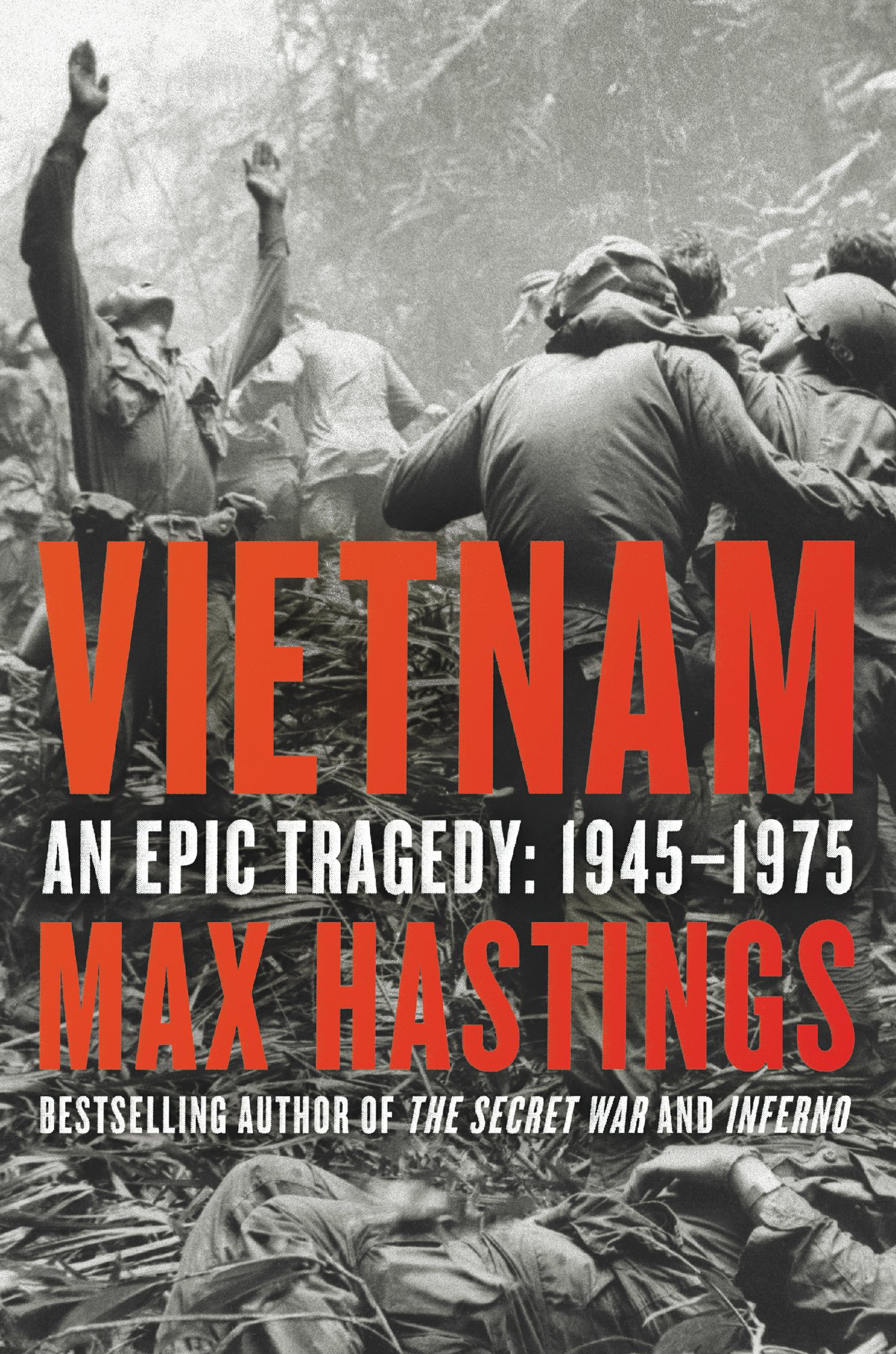
Image result for max hastings vietnam
British journalist Max Hastings, noted for his critically acclaimed books about World War II, has fast-forwarded his research and writing talent to a war that many Americans would like to forget.
His 900-page work chronicles Vietnam's tragic history from Ho Chi Minh's proclamation of an independent state after the 1945 Japanese surrender to the collapse of the South Vietnamese regime 30 years later after the United States cut off ground and air support. Despite ample accounts of heroism and sacrifice on all sides, it's a story in which each of the principal players — France, the United States, Saigon, Hanoi and the Viet Cong — comes away with well-deserved opprobrium.
Unsurprisingly, Hastings concludes that Vietnam was a catastrophe, one that took the lives of as many as 2 million to 3 million combatants and civilians. The war claimed 58,000 American lives, but the number of Vietnamese dead was 40 times greater.
This definitive narrative describes how the French debacle at Dien Bien Phu gave rise to the domino theory and the need to halt the spread of communist domination in Southeast Asia. There were more than 500,000 U.S. service personnel in Vietnam by the time of the 1968 Tet offensive, a stunning military defeat for the North Vietnamese and Viet Cong that was transformed into a propaganda victory.
After Tet, the war was never the same. CBS anchor Walter Cronkite declared the nation was mired in stalemate, President Lyndon B. Johnson said he would not seek re-election, and the U.S. abandoned any hope of victory and sought instead to extricate itself while avoiding explicit defeat.
The fighting would continue for another seven years, a period marked by the My Lai massacre, the invasion of Cambodia and the 1972 Christmas bombing, which Hastings says was designed for partisan political purposes and had no military justification.
The narrative includes detailed accounts of all the major battles, with riveting descriptions of what life was like for combatants on both sides. The reader relives the experiences of GIs plodding through booby-trapped jungle, North Vietnamese dodging B52 strikes while heading south on the Ho Chi Minh trail and helicopter pilots braving fire from hot landing zones while inserting troops or extricating the wounded.
Many of the campaigns covered in the book are familiar to those who served in Vietnam or followed the war in the media, but a rarely mentioned 1968 battle at Dai Do in which a Marine battalion suffered devastating losses gets special scrutiny. During three days of bloody combat, Marines displayed both courage and cowardice in a series of senseless assaults against a well-entrenched enemy. The author says the American commanders who "displayed folly of Crimean proportions" shoulder much of the blame.
Drug abuse, racial strife and the erosion of discipline and the will to fight took their toll on U.S. troops. By contrast, Hastings points to the stronger performance of the small contingents of Australians who were disciplined in their use of firepower and exercised better fieldcraft.
Neither side comes away with clean hands, but Hastings writes that news media were quick to record atrocities by U.S. troops and the brutality on the communist side went largely unreported, fueling antiwar propaganda that portrayed the North as the virtuous party.
Hastings' narrative, along with Ken Burns' masterful series on PBS, offers a well-balanced account of a war that ended more than four decades ago. The author weaves anecdotal and first-person accounts from both sides into the overall history to produce a compelling account that veterans of the war, those who felt its impact at home and readers born decades after the fighting ended will find hard to put down.
Today, with the rise of the internet and globalization, the outcome of the lengthy struggle may seem less cut and dried than it first appeared. Although Vietnam still endures harsh rural poverty and authoritarian rule, America's economic and cultural influences are leaving their mark on its former enemy.
"Whereas the US armed forced failed with B-52s, defoliants and Spooky gunships, YouTube and Johnny Depp have proved irresistible," Hastings writes.

Vietnam: An Epic Tragedy, 1945-1975 by Max Hastings – review

By Martin Woollacott
1 October 2018
Related image
Max Hastings has been going to the wars for close on half a century. Fascinated since he was a boy by all things military, he has reported with distinction on many conflicts as well as writing as a historian about those that occurred before his time. It has been an obsession, but one that he has nurtured into a major talent. He has long since shed the romantic view of combat evident in his early book on Yoni Netanyahu, the hero of Entebbe, to arrive at a more complex understanding of war, the nature of soldiering and the limits of military force.
Now he has turned his formidable guns on the Vietnam war, which so profoundly shaped the post-second world war era, gravely damaging a US that had previously had some claim to both moral and political world leadership. America’s fundamental mistake, as Hastings emphasises, was to think that military strength, however great, could make up for political failure. The anti-communist leanings of a substantial portion of the south’s population were not enough, in the absence of a worthwhile state, to ensure the survival of South Vietnam. The lessons of the war, needless to say, have been only half learned, not only by America but by a Russia that, in Afghanistan, repeated some of America’s Indochina mistakes, by a China even now holding down minorities by brute force and by a Vietnam still unable to fully relax its harsh grip on society.
Hastings himself says that “the literature of the Vietnam war is immense”. Why, then, add to it? It is a good question, but one to which his book provides a resounding answer. This is a work of considerable quality, marked by a possibly unique combination of military expertise, historical grasp and journalistic skill in unearthing hitherto undiscovered human stories of the war, as well as judiciously selecting from among others already known. It helps, too, not to be an American, because that lends a certain useful distance. There are some omissions: little, for example, on Truong Chinh’s malign influence on North Vietnam in the early years, and no mention of Bui Tin, the Northern soldier and author who has cast so much light on Hanoi’s policy choices. Such cavils aside, Hastings presents a vast panorama, admirably balanced and well managed, which does not neglect the geopolitical or the strategic but vividly brings home the reality of the war as experienced by individuals.
Those who figure include American officers and officials interviewed by Hastings, but also Russian air defence advisers, Chinese railway supervisors, British spies and Hollywood stars. Hastings expands the war’s cast to bring in some whose testimony has not previously been fully explored as well as some until now unrecorded. Many stories are of death, maiming, rape and destruction; others scalp-prickling tales of courage or cowardice under fire; others still of moments of decency and empathy. There are also stories that are funny, as in the case of the South Vietnamese general who forgot to arrive in time for a planned coup, or that of the gourmet North Vietnamese colonel, sick of the privations of the Ho Chi Minh trail, who wrote more in his journal about rare good meals than he did about the hard fighting he endured.

Alongside these vignettes are accounts of battles, not only of the best-known encounters, but of engagements now barely remembered, which Hastings covers partly for that reason but also because they were symptomatic of what was wrong with the American way of war. At times, commanders exhibited, he writes, “folly of Crimean proportions”. His judgment here is typical of the severity with which he deals with the stupidities, lies and crimes of everybody from the level of the White House and the Dragon Court, the north’s military headquarters, on down to US army lieutenants who wouldn’t come out of their bunkers or the Vietcong guerrilla who slit the throats of a family of nine, including six children.
It is a severity tempered with understanding, but Hastings makes even a reader familiar with these events grasp anew that it is entirely justified. This was a truly terrible war, marked from the outset by gross deceptions as well as daily cruelties. It was never more terrible and more shaming than in its last phase, when the Americans fought on, then encouraged their South Vietnamese allies to fight on, well knowing that the war was lost.
The obduracy of Le Duan, the dominant figure in the North Vietnamese leadership, clinging to the fantasy of a “general uprising” in the south and heedless of casualties as he ordered repeated general offensives, deserves condemnation. Yet the callousness of Nixon and Kissinger, presiding, as Hastings writes, over “gratuitous years of carnage, merely to conceal from the electorate, for their own partisan purpose, the inevitability of humiliation in Indochina”, seems worse. Le Duan had an attainable objective, the independence of a united Vietnam. But the Americans had by that stage no purpose other than to distract attention from defeat at whatever cost in blood. It was a disgraceful end to an intervention conceived in ignorance, based on false premises and conducted with increasing disregard for reality on the ground. It is a very sad story and one that Hastings tells very well.
Martin Woollacott is a former foreign correspondent for the Guardian.
•Vietnam: An Epic Tragedy, 1945-1975 by Max Hastings is published by William Collins (£30). To order a copy for £25.80 go to guardianbookshop.com or call 0330 333 6846. Free UK p&p over £10, online orders only. Phone orders min p&p of £1.99

Related:
Bullets, Bodies and Late-Night Bars-
https://www.maxhastings.com/2018/bullets-bodies-and-late-night-bars-max-hastings-adventures-in-vietnam/

Friday, August 10, 2018

Dianne Feinstein was an easy mark for China’s spy


August 8, 2018
Image result for dianne feinstein china spy
As vice chair of the Senate Judiciary Committee and a ranking member of the Senate Intelligence Committee, Dianne Feinstein (D-Calif.) has been investigating allegations of President Trump’s “collusion” with Russia.
But now we learn Feinstein may be the one compromised by a foreign power.
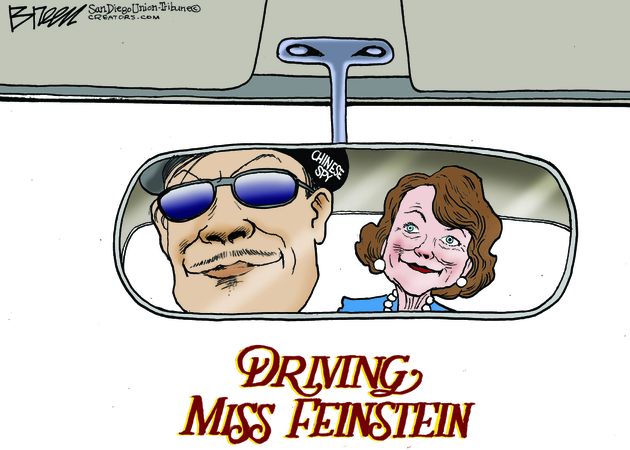
Turns out that Communist China had a spy in her office. A 20-year employee of Feinstein’s, the agent had been reporting back to China’s Ministry of State Security for well over a decade before he was caught in 2013, according to the FBI.
A Chinese-American who doubled as both an office staffer and Feinstein’s personal driver, the agent reportedly was handled by officials based out of the People’s Republic of China’s consulate in San Francisco, which Feinstein helped set up when she was mayor of that city. He even attended consulate functions for the senator.
Feinstein says she took the staffer off her payroll “immediately” after the FBI informed her five years ago that her office had been infiltrated by Chinese intelligence, and agents had identified the mole in a briefing. In a statement, the Democratic senator insisted he had “no access to sensitive information” and that he was never charged with espionage.
In June 1996 — after the staffer had begun working for Feinstein — the FBI detected that the Chinese government was attempting to seek favor with the senator, who at the time sat on the East Asian and Pacific affairs subcommittee of the Foreign Relations Committee, which oversees US-China relations. Investigators warned her in a classified briefing that Beijing might try to influence her through illegal campaign contributions laundered through front corporations and other cutouts.
The warning proved prescient.
One Chinese bagman, Nanping-born John Huang, showed up at Feinstein’s San Francisco home for a fundraising dinner with a Beijing official tied to the People’s Bank of China and the Communist Party Committee. As a foreign national, the official wasn’t legally qualified to make the $50,000-a-plate donation to dine at the banquet.
After a Justice Department task force investigated widespread illegal fundraising during the 1996 Clinton re-election campaign, Feinstein returned more than $12,000 in contributions from donors associated with Huang, who was later convicted of campaign-finance fraud along with other Beijing bagmen. The DNC and the Clinton campaign had to return millions in ill-gotten cash.
Still, Beijing got its favored trade status extended — thanks in part to Feinstein. In speeches on the Senate floor and newspaper op-eds, she shamelessly spun China’s human-rights violations, as when in 1997 she compared Beijing’s 1989 massacre of hundreds of young demonstrators to the 1970 Kent State shootings, calling for the presidents of China and America to appoint a human-rights commission “charting the evolution of human rights in both countries over the last 20 to 30 years,” that “would point out the successes and failures — both Tiananmen Square and Kent State — and make recommendations for goals for the future.”
Feinstein also led efforts to bring China into the World Trade Organization in 1999, which gave Beijing permanent normal trade relations status and removed the annual congressional review of its human-rights and weapons-proliferation records.
Feinstein, still among the Senate’s most influential China doves, travels to China each year. Joining her on those trips is her mega-millionaire investor husband, Richard C. Blum, who has seemingly benefited greatly from the relationship.
Starting in 1996, as China was aggressively currying favor with his wife, Blum was able to take large stakes in Chinese state-run steel and food companies, and has brokered over $100 million in deals in China since then — with the help of partners who sit on the boards of Chinese military front companies like COSCO and CITIC.
China investments have helped make Feinstein, who lives in a $17 million mansion in San Francisco and keeps a $5 million vacation home in Hawaii, one of the richest members in Congress.
Feinstein has insinuated that Trump is compromised by a foreign power. But it’s clear Feinstein has an alarming blind spot when it comes to China and national security.

Wednesday, August 08, 2018

Paul Manafort and Feinstein's China Spy


By Daniel John Sobieski

https://www.americanthinker.com/articles/2018/08/paul_manafort_and_feinsteins_china_spy.html

August 8, 2018

Political Cartoons by Steve Breen

Paul Manafort stands trial in Special Counsel Robert Mueller's dock for a tax evasion case that the Department of Justice in 2005 decided there wasn't enough evidence to prosecute for no other reason than he later worked for Donald Trump.  Perhaps now he wishes he had been the office manager for California senator Dianne Feinstein (D), who hired a Chinese spy to be her driver and office manager, for there seems to be a double standard here when it comes to working with agents for a foreign power.

There is no evidence or even a suggestion that Feinstein was colluding with the Chinese, just as there is no evidence that President Trump or Paul Manafort, during his short stint as Trump's campaign manager, colluded with Russia.  Yet Manafort is being persecuted...er, prosecuted for a minor crime while the Chinese spy, Russell Lowe, was allowed to pack his box and leave.  No criminal prosecution and no special counsel to see where this thread might unravel.  Again, the difference is that Manafort worked for Trump, and Lowe worked for Feinstein – ironically, one of the leaders in the Russian collusion witch hunt.

Imagine if this were Donald Trump's personal driver being groomed by Beijing's security service to spy on his boss and pass information to the local Chinese consulate and handlers when traveling abroad.  Faster than you can say "Carter Page," a special counsel would be appointed to nail the president for treasonous collusion.

In these cases, the FBI normally gives the organization or office in question what is called a "defensive briefing" – an alert that an individual is up to no good or suspected of doing something sneaky.  The office or organization can then take action.  This was done in Feinstein's case, but not for Trump.

In an editorial, the Wall Street Journal noted the mind-boggling double standard employed by the FBI in dealing with spies and suspected spies in the employ of Feinstein and Trump:

Foreign countries are always trying to steal U.S. secrets, and they sometimes succeed.  In this case Mrs. Feinstein tweeted over the weekend that the FBI approached her five years ago with concerns about an "administrative" staffer in her San Francisco office with "no access to sensitive information."  She said she "learned the facts and made sure the employee left my office immediately."

This is what the FBI should do, and the question Mr. Trump should ask is why the bureau didn't treat him as a potential President with the same customary courtesy.  The FBI claims it had concerns beginning in spring 2016 that low-level Trump campaign staffers Carter Page and George Papadopoulos were colluding with Russians.  Yet rather than give the Trump campaign the usual defensive briefing, the FBI launched an unprecedented counterintelligence investigation into a presidential campaign, running informants against it and obtaining surveillance warrants.  The country is still enduring the polarizing fallout from that decision through special counsel Robert Mueller's probe[.] ...

Mrs. Feinstein is also doing nobody a favor by downplaying this breach.  She claims the driver never had access to "sensitive" information, but the infiltration of the staff of a Senator who serves on the Senate Intelligence Committee is no small matter.  Who knows what the spying staffer was able to hear and report to China over the years?

The FBI of Andrew McCabe, James Comey, and Peter Strzok did not extend the Trump campaign the same courtesy because its leaders wanted to unseat a president they despised and had no such animus against a liberal Democratic senator.


Manafort's financial dealings with Ukraine are the centerpiece of a criminal trial, but no one seems curious about the remarkable financial success Feinstein and her third husband, Richard Blum, had in dealings with China with a Chinese spy on her payroll who arrived on the scene in 1993, one year after Feinstein was elected to the Senate.  As the Los Angeles Times has reported:

On Capitol Hill, Sen. Dianne Feinstein (D-Calif.) has emerged as one of the staunchest proponents of closer U.S. relations with China, fighting for permanent most-favored-nation trading status for Beijing.

At the same time, far from the spotlight, Feinstein's husband, Richard C. Blum, has expanded his private business interests in China – to the point that his firm is now a prominent investor inside the communist nation[.] ...

In 1992, when Feinstein entered the Senate, Blum's interests in China amounted to one project worth less than $500,000, according to her financial disclosure reports.  But since then, his financial activities in the country have increased.

In the last year, a Blum investment firm paid $23 million for a stake in a Chinese government-owned steel enterprise and acquired sizable interests in the leading producers of soybean milk and candy in China.  Blum's firm, Newbridge Capital Ltd., received an important boost from a $10-million investment by the International Finance Corp., an arm of the World Bank.  Experts said that IFC backing typically confers legitimacy and can help attract other investors.

No conflict of interest here.  "Here's a more recent connection between Sen Feinstein and China the press has ignored.  ZTE, the heavily sanctioned Chinese telecom company that paid a $1bn fine to the U.S., hired its first in-house lobbyist in '11 – none other than a former Feinstein aide," noted Benjamin Weingarten, a contributor for the Federalist, in a tweet.  As the Washington Post reported in 2012, Feinstein has a connection to the notorious Chinese communications firm ZTE:

ZTE, which is also based in Shenzhen, spent $80,000 on U.S. lobbying in the first six months of this year, down from $100,000 for the same period a year earlier, Senate records show.  In October 2011, the company registered its first in-house lobbyist, Peter Ruffo, a former aide to Sen. Dianne Feinstein (D-Calif.).

Clearly, there is more here than meets the eye.  Perhaps we might need a special counsel to follow the evidence wherever it may lead.  Right, Mr. Mueller?


Wednesday, June 06, 2018

American who idolised Bruce Lee and trained at Shaolin writing star's biography


He grew up wanting to be Bruce Lee, and later became a Shaolin disciple; now Matthew Polly is in Hong Kong to write story of kung fu star's life

By Shirley Zhao
http://www.scmp.com/news/hong-kong/article/1218619/american-who-idolised-bruce-lee-and-trained-shaolin-writing-stars
April 20, 2013

Image result for matthew polly
Martial arts expert Matthew Polly in front of a statue of Bruce Lee in Tsim Sha Tsui. Polly, who dropped out of Princeton to become a Shaolin apprentice, is writing the late star's biography. Photo: Edward Wong

Matthew Polly knows about being an introvert and an extrovert. When it's suggested he must be an extrovert, he doesn't deny it but confesses he used to be a skinny, nerdy boy, always too shy and geeky to communicate. Back then, he found it was always the suave and outgoing people who tended to lead or become popular among girls in the US, and he wanted to be one of them.
He believed going to China, to the Shaolin Temple to learn kung fu, would make him different. He went. It did.
"I'm getting better at it [being an extrovert] now," said the 41-year-old American author.
He certainly looks a natural now, always keeping a keen smile, hearty laughs, cracking jokes from time to time and, every so often, giving you a friendly pat on the shoulder or gentle touch on the arm. Even though he stands 1.92 metres tall, he doesn't look intimidating. He is a friend, a pal, and he makes sure you are impressed through showing off his tongue-curling Beijing Putonghua during conversations.
After American Shaolin, a US bestseller on his two-year kung fu training in Shaolin, and Tapped Out, on his ultimate fighting experience in mixed martial arts (MMA), Polly has come to Hong Kong for his third book project, a biography of Bruce Lee.
"No one's written a biography [of Bruce Lee] in the last 20 years," he said. "He's such a huge star. It seemed a shame that no one had written a very good biography about him."
Polly says most books in English about Lee only cover his life in the US, so he came, four decades after the death of Lee, trying to find out what he was really like through interviewing people in Hong Kong who actually knew him and his family.
Among those he has interviewed are movie mogul Raymond Chow Man-wai, Robert Chua Wah-peng, who created the popular television show Enjoy Yourself Tonight, martial arts master Ip Man's son Ip Chun and Betty Ting Pei, Lee's mistress, who was with him when he died in her apartment.
The interview with Ting lasted seven hours, Polly said, during which she showed him her kung fu moves and did Buddhist chanting.
"That has to be the most unique interview I've ever been in," he said. "I think it's one of the very first times she's ever told to Western journalists about her relationship with Bruce. For many years Betty Ting was blamed for Bruce's death, so I think it's good that she's finally decided to open up and tell her side of the story."
Polly's first encounter with Bruce Lee is a typical story. A scrawny 13-year-old who was always bullied suddenly discovered this exotic Hong Kong movie, Enter the Dragon, where a small, lean Asian man beat a whole bunch of people taller and stronger than him. The boy was fascinated and started learning kung fu two years later. He wanted to be Bruce Lee.
The boy, Polly, later entered the Ivy League, majoring in religion and East Asian studies at Princeton University, focusing on Buddhist and Taoist philosophies. He was charmed by the philosopher Zhuangzi's sense of humour and irony and imagined one day, through meditation, he could achieve enlightenment.
Then, after three years of study, he found the perfect answer to his pursuit of martial arts and spirituality - Shaolin Temple, which offered both. In Enter the Dragon, Bruce Lee played a Shaolin monk, so there was a definite plus side to it.
"I thought I could become a badass," he said. "And become an enlightened Buddhist, a master. It made perfect sense to me but everyone else thought I was crazy."
That was in 1992, when China was a mystery to many in the West. Polly's mother cried over his decision to leave university for Shaolin, and his father wouldn't talk to him for six months after he bought his plane ticket.
He left anyway, with a backpack and a sleeping bag, expecting to camp outside a quiet, peaceful Buddhist monastery in the middle of Henan province for days or even months until the monks let him in.
Instead, he wound up in a tourist attraction with souvenir stores and restaurants. A young monk led him to a martial arts school next to the temple, Shaolin Wushu Centre, where the school party chief agreed to let him be a Shaolin student for US$1,300 per month. He later discovered the chief overcharged him by almost US$800.
Polly, the first American Shaolin disciple, stayed in the school for two years, training with the Shaolin monks for seven hours a day and six days a week. There was no TV nor any other entertainment, and no one talked to him for the first two months, because the school leaders told them not to, fearing he might spread "impure thoughts".
Two sympathetic monks did break the order and talk to him, and they became close friends. But the big change didn't come until nine months into the training, when a kung fu master from the city of Tianjin requested a challenge match at a banquet thrown by a French photojournalist for Shaolin in the school's restaurant. Polly offered to take the challenge. The monks agreed. He won.
"That was the moment when I became sort of an official member of Shaolin Temple," he said. "And instead of Bao Mosi [his Chinese name], they started to call me laobao ['old Bao', an affectionate nickname]."
In 1995, seeing many monks emigrating overseas, Polly realised he had spent too much money being a foreign disciple in Shaolin and he wanted to finish university and get a job. He went back to the US, but his parents were not impressed by his kung fu achievements. "I don't know what we did wrong," his father said to him when seeing him practising his "iron forearm" against a tree, "but whatever we did wrong, I'm sorry".
His was an achievement-oriented family. He went to Princeton, later Oxford and became a Rhodes Scholar. His sister went to Yale. "At first [my parents] thought I'd fallen off the path of success by going over there," he said. "I think it was after I wrote the book and it became a national bestseller and a Hollywood option that they were like okay."
His two years in Henan being the only foreigner among all the monks and disciples also made him tougher, more confident and outgoing. "For me, whenever any problems come up, I'll think 'well, it can't be worse than Shaolin'," he laughed. "No matter how scared I am now, I can't be any more scared than I was at Shaolin. I think that's the great advantage of chiku [eat bitterness]. If you eat bitterness, then you'll know what sweetness is."
Having stayed in Hong Kong for more than two weeks, Polly will return in July, when the Heritage Museum has an exhibition about Bruce Lee and Betty Ting Pei may be doing a television show on the 40th anniversary of his death. He also hopes to interview more people who knew Lee, such as singer-songwriter Sam Hui Koon-kit and his wife Rebu, as well as Jackie Chan.
Polly says Hong Kong people have been talking more about Bruce Lee recently. He suspects this is related to the huge success of the three films in the recent Ip Manseries about Lee's martial arts mentor.
"There's an old saying that a prophet has no honour in his hometown," he said. "Now people are remembering that it really was Bruce Lee who put Hong Kong on the map. He was the one who brought Hong Kong and Hollywood together. Without Bruce there wouldn't have been a Jackie Chan or Jet Li. I'm glad he's getting the attention I think he deserves it because, for a while, I think people thought he wasn't cool any more."