Showing posts with label New York Yankees. Show all posts

Sunday, July 21, 2019

Mariano Rivera leaves Hall of Famers in awe: ‘In his own league’


By Kevin Kernan
https://nypost.com/2019/07/20/mariano-rivera-leaves-hall-of-famers-in-awe-in-his-own-league/
July 20, 2019

Related image
Roy Halladay, Mariano Rivera, Edgar Martinez, and Mike Mussina


COOPERSTOWN, N.Y. — On the serene veranda of the historic Otesaga Resort Hotel, Hall of Famer Dennis Eckersley was becoming animated.
Eckersley helped develop the role of the one-inning closer. He knew how tough a job it was, especially in the postseason, and that is why he was so excited to discuss Mariano Rivera’s revered place in the game.
“Listen, I can’t even put myself in the same category, I’m serious, I’m not trying to be Johnny Humble at all, this guy is in his own league, more than anybody,’’ Eckersley told The Post on Saturday.
Come Sunday, Rivera, the first unanimous selection to the Baseball Hall of Fame, will join the best-there-ever-was club.
“I’m a rookie in this thing,’’ said Rivera, who saved 652 games for the Yankees.
As for the other closers in the game, such as Eckersley, Goose Gossage and Trevor Hoffman (who was inducted last year), Rivera said: “They are way ahead of me. I can never put myself with any of them, I am just happy to be here.’’
Even though you were a unanimous selection?
“Even though I was unanimous, yes,’’ Rivera said. “I never even thought I would make any All-Star teams. … I played to win championships and that’s what I was focused on. The rest was just blessings from the Lord.’’
That is the essence of Rivera. He understands his place in the universe.
“Look at the numbers,’’ Eckersley said. “Beyond the numbers, which are incredible, are the postseason numbers. That is sick. The 0.70 postseason ERA, the 141 innings, that’s like the greatest year I ever had times two and it was in the playoffs.’’
There were 42 postseason saves. Rivera wasn’t perfect in the postseason, of course, but he was close — and he has the five rings to prove it.
“Ultimately,’’ Eckersley added, “it’s about the Ice Man for me. Because of the way he handled it. We’re two different people. I’m like ‘Aghh’ he’s like so cool, which I’ve always been envious of and I think everybody is. And to do it in that environment, having to pitch in Yankee Stadium. He handled everything with class.’’
The Yankee made sure to praise The Boss, George Steinbrenner.
“I know for sure,’’ Rivera said, “he would be proud of me. He would say, ‘Kid, great job.’ He always called me Kid.’’
How much does Rivera want to see Steinbrenner in the Hall.
“Oh, my God,’’ Rivera said, “if I had to give it all, I would do it.’’
Jackie Robinson is the one Hall of Famer he would have loved to have met.
“Mr. Jackie was the guy, but he has already passed,’’ Rivera, No. 42 said of the 42. “As a minority, he gave everything he had to come in and he did it with class. For me to be a minority and wear his number, is something special.’’
When someone joked Robinson could not have handled Mo’s cutter, Rivera said: “He would have. I would have put it in there for him.’’
Harold Baines, the late Roy Halladay, Edgar Martinez, former Yankees teammate Mike Mussina and Lee Smith also are going into the Hall, but this is Rivera’s party.
For this weekend, Cooperstown has become Mo-town.
“I might have to have a whole army around me to walk around here,’’ Rivera said with a smile.
As for how the game has changed, Gossage noted: “It took a one-inning pitcher to get a unanimous vote. I’m just saying that’s how different the game is today, you telling me that Babe Ruth and Lou Gehrig and right on down the list of great pitchers shouldn’t haven’t gotten 100 percent of the vote. There are 100 guys that if they pitched just the ninth inning they would have been unanimous. It’s not a knock on Mariano. My God, Mariano’s accomplishments are fabulous and I’m so happy for him.’’
When things did go wrong in the postseason, Rivera said: “That’s part of the game. I understood those moments are going to happen in the World Series, happen in the playoffs, and it happened during the regular season. I understood all that, so I would just have to forget it and move on. Good or bad you have to forget it.’’
Derek Jeter will be here Sunday as well and in 2020. Rivera said he is looking forward to welcoming Jeter into the Hall.
As the game continues to evolve, Rivera, the Greatest Closer, is now the opener for Jeter.

Saturday, July 13, 2019

Jim Bouton opened the lid on the closed ol’ boy network of baseball


July 12, 2019
Image result for jim bouton
It is difficult to know where to begin when writing about Jim Bouton, who died Wednesday at age 80. If he had never written “Ball Four,” Bouton would no doubt have still merited a New York Times obituary as a former Yankees pitcher who won 21 games in 1963 and 18 in 1964, then tacked on two World Series wins that October.
But a sore arm cost Bouton his fastball and caused him to end up pitching as a 30-year-old knuckleballer for the expansion Seattle Pilots at the start of the 1969 season. It was also probably the reason he was willing to team with longtime sportswriter Leonard Shecter on a book chronicling that season. Before it was over, Bouton had been sent to Class AAA Vancouver, returned to Seattle and then been traded to Houston.
Bouton never stopped taking notes. A year later, “Ball Four,” written in diary form, was published and became arguably the most iconic baseball book ever written. Some will argue for Roger Kahn’s lyrically brilliant “The Boys of Summer,” but nothing changed baseball or sports journalism as much as Bouton’s seminal work.
Never had an athlete written with as much honesty, candor and humor about what life was like inside a locker room. People often compare “Ball Four” to Jim Brosnan’s ‘The Long Season,” written 10 years earlier, and there’s certainly common ground. But “Ball Four” went to places no athlete had previously gone.
Bouton shocked people by writing honestly about good ol’ boy Yankee Mickey Mantle — not so much about his home runs but rather his drinking, womanizing and mean streak. His description of joining Yankees teammates on the roof of Washington’s Shoreham Hotel to “beaver-shoot” — check out women through their hotel windows — would be unacceptable in today’s world, and Bouton’s revelation of it infuriated baseball insiders.
Related image
New York Yankee starting pitchers left to right, Whitey Ford, Jim Bouton, Al Downing, Ralph Terry, and Stan Williams, September 4, 1963.

Bouton took ordinary players and made them into icons: journeyman pitcher Gary Bell yelling, “Smoke ’em inside,” as his scouting report for every hitter in baseball; Alvin Dark’s famous “take a hike, son,” remark to an autograph seeker; Jim Gosger’s “yeah-surre” comment as he burst from a hotel-room closet during a tryst between his roommate and a young woman.
And, of course, there was Seattle Manager Joe Schultz’s “Let’s go pound some Budweiser” war cry and his ability to repeat his two favorite profane words in, as Bouton wrote, “all their possible combinations.”
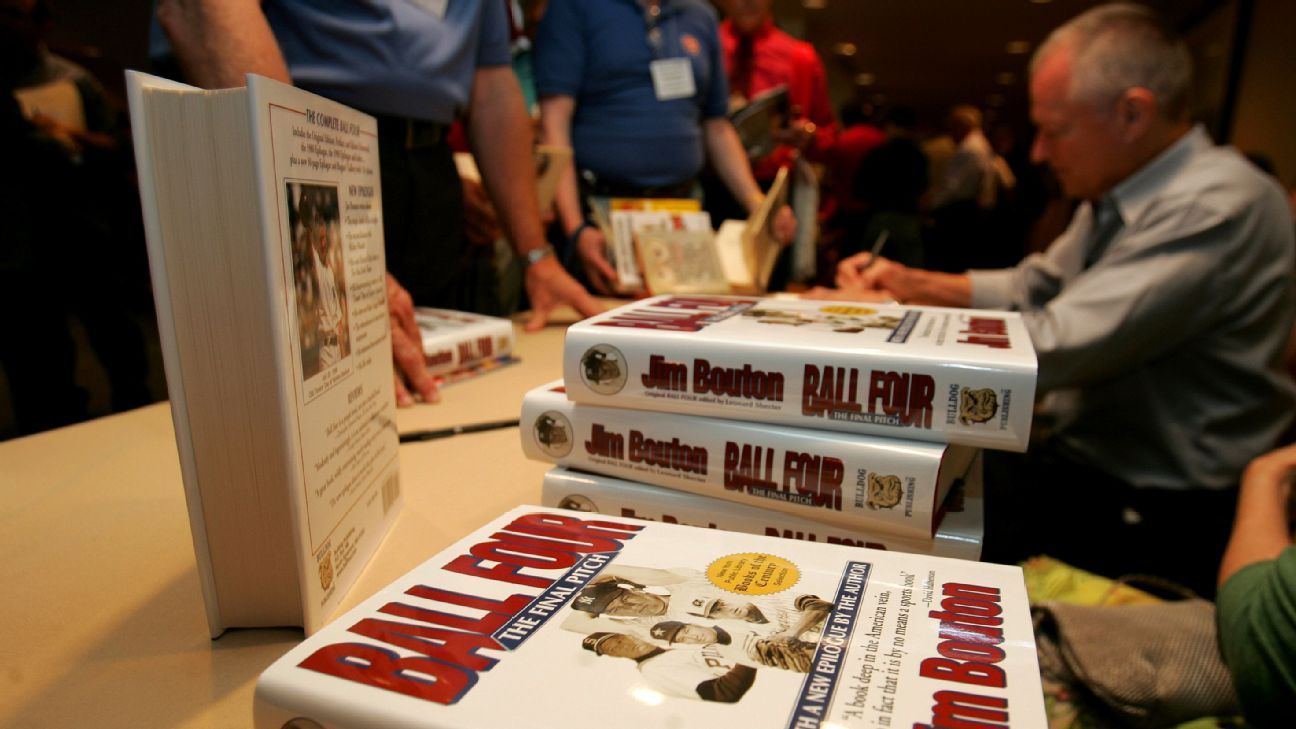
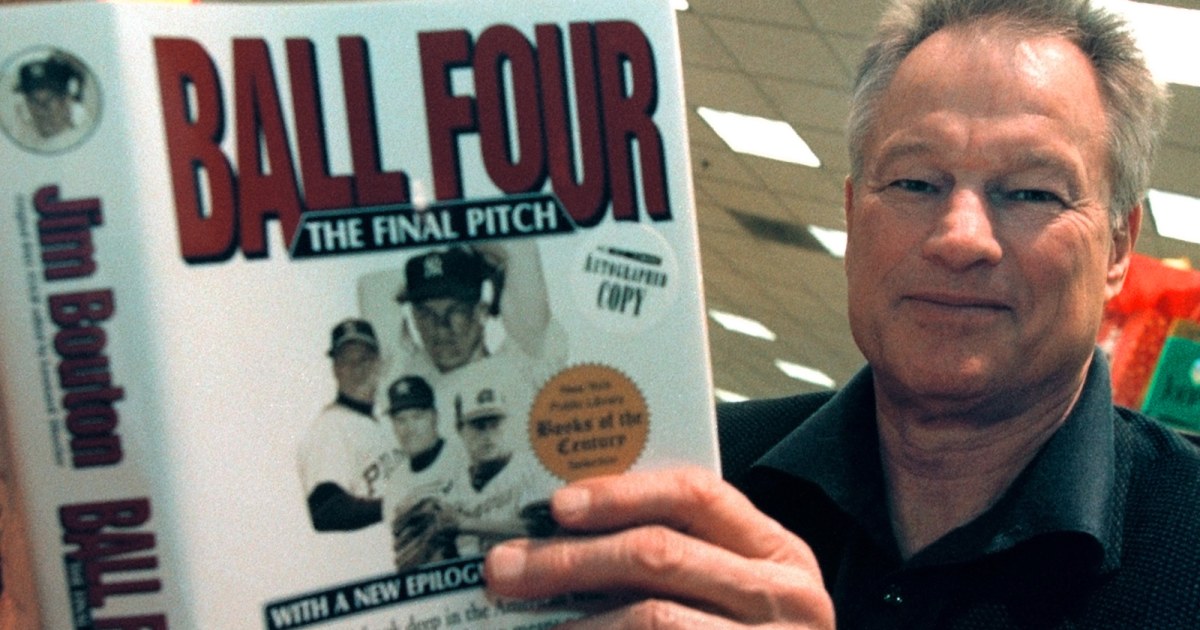
“Ball Four” has sold more than 5 million copies — Bouton updated it often — so there are plenty of people who will know those anecdotes and many more by heart.
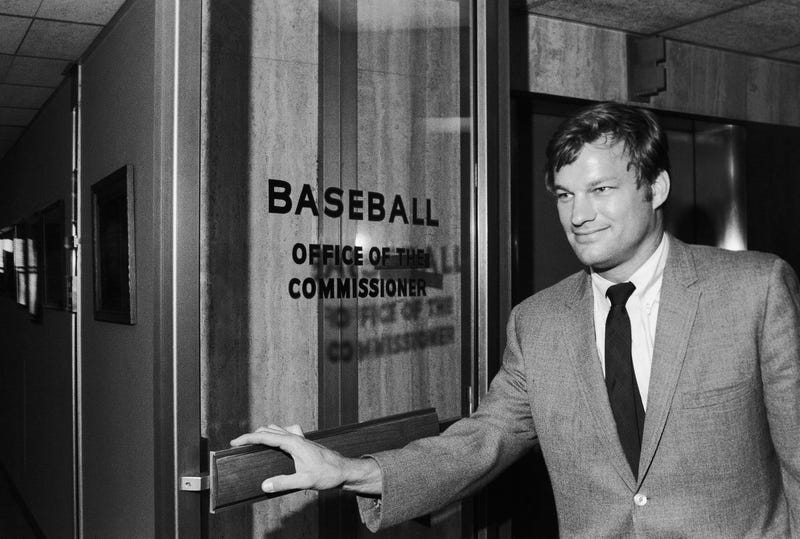
The book also made Bouton into a baseball pariah.When it came out in 1970, he was reprimanded by Commissioner Bowie Kuhn, who called the book “detrimental to baseball.” Kuhn also asked Bouton to sign a statement saying that the book was fiction. Bouton, naturally, refused.
Kuhn was hardly the only one to take issue with it. Players and many longtime baseball writers, some of whom considered themselves part of their teams, agreed with Kuhn.
Illustration for article titled Jim Bouton Woke Up America
(AP/Jim Lent)
No doubt many writers were simply jealous. In those days, with the wide-open access the media had, a good reporter could have told many of the same stories that Bouton told. But no one wanted to be drummed from the fraternity.
The irony is that few loved baseball more than Bouton. He made a comeback with the Atlanta Braves in 1978 — eight years after first leaving the game — and pitched in semipro leagues into his 50s. The final line of “Ball Four” poignantly expresses Bouton’s feeling about the game: “You see,” he wrote, “You spend a good deal of your life gripping a baseball and, in the end, it turns out that it was the other way around all the time.”
He also wrote often about sometimes “forgetting to tingle” as he walked across the outfield grass to the bullpen before a game, reminding himself how lucky he was to make a living playing baseball.
Bouton wrote a number of other books, including “Foul Ball,” about his efforts to save a minor league ballpark in Pittsfield, Mass., where he had settled after retirement. The book was written in the same diary form as “Ball Four” and, although the topic was completely different, had the same funny, anecdotal feel to it.
The book was also poignant. Bouton describes the death, in 1997, of his daughter Laurie in a car accident. He also addressed a New York Times op-ed written by his son Michael pleading with the Yankees to release him from baseball purgatory and invite him to Old-Timers’ Day. The Yankees relented and invited Bouton, who joyfully recounts his return to the Yankees’ clubhouse and the mixed reactions of his former teammates.
Image result for jim bouton
I wrote a favorable review of “Foul Ball” and was thrilled when Bouton reached out to thank me. That began a sporadic friendship, most of it on the phone. I loved hearing Bouton’s views of baseball today and his stories about old friends and teammates who had stayed in touch.
Bouton isn’t a Hall of Famer, but baseball should find a way to pay tribute to him and acknowledge, almost 50 years later, his massive influence on the game.
As for sports journalism, we were all influenced by him — whether my colleagues want to admit it or not. Bouton proved the importance of firsthand reporting, of truly getting inside a subject. No book — other than “All the President’s Men” — influenced me more as a reporter. Woodward, Bernstein, Bouton — pretty good role models.
Bouton did one other thing for me. Whenever I’m having a tough day at a ballgame — because of a rain delay, or because someone refused to talk to me or failed to show up for a scheduled interview, or an editor is being difficult (yes, it happens) — I look around and I think about what Bouton would have said.
“Don’t forget to tingle.”
Thanks, Jim.
For more by John Feinstein, visit washingtonpost.com/feinstein

Thursday, July 11, 2019

Jim Bouton never let ‘Ball Four’ repercussions ruin him


By Mike Vaccaro
https://nypost.com/2019/07/11/jim-bouton-never-let-ball-four-repercussions-ruin-him/
July 11, 2019

Image result for jim bouton

This was during the last and most brutal baseball strike, on an August afternoon in the terrible hot summer of 1994. Baseball was on most people’s hit list, which is the reason I’d gotten in my car and driven to a ballpark in Newburgh, N.Y. Jim Bouton was appearing there that night. It seemed the perfect time to talk to him.
He greeted people before the game, and he was more than happy to sign autographs, mostly of dog-eared copies of “Ball Four.” Time and again, he would draw a laugh by giving a variation of the same line: “I know a lot of people want baseball players to say they’d play for free. But baseball players who play for free all have something in common: They’re not good enough anymore than anyone wants to pay them.”
I got my audience with him late. I told him a story he’d surely heard 100,000 times by then, how reading “Ball Four” had changed the way I’d looked at baseball, how it humanized ballplayers, even God-like ballplayers. How it made me appreciate the game in a whole other way. And how it made me laugh like hell.
He signed my book, “To Mike: If I’m responsible for bringing one more sportswriter into this world, then it’s pretty clear I’m never getting into Heaven. Jim Bouton.”
Bouton died Wednesday at 80 at his home in the Berkshires after a long and difficult decline. The cause of death was vascular dementia, but he’d also suffered a stroke in 2012, and in 2017, he revealed he had a brain disease, cerebral amyloid angiopathy.
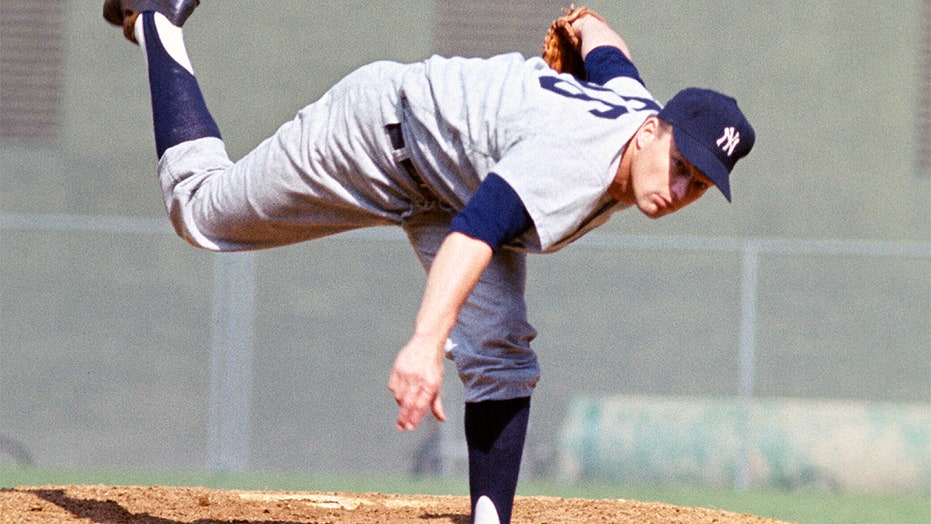
He was a mostly middling pitcher, known mainly for a pair of quirks: As a young player, he threw with such a vicious motion that his hat would often fly off when he delivered his fastball. Later, as he struggled to keep a place in the game — the central storyline of “Ball Four;” the hijinks and the laughs were just a bonus — he developed a knuckleball.
As a 24-year-old kid with the Yankees, he’d been good enough to go 21-7 with a 2.53 ERA in 1963, when he made his only All-Star team and finished 16th in the American League MVP voting. He won 18 more in 1964, then added two of the Yankees’ three victories in the World Series against the Cardinals.
Image result for jim bouton
Jim Bouton loses his cap while pitching for the New York Yankees in the 1964 World Series. (AP)

By 1965, though, he was 4-15, and his ERA ballooned to nearly 5. He’d already earned a reputation for dancing to his own drummer, whether it was in his yearly salary squabbles with Ralph Houk that he detailed gleefully in “Ball Four,” or for his left-leaning opinions, something that stands out in baseball clubhouses that have always tilted the other way.
Of course, it wasn’t until “Ball Four” that he became a household name. Bouton had always found a kindred spirit in a former Post baseball writer named Leonard Schecter, himself something of an oddity in the press box because he tended to write baseball stories that weren’t always limited to a baseball diamond.
Bouton spent the 1969 baseball season talking into a tape recorder as he tried, and succeeded, to make the expansion Seattle Pilots, as he earned a demotion to Vancouver and then a trade to Houston, introducing the world to a colorful Pilots manager named Joe Schultz and an unknown Seattle rookie named Lou Piniella, traded to Kansas City before the season started. He’d send the tapes back East to Schecter. The writer knew right away they had something; it turned out to be literary gold.
Bouton’s tales of ballplayer byplay and bacchanalia were irresistible to readers. “Ball Four” sold millions of copies and remains in print 49 years later, and was the only sports book included in the New York Public Library’s 1996 list of “Books of the Century.” It also sent the baseball establishment into a tizzy; Commissioner Bowie Kuhn called it “detrimental to baseball” and press box vanguard Dick Young called both Bouton and Schecter (who died in 1974) “social lepers.”
“Bleep you, Shakespeare!” Pete Rose howled at him once, from a dugout.
Bouton shrugged it all off, found fame and fortune as a sportscaster, as an actor, as the first investor in “Big League Chew” baseball gum, as a ballplayer again (he made it back to the bigs in 1978, starting five games for the Braves), as an author of four other books. If there was one consequence that hurt him, it was the Yankees never invited him to Old-Timers’ Day, fearful of how some of the stars of “Ball Four” — notably Mickey Mantle — might react.
But after Bouton’s daughter, Laurie, was killed at age 31 in a 1997 car accident, his son, Michael, wrote a letter to the New York Times the following Father’s Day, appealing to the Yankees to forgive and forget. The cheers he heard July 25, 1998, were louder than any he’d ever heard as a ballplayer. There were 55,638 people at the Stadium that day; you can bet most were cheering the author every bit as much as the pitcher.
Image result for jim bouton old timers day
Old-Timer's Day, 1998 (Chuck Solomon/Getty Images)
And you can bet as Bouton let those cheers wash over him, he remembered the last sentence of his book, as good a closing line as you could ever summon.
“You spend a good piece of your life gripping a baseball,” he wrote, “and in the end it turns out that it was the other way around all the time.”

Tuesday, March 12, 2019

The swing change that could make all the difference for Aaron Judge


March 11, 2019
Yankees right fielder Aaron Judge is due a big payday next offseason when he becomes eligible for salary arbitration.
(Butch Dill/USA Today Sports)
TAMPA — Watch Aaron Judge closely this spring and you will notice in batting practice and in games, he will sometimes take his mighty swing with no stride.
No leg kick from the front leg. No toe tap. No stride.
Just a powerful coiled right-handed snap swing. That is especially the case with two strikes, his new two-strike approach.
Judge is doing this to increase contact but also to get to the basics of his swing. To have a starting point. Judge is constantly evolving as a hitter, and this is a step in the process.
Certainly, Judge has shown himself to be one of the most grounded athletes in New York, an All-Star the last two years who is one of the major faces of the game. Now No. 99 is more grounded than ever with this two-strike approach.
Considering his power and strength, the more contact he makes will be a positive for the Yankees. Over the last two seasons, Judge has fired up a .282/.409/.588 slash line and a .993 OPS with 79 home runs, 181 RBIs and 205 runs scored.
Over 1,176 plate appearances the last two seasons, he has struck out 360 times. Last season in 257 at-bats that reached two strikes, he batted .183, walked 45 times and struck out 152 times. Ahead in the count, he hit .290. .173 with two strikes.
Judge rocks and coils before he swings, anchoring his weight on his back leg, then snaps the swing. He creates massive amounts of power with his 6-foot-7, 282-pound frame.
“It’s just basically the roots of it,’’ Judge told The Post over the weekend at George M. Steinbrenner Field. “That’s where it starts for me. I have to start with the no stride and then from there that’s where I can add a leg kick or some type of toe tap.
“For me I have to start with the basics.’’
Much like Ted Williams espoused, there is a science to hitting, and Judge is a student of the game and his swing.
“I think that is where a lot of guys actually get messed up, with their leg kick,’’ Judge said. “There are so many times I tell myself not to worry about it and still get messed up. My swing is pretty simple the way it is, just with a little leg kick and stuff like that, but there are times in the season I don’t even know what [the front leg] is doing. I feel like I am on time but I keep getting beat so I will have the chance to go back to the no stride, where it is kind of a rock to get into my hip and then swing, it’s simple.
“For me, I can always go back to something simple that will produce results,’’ Judge said. “Just be accurate with the barrel. That’s all I want to do.’’
That is great advice to all hitters.
Hall of Famer Reggie Jackson calls it barrel accuracy.
Ted Williams also said: “The way you bring your hips into the swing is directly proportionate to the power you generate.’’
Judge generates power with the hip coil.
“The one thing I was worried about going to the no stride is that I really don’t want to sacrifice power,’’ Judge said. “But when I started hitting in BP with it, I was hitting the ball the same distance as I do with the leg kick, so it really doesn’t matter.”
All this is part of the process and it remains to be seen exactly what will work best for Judge over the coming months. No stride brings him back to his hitting roots. Judge has had phenomenal success these last two years as a Yankee, so this is another component in his growing as a hitter, another tool in his tool box to get the most out of every at-bat, no matter the count.
Judge has homered 83 times over his first 294 career major league games so all the work he has put in to develop his approach and swing is paying off. This is just another component of becoming a more complete hitter, especially with two strikes.
For Aaron Judge, no stride, no problem.

Wednesday, January 23, 2019

Mo


By Derek Jeter
https://www.theplayerstribune.com/en-us/articles/derek-jeter-mariano-rivera-baseball-hall-of-fame
January 22, 2019

Image result for mariano rivera jeter


I heard a stat the other day and it blew my mind:
In human history, more people have walked on the moon than have scored an earned run off of Mariano Rivera in the postseason.
Sounds crazy, right? But it’s true.
According to NASA, 12 people have had the privilege of walking on the moon.
According to Baseball Reference, 11 people have scored an earned run off of Playoff Mo.
And while no statistic could ever truly encapsulate Mariano, I figure this one is as close as we’re going to get. Because I think it really gives you a sense of what sort of greatness we’re dealing with, when it comes to Mo. It’s hard to compare him to other closers — in fact, it’s hard to compare him to other pitchers.
Mariano is just on another level.
The thing I respect most about Mo is that what you see is what you get.
A lot of people I’ve met over the years, they’ve asked me what Mariano Rivera is like off the field. And I’ll tell you what I tell them — which is that he’s pretty much the same person you watched for all those years on the mound.
There’s no “persona” with Mariano. He’s never had a character that he portrayed. He’s always just calmly and coolly done his thing. He’s quiet. Thoughtful. Intense. He’s a man of faith.
He has an incredible eye for detail.
Have you ever seen a Mariano Rivera autograph? Google it when you get a chance. With a lot of guys, their signatures are these quick little scribbles. But Mariano, man, if he’s signing something for you, he takes his time. He puts care into it, until he gets it just right — like with everything else he does. To me, right there … that’s Mo.
And like I said: It was always the same thing on the mound. There wasn’t much mystery if you were facing Mariano Rivera. No smoke and mirrors — nothing to hide. The scouting report was the same every time. Mo knew he was going to throw that cutter. The guy at the plate knew he was going to throw that cutter. Fifty thousand plus at Yankee Stadium knew he was going to throw that cutter.
And it wouldn’t matter.
Because Mo wasn’t trying to trick you.
And in the end, like it or not, he was just going to flat-out beat you.
During my first full season in the minors, when I was 18—19 years old, Mariano was coming back after having had surgery on his arm. So one of the things I’d do from shortstop was keep track of Mo’s pitch count.
And although eventually I stopped counting his pitches, it’s funny — in a way, I never stopped being that 18-year-old kid. Because for all of the amazing things that happened to me over those next 20 years with the Yankees, I never stopped being aware of this one: that on any given night…. if we could just get ourselves a lead….
I had the best seat in the house to watch the greatest closer of all time.
Hall of Fame teammate. Hall of Fame person.
And now, officially, a Hall of Fame player.
Congratulations, Mariano, and the rest of this year’s class.
—Derek

Mariano Rivera personified grace. Inside lurked a monster competitor


By Buster Olney
http://www.espn.com/mlb/story/_/id/25816398/mariano-rivera-personified-grace-lurked-monster-competitor
January 22, 2019

Related image
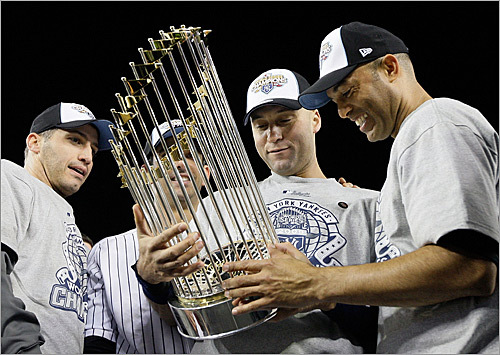
Andy Pettitte, Jorge Posada, Derek Jeter and Mariano Rivera after the 2009 World Series (Getty Images)

In Mariano Rivera's playing days, he believed, as a general rule, that you shouldn't fraternize with opposing hitters. At All-Star Games, he was polite to his temporary teammates, especially the pitchers, but he wasn't really into hanging out with the sluggers.
Rivera -- who became on Tuesday the first player ever elected unanimously to the Hall of Fame by the BBWAA -- believed you should keep your emotions locked down in success or failure. When you won, you should act like it was the expected result, and if you lost, you should never, ever allow an opponent to think they had accomplished more than just winning that day's game.
As the Diamondbacks swarmed the field to celebrate Luis Gonzalez's series-winning bloop single in Game 7 of the 2001 World Series, Rivera walked off the field at the same pace as in those hundreds of instances he clinched a save and moved to the catcher to exchange a handshake. His expression never really changed as he stepped into the visitors dugout, or when he responded to dozens of questions in the clubhouse afterward. This was the gracious face of Rivera that fans and opponents came to know and respect.
And it was a façade.
A mask. To cover for the monstrous, uncharitable competitor that resided within the right-hander. When Rivera is inducted into the Baseball Hall of Fame this summer, the greatest hitters in the world will surround him on the dais, and if you gave the right-hander truth serum, he almost certainly would tell you he could've dominated any of them on their best day.
I learned this about Rivera in the four seasons I covered the Yankees as a beat writer for The New York Times. Rivera was uniformly genial in the clubhouse, easy with a laugh and mostly measured in his words. But there were moments in which the ambitious, cutthroat antagonist escaped.
Rivera pitched 141 innings in the postseason, about the equivalent of two regular seasons of work for a fully deployed reliever, and in all of that time, he allowed two homers. Jay Payton of the Mets hit the second of those, in the 2000 World Series, in the midst of a rally that fell short in Game 2. Rivera made 63 playoff and World Series appearances after that and didn't allow another.
The first homer Rivera allowed in his 86 postseason games was hit by Sandy Alomar Jr. of the Indians, in a pivotal playoff moment in 1997. This was at the end of Rivera's first season as the Yankees' closer, in Game 4 of the American League Division Series. In a best-of-five series against the Indians, the Yankees led two games to one, and in the eighth inning of Game 4, they were ahead 2-1. When manager Joe Torre summoned Rivera to pitch, the Yankees were five outs away from advancing, in pursuit of what would have been the first back-to-back titles in the majors since the 1975-76 Reds.
In Rivera's first seasons as a reliever, he threw in the mid-90s, his fastball sometimes registering above that, in those days when some radar guns emitted numbers higher than others. With two outs, the Indians catcher stepped in to bat. Rivera whipped a fastball over the outside part of the strike zone, at 94 mph, and Alomar, a right-handed hitter, drove it to right field, a high fly ball. Paul O'Neill retreated to the wall, feeling for the fence, thinking he might have a shot for a leaping catch.
But the ball carried over O'Neill's glove, into the extended hands of the fans sitting in the first row of seats. (You can see the home run here.) O'Neill slammed his glove onto the warning track, in a moment that might make Red Sox pitcher Eduardo Rodriguez feel a little better about what he did in Game 4 of last year's World Series. Alomar raised both arms over his head, circling the bases with the game-tying run.
Cleveland scored again in the ninth inning to win that game, and the Indians prevailed again in Game 5 to eliminate the Yankees, and one of the primary storylines that hovered over Torre's team in the spring training that followed was whether Rivera would recover emotionally from that failure. Many closers had seemingly lost their confidence after a postseason moment like Rivera experienced, from the tragic example of Donnie Moore to others like Calvin Schiraldi and Mark Wohlers.
When Rivera first appeared at Yankees camp, he was asked about the Alomar homer, and when national writers circulated through New York's camp in Tampa in the days to come, he was asked about it some more. In 1998, the Yankees won 64 of their first 84 games, on their way to 114 regular-season victories. But all summer long, Rivera continued to hear the same questions and give the same polite answers. The Yankees clinched a playoff spot before September, leaving a month of columnist assessment about a possible Achilles' heel in this juggernaut -- and of course, the greatest unknown was whether the second-year closer might have a crisis of confidence once the team played meaningful games in October again.
I must've heard Rivera patiently respond to those questions a dozen or so times, and after mulling over the consistency of his answers, I stopped by his locker one day very late in the season.
That Alomar home run really doesn't bother you, does it?
"No," he said, the tone of his voice changing, sort of like Linda Blair's did in "The Exorcist." The stately curtain of comportment had just dropped, and the untethered Rivera launched emotional projectiles from deep within his competitive heart.
"You know why? Because I made that home run."
At first, I wasn't sure what he meant; I wasn't sure if he was kidding.
He wasn't.
I made Alomar's home run, he reiterated.
Rivera explained. He had thrown his fastball -- one of the best in baseball at that time, when a mid-90s fastball wasn't common -- over the outside corner. Alomar, the unvarnished Rivera said, stuck out his bat. Alomar had hit the ball squarely, he allowed, but it wasn't like he'd taken a big hack, and the ball had barely carried over O'Neill's glove and the right-field wall.
The power of that home run, Rivera concluded, was generated by Rivera. Not Alomar. As far as Rivera was concerned, he created Alomar's home run. Rivera, and not Alomar, had controlled the moment.
I walked away awed by his instinctive mental gymnastics that so easily somersaulted him to a place of emotional comfort.
Alomar's home run, as it turned out, was the lone pivotal postseason home run Rivera surrendered in his entire career. Five hundred twenty-seven batters faced in the playoffs and the World Series, and just 11 earned runs. A 0.70 ERA.
Those numbers are impossible, constructed on more than his ability to spin a cut fastball with unusual movement. Hopefully, the Hall of Fame can find room for the phrase "Mental Ninja" on the plaque of arguably the greatest postseason performer in baseball history.

A cut above ... Mariano Rivera built a Hall of Fame career thanks to his signature pitch and a foundation of humility and faith


By Bill Madden
https://www.nydailynews.com/sports/baseball/yankees/ny-sports-mariano-rivera-hall-of-fame-humble-20190121-story.html
January 23, 2019

Image result for mariano rivera daily news

To fully appreciate the phenomenon that was Mariano Rivera, you must first come to terms with one central, unbelievable fact: All of the records he accumulated in becoming the first relief pitcher elected on the first ballot to the Hall of Fame by the Baseball Writers Association – 652 career saves, 0.759 WHIP, 952 games finished, 0.70 postseason ERA, 11 World Series saves – were largely accomplished with just one pitch.

Oh sure, when he first came up to the big leagues in 1995 – as a starter – he had the standard repertoire of fastball, slider and what Yankee GM Gene Michael said at the time, “a helluva changeup.” But sometime shortly thereafter, when an electrifying three relief appearances against the Seattle Mariners in the 1995 American League Division Series - in which he struck out eight and allowed only four baserunners in 5 1/3 innings of shutout ball - determined his future as a back end reliever, he pretty much abandoned all those pitches in favor of the signature deceptive cutter that opposing hitters unanimously agreed was virtually unhittable.

“His mechanics are perfect,” Andy Pettitte once said when asked about Rivera’s greatness, “and he only throws one pitch.”

At one point at the end of his career, it was calculated that Rivera threw his cutter 92 percent of the time. What Hoyt Wilhelm’s knuckler was to the '50s and '60s, and Bruce Sutter’s splitter was to the '70s and '80s, Rivera’s cutter was the revolutionary reliever’s weapon from 1996-2011. There has never been anything like it, before or after. Former Kansas City Royals first baseman Mike Sweeney perhaps best summed up the essence of Rivera’s unhittable pitch: “You know it’s coming, but you also know what’s coming in horror movies too. It still gets you.”

“Everybody asks about it,” Rivera said, “but I always know something – that when God gives you something, it’s for you. I have taught a lot of people about the cutter, how to do it. But it’s mine. God gave it to me. Nobody can throw it the same way. Nobody. That’s it.”

Of course, it would be disingenuous to suggest there was nothing more to Rivera than just one pitch. Above all, there was his ice cool demeanor, an obliviousness to pressure, an uncommon humility and his spiritual devotion. He knew how good he was, but it was never about him. It was always about team and the glory of God.

He often talked about David, the Biblical one, another righthander of some renown who slew Goliath with his slingshot, and was the person he most modeled himself after because, “he was a king but he knew what his source was – the Lord – and he was also a humble man.”

Another time, in talking about his dirt-poor childhood in Panama, where he learned to play baseball with a glove made of cardboard, he elaborated: “Let me tell you where it comes from. It comes from the Lord. I know where I came from. I know what I have and what I didn’t have. It was because God allowed it to happen. Because He blessed me. Simple as that.”

Humility was always at the center of all of Rivera’s career highlights. On the occasion of his 300th save, Yankee manager Joe Torre presented him at his locker with the umpires’ lineup cards after the game. “Just put it on the chair,” Rivera said matter-of-factly. Later, he would explain: “Don’t get me wrong. It’s something to appreciate and it’s nice to have it. But there are other things to win.” Five years later, he recorded his 500th save, this one with an extra flourish, drawing a bases-loaded, ninth-inning walk from Mets closer Francisco Rodriguez for his first major league RBI. After recording the final four outs of the Yankees’ 4-2 victory over the Mets, his teammates rejoiced all around a grinning Rivera in the clubhouse. “The save was nice,” he said. “I’ve been blessed to have a lot of them. But the RBI was the best.”

Through it all, even after the very few crushing disappointments – the home run to Cleveland’s Sandy Alomar that took the Yankees out in the 1997 American League Division Series, the errant throw to second base that set in motion the Arizona Diamondbacks’ winning rally in the 2001 World Series – he was able to wrap his emotions in humility. “I still think that was the best World Series we played in,” he said later of the epic defeat in Arizona – a subtle reference to the Yankees’ three stirring victories in New York that lifted the spirits of everyone in the city in the wake of 9/11.

Only rarely has he let his emotions flow publicly – think the iconic photo of him hugging Yankee manager Joe Girardi and dissolving in tears after coming off the mound in his final game, Sept. 26, 2013 – and undoubtedly we will see snapshots of them again between now and when he makes his acceptance speech in Cooperstown next July. Be assured, however, it doesn’t matter a whit to him that he became the first player to be voted into the Hall of Fame unanimously by the Baseball Writers.

There is only one Hall of Fame in which Mariano Rivera wants to be defined and that’s God’s Hall of Fame, where he’s already assured first ballot entry.

Related:

Mariano Rivera unanimously elected to Baseball Hall of Fame class that includes Mussina, Halladay and Martinez »

The Mariano Rivera I know: The Yankee legend, unchanged by wealth and fame, lives his faith »

Matthews: Mariano Rivera was always a Hall of Famer »

That time Mariano Rivera nearly became a Marlin and more Hall of Fame moments »


Mariano Rivera: Perfect choice for 1st perfect Hall of Fame ballot


January 22, 2019
Image result for mariano rivera new york post
back-cover
Cheers to the perfect candidate for perfection.
Well, look, if you want to get all wonky about Mariano Rivera becoming the first player to ever gain unanimous Hall of Fame election on the writers’ ballot, then yeah, you can point out the silliness of the legendary Yankees closer succeeding where Hank Aaron, Willie Mays and everyone else failed.
Yet the world’s changing times brought us to this moment, and could baseball field a better symbol for perfection in 2019 than Mo?
Humble. Generous. Funny. Spectacular at his work, ordinary in his manner.
“He was such a class act,” Tino Martinez, Rivera’s Yankees teammate, said in a statement released by the team. “He never showed up a batter after striking someone out or retiring the final batter of the game.”
Added Yankees general manager Brian Cashman: “Mo was always someone who I could point to and say, ‘That’s what a Yankee should be like.’ ”
In a conference call Tuesday night, Rivera said, “I think that comes from back home, remembering where I came from and never forgetting where I came from. Because I was the New York Yankees’ closer, or we were winning or losing, that would never change my way to treat people and respect people and react to the game itself.”
His is indeed a rags-to-riches story, signed out of his native Panama for a $2,500 bonus, undergoing major right elbow surgery while still in the minor leagues and not making his big-league debut until age 25 (and not recording the first of his record 652 saves until age 26). Any young, aspiring athlete can read the Rivera tale and feel uncompromisingly inspired by it.
That goes double for the way he conducted himself. Good luck trying to find anyone in the game who will speak a disparaging word about Rivera, whose sublime tranquility as he jogged from the Yankee Stadium bullpen to the mound belied the soundtrack (Metallica’s “Enter Sandman”) that accompanied him.
Added another longtime teammate, Bernie Williams: “He was also one of those old school players that took it upon himself to take care of young players. He would take rookies to dinner, talk to them about life as a major leaguer and how to carry yourself. He was always very embracing of the young blood on the team, a great teammate.”
It wasn’t just how Rivera performed when he closed out the save, smiling and shaking the hand of his catcher without the histrionics. On the rare occasions when he blew a save, he made sure to stand at his locker shortly after the clubhouse opened to the media, taking accountability for his failure and reminding us that he was only human.
That humanity defined him, ultimately. During his final season, 2013, Rivera made a point to tour each visiting ballpark and meet with the stadium’s behind-the-scenes workers before games. It was a truly extraordinary endeavor, never attempted before or since. It spoke to the respect he held for the game and his Earth cohabitants.
You could offer similar praise about the way Aaron and Mays conducted themselves. They just arrived too early for the ultimate unanimity. Their names came up during a time when voters could fill out their ballots in relative anonymity and not worry about an unpopular opinion leading to a social media beatdown. This cushion afforded some voters the luxury of clinging to ridiculous notions like never voting for a first-year candidate.
And so Mays fell short on a remarkable 23 ballots, Aaron on nine and — three years ago — Ken Griffey Jr. on three, setting a new peak with 99.3 percent.
Rivera picked the right time to get on the ballot. And the writers picked the right guy to set the un-toppable ceiling.
“It was amazing, amazing,” Rivera said of his 100 percent approval rating. “ … I can’t even describe it or put it in words.”
Rivera might not have been quite perfect when it came to save opportunities. For this honor, though, in this time? The right word, for sure, is perfect.
Related: