Showing posts with label William F. Buckley Jr.. Show all posts

Thursday, March 07, 2019

Taking Off the ‘What Would William F. Buckley Do?’ Wristband


By MICHAEL WARREN DAVIS
https://www.theamericanconservative.com/articles/taking-off-the-what-would-william-f-buckley-do-wristband/
March 6, 2019

Related image

I landed my first job in journalism when I was 20 years old. It was my second year as an undergraduate at the University of Sydney. I’d written an article for Quadrant about the unceremonious and unconscionable firing of my friend, mentor, and thesis supervisor Barry Spurr. (Incidentally, I learned from a recent Prufrock newsletter that Barry has been appointed Quadrant’s new literary editor.)
About a week after the article was published, the editor asked me to stop byQuadrant’s offices and offered me a job. He was taking a leave of absence and was on the lookout for an ambitious young wordslinger to help the new guy find his bearings.
As it happens, the new guy was John O’Sullivan, who succeeded William F. Buckley at National Review in 1988. He’s the finest writer and editor I’ve ever met, and as kind and cultured a man as ever lived. I could write a long essay lavishing praise on him, and I will someday.
John was also (to my mind) a kind of second-class relic. I’d been a devotee of WFB since middle school, and this new career in journalism gave me reason to indulge my obsession during business hours. Imagine my thrill when, at an after-work drinkie-do, John said I reminded him of a young Bill Buckley. Maybe it was the fourth gimlet doing its work on my tired brain, but I had to choke back tears.
Of course, I’m not the first young hacksickle to worship at the altar of WFB, and I won’t be the last—not while The Bulwark (The Fireship?) is still churning out copy, at least. Over at that last, best hope for the Conservative Movement™, Zachary Shapiro brings the Cult of Buckley to heights that the 20-year-old me would have found immediately convincing. “WWBBD: What Would Bill Buckley Do?” Shapiro asks, coining a phrase that was no doubt on many wristbands at this year’s CPAC.
Shapiro sketches a blueprint for anyone thinking about running against Trump in the GOP primary, which is based on Buckley’s abortive 1965 run for mayor of New York. It’s a good strategy, if only because it requires the challenger to acknowledge from the outset that he doesn’t have a snowball’s chance of unseating the incumbent.
In fact, a young Michael Warren Davis would have admired Shapiro all the more for preserving the whiff of martyrdom that hung around the conservatism of the 1960s. I longed for the excitement and vitality of an embattled intellectual vanguard. It was like being Guevarista, except one got to go home at night to warm brandy and Grecian slippers.
Alas, my Buckleyism has dwindled in the years since I left Australia. In fact, I’ve spent much of that time trying to understand why I worshipped him in the first place.
♦♦♦
After all, even his most devoted followers must admit that Buckley was a middling journalist. Most probably can’t recall a single article he wrote, let alone name their favorite. His lack of original thinking was buoyed by his infamously florid prose, which, like Coca-Cola, has no nutritional value and needs to be consumed along with great helpings of heartier, blander fare.
Rather like Charles Krauthammer, his best work had nothing to do with current affairs. Krauthammer’s great muse was chess; Buckley’s was peanut butter. My fiancée and I remember very distinctly the conversation we had about Buckley’s odes to peanut butter on our first date. They’re exquisite.
For that matter, his column on smoking—one of his last published pieces, which ran three months before his death from complications of the same—is the manliest treatment of that exquisite vice (one that I also struggle with) ever set to paper.
Image result for william f buckley
So, too, his television show Firing Line. There he was, with his Brooks Brothers shirts (another shared vice) and trans-Atlantic accent (ditto), his flickering eyes and prehensile scalp. He’d spend an hour poking himself in the face with the butt end of a pencil, making windy, intelligent-sounding noises at famous people.
This was the beginning of the “gladiatorial” genre of current affairs television: popular and strong personalities engaged in gory combat that, at the end of the day, doesn’t really aspire to change hearts and minds. Bill O’Reilly and Tucker Carlson are his true heirs in this respect.
It’s all a great deal of fun, but WFB’s own performances weren’t especially edifying. He was soundly thumped by Noam Chomsky on the Vietnam war, for instance. Again, he’s at his best on basically unserious topics, such as: “To what extent, precisely, is a well-adjusted American able to humor a Hare Krishna?”
Of course, had he chosen just one field, Buckley could have truly excelled. He might have been an excellent feature writer or a superb talk show host, if he’d only put his heart into it. Instead, Buckley is remembered as a political operative. And though he never led the GOP, he did run its politburo for some three decades. In that capacity, he’s remembered as the “father of American conservatism”—or, at any rate, its midwife.
♦♦♦
We all know the story: WFB herded traditionalists, libertarians, nationalists, agrarians, Catholics, and an Austrian royalist under the masthead of his magazine, which he gave the inspired name of National Review. Frank Meyer fused them together in a new ideology, which was given the inspired name of fusionism. Buckley didn’t found the Conservative Movement™, but he owned the trademark.
Originally, National Review’s contributors were united only by their opposition to communism, progressivism, and everything to the left of William F. Buckley. Which is all fine. Then in the 1960s, the John Birch Society accused President Dwight D. Eisenhower of being a communist himself. Buckley declared the Birchers anathema, and National Review was now united by its opposition to everyone on WFB’s right as well.
That’s all fine, too, as far as I’m concerned. Buckley proved himself a capable gatekeeper for respectable right-of-center opinion. But then he bungled the infamous neoconservative-paleoconservative split of the late 1980s and early 1990s, siding with the come-lately neos against his longtime paleo allies.
Take, as a case study, the 1986 feud between Midge Decter and the late Joe Sobran. From their private correspondences, it’s clear Buckley doesn’t believe Decter. He can’t agree that Sobran’s weariness towards Israel is, in fact, a thinly veiled animus towards the Jewish people. Nevertheless, he obeys Decter and asks his protégé to step down as senior editor.
Sobran was evidently of the opinion that, if a man is going to be treated like a mad dog, he may as well act like one. Not only did he resign as editor, he disowned National Review altogether. And things got incrementally worse from there. The slow unraveling of this brilliant man has done much to justify Buckley’s disgraceful treatment of his old friend—and the excommunication of paleocons from the Conservative Movement™ more generally—ex post facto.
Buckley was ill at ease with his new bunkmates, however. In 2004, he said that neocons “simply overrate the reach of US power and influence.” In 2005, he called regime change and wars of democracy “terribly arduous.” Yet he refused to put himself at odds with the new Republican establishment.
Image result for william f buckley sobran
And so, while the magazine remained entangled with its neoconservative allies, he rallied behind the last remaining member of the original National Review coalition: the libertarians. Hence, he declared National Review’s support for recreational narcotics in 1996—almost two decades before The New York Times. This remains one of the magazine’s great boasts; it also, perhaps, marks the exact moment when the Conservative Movement™ threw in the towel on social issues.
♦♦♦
When Buckley died in 2008 (requiescat in pace), American conservatism bore virtually no resemblance to its old 1955 self. Some change is good, but often the pendulum swings entirely to the opposite extreme. A magazine that once declared that “the South must prevail” against desegregation now calls for states to“mothball” statues of Confederate war heroes.
Other changes were, perhaps, less than desirable from the get-go. This High Tory could do without the increasing defeatism on social issues and the pivot towards radical free-market economics. I prefer diplomacy to war; even more than diplomacy. I prefer keeping my nose out of other countries’ business. And I don’t appreciate being called “unpatriotic” for doing so.
I liked the National Review of Russell Kirk, who recalled how his father “looked back to the old rural tranquility of brick farmhouses and horses and apple orchards and maple groves from which he was swept away by the tide of industrialism.” What arrives in my mailbox now is the National Review of Kevin Williamson, who says of “the white American underclass”: “Economically, they are negative assets. Morally, they are indefensible.”
What remains in the Conservative Movement™ of the old Buckley, before he made it big and lost his way? Nothing, alas, but the excommunications. National Review famously tried Sobraning then-candidate Trump in 2016. Trump responded by saying Buckley would be “ashamed” of National Review’s editors, which I don’t think is true, though maybe he ought to have been.
One wonders if Trump, like Sobran, was “radicalized” by the heavy-handedness of the National Review-led conservative elite. Regardless, it showed that Movement and Populist conservatives are both eager to claim Buckley’s mantle and will brook no rival pretenders. Pope, meet Anti-Pope.
No offense to WFB, but I think I’ll find a different role model—one who’s a little more consistent. What would Edmund Burke do?
Michael Warren Davis is associate editor of the Catholic Herald. Find him at michaelwarrendavis.com. 

Saturday, June 24, 2017

The Political Odyssey Of William F. Buckley Jr: 'One Cannot Exaggerate Infinity.'


June 17, 2017

Image result for buckley felzenberg

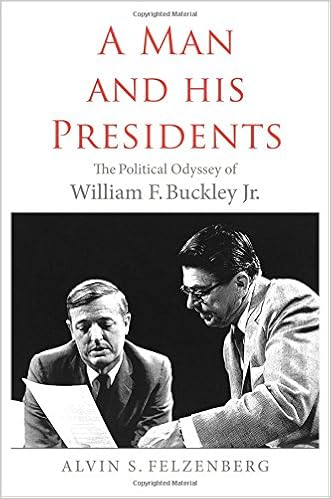
Comes now Alvin Felzenberg, with whom I am socially acquainted, with a marvelous biography of the man who perhaps more than any other public intellectual shaped the modern conservative movement and, thereby, modern politics: A Man and His Presidents: The Political Odyssey of William F. Buckley Jr.
This beautifully rendered book is making waves, drawing highest profile reviews. Deservedly so.
Coming from a different wing and a different generation of the conservative movement I met Bill Buckley in person exactly once. It was at a soirée, if memory serves, staged by Dr. Arthur Laffer in Washington, DC.
I was struck by how, in person, WFB was as suave as Roger Moore's James Bond. On TV, during his several decades as host of Firing Line, Buckley’s face presented a panoply of nonstop tics and odd mannerisms, almost a signature of his public persona. This anomaly is perhaps the only mystery that Felzenberg fails to probe.
For most of the youth who Occupy Conservatism today Buckley is a remote figure. He perhaps is mostly remembered as the most erudite of conservatives, from Firing Line and for the National Review, which he founded and for which he coined a suitably whimsical, borderline flamboyant, Mission Statement: “It stands athwart history, yelling Stop, at a time when no one is inclined to do so, or to have much patience with those who so urge it.”
Buckley went on, in a way that remains as true today as it was in 1955:
It is out of place because, in its maturity, literate America rejected conservatism in favor of radical social experimentation. … Radical conservatives in this country have an interesting time of it, for when they are not being suppressed or mutilated by the Liberals, they are being ignored or humiliated by a great many of those of the well-fed Right, whose ignorance and amorality have never been exaggerated for the same reason that one cannot exaggerate infinity.
Buckley, in ways large and small, whimsical and earnest, made an impact. He arguably played a material role in stopping history by providing a critical assist to the defeat of the USSR, thus earning a place in The Pantheon.
And although even Buckley could not prevent the subsidence of world culture and politics into “radical social experimentation,” something still very much besetting Western culture, perhaps he slowed it somewhat. And his legacy, foremost the National Review, remains one of the great ramparts of civilization.
Felzenberg lucidly tells the story of precisely how Buckley stood athwart history, yelling Stop. It’s a charming, consistently fascinating, story. Buckley's persona and life shaped and helps explain the circumstances of both the conservative movement (if something so still still can be called a movement) and our larger political culture today.
For me the highlight of the book is the recounting of Buckley’s 1965 Conservative Party mayoral candidacy against nominal Republican John Lindsay (who won) and machine Democrat Abe Beame (who succeeded Lindsay). Buckley's candidacy was, of course, a symbolic one. A reporter asked him what he would do if he won. Buckley answered: “Demand a recount.”
Still, this jeu d’esprit of a race did wonders for conservative morale after the setback of Barry Goldwater's presidential loss. Buckley, perhaps more than anyone, provided the "secret sauce" that powers movements: a narrative.
Buckley more than wove a narrative. He lived one. His life was an adventure. Felzenberg astutely calls it an odyssey. Be prepared to be immersed in an epic tale.
Felzenberg’s book has drawn handsome notice. It was featured on the cover of the New York Times Book Review and, almost simultaneously, reviewed by the Wall Street Journal wherein reviewer Lee Edwards recounts how President Reagan, at a public dinner, called Buckley "perhaps the most influential intellectual and journalist in our era." This is an important book about an important man.  And it has drawn due praise:
“A gracefully written and richly informative book.”—Damon Linker, New York Times 
“Deeply researched and smoothly written . . . a superb political biography… [a] fresh account of a much-chronicled figure.”—Lee Edwards, Wall Street Journal 
“A magisterial biography . . . . Felzenberg captures the toute ensemble, telling the story of modern America’s most vital conservative force in prose that is as enlivening as it is illuminating.  No one with an interest in the past six decades of American history will want to miss this wonderful and irreplaceable book.”—The New Criterion
There seems, however, something mischievous in the prominence given to it by the liberal New York Times. There, reviewer Damon Linker observes:
Reading the book in light of events since Buckley’s death — including the Sarah Palin sensation of 2008, the Anybody but Romney procession during the Republican primaries of 2012, but most of all Donald Trump’s shockingly successful populist insurrection in 2016 — one realizes the passages that provide the most illumination are those in which Felzenberg highlights what Buckley himself described as his greatest achievement: purging the conservative movement of “extremists, bigots, kooks, anti-Semites and racists.”
Nor is such use of this book as a bludgeon against what Buckley called "radical conservatives" -- among whom he properly counted himself --  limited to the left.
In Buckley’s own National Review -- itself a bastion of #NeverTrumpism -- prominent #NeverTrumper George Will (who resigned his membership in the Republican Party upon realization of the inevitability of Trump’s nomination) published a meditation on Felzenberg’s book under the headline Buckley Captained Conservatism Before It Was Hijacked:
“Today, conservatism is soiled by scowling primitives whose irritable gestures lack mental ingredients. America needs a reminder of conservatism before vulgarians hijacked it, and a hint of how it became susceptible to hijacking.” … “His true ideal,” Felzenberg writes, “was governance by a new conservative elite in which he played a prominent role.” And for which he would play the harpsichord.”
Using this book as a bludgeon against some of the more vivid Republican Party populist figures does not do the book, or such figures, justice. Felzenberg, especially in writing about Buckley’s 1965 mayoral race, makes it very clear that WFB appealed to many of the same kind of of blue collar voters who elected Trump. Felzenberg trenchantly quotes James Q. Wilson’s distinction between Democrats who championed the cause of workers, especially ethnic blue collars, and those who he called “amateurs,” the progressives who had, and have, hijacked my father’s (and, long ago, my very own) Democratic Party.

Buckley’s erudition, Ivy League pedigree, and personal wealth did not estrange working class voters. Workers sensed his respect for their values and dignity. They sensed the same in Trump, despite his foibles. This is no small thing.

There have long been tensions and rivalries, some more friendly than others, within the Vast Right Wing Conspiracy to which I belong. Damon Linker:
Those were the factions of the right that Buckley aimed to exclude from the conservative movement: proudly plutocratic libertarians; conspiracy theorists; angry, race-baiting populists; and paleocons dabbling in ethnic demonization.
Sound familiar?
Well, no. We paleocons do expect to be caricatured as very deplorable indeed. The picture drawn of us represents a rather grotesque caricature, relying on the amplification of tiny, immaterial, factions of a school of thought that is firmly rooted in classical liberal republican thought. Mischievous, sometimes malicious, journalists can always find, and exaggerate, an outlier. Few, virtually none, of us “dabble in ethnic demonization.” Those are opportunistic hangers-on.

But yes, By George!  Many of us outer borough bridge-and-tunnel Morlocks are vulgarians. Perhaps we, made irate that our jobs and economic security have been so eviscerated by the ruling elites, our values mocked, might at times justly be called “scowling primitives.” That said, the vast majority of us are not tools of plutocratic libertarians, nor conspiracy theorists, nor race-baiters, nor ethnic demonizers.  Few of us are “extremists, bigots, kooks, anti-Semites and racists” and those few unwelcome in our midst.

It’s sad that the Pretty People do not like us. But in a way that works to our political advantage. As the New York Times’s own Frank Bruni -- an honest and rigorous liberal -- wrote recently in Can Democrats Save Themselves:
They’re still not sure how much of Trump’s victory had to do with Hillary Clinton’s flaws versus the party’s poor grasp of America, and the more they focus on the former, tattling for the tell-all book “Shattered” and then tittering over its revelations, the less they own up to the latter. 
They’re still searching for a concise, coherent message. They’re still feuding: the Bernie Sanders/Elizabeth Warren wing versus the moderates. And they’re still indulging in elitist optics at odds with the lessons of 2016. Although new research commissioned by Priorities USA, a Democratic super PAC, concluded that many Obama-to-Trump voters believed that Democrats are out of touch with less affluent Americans, a recent, high-profile Democratic brainstorming session in Washington was held at the opulent Four Seasons Hotel.
 Somewhere in a dresser drawer I may still have my “Eat An Eloi” t-shirt. Time to take it out of mothballs.

Buckley considered Eisenhower a miserable president and had ticklish relations with nominally conservative Republican leaders throughout most of his career. The signal exception, of course, was the truly conservative Ronald Reagan, with whom Buckley was on close terms and served, somewhat, as a mentor. The Buckley political rule, as recorded by Barry Popik, was “I’d be for the most right, viable candidate who could win.”

It’s not quite Kristol Clear to this reader what William F. Buckley would have made of Donald J. Trump. He is not around to say. But in his day, Buckley served as a provocateur who aligned more with populists and with "radical conservatives" than with Establishment Republicans or "the well-fed Right, whose ignorance and amorality have never been exaggerated for the same reason that one cannot exaggerate infinity."

It is highly likely that Buckley, at very least, would have been in full sympathy with Kellyanne Conway's observation that “I thank God every day. I click my heels three times and say ‘[Hillary Clinton] is not the president, she is not the president, she is not the president.” Those who present WFB's life and work as an indictment of contemporary conservatism clearly have misread this book.

WFB, may he rest in peace, is no longer with us to tell us what he thinks in his invariably witty, erudite, way. That said, thanks be to Alvin Felzenberg for bringing to life the epic story -- the political odyssey -- of a radical conservative overflowing with wit and elan. Felzenberg distills the essence of Buckley's life and thought in ways thoroughly enjoyable and magnificently helpful for understanding the architecture of contemporary conservatism and national politics. It's an indispensable work.

Saturday, February 27, 2016

Buckley Deserves a Statue


WFB was a frequent visitor to Hillsdale, which does so much to preserve our patrimony.


By Thomas Novelly — February 27, 2016
http://www.nationalreview.com/


In 2004, William F. Buckley Jr. sent Hillsdale College thousands of the columns, speeches, and articles he had written over the years. The founder of National Review donated much of his life’s work to the college for an online database. Today, anyone can access his writings free of charge.

An injury prevented him from attending the unveiling ceremony, but he recorded his remarks for the gala dinner. “Thanks to Hillsdale College, it is all here, a lifetime’s work,” Buckley said. “Necessarily, you will find infelicities here, and maybe a deviation or two, but it is all an earnest attempt to contribute to the patrimony, preserved here thanks to Hillsdale.”

Now it’s time to preserve Buckley’s legacy in something more prominent than pixels. Hillsdale College — where am a student — should commission a statue in his honor.

We’re known at Hillsdale for our campus statues, on what the college calls the Liberty Walk. We have statues of George Washington and Thomas Jefferson. We have a statue of a Civil War soldier representing Hillsdale College students who fought in that conflict, and another of Abraham Lincoln. In May, when the class of 2016 graduates, we’ll put up a statue of Frederick Douglass.

We also have a statue of Ronald Reagan, the only statue of Margaret Thatcher in the Western Hemisphere, and a statue of Winston Churchill, holding a cigar in his right hand.

Buckley would be a fitting addition to this group, to commemorate his devotion to America, his dedication to young people, and his love for Hillsdale College.

Buckley understood the importance of higher education. In his first book, God and Man at Yale, he criticized his alma mater for neglecting its mission. “I believe that the duel between Christianity and atheism is the most important in the world,” he wrote. “I further believe that the struggle between individualism and collectivism is the same struggle reproduced on another level.”

That book launched his career, but he didn’t have to pick that fight or any of the others he would take on as he founded National Review, fought for the nomination of Barry Goldwater, ran for mayor of New York City, started Firing Line, and promoted Ronald Reagan. “Buckley could have been the playboy of the Western world,” historian Lee Edwards said in the new documentary The Best of Enemies, “but chose instead to be the Saint Paul of the conservative movement.”

President Reagan, the guest of honor at the magazine’s 30th anniversary party in 1985, told Buckley and his NR colleagues, “You gave the world something different, something in its weariness it desperately needed, the sound of laughter and the sight of the rich, green uplands of freedom.”

Novelly with the Ronald Reagan statue at Hillsdale College
A statue of Buckley would also salute his impact on young people. In 1960, Buckley invited a group of young activists to his family home in Sharon, Conn., to write down a set of principles. The Sharon Statement, as it was called, begins with words that can still inspire: “We, as young conservatives, believe that foremost among the transcendent values is the individual’s use of his God-given free will, whence derives his right to be free from the restrictions of arbitrary force.”

The Sharon Statement became the founding document of the Young Americans for Freedom. Today, it’s required reading at Hillsdale College. It’s in American Heritage: A Reader, a special compilation of primary documents assembled by our faculty and published for a core course on American history. This big anthology starts with the Mayflower Compact and ends with Reagan’s first inaugural address in 1981 and his speech to the British Parliament in 1982. In between, students encounter the Sharon Statement.

Buckley visited Hillsdale College many times. “Hillsdale is one of the truly exciting liberal-arts colleges in America,” Buckley said in a speech at the college in 1980. “It’s vibrant with a genuine enthusiasm for learning.” In 1996, the college gave him its Adam Smith Award for his dedication to conservative principles and his embodiment of Hillsdale’s values.

When Hillsdale sought a new president in 1999, Buckley formed a special committee to find the perfect fit. The next year, Buckley’s committee selected the college’s current president, Dr. Larry Arnn, one of the founders of the Claremont Institute. “Buckley was a friend of mine for at least two decades,” Arnn said. “He spoke at my inauguration.”

Hillsdale’s statues pay homage to great individuals and great visions. The addition of a statue of Buckley would honor his service to both modern conservatism and a school whose mission he personally embodied and publicly promoted.

When Buckley died, eight years ago today, President George W. Bush honored him. “Bill Buckley was one of the great founders of the modern conservative movement,” said Bush. “He brought conservative thought into the political mainstream, and helped lay the intellectual foundation for the conservative movement that continues to this day.”

The mission statement of National Review, which Buckley wrote, is well known: National Review, it proclaims, “stands athwart history yelling Stop.” A statue of Buckley on the grounds of a college he loved would send a message to the world — that Buckley’s ideas remain very much alive, forever standing athwart history.

— Thomas Novelly is a junior at Hillsdale College, where he serves as assistant city news editor of The Collegian, the campus newspaper. 

Thursday, October 29, 2015

Buckley and Vidal: Best of Enemies

October 29, 2015
William F. Buckley, Jr. and Gore Vidal

In the summer of 1968, ABC ranked so far behind NBC and CBS in the ratings that it was joked that the network came in fourth out of the three. It needed a gimmick to boost it out of the cellar. As the Democratic and Republican national conventions got underway, ABC hired two rapier-witted public intellectuals – William F. Buckley, Jr. and Gore Vidal – to debate each other on live television. Their explosive sparring propelled ABC News past the competition and transformed public discourse in the process.
Magnolia Pictures has captured this historic showdown in a very entertaining 89-minute documentary called Best of Enemies, which is now available for digital download and will be released on Blu-ray and DVD November 3rd. Featuring some fascinating footage of Buckley and Vidal and interviews with Andrew Sullivan, Christopher Hitchens, Dick Cavett, James Wolcott, and others, the movie is highly recommended.
Buckley, of course, was the preeminent conservative commentator, founder of National Review, host of Firing Line, and author of over fifty books including God and Man at Yale. The openly gay leftist polemicist Vidal was a celebrated novelist (Myra Breckenridge, Burr, Lincoln), playwright, essayist, and harsh critic of American foreign policy. Each of the two pugilistic pundits with their patrician accents and acid tongues saw the other as a threat to American values, and their seething enmity toward each other eventually boiled over shockingly in the course of the ABC debates.
“Buckley was the first modern conservative intellectual to see that ideological debates were cultural debates,” says his biographer Sam Tanenhaus. Vidal too acknowledged that “a cultural war has now joined the race war in the United States… This was the beginning of a war between an old order and what I hoped would be a new order.” In a way, the two men manifested the opposing cultural forces in 1960s American society, and the ABC debates shaped up as a way to determine in microcosm which way the country would turn.
Buckley came prepared to have fun debating the issues, but Vidal came prepared to demonize Buckley in the time-honored manner of leftists even today: as a heartless, greedy, racist, elitist bigot who despised the poor. Buckley was very familiar with this sort of attack, but Vidal knew how to get under his skin, and in the ABC debates he was relentless in creating for viewers a caricature of Buckley as a figure of moneyed white privilege (though Vidal certainly had no less privileged an upbringing himself). He lectured Buckley on the country’s income inequality, to which Buckley replied forcefully that “freedom breeds inequality.” Vidal, as if prescient about the Occupy Wall Street movement, warned his opponent that “you’re going to have a revolution if you don’t give people the things they want… They’re going to come and take it away from you.”
This prospect did unsettle Buckley some, because like all Americans in 1968, he saw cultural standards and traditions breaking down. He reviled what he called a mutinous element of society, and correctly predicted that the issue that would win the 1968 election was law and order.
That point could not have been made more starkly than at the Democratic convention in Chicago, where riot police and protesters clashed infamously. During the continuation of their ABC debates there, Vidal proclaimed the death knell of American empire, as evidenced by Vietnam and this unrest at home. “It’s like living under a Soviet regime here,” he said of the police brutality outside the convention theater. Buckley countered that “despicable” individual acts of police violence did not make a case for institutionalized fascism in America.
The argument escalated quickly into personal insults. Moderator Howard K. Smith tried to intervene and plead for civility, but it was too late. Vidal called his opponent a crypto-Nazi and Buckley lost it. “Now listen, you queer,” he shot back, “stop calling me a crypto-Nazi or I’ll sock you in the Goddamned face and you’ll stay plastered.” A noticeably distressed Smith declared the segment out of time for the evening, and grumbled that “more heat had been shed than light” in the evening’s confrontation. “The network nearly shat” over it, recalled Dick Cavett.
Buckley agonized for months about losing control, asking himself if he could have handled the moment better. He wrote a lengthy self-defense for Esquire, and Vidal responded in kind, suggesting in the course of his piece that Buckley was a latent homosexual. The result was three years of litigation between the two, at the end of which Buckley simply declared victory in a press conference just before the pair actually went to court.
Vidal was wounded by it as well. A confidante comments in the film that Vidal’s obsession with his antagonist ultimately bordered on “Norma Desmond territory” (referring to the insane Sunset Boulevard character), particularly as the novelist’s career lost steam and relevance.
Best of Enemies winds down on a surprisingly poignant note: two brilliant men consumed to the very end with claiming final victory over each other. But the documentary then strays from its charismatic protagonists and tacks on a conclusion about the lamentable current state of televised political commentary. We’re not listening to each other, the movie asserts; each side of the country’s political divide is trapped in its own noisy echo chamber rather than debating and sharing ideas in a common forum like the Buckley-Vidal debates. This is true to some extent but a facile and uninteresting point, and the clip of Comedy Central’s Jon Stewart pleading for more debate and less theater is laugh-out-loud hypocritical – Stewart, the man more responsible than any other for draining intellectual balance from television news and turning it into entertainment.
In any case, both Buckley and Vidal understood, as other intellectuals of the time did not, the value of using television to advance political ideas and philosophies, not to mention their own public personae. And yet both men complained about the medium’s inherent antipathy to intellectualism. Buckley said that there is a conflict of interest between “that which is highly viewable, and that which is highly illuminating.” Vidal wondered aloud whether viewers ever really “heard” the nuances of what was said and if all they did was focus instead on image and impression.
Nonetheless, for better or worse the debates virtually created the familiar TV news model of pundits challenging each other acrimoniously on the hot topics of the day in segments such as 60 Minutes’ “Point/Counterpoint” (Saturday Night Live parodied this trend in a well-known ‘70s skit in which Dan Aykroyd addresses his political opponent Jane Curtin as “Jane, you ignorant slut.”). But hotheaded though they may be, the Geraldo Riveras and Eric Bollings of today are no match for yesterday’s best of enemies, William F. Buckley and Gore Vidal.
Mark Tapson is the editor of TruthRevolt.com and a Shillman Journalism Fellow at the David Horowitz Freedom Center.

Thursday, August 27, 2015

Bill Buckley Gets Bigger Over Time

By Scott Porch
August 17, 2015
In the late ’60s, NBC and CBS were the most-watched TV networks and ABC was a distant third. (“It would have been fourth, but there were only three,” former NBC exec Richard Wald once joked.) For its coverage of the 1968 presidential election, ABC’s news operation lacked a high-wattage name like Walter Cronkite at CBS or David Brinkley at NBC. To liven up its convention coverage that fall, ABC seated conservative William F. Buckley beside liberal Gore Vidal and waited for sparks to fly.
And, wow, did sparks fly:
Vidal: “The only pro- or crypto-Nazi I can think of is yourself.
Buckley: “Now listen, you queer. Stop calling me a crypto-Nazi or I’ll sock you in the goddamn face, and you’ll stay plastered.”
That exchange, which would be considered over the line on Fox News or MSNBC today, was on live television. In 1968! “It’s the one time it happened, the one time he lost his cool,” says Sam Tanenhaus, the former editor of the New York Times Book Review who is writing a biography of Buckley. “He regretted it for a very long time.”
The Daily Beast recently caught up with Tanenhaus for a wide-ranging conversation about appearing as a talking head in Best of Enemies—the new documentary that looks at Buckley and Vidal's 10-day debate—as well as the status of his long-gestating Buckley biography, his years at the New York Times Book Review, and his thoughts on John Updike, Robert Caro, Garry Wills, and other major literary figures of the last half-century.
How’s the biography going?
I told the publisher, Random House, that I would get it to them in 2016, and that’s the plan. The reason I left the Times was so that I could finish it.
You left the Times last year, right?
I left in mid-December when they did the last round of attractive buyouts.
And you had already been writing for a while then, right?
Omigosh, yes. I signed the contract for this a long time ago. Sometimes people will ask when the manuscript is due, and I’ll say, “It’s due in June, but I’m not sure what decade.” [Laughs.]
Has Buckley’s significance changed over time?
Buckley gets bigger and bigger over time as his uniqueness becomes more apparent. People who remember him—even if they didn’t like him back in the day—who were piqued by him for one reason or another, now remember him nostalgically. It happens to all these great figures, especially conservatives. People hated Barry Goldwater until there was no Barry Goldwater left and they became Goldwater idolaters.
But you have another thing going on with Bill Buckley, which is that people of a certain [younger] age have no idea who he was; he means absolutely nothing to them. And that shows you how quickly time moves and how fast the past recedes. The fact that Bill Buckley is not remembered by almost everyone is kind of mind-boggling.
How do you tend to order Buckley’s roles in your head—TV personality, then political thinker, then author?
You take those three things and try to find the throughline. He is the intellectual architect of the modern conservative movement. He was not the greatest conservative thinker. He probably was its best sentence-by-sentence writer. He was a maestro on television. He more or less invented the contemporary debate show. Though if you watch episodes of Firing Line, they’re almost Monty Python parodies; everyone is so polite and genteel. There was a wonderful eccentricity that he had and that he brought out in his guests.
He was a columnist. He told me once that if you published all of his columns in book form, it would add up to something like 25 books. So author, television personality, columnist—sage and mentor. He mentored two important political figures—Goldwater and then Reagan.
And you knew him, didn’t you?
I interviewed him many times over the years. I lived in Tarrytown, New York, and I would drive over to Stamford, Connecticut. He divided his time between Stamford and Manhattan, but Stamford is where he liked to be. That’s where the boat was, and he had these beautiful views of the Long Island Sound. I would go to his house, and we would go to a restaurant nearby that he liked. I remember asking him at his house about his relationships with Goldwater and Reagan. He said, “They came to me.” And that was really important to him. Bill wasn’t a braggart by any means. He just wanted to be clear that he had not sought their approval or friendship or alliance.
He was the founding editor of an extraordinary magazine, National Review, and I’m writing on that now. It’s a really remarkable piece of history. He created it to educate political actors and promote political ideas at their most lucid and workable—not conservative theory but ideas— and to be a home for intellectuals who were on their own in the McCarthy era of the mid-’50s. He gave them a place to think and talk and engage in a truly viable, modern conservatism. It was important for him for National Review to be truly independent rather than Republican. We tend to think of them as identical now, but they were not in the mid-’50s.
Buckley had an accent that always sounded to me like Thurston Howell from Gilligan’s Island. Was that a blueblood accent? The Groton lockjaw?
It’s so funny. There were 10 Buckley children—so nine siblings and Buckley—and a few of them sounded exactly like him and the rest didn’t. He talked that way, his brother Reid, his sister Patricia, and his sister Jane spoke that way. They had all been educated at boarding school in England in their teens. What you don’t hear—did you grow up in the South?
I did. Near Nashville.
Do you hear any of the South in Bill?
Not really. Do you?
His mother was from New Orleans, and his father was from deep southern Texas. They were Southerners. I maintain—and you’ll probably say I’m totally wrong about this—that if you listen really closely to Bill, you’ll hear a kind of drawl. He was raised in Connecticut with a family of displaced Southerners. His father had planned for them to be in Mexico; he was an oil wildcatter who got driven out by the revolution and lost a fortune. Bill spoke Spanish before he spoke English. His voice was very animated. In person, his features and his voice had a lot of swoops up and down the scale. He was a Connecticut guy, which I’m discovering now as my wife and I have just moved to Connecticut. In Best of Enemies, he and Gore Vidal sound a lot alike.
Best of Enemies is about Buckley and Vidal at the 1968 conventions. Was that when most people learned who Buckley was?
No, he was already famous. He had run for mayor of New York in 1965, and it was a really fun and fascinating campaign. I wrote a piece for the New York Times Magazine about it in 2005, which was the 40th anniversary of that campaign. That campaign really put him on the map, and Firing Line came out of that. During the mayoral campaign, there was a newspaper strike. As they were approaching Election Day, there was basically a news blackout. The television stations had debates, and Bill was the star.
He was a great debater. Best of Enemies does not show him at his best as a debater, because he kind of got ambushed by Gore Vidal. Bill’s idea was to have an ideological argument, and he was really funny. He kind of made John Lindsay, who was a really charismatic guy, look like a stiff. Right after that in 1966 came Firing Line. Bill was on every Sunday, and he became the conservative that liberals loved to hate and were fascinated by. He was funny, he was smart, he had the giant vocabulary, and he was incredibly quick. He was getting more national attention than Reagan, who was running for governor of California at the same time.
What was it that Vidal called Buckley that got him so upset? Crypto-conservative?
Noooo, crypto-Nazi.
Right, crypto-Nazi. What did Vidal mean by that?
Crypto really means secret, like a crypt. In that exchange, Bill had made some comparison with student protesters and the Viet Cong, and Gore turns it around and says Buckley was a crypto-Nazi. The backdrop of this was the Chicago convention in 1968, which was a nightmare. It was a police riot—one of the lowest moments in modern American life. I’m old enough to remember it; I was 12 watching it with my father on TV. You saw protesters getting beaten and gassed. It was a very intense time, and that debate was about that particular moment.
And Buckley’s response where he says, “Now listen, you queer,” is the most unglued I’ve ever seen him.
It’s the one time it happened, the one time he lost his cool. He regretted it for a very long time, and I think I mention in Best of Enemies how Ted Koppel later interviewed Buckley, and Buckley was visibly stunned. He said to me right after, “I was sure they had destroyed that tape.” There had been a big lawsuit [over this article]. Bill had sued Esquire and Vidal, and it got very complicated. To Vidal, it seemed like more of a big joke. When they turned the camera off, Gore said, “We gave them a pretty good show tonight, didn’t we?”
When did you meet Buckley?
I had known him from the previous book I wrote, Whitaker Chambers: A Biography, about Whittaker Chambers. Buckley had helped me a lot on that book because Chambers, who had been involved in the Alger Hiss case, was kind of a hero and friend to him. So I met Bill around 1990.
There are two quotes that are frequently attributed to Buckley. One is the “standing athwart history yelling ‘stop.’” What was the context for that?
That’s really interesting. It’s in the publishers statement for the very first issue of National Review, which had the cover date of November 19, 1955. It was then a weekly journal; now it’s a fortnightly—which is a useful term that no one uses anymore—every other week.
Only at Wimbledon.
Exactly. It’s so useful, though. You say “bi-weekly” and “bi-monthly,” and nobody knows what you mean; you say “fortnightly,” and it’s very clear what it means. A lot of Bill’s vocabulary was very baroque like that; people thought he was very show-off-y. Buckley was a very precise writer and speaker. He said exactly what he meant, and that was very true of the statement about “standing athwart history.” That was the statement announcing the arrival of the National Review.
The context is that this is a time when conservatives like himself were not being much listened to. It was 1955, the aftermath of Joe McCarthy’s fall. Bill had written a book about Joe McCarthy and was quite close to him. McCarthy was the litmus test and lightning rod for that period’s intellectuals; you either hated McCarthy or you defended him. What that did was spotlight how marginalized Bill Buckley and his small cohort of conservatives felt at that time. They felt there was no place for them—that they were essentially shut out of the debate because they had defended McCarthy.
One of Bill’s great insights that had originated in his first book, God and Man at Yale, which he wrote in his mid-20s after he left college, was that the battles were cultural, that the liberals dominated the cultural debate. Conservatives still make that argument today. In the Obama years, conservatives probably have some grounds for saying it, but even in the years when conservatives dominated the cultural and social controversies, conservatives would say that the liberals controlled the media. That originated with Bill Buckley.
What about the other quote, the one about the Boston phone book?
He said, “I would rather be governed by the first 2,000 names in the Boston phonebook than by the faculty of Harvard,” which is a really brilliant thing to say. It’s really a statement about democracy and knowledge. Actually, I’ll tell you and nobody else knows this, he originally wrote, “I’d rather be governed by the first 2,000 names in the Garden City Long Island phone book,” but then he changed it because Harvard’s in Boston.
He also has a really famous quote from his campaign for mayor of New York. Someone asked him what he would do if he won, and he said he would demand a recount. That’s fantastic.
Do you have a sense of whether Buckley had a better time in the ’60s or the ’70s?
I think Bill was really at home in the ’60s. Many of his friends were liberals like Norman Mailer. Buckley’s closest friend on the left was probably John Galbraith, and he was great pals with Murray Kempton. Kempton and Buckley were both ’50s guys waiting for the ’60s to happen. The ’60s were more antic and anarchic, and that’s really where Bill Buckley was at his best.
The ’50s were boring for him. If you look at commentary and essays from people on the left like Irving Howe and Harold Rosenberg, they hated the consensus, can’t-we-all-get-along ’50s as much as Buckley did, and they often sound alike. Consensus was in its day a word for conformity. The ’60s unbuttoned all of that and unleashed all of these intellectual ids like Gore Vidal and Bill Buckley, who were born in the same year. Bill became a favorite on college campuses because he would say anything, which appealed to the ’60s sensibility.
What about in the ’70s?
The ’70s were also a good time for him. The ’70s don’t really become the ’70s until after Watergate, and that’s when Bill was really becoming a bestselling writer. His sailing books and his novels really took off in the ’70s, and the television program was successful. He was never a huge Nixon fan—Nixon was not really a conservative in Bill’s view—but Bill didn’t really care much about politics. He was more interested in his sailing and his friends and the socializing.
I spent many hours with Bill, and he only talked about politics when I asked him about it. He said, “I only do politics for money.” That’s Firing Line and the column and that sort of thing. The ’70s were a really prosperous time for him. He sailed across the Atlantic and wrote a book called Atlantic High. His spy novels were bestsellers. He had a good time in the ’70s.
You have a lot of material. Are you sure it will be a single volume?
If you sat in my office here, I have two file cabinets. I do it the old-fashioned way; I like paper. I have a table set up adjacent to my desk covered with folders. I have bins with thousands of pages in addition to the file cabinets and more behind me, you wouldn’t believe it. And there’s more to go. He did so much on so many fronts, that it’s hard to keep it all in one’s head. That said—no. I can’t do two volumes.
Robert Caro had an exchange with [his editor] Bob Gottlieb back in the day at Knopf when Caro was writing The Power Broker. The original manuscript for The Power Broker was enormous. He said to Bob Gottlieb, “What if we do two volumes?” And Gottlieb said, “I can sell one book about Robert Moses. I can’t sell two.” It’s up to me to find the best throughline. That’s my job as a biographer for a reader to get as much of the story and the multiple fronts that Bill operated on. If I can’t do it in one volume, then it’s just a great big flop. You know, the greatest of all modern biographers—everybody’s hero—is Richard Ellmann. He did James Joyce in one volume, he did Oscar Wilde in one volume, so it’s got to be doable.
What was your job like when you were the editor of the New York Times Book Review?
I was a manager in part, and then also a colleague. The Book Review has a handful of extremely skilled and seasoned preview editors. They’re the ones who look at the galleys when they come in. The sheer number of galleys is dismaying and alarming. I tell authors that they’d never want to set foot in the New York Times Book Review because you’ll see the galleys—the advance reading copies—in little dumpsters. That’s how they come in, and that’s how they go out.
How did you decide what books to review?
You can only review 1 or 2 percent of the books published each year, so we would do a triage to see which books are not going to be reviewed at all. We didn’t do self-published books, though that’s changing a tiny bit under Pamela Paul, my handpicked successor, if I may say so. We didn’t do reprints. We didn’t do reissues. We tended not to do university press books, which was kind of a shame, but there just wasn’t much space to cover more than a few. Many, many worthy books will not be reviewed.
My job was to meet with editors. The preview editors would have made the judgment on the books they thought we should send out for review, and then we would discuss who should review them. I would be involved in deciding what books would go out for review and helping decide who the reviewer should be. Often the preview editor would have someone in mind. I might have another suggestion, which was always collegial. The best part about the job was the collegiality. I also did the podcast, which was one of the early books podcasts.
Do you miss doing the podcast?
I do. It’s the thing I miss most. I really enjoyed interviewing authors and editors and the books reporter at the Times, whoever it happened to be—Motoko Rich, Julie Bosman, and now Alexandra Alter. We did it every week, and it was quite popular, and it still is. Pamela Paul does a great job. I was a guest on the podcast earlier this year for a review I did on Saul Bellow, who is a particular interest of mine.
You know, with a laptop and a $20 microphone, you could actually start another podcast.
[Laughs.] I don’t have the time! I have to get this book written, and I have been writing a lot more than I thought I would since leaving the Times. I’m doing something for The New Republic. I do a column for Bloomberg View. I have been writing some for a British publication that I really like called Prospect. I like translating literature and politics there for a non-American audience; you really have to think through things that you’d otherwise take for granted. I did a piece for Prospect on Obama, which was an against-the-grain piece saying he was a major president, which I think he is. I’m writing something now for Prospect on Pat Moynihan and have written on Philip Roth and John Updike.
You have a pretty broad interest in 20th century politics and literary history.
I was born in 1955, so I entered my twenties during the ’70s. That’s when my sensibilities were formed. When I was a kid I read Fitzgerald and Hemingway like everyone else. The term I think of it as is “mid-century”—from the ’30s through the ’70s with emphasis on the later decades. The ’50s were fascinating, and all those figures like Bill Buckley who were bored by them made that decade interesting as a starting point. I’m interested in the fiction and especially the criticism from the period—Lionel Trilling, Edmund Wilson.
And Garry Wills, who may be the greatest public intellectual of our time. I interviewed him for the book, and I wrote a profile of him. He was the most brilliant protege of Bill Buckley, who then became a defector. Bill used to say that National Review was a finishing school for apostates. Garry Wills wrote for National Review, Joan Didion wrote for them, John Leonard, John Gregory Dunne, Renata Adler, Arlene Croce—these really, really important figures all wrote for National Review at one time or another. I like the intersection of politics and literature. That’s why I’m interested in people like Chambers and Buckley. I’m interested in intellectuals who become people of action.
And you’re still writing on authors like Updike and Bellow.
For me, Updike and Bellow and Roth are giants now; they were writing when I was young. My copy of Updike’s Rabbit Redux is the copy I got when I was 15 or 16 through the Book of the Month Club. It’s the only book I ever had signed by an author in all of my years at the book review. We did a long video interview with him for the website. Those figures to me are very large and important. I think of them almost like family, and some of them are still working. Bob Caro is still working. Gay Talese is still working. I saw Garry Wills at the Aspen Ideas Festival a couple of weeks ago, brilliant as ever. Those figures are really important to me.