Showing posts with label Ronald Reagan. Show all posts

Saturday, May 25, 2019

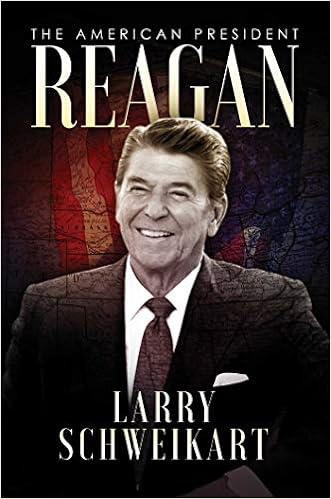
Book Review- 'Reagan: The American President' by Larry Schweikart


A Not-So-Distant Mirror
Remembering Reagan in the Age of Trump

May 24, 2019
Image result for reagan larry schweikart
If I can understand to any extent at all why millions of Americans today harbor an irrational hatred for Donald Trump, it’s because I, too, at one time, bought into the media’s systematic misrepresentations of a first-rate president. In my case, the president was Ronald Reagan, the subject of Larry Schweikart’s magnificent new biography, Reagan: The American President. Yes, I voted for Reagan in 1980, after having cast my first presidential ballot ever for Gerald Ford in 1976, but I wasn’t giving either of them a thumbs-up so much as I was expressing my abhorrence of Jimmy Carter, whose sanctimony, smugness, and self-satisfaction turned me off from the moment I first got a look at him and whose execrable performance, once he took office, made it urgent to get him out of there after one term and let him get started on his real life’s work – that of being, as Schweikart puts it, the nation’s “Moralist in Chief.”
But, no, I wasn’t a Reagan fan. Why? Simple. I was a naïve kid who read the New York Times front to back every morning, watched the network news religiously, and believed every word spat out by these oracles, having swallowed the Watergate-era myth that journalists were noble, truth-loving souls. I even made my own contribution to the anti-Reagan propaganda, writing an opinion piece for Newsweek in which I, a snot-nosed grad student, sneered at length about his supposed simplemindedness. It would take years before I grasped the extent to which I’d been brainwashed and, in my Newsweek diatribe, had only been regurgitating lies. 
Some of Reagan’s biographers, too, have echoed the mendacious line taken by the mainstream media during his political career. The worst of these, Edmund Morris, who was designated by Reagan as his official biographer and given unprecedented access, spent fourteen years on the project only to publish, in 1999, a bizarre volume that mixed fact, willy-nilly, with fiction. Morris excused this irresponsible approach – a total betrayal of their agreement – by saying that Reagan had turned out to be at once weird and boring and, even after all their time together, remained a total mystery to him, thus obliging him to make stuff up. My own impression was that Morris’s exposure to Reagan revealed to him a man who, at once good and great, defied everything that the cultural establishment said about him, and whom Morris, a Pulitzer Prize-winner, dared not write about honestly for fear of being accused by his confrères of hagiography.  
As fate would have it, two years after Morris’s worthless tome came Reagan: In His Own Hand, a compendious collection of radio talks written by Reagan during the period between his years in Sacramento and his years in Washington. These scripts, which covered almost every imaginable topic, displayed a thorough grasp of the issues and an impressive writing talent, and blasted to bits the image of him as a lazy dolt. Now, in Schweikart’s biography – the first to be based primarily on the Reagan archives – we finally have a solid life by a professional historian who, gratifyingly, rejects the decades of fraudulent spin and seeks earnestly to capture the real Reagan.
And what to say about the real Reagan, as portrayed in these pages? First of all, he was, as his strongest supporters always recognized, a decent man. His mother instilled in him “an abiding belief in the triumph of good over evil.” When, after college, he began a career as a radio announcer, he sent ten percent of his salary to his older brother, Neil, who was still a student. When Reagan screen tested in 1937 for Warner Brothers, the studio bosses weren’t sure about his acting, but they put him under contract anyway because they were so taken by his “wholesomeness.” When, a couple of months into his presidency, he was shot by John Hinckley, he found, on the way to the hospital, that he couldn’t bring himself to ask God for help “while at the same time I felt hatred for the mixed up young man who shot me,” and so he “prayed for Hinckley’s soul.”
The downside of this goodness was that Reagan, while no fool, was, like Anne Frank, ingenuous enough to believe that most people were essentially good. As Schweikart observes, his sunny view of humanity led to an “idealistic view that the US government was more or less pristine”; while he criticized faceless “bureaucracy” and “big government,” he was reluctant to confront the reality of “human corruption, lust for power, and petty jealousy,” not least in the inside-the-Beltway purlieus that we now, quite rightly, call “the Swamp.” As president, writes Schweikart, “Reagan all too frequently believed the liberals would in the end ‘play fair’ and let their humanity surface. One of the great ironies of Reagan’s presidency was that he had more success appealing to that human quality with the Soviets than he did with his Democrat opponents.” Brilliant point.
Reagan’s interest in politics took off during his Hollywood years, when he was president of the Screen Actors Guild and a member of something called the Hollywood Independent Citizens Committee of the Arts, Sciences, and Professions. Writing in Early Reagan (1986) about these groups, Anne Edwards bought into the left’s romantic myth about the blacklist, maintaining that Reagan was a traitor to his friends because he fought the attempt by CPUSA members – actual Kremlin tools, and bona fide traitors – to take over these organizations. Schweikart, by contrast, provides a frank account of Tinseltown politics at a time when New Deal liberals like Reagan and another gutsy anti-Communist, Olivia de Havilland, were denounced by fellow actors as “fascists” and “capitalist scum.”  
When Reagan’s film career waned, he found success in the new medium of television, serving as host of the anthology series General Electric Theater. As part of his deal (the biggest yet for a TV performer) he delivered talks at GE plants, where he revealed and honed a very particular set of skills that, it turned out, outshone his not inconsiderable acting talent – among them an ability to connect naturally with the common man and woman, to convey a genuine interest in their lives and concerns, and to communicate complex social and economic ideas largely by means of easily comprehensible anecdotes and jokes. Far from being a simpleton who, once in the White House, took direction from his cabinet, aides, and speechwriters, Reagan was, by his GE days, fully formed ideologically and very much his own man – one who’d concluded that appeasing the Soviet Union amounted to telling captive peoples to relinquish “hopes of freedom because we’ve decided to get along with your slave masters,” and who, having read the works of von Mises, Hazlitt, Hayek, and Bastiat, understood the vital importance of the free market.
Before long, national political figures got wind of Reagan’s rhetorical prowess. The result was “A Time for Choosing,” a speech he gave in support of Barry Goldwater’s 1964 presidential run. An instant classic, It marked the formal start of a political career during which Reagan, like Goldwater, would, because he preferred constitutional principles to social engineering, be repeatedly branded as a right-wing radical – often by people who were so lacking in a moral compass that they saw no ethical difference between the US and USSR. From the outset, moreover, Reagan’s opponents treated him as a genial boob. Thus Gerald Ford – a genuine mediocrity, party hack, and veteran D.C. drone who is best remembered, by me anyway, for denying in a debate that Poland was a Soviet satellite – at first responded to Reagan’s 1976 primary challenge by saying that he couldn’t take the ex-actor seriously. Sen. Jacob Javits (R-NY) called Reagan “extreme”; the now-forgotten Sen. Charles Percy (R-IL) predicted that a Reagan nomination would result in “crushing defeat.”
These are, of course, the same kinds of things said about Trump in 2016. But one difference is that the media, dishonest as they were, weren’t quite as bad then as they are now. It’s stunning to learn that after Reagan left Sacramento, Walter Cronkite offered him a twice-weekly five-minute slot on CBS to voice his views; later, under Carter, the same network gave Reagan free airtime to respond to a presidential speech on the Panama Canal, “something,” Schweikart rightly observes, ”that today would be unheard of.” As Schweikart sums it up: “Reagan in 1981 had a monumental edge that Donald Trump would not have in a similar situation thirty-five years later: while the media was overwhelmingly liberal and oppositional, it still played the game by the basic rules of journalism (or, at least, tried to appear to play by such rules).”
As this book counts down the years to Reagan’s presidency, it also gives us glimpses of the administrations he’s living through – of LBJ’s Great Society, which boosted welfare dependency and undermined the black family; of Nixon’s opening to the Kremlin, about which Brezhnev bragged in 1973: “We are achieving with détente what our predecessors have been unable to achieve using the mailed fist”; and of Ford, who, scared of offending Brehnev, refused to meet with Aleksandr Solzhenitsyn, leading Reagan (who generally eschewed even the mildest profanity) to refer to him as a “goddamned horse’s ass.” Then there’s Carter, who gets a whole chapter to himself – a delicious indictment of “the first president in American history to blame the American people themselves for whatever problems they faced.” Not only did Carter, in his inaugural address, congratulate Americans for shaking off their “inordinate fear of communism” (this, Schweikart points out, “at the very time the Soviet empire was expanding”); his Secretary of State, Cyrus Vance, actually bragged to Time that Carter and Brezhnev had “similar dreams and aspirations about the most fundamental issues.” In any event, it was the accumulated social and economic consequences of these predecessors’ policy blunders, capped off by Carter’s utter incompetence and passivity, that delivered the White House to Reagan – a beneficiary, as Schweikart puts it, of the same “populist boil against the ‘Establishment’” that would later lead Trump to victory.
The climax of this book, needless to say, is the account of Reagan’s two terms in office. Schweikart doesn’t ignore Iran Contra, the bombing of the Marines barracks in Beirut, or other dark chapters, but he recognizes that the heart of this story is the fact, that despite his illusions about human goodness, Reagan grasped the evil of Communism and the vital importance of individual liberty and free markets. Unlike such big-name economists as Lester Thurow and Paul Samuelson (the latter of whom pronounced in 1976 that “it is a vulgar mistake to think that most people in Eastern Europe are miserable”), Reagan – who, as president, spent weekends devouring mountains of raw intelligence on the Soviet economy – foresaw the Iron Curtain’s fall. And he know how to hasten that fall: George Shultz, his Secretary of State, would later testify that Reagan, in his dealings with Gorbachev, “combined a negotiator’s instinct and common sense with tough views and staying power”; Helmut Schmidt, the German chancellor, “found in 1981 that Reagan understood arms control perfectly, and better than any of his predecessors.” Yet even Schmidt considered Reagan’s hope of a Soviet collapse unrealistic, while reporter Lou Cannon, who would publish the condescending President Reagan: The Role of a Lifetime in 1991, maintained that Reagan was near-delusional to describe the USSR of the 1980s as brutal and in crisis. And pretty much everybody in Washington agree with Reagan adviser David Gergen that it was “outrageous” for Reagan, in a March 8, 1983, speech, to call the USSR an “Evil Empire” (a phrase he famously kept re-inserting into his text after his aides removed it).
But here’s the thing: Soviet officials would later admit he was right: they had been running an evil empire. Know-it-alls in the U.S. thought Reagan’s rhetoric threatened to “destabilize” U.S.-USSR relations (“stability” being, then and now, the Deep State’s top desideratum); but in fact that very rhetoric shook Soviet elites’ self-esteem to the core. Similarly, the U.S. media mocked Reagan’s Strategic Defense Initiative, which they nicknamed Star Wars – but it, too, unsettled the Soviets. So did the decisiveness with which he fired America’s striking air-traffic controllers in 1981 and responded to the 1983 Cuban invasion of Grenada. Schweikart quotes an internal Soviet document which acknowledged that Reagan had “restored Americas belief that it is capable of achieving a lot” and that he was “giving America what it has been yearning for. Optimism. Self-belief. Heroes.” How interesting that the Kremlin had his measure then – and feared and respected him accordingly – whereas many on the American left, even now, continue to dismiss him. For so effectively setting the record straight, and for giving Reagan the credit he deserves for setting aright the American Ship of State, Larry Schweikart deserves our immense gratitude.
[Order Larry Schweikart’s Reagan: The American President.]
Bruce Bawer is the author of “While Europe Slept,” “Surrender,” "The Victims' Revolution," and "The Alhambra." "Islam," a collection of his essays on Islam, has just been published.

Sunday, March 03, 2019

Trump Knows When to Fold ‘Em


By 
https://amgreatness.com/2019/03/01/trump-knows-when-to-fold-em/
March 1, 2019

Image result for trump vietnam
President Donald Trump speaks during a press conference after he failed to strike a deal with North Korean leader Kim Jong Un in Hanoi, Vietnam, on February 28, 2019.
 Evan Vucci/AP

In the course of a high-stakes negotiation, the player who walks away from the table is the one with the least to lose. Ronald Reagan did it to Mikhail Gorbachev at Reykjavik in 1986, and Donald Trump did it to Kim Jong-un this week in Vietnam. Good for the president.

A lot of people have brought up Reykjavik; I discussed the similarities on the Hugh Hewitt radio show with guest host Kurt Schlichter on Thursday. Reagan met Gorbachev in Iceland in the fall of 1986 and the two men were approaching an agreement that might have included the abolition of all nuclear weapons. But the Soviet premier wanted the Americans to drop the Strategic Defense Initiative, colloquially known as “Star Wars.” That was a bridge too far for Reagan, who abandoned the talks and went home.
Naturally, the hostile press was appalled—the abolition of all nukes! And this cowboy won’t give up a pet program that probably won’t work anyway! Warmonger! Reagan was widely viewed at the time as an “amiable dunce” who didn’t understand the first thing about the complexities of international diplomacy; why, the doddering old fool actually thought “We win, they lose” was a strategy.
As I wrote in my most recent book, The Fiery Angel:
Quick: would you rather read a think-tank white paper from around the time of the Reagan-Gorbachev Reykjavik summit in 1986, assuring the Boston-Washington corridor that the Soviet Union would remain the only other superpower indefinitely, and that its stability was vital to the balance of power, or watch “Rocky IV,” released in 1985? Which better predicted the events of November 1989?
Consider, for example, this review of Strobe Talbott’s 1984 book on arms control, “Deadly Gambits.” Talbott, then a writer for Time Magazine—he later left to join the Clinton administration as Deputy Secretary of State, and parlayed that into becoming president of the Brookings Institution—undertook in a widely unread book to contrast the arms-control policies of the Jimmy Carter and Ronald Reagan administrations, to the latter’s detriment, of course. This concluding passage from the contemporaneous New York Times review provides a flavor:
Mr. Talbott, who is diplomatic correspondent at Time, had previously written “Endgame: The Inside Story of SALT II.” What is striking about the two books is that ‘‘Endgame’’ was about how President Carter and his top aides—Zbigniew Brzezinski, Secretary of State Cyrus R. Vance, and Defense Secretary Harold Brown—were directly in charge of the arms control process. “Deadly Gambits” shows how President Reagan, Secretary of State George P. Shultz, Mr. Weinberger, and the three different national security advisers, had little to do with making arms control policy because they lacked the intellectual tools or interest in the subject.
He is particularly mocking of Mr. Reagan, who, Mr. Talbott writes, liked to give speeches on arms control, “but behind the scenes, where decisions were made and policy was set, he was to remain a detached, sometimes befuddled character.” Mr. Talbott says that even though Mr. Reagan presided at 16 meetings of the National Security Council on strategic arms talks, “there was ample evidence, during those meetings and on other occasions as well, that he frequently did not understand basic aspects of the nuclear weapons issue and of policies being promulgated in his name.” (Emphasis mine.)
A year later, the Russians were back at the bargaining table, this time in Washington, the result of which was the INF treaty, which regulated intermediate-range missiles (and which Trump recently scuttled, complaining that the Russians had long been violating the terms of the agreement). Two years after the signing, the Berlin Wall came down and the Soviet Union collapsed and disappeared in 1991.
We won, they lost. And the media fell utterly silent.
The point is that Reagan’s refusal to give up the SDI was instrumental in helping topple the USSR of late, unlamented memory. Because, for all the scoffing in the American media about it at the time, it plainly terrified the Russians, and had been doing so for several years. In February 1985, I heard East German party chief Erich Honecker denounce it vociferously in an outdoor speech before the re-opening of the Semper Opera House in Dresden, which had been destroyed by the Allied bombing raids 40 years earlier. Honecker did nothing without the Kremlin’s approval, so you knew it was on their minds.
Signs of the imminent Russian collapse were everywhere. In April 1986, I was in Leningrad when Chernobyl—Soviet technology at its finest—blew up; I didn’t find out about it until a few days after I had left the country because the Russians blacked out the news from their own people. But my first visit to Russia taught me a lot about countries in decline: everyone was a criminal. Russian women freelanced as prostitutes, while the men could be bribed easily (and stay bought), and everybody trafficked in contraband to make extra money on the side. The unofficial unit of exchange was not the worthless ruble, but a pack of Marlboro cigarettes.
When your women are selling themselves and your men are offering boosted tins of Beluga from the trunks of their cars, you know your country is in trouble.
Most of the media missed that, of course, preferring to stick to the eastern establishment narrative that the Soviet Union was the other superpower, with military parity with the United States and superior socialist domestic benefits—hey, they had free healthcare, right? And yet it was gone in the blink of an eye.
Reagan sensed it; Gorbachev knew it. The fragility of the system, brought on by the moral evil at its core, could be rouged and mascaraed but underneath the makeup still was a diseased trollop on her way to becoming the cheapest whore in town. When Reagan walked, the Russians panicked. And in that moment, the Cold War was won.
Trump’s job is actually easier: to bring a negotiated end to the Korean War, which has been in limbo since 1953, when hostilities ceased and an armistice was signed. Ever since, North and South Korea have faced off over a heavily armed border, and while the south has prospered and grown rich, the north is a Stalinist basket case ruled by a family of Communist thugs. It won’t last because it can’t last: Kim’s embarrassment at the hands of the American president will only make him more eager for another summit. At the same time, though, it weakens him in the eyes of his countrymen, thus making him even more vulnerable to a revolution when the times comes, which it will.
So Kim, a dead man walking now, gets back in his armored train while Trump flies back to freedom aboard Air Force One, knowing that it’s just a matter of time before the phone rings again. And this time, his terms for what in effect will be North Korea’s final surrender will be even tougher than the ones he offered now.

Thursday, January 10, 2019

MEDIA THROW EVERYTHING AT THE WALL TO SEE WHAT STICKS


By Ann Coulter
http://www.anncoulter.com/
January 9, 2019

Image result for trump border wall

Now that Trump has finally turned to the campaign promise that won him the election -- build a wall and deport illegals -- the Democrats, the media and even most Republicans are hysterical. 

Just remember: They were hysterical about Ronald Reagan, too. You don't change history by being a follower, particularly if the people you're following are unimaginative, go-with-the-flow company men. 

When President Reagan implemented the strategy that won the Cold War, he was opposed by the entire media, as well as foreign policy "experts" in both parties. 

The New York Times and Washington Post produced nonstop denunciations of his "dangerous" policies. There were propaganda movies like "The Day After," terrifying Americans about a Soviet strike on our country. Witless college students demanded cyanide pills be stocked in campus health care clinics, on the grounds that Reagan was going to get us all nuked. 

Only after Reagan's policies succeeded did these same hysterics say, Ho hum, no big deal. We always knew the Soviet Union was a paper tiger. 

Frantically rewriting history, they claimed Reagan had merely continued the policies of his predecessors. The truth about their eight-year primal scream is helpfully assembled in my smash best-seller, Treason: Liberal Treachery from the Cold War to the War on Terrorism. 

The Democrats, the media and most of the Republican Party are as fanatically opposed to Trump's ideas about illegal immigration as they were to Reagan's ideas about winning the Cold War.

Like Reagan, Trump has only the people on his side. Unlike Reagan, he doesn't seem as confident that he is right. 

So the people need to be louder. 

All we're getting from the media on immigration is an avalanche of lies, neurotically repeated by people citing one another: 

Polls show Americans don't want a wall!

We're a nation of immigrants!

Immigrants commit less crime than the native born!

Studies show: Black Americans are NOT hurt by illegal immigration.
 

Every one of these claims is a lie, as demonstrated in my book Adios, America. (Also a smash best-seller.) 

People assume a minimal standard of decency in others and think to themselves, Well, Joe Scarborough wouldn't say that if it weren't true. 

What viewers don't understand is how lazy media personalities are. They are merely quoting what someone told them. They don't know. Their expertise consists of memorizing a set of talking points, like ABBA memorizing the syllables to English words without knowing what they meant. 

If journalists allowed follow-up questions and you could ask, "How do you know that?" The answer would be, "I heard it from a guy at Vox." 

The media go to extremely biased sources; they know nothing, so they're not in a position to challenge them; and even if they were, they wouldn't, because they're on the same team. 

After a New York Times reporter tracked me down for a quote about the wall, I gave him the following, but he chose not to run it. Why should the Newspaper of Record present the opposition's side honestly? 

There are a million reasons we want a wall, but here are five:

1) The Simpson-Mazzoli Act -- passed almost 30 years ago to the day Trump was elected president -- came with elaborate promises that it would put an end to illegal immigration. In fact, 30 to 40 million more illegals have poured into our country since then.

2) Notwithstanding the vast number of illegal alien valedictorians, there are also criminals, drunk drivers, drug cartel members and desperately poor people consuming government services meant for the least among us and driving down the wages of our working class.

3) We need a better method.

4) Walls work. See Israel.

5) If we don't get it done now, we never will. Trump is our last chance.
 

But instead of explaining to the Times' readers why Trump's promise to build a wall shook the political world to its foundation, the newspaper trotted out campaign adviser Sam Nunberg's boast that he invented "build the wall" because Trump's mind tends to wander. It was only a dumb talking point, you see, not a serious campaign pledge. 

This is like claiming you were the guy who invented carrying an umbrella when it rains. I'm sorry, Sam, but you're not getting royalties for that. 

Building a wall is kind of an obvious idea for protecting a border. Not only have walls been used from time immemorial to defend borders, but those precise three words have been used to describe what should happen at our specific border thousands of times before Trump used them, according to a quick Nexis search. 

The current DNC talking point against a wall is that it is a "medieval solution to a 21st-century problem!" Turn on MSNBC or CNN right now, and you'll hear someone saying it. 

So are wheels. Are Democrats taking tires off their cars? 

A roof is a medieval solution. How about Nancy Pelosi replace the one over her house with "new technology" -- like a drone! Drones won't keep anything out, but at least she can see what's coming in seconds before it drops on her head. 

Medievalism: 1; Pelosi: 0. 

Thursday, October 18, 2018

A balanced introduction to Ronald Reagan the man


By Aram Bakshian Jr.
October 16, 2018
Image result for reagan spitz
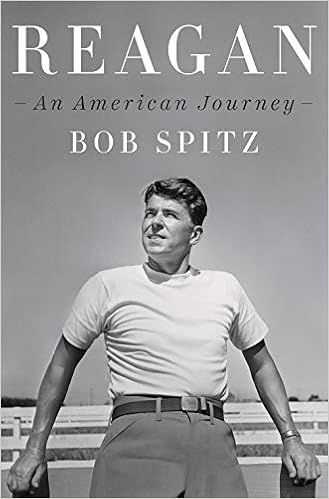
REAGAN: AN AMERICAN JOURNEY
By Bob Spitz
Penguin Press, $35, 863 pages
Question: What does Ronald Reagan have in common with Julia Child and the Beatles?
Answer: They’ve all been the subject of mammoth celebrity biographies by author Bob Spitz.
Which was why I approached reviewing Mr. Spitz’s “Reagan: An American Journey” with a somewhat jaundiced eye, expecting an overweight, cut and paste job that would read like a supermarket tabloid article on steroids.
I was wrong. Although over-long and often superficial in dealing with historical context, this is a book that probably comes as close to capturing the essence of Ronald Reagan the man — as opposed to Ronald Reagan the politician, actor, union leader or statesman — as any ever will. The result is worth reading, although patience and persistence are required to get through all 863 pages of a work that combines deep insights and shallow trivia in roughly equal measure.
Bob Spitz belongs to what I call the vacuum cleaner school of biography. He sweeps up everything he can lay his hands on in the hope that, when you sift through the contents of his vacuum bag you’ll be able to piece together the truth about his subject. He also takes a calm, almost apolitical view of Ronald Reagan the man, something which both ardent Reagan fans and fanatic Reagan haters have trouble doing because of their tendency to view our 40th president as a primarily political animal on whom they project their own partisan enthusiasms and pet peeves.
In doing so friend and foe alike sell Ronald Reagan short. He was much more than a politician. Indeed, his political career, begun relatively late in life, was the by-product of a personal odyssey that began in small-town middle America, was defined by a love of sports and drama dating from his college days, and propelled him to a respectable Hollywood career as both a second-tier movie star and a courageous union leader long before he gave a thought to running for any public office.
Like several other major presidents — George Washington and Dwight Eisenhower to name only two — Reagan was an accomplished, fully mature man of character who entered the political arena already tested and tempered by life. This is in stark contrast to the more common variety of compulsive politicians who start running for office at the student council level and spend the rest of their lives pursuing votes and applause as they struggle to climb the greasy pole. Many reach the top without really knowing who they are or what they stand for.
As Ronald Reagan’s director of presidential speechwriting during much of his first term, I had direct access to this truly remarkable man. What struck me most about him — aside from the fact that he was an incredibly likable, considerate man, full of confidence but devoid of vanity — was how genuine and consistent he was a human being. While he never stopped learning from his experience in the top job, he came to it as a true grown-up, a fully formed and formidable human being comfortable in his own skin rather than an applause craving narcissist with few if any inner convictions and no moral compass. Ronald Reagan was a man of strong convictions but moderate, self-controlled temperament, which more and more Americans came to appreciate as they got to know him.
While Bob Spitz sometimes drowns his readers with tedious details and is often politically tone deaf, he has captured the essence of Ronald Reagan the man. “One unassailable entry in the credit column,” he writes, “was Ronald Reagan’s heart. It was big and expansive. He never stopped believing in ‘the American miracle’ and the good people responsible for its achievements. He clung to the image of a nation populated by citizens ‘grounded in thoughtfulness and knowledge’ and governed by ordinary American ‘values and common sense’ In his final address to the nation … he looked into the camera like a benevolent father and reflected on his romantic view of America — the ‘shining city upon a hill’ — a place with ‘all kinds of people living in harmony and peace … ‘”
The meticulous, multi-volume Reagan biographical project of Craig Shirley remains the best source for understanding Ronald Reagan as a major historical figure. Lou Cannon’s first-hand accounts of the evolution of Reagan the candidate-politician are still second to none. But Bob Spitz has written clearly, convincingly and movingly about Ronald Reagan the man, a man who left the world a freer, better place than he found it, and who earned the respect of the people he served because he respected and appealed to what was best in them.
• Aram Bakshian Jr., a former aide to Presidents Nixon, Ford and Reagan, has written widely on politics, history, gastronomy and the arts.

Wednesday, October 10, 2018

How a longtime Democrat became Ronald Reagan’s biographer: Join a discussion with the author at the Oct. 11 Register Book Club


By 
https://www.ocregister.com/2018/10/03/how-a-longtime-democrat-became-ronald-reagans-biographer/
October 3, 2018

Image result for reagan spitz

As author Bob Spitz wrapped up his biography on Julia Child, he started to ponder who he might choose for his next biography. He was looking for someone with the cultural heft and impact of the chef and TV personality – or of the Beatles and Bob Dylan, subjects of previous books.
“I realized there was a thread all the way through them and that was that the subjects were beloved and that they had changed the culture,” says Spitz, who will talk about his new book, “Reagan,” at a public event held by the Register Book Club on Thursday, Oct. 11.
So he pored over lists of estimable artists, such as recipients of the Kennedy Center Honors of the National Endowment of the Arts, but nothing sparked his interest.
“Then my wife said, ‘What about Ronald Reagan?’ and I said, ‘Absolutely not,’” Spitz says. “I’m a longtime Democrat. I don’t think I’ve ever voted for a Republican. I’m just not wired that way.
“And yet I realized the Beatles changed the way we listened to music,” he says. “Julia Child changed the way we lived. Ronald Reagan certainly changed the way Americans thought about their government.
“Reagan was a guy whose life framed the entire 20th century,” Spitz says. “When I thought about it, this was a man who lived a remarkable life. As someone who perhaps didn’t appreciate him beforehand, I felt that I could really learn something that would show me why he meant so much to so many people.”
So he began the work that would find him spending three years doing research, another two-and-a-half writing the book, and all of the time with an eye toward making his biography new and different and necessary for readers to pick up despite the many other books on the 40th president of the United States of America.
“There are two different ways I can answer that,” Spitz of how a biographer approaches an already familiar subject. “No. 1, I feel that a biography – in addition to being detailed – has to have a compelling narrative. And while I loved Lou Cannon’s books they’re basically policy wonk books, and ‘Dutch’ failed in a lot of different ways. Even though [‘Dutch’ author] Edmund Morris is a terrific biographer I don’t think he ever got a handle on Reagan.”
Spitz says he’d already been over this hurdle with his 2005 book “The Beatles: The Biography.” There were more than 800 books on the Beatles when he started that project, but once you weeded out the hagiographies, the fanboy books, the very narrowly focused slices of their career, there really weren’t that many single-volume biographies of the entire arc of the Beatles story.
His two models for Reagan were David McCullough’s “Truman” and Steven Naifeh and Gregory White Smith’s “Jackson Pollock: An American Saga,” both of them big books that sought to spin a comprehensive narrative “with an eye for the audience, so that the audience gets swept up,” Spitz says.
The other thing that helped make his “Reagan” different than those that came before was the passing of time, he says.
“I discovered that when people age into their ’60s and ’70s they’re more willing to talk about their lives and the people they represented,” Spitz says. “They want to get their stories down. So many people haven’t talked before but they had an eye on their biological clock and said, ‘Well, this guy came along at the right time.’
“And also, Reagan had died, so they could talk more freely,” he says.
Nancy Reagan, before her death, gave Spitz unprecedented access to Reagan’s private papers, something he says she’d never granted another writer. Members of his administration such as Robert McFarlane and John Poindexter spoke freely about the Iran-Contra scandal while lesser-known but significant figures, such as the doctors and nurses in the emergency room where Reagan was taken after an assassination attempt, talked in great detail about how much more serious that moment was than Americans were led to believe.
Spitz says one of his happiest days came on a trip to France when he called actress Olivia de Havilland, with whom he’d been corresponding in hopes of an interview, and the now-102-year-old Hollywood star agreed to let him stop by her Parisian apartment for champagne and canapes and to talk about her friendship with Reagan during his time making movies.
“I felt this was such a valuable piece of information to add to the Reagan canon,” he says. “Not only to understand how his career was slipping away at this time, but also how the goings-on at the time of the Hollywood blacklist and the Screen Actors Guild (of which Reagan was president) shifted him away from being a Democrat to being a conservative Republican.”
Spitz says that regardless of one’s feelings about Reagan, whether you voted for him or not, or endorsed or fought the policies he advocated during his eight years in the White House, the story of his life is one that anyone can appreciate.
“He led an incredible life that took him through five different careers,” he says, ticking off Reagan’s success as a popular radio star in the Midwest, as an actor and Screen Actors Guild president in Hollywood, as a national corporate spokesman for the powerful General Electric, as California governor, and finally, president.
“Reagan shaped the 1980s, and if you want to learn how that era affected all of us you can get it through his story,” Spitz says. “I say read this as kind of an adventure story and learn a little about this man who appealed to so many people.”

The Register Book Club hosts Bob Spitz

What: The author of the new biography “Reagan” in conversation with Register pop culture reporter Peter Larsen
When: 7 p.m. to 9 p.m. Thursday, Oct. 11
Where: Anaheim White House, 887 S Anaheim Blvd., Anaheim
How much: $10 donation that will go to Caterina’s Club, which provides food, housing and job training for youth.
Also: Valet parking at the Anaheim White House restaurant is $6. Copies of Spitz’ book will be available for purchase and the signing at the event.
For tickets: Go to eventbrite.com and search for ‘Register Book Club’

Friday, May 18, 2018

Richard Pipes, authority on Russia and Soviet Union, and a Reagan-era hardliner, dies at 94


By  and 
https://www.bostonglobe.com/metro/obituaries/2018/05/17/richard-pipes-authority-russia-and-soviet-union-and-reagan-era-hardliner-dies/lSovElkZUSJ5RYLvET4dRI/story.html
May 18, 2018

Cambridge, MA - 5/1/1991: Richard Pipes, the Baird professor of history at Harvard University, poses for a photo inside his study at the Widener Library on campus in Cambridge, Mass., May 1991. (Bill Greene/Globe Staff) --- BGPA Reference: 170516_ON_027
Richard Pipes, 1991 (Bill Greene/Boston Globe)

Richard Pipes, the Frank B. Baird Jr. research professor emeritus of history at Harvard University and one of the West’s foremost authorities on Russia and the Soviet Union, died Thursday in Belmont. He was 94.

Dr. Pipes was a participant in history as well as its student. He headed an outside group, which became known as Team B, brought in by the Central Intelligence Agency in 1976 to analyze Soviet strategic objectives. Its hard-line findings helped lay the foundation for Washington’s eventual abandonment of the policy of cooperation with the Soviets, known as detente, and the massive arms buildup of the Reagan years.

From 1981 to 1983, Dr. Pipes served as director of East European and Soviet Affairs for the National Security Council.

“I never made history, but I certainly played a part in historical events,” he said in a 1999 Globe interview. “It was a great experience, and I think I contributed something to destroying the Soviet regime.”

Dr. Pipes’s “The Russian Revolution” (1990) and “Russia Under the Bolshevik Regime” (1994) are widely considered the most comprehensive studies of the origins and early years of the communist assumption of power in 1917. A one-volume condensation, “A Concise History of the Russian Revolution,” was published in 1995. All three books have been widely translated.
The books on the revolution concluded a larger study that had begun with “Russia Under the Old Regime” (1974), which had emphasized the continuities between Russian and Soviet history. In all, Dr. Pipes was the author or editor of more than two dozen books, including a two-volume biography of the Russian reformer Peter Struve (1970 and 1980), “Survival Is Not Enough” (1984), “The Unknown Lenin” (1996), “Property and Freedom” (1999), and “Communism: A Brief History” (2001).
“Richard Pipes was one of the most prominent, versatile, prolific, and influential historians of Russia in the English-speaking world,” said Jonathan Daly, a professor of history at the University of Illinois Chicago. Daly is at work on an intellectual biography of Dr. Pipes.
Dr. Pipes liked to describe himself as a “conservative anarchist.” He explained why in that 1999 interview: “a conservative because I have great respect for tradition . . . an anarchist because I don’t like anyone telling me what to think.”
Scorning “revisionist” studies of the Soviet Union, with their comparatively benign interpretations of Soviet actions and aims, Dr. Pipes held a critical view of the communist regime. Indeed, the dedication of “The Russian Revolution” reads “To the victims.”
Dr. Pipes’s feelings were reciprocated. Quotations from him were banned in the Soviet press, where he was exclusively referred to as an “imperialist adept” or “antisovietchik.” When the Kremlin published a book called “Richard Pipes: Falsifier of History,” he kept a stack of copies in his office, which he would show off to visitors.
The collapse of the Soviet Union was something Dr. Pipes took great satisfaction in. “In September of ’91 I stood inside the building where the Central Committee had had its offices,” he once recalled. “A Russian standing next to me said, ‘Did you ever think this would happen?’ That was a thrilling moment.”
Dr. Pipes’s knowledge of Russia’s past made him prescient about its future.
“I was very hopeful in ’91, ’92, that they would take a more democratic course,” he said in 1999. “I don’t think there’s the slightest chance communism will come back . . . but it’s entirely possible that they’ll go to some kind of authoritarian regime — and that would be consistent with their traditions.”
Vladimir Putin was first elected in 2000.
Richard Edgar Pipes was born in Cieszyn, Poland, on July 11, 1923, the son of Mark Pipes and Sophia (Haskelberg) Pipes. Growing up in Warsaw, he was first taught German, then Polish. His initial interests were musical and artistic. As an adult, Dr. Pipes collected art, favoring prints by the renowned Japanese artist Hiroshige. One of his books was “Russia’s Itinerant Painters” (2011).
“By a combination of daring and good fortune,” as Dr. Pipes once put it, he and his parents escaped Warsaw a month after it fell to the Nazis. Guards at the Austrian-Italian border questioned the authenticity of the Pipes’s forged passports. After a long delay, the family was told they could proceed, on one condition: that they not return to German soil. “We said ‘OK,’ ” Dr. Pipes recalled in 1999, with a long, heartfelt laugh.
From Italy, Dr. Pipes and his parents went to Portugal, reaching the United States in the summer of 1940. “It was so stable,” he said in that Globe interview. “I remember reading an advertisement in Life magazine for some insurance company: ‘Unforeseen events should not affect the course of a man’s life.’ I remember thinking, ‘These people are living in the 19th century!’”
He attended Muskingum College in Ohio and Cornell University. After serving in the Army Air Force, he entered Harvard in 1946. He got his doctorate there in 1950, became a full professor in 1958, and retired in 1996. From 1968-1973, he was director of the university’s Russian Research Center.
Of the time Dr. Pipes spent in the nation’s capital, he said in 1999 that he didn’t “want to be controversial. I don’t want just to be attacked, but it happens that I very often am. I tremendously value my intellectual independence and being able to say what I want, which made life very difficult for me when I was in Washington.”
As a mentor, Dr. Pipes “gave his students great latitude, though he often suggested to them what he considered promising research topics,” said Daly, who was among his graduate students at Harvard.
“His analytical brilliance, broad learning, extraordinary productivity, and dedication to clear scholarly writing served as a model to all of us.”
Daly added that “there were tensions with some of his graduate students in the late 1960s and beyond, given Pipes’s anti-Soviet and anti-communist convictions. Yet even those of his PhD students who fell out with him over his politics universally acknowledged the great benefits they reaped from the scholarly journal ‘Kritika,’ which Dr. Pipes launched in 1964.”
A 2007 recipient of the National Humanities Medal, Dr. Pipes leaves his wife, Irene Eugenia (Roth) Pipes; two sons, Daniel of Philadelphia and Steven of New York; and four grandchildren.
A graveside service will be held Friday in Beth Israel Memorial Park, in Waltham.
In 2003, Dr. Pipes published an autobiography, “Vixi: Memoirs of a Non-Belonger.”
“There are various reasons for writing an autobiography, but for me the most important is to get to know oneself,” he wrote.
“For if one has lived to a ripe old age, as I have, one’s life is a long story whose earlier chapters are clouded in darkness,” he added. “Are we the same over these decades? Can we still understand what we have once said and done, and why? To write an autobiography is akin to doing an archeological dig, with the difference being that the digger is also the site.”
Mark Feeney can be reached at mfeeney@globe.com. Bryan Marquard can be reached atbryan.marquard@globe.com.